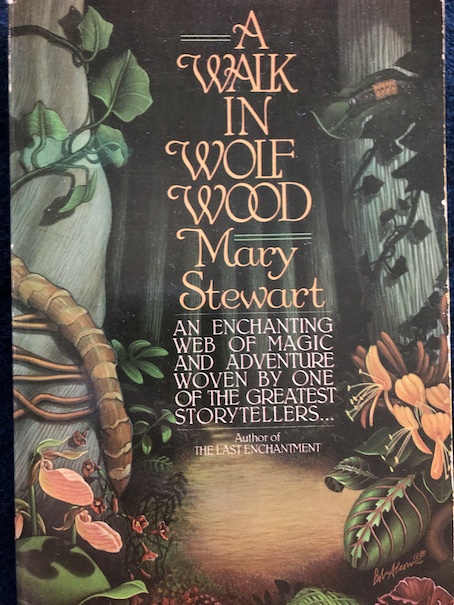
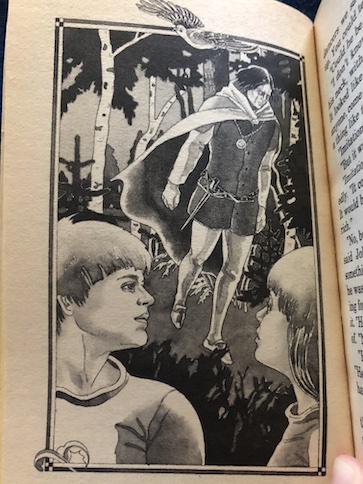
John and Margaret Begbie are traveling with their parents through Germany, and the family stops to have a picnic in the Black Forest. From their picnic spot, they can see the old castle on the hill that they visited earlier that day. The children’s parents doze off after lunch, but the children stay awake and see a strange man. The man walks by their picnic spot wearing an old velvet costume and a dagger in his belt, and the children see that he’s crying. The kids worry about the man because he seems so deeply distressed. They decide to leave a note for their parents and follow the man to be sure that he’s alright.
As they go after the man, they spot what looks like the tracks of a large dog, but the man didn’t have a dog with him. The kids realize that these are actually wolf tracks, and John remembers that their father told them that this area is called Wolfenwald, which means Wolf Wood. Then, they find the man’s gold medallion lying on the ground. Going a little further, they find an old cottage. The cottage looks abandoned, but they decide to explore around it anyway, just in case the man went inside. No one answers their knocks on the door, but they see the man’s clothes on the bed inside the house. They decide to leave the medallion with the man’s clothes and go back to their parents, but they suddenly notice that it has become night, and when they try to leave the cottage, they are confronted by a large wolf!
John frightens the wolf away by flinging the medallion at it. When the wolf is gone, the children decide that they have no choice but to risk going through the woods in the dark to find their parents. However, when they arrive at the picnic spot again, their parents aren’t there. The children find the note they left and a bar of chocolate. They eat the chocolate and lie down to wait for their parents to return for them, but the next thing they know, they are woken by the sound of a horn and the horses of a group of hunters. The hunters are pursuing the wolf. When they wave down one of the horsemen, he offers them a coin to tell him where the wolf is. Margaret points the man in the wrong direction to get the hunters off the trail of the wolf. The children aren’t really sure whether it’s a real wolf or just a dog that resembles one, but Margaret has the sense that the wolf needs their help.
The children also need help. They notice that the horsemen are dressed strangely, like people out of the past, and the coin that the man gave them is stamped with the year 1342 although it looks new. Even more strangely, the children suddenly realize that they understood what the man said even though neither of them can speak German. Is this is a dream, or have they gone back in time?
Not knowing what else to do, they decide to return to the cottage and see if the man who owns the medallion is there and can explain things. The man does have an explanation. He explains that he was the wolf. The man, whose name is Mardian, is a werewolf, and Margaret saved his life when she diverted the hunters. Mardian says that he and his family served the dukes who have ruled this land, and he and the current duke grew up together and were best friends for years. However, after suffering a terrible injury at the hands of an enemy and losing his wife, Duke Otho became a changed man, angry and bitter. In a fit of temper, he even accused Mardian of plotting against him. A real enemy in Otho’s circle, an enchanter called Almeric, used Otho’s suspicions to try to eliminate Mardian. When his plots to kill Mardian failed, Almeric used sorcery to turn him into a werewolf. Now, Alermic has promised a reward to the hunter who kills the wolf, and in the meantime, he has disguised himself as Mardian and taken his place in the duke’s castle. So far, the duke hasn’t even noticed that Mardian has been replaced by an imposter. Mardian believes that Alermic will use his position to kill both the duke and his young son so he can take the dukedom for himself. Can the children help Mardian expose the imposter and break the spell?
The book is available to borrow and read for free online through Internet Archive (multiple copies).
My Reaction
In order to reach the duke and get his help to expose the imposter, the children must disguise themselves as other children from this time period and join in the life of the duke’s castle. Mardian gives them a plausible cover story, in case anyone asks them who they are. They carry off the charade very well, and there are so many people and children in the castle that two more aren’t questioned. John is even mistaken for another boy, called Lionel. John doesn’t know who or where the real Lionel is, although he theorizes that the real Lionel might have died young because many children of this time period did. While real-life castles were full of many different types of people of all ages, I do find it a little difficult to believe that so few people are surprised by children who suddenly appear without any introduction. There does seem to be the implication that people do come and go from this castle, making it difficult to keep track of everyone.
Margaret and John also experience the different expectations people of this time have for girls and boys. John is immediately put to work as a servant, waiting on the noblemen of the duke’s court as a page along with the sons of the nobles. He also has to dodge the rough games that the other boys play that are meant to prepare them for war. On the other hand, Margaret is taken to the nurseries with the other young girls of the castle and lectured about how she should be quiet and modest. The girls are much more closely supervised than the boys, although she finds a way of slipping away from the others to meet with John.
I liked some of the descriptions of the Medieval food in the book. At one point, Margaret thinks she’s eating turkey (a bird native to the Americas and not found in Europe during this time period), but John tells her that it’s actually swan and peacock, birds which were eaten around this time. There are a few instances where alcohol is mentioned because people during this time period drink wine and small beer. The duke also insists that a boy bring him his favorite posset, a drink I discussed in my earlier review of the The Box of Delights.
This is the final book in The Dark is Rising Sequence, and it focuses on the epic battle between the forces of good (the Light) and the forces of evil (the Dark). Like the other books in this series, it uses and references folklore and Arthurian legends. At the end of the previous book, the characters used a magical harp to wake “the Sleepers” in Wales. The man that the children know as Merriman Lyon is actually Merlin from the Arthurian legends, and Will Stanton has discovered that King Arthur had a son named Bran who was brought into the 20th century by Guinevere and Merlin to protect him from his parents’ troubles in their own time.
Twelve-year-old Will Stanton is spending some time with his brothers at Midsummer because his oldest brother, Steven, has come home for a visit from his service in the navy. While the boys are out fishing, Will begins having visions of the distant past. He sees people who seem to be fleeing from something, and these people are talking about the terrible things that their pursuers would do to them if they caught them. Will watches as they bury something, some kind of treasure. He sees smoke on the horizon and has a sense of fear that tells him these people are right to be afraid. Then, suddenly, Will is back with his brothers in modern times, and a strange black animal, probably a mink, is sitting there, staring at Will. His brothers run the mink off, commenting on how oddly it was behaving.
Steven talks to Will in private about some odd things that have been happening that have let him know that Will must be involved in something strange. Strangers in other countries that Steven has visited have approached him and, with no explanation, have asked him to tell Will that the Old Ones of different regions are “ready.” Steven wants to know who these people are, how they know Will and know that Steven is will’s brother, what Will is involved in, and what they mean when they say that they’re “ready.” Will doesn’t want to answer at first because he knows that Steven won’t understand, but Steven insists that he wants an explanation. Will explains to him, as best he can, about the Old Ones, the magic of the world and the universe, and the opposing forces of the Dark and the Light that are fated to battle with each other. (This is the most complete and concise explanation of how magic works in these stories and how their universe is ordered.) As Will expected, Steven doesn’t believe him and insists that he can’t be an “Old One” because he is only twelve years old and Steven remembers when he was born, but Will asks him whether it’s any more plausible that a twelve-year-old boy would be involved in smuggling or other suspicious activities. Steven doesn’t know what to think, but then, some white moths come, and Will recognizes them as creatures that are reputed to carry away memories. After they leave, Steven doesn’t remember their conversation at all and is no longer interested in the idea of the “Old Ones.”
On the way home, Steven deals with a young local bully who stole an instrument case from a smaller boy. The bully threatens to send his father after Steven, and Steven, being a tough member of the navy, says that he’d be happy to talk to his father about the bully. The father does come to talk to Steven eventually, and the Stantons see that the young bully’s bad behavior is fueled by racist things that his father thinks and says. The father of the bully has no self-awareness. The Stantons are disgusted by him, but Will’s father says to his kids that they know that such disagreeable people exist and “You can’t convince them, and you can’t kill ’em. You can only do your best in the opposite direction—which you did.” (The part of the observation about not killing people sounds a bit violent, but I think I understand. You might not like certain people, and you might find them a hardship to have around, but you can’t just get rid of them, out of the world, anymore than the racist bully has either the right or the ability to get rid of all the people he doesn’t like. All people are a part of the world and all have a right to be there … no matter how much of a trial and hardship some of them make themselves to other people because they either don’t understand that other people are making allowances for them on a daily basis that they don’t make for others or deny knowing it to preserve their self-image and justify their bad behavior. Yeah, I’m a bit fed up with some people myself, but we’re all stuck with each other, so we all have to make the best of it.) Will finds himself evaluating this man as an Old One, trying to decide if he is also an agent of the Dark. He seems to be an ordinary human, but it has already been established that even ordinary humans can also serve the Dark, even unknowingly. Will finds himself thinking that people have multiple sides to their personalities, indicating that this obnoxious man may have a role to play in the upcoming struggle, either for good or evil, and whichever role it is will be his personal choice. On the other hand, there is a concept in this story that there are people and things outside of the battle between Light and Dark, people who are either neutral or a mixture of Dark and Light. In other words, this jerk could simply be just a random jerk and hold no other significance but that. (Spoiler: He doesn’t appear again in this story, and the jerk isn’t significant. He’s just a rude guy with a nasty son and some personal issues that are causing him to be a bad example. On the one hand, I’m was a little disappointed because I thought they were setting something up with this incident, but on the other hand, the character was so oblivious and full of himself that saying that he’s insignificant in the grand scheme of things actually pleases me.)
Later, the mink shows up again and kills some of the Stanton family’s chickens, not even carrying them off. It seems like the mink is merely killing for the pleasure of killing, not to eat. Will recognizes that the animal is another creature of the Dark and almost kills it, but he decides not to because it wouldn’t do any good. He knows that the Dark is rising, and killing this small creature won’t stop what is about to happen.
Will continues to have visions of the past and a sense that he is sometimes between time periods. Old Ones can travel between time periods, and even Will has done this before. The rising of the Dark that is happening in the 20th century is actually the Second Rising. The First Rising of the Dark was during the time of King Arthur, about 1500 years earlier. Will travels to that time with Merriman/Merlin and witnesses that struggle. There is a connection between the First Rising and the Second Rising. They are both part of the same, larger battle. Old Ones aren’t bound by time like normal humans, and the struggle between Light and Dark also transcends time.
To protect the six signs that Will had to gather in the second book of the series, he and Merriman hid them in the past, during Roman Britain. Now, Will has to retrieve them because they will be needed for the upcoming struggle. Will and Merriman have to go through multiple time periods to get the signs, and then, they have to summon the other Old Ones for the final battle. However, one of the Old Ones, a vital one, is missing. Will realizes that he must go to Wales once again to find the Old One known as The Lady.
In Wales, Will is reunited with Bran from the previous book and with the three Drew children from previous books, whose parents are staying at a local golfing hotel at Merriman’s suggestion. All of them will be needed for the battle is coming. They will each have to face their own tests of character and courage, and when it’s over, their futures will be in their own hands. They all go on their own trips through time, and Will and Bran visit the Lost Land, where Bran was actually born.
The book is available to borrow and read for free online through Internet Archive (multiple copies).
My Reaction and Spoilers
I often find myself feeling a little disappointed at the ends of books or tv shows that have a long wind-up to some kind of epic battle or revelation because what happens rarely meets my expectations. When a single event or plot point has been built up over a long time, the imaginations of readers and viewers sometimes have such high expectations that the final resolution of it can feel a little like a let down. With this one, I had some mixed feelings.
I liked it that all of the major characters had roles to play in the final events. I would have been disappointed if some of the major characters had fallen away. I didn’t want Bran to replace the Drew children in the story, for example. However, everyone has a role and at least one major test of character or bravery. There is a twist toward the end where a minor character but someone we’ve seen before in a sympathetic role turns out to have been secretly evil all the time. It’s a terrible blow to one of the other characters, but he comes to accept that this person deceived him about who she really is and the attachment he felt was to the facade not the person as she actually is.
One of the aspects of this series that interests me the most is that it’s pretty thorough in the way it addresses the problem of evil in human beings. Throughout the series, it has shown what the agents of evil in the form of agents of the Dark are like. Some of them are deceptive about who they really are and what they really want, like the secretly evil character in this book, shocking even people who are close to them when they learn the truth. It’s true that many of us have been shocked by someone in our lives who wasn’t quite what we thought they were or had something unsavory about them or their behavior that we never suspected because they were careful to hide it. In the first book of the series, there was a betrayal of trust that led someone to turn to the Dark side. In other books, we’ve also seen neutral people or natural forces, people who choose a side by accident and aid the causes of good or evil unwittingly because they’re wrapped up in their own issues and don’t see the bigger picture, and as mentioned about the bully and his father, there are also people who are a mixed bag, with the potential go to either way, shift back and forth, or just hover somewhere in the middle. The series covers quite a lot of the nuances of the choices people make about their behavior and the choices they make between good and bad.
That being said, even though this book explains the background to the battle between Light and Dark in a more straightforward way than other books, I felt like I never completely understood the motives of the Light and the Dark. It seems like the two of them are just naturally opposing forces. They don’t seem to have any specific over-arching goal that they’re trying to accomplish other than defeating each other. What their exact plains are once they’ve achieved victory isn’t clear.
Of course, readers know that the Light will win, and when it does, Merriman says that there won’t be further battles between Dark and Light. Merriman and other Old Ones move on to another world, where they say they have work to do, although Will Stanton will remain as “the Watchman” to continue watching over the world. Merriman says that the two of them will see each other again someday. Merriman says that the future of this world is in the hands of the children and other people of the world, referencing man’s ability to destroy the world. This book, and the rest of the series, was written during the Cold War, when people were particularly afraid of the threat of nuclear weapons. It seems like the legends and prophecies are over. Bran remains in the present although his father, Arthur, invited him to the past because he has become part of the 20th century and is bound to his friends and adoptive father by affection.
I enjoyed all the references to old legends during the course of the story. The Lost Land is a legendary country off the coast of Wales. They don’t use the name Lyonesse, but I think that’s what they’re referring to. Accord to the book, people can still hear the bells of the lost city, a legend that’s been applied to other lost towns in legends, and a phenomena that has a scientific explanation, When Bran and Will go there, they meet a bard named Gwion (Taliesen).
This is the fourth book in The Dark is Rising Sequence, and it picks up not long after the previous book ends.
Will Stanton has been very ill with hepatitis, and the doctor ask advised his parents to send him somewhere to rest for a while and recover his strength. In the previous book, his sister Mary had gone to stay with relatives in Wales after she had the mumps, so his parents agree to send him there. Even after he recovers, Will has a nagging feeling that he’s forgotten something very important. What he’s forgotten are the clues that he and his friends discovered at the end of the previous book, but little by little, they come back to him.
Will calls his relatives Aunt Gem and Uncle David, but really, they’re distant cousins. On his way to stay with them on their farm, Will sees a mountain that locals call “the Grey King”, which begins bringing back Will’s memory of the clues to the next item of power that he and his friends are supposed to find. An encounter with a strange dog with silvery eyes brings back the rest of Will’s memory, reminding him that he is the youngest of the Old Ones and it is his mission to find a magical harp in Wales.
The owner of the dog is an albino boy named Bran, who surprisingly knows the clues that Will had been struggling to remember. Bran reveals that Merriman visited him before Will arrived, told him to keep an eye out for Will and help him, and taught him the first part of the clue rhyme as a show that he can be trusted. The boys talk about what the clues in the rhyme mean. Will is supposed to find the harp on “the Day of the Dead”, which Will thinks means Halloween and which is coming soon, but he’s confused because the rhyme also refers to the end of the year. Bran says that Halloween might have once been regarded as the time of the New Year (which is true, and I discussed it in the History section of my Halloween Ideas site), and the two of them discuss some old traditions and superstitions about Halloween.
On Halloween, Bran and Will go into the mountains, and Will’s knowledge and abilities are tested before they are given the harp. Yet, Will is not the one to play it because he doesn’t know how. Bran is the harper. He also seems to have a strange connection to one of the lords who guarded the harp in the mountains. On the way down, the boys have a frightening encounter with a fox who has been killing sheep in the area, but weirdly, nobody else else can see the fox but the boys. A disagreeable farmer shoots poor Bran’s brave dog because he thinks that the dog is the one killing the sheep, and Bran is inconsolable. (I hate books where the dog dies.)
However, their work is not yet done. Will has to use what he’s learned from Bran about playing the harp to wake the Sleepers, who will aid the Light in the upcoming battle against the Dark. Bran also comes to learn his true identity and that of his mother. Although he is not one of the Old Ones, Bran is special and will play a pivotal role in the battle between Light and Dark.
The book is a Newbery Medal winner. It is available to borrow and read for free online through Internet Archive (multiple copies).
My Reaction and Spoilers
Even though this book is the Newbery Medal winner in the series, I didn’t like it as well as the earlier books. It’s partly because the dog Cafall dies, and I always hate books where the dog dies. I love dogs, and also, I realize that it’s often a cheap way to give readers and emotional wrench, to kill off a beloved animal. Also, I missed the familiar characters from the earlier books. The Drew children are not in this story, and even Merriman doesn’t play much of a role. For most of the story, Will is alone, although he does make an important friend in Bran, whose past is more mysterious than most people know.
Although, Cafall also represents one of the innocent sacrifices in the name of the battle between good and evil. Bran is angry at Cafall’s death and says that neither he nor his dog were part of Will’s battle or quest, and it wasn’t fair for them to be dragged into it or for Cafall to be killed. He’s partly right, although he is actually much closer to the center of this battle than he knows. Another character in the book talks to Will about the apparent callousness of the Light for those who end up being sacrificed in the struggle. Will’s answer is that some things cannot be helped. They might want to protect everyone and make things work out well for everyone, but circumstances don’t always make it possible, and there are times when trying to save someone or make someone happy could cause something else to happen that would be worse for everyone. I’m not completely satisfied with that explanation because, in this particular instance, I don’t see why this sacrifice was necessary and I feel like it could have been avoided, like I felt that another tragedy in The Dark is Rising could have been avoided. I suppose the principle that avoiding one sort of bad thing could lead to something worse could be true, but I just don’t feel it in these stories.
I was more convinced and intrigued by the concept of people who aid the dark without knowing that they’re doing it. In the previous book in the series, the author addressed the idea of neutral parties in the struggle between good and evil, but this book introduces the idea of ignorant or deluded people who do bad things without realizing. In the story, they aren’t regarded as true agents of the Dark because they haven’t consciously joined the Dark side and don’t even know that there’s any Light/Dark struggle happening around them, but they are doing what the Dark wants them to do and hurting people and the cause of the Light either because they are being tricked and manipulated into doing it or because they have some other motive that allows them to do bad things because they don’t care as much about the concept of good and evil as much as accomplishing their own goal.
In this case, the unwitting helper of the dark is the farmer who shot Bran’s dog. He genuinely did think that the dog was killing his sheep, so he thought that he was just protecting his property by killing the dog. That could be seen as a good motive gone astray, but when Bran’s real history is revealed, it is also revealed that the farmer also has darker motives for his bad behavior that he has been trying to keep hidden. It’s not just about protecting his sheep but also his resentment against Bran and Bran’s father, so he enjoyed hurting them by killing their dog. The farmer’s resentment goes back to when Bran’s mother, Guinevere, brought him out of the past to be raised by his adoptive father in the 20th century. Bran’s real father is King Arthur, but by the time Bran was born, Guinevere had already betrayed Arthur and feared that he would reject his son because of what she did. She wanted Bran to grow up in a safe place, away from his parents’ struggles. At her request, Merlin (which is Merriman Lyon’s real identity), brought her forward in time to the 20th century to find a new home for Bran. Bran’s adoptive father is a good man, and Guinevere knew that her son would be safe with him. He loved her in return and wanted her to stay and marry him, but Guinevere knew she couldn’t stay, so she left secretly, leaving Bran behind. Her departure might have been hastened because the farmer was jealous of Bran’s adoptive father for having Guinevere. Although he didn’t know Guinevere’s true identity, she was a beautiful woman, and the farmer wanted her for himself. He apparently tried to attack her or maybe even force himself on her, and he was fought off by Bran’s adoptive father and a friend of his. Although the farmer is a married man, he still harbors possessive feelings about Bran’s absent mother and resentment toward the men who stopped him from taking her. By extension, he also resents Bran. In the end, he is driven mad by his obsessions and his manipulation by the forces of the Dark.
The day before his eleventh birthday on Midwinter, Will Stanton has an uneasy feeling that something is about to happen. First, the rabbits that his family keep behave oddly. Then, other animals seem to be afraid of him when they never have before. When he and his brother James go to pick up some hay from Mr. Dawson, Mr. Dawson makes an odd comment about “the Walker” being abroad and that it’s going to be a bad night. Then, Mr. Dawson says that he has something for Will for his birthday. He gives Will an odd iron ornament and tells him to keep it safe and not talk about it with other people. Everything about this day seems odd to Will, but he accepts this unusual gift.
That night, Will has an increasing sense of terror, and a rook apparently breaks the skylight in his room during a snow storm. The next day, Will can’t seem to wake up his sleeping family. He puts on warm clothes and leaves the house with a strange feeling that this is somehow his destiny. Things in the area look different, as if he is now in a different time, sometime in the past. Eventually, he sees a man he knows who works for Mr. Dawson, John Smith. John Smith is working on horseshoes for a black horse that belongs to a mysterious stranger in a dark cloak. The mysterious stranger offers him food and a ride on his horse, but Will refuses both. The stranger gives him an uneasy feeling, and without really knowing why, Will says that he is looking for “the Walker.” The cloaked stranger tells him that “the Rider is abroad” and tries to grab him, but John Smith pulls him out of the way, and the stranger is angry. John Smith tells Will that he is just newly woken and will have to figure things out for himself but to trust his instincts today. A beautiful white horse appears, and John Smith says that Will can ride it, if he wants, but Will’s instincts tell him that he needs to go on alone. As he leaves, Will sees John Smith giving the white mare shoes that look like the iron ornament that Mr. Dawson gave him.
As he explores the countryside further, Will encounters a wandering tramp that he saw attacked by rooks the day before and confronts him as being “the Walker.” The Walker is defensive and suspicious, and he asks Will to show him “the Sign.” Will realizes that he must mean the iron ornament that he now wears on his belt, but before he can show it to the Walker, the Rider comes and frightens the Walker away. The Rider sees his Sign and comments that Will only has one of them so far, and that won’t help him much. Fortunately, the white mare comes and carries Will away from the Rider.
The white mare carries Will away into the hills, he has a sensation like he’s falling, and then, he finds himself alone in the snow near a pair of carved wooden doors that appear to be standing by themselves, attached to nothing. Will pushes on the doors and finds himself in what seems to be a great hall, hung with tapestries. There is an old woman and a tall man standing by the fireplace, and they greet him. Will tries to ask them about the doors and why they seem to be standing by themselves, but the doors have vanished behind him. The man says that Will’s first lesson is that nothing is what it seems to be.
The man introduces himself as Merriman Lyon (introduced in the previous book in the series), and he says that he and Will were born with the same gift, the power of the Old Ones. Now that it’s Will’s eleventh birthday, his gift is awakening, but he must learn how to control it. At first, Will doesn’t think that he has any particular gift, so Merriman shows him how he can receive mental pictures from someone else’s mind and send them a mental picture and how he can even put out a fire with his mind. Will becomes convinced that he does indeed have powers that normal boys don’t have. Merriman tells him that this gift is a burden, like many special gifts, but he was born with this gift for a special purpose.
Merriman says that he doesn’t want to tell him too much yet because the full knowledge of his destiny may be dangerous for him while he is still learning to use his gift. However, he does tell Will that he is actually one of the Old Ones, the first of his kind to be born in the last 500 years, and he will be the very last of them. Like other Old Ones, he will play a role in the battle between good and evil. His first role is that of the Sign-Seeker. He must find the six Signs and guard them. The iron ornament is the first Sign, but the others won’t be as easy to find.
Will returns to his family and his ordinary life, buying Christmas presents for his siblings for the coming holiday, but he knows that his life is no longer ordinary. He has much to learn about how to use his powers, and the sinister forces that pursue him to try to stop him from carrying out his mission.
The book is a Newbery Honor Book. It’s available to borrow and read for free online through Internet Archive (multiple copies). The book was adapted as a movie called The Seeker in 2007.
My Reaction and Spoilers
Fantasy books sometimes have to deal with the subject of religion and the relationship between magic and religion. This book also does so somewhat, but I noticed that it also seems to try to remove itself from consideration of the issue at the same time. At one point, Merriman discusses the idea of witches and witchcraft trials with Will, telling him that none of those involved were Old Ones, like the two of them. He says that everyone involved with witchcraft trials were ordinary humans, most of the people who were called “witches” were innocent victims although a small number were genuinely evil, and generally, the witchcraft trials were the result of human madness and irrationality, not genuine magic. In other words, readers don’t need to worry about trying to reconcile the power of the Old Ones with witchcraft because the author says that the two of them are two different, unrelated things.
Will and his family celebrate Christmas during the course of the book, and they go to church, so it’s apparently fine for an Old One to also be a Christian. Yet, there is a scene at church on Christmas where Will and John Smith have to stop the forces of the Dark attacking the church. The minister tries by calling on the powers of God and exorcising the evil spirits, but John Smith says that the minister’s efforts don’t work because “This battle is not for his fighting”, apparently indicating that the powers of Light and Dark as portrayed in this story are somehow outside of any religion or the interference of any god because they are forces that are completely unto themselves. The traditional Christian view would be that God commands the forces of good and light while the devil commands the forces of evil and darkness, but they’re saying here that’s not the case in this story. Will’s thought is that there is a place that exists out of time where all the Gods that ever were came from and also all of the forces and powers in the world, and it seems like some of these exist independently of each other, that they don’t have any beginning and so none of them is less old than any of the others. There is an element of pagan and folklore traditions that runs through these books, and I think that part of this concept references that, but I also see that looking at the battle between Light and Dark in this way, as being something independent of absolutely everything else, leaves the author of the stories free to have it play out in whatever way makes a good story without having to make it adhere to any rules and traditions other than the ones she’s chosen.
Of course, even fictional magic has to follow some rules in order to make logical sense to the readers. As I said, there are pagan and/or folklore traditions that are implied to be true or to have more significance than most people would suspect. Will uses holly as a form of protection for his home during Christmas. Aside from its association with Christmas, there are also many folkloric superstitions about holly. It is also revealed that part of what makes Will so special is that he is the seventh son of a seventh son, another concept from folklore.
A theme that is carried over to this book from the first one in the series is that evil can sometimes appear innocent and even friendly. People who have appeared as friends before can be revealed to be secretly evil or coerced to the dark side, even people who have been close before. Those who aren’t as in tune with the battle between good and evil may be fooled by friendly smiles, charming manners, and a pleasant appearance, but those who are aware of the difference between dark and light can feel when someone isn’t right.
There is one case in this book where a previously good person turns to the Dark because he feels betrayed about how Merry put his life at risk for the cause of the Light. I feel like this could have been avoided if Merry had been more honest with him in the beginning about the risks of what they were doing and the reasons why it was so important, but Merry seems to feel like it was all inevitable, something that was fated to be. Yet, at the end of this person’s life, Merry emphasizes that all of the choices this person made were his own, and although he went through much suffering because of things that had to happen as they did, he could have still had a better life even while undergoing his ordeals if he had made different choices along the way. I think I see what he means, that there are some things in life that are unavoidable but people can make them better or worse through their own choices and behavior, but I still feel like Merry set him up for this bad situation because he didn’t explain things properly when he should have. Maybe that was Merry’s bad decision, too?
Parts of this book actually reminded me of The Box of Delights, a vintage children’s fantasy book that also takes place at Christmas. In both books, Herne the Hunter, a character from folklore, makes an appearance, and the boys in each story get turned into different animals through their adventures with magical books.
The Box of Delights by John Masefield, 1935, 1957.
This book is a sequel to The Midnight Folk. Since the events of the previous book, Kay Harker has become a student at a boarding school, and he is now returning home for Christmas.
At the train station, Kay panics when he realizes that he can’t find his ticket, but it is returned to him by a nice old man with a dog named Barney. Kay also sees some men who seem to be looking for someone else. He overhears their description of the man they’re looking for, but they seem to conclude that the man isn’t on the train. Kay thinks that they might be police detectives, looking for an escaped criminal. His conclusion is proven correct when a porter tells him later that the detectives caught the man they were looking for, trying to disguise himself as a duchess. Kay asks what the criminal did, and the porter says that he’s murderer who killed his father-in-law in a very brutal way. Now, the detectives are taking him away in a special card with an armed guard, and he will probably hang for the crime. Kay finds the story thrilling, but he wonders if the guard made it up or embellished it. When he buys a newspaper, he doesn’t see anything about a murder like the porter described in it.
Kay enjoys the train ride home because, when he went to school, it was by car, so he’s seeing things on the journey home that he hasn’t seen before. On the train, he meets a couple of men dressed like theology students, but whether they’re really theology students is questionable. They sometimes speak to each other in a foreign language that Kay thinks might be Italian, and they trick Kay into playing a card game for money that’s like the Shell Game. Kay only plays once, and when he realizes that he’s been tricked, he decides the men are sinister. The two men ask Kay about the countryside, and one of them refers to him as “Mr. Harker” when Kay never introduced himself. Kay asks the man how he knew his name, but the man never really explains. When Kay arrives at his train station and meets Caroline Louisa, who looks after him, he realizes that his coin purse and watch are missing. Strangely, when he checks for them, he finds the ticket that he thought that he’d lost, so the ticket the nice man gave him must have been his own.
The nice man with the dog is also at the train station. Caroline Louisa thinks that he looks like a Punch and Judy man, and when Kay asks him, he simply says that he is a showman. He also seems to speak in odd riddles, telling Kay that “the Wolves are Running” and asking him if he will do anything to stop them biting. Kay says that he doesn’t know what he means. Rather than explaining, the man asks him to go to a shop in town to buy some muffins, and while he’s there, to look for a lady wearing a ring like the one he’s wearing and give her the message that “The Wolves are Running.” Kay is surprised that this man also seems to know his name and won’t explain how.
When Kay returns to Caroline Louisa, he mentions the men on the train who knew his name, and she says that they probably read it on his luggage labels. Without telling Caroline Louisa why, Kay asks if they can stop in town to buy some muffins. Caroline Louisa also mentions that the four Jones children, Peter and his three sisters, will be spending Christmas with them because their parents have to go abroad. Kay gets along pretty well with the Jones children, and Peter will be sharing a room with him. Kay says that he will have to get some extra presents for the Jones children in town as well. They stop in town, Kay buys the muffins as he was told, and sees the woman that the old man described with a ring like his. Not knowing why it’s important, Kay passes along his message to her, and she nods to him. Then, Kay notices that there are people in town with Alsatians, and they seem to be on the scent of something. Kay wonders if they could police dogs, and Caroline Louisa says she doesn’t know, but she doesn’t like them herself because they remind her too much of wolves.
When they get home to Seekings, the four Jones children are already there. (We did not met them in the previous book, so these are new characters to readers, although Kay has already met them at this point.) Kay thinks of Peter as “a good honest sort of chap.” Of his three sisters, Kay thinks of Jemima as being the smart one. Maria is untidy and has a toy pistol. She has a fascination with gangsters, like in the movies, and she wishes that they could find a gang of robbers and have a battle with them. Susan looks like a small fairy.
Kay gets the idea of inviting the man they’ve come to think of as the Punch and Judy man to the house to perform for them. When he goes back to town to invite him, another man wearing the same ring as the others stops him and tells him to pass on the message that “Someone is safe.” Kay thinks that the message is intended for the Punch and Judy man and passes the message on to the old man when he sees him. He tries to ask the old man what he’s been talking about when he talks about the “Wolves”, but he’s evasive. Instead, he tells Kay that he will come perform a Punch and Judy show for the children at Seekings at the time he was thinking of. Kay asks him how he knew he was going to make that request, but he ignores the question. The old man produces the image of a Phoenix in the fireplace at the pub where they are talking, and he says that he has other wonders in a little box that he will show him later.
When the old man, whose name is Cole Hawlings, comes to Seekings to perform for the children, he does many magic tricks that appear to be real magic. After his performance, some Christmas carolers come to the house, and Kay spots three men, who seem to be spying on the house, trying to see into the study. One of them is one of the men who tricked him with the card trick on the train. Cole Hawlings is very nervous about these men and starts talking about wolves running again.
Caroline Louisa is unexpectedly called away to tend to her sick brother, and while Kay is seeing her off, the other children are approached by one of the spying men, who asks where Hawlings went. Maria, who didn’t actually see Hawlings leave, mistakenly says that he left with the carolers. As Kay returns to the house, he overhears the spying men talking about it. They are definitely after Hawlings, and they are associates of Abner Brown, the villain from the previous book. Kay realizes that his old enemy has returned, and once again, he will have to face off against evil magic.
When Kay meets up with Hawlings again, Hawlings says that it’s not really him that the wolves are after but the Box of Delights that he carries. He gives it to Kay for safe keeping. Kay doesn’t fully understand the purpose of the box, although Hawlings shows him how to use it to return home without any time seeming to have passed. The next day, Kay brings Peter with him when he goes to see Hawlings, and the boys witness Hawlings being kidnapped and dragged into an airplane! They try to report it to the police, but the police don’t believe that they witnessed a kidnapping, and someone else turns up in another town, claiming to be Hawlings. Where is the real Hawlings, why do Abner Brown and his people want his box so badly, and what is Kay going to do with it?
The book is available to borrow and read for free online through Internet Archive (multiples copies). There have been multiple dramatizations of the book, and you can sometimes find them or clips of them on YouTube.
My Reaction
I felt like this story was more cohesive than The Midnight Folk, which seemed more disjointed. It is still episodic and tries to work in various elements from children’s fantasies, stories, and folklore. When Kay opens the box, he finds a strange book, and when he opens the book, he finds himself in a forest with Herne the Hunter, a character from folk legends. Herne turns Kay into different animals. After a delightful adventure exploring the woods with Herne in different animal shapes, Kay finds himself back in his own bedroom with hardly any time having passed. Later, the children use the box to shrink themselves to hide from the villains and meet fairies. Aside from the traditional and folklore elements, there are also elements of modern stories and fantasies. The children have a fascination with gangsters (probably from movies of the time), and the villains have some pretty impressive equipment, like a taxi that turns into an airplane and airplanes that fly silently, seeming to combine more modern technology with an element of fantasy or magic.
I also liked the addition of Peter and his sisters because it gave Kay other children he could talk to and who could see the things he sees and share in his adventures. Kay doesn’t tell his friends everything, although they do share in various parts of his adventures, and I’m actually amazed that they take these parts in stride and don’t ask as many questions as I think they should be asking. The adults around them are completely oblivious to the magical happenings, with the exception of Hawlings.
As an historical food note, the police inspector recommends to Kay that he have a hot milk drink called a posset, and he describes what goes into one, but the version that he describes is non-alcoholic. The original drink was an alcoholic beverage, but presumably, this one was toned down for children. The way they describe it in the book, it sounds similar to a non-alcoholic eggnog, but served hot.
When the story begins, in 1912, the four Linnet children are in a bad situation. With their father on his way to serve in the army in India with a stop in Egypt, they have been left behind to stay with their grandmother, who is not an indulgent, “grandmotherly” sort of grandmother. First, she’s planning to give away the children’s dog because she doesn’t like dogs. Then, she’s planning to send the two eldest children, Robert and Nan (short for Anna), to boarding school, while keeping the younger children, Betsy and Timothy, to be tutored at home. Worse, she locks the children up by themselves, sometimes in the dark, leaving them to scream.
Admittedly, the reason why they were locked up was because their grandmother had arranged a tea party to show them off to her friends, and the children, not liking parties, had barricaded themselves in a hen house, fighting off the gardener and their grandmother’s companion with rhubarb stalks until they were finally caught. They were locked away from the party guests until they were ready to apologize, which none of them want to do. (Bad strategy on the part of the adults. Some things are their own punishment. Rather than locking the children up, which is cruel, they should have let the children suffer the consequences of their own bad choice. Don’t get them out of the hen house; insist that they stay out there, not being allowed any of the goodies at the party or even being allowed back into the house until they first clean themselves up in the yard. The kids aren’t very good at planning, and I’m sure they don’t have food stores in the hen house. Everyone gets hungry eventually, and it should be clear to the children that it’s their personal choice how long they want to stay that way. But, the grandmother also shouldn’t give away the children’s dog without their consent, so it’s hard to feel too sympathetic here.) Realistically, it is acknowledged that their grandmother could be quite kind with children who were gentle, quiet, and well-behaved, but also realistically, this is not the case with her grandchildren. Frankly, the children are wild and have no inclination to compromise with their grandmother. With all of these things combined, it is clear that life with their grandmother is going to be impossible, and Robert decides that there’s only one thing to do: escape.
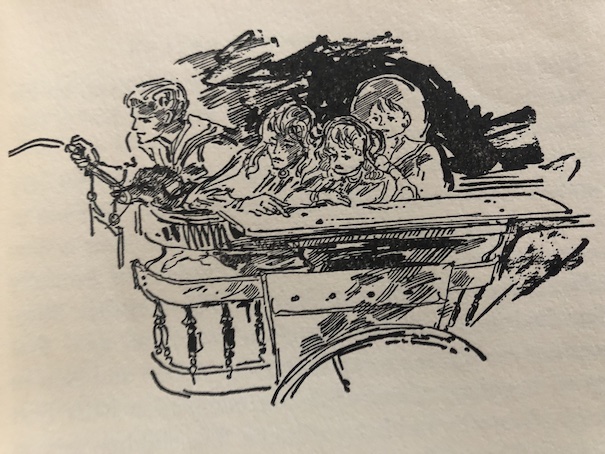
Robert manages to break out of the room where he’s been locked up, and he frees his siblings and their dog, Absolom. The four children set off with their dog, intending to walk to the mountains (just some mountains, somewhere to the west – nowhere specific and no real plan involved) and make their living there because Robert imagines that would be a good idea. As they pass an inn, they spot a pony and cart tied up outside, and they decide to appropriate them for some transportation. Besides, Robert has always wanted a pony. Nan is concerned that they’re stealing, but Robert says that they’re just “borrowing.”
The Linnet children have much more in common with their Uncle Ambrose than with their grandmother or other relatives. Uncle Ambrose is similarly unsociable and impatient. Uncle Ambrose was once a teacher, but now that he’s retired, he has no desire to spend time with children again. He also doesn’t like dogs. But, it turns out that the pony they “borrowed” belongs to him and takes them to his house. When Uncle Ambrose realizes who the children are, he takes them into his house and keeps them over night, although he doesn’t introduce himself to them immediately. The children feel much more at home with Uncle Ambrose, even when they don’t know who he is, because his house is a bit shabby and untidy, and he has a pet owl and a cat with kittens. Also, in spite of his gruff manner and assertion that he’s not happy about having children around, Nan has the sense that he actually likes them. The children decide that they’re going to try to behave themselves in this house because they like being there and want to stay.
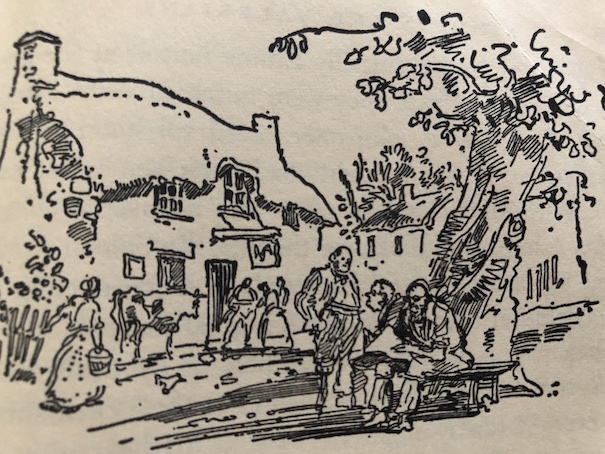
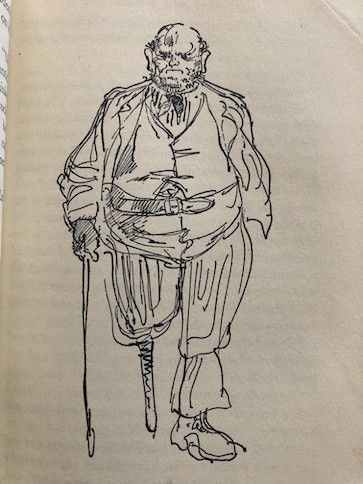
In the morning, Uncle Ambrose goes to town to get the groceries that his peg-legged gardener, Ezra, neglected to get the other day when the children stole the pony and cart in town. When he returns, he also has the children’s luggage with him. Uncle Ambrose went to see his mother about the children, and when he suggested that he could keep them at his house, the children’s grandmother eagerly took him up on the offer. The children are all intensely relieved that they won’t be sent back to their strict grandmother and her overly-tidy house and can stay with their eccentric uncle, the peg-legged gardener who comes home singing in the middle of the night when he gets drunk, and the wonderfully untidy garden outside, where they can play.
Uncle Ambrose confesses to the children that he has actually missed his students since he retired from teaching. He isn’t particularly fond of children by themselves, but he is fond of teaching them. As a condition of the children staying with him, Uncle Ambrose insists that they allow him to educate them. The children agree to this because one of their reasons for running away was so they would not be split up when Robert and Nan were sent to boarding school. The children just want to stay together with their dog. Uncle Ambrose agrees to this, saying that he doesn’t approve of sending young girls to boarding school at all, although he insists that girls be properly educated as well as boys. He says that he wouldn’t even consider sending Robert to boarding school until he’s had a better grounding because he’s not satisfied with the reports he’s had of Robert’s academic abilities. The children aren’t thrilled at the idea of studying, but they agree to it because staying together and studying with Uncle Ambrose sounds better than being split up or the other alternative, being sent to stay with their Uncle Edgar in Birmingham. Also, Uncle Ambrose is willing to give the children some time each day to themselves, to play or do what they want. He won’t even insist that they show up for meals, but if they miss them, they’ll just have to go hungry. (See? I told you it was a better strategy than fighting to get them out of the hen house.) As much as the kids don’t like the idea of studying, they love the idea of having some freedom. Freedom means that adventures could happen.
Now, the story at this point could have been a complete story by itself – a group of wild, undisciplined kids are left with their strict grandmother, and after a battle of wills between the children and the grandmother and some overly-harsh punishment, the children run away, finding a gruff but kindly bachelor uncle who rediscovers the pleasure of having children around and also happens to have once been a teacher and can tutor the children while their father is away, managing to inspire the children to behave a little better and learn to make some better decisions by granting them a little freedom to make some of their own choices instead of being too controlling. That’s all very nice as a single story. However, in this case, all of that is just the background for the story to come. We’re still in just the first part of the book.
Segue to the Magic
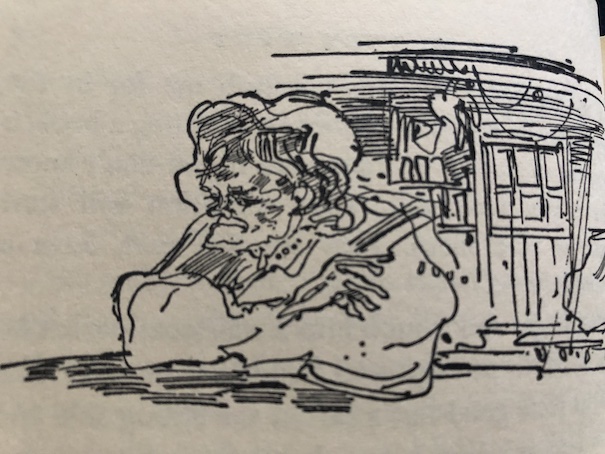
After it’s settled that the children will stay with Uncle Ambrose, they decided to go into town for their first free excursion. They stop at the little store in town to buy some sweets and a picture postcard to send to their grandmother because Nan has been thinking over their time with her and has realized that they were badly behaved and feels guilty about it. The store is managed by Emma Cobley, an old woman in an old-fashioned dress and cap and a red shawl who owns a black cat named Frederick. Emma is a little creepy and she warns the children to stay away from Lion Tor because it’s a dangerous place. (A “tor” is “a high, craggy hill.”)
When the children return to the house, Ezra insists upon introducing them to the bees. The children think that this is a very odd thing to do, but Ezra says that it’s important, and he asks the bees to look after the children. Timothy asks if it’s possible for bees to look out for people, and Ezra says that they once saved his life when he fell into an old tin mine and showed the vicar (the children’s uncle, after he retired from teaching – they’re all living at the vicarage now) where to find him. When Ezra hears that they’ve been to Emma Cobley’s shop, he tells them not to go there anymore. The most Uncle Ambrose buys there is stamps, but neither of them ever buys anything else from her, and Ezra is reluctant to tell the children why. There is something a bit creepy about Emma and some suspicious things in her shop, like the overly-appealing candy and the one postcard that she refuses to allow the children to buy or even look at for long.
As the children start having lessons with Uncle Ambrose, Robert asks him if he will be giving them pocket money. Uncle Ambrose says that he doesn’t give pocket money, but there are opportunities for earning some. He gives them a list of chores that they can do and what he’s willing to pay for doing them. He also points out to Robert that, as the oldest boy, he can’t expect to wriggle out of the tougher chores or leave them to the girls, but if he’s willing to tackle the tougher chores, he will pay him well for it. Uncle Ambrose has somewhat chivalrous sensibilities about what girls can handle, and he also reminds the boys that there are consequences for misbehavior, lying, or stealing. He says that he would never use corporal punishment on a girl, but he has caned boys before and could do the same to his nephews if they give him reason. He tells the children that, from this point on, they cannot interrupt their lesson time with any subjects that aren’t related to the lesson. (He never does hit any of the children and does make reasonable exceptions to this rule later in the story.) It isn’t just the threat of punishment that keeps the children in line, though. It turns out that Uncle Ambrose is an excellent story-teller, and when he starts describing other countries or historical events, the children are captivated. In many ways, Uncle Ambrose makes learning fun because he really loves his subjects and knows how to share what’s fascinating about them with other people. There are parts of the learning that seem like drudgery, but they are balanced out by the parts that are truly fascinating.
The children also gradually begin learning more about the other people who live nearby. There is a black man (called a “Negro” in the story) called Moses Glory Glory Alleluja. (That’s apparently his real name in the story and not just a nickname, to which I say, “God help us all!”) When the children first see him, they’re startled and afraid of him because he’s carrying a curved knife and looks like “a coal-black giant.” They stop and stare at him because they’re afraid, and Ezra tells them not to hurt the poor man’s feelings because he’s a gentle man. As he gets closer to the children, they realize that he’s not as fearsome as they had first thought from a distance. He’s actually very pleasant, and the knife he’s carrying is just a scythe for clearing plants.
Moses works for Lady Alicia (a sort of man-of-all work – cook, gardener, butler, etc.), and Lady Alicia also has a monkey called Abednego. When the kids go with Ezra to pick up a couple of extra beds that Uncle Ambrose is borrowing from Lady Alicia for the children, Abednego takes Betsy’s doll, and she has to chase after him to get it back. In the process, Betsy meets Lady Alicia, an elderly lady in very worn fancy clothes and wearing jewelry. The two of them introduce themselves to each other and explain a little about who they are. Lady Alicia once lived there with her husband and son, but she says that her son, Francis, was “lost” years ago on Lion Tor at the age of eight. She doesn’t explain at this point how that happened or even if her son died or simply disappeared. Her husband also disappeared a few years later overseas because he was a traveler and explorer. She doesn’t seem to expect to see either of them again. This is really where the main plot of the book is introduced.
The Magic
So, now we know that there’s a creepy old lady who owns a shop that isn’t quite what it seems to be and a mysterious and sad old lady whose husband and son have disappeared, and it’s all connected to Lion Tor. The children’s first encounter with Lion Tor happens when Betsy’s siblings realize that she’s missing at Lady Alicia’s house. Not knowing that she’s with Lady Alicia, they assume that she’s wandered off into the woods to pick flowers and go searching for her. Nan finds her way to Lion Tor, where she discovers a cave that is filled with paintings. She knows they weren’t done by cave people ages ago because people in the drawings are wearing modern hats. The artist turns out to be a bearded man in ragged clothes who seems unable to speak.
Nan learns that this man is called Daft Davie, but Nan doesn’t think that’s fair because he seems intelligent and artistically talented, even though he isn’t able to speak. Ezra explains to her that Davie used to work for a blacksmith in another village nearby but some boys kept teasing him and tormenting him because he couldn’t speak, so he eventually went to live by himself at Lion Tor.
The boys eventually find Betsy with Lady Alicia. To their surprise, Lady Alicia seems to be enjoying Betsy’s company, even though she doesn’t normally like visitors. She invites the children to return again with Nan, making an odd comment about how the Linnet family seems “inevitable” but might do her some good.
Uncle Ambrose allows Nan to use the parlor of his house as her private room, where she can do her sewing and darning or just have time to herself. He says that he hasn’t done much with the parlor himself, other than putting furniture in it, because the parlor is usually for the lady of the house, and he’s unmarried. Now that Nan is there, she counts as the lady of the house as the oldest girl, and Uncle Ambrose can tell that she’s a reflective kind of person who can use some quiet time to herself, away from the other children. Nan is appreciative, and she’s also surprised when Uncle Ambrose tells her that the previous lady of the house was Lady Alicia. Before her marriage to the local lord, she was the daughter of the previous vicar, and he found some of her old books in a hidden cabinet in the room.
Uncle Ambrose removed the books from the hidden cabinet and put them on the bookshelf in the room, but out of curiosity, Nan investigates the hidden cabinet and finds that it still contains a notebook. However, the notebook belonged to a young Emma Cobley, not Lady Alicia. The notebook contains what looks like evil witchcraft spells. Nan is alarmed, although later, she’s confused because she sees Emma Cobley at church. She isn’t sure what to think because she can’t imagine that a real, evil witch would go to church. Nan considers that perhaps Emma used to practice witchcraft in her youth but repented later and changed her ways. However, if that’s true, why does Ezra disapprove of her, and how can they explain Emma’s creepy black cat? When Nan studies the spells in the book, seeing spells that can prevent a person from speaking, cause a person to lose his memory, and cause a person to forget affection for another, Emma’s true character and some of the mysterious events of the past begin coming a little more clear.
When Nan talks to Ezra later, he says that Emma Cobley’s father was a black-hearted warlock who taught her evil spells. Ezra says that his own mother practiced white magic and that his family is descended from ancient peoples who were called fairies or gods. Nan had thought that there was something gnome-like in his appearance and isn’t surprised that he’s a bit magical. Ezra further describes the day that Lady Alicia’s son disappeared at Lion Tor. They’d been on a picnic with the boy’s nurse, and the nurse and the boy had been playing hide-and-seek. A mist came up, and they were unable to find the boy. They feared that he might have drowned in the marsh because his cap was nearby, but they were never able to establish that. Some other people thought he might have been kidnapped by gypsies, but there was no evidence of that, either.
In the cemetery of the churchyard, there is a memorial to Lady Alicia’s husband, Hugo Francis Valerian, and his son who was named after him, but the husband’s death date is unknown. The children argue about what that really means. Robert says that the Valerians are dead, but they’re just not buried at the site of the memorial because they were lost and nobody knows exactly when they died and where the bodies are. However, Betsy has the feeling that they’re not dead, and Nan agrees that disappearing isn’t the same as dying. But, is that really true? Are the Valerians alive or dead, and if they are alive, where are they?
Pieces of the past continue falling into place. Betsy and Nan accidentally find old love letters that Emma Cobley wrote to the elder Hugo Valerian … love letters that also contain angry threats when the love wasn’t returned. Pictures that Davie painted on the walls of his cave resemble ones from Lady Alicia’s tapestry. Uncle Ambrose doesn’t believe in the power of witches and thinks that what Ezra has been saying about magic and spells is just superstition, but Ezra knows a few things that Uncle Ambrose doesn’t. He’s the one who knows how to undo Emma Cobley’s wicked spells.
The book is available to borrow and read for free online through Internet Archive. Sometimes, this book also appears under the title The Runaways.
My Reaction and Spoilers
A Few Concerns
I didn’t like the parts with the harsh punishments or threats of it for the children. Locking children up or caning them would be considered child abuse by modern standards, although my feelings about that are somewhat offset because they kids are pretty wild and the book makes it clear that they are badly behaved in the beginning and provoked the punishment they received. I’m willing to let it go partly because nobody actually gets caned and because of the fairy-tale atmosphere of the story. In fairy tales, there is often a cruel relative, and in this case, it’s more like an overly-provoked one at her wit’s end. In either case, the children’s situation with their grandmother in the beginning establishes the reason why they go to live with their eccentric uncle and have magical adventures.
Some people might not care for the different standards for boys and girls in the story. It’s old-fashioned, out of date even for the time when the book was first published, but the setting is also old-fashioned, so I think it’s meant to establish the time and place. It’s common in older children’s books and stories that imitate them for boys to be given more freedom than girls but also for boys to be subjected to harsher, more physical punishments when they get out of line. Uncle Ambrose seems to have similar feelings in that direction, although he does give the boys and girls the same lessons because he feels that girls’ minds also need to be educated, and he allows all of the children to have equal free time and ability to play and explore the area together.
As another reviewer of this book observed, it seems a little strange that the children would be so frightened of Moses when they first meet him because they used to live in India, and you would think that they would be accustomed to the idea that there are people of different races in the world. This can’t be the first time that they’ve seen people who look different, although I suppose they could be a little intimidated by him being especially tall and carrying a scythe. That might be something that would be a little startling to see very suddenly until you look again and realize it’s just a really tall guy with a farm implement because we’re living in the countryside now. I liked the warning from Ezra to the children to behave themselves and not hurt Moses’s feelings. I thought it was good to emphasize that other people’s feelings are important, and that comment helped to humanize Moses because, even if he looks a little strange or intimidating at first, he’s still a human being with feelings.
However, there is another part of the story not too long after that, when they’re looking for Betsy and Robert, who has a habit of play-acting, pretends like he’s a Roman emperor giving a command to a “coal-black Nubian standard-bearer”, saying, “Slave, lead on.” There seems to be some self-awareness in the story that this wasn’t a good thing for Robert to say to Moses (who is a servant, not a slave, although Ezra later says that there is a rumor that Lady Alicia’s husband may have bought him in a slave market overseas when he was young), and Timothy is concerned that Robert might have offended him. The story says that Moses isn’t the kind of person who takes offense or holds grudges, and he seems to understand that Robert is play-acting, but I felt like this somewhat undermined the message of considering other people’s feelings by suggesting that the best way to be is not to have any particular feelings to consider. That’s not something anybody can count on in real life or insist that others provide for them. Real human beings are not like stuffed teddy bears, who can take endless abuse or respond to any comment with a constant smile and still be lovable and want to snuggle afterward, like none of it matters. Real humans have both feelings and limits, and this is one instance where I felt like someone should have thrown a little cold water on Robert’s play-acting. The whole story has an air of unreality about it, which is part of the charm, but I think even fantasy stories should be real about human behavior.
The Fantasy
The fantasy in the story is really very light, compared to most fantasy books. Although it becomes well-established by the end of the book that Emma Cobley is definitely a witch who cast evil spells which caused Lady Alicia to lose both her son and her husband, the spells and their undoing were done in such a way that Uncle Ambrose never seems to realize that it was all magic. Basically, the children and Ezra find the little figures with pins in them that Emma made, and Ezra recites a magical rhyme that allows them to remove the pins, thus breaking the spells. Then, they burn the figures and Emma’s old spell book, destroying her magic forever. After that, Lady Alicia’s son and husband both come back, Emma actually becomes a much nicer person, and everybody lives happily ever after.
The pace of the story is fairly slow, which is actually part of its atmospheric charm. For a book dealing with an evil witch, black magic spells, and unhappy people, it’s really pretty relaxing. I think part of that effect is because of its gradual pace and also because there are never very serious consequences for anybody in the story. It’s sad that Lady Alicia, her husband, and her son were all parted from each other for a period of years, but when the spells are broken, they are pretty quickly very happy again. Emma Cobley does try to prevent the children from learning her secrets and breaking the spells, but really, nothing bad happens to the children at all. There is one semi-frightening part where the boys and their dog are up a tree with Emma and her friends below it, but then Uncle Ambrose comes and takes the children home, and everything is fine. Emma tries to cast spells on the children at once point, but the children don’t even notice until they find the figures of themselves later. Ezra tells them that the witch’s spells were ineffective against them because he made his own figures of the children first and put them in the church, so they are protected. Emma herself faces no consequences in the end, either. They don’t have to destroy the witch to destroy her magic, and once her magic is gone, she is so changed and everyone is so happy that there’s no retribution, only forgiveness.
On the one hand, the lack of consequences in the story for things the children do make the story feel like the stakes are low. There is a sense of sadness around characters in the story, but is no particular sense of urgency. They are not racing the clock to break the spells, and the villains are pretty ineffectual at putting up obstacles to their success. On the other hand, it seems like most of the story focuses on atmosphere over action. This little village is an enchanting place to be. It’s charming, and the lack of consequences for the children, whether it’s for being racially insensitive or facing down a witch or even just staying out late, make the story feel like a very safe kind of adventure. Uncle Ambrose, Ezra, and their bees won’t let anything serious befall the children, and the worst punishment they have for misbehavior is being sent to bed with gruel (a kind of thin porridge) instead of a proper supper. Uncle Ambrose told them that if they missed meals, it would be their fault, and they’d have to go without. However, he never lets children go to bed hungry, and he even allows them sugar on their gruel. Again, very low stakes, but charmingly so. This story is not stressful, which is good, but it’s not for people looking for excitement.
I was a little impatient with the children for not making the connection between the spells in the book and Daft Davie even after seeing the figurines, including the one with the pin in its tongue. This spell is supposed to prevent people from talking, and who else do they know who can’t talk? There aren’t that many people in the area, and there’s only one person in the story whose main characteristic is an inability to speak. Even as they’re breaking the spells, they don’t know who they’re breaking them for, like they can’t even guess, and Nan is surprised when Davie can suddenly talk afterward. I think this is one of those stories that wants to make readers feel clever for figuring it out before the characters, but that can also feel a little frustrating. If there’s one thing I would change about this story (other than the racial bits), I would want the children to realize the truth about the spells faster and break them more deliberately.
I don’t really mind that Uncle Ambrose never believes in the magic. The book leaves the situation a little open for the characters, and possibly even the readers, to believe that there are other explanations for what happens. Maybe “Davie” lost his memory and ability to speak through an illness. The children in the story know that’s not it, but it’s not important for anybody else to know. Although, perhaps Uncle Ambrose knows more about magic than he lets on because, for reasons that are never explained, his pony never grows old, and his pet owl seems immortal. But, maybe that’s for the readers to decide.
Barbara and Rick Benton have an old woman, Mrs. Cunningham, taking care of them while their parents are away on a trip. They don’t mind Mrs. Cunningham, but she has a habit of cooking cabbage, which makes the house smell bad. One day, they decide to buy a can of air freshener to make the house smell better, but they don’t have much money. After looking over the selection at the store, they realize that they only have enough money to buy a really cheap bottle with a damaged label. They’re not even sure what scent it’s supposed to have, but they decide that it’s better than nothing and take it.
However, the bottle isn’t air freshener at all. When they get it home and open it, a man with an umbrella pops out of the bottle. He introduces himself as a wizard named Harrison Peabody, saying that he was accidentally trapped in the bottle. When they tell him why they got the bottle, he offers to fix the smell for them, producing real roses by magic in Barbara’s bedroom.
It’s pretty impressive, but Barbara soon learns that magic has inconveniences. The roses get in the way when she tries to do her homework, they have thorns that prick her fingers, and she’s worried that it will get messy if she has to water them. She asks Harrison Peabody if he can take them away, but he says that undoing magic is more difficult than doing it. It’s even more inconvenient when he produces a pine forest in Rick’s room because he wanted his room to smell like pine.
The kids let Harrison Peabody, who they call Harry, stay in their attic because there’s an extra mattress there, but they’re careful to hide him from Mrs. Cunningham. Barbara uses Harry’s magical umbrella to get rid of the roses and pine trees while he’s in the bathroom.
It seems like Harry’s magic works sometimes but not always. In the morning, he’s able to use it to remake the attic into a comfortable living space and provide a lavish breakfast, but later in the day, he needs the kids to bring him food. Harry is reluctant to explain, but he finally admits that he’s not a very powerful wizard. All of his magic depends on his umbrella, and the umbrella only does magic when it’s raining. Even then, it will only work its magic if you ask it politely.
The kids take Harry to Prospect Park for a picnic, and in the lake, they spot a sea serpent. It turns out that the sea serpent can talk. His name is George, and he actually knows Harry. George gives Harry and the kids a ride around the lake, and they use the umbrella’s magic to clean the lake and make it suitable for swimming. Unfortunately, they accidentally lose the umbrella in the lake.
The next day, the kids go back to the park to look for the umbrella while Harry stays at home with a cold. George finds the umbrella for them, warning them to remember that it’s Harry’s umbrella and that things often go wrong, even when Harry tries to use it. Ignoring that, Rick impulsively wishes for the umbrella to take him and his sister to the zoo, and when they get there, he also impulsively wishes that all of the animals were free. Then, it stops raining, so he has no chance to take it back.
Chaos ensues, with all of the zoo animals roaming around free and the zookeepers struggling to round them all up again. Then, to the children’s horror, some of the zookeepers catch George, thinking that he’s another escapee. The zookeepers quickly realize that they’ve never seen any animal like George before. They don’t know what he is, but they decide that they can’t let him roam around free. They put him in an aquarium at Coney Island, and it’s up to the children to rescue him!
The book is available to borrow and read for free online through Internet Archive (multiple copies).
My Reaction and Spoilers
This book is odd because it gave me so many feelings of the story being incomplete. It seems like it was written as a fantasy adventure story for fairly young kids because all of the problems are pretty easily solved, but there are so many questions left unanswered that I almost feel like it used to be a longer story but was cut down for some reason. Actually, it’s probably that it could have been a longer story but the author chose not to make it longer.
First, we never get any explanation of Harrison Peabody’s background, how he came to be a wizard, and how or where he got that magical umbrella. When the children ask him how he got into the bottle, he says that it was an accident, that he just went in for a little bit and someone capped up the bottle so he couldn’t get out. But why? Was someone trying to get rid of Harry, like those stories where someone tries to get rid of an evil genie by tricking him into going back into the bottle he came from? But, Harry’s not a genie and not a bad guy.
There is also no explanation of how he came to meet George the sea serpent. The closest we get to George’s background is that George says that he was one of the sea serpents that John Van Nyse saw at Steinbokkery Pond, which was once on the site of the Lefferts House, referencing an old story from New York. I liked the reference to a piece of local folklore, and it does help to date Harry a little because, when Harry encounters George in the park, George has to explain to him that the Steinbokkery Pond was drained to build the Lefferts House. Since Harry didn’t know that and has memories of what the area used to be like, Harry must have been in the bottle since before the house was constructed, around 1783. But, again, the story never explains that.
The end of the book is also abrupt. When the kids retrieve the lost umbrella from George, Rick’s sudden wishes to go to the zoo and free the animals seem, well, pretty sudden. He didn’t mention anything about wanting to go the zoo before, and it seems like the kids would have been in a hurry to get the umbrella back to Harry. It feels like that incident was just thrown in to have something zany happen that would add some excitement to the story.
Rescuing George isn’t too hard with the magic umbrella. George decides that he wants to return to the ocean instead of going back to the lake in the park, so the kids wish him to be where he wants to go. Then, after they return to Harry and point out to him that their parents will return soon and will surely notice that he’s been living in the attic, he uses the umbrella to return the attic to its former state. Then, he whispers something to the umbrella, and they both abruptly vanish. There is no indication of where Harry is going; he’s just gone. I think it’s meant to be mysterious, but to me, it just felt odd and incomplete. I had been expecting that there would be some kind of resolution of the chaos that the magic umbrella causes. Maybe Harry would decide that magic has caused too much trouble and he’ll put the umbrella away, saving it only for emergencies. I even thought that there might be some romance with Mrs. Cunningham, who I assumed was a widow, and maybe they would go on to be caretakers for other children, like they were for Barbara and Rick, with the implication that their magical adventures would continue. Instead, Harry just disappears, and the story is over with no further explanation.
Mrs. Piggle-Wiggle by Betty MacDonald, 1947, 1957, 1975, 1987.
This book has been printed and reprinted many times over the decades. The edition that I used for this review is the same one that I read when I was in elementary school, printed in the 1980s. One of the reasons why the edition matters is that the illustrations were different in the first printings in the book. In 1957, the illustrations were replaced by the ones you see here, which continued to be used in later printings.
Mrs. Piggle-Wiggle is a widow who lives in an upside-down house. Her husband was a pirate, and she has magical cures for the bad habits of the children who live in her neighborhood. Sometimes, she doesn’t need magic for a particular child’s bad habit, just using psychology. Sometimes, certain behaviors, like staying up all night instead of going to bed, are their own punishment, and Mrs. Piggle-Wiggle advises the parents to let the children do them for a certain period of time so they can find out for themselves why these things are a bad idea, usually with very funny results. This book is the first book in the series, and it particularly uses more psychology than magic.
As an adult, I actually prefer the psychological cures to the magical ones. These stories are meant to be humorous rather than practical, and because of that, they’re not realistic. First, they never really go into the psychological reasons why some of these kids do the things they do, like becoming over-protective of their belongings or suddenly becoming afraid of taking baths. Then, when children suffer the consequences of their misbehavior, the consequences are humorous and exaggerated, like the boy whose room gets so messy that he actually traps himself inside until he decides to clean up and the girl who gets so dirty that her parents can grow radishes on her. However, the fact that there are consequences for the children’s behavior is a useful touch of realism. It gives parents or teachers the opportunity to talk to kids about what they expect would happen if they actually did any of the things kids do in the stories and think about some of the consequences of their own actions. These are stories that can make kids chuckle and then make them think.
I think it’s important to point out that Mrs. Piggle-Wiggle never actually blames the children for their bad behavior, seeing it more as an affliction that they need to be cured from. She likes all children in spite of their bad habits and bad behavior (something I admit that I find hard to do with people in real life), and she wants to cure them of their problems so that other people will see how likeable they are underneath. Even though Mrs. Piggle-Wiggle likes the children, she doesn’t spare them from the consequences of their actions because that is part of the cure that the children need to become the best versions of themselves. Sometimes, the consequences are the cure by themselves, and those are the stories I like best. After all, what makes bad habits “bad” is that they have bad consequences to them. They cause problems, both for the person behaving badly and others. Maybe, sometimes, people need to see the problems for themselves and experience the consequences directly before they find the motivation to fix their behavior. I can believe that part of these stories is realistic. The rest of it is just for fun.
The Mrs. Piggle-Wiggle books are collections of short stories, and each one focuses on a different child or set of children, their particular problems or bad habits, and Mrs. Piggle-Wiggle’s solutions for them.
The book is available to borrow and read for free online through Internet Archive (multiple copies).
The Stories in this Book:
Mrs. Piggle-Wiggle, Herself
This section of the book introduces and describes Mrs. Piggle-Wiggle. She is a small woman with a hump on her back, which she says contains magic. (The hump isn’t really shown in the pictures of her in the book, but she’s supposed to have one.) She has very long brown hair, which she usually wears up, but sometimes, she lets it down so that children can comb and braid it or style it in different ways. Her eyes are also brown, and her skin is described as being a “goldy brown.” (Her racial identity is not specified because it’s not important to the stories. The pictures show her as being white, so maybe she just has a tan, but I find the written description interesting because it could leave the character open to different interpretations and playable by different types of actors. Her description could fit quite a lot of people, really.) She wears brown clothing (although that’s not how she’s shown in the pictures) and smells like sugar cookies. She claims not to know her own age, saying that it doesn’t matter, since she’ll never get any bigger than she is now.
Mrs. Piggle-Wiggle is a widow, and she tells the children that her husband was a pirate who buried treasure in the back yard before he died. She has no children of her own, but she loves all the neighborhood children, and she frequently looks after them and has them come over to play. She doesn’t often speak to the children’s parents because she gets nervous around adults. She also has a dog named Wag and a cat named Lightfoot.
Mrs. Piggle-Wiggle lives in a little brown house that is upside down. She says that her house is upside down because, when she was a little girl, she used to look up at the ceiling when she was in bed and wonder what it would be like to walk on the ceiling, so when she grew up, she purposely built her house upside down just to find out. The only parts of the house that are normal are the kitchen, the bathroom, and the stairs because none of them would work properly if they were upside down.
When I was a kid, I thought that the upside-down house was the best part of the stories. When people walk around inside it, they have to step over the sills of the doorways because what should be the tops of doors are not flush with the ceiling the way the bottoms are flush with the floor, and these doorways are upside down. Mrs. Piggle-Wiggle put little steps into and out of doorways to help with that, but kids like to jump the doorways as a challenge. Mrs. Piggle-Wiggle lets them make chalk marks to record the lengths of their jumps. Also, because the ceilings are now the floors, the chandelier is on the floor of the living room, shining upward instead of down, and kids sit around it like it’s a camp fire. The children can also use the slanting ceiling-floors of the house as slides.
Most of this part of the book is backstory for Mrs. Piggle-Wiggle, but it explains that the first neighborhood child she made friends with was a girl named Mary Lou, who was running away from home because she hated doing the dishes so much. Seeing Mary Lou going down the sidewalk in the rain with her suitcase, Mrs. Piggle-Wiggle invited her in for tea and cookies, and Mary Lou told her about her problems. Mrs. Piggle-Wiggle tells Mary Lou that she really likes washing dishes because it’s fun to pretend that she’s a beautiful princess who was captured by an evil witch who makes her do all the cleaning and that the only way she can escape is to have everything clean by the time the clock strikes. Mrs. Piggle-Wiggle draws Mary Lou into a game of pretend, where they both pretend that they’re cleaning the kitchen for the evil witch. Then, Mrs. Piggle-Wiggle puts on her witch’s costume, pretending to be the witch, inspecting the kitchen to make sure that it’s clean.
It’s so much fun that Mary Lou gets over hating washing the dishes. When she tells her parents about Mrs. Piggle-Wiggle, they let her spend time with Mrs. Piggle-Wiggle, and she brings her friend, Kitty, to visit when Kitty says that she hates making the beds at her house. Mrs. Piggle-Wiggle plays a similar game of pretend with Kitty and Mary Lou, where they pretend that they are making beds for a cruel queen who will throw them in the dungeon if the sheets are wrinkled.
Gradually, Mary Lou and Kitty start bringing their siblings and other friends to see Mrs. Piggle-Wiggle, and Mrs. Piggle-Wiggle gets to know all of the children in the neighborhood. She shows them how to make chores fun, teaches them to do things like bake cookies and pies, and lets them dig for pirate treasure in the backyard. Because she is so good with children, parents in the neighborhood call her to ask for help and advice when they’re having problems with their kids.
The Won’t-Pick-Up-Toys Cure
Hubert Prentiss’s grandfather gives him many wonderful toys, but Hubert doesn’t like putting them away. It’s very difficult to get around his room, and the problem gets worse all the time. Hubert’s mother tries asking other mothers what they do with their children, but they either don’t have the same problem or don’t know what to do. Then, one of them suggests asking Mrs. Piggle-Wiggle because she’s so good with children. Mrs. Piggle-Wiggle has met Hubert before because he’s come to her house with the other children.
Mrs. Piggle-Wiggle suggests that Hubert’s mother let Hubert make his room messy and that she not try to pick up after him or even enter his room. Then, when the room gets to the point that it’s difficult for Hubert himself to even go in or out, to give her a call. After a week, Hubert’s room is so bad that he can’t open his bedroom door and can’t even use his bed. His mother has to feed him through his bedroom window. Even though she’s only able to give him things like peanut butter sandwiches through the window and Hubert doesn’t have anywhere comfortable to sleep anymore, he’s still not motivated enough to leave his room and put away all his toys. However, Mrs. Piggle-Wiggle has a plan to motivate Hubert enough that he’s willing to finally clean his room just to get out.
The Answer-Backer Cure
When Mary O’Toole’s teacher picks her to stay in at recess and help clean up the classroom, Mary is so irritated that she tells the teacher to do it herself and to let her go play with the other kids. Her mother tells her that was a rude thing to say to her teacher, but it’s just the beginning of Mary’s bad habit of being rude and impudent to people. Mary thinks that it makes her look smart to contradict people, and her new responses to any order or request her parents and teacher make are “Why should I?” and “I’ll do it because I want to but not because you tell me to.” (Nobody but you cares why you do it, kiddo. They just want it done because they just want to get through the day and accomplish things. You can either be the one who makes that easier or the one who makes that harder or more unpleasant, but things are still going to need to be done either way.)
Mary’s mother goes through the usual routine of calling other mothers for their opinions, and one of them suggests talking to Mrs. Piggle-Wiggle. Mrs. Piggle-Wiggle’s solution is to let Mary keep her parrot, Penelope for awhile. Penelope is as rude as Mary is and repeats many of the things that Mary herself says. At first, Mary thinks it’s funny, but gradually, she begins to see how annoying it is and realizes how she sounds when she talks that way. Her dad actually laughs when he hears how much the parrot sounds like Mary, which makes Mary mad. Penelope also uses remarks that Mary thought that she’d made up herself, but she says them before Mary actually said them around her, making Mary realize that she’s not even as clever and original as she thought she was. When she sees how annoying it is to be around someone as rude and negative as she was, Mary apologizes to her teacher and gives it up.
(Actually, I know a lot of adults who talk just like Mary – “I’ll do it because I want to but not because you tell me to.” If they don’t use those exact words, it’s solidly the exact same attitude. They say they do it specifically because they’re adults and nobody should be telling them what to do under any circumstances, even if it’s something important. For them, it’s a kneejerk reaction to being told something, anything, no matter the circumstances and with little thought or attention to what they’re being told and whether it’s actually worthwhile. I always think of this story whenever I hear them talking that way.)
The Selfishness Cure
Dick Thompson is selfish and greedy. It’s no fun for other kids to come play at his house because he won’t share any of his toys or let anybody touch anything that belongs to him. It’s always “MY” this and “MY” that and everything is “MINE!” Dick’s mother realizes that something must be done when she gives Dick a box of peppermint sticks specifically to share with other kids in order to teach him how to share, and he actually hits Mary O’Toole on the hand with his baseball bat for trying to take one.
When Dick’s mother calls his father at work and asks him what they should do, the father’s first suggestion is a good, hard spanking because that’s something Dick can keep all to himself, but the mother is upset at the idea of more physical violence. The father then suggests that she talk to Mrs. Piggle-Wiggle because she’s helped other children in the neighborhood.
Mrs. Piggle-Wiggle’s Selfishness Cure is her special Selfishness Kit. It contains a variety of padlocks that Dick can use to lock up his stuff. It also has labels and paint that Dick can use to label all of his stuff, and it even has a pastry bag for labeling Dick’s food as his with frosting. The idea is to indulge Dick’s desire to prevent anyone from touching anything that belongs to him until it becomes so much of a hassle that he decides that it’s too much trouble.
At first, Dick is really happy that he can label everything he owns with his name and write “DON’T TOUCH!” on it, but as predicted, it turns out to be a big problem. Because Dick has everything, including his lunch, marked with his name and “DON’T TOUCH”, it isn’t long before everyone at school knows and is laughing at him. Plus, as my mother says, “With some kids, you can tell them not to touch something, and they won’t touch it, but there are also kids who, when you tell them not to touch something, just can’t wait to touch it.”
The Radish Cure
Patsy is a perfectly ordinary girl, but one day, she suddenly decides that she hates baths and refuses to take another one. There is no explanation why, and none of the other mothers in the neighborhood seem to be having that problem with their children, but Mrs. Piggle-Wiggle has a solution.
Mrs. Piggle-Wiggle tells Patsy’s mother to led her go several weeks without washing at all, letting her get as dirty as she wants. Then, she should get a packet of small radish seeds and plant them on Patsy. When Pasty sees that she’s sprouting radishes, she suddenly decides that she’s ready for a bath.
The Never-Want-To-Go-To-Bedders Cure
The three children in the Gray family never like going to bed. Every night, when it’s time for bed, they beg to be allowed to stay up a little later and insist that nobody else in the neighborhood goes to bed as early as they do. It often takes about an hour of whining, complaining, and arguing before their parents are able to get them to bed.
Mrs. Gray goes through the usual routine of asking other parents if they have this problem with their children, but none of her friends do, so she asks Mrs. Piggle-Wiggle what to do.
Mrs. Piggle-Wiggle’s advice is to let the children stay up as late as they want to. Mrs. Gray worries that not getting enough sleep will be bad for the children’s health, but Mrs. Piggle-Wiggle says that a day or two with less sleep won’t make much of a difference, and by that time, they’ll realize why going to bed at night is a good idea.
The Gray children think it’s great at first that their parents no longer tell them to go to bed and even let them stay up half the night, but soon, they’re falling asleep in the middle of the day, missing movies that they go to see when they fall asleep in the theater and missing out on fun activities with other kids either because they’re asleep or too tired to enjoy them.
The Slow-Eater-Tiny-Bite-Taker Cure
A boy named Allen has suddenly become obsessed with eating his food very slowly, taking super-tiny bites. It’s a very odd habit, and it makes meal times difficult because he eats very little and take a very long time to do it. I’d be worried if he was having difficulty swallowing, but his mother calls Mrs. Piggle-Wiggle.
Mrs. Piggle-Wiggle gives his mother sets of dishes in different sizes, from fairly large to ridiculously tiny. At each meal, Allen’s mother uses progressively smaller dishes. Allen is fascinated by the tiny dishes, which fit his new dainty eating, but he’s getting weaker because he’s been hardly eating anything.
I actually found the descriptions of his weakness a little alarming, but his mother then reverses the order of the dishes she gives him, starting with the smallest and then moving to the biggest. As Allen realizes that he feels better when he starts eating more food, his appetite returns, and he gets his strength back.
The Fighter-Quarrelers Cure
Twins Joan and Anne Russell have been fighting with each other a lot, and it’s driving their parents crazy. The twins argue with each other over everything, like who is wearing whose clothing and who had more bacon or the biggest slice of melon on their plate at breakfast, and they even pinch and slap each other. Sibling quarrels are pretty common, but Mrs. Russell asks Mrs. Piggle-Wiggle if there’s anything they can do to end this constant fighting.
Mrs. Piggle-Wiggle advises the girls’ parents to make notes about the types of petty things that the girls argue about and spend a day having staged arguments of their own in front of the girls to show them what it’s like to be around that type of arguing all the time.
From the moment they wake up the next day, the twins suddenly find themselves in the awkward position of trying to reason with their parents and referee their quarrels as they become witnesses to the same kinds of petty behavior they’ve been doing themselves. Finally, the girls have had their fill of fighting, and with their petty quarrels now in perspective, the entire family promises each other that they won’t fight like that again.
The Twelve Dancing Princesses retold and illustrated by Ruth Sanderson, 1990.
This is a retelling of the classic German fairy tale collected and published by the Brothers Grimm in 1812. There are various retellings of this story, some changing the number of princesses and some giving the characters different names. This one is actually closer to the Andrew Lang version from The Red Fairy Book, published in 1890.
A king with twelve daughters has a strange mystery to solve. All twelve of his daughters sleep in the same room every night. The door to their room is always locked, but every morning, the girls’ shoes are completely worn out, like they’ve been dancing all night. The girls claim that all they do at night is sleep, but that doesn’t explain what happened to their shoes.
The king is confused and troubled by this odd mystery, so he promises the hand of one of his daughters in marriage to the man who can solve the mystery. A series of princes attempt to solve the mystery by sleeping in a room next to the princesses, but in the morning, each of the princes has mysteriously disappeared and the princesses’ shoes are still worn out.
With the mystery getting more mysterious and more urgent, with the princes’ disappearances, a commoner named Michael decides that he wants to try to solve the mystery. A woman Michael meets recommends that he take a job as a gardener’s helper at the castle and see if he can spot something that would give him a hint. The mysterious woman gives Michael a cloak that will make him invisible so that he can follow the princesses and see what they do.
Michael first meets the princesses when the gardener sends him to give a bouquet of flowers to each of them. He catches the attention of the youngest princess, Lina. Lina’s sisters tease her about admiring a simple garden boy, but Michael also likes Lina.
Because he is a commoner, Michael doesn’t think that he can go the king directly and ask to investigate the mystery of the princesses, so he decides to use his magic cloak to spy on them secretly. When he’s invisible, he slip into their room before the princesses are locked in for the night and hides. After everyone thinks that the princesses have gone to bed, they get dressed as if they’re going to a dance, putting on their new dancing shoes. The eldest princess opens a special trap door in the floor, and they all leave secretly, with Michael following them.
Michael follows the princesses through magical woods to a lake where the captive, now enchanted, princes wait to take the princesses to a magical palace in boats shaped like swans. There, the princesses dance with the princes all night, wearing their shoes to pieces.
Lina suspects that someone followed them because Michael accidentally stepped on her skirt a couple of times, and Michael confirms her suspicion when he places a branch from the magical woods into her bouquet of flowers. At first, Lina tries to bribe Michael into keeping their secret by offering him money, but he refuses. She asks him if he plans to tell the king and collect his reward by marrying one of the princesses, but Michael says he won’t. Lina tries to ask him why, but he doesn’t want to answer. The truth is that Michael loves Lina and doesn’t want to get her into trouble or force her to marry him if she doesn’t return his affections.
Eventually, Lina tells her eldest sister, the one who is controlling all of the magic behind their escapades, about Michael and what he knows. Lina’s sisters want to have Michael thrown in the dungeon to keep him quiet, but Lina is horrified and says that if they do that, she’ll tell their father the truth herself. Instead, they decide to openly invite him to their next dance and offer him the magical drink that would enchant him like they did with all of the other princes. Michael overhears their plan and decides that he will see if Lina really loves him. If can’t appeal to her heart, he’ll drink the drink and be enchanted.
When Lina prevents Michael from drinking the enchanted drink at the dance because she loves him and can’t stand to see him turned into a mindless magical slave, the spell is broken on all of the other princes. They all return to the castle, and the magical palace crumbles behind them. When they reveal the truth to the king, he makes Michael the heir to the kingdom with Lina as his wife.
I’ve heard many different versions of this story before, but there are always so many unanswered questions. Just how did the eldest princess come up with this whole magical dancing scheme in the first place? Where did she even learn to do magic? How come the princesses are never tired even though they dance every night instead of sleeping? (Well, I guess that could just be magic because magic can fill many plot holes.) Why did the king just keep giving the girls new dancing shoes when they kept wearing them out every night? My parents would have just stopped giving me things that I repeatedly broke, telling me that I can’t have new stuff if I can’t take care of the old. They’d probably say something like, “I don’t know what you’re doing with those shoes every night, but whatever it is, you’re not going to do it anymore because you won’t have them.” But, fairy tale characters just aren’t that practical, and if they were, the story would have ended much sooner. In fact, why didn’t the king himself just sit up for one night with his daughters and see for himself what they did or split them up and put them in different rooms of his castle to put an end to their hijinks? Just what is the king going to do with the eldest princess, now that he knows that she’s some kind of witch or enchantress? Did her powers break completely when Michael broke her spell? Also, what was the deal with the mysterious woman Michael met on the road, who gave him the invisibility cloak? How did she figure into this, or was she just some random, magical being or enchantress who, coincidentally, just happened to have a magical cloak that she could spare? The story doesn’t really say.
I love the pictures in this book because they are beautiful and detailed, but the art style is a little unusual. Instead of having every picture appear in its entirety on a page, some pictures wrap around to the next page, either giving a hint of what’s coming or a taste of what was on the previous page. Sometimes, I found myself wanting to see the whole picture at once, but I can see how the illustrator was trying to make scenes in the story kind of flow into each other.
The book is available to borrow for free online through Internet Archive.
The Case of the Dragon in Distress by E. W. Hildick, 1991.
The McGurk organization start getting interested in the Middle Ages when they acquire a round table, which reminds them of King Arthur’s Round Table, and they begin studying the Middle Ages in school. Shortly after that, Brains buys a set of walkie-talkies at a fire sale. At first, they don’t work, but Brains tinkers with them until he can get them to send and receive. The strange thing is that they only seem to work well at night.
One night, the organization decides to test them, and somehow, they are transported into the Middle Ages. A strange voice speaks to them through their “little black boxes” and sends them on a quest that takes them to the castle of Princess Melisande the Bad. The castle is supposedly guarded by a dragon, but it is really a couple of servants in a dragon costume. Like many others in the castle, they are prisoners of Princess Melisande, who appears young and sweet, but is actually evil. She uses the dragon story to lure brave men to the castle so that she can imprison them and drink their blood. She has leeches put on them, and then she eats the leeches. That is how she maintains her youth, even though she is ancient. Among her prisoners are the king’s son, Prince Geoffrey, and the young chief of the McGurk clan from Ireland, who may be a distant ancestor of Jack P. McGurk.
When the members of the McGurk Organization arrive at the castle, everyone is amazed by their strange appearance, modern clothes, and the little black boxes that talk. Even Princess Melisande is in awe of them, but the McGurk in her prison is weakening, and she may be planning to replace him with the McGurk from modern times.
The book is currently available online through Internet Archive.
My Reaction and Spoiler:
The two servants who were pretending to be the dragon, Gareth and his sister Gwyneth, are also time travelers, but they are from the 17th century. They were brought to the Middle Ages after drinking a potion that was supposed to cure them of a fever. In their own era, they live close to the castle where they are now imprisoned, and they know that there is a secret passage that leads out of the castle from the dungeon. The kids develop a plan to sneak out of the castle under the dragon costume, but they are caught and thrown in the dungeon. They try the secret passage, not knowing if the path goes all the way through. It does, and they make it to the king’s camp. When they tell the king that Princess Melisande has his son, the king plans to storm the castle and free the prisoners. McGurk says that their mission is accomplished, and the voice from their little black boxes says that it’s time for them to go home. Everyone wakes up in their own beds, as if nothing had happened. They believe that the walkie-talkies are responsible for what happened, but they aren’t quite sure if they actually went back in time or merely dreamed that they did. There is some evidence that they really went back in time, but it isn’t answered definitely.
I liked this book as a kid, although it’s a little bizarre because most of the books in this series are just mysteries involving a group of neighborhood friends that take place contemporary to when the books were written. There is usually nothing magical or supernatural about the books in this series, and it’s kind of a weird departure from the usual format. There is another book after this one that continues their time traveling adventures.