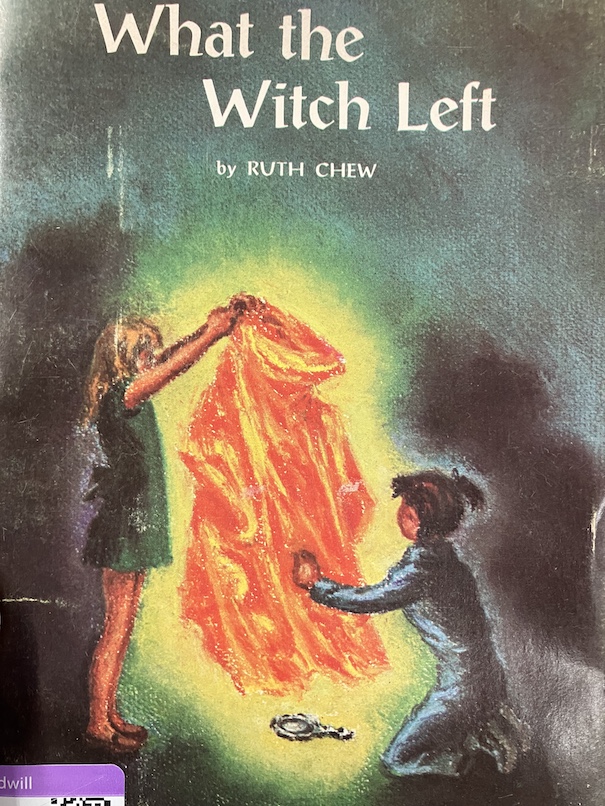
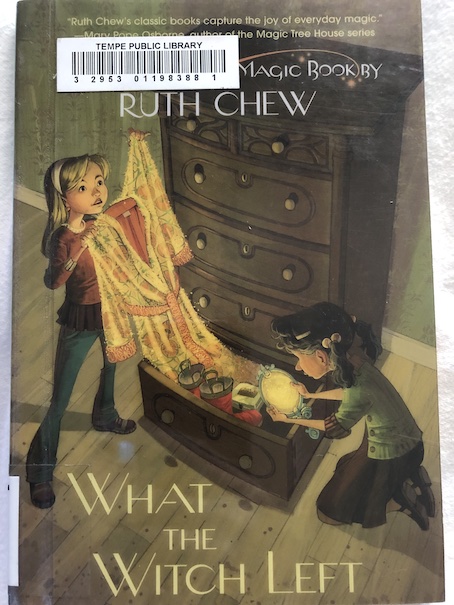
What the Witch Left by Ruth Chew, 1973, 2013.
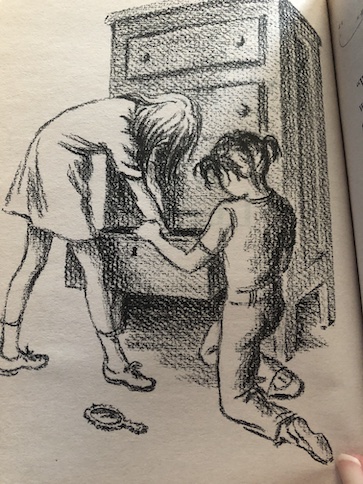
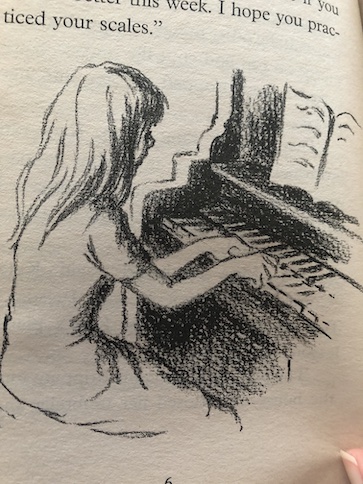
Katy and her friend Louise are bored one day at Katy’s house. They start snooping around a drawer that contains things that Katy’s Aunt Martha left behind after her last visit, even though Katy’s mother told her not to mess with them. At first, they seem pretty ordinary. There’s a pair of boots, a bathrobe with a pretty design, a pair of flesh-colored gloves, and a mirror. Katy tries on the pair of gloves, but to her surprise, they fit so well that they can’t be seen or felt once they’re on her hands. Then, Katy’s piano teacher shows up to give Katy a lesson, and Katy starts the lesson without taking the gloves off. To everyone’s surprise, Katy plays unusually while she’s wearing the gloves. Everyone else just assumes that Katy has been practicing more or trying harder than she usually does, but Katy wonders if the gloves have something to do with it.
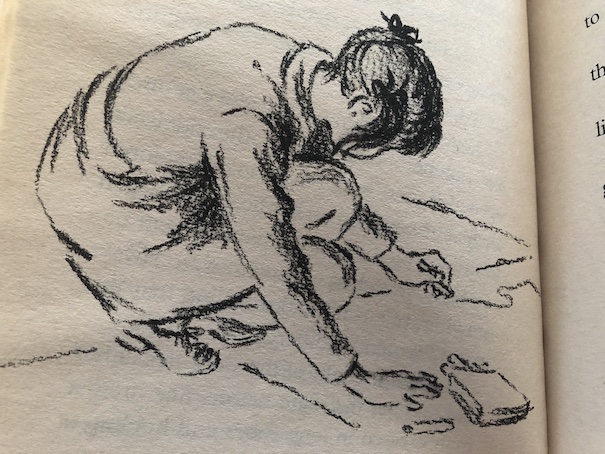
She becomes more sure that the gloves are magic when she discovers that she can do other things unusually well while wearing them. She was never very good at sewing before, but while wearing the gloves, she mends a tear in her dress so well that it’s difficult for anyone to see that it was ever torn. Katy tells Louise that she thinks the gloves are magic and offers to let her try them, too. Louise points out that she’s left-handed while Katy is right-handed, so they can each wear one of the gloves on their dominant hands to test their magic. Like Katy, Louise finds that she can do things unusually well while wearing one of the gloves. She likes to draw chalk pictures on the sidewalk, and while wearing one of the gloves, she makes a drawing so realistic that total strangers stop and tell her how amazing it is. When the girls get to school, they both easily pass their spell test with perfect scores, and they have no trouble writing an essay in class, even though they don’t really understand or remember everything they wrote when they’re done.
It seems like Katy is right that the gloves are magic, but they soon realize that there are drawbacks to relying on magic to do all of their work for them. It turns out that the girls not only wrote the essay too easily but, because they were sharing the pair of gloves, they wrote identical essays. Their teacher accuses one of them from cheating in class and moves Katy to a different seat. Since Katy had more trouble pronouncing the words in the essay that she didn’t really write herself, the teacher also decides that she was the one who copied and assigns her an extra punishment. However, Katy admits to Louise that she’s not really angry about being punished because, although she didn’t cheat in the manner the teacher thought she did, wearing the gloves and making them do her work for her was still a kind of cheating. The girls decide not to wear them to class anymore, although they do wear them while working on their costumes for the school’s Thanksgiving play because they need help with sewing.
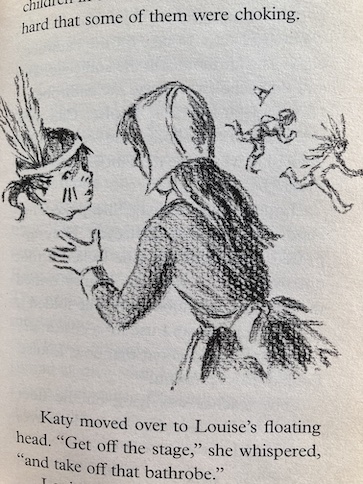
Before the play, Louise’s mother tells her that she took the wrong blanket for her Indian (Native American) costume and tries to give her another one to use that doesn’t look as good. Louise is upset because she had gotten her costume looking so good, and she doesn’t want the old army blanket her mother gave her. Katy offers to let Louise use Aunt Martha’s colorful bathrobe for her costume instead, but unbeknownst to the girls, the bathrobe is also magical. They realize it for the first time when Louise walks out on stage during the Thanksgiving play and is completely invisible except for her head, the only part of her not covered by the bathrobe. Some people panic when they see Louise as just a floating head, while others assume that it’s a magic trick to spice up the play. Katy and Louise let everyone think it was just a magic trick and are mysterious about how they accomplished it, but this incident makes them realize that everything Aunt Martha left behind is probably magical in some way.
Louise asks Katy more about her Aunt Louise, but Katy admits that she doesn’t really know much about her. She’s not really a relative, just a friend of her grandmother’s, and she and her mother call her Aunt Martha out of habit. They decide to investigate the rest of the items in the drawer, but they know they have to be careful about how they do it to avoid causing chaos or attracting too much attention from other people.
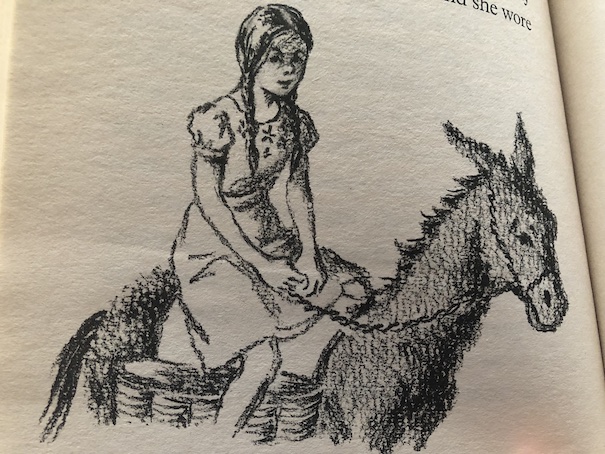
Investigating Aunt Martha’s magical items leads the girls on fun adventures. The boots turn out to be seven-league boots, and Louise and Katy decide to test them by walking to Florida to go swimming in November. However, they go the wrong way and end up in Mexico instead. There, they meet a girl named Pilar. They help Pilar to weave some straw place mats with the help of their magic gloves, and Pilar lets them ride on her donkey, Pepe.
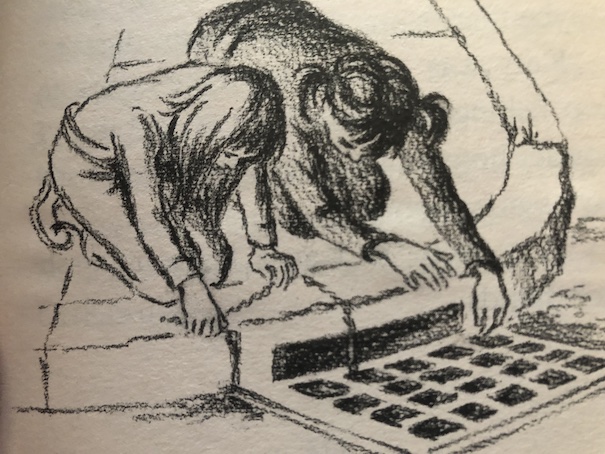
The girls start to suspect that Aunt Martha is actually a witch, based on her magical objects and Katy’s mother’s description of her. The girls panic when they accidentally lose the key to the drawer with all the magical objects in it down a drain, and Katy’s mother gets a letter saying that Aunt Martha is coming to visit. What will the girls do if Aunt Martha discovers that they’ve been using her magical objects, and what if they have to admit that they lost the key to the drawer?
The book is available to borrow and read for free online through Internet Archive (multiple copies).
My Reaction and Spoilers
Ruth Chew is known for writing stories about magic and witches for kids, but what I like about these stories is their gentleness. I think that’s also part of what makes other people nostalgic for these books because they’re very gentle and comforting to read. The kids in the stories have magical adventures, and they get into some minor trouble because of them, but nothing really stressful or dangerous happens. It’s a relatively low-stakes adventure, but sometimes, that’s exactly what you want when you want to relax. Things generally work out well in the end, and it wouldn’t be a bad story to read to kids as a bedtime story.
Aunt Martha is a witch, but she’s a nice witch. She knows what the girls have been doing, and she doesn’t mind. In fact, it is implied that she left these items there for Katy to use one day. It isn’t fully explained why she did this or just how much she knows about the girls’ activities. It seems like their adventures were basically the end in and of themselves, like Aunt Martha just wanted Katy to have some magical fun. That’s typical of Ruth Chew’s magic books. They don’t often explain much about the origins of the magic, and things are often wrapped up at the end without the characters really knowing everything. The characters don’t really seem to mind not getting all the answers because they’ve had their fun, and they’re satisfied with that.
This book has a typical Thanksgiving play of the kind held by many American schools in the mid-to-late 20th century. I’m not sure what schools do in the 21st century, but I also remember plays with Pilgrims and Indians (Native Americans) from when I was a kid in the 1980s and early 1990s. By the time I was in school, teachers were urging kids to use the term “Native Americans” instead of “Indians”, although people were still saying “Indians” as the generic because it was what kids heard from tv, books like this, and things other people said. As an adult, I really do prefer “Native Americans” to “Indians.” It’s a little longer to say when you’re speaking out loud, but it does help to distinguish “American Indians” from Indians from India, and it can be awkward if someone has to ask what kind of Indians you’re talking about. It’s also generally what Native Americans seem to prefer, if someone isn’t naming their specific tribe, and it’s best to call people what they prefer to be called. Nobody in the book discusses this because the Thanksgiving play is just background, an opportunity for the girls to try on the bathrobe and discover that it’s magical because they need something for a costume.

