The Secret of the Haunted Mirror

The Three Investigators

TIHauntedMirror

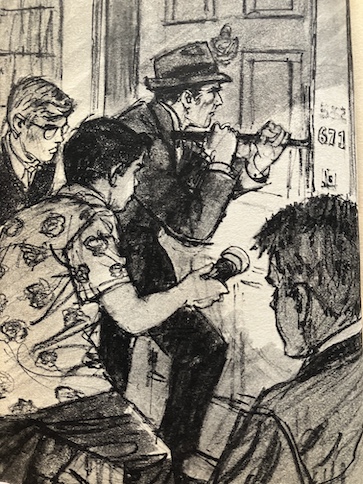
Mrs. Darnley has collected mirrors for years, and she has some pretty impressive ones in her collection. Her strangest mirror by far is the goblin mirror that her friend in another country, the Republic of Ruffino sent to her. There is a legend surrounding the mirror that says it was once owned by magician who used it to communicate with goblins under the earth. Supposedly, the magician went inside the mirror himself and now haunts it.

A man called Sr. Santora has been pestering Mrs. Darnley to sell the mirror to him, claiming he’s a descendant of the magician who created it. He insists that the legends about the mirror are true and that terrible things have happened to previous owners of the mirror. Mrs. Darnley didn’t believe these stories at first, but now, she and her grandchildren have seen this ghost in the mirror and heard unearthly laughter in the night. That isn’t the only strange phenomenon they’ve experienced. Someone tries to steal the mirror from Mrs. Darnley’s house, and Mrs. Darnley, not knowing what to do, asks the Three Investigators to find out what the mirror’s secret really is.

The Three Investigators are pretty sure from the beginning that someone is faking the ghost, although they don’t know exactly how. At first, they think that Sr. Santora hired the man who tried to steal the mirror, but when they follow the attempted thief, Pete sees him attack Sr. Santora!

Jupiter spends a stormy night at Mrs. Darnley’s house and has an encounter with the “ghost” that reveals how the haunting was accomplished and reveals connections to another magician who once owned Mrs. Darnley’s house and to the president of the Republic of Ruffino. It seems that the mirror contains secrets that aren’t entirely magical. There are two competing forces trying possess these secrets.

When Mrs. Darnley’s grandson is kidnapped, the kidnapper demands that she turn over the mirror in an abandoned warehouse. The Three Investigators must hurry to find the kidnapped grandson, discover which side in this power struggle is responsible for the kidnapping, and what the real secret of the mirror is before it’s too late!

The book is available to borrow and read for free online through Internet Archive (multiple copies).

The part I enjoyed the most about this mystery was the creepy legend and haunting of the mirror. One of the features of the Three Investigators books that I like is that they have some spooky mysteries in the pseudo-ghost story fashion of Scooby-Doo, and some of their supposed ghosts and supernatural creatures are much more original than in other series. The idea of a haunted goblin mirror and Jupiter’s encounter with it on a spooky, stormy night are delicious to a Scooby-Doo style mystery fan!

There are echoes of the first Three Investigators book in this one because there are secrets to Mrs. Darnley’s house that she doesn’t fully understand, and the haunting is based on magic tricks. There is some political intrigue to the story, too. The Republic of Ruffino isn’t a real place, so readers find out about its circumstances along with the Three Investigators. There is also a secret room and a clever hiding place for something in the solution to the mystery.

The Mystery of the Talking Skull

The Three Investigators

Jupiter reads in the newspaper about a public auction of luggage abandoned at hotels. He is curious about the auction and persuades Bob and Pete to come with him. On a whim, Jupiter bids on an old trunk at the auction and gets it for a dollar. Even the auctioneers don’t know what’s in the trunk because it’s locked. However, shortly after Jupiter buys the trunk, others show up offering to buy it from him.

It turns out that the trunk used to belong to a magician called the Great Gulliver, who disappeared about a year earlier. His signature trick was a talking skull called Socrates, which is still inside the trunk. The Three Investigators study the skull because Jupiter is curious to see how the trick works, but he can’t find anything about the skull that would explain how the trick was done. However, when the skull begins to speak to the boys, it suggests an even more puzzling mystery.

In the middle of the night, the skull tells Jupiter to go to a certain address and use the skull’s name, Socrates, as the password. When Jupiter goes there, he meets a gypsy fortune teller called Zelda, who tells him that Gulliver isn’t dead but he’s no longer among the living. She also tells him that there are people who want money, but the money they want is hidden. Zelda says that maybe Jupiter can help, and she tells him to protect the trunk and listen to anything else the skull might say.

When the Three Investigators look through the trunk again, they find a letter hidden inside, under the lining. The letter is from a man Gulliver once knew in prison, Spike Neely. The man was dying, and he wanted to tell Gulliver where he hid some money he stole years before. Because he knew the authorities would read any letter he sent, he could only hint at the location. The letter was short, and it doesn’t seem to say much, but The Three Investigators are sure that there’s a clue to where Spike hid the money somewhere in the letter.

However, The Three Investigators find themselves questioning how much they want to investigate this particular mystery. Jupiter was followed by a strange car on the way home from Zelda’s, probably the men Zelda spoke of who are looking for the money. Then, Jupiter’s Aunt Mathilda gets spooked by the skull when it says “boo” to her, and she tells Jupiter to get rid of it. The boys decide to sell the trunk to Maximilian, a magician who was interested in buying it for the sake of the talking skull and other tricks inside. When Maximilian takes the trunk, they think that’s going to be the end of the matter for them, but the next day, Police Chief Reynolds comes to see them because Maximilian was in a car accident. He says that another car forced him off the road and a couple of men stole the trunk!

Chief Reynolds tries to see Zelda, since she seemed to know something about the hidden money, but when he goes to the address where Jupiter met her, Zelda and the other gypsies are gone. Then, somebody mails the trunk back to Jupiter! When the boys open the trunk again, Socrates the skull says, “Hurry! Find–the clue.” It looks like they’re on a hunt for stolen money whether they like it or not!

The book is available to borrow and read for free online through Internet Archive (multiple copies).

The idea of a mysterious talking skull that used to belong to a vanished magician is exciting by itself, and I remember liking this story the first time I read it. As an adult, the parts about the gypsies seem a little cringey, the stereotypical stuff of vintage children’s books. A mysterious fortune teller is compelling and reminds me of similar type characters that appeared in the original Scooby-Doo cartoons, but The Three Investigators aren’t really big on accuracy when it comes to cultural representations. That sort of thing never occurred to me as a kid. All I cared about was an interesting story, and this book does have that. It’s just that, when you’re an adult and you know more about the world, you can tell when a character or culture is really just a cardboard cutout with no depth to it, more of a stock element pulled out of an old bag of tricks, and it hits you differently.

The talking skull element was cool, and I loved the idea of buying a mystery trunk cheaply and finding an amazing mystery in side. It’s the sort of thing I would have loved to do or envision doing as a kid, although in real life, the contents of the trunk would probably have turned out to be far less exciting, like a bunch of rusty hardware or somebody’s collection of water-damaged magazines. It’s that sense that, when you open it, there could be anything inside that’s compelling, and the best books have that sense of anticipation, too.

The solution to this mystery involves the Three Investigators examining the letter to figure out where Spike hid the clue to finding his loot. There is one part of his letter that seems to hint at something personal, a person who doesn’t really seem to exist, but that’s only half of the clue. The other part lies in the stamps he used and also in Spike’s distinctive trait of having trouble pronouncing words with the letter ‘L’ in them. It’s the sort of multi-layered clue that might appear in a Sherlock Holmes story. From there, the Three Investigators have to track down the house that Spike’s sister owned, where he was apprehended after the robbery, which proves more difficult than they anticipated because all of the houses from that neighborhood have been moved to a new location and were given new numbers. There were parts of the treasure hunt that were exciting and others that seemed to drag a little, but there are definitely some violent characters looking for the money, too.

Someone is obviously using the Three Investigators to try to find the money on their behalf, urging them on by using the talking skull, and that adds layers to the mystery. Who is trying to use them to solve the mystery, or is it more than one person or group of people? When people approach them with information or ask for their help, who can they trust? By the end of the story, we do learn where Gulliver is (if you haven’t guess it already) and the full story behind Spike hiding the money and what led to Gulliver’s disappearance.

The Magician’s Nephew

The Chronicles of Narnia

The Magician’s Nephew by C. S. Lewis, 1955.

Although this is not the first book in The Chronicles of Narnia, it takes place earlier in time than the other books and explains much of what happens in the later books. It starts in London in the late 1800s. No exact date is given, but the story says that it’s when Sherlock Holmes was still living in Baker Street and the Bastable Children were hunting for treasure (a reference to a Victorian children’s book by E. Nesbit). In fact, the characters make many other references to popular literature of the period throughout the story.

A girl named Polly Plummer is living in London when a boy called Digory Kirke comes to live with his aunt and uncle in the house next door. Digory is very unhappy because he used to live in the countryside and have his own pony, and he doesn’t like the city. The reason why he has to live with his aunt and uncle is that his father needs to go to India, and his mother is very ill and may die, something that has Digory very worried. He also tells Polly that his aunt and uncle are very strange, and it makes him nervous. His uncle spends most of his time in his study at the top of the house, a room where Digory is forbidden to go, and Digory thinks that there might be some terrible secret there. He once heard what sounded like a scream from that room. There are times when his uncle starts to talk about something while they’re eating together, but Digory’s aunt (his uncle’s sister, not his wife) keeps interrupting him and stopping the conversation before it even starts. The children speculate that Digory’s uncle’s secret might be that he’s keeping a mad wife in the attic (like in Jane Eyre) or maybe he’s involved with pirates, like in Treasure Island. Polly thinks all this secrecy and mysteriousness sounds exciting, but Diory says she might not think so if she had to live in a house like that. His uncle is a sinister person, and Digory thinks he might be mad. After a fashion, Digory is correct.

Digory and Polly become friends and play together over the summer. The weather is frequently rainy, so they spend most of their time inside, exploring their own houses. Their houses are part of a row of adjoined houses, and Polly discovers an attic crawl space that links all of the houses together. The children realize that they can use this crawl space to access other houses in the block. They don’t want to trespass into an occupied house, but there’s an empty house beyond the one where Digory’s aunt and uncle live that’s been empty for years. The children are curious about that house and think maybe it’s haunted, so they decide to use the crawl space to access the empty house. Unfortunately, the children accidentally come out of the crawl space in Digory’s uncle’s secret study.

When Digory’s Uncle Andrew catches the children in his study, he locks them in, saying that children are exactly what he needs for his experiment, and this time, his sister can’t interfere. The children are frightened and ask to leave, but Uncle Andrew offers Polly one of the yellow rings he has on a table. Polly can’t resist touching one of the yellow rings, and she suddenly vanishes from the room. Digory angrily demands to know where Polly went, and Uncle Andrew explains that this is his experiment.

Uncle Andrew calls himself a scholar, but he’s also a magician, and he’s been experimenting with dangerous magic. When he was young, he had a godmother named Mrs. Le Fay. Mrs. Le Fay was a somewhat disreputable person who had been to prison (for things that Uncle Andrew doesn’t want to explain), but she was always nice to Andrew because they shared common interests. Their interests were magic and esoteric knowledge. Mrs. Le Fay was one of the few living humans who had some fairy blood in her, so she was Andrew’s “fairy godmother.” Before she died, she gave Andrew a strange box and told him to destroy it using a magical ritual after her death. Of course, Andrew broke his promise and kept the box to study it. Uncle Andrew thinks of himself as a great scholar and researcher, and things like promises and ethics and even the welfare of other human beings are not going to stand in the way of his pursuit of arcane knowledge.

After spending considerable time studying the box, he realizes that it was made in the ancient land of Atlantis, but more than that, the contents, a set of yellow and green rings, came from another dimension, another world in another universe. Uncle Andrew realized that the rings would allow a person to access that other dimension. The yellow rings would send people to the other dimension, and the green ones (he’s pretty sure) allow them to return from that dimension. Naturally, he thought of himself as too important to risk in the experiment, so he needed to send someone else instead. He tried it at first with guinea pigs, but he couldn’t tell the guinea pigs what to do to come back, so he realized that he needed to send humans. Now that he has tricked Polly into going, he says that the only way Polly can come back is if Digory goes, too, and brings her one of the green rings that she can use to return. Digory is angry at his uncle for trapping them in this way, but since he knows his uncle won’t rescue Polly, he agrees to go find her.

After using one of the yellow rings himself, Digory finds himself coming out of a pool in a strange forest. Polly is there, but something about this forest muddles their minds so they have trouble remembering who they are, where they’re from, and what they’re supposed to do. After talking to each other awhile, they remember. They’re about to return to their own world by putting on their green rings and stepping into the pool they both came from when Digory realizes that there are other pools around them that could lead them to other worlds. Digory is excited and wants to explore these other worlds, but Polly sensibility insists that they carefully mark the pool that will take them home and test it to make sure that it will allow them to return before they try going to a different world. They change rings before they are fully in their own world again, so they won’t immediately return to Uncle Andrew before they’ve fully understood what these other places are and what they’re about.

When the children try entering a different world, they find the ruins of an ancient palace and city. There is no one around, and it looks like it’s been dead or abandoned for ages. Exploring the palace, they find a collection of statues in royal clothes and crowns. Some of the statues seem to have kind and wise faces, while others are cruel and distressed. Then, the children see a little bell and a hammer with a warning on the bell in a strange language that the children are somehow able to understand. Polly thinks that they should leave the bell alone, but Digory feels a strong urge to strike the bell and see what happens. Digory grabs Polly’s arm to stop her from leaving this ruined world and strikes the bell. Almost immediately, the children realize that this was a terrible choice.

The bell wakes one of the statues, a tall and beautiful but cruel woman who says that she is Jadis, the last queen of this world. Digory finds her impressive at first, but that feeling turns to horror as she tells them her story. Jadis says that she and her sister were fighting for the throne, and her sister’s forces were winning. As she stood on the brink of defeat, Jadis used a terrible spell that immediately killed everyone in their world except herself, including her sister, her forces, and all of the citizens. Jadis says that the citizens served no other purpose than to serve her anyway, since she is rightful queen, and she blames her sister for not simply giving her the crown when she demanded it. After everyone was dead in her world, Jadis put herself into a magical sleep until someone came to wake her up. When she has finished telling the story, Jadis commands the children to take her to their world so she can rule them instead.

Polly and Digory try to use their magic rings to escape from this terrible queen, but Jadis grabs hold of them and is brought to Earth anyway. Although Jadis’s magical powers don’t seem to work on Earth as they did in her world, she is still unnaturally strong and formidable. She is as cruel, selfish, and vain as Uncle Andrew, but she could easily wipe the floor with him, if she wanted to. Uncle Andrew’s initial joy at his experiment being an unqualified success that actually bought someone from another world into his world turns to panic when he realizes that Jadis is more than he can control and regards him as no more important than one of his guinea pigs was to him. Digory apologizes to Polly for ignoring her warnings and waking Jadis, and the children try to figure out how they can get rid of her before she can take over their world.

My Reaction and Spoilers

I didn’t read this book when I was a kid, but I’m glad I did as an adult because I enjoyed it, and I appreciated the explanations behind some of the things that happen or exist in the other stories. Digory Kirke is actually the old professor the Pevensie children go to stay with in the country when they are evacuated from London during WWII in the first book in the series, The Lion, the Witch, and the Wardrobe. We also learn that he and Polly actually witness the creation of Narnia when they try to get Jadis back to her own, crumbling world. Jadis was inadvertently responsible for the lamppost that the Pevensie children find in the woods when they first visit Narnia. Jadis also becomes the White Witch who tries to make herself Queen of Narnia. At the end of the book, we also learn the origins of the magic wardrobe and what makes it so special.

There are Biblical themes throughout the story, but especially around the creation of Narnia and the mission that Aslan gives Digory to make up for accidentally bringing Jadis to Narnia. Narnia’s creation isn’t quite like the Biblical creation story. In this book, Aslan the Lion sings Narnia into existence. However, there is a pairing up of animals that almost mimics the pairs of animals being chosen for the Ark in the Noah story.

After Digory admits that he is the one who brought Jadis to this new world, Aslan sends him to fetch an apple from a distant garden, from which Aslan says he will plant a tree that will protect Narnia for years. The apple and the garden mimic the story of the Garden of Eden. The garden has a fence around it with a warning about trespassing and stealing fruit for selfish purposes. Digory retrieves the apple that Aslan asks for, and he is tempted to take one himself, but before he can go much further with that thought, he catches Jadis in the garden, stealing an apple for herself. When Jadis eats the apple, it turns her into the pale witch she becomes. Jadis says that she will now live forever and never age. She tries to convince Digory to eat the apple he has picked or give it to his ill mother, but Digory successfully resists the temptation. Aslan tells Digory that it is good that he resisted the temptation because, while the fruit would grant eternal life to whoever eats it, it comes with a heavy price if the fruit is obtained through dishonest means. Jadis/the White Witch is granted unnaturally long life, but she is never the same again. Aslan does give Digory the means to heal his mother before he returns home.

I really liked the children’s hideout in the crawl space that spans the houses. They use the crawl space and its relationship to the houses to explain how there can be parallel worlds that can be connected, but I like the setting so much that I would have liked to see a children’s mystery or adventure story in a similar setting. I found myself wondering what would have happened if the children had managed to reach the empty house they wanted to enter and explore. They never did because they got into Uncle Andrew’s study by mistake, but I think it’s fun to imagine what they would have done if they had. Maybe they would have turned it into a secret hideout, or maybe they would have encountered criminals who had already turned it into their hideout. Maybe someone would eventually buy the house and move in. The whole setup offers possibilities.

The Magician’s Company

The Magician’s Company by Tom McGowen, 1988.

This is the second book in the Magician’s Apprentice trilogy.

The story picks up where the previous book left off. Armindor the Magician, his apprentice Tigg, and their friend Reepah, who is a creature called a grubber, are on their way home with the “magical” devices that they retrieved in the last book, taking them back to their Guild for investigation. On their way home, they pass through a land consumed by civil war, and they pass a wagon surrounded by dead bodies. They can tell that the people were civilians, probably entertainers, and further down the road the find a young girl about Tigg’s age (around 12 years old), struggling along, carrying her belongings. They ask the girl about herself, and she breaks down crying, telling them how she and her family were fleeing the war, but her aunt and the other members of their puppeteer troupe were murdered by soldiers. The girl, whose name is Jilla, survived by hiding in a secret compartment in their wagon. After her aunt and the others were killed, Jilla gathered up what she could, taking the puppets that would help her to earn her living and a few other belongings not stolen by the soldiers, determined to continue her journey to a safer place, like the city of Inbal.

Armindor and Tigg have horses, and they offer to help the girl on her way to Inbal, a city in another territory. Along the way, Tigg tells Jilla the story of their previous adventures, and Armindor invites Jilla to stay with them awhile longer and even come home to Ingarron with them because it would be very difficult for a young girl to manage on her own in a strange city. Jilla is happy to stay with them because she is thankful for their help and worried about managing on her own yet.

In Inbal, Armindor and Tigg visit the sages in the city to show them their discoveries. They speak to Tarbizon, an old friend of Armidor’s, showing him what they found and explaining the threat posed by the reens, a species of intelligent but diabolical creatures that evolved/mutated from rats, have the ability to talk, use blowguns with poisoned darts, and are plotting to take over the world. (Yes, really. Even they think it’s weird.) Before they continue their journey to Ingarron, they decide to stay in Inbal for the winter because it would be difficult to travel until spring. Someone breaks into the place where they are staying and goes through their belongings. They have no idea who did it, but apparently, whoever it was didn’t find what they were looking for because nothing seems to be missing. Since they will be staying in the city for awhile, they decide to rent a house instead of staying in the guestinghouse (inn) where they have been staying.

While they are looking for a house to rent, Tigg is kidnapped. Fortunately, Reepah is able to sniff out where he is. Armindor pretends that his “magic” is what told him where his apprentice was in order to intimidate the kidnapper. Caught and frightened of the magician’s powers, the kidnapper admits that he was paid to abduct Tigg by Pan Biblo, who is the head servant of Councilor Leayzar, who is part of the High Council of Inbar and who has convinced the other sages that the reen do not pose a serious threat in spite of Armindor’s warnings. When they rescue Tigg, Tigg says that a man had questioned him about the spells that he and Armindor retrieved from the Wild Lands and Armindor would be willing to trade them for Tigg. From this information, Armindor realizes that Leayzar wants the lost technology they’ve discovered, but he can’t figure out why. It doesn’t take long for Armindor to realize that Leayzar is working with the reen. The reen have hired humans to work for them before, and they desperately want pieces of lost technology in order to gain dominance over humans.

Armindor and the others go to the sages in the city and tell them what they’ve discovered about Leayzar, and the other sages take it seriously. Some of them wonder why Leayzar would want to ally with a group that is an enemy of his own species, but Armindor says that it’s hard to say because they don’t know what the reen told Leayzar. Maybe Leayzar doesn’t understand what the reens’ full plans are and whatever they promised him in return was just too compelling to resist. At the end of the previous book, some of the weenitok gave Armindor a sealed box that they found, left over from the end of the Age of Magic. The sages decide that it’s time to open the box and study its contents in the hope of getting some answers. If the last book didn’t fully establish that their world is our world in the far distant future, the contents of the box explicitly state it.

Inside the box, there is a recorded message from the year 2003 (the future at the time this book was written, but the past to us in early 2021, and it’s interesting what this message has to say about the world in 2003). The message is from Dr. Dennis Hammond of the National Science Foundation Project for the Preservation of Civilization. He says that there has been a war between the “Pan-Islamic Brotherhood” (the closest real-life equivalent would probably be the Muslim Brotherhood, but that’s more of a social/political movement or terrorist group (depending on who you ask) rather than an official alliance of nations) and the United States and its allies, including Canada, Europe, China, and the Soviet Union (which stopped existing just a few years after this book was published in real life and would just be called Russia in 2003). Dr. Hammond says that thermonuclear war is pending, and he and other scientists are worried because they think the resulting destruction will be the end of civilization as they know it. (He doesn’t explicitly say this is World War III, but that’s basically what it amounts to. In real life, we haven’t actually had World War III yet as of early 2021, although in 2001 and the following years, there was some speculation that the destruction of the World Trade Center and other terrorist attacks might eventually lead to World War III, so it seems that the author has caught on to a source of world tension even if he didn’t predict how it would come out.) In order to preserve existing knowledge about science and world history, they made a series of these boxes containing small computers designed to last for about 10,000 years and hid them at various locations around North America (so now we know roughly where these characters are) so that future generations that find them will have access to knowledge that may have been lost. The computers even contain language tutorials just in case language has changed too much for this speech to be understandable. It’s fortunate that the early 21th century scientists thought of that because it turns out that none of the sages understood a word of what the voice in the box said. The readers now understand the full situation, but the characters don’t.

Everyone is astonished at this talking box. They’ve never even heard of such a thing, and they think that it must be a “spell” from a past “magician”, which he created to preserve his voice. They understand that the voice is speaking an unfamiliar language, and there is a picture on the included screen showing a finger poking one of the buttons in the box, so they get the idea that the box wants them to press buttons. When Armindor presses the red button indicated, the computer in the box begins a simple language tutorial, showing them pictures of familiar things and saying their names, like “sun” and “cloud.” The sages understand that they’re being taught an ancient language, and they quickly begin taking notes. Armindor is moved to tears because this is exactly what he has been hoping to discover for years, the secrets behind all of the ancient “magic.” They can tell that the “magician” who made the box was trying to teach them, and they’re more than ready to learn!

But, there is still the matter of Leayzar and the reen to deal with. When they learn that Leayzar is looking for Armindor, Jilla suggests a cover they could use to hide their identities: becoming a troupe of puppeteers with her puppets! Becoming puppeteers also gives them the opportunity to spread word of the reen threat to the public through their puppet plays.

The book is available to borrow and read for free online through Internet Archive.

My Reaction

I said in my review of the last book that Armindor and Tigg don’t find any easy answers or any miraculous device that instantly solves all of their society’s problems and launches them back into an age of technology. The computer in the box comes the closest to that, but it’s still not an easy answer because Armindor and the other magicians and sages of his time can’t understand the language it uses or how the computer works when they first find it. They understand enough to know that it’s trying to tell them something and that its creators are trying to teach them how to understand and use it, but it’s going to take some time before they reach the point where they will understand enough of the language to figure out all of the information that the computer has to share. There will be enough work cut out for future “magicians” (really, scientists) of their time, like Tigg, to figure out how the computer works, what information it has to share, and how they can teach the rest of their people what they’ve learned. It’s a turning point in their history, but it’s not an instant solution. Plus, although the characters don’t really understand it at first, the readers are told that there are other boxes that are still waiting to be found. Do these boxes all contain the same information, or are there other pieces of knowledge in each one? There are plenty of secrets for a new generation of scientist/magicians to unravel.

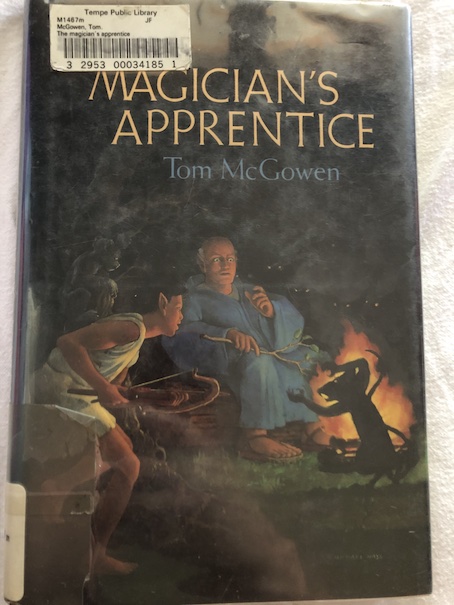
The Magician’s Apprentice

The Magician’s Apprentice by Tom McGowen, 1987.

From the title of this book and others in this series, it sounds like the stories take place in a fantasy world. When you’re reading this book, it seems like fantasy at first, but it’s not. It’s actually science fiction.

Tigg is a poor orphan boy who makes his living in the city of Ingarron as a pickpocket because he has no other means for survival. One night, he notices that a sage has left the door to his house open, and although it’s a risk, he decides to enter and see if he can find anything worth stealing. The sage, a man called Armindor the Magician, catches Tigg. In fact, Armindor had deliberately left the door open for Tigg to enter. When, Armindor questions Tigg about who he is, Tigg says that he’s about 12 years old (he’s unsure of his exact age and defines it in terms of “summers”) and that he has no family that he knows of. He lives with an old drunk who makes him pay to live with him with the money he steals.

Tigg asks Armindor what he plans to do with him. He can’t really punish him for stealing from him because Tigg hadn’t had a chance to take anything of Armindor’s before he was caught. Armindor says that’s true, but he was planning on stealing something, so Armindor tells him that he will do the same to him – plan to take something he has while still leaving him with everything he has. Tigg is confused, and Armindor explains his riddle. He witnessed Tigg picking someone else’s pocket and was intrigued by the boy because he seemed to possess courage, wit, and poise. He left his door open for Tigg because he has been looking for a young person with those qualities to be his apprentice. If Tigg becomes his apprentice, he will have to put his good qualities to use for him, but yet, he would keep these qualities for himself as well.

Tigg likes the praise but has reservations about becoming a magician’s apprentice because an apprenticeship would limit the freedom he currently has. His current existence is precarious, but the long hours of work and study involved in an apprenticeship sound daunting. However, Armindor isn’t about to let Tigg get away. He takes a lock of Tigg’s hair and a pricks his thumb for a drop of his blood and applies them to a little wax doll. He tells Tigg that the doll is a simulacrum and that it now contains his soul, so whatever happens to the doll will also happen to him. If Tigg runs away from his apprenticeship, Armindor can do whatever he likes to the doll as his revenge or punishment. Tigg, believing in the power of the simulacrum and feeling trapped, sees no other way out, so he becomes Armindor’s apprentice.

Although Tigg is fearful and resentful of his captivity as Armindor’s apprentice, it soon becomes apparent that life with the magician is better than what he used to have living with the old drunk. Armindor gives him a better place to sleep and better food. There is work and study, but it’s not as difficult or unpleasant as Tigg first thought. At first, he is daunted at the idea of learning to read and do mathematics, but Armindor is a patient and encouraging teacher, and Tigg soon finds that he actually enjoys learning things he never thought he would be able to do.

Armindor’s magical work seems to mainly involve healing sick people. When people come to him with illnesses, he gives them medicines that he calls “spells.” He keeps a “spell book” with instructions for remedies that he’s copied from other sources. Armindor teaches Tigg about the plants he uses in these spells. Armindor also does some fortune-telling, and he teaches Tigg that, too.

However, Tigg is still uneasy because, although Armindor treats him well, he still has that simulacrum of him, and he can also tell that the money he takes in doesn’t seem to account for his personal wealth. Armindor sometimes goes to meetings with other sages, and Tigg is sure that they’re doing something secret.

It turns out that Armindor is planning a special mission involving Tigg, one that will take them on a journey through uninhabited lands to the city of Orrello. Tigg realizes that if he leaves the city with Armindor, he will be committed to whatever secret plans Armindor has. At first, Tigg wants to take the simulacrum and escape, but when Armindor intentionally leaves the simulacrum unguaded where Tigg can easily take it, Tigg realizes that Armindor is telling him that he’s not really a captive and that Armindor is giving him a choice, trusting him to make the right one. Tigg realizes that he likes being trusted and that he trusts Armindor, too. He decides to stay with Armindor as his apprentice and go with him on his mission.

Tigg and Armindor leave town with a merchant caravan. On the way, the caravan encounters a wounded creature called a grubber. Grubbers are described as furry creatures about the size of a cat and have claws, but they have faces like bears and walk on their hind legs and may be intelligent enough to make fire and have their own language. One of the soldiers with the caravan things that the grubber is wounded too badly to save and wants to put it out of its misery, but Tigg insists on trying to save it. Armindor treats the grubber for Tigg, and it recovers. It is intelligent, and Tigg teaches it some simple human words, so they can talk to it. He tells them that his name is Reepah because grubbers have names for themselves, too. Armindor asks him if he wants to return to his own people when he is well, but by then, the caravan has taken them further from the grubber’s home and people, and he says that he doesn’t know the way back, so he’d like to stay with Armindor and Tigg, which makes Tigg happy.

However, Tigg soon learns that their journey has only just begun. They’re not stopping in Orrello; they’re just going to get a ship there to take them across the sea. Their eventual destination is the Wild Lands, an uninhabited area said to be filled with monsters and poisonous mists. Tigg is frightened, but also feels strangely compelled to see the place and have an adventure. Armindor finally explains to Tigg the purpose of their secret mission.

Years ago, there was another magician in Ingarron called Karvn the Wise, and he possessed some rare “spells” that no one else had. Armindor now has one of these “spells”, which he calls the “Spell of Visual Enlargement.” Tigg describes it as looking like a round piece of ice, and when he looks through it, things look much larger than they really are. Tigg is amazed.

Anyone reading this now would know from its description that what Armindor has is a magnifying lens. Tigg and Armindor don’t know the words “magnifying lens”, which is why they call it a “spell”, but that’s what they have. This is the first hint that this book is actually science fiction, and the “spells” are really pieces of lost technology and knowledge that are being rediscovered. One of Arthur C. Clarke’s Three Laws of science fiction is “Any sufficiently advanced technology is indistinguishable from magic.” Armindor the Magician thinks of himself as practicing magic with “spells” because he’s doing things and using things he can’t fully explain, but he’s actually a doctor and scientist. He doesn’t fully understand why these things work like they do, but he’s investigating how different forms of science, technology, medicine, and knowledge work, and he’s passing that knowledge along to his student and assistant, Tigg. So, you might be asking at this point, who made the magnifying lens and why doesn’t Armindor understand exactly what it is?

Armindor knows enough to understand that the lens is made of glass, not ice. He knows what glass is, but he says that their people don’t have the ability to make glass that clear and pure themselves. This lens is the only one of its type they have, and it’s more than 3000 years old, from what Armindor calls the “Age of Magic.” Tigg has heard stories and legends about the Age of Magic, when people apparently had the ability to fly through the air, communicate over long distances, and even visit the moon. The events that brought an end to the “Age of Magic” were “The Fire from the Sky and the Winter of Death.”

Spoiler: I’m calling it a spoiler, but it really isn’t that much of a spoiler because, by the time you reach this part in the story, it starts becoming really obvious, even if the characters themselves don’t quite know what they’re describing. This fantasy world is our world, but far in the future. For some reason, thousands of years in the future, so much of our knowledge and technology has been lost, society has reached the point where people don’t know what magnifying lenses are. Also, there are creatures in this world, like grubbers, that don’t exist in other times. Something major must have happened, and it doesn’t take too long to realize what it was. Even when I read this as a kid in the early 1990s, I recognized what the characters are talking about. This book was written toward the end of the Cold War, in the 1980s, and the concept of nuclear winter was common knowledge at the time and something that was pretty widely talked about and feared, even among kids. We know, without the characters actually saying it, that the winter was caused by nuclear weapons rather than an asteroid striking the Earth because Armindor knows from writings that he’s studied that animals mutated after the “Fire from the Sky.” An asteroid or massive eruption can cause climate change due to debris in the air, but they wouldn’t cause mutation like the radiation from a nuclear explosion would. People also mutated, and Tigg and Armindor and other people now have pointed ears. People have been like that for so long, they think of it as normal, and it’s only when Armindor explains to Tigg about the concept of “mutation” that Tigg wonders what people in the past looked like.

Armindor explains that Karvn had a nephew who was a mercenary soldier. One day, this nephew came home, seriously wounded. He died of his wounds, but before he died, the nephew gave Karvn this lens, explaining that it came from a place in the Wild Lands. He said that there were many other types of “spells” and magical devices there left over from the Age of Magic. The nephew and his friends had hoped to make their fortune selling the secret of this place, but there was a battle, in which the nephew was seriously wounded and his friends were killed. He told Karvn where to find this place in the Wild Lands, but Karvn was too old to make the journey himself. He wrote an account of his nephew’s story, and after his death, all of his belongings and writings became property of the Guild of Magicians, to which Armindor also belongs. Armindor has studied Karvn’s writings, and he thinks he knows where to find this place with magic and spells, and he is going there to claim whatever he can find on behalf of the Guild.

There is danger on this journey. These lands, which Armindor says were once one country long ago, are now smaller countries that war with each other. (This is probably the United States and the different lands were once individual states. When they travel across water, I think they’re crossing one of the Great Lakes, although I’m not completely sure. The author lived in Chicago, so I think that might be the jumping off point for the crossing.) There are bandits and mercenaries and the strange creatures that inhabit this land, and it’s difficult to say whether there is more danger from the creatures or the humans.

This book is available to borrow and read for free online through Internet Archive.

My Reaction

I remembered this series from when I was a kid. It made a big impression on me because of the way that technology was treated as magic. The types of futures depicted in science fiction books, movies, and tv series can vary between extremely advanced technology and civilization, like in Star Trek, and this kind of regression to the past, where even simple forms of technology that we almost take for granted today seem wondrous and are the stuff of legends. Nobody knows what the future actually holds, but I thought this series did a nice job of showing how people who had forgotten much of the everyday knowledge of our time might think and feel when encountering it for the first time, knowing that people who lived in the past were once able to make these amazing things themselves and use them every day.

Because of the mutations that have taken place in animals, probably due to radiation from nuclear fallout, some types of animals have become intelligent. The grubbers, who call themselves weenitok, are peaceful, but the reen (which Armindor realizes are a mutated variety of rat) actually want to gain access to old technology so they can conquer the humans and take over the world for themselves. These are Armindor and Tigg’s worst enemies, along with the human they’ve hired to do their dirty work. (Yes, the mutated rats are paying a human mercenary. Even the characters in the book realize that’s weird.)

When Tigg and Armindor finally reach the special place with the magical devices, it turns out to be an old military base. Much of what they find there has been destroyed by time. Armindor tells Tigg to look for things that are made out of glass, metal that hasn’t corroded, or “that smooth, shiny material that the ancients seemed so fond of” (plastic) because these are the things that are most likely to still be usable. Tigg makes a lucky find, discovering a “Spell of Far-seeing.” It’s a tube that can extend out far or collapse to be a smaller size, and it has glass pieces similar to the magnifying lens, and when you look into it, it makes things that are far away look much closer. (Three guesses what it is.) Tigg also discovers a strange, round object with a kind of pointer thing in the middle that moves and jiggles every time the object is moved but which always points in the same direction when it settles, no matter which way the object is turned. Most of what they find isn’t usable or understandable, but they do find four other objects, including a “spell for cutting” that Armindor thinks that they might actually be able to duplicate with technology and materials that their people have. Each object that they find is described in vague terms based on its shape and materials because Armindor and Tigg don’t know what to call these things. Modern people can picture what they’ve found from the descriptions, and it isn’t difficult to figure out what they’re supposed to be. Sometimes, Armindor and Tigg can figure out what an object is supposed to do just by experimenting with it, but others remain a mystery. Armindor explains to Tigg that is what magicians do, investigate and solve these types of mysteries, “to take an unknown thing and study it, and try it out in different ways, and try to think how it might be like something you are familiar with.” (They’re using a form of reverse engineering.) Tigg decides that he really does want to be a magician and make this his life’s work. He’s going to become a scientist.

I liked it that none of the objects they find are any kind of advanced super weapon or a miraculous device that instantly solves all of their society’s problems and launches them back into an age of technology (although there is an odd sealed box that proves to be important in the next book). There are no easy answers here. In the grand scheme of things, they risked their lives for things that nobody in modern times would risk their lives to retrieve, but they have to do it because, although these things are common in our time, they are unknown in theirs. If they can figure out not only how the objects work and what they were supposed to do but why they work the way they do, they can gradually rebuild the knowledge of the past. The objects that they find are generally useful. Some are labor-saving devices, some are examples of scientific principles they would use to create other things (demonstrating concepts like optics and magnetism) and one is a medical device, which if they can figure out how to use it, will help advance their medical knowledge and treatments.

One of the fun things this book inspired me to do was to look at the world around me while imagining that I had never seen some of the basic objects in the world before. This could be a fun activity to do with kids, something like the archaeology activity that some teachers of mine did with us years ago, where we had to intentionally create objects from some kind of “lost” civilization for our classmates to analyze, to try to figure out what they were supposed to do and how that civilization would have used them. But, you don’t even have to create anything if you use your imagination and try to think what a traveler from another time or another world might think if they saw some of the things in your own home right now. Imagine what someone from a world without electricity would think of something even as basic as a toaster. How would you explain such a thing to someone who had never seen anything like it?

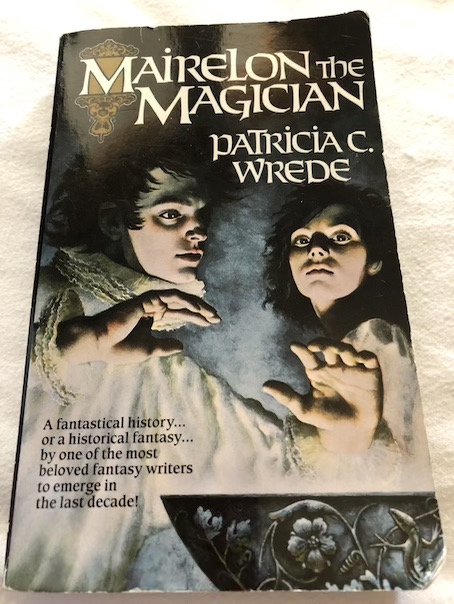
Mairelon the Magician

Mairelon the Magician by Patricia C. Wrede, 1991.

This young adult book takes place in an alternate history version of Regency England.  In this world, magic is a normal and accepted part of society.  “Wizard” is an accepted profession, and there is even a Royal College of Wizards dedicated to magic.  Not everyone can be a wizard because not everyone has the ability to use magic.  It is a skill that people are either born with or born without, similar to people who have an innate talent for art or music, compared to people who are born tone-deaf or color-blind.

In this early 19th century world, there is a teenage girl, Kim, who lives on the streets and survives by her own wits, taking whatever jobs she can and committing a little petty thievery whenever she needs to.  She has spent most of her life dressing like a boy and pretending that she is one because life on the streets is even more precarious for a girl.  For a time, she was part of a gang of child thieves run by a woman call Mother Tibb.  As far back as Kim can remember, Mother Tibb was the only one who took care of her as a child.  Kim has no memory of her parents or any knowledge about what happened to them.  She doesn’t even have a last name.  However, before the story begins, Mother Tibb was caught and hanged for her crimes.  Some of the other child thieves were apprehended and put in prison or exiled to Australia, but Kim managed to escape.  Since then, she has been on her own.  So far, she has managed to avoid being pressured in to joining up with other gangs or turning to prostitution to survive, but the fear of that haunts her. Her future is uncertain.

At the beginning of the book, Kim is hired to sneak into the wagon of a traveling magician who is performing in the market and to see what he keeps among his belongings.  The man who hired her doesn’t want her to take anything, but he is particularly eager to see if the magician has a particular silver bowl in possession.  It’s a strange request, but the money that the man offers Kim is too good to pass up.

However, the magician, who calls himself Mairelon, isn’t quite what he seems.  He is not just an ordinary traveling entertainer using some sleight of hand to amuse people in the market.  Kim discovers that he can do real magic as she searches his wagon and is knocked unconscious by a real magical spell that Mairelon uses to protect his belongings.

When Kim wakes up, Mairelon and his servant, called Hunch, have tied her up.  Unlike Hunch, Mairelon has also realized that Kim is actually a girl, not a boy.  The two of them question Kim about why she sneaked into the wagon, and she tells them the truth about being hired to do it.  When she describes the man who hired her, it seems that Mairelon recognizes the description.  The part about the silver bowl also unnerves him.

Surprisingly, Mairelon makes Kim an offer to come with him and Hunch when they leave London.  He is fascinated by Kim’s skills in picking locks, even the lock on the booby-trapped trunk that knocked her unconscious, and he thinks that Kim might be useful to him and Hunch, perhaps helping with the magic act.  In return, he offers to teach Kim some of his magic tricks.  Hunch is dubious about Kim because she has obviously been a thief, and Kim also isn’t sure what to make of Mairelon.  She knows that he’s hiding something, but she isn’t sure what.  No one with real magical abilities like him would ordinarily be making a living with simple magic tricks in the market. 

However, Kim does accept the offer because she’s been worried about one of the major criminals in the area, Dan Laverham, who has been showing too much interest in recruiting her. He is heavily involved with a number of criminal activities, and he knows that Kim is a skilled lock pick.  If he found out that she was a girl, he would probably also press her into prostitution. Dan Laverham would be a good reason to get out of London for a while.  Also, Kim realizes that if she learns a few magic tricks from Mairelon, she might be able to set herself up as an entertainer and make an honest living, safe no matter who finds out that she’s female.  Besides, Kim realizes that if she’s not satisfied with the situation, she could always run away later.

Before leaving London with Mairelon, she returns to the man who hired her, at Mairelon’s suggestion, and tells him that she didn’t see a silver bowl in Mairelon’s wagon (which is true because she was knocked unconscious and didn’t see anything in the trunk).  The man is angry, but Mairelon, who followed her in disguise, helps to create a distraction so that she can get away from the man.  They leave London in the middle of the night because Mairelon says that he was spotted by someone who recognized him when he went out to get magic ingredients.

On the journey, Kim gradually gets to know Mairelon and his situation.  The silver bowl, which Mairelon does have, is actually part of a set of magical objects which, when used together, can compel people to tell the truth without interfering with their ability to answer questions intelligently.  Mairelon’s real name is Richard Merrill, and he is, or was, part of the Royal College of Wizards.  Years earlier, the Royal College of Wizards was analyzing this particular set of magical objects and the unique spell that they control, when they were suddenly stolen, and Merrill was framed for the theft.  At the time, Merrill was unable to prove his innocence (at least not without sounding as if he had done something inappropriate with a lady, which he also did not do – they were just together at the time of the theft because she was helping him and another friend with a magical experiment), but he was also recruited by his friend in the government to be a spy against the French, so the story of his supposed theft gave him a plausible reason for wanting to leave the country.  In the time since then, he and his friend have continued to look into the matter of the theft, and they have made some progress in tracking down the other pieces of the magical set.  At the time that Kim met him, he was on his way to the next piece of the set, a silver platter.

To their surprise, however, they soon discover that someone has been making copies of the platter.  The copies are not magical, but they do confuse the issue.  Who is making the copies and why would they want copies, since they do not have the powers that the original has?  As Kim and Mairelon investigate, they crash a house party at a lavish country estate and spy on a meeting of a rather inept society of druids.  All the while, they are getting closer and closer to finding the original thief.

I loved the combination of mystery, fantasy, history, and humor in this book!  It’s one of my all-time favorites.  It has a happy ending with Mairelon’s name cleared and the thief caught.  They also discover that Kim has the ability to use magic, and Mairelon offers to take her on as his apprentice, saving her from the streets forever.  There is a sequel to this book called Magician’s Ward, about Kim’s life and adventures as Mairelon’s student.  The hints of romance in this book are also much stronger in the next one.  There are only two books in this series, which is disappointing because the characters are so much fun, and I think that there is a lot more room for their development.  By the end of the next book, Kim’s future is looking more certain, but her past is still murky.  Originally, I had expected that there would be secrets revealed about Kim’s past because of her ability to use magic, possibly something that was passed on to her by her parents.  However, by the end of the second book, Kim still doesn’t know who her parents were/are, and it doesn’t look like there’s any chance that she will ever know.  Perhaps it doesn’t really matter. Sometimes, secrets are more tantalizing when you imagine the answers than when you actually find out.

The book is currently available online through Internet Archive.

How to Haunt a House for Halloween

HauntAHouse

How to Haunt a House for Halloween by Friedhoffer, the Madman of Magic, with Harriet Brown, 1988.

This book was written by a magician to provide tips for setting up a haunted house for a party, either in your house with friends or in a more public setting, like a school, camp, or church party or carnival.  It starts with basic preparation tips, like deciding the type of haunted house you want, making sure that you have permission for the project from the person in charge (whether it’s parents or a school principal), mapping out the available space and what you would like to put in it, and making lists of invited guests.

The book advises setting a mood and storyline for the haunted house, with a script to follow based around the type of ghost story you have in mind surrounding the house.  A well-told story with the proper atmosphere helps to draw the audience in and keep them in the right frame of mind.

There are tips to appeal to different senses with the haunted house effects, including sound (spooky noises) and touch (things people will feel as they walk through the house but not necessarily see).

Many of the haunted house tricks described are basically magic tricks, which makes sense for a book written by a magician.  Some are costumes for “ghosts” in the haunted house like an “Elongating Ghost” (a ghost that can grow unnaturally tall) and a headless man.  The last section of the book describes how to hold a fake seance.  The beginning emphasizes that it’s more important to perform simple effects well than to have fancy effects.

The book is currently available online through Internet Archive.

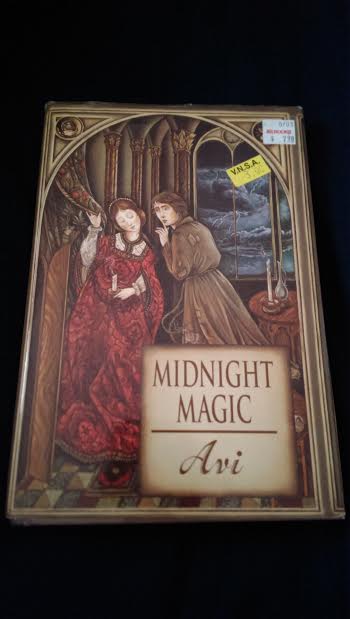
Midnight Magic

midnightmagicMidnight Magic by Avi, 1999.

The story takes place in Italy, toward the end of the Middle Ages.  Mangus, a formerly wealthy scholar and philosopher, is living under house arrest because the king believes that he has practiced black magic. Mangus was merely performing magic tricks to earn extra money, and in fact, does not believe in real magic.  However, the king is very superstitious and easily influenced by his scheming advisor, Count Scarazoni, who needed a scapegoat to distract everyone from his schemes.  Unfortunately, many people in the kingdom of Pergamontio believe that Mangus is a real magician with frightful powers.  Even Fabrizio, an orphan who is Mangus’s only remaining servant, believes that magic really exists.

When a messenger arrives, summoning Mangus to the castle to see the king, they are afraid that the king has reconsidered his decision to spare Mangus’s life. However, it turns out that the king is in need of Mangus’s help. He believes that his young daughter, Princess Teresina, is being tormented by a ghost, and he wants Mangus to use his magic to get rid of it.

Mangus again protests that he does not do real magic, but both the king and Count Scarazoni promise dire consequences if he fails to help them deal with the problem.  Mangus isn’t sure why Count Scarazoni has asked for his help because he knows that the count doesn’t really believe in magic, except perhaps as a way of appeasing the king.  The king promises that if Mangus can free the princess from the influence of the ghost, he will not only end Mangus’s house arrest but reward him with a generous pension.  Mangus has little choice but to agree to do his best, and the promise of the pension for his master convinces Fabrizio to do everything he can to make sure that Mangus succeeds, not only to save his master’s life but to restore his family’s fortunes.

But, what is the secret of the ghost?  Fabrizio believes in ghosts, even though Mangus doesn’t.  Princess Teresina insists that the ghost is real, appealing directly to Fabrizio to convince Mangus that it is. Adding to the mystery is the disappearance of the princess’s brother, Prince Lorenzo, and the murder of the princess’s tutor. Danger lurks in the castle, and conspiracies are around every corner. Could the troubled spirit really belong to the murdered prince?

The book is available to borrow and read for free online through Internet Archive.

My Reaction

I love historical books and spooky mysteries, and this is both! The Italian kingdom where the story takes place is fictional, but it takes its inspiration from real kingdoms of the later Middle Ages and early Renaissance, with Machiavellian intrigue, power struggles, and arranged marriages, even for children, that could influence the balance of power and successions. (There is talk of a potential arranged marriage in the story, but no child marriages actually take place.  If a child is old enough for ghost stories and murder mysteries and isn’t too frightened by them, there is really nothing more concerning than that to prevent them from reading this book.)

Princess Teresina is one of the most intriguing characters in the book.  Although young, she isn’t a shrinking violet or anyone’s fool, and she’s definitely not a tea party and ball gown kind of princess.  Like real life Medieval princesses, she is the product of a family who came to power by the sword and maintains it by the iron fist in the velvet glove and some clever political maneuvering, although some members of the family are more clever about it than others.  Princess Teresina well knows the family she was born into and what’s expected of her as royalty, and she knows to be careful about who she trusts and what the consequences of trusting the wrong people can be.  Although apparently terrified by the ghost, the princess has a kind of toughness and shrewd determination to do what she thinks is necessary.  She seems to be smarter and knows more than most people give her credit, and Fabrizio often wonders just how much she really knows.

One of the best things about the story is that, as soon as you think you know what’s going on, you learn that there is more to the story. There are conspiracies within conspiracies!

Hint: If you like pseudo-ghost stories, spooky stories of the Scooby-Doo variety, where there are logical explanations for the supernatural phenomena … you won’t be disappointed.

Susan’s Magic

SusansMagicSusan’s Magic by Nan Hayden Agle, 1973.

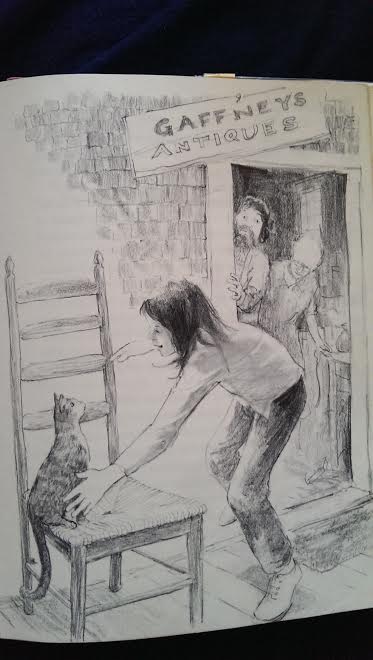
Susan Prescott believes in magic, although her mother tries to tell her that it’s all imagination.  Susan gets feelings about things and sometimes seems to have the ability to make things work the way she wants them to.  That’s part of the reason why she can believe that old Mrs. Gaffney is really a witch.  People say that Mrs. Gaffney used to be a fortune teller but had to stop when one of her predictions became frightening true and people got scared of her.  Now, Mrs. Gaffney runs an antique shop, living in a small apartment above it.  But, whether Mrs. Gaffney is really a witch or not, Susan’s life soon becomes entangled with hers through a series of unforeseen events.

Susan lives with her mother, who is a practical, down-to-earth woman, and her older brother Mike, who likes to play football.  Her parents are divorced, and her father lives in another state, only visiting occasionally, often at unpredictable times.  Susan’s father is known for not being very dependable, and he apparently left the family to be with another woman, although the story doesn’t provide many details.  Susan misses her father and is hurt by his absence, lack of dependability, and that he is more interested in being with someone else, somewhere else, instead of with her, her mother, and her brother.

The story begins when Susan sets out one day to buy a present for her mother’s birthday, and another girl she knows from school tells her to have a look at the flea market being held that day at a church.  Susan doesn’t have much money, and even most of the used items at the flea market are beyond her small savings.  Then, she foolishly spends what little money she has on cupcakes and lemonade.  Susan is angry with herself for her  foolishness, but her mistake leads her to greater adventures.

SusansMagicPic1One of the things at the sale which especially captures Susan’s attention is a small stuffed toy elephant.  The elephant is very worn, and Susan feels sorry for him, wanting to take him home and take care of him.  However, her money is gone, and she still has no present for her mother.  Then Mrs. Gaffney spots her looking sad and offers to lend her the 25 cents she would need to buy the elephant.  Although Susan has reservations about accepting such a loan, she does anyway, telling Mrs. Gaffney that she’ll pay her back.
Susan brings the elephant, which she names Trunko, home, and when her mother thinks that Susan meant to give it to her for her birthday, she doesn’t correct her although she has become very attached to him herself.  Her mother, sensing Susan’s attachment to the toy, says that they can share it and that Susan can sleep with it.  Susan thinks this is a good arrangement until someone calls the house to say that the toy elephant was donated by mistake and that the original owner is sad and wants it back.

At first, Susan can’t bear the thought of giving up Trunko. But when she learns that the real owner is Hugo, a member of her brother’s football team, that he has had the toy ever since he was small, and that he really misses it, she realizes that she has to let him have it back.  To thank Susan for giving him back Trunko (originally named Stanley), Hugo gives Susan a stray cat that had been living under his porch.  Susan loves the cat immediately and names her Sereena.

However, Susan’s mother says that they can’t keep the cat because the hill nearby is a bird sanctuary.  Susan tries to persuade her mother otherwise, but she says that they’ll just have to find another home for Sereena.  Susan tries to get an older girl from school to look after the cat for awhile while she tries to persuade her mother to let her keep her, but the other girl refuses.  Then, unexpectedly, the cat runs into Mrs. Gaffney’s shop as Susan is walking past it.

In Mrs. Gaffney’s shop, Susan accidentally breaks a teapot, increasing her debt to Mrs. Gaffney.  However, Mrs. Gaffney turns out to be a cat lover and agrees to look after Sereena for Susan.  This is the beginning of a new relationship between Susan and Mrs. Gaffney as Susan offers to work for her in order to pay off her debt.  Mrs. Gaffney could use some help in her shop because sales haven’t been good, and she’s worried about losing it.

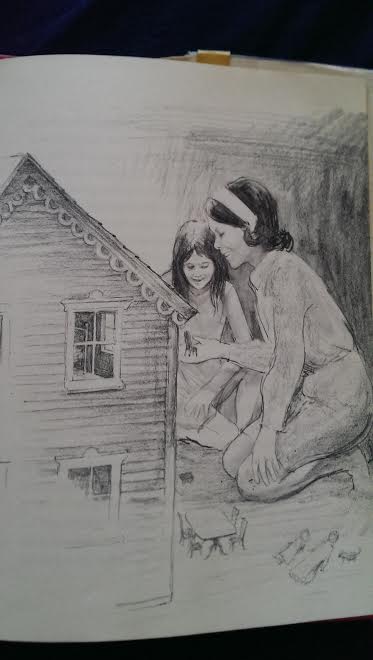
Sereena herself turns out to be good for Mrs. Gaffney’s shop, attracting customers’ attention to the items for sale.  Susan feels jealous about how much Sereena likes Mrs. Gaffney and her shop, as if Sereena has abandoned her like her father and Trunko have.  But, when a beautiful dollhouse in Mrs. Gaffney’s shop catches her eye and it turns out to be even more valuable than Mrs. Gaffney believed it was at first, Susan has to decide whether she is willing to give it up to help Mrs. Gaffney earn enough money to fix up her shop or if she will hold Mrs. Gaffney to her earlier promise to sell it to her for much less.

SusansMagicPic2In spite of the talk about magic and witches, this is not a fantasy story at all.  Susan’s concept of magic has more to do with a way of living, dealing with change, and solving life’s problems.  For the first part of the book, Susan’s “magic” focuses on getting what she wants for herself and getting things to work out the way she wants them to.  But, as the book goes on, Susan matures in the way she deals with the complications in her life.

Toward the end of the book, Susan thinks about reality and fantasy: “The magic part of living was how you fit yourself around real things, she guessed.  A magician was extra good at fitting. That’s why being one was important.”  What Susan really wants and the kind of person she wants to be change.  She comes to realize that, while she can’t get and keep everything she wants in life in the sense that it’s always with her all the time, caring about people and things is also a kind of ownership.  Giving up the toy elephant and sharing the cat with Mrs. Gaffney do not mean losing them completely because she still cares about them and the people connected with them.

Susan also realizes that, even if she doesn’t get exactly what she wants in the beginning, as long as things work out for the people she cares about, she can still be happy.  Although she has to make sacrifices at times for the people she cares about, she earns the love and respect of the people who mean the most to her.  Susan says, “Anyway, magicians don’t lose. They win. Dad, Trunko, and Sereena are mine still in a way.”  She will always be close to her mother and brother, even without her father’s presence, and Hugo, Mrs. Gaffney, and Sereena are all her friends.  Susan is a winner not because she gets what she wants for herself but because she knows how to make things work out in the best possible way for everyone she cares about, and that’s a kind of magic.

The book is currently available online through Internet Archive.

In some ways, this story reminds me a little of the Miyazki movie Whisper of the Heart, which also features a young girl who likes making up stories and who is led to an antique store by a friendly cat and meets an older person who helps her to learn about the person she wants to be and the kind of life she wants to live.  The two stories are not the same, though, and Whisper of the Heart was based on Japanese manga, not this book.  In some ways, however, both this book and Whisper of the Heart are the kind of stories that take on a new life when you read them as an adult because, at that point, you understand some of the feelings behind them better.