Time of Wonder

Time of Wonder by Robert McCloskey, 1957, 1985.

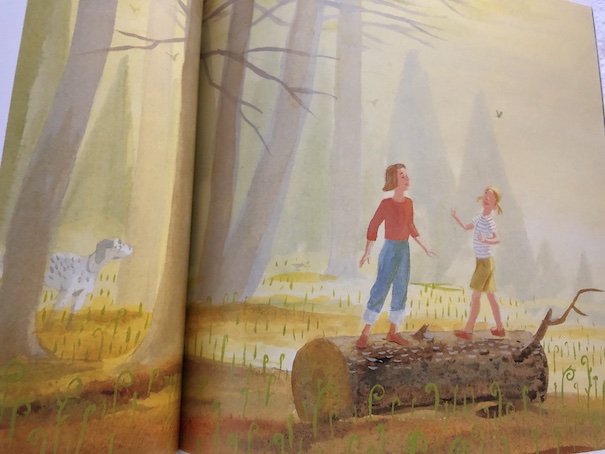
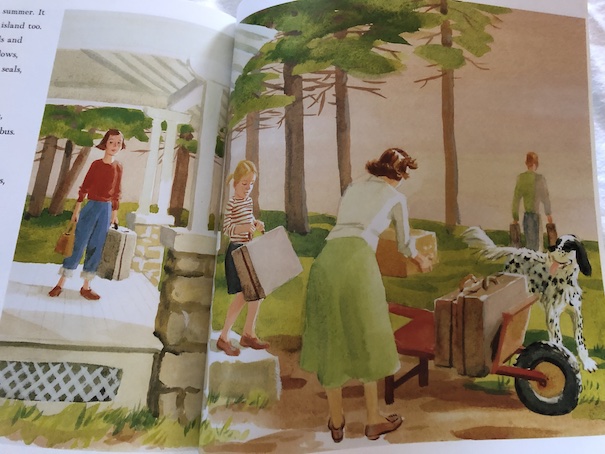
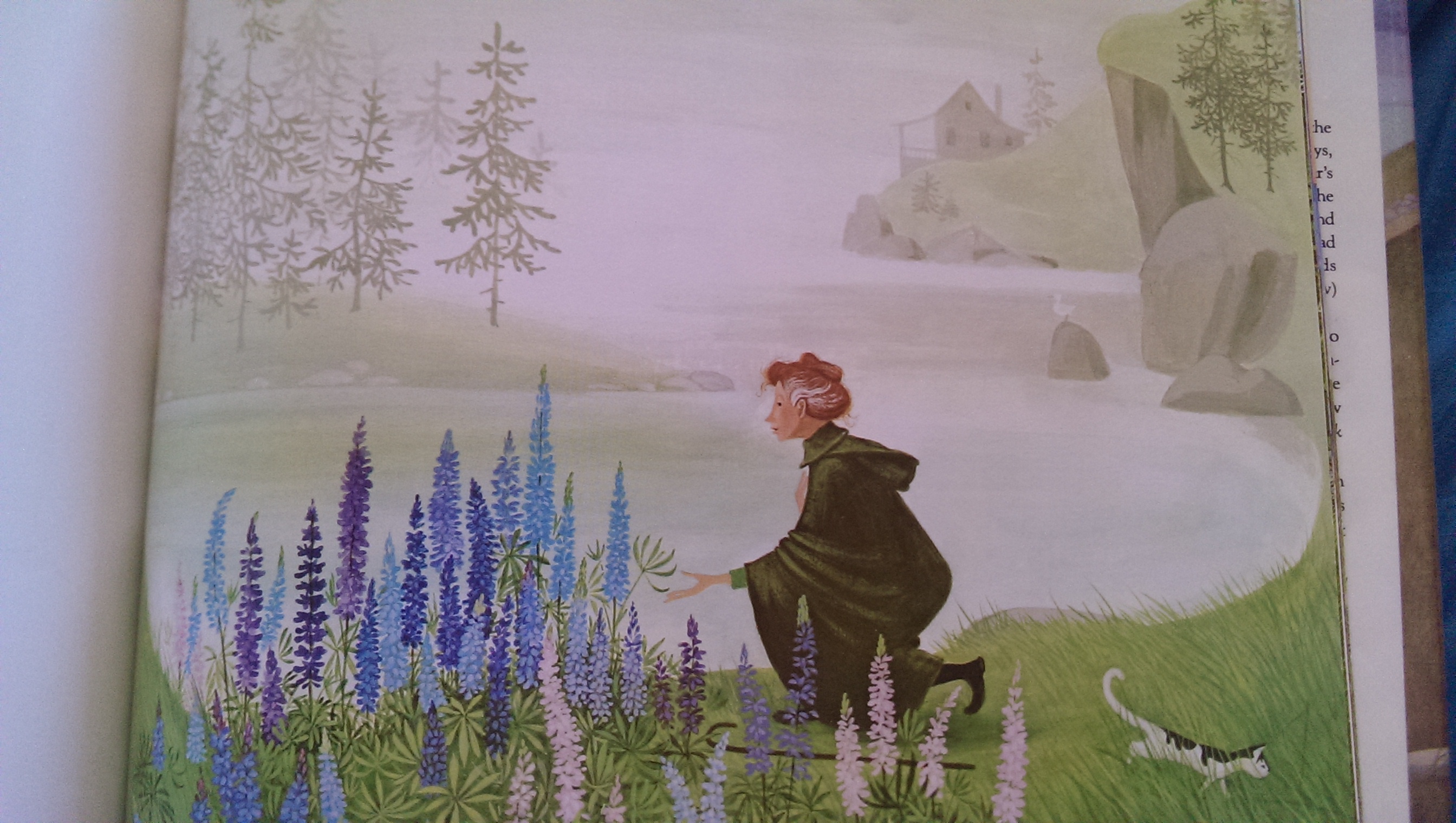
This is a beautiful, very relaxing picture book about a family’s summer vacation on an island off the coast of Maine. Although you can see from the pictures that the main characters are a pair of sisters, the entire story is told in the second person, from the point of view of “you.” Readers are meant to feel like they’re part of this magical summer trip!

“You” feel like you’re spending the morning walking in the fog along the bay, enjoying the plants and birds in the forest nearby, and sailing in the bay with seals and leaping porpoises.

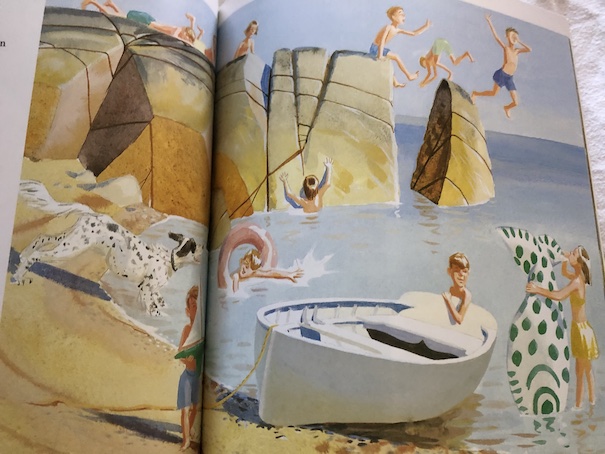
During the day, there are other children playing on the beach, diving from the rocks, and swimming. In the evening, “you” row a boat out into the quiet water and use a flashlight to look at the crabs.

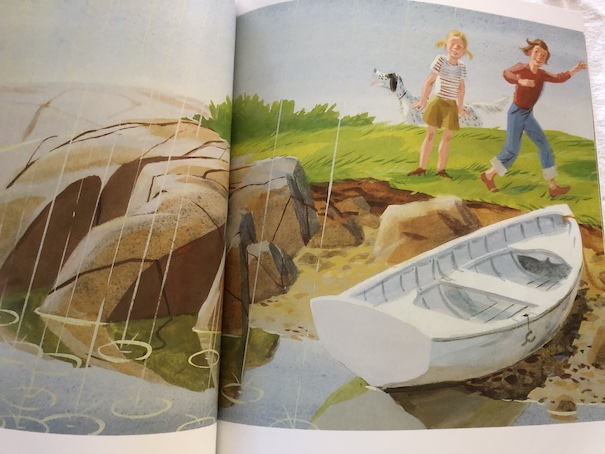
When it rains, “you” feel it! Most of the time the weather is peaceful, but there is a storm approaching, and people know they have to get ready for it. When it comes, it brings a strong wind that blows through the house!

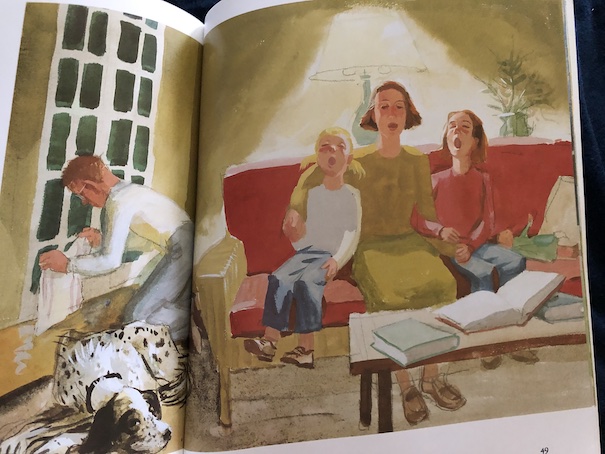
The family reads together and sings songs until the storm is over and it’s time to go to bed.

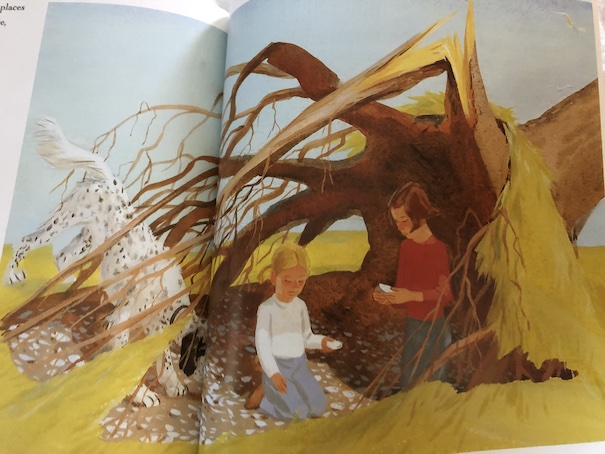
The next day, trees are uprooted, and “you” get to explore what’s beneath their roots.

When it’s time to go home because school will be starting again, you’re a little sad to leave this place, although you’re also glad to go home again.

The book is available to borrow and read for free online through Internet Archive (multiple copies). It’s a Caldecott Medal winner!

My Reaction

This is a great book when you want something calm and relaxing or you feel like you need to take a mental vacation, whether you’re a kid or adult! Nothing stressful happens in the story. It’s just a lovely memory of a peaceful vacation. Even the storm that comes doesn’t do anything worse than blow things around the room and knock over some trees and plants. The girls in the story help clean up after the storm, find ancient seashells under the roots of a fallen tree, and are happy that the sunflowers are looking toward the sun again.

When the girls are looking at the shells under the fallen tree, they think about the Native Americans who lived in the area before white people came and before the tree grew there. They call them “Indians” instead of Native Americans, but that’s the only thing I can find to nitpick about the story.

I think this would make a great, calming bedtime story for kids, especially during the summer! It reminds me a little of the song Verdi Cries, about someone’s memories of a special vacation.

The setting for the story, on an island off the coast of Maine, is based on the author’s family’s summer home, and the two girls in the story are based on his own daughters. They are not named here because the story is about “you”, but the older girl is Sarah (called Sal) and the younger girl is Jane. They appear in and are named in Blueberries for Sal and One Morning in Maine, where they are much younger.

One Morning in Maine

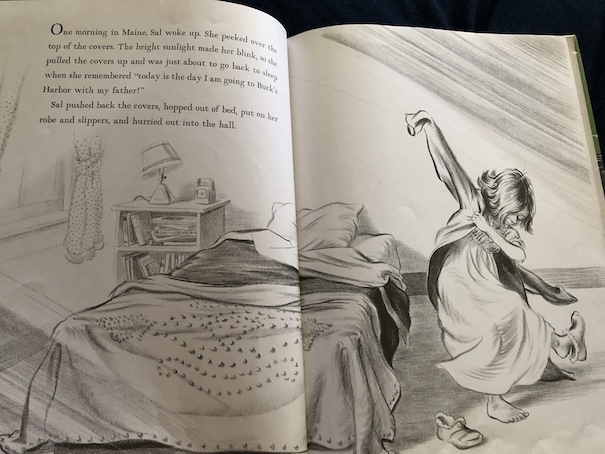
This cute picture book features Sal, a little girl who also appeared in Blueberries for Sal. She and her family live or are staying on an island off the coast of Maine. One morning, Sal wakes up and is excited because she remembers that she and her father will be going to Buck’s Harbor (a real place).

She helps her little sister, Jane, to get ready, and while they’re brushing their teeth, she feels that one of her teeth is loose. She’s never had a loose tooth before, and she runs to tell her mother. Her mother tells her not to worry about it because everyone loses their baby teeth when they’re growing up. She say that a new, bigger tooth will grow in when the old tooth falls out. Her mother says that if she puts her baby tooth under her pillow, she will get a wish, but she shouldn’t tell anyone what the wish is.

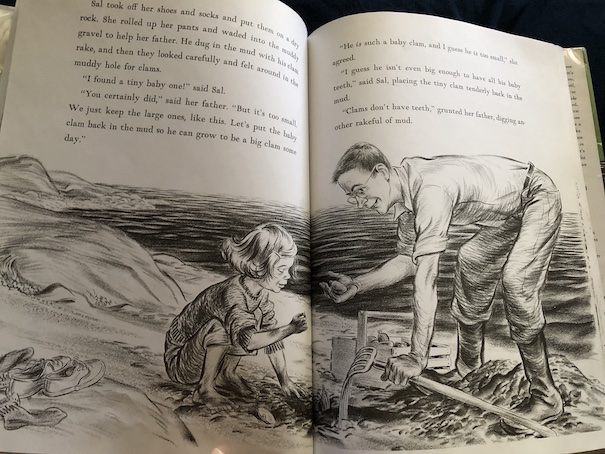
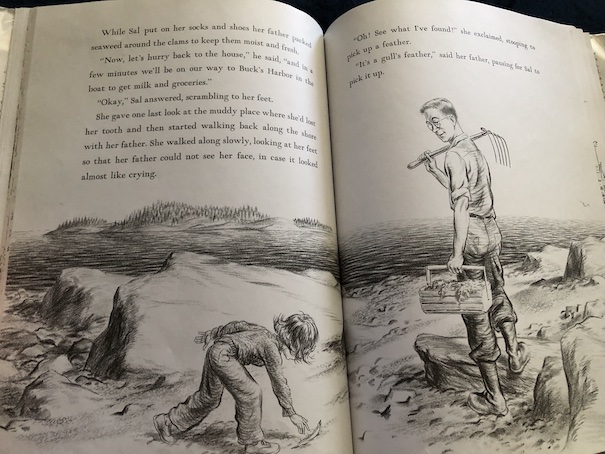
On her way to the beach, where her father is digging clams, Sal proudly tells all the animals she sees about her loose tooth. When she reaches her father, she tells him about the tooth, too. Then, she joins him in digging for clams.

Then, Sal realizes that she’s already lost the tooth somewhere. She’s really disappointed because she wanted to make a wish. As she and her father walk back to the house, Sal sees a feather that a gull lost. Since the feather is kind of like a tooth because a new feather grows in when one falls out, she decides that she can make her wish on that.

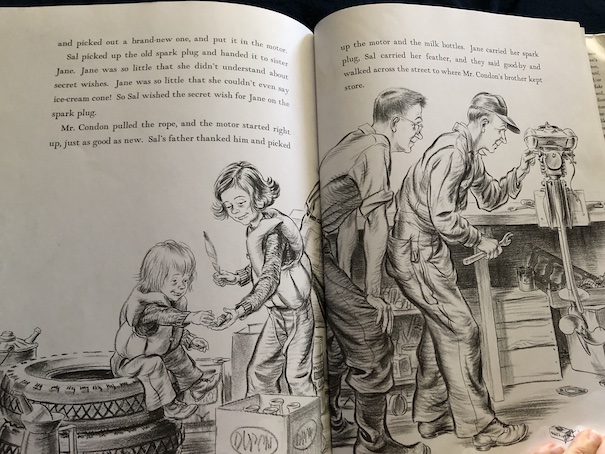
When it’s time to go to Buck’s Harbor, the motor on the boat won’t run, so the girls’ father has to row the boat. When they go to get the motor fixed, Sal tells the mechanic about her tooth. When the spark plug in the motor is replaced, Sal compares the old plug to her lost tooth and gives the old plug to Jane so she can have something to wish on, too.

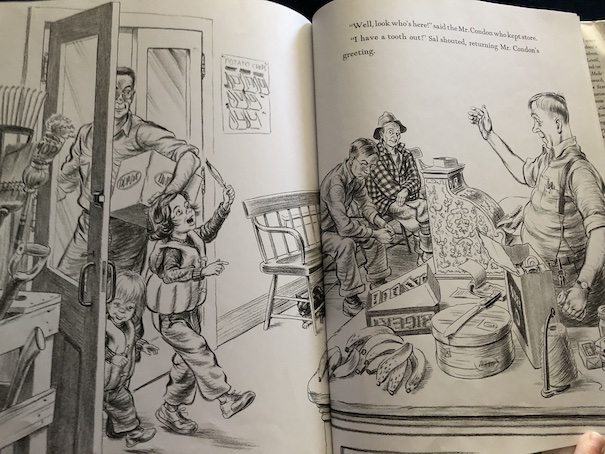
She also tells the men at the grocery store about her tooth, and she ends up getting an ice cream cone, exactly what she wished for! The book ends with Sal, her father, and her little sister all going home for clam chowder for lunch.

The book is available to borrow and read for free online through Internet Archive (multiple copies). It’s a Newbery Honor Book!

This is just a cute little story about a little girl who is proud of losing her first loose tooth. It’s a sort of rite of passage that all small children go through. Her parents don’t tell her about the tooth fairy or promise her money for her tooth, but she does get a wish. Because her wish is a simple one, it’s easily fulfilled.

The different animals that can be found on the coast of Maine would also be interesting to child readers. Sal and her father also talk about which of the animals have teeth and which don’t. The birds and the clams don’t have teeth, but seals do. Sal keeps making comparisons between her tooth and other things that have to be replaced eventually, like the bird’s feather and the old spark plug, finding a kind of magic in things that are discarded and replaced with something new.

Sal and Jane are based on the author’s real life daughters, and their family did live in Maine. The setting of the book is the family’s summer home.

Sign of the Beaver

Sign of the Beaver by Elizabeth George Speare, 1983.

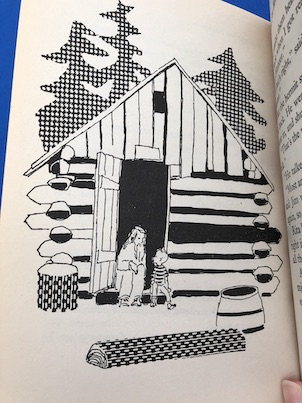
The story begins in the late 1760s with twelve-year-old Matt’s father leaving him alone in the log cabin that he and his father built for their family in the Maine territory. The rest of their family is still in Massachusetts, and Matt’s father is going to get them and bring them to their new home. Their family will be the very first to settle in what will soon be a new township. However, for now, Matt is alone at their cabin, surrounded by miles of wilderness, while he waits for his father to return and the rest of his family to arrive. Matt will be looking after the cabin and the field of corn that he and his father planted, but he finds the silence and solitude unnerving.

Before he left, Matt’s father left his watch and rifle with Matt. After his father leaves, Matt tries the rifle. He doesn’t hit anything, and he decides that it will take getting used to. He learns to hunt with it, and Matt finds that he is very busy with hunting, fishing, and chores, which helps pass the time. Every day, he makes a notch on a stick to mark the days that pass.

Gradually, Matt becomes aware that someone is watching him. Someone seems to be hiding and following him. Since there are no other white families living for miles around, he can only assume that it must be an “Indian” (Native American). They know that there have been some in the area, although they haven’t really met any yet. Matt finds the prospect a little worrying because he isn’t sure what to expect from them, but his father always told him that, if he met an Indian, he should just be polite and respectful. Matt is nervous that whoever is watching him is also hiding from him, though.

One day, Matt hears someone wearing heavy boots tramping in the woods, and Matt thinks that maybe his father has returned early for some reason. However, it turns out to be a stranger in a blue army uniform. Although Matt has missed having company, he finds himself reluctant to talk much to this stranger, and he doesn’t want the man to know that he is there completely alone. Still, the stranger is hungry, so Matt agrees to let him share a meal with him. The stranger, who calls himself Ben, stays the night with Matt, uninvited. Matt can’t bring himself to turn away someone who needs hospitality in the wilderness, and Ben tells him stories of his past adventures. Matt still has misgivings about Ben, and he’s sure his stories are tall tales. When Ben mentions leaving a town because there was trouble there, Matt thinks maybe Ben ran away because he’s a criminal. Matt plans to stay awake that night to keep an eye on Ben, but he eventually falls asleep. When he wakes up, Ben is gone, and so is his father’s rifle. Ben is a thief! Matt realizes that he was right to be suspicious of Ben and is angry that he let him get away with stealing the rifle.

Without that rifle, Matt can’t hunt. He can still feed himself through fishing, but he loses more of his supplies when he forgets to properly bar the door while he’s out fishing, and a bear eats most of the food in the cabin. Reduced to eating only fish, Matt gives in to temptation and tries to get some honey from some bees he finds in a nearby tree. It’s a bad idea, but this decision changes everything for Matt.

Matt is badly stung by the bees, and when he tries to escape them in the water, he nearly drowns. Fortunately, Matt is saved from drowning by the Indians who have been watching him. It turns out to be a grandfather and his grandson. The grandfather, Saknis, takes Matt back to his cabin, brings him food, and treats his wounds. When he realizes that Matt hurt his ankle and lost his boot in the water, he gives Matt a crutch to use for walking and a new pair of moccasins to wear.

Matt is both grateful for this much-needed help but also very self-conscious about it. He can tell that the grandson, Attean, doesn’t like him and thinks that he’s a fool for getting hurt like this, which is embarrassing. Matt also thinks that he should repay them for what they’ve given him, but he doesn’t have much to offer. The only thing he can think of to give them is the only book he owns, a copy of Robinson Crusoe. Matt is embarrassed when he realizes that the Saknis can’t read, and he thinks maybe he will be offended at this type of gift, but the older man realizes that Matt’s knowledge of reading is a gift that they badly need.

In broken English, the old man explains that his people have made treaties with white people before, but because they can’t read English, they never really know what’s written in the treaties. When white people break the treaties or tell them that they’re no longer allowed in certain areas of land, there isn’t much they can do, since they don’t even know for certain what was in the original agreements. He realizes that his people can’t afford to be ignorant. There are more white people moving into their territory all the time, and his people will have to know how to deal with them. Therefore, Saknis proposes a kind of treaty with Matt: they will continue to bring Matt food if Matt teaches Attean to read.

Attean immediately protests this plan. He really doesn’t like Matt, or any white people in general, and he doesn’t want these reading lessons. However, his grandfather is firm that this is something he needs to do. Matt also isn’t sure about this plan. He does owe them for their help, but he’s never taught anybody to read before. His own early lessons didn’t go particularly well, although he likes reading Robinson Crusoe now. Also, Matt thinks of Attean as being a “savage” and a “heathen” who doesn’t even really want to learn, so he’s not confident that the reading lessons are going to go well. Still, Matt does owe them for saving him and could use their continued help while he recovers from his injuries, so all he can do is try.

When Attean gets frustrated during the first reading lesson and storms out of Matt’s cabin, Matt thinks that the lessons are already over. Yet, Attean does return for more lessons. Gradually, Matt thinks of ways to make the lessons more interesting to Attean, reading the most exciting parts of Robinson Crusoe out loud to Attean to get him interested in reading the story himself and finding out what will happen to the main character. It isn’t easy to get Attean interested in learning because Attean is initially determined not to be interested or impressed by anything Matt has to say.

When Matt becomes curious about some of the things Attean and his tribe do, like how Attean hunts rabbits without a gun, Attean opens up a little and shows Matt some of the things he knows. Matt begins to admire some of the unique skills Attean shows him and learns to use them for himself. Matt is aware that his first efforts must look clumsy and childish to Attean as he tries to learn skills that Attean has known for years, but it puts the boys on a more equal footing with each other. Each of them has something to learn from the other, and it’s all right for each of them to look a little awkward to the other while learning. Matt gets embarrassed sometimes when he does something clumsy in front of Attean, but he learns that he must also persevere. Attean teaches him some good, practical skills for making things without using some of the manufactured goods that he and his father brought with them from Massachusetts. When Matt loses his only fish hook, Attean shows him how to make a new one. Attean teaches Matt to be self-reliant and to use new methods to accomplish his goals.

During the part where Matt reads the part of Robinson Crusoe where Robinson Crusoe rescues the man he calls Friday, and Friday, out of gratitude, becomes his slave, Attean protests that would never happen in real life. Attean says that he would rather die than become a slave. Matt is surprised because he never really thought that much about how someone like Friday would feel in real life. Matt learns to look at the story as Attean would, reading the best pieces to him, the ones that emphasize the friendship between the two characters rather than servitude.

Gradually, Matt and Attean become friends. Matt doesn’t think he’s very good at teaching Attean to read, but Attean does slowly learn. Although Attean resists learning to read because he’s trying to prove that he doesn’t need this skill that he associates only with white people, his spoken English becomes better as he and Matt talk. Attean admits that he tells parts of Robinson Crusoe to his people, and they enjoy hearing them, so Matt moves on to stories from his father’s Bible. Attean finds the Bible stories interesting and compares them to stories that his people already tell. (It is interesting, for example, how many civilizations around the world tell stories about great floods.) The boys are fascinated by the common themes in their stories.

The boys also enjoy doing things together, and Matt feels less lonely when Attean comes to visit. Matt doesn’t always like Attean because he has a disdainful attitude toward him, but they learn to trust each other, and they find interesting things to do together. Matt comes to realize that his irritation at Attean’s attitude is because it’s so difficult to earn Attean’s respect, and he really wants Attean’s respect. Although Matt doesn’t like Attean’s attitude toward white people, he does agree with Attean about some things, and he has to admit that he cares about what Attean thinks. Matt does get some respect from Attean later when the boys have a hair-raising encounter with a bear. Attean is the one who actually kills it, but Matt proves his usefulness during the struggle. Matt also comes to understand Attean’s resentment against white people when Attean eventually tells him that he’s an orphan and that his parents were killed by white people. That’s why he lives with his grandparents.

As time goes by, Matt becomes increasingly worried about whether or not his family will ever arrive. He worries that maybe something happened to his father and that the rest of the family won’t know where the cabin is and won’t be able to find him. When it passes the time when his family should have arrived, Matt fears that maybe they will never come at all. What if he is left alone? He has survived so far, with some help from Attean and his people, but can he live alone forever? Or could there be a place for him among Attean’s people?

Saknis has also been thinking about this, and he has noticed that Matt’s family has not yet come. He knows that it would be dangerous for the boy to remain alone in the cabin when winter comes. As the seasons change, the Native Americans are preparing to move to their winter hunting grounds. Saknis invites Matt to come with them, and Matt has to decide whether to accept the offer or stay and wait for his family.

This book is a Newbery Honor Book. It’s available to borrow and read for free online through Internet Archive (multiple copies).

My Reaction and Spoilers

This story reminds me a little of The Courage of Sarah Noble, where an 18th century white child who is afraid of Native Americans comes to learn more about them by living with them and interacting with them. I actually read The Sign of the Beaver when I was a child, and I only read The Courage of Sarah Noble as an adult. I’m not sure now if I prefer one of these books over the other. For a long time, I forgot the title of The Sign of the Beaver, although I did like this book the first time I read it. I remembered the concept of the boy living alone while he waited for the rest of the family to join him. One part that stuck in my mind the most was the part near the end of the story where Matt makes a cradle because he knows that his mother was expecting a baby when he last saw her and thinks that it would be nice to have a cradle ready for his new younger sibling, but when his family arrives, he is told that the baby died. That tragic image just stayed with me for years.

Some of the prejudiced language in the story, like “savage” and “heathen” and some anti-Catholic talk from Ben early on, is a little uncomfortable, but this is one of those stories about changing attitudes and overcoming prejudice. The main character has to show some fearful and/or prejudiced thoughts toward Native American initially for readers to appreciate how far he comes and how much his thinking changes after he makes friends with them and learns more about them.

Ben, of course, is a villain character, so his prejudiced talk is a reflection of that. He’s selfish and a thief, so his views of other people are based on what puts him in the best light or justifies things that he’s done. When he talks about the people of the last town he was in being against him and making trouble so he had to leave, both the readers and Matt realize that Ben was the one who started the trouble. Ben blames other people for problems he creates himself. The stories he tells Matt about his earlier, supposedly brave adventures are based around the French and Indian War, which is where the Catholics enter the discussion.

Several times during the story, Attean uses the word “squaw” to refer to women. I didn’t think too much about that sort of thing when I was a child because I assumed that both the author and characters in books that used that term knew what it meant and were using it correctly. Since then, I’ve heard that it actually has a rather vulgar meaning, although I’ve also heard conflicting information that it’s not always vulgar. The contradictory accounts make it a little confusing, but according to the best explanations I’ve read, the contradictions about the meaning of this word have to do with similar-sounding words in different Native American languages. Not all Native American tribes have the same traditional language, and some have words that sound like “squaw” and refer to females in a general way, while others have words with a similar sound that refer to female anatomy in a more vulgar way. For that reason, something that might seem innocuous to one native speaker might sound crude to another, and non-native speakers of any of the languages involved may not fully understand all the connotations of the word. In the end, I’m not sure how much of this the author of this book understood, but my conclusion is that it’s best not to use certain words unless you’re sure of their meaning, not only to you but to your audience. I only use the word here to make it clear which word appears in the book. Other than that, I don’t think this word is a necessary one, at least not for me. I understand what Attean is referring to in the context of the story, and I think that’s what really matters in this particular case. Whether that’s the right word for Attean’s tribe to use at this point in history would be more a matter for a linguist. I’m willing to accept it in the book as long as readers understand the context of the situation and are content to leave the word in the book and not use it themselves outside the context of the story.

When Attean talks about women in the story, it’s typically to point out certain types of work that he considers women’s work instead of men’s work. Matt is a little offended sometimes when Attean tells him that some chore he’s doing is for women instead of men. Matt’s family doesn’t have the same standards for dividing up chores as Attean’s tribe does, and the fact is that Matt is living alone at the moment. There are no women in Matt’s cabin, only Matt. Any chore that needs to be done right now is Matt’s to do because there simply is no one else to do any of it for him. I think when Attean tells him that he’s doing women’s work, he’s trying to needle Matt because, otherwise, he comes off as sounding a little dense. Sure, Attean. We’ll just have the women who aren’t here do this stuff that needs doing right now. During the course of the story, Matt comes to appreciate how the Native Americans live differently because it makes sense for the place where they live and their circumstances, but this is one instance where Attean could be a little more understanding about Matt’s circumstances.

One thing that I had completely forgotten about in this story was the part where Matt thinks about how Attean smells bad. Earlier, when I did a post about Mystery of the Pirate’s Ghost by Elizabeth Honness, I was irritated at the author for having one of the characters imagining smelly Native Americans because I had never heard of that as a stereotype before (I thought at the time), and I didn’t know where that idea came from. A site reader suggested that the trope came from the Little House on the Prairie series because there is talk like that in those books, but The Sign of the Beaver actually offers an immediate explanation as soon as Matt thinks about the cause of the smell. Matt realizes that Attean has smeared a kind of smelly grease on his body that is meant to repel mosquitoes. Matt has heard of people doing this before, and he understands that there is a useful purpose behind it, but he just hates the smell so much that he thinks he’d rather just put up with the mosquitoes. That explanation really helps to put everything into context. When there’s no explanation about things like this in stories, it makes it sound like Native Americans are just smelly because they’re “savages” who don’t bathe or something, but when you hear the explanation, it’s just that the smell is an inconvenient side effect from something that has a real, practical purpose. It might be unappealing to Matt, but there is a point to it. So, on the one hand, I feel a little bad about getting down on Elizabeth Honness for throwing that idea into her story without an apparent basis, but still irritated because, if she knew that was the explanation, she could have said something about it instead of just throwing that out there, like everyone reading the story would already know. I have similar feelings about some of the things Laura Ingalls Wilder put in her books, too. Context is important, and some authors are better at providing it than others. I also think that context is something that books from the late 20th century and early 21st century often provide better than books from earlier decades, although there are some exceptions.

At the end of the story, we don’t know for sure whether Matt and Attean will meet again. When Matt’s family arrives, they tell him that other white families will be arriving soon. Matt knows that the tribe he befriended will likely lose their hunting grounds to the town that will be built there. Matt is concerned for their future, but he is glad to be reunited with his family and still considers Attean his friend.

Mystery at Kittiwake Bay

Mystery at Kittiwake Bay by Joyce A. Stengel, 2001.

Cassie Hartt has only recently moved to Kittiwake Bay, Maine with her mother and brother following her parents’ divorce. Her mother is a nurse, and she has found a job at the local hospital, which is actually 30 miles away from the little town where they were able to find a house. Because of her mother’s long commute, Cassie will need to look after her 7-year-old brother, Danny. Soon after arriving, she meets a nice boy named Marc Nolan, who is a little older than she is and loves boats, and a girl name Liz Painter, who likes photography and walks her cat on a leash. Liz is the one who introduces Cassie and Danny to the Beachcombers Club, which is a group for kids Danny’s age who like to go swimming and camping and the kids who hang out at the Sand Shack coffee shop. Marc is one of the Sand Shack kids, and so is a boy named Ryan Jerrick, who is Liz’s crush. Cassie is glad to be making friends and starting to get settled into her new home, but soon, there are complications.

One evening, on her way home from the grocery store with her dog, Sam (short for Samson), Cassie sees some mysterious figures sneaking around in the dark. She doesn’t know who they are, but the way they’re sneaking around worries her. She later learns that there have been robberies in the area.

Cassie develops a fascination for the large house that she saw on a cliff near the ocean, and Marc and Ryan tell her that’s a senior citizens’ residence called Waterview Manor. Both of them work there part time. Liz says that the house wasn’t always a senior citizens’ residence and that there are a lot of weird stories about the place. It was built by a rich man before the Civil War, but it became property of the town in the 1950s. One of the stories about the place is that it was once part of the Underground Railroad helping escaped slaves. The boys say that a woman named Mrs. Wentworth says that her grandfather was one of the people helping escaped slaves. There’s also a story about Captain Kidd hiding his treasure somewhere around the old house, although Ryan doesn’t believe any of these stories. He thinks Mrs. Wentworth just tells tall tales. Cassie thinks that she might like to volunteer at the house, like the boys did before they started working there as employees. If her little brother joins the Beachcombers Club, she’ll have some free time for volunteer work.

When Cassie goes to Waterview Manor to sign up, she witnesses an argument between Ryan and Mrs. Wentworth, who is confined to a wheelchair. Ryan was being disrespectful because Mrs. Wentworth was telling one of her stories about the history of the town that Ryan thinks is outlandish, and Mrs. Wentworth was telling him off. Ryan doesn’t actually like working at Waterview, but he has to keep his job because he needs the money. Cassie thinks he’s arrogant. Ryan has no patience for the fetching and carrying he has to do for the older people, and he thinks that Mrs. Wentworth’s mind is going. Cassie thinks that Mrs. Wentworth sounds like she still has her faculties and is sympathetic when Mrs. Wentworth laments about not being able to do things she used to do because her hands and feet won’t obey her anymore. Mrs. Wentworth is physically feeble these days, but she knows what she’s talking about when it comes to local history.

After she signs up to volunteer, Cassie can’t resist a peek into the forbidden East Wing of the house, and she meets Marc there. They both admit that they’re curious about the stories of treasure in the house. Unlike Ryan, Marc believes Mrs. Wentworth’s stories, and Cassie can’t wait to hear more!

Mrs. Wentworth used to be a history teacher, and she does know more about local history than Ryan gives her credit. She tells Cassie how her grandfather used to be a conductor on the Underground Railroad and how his friend, Mr. Palmer, who was the original owner of Waterview Manor, was a stationmaster, which meant that he hosted and hid the escaping slaves that Mrs. Wentworth’s grandfather conducted to him. Mrs. Wentworth’s grandfather told her about a secret room where they used to hide people and a secret tunnel that would take them to the landing site for the boat that would smuggle the runaways to Canada. When Cassie asks her about the story about Captain Kidd hiding his treasure somewhere in the area, Mrs. Wentworth said that her grandfather always believed he did, although Captain Kidd was much older than both her grandfather and the Manor. She explains a little about the life story of Captain Kidd and how it seems that most of his treasure was never found.

However, they soon have a more modern mystery on their hands. Whoever has been stealing things in the area recently seems to have started taking things from Waterview Manor. First, an expensive chess set belonging to one of residents disappears. Then, some jewelry and a coin collection disappear. Then, someone steals Mrs. Wentworth’s beloved lavaliere necklace, a special present from her late husband. For someone to both know about the residents’ valuables and to have access to them, the thief must be somebody working at the Manor! Who, could it be? Is it grumpy Ryan, who needs money? Is it John, another employee, who often acts a little strange? Could it even be helpful Marc, who seems nice but is often lurking around areas where both he and Cassie aren’t supposed to be? Or is it someone else Cassie wouldn’t even think to suspect?

The mysteries of the past start mingling with the mysteries of the present. Cassie sees signal lights from the tower of the old house that remind her of of the signals Mrs. Wentworth said the Underground Railroad used. Is someone now using them for a different purpose?

The book is available to borrow and read for free online through Internet Archive.

My Reaction

The Underground Railroad is a popular subject in US children’s books. There is something compelling about people sneaking around on clandestine missions and hiding in secret rooms and secrets passages, and since these things were used in the real life Underground Railroad, they make convenient devices for US children’s books with some historical flavor. The former Underground Railroad secret passage in Waterview Manor does play a role in this story. Someone is using it for a new purpose, just like they’re using signals from the tower.

The purpose of the Underground Railroad secret tunnel in the story is also to show that Mrs. Wentworth knows what she’s taking about when she tells her stories about local history. Ryan tries to discount her stories because some of them sound a little far-fetched and dramatic and because he thinks scornfully of the old people he serves in his job. Ryan has a negative attitude and looks at the elderly as being senile and demanding. Cassie feels differently because she has more empathy and, perhaps, because her mother is a nurse, which may make her more aware of the human condition and more comfortable helping other people. She seems to understand what Mrs. Wentworth means when she talks about finding it frustrating that she can’t do things she used to do, and she says that she agrees with Mrs. Wentworth when she says that she likes keeping her hair long even though a nurse at the Manor says it would be easier to care for if she cut it shorter. The nurse is probably thinking that short hair would be easier on those who might have to help Mrs. Wentworth wash and brush it, but Cassie understands when Mrs. Wentworth explains why she likes her hair long. Cassie thinks the people who live at Waterview Manor are interesting, and she admits to her mother that she likes to pretend that they’re her grandparents. She is fascinated by Mrs. Wentworth’s stories, and because she and Marc believe what she says, they are able to get to the bottom of the mysteries surrounding the Manor.

I was pretty sure I knew who at least one of the thieves was, and I was also pretty sure I knew why. I was correct in my first guess, but there were enough red herrings along the way to give me some doubts, so there was plenty of suspense in the story. One of them wasn’t fully aware of what he was getting involved with at first, but he does bear responsibility for what he did even after he knew.

This book also deals with the subject of divorce and how it affects families and children. Books like this were once rare, but they have been very common staples of children’s literature since the late 20th century, reflecting changes in American society and a growing willingness to discuss difficult topics with children. Moving to a new state and starting over after the divorce wasn’t easy for Cassie, her mother, and her brother. Cassie quickly becomes interested in the history of her new town, and it doesn’t take her long to find some new friends and a volunteer activity to keep her occupied. However, other aspects of the changes in her life and family will take longer to get used to. Her mother has to work long hours with a long commute, so Cassie frequently has to be responsible for her younger brother when he’s not at activities of his own, and her mother often isn’t home for Cassie to discuss things with her.

There is also some tension between Cassie and her brother because the divorce has changed their relationship with each other. Because Cassie has become more of a caregiver to Danny because her mother has to work, she has to make arrangements for Danny before she can do anything on her own, which sometimes makes things awkward for her. Danny also becomes jealous because Cassie does have more ability to do things on her own than he does and because she makes friends and settles into their new town more easily than he does.

One part of this book that I hated was when Danny intentionally left Sam outside alone to spite Cassie, and Sam is poisoned by one of the villains and nearly dies. Cassie is very upset with Danny because of this incident, understandably so, but I didn’t like it that the other characters were pressuring her to be okay with Danny and forgive him too quickly. They do this because Danny is young, they think that he left the dog out by accident, and Danny feels really badly about almost getting the dog killed. Cassie knows, although Danny doesn’t initially admit it, that Danny left the dog outside on purpose. That purposefulness maliciousness is not a thing that I think should be too easily forgiven, especially not because someone just “feels bad.” Let’s insist on a little empathy here, Danny. Cassie feels bad because you almost got her dog killed. Sam really feels bad because he’s the one who almost died! Maybe your feelings shouldn’t be given first priority here, since you were the one who caused the harm. Sam is a dependent animal. Under no circumstances should animal abuse be excused, and leaving a dependent animal outside alone to be lost, hit by a car, or yes, harmed by some other malicious person is abusive. Danny should not be given a pass for malicious behavior or animal abuse just because he “feels bad.”

Giving people that type of excuse for malice and abuse just encourages more of it in real life because the person finds that there are no consequences for their actions and it gets them the forgiveness and attention they want, so they keep doing it. It’s a dangerous thing to allow. The story makes it clear that Danny was acting out on bad feelings that he already had about the divorce and feeling neglected by both his mother and Cassie, but I think it’s important to make it clear to him that, even if he’s “feeling bad”, that does not give him the right to hurt other people or animals. Nobody has the right to hurt others just because they’ve got mixed-up feelings. I hate it that the other characters don’t seem to feel that way.

The story ends happily when Danny tries to make it up to Cassie by investigating the situation and Cassie rescues him from the bad guys. They have a heart-to-heart talk that makes Cassie realize how important Danny is to her and that she has to make time for paying attention to him and supporting him more during this difficult time. Still, I feel very strongly that the story and the other characters should emphasize to Danny that causing hurt because you feel hurt is wrong and damaging to relationships. The way the other characters tried to make Cassie feel bad about the situation also really felt like gaslighting. She had a real and serious reason for being angry with her brother, and it just made me really angry when they acted like she was the bad one because Danny was “feeling bad” and she wanted him to be accountable for his actions. He knew what he was doing, and he should have known it was dangerous to Sam, even if he didn’t know that someone was going to deliberately try to kill the dog.

I know that Danny has some emotional issues that need to be addressed, but I’m saying that he also has some behavior issues that also need to be addressed. There are helpful ways to deal with emotions and destructive ways to deal with emotions. Danny is not too young to understand the consequences of his actions and to accept them. I don’t think that learning that it can take awhile to regain trust after betraying someone’s trust is also an unbearable lesson. In fact, I’d call it a life skill. If it helps him to develop more empathy and consider other people and the consequences of his actions before he lashes out, it is worth it.

Skylark

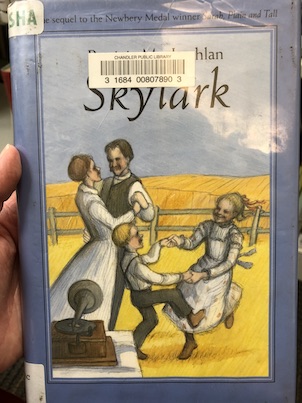
Skylark by Patricia MacLachlan, 1994.

The second book in the Sarah, Plain and Tall Series picks up about two years after the first book, shortly after Sarah marries Jacob, the father of Anna and Caleb.  That summer is very dry, and people worry about when it will rain next.  If there is no rain, their farms will be in danger.  Some people have been known to simply abandon their farms and move on during especially long dry spells.  Jacob says that their family won’t leave, no matter what, because “Our names are written in this land,” meaning that they have a commitment to it because they were born there and make their lives from the land.  However, Sarah was born in Maine, and Caleb worries that, if the dry spell goes on too long, Sarah will want to return to Maine.

The year goes on, and Sarah settles in to life on the farm.  Her cat, Seal, has kittens.  Sarah reflects on the baby animals and seems thoughtful about babies.  However, people are becoming ever more concerned that the water in the wells is lower than usual.  As people keep hoping for rain, Sarah gets a letter from Maine, saying how lovely and green everything there is.  The land around the farm is dry and brown, and the family has had to ration their water carefully, their supplies running increasingly low. 

Eventually, a family from the area has to pack up and leave because their well is dry.  Sarah is upset, trying to think of some way around the problem, but there is nothing to be done.  Everyone’s supplies are running low, and they’re already doing everything that can be done.  Sarah hates feeling helpless against the problem.  When Sarah’s best friend, Maggie, talks about leaving with her family, Sarah says that she hates the land because it takes so much and gives nothing back.  Maggie tells her that she’s like a lark that hasn’t come to land yet and that, if she is hoping to survive in this land and make a home there with Jacob, she will have to write her name in the land, just as he has.

Although the characters become increasingly distressed, in a way, I like the story for that.  Sarah is a strong, capable woman, but even she doesn’t have all the answers to every problem.  It’s upsetting for her to realize that, but it’s very human.  After the family’s barn catches fire and burns down, Jacob persuades Sarah to take the children and visit her family in Maine.  While they are gone, he will take care of the animals and try to keep the farm going, waiting for rain.

In Maine, Sarah and the children stay with Sarah’s aunts.  Aunt Mattie, Aunt Harriet, and Aunt Lou, who have never married, are called “The Unclaimed Treasures.”  They shower the children with affection.  Still, the children miss their father and worry about what is happening on the farm.  Sometimes, the children have bad dreams in which their father is unable to find them.

In the end, the rain comes on the prairie, and Jacob comes to Maine to collect his family.  Then, the family learns that Sarah is expecting a baby.  Anna worries a little because her mother died giving birth to Caleb, but Jacob and Sarah reassure her that everything will be fine.  When they return home, Sarah writes her name in the dirt, signaling her commitment to her new life on the prairie.

There is a movie based on the book that follows the story very well. In fact, some of the dialog is almost word-for-word from the original. The book is available to borrow and read for free online through Internet Archive (multiple copies – including one in Spanish).

The Yellow House Mystery

The Yellow House Mystery by Gertrude Chandler Warner, 1953, 1981.

This story in the Boxcar Children series picks up the following spring after the previous book.  The children’s cousin, Joe, is arranging for the excavation of the cave where the children found their Native American artifacts.  They’ve decided to use dynamite to blast open the roof of the cave to make excavation easier (I’m not sure if this is really the best way to get at artifacts that were sheltered safely for years in their cacve and were easily being dug up by children in their current situation, but okay), and although he had told the children that they couldn’t be there for the blasting, he’s changed his mind.  He’s even going to let seven-year-old Benny be the one to push down the handle that will set off the blast.  (Because this is one of the early books in the series, the children are aging from the first book in the series – Henry is sixteen years old, Jessie is now fourteen, and Violet is twelve.)

One of the people who will be working on the excavation is Alice, an old school friend of Joe’s.  Everyone can tell that Joe is in love with her, and soon, he proposes to her.  They get married and decide to spend their honeymoon camping out in the barn on the island, just like the children did the previous summer.

However, the children have started to wonder what the story is about the old yellow house on the island.  For some reason, it makes their grandfather sad, and he doesn’t like to talk about it.  Eventually, their grandfather tells them that their housekeeper, Mrs. McGregor, used to live in that house with her husband, Bill.  Bill used to take care of Mr. Alden’s father’s race horses.  He was a nice man, but weak-willed.  His brother, Sam, and his brother’s disreputable friends were often able to persuade Bill to do things that would get him into trouble, and Bill was never able to stand up to them.  One day, he vanished mysteriously from that house, and neither his wife nor the Aldens have any idea what happened to him.  There are only two clues about the reason for Bill’s disappearance.  One is money that Bill was supposed to give to Mr. Alden’s father for the sale of two horses that he managed on his behalf.  Mr. Alden assumes that Bill’s brother did something with the money and that Bill probably left because he was afraid to face Mr. Alden without the it.  Sam died soon after Bill disappeared, so they were unable to ask him about what he knew.  The other odd thing that happened before Bill disappeared was that Mrs. McGregor heard strange sounds in the night.  When she went to investigate, her husband was apparently just reading a newspaper, and he claimed that the noise was nothing unusual.  But, what was Bill really doing?

The kids want to investigate Bill McGregor’s mysterious disappearance, and their grandfather and Joe and Alice enter the house with them to have a look for more clues.  In a hiding place behind one of the fireplace bricks, they find a letter from Sam to Bill about the money from the horse sale.  Sam promised Bill that he would be able to pay him back more than the money he owed and tells Bill to meet him at a house in Maine near Bear Trail.  The kids persuade their grandfather to let them to go Maine with Joe and Alice over the summer to try to find the house on Bear Trail so they can find out what happened to Bill.  The trip will involve camping, hiking, and canoeing, but they’re up to the challenge!

Joe is familiar with Bear Trail because he used to work as a trail guide when he was in his teens.  They are also joined by another trail guide, Mr. Hill, and have adventures that include a storm and a real bear.  However, the real answers to the mystery lie at the Old Village at the end of the trail.

The book is available to borrow and read for free online through Internet Archive. There are multiple copies of the book. In order to check out a book through Internet Archive, you need to sign up for an account. The account is free, and you read the books in your browser.

My Reaction

In a number of ways, this book is more adventure than mystery.  It doesn’t take long for the kids to realize discover Bill McGregor’s new identity.  However, what happened to the money is more of a puzzle.  Even Bill has been unable to find where his brother hid it years ago.  Benny discovers it by accident while watching a toad. 

One thing that had made me uncomfortable was how long Bill had stayed away from his wife.  When the kids confront him about his real identity, it turns out that Sam’s disreputable friends had lied to him, telling him that his wife had died shortly after he disappeared.  He is overjoyed to discover that she is still alive, and she is glad to see him when he finally returns home.

Mother Carey’s Chickens

MotherCareysChickens

Mother Carey’s Chickens by Kate Douglas Wiggin, 1911.

The book begins with a quote from an older children’s book, Water Babies:

“By and by there came along a flock of petrels, who are Mother Carey‘s own chickens…. They flitted along like a flock of swallows, hopping and skipping from wave to wave, lifting their little feet behind them so daintily that Tom fell in love with them at once.”

This book is very different from the story in Water Babies (which is actually a very dark book for children), but the quote is foretelling some of the events of this story, and the characters refer to the story now and then throughout the book.  Mother Carey’s Chickens is the book that the Disney movie Summer Magic was based on.  The basic premise of the story is the same between the book and the movie, but there are also many differences in details.  For example, in the movie, the Carey family had only three children, and in the book there were four.  The oldest children in the family also seem older in the movie than they were in the book, and their stuck-up cousin Julia was also much younger in the book.

When the book begins, Mrs. Carey is not yet a widow, but she has received news that her husband, a Navy captain, is ill with what appears to be typhoid.  She has to go to him, leaving her four children Nancy, Gilbert, Kathleen, and Peter, at the house with their two servants.  (Kathleen was the child who did not appear in the movie.)  She gives them some instructions to call on their relatives if they need any further help and refers to them as her “chickens” in reference to the bit of seafaring folklore that the earlier quote mentioned.  They explain that this nickname for the children was based on a joke made by their father’s Admiral back when Nancy turned ten years old.

Nancy is the eldest of the Carey children (played by Hayley Mills in the movie), and from the way that the book describes her, I suspect her to be something of a Mary Sue for the author.  Nancy has a knack for making up and telling stories, and at one point, the book says, “… sometimes, of late, Mother Carey looked at her eldest chicken and wondered if after all she had hatched in her a bird of brighter plumage or rarer song than the rest, or a young eagle whose strong wings would bear her to a higher flight!”  Nancy and her younger sister, Kathleen, are both pretty, but Nancy is definitely the center of attention and a much livelier personality.  The book is complimentary to all of the children, however.  Gilbert is described as a “fiery youth” and little Peter, the youngest, as “a consummate charmer and heart-breaker.”  Although Peter is only four years old, the book says, “The usual elements that go to the making of a small boy were all there, but mixed with white magic. It is painful to think of the dozens of girl babies in long clothes who must have been feeling premonitory pangs when Peter was four, to think they couldn’t all marry him when they grew up!”  So, the Carey children are generally idealized as children, something pretty common in older children’s literature, especially in stories that are meant to teach certain lessons or morals, as this one does.

While the children wait for their mother to return home, they are on their best behavior even more than usual, with Nancy and Kathleen having the following conversation:

“It is really just as easy to do right as wrong, Kathleen,” said Nancy when the girls were going to bed one night.

“Ye-es!” assented Kathleen with some reservations in her tone, for she was more judicial and logical than her sister. “But you have to keep your mind on it so, and never relax a single bit! Then it’s lots easier for a few weeks than it is for long stretches!”

“That’s true,” agreed Nancy; “it would be hard to keep it up forever. And you have to love somebody or something like fury every minute or you can’t do it at all. How do the people manage that can’t love like that, or haven’t anybody to love?”

“I don’t know.” said Kathleen sleepily. “I’m so worn out with being good, that every night I just say my prayers and tumble into bed exhausted. Last night I fell asleep praying, I honestly did!”

“Tell that to the marines!” remarked Nancy incredulously.

So, the kids are pretty good, but perhaps not perfect. Still, Mary Sue characters usually do have a flaw that’s not really considered much of a flaw, making them more endearing.

Even if you don’t know the story from the movie, you may have guessed that when the children’s mother returns home, it is with the news that their father has died.  With the father’s death comes many changes for the Carey family, which is the point in the story where the movie begins.  Without the father’s salary, and with all four children less than fifteen years old, the family has to cut expenses, letting the servants go.

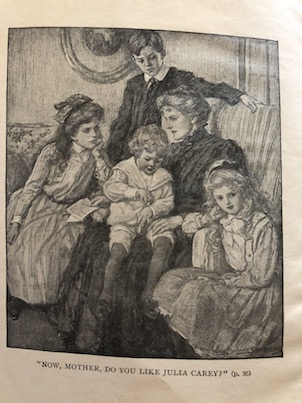
MotherCareysChickensJuliaComingThen, the family receives word that Captain Carey’s brother is in failing health and that his business partner, Mr. Manson, is seeking to place his daughter, Julia, with a relative.  Mr. Manson has already spoken to a cousin of the family about Julia, but this cousin has refused to take her.  The now-fatherless Carey family knows that taking on another relative will be an added burden on them, but Julia has no other family and nowhere else to go, so they see it as their duty to help her.  Admittedly, none of them likes Julia very much.  They remember her as a spoiled child who was always bragging about the wonderful things that her wealthier friend Gladys Ferguson had or did.  Even now, the Ferguson family has invited Julia for a visit before she goes to live with her aunt and cousins, but unfortunately, they have no intention of adopting her or even trying to care for her until her father is well themselves.  Nancy sees them as simply spoiling Julia and preparing her for a life that the Carey family can’t possibly support.
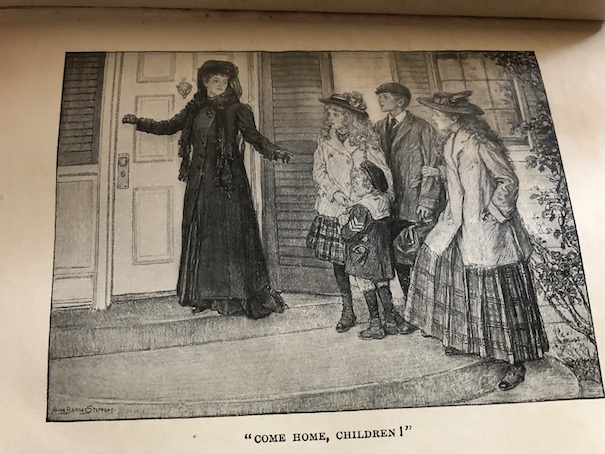
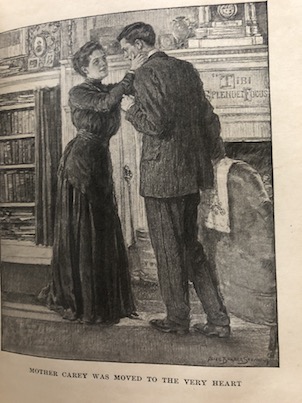
Then, Nancy has an idea that changes everything for the family.  She reminds them all of a trip that they took to Maine years ago and a beautiful old house that they saw in a small town called Beulah.  The memories of that happy time and idyllic house and small town call to them, and Nancy and her mother wonder what happened to the house.  They decide to talk to a friend of Captain Carey’s who had a small law office in the area, sending Gilbert to Beulah to find him.  In Beulah, Gilbert learns that the Yellow House (as people commonly call it, although it also has the name Garden Fore-and-Aft) belongs to the wealthy Hamilton family, who don’t live there but have used it as a kind of vacation home.  The father of the family, Lemuel Hamilton, is in diplomatic service and lives overseas.  During the last few years, the younger Hamiltons had used the house to host house parties of other young people they knew from school, but now the young people are living all over the world, and the house has been empty.  Gilbert’s father’s friend, Colonel Wheeler, and a local store owner, Bill Harmon, describe the house’s current condition to Gilbert.  Since the younger Hamiltons renovated the barn and put in a dance floor for their parties, it’s too fancy and no longer usable for its original purpose, which is why no farming families have been interested in the house themselves.  The men say that they can rent the house to the Carey family on behalf the Hamilton family (who, after all, still have to pay taxes on the property and wouldn’t mind a little extra money to cover it) for a sum much less than the rent of their current house.  The house could use a few minor repairs, and the barn is more fixed up for holding dances than keeping animals, but that’s no problem for the Carey family.  Living there would save the family a lot of money until the children are grown and able to start earning their own livings.  Even though Gilbert is only about fourteen, he is able to rent the house on his mother’s behalf.

MotherCareysChickensHome

The entire family is pleased, except for Julia, who is still a snob.  The book explains that Julia had always been a very well-behaved little girl although neglected by her somewhat flighty mother.  (The book doesn’t say exactly what happened to Julia’s mother, although she is no longer part of Julia’s life.  She may be dead, or she may have run off a long time ago.)  Because she was an only child and always seemed the “pink of perfection” (which provides the title of a song about Julia from the movie version of the book), always seeming to say and do the right thing, her father spoiled her from a young age, giving her every possible advantage he could.  When Julia first arrives at the Yellow House in Beulah to stay with her relatives, she still prattles on about her wonderful friend Gladys and all the luxuries she has.  The book says, “She seemed to have no instinct of adapting herself to the family life, standing just a little aloof and in an attitude of silent criticism.”  So, if Nancy sounded a little too wonderful in her earlier description, understand that Nancy thinks that Julia is too sickeningly perfect and smug.  Julia’s problem, as I see it, isn’t so much that she’s too perfect as she expects the rest of the world to be too perfect.  Because she is so focused on perfection, she isn’t sympathetic enough to other people or accommodating to imperfect situations.  As the book says, “She seldom did wrong, in her own opinion, because the moment she entertained an idea it at once became right, her vanity serving as a pair of blinders to keep her from seeing the truth.”  Besides being spoiled, she is very naive and rigid in her thinking.  She thinks that she knows what’s what and how things ought to be, and that’s all there is to it.

A major part of the story deals with Julia’s adjustment to family life and the realities of the family’s situation.  At first, she thinks that Mrs. Carey should save up for college for Gilbert and a proper coming-out for each of the girls in the family to give them all the advantages that life has to offer.  She’s sure that her father will get better and be able to help pay for everything when the time comes.  However, Mrs. Carey doesn’t want to wait on that hope.  She says that she’s sure that the children will be able to make something of themselves even without the advantages.  Matters come to a head with Julia when Kathleen gets tired of Julia complaining about everything and everyone and says that if her father hadn’t lost so much of her parents’ money as well as his own, the whole family would be better off.  Julia demands to know from Mrs. Carey if that is true, and Mrs. Carey says that she and her husband did invest in her father’s business, an investment which he may never pay back, due to his poor health.  She also tells Julia:

“You are not a privileged guest, you are one of the family. If you are fatherless just now, my children are fatherless forever; yet you have not made one single burden lighter by joining our forces. You have been an outsider, instead of putting yourself loyally into the breach, and working with us heart to heart. I welcomed you with open arms and you have made my life harder, much harder, than it was before your coming. To protect you I have had to discipline my own children continually, and all the time you were putting their tempers to quite unnecessary tests! I am not extenuating Kathleen, but I merely say you have no right to behave as you do. You are thirteen years old, quite old enough to make up your mind whether you wish to be loved by anybody or not; at present you are not!”

It’s an awful thing to say to a child that she isn’t loved, but it is something of a wake-up call to Julia to realize that the way that she was behaving was making herself unlovable to the people who should have been closest to her.  When she tells Mrs. Carey that Gladys loves her, Mrs. Carey says, “Then either Gladys has a remarkable gift of loving, or else you are a different Julia in her company.” Mrs. Carey tells her to consider what the Bible says about “the sin of causing your brother to offend.” It’s probably the first time that Julia was ever criticized for anything, breaking her perfect record of apparent perfection.  Julia has greatly provoked the rest of her family and realizes that she has earned whatever bad feelings they have toward her.  She has ignored their difficulties because she was too focused on what she wanted for herself and the way that she thought that life should be, not realizing how much harder she had made things for everyone.  For the first time in her life, Julia admits that she is not perfect and asks for another chance to make things right, marking a real change in her character.  Personally, though, I think that some of this drama could have been avoided if, knowing Julia and her behavior as she does, Mrs. Carey had spoken to her when she first came to live with the family, explaining the family circumstances in a straight-forward way and making it known that she expects certain standards of behavior from Julia when she’s in her house.  Making the rules and enforcing them them from the beginning may have prevented a lot of stress and saved Kathleen from exploding emotionally.

MotherCareysChickensLatinA character that appears in the movie, Ossian “Osh” Popham, is also in the book, although instead of being the store owner, he’s a local handyman who helps the family get the house in order.  His children, also characters in the movie, are in the book, too, although I didn’t like the way the book described his daughter, Lallie Joy.  It says that “she was fairly good at any kind of housework not demanding brains” and that she “was in a perpetual state of coma,” in case you didn’t understand that she’s basically stupid.  I always hate it when stories make a character intentionally stupid.  I did appreciate her explanation of her name, though: “Lallie’s out of a book named Lallie Rook, an’ I was born on the Joy steamboat line going to Boston.” I had wondered where the name came from.
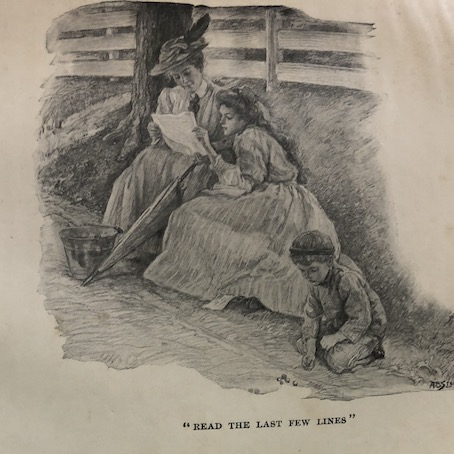
While the family continues fixing up the house to make it nicer to live in, Nancy writes a letter to the owner of the house, 50-year-old Lemuel Hamilton, who is an American consul in Germany, telling him about her family and their life at the house.  Lemuel Hamilton finds her letter charming.  Seeing the picture of her family that Nancy encloses with the letter makes Lemuel think of his own family, scattered to the four winds, the children grown or nearly grown, either away at school or starting their first business ventures in various parts of the world.  He’s lonely for the comforts of having all of his family living together and surprised at how happy this much-poorer family looks in the old house in the small town that his ambitious, social-climbing wife always thought was beneath them.  Then, it occurs to him that his sons are of an age when they’ll start thinking about marriage soon, and he wonders what wives they’ll choose and what their family lives will be like.  On an impulse, Lemuel writes to the Carey family, telling them that they can live in the house rent-free as long as they continue with the household improvements, and he also forwards Nancy’s letter to his younger son, Thomas (tying the story back to the quote at the beginning of the book), who is living in Hong Kong and who was the one who always liked the Yellow House the most.

MotherCareysChickensLetter

MotherCareysChickensTomRosesWhen Lemuel tells the Careys that they can stay in the house for as long as they like, unless his son Tom wants the house, Nancy begins thinking of Tom as a possible threat to her family’s happiness.  (She thinks of him as “The Yellow Peril” in a reference for the old xenophobic term used by people who were afraid of immigrants from Asia, since he would be coming from China, and as a pun on the Yellow House that they might be competing for. This term is also mentioned in the Disney movie.)  Of course, Tom turns out to be no threat.  Tom has been lonely pursuing his tea business in China, and Nancy’s letter and happy family life call him home to a romance that will change the lives of the Careys as well.  By the end of the book, Nancy is seventeen years old, old enough for romance and charmed by the romantic Tom.

The lessons that the story emphasizes are the importance of family relationships and togetherness over personal ambition and developing the ability to triumph over adversity instead of waiting for life advantages that may never come.  Like other books from the early 20th century, the values of hard work and cheerfulness are emphasized, and there is the implication that important people will recognize and reward these qualities when they see them.  Pretentiousness and snobbery are criticized.  A settled, happy family life is the ultimate goal.

Overall, though, I really prefer the movie to the book.  I think that cutting down some of the side plots improved the story.  Besides removing the younger daughter, Kathleen, from the story, the movie also eliminated other side characters, like Cousin Ann and the Lord siblings, Cyril and Olive, who also live in Beulah and become friends of the family.  Also, making Julia older than she was in the original book, closer to Nancy’s age than Kathleen’s, improves the sisterly relationship that the girls eventually have.

My copy of the book originally belonged to my grandmother, who was born the same year that this book was originally written.

The book is now public domain and available online through Project Gutenberg.

Mystery Back of the Mountain

MysteryBackMountainMystery Back of the Mountain by Mary C. Jane, 1960.

Anne and Stevie Ward are thrilled when they discover that their father has inherited a house in the country from a distant relative who has recently died. Neither of the children had met their father’s “Uncle” James (really a distant cousin of their great-grandfather), and even their father hadn’t seen him for years. Probably, the only reason Uncle James left him the old farm where he used to live was because he had no children of his own and the two of them shared the same name.

The children think that a country house would be a great place to spend the summer, and even their mother thinks that perhaps they should keep the house as a vacation home, but their father has some reservations about it. For starters, the old farm house, located outside of a small town in Maine, is kind of shabby and has no running water or electricity. It’s so isolated that people named the area Back of the Mountain. Then, there’s Uncle James’s reputation. Uncle James was the black sheep of the family, having apparently made his money in some unethical business dealings and then became involved in some kind of inappropriate romance that ended tragically. The children’s father isn’t completely sure of the details because he only heard whispered rumors about Uncle James when he was young, but he knows that the people of his town weren’t very fond of him, and he suspects that they might feel the same way about his relatives. He thinks that it might be better just to sell the house and forget about it. Nevertheless, he agrees with his wife that the family should go there and take a look at the house and decide what they’re going to do with it.

MysteryBackMountainMissingPictureWhen they get to Maine, they meet Uncle James’s lawyer, Mr. Palmer, to collect the key to the house.  Mr. Palmer tells them that the house has a few items in it that could be considered valuable antiques, including a portrait of the woman that Uncle James had wanted to marry, Drusilla Randall.  The children’s father asks Mr. Palmer more about Drusilla Randall, and he says that all he knows is that she had an argument with Uncle James and then disappeared.  He thinks that she just left town, although he says that there are rumors that Uncle James may have murdered her.  Mr. Palmer thinks that the rumors are ridiculous and doesn’t take them seriously, but Stevie and Anne are disturbed at the idea that their relative may have been a murderer, or that people thought he was.  Mr. Palmer also mentions that Drusilla’s sister, Marion, has decided to return to her family’s old house for the summer as well, so she’ll be living close to their farm.
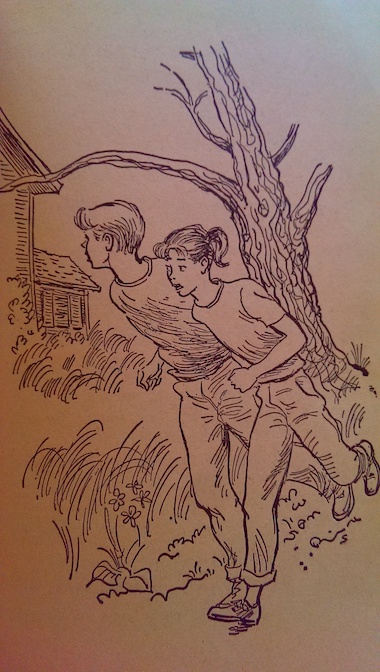
MysteryBackMountainRunningThe house is certainly an isolated place, and their closest neighbors, the Hodges have an old grudge against Uncle James.  The unethical business deal that Uncle James did years ago involved buying some of the Hodges’s family’s best land.  Bert Hodges, who was young at the time, says that the deal ruined his father’s life, and it’s making his miserable, too, because he really needs that land to make his farm profitable.  Anne hears this from Bert’s young niece, Oleva, an orphan who has come to live with her aunt and uncle.  Although Uncle Bert is strict with her and somewhat bitter about the past and the family’s circumstances, Oleva likes her aunt and uncle and wishes they would adopt her, giving her the stable home she’s longed for since her parents died and she began being traded around among her relatives.  However, Bert doesn’t have much faith in other people, and even though he likes his young niece, is afraid to commit to adopting her.

MysteryBackMountainBridgeAnne feels badly that Uncle James’s land deal seems to have ruined people’s lives.  Oleva also tells her something disturbing about Drusilla, the girl that Uncle James loved.  They were supposed to be married when Drusilla turned twenty, but she disappeared before that happened, and most people think that she drowned in the natural pool on Uncle James’s property.  It’s deeper than it appears at first, and some things belonging to her were found nearby, so everyone thinks that she probably drowned and that her body is still somewhere at the bottom of the pool.  Whether her death was an accident, suicide, or murder is still unknown.

Mysterious things are happening around Uncle James’s property.  The portrait of Drusilla that Mr. Palmer said would be in the house is missing.  The family hears eerie howls in the night.  Oleva is sneaking around, doing something that she says her uncle would disapprove of, but which she insists that she can’t stop.  Then, Anne finds a poem engraved on a stone in an old graveyard, apparently written by Uncle James in Drusilla’s memory that points to the secret of their quarrel and her death.  The things that Uncle James did in his life still cast their shadow, and the only person who can tell them the full story of what really happened all those years ago and set things right . . . is Drusilla.

Uncle James’s problem, as the children eventually learn, was the nature of his ambitions.  He wanted to be a big man more than a good one.  It wasn’t that he was completely awful.  Drusilla herself (once the children learn where she really is and who she is) tells them that he could be charming, and she knows he never really meant to do anything wrong.  The problem was that he wanted to be important and admired by others to the point where “getting ahead” of others was all that really mattered to him.  There was a point when he could have used what he had to help his neighbors when they were in trouble, but instead, he used their troubling situation to his own advantage to take what they had for himself.  When he discovered something valuable on the land he’d acquired from Hodges family, something that would have saved them from their problems if they had known about it before the sale of the land, he could have turned it over to them to help make things right, but he refused to do it, which was the basis of his quarrel with Drusilla.  As far as Uncle James was concerned, he was entitled to what he found because he had bought the land legally, but Drusilla argued against keeping it on moral grounds, out of compassion for the Hodges.  In the end, Uncle James was admired by no one because of his selfishness, and Drusilla realized that wasn’t a quality that she wanted in the man she was going to marry.  Uncle James’s attempts to make people admire him for being wealthy and important ended up costing him friendships, relationships with relatives, and ultimately, the woman he wanted to marry.  Like others, Uncle James believed that Drusilla was dead, that she had drowned herself over their quarrel.

Uncle James’s drive to make people like him causes Anne to reconsider something that was bothering her as well.  She isn’t as good at making friends as her brother because her brother is more outgoing and good at sports.  The other kids always want Stevie to play for their team.  Anne often wishes that she could be more athletic, “to come in first,” so that other kids will like her better and want her to play with them more, instead of picking her last for every game.  However, she comes to realize that being “first” in things isn’t what really wins friends in the end.  Caring about others and being there for them when they need you wins real friends.  As Anne explores the old graveyard, she thinks about how just being alive and enjoying life is a great feeling by itself, whether you’re “first” or not, and sometimes, good things come to those who take their time instead of just rushing to be “first.”

Miss Rumphius

MissRumphius

Miss Rumphius by Barbara Cooney, 1982.

From the time she was young, Alice Rumphius wanted to travel and see the world.  She planned to return home to live by the sea when her travels were over.  However, her grandfather, an artist, gives her one more mission in life: to make the world more beautiful.  Although Alice isn’t quite sure how she will accomplish that, she agrees.

RumphiusPainting

When she grows up, she lives out her dream of traveling, seeing all the places that she read about while she working in a library.  However, she ends up hurting her back while getting off of a camel she was riding, so she decides that it’s time to retire and find a home by the sea, as she planned.

RumphiusCamel

As she recovers from her injury, she thinks about her mission to make the world more beautiful.  At first, she still doesn’t know how to accomplish that, but some flower seeds she planted and her particular love of lupines give her the inspiration for her final legacy of beauty.

RumphiusLupines

Her gift of spreading seeds of beautiful flowers gives her a reputation as an eccentric, the Lupine Lady, but it also inspires a new generation to undertake their own missions to see the world and to create beauty in their own way.

RumphiusChildren2

One of the things that fascinates me about Miss Rumphius and her story is that she leads a very non-traditional life.  She has very definite goals from childhood and sticks to them throughout her life, but they are not quite the common goals of most people, like marriage and career.  She remains unmarried throughout her life (the book never says anything about whether she had any romances in her life because that wasn’t one of her main life goals and therefore not really important to the story), and her only listed career was that of working in a library, which allowed her to have some money and to read about the places where she wanted to travel.  In the end, she is not wealthy and has no husband or children of her own, but she is happy because she has achieved the things that always meant the most to her.  She has had rich life experiences, she has made the world a little better for her presence, and she encourages her nieces and nephews to see the world, to enjoy their experiences, and to leave their own mark of beauty.

Apparently, parts of the story are based on the author’s own life and on the life of Hilda Hamelin, the original Lupine Lady.  The book is currently available online through Internet Archive.

Fudge-A-Mania

FudgeAManiaFudge-A-Mania by Judy Blume, 1990.

Peter is horrified when he finds out that his family is going to spend their vacation in the same place as bossy know-it-all Sheila Tubman and her family.  Even worse, the two families are going to be staying to be staying right next to each other.  Really right next to each other.  They’re staying in the same house, which has been split into two halves.  As far as Peter is concerned, the only thing that might save his summer is that his friend Jimmy will be coming up to stay with them part of the time.

The arrangement turns out to be a little better than Peter thought it would be at first.  Sheila finds a way to make some extra money by baby-sitting Peter’s five-year-old brother Fudge.  Fudge says at first that he wants to marry Sheila, although it turns out to be mostly because he’s afraid of monsters in his room at night, and he thinks that if he gets married and shares a room with Sheila, it will keep the monsters away.  Then, he decides that marriage may be unnecessary when he makes friends with a little girl named Mitzi, who is staying with her grandparents nearby.  Mitzi’s grandmother makes a special monster spray for her to keep monsters away, so Fudge decides that he might not have to marry Sheila after all.

Peter is happy when he discovers that Mitzi’s grandfather is Big Apfel, his baseball hero, and that he holds baseball games that are open to the public, so he and Jimmy can also play with him.  He also gets a crush on Isobel (“Izzy”), a girl who works at the local library, although Isobel is a few years older than he is.  The baseball game goes well enough, but the crush, not so much.

Then, comes the most shocking news of the summer: Peter’s grandmother and Sheila’s grandfather decide to get married!  If that happens, Peter and Sheila realize that they’ll be related by marriage!

Big Apfel and his granddaughter Mitzi are fictional characters, but the book that Mitzi claims is about her, Tell Me a Mitzi, is a real book.

This book is part of the Fudge Series.  It is available to borrow and read for free online through Internet Archive.