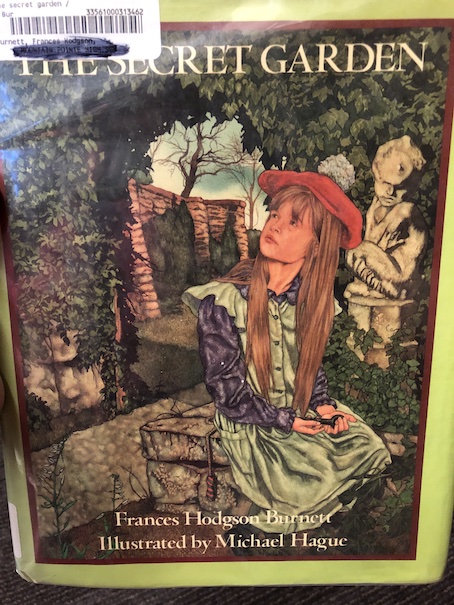
The Secret Garden by Frances Hodgson Burnett, 1911, 1987.
When Mary Lennox arrives in England following the deaths of her parents, people think that she is a peculiar child. She was born and raised in India. She is very thin, and her skin has a yellowish tint because she was frequently ill there. She also has a sour disposition, and it’s not just because she is grieving for her parents. Mary comes from a wealthy family, but she has been emotionally neglected for most of her life. She has not experienced real affection from anyone in her life, so she feels little affection for anyone. Her father worked for the British government in India, and between his work and his own illnesses, he never really had time for Mary. Her mother was a beautiful but frivolous woman who spent most of her time at parties or entertaining her friends. Her mother never really wanted a child at all, and she left Mary’s care and upbringing to an Indian nurse, with the instructions that the nurse keep Mary out of sight as much as possible. Her mother just didn’t want to bother with her. Because her mother didn’t want to be bothered with hearing Mary cry, even as a baby, the nurse and other household servants gave Mary anything she wanted and let her do as she pleased to keep her content. As a result, Mary became a spoiled and unmanageable child, and governesses who came to teach her never stayed very long because she was so temperamental.

Everything changed when Mary was nine years old. A cholera epidemic broke out, and Mary’s nurse was the first to die in their household. (Mary’s frivolous mother even admits, in Mary’s presence, that she was warned to leave the area weeks ago, but she wanted to stay for the sake of a dinner party. When the nurse dies, she realizes for the first time that she’s been a fool.) The other servants forgot about Mary in their panic, and people fled the area. Mary is discovered alone in the house by soldiers, who inform her that her parents died during the night. Mary is cared for temporarily by a clergyman and his family, but she doesn’t get along with the other children because she is spoiled and temperamental. She likes to play alone, pretending that she is planting a garden, so the other children tease her about being Mistress Mary, Quite Contrary from the nursery rhyme. Then, she is sent to England to live with her uncle, Archibald Craven, at Mistlethwaite Manor. She knows nothing about her uncle or England, only that her uncle supposedly lives in an isolated house and never sees people.
The trip to England opens Mary’s eyes a little to the world and the ways of other people. She begins to notice that other children are treated differently from the way she’s always been treated. Other children seem to belong to adults who care for them, their mothers and fathers. Mary has never really felt like she belonged to anyone. In fact, many of her mother’s friends were completely unaware that she even had a child because Mary was always kept out of sight, and her mother had always lived like she wasn’t a mother at all. Mary has so little connection to her own parents that she doesn’t miss them at all when they’re gone. People keep saying that it’s such a shame that her mother was so beautiful and charming and that her daughter is so unattractive and unpleasant, but the adults also comment to each other that if Mary’s mother had spent any time with her or cared for her, Mary might be very different. Mary doesn’t think of herself as being unpleasant, although she often thinks other people are unpleasant.
On her arrival in England, she is met by her uncle’s housekeeper, Mrs. Medlock, a no-nonsense woman. Mrs. Medlock tells her that her uncle’s manor is grand but gloomy and peculiar. It’s 600 years old, located near a moor, has over 100 rooms (most of them closed up and unused), is full of fine things, and has a garden around it. It all sounds very different from India, and Mary finds it hard to form an opinion about it. Mrs. Medlock is surprised at how unresponsive Mary is, and Mary says that there isn’t much point in her thinking or feeling anything because what she thinks and feels won’t change her situation. She has to go live at the manor whether she likes it or not. Mrs. Medlock admits that is true and that she doesn’t expect that Archibald Craven will pay much attention to her. He was married, and he and his wife loved each other very much, but his wife died, and that’s part of the reason why he lives like a hermit now. He also has a crooked back and doesn’t like for many people to see him. This begins to awaken some feelings in Mary. For the first time in her life, Mary feels a little sorry for her uncle, hearing about the sad death of his wife. It reminds her of something from a book. Mary begins to think that life at Mistlethwaite Manor sounds like it’s going to be lonely and dreary. Mrs. Medlock says that she will be expected to entertain herself most of the time.
Mary’s first impressions are indeed as lonely and gloomy as she expects. When she arrives, he is met by more servants, not her uncle. Mrs. Medlock is told that Mary’s uncle doesn’t want to see her and that she should be taken to her rooms. She is told that her uncle is leaving for London in the morning, and that she will be expected to keep to her rooms.
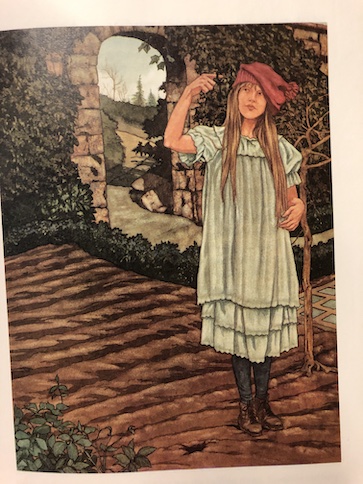
The only person who is pleasant to Mary is Martha, the house maid. Mary is surprised at Martha’s friendly and open manner because the servants in India always behaved in a servile way, even taking blows and abuse without complaint. When Mary sees the moor for the first time in daylight, Martha asks her if she likes it. Mary says that she doesn’t, but Martha tells her that it’s only because she’s not used to it and that she’ll like it better when she gets used to it. Mary asks Martha if she likes the moor, and Martha says she does. She describes to Mary all of the things that she likes about the moor, including the plants, the smells, the fresh air, and the sounds of the bees and birds. Martha waits on Mary a bit, but not in the way that the servants in India did. Mary is shocked to discover that there are some things that Martha expects her to do for herself, like dressing herself.
There is some racial talk at this point in the story, but the attitudes of the characters are somewhat mixed. Some of it seems to be inappropriate or derisive (mostly on Mary’s part), but some of it also seems friendly or interested in other races (mostly on Martha’s part). Martha says that things in India were different because there were more black people there inside of white people. The story uses the word “black”, apparently not making any distinction between people from Africa and people from India, like all non-white people are “black” by default. (My conclusion, from this part of the book and some later comments, is that Martha actually doesn’t know the difference.) Martha confesses that, when she first heard that Mary was coming from India, she might even be black herself. Mary is enraged at the idea that anyone would think of her as being “black” or a “native”, and she calls Martha a “daughter of a pig” because that’s what people in India would have thought of as one of the worst possible insults. Martha is unphased by this temper tantrum and just tells Mary that there’s no cause to be angry and that girls shouldn’t use language like this. Martha says that she wasn’t at all upset when she thought that a black girl might be coming to live at the manor because she’s never actually met a black person before and was looking forward to having that new experience. She says that she has nothing against black people and has heard that they are quite religious. Mary tells Martha that she doesn’t know anything about black people because they are only servants, not people, and she bursts into tears. Mary thinks this because the only non-white people she’s ever known were servants, and she doesn’t want to be thought poor and servile. To placate Mary, Martha admits that she doesn’t know much about these things, but Mary is the one who is about to get some new learning experiences.
Martha, who describes herself as being a somewhat common person, says that her mother always said that it’s a wonder that rich children don’t all turn out like fools because they don’t do many things for themselves, and she says that it will be good for Mary to learn how to do some basic things to take care of herself, like how to get dressed without help. Mary tells Martha that it was “not the custom” for children in India to dress themselves because that was only life she ever knew. The servants used to dress her and do things for her like she was a little doll instead of a person, and at first, Mary doesn’t know what to do or say when Martha speaks to her in a personal way, like a human being, or insists that she do things for herself. It helps that Martha comes from a large family with twelve children. She might know a lot about the world and other cultures, but she knows a lot about what to do with children and what children can be capable of doing, and these are things Mary needs to learn.
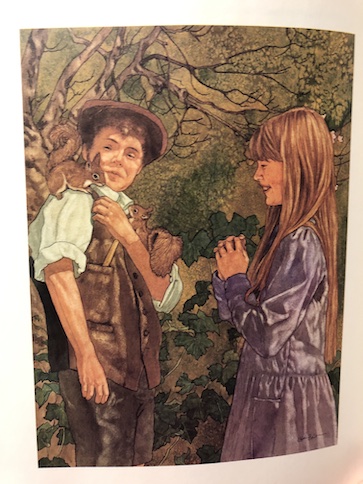
Mary is surprised when Martha tells her about one of her brothers, Dickon. Dickon has a way with animals, and he has tamed some wild animals, including a wild pony that he can now ride. Mary has never been allowed to have a pet before, although she has always wanted one. Mary has rarely been interested in anything, but Dickon begins to fascinate her.
Since there is little in the house to amuse a child, Martha insists that Mary go outside by herself and explore. Nobody will entertain Mary, so she must learn to play and amuse herself. For a start, Martha says that Mary can go look at the gardens. Intriguingly, Martha mentions that one of the gardens is locked. Mary asks why, and Martha says that the garden used to belong to Mrs. Craven and that Mr. Craven has kept it locked since she died ten years ago. He even buried the key somewhere. In spite of herself, Mary begins to be very curious about the locked garden and the reason why it is kept locked. As she explores outside, she discovers that the house is surrounded by several walled gardens, most of which have open doors in their walls. It is winter, so most of the gardens are bare. It is dreary, but Mary sees a robin and is cheered by its singing.
Mary is not accustomed to people liking her or to liking other people, but she begins making friends with the gruff old gardener, Ben Weatherstaff. He can whistle for the robin, and it comes to him, and that intrigues Mary. The gardener tells Mary about robins and about the friendly robin in particular. Seeing him interacting with the bird prompts Mary to mention that she is lonely, a revelation that surprises her. Her nurse didn’t like her, and she was never allowed to play with other children, so she has never had any friends. Ben Weatherstaff understands about loneliness because he doesn’t have much company, except for the birds. He is accustomed to plain speaking, and he comments that he and Mary have much in common, both being sour of disposition and plain looks. Mary is surprised at this candor and at the image it has given her of herself. The only people who interacted with her before were servants, who were paid to praise their employers. It never occurred to Mary before how other people really saw her and that her lack of human contact and affection is part of the reason why she feels so sour, behaves badly, and has trouble feeling emotional connections to other people because, to her, that was just normal life. The move to England is starting to show her that what she has always thought of as normal isn’t really, and her version of normal wasn’t even really healthy for her. She is touched when the robin acts like it wants to be friends with her, the first living thing that really seems like it wants to like her, and Mary finds herself liking a living thing for the first time, too.
It starts to become routine for Mary to explore the gardens every day, and she begins to grow healthier with the fresh air and activity. The cooler climate of England agrees with Mary more than the warmer climate of India, and her explorations and time alone awakens her mind and imagination. Martha’s practical mother hass Martha give Mary a gift of a skipping rope and tells her to have Mary spend as much time outside as possible. Mary begins to like Martha’s mother and Dickon from the stories Martha tells her about them. She’s not accustomed to liking people, and it surprises her that she can like someone just by description, without even seeing them. Martha poses a question to Mary about whether or not she likes herself, a question her mother once asked her when she was being critical of other people. Mary never thought about it before, but she has to admit that, now that she thinks about it, she doesn’t really like herself, and she can now see why other people didn’t like her before.
Mary begins to grow closer to Martha, who is also lonely, in her own way. She misses her mother and all her brothers and sisters when she’s working at the manor, and the other servants make fun of her for her common speech and Yorkshire expressions. Mary doesn’t make fun of her speech because, after living in India, she understands that some people just speak different dialects and doesn’t consider it unusual to not understand everything a person says, so Martha doesn’t mind spending time with Mary and talking to her, answering her questions as best she can. It isn’t always easy because, as she admits to Mary, there are things about the house and Mr. Craven that she’s not allowed to talk about. Mr. Craven is a very private person, and Mrs. Medlock won’t let the servants gossip too much.
Mary asks Martha more about the locked garden and why Mr. Craven hates it. Martha says that she might as well know that he used to love it when Mrs. Craven was alive because the two of them tended it together and spent a lot of time there. There was a tree with a branch shaped like a seat, where Mrs. Craven liked to sit. One day, the branch broke, and Mrs. Craven was hurt so badly by the fall that she died the next day. Ever since, Mr. Craven can’t bring himself to enter the garden or even hear anybody talk about it.
Something that Martha refuses to explain to Mary is the mysterious crying noises that Mary sometimes hears. She makes excuses, like it’s the wind or another maid with the toothache, but Mary is sure that it’s a child crying inside the house. Mary tries to explore the house, but Mrs. Medlock stops her from poking around too much. It’s only outside that Mary is truly free to explore.
Then, while watching the robin the garden, Mary finds both the key to the locked garden and the door inside. At first, the old garden looks dead, but then, she finds some tiny growing things. Mary begins tending the garden herself, realizing that, if she weeds the garden, there will be more room for the plants to grow. She asks Martha some questions about plants and gardening, and Martha explains some things, saying that Dickon knows more about gardening. Martha is pleased by Mary’s new interest in gardening. She doesn’t know that Mary has gotten into the locked garden, but her mother said that it would do Mary good to have a little space to make a garden for herself. Without telling Martha her secret, Mary says that’s just what she wants to do. Martha helps helps Mary write a letter to Dickon, asking for his help getting gardening tools and seeds and getting her garden started.
When Mary finally meets Dickon, she lets him in on the secret of the locked garden, but she swears him to secrecy about it. Mary has come to identify with the garden because, like Mary herself, it’s been neglected for a long time. For ten years, it was left alone, and nobody cared whether it lived or died, but Mary cares. She is determined to help it live, and she doesn’t want anybody to stop her. Dickon also finds the secret garden fascinating, and he is willing to help tend it in secret. He shows Mary how to tell which plants are alive or dead, and he explains what they will need to do to restore the garden to its former glory.
Mr. Craven inadvertently gives Mary permission for her secret activities when he sees her for the first time, to check on how she’s doing. He apologizes to Mary for being a negligent guardian, admitting that he has forgotten to hire a governess for her. He is forgetful because his health is poor, but he says that he does care about her welfare. Mary begs him not to give her a governess right away because her health is improving from playing outside in the gardens. Mr. Craven admits that what she says agrees with advice that Martha’s mother has given him about caring for Mary, so he says that she may go without a governess for now and may spend as much time outside as she likes. He asks her if she would like any toys, dolls, or books, and Mary asks him if she can have some earth for planting things instead. Mr. Craven says that she reminds him of someone else, but he agrees that she can have any patch of earth that she likes, as long as it’s not being used for anything else. He is going to be traveling abroad for his health until next winter, so Mary knows that she will have plenty of time for working in the secret garden and Mr. Craven’s technical, if unknowing, permission.
The mystery of the crying that Mary sometimes hears is solved when she boldly investigates the sound one night and finds a strange boy, about her age. She asks him who he is, and he says that he is Colin Craven, Archibald Craven’s son. When Mary explains that Mr. Craven is her uncle, the two of them realize that they are cousins. Colin explains that people aren’t allowed to see him or talk about him because he is ill. His father worries that Colin will have a crooked back, like he does, and Colin doesn’t want anybody to see him like that. He admits to Mary that people used to take him places when he was younger, and people would stare at him and whisper about him, and he hated it. He could tell that people thought he looked sickly and that they were sorry for him. Colin thinks that he is too sickly to live to adulthood because he has heard people talking about the possibility of him having a lump on his back and the possibility of him dying when they think he couldn’t hear them or couldn’t understand. However, he has understood all of it from a young age, and it has always terrified him. He doesn’t even trust his doctor because his doctor is a relative of his fathers and stands to inherit the manor if Colin doesn’t live to adulthood. Colin can tell that the doctor is hoping that will happen. The doctor hasn’t actively tried to harm Colin, but he hasn’t been very much help, either.
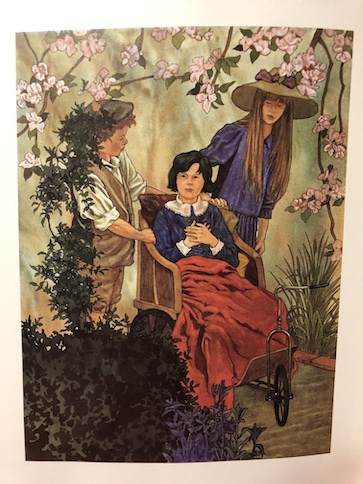
Colin is every bit as spoiled as Mary was when she first arrived in England. Like Mary, he has been shut away from most people and looked after by servants, who give him anything he wants and do whatever he says because they feel sorry for him and because he throws fits when they don’t. His father rarely sees him because he looks like his mother, which makes him sad, and he fears that he will see Colin become deformed or sicken and die. In meeting Colin, Mary finds herself confronted by a child very much like herself, but it turns out that she’s more than a match for him. In fact, she’s exactly what Colin has needed, to the amusement of all the servants. She doesn’t give in to Colin’s imperiousness nor his hysterics. She offers him the reassurance that he has needed that he is not deformed nor likely to die when he admits to her what his real fears have been. She provides him companionship and also gives him new things to think about besides his worries. Because he rarely leaves his room, he doesn’t know anything about the secret garden, but after she has determined that he can be trusted to keep the secret, she tells him about it. Colin badly wants to see it, and Mary asks Dickon to help take Colin out to see the garden in his wheelchair. As the children enjoy and work in the garden, restoring it to life, it also offers new life to the neglected children. As the flowers grow and bloom, the children blossom, too.
The book is public domain now, and you can read it for free online through Project Gutenberg and Internet Archive. You can also read it in your browser through Lit2Go, which also includes audio readings of each chapter. There have been many different printings of this book with different illustration. The edition I used for the pictures on this review was from 1987. It has been made into movies several times.
My Reaction
Benefits of Nature and the Power of Positive Thinking
I love the atmosphere of The Secret Garden! The old manor house is wonderfully old-fashioned and gloomy. Mary’s bedroom has tapestries on the walls, and the house is mysterious and maze-like inside and surrounded by walled gardens and the open moor. Like Mary at the beginning of the story, I’ve never lived anywhere with a moor, and Martha’s descriptions of the plants and smells of the moor helped.
One of the most prominent themes in the story is the love of nature. The children see miracles in nature, and they find their interactions with growing plants healing to their spirits and bodies. There is also a strong emphasis on the power of positive thinking. The children come to realize that many of their emotional and health problems stem from their negative thoughts, and they make a conscious effort to focus more on positive things, replacing old, negative habits with healthier ones. The improvements they experience in their lives and attitudes give them encouragement to keep working on improving their thinking habits.
Frances Hodgson Burnett’s thoughts on healing and the power of positive thinking come from a time in her life when she suffered from severe depression and “nervous prostration.” While struggling to recover from her emotional disorder, she researched Christian Science, metaphysics, New Thought, and spiritualism. The philosophies of the characters in the story seem to be an amalgamation of different philosophies and schools of thought, not strictly adhering to anything in particular. There isn’t anything particularly religious about the children’s thinking, which I think makes sense because these neglected children probably haven’t been schooled much in religion. The children’s thoughts seem to be based on bits and pieces that they’ve read or heard about from others and some pieces of Eastern philosophy from Mary’s time in India, along with some things which seem to be their own invention. Colin thinks that the healing he experiences and the power of nature are some form of magic, and he decides that he’s going to spend his life experimenting with this type of magic and telling others about his discoveries. I found this part of the story interesting because Colin’s scientific concepts of magic and magical experiments remind me of Gerald Gardiner and the origins of Wicca (this Timeline documentary on YouTube explains it – the part about his youth is 10:30 in – that’s the part that reminded me the most of this book). Gerald Gardner was ill as a child because he was an asthmatic. The climate in Britain, where his family lived, didn’t seem to suit him, so his parents arranged for him to travel with a nanny. He spent much of his youth living away from Britain, in areas with warmer climates. The change of climate helped him, but during his travels, he also developed an interest in ritual healing magic and folk remedies, which he also believed helped him, and he conducted magical experiments to perfect his rituals. He combined these ideas and experiments with his own research into spiritualism and philosophical systems to form Wicca. Gerald Gardner was born before The Secret Garden was written, but his magical experiments and promotion of the Wicca movement occurred decades after this book was written, in the 1930s and 1940s, so Frances Hodgson Burnett couldn’t have used him for inspiration. I think it’s more that he found inspiration from similar spiritualist and philosophical sources, and he also used the natural environment in dealing with a chronic illness, as the author and the characters in the book did.
I don’t really believe in the more magical/metaphysical aspects of this type of philosophy, but a person’s environment can have a very real effect on their emotional and physical health. In my list of Cottagecore books, I talked about how people found solace in nature during the stress of the coronavius pandemic, and people have sought comfort in nature and the countryside for other forms of stress for generations. It’s a theme that often appears in vintage children’s literature, which made assembling the list of books with Cottagecore themes easy. People are often calmed by environments with plants and rooms with windows that allow them to see the outside world because they feel more natural. The need to feel in touch with the natural world was something discussed in the documentary about Gerald Gardner. It seems to be a fundamental human need, although people may experience it in different ways or on different levels.
There are also some scientific reasons why a person’s environment and the amount of time they spend outdoors can influence their health. Colin thinks of his magical experiments as a form of science, but more measurable forms of science include temperature, humidity, and the influence of sunlight in producing vitamin D in the human body. It’s not as romantic to look at it from this point of view, but these things to make a real difference to a person’s health. Some people’s bodies seem better adapted to certain types of climate, and moving to a different environment can potentially improve their health, depending on what conditions they have. The reason why my family moved to Arizona from the Midwest was that my grandfather suffered from arthritis from a relatively young age, and he was told by his doctor that he would improve in a warm, dry climate. My mother was also frequently ill in the Midwest, and her doctor said that it was because the winters in Ohio were too long and the summers were too short, so she was vitamin D deficient. People absorb vitamin D through the skin from sunlight as well as food, so spending time outside regularly can help them absorb more vitamin D. (Don’t overdo the sun bathing. Some time in the sun is good and can give your vitamin D a boost, but too much can lead to sun burns and skin cancer. There are happy mediums.) After the move to Arizona, both my mother and grandfather improved in health because the climate was better for their health conditions, and both of them could spend more time outside throughout the year.
They’re not the only ones I know of who have experienced this. Arizona has also been a destination for people with asthma for decades because they also seem to benefit from a warm, dry climate with plenty of sunshine and outdoor activity. In the Timeline Documentary about Gerald Gardner, they mentioned that one of the things Gardner did for his health after he returned to live in England was to become a nudist. I wondered if part of that could have been to maximize the amount of exposed skin that could absorb vitamin D. From what I’ve read, there does seem to be a link between low levels of vitamin D and asthma, but I’m not a healthcare professional, so I can’t be completely sure. My knowledge of this sort of thing is mainly anecdotal.
In the story, Mary didn’t seem to do well in India’s hot climate, but she felt better in England, where the climate was cooler. (I wondered early in the book if it was partly because her parents had her dressed in fashionable English clothes that were unsuited to India’s environment, but the book doesn’t clarify that point.) In England, she spends more time outside, partly because she needs to find ways to entertain herself, and also because being outside feels more comfortable to her than it did in India, so she receives more of the benefits of outdoor, physical activity. It seems like the key is noticing what your body seems to need and finding an environment that supports those needs or making lifestyle changes that allow you to take better advantage of the environment where you are. Of course, if you’re dealing with an illness, you should discuss treatment and lifestyle with your doctor and follow their guidance.
Racial Issues
There are some racial issues in this book, as I described above. The characters in the story have some false notions about people from India, although I found it interesting that Martha, who has never met anyone from India or people from different races in general, seems more positive and open to the experience of meeting different types of people than Mary. Of course, Mary has met people from India before, so she’s not curious about them. She thinks that she knows what they’re like, but her attitude is colored by her dysfunctional upbringing and her overall negative view of life and people in general. Even though she speaks about the Indians she knew in a derogatory way, I notice that, as she and Colin begin healing, she draws on her knowledge of Indian mysticism. She didn’t like her life in India because she was unhealthy and unloved there, but it does seem to have left its mark on her.
I’m not sure whether different editions of this book have changed the parts about Mary’s racial attitudes or not, but I know that there are some simplified or abridged editions, for those who might enjoy the general story without dealing with the objectionable parts.



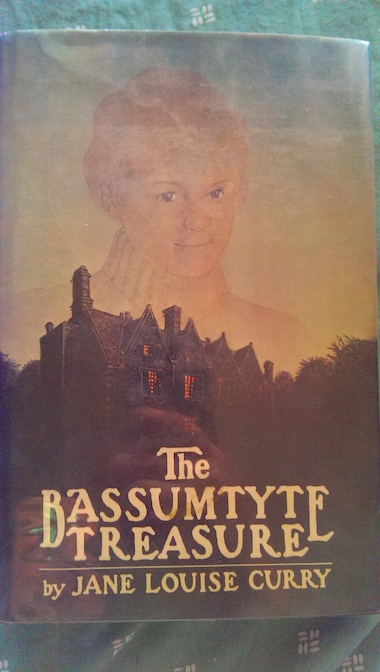 The Bassumtyte Treasure by Jane Louise Curry, 1978.
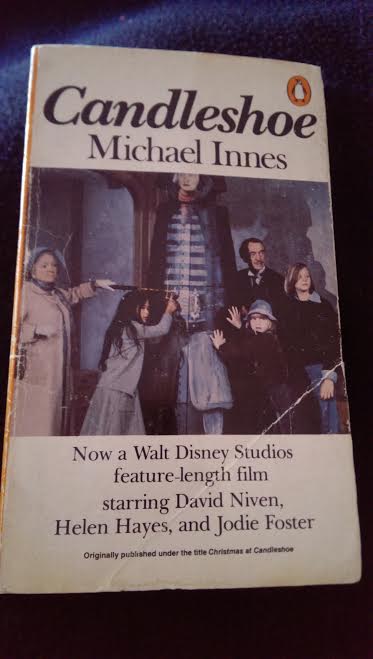 Candleshoe by Michael Innes, 1953.
 Jestress's Forgotten Books and Stories