The Girl Who Loved Caterpillars

The Girl Who Loved Caterpillars adapted by Jean Merrill, illustrated by Floyd Cooper, 1992.

This story is a rendition of a 12th century folktale from Japan.

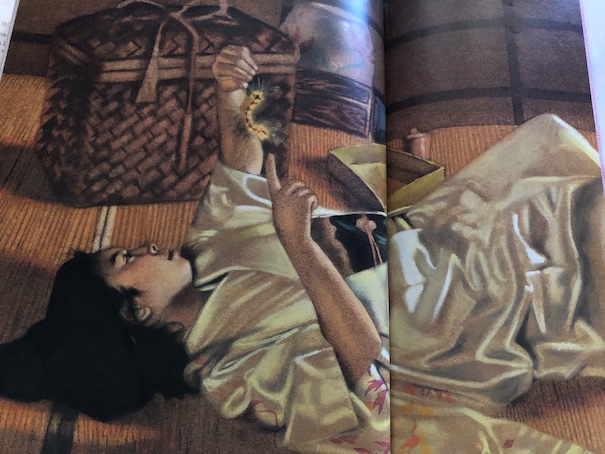
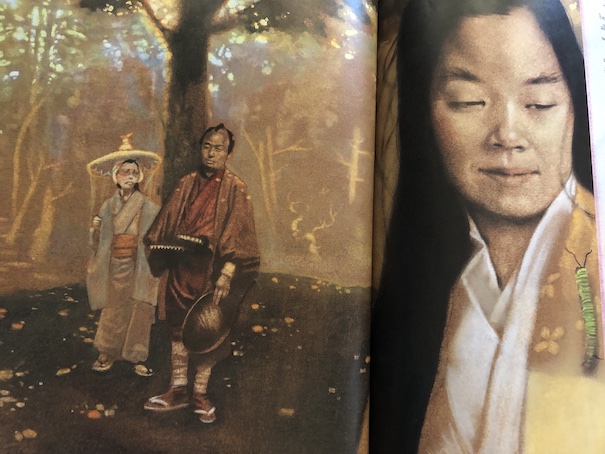
Izumi is the daughter of an important man, a provincial inspector who serves the emperor in Kyoto. Court life is full of elegance, and Izumi is a pretty and clever girl. Her parents have high hopes that she might become a lady-in-waiting or marry a nobleman, but she is mainly known for one thing: her peculiar love of caterpillars.

A beautiful and elegant woman who lives nearby is known for her love of butterflies, and she is considered to be The Perfect Lady. She has all of the skills that a noblewoman could aspire to, and Izumi’s parents think of her as a great role model for their daughter.

However, Izumi doesn’t see the appeal of beautiful butterflies. After all, they come from caterpillars, and caterpillars are much more interesting. Izumi also loves worms, toads, insects, and other things that most people would find unappealing. She likes to keep them as pets and observe how they live and grow. Izumi’s parents don’t approve of the lower-class boys who bring Izumi new creatures for her collection, and nobody else understands her fascination with these creatures.

Izumi just loves the natural world. To her, court life and the beauty standards for women there are too artificial. She also believes in reincarnation and the idea that any person might have been one of these unusual creatures in a past life or could be one in the next. Her parents love her, and they understand how she feels when she explains her reasoning to them, but they also worry about her future. If she doesn’t conform more to the standards of the court and develop more “normal” interests, will she ever make a desirable marriage? People at court gossip about Izumi and her odd tastes.

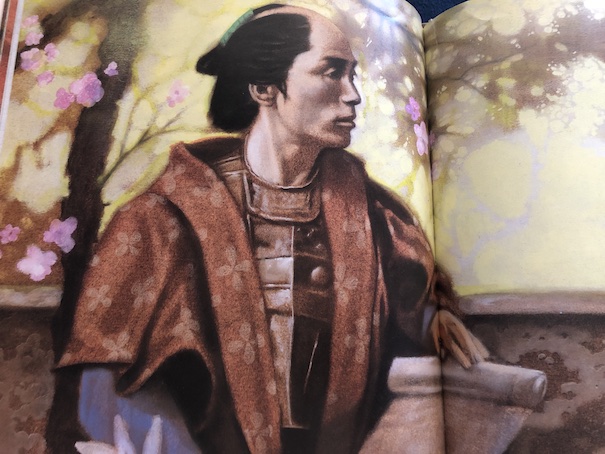
However, the rumors about Izumi reach a young nobleman who is as clever as Izumi, and he is fascinated at the idea of a pretty girl who isn’t afraid of the creeping creatures of the Earth.

The book is available to borrow and read for free online through Internet Archive.

My Reaction

I remember this story from when I was a kid! When I was a kid, I didn’t bother to read the Afterword of the book, which explains more about the origins of the story. Izumi’s story actually seems to be part of a much longer story about court life in Medieval Japan. The original author of the story is unknown, and Izumi’s part of the story is incomplete. It ends with the promise that what happens next will be revealed in the next chapter, but the rest of the story is unknown. We don’t know if she ends up marrying the nobleman who has developed a fascination with her or not.

I have a theory, based on a comment that Izumi made, comparing caterpillars to their adult forms and asking why people are only interested in the adult forms, that Izumi’s love of caterpillars is based both on her young age and perhaps a hidden affinity for children. Perhaps Izumi will grow to love butterflies as well as she grows up and be viewed as more of a butterfly herself, or maybe the nearby lady who loves butterflies will admit to a secret love of caterpillars as well. None of us stay young, and we all evolve as we grow, but part of us always remembers being in those early, awkward stages. Maybe everyone has a secret soft spot for the young, even when they’re fuzzy or grubby crawling things, and a desire to see them become the best form of themselves.

Whatever her future brings, readers get the impression that Izumi is happy and at peace with herself as she is, whether anyone else agrees or not. We can hope that the young nobleman will also love her for the person she is, but Izumi seems to believe that being true to her own nature is the way to achieve inner peace.

In other times and places, as the Afterward observes, Izumi might have been a scientist, naturalist, or philosopher. The traits that make her seem odd for her time and place are actually desirable ones that could make her more successful in other circumstances. In the early 21st century, Izumi’s sense of individualism and her value of the natural world would probably win her many friends. People who enjoy the aesthetic of Goblincore would probably relate to her feelings about caterpillars and other crawly creatures.

Castles

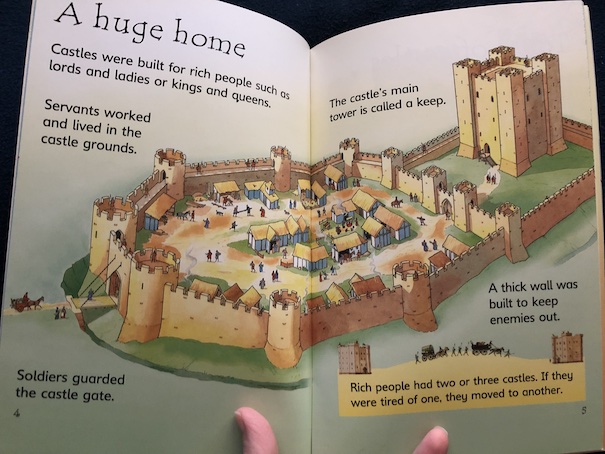
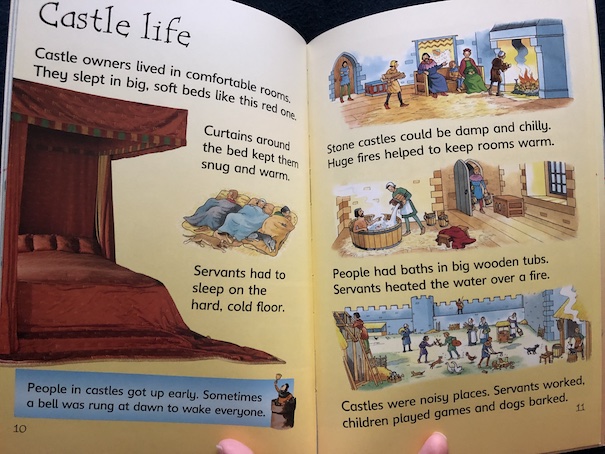
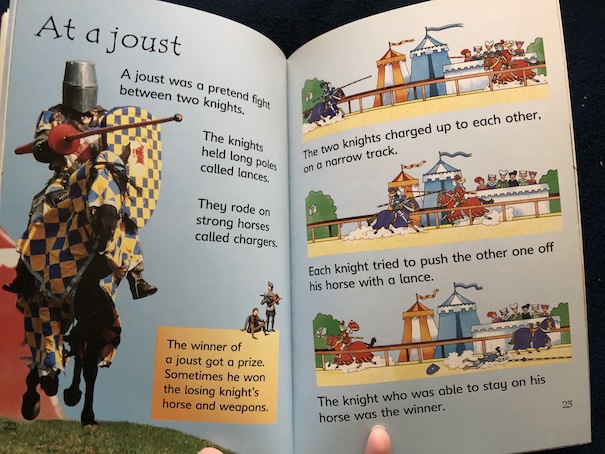
Castles by Stephanie Turnbull, illustrated by Colin King, 2003.

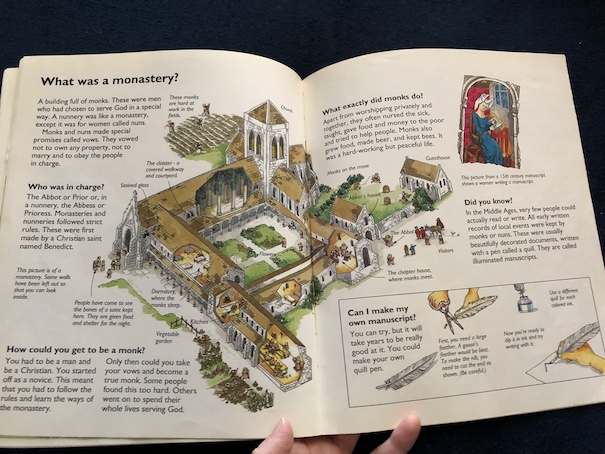
This nonfiction picture book for kids is part of the Usborne Beginners series, originally published in Britain. There are other books about castles, knights, and life in the Middle Ages from Usborne, but this book in particular, like others in its series, is a simplified version meant for beginning readers. The book is recommended for ages 4 and up.

The book explains different types of castles and the parts of a castle. It also offers details about daily life for people who lived in castles, including hunting, food and feasts, and things they would do for fun.

There are also pages about knights, the armor they wore, jousts, and attacking and defending a castle.

The book ends by explaining why castles from the Middle Ages are in ruins today.

In the back of the book, there is a glossary of terms and a link to the Usborne site’s page of quicklinks, which still works and has links to child-friendly informational sites on various topics, organized first by topic and then by related book. Both the book and the website offer Internet safety tips for kids and parents.

The book is available to borrow and read for free online through Internet Archive (multiple copies).

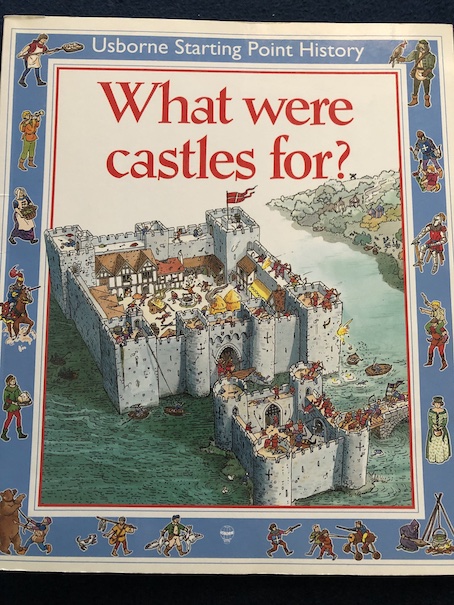
What Were Castles For?

What Were Castles For? by Phil Roxbee Cox, illustrated by Sue Stitt and Annabel Spenceley, 1994.

This nonfiction picture book for kids is part of the Usborne Starting Point History series, originally published in Britain.

I love books about daily life in the past, and this book explains the lives of people who lived in castles during the Middle Ages by answering questions about what castles were for and what people in castles did. Each page of the book is organized around sections answering specific questions.

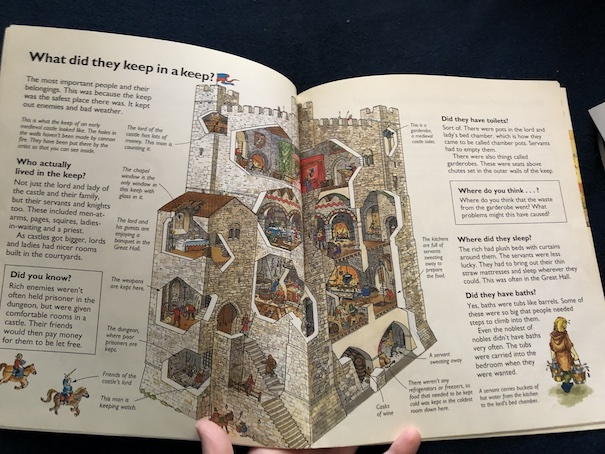
First, the book describes the basic purpose of castles and different types of castles that have existed and how they were built. The, it shows different parts of a castle and what people did in different parts. One of my favorite parts is where they show what is in a castle’s keep, which is where the lord of the castle and his family lived. The book uses cutaway pictures to show what is inside buildings, and the detailed pictures show the different activities of the people.

Among the activities of the nobles who lived in castles, the book explains how they would hunt and hold feasts and jousts.

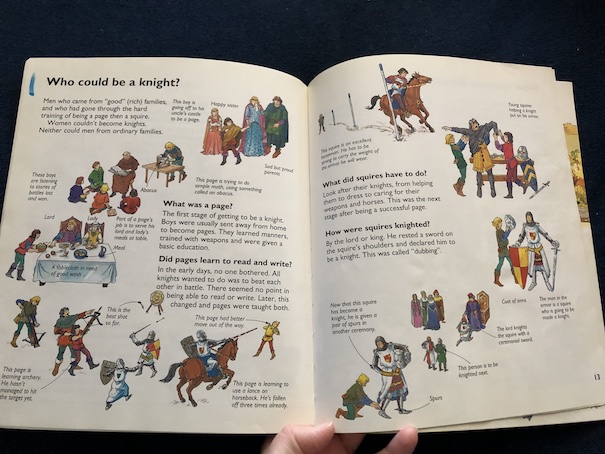
Knights and warfare were central to the purpose of a castle, which was to provide a defensible fortress for the noble families who lived in them and their supporters. The book explains how boys from noble families were raised and educated to be knights. There are also pages showing weapons and the siege of a castle.

One of the things I liked about this book is that, while it is mainly about castles and the people who lived in them, it also shows how people lived outside of castles in small villages, towns, and monasteries. While castles are iconic of the Middle Ages, seeing how people lived in these other places gives a more expanded view of life in Medieval times.

The pictures really make the book! Every picture from the cutaway castle views to the scenes of villages and towns or jousts and hunts, show many people and small details. There are little descriptions labeling the people and details, most giving extra historical information, but some just for fun so readers can notice humorous details, like the monk being chased by bees at the monastery, the chicken escaping along the castle wall, the sister who is happy that her brother is going off to learn to be a knight, and the page who is learning archery but hasn’t made the target yet (his last failed shot falls short of the target, but it’s labeled as the best he’s done so far).

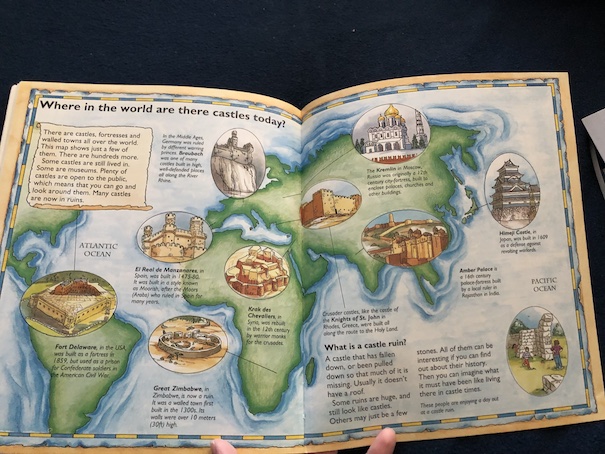
In the back of the book, there is a section with the legend of Richard the Lionheart and his minstrel and a map marked with famous castles around the world.

The book is available to borrow and read for free online through Internet Archive (multiple copies, including one in French).

Knights & Castles

The Usborne Time Traveller Book of Knights and Castles by Judy Hindley, illustrated by Toni Goffe, 1976, 1993.

This nonfiction picture book for kids is part of the Usborne Time Traveller Books series, originally published in Britain.

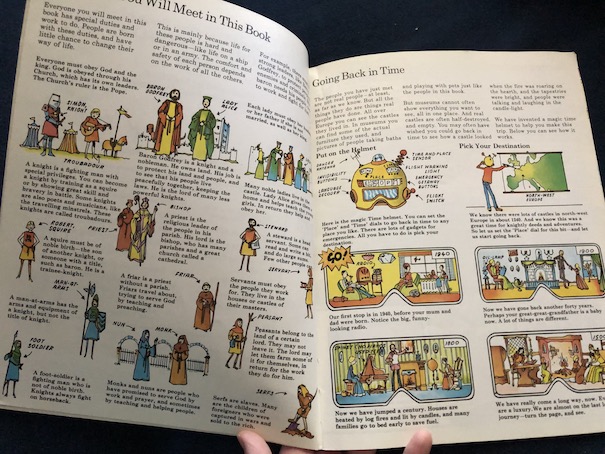
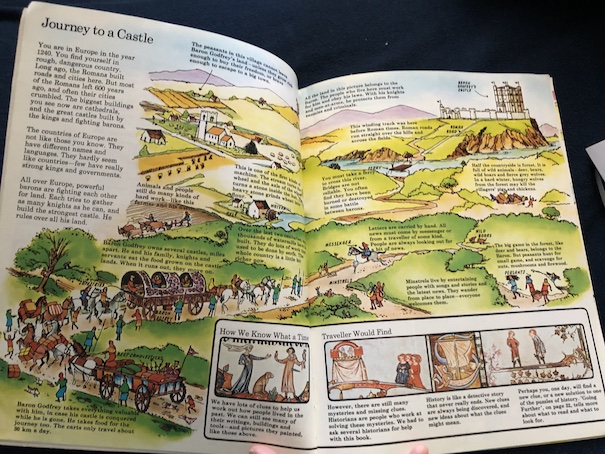
The contents are framed as a time back in time to the Middle Ages, specifically 1240 AD, to see how people would have lived in Medieval times and what castles were like when people actually lived in them. Readers follow a specific set of Medieval characters as they go about their lives.

Our trip back in time begins with a road journey to a castle. Readers see how people in the Middle Ages traveled. The journey page also explains how the Romans built the roads Medieval people used centuries earlier, which is a good historical segue because the period that we call the “Middle Ages” begins with the fall of the Roman Empire and the withdrawal of Roman forces from the furthest parts of its empire. On some pages of the book, there are extra panels at the bottom of the page with additional information, and the first set explains how we know what people would find if they were able to travel back in time to the Middle Ages, explaining how historians have gleaned information from Medieval writings and pictures and from studying physical objects, like buildings and tools.

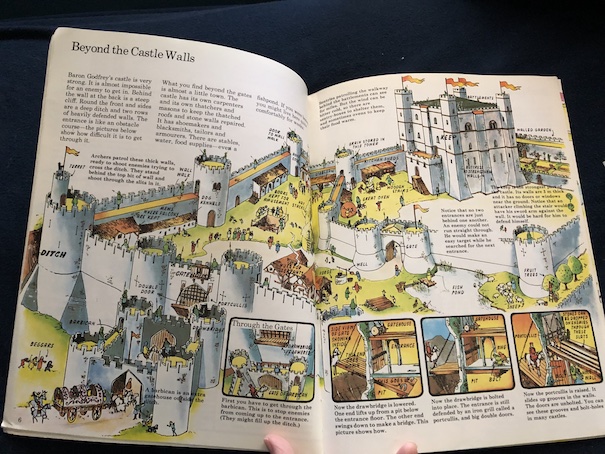
When readers arrive at the castle, the book explains different parts of the castle and how they were used for defense.

I particular like the cutaway pictures of the interior of the keep because I enjoy the details of people’s living quarters and daily life in the past. There is a page that shows the morning routine of the castle and how people would get dressed for the day. There are also pages about hunts, feasts, a visit to a building site, and a trip to town.

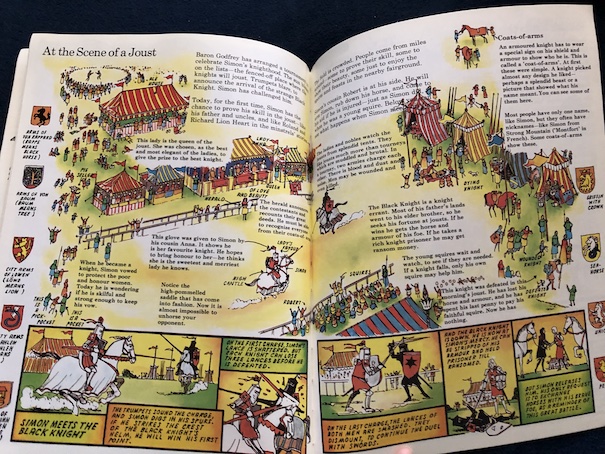
There are a couple pages about knights and how a boy would train to be a knight. There are also pages about jousts, the Crusades, and attacking and defending a castle.

The pictures are cartoon-like, but they are busy and full of details for readers to study, accompanied by notes that offer more information and historical background.

At the end of the book, there is a map showing locations of famous European castles.

The book is available to borrow and read for free online through Internet Archive (multiple copies).

The Midwife’s Apprentice

The Midwife’s Apprentice by Karen Cushman, 1995.

The story focuses on a young girl in Medieval England. She is about twelve or thirteen years old, but she doesn’t know her age or even her real name. Everyone just calls her Brat. For as long as she remembers, she’s always been alone, a homeless orphan traveling and begging from town to town. When a midwife finds her sleeping in a dung heap, she takes the girl on as a servant and apprentice. It isn’t as a kindness. The midwife just realizes that she can get some cheap labor out of the girl as long as she feeds her. Also, because the girl isn’t very bright or experienced, she is no professional competition for the midwife. People begin calling the girl Beetle because she was in the dung heap like dung beetle.

The midwife, Jane, became a midwife because she had six children of her own, although none of them survived. Beetle wonders if she could be a witch because of her strange mixtures, but really, she’s just a midwife. Whenever a woman in the area gives birth, Beetle goes to help carry things for Jane. Beetle is not allowed to watch the births herself, just stand by to fetch and carry. Beetle realizes that part of the reason she is not allowed to watch the births is so Jane can keep her professional secrets, although Beetle soon begins learning about plants and how to make medicines from them and she sometimes spies on births when she can to learn more.

People in town aren’t nice to Beetle. Jane is stingy and never helps anyone who can’t pay her fee. The local people don’t like her, but they tolerate her because they have need of her skills. Beetle often has to deal with the anger that people are afraid to show to Jane. Beetle’s best friend is a cat who was nearly killed by some mean local boys. She talks to the cat. Both of them are abused by locals, especially the mean boys.

Then, Beetle begins to notice that Jane keeps slipping away on mysterious errands, giving excuses for her absence that make no sense. Beetle begins to follow Jane to find out what she is doing. What Beetle learns is that Jane is having a love affair with a married baker.

One day, the miller comes looking for the midwife, but she isn’t home. Desperate for help with his wife’s birth, the miller makes Beetle come with him. Beetle doesn’t know what to do, and the miller’s wife angrily throws things at her until Jane comes to take over. Jane insults and abuses Beetle, too.

It seems like taking abuse is Beetle’s lot in life and that she has to take it or be thrown out into the street again. Her life starts to change when a kind merchant at a fair compliments her curls and gives her a wooden come with a cat carved on it. Then, another man mistakes her for a girl named Alice who can read. Beetle begins to look at herself in a new light. She realizes that at least some people see her as a person who can be pretty and smart, and maybe, she really can be pretty and smart. Liking the name Alice, Beetle decides that she will take the name for herself so she can gave a proper name.

When she returns to the midwife and the midwife abuses and insults her again, Beetle confidently tells her that her name isn’t dung beetle or brat but Alice. The midwife isn’t impressed and even people in town laugh at her for it, but Alice retains her new sense of confidence. She gives the cat a name, too, calling him Purr.

Without Jane realizing just how much Alice has been learning, Alice gradually begins helping people on her own. After saving the life of one of the local bullies, who almost drowned while chasing her, the boy starts treating Alice better. When his cow is having a difficult birth, the boy gets Alice to help him tend to the cow, increasing her knowledge of births.

Then, during one very difficult human birth, Jane leaves Alice to tend to the woman alone while she goes to tend to the lady of the manor, who is also giving birth. Alice protests that she doesn’t know what to do and can’t manage on her own, but Jane tells her she doesn’t have to do anything because this baby is likely to die. Jane just wants Alice to stay to cover for her so she can go earn another, even better fee. However, to everyone’s surprise, Alice saves the baby in Jane’s absence by applying what she has learned so far. The grateful mother names the baby after Alice, and the father refuses to let Jane take credit for Alice’s work. Jane is angry and jealous, especially when another mother insists that she wants Alice and not Jane to tend to her during her birth. Jane throws a fit and accuses Alice of stealing her customers.

Unfortunately, that birth doesn’t go well, and Jane has to step in to help and save the baby. In despair at what she sees as her failure, Alice runs away, convinced that she is just a nobody and too stupid to be anything, even a midwife’s apprentice.

At first, she wants to give up and die, but with the company of Purr the cat, she finds her way to an inn where she finds work. It’s enough to keep her alive, but Alice finds it difficult to shake her feeling that she is nothing and will never be anything. Alice really misses her work with the midwife, although not really the midwife herself, but she has trouble getting over the sense that she is just a failure. It takes a few lessons in reading from a scholar staying at the inn, the realization that she has been a help to someone else in a difficult situation, the encouragement of the boy who was one of her former bullies, and even some surprising comments from Jane the midwife herself to help Alice realize what she needs to do.

The book is available to borrow and read for free online through Internet Archive (multiple copies).

My Reaction

I found this story stressful because there were so many mean people in it. I hated the casual cruelty of the local boys and how they almost killed the cat. I hated Jane, who used and abused a vulnerable orphan girl. I also hated the townspeople in general because this seems to be entirely a town of people who are looking to use and abuse anybody they can and who will also allow other people to abuse the vulnerable, both human and animal, if they can use the abuser for their purposes. For much of the book, I looked for a character other than our heroine with some redeeming quality of some kind and didn’t find one.

The first character I actually liked was the kind merchant who gave Beetle/Alice the comb, but I still felt like the town is the town of the damned because nobody there was really nice. Almost every interaction Alice has with anybody there is unpleasant to some degree until she does something to buy their goodwill or at least civility. The innkeepers are nicer to Alice, although she knows that they’re not entirely honest in the way they run the inn. The scholar was one of my favorite characters because he sees Alice’s potential and gives her lessons in reading by first explaining things to her cat to get her interested. His kindness didn’t need to be bought with anything. The scholar is also the first person who cares about what Alice wants out of life and gets her to consider what she really wants, which builds her confidence and her feeling that she is a real person with wants that matter.

William became nicer after Alice saved his life, which is a kind of cliche in stories about bullies and is still a form of being bought. He’s still not completely nice after that, although he does teach Alice a couple of useful lessons, and he tells Alice that he doesn’t think that she’s a failure as a midwife just because she didn’t know everything and still needed some help. Even better, he points out that Jane doesn’t really know everything, either; she just acts like she does.

I never grew to like Jane. When Alice overhears Jane talking about her, Jane actually says that Alice is bright, which is a surprising compliment, given all of the insults and abuse she constantly heaped on her and her fear and resentment that Alice might steal her customers. Jane doesn’t regard Alice as a failure for not being able to handle a birth on her own, but she says that Alice gives up too easily. She wants an apprentice who is willing to take everything she heaps on her and won’t give up, no matter what. While persistence is an important quality, I was angry with this character for trying to wrap up her own abuse nicely like it was all part of some important, intentional lesson. Jane never had any notion of turning Alice into a fully-trained midwife. She more wanted a cheap drudge than an honest apprentice to learn her craft. In fact, she actively tried to avoid telling Alice much because she was always afraid of training a competitor. Jane wasn’t trying to teach Alice to persevere at any point before she said that. She wasn’t trying to teach her any more of anything than she absolutely had to in order to get the cheap labor she wanted! Her attempt to wrap this whole mess up neatly like a PSA just didn’t work for me because she’s nothing but an abusive employer who screams and throws pots and doesn’t actually want her “apprentice” to progress enough to do as well or better than she does. While Alice does return to be her apprentice because she knows that she really does want to be a midwife and that there are still things she can learn from Jane, including the value of persistence, I still hope that Alice will eventually leave Jane and find a better community to exercise her skills and employers and clients who are better behaved, more appreciative, and generally less toxic and abusive.

Because of the content of this book, it is not for young children. It would be best for tweens and teens.

Catherine Called Birdy

Catherine, Called Birdy by Karen Cushman, 1994.

Catherine is a 14-year-old girl living in Medieval England in 1290. The entire book is written in the form of diary entries, but after the first few extremely short and unenthusiastic entries, Catherine reveals that she is not writing these entries of her own free will. Keeping a diary was her brother Edward’s idea. She explains that Edward, who is studying to be a monk, thinks that keeping a diary will help Catherine become “less childish and more learned.” At first, Catherine declares that she won’t continue writing and that Edward can write the diary himself if he wants it so badly, but she changes her mind when her mother releases her from the even more boring chore of spinning so that she can have more time to write. Although she can’t think of much of interest to write about her daily life at first, she would rather continue to try writing than spin.

From there, Catherine describes her life and family in detail. The diary continues for a full year, from September 1290 to September 1291. Catherine lives with her parents, but she isn’t fond of her father, who often hits her. Her father is a country knight, but not a particularly wealthy one. They have some servants but not enough that Catherine doesn’t need to help with household chores. She would much rather be out, running around the fields and playing than doing chores and sewing with the other ladies of the household. Catherine’s mother has suffered several miscarriages since her birth, and she still mourns for the children she has lost. Catherine is her youngest child, and she is the only one who still lives with her. Catherine has three older brothers, and none of them live at home anymore. Two of her brothers are away in the king’s service, and Edward is at his abbey. Catherine’s first diary entries are mostly about chores, avoiding chores, and pulling some admittedly childish pranks and stunts.

However, her diary entries soon note that a major change seems to be starting. She notices that her father is suddenly taking an unusual amount of interest in her. Usually, he pays little attention to her, except to give her a slap or smack, but suddenly, he starts asking her probing questions about herself and her health habits. It’s strange behavior for him, but Catherine soon realizes the reason why. Her father is planning to marry her off, or sell her off, as Catherine thinks of it. Catherine’s assessment is pretty accurate because the man is wealthy and has promised her father a handsome sum if Catherine marries him. Catherine’s father’s main interest in her and her future marriage is how it can benefit him.

Catherine doesn’t consider herself a great beauty, a very accomplished young lady, or a real prize, so she can’t imagine why this man might want her and even be willing to pay for the privilege. It turns out that her prospective suitor is a wool merchant whose ambition is to become mayor. Catherine’s family is nobility, although not very high-ranking or important nobility, but having a wife of noble blood would be to the merchant’s political advantage.

Catherine has already decided that she doesn’t want him. When Catherine learns that her prospective suitor will be coming to see her, she decides that she will act stupid and unappealing so he will give up the idea of marrying her. However, even though she scares away the first suitor, she is at the age when noble girls start to consider marriage, and there are soon other suitors. Catherine doesn’t want any of them! She doesn’t even want to be a noble young lady at all. The story of Catherine’s attempts to get rid of her unwanted suitors and to figure out what she really wants out of life are lively and humorous and sometimes touching.

The book is available to borrow and read for free through Internet Archive (multiple copies).

My Reaction

I enjoyed the details of everyday life that Catherine describes. She finds the typical chores that young ladies of her social class do boring, and she often dreams that she could do something more exciting or outdoors, whether it’s traveling on a Crusade or even just ploughing a field. Still, she describes her activities in detail, including the ingredients that she uses to make different types of medicines. One of the duties of a Medieval housewife was to tend to the health of members of the household, so like other Medieval young ladies, Catherine has been learning how to make various home remedies, with varying results.

Modern day anti-Semitism has roots in Medieval times, and this book also addresses that when Catherine’s mother allows a party of traveling Jews to stay the night. At this point in history, the king is ordering Jews to leave England because he thinks they are evil. These travelers are poor refugees on their way to live in Flanders (a region in modern Belgium). Catherine notes that her mother is not afraid of Jewish people, even though other members of their household are. Catherine herself is curious about them. She has heard stories that Jewish people secretly have horns and tails, like the devil, and she excitedly spies on them to see if it’s true. She is actually disappointed to find out that it’s not true and that these poor people are just poor people in ragged clothes. One of the women allows Catherine to listen while she tells stories to entertain the children in the group, and Catherine finds the stories charming. It occurs to her that there are different types of stories in the world, ones that are true and ones that aren’t, and that the stories people have told her about wicked Jewish people aren’t true. She even starts to think that it would be exciting if she were to join the Jewish group and go abroad with them to seek her fortune.

She does temporarily disguise herself as a boy to go with them, but when she explains to dissatisfaction with her life to the woman in the group, the woman discourages her from running away. The woman says to her that, in the end, nobody is going to ask her why she wasn’t like one of the boys or men but why she didn’t spend her life simply being Catherine. In one of her stories the night before, the woman had emphasized knowing who you are and where you are and what you are to orient yourself in the world. Although Catherine doesn’t fully understand it at first, the key to finding her happiness isn’t about running away from the things she doesn’t like in her life, whether it’s chores that she finds boring or a suitor she doesn’t like, but how to make choices that give her life a purpose that suits her and that lead her to better options.

Catherine daydreams about more exciting options in life, but none of them are really right for her because there are things that she doesn’t know about the realities of these other positions. She loves the beautiful illuminated manuscripts that monks like her brother make, and she wonders if she could disguise herself as a boy and become a monk so she can spend her days making beautiful paintings. Her brother laughs at the idea because he says that her figure is too feminine for her to be a boy, and there is no point in her becoming a nun because nuns spend most of their time sewing, one of the chores that Catherine doesn’t like. When she asks her Uncle George about being a Crusader, he tells her that war is more like hell than the heavenly adventure she is imagining. Although Catherine thinks than men’s work and war sound exciting, her brother and uncle realize that Catherine knows little of the reality behind them, and she would not be happy with the reality if she knew. Early in the book, she also laments about never having been allowed to see a public hanging, but when she learns more about them, she realizes that she doesn’t like them. This book reminds me a little of the picture book Hester the Jester, where another Medieval girl tries different professions before deciding that she’d rather be herself.

None of this is to say that there are only separate roles for men and women in life and that Catherine, as a young woman, would be incapable of doing anything other than typical women’s work. It’s really more that, while there are relatively limited possible occupations for a girl of Catherine’s time and social level, it’s the woman who makes the occupation rather than the occupation that makes the woman. Catherine can still be happy in her position as a young noblewoman of her time if she can learn to shape her position in life to suit her, learning and adjusting her life as she goes. That’s the best way for a girl in Catherine’s position to become her own woman.

An older noblewoman, who correctly guesses Catherine’s nickname of Birdy, talks to her about the lives of noblewomen. Although she is of a much higher rank than Catherine, she tells Catherine that her position also comes with duties and obligations, not the freedom and adventure that Catherine imagines. However, the older woman says that, just because she doesn’t spend all her time flapping her wings, doesn’t mean that she can’t fly, meaning that although she can’t control everything about her life and obligations, she is not powerless. She tells Catherine that she picks her battles and that Catherine should consider what she says and do the same. Catherine doesn’t understand her full meaning at first, but the older woman means that, rather than chafing over the position in life that she was born to and the things she can’t change, Catherine can focus on the parts that she can control and change. When Catherine gains a greater understanding of who she is and how she can remain herself in whatever circumstances she finds herself in life, she is ready to move forward in her life.

For a girl of Catherine’s social class, marriage is expected, unless she becomes a nun, which Catherine has already rejected as an option. Catherine doesn’t like the idea of marriage because she thinks that she knows what a marriage is like, based on her parents’ marriage, but Catherine’s mother tells her that a marriage is what you make it. Catherine’s father is a brutish man who drinks too much, but he treats his wife very differently from the way he treats everyone else, which is why she still loves him. Catherine observes that people can have layers and that sometimes, people are different when they’re in the company of different people. Even her brother Robert, who is frequently odious, surprises her with a great kindness when she needs it. It helps Catherine to realize that marriage might not be so bad if it can be with a person who is kind and agreeable in the ways that matter to her.

A major part of Catherine’s problem is that her choice of who to marry largely depends on what her father arranges, and her father is an uncaring, brutish man who sees Catherine more as an asset to be used than a person whose own future needs to be nurtured. Although Catherine doesn’t like the men her father would pick to be her suitor, mostly because they would benefit him more than Catherine, circumstances eventually allow Catherine to marry a man who would suit her instead. Like Catherine, her new intended husband is known to be a man who values learning and was criticized by his brutish father about it, so the two of them may understand each other and share similar ideals in life. Being a married woman who is married to a man who suits her, rather than trapping Catherine in an unwanted position in life, will allow her to run her own household in her own fashion and give her a way to escape from her father and his abusive and self-serving treatment.

I particularly liked some of interesting the Medieval superstitions that Catherine believes. When her mother gives birth to her little sister at the end of the book, Catherine unties all of the knots in the house, which I’ve heard of before as a superstition to help ease births.

Because of some of the content of the book, like the description of the difficult birth of Catherine’s sister, I think this story would be best for tweens and teens.

Adam of the Road

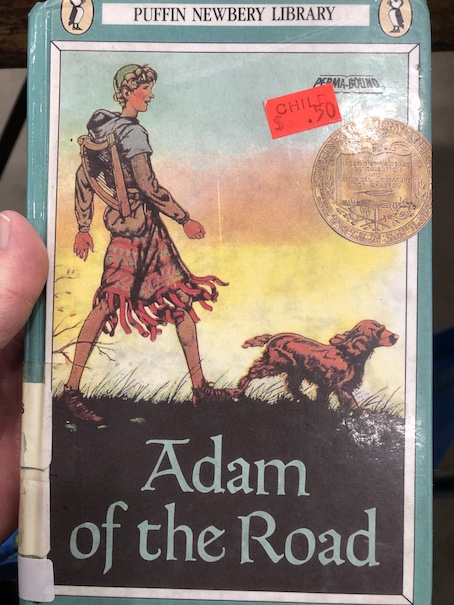
Adam of the Road by Elizabeth Janet Gray Vining, illustrated by Robert Lawson, 1942.

The story takes place in England in 1294. It’s summer, and eleven-year-old Adam Quartermayne is waiting for his father, Roger the minstrel, to come see him at the dormitory where he’s been living while he’s going to school at the Abbey of St. Alban. Roger Quartermayne has been in France, attending a minstrels’ school, where he has been learning new songs and stories. More than anything, Adam wants to go on the road with his father, traveling from town to town, playing their musical instruments.

Roger is a higher class of minstrel than most, truly skilled in his art, welcome even in noble manor houses and castles, and well-paid for his performances. Roger plays a viol, while Adam can play the harp. Adam practices his playing while at school and tells stories to the other students. Although his teachers would prefer that he spent his story-telling time talking about the saints, they allow him to entertain the other boys as long as his stories are tasteful and not rude or mocking. Adam’s father has impressed on him that a minstrel’s job is not to tell his own feelings but to choose entertainment that suits the mood of his audience, whether it’s happy or sad. (In other words, they know how to read a room, and a good minstrel can make the audience feel like he’s saying what’s on the minds of the listeners.)

Adam’s closest companions at school are his best friend, Perkin, and his dog, Nick. Since Nick isn’t allowed in the dormitory, Adam pays for him to board with a woman in town. He and Perkin go to visit Nick when they can. Adam has taught Nick to do entertaining tricks, as befits a minstrel’s dog.

When Adam’s father comes, he tells Adam that he has taken a position with Sir Edmund de Lisle and is now traveling with his party. Roger invites Adam to join him on their journey to London, and Adam eager accepts. His only regret at leaving the school is that Perkin cannot come with them, but Perkin says that they’ll see each other again. Perkin’s father is a ploughman (this video, from Crow’s Eye Productions, explains a little about the life of a ploughman and how they dressed), and he says that, if they pass through the village where he lives, they can stop and visit his parents and the parson who sent him to the abbey school.

The open road is like home to minstrels like Roger and Adam. They spend their journey entertaining Sir Edmund’s party with stories. Adam develops a crush on Sir Edmund’s pretty niece, Margery, although her brother, Hugh, is an annoying snob. Adam’s first efforts to join his father in playing music are awkward and embarrassing, but Roger says he will improve. Adam is also lonely without Perkin to talk to. There are other boys at Sir Edmund’s manor house, but they all ignore him. They become friendlier when Adam takes the advice of a friendly squire to lend them his horse for their jousting practice when Hugh’s horse is lame. At first, Hugh thinks that a minstrel like Adam wouldn’t know anything about martial arts, but Adam demonstrates that he has also had some training, causing Hugh to give him more respect. From then on, he is able to join the other boys in their games.

At the wedding of Sir Edmund’s daughter, Emilie, Adam has the chance to see many other minstrels and entertainers of various kinds. Although both Adam and his father are richly rewarded for their performance, Roger gambles away his share of the money playing dice with the other minstrels. He tells Adam to keep his own money close to him and not to hand it over to him, even if he asks for it. Roger recognizes that he has a gambling problem and can’t be trusted with money. Worse still, he gambled away their horse, too. It’s upsetting to Adam because they had never had a horse before, and he was fond of it. He also knows that Hugh was fond of that horse. Roger is embarrassed about what he has done, and Hugh worries that Jankin, the man who won the horse, will ride him to death because he doesn’t know how to take care of horses.

Although they are still in the employ of Sir Edmund, he will not be needing them for a while, now that the wedding of his daughter is over. Roger and Adam go on the road again, although they are supposed to return to Sir Edmund’s manor after traveling their route. In London, they meet up with Jankin again, and he tries to get Roger to gamble with him again for ownership of Adam’s dog, but Roger refuses, saying he doesn’t want to play anymore and the dog belongs to his son. However, when they happen to be staying at the same inn later, Jankin steals Adam’s dog!

Roger and Adam hurry after Jankin to get Nick back, asking people they meet on the road which way he went with their dog. They almost catch up to him at a ferry, but he gets on the boat and it leaves before they can reach it. Not wanting to wait for the ferry to return and desperate to reach his dog, Nick jumps in the water and tries to swim after the ferry, but he is still unable to catch up. When he climbs out of the river, he is alone and too tired to continue the pursuit anymore. He is separated from his father, but he still has his harp, thanks to a kind woman who helped him. What is he going to do? Will he ever find his dog or father again?

The book is a Newbery Medal winner. It is available to borrow and read for free online through Internet Archive (multiple copies).

My Reaction and Spoilers

The story offers a ground-level view of Medieval society. Through his travels, Adam mixes with children and adults from various levels of society. Adam begins at a monastery school, taught by monks. Then, he joins his father, working for a noble family and living at their manor, where Adam becomes friends with noble boys training to be knights. They meet other minstrels, and when they travel on the road, they also meet traveling pilgrims, stay at inns and speak to the innkeepers. When Adam is on his own, he briefly stays with a ferryman and his wife, travels with a merchant, is robbed by highwaymen and has to get help from local law enforcement, gets information from a shepherd, attends a large fair with people of all kinds, and toward the end of the book, spends time with Perkin and his family, helping his father with ploughing. Along the way, Adam learns many things about people and different members of society, including how girls are treated differently from boys, even in noble families and what common people think about the king and parliament and how they make laws.

During the course of the story, Adam and his father also discuss some of the philosophy behind their own profession. It begins with Adam’s reflection on what his father said about choosing his selections of songs and stories to appeal to his audience because his job is to please others, not merely himself. However, when Adam briefly joins up with some poorer minstrels, he comes to understand that it’s not just a matter of giving people what they want. A better minstrel not only gives people material they like but which appeals to the better sides of their personalities, elevating them to their highest versions of themselves, instead of just catering to everyone’s lower tastes. Understanding other people and their lives and tastes are critical to the job of being an entertainer. Adam also learns a little about the use of humor and how it can benefit both himself and others when used well. At one point, when Adam is recovering from an incident that was embarrassing to him, he makes a joke about it that amuses a new friend, and when his new friend laughs, Adam realizes that he feels better about the embarrassing incident. His use of humor softens his feelings of embarrassment and also provides a useful tool for entertaining and bonding with someone else. The story compares it to an oyster turning an irritant into a pearl that is both less irritating to the oyster and something beautiful for someone else. Although Adam goes through genuinely terrible circumstances through his travels, the experience shapes his views of life and the type of minstrel he wants to be.

I was genuinely worried about the animals in the story because I find it stressful to read about animal cruelty. Fortunately, both the horse and dog survive their experiences with Jankin, and Adam is reunited with his father and Nick.

I enjoyed the pieces of real Medieval songs that appear throughout the story, like Sumer is I-cumen In (You can hear the song in this YouTube video. This one explains what the Old English words mean. It’s about the beauties of nature and lively animals at the beginning of summer, apparently with a confusing line about farting billy goats.) and an old version of London Bridge is Falling Down, which also includes an explanation of the story behind the the song.

As another piece of trivia, Jankin is actually a Medieval nickname for John. In Medieval times, it was common to get new nicknames for certain common names by changing just one letter or sound in the name and/or adding “-kin” to the end of a name as a diminutive, like we might add a “-y” for Johnny. In fact, the name Jack that is used as a nickname for John comes from this earlier nickname – John to Jan to Jankin to Jackin to Jack. We get other nicknames that don’t completely resemble the original name from this same method of creating new nicknames, like the nickname Peggy for Margaret – Margaret to Maggie to Meggy to Peggy.

Medieval Places

Medieval Places by Sarah Howarth, 1991, 1992.

This book takes a unique approach to explaining life in the Middle Ages. It focuses on the types of places where people spent their time and what they did there. I like it that the author doesn’t rely on just one country for the descriptions of places, providing examples from various places around Europe, including Germany, France, Italy, and Iceland.

The book is available to borrow and read for free online through Internet Archive. There is also a companion book to this one about Medieval People. The author has also written other books about people and places in different time periods.

The places described in the book are:

The Field

During the Middle Ages, most people lived in small farming communities, making their living through farming. This chapter describes the agricultural year and the feudal system, where peasants worked fields belonging to lords and gave the lords their services and food they produced in return for use of the land.

The Peasant’s Cottage

This chapter explains what a peasant’s house and living conditions were like.

The Castle

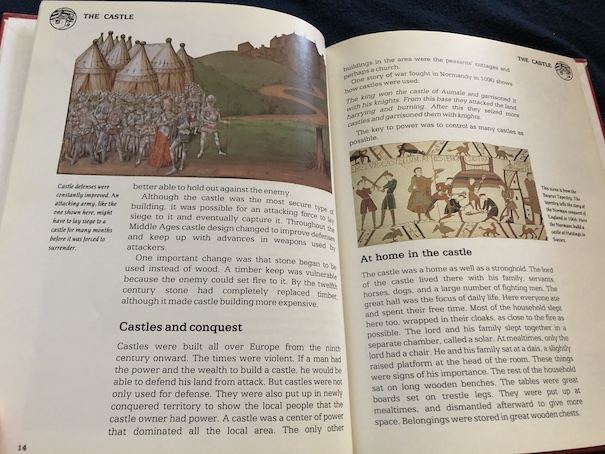
This chapter explains how castles were built and how they were used to control territory. There is also a brief description of what life in a castle was like.

The Battlefield

This chapter describes how warfare and sieges were conducted and what types of weapons were used.

The Forest

People hunted animals in forests for sport and food, but there were rules regarding who could hunt where and what types of animals they were permitted to hunt. Anyone caught breaking these rules would labeled a poacher and could suffer serious consequences.

The Law Court

There were different types of law courts in different places, and they could handle different types of cases or offenders. For example, clergy were often tried in special courts. Punishments for offenders varied with the nature of the offense. Prison wasn’t typically a punishment by itself. Dungeons were more for holding prisoners until their case was tried. After the trial, another punishment would be assigned, possibly a fine or some form of public humiliation. For more severe offenses, offenders might have a hand or an ear cut off or might be executed. However, there were some law breakers who had so many supporters that no one was ever able to bring them to justice.

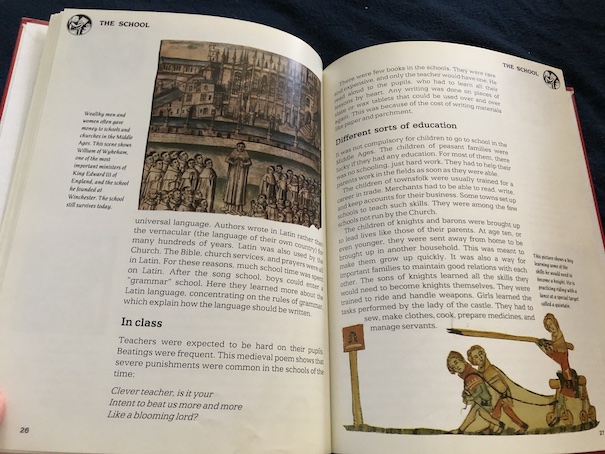
The School

Most schools were church schools held in monasteries, cathedrals, and other churches. There, students would be taught Latin (the universal language of educated people all over Europe during the Middle Ages) and religious lessons. Students practiced writing lessons on wax tables or pieces of slate that could be reused. School was not a requirement, and most lower-class children did not attend, either simply helping their families on their farms or learning a trade. There were some secular trade school run by towns to teach the children of merchants some basic skills, like reading, writing, and keeping accounts.
The University

The format for modern universities began during the Middle Ages. Particularly skilled teachers, often ones who taught at church schools, who gained a reputation for their teaching ability sometimes attracted a following of scholars, and people would travel to the location where they were teaching in order to study with them. Universities grew because of the excellent reputations of individual teachers, who attracted students to come. As they grew, they developed sets of rules, sort of like the a trade guild, organizing courses for students to study and exams to test them on what they had learned. There were no age requirements for students, but they always started by studying some general knowledge subjects, like Latin and mathematics, before choosing a specialty to study, such as law, medicine, or theology.

The Road

There were various reasons why people had to travel during the Middle Ages. Nobles had to travel to to visit different parts of their estates, and peasants had to travel to bring their produce to markets. Merchants would travel in search of customers for their trades. Criminals and judges both had to travel to law courts. Messengers would carry letters. There were also soldiers and religious pilgrims. People from every level of society could be on the roads. However, the roads were rough, making travel uncomfortable, and there was always the danger of robbers.

The Port

People also traveled by ship, and merchants brought goods from other countries through ports.

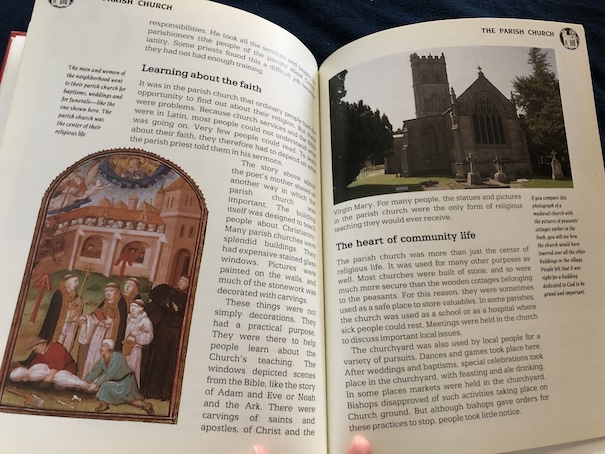
The Parish Church

Local parish churches were important centers of life and religion in the community. The local church would perform baptisms, marriages, funerals, and other services for the parishioners. Because most people couldn’t understand Latin and many couldn’t read at all, priests had to use sermons and scenes painted on the walls of the church to teach people Biblical lessons. Sometimes, church buildings and the churchyards surrounding them were also used for other important community functions, like schools, hospitals, meetings to discuss local matters, and even markets, dances, and games.

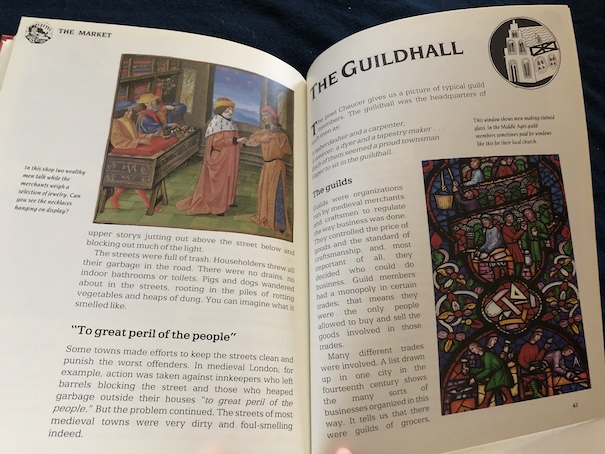
The Market

People in towns practiced trades other than farming, so towns held regular market days when village farmers could come and sell their produce.

The Guildhall

Various types of merchants and craftsmen formed guilds to organize and regulate the standards for their trades and how much their goods and services would be worth. Guilds were also responsible for arranging apprenticeships for those wanting to learn specific trades.

Medieval People

Medieval People by Sarah Howarth, 1991, 1992.

This book looks at Medieval history in terms of the different types of people in Medieval society and what their lives were like. It has examples from different countries focusing mainly on western Europe.

The book is available to borrow and read for free online through Internet Archive. There is also a companion book to this one about Medieval Places. The author has also written other books about people and places in different time periods.

The types people included in the book are:

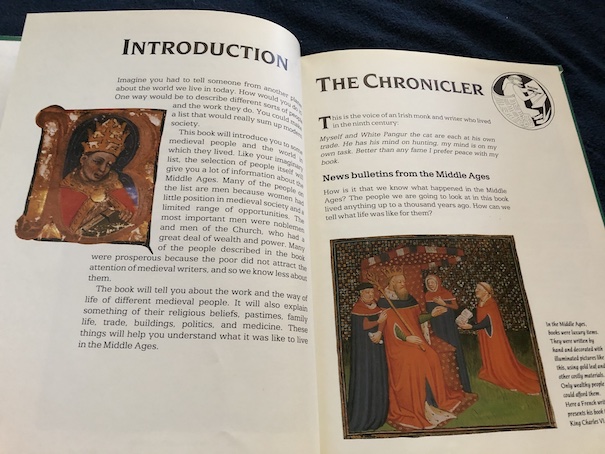
The Chronicler

This is an important chapter because it explains how we know many of the things we know about the Middle Ages. Some people kept chronicles of events that happened in their time. Most of the chroniclers were monks because they were usually the ones who had both the education and the time to keep written chronicles. That’s part of the reason why many chronicles have religious overtones. People who wrote chronicles not only recorded events but also considered why certain important events may have happened, and they interpreted events through their religious beliefs.

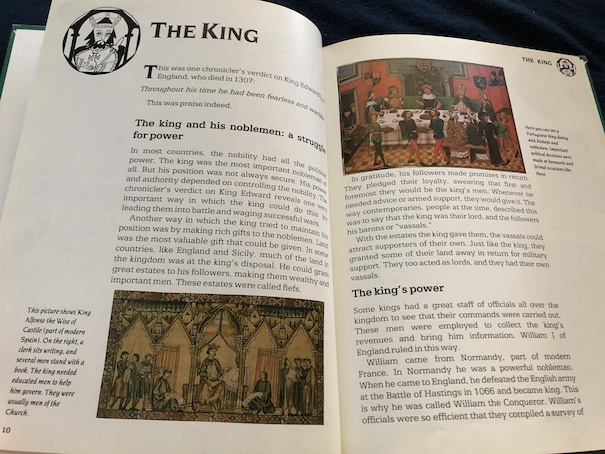
The King

Medieval society was structured in levels, and the king was the person who held the most power and authority. However, he also depended on the nobles who supported him, so he had make sure that they were satisfied with his rule and rewarded for their loyalty. A successful king had to be a successful military leader, and he rewarded the nobles who served him with gifts of land. In turn, the nobles had to serve the king militarily and successfully manage their estates, and they could attract other people to serve them by granting them some of the land that they received from the king.

The Pope

The pope is the highest leader in the Catholic Church, and during the Middle Ages, Catholicism was the major Christian denomination in western Europe. (The Greek Orthodox Church was the major Christian group in eastern Europe, and Protestantism wasn’t an option until the Reformation.) Medieval popes were different from modern ones because they were political leaders as well as spiritual ones, and they clashed with secular kings about whose authority was greater.

The Bishop

Bishops were below the pope and the archbishops in authority, but they oversaw the lower religious officials within their territory or diocese. A bishop would make sure that church buildings in his diocese were being built and properly maintained and that the clergy were doing their jobs correctly and teaching and leading their parishioners properly. He would also oversee the training of new priests. In some ways, his position would be somewhat like that of a noble within the church, answerable to people higher than himself and in charge of people below him, but aside from his position in the church, a bishop would also have obligations to the king, owing services to him. Kings often used bishops as ambassadors and advisers and even as military leaders because they were among the most educated people available. However, this sometimes put bishops in an awkward position when their kings’ demands conflicted with their orders from the pope.

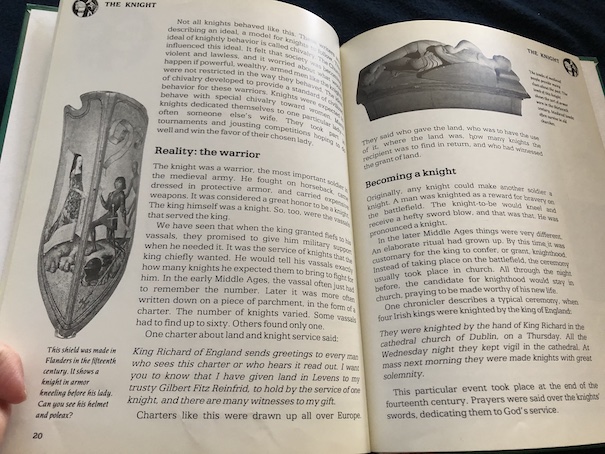
The Knight

A knight was a warrior who fought on horseback. Part of the service that nobles owed to their king in exchange for grants of land was supplying him with knights when he needed them. In the early Middle Ages, the status knighthood was a reward for excellent performance as a soldier, but later, there were rituals associated with knighthood, including that knighthood could only be granted by a king.

The Pilgrim

Pilgrims were travelers going to religious shrines. Some shrines were fairly close to the places where they lived, and some were far away, in major cities like Rome and Jerusalem. Pilgrims hoped to spiritually connect with the saints associated with the shrines they visited in order to ask for their help with some special purpose, such as recovery from an illness or the forgiveness of their sins.

The Lady

Women in Medieval society were subject to the authority of their fathers up until their marriage, and then, they were under the authority of their husbands. Money was a consideration when marriages were arranged, and marriages could be arranged for wealthy heiresses when they were very young. Married women had the task of managing their husband’s household and accounts, supervising the servants, and making cloth and clothing for her household. Women who did not marry might become nuns. Some liked the religious and scholarly life of a nun, but others simply became nuns because they had no other options and their families didn’t know what else to do with them.

The Herald

Knights always wore full armor when they fought, including a visor that covered the face. In order to know who was who, knights had special crests or coats of arms, which included identifying symbols and colors. Knights could wear their coat of arms on a tunic over their armor, have it displayed on a banner, and on coats on their horses. The herald was the person who kept track of everyone’s coat of arms, ensuring that they were all unique and settling disputes between knights who tried to claim the same combination of colors and symbols.

The Monk

Monks and nuns devoted their lives to prayer and meditation. Their days were organized around prayer, but they also performed manual labor, producing food for the monastery where they lived. Other tasks involved copying the Bible or prayer books and making clothing or medicine for the poor.

The Doctor

There were many dangers from illness during the Middle Ages, particularly the Black Death in the 14th century, when about a third of the population of Europe died. Doctors often didn’t understand the causes of illness, and not all doctors and healers even had any formal training. Wealthy people could afford doctors with more training. Cures often included combinations of herbs and various experimental substances, like crushed bugs or even gold and pearls. They had reasons for choosing the substances they did to put in medicine, but because they were lacking knowledge of the true nature of disease, their choices were often flawed.

The Heretic

Although the Catholic Church was the major form of Christianity in western Europe and widely regarded as the “true” Christian religion, religious beliefs were not completely uniform in the population. People whose beliefs seriously conflicted with the Church would be labeled as “heretics.” Because the Church believed that heretics’ souls were in danger, they could use severe punishments and even execution or the threat of it to force them to change or to stop spreading their messages to other people, thus endangering their souls.

The Mason

Masons were responsible for the great building projects of the Middle Ages, like castles and cathedrals. Some of these great buildings kept a staff on site to handle repairs, but some masons were itinerant, moving from site to site as necessary.

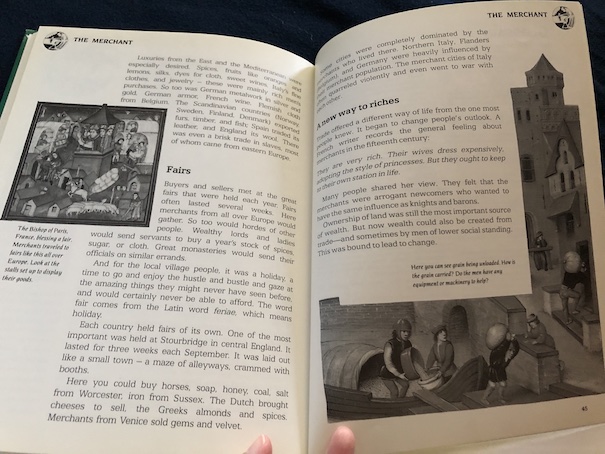
The Merchant

Merchants had to travel frequently to obtain and trade goods, some of them even from other countries. Towns would hold fairs at regular intervals where merchants would gather to sell their goods. Merchants with highly desirable goods could become very wealthy, and some people thought that they often got above their station in society, living like nobility.

Eyewitness Medieval Life

Eyewitness

Medieval Life by Andrew Langley, photographed by Geoff Brightling and Geoff Dann, 1988, 2004.

I love books that explain the details of daily life in the past, and I especially like Eyewitness books because they include such great photographs to show objects that people would have used in the past.

This book begins by explaining the time period of the “Middle Ages”, which was the period between Ancient Greece and Rome and the Renaissance, when culture and knowledge from Ancient Greece and Rome came back into vogue. The Middle Ages lasted about 1000 years, roughly from 400 to about 1540 AD. (Estimates of the start and end dates vary because this was a period defined by cultural changes, which are gradual and don’t have precise start and end dates.) This long period of time can also be divided into smaller periods and contained many important events that helped to shape society and culture, including The Crusades and The Great Plague.

Medieval society was hierarchical and was based on land ownership. The king and the highest nobles controlled the land and allowed people in lower levels of society to use it or grant farming rights to peasants in exchange for rent in the form of their services and a share of what they produced. The peasants or serfs were tied to the land they farmed, and the land was owned by the lords they served. They were not regarded as “free” people, and they couldn’t leave their lord or the land except by raising enough money to buy some land for themselves or by marrying a free person from a higher level of society.

A lord’s manor included not only his manor house or castle but the nearby village, church, and the farmland where his serfs worked. Often, villages and manors had little contact with the outside world, so the people who lived there had to make most of what they needed themselves. Most people never left their land or were only able to travel a short distance from it, so the only new people they might meet would be traveling peddlers, soldiers, or pilgrims.

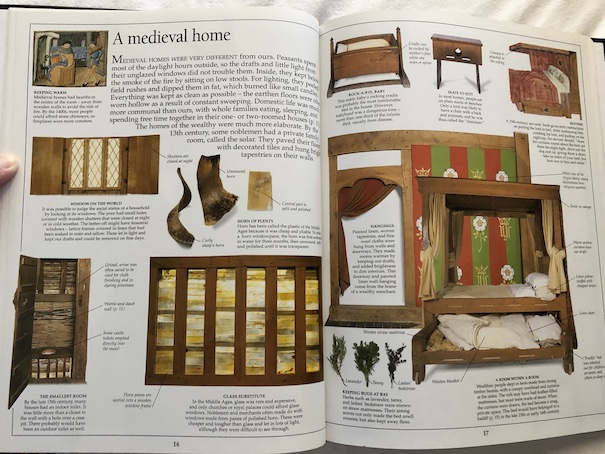
The book explains what would be found in a typical Medieval home. Poor people lived in houses that had only one or two rooms for the entire family. Few people could afford to buy glass windows. Poor people only had wooden shutters to cover their windows. Others might have tallow-coated linen over a lattice frame, which would let in light, and some wealthier people had pieces of polished horn in their windows, which also let in light, although you couldn’t really see through them well. What people ate varied depending on their social status. Wealthier people could afford a wider variety of foods, and poor people mostly ate what they produced themselves.

Women’s lives also varied depending on their social status. Pleasant women farmed and provided for their families alongside their husbands. Women in families of craftsmen and tradesmen often worked alongside the men in the family business. Wealthy women managed their husbands’ households or could rise to rank of influential abbess if they joined religious orders. However, the highest ranks in society were occupied by men.

While peasants served their lords, lords also owed services to higher nobles and, ultimately, to the king, although sometimes the king struggled to control powerful nobles and assert his authority over them. The king generally had to keep his nobles satisfied with his rule if he wanted to retain their loyalty because, while he was the source of their land and authority, they were effectively ruling over their own smaller lands with their own troops. While nobles owed their king military service and support, if they were dissatisfied with the state of their lands or were just unoccupied with other battles to fight and saw an opportunity, they would sometimes use their troops to raid the lands of neighboring nobles. Part of the king’s job involved preventing his nobles from being dangers to him and to each other. The king also made and enforced laws, settled disputes, and oversaw the collection of taxes.

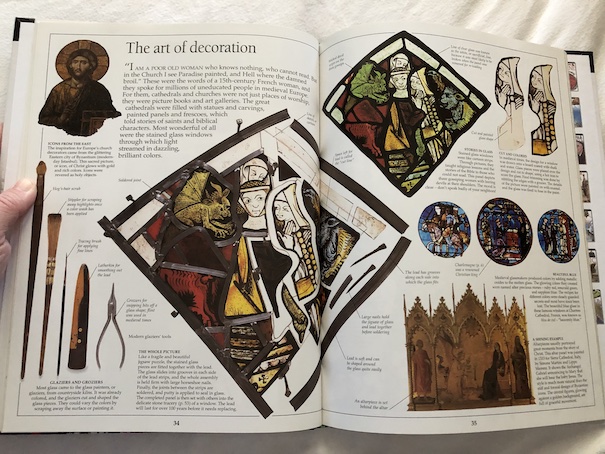
Christianity, specifically in the form of Catholicism, was central to the lives of people in the Middle Ages. During this time, stonemasons and craftsmen developed new techniques for building impressive cathedrals that still stand today. These cathedrals were lavishly decorated with statues, frescoes, and stained glass windows that depicted Biblical stories and the lives of saints. These works of art were important for helping to teach people who did not have the ability to read the Bible themselves about their religion.

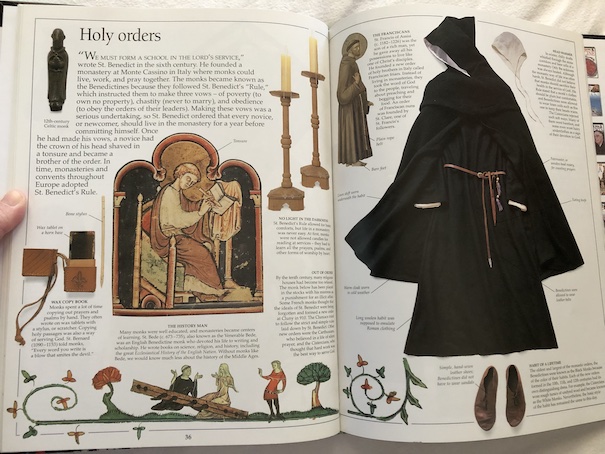
Religious orders of monks and nuns performed important functions for society, such as caring for people who were poor or sick, providing safe places for travelers to stay, and copying written texts by hand. In the centuries before the printing press was invented, there were only handwritten books, and they took time and skill to produce. It could take an entire year for someone to copy an entire Bible. Few people were able to own personal books, and much of the schooling in this period was provided by religious orders.

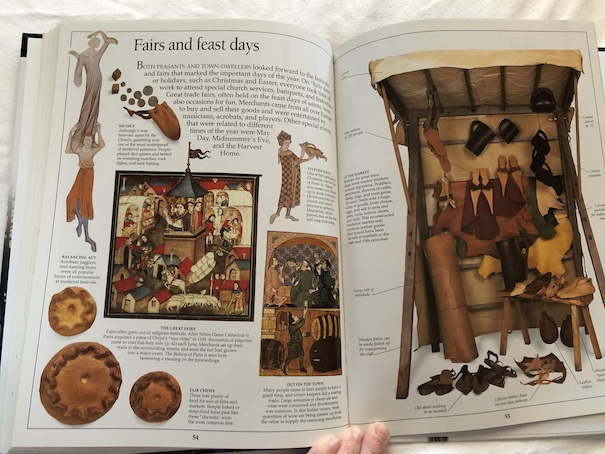
The book describes the rise of Islam during the early Middle Ages, increases in trade and commerce, the growth of towns, and guilds that controlled different professions. It also describes Medieval music and entertainment, such as plays and parades. One of my favorite parts of the book is about fairs and feast days.

The book ends by describing the beginning of the Renaissance and the rediscovery of classical Greek and Roman culture as well as the beginning of the Reformation and the development of new scientific discoveries and artistic styles.

The book is available to borrow and read for free online through Internet Archive (multiple copies).