Medieval Holidays and Festivals

MedievalHolidays

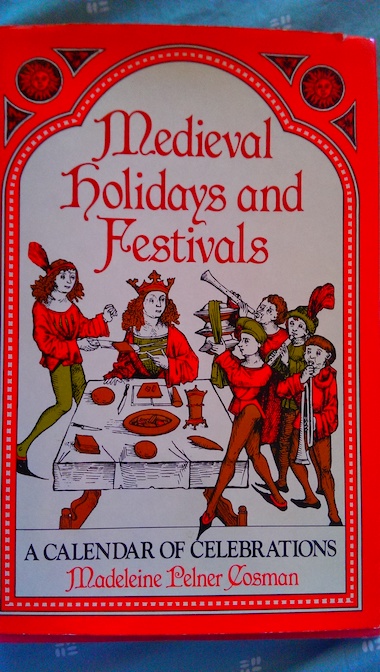
Medieval Holidays and Festivals: A Calendar of Celebrations by Madeleine Pelner Cosman, 1981.

This book explains the holidays that people celebrated in Medieval times and how these holidays would have been celebrated, along with some special information about Medieval feasts.  The author also explains a little about how historians uncover and interpret information about people’s lives in the past.
MedievalHolidayProcession

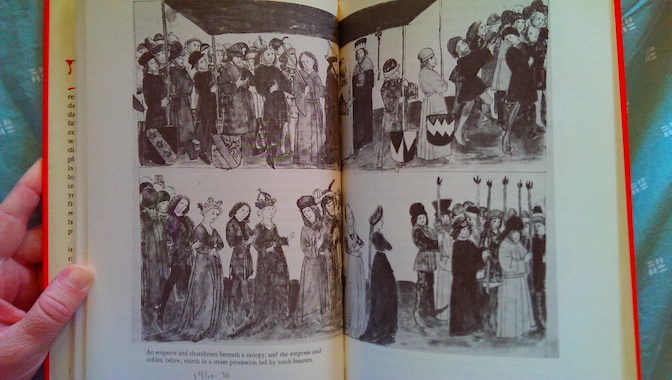
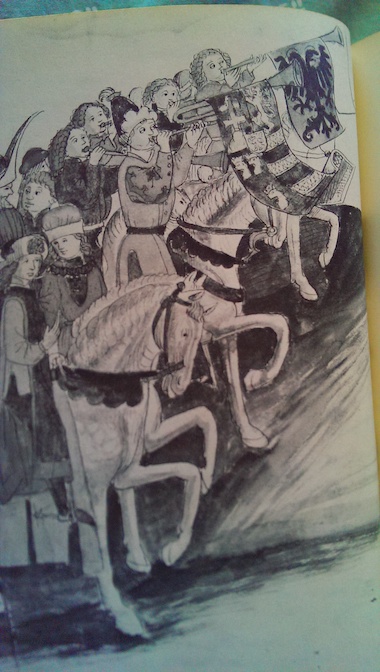
Many of the holidays celebrated in Medieval times tended to be either religious in nature or having to do with the changing of seasons.

The holidays included in this book are listed by month:
MedievalHolidaysHorsesJanuary — Twelfth Night — An extension of Christmas (remember the Twelve Days of Christmas song?), Twelfth Night is also known as Epiphany — the night that the Three Wise Men supposedly visited baby Jesus after his birth.

February — St. Valentine’s Day

March — Easter

April — All Fool’s Day — Not just a day for pranks, but when everything is turned upside down and backwards, and people intentionally did the opposite of whatever they usually did in many ways.  Basically, a celebration of everything silly and ridiculous.

May — Mayday — A celebration of spring.

June — Midsummer Eve — A celebration of summer.
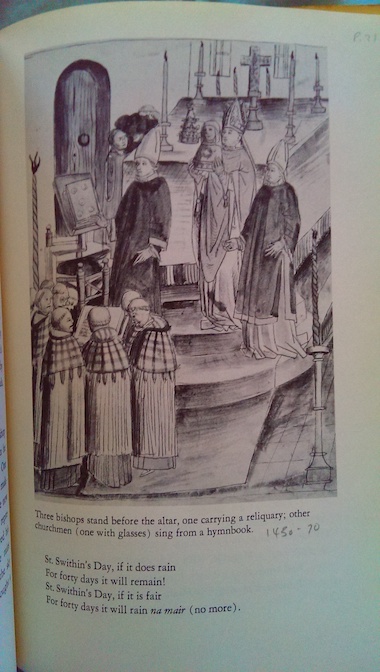
MedievalHolidayBishopJuly — St. Swithin’s Day — St. Swithin was a bishop of Winchester who had asked to be buried without great ceremony upon his death.  However, people later decided to give him a grand tomb.  When they tried to place his body in the tomb, it started raining heavily and didn’t stop until they moved the body to a new location.  They took the rain to be an expression of St. Swithin’s displeasure at the unwanted tomb.  From then on, this time of year was used to predict rainfall for the rest of summer.

August — Lammas Day — The word Lammas meant “Loaf Mass,” which was when there would be special blessings for bread and grain and thanks given for bountiful harvests.  The holiday was marked by the baking of a variety of special breads, including those in usual shapes, flavors, and colors.  Some of them could be very elaborate.

September — Michaelmas — The holiday celebrating St. Michael is oddly associated with three things that few people would associate with each other: gloves, geese, and ginger.  The glove was the symbol of the market of craftsmen held on Michaelmas.  Geese and foods flavored with ginger were popular dishes served at Michaelmas.

October — Halloween

November — Catherning, or St. Catherine’s Day — St. Catherine of Alexandria was learned noblewoman who was killed on a wheel (it was a bizarre and disgusting form of execution).  The holiday honoring her was associated with wheels, women (especially unmarried women and women students), and the professions which were associated with her such as lawyers, carpenters, spinners, lace makers.

December — Christmas

Each section in the book describes special traditions associated with each holiday, including games that would have been played and food that would have been eaten at that time.

In the back of the book, there is a section that explain decorations used for Medieval feasts, how to hold a Medieval-themed feast in modern times, and Medieval costumes. There is also a section of Medieval recipes.
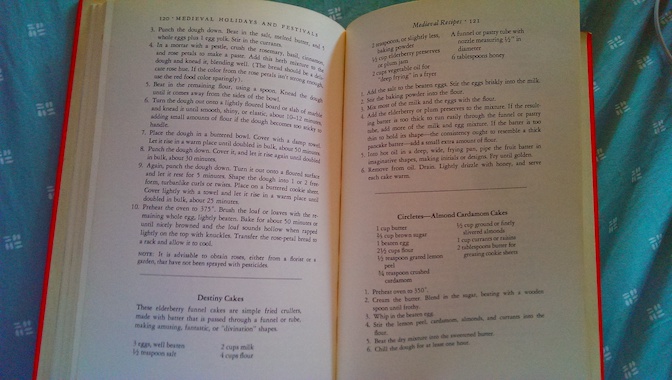
MedievalHolidaysDestinyCakes

This book is available to borrow and read for free online through Internet Archive.

Castle Diary

CastleDiary

Castle Diary: The Journal of Tobias Burgess, Page by Richard Platt, 1999.

Tobias is an eleven-year-old boy living in England in 1285.  He is from a noble family, and his father is sending him to his uncle to become a page.  As a page, Tobias will learn manners and skills that he will need as he eventually becomes a squire and then a knight.  During the first year of his training that he spends with his uncle, he keeps a diary of everything that happens to him and everything he learns.  Toby is a fictional boy, but his life and family are meant to illustrate what life was like for a young boy from his social level during the Middle Ages.

CastleDiaryPic1

The castle were Toby’s uncle lives is much bigger than his parents’ manor house.  Toby has to learn the roles of all the servants who live there: who is in charge of what and who reports to who.  Not all servants are equal, and some command more respect than others.  Some of them are even from noble families like his, including his aunt’s companion, Isbel.  Toby himself is assigned to do chores for his aunt like running errands, delivering messages, serving food at meals, and holding up the hem of her cloak when she walks outside.

Toby shares a room with the other pages at the castle, all boys of noble families and destined to become knights, just like him.  They have lessons in reading, writing, mathematics, Latin, and scripture from the castle’s chaplain, and he is a harsh disciplinarian.  They practice their lessons on wax tables that can be smoothed out and used again.  The boys also learn manners and start learning archery and about all the weapons and armor that knights use.  When they have time to play, they try walking on stilts and play at being jousting knights by carrying each other on their backs and trying to knock each other off.

CastleDiaryPic2

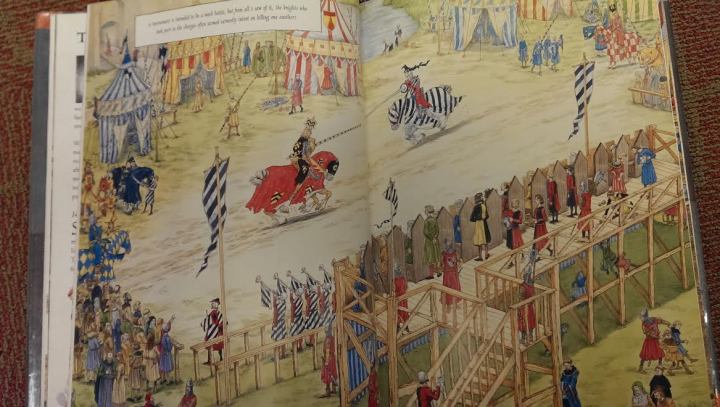
During the course of the year, Toby gets to witness a hunt, a joust, and a banquet with important guests.  At one point, he gets sick and receives treatment from a physician.  He also encounters a poacher on his uncle’s land.  This man is eventually caught (although Toby decides not to turn him in) and put on trial, but in the end, he is not punished because the jurors were sympathetic.  The book ends with a Christmas celebration, after which Toby goes home to visit his parents.

CastleDiaryPic3

In the back of the book, there is a section with more information about Medieval society, castles, sieges, weapons, armor, and the changes that eventually brought an end to feudal system that Toby knew.

The book is part of a series of historical picture books.  It is currently available online through Internet Archive.
CastleDiaryPic4

The Great and Terrible Quest

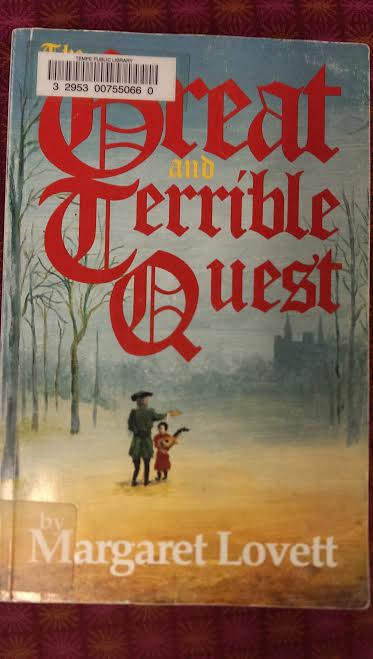
greatterriblequestThe Great and Terrible Quest by Margaret Lovett, 1970.

This story takes place in a fictional kingdom during the Middle Ages. Trad is a ten-year-old boy who has lived most of his life with his abusive grandfather. He barely remembers his parents, who died in a plague when he was only four. This grandfather consorts with robbers and evil men. Trad often pretends to be stupid to avoid their notice and warns travelers away from their territory.

One day, he rescues a man who has been badly wounded and cares for him in a secret cave. This man, whose white hair makes him seem elderly, insists that he is on a mission, a great and terrible quest . . . but because of a head wound, he can’t remember what his quest is. All that he knows is that time is short, and he does not have long to complete his quest to find something very important.

Trad soon learns that his grandfather’s wicked friends are the ones who attacked this mysterious stranger. Taking Trad’s father’s old lute, a couple of coins, and a mysterious ring dropped by one of the robbers which seems to have once belonged to the stranger, Trad and the stranger embark on a journey across the land, making friends and pursued by enemies as they go. While the stranger struggles to remember his identity and the nature of his mission, Trad begins to learn a few things about his own forgotten past and the nature of his family. Nothing is what it seems. Their country is in trouble because of the evil men who have been controlling it. Everything depends on the success of the stranger’s mission, and Trad has a much larger role to play than he had ever dreamed.

It’s a beautiful and fascinating story about good and evil, loyalty, friendship, and determination to do the right thing, even against the odds. There are parts that might frighten younger readers. The fights are violent and bloody, and there are a couple instances of cruelty to animals (partly, it seems, to show how truly evil Trad’s enemies are). Still, it’s a great story for tweens and teens, and readers will want to cheer Trad on as he struggles to help those around him and find his own destiny.

Although the kingdom is fictional and the themes are similar to fantasy stories, there is no actual magic in the story.

The book is currently available online through Internet Archive.