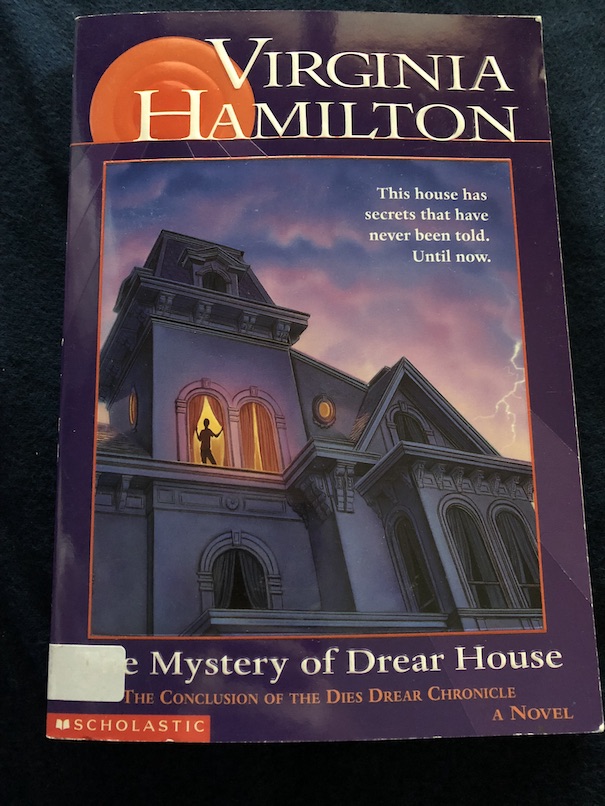
The Mystery of Drear House

The Mystery of Drear House cover

The Mystery of Drear House by Virginia Hamilton, 1987.

This book is the continuation of The House of Dies Drear, and the final book in the short series.

The Smalls are now settled into the house that formerly belonged to the abolitionist Dies Drear, who used secret tunnels to help smuggle escaping slaves to freedom as part of the Underground Railroad. Thomas Small’s father is a college professor, who finds the history of the house endlessly fascinating, especially now that they know about the hidden treasure that the caretaker, Mr. Pluto has been guarding for many years.

Apart from the Small family and Mr. Pluto, Pesty is only other person who knows where the hidden treasure is. Pesty (a nickname, her real name is Sarah) is the adopted daughter of the Darrow family, who live nearby. The Darrows are generally known to be nasty and scheming, and they have spent years looking for the treasure they know that Dies Drear hid. In the last book, Pesty helped the others to frighten off the Darrows when they were getting too close to the secret, but Thomas is still concerned that they might be a threat. He also privately questions Pesty’s loyalty, wondering if she’ll continue to keep the secret from the Darrows, although Mr. Pluto is confident that she will because she knew the secret of the treasure even before the Smalls did.

Mac, a boy about Thomas’s age, is the youngest of the Darrow brothers, and he’s not as mean as the rest of his family. Thomas kind of wants to be friends with him, but he’s not sure if he can really trust him. Mac tells Thomas that he can come over to visit sometime and that his mother is an invalid who sometimes spends months in bed. When Mac shows an interest in Thomas’s great-grandmother, who is coming to live with them, Thomas gets the idea to bring his great-grandmother over to the Darrow house to visit Mac and Pesty’s mother.

However, before they can visit Mrs. Darrow, she comes to visit them, entering their house through one of the secret passages that Thomas and his family haven’t learned about yet. She startles Thomas’s great-grandmother with her sudden arrival, and Thomas is irritated that Pesty didn’t tell him about that secret passage even though she knew about it. Pesty explains to them that her mother is mentally ill, a chronic condition of some kind, and she gets a little odd during times when she doesn’t take her medicine. Thomas’s great-grandmother seems to understand the situation, and she insists on escorting Mrs. Darrow home.

In the secret tunnel Mrs. Darrow used to come to their house, there are hidden rooms, and when they all arrive at the Darrow house, Mrs. Darrow begins telling them a kind of odd story, really little bits and pieces of stories that she has told Pesty and Mac before. Pesty seems to have a better understanding of what Mrs. Darrow is talking about than Mac does, but Thomas can tell that Mac has heard his mother tell these stories before and that he is also trying to get a better understanding of them. For some reason, Pesty seems to be holding back information from Mac as well as Thomas.

The story that seems to concern Mrs. Darrow the most is about an Indian Maiden (Native American). She seems to get upset at first when Thomas mentions that Mac had mentioned an Indian Maiden before. It turns out that the Darrows are part Native American, and the “Indian Maiden” is one of their relatives from the past. She played a role in the Underground Railroad with Dies Drear but lost her life when she was caught. The Indian Maiden was hiding secrets that Pesty is still trying to protect, and she has also been worried about Mrs. Darrow, who sometimes acts out part of the old story as if she were the Indian Maiden herself.

Meanwhile, it seems like someone is playing the ghost of Dies Drear and trying to frighten Mr. Pluto into telling him about the hidden treasure. Thomas and Pesty see the tracks of this person one day when they go to visit Mr. Pluto. The relationships between the different members of the Darrow family are complicated, and not all of them are really after the same thing.

The book is available to borrow for free online through Internet Archive.

My Reaction and Spoilers

Mrs. Darrow’s mental illness and the different motives of the younger Darrows vs. the older Darrow boys and their father are at the heart of much of the mystery and peculiarity of the Darrow family. Mac actually opposed his father and brothers the last time they tried to get the hidden Drear treasure, and since then, they’ve been shunning him. Pesty tries to look after Mrs. Darrow as best she can, but she’s been handling the job largely by herself, and at the same time, she could really use the support of a mother who can look after her. Pesty doesn’t really like all of the secrets that she has been forced to keep, but for a long time, she hasn’t felt safe in confiding the full truth of anything to anybody. She feels even more left out of the Darrow family than Mac is because she’s their adopted child, not a blood relative, even though she is always looking after Mrs. Darrow and thinks of her as her “Mama.”

The solution to many of the problems with the Darrows comes with the public exposure of the Drear treasure and the end to all the secrecy. The Smalls decide to give Mrs. Darrow the credit for finding the treasure, so although Mr. Darrow is angry that he will never get his hands on the hidden treasure that he and his family have searched for so long, they will get part of the reward money for finding it. The foundation that receives the treasure also gives jobs to Mr. Small and Mr. Darrow, changing the lives of the Darrows for the better. Even though Mr. Darrow didn’t get what his family originally wanted, they end up with something that improves their situation, and they no longer feel the need to hide Mrs. Darrow’s condition from everyone. The Darrows are freed from part of their past, and now, they’ll be able to go forward with their lives. Mr. Darrow also shows that he really cares about his adopted daughter.

The Darrows are a mixed race family, and their heritage is in keeping with real events in American history. People with mixed black and Native American heritage are sometimes colloquially known as “Black Indians,” and people with that type of mixed ancestry have existed in the Americas since Colonial times. By the end of the story, the Darrows’ full history isn’t completely explained in detail, but it seems that it was probably Dies Drear’s work with the Underground Railroad that brought their ancestors together. Freed and escaped slaves did sometimes intermarry with Native Americans.

Shadow in Hawthorn Bay

Shadow in Hawthorn Bay by Janet Lunn, 1986.

Mary (or “Mairi,” they spell it both ways) Urquhart and her cousin Duncan had always loved each other.  They were always close as children, feeling more like two parts of one person than separate people, and they always imagined that they would spend the rest of their lives together.  Then, Duncan’s parents, Mary’s Uncle Davie and Aunt Jean, decided that they wanted to travel to Canada, while Mary and her parents stayed at home in the Scottish Highlands.  Duncan hadn’t really wanted to go.  He was only eleven, and he promised Mary that when he was older, he would work hard to earn enough money to come back.  However, Duncan never came.  He only sent Mary a brief letter about the dark forest where he now lives.  Mary feels like the Duncan she knew is gone forever.

Four years later, in 1815, when Mary is fifteen, she has a strange feeling, like Duncan is calling to her from across the ocean.  All of her life, Mary has had a strange gift for seeing into the future or reading others’ minds.  The “gift of two sights,” people call it, but Mary doesn’t feel like it’s a gift.  It makes her uneasy, and she can’t control it.  She hears Duncan’s calls to her through her “gift,” but she is afraid because she doesn’t want to leave Scotland.  She wants Duncan to come to her.

However, she is unable to resist Duncan’s calls.  She asks her parents for help with money for her passage to Canada, but they tell her that she is wasting her time and that, even if they sold their family’s most precious heirloom to give her the money, there would not be enough for the return journey.  A family friend gives her the money instead, and although Mary doesn’t really want to accept it and doesn’t really want to go, she can’t help herself.

The journey to Canada is miserable, and when she finally arrives at the place where her aunt and uncle live, alone and without money, she learns something which she thought she had sensed during the journey: Duncan is dead.  Duncan committed suicide while Mary was still on the ship to Canada.  Mary has arrived too late.  To make matters worse, one of the family’s neighbors, Luke Anderson, tells her that her aunt and uncle gave up the idea of farming in Canada and have already begun the journey back to Scotland.  Mary has no money to follow them, and they have no idea that she’s now in Canada, alone.

Luke takes Mary to Mrs. Colliver, who tells Mary a little about her family and their life in Canada and why they decided to leave.  Mary is devastated by the loss of Duncan and tries to tell Mrs. Colliver about how she felt that Duncan had been calling out to her, but Mrs. Colliver tells her that she doesn’t believe in ghosts or things like that.  Although Mary knows that her “gift” is real and so are spirits, she learns that others in the community share Mrs. Colliver’s no-nonsense, disbelieving attitude toward such things.  Mary, in her despair, wants to rush straight back to Scotland, but Mrs. Colliver, with her practicality, points out that Mary can’t possibly get there without money.  She tells Mary that she can stay with her family, that she will give her room and board in exchange for help with chores and that she can earn extra money for weaving and spinning.  Mary is clumsy at household chores because she was always better with animals at home, but when Mrs. Colliver sees Mary’s skills with animals, she is appreciative.

Life is hard in the small farming community.  Mrs. Anderson, Luke’s mother, explains to Mary that most of the people who live there are refugees.  When they were young, their families moved there from the Thirteen Colonies that now make up the United States because they were Loyalists.  When the Revolution came, they couldn’t stay, and so had gone north to Canada, where they struggled to establish a new community for themselves with their small homesteads. During her time there, Mary witnesses the death of a baby and the hardships of this strange place, seeing why Duncan didn’t like it there.  They tell her that Duncan was a strange boy who would seem bright and happy one day, but black with depression the next, something Mary remembers in him even before he went to Canada. 

The people are kind and welcoming to Mary, although they find her a bit strange.  As Mary struggles to make a life for herself, hoping to earn enough money to return home, she slowly comes to appreciate Luke’s kindness and help.  She learns healing arts and the use of herbs from another woman in the community, developing new skills.  In helping others, she earns their appreciation and a place in their community.  Luke Anderson becomes very fond of Mary, but she still mourns for her lost Duncan.  In spite of his kindness, she doesn’t see how she can make this strange, hard, dark forest of Canada her home, where it doesn’t even seem like the spirits she believed in and that seemed to protect her when she lived in Scotland exist.

Mary is melancholy and feels like she doesn’t belong in Canada.  It distresses her that she can no longer feel Duncan’s presence . . . although she can oddly hear him calling to her sometimes.  Mary also unnerves people when she makes predictions that come true and speaks about ghosts and spirits.  When she almost gives in to her homesickness and depression and kills herself, lured to the spot where Duncan drowned himself by his ghostly calls to her, she finally sees Duncan’s death for what it really was and finds the courage to refuse to follow him down the dark path that he chose for himself and to fight for the life she has been building, the one she really wants to live.

The book is available to borrow and read for free online through Internet Archive.

My Reaction

This book is part of a loose trilogy, involving ancestors and descendants of the Anderson and Morrisay families.  All of the books take place in or near Hawthorn Bay in Canada, but at different time periods.  Some of the characters are psychic, like Mary, or have the ability to travel through time, like Susan in The Root Cellar, who is apparently Mary’s granddaughter.  The connection between Mary and Susan is never stated explicitly, but it’s implied by their last name, shared psychic abilities, and comments that a friend makes about Susan’s grandmother in The Root Cellar.  In this series, the characters from each of the books generally don’t appear in any of the others (except, perhaps, for Phoebe, who appears briefly in this book and is the main character in the third story).  Most of the time, you only know about the family connections by reading the books and taking note of the last names.  The books go backward in time as the series progresses, and the connection between the Anderson and Morrisay families is only obvious in The Root Cellar.

With the deaths that occur in the book, discussions of suicide, and the influence of Duncan’s selfish, malevolent spirit, this is not a book for young kids. I’d say that readers should be middle school level or older. There is also some implied sex and pregnancy out of wedlock when one of Luke’s brothers gets one of Mary’s friends pregnant. Her friend doesn’t give the details of what happened, but from what she says, it’s implied that Luke’s disreputable brother forced himself on the girl and that she went along with it because she didn’t know what else to do. The description of that incident is minimal, but older readers will understand what happened. There is a scandal in the community because of it, and the disreputable brother leaves rather than face the consequences of his actions.

Themes and Spoilers

I enjoyed the book for its references to Scottish folklore, which Mary believes in and seems to be in touch with through her “gift” and for Mary’s growing confidence in her abilities and more mature understanding of what her cousin was really like and what her relationship with him really was.  In some ways, I do feel sorry for Duncan because he seems to have been suffering from some kind of mental illness, possibly bipolar disorder or manic depression, which would explain how his moods could shift so abruptly and dramatically.  However, Duncan was also a selfish and controlling person.  Although Duncan’s death was sad, Mary realizes that his end was of his own making, and it’s not the future she wants for herself.  There are some disturbing scenes in the story.  Mary witnesses the deaths of others, including a baby, because it is a harsh environment, where people sometimes succumb to sickness or bad weather, although these deaths are not described in too much detail. 

There are also some frightening moments, like when Duncan’s ghost almost convinces Mary to kill herself and when he similarly lures a young boy, Luke’s younger brother, to the spot where he drowned and almost kills the boy because Mary finds the little boy comforting and Duncan doesn’t want her to be comfortable and happy.  In the beginning, readers see Duncan through Mary’s fondness for him, so the true darkness of his personality isn’t immediately apparent, although I had some misgivings about him from Mary’s first description of how they played together as children.  I didn’t like the way she described how he would tease her until she became angry or hurt and then he would sulk until she comforted him.  She says that wasn’t really fair, but to me, it was disturbing because I have seen that kind of selfish personality before, and it’s never a good sign.  It shows right from the first that Duncan doesn’t really care about Mary’s feelings.  He cares only about his own feelings, and he has no interest in changing his behavior out of consideration for her.  In fact, the very idea that he should consider her feelings seems somehow insulting to him, even though he supposedly loves her.  He just thinks that she needs to reassure him that everything he does is fine whether it is or not.  In his view, Mary is obviously wrong to feel hurt even when he tries to hurt her because he has more right to his feelings than she has to hers and he should be able to behave any way he wants with no consequences.  That’s what Mary’s first description of Duncan said to me.  As soon as I saw that, even though some might consider it just the actions of an immature child, I had some suspicions about him.

My suspicions were somewhat confirmed before Mary left home. Her mother told her that she didn’t think Duncan was worth chasing after, calling him sulky and thoughtless, but the full truth of that doesn’t strike Mary until she confronts his spirit where he died. Because people in Canada don’t like to talk about Duncan much, when Mary first hears about his death, it isn’t immediately clear that he killed himself or how.  At first, it’s just somewhat implied, but when Mary is almost lured to her death, she sees the full truth about Duncan. 

Mary comes to realize that, although everyone, including Duncan and herself, felt like the two of them were two parts of the same person, they really weren’t.  Mary sees that not only can she live without Duncan, she has been living without him for years.  She lived without him for a time in Scotland, and she’s been living without him in Canada, and she can continue to live without him wherever she chooses to live the rest of her life.  When she was younger, she had thought of Duncan as being the stronger of the two of them because he was not plagued by the same “gift” she was, but she realizes that she is actually the stronger of the two of them.  Duncan’s “love” for her had also always been a selfish one.  He couldn’t bring himself to work hard and return to Scotland for her sake, but he expected her to give up everything, even her own life, to join him in Canada and in death.

When Mary realizes all of this, Duncan’s spirit loses its hold over her, and she comes to see that the darkness in him was darker than the forests that had seemed so frightening to her before.  Free from the shadow of Duncan’s death and his selfish spirit, Mary is able to see the beauty of Canada and to be more open to the good people around her, forging a new future with a better man.

A Plague of Sorcerers

PlagueSorcerersA Plague of Sorcerers by Mary Frances Zambreno, 1991.

Jermyn Graves comes from a family of sorcerers, but although he seems to have the talent, it takes him unusually long to get his familiar. Familiars, animals with a special link to a wizard, assisting them in their magic, come to their masters when they are ready to begin learning magic, and without one, Jermyn cannot really be a wizard.

When Jermyn’s familiar finally appears, everyone is surprised to find that it is a skunk. Some people make fun of him for having such a strange familiar. No one is quite sure what the meaning of his familiar is, and the exact nature of Jermyn’s magical talent is still unknown. Still, his aunt apprentices him to a theoretician, a man who does not actually practice magic himself, but who studies the theory behind it. He can assist Jermyn until Jermyn’s true talents become known and he can study with a master who shares his specialty.

Jermyn likes his new master and the young orphan girl who lives with him. However, disaster soon strikes the city. Sorcerers are falling victim to a strange disease that sends them into a coma. Despite their best efforts, none of the remaining sorcerers can discover the source of the disease or its cure, and all the time, there are less and less sorcerers to continue the work. Time is running out, and Jermyn and his unusual familiar may be the only ones capable of finding the answer.

Jermyn does have a special talent which he comes to fully understand, and he uses it to save the other sorcerers and put an end to the mysterious plague.  Although the others had laughed at Jermyn’s skunk, he later comes to realize that she was the one keeping him from getting the plague himself because of some unusual qualities of her own.  The combination of mystery and fantasy is exciting, and there is a mysterious villain who may not even be aware of their villainy because of their own hidden sides.

This book is currently out of print, but there are used copies still available, and you can also buy an electronic copy from American Fantasy Press.

There is a note in the beginning of the book that says that the first two chapters are based on a short story written by the author earlier.  The book is currently available online through Internet Archive.  There is also a sequel to this book, Journeyman Wizard.