The Halloween Play

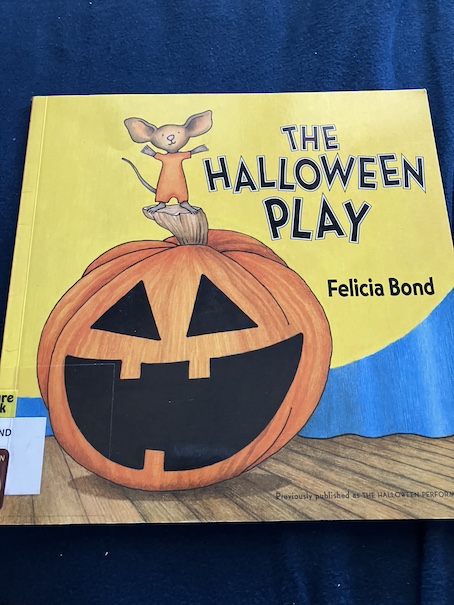
Halloween is coming, and the students in Roger’s class at school are preparing for their Halloween play. The class rehearses their play every day, and they make invitations to the play to send out to people in town.

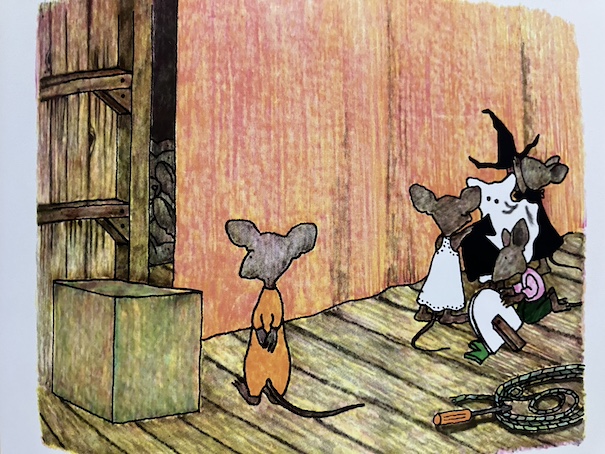
On the night of the play, the school’s auditorium is full of people waiting to watch the play, and Roger waits backstage for his turn to go on stage. He doesn’t have a big role in the play, but his role is important.

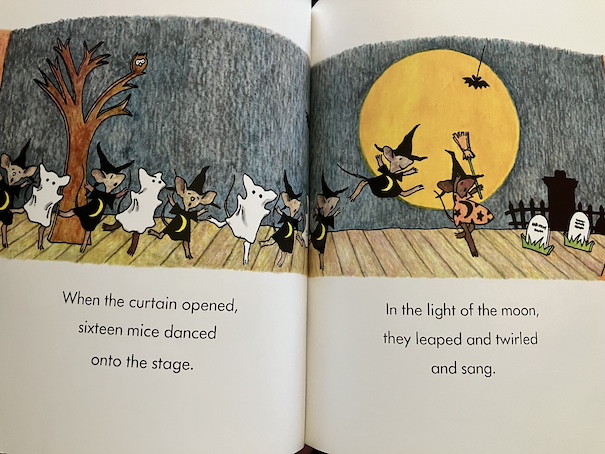
The other students in Roger’s class go on stage, dressed as witches, ghosts, and skeletons. They perform the songs and dances they’ve rehearsed. The audience laughs at the funny parts, and everyone is enjoying the play.

All the time, Roger is backstage, listening and preparing for his part. He counts down the lines until the moment comes when Roger steps on stage for the play’s finale!

The book is available to borrow and read for free online through Internet Archive (multiple copies).

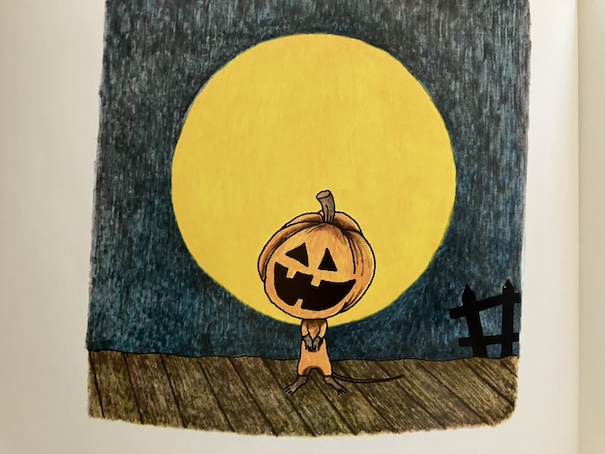
I remember reading this book when I was a little kid, and it was a Halloween favorite of mine! Felicia Bond is better known today as the illustrator (but not the author) of If You Give a Mouse a Cookie, which was originally published two years after this particular picture book. The art style between the two books is noticeably similar, but the book about the Halloween play is different because this is about mice who live like people and do not interact with humans. I was also amused that one of the student mice in this book was dressed in an orange shirt with a black zig-zag and black shorts, like the cartoon character Charlie Brown, who wears a yellow shirt with a black zig-zag and black shorts. The tv special It’s the Great Pumpkin, Charlie Brown was known for popularizing the concept of Halloween tv specials, and Roger the mouse plays a large pumpkin in his class’s Halloween play, although Roger isn’t the mouse wearing the Charlie Brown style clothes. Roger is the one in the sweater with an R on the front. I was just amused by this little detail in the pictures of his class.

This picture book is a sweet little story about a mouse boy and the Halloween play given by his class. School plays on a wide variety of themes are a common experience for human children attending both public and private schools, and they are often memorable points in children’s school experiences. They can also be very emotional experiences. Students can be nervous about plays and being on stage in front of an audience, and sometimes, there are conflicts about which students get the best parts. This cute little picture book doesn’t have any drama in it and doesn’t talk about stage fright, although there are other children’s books that address these issues.

Instead, the story is more about a magical evening and the small but important role played by one particular student. Much of the story shows the build-up to the play, and when the play begins, Roger only appears on stage at the end of the play. The rest of the time, he’s listening to the other students from back stage, waiting for his cue to step into the spotlight. We don’t know exactly what the play is about, but it’s not that important. Those quiet moments of anticipation backstage are magical, and Roger will never forget how exciting this evening has been!

The Bell Tolls at Mousehaven Manner

This book is the sequel to Shadow Over Mousehaven Manor.

Since the characters’ adventures in the previous book, Minabell Mouse has come to live with her Aunt Pitty Pat in their ancestral home, Mousehaven Manor. Just as Aunt Pitty Pat and Minabell have finished their spring cleaning, Minabell’s cousin Violet Mae arrives for a visit … apparently a long one, based on the amount of luggage that she brought with her.

Also, the prairie hawk who brought Violet Mae to Mousehaven Manor brings a package for Minabell, although there’s nothing to say who the package is from. Minabell finds the package disturbing and is afraid to open it. Instead, she stashes it in the music room. Still, the package leaves her feeling weak and unwell, as if it were somehow cursed.

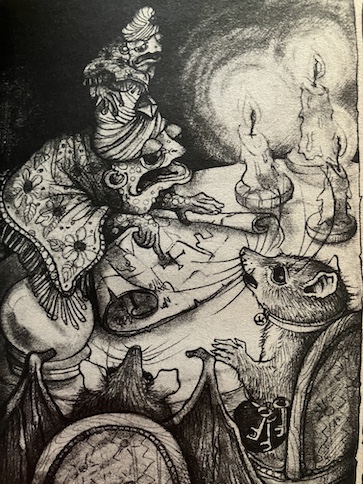
That evening, their friend Percy the bat comes to dinner, and they are also joined by a mysterious stranger bat who calls himself Count Von Flittermouse. Count Von Flittermouse is a traveler, but he has no luggage except for a large box, which he declines to bring inside. They invite him to join them for dinner, but he says he’s already eaten, so he will just join them in conversation. Aunt Pitty Pat asks the Count if he’d like to spend the night at Mousehaven Manor, but the Count says that he’s a nocturnal creature, so he’s active at night. He asks for directions to Springfield because he says he wants to camp in the Oak Ridge Cemetery and visit Lincoln’s tomb. After dinner, the Count leaves, and they see he’s carrying a long box on his back. He’d mentioned that he brought his bed with him, so they figure that’s what it is. Percy seems a little uneasy about the Count, and Minabell notices that the Count left some odd kind of dust on the chair where he was sitting.

Minabell is in charge of security at Mousehaven Manor, but that evening, she accidentally leaves the music room window open. At night, Minabell hears someone moving around the manor, but she never sees the mysterious intruder, and in the morning, nothing is missing, so her aunt thinks it might have been her imagination.

Meanwhile, a country singer mouse called the Rhinestone Rodent arrives in town. (A joke on the Rhinestone Cowboy song.) Minabell is shopping when she stops to watch the singer perform. Then, an alarm goes up among the mice in town because Mousehaven Manor is on fire! Minabell rushes home, and Percy rings the bell at Mousehaven Manor to summon help. Others come to form a bucket brigade, and they successfully put the fire out. Aunt Pitty Pat is fine, but it takes them awhile to find Violet Mae. Violet Mae casually strolls downstairs and tells them that she was upstairs, having a nap and missing the whole thing.

Part of the mansion is damaged from the fire, and they have to clean everything up. Violet Mae meets the Rhinestone Rodent and develops a crush on him. While Violet Mae and Aunt Pitty Pat go to see the Rhinestone Rodent perform, Minabell and Percy inspect the site of the fire. They determine that the fire was set deliberately, but it was never intended to burn down the whole mansion. It seems like whoever set the fire was using it to cause a distraction while they did something else, but they’re not sure what.

The mysterious package that Minabell hid in the music room is still there, and Minabell finally opens it in front of Percy. It turns out that it’s from Wendell Weasel, a member of the local law enforcement agency, the Illinois State Ski Patrol. The mysterious package contains an equally mysterious ancient box, and Wendell’s letter explains that this box has been passed down in the Mouse family for generations, always held by the head of the family. Until recently, it was in the possession of Colonel Mouse, who was Violet Mae’s guardian but has recently passed away (something that Violet Mae has completely failed to mention to anyone, which is weird). Wendell says that Violet Mae doesn’t know anything about the box, but Colonel Mouse wanted Minabell to look after both the box and Violet Mae. Wendell says that there is a document in the box itself that will explain the purpose of the box, but each caretaker of the box is bound to use its contents to help others and not just for personal gain. Also, there are evil people who may try to steal the box, so Minabell is going to have to be careful.

In the mysterious antique box, Minabell finds a pile of sand surrounding a bottle holding something intensely cold and an old map written in Spanish. It seems like this is what their mysterious intruder was looking for, but what does it mean, and who wants it?

The book is available to borrow and read for free online through Internet Archive (multiple copies).

This story is more supernatural than the previous book in the series, which was an adventure story. I thought that the villain in the story was pretty obvious, although I did have a couple other suspects in mind for a more devious twist. It turned out to be the obvious choice, though.

Count von Flittermouse is not what he seems, in more ways than once. Percy figures out pretty quickly that the Count is a vampire bat, but what that seems to mean in this version of the animal world is not only different from what vampire bats actually are, but it’s also kind of confusing. I expected that he’d turn out to be like a human vampire, only with a bat as his main form – drinking blood, being immortal, etc. But, that’s not it. Count von Flittermouse is a shapeshifter. He can change into different scary animals, like wolf and spider. That’s his main super power. So, he’s not exactly what I think of as a “vampire”, he’s more like a werewolf, or werebat, or werewolf bat or something. We never see him drink blood or try to drink blood, although there are some bones in his lair that suggest that he might eat other animals. They don’t really go deep into the lore of it or outline the rules for vampire bats in their version of Illinois. You just have to take their word for it that vampire bats are shapeshifters, and that’s it. That’s their thing. Also, their vampire bats aren’t immortal vampires. That’s really the problem that Count von Flittermouse has. He’s actually a very old vampire bat and not likely to live much longer unless he can get his little winged paws on the package that Minabell received.

The bottle in the mysterious package turns out to contain water from the Fountain of Youth. Generations back, one of Minabell’s ancestors accompanied Spanish conquistadors on their search for the Fountain of Youth, and they not only found it but saved some water from it. Count von Flittermouse wants it to restore his youth and make him immortal. It wouldn’t be so bad if he wasn’t also evil and a werewolf bat.

Of course, our heroes are victorious. They find a way to use the special water so that it benefits everyone, except for the evil bat, and everything ends happily. I actually think that this book might make a fun Disney cartoon, something like a more supernatural version of The Great Mouse Detective. Even though I thought that the book’s version of what a vampire bat is and what it does is a little confusing, a movie version could clarify some of the rules regarding what vampire bats are supposed to be and what they do. The lore about human vampires varies depending on the source, although they usually do have the ability to shapeshift into bats, an ability which is kind of pointless if the vampire happens to already be a bat. It’s understandable that the story has to tweak the traditional vampire lore to fit into this animal society. I kind of picture that the vampire bat would only be able to change into things whose blood it sucked earlier, but that’s just my theory; the book doesn’t clarify that point. Still, it’s a fun story, and I think a movie version would also be fun.

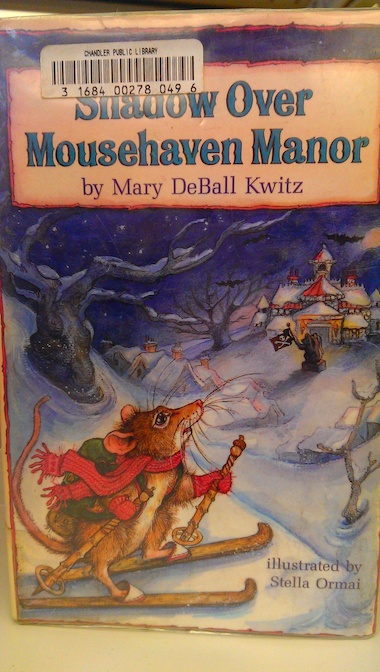
Shadow Over Mousehaven Manor

Shadow Over Mousehaven Manor by Mary DeBall Kwitz, 1989.

Minabell Mouse is happily looking forward to her Aunt Pitty Pat visiting her for Christmas with her new husband, Magnus, but she receives an urgent message from Magnus, saying that her aunt is very ill and may not survive much longer. He urges Minabell to home to her aunt’s home, Mousehaven Manor right away and bring the copy of her aunt’s will that her aunt left with her. With her home suddenly damaged badly by a storm, Minabell does immediately set out for Mousehaven Manor, crossing the Illinois prairie through the tunnel called Rodent Run, which small animals use to travel in safety. Before she leaves home, one of her friends gives her a Christmas present to take with her, something long and thin. It’s awkward to carry, but her friend insists that she take it with her and open it on Christmas. Another friend warns her to beware of the tough Chicago rats who are a gang of criminals who have invaded Chicago’s City Hall.

On the way, Minabell Mouse stops to rest and has a fearful encounter with a group of rats carrying a pirate flag with the name “Prairie Pirates” on it. She witnesses them murder a chicken at a farm, pluck it, and carry it off. It’s horrifying, and Minabell is lucky that the pirates didn’t see her. She is alerted by a stranger who makes her keep quiet.

The stranger introduces himself as Secret Agent Wendell Weasel, a member of the Illinois State Ski Patrol, a form of animal law enforcement. Minabell asks Wendell who those pirates were, but before he answers her questions, he insists that she identify herself and tell him where she’s going and why. Minabell explains to Wendell about her aunt, and he looks at the copy of the will she is carrying, which leaves everything to her, as her aunt’s closest relative.

Wendell urges Minabell to turn around and go home because it’s too dangerous for her to continue her journey. The Prairie Pirates are a band of Chicago rats, and the “Sungam” that they heard the pirates chant is the code name of their leader. Wendell says that he can’t tell her more than that because the information is classified, but he says that if Minabell really thinks about the word “Sungam”, she will see that there is a good reason not to go to her Aunt Pitty Pat and Uncle Magnus. (Hint, hint.) Of course, Minabell doesn’t see what Wendell is talking about at first and continues her journey because she thinks Aunt Pitty Pat needs her. She does, but not in the way Minabell expects.

Minabell does realize the significance of the word “Sungam” when she uses it to frighten off cats who attack her. Puzzling over the word more, Minabell tries writing it out in the snow and sees that it’s “Magnus” spelled backward. Minabell realizes that her aunt has actually married the leader of the Prairie Pirates! The Prairie Pirates have taken over Mousehaven Manor, and her beloved aunt is their prisoner! (Flying their pirate flag over the house isn’t the most subtle way to lure an innocent victim into their new hideout. I don’t think it even counts as a hideout anymore if you have a banner advertising that you’re there. Even if Minabell hadn’t already figured out the code name clue, the flag is a dead giveaway. Just saying.)

There is still time for Minabell to turn back before meeting the pirates, but she can’t leave her aunt in danger and Mousehaven Manor occupied by the enemy. However, she’s going to have to come up with a clever plan, or she’s going to be in danger, too.

I haven’t found a copy of this book online, but there is also a sequel called The Bell Tolls at Mousehaven Manor. There are only two books in the series.

My Reaction and Spoilers

I had to get this book because I vaguely remembered a teacher reading it to my class years ago in elementary school. There was a lot about the book that I forgot over the years. I had completely forgotten that it was actually a Christmas story. My strongest memory of this story was actually a small detail, but one that they repeat during the book. Minabell has a little ritual that she does whenever she needs to remember something, particularly when she needs to remember where she hid something. I had forgotten the rhyme she says, but I remembered her writing what she needs to remember on her forehead with her finger. That struck me as actually a clever trick because writing something, even if you never look at it again, helps things to stay in your memory because you really need to concentrate in order to write, and you can remember the act of writing, which brings back the memory of what you’ve written. When I was a kid, after hearing this story, I used to do that sometimes, write something on my forehead with a finger to help me remember.

Reading the book as an adult, the Sungam/Magnus clue is pretty obvious. The plot also sort of reminds me of The Mysteries of Udolpho, which I read several years ago because I really like Jane Austen’s Northanger Abbey, which references and parodies that book. The connection that book and this one is that part of the long, rambling, episodic plot of The Mysteries of Udolpho involves an aunt who has cluelessly married the leader of a gang of bandits, and the leader of the gang just wants to acquire her money and property. This book is a little different because the mouse aunt has not actually married the rat; he’s just holding her captive so he can take over her house and use it as the base for his gang and claiming that they’re married to justify occupying the manor. Like in The Mysteries of Udolpho, the bandit leader holds the aunt and her niece captive at an isolated manor house, trying to get the aunt to not only sign over all her money and property to him but also her niece’s inheritance. That’s why Magnus told Minabell to bring her copy of her aunt’s will. He needs to change the will so that it leaves Mousehaven Manor to him.

So, strangely, Shadow Over Mousehaven Manor is a little like The Mysteries of Udolpho for children. I actually recommend it more than The Mysteries of Udolpho because The Mysteries of Udolpho is rather long and disjointed. Both books contain some admiration of the beauties of the countryside while the character that travel, but the scenery descriptions are much longer in The Mysteries of Udolpho, and Shadow Over Mousehaven Manor is just more fun to read because it involves talking mice and pirate rats. The mice in this book are also much more sensible than the humans in The Mysteries of Udolpho. The mouse aunt knows darn well what Magnus is, while the human aunt was completely clueless almost up to the point where her husband caused her death. I’ve amused friends sometimes with describing The Mysteries of Udolpho, and I might put my short (short-ish) explanation of the plot (plots) of the book on the Internet sometime just for fun, but I mostly recommend reading that book only if you’ve already read and like Northanger Abbey.

I’m going to include some spoilers for the story because this book isn’t currently available to read online. Minabell has the presence of mind to realize that, before she attempts to enter Mousehaven Manor and save her aunt, she needs to hide the will she is carrying because she can’t let it fall into Magnus’s hands. When she does reach the manor, she is also imprisoned with her aunt in the manor’s dungeon, along with a friend who came to try to help her. (I don’t really know why any mansion in the US, mouse or human, needs a dungeon, but maybe mouse history in the US was more feudal than human society or something. It doesn’t really matter. It’s just a really cool mouse manor house, and it has a dungeon. It also has secret passages.) They get out of the dungeon because the aunt remembers an old song that has a clue to a secret way out of the dungeon, and they find their way to the belfry tower, where they ring the bell to signal for help. There, they meet a family of bats hibernating in the bell tower. The bell wakes them up, and one of them helps them reach their friends. Minabell, her aunt, and their friends battle the pirates and drive the out of Mousehaven Manor. They celebrate with a big New Year’s party, and Minabell decides that she wants to continue living at Mousehaven Manor with her aunt.

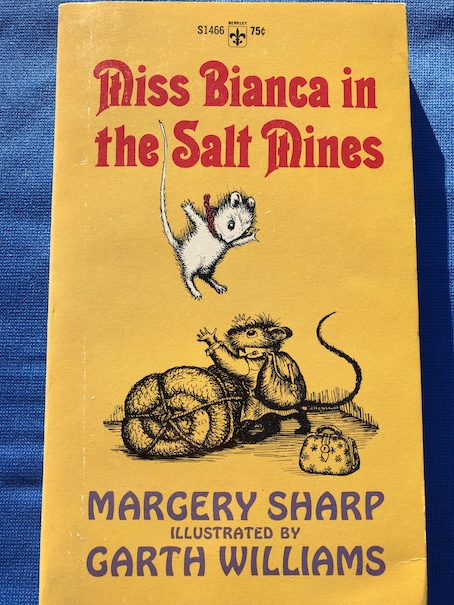
Miss Bianca in the Salt Mines

Miss Bianca in the Salt Mines by Margery Sharp, illustrated by Garth Williams, 1966.

This book is part of the Rescuers series.

When this story begins, Miss Bianca, who is Perpetual Madam President of the Mouse Prisoners’ Aid Society, is evaluating candidates for the Tybalt Stars award, which is given for mice who are brave in the face of cats. Bernard, the secretary of the society, is helping her. Each of the candidates is undeniably brave, but Miss Bianca notices that each of them also had a self-serving motive behind their bravery, which seems disappointing for a benevolent society. When they stop for lunch and Bernard goes to fetch some salt for them, he finds a note in the salt that says, “Someone please get me out of the salt mines.” The note is signed “Teddy (age 8).” Naturally, Miss Bianca is eager to help the poor boy! Bernard is a little more doubtful about the mission because the salt mines are about a thousand miles away, extremely dangerous, and extremely well guarded. Nevertheless, the Mouse Prisoners’ Aid Society cannot refuse to help a prisoner, and neither can its President.

Soon, Miss Bianca has members of the society trying to learn anything they can about a missing boy named Teddy, but apparently, no one has reported a boy by that name or age as missing. Bianca uses the lessons of the boy who owns her to learn more about the salt mines and how to get there. In order to get to the salt mines, they’d have to go by train, and it’s a very dangerous route. At the next meeting of the society, Miss Bianca asks for volunteers to go rescue Teddy, but everyone is reluctant to go, and many members of the society don’t like it that Miss Bianca doesn’t even seem to have any facts about Teddy or his situation that could help them. Miss Bianca says that, even though she can’t be more specific about Teddy’s background or how he came to be in the salt mines, the important fact is that he shouldn’t be there, and he needs help getting out. Since no one else wants to volunteer for the rescue mission, Miss Bianca says that she’ll go herself, and of course, Bernard insists on coming with her.

To Miss Bianca’s surprise, her biggest opponent, a curmudgeonly mouse called the Professor (his real name is George) who teaches mathematics, also volunteers to join the mission. Bernard and Miss Bianca are even more surprised when the Professor insists on bringing his friend Caerphilly along. Caerphilly is very elderly, but he’s also a professor of geology. Caerphilly has never actually been to the salt mines before, but he’s always wanted to see them and study them. Bernard and Miss Bianca aren’t sure that Caerphilly is up to handling the dangers that they’re likely to encounter on the mission. Miss Bianca reminds Caerphilly that this is supposed to be a rescue mission, not a scientific expedition. Caerphilly is unconcerned, saying that they can handle the rescue, and he’ll handle the science. Miss Bianca says that the Professor should warn his friend just what risks a rescue mission involves, but the Professor is also unconcerned, saying that the geology department at the university thinks too much of itself, and he wouldn’t mind seeing his friend chased by bloodhounds. (Some friend he is.) Miss Bianca is concerned both because of the danger and because their self-serving motives are just what she was concerned about before.

In spite of that, they decide to proceed with the mission, bringing the two professors. They take some time to make their preparations. Bernard and Bianca research the trains they’ll need to take. The Finance Committee allows them to take along the society’s Treasure – there’s only one, a single gold coin they found in a ruined building. Teddy might need this to pay for his train fare after they get him out of the mines. The Ladies’ Guild also knits mittens for the unfortunate boy because the salt mines are reportedly very cold. Miss Bianca tells the boy she lives with not to worry if he doesn’t see her for a week or so because she’s going to be writing an epic poem and needs privacy.

As they finally set out on their mission, the Professor is pessimistic, but the train journey is uneventful. When they arrive at the salt mines’ train station, it’s a very bare and gloomy building. Bernard finds a wooden door with some steps heading down.

At the bottom of the steps, they find themselves in an underground cavern filled with stalactites and stalagmites. There is also an underground lake surrounded by crusts of salt. The Professor realizes that they have entered the salt mines through a disused and forgotten entrance. In the distance, they hear the sounds of prisoners mining the salt.

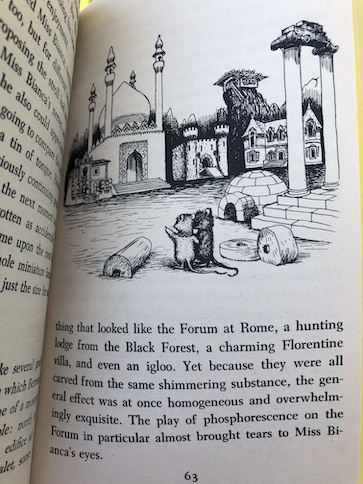
It’s a long walk to the active part of the mine, but along the way, they make an important discovery – a mouse-sized city carved out of salt! Each of the buildings in the miniature town are unique and resemble famous buildings from around the world. Miss Bianca thinks that the buildings were probably carved by prisoners who made buildings to resemble the places where they used to live. It’s the perfect place for the mice to stay, though.

Bernard, inspired by this strange place, tries to write a poem for the first time in his life, which isn’t very good. Miss Bianca tries to be nice about it, but he can tell that she doesn’t like it. Bernard is upset enough to try to drown himself (that part of the story struck me as rather shocking, although it’s handled so matter-of-factly as just a product of the weird atmosphere of this place), but he can’t because he just floats in the salt water. It seems like most of the members of the expedition temporarily forget about Teddy. Only Miss Bianca isn’t affected by this strange little town because she lives in a porcelain pagoda at home that her boy gave to her, so these buildings are very much like what she already knows.

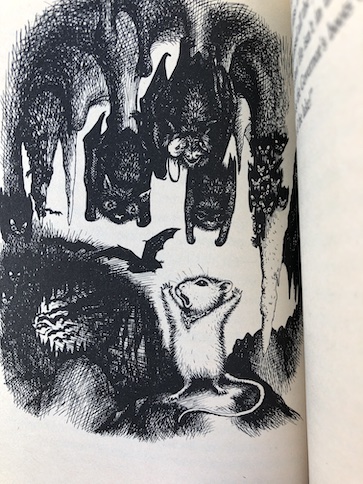
Fortunately, the expedition gets some help from some friendly bats who live in the mines. The younger bats in the group say that they’ve seen little Teddy serving the governor of the salt mines, who tends to stay apart from most of the prisoners because the prisoners have attacked him before. This is fortunate news because it means that Teddy is closer to the little salt town than they thought, and it won’t be as difficult to find him as they anticipated. He’s on an island in the middle of the lake of salt water, and that’s not too difficult to reach because Bernard has already proven that it’s easy to float in salt water.

Once they find Teddy, they also have to get him onto a train to get him away from the salt mines, which may not be as easy.

The book is available to borrow and read for free online through Internet Archive (multiple copies).

My Reaction and Spoilers

I generally prefer the plots of the Disney movies to the original books in this series, but this was still a fun story. I was a little disappointed that they never actually used the two professors’ specialties. I thought at first that they would use the geology professor to spout some interesting and useful facts about caves or mines, but they didn’t, and there was nothing in the story where a mathematics professor would be particularly useful. It just seems like a missed opportunity there.

There were some funny moments in the story. I liked the part where one of the bats, not really seeing Bianca clearly because bats are near-sighted, comments to another that, whatever it, if it moves, you should salute it, and if it doesn’t, you should paint it. Bianca takes that as a sign that this particular bat has completed his National Service, also noting that being near-sighted isn’t a barrier for bat National Service because, if it was, no bat would be able to participate.

In a twist at the end of the story, it turns out that Teddy used to live with his uncle and that Teddy’s uncle is the tutor for the boy that Miss Bianca lives with. Once Teddy is restored to his uncle, he comes to the house with his tutor and becomes friends with Miss Bianca’s boy.

Ben and Me

Ben and Me by Robert Lawson, 1939, 1967.

I remember reading this book in elementary school. It’s about Benjamin Franklin’s friendship with a talking mouse (fictional, of course), and how his mouse friend helped inspire him in his work.

The book begins with the author saying that this manuscript, supposedly written by Amos the mouse, was found in a small compartment in a room in an old house that was being renovated. The little compartment was furnished with miniature pieces of Colonial style furniture. The author goes on to say further that the manuscript has been authenticated as being early American and that the National Museum of Natural History has confirmed that the handwriting of the manuscript was done by a mouse. (I’d love to see comparisons of different animals’ handwriting and hear their explanation of how the handwriting of a mouse differs from the handwriting of other members of the rodent family, but trust us, kids, this is all very scientific.) The author says that this account of Benjamin Franklin’s life differs from the stories told by later scholars, but he trusts the descriptions of this mouse who was so close to Benjamin Franklin. (Yeah, sure, why not?)

In the “manuscript”, Amos says that he’s writing not long after the death of his friend, Benjamin Franklin, and some people have attempted to write about the life of Benjamin Franklin, but Amos isn’t satisfied with their accounts of his life and wants to write the truth himself. (Benjamin Franklin also wrote a famous autobiography, but they don’t mention that. I know that this is a story about a talking, writing mouse, but I’m just saying.) Amos says that, much as he liked Ben Franklin, Franklin was kind of stupid at times and that, as Franklin’s secret adviser, he was actually the source of many of Franklin’s greatest ideas.

Amos says that he was born into a large family of poor church mice. Then, during the winter of 1745, food grew scarce, and as the oldest of his siblings, Amos decided to set out to seek his fortune and maybe a way to help provide for the rest of his family. It’s a cold night, and lured by the smell of cheese, Amos finds his way into the house where Ben Franklin lives. He finds Franklin sitting and sneezing in a chilly room near a small fireplace. Ben is trying to write, but because of the sneezing, he’s not making much progress. Amos, cold and tired, climbs up on Ben and curls up in his fur cap and goes to sleep.

When Amos wakes up in the morning, the fur cap is hanging on the bedpost, and the room is still cold. Amos talks to Ben, recommending that he put more wood on the fire. Ben doesn’t question why a mouse is talking to him and just retorts, “Waste not, want not.” Amos points out that there will be plenty of waste and extra expenses if the cold makes him sick. Ben agrees with that and decides to use more wood on the fire. Then, Amos points out to him that the fireplace would be more effective at heating if it was in the middle of the room, explaining how his family used to gather around a hot chestnut to warm themselves. Ben is intrigued by the idea, and they discuss how a fireplace could be located in the middle of the room and how to handle the smoke from the fire. Ben excited sets to work building the stove according to Amos’s suggestions. His first attempt is a bit crude, but the stove works much better at heating the room than the fireplace did, and Ben is pleased. He shares some bread and cheese with Amos, and the two of them become friends.

Ben begins writing about the design of the stove as if he had created it all by himself, but Amos points out that Ben had acknowledged his contribution. Amos doesn’t care about getting fame or public credit for his contribution, but he needs food and has a large family to help provide for, so he and Ben work out an agreement: in exchange for Amos’s companionship and help, Ben agrees to leave regular supplies of food at the church for Amos’s family and to provide Amos and any descendants he may have food and a home in his fur cap. Ben sews some special compartments in the fur cap so that Amos has secure places to sleep and store a little food. There’s also a little compartment near Ben’s ear where Amos can quietly whisper suggestions to Ben.

Life with Ben isn’t easy. Amos hates it when Ben goes swimming and leaves his cap on the ground. One day, a dog steals the cap (along with Amos), and Ben has to chase the dog in order to get the cap and Amos back. Ben promises not to take the cap off his head ever again.

Amos also doesn’t like Poor Richard’s Almanack and doesn’t consider the facts or maxims it offers to be worth much. Ben points out that people do use his paper and its predictions of sunrise, sunset, and high and low tide, and the money the paper makes helps support them both. It also seems weird to Amos that Ben attributes everything to do “Poor Richard” when there is no such person. Amos starts substituting his own name for “Poor Richard” in the paper, and he also changes some of the predictions of times for the tides. It turns out that this is one area where Ben knows better than Amos because Amos predicts the wrong time for high tide and some ships are stranded. Confronted by the angry men from the ships, Ben points out that the paper with the wrong time says “Amos” instead of “Poor Richard”, so it can’t be his work. The angry people realize that Ben is right, and Amos realizes that he shouldn’t interfere with the paper.

Amos also hates it when Ben starts to experiment with electricity and Ben shocks him. He tells Ben to leave him out of his electrical experiments. However, Ben continues his experiments with a group of other interested people, disappointed that Amos doesn’t seem to understand what he’s trying to accomplish. Amos finally reads Ben’s writings about electricity and his experiment, and when a boy Ben got to assist him at one of his meetings uses Ben’s electrical device to shock the governor, Amos urgently whispers to Ben to stop the boy. Ben doesn’t consider the experiment to be a failure because it very effectively demonstrated how electricity affects human beings, although some people, including the governor, start avoiding Ben after the experience.

Then, Ben starts wondering if lightning and electricity are the same thing. Amos says he doesn’t care because both to those things should be avoided, whether they’re the same or not, and Ben says that he has “no vision.” Ben’s first experiment with lightning rods is frightening, even terrifying Ben to the point where he modestly refuses to take credit for the invention. In spite of that scare, Ben continues to wonder about the nature of lightning. He starts taking Amos with him while he flies kites for fun, and he rigs up a little car on the kite string for Amos so Amos can ride on the kite and come down when he wants to. Ben suggests that Amos that he could get a better view of lightning and describe it to him if he stays on the kite during a storm, and Amos refuses to consider it, but one day, Ben tricks him into doing it anyway. Amos is angry at Ben for making him suffer through the storm while he took shelter in a shed and refuses to discuss what he experienced with him. Burned with electrical shocks from the storm, Amos returns to his family at the church, where they dress his wounds, and he rests.

Ben comes to see Amos about their earlier agreement. Amos tells him that the electrical experiments were never part of the agreement and he will never return to him while he is doing these things. Ben agrees to stop all of the electrical experiments, and he and Amos write a new agreement with each other.

At this time, troubles are arising between England and the Colonies, and Ben is concerned. He tells Amos that he needs his skills for gathering information and asks him to accompany him to England to present the Colonies’ case before the King and Parliament. Amos initially agrees to go, but he backs out of the voyage when he sees that Ben has attached lightning rods to the ship. Pointing out to Ben that the lightning rods are a violation of their agreement, he returns to the church and lets Ben go to England alone.

While Ben is gone, Amos hears the people of Philadelphia talking about current events, like the stamp taxes, and how they feel about them. Amos finds himself siding with the colonists and wanting to do something to help, and he realizes that Ben is his best chance for helping to accomplish something. When Ben returns from England, Amos rejoins him, and he goes with Ben to the committee meetings he attends, including the one for writing the Declaration of Independence. Amos helps Ben by gathering information from other people. Amos meets another mouse named Red, who comes to Philadelphia with Thomas Jefferson and starts preaching revolution to the mice in town. Amos borrows some of the pieces of writing from Red’s Manifesto and tells them to Ben, who in turn, tells them to other members of his committee so they get included in the Declaration of Independence.

Then, George Washington says that the Colonies could really use some help and support from another country. Amos persuades Ben to suggest France. George Washington accepts the suggestion, and Amos accompanies Ben to France to ask for help from the French government. Ben enjoys the attention he gets from the ladies in France, frequently dining with his admirers. Amos is afraid of the ladies’ pet dogs and cats, though, so he persuades Ben to put most of his attention on a woman who doesn’t have cats. It turns out that this lady also has a mouse who lives with her named Sophia. Sophia is actually married, but her husband has been exiled to the United States, and her children are being held in the palace of Versailles. Amos wants to help Sophia, but he’s not sure how until after the Revolutionary War ends and Red arrives in France with Thomas Jefferson. Amos explains the situation to Red, and Red is more than eager to help assemble a force to stand up to the oppressive aristocratic French mice.

The mouse battle that follows terrifies the human French court, but the mice successfully rescue Sophia’s children. Ben suddenly finds himself a social outcast for bringing mice to the royal court, so he’s ready to return home, bringing Sophia and her children with them. Ben is welcomed home as a hero by the humans. Sophia is reunited with her husband, and Amos remains a friend of the family. Three of Sophia’s oldest children marry Amos’s three youngest siblings, tying their families together.

The story ends with the mice giving Ben a nice, new hat for his birthday. Ben keeps the old one just as a house for Amos to live in, but Amos is mostly retired, his time occupied by teaching his young nieces and nephews.

The book is available to borrow and read for free online through Internet Archive (multiple copies). There is also a Disney film based on the book that is also on Internet Archive (about 21 minutes long).

My Reaction

I remembered liking this story when I was a kid, but I’m not as fond of it now. I don’t like books with intentionally stupid characters, and in this case, the intentionally stupid character is a real, historical person, which doesn’t seem fair. I know it’s supposed to seem humorous, but it just doesn’t seem to hold up after all these years.

I also hated the part where Ben intentionally kept the poor mouse up in a kite for half an hour during a terrifying storm. It’s just so cruel, even though it’s supposed to humorous. What can I say? I have a soft spot for cute, fuzzy animals, and I just don’t like to think of any little animal suffering, even if it’s in blatantly ridiculous circumstances.

I had forgotten about the Disney cartoon, although I think I remember seeing that when I was a kid, too.
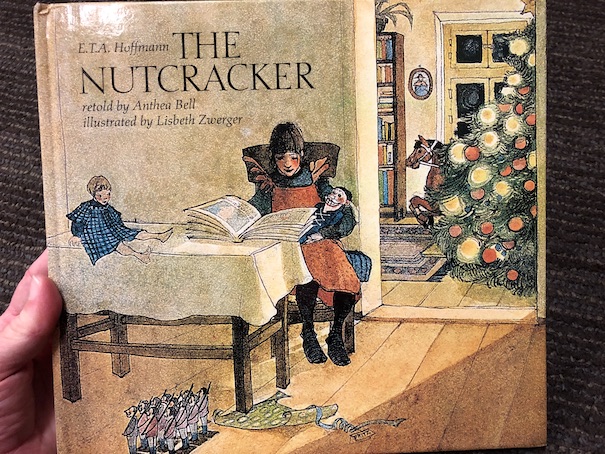
The Nutcracker

The Nutcracker by E.T.A. Hoffmann, retold by Anthea Bell, 1816, 1987.

The reason for the two dates of this book is that the original Nutcracker story was written by a German writer, E.T.A. Hoffmann, in 1816, as the novella The Nutcracker and the Mouse King. Some places, including the back of this book note different publishing dates for the original story because it was published more than once during the 1810s, as part of different story collections. This article gives more details about the original version of the story and different publications. Since then, it has been retold many times and in many different forms, including the famous ballet based on the story. In ballets and plays, the name of the heroine is often Clara, but in this picture book, as in the original story, the heroine’s name is Marie.

In the beginning of the book, which is set in the 19th century, Marie and her brother Fritz, are opening their Christmas presents on Christmas Eve. (The book explains that opening presents on Christmas Eve is a German tradition. A friend in Germany also explained that to me once because, in Germany, presents are supposedly brought by the Christ Child, not by Santa Claus. Since then, I’ve read that explanation may vary, depending on whether the household is Catholic or Protestant.) The children receive many wonderful presents, including a toy castle from their godfather, Mr. Drosselmeier. Marie’s favorite present is a nutcracker that looks like an odd little man. When Fritz is too rough with the nutcracker and breaks it, Marie takes care of it.

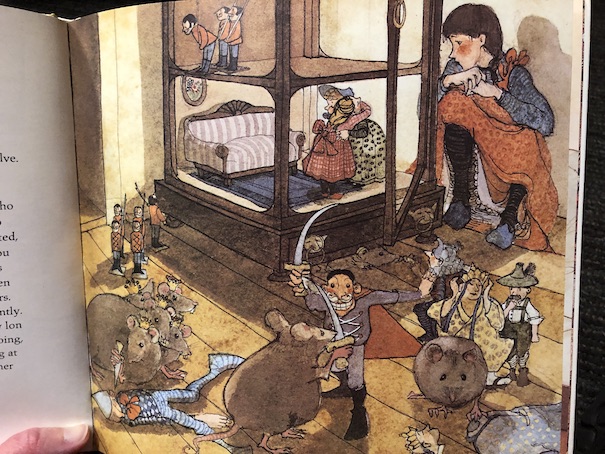
Marie stays up late, and when she finally puts the nutcracker away at midnight, she is astonished to see an army of mice coming out of the floorboards. The leader of the mouse army is the Mouse King, who has seven heads. The Nutcracker leads an army of toys against the mouse army. The mouse army appears to be winning, so, to save the Nutcracker, Marie takes off her shoe and throws it at the mice. Then, her arm hurts, and she apparently faints.

When Marie wakes up, she is in her own bed, and her mother tells her that she apparently put her arm through the glass door of the toy cabinet, cutting herself badly. When Marie tries to tell her mother about the battle between the toys and the mice, her mother and the doctor think that she’s ill and confine her to her bed for a few days. Mr. Drosselmeier repairs the Nutcracker and returns it to Marie, telling her the reason why nutcrackers look so strange and ugly, calling it The Tale of the Hard Nut.

Year ago, there was a royal banquet given by the King and Queen who were the parents of Princess Pirlipat. A mouse who claimed to be the queen of Mousolia demanded some food from the banquet as the Queen was preparing it. The King was angry that the mouse took some of the food and wanted revenge. The King asked his Court Watchmaker, who was also named Drosselmeier, to build some mousetraps to catch the mouse queen’s seven sons. When the sons were caught, the mouse queen vowed that she’d take her revenge on Princess Pirlipat. Princess Pirlipat was a pretty baby, but the mouse queen turned her ugly. The King took out his anger on the Court Watchmaker, ordering him to find a way to change Princess Pirlipat back to normal and threatening to behead him if he failed. After consulting the Court Astronomer, the Court Watchmaker learned that the key to breaking the spell on the princess was a special nut, which had to be cracked by being bitten by a man who filled certain special requirements, which all happened to be met by the son of the Watchmaker’s dollmaker cousin. The King had promised that the person who could break the spell could marry his daughter, but the mouse queen interrupted the last part of the ritual, causing the young cousin to turn ugly himself. When pretty Princess Pirlipat saw her rescuer turn ugly, she didn’t want to marry him anymore. The Court Astronomer said that the only way to break the spell on the young man was for him to defeat the new Mouse King – the mouse queen’s youngest son – and for him to find a woman who would love him regardless of his appearance.

Marie knows that the story is true because she has seen the Mouse King herself. She loves the Nutcracker and wants to help him. The Nutcracker returns to visit Marie during the night and makes repeated demands of her for her candy and toys. Marie knows that, no matter what she gives him, the Mouse King will keep returning to demand something else. The Nutcracker tells her that he needs a sword to fight the Mouse King. They borrow one from a toy soldier, and the Nutcracker successfully defeats the Mouse King, giving Marie his seven golden crowns.

As a reward for helping him, the Nutcracker takes Marie to the land where he is from, leading her there through a magic staircase in an old wardrobe. The Nutcracker’s land is beautiful, filled with candy and sweets and gold and silver fruit. (The Christmas Wood that they pass through reminds me of the woods in the wardrobe in The Lion, the Witch, and the Wardrobe.) The Prince Nutcracker’s home is Marzipan Castle in Candy City, where his beautiful princess sisters live. They welcome Marie and the Nutcracker home.

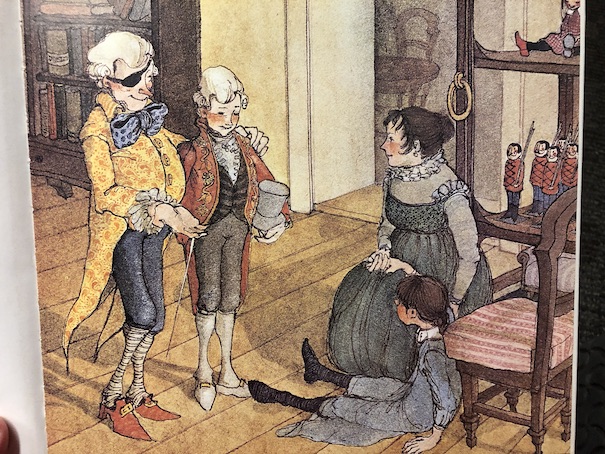
Then, suddenly, Marie wakes up, as if it were all a dream. However, Marie knows that it wasn’t a dream because she still has the Mouse King’s crowns. Marie tells the Nutcracker that she loves him. There is a sudden bang, and Marie faints. When she wakes up, she is told that Mr. Drosselmeier’s nephew has come to visit them. The nephew is the Nutcracker, restored to human form and now a handsome young man, thanks to Marie’s love. Marie later marries the nephew, and the two of them rule magical Kingdom of Sweets.

There is a section in the back of the book that explains a little more about E.T.A. Hoffmann and the original version of the Nutcracker story.

This book is available to borrow for free online through Internet Archive.

Lilly’s Purple Plastic Purse

Lilly’s Purple Plastic Purse by Kevin Henkes, 1996.

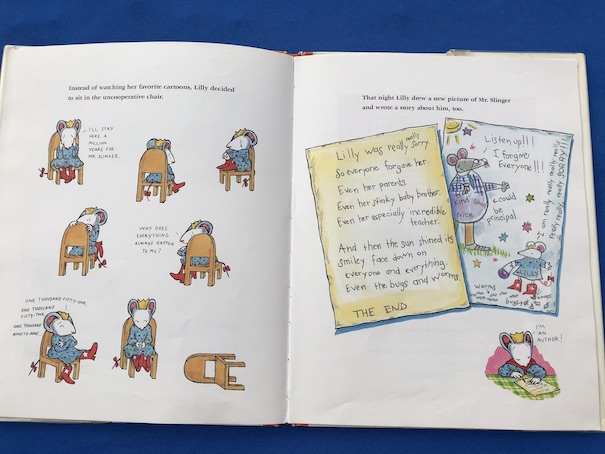
Lilly loves going to school, and she especially loves her teacher, Mr. Slinger. Everyone in class thinks that he’s great, and he inspires a lot of them, including Lilly, to want to be teachers themselves.

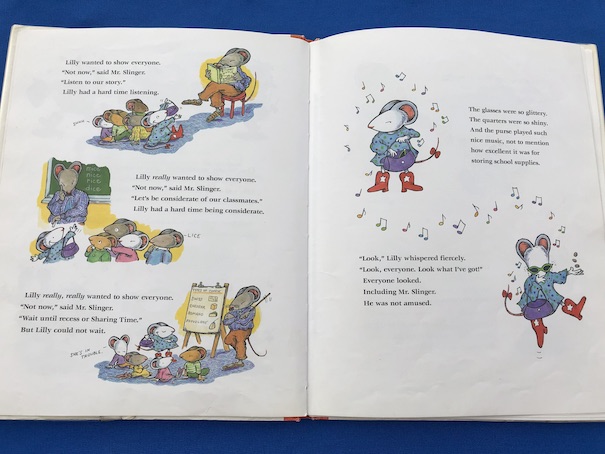
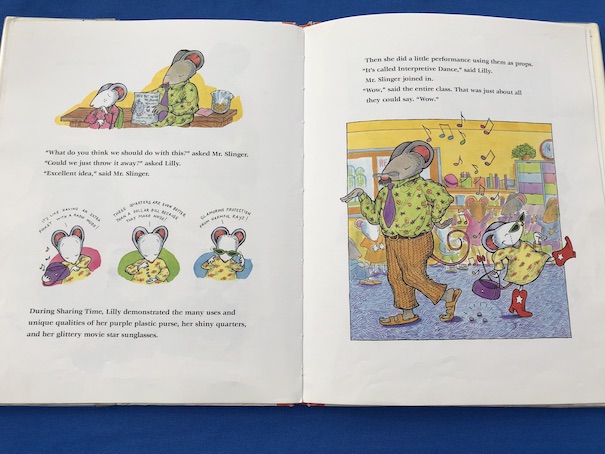
One day, after a special shopping trip with her grandmother, Lilly gains a some special new treasures: movie star sunglasses, some quarters, and a purple plastic purse that plays a tune when she opens it. Eager to show off her new things to her friends, Lilly brings them to school. However, she just can’t wait until recess or Sharing Time to show everyone. She keeps trying to draw attention to these things while the teacher is talking and opening the purse so it keeps playing its tune.

Finally, after repeated warnings, Mr. Slinger is forced to confiscate Lilly’s purse with its other treasures. Lilly is hurt and feels betrayed by her favorite teacher. Sad and angry at having her treasures taken from her, she draws a mean picture of her teacher as a purse thief, leaving the picture where she knows he will find it.

However, Mr. Slinger isn’t as mean as Lilly thinks that he is when he takes her purse. After he gives the purse back to her, she discovers a nice note from him inside, telling her that tomorrow will be a better day, and there’s even a little bag of snacks. Now, Lilly feels guilty about her mean picture. It’s too late to get it back, and she worries that her teacher will never forgive her.

The story is really good at showing how Lilly’s emotions change through the course of the day and how her sadness and anger grow more urgent the more she thinks and worries about them. It’s a good story to use when talking about feelings with young children (through the course of the story, Lilly is happy, excited, sad, betrayed, angry, guilty, worried, and embarrassed – some of these are stated explicitly and some are more implied) and how to deal with emotions. Adults can talk to children how one kind of emotion can lead to another (like how Lilly’s sadness turns to anger at her teacher for making her feel sad by confiscating her purse) and how some ways of dealing with emotions are better than others. It is both creative and appropriate that Lilly used her drawing ability to both insult her teacher and, later, apologize to him.

Fortunately, both Lilly’s parents and her teacher are very understanding. Her parents reassure her that her teacher will forgive her. Lilly draws a new, nicer picture of her teacher to go with her apology to him, and her parents give her some snacks to give to him as well. He does forgive her, and she finally gets to show everyone her amazing purple plastic purse at Sharing Time (being careful not to disturb anyone with them at other times.

The book is currently available online through Internet Archive. It is part of Mouse Books series.

The Turret

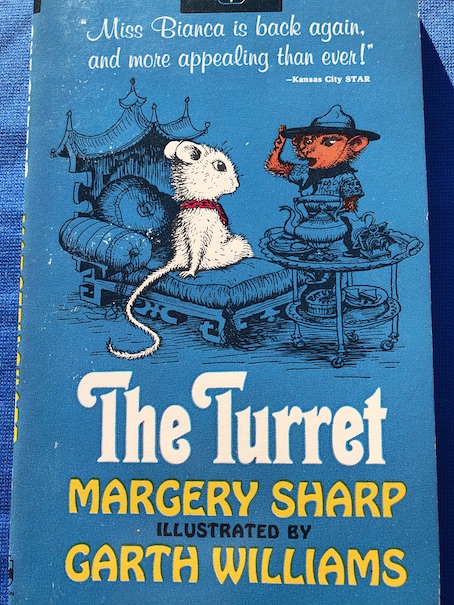
The Turret by Margery Sharp, 1963.

Miss Bianca has decided to resign as Madame Chairwoman of the Mouse Prisoners’ Aid Society.  She has never felt particularly drawn to public life, really preferring her quiet life as a pet of an Ambassador’s son (whom she always calls “the Boy”), keeping him company during his lessons and writing poetry in her spare time.  During the times when she is away from the Boy, undertaking rescue missions for the society, she knows that the Boy pines for her and worries about where she is.  She has started to feel a little guilty that she might be neglecting her Boy.

Bernard, the Secretary of the society, actually feels a little relieved by her decision to resign.  While he thought that she made a great chairwoman, he has always worried about the dangerous nature of their missions, afraid that something might happen to Miss Bianca.  (Miss Bianca is a little annoyed that he seems so eager for her to resign, and his comment that “you’re too beautiful to be allowed into deadly peril” makes a weirdly chauvinistic compliment – like it would be okay for her to risk her neck if she were ugly because it would be less of a loss? – but Miss Bianca takes it in the spirit in which it seems to be offered.)  The two of them reminisce about some of their past missions.  Bernard thinks that the worst villain they’ve faced was the head jailer in the Black Castle (from the first book in the series), but Miss Bianca thinks that the worst was Mandrake (from the last book) because the target of his cruelty was a defenseless child.

The society plans to throw a special dinner for Miss Bianca, and Miss Bianca suggests that she would like a picnic by water.  The ideal place for it would be the moat around an old tower outside of the city.  Miss Bianca enjoys the picnic and is fascinated by the crumbling old turret.  Then, she notices something white in the window.  Thinking that it’s a piece of litter, one of the mouse boy scouts goes to retrieve it.  It turns out to be a small piece of linen, and after the boy scout takes it, it’s replaced by another.  Miss Bianca comes to the conclusion that there is someone in the turret and that the person could be a prisoner, signaling for help.  When she studies the scrap of linen more closely, she also realizes that she knows who the prisoner is because it has the name Mandrake on it!

After the events of the previous book, the evil Duchess had Mandrake locked in the turret.  To Bernard, it sounds like a just punishment for Mandrake, but Miss Bianca feels a responsibility to rescue him, in the hope that he might reform.  However, Bernard is skeptical about that possibility, thinking that they would just be letting a criminal lose if they tried to free Mandrake, and Miss Bianca is unable to persuade the other members of the society to undertake the mission.

However, Miss Bianca is unable to give up on Mandrake and goes to see him in his turret. Mandrake is a shadow of his former self.  She introduces herself to him as a member of the Mouse Prisoners’ Aid Society, and it turns out that he’s heard about it from friends of his who have been in jail (having had many disreputable associations over the years).  In order to test how likely Mandrake would be to reform, Miss Bianca asks him what he would do if he were freed from captivity, and he says that he’d like to be a gardener at an orphanage.  He feels badly about the child slaves he helped to abuse while serving the Duchess, and he’d like to see children happy, making their garden a beautiful place.  Miss Bianca is satisfied with this and sets about planning his escape. (She’s free to undertake this mission because her Boy is having his tonsils out and won’t miss her for awhile.)

At first, Mandrake doesn’t know how people even bring him food, since his room in the turret doesn’t seem to have a door and food just seems to arrive during the night.  Miss Bianca stays up at night to see what happens and learns that there is a hidden staircase in the turret that his jailers use.  Before Mandrake can escape, though, he needs to be stronger because he’s badly under-nourished.  Miss Bianca recruits the mouse boy scouts to bring him vitamins to help make him healthier and tries to figure out how the secret passage works and think of some way to create a distraction so that Mandrake can escape.

Shaun, the leader of the boy scouts, helps her to come up with a plan.  (The book says that Shaun is half-Irish and thinks of himself as being a “handsome boy-o.”  Stereotypical.)  Shaun has figured out that the jailers watching Mandrake are actually grooms by trade, and he knows of a race horse, Sir Hector, who could provide a good distraction for them.  Miss Bianca approves of the plan and persuades Sir Hector to help them.

Meanwhile, the members of the Prisoners’ Aid Society are getting fed up with their strict new chairwoman, who only seems interested in forcing them to participate in group exercises.  Members are starting to avoid going to meetings, and worse still, someone suggests to Bernard that the bossy chairwoman particularly likes calling committee meetings because she’s in love with him and wants the excuse to see him. The thought horrifies Bernard, but he’s afraid to say anything to Miss Bianca because he doesn’t want her to feel obligated to try to become the chairwoman again in order to solve the society’s problems (or his), not knowing what she’s actually been up to in her free time.

In the end, everything works out well.  When Mandrake is rescued, he actually does become the gardener for an orphanage.  The members of the society find out Miss Bianca’s daring mission, undertaken with just a handful of boy scouts, and feel badly that they didn’t take part.  They complain to the new chairwoman that she was just wasting their time with exercises instead of real missions, and she resigns, saving Bernard from her attentions.  Miss Bianca does not return to the society as its chairwoman, but the next chairwoman is more competent.

This is the third book in the Rescuers series, and it is currently available online through Internet Archive.

The Rescuers

The Rescuers by Margery Sharp, 1959.

This is the first book of The Rescuers Series.  Disney made a movie called The Rescuers based on this series, but the movie was very different from the book.  The movie involved a pair of mice who were members of a mouse version of the United Nations called The Rescue Aid Society who rescued a young orphan girl who was kidnapped for the purpose of recovering a treasure from a dangerous cave.  In the book, the prisoner the mice rescued was a poet who was being held captive in a castle.

The beginning of the first book of the series explains the purpose of the Prisoners’ Aid Society, an organization of mice that helps human prisoners:

“Everyone knows that the mice are the prisoners’ friends – sharing his dry bread crumbs even when they are not hungry, allowing themselves to be taught all manner of foolish tricks, such as no self-respecting mouse would otherwise contemplate, in order to cheer his lonely hours; what is less well known is how splendidly they are organized. Not a prison in any land but has its own national branch of a wonderful, world-wide system.”

However, the mice are daunted by their latest concern, a prisoner who is being held captive in the Black Castle, a Norwegian poet.  The Black Castle is a harsh prison, and because of the jailer’s cat, mice usually cannot reach the prisoners there.  However, the current chairwoman of the society believes that it may be possible to rescue one of the prisoners there.  She thinks that Miss Bianca is just the mouse for the job because she is the pet of an ambassador’s son and will soon be traveling to Norway with her owner.  The chairwoman sends Bernard, a pantry mouse, to Miss Bianca to recruit her for the mission.

Miss Bianca is frightened when Bernard explains the mission to her and faints.  However, it turns out that Miss Bianca is a poet, and so is the man who is being held prisoner.  Bernard uses her sympathy for a fellow poet and some flattery to inspire her to agree to help.

When Miss Bianca reaches Norway, she recruits some help from the mice in the cellar of the embassy.  In particular, a sailor mouse called Nils accompanies her to where the other mice from the Society are meeting.  There, Bernard joins them for the journey to the Black Castle.

When they reach the castle, Miss Bianca, Bernard, and Nils take up residence in an empty mouse hold in the head jailer’s quarters.  (There is a horrifying description of how the head jailer apparently pinned live butterflies to his walls to die. Ew!)  The jailer does have a horrible cat named Mamelouk, who is as cruel as his master.  At first, Miss Bianca isn’t afraid of the cat, having known a nice cat who didn’t eat mice when she was young.  After talking to Mamelouk and interacting with him, she comes to recognize his cruelty and real intentions toward her.  However, Mamelouk is an important source of information.  It is from Mamelouk that they learn that the jailers will be having a New Year’s Eve party soon and that many of them are likely to be lax in their duties.  This will be the best time for them to try to rescue the poet!

The mice do successfully rescue the poet, and Miss Bianca returns to her boy, who has been missing her. However, this is just the first of her adventures in this series!

Overall, I prefer the first Disney Rescuers movie to the book because the prison/castle seemed pretty dark for a children’s book, and I think the idea of rescuing a child is also more appropriate for a children’s book.

The book is currently available online through Internet Archive.

Basil in the Wild West

BasilWestBasil in the Wild West by Eve Titus, 1990.

This book picks up right after the previous book in the Basil of Baker Street Series, Basil in Mexico.

After leaving Mexico, Basil and his best friend Dr. Dawson journey north into the western territories of the United States.  There, some friends of their ask them to investigate a smuggling operation.  Mice have been illegally bringing Mexican antiquities across the border.

Basil realizes that the smugglers have been smuggling the antiquities in the open, pretending that they are ordinary replicas, the kind that tourists often buy.  Because the border guards aren’t experts in antiquities, they haven’t been able to tell the difference between harmless souvenir replicas and the real thing.

When they catch one of these smugglers, they learn that the mastermind behind the scheme is a mouse called J.J. in a town called Moriarty in New Mexico (the name of the town irritates Basil).  They go to the town with the help of some friendly horses and confront J.J..  At first, they think it won’t be too difficult because, although J.J.’s house is well-guarded, he is confined to a wheel chair because of an accident.  However, the wheel chair is an act, and J.J. is no ordinary mouse.

BasilWestPic2Although J.J. escapes, Basil and Dr. Dawson decide that the smuggling ring has been defeated and it’s alright to continue their sight-seeing.  However, their adventures are not over!

Basil and Dawson want to see the Grand Canyon, but it turns out that the hotel where they are staying is being terrorized by a weird, glowing Thing.  Nobody knows what it is, but guests think it could be some kind of ghost or monster, and many of them are too afraid to stay.  The owners of the hotel ask Basil to discover what the Thing is and stop whoever may be behind it before their hotel is ruined!

This book is really two stories in one, and neither has any direct bearing on the other.  In that way, it’s kind of disjointed.

The book is currently available online through Internet Archive.