 Basil and the Pygmy Cats by Eve Titus, 1971.
Mouse detective Basil’s arch enemy, Professor Ratigan, has taken over the Asian country of Bengistan, near India. Basil discovers that he is holding the real ruler of the country captive so that he and his gang can loot the country for everything they can get, keeping the populace in subjugation. Basil is determined to go there and free the rightful ruler so they can vanquish Professor Ratigan!
When Dr. Edward Hagerup of the British Mousmopolitan Museum hears that Basil is heading to Asia, he asks him to investigate an historical mystery for him. There have been tales of a race of pygmy cats, no bigger than mice, but new evidence has been found that suggests there is more truth behind the stories than anyone has realized. Basil has an interest in archaeology and eagerly accepts this extra task as part of their mission. Along the way, other mice who have heard of the expedition join up to help Basil.
At first, Basil’s original mission, stopping Ratigan, seems easy. Basil and his friend Dawson allow themselves to be captured so that they can get into the palace and find the real Maharaja of Bengistan. After solving a secret code in the dungeon, they find the Maharaja, who tells them that another acquaintance of theirs, the opera singer, Relda, is also a prisoner in the palace. She was giving a performance there when Ratigan and his thugs took over, and Ratigan has forced her to stay, giving private performances for him. During one of these performances, Basil and his friends manage to take Ratigan by surprise and capture him.
 Now, Basil thinks that he and his associates are free to continue their other mission, finding the lost civilization of pygmy cats. However, that mission is fraught with danger and surprises, and they haven’t quite heard the last of Ratigan.
The story isn’t really much of a mystery. It’s really more an adventure story.
Basil and his friends manage to locate the island of pygmy cats with the help of Jeannie (a sea serpent related to the Loch Ness Monster who lost her way back to Scotland after a family trip — I kid you not) and the Sacred Catfish (which they bribe with catnip — I also kid you not, and his nip trip is a little disturbing).
This is my least favorite of the Basil series, partly because of the lack of mystery and also because of “primitive” nature of the pygmy cats when they find them. Basil makes it clear that the pygmy cats are inherently less intelligent than mice and that their greatest achievements were because of the influence of royal mice who washed up on the shores of their island years ago, only to be wiped out by a volcano. (Really? Really. Basil, if these mice were so superior and the pygmy cats so inferior, why were the cats able to get away from the volcano when the mice didn’t, hmm? Why didn’t the mice just go to the part of the island where the cats were until the volcano stopped erupting? Just what kind of bill of goods are you trying to sell us, Basil?) Basil comes off sounding like a 19th century imperialist, and the fawning adoration he gets for his discovery is really annoying.
In general, I don’t like the Basil stories that turn out to be more adventure than mystery, and Basil’s smug superiority at various points in the story are off-putting. It’s true that that Sherlock Holmes (which this series parodies) had an ego as well, but these sort of imperialist attitudes in a children’s story are distasteful. Although I like recommending nostalgic books for future generations, this is one that I really can’t recommend. The brightest spot in this book was the secret code in the dungeon, which is more in keeping with the mystery theme. If the book had made the plot to capture Ratigan and end his reign of terror in another country without all this stuff about an “inferior” species of small cats, it would have been a much better story.
Like other books in this series, this book contains a number of jokes on the original Sherlock Holmes stories. Read a number of the names backwards, and you’ll see some familiar names from Sherlock Holmes as well as a reference to another series by Eve Titus.
This book is available to borrow and read for free online through Internet Archive.
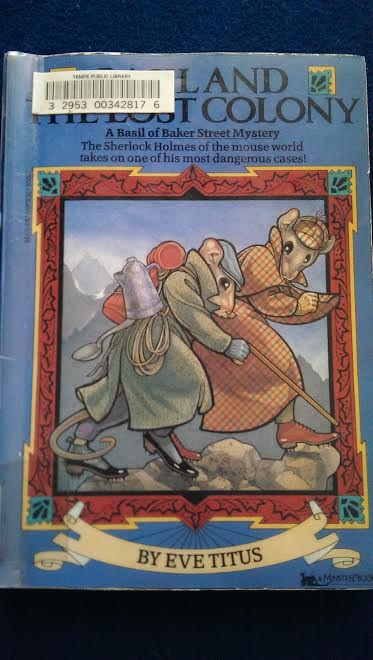 Basil and the Lost Colony by Eve Titus, 1964.

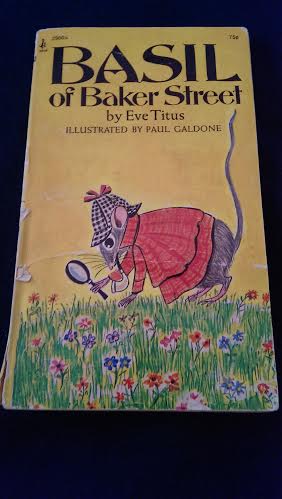 Basil of Baker Street by Eve Titus, 1958.
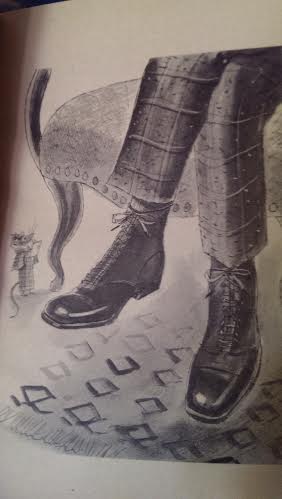 In this book, Basil’s skills are put to the test when he is hired by his mouse neighbors to find their two missing daughters, a pair of twins named Angela and Agatha. The twins have been kidnapped, and soon, a note arrives, saying that all the mice in Baker Street have only 48 hours to evacuate their home if they ever want to see the twins again. A gang called The Terrible Three want to use Holmestead as their headquarters. With only two days to solve the case, Basil and Dr. Dawson set out to find the gang and rescue the twins so that they can keep their wonderful home!
 Jestress's Forgotten Books and Stories