The Puppeteer’s Apprentice

The Puppeteer’s Apprentice by D. Anne Love, 2003.

Poor Mouse works as a scullery maid in a castle in Medieval England.  She has lived there all her life, since someone abandoned her at the castle as a baby.  She has no idea who her parents are, when her real birthday is, or exactly how old she is (the cook once said she was about eleven, but he wasn’t sure).  She doesn’t even have a real name; Mouse was simply the name given to her by the cook, who makes her work hard and beats her if she makes a mistake.  Mouse’s life is hard, but then one day, she makes a big mistake, and the cook gets in a rage and attacks her with a meat hook.  Mouse escapes from him and flees the castle.  She knows that she cannot go back, but she doesn’t know where to go. 

For the first time in her life, Mouse’s fate is in her own inexperienced hands.  For a time, she joins up with a group of travelers, who take her to the city of York.  However, none of them can adopt Mouse, and she must struggle to make a life for herself.  In York, Mouse sees a puppeteer performing, and she is inspired to learn to be a puppeteer herself.  Through a mixture of trickery and pleading, Mouse convinces the puppeteer to take her on as an apprentice. 

Although Mouse makes many mistakes at first, and the puppeteer gets angry and threatens to leave her behind, the two eventually learn to get along with each other.  Mouse gains skill at making and manipulating the puppets, and her confidence grows.  However, danger still lurks in the future, for the puppeteer also has a dark past and dark secrets which pursue the two of them in their travels.

The book is currently available online through Internet Archive.

My Reaction and Spoilers

Stories with abused and neglected children are always sad. Mouse is failed by various adults who are mainly focused on their own lives and securing their own positions in life before she finally becomes independent. We don’t know why Mouse was abandoned as a baby, although it was probably because her parents were poor and maybe unmarried, which would have been a stigma at the time. We can be pretty sure that, whatever happened, Mouse’s parents’ position in life was too precarious to take care of her themselves. The castle cook she lives with is mainly worried about his own job and is more of an unwilling employer to Mouse than a parent. In fact, employment is more of a theme in Mouse’s precarious life than family. Even the puppeteer is more of an employer to Mouse than a parent. Mouse learns from the puppeteer, but it’s as an employee, and Mouse is well aware that she can be abandoned at any time if she fails to please her employer. In the end, Mouse gains an independence that pleases her, but I still found it a little sad because it seems like the one and only person who can’t abandon Mouse is Mouse herself and that there is little or no security in trusting or relying on others. The eventual goal turns out to be employing herself so she doesn’t haven’t to rely on someone who can dump her. I suppose that can be true in real life, too, but it’s one of hard, dark sides of life.

Although, the adult characters’ focus on securing their own lives and positions first is also a testament to the nature of the time when the story is set. Opportunities are limited by social level, and there are few sources of support for those who suffer unfortunate circumstances. Although it seems like the adults in the story are cruel and neglectful, there’s also a desperation to their own situations. The one person in the story who is willing and able to offer more generosity to Mouse than other characters is able to do so because of his privileged position in life. Even the puppeteer, while seeming more free than other characters, is living under danger and threat, and there is genuine risk to sharing in her life that Mouse doesn’t come to understand until later.

The puppeteer always dresses in loose-fitting clothes to cover up the fact that she is a woman.  Although there is no reason why women cannot be puppeteers, she finds it necessary to disguise herself because she is pursued by an enemy from years ago.  Once, her father, who was a master puppeteer, saved the life of a young Duke who was attacked by a man named Ordin.  Ordin was trying to steal some of the duke’s lands.  The old puppeteer and his daughter stood witness against him, and he was thrown into prison.  Later, when he got out of prison, he attacked the party on the road, killing the old puppeteer and his companions.  Only the daughter escaped alive, and she became a puppeteer to support herself.  Ordin escaped, and she was forced to disguise herself to protect herself.  She even refuses to tell Mouse or anyone else what her real name is through most of the book. 

However, Ordin recognizes her one day while she and Mouse are giving a performance.  He and another highwayman follow them on the road and attack them.  The puppeteer kills the other highwayman but is gravely wounded herself.  Mouse fights back against Ordin, knocking him into the fire, and he burns to death.  They are not far from the duke’s castle, so the puppeteer sends Mouse there to get help.  Mouse tells the duke what happened to the puppeteer, and he has her brought to his castle.  The puppeteer, realizing that she will not recover from her wounds, finally tells Mouse her story and offers her name if Mouse wants it for herself.  The duke offers to let Mouse stay at his castle.  Mouse stays the winter, but in the spring, she decides to leave.  She has come to love life on the road, and she promised the puppeteer that she would take care of the puppets.  Mouse decides to take the puppeteer’s name, Sabine, as her own and sets off on a journey to find a place to perform her new puppet play, one telling the puppeteer’s story.
For Those Thinking of Notre Dame …

Sometimes, current events remind me of the events of children’s books. I debated about bringing this one up because I haven’t gotten hold of this particular book recently (partly because I’m probably not the only person who’s thinking about it right now), and I don’t have a proper post prepared for it, but years ago, a teacher introduced my class to Cathedral by David Macaulay. David Macaulay wrote a series of children’s books, explaining the architecture of historical buildings, including one about the construction of Gothic cathedrals, like Notre Dame in Paris.

The pictures in these books are fascinating, which is why I’m sorry that I don’t have a proper post prepared with example pictures. (I’ll probably do one later, when I can get hold of the book again) The book is available in multiple copies through Internet Archive, although there is a waiting list to get it right now.

However, the book was also made into a documentary film. Part of the story-line involves a fictional Medieval town replacing their cathedral after their first cathedral was destroyed by fire. (In the book, the cathedral was damaged by lightning, not destroyed by fire. The two stories aren’t the same.) This fictional cathedral serves as an example of the process of constructing a Medieval cathedral and the difficulties and dangers it might involve. The story of the town alternates with explanations about the history and architecture of cathedrals. This short clip explains the basic architecture of a Gothic cathedral, using Notre Dame as an example toward the end.

One of the aspects of the story that I find most inspiring is the dedication that the people who funded and built the cathedral showed. The construction of a cathedral in the Middle Ages could take a lifetime or even longer, and not everyone who began the task would live to see its completion. Their motivation was not mere personal gain but a glorious accomplishment that would both honor their beliefs and last far beyond them.

I’m not sure how long it will take to complete the renovations after the fire that damaged Notre Dame, but whatever it takes, I’m sure it will be worth it.

Medieval Holidays and Festivals

MedievalHolidays

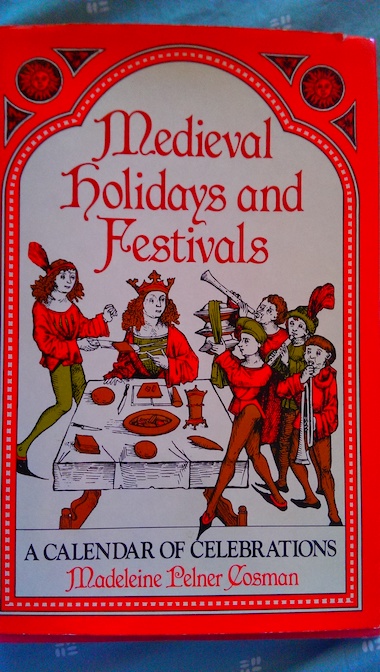
Medieval Holidays and Festivals: A Calendar of Celebrations by Madeleine Pelner Cosman, 1981.

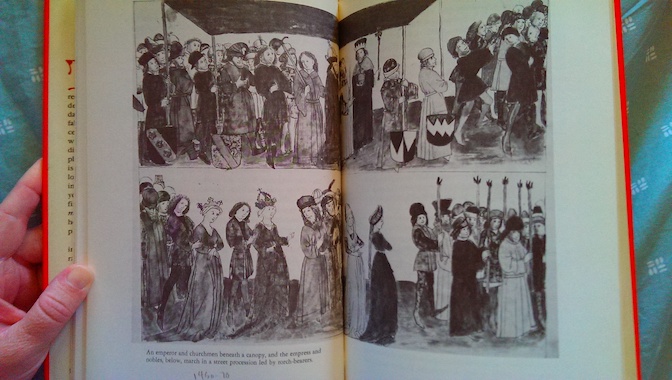
This book explains the holidays that people celebrated in Medieval times and how these holidays would have been celebrated, along with some special information about Medieval feasts.  The author also explains a little about how historians uncover and interpret information about people’s lives in the past.

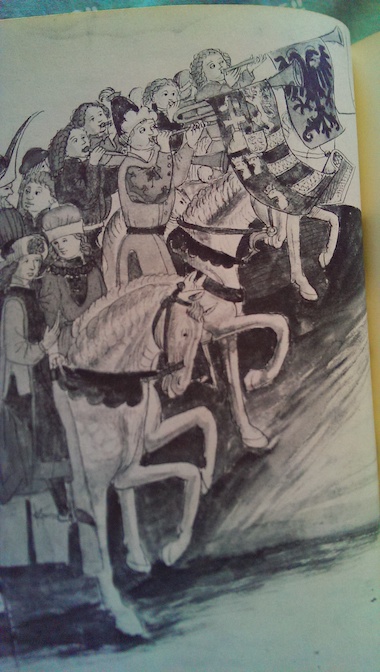
MedievalHolidayProcession

Many of the holidays celebrated in Medieval times tended to be either religious in nature or having to do with the changing of seasons.

The holidays included in this book are listed by month:

MedievalHolidaysHorsesJanuary — Twelfth Night — An extension of Christmas (remember the Twelve Days of Christmas song?), Twelfth Night is also known as Epiphany — the night that the Three Wise Men supposedly visited baby Jesus after his birth.
February — St. Valentine’s Day

March — Easter

April — All Fool’s Day — Not just a day for pranks, but when everything is turned upside down and backwards, and people intentionally did the opposite of whatever they usually did in many ways.  Basically, a celebration of everything silly and ridiculous.

May — Mayday — A celebration of spring.

June — Midsummer Eve — A celebration of summer.

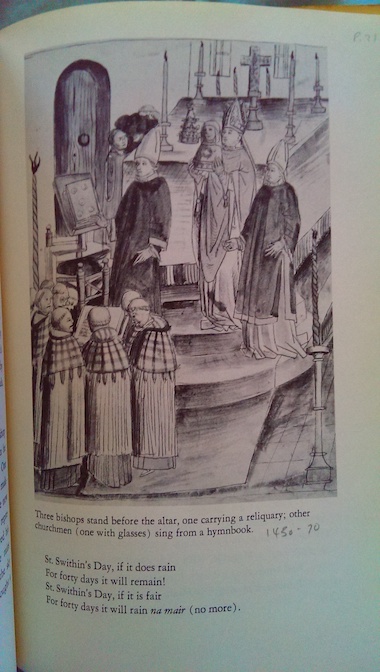
MedievalHolidayBishopJuly — St. Swithin’s Day — St. Swithin was a bishop of Winchester who had asked to be buried without great ceremony upon his death.  However, people later decided to give him a grand tomb.  When they tried to place his body in the tomb, it started raining heavily and didn’t stop until they moved the body to a new location.  They took the rain to be an expression of St. Swithin’s displeasure at the unwanted tomb.  From then on, this time of year was used to predict rainfall for the rest of summer.
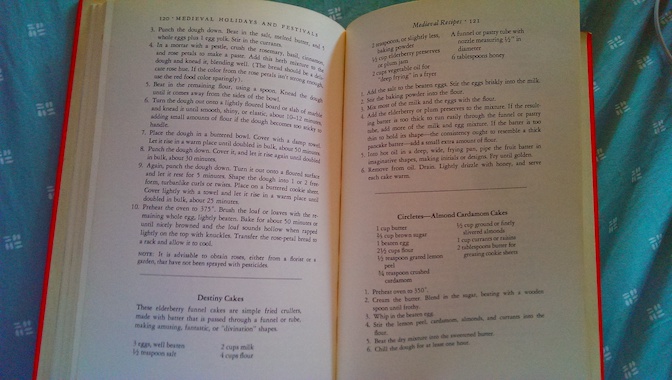
August — Lammas Day — The word Lammas meant “Loaf Mass,” which was when there would be special blessings for bread and grain and thanks given for bountiful harvests.  The holiday was marked by the baking of a variety of special breads, including those in usual shapes, flavors, and colors.  Some of them could be very elaborate.

September — Michaelmas — The holiday celebrating St. Michael is oddly associated with three things that few people would associate with each other: gloves, geese, and ginger.  The glove was the symbol of the market of craftsmen held on Michaelmas.  Geese and foods flavored with ginger were popular dishes served at Michaelmas.

October — Halloween

November — Catherning, or St. Catherine’s Day — St. Catherine of Alexandria was learned noblewoman who was killed on a wheel (it was a bizarre and disgusting form of execution).  The holiday honoring her was associated with wheels, women (especially unmarried women and women students), and the professions which were associated with her such as lawyers, carpenters, spinners, lace makers.

December — Christmas

Each section in the book describes special traditions associated with each holiday, including games that would have been played and food that would have been eaten at that time.

In the back of the book, there is a section that explain decorations used for Medieval feasts, how to hold a Medieval-themed feast in modern times, and Medieval costumes. There is also a section of Medieval recipes.

MedievalHolidaysDestinyCakes

This book is available to borrow and read for free online through Internet Archive.

Meg Mackintosh and The Mystery at the Medieval Castle

Meg Mackintosh Mysteries

MMCastle

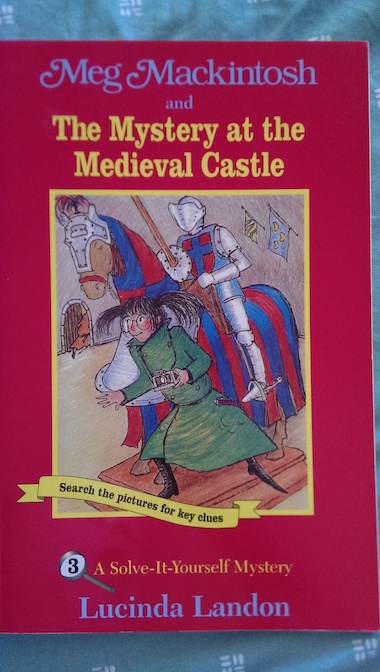
Meg Mackintosh and The Mystery at the Medieval Castle by Lucinda Landon, 1989.

Meg is visiting Dundare Castle with her teacher and some other students.  Dundare Castle is a special museum where people can learn about life in Medieval times, although it used to be a private home.  The owner’s family came from Scotland, and they built their home to look like their ancestors’ castle there.  Eleanor, the owner, now calls herself the Duchess of Dundare, and with her staff, dresses up to recreate the lives of people from the 1300s.

MMCastleTour

One of the Duchess’s prized possessions is a silver chalice studded with jewels that has been in her family for generations.  She keeps it on display in the castle’s “abbey,” guarded by the actor playing the part of a knight, Knight Henry.  But, when Meg and her classmates get to the abbey, the chalice is gone, and Knight Henry is lying on the floor, unconscious!

MMCastleTheft

Not long before they found Knight Henry, the kids had seen a robed figure run across the courtyard.  Monk William falls under suspicion, although the Duchess doesn’t really believe that he is guilty because he’s been with her family for a long time.  There are other possible suspects, and Meg believes that both the thief and the chalice are still in the castle.

The book is currently available online through Internet Archive.

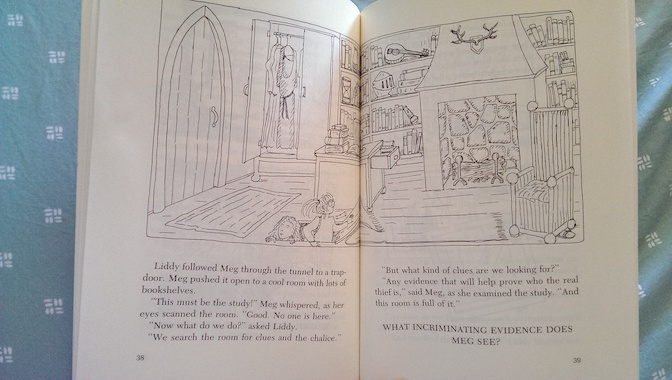
MMCastleSearch

My Reaction

I love this series because the books are interactive, giving readers the opportunity to figure out the clues and solve the mystery along with Meg. As Meg interviews the other actors in the castle and explores every room, readers are invited to study the pictures and consider the evidence to see if they can solve the mystery before Meg can.  At various points in the story, there are questions for the reader to consider, giving them the chance to pause and see if they’ve noticed what Meg has seen. I recommend that adults who are introducing children to the mystery genre read a couple of these stories along with them and discuss the clues as they go, helping children to learn how to notice details, solve puzzles, and think critically. It’s a good learning opportunity as well as a fun mystery!

Midnight Magic

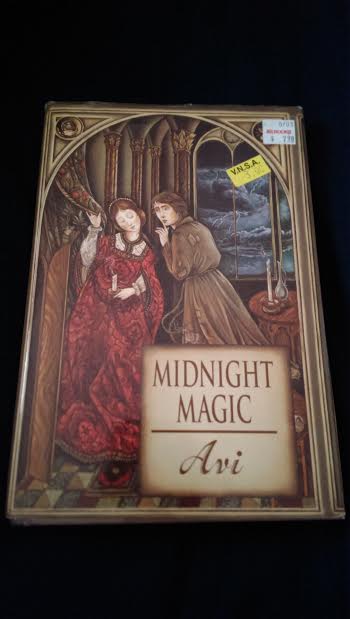
midnightmagicMidnight Magic by Avi, 1999.

The story takes place in Italy, toward the end of the Middle Ages.  Mangus, a formerly wealthy scholar and philosopher, is living under house arrest because the king believes that he has practiced black magic. Mangus was merely performing magic tricks to earn extra money, and in fact, does not believe in real magic.  However, the king is very superstitious and easily influenced by his scheming advisor, Count Scarazoni, who needed a scapegoat to distract everyone from his schemes.  Unfortunately, many people in the kingdom of Pergamontio believe that Mangus is a real magician with frightful powers.  Even Fabrizio, an orphan who is Mangus’s only remaining servant, believes that magic really exists.

When a messenger arrives, summoning Mangus to the castle to see the king, they are afraid that the king has reconsidered his decision to spare Mangus’s life. However, it turns out that the king is in need of Mangus’s help. He believes that his young daughter, Princess Teresina, is being tormented by a ghost, and he wants Mangus to use his magic to get rid of it.

Mangus again protests that he does not do real magic, but both the king and Count Scarazoni promise dire consequences if he fails to help them deal with the problem.  Mangus isn’t sure why Count Scarazoni has asked for his help because he knows that the count doesn’t really believe in magic, except perhaps as a way of appeasing the king.  The king promises that if Mangus can free the princess from the influence of the ghost, he will not only end Mangus’s house arrest but reward him with a generous pension.  Mangus has little choice but to agree to do his best, and the promise of the pension for his master convinces Fabrizio to do everything he can to make sure that Mangus succeeds, not only to save his master’s life but to restore his family’s fortunes.

But, what is the secret of the ghost?  Fabrizio believes in ghosts, even though Mangus doesn’t.  Princess Teresina insists that the ghost is real, appealing directly to Fabrizio to convince Mangus that it is. Adding to the mystery is the disappearance of the princess’s brother, Prince Lorenzo, and the murder of the princess’s tutor. Danger lurks in the castle, and conspiracies are around every corner. Could the troubled spirit really belong to the murdered prince?

The book is available to borrow and read for free online through Internet Archive.

My Reaction

I love historical books and spooky mysteries, and this is both! The Italian kingdom where the story takes place is fictional, but it takes its inspiration from real kingdoms of the later Middle Ages and early Renaissance, with Machiavellian intrigue, power struggles, and arranged marriages, even for children, that could influence the balance of power and successions. (There is talk of a potential arranged marriage in the story, but no child marriages actually take place.  If a child is old enough for ghost stories and murder mysteries and isn’t too frightened by them, there is really nothing more concerning than that to prevent them from reading this book.)

Princess Teresina is one of the most intriguing characters in the book.  Although young, she isn’t a shrinking violet or anyone’s fool, and she’s definitely not a tea party and ball gown kind of princess.  Like real life Medieval princesses, she is the product of a family who came to power by the sword and maintains it by the iron fist in the velvet glove and some clever political maneuvering, although some members of the family are more clever about it than others.  Princess Teresina well knows the family she was born into and what’s expected of her as royalty, and she knows to be careful about who she trusts and what the consequences of trusting the wrong people can be.  Although apparently terrified by the ghost, the princess has a kind of toughness and shrewd determination to do what she thinks is necessary.  She seems to be smarter and knows more than most people give her credit, and Fabrizio often wonders just how much she really knows.

One of the best things about the story is that, as soon as you think you know what’s going on, you learn that there is more to the story. There are conspiracies within conspiracies!

Hint: If you like pseudo-ghost stories, spooky stories of the Scooby-Doo variety, where there are logical explanations for the supernatural phenomena … you won’t be disappointed.

Castle Diary

CastleDiary

Castle Diary: The Journal of Tobias Burgess, Page by Richard Platt, 1999.

Tobias is an eleven-year-old boy living in England in 1285.  He is from a noble family, and his father is sending him to his uncle to become a page.  As a page, Tobias will learn manners and skills that he will need as he eventually becomes a squire and then a knight.  During the first year of his training that he spends with his uncle, he keeps a diary of everything that happens to him and everything he learns.  Toby is a fictional boy, but his life and family are meant to illustrate what life was like for a young boy from his social level during the Middle Ages.

CastleDiaryPic1

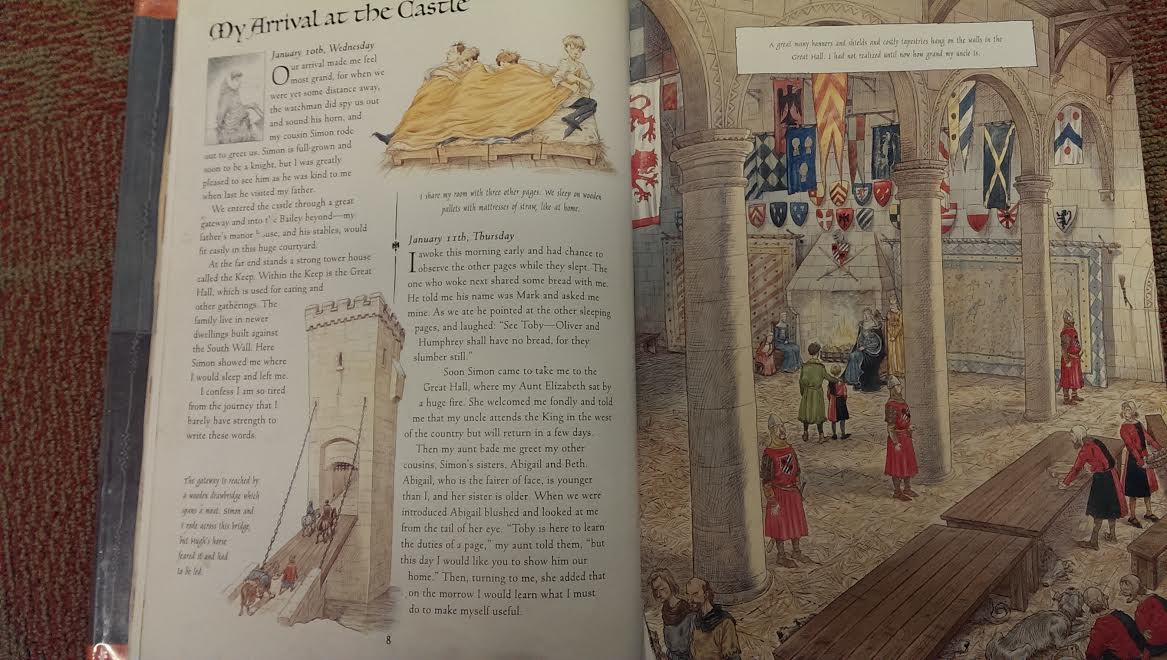
The castle were Toby’s uncle lives is much bigger than his parents’ manor house.  Toby has to learn the roles of all the servants who live there: who is in charge of what and who reports to who.  Not all servants are equal, and some command more respect than others.  Some of them are even from noble families like his, including his aunt’s companion, Isbel.  Toby himself is assigned to do chores for his aunt like running errands, delivering messages, serving food at meals, and holding up the hem of her cloak when she walks outside.

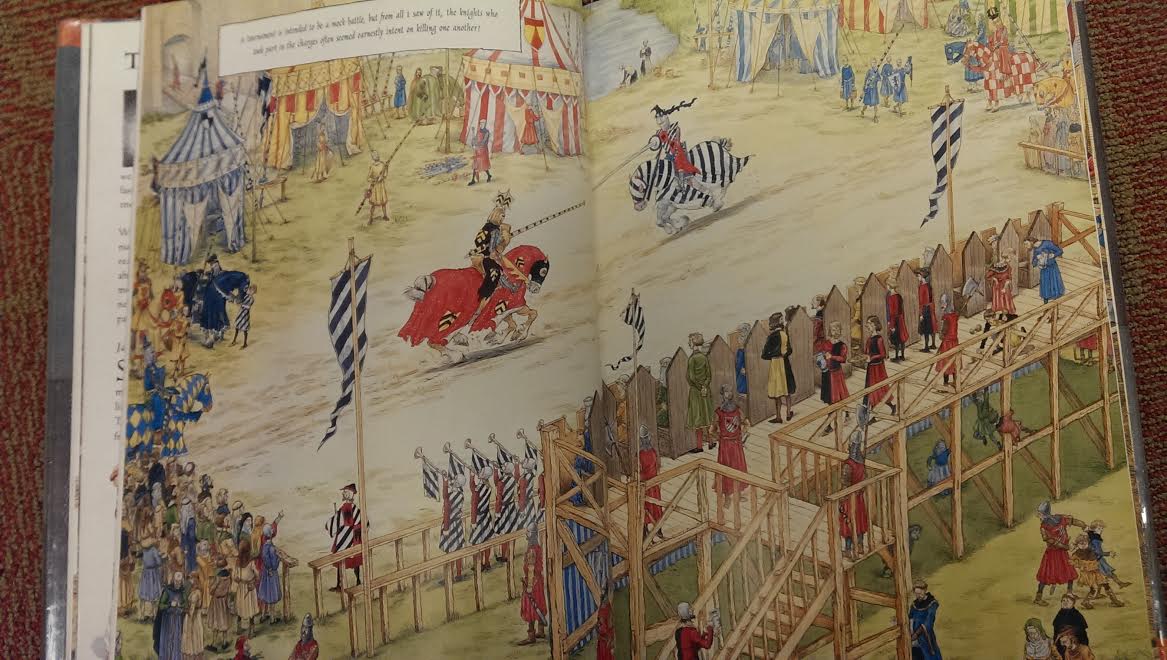
Toby shares a room with the other pages at the castle, all boys of noble families and destined to become knights, just like him.  They have lessons in reading, writing, mathematics, Latin, and scripture from the castle’s chaplain, and he is a harsh disciplinarian.  They practice their lessons on wax tables that can be smoothed out and used again.  The boys also learn manners and start learning archery and about all the weapons and armor that knights use.  When they have time to play, they try walking on stilts and play at being jousting knights by carrying each other on their backs and trying to knock each other off.

CastleDiaryPic2

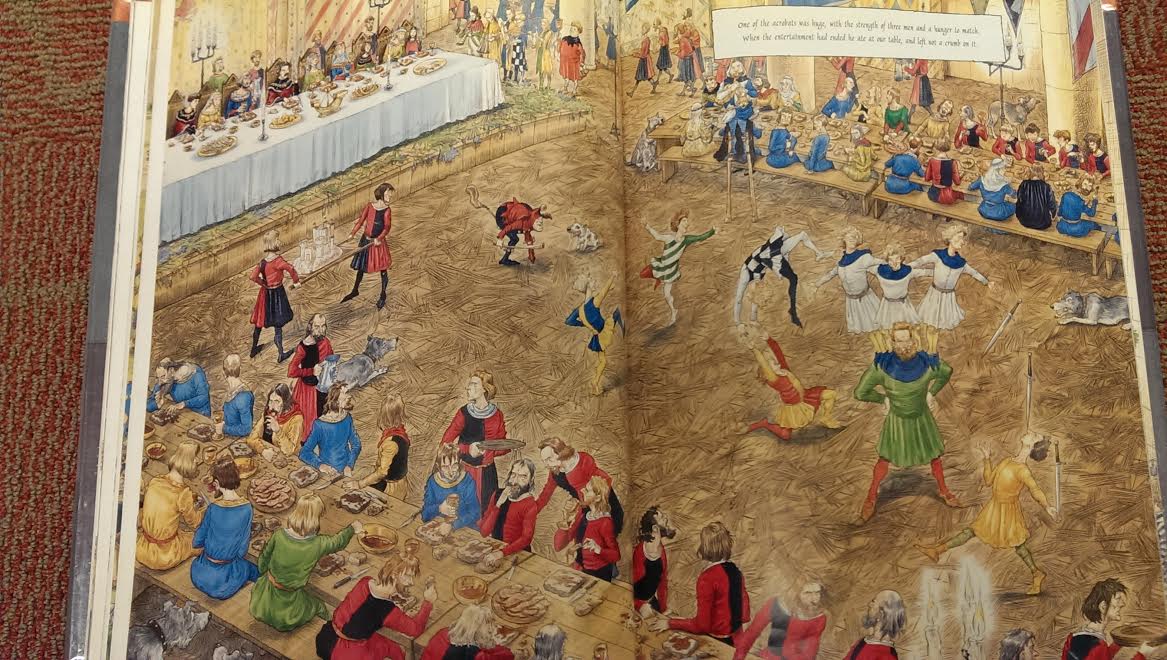
During the course of the year, Toby gets to witness a hunt, a joust, and a banquet with important guests.  At one point, he gets sick and receives treatment from a physician.  He also encounters a poacher on his uncle’s land.  This man is eventually caught (although Toby decides not to turn him in) and put on trial, but in the end, he is not punished because the jurors were sympathetic.  The book ends with a Christmas celebration, after which Toby goes home to visit his parents.

CastleDiaryPic3

In the back of the book, there is a section with more information about Medieval society, castles, sieges, weapons, armor, and the changes that eventually brought an end to feudal system that Toby knew.

The book is part of a series of historical picture books.  It is currently available online through Internet Archive.

CastleDiaryPic4

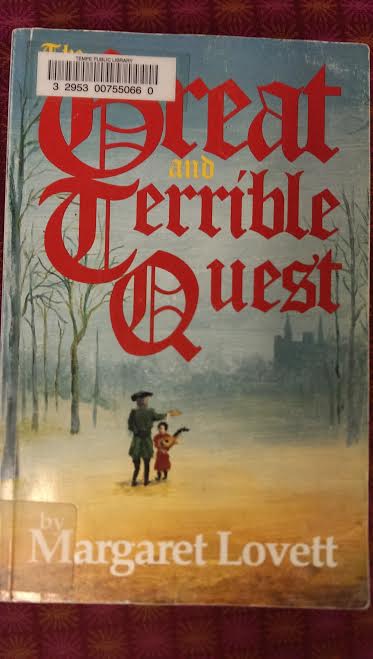
The Great and Terrible Quest

greatterriblequestThe Great and Terrible Quest by Margaret Lovett, 1970.

This story takes place in a fictional kingdom during the Middle Ages. Trad is a ten-year-old boy who has lived most of his life with his abusive grandfather. He barely remembers his parents, who died in a plague when he was only four. This grandfather consorts with robbers and evil men. Trad often pretends to be stupid to avoid their notice and warns travelers away from their territory.

One day, he rescues a man who has been badly wounded and cares for him in a secret cave. This man, whose white hair makes him seem elderly, insists that he is on a mission, a great and terrible quest . . . but because of a head wound, he can’t remember what his quest is. All that he knows is that time is short, and he does not have long to complete his quest to find something very important.

Trad soon learns that his grandfather’s wicked friends are the ones who attacked this mysterious stranger. Taking Trad’s father’s old lute, a couple of coins, and a mysterious ring dropped by one of the robbers which seems to have once belonged to the stranger, Trad and the stranger embark on a journey across the land, making friends and pursued by enemies as they go. While the stranger struggles to remember his identity and the nature of his mission, Trad begins to learn a few things about his own forgotten past and the nature of his family. Nothing is what it seems. Their country is in trouble because of the evil men who have been controlling it. Everything depends on the success of the stranger’s mission, and Trad has a much larger role to play than he had ever dreamed.

It’s a beautiful and fascinating story about good and evil, loyalty, friendship, and determination to do the right thing, even against the odds. There are parts that might frighten younger readers. The fights are violent and bloody, and there are a couple instances of cruelty to animals (partly, it seems, to show how truly evil Trad’s enemies are). Still, it’s a great story for tweens and teens, and readers will want to cheer Trad on as he struggles to help those around him and find his own destiny.

Although the kingdom is fictional and the themes are similar to fantasy stories, there is no actual magic in the story.

The book is currently available online through Internet Archive.