The Princess and the Goblin

“But, Mr. Author, why do you always write about princesses?”
“Because every little girl is a princess.”
“You will make them vain if you tell them that.”
“Not if they understand what I mean.”
The Princess and the Goblin, Chapter 1: Why the Princess Has a Story About Her

This is an enchanting fairy tale-type story about a princess. One of the best parts comes at the beginning of the book, when the reader supposedly interrupts the author as he starts to tell the story, asking him why he likes to tell stories about princesses. The author explains that princess stories remind every little girl that she is a princess, that they are all the daughters of kings (apparently in the sense that any man can be the king of his family with all the dignity and wisdom that implies, and it reflects well on them when their daughters behave well, as if they were raised with the manners of royalty), even if they sometimes forget that and behave in very un-princesslike ways. He wants to remind them that they are all princesses and can behave with the grace and dignity of princesses, and he can also pamper them a little because, in the course of the story, he can give them every beautiful thing he wants all the little princesses of the world to have. There’s kind of a behavioral caution in that explanation, but also a sweet sentiment. Even if you’re just an ordinary girl, you can still act with royal dignity and grace, and through the story, you can vicariously enjoy all the riches and adventure that a fairy tale princess can have.

The princess in the story, Princess Irene, is about eight years old, being brought up in a castle or manor house in the countryside because her mother was not physically strong when she was born and is now dead. She is largely raised by her nurse and only sees her father, the king, occasionally. Her father spends his time traveling between his castles and manors, visiting various parts of his country to make sure that everything is in order. Princess Irene cannot go with him because she is still too young to travel that much.

There are caverns under and around the castle-like manor house where Princess Irene lives. There are mines in the area, and the caverns are inhabited by creatures like kobolds or goblins. The story says that there are legends that these creatures once lived above ground, but having some quarrel with requirements imposed on them by the king or human society, they retreated underground to live there in secret. From generations of living underground, they have become physically altered into deformed creatures, but they have also acquired arcane knowledge and delight in playing mischievous tricks. Because of fears of the goblins coming out at night, Princess Irene is kept safely indoors before the sun goes down and has never seen the night sky by the age of eight.
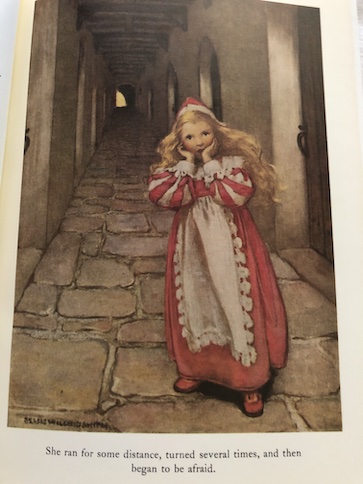
One rainy day, Princess Irene is sitting in her nursery, bored. She has many fabulous toys (so amazing that the author of the book declines to describe them and cautions the illustrator against attempting to draw them, so readers can imagine any fabulous toys they like), but Irene in not in any mood to be amused by anything. Princess Irene is restless and doesn’t even quite know what she wants. When her nurse leaves the room, Irene takes the opportunity to run off and explore parts of the castle she has never before explored. She runs up some stairs into a passageway full of doors. She continues running through the passageways with doors leading to rooms with nobody in them until she becomes lost and confused. The corridors are empty, and there is no sound but the rain. One of my favorite quotes from this book says, “It doesn’t follow that she was lost, because she had lost herself though.” Just because Princess Irene doesn’t know where she is or where she’s going doesn’t mean that she isn’t heading in the right direction, where she needs to be.
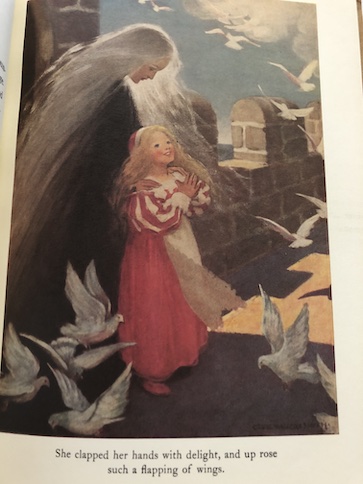
Frightened, Princess Irene tries to find her way back to the nursery. Eventually, she finds her way to a room where she hears a humming sound. When Irene enters the room, she finds a beautiful old lady with silver hair sitting at the spinning wheel. Irene isn’t sure how old the lady is because she seems almost ageless. The lady notices that she’s been crying and asks her why, and Irene explains that she is lost. The lady is kind to her, washing her face and hands, and she introduces herself as Irene, too. She says that she is the princess’s great-great-grandmother and that Princess Irene was named after her. Princess Irene wonders why she’s never seen her before, and the elderly Queen Irene says that no one else knows that she is here. She shows Princess Irene the pigeons she keeps and promises that Princess Irene will see her again. Then, she guides the little girl to the stairs back to the nursery.

When Princess Irene is back in her nursery, her nurse is relieved because she’s been looking for her. The princess explains that she was with her great-great grandmother, but her nurse doesn’t believe her. Princess Irene is offended that her nurse thinks she made up the whole story. The next day, Princess Irene tries to find the old lady’s room again, but she can’t. She almost starts to wonder if she did just dream about her.

After the rain is over, the princess and her nurse spend some time outside. They wander farther than they should, and the nurse realizes in a panic that they cannot get back to the castle before the sun sets. The nurse grabs the princess’s hand and begins running for home. She becomes even more panicked when the princess thinks she sees little men and hears a sound like laughing. In their haste and panic, they get lost. The princess doesn’t understand why her nurse is so panicked because no one is supposed to scare her by telling her about the goblins.
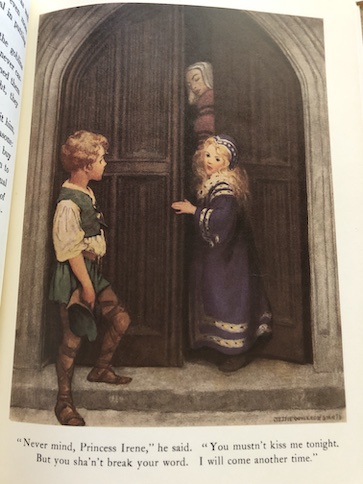
Fortunately, they meet up with Curdie, a young miner boy. It scares the nurse that Curdie is singing about goblins, but Curdie says that goblins can’t stand singing. Goblins don’t bother Curdie because he’s used to them and doesn’t let them frighten him. This is the first time Princess Irene learns about the goblins. When the nurse tells him who the princess is, Curdie says that they wouldn’t have gotten lost if they weren’t frightened and that it was a bad idea to say the princess’s name because the goblins might have heard and will recognize her if they see her again. Curdie guides them back to the castle before anyone realizes that they are missing. Irene likes Curdie and wants to give him a kiss for helping them, but the nurse stops her. Curdie tells her that there will be another time, and she can keep her promise of a kiss later.

Curdie can tell that the goblins are angry with him for interfering with their pursuit of the princess by their behavior toward him the next day. It doesn’t bother him much because he knows exactly how to deal with them. Goblins are intimidated by songs and rhymes, probably because they can’t make any themselves. Miners who are good at remembering songs and rhymes or making new ones for themselves don’t need to worry about the goblins, and Curdie has a talent for this sort of thing.
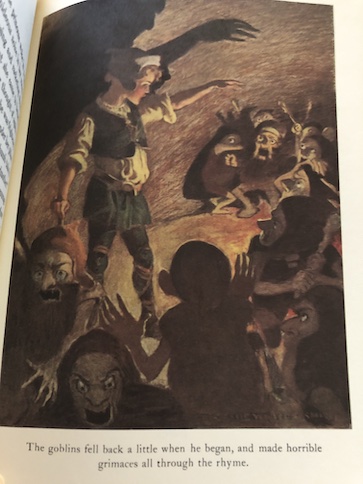
While Curdie is in the mine after the other miners have left, he overhears a goblin family talking, and he learns some useful things. First, he finds out that goblins’ feet are a vulnerable point on their body. Their heads are very hard, but their feet are very soft, and they have no toes. The only one who wears shoes is the goblin queen, and the goblins say that’s because the goblin king’s first wife wore shoes, and the second queen doesn’t want to seem inferior to the first. The goblin king’s first wife was a human woman, who died giving birth to their son. Second, the goblins are building new homes further away from where the miners have been mining. Third, the goblins are planning some kind of disaster against the miners. Curdie secretly follows the goblins to find out where the goblin palace is and learn more of their plans. At the goblin palace, he hears them discussing their plans. They don’t offer many new details, but it is clear that they are planning some sort of revenge against humans.

Princess Irene finds her way to her great-great-grandmother’s room again one night. This time, the old Queen Irene shows Princess Irene what she is spinning. She is spinning spiderwebs to make something for Princess Irene. She heals a wound on the princess’s hand and invites her to spend the night with her. When Princess Irene wakes up, she is back in the nursery, but she now believes that it wasn’t just a dream.

Later, the princess is frightened by a horrible goblin creature that enters her nursery through a window that the nurse left open when it was getting dark. Terrified, Princess Irene runs out of the castle into the darkness (somehow missing the extra guards that her father left at the castle for her protection). Fortunately, her great-great-grandmother sends her a magical lamp that guides her back to the castle. There, she gives the princess the present that she has finished making: a ball of finely-spun spider silk. She also gives Princess Irene a ring with a fire opal. She tells the princess that these things will guide her to safety any time that she is frightened.

The magical spider silk thread helps Princess Irene to find Curdie when he is captured by the goblins. Curdie has been trying to learn more about the goblins’ plans. Curdie discovers that the goblins are planning to kidnap Princess Irene as both a hostage and a bride for their half-human, half-goblin prince. Worse still, if their plot to abduct the princess doesn’t work, they plan to flood the mines and drown the miners!

This book is in the public domain. It’s available to read online through Project Gutenberg (multiple formats) and Internet Archive (multiple copies). You can also hear a LibriVox audio reading of this book online through YouTube and other audio recordings at Internet Archive. The story was made into an animated movie in 1991, and you can see it online through Internet Archive. There is only one sequel to this book, The Princess and Curdie. Personally, I think the original is better than the sequel.

This is a classic children’s fantasy story! The princess is sweet, the villains pose a real threat, and the story doesn’t shy away from the goblins’ evil. When they’re describing what to do with the princess when they get her, they talk about how they’re going to make her toes grow together so she’ll be like them. As princess stories go, this one isn’t as sparkly and pink as many modern princess books. Still, as the author notes in the beginning, this story allows all little girls to think of themselves as princesses and imagine themselves going through the adventure with Princess Irene.

As with many other Victorian era children’s stories, there are moral lessons in this one. The author periodically reminds readers about how princesses should behave with bravery and should keep their promises. There are also various other morals in the story, like the value of hard work and duty to others, learning to understand other people and give them the benefit of the doubt, and having the courage to admit mistakes and make them right. All of these values are described as being noble, and it’s implied that Curdie might have princely blood for exhibiting these values. The book uses royalty or the behavior of princesses and princes as a sort of metaphor for moral behavior.

Princess Irene’s great-great-grandmother is never fully explained. At one point, Princess Irene brings Curdie to see her, but he can’t see her, even when the princess is sitting on her lap. However, the king himself goes to see her without the princess. The princess knows that’s where he’s going because he’s heading in that direction. He is aware that the old Queen Irene is there, but he doesn’t share that knowledge with anyone else. When Curdie tells his mother that the princess tried to show him her great-great-grandmother but nobody was there and he thought that she just made it all up, his mother tells him that there is something very odd about the royal family. She says that they’re not sinister, but there are rumors and implications that there is something magical about them or that they are not quite normal humans. At the end of the story, we never get a firm answer about what Queen Irene really is. When I first read this book, I thought that she might be a ghost because, as an ordinary human, she shouldn’t be alive anymore, and I figured that she only shows herself to members of her own family. However, that doesn’t fully explain her magic, and from what Curdie’s mother says, maybe she’s some kind of fairy or elf or maybe a powerful sorceress, who can either live forever or for a long period beyond the normal human lifespan.

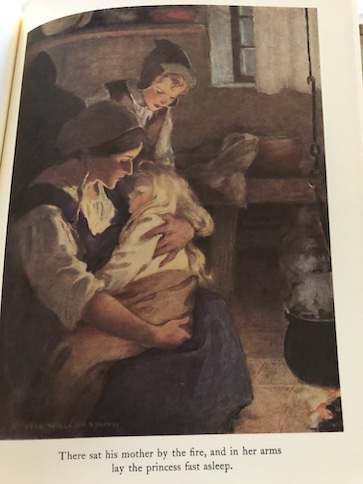
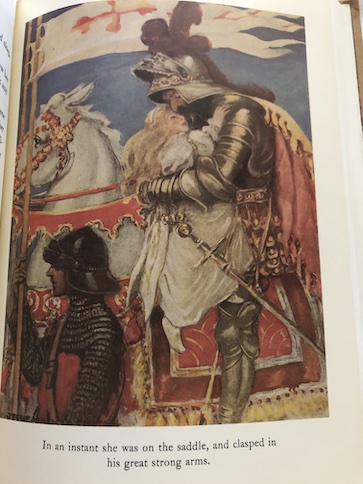
One of the parts that I always liked best about this book is the illustrations. They’re charming and magical! These particular illustrations were made by Jessie Willcox Smith, a famous illustrator of children’s books in the early 20th century, in 1920.

Island of Adventure

Enid Blyton’s Adventure Series

Island of Adventure by Enid Blyton, 1944.

Philip Mannering is spending part of his summer holidays at the home of one of his teachers, doing some extra studying, which is a bit depressing.  He has fallen behind in school because he recently suffered from Scarlet Fever and Measles, and he is trying to catch up.  He’s not the only boy studying at the teacher’s home, but he isn’t really friends with the others.

One day, he’s doing some studying on the hillside and hears a strange voice telling him to shut the door and not whistle.  There is no door on the hillside, and he wasn’t whistling.  Philip is very confused until he realizes that the voice is coming from a big, white parrot sitting in a tree.  Then, he hears a child’s voice calling the parrot from the garden of the teacher’s house.  Philip is happy, thinking that another boy has joined the study group, but it turns out that he’s only half right.

The voice in the garden belongs to Lucy-Ann Trent, who isn’t a student and isn’t there to study.  Her brother, Jack, is the one who needs to catch up in school because he never focuses on his studies.  Jack has only one interest in life, and that’s birds.  Jack owns the parrot, Kiki, and wants to be an ornithologist when he grows up.  He is bright but disinterested in anything that isn’t related to his chosen field.  Lucy-Ann is only there to spend time with him and keep him company while he gets extra tutoring.  The two of them are orphans.  They don’t remember their parents because they died in a plane crash when the children were very small.  Most of the time, they live at boarding school, which is why they don’t spend as much time together as they like.  Usually, during their holidays, they live with a fussy uncle, which is why the parrot is always barking orders at the children.

Philip also usually lives with an aunt and uncle when he’s not at school.  His father is dead. His mother is still alive, but she spends most of the time working at her art agency.  He also has a sister named Dinah, but they don’t usually get along.  Philip is surprised at how well Jack and Lucy-Ann get along with each other because he’s always fighting with his sister, who has a temper. (Although, admittedly, he does push Dinah to lose her temper.)  Strangely, Philip finds himself wishing that Dinah were also there because, when he becomes friends with Jack and Lucy-Ann, it occurs to him that she would nicely round out the group.

Philip, Jack, and Lucy-Ann become friends by bonding over their shared love of animals. Philip likes the parrot and tells Jack and Lucy-Ann that they would probably like his aunt and uncle’s house because they live by the sea, and there are many sea birds in the area.  Philip doesn’t know much about birds in general, but he likes collecting various small pets, including mice and caterpillars.  The teacher isn’t too happy about these animals because they disrupt study sessions.

Then, Jack and Lucy-Ann get a letter saying that they’re going to have to continue staying with the teacher through the rest of the summer because their uncle has broken his leg and can’t take them back.  The children aren’t happy about that and neither is the teacher because he had other plans after the summer tutoring session ended, even though the uncle has provided a generous check for the children’s care.

Then, Philip has a wonderful idea: maybe Jack and Lucy-Ann can come visit him and his sister at his aunt and uncle’s house.  Dinah has written to him that she’s bored and lonely and misses him, even though they usually fight.  She would like the company, and Philip knows that his aunt and uncle could use the money the children’s uncle is willing to offer for their boarding.  Jack and Lucy-Ann like that idea, but they’re not sure that their uncle and teacher would agree to let them go because they don’t know Philip’s aunt and uncle, and they think maybe Philip’s aunt and uncle wouldn’t want two strange children staying with them.  The children know their plan would be best for everyone, but since they’re not sure that they can persuade the adults, they take the attitude that it’s easier to ask for forgiveness than permission and plot for Jack and Lucy-Ann to run away and join Philip on the train home.  Jack and Lucy-Ann secretly send their trunks to the train station along with Philip’s and tell the teacher that they’re just going down to the station to say goodbye to Philip when he goes.  Then, they quietly buy their train tickets and leave.

When the children arrive at Philip’s home, Aunt Polly is irritated because she isn’t prepared for unexpected guests.  There are no rooms or beds for them, and she says that they can’t stay.  However, she is surprisingly won over by Kiki, who says, “Poor Polly!” over and over in a sad tone.  Not knowing that Kiki is also sometimes called Polly, Aunt Polly thinks that the bird knows her name.  She often feels overworked and rarely gets any sympathy, so she appreciates this gesture from Kiki, who repeats the phrase more often, seeing that it pleases Aunt Polly.  Aunt Polly is also charmed that Polly tells people to get a handkerchief when they sniffle or sneeze because she’s always saying that to Dinah.  When she telephones the children’s teacher to discuss the situation and learns about the fee the children’s uncle is willing to pay for caring for the children, she decides that maybe the children can stay after all.  The relieved teacher promises to endorse the check over to her.

Aunt Polly is relieved to get the extra money, and she reveals to the children that she’s been very worried about expenses because Philip and Dinah’s mother has been ill and hasn’t been able to send the money she usually sends from her job.  Her doctor says that she’s run-down and needs a rest, but her job is an important source of money to the whole family.  Everyone is relying on her, but since she hasn’t been able to send her usual support money for the children, Aunt Polly is worried about how she will afford the children’s school fees.  Philip bravely says that he’s willing to quit school and get a job instead to help out the family, but Aunt Polly says he’s still too young.  Philip has wished before that he was old enough to be the man of the family and provide for his mother.  His uncle isn’t much help with money and doesn’t pay attention to family expenses, too absorbed in his academic work.  Aunt Polly says that the money she’ll get from boarding the Trent children will help out.

Philip says that part of the trouble is that the house where they live is really too large. About half the house is crumbling into ruins from neglect, and the other half is really too big for Aunt Polly to maintain.  Aunt Polly agrees but says that moving would be difficult because few people would want a house like this one, crumbling and located in a rather lonely spot along the coast.  Besides, the children’s uncle loves it because he knows all the history of the area, and he wouldn’t want to leave.  Philip thinks the only thing that will really help is when he and Dinah are old enough to get jobs.  Then, the two of them will be able to help their mother afford a place for three of them.

Philip’s aunt and uncle have a gloomy man named Joe working for them, and he tells the children that the tower room where the boys will sleep on an old mattress (a prospect that seems adventurous to them instead of an inconvenience) isn’t a good room because it’s the only room where they can see the Isle of Gloom.  He says that bad things are associated with the Isle of Gloom because bad people who did terrible things lived there.  Jack asks Philip about the Isle of Gloom.  Philip says that it’s difficult to see, even from the tower room, and it’s always covered in mist.  Nobody lives there now.  Jack thinks it sounds great because the birds on the island have probably never seen people before and won’t be afraid of them, so he could get some amazing pictures.  He thinks maybe he’ll even find some rare birds.  Philip says that he and Dinah have never been there before themselves, and he’s not sure whether there are birds there or not. 

Staying at the house by the sea isn’t easy.  All of the children are expected to help with the chores.  There is no electricity, and they use oil lamps that need to be cleaned.  The water has to be pumped from a well.  Still, Jack and Lucy-Ann think that it’s just part of the adventure.  They enjoy going swimming and fishing with Philip and Dinah, and Jack has fun bird-watching, but Joe the handyman is always spying on them and acting creepy.  He keeps telling the children spooky stories about things lurking in the dark.  For some reason, Joe tries to discourage the children from exploring the area or going out in a boat, but they soon make an interesting discovery. 

While the children are exploring a cave, Philip teases Dinah, and she hits him.  He stumbles back and ends up in a hidden tunnel.  Philip and Jack explore the tunnel and discover that it leads to some carved stone steps and trapdoor that leads up to a storeroom that’s part of the cellars at the house.  Philip says that he never knew this part of the cellar existed.  The boys discover that the door to the storeroom is usually hidden by boxes, but Joe has the key and comes in.  Kiki, who is with Jack as usual, makes some sounds that terrify Joe, who thinks that there are strange and spooky things in the cellar.  The boys think that it’s hilarious that Joe got scared when he’s always trying to scare them.  They steal the key that Joe left in the door so they can come and go whenever they like, but they wonder why Joe even hides the door to the storeroom in the first place.  Philip is sure that even his aunt doesn’t know about that storeroom, or she would have mentioned it before.

Joe is definitely doing something suspicious, going out at night in a boat, fearful that the children will find out what he’s doing. The children make friends with a nice man named Bill, who is staying in an old shack nearby. Bill says that he’s there for bird-watching, but he doesn’t seem to know that much about birds or talk about them as much as Jack does. Bill has a boat and takes the children out sailing, but he doesn’t want to take them to the island and warns them to be careful of Joe. Does Bill know something the children don’t, or does he have some dangerous secrets of his own?

The book is available to borrow and read for free online through Internet Archive (multiple copies). It was first published in Britain, and some US copies use the title Mystery Island instead. The book was made into a movie in the 1980s, and you can see it on YouTube. The movie has John Rhys-Davies as one of the villains.

My Reaction

First, I’d like to get it off my chest that I didn’t like many of the family relationships throughout the book. Aunt Polly’s marriage is a little disturbing because she doesn’t have enough money to run the household, but her husband not only says that he has none to give her and wouldn’t give her any even if he did have money. He doesn’t seem to care about the welfare of either Polly, who is eventually revealed to have a heart condition, or the children in his care. He buries himself in his study most of the time and has almost no idea of what’s going on in the rest of the house or even who’s there. He’s not just obsessed with his studies, but at times, it seems like he’s deliberately hostile toward everyone else, including his wife, like their existence in the house is a terrible inconvenience to him.

I didn’t like the way Philip and Dinah were portrayed as always fighting physically in the book. Admittedly, my brother and I got into physical fights when we were little, but Dinah is twelve years old, and Philip is older than she is. Both of them seem to be too old to be acting the way they do in the story. Dinah is very emotional and has a hair-trigger temper, and Philip, knowing this, intentionally baits her into losing his temper. He likes to put creepy-crawly creatures on her or act like he’s going to, knowing she doesn’t like it and that she’ll react, and then he’s not happy when she lashes out and hits him. While Dinah shouldn’t react by hurting people physically, I could sort of understand it if she constantly has to put up with this from Philip. Living with someone who is always baiting you and escalating his behavior until you break would probably leave anyone broken in the end, and I can’t help but think that Dinah’s emotions would stabilize more if she didn’t have to deal with someone always trying to throw her off balance. Maybe she’d still be an emotional person, but I notice that it’s particularly Philip who gets her to fight physically while nobody else does because they don’t bait her into it. I found that sibling relationship kind of disturbing because Philip seems to know exactly what he’s doing, and as I said, he’s too old to be doing this stuff innocently.

Jack and Lucy-Ann seem to have a more fond sibling relationship. Lucy-Ann sometimes seems a little clingy with Jack, but I think that might be because the children are orphans and are not fond of their stern uncle, so they don’t really have anybody else to be close to except each other.

My copy of the book is one of the later editions that had some of the names and language changed to remove racially-problematic aspects of the story. In the original version of the book, the sinister handyman was a black man called Jo-Jo, and his race was unduly emphasized. I prefer the version where he’s just a weird guy named Joe.

The mystery isn’t bad. I knew right away that Joe was suspicious because he kept acting suspiciously, but the mystery is one of those type where it’s not so much about “whodunnit” as about “What is this person doing?” Readers know that Joe is up to something, but it isn’t clear for much of the book what it is. I had a couple of ideas early in the story, but neither was right.

Bill is also an interesting addition to the story. For part of the book, he looks a little suspicious because readers can tell that he’s not the bird-watcher he pretends to be, but he doesn’t seem to be allied with Joe. Bill is actually a good character, although he’s not what he appears to be, and he becomes one of the important characters in other books in the series.

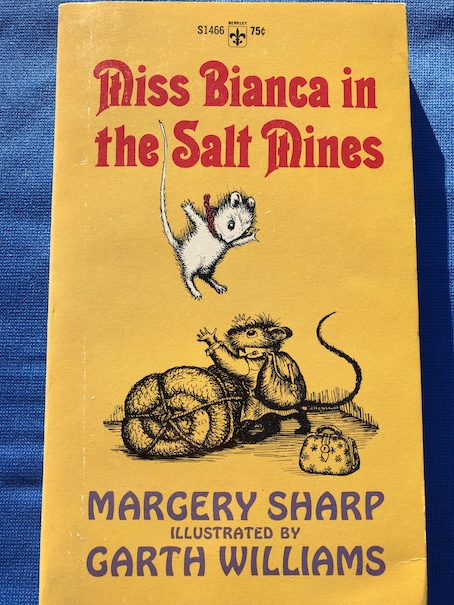
Miss Bianca in the Salt Mines

Miss Bianca in the Salt Mines by Margery Sharp, illustrated by Garth Williams, 1966.

This book is part of the Rescuers series.

When this story begins, Miss Bianca, who is Perpetual Madam President of the Mouse Prisoners’ Aid Society, is evaluating candidates for the Tybalt Stars award, which is given for mice who are brave in the face of cats. Bernard, the secretary of the society, is helping her. Each of the candidates is undeniably brave, but Miss Bianca notices that each of them also had a self-serving motive behind their bravery, which seems disappointing for a benevolent society. When they stop for lunch and Bernard goes to fetch some salt for them, he finds a note in the salt that says, “Someone please get me out of the salt mines.” The note is signed “Teddy (age 8).” Naturally, Miss Bianca is eager to help the poor boy! Bernard is a little more doubtful about the mission because the salt mines are about a thousand miles away, extremely dangerous, and extremely well guarded. Nevertheless, the Mouse Prisoners’ Aid Society cannot refuse to help a prisoner, and neither can its President.

Soon, Miss Bianca has members of the society trying to learn anything they can about a missing boy named Teddy, but apparently, no one has reported a boy by that name or age as missing. Bianca uses the lessons of the boy who owns her to learn more about the salt mines and how to get there. In order to get to the salt mines, they’d have to go by train, and it’s a very dangerous route. At the next meeting of the society, Miss Bianca asks for volunteers to go rescue Teddy, but everyone is reluctant to go, and many members of the society don’t like it that Miss Bianca doesn’t even seem to have any facts about Teddy or his situation that could help them. Miss Bianca says that, even though she can’t be more specific about Teddy’s background or how he came to be in the salt mines, the important fact is that he shouldn’t be there, and he needs help getting out. Since no one else wants to volunteer for the rescue mission, Miss Bianca says that she’ll go herself, and of course, Bernard insists on coming with her.

To Miss Bianca’s surprise, her biggest opponent, a curmudgeonly mouse called the Professor (his real name is George) who teaches mathematics, also volunteers to join the mission. Bernard and Miss Bianca are even more surprised when the Professor insists on bringing his friend Caerphilly along. Caerphilly is very elderly, but he’s also a professor of geology. Caerphilly has never actually been to the salt mines before, but he’s always wanted to see them and study them. Bernard and Miss Bianca aren’t sure that Caerphilly is up to handling the dangers that they’re likely to encounter on the mission. Miss Bianca reminds Caerphilly that this is supposed to be a rescue mission, not a scientific expedition. Caerphilly is unconcerned, saying that they can handle the rescue, and he’ll handle the science. Miss Bianca says that the Professor should warn his friend just what risks a rescue mission involves, but the Professor is also unconcerned, saying that the geology department at the university thinks too much of itself, and he wouldn’t mind seeing his friend chased by bloodhounds. (Some friend he is.) Miss Bianca is concerned both because of the danger and because their self-serving motives are just what she was concerned about before.

In spite of that, they decide to proceed with the mission, bringing the two professors. They take some time to make their preparations. Bernard and Bianca research the trains they’ll need to take. The Finance Committee allows them to take along the society’s Treasure – there’s only one, a single gold coin they found in a ruined building. Teddy might need this to pay for his train fare after they get him out of the mines. The Ladies’ Guild also knits mittens for the unfortunate boy because the salt mines are reportedly very cold. Miss Bianca tells the boy she lives with not to worry if he doesn’t see her for a week or so because she’s going to be writing an epic poem and needs privacy.

As they finally set out on their mission, the Professor is pessimistic, but the train journey is uneventful. When they arrive at the salt mines’ train station, it’s a very bare and gloomy building. Bernard finds a wooden door with some steps heading down.

At the bottom of the steps, they find themselves in an underground cavern filled with stalactites and stalagmites. There is also an underground lake surrounded by crusts of salt. The Professor realizes that they have entered the salt mines through a disused and forgotten entrance. In the distance, they hear the sounds of prisoners mining the salt.

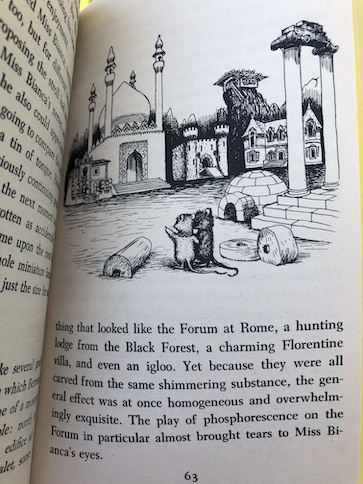
It’s a long walk to the active part of the mine, but along the way, they make an important discovery – a mouse-sized city carved out of salt! Each of the buildings in the miniature town are unique and resemble famous buildings from around the world. Miss Bianca thinks that the buildings were probably carved by prisoners who made buildings to resemble the places where they used to live. It’s the perfect place for the mice to stay, though.

Bernard, inspired by this strange place, tries to write a poem for the first time in his life, which isn’t very good. Miss Bianca tries to be nice about it, but he can tell that she doesn’t like it. Bernard is upset enough to try to drown himself (that part of the story struck me as rather shocking, although it’s handled so matter-of-factly as just a product of the weird atmosphere of this place), but he can’t because he just floats in the salt water. It seems like most of the members of the expedition temporarily forget about Teddy. Only Miss Bianca isn’t affected by this strange little town because she lives in a porcelain pagoda at home that her boy gave to her, so these buildings are very much like what she already knows.

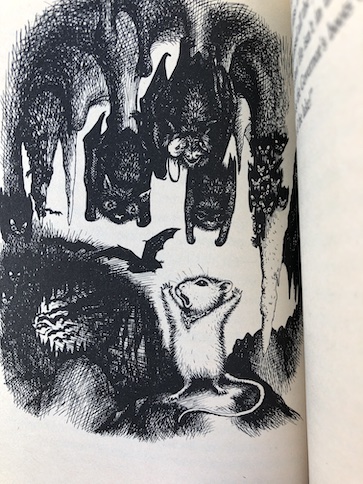
Fortunately, the expedition gets some help from some friendly bats who live in the mines. The younger bats in the group say that they’ve seen little Teddy serving the governor of the salt mines, who tends to stay apart from most of the prisoners because the prisoners have attacked him before. This is fortunate news because it means that Teddy is closer to the little salt town than they thought, and it won’t be as difficult to find him as they anticipated. He’s on an island in the middle of the lake of salt water, and that’s not too difficult to reach because Bernard has already proven that it’s easy to float in salt water.

Once they find Teddy, they also have to get him onto a train to get him away from the salt mines, which may not be as easy.

The book is available to borrow and read for free online through Internet Archive (multiple copies).

My Reaction and Spoilers

I generally prefer the plots of the Disney movies to the original books in this series, but this was still a fun story. I was a little disappointed that they never actually used the two professors’ specialties. I thought at first that they would use the geology professor to spout some interesting and useful facts about caves or mines, but they didn’t, and there was nothing in the story where a mathematics professor would be particularly useful. It just seems like a missed opportunity there.

There were some funny moments in the story. I liked the part where one of the bats, not really seeing Bianca clearly because bats are near-sighted, comments to another that, whatever it, if it moves, you should salute it, and if it doesn’t, you should paint it. Bianca takes that as a sign that this particular bat has completed his National Service, also noting that being near-sighted isn’t a barrier for bat National Service because, if it was, no bat would be able to participate.

In a twist at the end of the story, it turns out that Teddy used to live with his uncle and that Teddy’s uncle is the tutor for the boy that Miss Bianca lives with. Once Teddy is restored to his uncle, he comes to the house with his tutor and becomes friends with Miss Bianca’s boy.