Kirsten’s Surprise

Kirsten, An American Girl
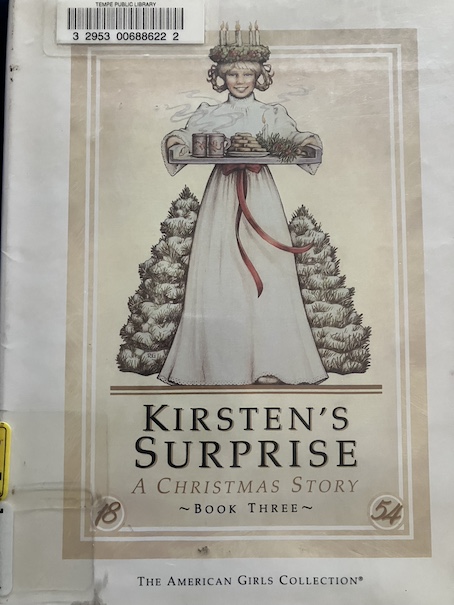
It’s winter, and Kirsten’s family is just starting to prepare for Christmas. Kirsten’s mother has her help make their Christmas bread. So many things have changed for their family since they came to America and moved to the frontier in Minnesota, Kirsten asks her mother if they will be celebrating Christmas just like they used to when they lived in Sweden. The family doesn’t have much money and can’t afford extra treats, but her mother says they will do the best they can.

When they arrived last summer, the family didn’t even have enough money to pay for a wagon to carry their belongings to their new house, so they had to leave them in storage in Riverton, including Kirsten’s doll, Sari. Since then, Kirsten has been using a stuffed sock as a doll. Kirsten’s mother tells her that her father has arranged for their trunks to be sent to Maryville, which is closer, but still 10 miles away. Kirsten is eager to retrieve them, but her mother says that will have to wait because there are too many other things they need to do now to get ready for winter. Kirsten worries that they won’t be able to get their trunks before the snows come. If the roads are blocked by snow, they won’t have their trunks until spring! The more Kirsten thinks about the trunks, the more she wishes that they had the things in them, the things that would remind her of her home in Sweden and make their cabin feel more like home.

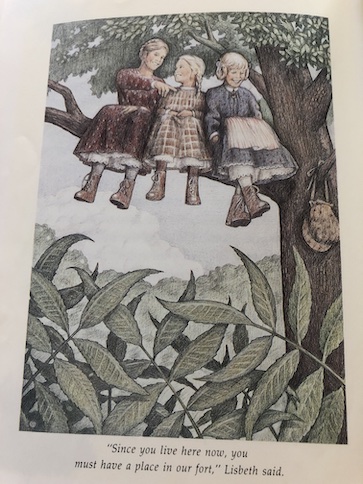
One day, while she is playing with her cousins, Lisbeth and Anna, Kirsten mentions St. Lucia, and she is surprised when her cousins don’t know what she is talking about. In Sweden, families traditionally celebrate St. Lucia’s Day before Christmas. However, Lisbeth and Anna were too young when they left Sweden, years before Kirsten left with her family, so they don’t remember that tradition, and since they came to America, they only remember celebrating Christmas in December. They ask Kirsten what happens on St. Lucia’s Day. Kirsten explains that it’s the shortest and darkest day of the year. One girl in the family dresses up as the Lucia queen, wearing a white dress and a wreath of candles on her head, and she wakes her family, bringing them a special breakfast with coffee and Lucia buns. Anna is enchanted by this description, and the girl talk about surprising their families with their own St. Lucia’s Day celebration.

Then, Kirsten remembers that the long, white nightgown she used for her St. Lucia’s Day dress last year is in one of her family’s trunks, and St. Lucia’s Day (December 13th) is only five days away. The other girls are about to give up on the idea of celebrating St. Lucia’s Day, but Kirsten thinks maybe they should ask Miss Winston if she knows what to do. Miss Winston is their schoolteacher, and she’s still living with Lisbeth and Anna’s families. Miss Winston has mentioned that she misses the Christmas parties her family and friends had back East, so the girls think that she might enjoy helping them plan a special surprise.

Miss Winston is happy to give the girls some candles and help them make St. Lucia crowns, but Kirsten’s father is still too busy to get the family’s trunks. He gets so annoyed with Kirsten asking about them that he tells her not to ask about them again. Lisbeth says that, if their plan won’t work out for this year, they can do it next year, but Kirsten feels badly for getting their hopes up. Her own hopes are also set on having a St. Lucia Day, but she doesn’t know what to do without the dress in the trunk.

Then, one day, she finally hears her father say that he will have time to go for the trunks, and he thinks he had better do it soon because there will be more snow coming. Kirsten is excited and asks if she can go along with him to get them. At first, he doesn’t want to take Kirsten because there won’t be much room in the sleigh for her, and he thinks it would be better for her to go to school with the other children, but she persuades him to let her come.

The journey to Maryville is fun, riding through the snow and singing a Christmas carol. Kirsten even gets a piece of candy at the general store. When they retrieve the trunks, Kirsten wants to open them right away, but her father says they need to leave because it’s already snowing harder, and they need to get home.

The weather gets worse on their way home, and Kirsten wonders if they should turn back, but her father thinks they can make it home. As it gets worse yet, Kirsten’s father gets out of the sleigh to lead the horse through the snow, and he accidentally twists his knee. With her father injured, Kirsten gets out the sleigh to lead the horse. The situation is dangerous, but fortunately, Kirsten realizes where they are, and she knows that there is a cave nearby where they can take shelter.

When Kirsten and her father arrive home, they are greeted by their worried family, and it’s St. Lucia Day. With some help from Miss Winston and her cousins, Kirsten is able to give her whole family their St. Lucia Day surprise, but it has even greater meaning because of everything they’ve been through.

There is a section of historical information in the back of the book about how Christmas was celebrated on the American frontier in the mid-19th century and how it was different from the Christmases families like Kirsten would have experienced in Sweden.

The book is available to borrow and read for free online through Internet Archive.

This was my favorite of the Kirsten books! Although there is some danger to Kirsten and her father when they get caught in the snowstorm after retrieving the trunks, everything turns out fine, and Kirsten saves her father because she insisted on going with him on the trip. This book is also fun because it introduces readers to the concept of St. Lucia’s Day. I think the first book I read as a kid that explained about St. Lucia’s Day was the nonfiction book Christmas Around the World, but I liked seeing this frontier family celebrate their St. Lucia tradition.

thought that Kirsten’s parents impatience with her “pestering” them about retrieving the family’s belongings was realistic, just like parents in real life might act when a child repeatedly asks for something they can’t give them right away. However, at the same time, Kirsten’s mother seems to understand that Kirsten is asking for the trunks for deeper emotional reasons. Not only does Kirsten badly miss her doll, which has been stored in one of the family’s trunks since the beginning of the series, but the other things in the trunk are both useful for the winter season and have connections to the people the family left behind in Sweden. With Christmas coming, Kirsten and other members in the family are missing those connections and the feeling of home. Kirsten’s mother points out that people are more important than belongings, but she also agrees with Kirsten that some belongings represent ties to other people.

Kirsten also misses the tradition of St. Lucia’s Day because that tradition usually marks the beginning of the Christmas season for the family. When Kirsten surprises her family by dressing in her St. Lucia costume, it’s a happy surprise for everyone and really makes everyone feel like Christmas. However, Kirsten also feels the significance of the holiday more than she ever did before because, having been welcomed home by the lights of their house and her waiting and worried family, she better appreciates the tradition of St. Lucia welcoming others with light and food.

As with other historical American Girls books, I also enjoyed the detailed colored pencil drawings of the characters and scenes!
Meet Kirsten

Kirsten, An American Girl

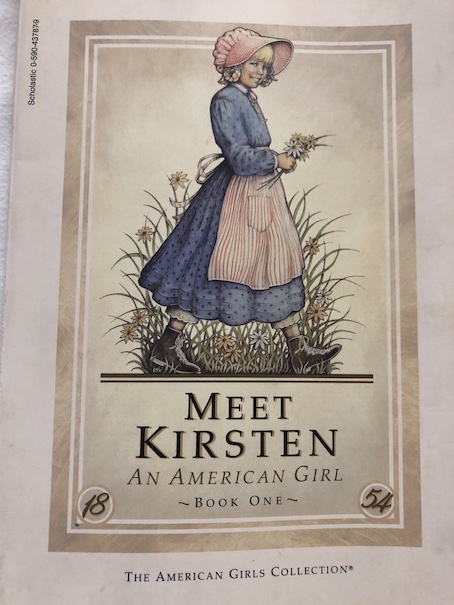
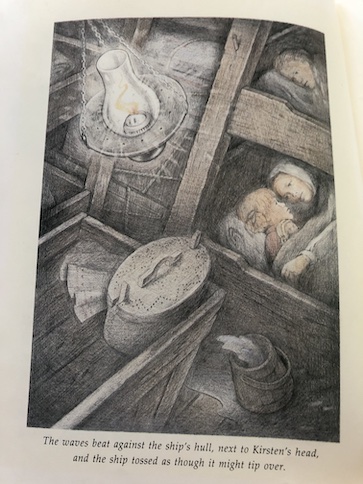
It’s the summer of 1854, and Kirsten Larson is traveling by ship to America from Sweden with her family. There have been storms during the voyage, and the sailing has been rough. It’s crowded on the ship, and people have been seasick. On board the ship, Kirsten makes friends with another girl her age, Marta. The two girls play with their dolls together and talk about the things they’ll do when they finally reach America. The reason why the Larsons are traveling to America is that Kirsten’s Uncle Olav is already there. He has established a farm in Minnesota, and he has married a widow with two daughters. He wrote to the Larsons and asked them to join him and his new family in Minnesota and help on the farm.

When their ship finally reaches America, it docks in New York. No one is allowed to leave the ship until the health inspector declares that they are healthy. Health inspectors will not allow anyone with a serious, contagious disease, like cholera or typhoid, to go ashore. When they are allowed ashore, Kirsten’s father finds an agent to help them change their money at a bank and buy train tickets for their trip west. The agent, who is also from Sweden, will even accompany the family to the Mississippi River as a guide. The family needs help because they can’t speak English yet.

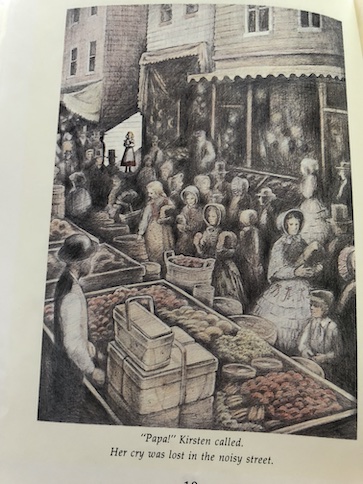
When they go to buy food in New York, Kirsten is accidentally separated from her father and gets lost. Because she can’t speak English, nobody understands what she’s saying, so Kirsten can’t ask for directions. Kirsten is frightened, but a kind lady sees her distress and tries to ask her what’s wrong. Kirsten can’t tell her, but then, she realizes that she can draw a picture, so she draws a picture of a ship. The lady leads Kirsten back to the dock, and she manages to find the rest of her family in the nearby Battery Park.

The next day, Kirsten says goodbye to Marta because the Larsons are leaving the city before Marta’s family. Because Marta’s family is also going to Minnesota, they hope that they will meet again there or somewhere on the way.

Kirsten has never seen a train before, and her first ride on one is frightening at first. The trip lasts for days, but finally, they arrive in Chicago. There, they will meet up with other pioneers heading to the Mississippi River. At the boarding house in Chicago, Kirsten reunites with Marta, whose family will also be traveling with them!

The pioneer families take wagons to the Mississippi River, and then, they board a riverboat. Kirsten’s mother worries because, when they boarded the riverboat, she was sailors burying a passenger who died of cholera. (A disease caused by ingesting contaminated food and water.) Cholera is a serious risk, and her worries are justified. On their third day on the boat, Marta becomes ill with cholera and dies from it.

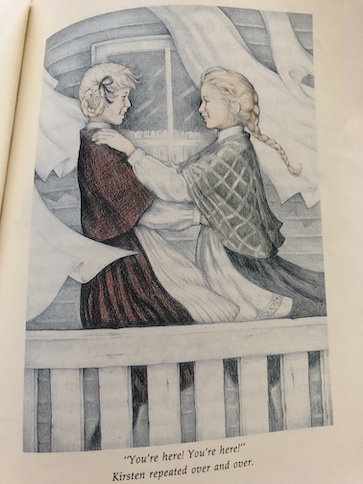
Kirsten is distressed at Marta’s sudden death, but fortunately, the Larsons all make it to Minnesota. All along, Kirsten has been struggling with homesickness and is still grieving the loss of the only friend she had in America, but she is cheered when she is greeted by her new cousins, Anna and Lisbeth. With her cousins as her new friends, Kirsten thinks that Minnesota might come to feel like home after all.

The book ends with a section of historical information about immigrant families, like Kirsten’s.

The book is available to borrow and read for free online through Internet Archive (multiple copies).

Although I liked the American Girl books when I was a kid, I didn’t like the Kirsten books, partly because of Marta’s death. I don’t think any of the other American Girl books has a child death in the first book. In fact, I don’t even remember any other children dying in any of the series, unless it happens in one of the newer books I haven’t read yet. It is realistic for a child to die while traveling west. Diseases like cholera were a real-like risk to pioneers. I’ve visited places along the old Oregon Trail, and I’ve seen the graves of real pioneer children who died of disease. There’s also a doll at one of the local historical museums in my area that once belonged to a little girl who died on the trip west. I know that children died on the journey west in real life, but it’s still depressing to read about, which is what bothered me about the Kirsten books. For this reason, I don’t think I read all of the Kirsten books when I was a kid, or at least, I don’t remember much about most them.

Reading this book again as an adult, I found it easier to deal with Marta’s death. I knew it was coming, so there was no shock to me. Marta’s illness is only a small portion of the book, and Kirsten doesn’t see Marta dead. We do get a picture in the book of the riverboat sailors carrying Marta’s coffin away for burial.

I always appreciate the sections of historical information in the back of American Girl books. This one discusses immigrants, the reasons why they wanted to move to a new country, and the conditions they encountered during their journey.

Earlier, when I covered Rasmus and the Vagabond, I mentioned that the characters hide in an abandoned village, and Oscar tells Rasmus that the reason that the village is abandoned is because, years before, the people in the village all decided to emigrate to America together, specifically Minnesota (a popular destination for Scandinavian immigrants).  The Library of Congress has more information about Swedish immigrants and the major periods of immigration.  Around the time that Kirsten’s family emigrated to the United States, Sweden was suffering problems from overpopulation, lack of adequate tillable farm land, and famine. We don’t hear the Larsons describe any particular problems they had in Sweden or suffering. We are told that they had a farm in Sweden with a house with a maple tree near the door and a barn, but we don’t know if the family was suffering in spite of owning the farm. The important point is more that conditions in general were bad in Sweden, so the promise of rich farm land in Minnesota was attractive to them. The historical information included in the back of Meet Kirsten doesn’t cover this information about conditions in Sweden. Instead it focuses on what immigrant families might pack to bring with them on such a journey and what the traveling conditions would have been like.

Betsy-Tacy

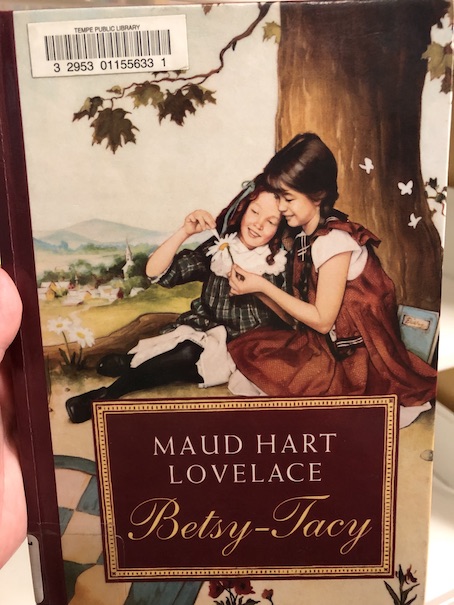
Betsy-Tacy by Maud Hart Lovelace, 1940.

This is the first book in a series about two best friends growing up in Minnesota around the turn of the 20th century. The stories in this book and the rest of the series are based on the author’s own childhood experiences with her best friend.

At the beginning of the book, Betsy meets her best friend, Tacy (short for Anastacia), for the first time after Tacy’s family moves into a house nearby when the girls are both about five years old.  Tacy is very shy and doesn’t want to talk to Betsy at first.  It isn’t until Betsy’s fifth birthday party, a short time later, that the girls really get to know each other and become friends.  After that, they are inseparable, almost to the point where people begin to think of them as one person, Betsy-Tacy. 

Each of the chapters in the book is a short story.  Some of them are about everyday things, like how Betsy would make up stories about her and her friend, how the girls would play dress up and paper dolls, or how they would have a “store” and sell bottles of colored sand to their friends.  Some of the stories are touching, as the girls help each other through some of the most important times of their young lives.  Betsy, the more out-going one, helps shy Tacy through the trauma of their first day of school.  Tacy, who has many brothers and sisters, reassures Betsy that everything will be alright when Betsy’s younger sister is born.  Both girls struggle to come to terms with the death of Tacy’s baby sister. 

At the end of the story, the girls make a new friend when a family moves into the chocolate-colored house with the stained glass window that the girls had always admired.

In the 60th anniversary edition of the book, there are pictures of the author and her best friend, Bick, who is the model for Tacy in the stories, and pictures of the author’s family.  There is also a description of the author’s early life and how the stories were based off her recollections of her own childhood.

This book is available to borrow for free online through Internet Archive.