#21 The Secret of the Haunted Mirror by M. V. Carey, 1974.
Mrs. Darnley has collected mirrors for years, and she has some pretty impressive ones in her collection. Her strangest mirror by far is the goblin mirror that her friend in another country, the Republic of Ruffino sent to her. There is a legend surrounding the mirror that says it was once owned by magician who used it to communicate with goblins under the earth. Supposedly, the magician went inside the mirror himself and now haunts it.
A man called Sr. Santora has been pestering Mrs. Darnley to sell the mirror to him, claiming he’s a descendant of the magician who created it. He insists that the legends about the mirror are true and that terrible things have happened to previous owners of the mirror. Mrs. Darnley didn’t believe these stories at first, but now, she and her grandchildren have seen this ghost in the mirror and heard unearthly laughter in the night. That isn’t the only strange phenomenon they’ve experienced. Someone tries to steal the mirror from Mrs. Darnley’s house, and Mrs. Darnley, not knowing what to do, asks the Three Investigators to find out what the mirror’s secret really is.
The Three Investigators are pretty sure from the beginning that someone is faking the ghost, although they don’t know exactly how. At first, they think that Sr. Santora hired the man who tried to steal the mirror, but when they follow the attempted thief, Pete sees him attack Sr. Santora!
Jupiter spends a stormy night at Mrs. Darnley’s house and has an encounter with the “ghost” that reveals how the haunting was accomplished and reveals connections to another magician who once owned Mrs. Darnley’s house and to the president of the Republic of Ruffino. It seems that the mirror contains secrets that aren’t entirely magical. There are two competing forces trying possess these secrets.
When Mrs. Darnley’s grandson is kidnapped, the kidnapper demands that she turn over the mirror in an abandoned warehouse. The Three Investigators must hurry to find the kidnapped grandson, discover which side in this power struggle is responsible for the kidnapping, and what the real secret of the mirror is before it’s too late!
The book is available to borrow and read for free online through Internet Archive (multiple copies).
My Reaction
The part I enjoyed the most about this mystery was the creepy legend and haunting of the mirror. One of the features of the Three Investigators books that I like is that they have some spooky mysteries in the pseudo-ghost story fashion of Scooby-Doo, and some of their supposed ghosts and supernatural creatures are much more original than in other series. The idea of a haunted goblin mirror and Jupiter’s encounter with it on a spooky, stormy night are delicious to a Scooby-Doo style mystery fan!
There are echoes of the first Three Investigators book in this one because there are secrets to Mrs. Darnley’s house that she doesn’t fully understand, and the haunting is based on magic tricks. There is some political intrigue to the story, too. The Republic of Ruffino isn’t a real place, so readers find out about its circumstances along with the Three Investigators. There is also a secret room and a clever hiding place for something in the solution to the mystery.
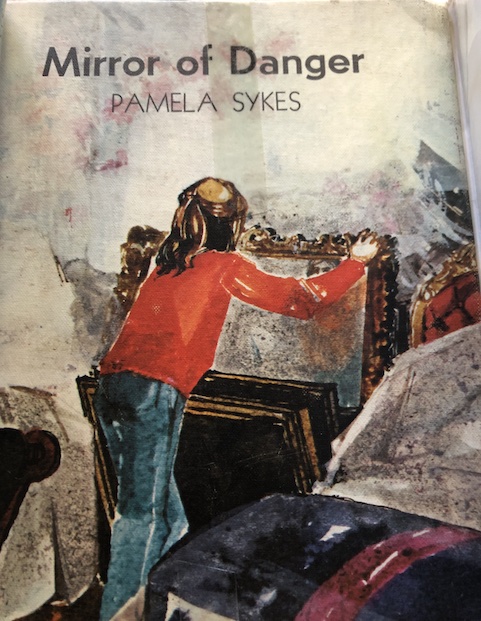
In the beginning, Lucy is an orphan who lives in the countryside with her elderly Aunt Olive. The two of them are very fond of each other. Then, Aunt Olive dies, and Lucy has to go live in London with her distant cousins. Even though Lucy inherited her aunt’s house, there were bills to settle, and the trustees in charge of Lucy’s legacy had to sell the house to pay them and provide money to help support Lucy. Lucy’s cousins have agreed to take her for Christmas, but Lucy isn’t sure whether or not she will be living with them permanently. It depends on how well Lucy gets along with the children of the family. People keep telling her “we’ll see” and reminding her to be brave and sensible and that changes are natural after someone dies. Her trustees and her aunt’s old friends want to do what’s best for Lucy, although they’re secretly a little concerned about whether their plans are what’s best for her. If she doesn’t get along with her relatives, they might have to send her to a boarding school, although they know that type of environment isn’t really suited to Lucy’s personality.
Since Lucy was raised and home-schooled by an elderly and old-fashioned woman, she is not accustomed to living in a big family or with other children and not even accustomed to any type of school environment. The adults who know her understand that Lucy is a quiet, reserved child who acts older than her age. Before she goes to stay with her relatives for Christmas, one of her trustees, Mr. Thomas, talks to Lucy about her life with her aunt and the need to give her other relatives a chance to be friendly. He says that Aunt Olive was an old woman who had a tendency to look back to the past, but Lucy is young and still has her future ahead of her. Mr. Thomas advises her to look forward. However, Lucy can only think of how much she already misses her life with her aunt and how she can’t imagine being happy with these relatives she’s never even met. She escapes thinking about these things by imagining herself other places, immersing herself in past memories.
Lucy feels out of place in her new home and worries if these relatives really want her. The father of the family, called Uncle Peter, is an architect, and the mother, called Aunt Gwen, is an artist who used to design theatrical costumes. Their three children are pretty close in age to Lucy. Patrick is the oldest, Rachel is closest to Lucy’s age, and Bill is the youngest. Their house is an old Victorian house, which pleases Lucy, but she doesn’t like it when she finds out that Uncle Peter is modernizing it. Home renovations are part of what he does as an architect, but Lucy prefers old-fashioned styles to the modern ones, which feel too stark and have garish colors. The children of the family are noisy, and Lucy has to share a room with Rachel, when she’s used to having a room of her own in a quiet, old-fashioned house. Rachel points out that they haven’t been in this house very long themselves, and there are rooms in this house that haven’t been renovated yet. When the renovations are done, Lucy could have one of those rooms for herself, but again, Lucy feels like the renovations are destroying the old-fashioned charm of the place. She doesn’t see why everything has to be new and modern. While she has no idea where else she could go, Lucy just can’t imagine herself living in this house with these people.
Then, Lucy makes an unusual new friend. Alice is a girl about Lucy’s age, and she used to live in the aunt and uncle’s house 100 years before. Now, she haunts it as a ghost. Lucy first sees Alice in a mirror in the attic, where there are many antiques that have been stored away from Alice’s time. Alice brings Lucy back in time to visit her in the Victorian era because Alice is lonely in the past. She has six older siblings, but four of them have already left home to marry or start careers, and two are at boarding school. Her parents are away much of the time, so most of the time, she is alone with her tutor, whom she calls Mademoiselle. Alice says that she really wants someone to play with.
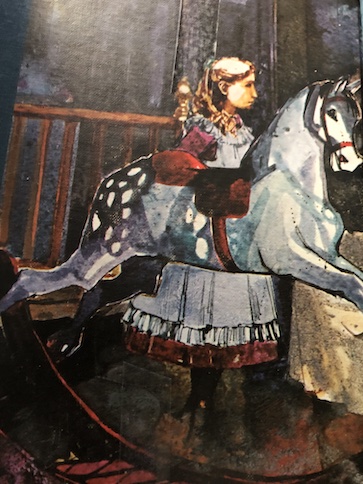
Alice shows Lucy her toys and games, which are all familiar to Lucy, looking like the ones she always played with at Aunt Olive’s house. However, Alice is spoiled and cheats at games to win. The two of them argue about it, and then Alice sends Lucy to the attic because her tutor is coming, and Alice doesn’t want her to see Lucy. Lucy finds herself in the attic in her aunt and uncle’s house in modern times, unsure of what just happened.
Over the next few days, Lucy spends part of her time with her relatives, preparing for Christmas, and part of her time in the Victorian era with Alice, which is also around Christmastime. Things are still awkward between Lucy and her cousins. On the one hand, she has some fun with them, doing things that Aunt Olive would never have allowed her to do, like going to the movies without adults and eating take-out fish and chips. On the other hand, Lucy is still overwhelmed when her cousins get boisterous, and she is repulsed by their ultra-modern Christmas decorations. Although Alice intimidates and even frightens Lucy, whenever things get overwhelming for her in modern life, Lucy retreats into the past with Alice … only for Alice to get intimidating and frightening again as she tries to keep Lucy in the past with her.
In some ways, Lucy feels more comfortable in the past than she does in her aunt and uncle’s modern home. She likes the homey feel of the house as it was in the Victorian era. The old-fashioned Christmas decorations and Alice’s party are far more charming to her than the modern ones, and she likes the old-fashioned party games better than dancing to modern music. However, Lucy becomes increasingly afraid of Alice. Alice tries to trap Lucy in the past and make her forget all about the present. When Lucy resists and tries to remember things about her family or modern times, Alice gets angry and threatens her. She says that she’ll make something bad happen if Lucy tells anybody about her. Alice has sinister intentions for Lucy. Alice is a lonely and selfish child who isn’t above lies, cheating, and manipulation to get what she wants. She exists only in the Victorian era, and what she wants more than anything is a playmate to join her for all eternity. She says that she always gets what she wants. She wants Lucy.
The book is available to borrow and read for free online through Internet Archive (multiple copies). The original British title of this book was Come Back, Lucy, which was also the title of the tv mini-series from 1978 based on the book. You can sometimes see trailers, clips, or episodes from this series online on YouTube. This fan page has more information about the tv mini-series and the book and its author.
My Reaction and Spoilers
The heart of the story is about looking back and living in the past instead of looking forward and living in the present. Aunt Olive, as an elderly woman, had a tendency to live in the past, bringing up Lucy as if she were a Victorian girl instead of a modern one. Because that was the only life Lucy knew from a young age, she clung to it after Aunt Olive’s death. It was what was familiar and comfortable to her when her life was changing, and she needed comfort. Her London relatives know that this is the case, but they’re not sure how to connect with her at first and to help her see that modern times and a new home can also become comfortable.
There’s a difference between just liking old-fashioned, vintage things and styles and the type of living in the past that Lucy does at first. There are people in modern times who still like the Cottagecore aesthetic and who try to live a slower pace of life and enjoy old-fashioned things and simple pleasures, something that came out of the coronavirus pandemic. But, just having a few vintage things and learning to slow down and appreciate the small things in life isn’t quite what Lucy does. It is the sort of thing she misses from the old-fashioned house in the country, where she used to live, but the problem is that she uses her memories of that time, Aunt Olive, and the stories that Aunt Olive used to tell her about life in the past to take her mind off the things and people in the present too much. Whenever things get stressful or upsetting to her, she retreats into past memories, so she doesn’t have to think about how her life has changed or learn to appreciate the things around her or get along with other people. Her relatives can tell that she’s shutting them out, and while they’re sympathetic to her struggling through her grief, it’s also hurtful that she’s rejecting them. She’s not just using her past memories or love of old-fashioned things for comfort but to avoid dealing with things in the present and forming new relationships.
At the same time, Lucy feels like her relatives don’t really care about her or the life she had before she came to them because they never express sympathy about Aunt Olive’s death or ask her any questions about what she was like. However, that’s due to a misunderstanding and miscommunication rather than her relatives trying to ignore Lucy or Aunt Olive’s death. If Lucy had bothered to read Aunt Gwen’s letter to her all the way through before she arrived at their house, she would have known that Aunt Gwen had told her children not to bring up the subject of Aunt Olive until Lucy did because she didn’t want them upsetting Lucy by forcing her to talk about her death if she wasn’t ready. Her relatives planned to wait for Lucy to feel ready to talk to them and for her to raise the subject herself. Because she was too upset to read the letter, Lucy didn’t understand that and has been waiting for them to talk to her first. At the end of the story, Lucy does read the letter, and she and her relatives have an honest talk about everything, including Alice. This is exactly what Lucy needs to free herself from Alice.
Alice is a similar sort of malevolent child ghost to Helen in Wait Till Helen Comes or Emily in Jane-Emily. She is selfish, and she has no concern for Lucy and Lucy’s life and future. Alice is dead, and she lives only in the past because that’s the only place where she can live. She has no future left. The one thing that past Alice is waiting for is a message from her parents, who are looking for a house in the country to buy. When the message finally arrives for her on December 21, 1873, Lucy has her final encounter with Alice on the 100th anniversary of the event. Alice is happy because she wants to move to the new house and live there with her parents, but she’s also decided that she’s going to bring Lucy with her by drowning her in an icy pond. In a frightening scene, she tricks Lucy into walking out on thin ice, but fortunately, Lucy is saved by her cousin Patrick.
After this incident and her brush with death, Lucy is finally able to release all of her bottled-up feelings about Aunt Olive and the changes in her life and explain everything to her relatives about Alice and how Alice has been influencing her to do and say things that upset them. Aunt Gwen had suspected that Lucy had seen a ghost or at least thought that she had, but she had thought that maybe Lucy had seen someone who made her think that she was seeing Aunt Olive’s ghost. Then, Aunt Gwen saw a door in the house open and close by itself, making her think that maybe the ghost was real. Rachel knew that Lucy was upset about someone named Alice because Lucy was talking in her sleep, but she didn’t know who Alice was. By the time Lucy reveals everything, all of her relatives have had encounters with Alice or things Alice caused to happen. Lucy isn’t sure when she explains things whether or not they all believe her that Alice is a real ghost. Aunt Gwen is convinced, and so is Bill because he met Alice face-to-face at one point and can describe her. Uncle Peter does consider the idea that Alice is a ghost in Lucy’s mind, inspired by all of Aunt Olive’s stories about her Victorian youth and the old house they now live in, but then, he looks through more of the things in the attic and finds Alice’s old scrapbook with her final note about moving to the countryside and starting a new life on December 21st. In the context of the story, Alice is a real ghost who posed a real threat to Lucy, and not just the imagining of a distraught child.
There are a couple of factors that end Alice’s threat to Lucy. The first one is getting past the 100th anniversary of Alice leaving the house, which seems to hold great significance to the ghost, like it was her last opportunity to connect with the house in the present. We never find out Alice’s full history or why she haunts the house as a child in the time shortly before she was supposed to move to the country. She simply disappears after her attempt to kill Lucy so she can remain in the past forever and go to her new home with her. Alice is a ghost who is conscious that she is a ghost, and she knows that Lucy lives in a different time period with people who inhabit her house in the future or present time. Because Alice is a child and seems forever stuck as a lonely child, it seems that she died young somehow and is aware of it, but we never find out exactly how that happened. I have a theory that she was killed in an accident on the way to her new home, but we are never told that. It feels like a let-down that we don’t get the rest of the story about Alice, especially because Lucy says that she would like to learn more about the historical Alice so she can think of her more as a person and less as a ghost.
There is a sequel to this book called Lucy Beware, so perhaps more of that information is revealed in the sequel. The sequel is much more rare than the original, book, though. It only rarely comes up for sale, even online. I’ve checked Amazon, eBay, Etsy, Alibris, and Abe Books, and currently, none of them have a copy. It’s not even on Internet Archive. (At least, not yet, as of this writing.) You can try to get the sequel through an interlibrary loan, but not all libraries will loan out books that are considered “rare.”
The most important factor that breaks Alice’s connection to Lucy is Lucy’s changing feelings. Lucy has some control over when she goes back in time and when she returns to the present, although it takes her a while to see it. There are times when she deliberately seeks out Alice in the past, even when Alice disturbs her, because she just finds the present time and her relatives so overwhelming. While she doesn’t really want to stay with Alice in the past forever, especially at the expense of her own life, Alice gives her someone to talk to about things that she can’t bring herself to talk about with her relatives and a place to retreat to so she doesn’t have to think about the present or her future. At one point, Lucy and Rachel are talking about the importance of making plans for the future. Rachel says that everyone needs to think of the future, and she is exhilarated by all of the possibilities that modern life has to offer for young women. However, because of her life with Aunt Olive, who lived mainly in the past, Lucy is unaccustomed to thinking about the future and finds the prospect frightening. To a woman like Aunt Olive, girls should simply receive a basic education and then get married. Beyond that, Lucy doesn’t know what she wants out of life. She has never considered having a career or learning to support herself because Aunt Olive never discussed things like that with her and never prepared her to make decisions like that. At the beginning of the story, Lucy finds it difficult to look much beyond the immediate future anyway because it seems uncertain where she will live since Aunt Olive is gone. However, once she and her relatives open up to each other and it becomes clear that they do want her to stay with them, her doubts and fears about her immediate future are resolved. She has people who love her, care about her feelings, and want her to talk to them about things, so she no longer feels so overwhelmed about her situation and in need of a retreat. Aunt Gwen says that Alice no longer has influence over her because, whether or not Alice still wants Lucy, Lucy no longer wants or needs Alice. Lucy can now face her present and future without feeling the need or temptation to escape into Alice’s past.
It’s true for people who are victims of living narcissists, too. Abusive people count on their victims being unable to leave them, and they even try to gaslight victims into thinking that they really need them in their lives, for some reason. As soon as their victims realize that they can escape and manage without them, their abusers lose their hold on them. Lucy has no more desire to return to her abuser/attempted murderer because she has dealt with the insecurities that made her vulnerable to Alice and kept her tied to the past, and she has forged new bonds with other people.
One other thing that I really liked about this story was the description of the antique games and game pieces that Lucy kept from Aunt Olive’s house. If you’ve never heard the term before, Spillikins is an old name for Pick-up Sticks. One of the more unique gaming pieces was the set of fish-shaped game counters. There were real fish-shaped game counters (link repaired 12-11-23) like that that were used in the 1800s for playing card games.
The story of Alice in Wonderland is over 150 years old, and the sequel, Through the Looking Glass, is now 150 years old, as of 2021. These books have been reprinted in many different languages and editions. The edition that I’m using for this review is actually a combined edition of the two from 1960 with added notes by Martin Gardner. (Although I used a cover image from a different edition above.) I like editions with added notes because there is quite a lot to explain about both Lewis Carroll and his stories.
I explained a lot of Lewis Carroll’s background and some of the controversies surrounding his life in my review of Alice in Wonderland. One important point about the Alice stories is that they are full of puzzles, riddles, word games, in-jokes, and parodies of poems that were popular in the author’s time. Lewis Carroll (real name Charles Dodgson) was a mathematician and scholar at Oxford, and he liked to play with logic puzzles and word games. Sometimes he would hide people’s names within poems or parts of the story by rearranging the letters of their names or using them as the beginning of lines in a poem, as an acrostic. There is an acrostic poem which is dedicated to Alice Liddell, the real girl who inspired Alice in Wonderland. This poem is printed as part of some editions of Through the Looking Glass, including the one that I’m using. The acrostic poem also references Row, Row, Row Your Boat, which is apparently older although its origins aren’t completely certain. If you read down the beginning letters of the poem, you find out that Alice’s middle name was Pleasance.
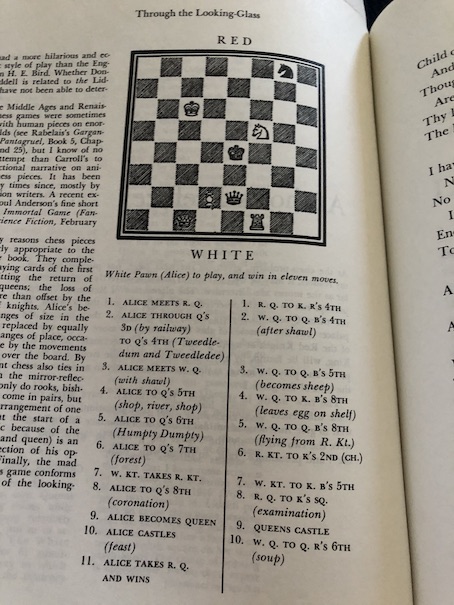
The chess game in Through the Looking Glass is meant to be part of an actual chess game with real moves that can be mapped out on a board. The game and the moves in the story are explained in the preface of my copy of the book. Alice begins as a white pawn in the game, but when she reaches the other side of the board, she becomes a queen, which is part of the rules of chess – pawns that successfully reach the opponent’s side may be exchanged for other pieces. The colors of the chess pieces in Alice’s game are red and white instead of black and white because red and white are old traditional colors. Although black and white are common today, many different color combinations have been used, and the red and white combination dates back to the Middle Ages.
The story begins on the day before Guy Fawkes’ Night. (Alice has been watching the bonfire preparations out the window.) Alice is trying to wind some yarn, and her pet cat Dinah’s little black kitten keeps playing with it. Alice chastises the kitten, and then begins talking to the kitten about the way it was watching her play chess earlier in the day. Alice likes to play games of pretend, and she starts to pretend that the kitten is the red queen from the chess game. The kitten doesn’t cooperate in posing like the chess queen, so Alice holds it up to a looking-glass.
As they look in the mirror, Alice gets the idea of a “Looking-glass House” – a house on the other side of the mirror that can be reached by stepping through it. Alice starts to imagine what it would be like to enter the world on the other side of the mirror. She gets up on the mantle over the fireplace and steps through the mirror into the looking-glass house to see what is there.
Things in the looking-glass house are very strange. The clock and the pictures seem to be alive, and so are the chess pieces. Alice helps the pieces back onto their table after they’ve been knocked off, but they don’t seem to understand what has happened and are alarmed. Alice then picks up a book on the table near the chess board and reads the poem Jabberwocky, which is about the defeat of a horrible monster. The poem is written in backwards writing, and Alice has to hold it up to a mirror to read it. The poem is a nonsense poem that contains many made-up words, which are explained later on in the story.
Alice decides to see what is outside the house. She discovers that the flowers can talk to her, but they are rude and insulting. Then, Alice encounters the Red Queen, who has grown taller than she was in the house. (The flowers say that it’s because of all the fresh air outside.) The Red Queen is both commanding and contradictory, but she gives Alice directions to other “squares”, addressing her as a chess pawn.
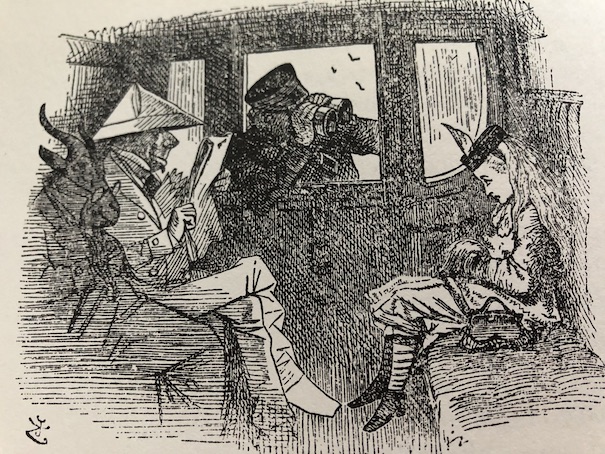
Pawns get to move two squares on their first turn, so Alice gets to go by train. In the train carriage, Alice meets many strange characters, including a gentleman dressed in white, a Goat, a Beetle, and a Gnat, who keeps whispering in her ear and suggesting that she make jokes based on puns. Through the Gnat, Alice meets other strange insects, like the snap-dragon-fly, the rocking-horse-fly, and the bread-and-butterfly. The Gnat tells Alice that the creatures in the woods don’t have names, and when Alice goes through the woods, she temporarily forgets her name, getting it back again on the other side.
Soon after, Alice meets Tweedledum and Tweedledee. (Lewis Carroll didn’t invent these characters. They are nursery rhyme characters.) They ask Alice if she likes poetry, and they tell her the tale of The Walrus and the Carpenter. (This is one of the most-quoted poems in the Alice stories – many people remember the part where they “talk of many things” – “Shoes and ships and sealing wax and cabbages and kings.”) At the end, Alice can’t decide which of the two characters she likes the best because both are sneaky and eat the oysters that trusted them, so she decides that she doesn’t like either of them. (Yeah, I can think of others stories where I’ve felt the same way.) Alice hears a strange sound, and they tell her that it’s the Red King snoring and that the Red King is actually dreaming about her right now. Tweedledum and Tweedledee insist that Alice isn’t a real person, only part of the Red King’s dream, and that she’d disappear if he were to wake up, which upsets Alice. Alice starts to cry, which she thinks is proof that she’s real, but they claim that those aren’t real tears. Finally, Alice decides that they’re just talking nonsense and that there’s no point in crying over it. Tweedledum and Tweedledee want to have a battle (as in their poem), but a large crow interrupts them and frightens them away by producing a great wind.
Alice catches hold of a shawl that was being blown away by the wind and returns it to its owner, the White Queen. The White Queen speaks very strangely, and she says that it’s an effect of living backwards. Because she lives backwards, her memory works both ways, and she can remember things that haven’t happened yet. The White Queen screams with pain before she pricks her finger, so she doesn’t have to do it again after her finger is hurt. Alice cries when she talks about how lonely she is in the woods, and the White Queen distracts her by telling her to consider things because no one can think of two things at once (which is true). The White Queen talks about considering and believing impossible things (sometimes she believes “six impossible things before breakfast” – one of the most famous lines that is often quoted from this story).
As Alice asks the White Queen if her finger is better, she suddenly and inexplicably finds herself in a shop and talking to a sheep, who asks her what she wants to buy. Alice tries to look around, and the Sheep asks her if she’s a child or a teetotum (a kind of spinning top used in old games, sometimes by itself and sometimes as a replacement for dice or a spinner – dreidels are a kind of teetotum) because of the way she’s turning around. The Sheep is knitting and keeps picking up more needles to knit with. For awhile, the shop disappears, and Alice finds herself in a boat with the Sheep, but then the shop returns, and the Sheep asks her again what she wants to buy.
Alice decides to buy an egg, and the egg that she buys turns into Humpty Dumpty when she approaches it. Humpty Dumpty is a bit rude and insults Alice’s name because he doesn’t think it means anything. Alice mistakes Humpty Dumpty’s cravat for a belt because he’s egg-shaped and doesn’t have a true neck for wearing a tie. Humpty Dumpty reveals that the cravat was an un-birthday (a concept that Lewis Carroll invented) present from the White King and Queen. All through the conversation, Humpty Dumpty uses words in unusual yet strangely nit-picky ways, making words mean only what he wants them to mean in the moment. Because he’s so particular about the meanings of words, Alice asks Humpty Dumpty about all the strange words in the Jabberwocky poem, and he explains what the made-up words mean. Humpty Dumpty recites another poem for Alice that doesn’t seem to have a true ending and then abruptly dismisses her.
As Alice leaves, she meets the king with all of his horses and men (from the Humpty Dumpty nursery rhyme) and is introduced to one of his messengers. Alice is amused by the name and description of the messenger and starts playing a game of “I Love My Love” out loud with the messenger’s name. (The two messengers are called Haigha and Hatta and are shown looking like the March Hare and Mad Hatter from Alice in Wonderland in the illustrations.) The messenger informs the king that the lion and the unicorn are fighting for the crown again (another nursery rhyme reference). The king says that it’s all a joke because the crown is his and neither one of them is going to get it no matter which of them wins the fight.
The unicorn is amazed to meet Alice because he never knew that children were real before. As at the end of the rhyme, they are given plum cake, and they hand the dish to Alice for her to cut the cake. However, Alice finds that she can’t cut it, so they ask her to hand the cake around first and then cut it afterward, which surprisingly works.
After the others are drummed out of town, also as part of the rhyme, the Red Knight attempts to capture Alice, but the White Knight shows up to save her. The White Knight tells Alice all about his inventions, none of which make any sense, and sings her a song which apparently has several names and is set to the tune of a song Alice recognizes as “I give thee all, I can no more” (which is another name and the first line of the song which is really titled My Heart and Lute, which is part of the on-going joke about the song’s real name).
Then, Alice reaches the final square of the board and becomes a queen, finding a crown suddenly on her head. The Red Queen and the White Queen appear suddenly, and the Red Queen tells her that she must pass an examination before she can truly become a queen. The queens ask her a series of questions that are supposed to be math questions but are actually a combination of riddles and nonsense. Their general knowledge questions are a combination of nonsense and puns. Eventually, the Red Queen and White Queen both fall asleep to a parody of “Rock-a-bye Baby.”
Alice finds herself in front of a door labelled “Queen Alice,” but the old frog who comes to the door doesn’t seem to want to let her in. Alice enters anyway and sits next to the Red Queen and White Queen. They introduce her to the food being served at the feast, but they don’t actually allow her to have any because it isn’t polite to cut and serve something you’ve been introduced to, and the plum cake verbally protests when Alice tries to serve it anyway.
The White Queen tells Alice a riddle in poem form about fish. The riddle is never answered, but everyone drinks to Alice’s health. The Red Queen tells Alice that she should make a speech, and as she gets up, many strange things begin happening in the room. Alice thinks that the Red Queen is responsible and grabs hold of her, threatening to “shake her into a kitten.” Alice suddenly wakes up, holding her little black kitten.
Like in Alice in Wonderland, everything that Alice experienced was a dream. However, the end of the book poses the question of whether the dream was Alice’s or the Red King’s. The question is never answered; it’s just something to make the readers think. That’s actually what I like most about the Alice stories, that they are partly meant to make the reader think. The stories are somewhat disjointed and constantly changing, kind of like dreams do, but I appreciate all the references and parodies in the stories.
Young Sally’s parents are away on a business trip, so she’s been staying with Mrs. Chipley, but now Mrs. Chipley has a family emergency to tend to. Mrs. Chipley’s daughter is ill, and Mrs. Chipley needs to go and help her with her children. While Mrs. Chipley is gone, there is only one other person for Sally to stay with: her Aunt Sarah, an elderly woman who Sally doesn’t really know. Aunt Sarah moved to California when Sally was just a baby, and the only reason why she has returned is that she has decided to sell her old house.
Sally is a rather shy girl. She’s uneasy around Aunt Sarah, who is obviously unaccustomed to spending time with children, and Aunt Sarah’s creepy cat, Shadow. The house is old, chilly, and filled with strange things. However, Sally is enchanted with the bedroom that Aunt Sarah gives her and the portrait of a girl and her doll that hangs on the wall. The girl looks very much like Sally herself, and Aunt Sarah tells her that the girl was also called Sally and lived in that bedroom as a child, many years ago.
Fascinated by this earlier Sally and her beautiful doll, modern Sally decides to try to find the doll. Although her aunt tells her that she shouldn’t go poking around in the attic, Sally can’t help herself. She finds a trunk with Sally’s name on it full of girls’ clothes, just the right size for modern Sally to wear. There is a doll in the trunk also, but it’s not the same doll as the one in the portrait. When Sally reads the diary in the old trunk she learns the reason why. The doll in the picture, Elizabeth, was lost many years ago, when the earlier Sally was still young. As modern Sally plays dress up with the earlier Sally’s old clothes and studies herself in the mirror, she finds herself taken back in time, seeing the house through earlier Sally’s eyes. In the past, it was a busy and happy household with parents, an elderly aunt, earlier Sally, Sally’s little brother, and Sally’s pet cats.
A short time later, Aunt Sarah wakes modern Sally on the floor of the attic, and they assume that it was all a dream, but this look into the past changes Sally’s feelings about the house and her aunt’s cat, who suddenly seems friendlier and reminds her of the mother cat she saw in the past. Aunt Sarah also seems a little less stern as they discuss earlier Sally and her lost doll. Aunt Sarah says that no one ever saw the doll again after it disappeared on Christmas Eve all those years ago. Earlier Sally had put the doll on top of the Christmas tree, like an angel, and after the family finished singing Christmas carols, the doll was gone. They could never figure out what happened to her. Modern Sally thinks that sounds very sad and wants to investigate the mystery of the missing doll, although Aunt Sarah isn’t very enthusiastic. She says that if the doll could be found, it would have been found long ago, and the earlier Sally has long since grown up and no longer needs it. Although, oddly, Aunt Sarah remarks that the earlier Sally had always thought that Elizabeth was “a little bit magic.”
Modern Sally continues to look for the doll anyway and also continues having moments when she sees the past as the earlier Sally did many years ago, especially when she looks into the mirror in the attic. One day, she invites a neighbor girl named Emily over, and while the two of them are looking around the attic, Emily finds Elizabeth’s old doll bonnet. The girls are excited because they now know for certain that Elizabeth is still in the house, waiting to be found. The girls are running out of time to find her. If Aunt Sarah agrees to sell the house, it will be torn down to build apartments. But, Sally falls ill with the flu, and it isn’t until Shadow gives her an important clue that Sally realizes where Elizabeth must be.
This book is currently out of print, but it’s one that I’d dearly love to see in print once more! It is available to borrow and read for free online through Internet Archive.
My Reaction and Spoilers
Adults reading this story will probably realize before the children do (spoiler) that Aunt Sarah herself was the earlier Sally, the one who lost her favorite doll many years ago. “Sally” is a nickname for Sarah, like “Molly” can be for Mary and “Peggy” can be for Margaret, although any of those names can also be used by itself. (In the Middle Ages, it was common for popular names to get different variations of nicknames by changing one sound in the original name and then changing one more sound in the first nickname to get another one, and sometimes even moving on to change one more sound to get yet another nickname that was very changed from the first. Those nicknames that look significantly different from their original names are a holdover from that practice, having lasted even into modern times. John/Jack works on the same principle. Fun fact!) When Aunt Sarah grew up, she stopped using her childhood nickname, but the name was passed on to modern Sally.
At first, modern Sally sees her stern aunt as being witch-like, all dressed in black and fussy, but gradually, the memories of the past, her new relationship with young Sally, and the finding of her slightly-magical doll soften her. There are hints of Aunt Sarah’s youth in the attic, although Sally at first dismisses thoughts that some of the lovely things there could have belonged to her cranky old aunt because she has trouble thinking of her aunt as once having been young, pretty, and sweet. However, part of the theme of the story is that everyone was young once. Aunt Sarah is is bent and achy from arthritis, giving her the witch-like appearance and making her short-tempered at times. She also hasn’t been around children much for years, and part of her fussiness comes from forgetting what it was like to be young herself. Modern Sally, with her resemblance to her elderly aunt, and Elizabeth the doll both work their magic on her, reminding her what it was like to be a young girl and helping to revive a more youthful spirit in her.
I was happy that (further spoiler) Aunt Sarah decides not to sell the house after all, not just because she and Sally will get to spend more time together, but because old houses like that are rare these days. I like the idea that the old family heirlooms in the house will now be preserved, like the sleigh out in the old barn and the melodeon, a type of small organ. I liked the way the book described the melodeon making musical sounds as people walk past it because of the way the floor boards move. I also loved the description of the gas plant that Sally sees in earlier Sally’s memories. If you’d like to see what a gas plant looks like when it’s lit, have a look at this video on YouTube.





 Jestress's Forgotten Books and Stories