The Day of the Ogre Kachinas

The Day of the Ogre Kachinas by Peggy D. Spence, 1994.

My Dog, Betty

First, I would like to apologize for the cover picture above. This book was in better condition when I first got it. Then, I accidentally left it where my dog could play with it. Oops. She greatly enjoyed this book, which was printed on high-quality and apparently tasty paper, and thought it was a lot of fun, although she found it very difficult to get through. In fact, she did not get past the cover. (Thank goodness.) I enjoyed it much more.

The story is set in a Hopi town in Arizona (my home state!) and features Hopi traditions about kachinas. The introduction to the book explains a little about kachinas, which are spirits that represent concepts in the natural world. In Hopi ceremonies, men dress up as these spirits and dance or act out certain rituals. The ritual in this book is that of the Ogre Kachinas, which is meant to influence children’s behavior, teaching them what their community views as right and wrong and letting them know when they have overstepped the boundaries of their community. (I don’t know if eating the cover of a book counts as overstepping, but I promise that no doggies were harmed or even frightened as part of this book or the reading of it.)

Judson Honyouti, a young Hopi boy, is not a bad kid, but sometimes, like many other kids, he does things that he shouldn’t do. Sometimes, he forgets things or loses his temper and fights with people. His parents and the other adults in his village try to teach him the right things to do, but sometimes, he needs a little extra help to remember.

Judson is nine years old, and he knows that when he sees kachinas in a ceremony, it is only some of the men in his village, wearing costumes. He hopes that when he is old enough, he may become one of the kachina dancers himself, but for that to happen, he must follow his people’s ways and be a good member of his community. To be a good member of his family, Judson helps his father to take care of their cornfield and helps to look after his little sisters, but he still sometimes gets into trouble.
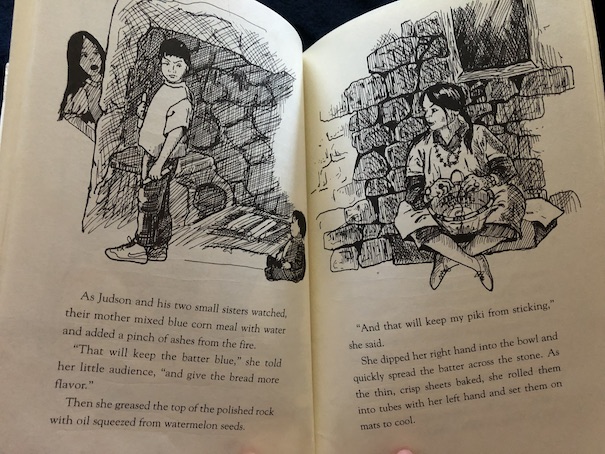
One day, Judson falls asleep while tending his family’s sheep, and most of them wander off. His father has to help him find the sheep again. Then, when his mother asks him to take some stew to his grandfather, Judson drops the bowl because he is playing and not paying attention. To make up for losing the stew, Judson gives his portion to his grandfather. Then, when Judson is supposed to be helping his mother to make piki (or paper bread) so that she can use it to trade in the market, Judson gives into temptation and eats too much. He has to help her make more.

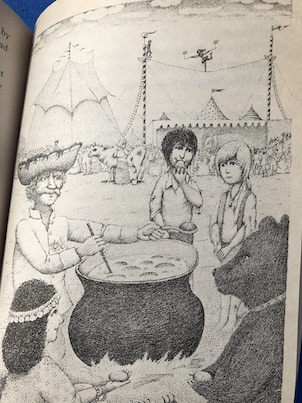
In the market in the plaza, the Ogre Kachinas (really, men dressed up in costume), frighten the children and warn them that they must obey their parents. The Ogre Kachinas like to eat naughty children (but not really), and they say that they will return again soon to see if the children have been good. If they have been bad, the Ogre Kachinas might carry them away!

Even though Judson knows that the Ogre Kachinas are just human beings, their warnings worry him because he knows that he has been doing things wrong and has been getting into trouble. In spite of Judson’s attempts to do better, he still keeps getting into trouble. He fights with his sisters and even hits two other boys when he gets into fights at school. His father warns him that the ogres might come for him if he doesn’t behave, and sure enough, the Ogre Kachinas come one night.

The Ogre Kachinas dance around Judson and his parents and confront Judson with their knowledge of all of the things that Judson has been doing lately. They threaten to take Judson away and eat him because they like to eat bad boys! Even though Judson knows that the kachinas are just ordinary humans in disguise, it’s an alarming performance! However, as part of this tradition, Judson’s parents speak up for him and tell the Ogre Kachinas to leave Judson alone.
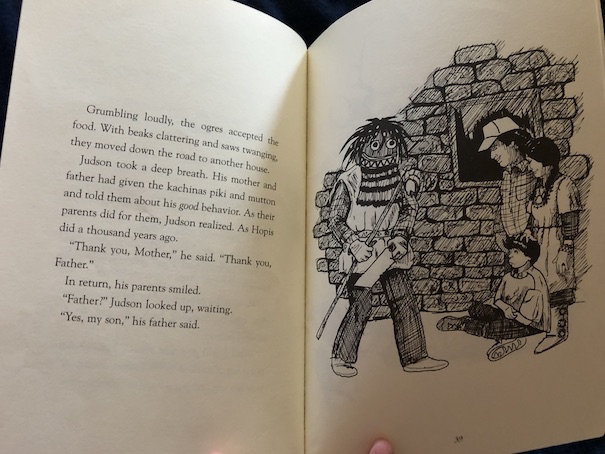
It’s true that Judson has done things that he shouldn’t have done, but in many cases, he also did something to try to make up for what he had done wrong, like when he gave his portion of the stew to his grandfather to make up for the portion that he had ruined. He gets into trouble, but he is also polite and helpful in many ways. His parents say that he is actually a good boy and would make the ogres sick if they tried to eat him. Judson is relieved to hear that his parents love him and value the good things he does, even when he isn’t perfect. The Ogre Kachinas not only remind children of what they are not supposed to do but provide an opportunity for the parents to explain that they value their children and what the children do right. As Judson’s parents give the kachinas gifts of food and send them away, Judson realizes that their parents must have done the same for them when they were children and that the same thing has also happened for all Hopi children for generations.

I like books that include a little history and interesting information about cultural practices, but I also like this book for its understanding of human nature. First, I grew up in Arizona (in the American Southwest, for those who live outside of the United States), where this story is set. Although I am not Native American and didn’t grow up on an Indian Reservation, like Judson, I knew about Kachinas and was fascinated by them when I was growing up. I read books about Kachinas, and I loved the display of Barry Goldwater’s Kachina doll collection at the Heard Museum when I was a kid. I used to remember more of the individual names of different kinds of Kachinas and could point out the different ones in the Goldwater collection, but I’ve forgotten some of them as an adult. These things slip away if you don’t reinforce them. The book describes how Kachinas function in Hopi culture. There are different kinds that perform different ceremonial functions, but the main ones in the story are the Ogre Kachinas, which are meant to help frighten children into good behavior.

The need for both positive reinforcement and negative reinforcement is a real part of the human condition. Negative reinforcement has a bad reputation in modern times for making people feel scared or ashamed, and I think that it isn’t enough to have just negative reinforcement (punishment or criticism for things that a person has done wrong) or just positive reinforcement (praise for doing things right) by itself; I think they function best as a pair, the way they do in this story. It isn’t enough to just tell people what not to do (negative reinforcement) because it often leaves them wondering what they should have done instead, and it’s not enough to just give them praise with no criticism because it leaves them with the feeling that they do nothing wrong, and they’re often surprised later when they find out that things they’ve been doing have been seriously getting on everyone’s nerves all along. I think an over-reliance on positive reinforcement alone is part of the modern phenomenon where people don’t realize that they’ve been acting like bullies or saying really inappropriate things for years because, somehow, no one clued them in earlier in life. I’m pretty sure that I know why that is: it’s difficult to be the bearer of bad news or criticism that someone has gone too far with their behavior, to play the role of the disciplinarian, the “rules police” who has to stop the game to tell someone they’re not playing right. In an odd sort of way, the Ogre Kachina costumes probably make it easier for the elders of the community to dish out the criticism and discipline because they’re not quite doing it as themselves; they’re doing it in disguise as the horrible “ogres.”

To help people understand how they’re really supposed to behave in society, they need to know both what they’re not supposed to do and what people really want them to do instead. Judson gets both kinds of feedback in the story during the Ogre Kachina ceremony. First, he is confronted by what he has done wrong, and then he gets to hear his parents explain what he has done right in order to emphasize both what they love about him while helping him to realize what he needs to fix in order to be a better person in their society. Having a child confronted by scary ogres that threaten to eat him for doing things wrong sounds pretty scary, but the book does note that Judson is old enough to know that the Kachinas are just people in costume. Even though he’s kind of scared at being confronted by them, and for a moment, he does feel like they’re really threatening to eat him, he is aware that they are not what they appear to be and realizes that it’s all part of the ceremony. It also means that he is old enough to accept the rebukes as the consequences of their behavior, and he finds his parents’ praise of his good deeds as a motivator to do even better next time, not as an excuse for the things he did wrong.

By the way, Betty the dog was not punished for eating the book cover. I just took the book away from her and gave her a toy she could chew on instead. She is a good doggy, and I should not have left the book where she could get it. Bad Tracy!

The book is available to borrow for free online through Internet Archive.

Vampires Don’t Wear Polka Dots

The Adventures of the Bailey School Kids

#1 Vampires Don’t Wear Polka Dots by Debbie Dadey and Marcia Thornton Jones, 1990.

The kids in the third grade class at Bailey Elementary School have been pretty hard on their teachers. Their last teacher resigned when she suffered a nervous breakdown due to their misbehavior and pranks. Now, the kids have a new teacher, Mrs. Jeepers.

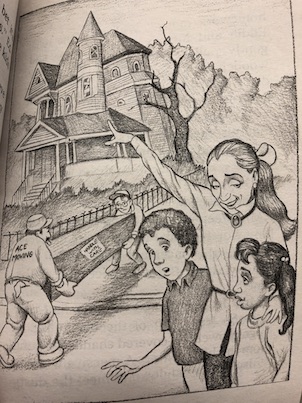
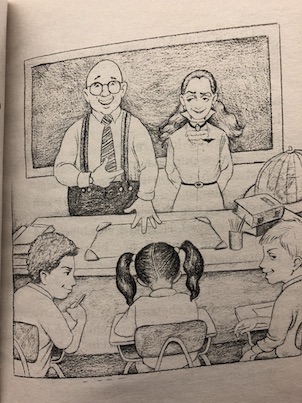
Mrs. Jeepers has just moved to their city from Transylvania, and everyone in class agrees that she’s not a normal teacher. She seems to have a hypnotic power over people, and her mysterious green brooch seems to glow and have magic powers. Not only that, but she has moved into a creepy old house in the neighborhood with a long box that could contain a coffin. Could Mrs. Jeepers be a vampire? No one knows, but none of the kids want to risk making her angry, except maybe Eddie, the class trouble-maker.

Mrs. Jeepers lays down the class rules on the first day. The rules are basically that the students should treat her and each other nicely, talk only when appropriate, and walk instead of run. Eddie asks her what happens if they break the rules, and Mrs. Jeepers only replies, “I hope you never have to find out.” Most of the other students are nervous about creepy Mrs. Jeepers and do their best not to make her angry, but Eddie is annoyed by how good the others are being and tries to various antics to get Mrs. Jeepers angry and make the other kids goof off, like normal. Sometimes, Mrs. Jeepers stops these antics, apparently with the power of her mysterious brooch.

Mrs. Jeepers is strangely evasive about her past, although she mentions that her husband is dead. He is the one who gave her the bat charm bracelet that she wears. Eddie and Melody try sneaking into Mrs. Jeepers’ house one night to see if they can get a look at the long box that might be a coffin, but they are unable to actually open the box, which seems to be locked from the inside.

The question of whether Mrs. Jeepers is really a vampire is never settled. Unlike most mythological vampires, she seems to have no problem going outside during the daytime. When the kids test garlic on her, it makes her sneeze. She does seem to have a strange power to make the children behave themselves, but that is partly because they are afraid of making her angry. At the end, Eddie finally causes Mrs. Jeepers to lose her temper. She takes him out of the classroom for a moment to talk to him, and when they return, Eddie seems to have been badly frightened by something. He never tells the others exactly what Mrs. Jeepers said or did, but he says that she is not normal and that he’ll never do anything to make her angry again.

When the book ends, it says that the children got through the rest of the school year with Mrs. Jeepers without getting her angry or seeing her brooch glow again, making me think that the book wasn’t always intended to be part of a series. However, for the rest of the series, the kids are still in the third grade with Mrs. Jeepers as their teacher.

The fact that the kids can never really prove that Mrs. Jeepers is a vampire, although they continue to believe it throughout the series, sets up the pattern for the books that follow it. Throughout the series, the kids encounter other people (including some relatives of Mrs. Jeepers) who seem strange and may be creatures from mythology or folklore or other supernatural beings, but the books always leave some room for debate. Mrs. Jeepers is the only one of these strange people to remain with the kids throughout the entire series. Other characters come and go, although there are a few recurring characters.

I always like it when children’s books reference other children’s books. In the beginning of the book, after their first teacher leaves, the kids worry about who their new teacher will be, and they make a reference to Miss Viola Swamp from the Miss Nelson books.

The book is available to borrow for free online through Internet Archive.
The Whipping Boy

The Whipping Boy by Sid Fleischman, 1986.

Jemmy is an orphan who lives in the royal castle as the prince’s new whipping boy.  Prince Horace, or Prince Brat, as the prince is commonly called, is known for constantly misbehaving, playing mean pranks, and refusing to do his lessons (he tells his tutor that he doesn’t need to learn how to read because he could always get someone else to do his reading for him).  However, in their land, it is illegal for anyone to use any kind of physical force or punishment on a prince.  Instead, the royal family employs a whipping boy to take the prince’s punishments for him.  As you can imagine, seeing someone else whipped in his place does little to correct the prince’s bad behavior.  In fact, the prince usually likes the spectacle of the whipping boy yelling.  He doesn’t like it that, unlike the others, Jemmy never yells when he’s whipped.

Jemmy was recruited for the role of whipping boy off the streets, where he survived by being a mudlark and rat catcher.  There are benefits to living in the palace, even if his purpose in being there is to take the prince’s punishments.  Jemmy gets food to eat and nice clothes to wear and attends the prince’s lessons with him, where he pays attention when the prince does not.  Jemmy actually loves the books and learning he receives.

After about a year, though, the prince suddenly comes to Jemmy in the middle of the night and tells him that he’s running away from home and wants Jemmy to come with him as a manservant.  When Jemmy asks him why he wants to leave, the prince says that he’s bored.  Jemmy wonders why Prince Brat wants him to come along instead of a friend, but then he realizes that, as nasty as he is, Prince Brat doesn’t have any real friends.

When the two of them are outside of the palace, Jemmy is tempted to run off and leave Prince Brat to fend for himself, but before he can make up his mind about it, the two boys are taken prisoner by bandits, Cutwater and Hold-Your-Nose Billy (named for all the garlic he eats).

Prince Horace tries to pull rank on the bandits, telling them who he is and ordering them to go away.  It’s a mistake.  When the bandits see the royal crest on the saddle of the horse that the boys are riding, they decide that they can probably get a good ransom for the prince.  Since neither of the bandits can write, they try to make the prince write his own ransom note, but of course, Prince Brat can’t write because he’s refused to learn. 

Jemmy, seeing an opportunity to turn the situation around, offers to write the note instead.  As Jemmy suspected, when the bandits realize that he can write and Horace can’t, they start assuming that he’s actually the prince and that the two boys have switched places.  After writing the note, Jemmy suggests that they let the “whipping boy” (Horace) take it to the castle, thinking that not only will Horace get safely away but that he’ll be rid of Horace after that.

To Jemmy’s surprise, Prince Horace ruins the whole scheme by refusing to return to the castle.  Jemmy tries to reason with him, but Horace says that he won’t go home until he’s ready.  The boys to manage to slip away on the bandits, and Horace insists on following Jemmy even though Jemmy wants to be rid of him.

Although Jemmy can’t understand why, Horace says that he’s having the time of his life.  For once in his life, he doesn’t have people fussing over him and telling him to keep his clothes clean.  Horace has found palace life stifling and boring, and he feels like his father hardly notices him or cares.  Part of the reason why Horace acts up is to get his father’s attention.  Jemmy is surprised by these insights into the prince’s life and character, and he is also surprised that, when he finally gets the chance to slip away and leave Horace behind, he can’t do it.  He knows that Horace isn’t used to life outside the palace, and Jemmy worries about what might happen to him if he’s left alone, although he tells himself that Horace could always return to the castle.

Before their adventures are over, Horace gets to experience what it’s like to do chores for himself and even to be whipped by the bandits, when they think he’s the whipping boy.  Being whipped himself shows Horace what he has subjected others to on his account.  Jemmy is surprised that Horace bears the punishment without crying or complaining, something which Horace says that he learned from watching Jemmy, who made it a point to take whippings with quiet dignity.  Horace also learns what other people really think of him when a woman at a fair comments on the prince’s disappearance, using the “Prince Brat” nickname and saying that the young prince is a “terror” and bound to be a terrible king when he’s older.  Usually, people are careful about what they say in front of the prince, and Horace is shocked to find out how disliked he is because of his bad behavior.  However, Horace’s new experiences and realizations bring a change in his outlook and personality that make him more sympathetic and likeable.  There is also the realization that what Horace really needs in his life isn’t a whipping boy to take his punishments for him but someone who can be a real, honest friend with him, like Jemmy.

In the end, Jemmy becomes the prince’s companion, not his whipping boy, so that the prince will be less lonely and stop acting out to get attention.  The king promises that Horace can keep Jemmy as his companion and his responsibility as long as Horace himself can behave responsibly and do his lessons as he should.

Although the country and characters in the story are fictional, the practice of keeping a whipping boy so that princes wouldn’t have direct physical punishment was a real practice.  Even today, the term “whipping boy” can stand for a person who takes blame or punishment in the place of someone with higher rank or authority, even when the person of higher rank is the one at fault.  For example, if a business manager or CEO makes a bad decision and orders one of his employees to do something they shouldn’t and the employee gets the blame for it as if what they did was their idea and not the boss’s, that employee can be considered the “whipping boy.” Another example would be if a stepchild in a family was given blame or punishment in place of a biological child because of favoritism on the part of the punishing parent (similar to the crude saying “beaten like a red-headed stepchild“). In fact, depending on the circumstances, a “whipping boy” might not even be a person, but a thing or a concept that is blamed instead of the person or thing that is the true cause of a problem, such as blaming “modern society” or “kids these days” for an individual’s bad habits or behavior, “the government” or “the system” for a business’s bad decisions or policies, or “millenials” for practically everything they’ve been blamed for by older people. It is similar to the concept of the “scapegoat” or “fall guy” but with the connotation that the person who is really at fault, the one who is trying to avoid blame or punishment, succeeds because of higher rank, authority, seniority, or some other form of favoritism among those who will assign blame or punishment.

This book is a Newbery Medal Winner and is available online through Internet Archive (multiple copies).

There is also a movie version of the book, sometimes called Prince Brat and the Whipping Boy.  The movie follows the concept of the original story pretty well, but it elaborates more on Jemmy’s life before he became the whipping boy and on how Horace feels neglected by his father.  In the movie, Jemmy is pressed into service as whipping boy by the king’s soldiers, who don’t bother to find out if he has any other family.  Although Jemmy is an orphan in both the book and movie, in the movie, he also has a younger sister he looks after, and part of what he wants to do when he leaves the palace is to find her.  The boys together learn that the younger sister was arrested for attempting to steal a handkerchief in Jemmy’s absence, and they have to rescue her from prison, a side adventure that didn’t occur in the book.  In the movie, Horace also explains to Jemmy that his mother died in a riding accident when he was young and that his father pays more attention to affairs of state than he does to him.  Horace is shown multiple times trying to get his father’s attention, only to be brushed off because his father is too busy.  In the movie, the king almost declares war on another country, thinking that Horace was kidnapped over a border dispute, something that didn’t happen in the book.  In both the book and the movie, Jemmy’s new friendship with Horace brings about a change in the prince.  At the end of the movie, both Jemmy and his sister are taken in to the palace as companions for Horace. Sometimes you can find this movie or clips of it on YouTube. Although it was originally released on VHS, it is currently available on DVD.

Miss Nelson is Back

NelsonBack

Miss Nelson is Back by Harry Allard and James Marshall, 1982.

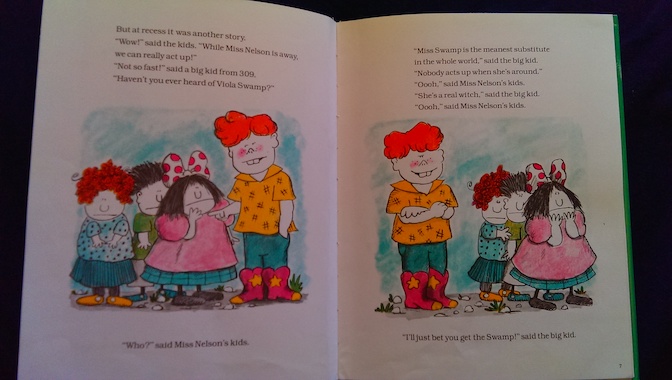
Miss Nelson, a teacher, tells her class that she will have to be away for awhile, having her tonsils removed, so someone else will be teaching their class.  At first, the kids think that they’ll be able to get away with a lot while Miss Nelson is away, but an older kid warns them that their substitute will probably turn out to be Viola Swamp, the meanest substitute ever.

NelsonBackWarning

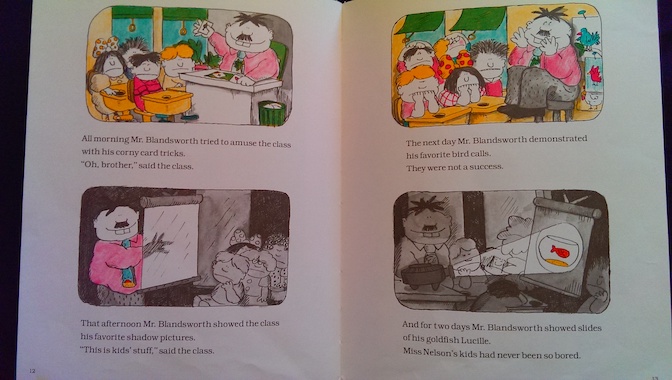
The kids are nervous until they find out that Mr. Blandsworth, the school principal, will be their substitute himself.  The worst thing about Mr. Blandsworth is that he’s boring, and he tends to treat them like they’re little kids.  They put up with it for awhile, but then, they realize that they can get rid of Mr. Blandsworth by convincing him that Miss Nelson has come back to school.

NelsonBackPrincipal

They put together their own Miss Nelson costume, with some of the kids sitting on each other’s shoulder’s to appear taller in the outfit.  It’s cheesy, but it convinces the principal.  But, the kids take it even farther than that.  Now that there’s no substitute teacher, they can do whatever they want!  Their “Miss Nelson” takes the class on an impromptu field trip to the movies and the ice cream parlor, and no one stops them because they’re with their “teacher.”

NelsonBackFieldTrip

Unfortunately, they make the mistake of walking past Miss Nelson’s house, and she discovers what they’ve been doing.

NelsonBackReveal

Miss Nelson arranges for Miss Viola Swamp to come and teach the class a real lesson.

NelsonBackSwamp

The book is currently available online through Internet Archive.

My Reaction

I actually like this book even better than the first book in the series because I think that the kids’ Miss Nelson costume is hilarious! Mr. Blandsworth is completely clueless about the kids’ deception, just as he never figures out what the real truth is about “Viola Swamp.”

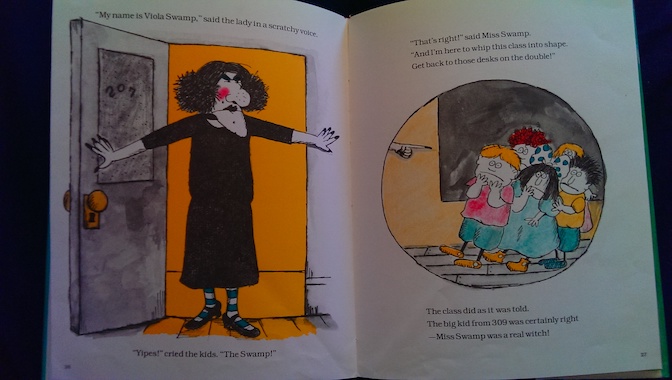
As usual for the series, the story never explicitly states that Miss Nelson and Viola Swamp are the same person, but it’s heavily implied in the text (such as Viola Swamp’s scratchy voice from Miss Nelson having her tonsils out) and shown in clues in the pictures. Miss Nelson uses “Viola Swamp” as her alter ego whenever she needs to give her students some tough love, but that’s just a joke that Miss Nelson shares with the readers.