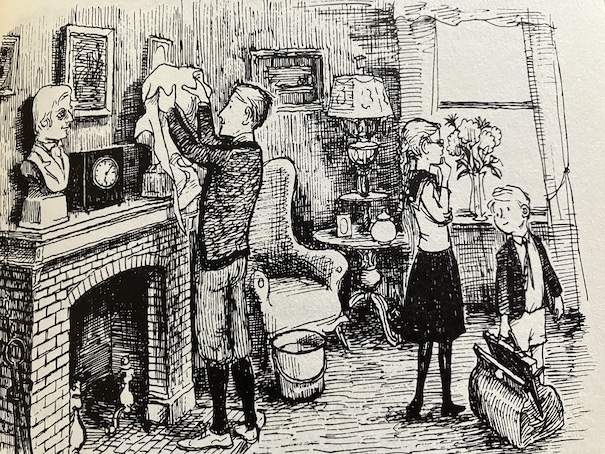
Eleanor and Edward Hall are orphans who live with their Aunt Lily and Uncle Frederick in their family’s big but somewhat shabby old house in Concord, Massachusetts. The family has lived there for generations, and they are intellectuals with a particular interest in the literary history of Concord. Uncle Freddy is obsessed with Ralph Waldo Emerson and Henry Thoreau, although he doesn’t share Eleanor’s love of Louisa May Alcott. When a couple of the town leaders threaten to take the family’s house because of unpaid back taxes and to destroy it because they think it’s an eyesore, the children come to learn that their house holds more secrets and history than anyone knows.
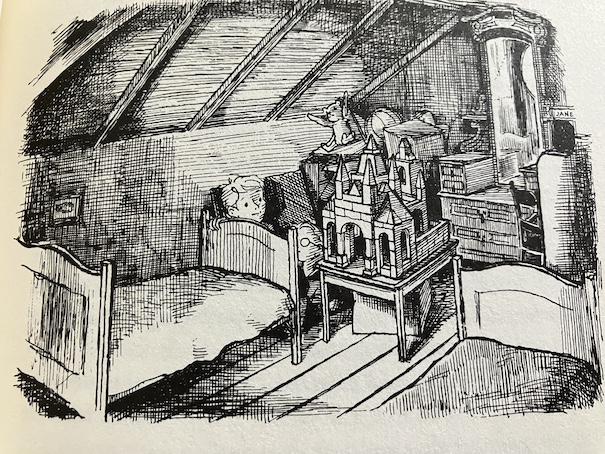
As Eleanor and Edward look at the house from the outside, they suddenly realize that there’s an window at the top of the house that’s shaped like a key and made of colored glass. They’ve never seen that window from the inside of the house, so there must be a secret room! The children search the attic and find a trap door that they never realized was there before. When they look into the hidden room, they find a pair of children’s beds and toys.
The children ask Aunt Lily about the room, and she sadly admits that she hadn’t wanted to tell them about it. Then, she begins to explain more about the family’s history and the aunt and uncle the children never knew. Aunt Lily is their father’s sister, and Uncle Freddy is their brother, but there were once two more children in the family, called Ned and Nora. Eleanor and Edward were named after them, but Ned and Nora mysteriously disappeared years ago. Aunt Lily still believes and hopes that, somehow, they will return someday, so she has always kept their room ready for them.
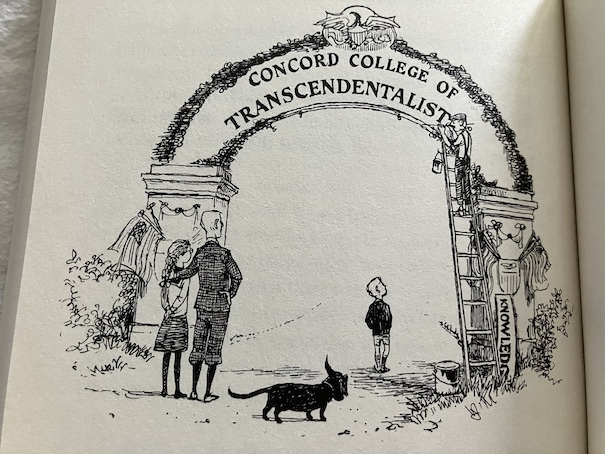
When she shows the children pictures of Ned and Nora in the family’s album, they also see a picture of a young man in a turban and ask about him. Aunt Lily says that the man is Prince Krishna, son of the Maharajah of Mandracore. Their Uncle Freddy has written books about Emerson and Thoreau and was once considered an expert on the Transcendentalists. People who were interested in Transcendentalism, like Prince Krishna, used to come and study with him. Aunt Lily wasn’t really interested in Transcendentalism, but she explains, “I think he said that the Transcendentalists believed that men’s minds were very wonderful, and that they could know all kinds of important things without being taught about them through their eyes and ears –because they were part of something called an Over-Soul.” Eddy approves of this concept because it sounds like it’s about learning without school, and he approves of anything that involves no school.
Everyone was fond of Prince Krishna while he lived and studied with the family, and Aunt Lily said that he used to make up fun games for Ned and Nora, like treasure hunts with real jewels as prizes because the prince was very rich. The children get the sense that Aunt Lily was in love with Prince Krishna, but he also vanished shortly after Ned and Nora did. When they discovered that Ned and Nora were missing from their beds one morning, Prince Krishna dashed around, looking for them, but suddenly, he was also gone, and no one knew where or how.
Eleanor and Eddy return to Ned and Nora’s room upstairs to have another look at it, and they find a mysterious poem called “Transcendentalist Treasure.” From the handwriting, which matches a note that Prince Krishna wrote to Ned and Nora with a present he gave them, Eleanor and Eddy realize that Prince Krishna also wrote the poem. Since the poem seems to be some kind of treasure hunt, the children think that it was probably part of the treasure hunts that Prince Krishna used to make for Ned and Nora. They try to figure out what the clues in the poem mean and what it might lead to, hoping that it might be the jewels that Aunt Lily told them about and which haven’t been seen in the house since Ned, Nora, and Prince Krishna vanished. If they could find those jewels, they could pay the back taxes and save their house!
However, they don’t really begin to grasp the full importance of the poem until they ask Aunt Lily if they can spend the night in Ned and Nora’s room. During the night, they have a bizarre dream, in which they’re climbing an elm tree with Ned and Nora and find a harp, which is something that was mentioned in the poem. A dangerous wind blows them out of the tree, and they wake up. They could have believed that it was only a dream except that they realize that they both dreamed the same thing, Eleanor has bruises and a scratch on her leg that she got from falling out of the dream tree, and Eddy has located the harp in Ned and Nora’s bedroom.
They show the harp to Aunt Lily, and she says that Prince Krishna had given it to Ned and Nora years ago, hanging it in a tree so that they would hear the wind blowing across it. The poem and the dreams that Eleanor and Eddy have seem to be hinting at the treasure hunts that Prince Krishna had with Ned and Nora. Eleanor and Eddy begin to think that solving the riddles in the poem may not only lead them to the jewels but to the truth about what happened to Ned, Nora, and Prince Krishna.
The book is available to borrow and read for free online through Internet Archive.
My Reaction and Some Spoilers
The book introduces the concept of Transcendentalism. I remember my English and history teachers discussing the Transcendentalists when I was in high school, but for some reason, they didn’t appeal to me back then, even though I went through a kind of phase where I was interested in metaphysical topics. I think my teachers put a lot of emphasize on their interest in nature, and I wasn’t an outdoorsy person. The background information in this story revived old memories of my high school classes and actually clarified a couple of points for me. The kids visit real places in Concord, Massachusetts, including the house where Louisa May Alcott once lived, and the book is full of discussions of literary figures and their lives and quotations from their works.
The children’s surrealist dreams connect to real objects in their lives and in the history of the family and their house. The dreams follow the poem that Prince Krishna left behind, and in each of their dreams, they see Ned and Nora up ahead of them, so the Eleanor and Edward realize that they’re following their path. The poem and the dream reference pieces of Transcendental literature and thought, and the children’s uncle explains the references throughout the story.
Many of the dreams also show the children’s personal and mental growth. In one dream, the children examine different images of their future selves, seeing how different choices they make can lead their lives in different directions, and they make up their minds which version of themselves they want to aim to be. In another dream, the children are trapped in a nautilus shell, and they discover that they have to think their way out of it. The thoughts they have help them work their way through each chamber of the nautilus, but they have to use thoughts with increasing depth and complexity to make progress. At first, remembering nursery rhymes is enough to help them move forward, but as they go further, they have to concentrate on more complex poems and higher-level moral and philosophical thoughts.
Although the dreams the children have are very surreal, and readers have no idea where they might be leading, the children do find Prince Krishna and their missing aunt and uncle. When the three of them return, Prince Krishna does explain where they were the entire time they were missing. He doesn’t offer a detailed explanation because they were trapped in a sort of magical/metaphysical prison, but he does explain who trapped them and why. There is a villain in the story, but it takes a while to grasp who and what the villain is because readers don’t really see it/him in his true form and don’t understand who he is and what his motives are until Prince Krishna explains. Eleanor and Eddy end up understanding more than Aunt Lily and Uncle Freddy do in the end, but finding Ned and Nora, Prince Krishna, and Prince Krishna’s treasure changes everyone’s lives for the better. Throughout the book, Uncle Freddy is mentally unbalanced, eccentric at the best of times and outright crazy at others. Local people want to see him committed to an asylum, but his mind was unbalanced by Ned and Nora’s disappearance. Once they’re back, he regains his senses.
The author wanted to write realistic children as her protagonists to appeal to real children. Eleanor and Eddy have their own insecurities and dreams which play into their characters all through the book and appear in the visions of the futures and choices they have to make in their dreams.
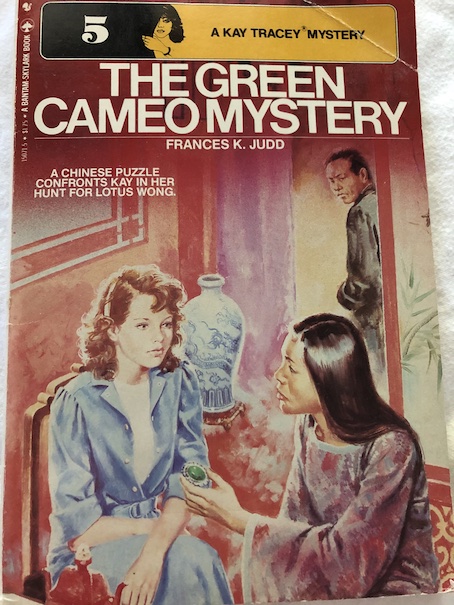
The Green Cameo Mystery by Frances K. Judd, 1952, 1980.
The story begins with Kay’s friends, Betty and Wendy, treating her to lunch, but when the girls try to pay the bill, the cashier says that their money is counterfeit. Betty and Wendy say that their mother gave them the cash, and she got those particular bills on a recent trip to San Francisco. The cashier tells them to contact the Secret Service and report the counterfeit money and tell them where it came from. (This book is old, but the Secret Service still investigates counterfeit money.)
As the girls leave the restaurant, they talk about the errands they want to run this afternoon. There is an auction Kay wants to attend because there’s a beautiful Chinese desk that she wants to get for her cousin, Bill, for his new office. However, she remembers that she needs to drop Bill’s shirt off at a laundry before they go to the auction. The laundry is a cliched Chinese laundry (connections are building in this story), but the man Kay usually sees there is absent today. The woman at the counter, Lily Wong, says that she’s the man’s sister and that her brother is unwell. Kay asks if he’s been to a doctor, and Mrs. Wong fearfully says that she doesn’t think that there’s anything a doctor could do against the green cameo. She explains that her husband got the green cameo in Shanghai, but it’s cursed, and it brings misfortune to her family every three years. While the girls are talking to the woman, she gets a phone call from someone who tells her that her daughter Lotus is now missing, having disappeared from the college she attends. (Yeah, Lotus. I don’t know if that’s a name that Chinese people actually use, but many of the Chinese names in this book struck me as being made up. I could be wrong because I’m not an expert on Chinese names, but they have that look.)
Mrs. Wong tells Kay that she tried to hire a medium named Cara Noma to break the curse of the green cameo, but she hasn’t been able to do it. Right away, Kay is sure that Cara Noma is a fraud. Kay volunteers to help find Lotus. A prime motive for her disappearance is Lotus’s impending arranged marriage to an older but wealthy businessman named Foochow. (I Googled that name, and apparently, it’s a romanized version of a place name, not a last name.) Kay’s first thought is that Lotus may have run away because she decided that she didn’t want to participate in this arranged marriage. Mrs. Wong also tells Kay that Cara Noma claims that her daughter has sold a jewel box with a green lotus cameo on the lid that Mr. Wong gave her as a betrothal gift.
The medium Cara Noma shows up while Kay is discussing the situation with Mrs. Wong and starts into her mystical act about how she’s going to break the curse. Kay impatiently tells her that it’s all nonsense and that she’s just taking poor Mrs. Wong’s money. Even Mrs. Wong agrees because, so far, Cara Noma hasn’t produced any results, and Kay is nice enough to offer to help her for free. Angrily, Cara Noma grabs both Kay and Mrs. Wong and uses some blood from a cut on Mrs. Wong’s finger to draw a red X on Kay’s forehead. She declares that she has transferred the curse of the green cameo to Kay and that Kay will soon see that the curse is real.
Kay still doesn’t think that the curse is real, and she and her friends head over to the auction where she wants to buy that desk for her cousin. Before the auction begins, Kay and her friends are looking over the items for sale when Kay discovers that the desk she wants to buy has a secret compartment in it. On impulse, she puts the envelope holding her money in the secret compartment to try it out. (This is so dumb, Kay. Don’t put all of your money in the secret compartment of a desk you don’t own!) Then, she gets distracted when she spots a jewelry box matching the one described by Mrs. Wong. Then, Kay’s nemesis from school, Chris Eaton, shows up and tells her not to waste her time bidding on the jewelry box because she wants and she has more money than Kay.
It turns out that Kay is unable to buy the desk she wanted to buy because the bidding is much higher than she can afford. Then, a man named Sidney Trexler shows up and protests the auction, saying that the desk belongs to him and he doesn’t want to sell it. It turns out that he’d been storing the desk there, but the desk was being sold because he hadn’t paid his storage fees. Mr. Trexler says that he has the money to pay his fees now and wants the desk back because he’s planning to get married and will need the furniture. The man who was going to buy the desk agrees to cancel his offer to buy so Mr. Trexler can have the desk back. When the jewelry box comes up for sale, both Kay and Chris Eaton are outbid by Mr. Trexler as well. Kay is disappointed because she was hoping to get the jewelry box for Mrs. Wong.
However, the mystery is only just beginning. When Kay gets home, she finds that the envelope she thought held her money isn’t really her envelope. She did remember to retrieve the envelope from the desk before it was sold (for a moment, I was afraid that she would forget), but by mistake, she grabbed a different envelope. Is this the first bad luck of the curse? Kay knows that she has to talk to either the auction house or Mr. Trexler to get her envelope and money back! Then, a taunting comment from Chris Eaton reveals that Mr. Trexler’s fiancee is actually Lotus Wong. Now, Kay really needs to find Mr. Trexler!
The book is available to borrow and read for free online through Internet Archive.
My Reaction and Spoilers
So, right from the beginning of this story we have the mystery of the counterfeit money, the mystery of the cameo curse, the mystery of the fake medium, the mystery of the disappearance of Lotus Wong, and the mystery of Mr. Trexler and his engagement and sudden money. The girls also come to wonder about Mr. Wong. He seems to have much more money than his brother-in-law who operates the laundry, and his wife seems afraid of him. What is Mr. Wong’s business, and why doesn’t he do more for his brother-in-law? Are any or all of these things connected? Actually, yes. At first, I wasn’t sure how they were going to circle back toward the counterfeit money from the beginning of the book, but it turns out that Cara Noma is in on the counterfeiting operation. For a time, it looks like Mr. Wong might be the head of the operation, but it turns out that he’s innocent. I thought that Lotus’s reasons for running away were poorly explained. Part of it is that she doesn’t want to marry Foochow, but there’s also a side plot about Cara Noma using hypnosis to control both Lotus and her mother. I think the implication is that she was doing it to milk Mrs. Wong of money while keeping Lotus hidden from her, but it seemed like an odd complication to me since Cara Noma was also involved in the counterfeiting ring.
I’m not sure that I’d call anything in the book “racist”, although I think there may be justification for saying that parts are “stereotypical” and probably a bit culturally shallow and “tone deaf.” My first impression was that the author and the characters in the story like Chinese culture for being exciting and exotic, but in that way where there’s no real depth to their knowledge it and it comes off as being a bit like caricatures of Chinese people you might see in old movies. I’ve seen some of the old Charlie Chan mystery movies, and the way the characters in the book talked kind of reminded me of them. The Chinese names seem pretty stereotypical and so does the way they speak in broken English. They don’t do the “Engrish” thing where the ‘l’s and ‘r’s are swapped, but the Chinese characters don’t speak proper English, and they throw in phrases and expressions that I think are meant to sound quaintly foreign. At one point, Mrs. Wong says to the girls, “When you see Lotus again, tell my lovely flower not study too hard. Much study make many wrinkles.” I’m not sure whether that was just a joke or if it was supposed to be some kind of pseudo-proverb, like Charlie Chan used to make. On the other hand, some of the speech patterns I thought might be old stereotypical tropes from movies might have more grounding in real life than I’ve credited them for having. Lily Wong also sometimes refers to herself in the third person, “Lily Wong not sure,” instead of “I am not sure.” I’ve met people in real life whose first language was Chinese, and none of them do this. I thought at first that this might be another trope carried over from old movies, but I looked it up, and apparently, actual Chinese speakers can do this sometimes. The technical name for it is illeism. So, while some of the speech patterns seem like old movie tropes, they might not be completely wrong for real life.
One part of the story that bothered me is the Chinese play that Kay’s school decides to perform. Kay and her friends are told that “a delegation of foreign visitors to the United States” (no nationality/nationalities specified at first) would be visiting schools in the area, including the high school that they attend. To entertain their foreign visitors, the school decides that they’re going to put on a short play, and of course, the drama teacher picks one with an “Oriental” theme called “The Pagoda Mystery.” (“Oriental” is the word they use, which is rather vague and considered somewhat outdated now. Some people consider it demeaning because it has old associations with stereotypes that people don’t want to perpetuate. The demeaning part seems to be more in the attitudes associated with its use than in the word itself. It is a technical geographic term that refers to the Eastern Hemisphere, but my thought is that referring to an entire hemisphere is rather vague. I don’t think the book meant it badly, but in modern times, it’s generally considered more polite and a sign of being well-educated to use the most specific word possible when describing geographic regions or groups of people. When people are overly vague, it makes it sound like they don’t know what they’re talking about or what the more specific word is. If this play is specifically about China, they could have just said that.) It’s rather coincidental that they’re doing a mystery play set in China right when Kay is working on a mystery involving people from China, but those types of coincidences happen often in Kay Tracey books. I wasn’t able to find any real information about this play, so I’m pretty sure sure that it was just made up by the author of the book so the school would have just the right kind of coincidental play to perform. Also, of course, Kay gets the lead role in the play when she tries out for it, that of a beautiful Chinese maiden. If there are any Asian students at this school, they aren’t mentioned, so I don’t think there are any. Charlie Chan was also not played by Asian actors, even though other characters in the series were, which is why they bother people now and there haven’t been any new ones made since 1981. The book says, “But because of her recent experiences at the Wong home, Kay spoke her lines with special feeling and proved her familiarity with Chinese customs and people. Therefore, the leading role was given to her.” I’m not convinced that her conversations with Mrs. Wong have really given her deep knowledge of China, but they did have tea together at her house, so maybe there’s an implication that she told her more about Chinese tea customs than the book described or something.
By another coincidence, it turns out that Mrs. Wong was in a production of the same exact play in China when she was young, and she played the part that Kay is going to play, so she coaches Kay in how to play the part. (What stroke of luck! See, Kay isn’t cursed!) Mrs. Wong assures Kay that when her face is made up to look Chinese, no one will know that she isn’t really Chinese because she’s such a good actress. I suppose that people in the 1950s, when this book was originally written, would be a little more accepting of non-Asians wearing makeup to play Asians (called “yellowface“) just because it was done more often back then, and people get comfortable with things they see often. It’s not particularly comfortable for modern people because our society is sufficiently diverse to have actual Asians playing Asian roles without the help of cheesy makeup, so this part of the story is eye-rolling, especially the way everyone fawns over Kay being so authentic-seeming. Also, much of what Mrs. Wong teaches Kay seems to involve making gestures with her hands and fluttering her eyelashes when she speaks, which the drama teacher praises as being very realistically Chinese. It’s hard to know exactly what that means without seeing exactly what Kay’s doing, and the description doesn’t say much. The fluttering eyelashes make me think that she’s acting flirty, but I don’t know if that’s suppose to be part of her role in the play or not because we’re never told the full story. Again, I could be wrong, but it Kay’s apparently authentic performance seems more like something from an old movie than real life.
I think that the drama coach choosing a play from China was meant to be some kind of salute to the foreign visitors (and a coincidence that helps further the plot of Kay’s mystery), but it seems like a kind of tone-deaf choice to me, not thinking about what people really want to see and experience when they visit a foreign country. If I were the person making the decisions, I don’t think that I would be comfortable with showing visiting foreign dignitaries a high school production of a play they would already know from their own youths in their country, entirely acted by people wearing makeup to look like them, probably with varying degrees of success. It just seems awkward and might give the impression that they were being made mocked rather than honored. People travel to see new and different things, not imitations of things they already have back home. That would be like someone from New York City going to New Orleans and spending their entire time there watching productions of Broadway plays instead of touring the French Quarter or the Garden District. If you’re just going to do something you could do back home, what did you even make the trip for? Traveling is about seeing things that make different places unique. So, if I were in charge of the high school play, I think I would have picked something that had nothing to do with China, something new and original that the visitors could describe to people back home as something you could only see if you go to America. It might be an American-written play or maybe something that the students put together themselves to show their individual personalities and interests, a view of the modern American teenager, like a collection of student-written short skits or a talent show. Musical performances would be good because people can still enjoy the sounds of the music even if they don’t know all of the words. It’s pretty likely that this school has a band or orchestra, and there may be some unofficial student bands that could play. Dancing, gymnastics, and juggling acts might be good, too, if there are people who know how to do those, because people understand what they are just by looking at them. They don’t require explanations like humor that involves puns and might go over the heads of people who aren’t completely fluent in a language. I like the idea of the entertainment being a sort of variety show with music and skits because that’s a traditional form of entertainment that was still popular in the 1950s, and it’s a good format when you have a large group of people because there are multiple leading parts and solos in different acts of the show, avoiding some of the inevitable arguments about who gets the best parts. They could even have displays of artwork or science projects from students who aren’t part of the performing entertainment. It would offer variety for the visitors and give everyone a chance to contribute something.
Of course, there’s a subplot to the story about Chris Eaton, Kay’s school nemesis, trying to steal her part in the play. Chris even goes so far as to drug Kay’s food so she’ll miss the performance. First of all, I’d never be as trusting as Kay, and I wouldn’t eat anything that someone who has a history of doing nasty things gave me. If Kay’s so sharp, she should have figured that Chris would do something nasty to her food. Second, drugging somebody isn’t a harmless prank. Chris apparently slipped Kay a strong sleeping pill, and Kay didn’t even finish everything Chris gave her. We don’t know whether Chris might have accidentally overdosed Kay if she’d eaten it all. People can die from drug overdoses. Chris also couldn’t know for sure whether or not Kay might have been taking some other medication at the time that would conflict with what she gave her. People can also die from mixing the wrong medications. For some reason, Kay and her friends don’t tell on Chris, and Chris isn’t punished. I understand that people don’t like to be thought of as tattletales, but I think that there are limits to what people should be willing to put up with, and being drugged should definitely something no one should tolerate. What she did was serious, and I don’t like it that they’re pretending like it isn’t.
Overall, I found myself often thinking of the old Charlie Chan movies while reading this book, comparing what I was reading to what I’ve seen in old movies. There are reasons why the Charlie Chan movies didn’t last, and I think this book is a decent example of some of those reasons. During their heyday, the Charlie Chan books and movies were welcomed as one of the first portrayals of an Asian hero in American culture who was kind, intelligent, and upheld justice. Even though Charlie Chan was a stereotypical character, he was a stereotype of all that was good, which was a welcome break from previous stereotypes of Asians as devious, evil characters, like the fictional villain Fu Manchu. Charlie Chan was one of the first fictional characters to encourage the American public to see Asian people in a friendly light and even as people to be admired. The Charlie Chan series encouraged a positive interest in Chinese people and culture, even though it was also somewhat shallow and stereotypical. As I said, the actors who portrayed Charlie Chan in movies were not Asian themselves. Hollywood back in the day couldn’t bring itself to put an Asian in the leading role. Culturally speaking, it’s probably best to look at that series as a stepping stone to better things. Once people have been introduced to a concept, we expect them to eventually gain more depth and understanding. Charlie Chan helped people to break away from old, toxic ideas and prejudices, but that doesn’t mean that people should stay at that level of cultural understanding and portrayals. People progress. They grow and learn, and so do societies and cultures.
What I’m saying is that nothing in this story related to China or Chinese culture is educational for children. They won’t learn anything from this book, and most of the books that I read as a child specifically included real facts about other countries and culture to be at least factually-correct or semi-educational. This book doesn’t even define the word “pagoda” for anyone who doesn’t already know it. There are no Chinese words in the story, and when Kay and her friends have tea with Mrs. Wong, they don’t say whether there are any special tea customs they observe. What the book tells you about Chinese people is very general – that they have some interesting antique furniture and art objects, they drink tea, they might be superstitious, not all of them speak good English, some are friendly and helpful while others are sinister criminals, and if you want to act like one on stage, hand gestures and fluttering eyes are pretty important (whatever that means). Some of that stuff is true, particularly the parts about tea, the fascinating antiques, and the fact that some can be good and some bad, like human beings in general. But, there’s not much concrete, factual knowledge here, and some parts might give kids the wrong impression. I had the feeling the whole time I was reading it that the person who wrote it was a fan of old movies and didn’t really know much about Chinese culture to tell anybody in a factual, educational way. The old Scooby-Doo cartoons were kind of like this when they talked about other countries and cultures, too, because many of them were written as kind of spoofs on movies that people would have known when they were first made. If you’re into old movies, you can recognize the references, but they weren’t meant to teach anything or include any real information. If you compare the older Scooby-Doo series to the more modern ones, you’ll notice that some of the modern ones make more of an effort to include some real, educational facts. Scooby-Doo isn’t an educational show, but I have noticed a slight shift in how they talk about other countries and cultures. That’s more the standard of children’s literature and entertainment I’m accustomed to – when someone says something about another country or culture, I expect it to be something factual that shows that the author did at least a little basic research and knows something about what they’re talking about. It’s grating to me sometimes that older, vintage children’s series don’t always do this. Some of them even shamelessly make things up about other countries and cultures just because they think it would make the story more exciting, assuming that the kids reading the books won’t notice or care. If this book sparked an interest and encouraged kids to learn more about China or Chinese culture, it’s not too bad, but by itself, it doesn’t demonstrate any helpful level of cultural knowledge and information.
#106 The Vanishing Passenger by Gertrude Chandler Warner, 2006.
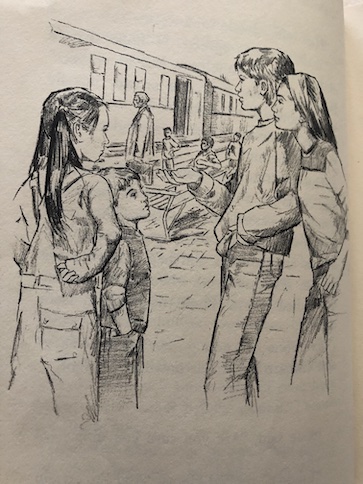
The Alden children have been working on a project at their public library to invite the author of one of their favorite book series to visit as a guest speaker. However, when they go to meet his train, the author isn’t there. He’s completely disappeared!
The Aldens know that he got on the train because they spoke to him on the phone earlier. When they interview some of the passengers, they discover that the train trip was somewhat chaotic. The train passed through a harsh storm. A small dog disappeared, and his heart-broken family is searching for him as well. The evidence seems to point to the author jumping off the train, but why would he do that? Where is he now, and why hasn’t he tried to get in touch with them?
Carefully, the Aldens have to work backward through the train journey, piecing together the author’s movements to put together the whole story.
The book is available to borrow and read for free online through Internet Archive.
My Reaction
I really appreciated the premise of this story. A mysterious disappearance makes a more unusual kind of mystery than the more typical crimes that appear in mystery stories, like theft. This is a story of a trip in which quite a lot of things went wrong. The kids do manage to track down their missing author with some surprising help from the author’s rival, who is also apparently his friend, showing the children that not all competition has to be unfriendly.
The Yellow House Mystery by Gertrude Chandler Warner, 1953, 1981.
This story in the Boxcar Children series picks up the following spring after the previous book. The children’s cousin, Joe, is arranging for the excavation of the cave where the children found their Native American artifacts. They’ve decided to use dynamite to blast open the roof of the cave to make excavation easier (I’m not sure if this is really the best way to get at artifacts that were sheltered safely for years in their cacve and were easily being dug up by children in their current situation, but okay), and although he had told the children that they couldn’t be there for the blasting, he’s changed his mind. He’s even going to let seven-year-old Benny be the one to push down the handle that will set off the blast. (Because this is one of the early books in the series, the children are aging from the first book in the series – Henry is sixteen years old, Jessie is now fourteen, and Violet is twelve.)
One of the people who will be working on the excavation is Alice, an old school friend of Joe’s. Everyone can tell that Joe is in love with her, and soon, he proposes to her. They get married and decide to spend their honeymoon camping out in the barn on the island, just like the children did the previous summer.
However,
the children have started to wonder what the story is about the old yellow
house on the island. For some reason, it
makes their grandfather sad, and he doesn’t like to talk about it. Eventually, their grandfather tells them that
their housekeeper, Mrs. McGregor, used to live in that house with her husband,
Bill. Bill used to take care of Mr.
Alden’s father’s race horses. He was a
nice man, but weak-willed. His brother,
Sam, and his brother’s disreputable friends were often able to persuade Bill to
do things that would get him into trouble, and Bill was never able to stand up
to them. One day, he vanished
mysteriously from that house, and neither his wife nor the Aldens have any idea
what happened to him. There are only two
clues about the reason for Bill’s disappearance. One is money that Bill was supposed to give
to Mr. Alden’s father for the sale of two horses that he managed on his behalf. Mr. Alden assumes that Bill’s brother did
something with the money and that Bill probably left because he was afraid to
face Mr. Alden without the it. Sam died
soon after Bill disappeared, so they were unable to ask him about what he knew. The other odd thing that happened before Bill
disappeared was that Mrs. McGregor heard strange sounds in the night. When she went to investigate, her husband was
apparently just reading a newspaper, and he claimed that the noise was nothing
unusual. But, what was Bill really
doing?
The kids want to investigate Bill McGregor’s mysterious disappearance, and their grandfather and Joe and Alice enter the house with them to have a look for more clues. In a hiding place behind one of the fireplace bricks, they find a letter from Sam to Bill about the money from the horse sale. Sam promised Bill that he would be able to pay him back more than the money he owed and tells Bill to meet him at a house in Maine near Bear Trail. The kids persuade their grandfather to let them to go Maine with Joe and Alice over the summer to try to find the house on Bear Trail so they can find out what happened to Bill. The trip will involve camping, hiking, and canoeing, but they’re up to the challenge!
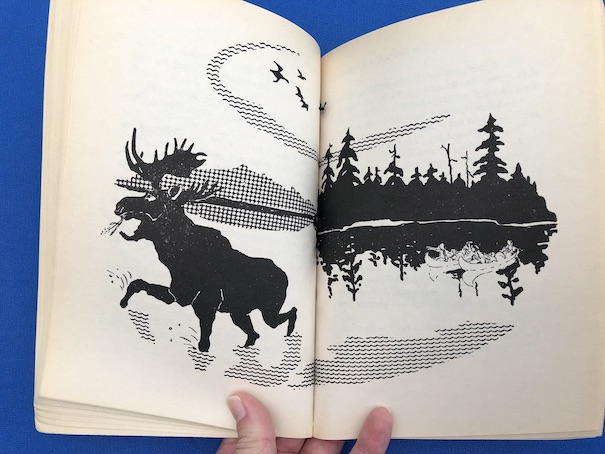
Joe is familiar with Bear Trail because he used to work as a trail guide when he was in his teens. They are also joined by another trail guide, Mr. Hill, and have adventures that include a storm and a real bear. However, the real answers to the mystery lie at the Old Village at the end of the trail.
The book is available to borrow and read for free online through Internet Archive. There are multiple copies of the book. In order to check out a book through Internet Archive, you need to sign up for an account. The account is free, and you read the books in your browser.
My Reaction
In a
number of ways, this book is more adventure than mystery. It doesn’t take long for the kids to realize discover
Bill McGregor’s new identity. However,
what happened to the money is more of a puzzle.
Even Bill has been unable to find where his brother hid it years ago. Benny discovers it by accident while watching
a toad.
One thing that had made me uncomfortable was how long Bill had stayed away from his wife. When the kids confront him about his real identity, it turns out that Sam’s disreputable friends had lied to him, telling him that his wife had died shortly after he disappeared. He is overjoyed to discover that she is still alive, and she is glad to see him when he finally returns home.
Miss Nelson is Missing! By Harry Allard and James Marshall, 1977.
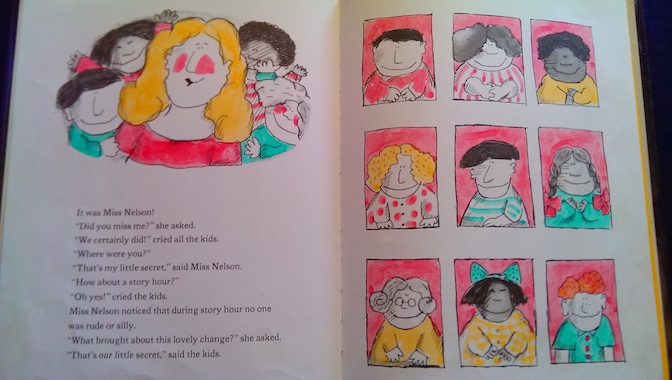
The kids in Miss Nelson’s class at school are terrible! No matter how nice she is to them, they always act up and refuse to do their work. Miss Nelson knows that this can’t continue.
Then, one day, Miss Nelson doesn’t show up for class. The kids have a substitute teacher, the terrible Miss Viola Swamp. Miss Swamp is super strict. She makes the kids work harder than they’ve ever worked in their lives, and she doesn’t put up with any nonsense.
Miss Swamp is so mean that the kids really start to miss nice Miss Nelson. What happened to her? The kids try to find their nice teacher so they can get rid of the mean substitute. They try to go to the police to report her as a missing person and go to her house to see if she’s there, but the only person they can find is Miss Swamp. They imagine all sorts of terrible things that could have happened to Miss Nelson.
Then, just as they’re sure that they’ll never see Miss Nelson again, suddenly she’s back. Miss Nelson never says exactly where she’s been, but the kids are so glad to see her that they behave much better.
This is the first book in a series. It is available to borrow and read for free online through Internet Archive.
My Reaction and Spoilers
The big joke of the book, and all the others in this series, is that Miss Nelson and Miss Swamp are the same person. It’s not much of a spoiler to say that because, even though the story never explicitly says that they are the same person, it’s heavily implied, especially at the end of the book. The fun is that the kids in Miss Nelson’s class never guess, leaving readers to enjoy the joke along with Miss Nelson.
Some people like to take advantage of people who are “too nice”, but just because a person prefers to be nice doesn’t mean that they’re weak, stupid, or incapable of being tough when they need to be. Miss Nelson just found a creative way to be as tough and mean as she needed to be to get the kids in her class to behave without ruining her own reputation as a nice person. “Viola Swamp” will always be there whenever Miss Nelson needs her again … and that leads into the rest of the books in the series.
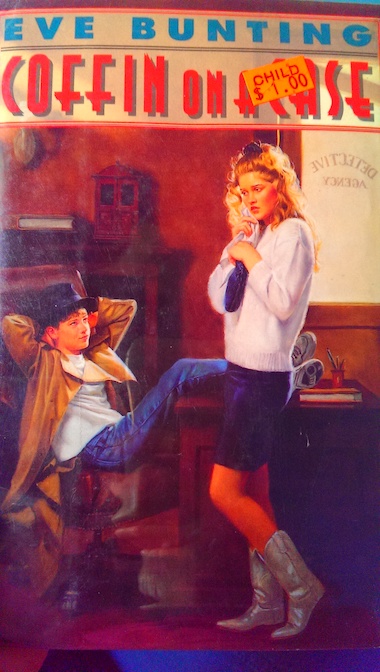
Twelve-year-old Henry Coffin’s father is a private investigator, and Henry hopes to be one himself someday. He’s learned a lot by watching his father in action. One day, a sixteen-year-old girl, Lily, comes to the office and asks for help in finding her missing mother. Lily found her mother’s car in their driveway with groceries still in it, and her mother is nowhere to be found. She doesn’t want to go to the police because she once called the police about her mother being missing only to discover that there was a mix-up and that her mother had tried to leave her a note that she hadn’t seen. Lily has double-checked this time to make sure that there was definitely no note from her mother and none of her mother’s friends have heard from her, but she worries that the police would think that she’s being paranoid, so she decided to consult a private investigator instead.
Henry’s father is concerned about the disappearance of Lily’s mother, but he’s unable to take the case because he has to go out of town. He tries to refer Lily to another investigator or a friend of his who is with the police, but Lily just storms out of the office. Henry wishes that he could take the case for his father. His own mother abandoned him and his father when Henry was just a baby, so disappearing mothers are of great concern to him. Later, when Lily gets in touch with him, Henry agrees to help her without telling either his father or Mrs. Sypes, the housekeeper who has looked after him since his mother left.
At first, there doesn’t seem to be much to go on. Lily’s mother makes wooden storks that she sells as lawn decorations to people who have recently had a baby. She was going to sell a couple before going to pick up the groceries, but Lily says that there is an extra one missing. Somewhere between the grocery store and home, Lily’s mother made an unexpected stop . . . and there are signs that someone other than Lily’s mother drove the car to Lily’s house. But, who was it, and what happened to Lily’s mother?
The answers to these puzzles put Henry on the trail of some dangerous thieves who would do just about anything to cover up their crime.
The book is available to borrow and read for free online through Internet Archive (multiple copies).
My Reaction
Henry shows excellent deductive reasoning as he analyzes the clues and reconstructs Lily’s mother’s trail to learn what happened to her. Both Henry and his father are inspired by the fictional character, Sam Spade, and Henry makes frequent references to him in the story, thinking what Sam Spade would say or do in certain situations.
Throughout the book, Henry also considers his own mother’s disappearance years ago. Her abandonment of her family was her own choice, not an abduction, which makes her situation different from what happened to Lily’s mother. Henry has no real memory of his mother, which pains him somewhat. He sometimes dreams that she’ll return home one day for a happy ending, like in the movies, but he also realizes that’s really just a daydream. When Lily’s mother is finally rescued, Henry and Lily continue being friends, and Henry also considers whether a relationship would be possible between his father and Lily’s mother. It’s a nice idea, but Henry also thinks that isn’t likely, and he’s okay with that.











 Coffin on a Case by Eve Bunting, 1992.
 Jestress's Forgotten Books and Stories