The Mystery of the Golden Reindeer

Three Cousins Detective Club

#30 The Mystery of the Golden Reindeer by Elspeth Campbell Murphy, 2000.

Titus doesn’t really like to go Christmas shopping. The department store is always crowded around Christmastime, and he’d really rather just stay home, where it’s comfortable and quiet, and eat popcorn and watch videos. However, his mother really wants to go to the department store and so do his cousins, so they persuade him to come along. The three cousins are allowed to browse in the toys without adult supervision, as long as they stay together. They make arrangements to meet Titus’s mother for lunch in the store’s restaurant.

When they get to the toy department, they hear an announcement about a lost child, and to their surprise, their younger cousin, Patience, suddenly appears. She had been shopping with her grandmother when she spotted her cousins and started following them. As far as Patience is concerned, she wasn’t lost because she knew where she was. It was her grandmother who was lost, and she points out that she found her cousins instead of them finding her. The cousins manage to find Patience’s grandmother and reunite the two of them, and they invite them to come to the restaurant with them for lunch.

When they meet up with Titus’s mother, they all are surprised when she tells off Titus for wandering around the department store by himself when he was supposed to stay with his cousins. They all insist that Titus was with them the entire time. Titus’s mother was sure that she saw him riding the escalator alone, but none of them were on the escalator because Patience is afraid of escalators. Patience suddenly speaks up and says that she must have seen the “other Titus”, not the “real Titus.”

They enjoy the restaurant, which has a large Christmas tree, decorated with golden reindeer. During lunch, Patience tries to point out the “other Titus” to them, but nobody else spots who she’s pointing to. Patience is known for having an imaginary friend named Amy and for making up tall tales. She sometimes mixed up things she’s imagined with things that are real, so they’re not sure if she really saw the “other Titus” or not. (Personally, I thought this was silly on their part because they already know that Titus’s mother saw someone who looked a lot like him. Titus is wearing a distinctive black-and-white scarf, so I figured at this point that there’s someone wearing a scarf that’s also black-and-white.) Titus feels a little uneasy that there might be another him wandering around.

Titus’s mother wants to look at some furniture after lunch, and she asks Patience’s grandmother if she could come with her and give her opinion. The three cousins would rather go look at store windows instead of furniture, and Patience insists that they take her with them. The older cousins know that Patience can be a handful to look after, but Sarah-Jane knows that she would feel badly if they didn’t take Patience somewhere where she would have more fun than she would have looking at furniture. Patience promises that she’ll stay with her cousins and not run off anywhere, so the adults agree to let her go with them.

While Titus and Patience are looking at the Christmas tree together, Titus is surprised by a teenage boy who comes up to him and starts talking to him as if he knows him. The teenager says that he has a message for him and tells him, “Happy Birthday. The golden reindeer. Dish towels. Christmas tree.” Titus asks him what he’s talking about, and the teenager says that he was paid to deliver that message to him and that he must have been expecting him. When the other cousins come back from the restrooms, Titus and Patience tells them what happened, and they’re equally confused. All they can think is that this bizarre message was meant for the “other Titus.” But, who is the “other Titus”, and what does the message mean?

Theme of the Story:

“What you get from wisdom is better than the finest gold.”

Proverbs 8:19

The book is available to borrow and read for free online through Internet Archive.

My Reaction and Spoilers

This mystery does involve a lookalike for Titus. However, the mystery doesn’t quite end when they meet the other boy. He tells them that he got a phone call telling him to come to the department store for a special message about something that belongs to his family that was stolen. When the other kids tell him the message that was given to Titus, he finds it just as confusing as they do.

It’s Patience who really solves the mystery of what the clues in the message mean, and that’s both because she is nosy and because, as a young child, she doesn’t take certain things for granted, the way an adult or older child would. Sometimes, people see not what’s actually there but what they expect to see. Titus’s mother didn’t really see him on the escalator alone; she saw the other boy, who happened to be wearing a different black-and-white scarf. She just figured it was Titus because she expected the boy with the black-and-white scarf would be her son, and she didn’t look closer to notice that it wasn’t the same boy and that the scarf actually had a different pattern. It was the same with the teenager who was looking for the other boy. In the case of the clues, all of the older kids assume that the packages underneath the decorative Christmas trees in the department store are just empty boxes, wrapped up for decoration. Because Patience wants to check to see if they’re all empty, she’s the one who realizes that one of the packages isn’t like the others.

We never learn who stole the object that the other boy was looking for, but he does get it back. Also, Patience learns to get over her fear of the escalator.

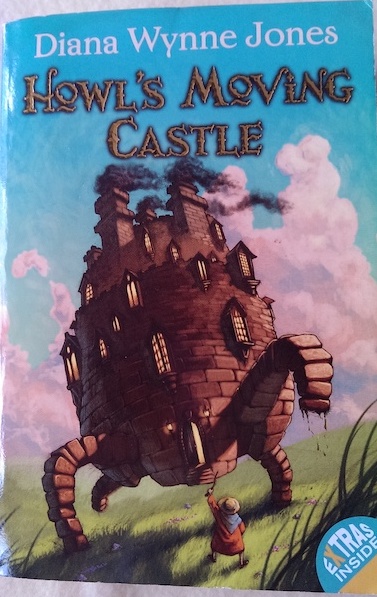
Howl’s Moving Castle

Howl’s Moving Castle by Diana Wynne Jones, 1986.

The kingdom of Ingary is the land of fairy tales. There is magic, and in a family of three children, it’s always expected that the youngest of the three will be most successful. Sophie Hatter, as the oldest of three, is disappointed when she first realizes that, but she reconciles herself to her rather dull fate. She is devoted to her younger sister and half-sister, and she does her best to look after them and help prepare them for their futures.

When Sophie Hatter’s father dies, her stepmother Fanny has to decide what arrangements to make for the family’s hat shop and the three girls in the family: Sophie, her younger sister Lettie, and her half-sister Martha.  Because Martha is very bright and expected to one day seek her fortune in the world, as third children generally do, Fanny arranges for her to become an apprentice to a respected witch.  Lettie becomes an apprentice in a pastry shop, where she will learn a good trade and possibly meet a nice young man to marry.  Sophie, as she had always expected, continues to work in the hat shop.  None of the three girls are particularly excited about the arrangements, but they make the most of it.  Sophie does have a talent for hat-making.  In fact, she has a very unusual talent because, as she talks to the hats while she makes them, the things she predicts for the buyers come true. People become increasingly attracted to the hat shop because it seems like good things happen to people who buy hats there.

Sophie is good at working in the hat shop, but she has to admit that her life there is dull. She doesn’t really know what else she would want instead, but she feels isolated, hearing gossip from other people but not really talking to anybody herself. A visit to her sister Lettie on May Day puts Sophie’s life in perspective and calls the things that are expected of older and younger siblings into question. Sophie learns that her sisters, dissatisfied with the arrangements Fanny made for them and having ambitions other than the ones that are expected of them, have secretly switched places with each other. Lettie craves learning and adventure, so she has taken Martha’s place as the witch’s apprentice to learn magic. Martha doesn’t actually care about going out to seek her fortune at all. She doesn’t want adventure or riches. What she really wants, although she’s never admitted it before, is to marry, settle down, and have ten children. Working in the pastry shop, she has already attracted quite a following of young men, and she’s sure that she’ll find one who will love her and make her happy. Neither of them cares about fitting the tradition mold of three siblings, and they’re both concerned about Sophie’s future. Sophie has never had any particular ambitions of her own, but her sisters know that being shut up in the hat shop all the time isn’t good for her. They think Fanny is taking advantage of her because it’s Sophie’s work that’s attracting all the customers these days, and Fanny isn’t even paying her an apprentice’s wage! Apprentices like Lettie and Martha get wages at other businesses, but Sophie’s been working for free while Fanny takes all the profits. It gives Sophie a lot to think about, and she becomes convinced that she’s being exploited when she asks Fanny about wages, and Fanny puts her off. Sophie is so angry that she thinks maybe she should run away to seek her fortune, but she can’t shake the idea that eldest children can’t do that. Soon, circumstances intervene to force Sophie to be the one to go out and seek her fortune anyway.

Dangerous and mysterious things are happening in the kingdom. Rumor has it that the evil Witch of the Waste has threatened the king’s daughter and that the king’s personal wizard, Suliman, has vanished after going to deal with her. People think that the Witch of the Waste probably killed him. The king’ brother, Prince Justin, also went in search of Suliman and disappeared.

One day, the Witch of the Waste pays a visit to Sophie’s hat shop.  Mistaking Sophie for one of her sisters, the witch curses Sophie, turning her into an old woman.  Unable to explain to anyone what has happened (which is part of the curse), Sophie makes the decision to leave the hat shop, finding a new job as housekeeper to the mysterious wizard Howl, a sinister figure himself.  Little is known about Howl, although he is known to live in a strange castle that moves from place to place, apparently of its own accord, and he has a reputation for breaking women’s hearts.

Howl is even stranger although somewhat less sinister when Sophie gets to know him.  He allows Sophie to stay in his castle, not so much by requesting her to stay but by not telling her to leave, much like he did with his apprentice Michael, an orphan who came to live with him and gradually became his apprentice when Howl decided not to send him away.  Howl is vain (using makeup and hair dye to make himself more handsome), immature, and somewhat cowardly, but he is still a powerful wizard and can accomplish great things when he makes up his mind that he wants to (or finds himself unable to refuse).  He doesn’t real steal girl’s souls, as some of the rumors about him say, but he is definitely a flirt and a womanizer, who drops girls as soon as they fall in love with him because he likes pursuing them but is afraid of commitment. In fact, he even has Michael spread scandalous rumors about him in the towns where they do business so people will be more reluctant to try to get him to commit to anything or anybody.

Howl has other problems aside from his immaturity and fear of commitment.  Calcifer, the mysterious fire demon that powers the moving castle, hints as much to Sophie.  He hopes that Sophie will be able to help, although he, too, is unable to explain the reason why for magical reasons.  Howl is not an ordinary person, but a traveler from another dimension, from a strange country called Wales, the same place where the king’s wizard, Suliman, was from. In Suliman’s absence and against Howl’s will, the king recruits Howl to be the new royal wizard, to find the missing Suliman and Prince Justin, and to deal with the Witch of the Waste.

Sophie struggles to convince/cajole/force/help Howl to save the kingdom and to learn the secret curse that Howl himself is living under even while suffering from her own curse.  Surprisingly, it seems that Sophie is the key to breaking not only Howl’s curse but her own.

The book is available to borrow and read for free online through Internet Archive (multiple copies). It’s the first book in a loose series. Many people these days are familiar with the story because it was made into a Miyazaki movie, although the movie was very different from the book in a number of ways.

My Reaction and Spoilers

I first read this book when I was in high school, years before the movie version was made. In a way, the book is party mystery or puzzle as well as fantasy. Calcifer and Howl have a problem that they can’t talk about because of the magic around it. Only one rumor about Howl is true: Howl is literally heartless. But, Calcifer has a heart. It takes a long time for Sophie to make the connection and to realize what Calcifer actually is and what Howl did. Howl made a sacrifice years before that has left both Howl and Calcifer in a precarious position. The clues to Howl’s past and the arrangement between him and Calcifer are in a poem by John Donne that turns out to be part of Howl’s nephew’s school assignment. The Witch of the Waste, who turns out to be one of Howl’s former, discarded conquests, knows Howl’s secret and is trying to use it to get revenge on Howl.

Although the movie version is very good, and I enjoyed watching it, it is very different from the original book. The beginning part of the movie, where Sophie is working in the hat shop and cursed by the Witch of the Waste before going to work for Howl is very similar to the original book. However, the major problem of the war in the movie never happened in the book. War is a common theme in Miyazaki movies, but there’s nothing in the book about wizards making themselves into weapons of war. Instead, the main problems of the book are about lifting Sophie’s curse, figuring out what the secret contract between Howl and Calcifer is, evading the wrath of the Witch of the Waste, and finding the missing Suliman and Price Justin. The movie addresses the arrangement between Howl and Calicifer, but it doesn’t fully cover any of the rest of it. There are some characters and plot lines from the book which were combined or reduced in the movie in favor of the war plot, which I found less interesting because it has less intrigue. In the movie, the Witch of the Waste is tamed and redeemed as a character, but in the book, she really is evil and is never redeemed.

There’s also nothing in the movie about Howl being from Wales in our world and the land where he lives being a different dimension, but that’s a major part of Howl’s character in the book. In the book, Sophie even visits Wales with Howl and meets his family. His sister thinks that Howl, known as Howell Jenkins in his native Wales, is a wastrel, who hasn’t made anything of himself in spite of his college education. She’s only partly right. What she doesn’t know is that Howl started learning about magic at university, which is how he found out how to travel to other dimensions and make himself into a wizard. In spite of his immaturity and attempts to avoid certain types of service, he is actually very skilled and powerful. Howl can’t tell his sister the truth, so he just lets her think that he’s a wastrel.

Sophie finds Wales strange and mysterious. She is terrified when Howl takes her and Michael for a ride in his car. One of my favorite parts is when Howl needs to talk to his nephew about the poem he was assigned at school, but he doesn’t want to talk to Howl because he’s playing a computer game with a friend. Sophie and Michael don’t understand computers or that the boys are playing a game, so when the friend says that he can’t stop to talk or he’ll lose his life, they think that the boy’s life is really in danger. They almost panic when Howl pulls the plug on the computer to get his nephew’s attention, totally unworried about his nephew possibly dying. That’s one of the reasons why I prefer the book to the movie. Many of the humorous little moments like this are lost in the movie, although the movie did keep the episode where Howl has a temper tantrum and fills the house with green slime.

There are also intricacies of the plot that aren’t explained in the movie. The one I mind the most is that the movie doesn’t fully explain how the curse on Sophie works or how it gets broken, either. The book provided more information, which helps Sophie fully appreciate who she really is. As Calcifer realized soon after meeting Sophie, removing the curse on Sophie is complicated because it has two layers. Howl even admits later that he’s been quietly trying to remove Sophie’s curse himself, but he was never successful because Sophie was actually maintaining the curse herself. The first layer was what the Witch of the Waste did to her, but Sophie herself has magical powers that she has been unconsciously using throughout the book. The reason why good things kept happening to the people who bought her hats was that she was unconsciously casting spells on the hats when she talked to them while making them. The second layer of the spell on Sophie herself was her unconsciously reinforcing her sense of being old through all of the negative things she’d been telling herself about being the eldest child in her family. Sophie’s power typically manifests in the things she tells to people and things, and she’s been telling herself all the wrong things.

Because of all of the tales about how the youngest children are the ones who successfully go out to seek their fortune, Sophie has felt relegated to just being the eldest, helping other people, and not really thinking about what she wants for herself. Even as a young woman, she acted and felt old before her time because she didn’t have any confidence in herself or anything to look forward to in her future. Her sisters even worried about her for not having enough self-respect, no ambitions or dreams of her own, or ability to stand up for herself. Because she never expected to do much of anything with her life or any belief that she might have talents of her own, she and everyone else completely overlooked all of the magic that she’s been instinctively doing. When Sophie discovers that her sisters have switched places and learns about their real life ambitions, she is stunned to realize that she has badly misunderstood both of them for most of their lives, also making assumptions about them based on their birth order. She has also misjudged or underestimated other people, but the person she’s misjudged and underestimated is herself. Howl is the one who tells her that there’s nothing wrong with her being the eldest sister; the times when she gets things wrong have been when she acts without fully thinking things through. Part of the key to breaking her curse is to get rid of the negative feelings she’s had about herself and her ability and to see herself for who she really is: a person with powerful talents and a right to want things and achieve things for herself and her future. Once she sheds her doubts about herself and her abilities and stops thinking of herself as just the eldest and doomed to fail, she realizes how she can use her powers to save Calcifer and Howl, and Calcifer lifts the rest of her curse.

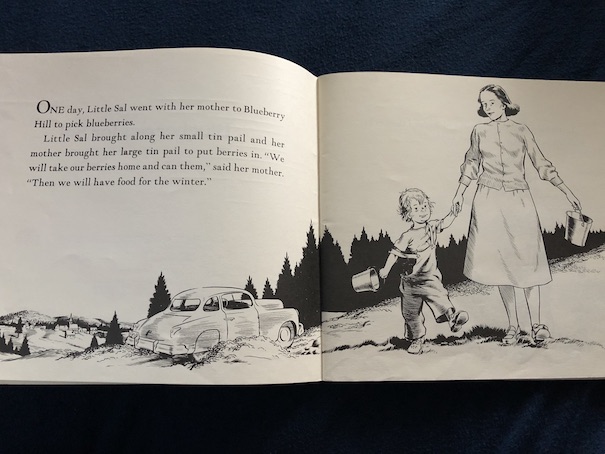
Blueberries for Sal

Blueberries for Sal by Robert McCloskey, 1948.

Sal is a little girl whose mother takes her to pick blueberries one day. The mother wants to can the blueberries for winter.

Sal gives in to temptation and eats the blueberries as she picks them.

Meanwhile, a mother bear and her baby come to eat blueberries.

Both Sal and the Little Bear lose sight of their mothers, and when they go looking for them, Sal accidentally finds the mother bear, and the little bear accidentally finds Sal’s mother.

Eventually, the mother bear realizes that Sal is following her when she hears the blueberries plunking into Sal’s pail. Sal’s mother realizes that a small bear is following her when he eats blueberries out of her pail.

Fortunately, nothing bad happens. The mothers just look around for their respective children and figure out where they are by the sounds they make. Then, the mother bear leaves with her baby, and Sal and her mother take their blueberries home.

At first, I was worried about Sal being with the mother bear and how Sal’s mother would react to the mother bear when she saw it, but the two mothers never meet in the story, and the children are fine.

The book is a Caldecott Honor Book. It is available to borrow for free online through Internet Archive (multiple copies).

Once Upon a Dark November

Once Upon a Dark November by Carol Beach York, 1989.

Katie Allen likes her part-time job helping Mrs. Herron with her housework. One of the best parts of the job is that she gets to see Mr. Herron, her English teacher, at home. Katie has a crush on Mr. Herron, although no one but her best friend knows it.

One day, while she’s at the Herrons’ house, Mrs. Herron tells her that her cousin Martin is coming for a visit. She says that Martin hasn’t been in Granville in years, although he used to live with their aunt when he was young. Their aunt is Miss Gorley, the creepy lady who lives across the street from Katie’s house. When Martin arrives, he turns out to be pretty creepy himself. He never says very much to anyone and spends a lot of his time just staring out the window. Mrs. Herron is not happy to have him there and wishes that he would leave.

One day, Martin disappears, and the next day, Miss Gorley is found murdered in her house. Did Martin return to Granville just to murder his aunt? Where is he now, and who is that mysterious person who tried to attack Katie at her house, dressed in a Frankenstein costume? Did Katie see something that she wasn’t meant to see?  Katie doesn’t remember seeing anything important, but now she has to figure out what it was before it’s too late!

This book is not for young children.  It would be best for kids in middle school (about 12 and up).  There is murder and attempted murder, including the attempted murder of Katie, who is a child, because the murderer of Miss Gorley thinks that she knows too much.  There is also some discussion of child abuse, which was part of the motive behind Miss Gorley’s murder.  Katie did see some things that are important to the case, but their full importance doesn’t occur to her until the attempt on her own life.  People are not quite who they seem to be, and some of Katie’s initial impressions were closer to the truth than someone wants her to know.

The book is currently available to borrow for free online through Internet Archive.

The Spooky Halloween Party

SpookyHalloween

The Spooky Halloween Party by Annabelle Prager, illustrated by Tomie de Paola, 1981.

This book was an old Halloween favorite of mine when I was a kid.  It’s funny, slightly spooky, and has a bit of a twist ending!

Albert’s friend, Nicky, is inviting all of their friends plus his cousin Suzanne to a spooky Halloween party at his new apartment on Halloween night.  Albert hasn’t been to his new apartment yet, and Nicky says that it’s going to be really scary because he wants everyone to come in costume and to not tell anyone what they’re going to be so that everyone will be surprised when they take off their masks at the end of the evening.

SpookyHalloweenNickysParty

Albert doesn’t think Nicky’s party is going to be all that scary because he’s pretty confident that he’ll know who his friends are right away, even in costume.  Some of them have already given him hints.  Nicky was practicing going, “Whoo, whoo!” in order to scare people, so Albert knows that, whatever his costume is, it’s something that makes that sound.  Jan called up and asked Albert if he had an old mop that she could borrow, so he thinks that she’s probably going to be a witch and that she just got confused, thinking that witches carry mops instead of brooms.  Dan told Albert straight out that he’s going as a pirate because he doesn’t see the point in keeping his identity a secret.  So, Albert isn’t expecting any real surprises at Nicky’s party.

As for Albert’s costume, he’s tired of wearing the usual old clothes in the dress-up box, so he decides that this time, he’ll wear the box itself.  He cuts holes for his eyes and arms and decorates it so that he looks like a robot.  Almost completely covered by the box, he’s sure that everyone will have a harder time guessing his identity than he will theirs.

SpookyHalloweenElevator

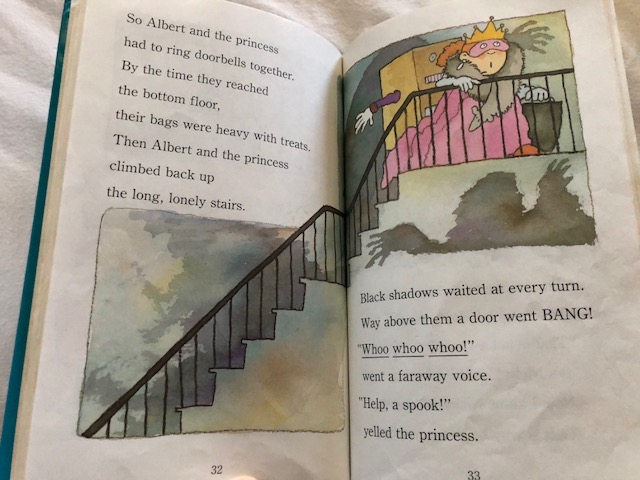
When Albert arrives at Nicky’s new apartment house, he meets a girl dressed like a princess in the elevator.  She says that she’s going to the Halloween party on the fifth floor, and when Albert says that he is too, she suggests that they walk there together.  Albert guesses that she is Nicky’s cousin, Suzanne, who he hasn’t met before.

The apartment is pretty spooky, lit by jack o’lanterns, and there are already some guests there.  Albert is a little surprised that he doesn’t see a pirate, but there are a couple of witches and an owl, who could be Nicky.  Yet, when Albert tries to talk to the other guests, they seem to be acting strangely, and he realizes that he’s not quite sure who is really who.

SpookyHalloweenArrival

The princess is pretty spooked, and as the party goes around the apartment house, trick-or-treating, she kind of clings to Albert.  When some strange noises and a far-away “Whoo, whoo” sound startle her, Albert reassures her that it’s only Nicky in his owl costume.  Then, the princess tells him that she knows the owl, and it’s not Nicky.  That’s when Albert really starts getting scared, wondering why he doesn’t seem to know his own friends.

SpookyHalloweenTrickOrTreat

The book is available to borrow and read for free online through Internet Archive.

My Reaction and Spoilers

The reason why Albert doesn’t seem to know anyone becomes apparent when they unmask themselves after trick-or-treating.  Albert is really among strangers!  The princess isn’t Nicky’s cousin at all, and he followed her to the wrong Halloween party!  There were two Halloween parties on the fifth floor that night.  Nicky lives in apartment C, and Albert accidentally joined the party in apartment B.  Fortunately, Albert’s friends are also trick-or-treating around the apartment building and show up at that moment.

What started out as a potentially embarrassing mistake actually ends up making the evening more fun for everyone.  Albert’s mix-up brought an element of real suspense to both of the Halloween parties, with him wondering who everyone really was, the guests at the wrong party wondering who he was, and all of Albert’s friends wondering where he was.  Also, Albert gets some new friends out of this experience, and both parties end up combining into one big party at Nicky’s apartment.

SpookyHalloweenBigParty

Race isn’t important to the story and is never mentioned, but I’d just like to say that I appreciated the diversity of characters in the pictures.  Albert is black and so is Jan (you can see that when she isn’t wearing her clown costume), and the boy in the owl costume looks like he might be Asian.  I also really love that owl costume!  I don’t think I’ve ever actually seen anyone dress as an owl for Halloween, but it looks awesome!

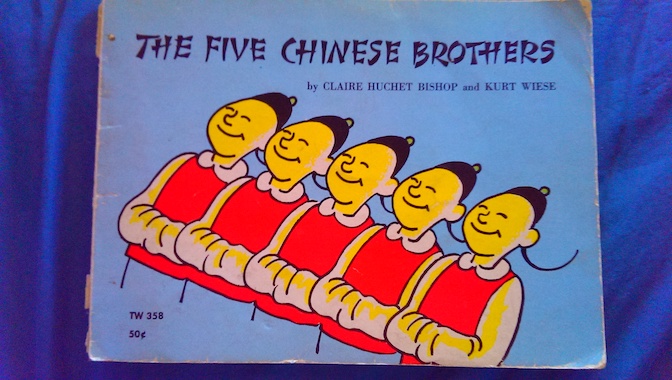
The Five Chinese Brothers

FiveBrothers

Although this picture book has faced some criticism for promoting Asian stereotypes (largely about the way the characters are drawn), it has nostalgic appeal for some people and is still in print.  What I find interesting about it is that it is actually based on an old folktale, Ten Brothers.  Folktales of this type, where people with different types of super-human powers must help each other to overcome obstacles, can be found throughout the world.  Another story on this theme is How Six Made Their Way in the World.

In this story, there is a family in China with five brothers who look alike, except that each brother has a unique super power (listed by birth order):

  • One can swallow the entire sea, although only for a limited amount of time.
  • One has a neck as strong as iron.
  • One can stretch his legs extremely far.
  • One is impervious to fire.
  • One can hold his breath for an unlimited amount of time.

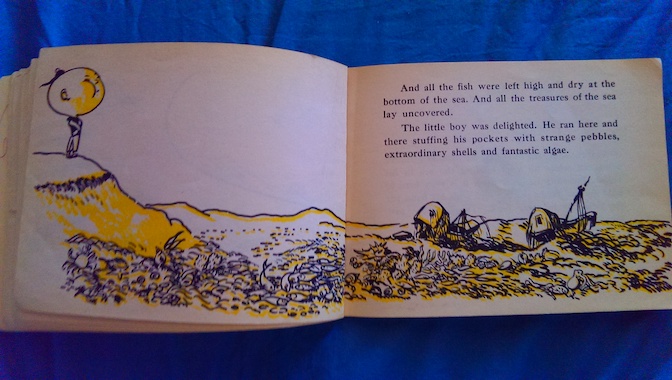
They live in a village by the sea and make at least part of their living by fishing.  One day, a young boy asks to go fishing with the brother who can swallow the sea (they don’t have names in the story, they’re just referred to by ability or birth order).  At first, the brother is reluctant to allow it, but when the boy begs, the brother agrees only on the condition that the boy obey him and return to his side as soon as he gives the signal.  The brother swallows the sea and allows the boy to collect as much fish as he likes from the empty sea bed.  However, the boy gets too wrapped up in all the amazing things he finds on the empty sea bed and ignores the brother’s frantic signals to return.

FiveBrothersSeaSwallow

Finally, the brother cannot hold back the sea any longer and releases it.  The boy drowns, and the brother is arrested for the boy’s death.  The judge decrees that the brother will be executed by having his head cut off.  Before the execution, the brother has a last request: that he be allowed to return home to say good-bye to his mother.  The judge allows it, and the brother switches places with his brother who has a neck like iron.

FiveBrothersHead

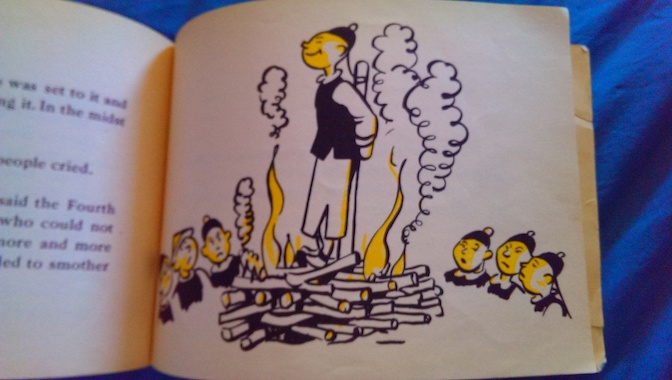
Needless to say, the execution doesn’t go as planned, and everyone is astonished when the executioner cannot cut off the brother’s head.  The judge decrees that he will be executed by drowning instead.  However, he does grant the brother’s request to say good-bye to his mother once again, giving him the chance to switch places with another brother who can safely face the next ordeal.

FiveBrothersBurn

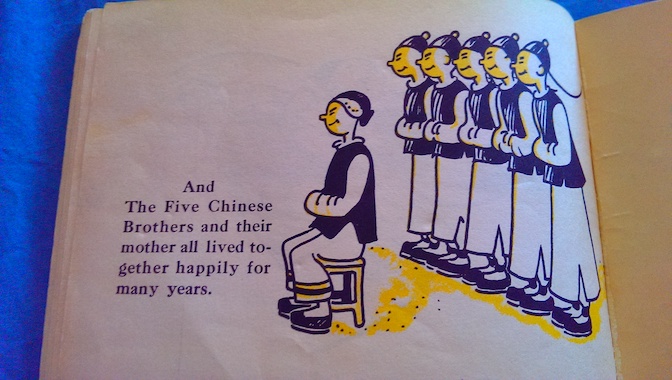
The process continues through one form of execution and another as each of the brothers survives, using his own special power.  Finally, the judge decides that if the man (he doesn’t know there’s more than one, apparently) cannot be killed, he must be innocent and pardons him.

The book is currently available online through Internet Archive (multiple copies).

FiveBrothersFamily

The Twin in the Tavern

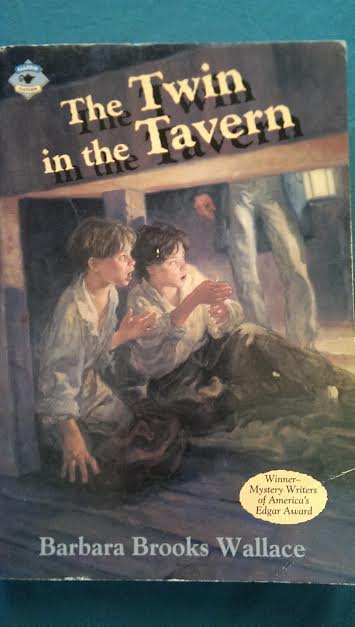
TwinTavernThe Twin in the Tavern by Barbara Brooks Wallace, 1993.

Young Taddy has lived with his Aunt and Uncle Buntz in Virginia ever since he can remember. When they die during an epidemic, he is left completely alone and afraid that he will be sent away to a work house. Before his uncle dies, however, he tells Taddy something that gives him even more reason to be afraid. He tells Taddy that nothing is how it seems and that Taddy is not really their nephew. He says that Taddy will only learn the truth when he finds his twin, but he must beware because he is in danger. Unfortunately, he never says where Taddy’s twin is or what kind of danger he is in.

Before Taddy can decide what to do, a couple of thieves, Neezer and Lucky, come to rob the house because they heard that Mr. and Mrs. Buntz were dead. When they discover Taddy in the house, they bring him with them to Alexandria and make him work in their tavern. Taddy is only given scraps to eat and he must sleep under a table in the kitchen with another boy who works for Neezer called Beetle. However, by coincidence, Neezer and Lucky may have brought Taddy to the very place he needs to be to find the answers about his past and his true identity.

Danger seems to lurk around every corner in the city, and Taddy doesn’t know who to trust. Even when Neezer hires him out to work in the home of the wealthy Mrs. Mainyard and her two daughters, sinister characters surround him, from the suspicious Professor Greevy to the stern John Graves, who visits the family.  At one point, Taddy thinks that he’s found his twin, but the boy mysteriously vanishes. Will Taddy find his twin and the secret of his past, or will the danger that his uncle warned him about find him first?

This book was a BOOKLIST Editors Choice Book in 1993 and won the 1994 Edgar Allan Poe Award.  It is available to borrow and read for free online through Internet Archive.

My Reaction

This was one of my favorite mystery stories when I was a kid!  Orphans with mysterious pasts are staples of children’s literature and make for compelling mystery stories, and the addition of a secret twin makes it even better!  Secret twins can be somewhat cliche in stories, but this one is good because there’s an unexpected twist for Taddy that he never considered until the truth is finally revealed.

Many of Barbara Brooks Wallace’s mystery books involve sinister characters with hidden agendas and children who don’t know who to trust because they don’t fully understand the plot they’re caught up in.  This book is like that because Taddy doesn’t know the real source of danger to him.  Like other children in stories of this type, Taddy frequently depends on the help of other children because he doesn’t know which adults to trust.

The story is set at an unspecified time in the past, although it appears to be sometime in the 19th century.

Lisa and Lottie

LisaLottieLisa and Lottie by Erich Kastner, 1969.
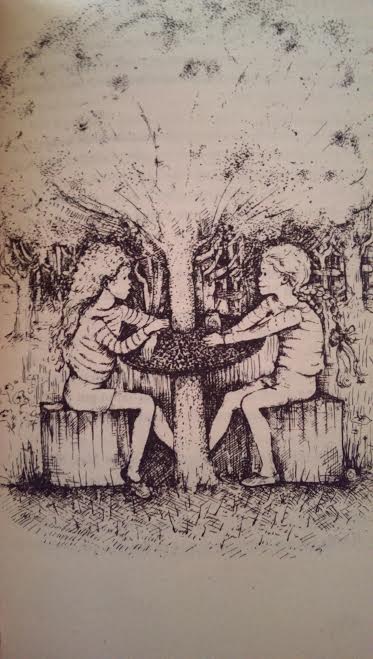
First, a note about the copyright: the date I give is for the edition I own, which is an English translation of the original German book.  The original copyright date for the story is 1949.  This is the story that was the basis for Disney’s The Parent Trap, both the version with Hayley Mills (1961) and the later Lindsey Lohan version (1998).  Neither movie completely follows the original story (although some of the dialog in the Hayley Mills version is almost word-for-word from the English version of the original story) because the settings are shifted to new locations, but both of them capture the concept of twins who were separated as infants by their divorced parents only to meet again years later by accident.  As in the book, each of the twins has been living a different kind of life with one of their parents, but they decide to switch places so that each of them can meet the parent they’ve never known.

Lottie Horn is a very serious little girl.  She can’t help it because she lives with her single mother, who spends much of her time working, and she relies on Lottie to take care of a number of household chores.  But, her mother feels badly that Lottie has been growing up so quiet and serious, so to help her relax and make more friends her own age, she decides to send Lottie to summer camp at Bohrlaken on Lake Bohren.

Shy Lottie thinks that her summer is going to be horrible when she meets up with boisterous Lisa Palfy, a girl who strangely looks exactly like her.  Lisa is shocked at the sight of this girl who looks so much like her, and after some teasing, joking, and staring from all the other girls, she loses her temper and kicks Lottie in the shin.  The camp leaders decide to give the two girls beds next to each other, saying that they’ll just have to get used to each other.  Lottie thinks that it’s going to be awful, but when Lisa sees how unhappy Lottie is, she apologizes and starts being nicer to her.

LisaLottiePic1

The two girls discuss their lives and their strange resemblance with each other, and some unsettling details are revealed.  First, they learn that they not only share a resemblance but the same birthday.  They also realize that they were both born in the same city, although Lottie now lives in Munich and Lisa lives in Vienna.  This strange coincidence is troubling enough, but then each girl reveals that she lives with only one parent: Lottie lives with her mother, and Lisa lives with her father.  Lottie has no memory of her father and no knowledge of what happened to him, where he might be, or even if he’s still alive.  Lisa also has no memory of her mother, but she did once see a picture of her, a picture which her father hid somewhere after he found her looking at it.  The girls start getting suspicious, so Lottie shows Lisa a picture of her mother, and Lisa confirms that it’s an identical copy of the picture of her mother she saw before.  Lisa and Lottie realize that they are long-lost sisters.

LisaLottiePic2Through the rest of the summer, the girls discuss their lives and parents in great detail and continue speculating about the reasons for their parents’ separation and why they were never told about each other’s existence.  They are somewhat angry at their parents for not telling them the truth, but they each also want to know more about the parent that they have never really known and perhaps to learn the truth behind their parents’ separation. They begin hatching a plot to switch places so that Lottie can go to Vienna to meet their father and Lisa can go to Munich to be with their mother.  They get little notebooks and fill them with as many details of their lives as they can think of so that each girl can seem to behave like the other, although they know it won’t be easy because they’ve lived very different lives.  They don’t like the same foods, and Lottie knows how to cook, but Lisa doesn’t.
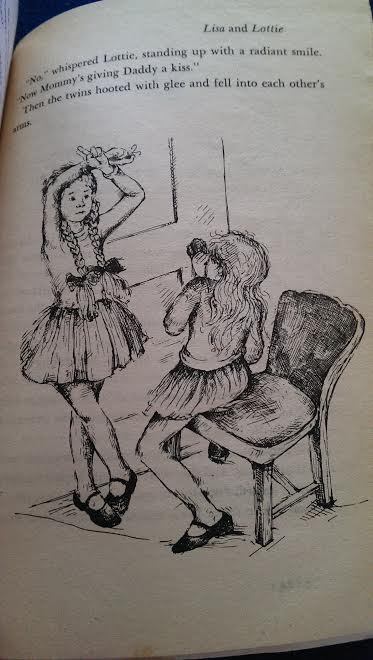
Still, the girls proceed with their plan.  When it is time to leave camp, the girls dress as each other.  Lisa puts her hair in braids as Lottie always does.  Lottie lets her curls hang loose, like Lisa usually does.  Then, each of them boards the train for the other’s city at the station.

LisaLottiePic3Lisa is overjoyed to finally meet her mother in Munich.  But, her mother has to work very hard as a photographic editor for a newspaper, and they don’t have much money.  Lisa isn’t as good at cooking or taking care of household chores as Lottie is, so she finds it difficult to help, although she learns quickly.

In Vienna, Lottie meets her handsome but somewhat reclusive father.  Her father is an opera conductor, but he’s also a composer who needs to spend much of his time alone in order to compose his music, which was the primary reason for the divorce.  He always wanted to devote his life to the arts, and he felt that marriage and family life got in the way, although he dearly loves his remaining daughter and dotes on her.

But, life in Vienna isn’t that great for either Lottie/Lisa or her father.  Rosa, the housekeeper who often looks after “Lisa” and takes care of their apartment only pretends to like her when her father is around and steals from the household funds.  Also, in spite of finally having plenty of time along for composing music (which is successful), her father is lonely and unhappy.  Although he doesn’t want to admit it at first, he misses the comforts of family life and the company of his wife.

Each girl, because of her different personality, manages to make changes in the life of the other and in their parents which are for the better, but the charade cannot continue forever.  Lottie finds out that their father is considering marriage to a woman who doesn’t like her.  Then, Lottie falls seriously ill.  More than ever, she needs her mother . . . and her twin.

The book is currently available online through Internet Archive (they have multiple copies).

My Reaction and Spoilers:

LisaLottiePic4The book is much less of a comedy than either of the two Disney movies, although there are some funny parts, like when Lottie (as Lisa) takes over the household accounts to stop Rosa’s stealing and ends up turning her into a much better housekeeper with her practicality.  Surprisingly, Rosa actually starts respecting her more and even liking her better because of it.
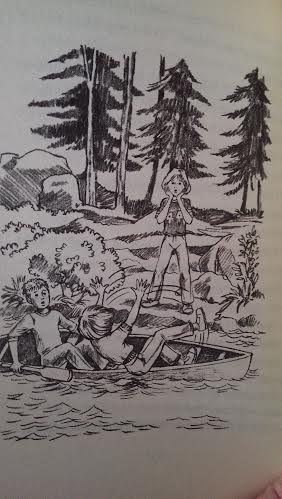
Much of the focus of the book is how divorce affects children as well as parents, although there is room for debate on how each side views the issue, and some modern families may disagree with some of the points characters in the story make.  The point of view of the story shifts between each of the girls and also between their parents and other characters to show different reactions to the situation.

The children are understandably upset at the entire issue and believe what their parents did was wrong.  The girls admit that they do not think of either of their parents as evil or cruel, but they view the separation and lies that were forced on them without their consent as cruel.  Lottie even has a nightmare which is a twisted version of Hansel and Gretel in which her father threatens to cut both her and her sister in half because it would only be fair for each parent to get half of each child.  At camp, the girls see one of their friends crying, having just found out that her parents are going to get a divorce.  Other girls at the camp call her parents mean for making the decision while she was away at camp and just springing it on her with no warning at all.  For the children in the story, the worst part about parents divorcing is when they give little or no thought to how the children will feel or be affected by the decision and don’t even talk about the situation with them.

Some of that sentiment is echoed by adults in the story, although the adults are a little more ambivalent on the issue, knowing that different people and different circumstances must be judged on an individual basis.  The adults try to do what they think is best for the children, but they make mistakes, partly because they are too absorbed in their own concerns to understand the entire situation, and they come to realize it.  The overall sentiment of the book seems to be that, while marriages are made up of only two people, families are made up of more, including the children.  When a couple divorces, it not only affects the marriage, but the whole family as well, and parents need to remember that.

Like the movies, the book also ends happily, and the father finds a way (with the help of Lottie) to balance his work life with his family life.

Double Trouble on Vacation

DoubleTroubleVacation

Double Trouble on Vacation by Michael J. Pellowski, 1989.

The Daniels twins are at it again! Sandi and Randi are looking forward to spending their vacation at the lake with their family. Sandi is trying to work on her wilderness merit badge, and Randi just wants to go fishing. But, when Bobbi Joy, a bully they know from school, turns up at the lake, visiting her cousin, the girls make the mistake of accepting a bet from her. Randi bets Bobbi Joy that she can beat her in the fishing derby, not knowing that Bobbi Joy’s cousin, who is her fishing partner, is a fishing champion. Although the stakes are fairly harmless, just taking a jump in the lake with all her clothes on, Randi still can’t stand the idea of losing to Bobbi Joy.

Things get complicated when Randi is sprayed by the skunk that their little brother Teddy tried to befriend. Randi doesn’t want her team to be disqualified from the fishing derby, but she can’t go smelling like skunk! Instead, she talks Sandi into taking her place once again. But, Sandi has to give a speech later that day in order to get her merit badge. Can she help her sister and still make it in time to make her speech?

This book is currently available through Internet Archive.

DoubleTroubleVacationPicThis is the last of the four books I have in this series, but there are two other books in the series that I don’t have and haven’t read: A Double Trouble Dream Date and Double Trouble Mystery Mansion.  In A Double Trouble Dream Date, the twins conspire to get roles in a new music video with a teen star, when only Sandi is actually able to sing.  In Double Trouble Mystery Mansion, the girls are investigating a haunted house which holds a hidden treasure.  There is a real ghost in the story, but only Sandi has been able to see it.  At first, Randi doesn’t believe her that there even is a ghost, and the girls attempt another switch to see if they can convince the ghost to show himself to Randi, too.

Triple Trouble in Hollywood

TripleTroubleHollywoodTriple Trouble in Hollywood by Michael J. Pellowski, 1989.
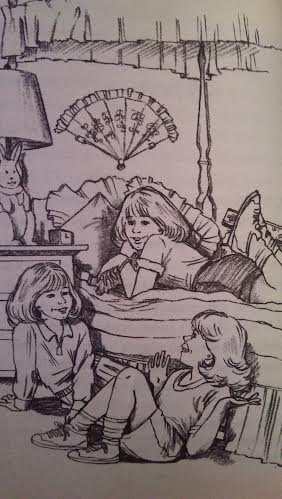
This time, Randi and Sandi to go Hollywood to visit their cousin Mandy. Mandy is no longer the same snobbish girl that she was the last time they were together, but she still has ambitions. Right now, she’s trying out for a part in a commercial, but she’s up against some stiff competition.

The commercial requires the girl to sing a jingle and do a back flip. Although Mandy has an excellent speaking voice, the other girls know that she’s terrible at singing, and Mandy doesn’t think she can do the back flip, either. Her main competitor, Tara, can do both of those things. Tara is a wealthy girl whose parents hired coaches to teach her singing and gymnastics especially for this role.

The three girls don’t think it’s fair that Tara has such advantages, and she’s an even bigger snob than Mandy ever was. Then, Randi suggests that they use their similar appearances once again to turn the situation around. Randi is athletic enough to do a back flip, and Sandi is an excellent singer. With all three of them working together, the try-outs for the commercial would be a snap!

TripleTroubleHollywoodPicSandi doesn’t want to do it because it would be dishonest, but Randi and Mandy talk her into it. It’s partly to help Mandy, partly to get back at Tara for her rotten attitude, and partly for the chance to meet the heartthrob Judd Morrison who will also be in the commercial. Of course, as is always the case when the girls switch places, nothing goes as planned.  But, to the girls’ surprise, their younger brother Teddy helps to make things better in the end.

This is part of the Double Trouble Series.

The book is currently available through Internet Archive.