The Mysterious Horseman

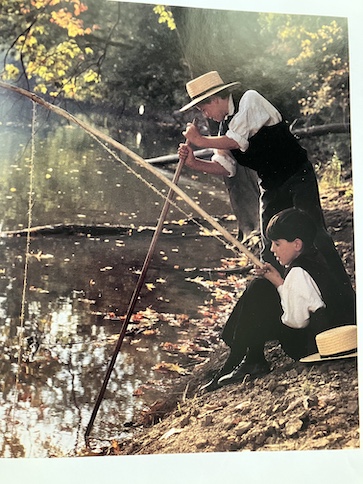
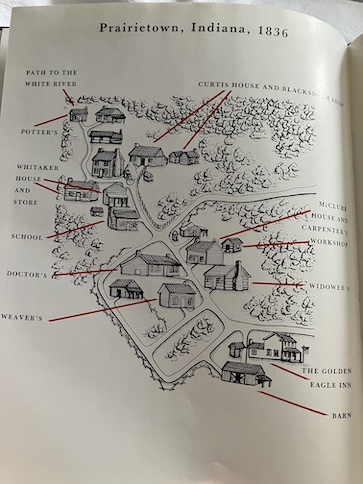
This book is part of a loose series of books by Kate Waters, showing child reenactors at living history museums, having adventures in the roles of the characters they play. While most of the books are set in Colonial times at Plymouth and Colonial Williamsburg, the setting for this story is the Connor Prairie living history museum in Indiana, which shows life in a small town in the 19th century.

The story centers around a boy named Andrew McClure. He is the only one of his siblings left still living with their parents. His older sister is now married, and his baby brother died of an illness during the last year. His family is still grieving for his little brother. Andrew’s best friend is a boy named Thomas Curtis, who lives nearby, and Andrew works part time at a local inn to earn some money.

One day, while Andrew is doing some sweeping at the inn, he overhears some men talking in the taproom. He doesn’t hear their entire conversation, but he hears them talking about a mysterious rider without a head who chased a schoolmaster. Andrew is startled, and he wonders if that has something to do with the new schoolmaster who is supposed to arrive in town.

When Andrew is done with his work, he goes to the schoolhouse, and he finds his friend Thomas and Thomas’s sister, helping the new schoolmaster to clean the schoolhouse and prepare it for lessons to start. Andrew wants to talk to Thomas about what he overheard at the inn, but the schoolmaster only wants to talk to the boys about lessons.

Later, Andrew does have a chance to talk to Thomas, and both of the boys are spooked by the idea of a headless rider. They even think that they hear the rider on the road! The frightened boys go see Thomas’s father, the blacksmith, and tell him about the rider. Fortunately, the blacksmith knows what the men were talking about, and he can settle the boys’ fears.

The book is available to borrow and read for free online through Internet Archive.

I didn’t know about this book until I was looking up Kate Waters’s books for my younger cousins. I was surprised because Kate Waters’s living history museum books are mostly set on the East Coast or focus on the Colonial era. This 19th century book set in Indiana somewhat departs from the theme and has a different feel from the other Kate Waters books, but I enjoyed it. I’ve been to Connor Prairie because I have relatives in the area, and I enjoyed my visit. It’s been years since I’ve been there, so I didn’t immediately recognize the setting. When I read the explanation in the back of the book, I was fascinated to realize that I had visited that location before.

Andrew has a fascination for life on the frontier because he often watches people pass through his town on their way further west, and he daydreams about going west himself. His family is also still coming to terms with the death of his little brother, so the subject of death is still on Andrew’s mind. The deaths of children due to illness were sadly common in the 19th century and on the frontier, and the mourning in Andrew’s family adds to the melancholy and spooky atmosphere of the story.

Most adults and older children will probably recognize what the men at the inn where actually talking about when they were discussing the headless rider who chased the schoolmaster. When the boys talk to Thomas’s father, he immediately recognizes the story as the plot of The Legend of Sleepy Hollow by Washington Irving, originally published in 1820, about 16 years before the story in this book is suppose to take place. The men at the inn were just discussing the plot of the story, not something that they saw on the road themselves.

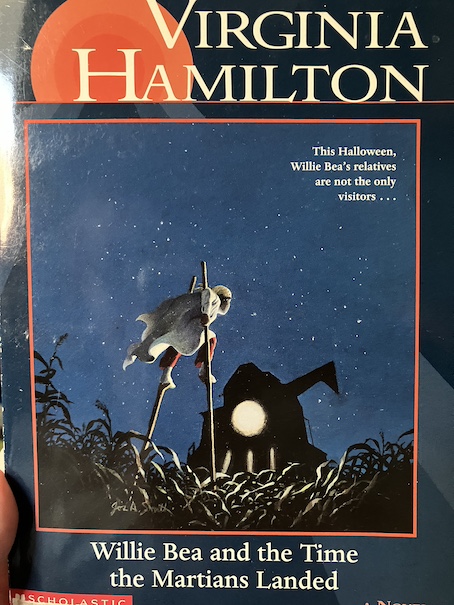
Willie Bea and the Time the Martians Landed

It’s Halloween 1938, and Willie Bea’s relatives have gathered at the old family farm, near where she lives. Money is tight because of the Great Depression, but one of her aunts lives and works in the city, making more money than the others, and is willing to help fund family dinners and provide a little extra for her nieces and nephews when they need something, like new clothes. The aunt is a little scandalous in their family for her multiple marriages, but the others appreciate her generosity, and the nieces and nephews like getting some extra attention and a few treats from her.

The family gathering is a bit chaotic with children running around and getting into trouble. One of Willie Bea’s cousins gets into particular trouble with her mother for using his bow and arrow set to shoot a pumpkin off of Willie Bea’s younger brother’s head. Their mother panics when she catches them doing it because he could have missed and killed the little boy, but Willie Bea tries to calm her mother. Willie Bea was less worried because she knows her cousin’s archery skill and that he wasn’t going to miss, but she understands that adults think of the risks and aren’t fully aware of what the kids are capable of doing. (I’m siding with the mother on this one. Even people who are very good at something can miss now and then, and it’s a big risk to take with someone’s life.) Willie Bea also realizes that the decision to use her little brother for the William Tell act actually came from another cousin because the cousin doing the archery wouldn’t have thought of it himself, and it’s not fair that her mother doesn’t know to blame this other cousin.

Willie Bea talks to her father about the incident, hoping that he’ll understand how unfair it is. However, her father tells her that what her cousin did was dangerous, no matter why he did it. Even though he has a reputation for being good with archery, even people who are good can still miss, and accidents can happen. (See?) Her father lets Willie Bea know that he’s aware that she and her cousins do risky things sometimes when they’re playing with each other, but as an adult, he and the other adults have a responsibility to tell them when something they’re doing is too risky and to put a stop to it. No matter how many times they’ve done some of these things without having an accident, some things are just accidents waiting to happen. They should never assume that an arrow can’t go wrong just because it hasn’t yet or that they can’t fall from a high place just because they haven’t fallen yet.

Willie Bea is a little embarrassed by the talk and feels like her father still doesn’t understand. However, Willie Bea herself has been starting to understand a few things about her relatives this Halloween, things that she either hasn’t noticed before or only half noticed. She can see that one of her cousins is too manipulative, noting the little tricks she uses to get her way and the things she says and does when she wants to be spiteful. She can see that her other cousin has trouble asking up for himself and is particularly vulnerable to manipulation.

Willie Bea also begins to notice things about the adults in the family and their relationships with each other. Aunt Leah, the aunt who has more money than the others and has been married multiple times seems glamorous and fascinating to Willie Bea. Aunt Leah is into horoscopes and fortune telling, and when she reads Willie Bea’s palm, she predicts something special for her. Although Willie Bea loves her own mother, she is intrigued by the family gossip that her father was seeing Aunt Leah before falling in love with her mother, and Willie Bea fantasizes about what it would be like to live with Aunt Leah in the city. She imagines that it would be exciting, and she asks her father why he chose her mother instead of Aunt Leah. Her father knows that Willie Bea doesn’t entirely understand what it’s like to make that kind of choice and what living with a woman like Aunt Leah would really mean. (It occurred to me that the multiple divorces Leah has had might be a clue.) He just explains to Willie Bea that his choice became clear after he got to know her mother as well as her sister, Leah. He knew her mother was the right choice because she was the kind of steady woman who would always be there for him.

That evening, while Willie Bea is putting together her hobo costume and the ghost costumes for her younger siblings and her parents are listening to the radio, Aunt Leah suddenly bursts in and starts having hysterics about it being the end of the world! It takes Willie Bea’s parents a while to get a clear answer from Aunt Leah about why she’s so upset. When she recovers enough to explain things, she says that she was listening to the radio, and she heard that Martians have invaded New Jersey! She describes the horrible, terrifying reports that the radio announcer made about the Martians destroying army troops with their deadly heat ray. Aunt Leah was so terrified by what she heard that she not only turned off the radio but unplugged it, and she says that she’ll never plug it in again, which might be a moot point, if aliens really are here to destroy the world. (If you know what was infamously broadcast on Halloween 1938, you know what Leah heard and that it’s not what she thinks it is.)

While Willie Bea’s parents are trying to decide what to make of Aunt Leah’s story, Willie Bea’s Uncle Jimmy arrives. He says that the rest of the family has also heard what Aunt Leah heard and that they’re all gathering at the old family farm. Rumor has it that people have seen the terrible invaders over at the Kelly farm. Willie Bea’s mother gathers the children and heads to the family farm that Willie Bea’s grandparents own to be with the rest of the family, while Willie Bea’s father tries to see if he can find the station that Leah was listening to and hear the reports for himself. It occurs to him that it might not be an invasion of the Martians but could actually be Germans and German war machines because they’ve all heard about the Nazi takeover of Germany, and he remembers the horrible Hindenburg disaster. If Germans could make a blimp that explodes into a fiery terror like that, then he thinks maybe they could make something that resembles an alien invasion.

At her grandparents’ farm, Willie Bea watches as various relatives panic, cluster around the radio, trade rumors, and try to figure what’s going on. Rumor has it that there are Martians on the Kelly farm, so Willie Bea convinces young Toughy Clay to go over there and try to see them for themselves. At Willie Bea’s insistence, they use the stilts that the children like to walk on to give themselves longer legs, so they can get there faster. Nothing is as it seems this Halloween, and Willie Bea’s expedition to see the Martians definitely doesn’t go as planned.

The book is available to borrow and read for free online through Internet Archive (multiple copies, including a short picture book version).

Almost of the characters in this book are African American. I don’t think it’s ever stated directly because there’s no need in the story to describe them, compared to anyone else, but I think it’s subtly implied. There is only one point in the story where race is mentioned at all, and that’s when Willie Bea is hurt, and the doctor comes to see her. Willie Bea describes the doctor as an old man who delivered most of the babies in her family and knows everybody in the community, and she says that he visits everyone, black or white, rich or poor. Willie Bea’s family is at the poorer end of the community because the doctor knows that people like them don’t normally call the doctor unless it’s something that they really can’t handle by themselves.

I found the family relationships in the story confusing at first. The kids are all referred to by nicknames, and when they are first introduced, it’s difficult to keep it straight who is whose sibling and who is a cousin, and who is older and who is younger. At least, that’s how it seemed to me. Relationships are explained gradually as the story continues, along with characters’ real names as well as nicknames, but it takes some time to get to the explanations.

The story has a slow start, and the real adventure doesn’t begin until about halfway through the book. In some ways, it’s a coming of age story for Willie Bea because she finds herself seeing her family in ways that she never has before, becoming more aware of different sides of their personalities and gaining more insights into their relationships with each other. She also comes to see firsthand what her father means about the stunts that she and her cousins pull and how she should never assume that they can’t get hurt just because they haven’t before. Much of this book is what I would call “slice of life”, a sort of glimpse into Halloweens of the past in a rural community, especially one particular Halloween that would have been memorable for anyone who was alive at the time in the United States.

The radio broadcast that has Willie Bea’s family and others in the community panicking over an alien invasion is The War of the Worlds, a play based on the novel of the same name by H. G. Wells. This type of panic over this particular radio performance was a real, historical incident because the radio play was presented in the format of news broadcasts at the time, and some people who tuned into the program late misunderstood what they were hearing and thought that it was a real news broadcast about an actual emergency. It wasn’t a widespread panic because, first, people who started listening to the broadcast from its beginning knew what they were listening to, and second, not everyone was listening to the broadcast at all. Still, there was enough panic over the radio performance that it became newsworthy and has become a piece of American history and lore.

I enjoyed the historical details in the story, particularly all the radio play references throughout the story. Willie Bea’s family likes to listen to radio shows, and I’m familiar with some of them because I also enjoy old radio plays. Her family likes to listen to The Shadow and Little Orphan Annie. Willie Bea likes to amuse her siblings by imitating people from the radio, singing theme songs and reciting jokes from Jack Benny, like the famous “your money or your life” joke.
Mystery Madness

Mystery Madness by Otto Coontz, 1982.

While Murray’s parents are on vacation, his older sister, Blanche, is in charge of the house. One day, he calls Blanche to get a ride home from the dentist and hears what he thinks is Blanche shooting their housekeeper.

Earlier that morning, he had heard Blanche talking on the phone to someone about a gun. Then, when he calls home, a friend of Blanche’s, Harold, answers, and Murray hears a gun going off in the background and Blanche apologizing to the housekeeper and talking about blood on the carpet. When Murray gets home, his mother’s Persian rug is missing and sees what appears to be a head in a bucket under the sink in the kitchen, further proof that the housekeeper is dead and that her blood stained the carpet.

Murray doesn’t know what to do because he is sure that his sister would never shoot anyone on purpose, and he doesn’t want to see her go to jail. He consults a private detective, Mat Cloak, who he met in a doughnut shop, for help.

The detective agrees to look into the case, and along the way, he realizes that it has connections to a case that he is already investigating. What really happened to the housekeeper? Is Blanche really guilty of murder? Moreover, who is the strange man who is following Murray around?

It’s a very funny story with some twists that readers won’t be able to guess right away. Part of the mystery is pretty obvious because Blanche is a theater student, but the real mystery is one that Murray isn’t even trying to solve and the real villain is someone who Murray thinks is a victim.

The book is available to borrow and read for free online through Internet Archive.

Blueberries for Sal

Blueberries for Sal by Robert McCloskey, 1948.

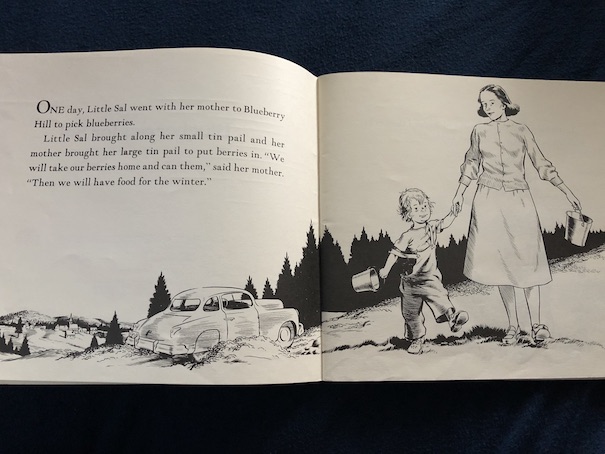
Sal is a little girl whose mother takes her to pick blueberries one day. The mother wants to can the blueberries for winter.

Sal gives in to temptation and eats the blueberries as she picks them.

Meanwhile, a mother bear and her baby come to eat blueberries.

Both Sal and the Little Bear lose sight of their mothers, and when they go looking for them, Sal accidentally finds the mother bear, and the little bear accidentally finds Sal’s mother.

Eventually, the mother bear realizes that Sal is following her when she hears the blueberries plunking into Sal’s pail. Sal’s mother realizes that a small bear is following her when he eats blueberries out of her pail.

Fortunately, nothing bad happens. The mothers just look around for their respective children and figure out where they are by the sounds they make. Then, the mother bear leaves with her baby, and Sal and her mother take their blueberries home.
At first, I was worried about Sal being with the mother bear and how Sal’s mother would react to the mother bear when she saw it, but the two mothers never meet in the story, and the children are fine.
The book is a Caldecott Honor Book. It is available to borrow for free online through Internet Archive (multiple copies).

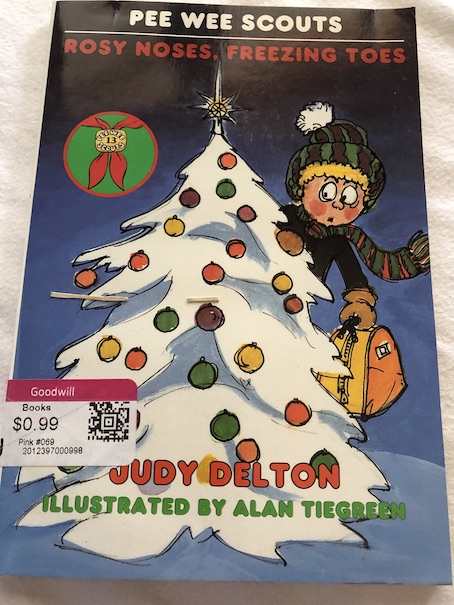
Rosy Noses, Freezing Toes

Pee Wee Scouts

#13 Rosy Noses, Freezing Toes by Judy Delton, 1990.

At one of the scout meetings, Mrs. Peters, the troop leader, says that her antique vase is missing. It’s a family heirloom, and Mrs. Peters wants to ask the scouts if they know anything about its disappearance or if they have any idea of what could have happened to it. None of them knows, but they’re fascinated by the mystery. After they search the house and can’t find it, Mrs. Peters says that she’ll just have to report its disappearance to the insurance company. Mrs. Peters is willing to let the matter go at that, but the scouts keep wondering what happened to the vase and if one of them could have taken it.

Mrs. Peters tells the scouts that the next badge they will earn will be their music badge. To earn the badge, the children will have to sing or play an instrument or tell the group about the life of a composer. Some of the children already play instruments and know what they’re going to do, but others aren’t sure. Since it’s December, Mrs. Peters suggests that some of them could sing popular Christmas songs or a Hanukkah song.

Sonny Betz declares that he doesn’t want to participate because he can’t play an instrument and over the next few days, he seems upset and nasty with people. Molly asks him what the matter is, and Sonny tells her that his mother is forcing him to take violin lessons. Mrs. Betz has always wanted Sonny to learn to play the violin, and his new violin teacher has assured her that Sonny will be able to learn the first line of Jingle Bells in time for the scouts’ music show, even though it’s coming up fast. Sonny isn’t happy about it, and to make him feel better, Molly tells him that he’s lucky because nobody else will be playing the violin and it will make him different. Unfortunately, the other kids tease him and call him “Maestro,” so he starts feeling bad.

Molly doesn’t like the way the others keep teasing Sonny, and when Tracy says that Sonny is a baby, Molly tells her that it’s not his fault because his mother is the one who makes him take violin lessons and keep the training wheels on his bike even though he’s in the second grade and all the other things that people tease him about. Mrs. Betz doesn’t realize how much Sonny hates some of the things that she makes him do and how much the other kids tease Sonny about these things. Molly overhears her mother saying that Sonny will “be a handful by the time he gets to high school,” probably because she’s imagining that Sonny will rebel against all things his mother has been making him do once he’s a teenager. Actually, it’s not going to take that long.

Mrs. Peters uses the insurance money from her vase to buy a piano. The scouts’ music show goes okay at first, although none of the kids are spectacular at music. Molly, Mary Beth, and Lisa paint their noses red and sing Rudolph the Red-Nosed Reindeer. Kevin whistles. Roger plays White Christmas on the drums with no other accompaniment, confusing everyone about what song he’s actually playing. Poor Sonny has to go last, when everyone is starting to get tired of the entertainment, but he doesn’t play well. The other scouts cover their ears, and the screeching of the violin makes the dog bark and Mrs. Peters’s baby cry. Sonny is so upset that he runs away from the show and has a fit.

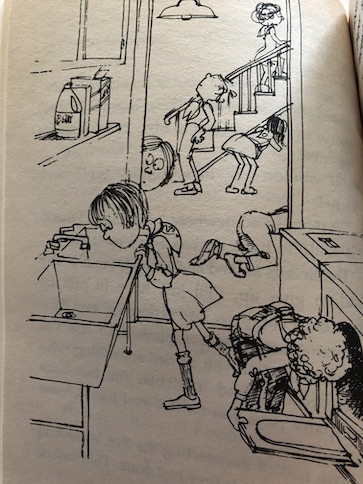
The next day, Molly learns that Sonny has run away from home completely, leaving behind a note that he’s heading to Alaska. Everyone is searching for Sonny and getting worried about him being outside alone in the snow. However, Molly soon discovers that Sonny hasn’t gone as far as everyone fears and he’s certainly not on his way to Alaska. She discovers Sonny hiding in her family’s bathtub. Sonny explains to her that he didn’t have the money to go to Alaska, but he couldn’t bring himself to go home, and he picked Molly’s house to hide in because Molly is the only one who didn’t tease at him. Molly promises not to turn him in, but she says that he won’t be able to stay in her bathtub forever. His mother has called the police to report his disappearance, and Molly’s parents are bound to find him eventually. Sonny swears that he can’t go home because he hates playing the violin so much. What can Molly do to help him change his mind?

I didn’t like the way the other scouts were so mean to Sonny in the book. Sonny does do childish things, like being mean to the younger kids on the playground when he’s upset and throwing fits when things go wrong. However, Molly tries to be understanding with Sonny, even when he’s being fussy and whining, and she recognizes that Sonny is in a difficult position. His mother has certain expectations of him, and Sonny doesn’t think that anything will change her mind. The way things work out, though, makes it seem like Sonny never really explained to his mother how upset he was about the violin lessons and maybe not even how upset he’s been about some other things. Part of Sonny’s difficulty and the reason why he seems babyish to the other kids is that he seems to have trouble managing and articulating his emotions, including standing up for himself and what he really wants. Some of the other scouts help Molly to convince Sonny that running away isn’t the solution, and Molly calls Mrs. Betz to tell her that Sonny is okay but won’t come home until she promises that he can stop playing the violin. Sonny declares that he wants to see that in writing, and his mother gladly writes him a note that says that he doesn’t have to play the violin again.

So, what about the antique vase mystery from the beginning of the story? Before the end of the book, they do locate the missing vase (not really stolen, more misplaced and forgotten), but Molly accidentally breaks it. Mrs. Peters says that it’s okay because, with the vase broken, she doesn’t have to give the money back to the insurance company, and she gets to keep her new piano. She’s been wanting a piano, and the truth is that she never really liked the vase, even though it was a family heirloom. Yay? Merry Christmas!

The book is available to borrow for free online through Internet Archive.

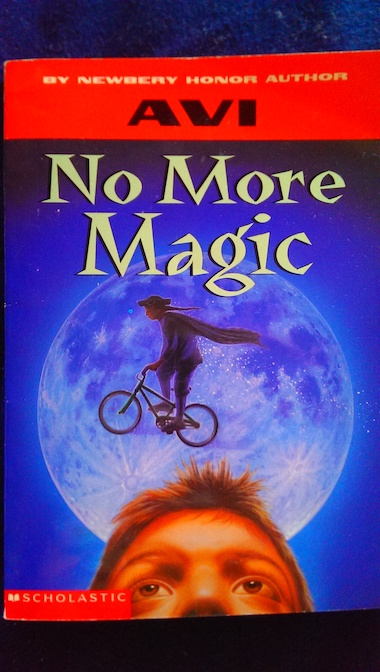
No More Magic

NoMoreMagic

No More Magic by Avi, 1975.

Chris has a fun time on Halloween with his best friend, Eddie.  The two of them are dressed as superheroes.  Eddie is Batman, and Chris is the Green Lantern.  However, the next morning he discovers that his bike is missing.

Chris loves his bike because of its wonderful green color.  He thinks of green as a magical color, and the bike has a great shimmery kind of green paint that reminds him of the Green Lantern.  Although his green bike was a little old and his mother gets a good deal on a newer yellow bike, Chris misses his old one and begins investigating, trying to figure out who could have taken it.

At first, the challenge seems difficult.  On Halloween night, lots of people were running around in costume.  However, Chris’s community isn’t too big, and he is able to identify many of the people who came to the house around the time that the bike disappeared.  One kid that he doesn’t know well is Muffin, a new girl at school, who came to the house in a nurse costume.  There was also a mysterious kid who came in a warlock outfit, with a cape and a tri-cornered hat.

When Chris interviews Muffin to see if she knows anything about his missing bike, he learns that the warlock costume originally belonged to her.  She had made it herself and was proud of it, but someone stole it while it was hanging up to dry.  The nurse costume was a last-minute substitute.  Chris thinks that whoever was wearing the warlock outfit is the most likely suspect for stealing his bike because the local police chief told him that a man had complained that someone riding a bike like his and wearing a costume like the warlock costume ran into him.  He suggests that the two of them team up to find the mysterious warlock/thief and get their stuff back.

Muffin is kind of a strange girl and is oddly evasive about her life and family.  At first, all she will tell Chris is that her real name is Maureen (but she doesn’t like that name) and that she has come to town to live with her aunt because her parents “aren’t around.”  Her aunt seems somewhat strict, and Chris donates some of his own money to Muffin to help her buy a used bike so the two of them can ride around together, looking for clues.

One of the first things they learn is that the person wearing the warlock costume won the prize for the best costume at the Halloween parade downtown.  Chris didn’t attend the Halloween parade, but his friend, Eddie, says that he went.  However, Muffin and Chris notice that Eddie’s name wasn’t on the list of attendees.  When they try to ask Eddie about it, he becomes strangely angry.  Chris doesn’t want to think that his best friend could have stolen his bike or the warlock costume or both, but why would he try so hard to avoid answering their questions if he didn’t have something to hide?

Then, Chris learns why Muffin is so secretive about her life.  The school counselor has noticed that Chris has made friends with Muffin, which she thinks is good, but she tells Chris’s mother about Muffin’s circumstances because she thinks that they should know.  Muffin’s parents recently split up.  For unknown reasons, her mother walked out on her father.  Muffin’s father was distraught when his wife left, and he decided that he should go after her and try to straighten things out with her.  He left Muffin with her aunt and went to try to find his wife, although no one really knows exactly where they went or when Muffin’s father might be back to get her.  The part that worries the school counselor is that Muffin seems to be blaming her parents’ problems and their mysterious absence on magic.  She thinks that magic made her mother go away and that magic is what’s keeping her father away.  The school counselor thinks that being friends with Chris, who is a pretty practical kid (even though he also believes in magic a little), will help bring Muffin down to Earth, and Chris’s mother encourages him to be nice to Muffin and bring her over for dinner.

Still, Chris can’t shake the thought of magic from his head.  He has the strange feeling that, somehow, his magic bike and the magic that Muffin is looking for to get her parents back are connected.  One night, he even thinks that he sees the warlock flying across the sky with his bike, although his father thinks that he dreamed the whole thing.  Neither of his parents believes in magic, and Chris even comes to question whether Muffin is to be trusted.  However, as Chris’s father says, it’s often a matter of asking the right questions before ending up with the wrong answers.

Muffin’s belief in magic comes from what her father said after her mother left.  He said that “the magic had gone,” and he blamed himself for being too self-centered to realize it.  Adults would realize that “the magic” the father was talking about is the romantic feelings that come with love, but Muffin had interpreted the phrase literally.  When her father decided to go after her mother and try to work things out, he said that he was going to “go and find the magic and make it work again.”  Again, Muffin believed that was literally what he was going to do.

It turns out that there are perfectly logical explanations for what happened to both Chris’s bike and the warlock costume, and the two missing objects are not necessarily connected.  Much of what happened on Halloween night involved a series of coincidences, deceptions, and misunderstandings, but even when the full truth becomes known, Chris and Muffin can’t shake the thought that there was a kind of magic behind it all.  Plus, as the kids had guessed, Muffins parents return when they find Chris’s magic bike.

The book is available to borrow online for free through Internet Archive.

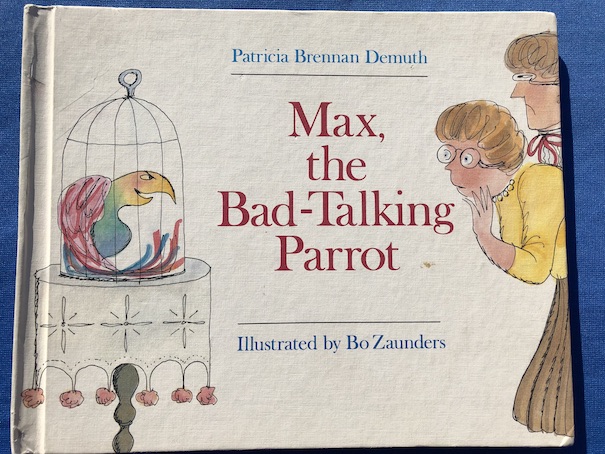
Max, the Bad-Talking Parrot

Max, the Bad-Talking Parrot by Patricia Brennan Demuth, illustrated by Bo Zaunders, 1986.

Don’t worry, Max’s “bad” talk isn’t really that bad.

Max is a parrot who belongs to a woman named Tillie.  They live in a house that has been made into two apartments.  The woman who lives in the apartment above them is Mrs. Goosebump.  Mrs. Goosebump is Tillie’s friend, and Max likes her, too.

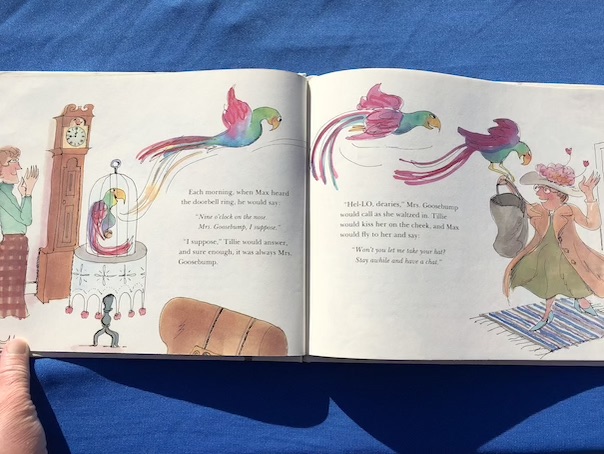
Because Mrs. Goosebump works the night shift in a toll booth, she always comes to see Tillie and Max in the morning, when her shift is over.  Max always greets her with one of his rhymes.  Everything Max says is a rhyme.

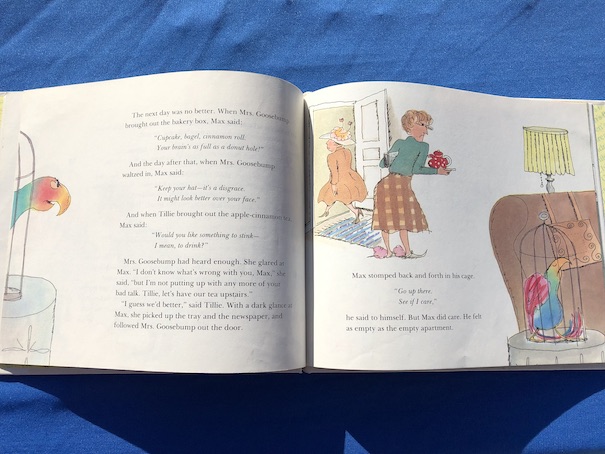
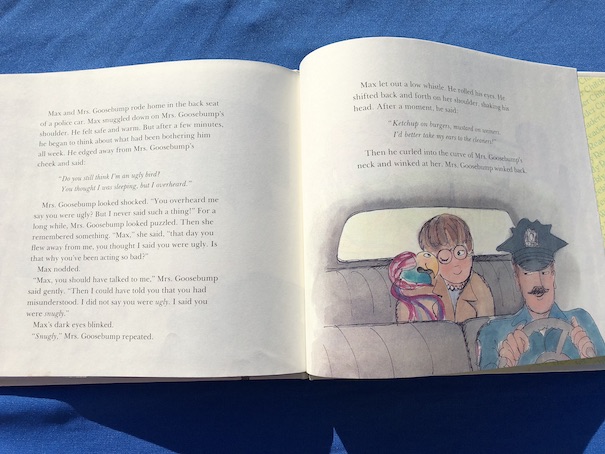
However, one day, as Max is dozing on Mrs. Goosebump’s shoulder during one of her visits, he thinks that he hears her calling him an ugly bird.  Max gets upset and returns to his cage, not ever saying goodbye to Mrs. Goosebump when she leaves.  He feels badly about the insult, and when Mrs. Goosebump visits later, he only gives her insulting rhymes, like, “Cupcake, bagel, cinnamon roll, Your brain’s as full as a donut hole!”

Mrs. Goosebump and Tillie have no idea why he’s so angry. The only thing that they can think to do is ignore him.

Later that night, a burglar breaks into Tillie’s apartment and starts stealing some of her things, including Max!  Max is scared, but by coincidence, the burglar stops to pay at Mrs. Goosebump’s tollbooth.  When Max recites some of his rhymes for her, she recognizes one of his usual rhymes and calls the police.

After Max is rescued, he finally tells Mrs. Goosebump why he was so angry, and Mrs. Goosebump explains that she actually said that he was “snugly”, not ugly.  With the misunderstanding cleared up, the two of them become friends again.  Max is also considered a hero for alerting Mrs. Goosebump about the robber.

When I was a kid, I thought that Max’s rhymes were funny, and the scene with the robber at the tollbooth is funny because Max tricks Mrs. Goosebump into believing that the burglar is insulting her before he says the rhyme that Mrs. Goosebump recognizes.  The book is also a good lesson about the importance of talking to people about what you’re feeling in order to clear up misunderstandings.

The Valentine Mystery

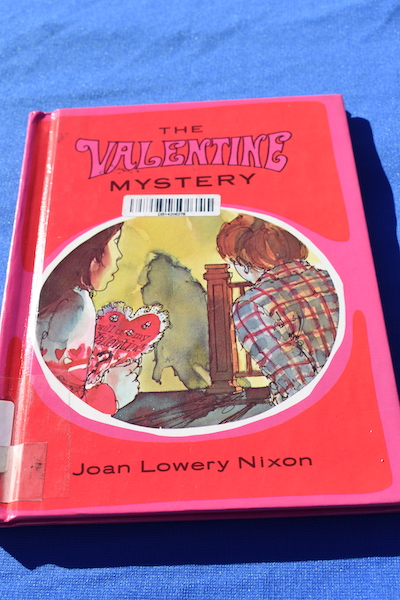
The Valentine Mystery by Joan Lowery Nixon, 1979.

Someone leaves a mysterious, unsigned valentine for Susan Connally at her apartment on Valentine’s Day. Even though everyone was home at the time that the valentine was delivered, the only person who saw the person who brought it was Susan’s little, two-year-old brother, Barney.  All Barney can say about this person is that “He had watches on his tennis shoes.”

Susan and her other brother, Mike, decide to ask some of the other people who live in their apartment building if they know anything about the valentine or a strange person who wears watches on his shoes. 

Nobody knows a person who wears watches on their shoes.  Most people aren’t even wearing tennis shoes.  They’re wearing boots because it’s snowing outside. The questions the kids are asking about people with watches on their tennis shoes sound so strange that one of their neighbors, Mrs. Pickett, thinks that the kids are trying to find the solution to a riddle and keeps guessing things like “a spotted dinosaur who has time on his hands?”  (Mrs. Pickett is one of my favorite characters in this book. All of her solutions involve a spotted dinosaur, for some reason.)

There is a boy named Pete who lives in their apartment building.  His family has only moved there recently, and he’s in Susan’s class at school.  Susan thinks it would be nice if the valentine turned out to be from him, but he’s not wearing tennis shoes or watches.  He’s also wearing boots with round buckles on them.

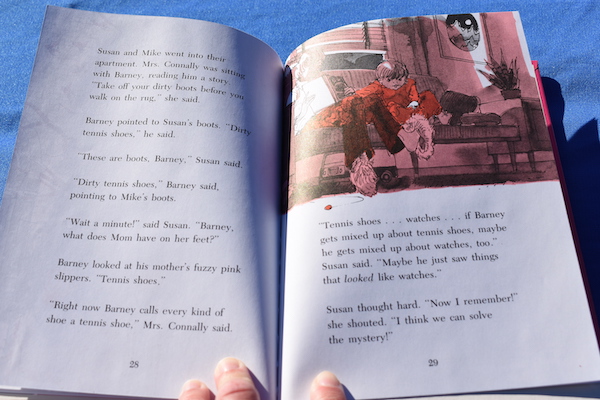
The breakthrough comes when the kids discover that their little brother is going through a phase where he calls all kinds of shoes “tennis shoes.”

The book is available to borrow and read for free online through Internet Archive.

I read this book when I was a kid and then spent years trying to remember what book involved a kid who thought someone had watches on his tennis shoes before I found it again. It’s a cute, fun Valentine’s Day mystery story, and I love all of Mrs. Pickett’s guesses about who would wear watches on their tennis shoes.

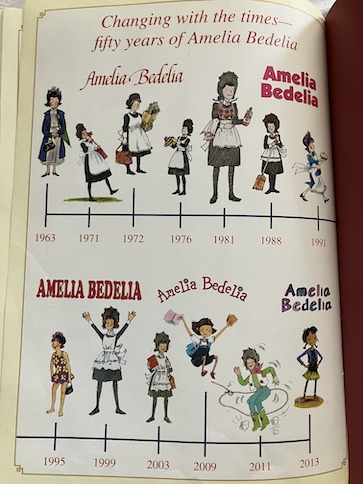
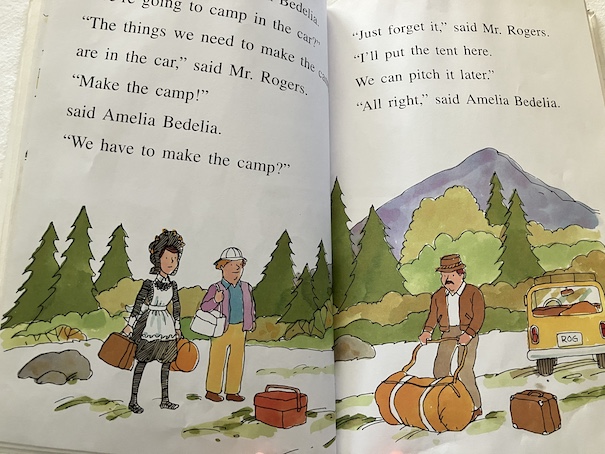
Amelia Bedelia Helps Out

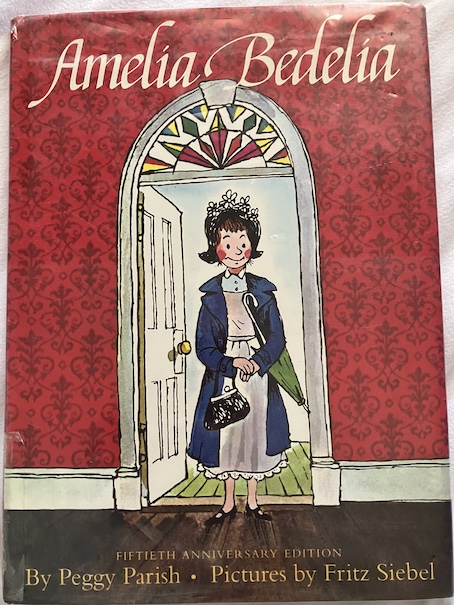
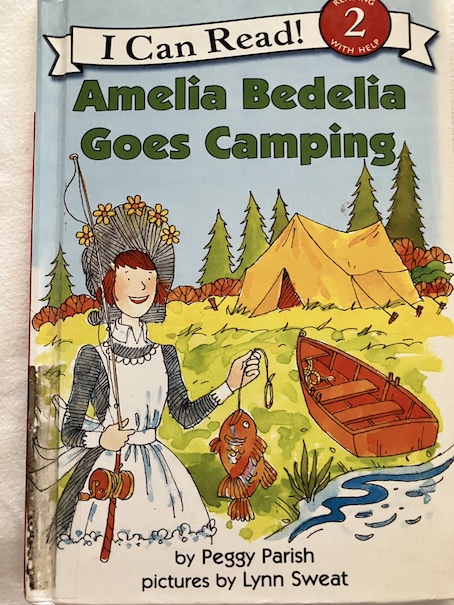
Amelia Bedelia Helps Out by Peggy Parish, 1979.

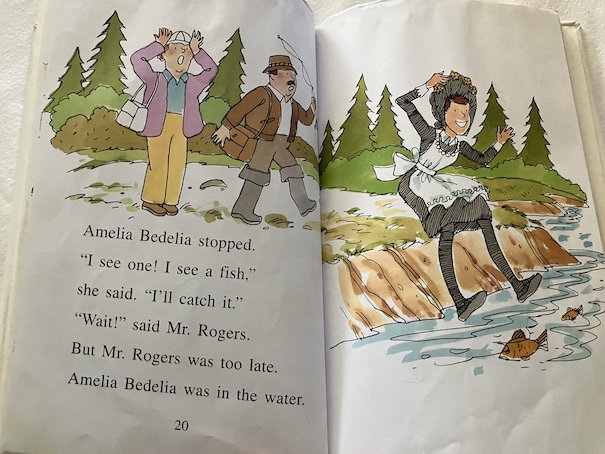
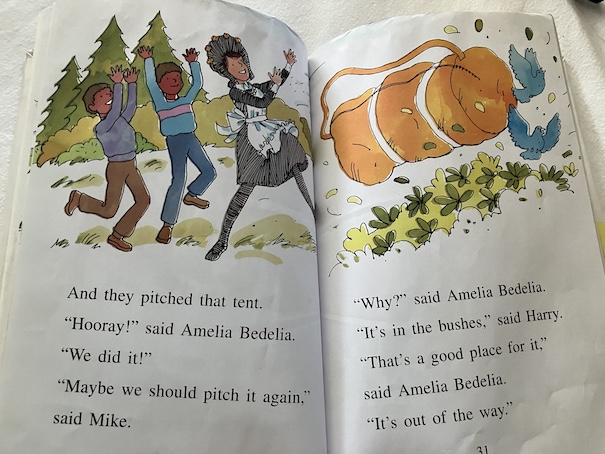
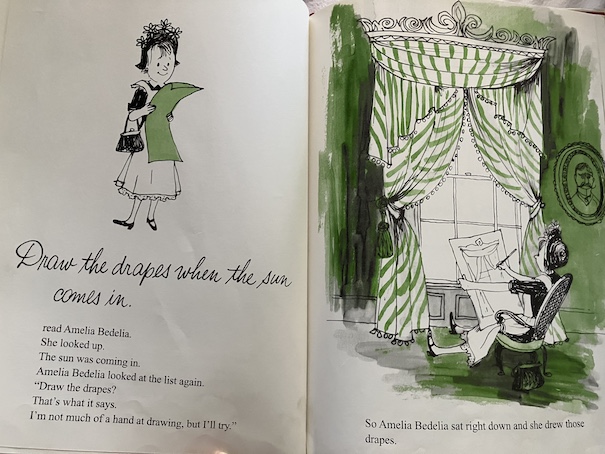
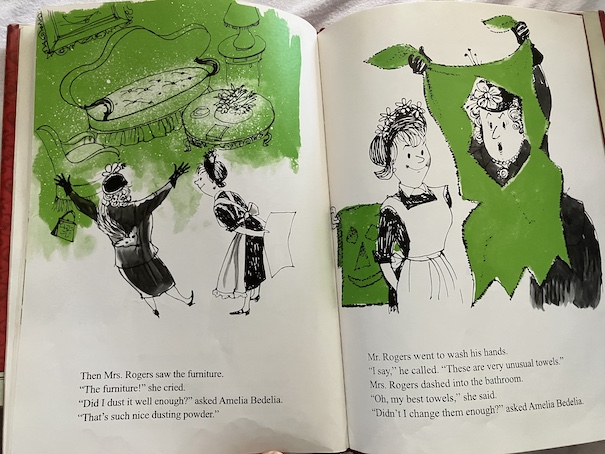
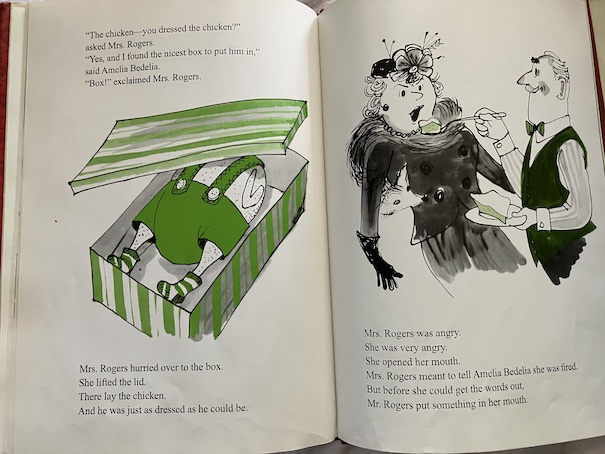
Mr. and Mrs. Rogers are loaning their maid/housekeeper, Amelia Bedelia, to a friend, Miss Emma to help her with a few things around her house.  Amelia Bedelia also has her niece, Effie Lou, with her to give her a hand.  Effie Lou doesn’t quite know what her aunt does for a living, but although Effie Lou’s first instincts seem to do the normal thing with the instructions that Miss Emma gives them, Amelia Bedelia quickly “corrects” her niece to do things in her quirky, literal-minded way.  For example, when Miss Emma tells them to weed the garden, Effie Lou starts to pull the weeds, but Amelia Bedelia convinces her that they are supposed to add more since Miss Emma didn’t say “unweed” the garden.

From there, Amelia Bedelia interprets Miss Emma’s order to “stake” the beans in the garden as tying bits of steak to them.  They also give the chickens Miss Emma’s quilting scraps instead of food scraps and sew grass seeds onto thread instead of “sowing” them into the ground.

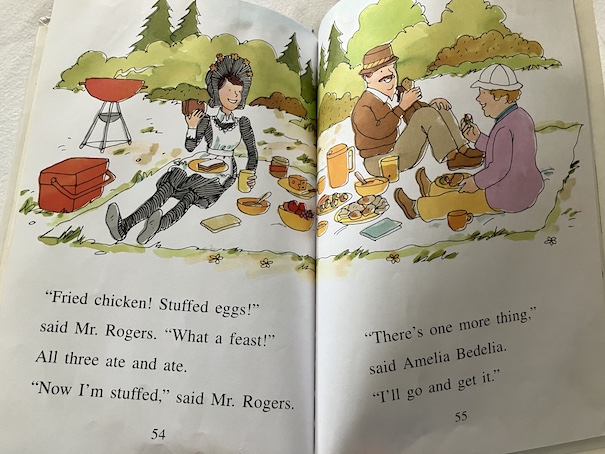
Is Amelia Bedelia a bad influence on her niece?  Maybe, but once again, her baking skills come to the rescue.  Miss Emma asks her to bake a “tea cake” for some guests who will be coming over. 

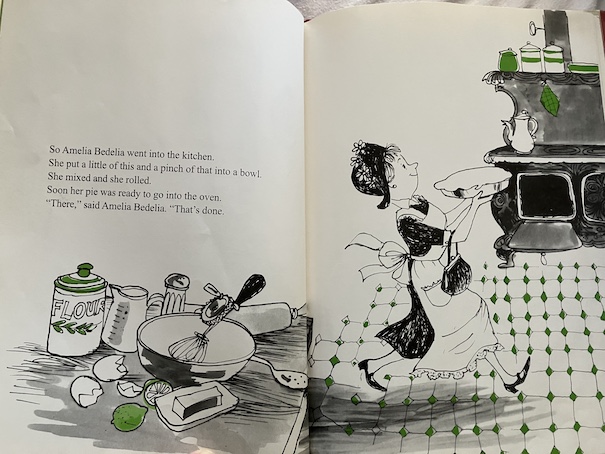
Now, depending on where you live, “tea cake” actually can mean different things.  Sometimes, it’s just a small cake that’s served with tea, and other times, it’s a special kind of cookie or biscuit (the distinction is regional).  The way Amelia Bedelia interprets it is a cake that actually includes tea as an ingredient.  Surprisingly, though, everyone loves it, even more than the nut cake she also baked.

The book is currently available online through Internet Archive.

The Black Jacket Mystery

Trixie Belden

TBBlackJacket

#8 The Black Jacket Mystery by Kathryn Kenny, 1961.

Trixie and the other Bob-Whites are concerned about their pen pals in Mexico because an earthquake has damaged their town. To help them rebuild their school library, the Bob-Whites decide to hold a benefit carnival to collect books.

While they are planning the carnival, Trixie becomes worried about Regan, who is in charge of Mr. Wheeler’s stable. She overhears him speaking to her mother about a problem, asking her advice, but saying that he doesn’t want the kids to know. Although Trixie doesn’t want to pry to into Regan’s business, she can’t help but worry about him and wonder what he doesn’t want them to know.

Then, a boy called Dan Mangan comes to live with Mr. Maypenny. Dan wears a black jacket and looks like a member of some kind of street gang. At school, he brags about brushes with the law. The Bob-Whites try to be friendly with him, but something about Dan gets on Trixie’s nerves.

When someone sells Honey’s missing watch at Mr. Lytell’s store, people begin to suspect that Dan may be a thief. But, soon, Trixie and the others start to suspect that someone else may be hiding out in the woods.

The book is currently available online through Internet Archive.