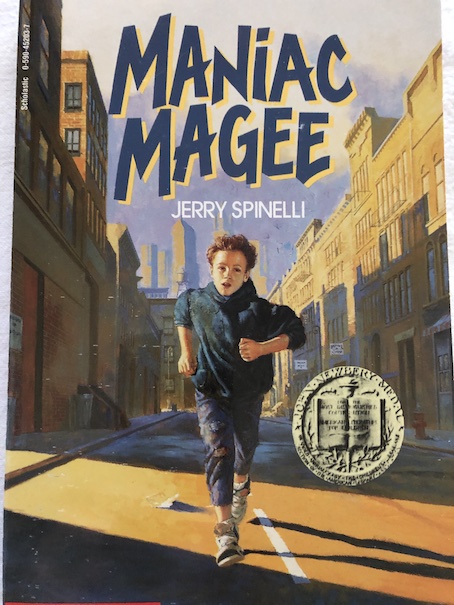
Maniac Magee by Jerry Spinelli, 1990.
When the character of Maniac Magee is introduced, he is described as a legend or a tall tale. Even though he is a young boy, his origins are unusual, and people have built up stories around him. The story even admits that his personal story is part fact and part legend.
The truth is that “Maniac” is an orphan. His real name is Jeffrey Lionel Magee, and he was born a normal boy with normal parents, but his parents were killed in a trolley accident when he was only three years old. After that, he went to live with his aunt and uncle in Pennsylvania. However, his aunt and uncle had an extremely dysfunctional marriage. They didn’t believe in divorce, so they stayed married, but they lived a strange, separated life in their house. They divided their home in half so they could effectively live apart, avoiding each other most of the time. They shared Jeffrey by taking turns eating meals with him, but they never ate together as a whole family. Eventually, Jeffrey couldn’t take this weird life anymore, where his aunt and uncle never talked to each other. One day, he blew up at them at a program at his school, and he ran away.
For the next year, Jeffrey seems to have wandered around by himself. Nobody is sure exactly where he was during that year, but he eventually turned up in another town about 200 miles from where he started. He wore ragged clothes and worn-out shoes, but he greeted people with a cheery, “Hi.” One of the first people he meets is a black girl named Amanda with a suitcase, and he asks her if she’s running away. Amanda tells him that she’s not running away, just going to school. Her suitcase is full of books. Jeffrey is fascinated by the books, and he offers to carry her suitcase. Amanda thinks it’s strange that a white boy like him is in an area of town that is almost entirely black, and she asks him who he is and where he lives. Jeffrey doesn’t quite know how to answer her at first because he doesn’t really live anywhere.
He asks her why she carries so many books to school, and she explains that she has younger siblings who color all over everything and a dog who chews everything, so she feels like she has to carry her whole personal library around with her to protect it. Jeffrey begs Amanda to loan him a book. At first, she refuses because she doesn’t know if he’ll give it back, but he swears he will. After they argue about it, Amanda tosses him a book because she has to hurry off to school and can’t take time to argue anymore.
Jeffrey continues to wander around the town for several days. People begin to notice him, how he runs everywhere goes, how he’s always carrying a book, and how he shows off his sports prowess by bunting a frog during a baseball game he joins. He lives in the deer shed at the zoo and eats some of the food for the animals, although he also joins a large family at dinner one night because they’re always taking in people or inviting people to dinner, so one extra person doesn’t attract too much attention. Nobody knows what to call him, so they start thinking of him as that “maniac” and start calling him Maniac.
The bully who threw the frog at him in the baseball game gets angry because Maniac’s bunt ruined his perfect record of strikeouts, so he decides to beat up Maniac in revenge. When he and his friends chase after Maniac, Maniac runs in the direction of the invisible line that divides the town in half, into the white portion and black portion of town. Maniac doesn’t understand the division between the parts of the town, but the other kids do, and they won’t follow him across the line between their part of town and the other part of town. Maniac’s disregard of the racial separations in this town is one of the things that sets him apart from other people and accentuates his oddness. He’s not afraid to share food with a black kid, even eating over the same place where the other kid bit.
When one of the black kids fights with Maniac, trying to get the book away from him, a page is torn. Fortunately, Amanda knows immediately which of them ripped the book. Jeffrey/Maniac reassures her that they can fix the torn page, so Amanda invites Jeffrey home with her. He spends the rest of the day with Amanda and her family. In the evening, Amanda’s father offers to take him home, but Jeffrey doesn’t know how to explain that he lives the deer shed at the zoo. In the car with Amanda’s father, Jeffrey tries to pretend that he lives in a house a few blocks down the street, but Amanda’s father knows immediately that it can’t be true. Jeffrey still doesn’t understand the division in the neighborhoods in town, and the house he picked for his pretend house is in the black area of town. When Amanda’s father presses Jeffrey for an explanation, Jeffrey admits that he doesn’t have a home and explains about his past. Amanda’s father immediately takes Jeffrey back to his family’s house, and Amanda’s mother insists that Jeffrey stay with them.
For the first time in about a year, Jeffrey has a home! Jeffrey gets along well with the family and is good with Amanda’s little brother and sister. He likes reading Lyle, Lyle Crocodile to them. He doesn’t even mind taking baths with the little kids or untying their knotted shoelaces.
Maniac starts feeling at home in the black neighborhood, although he’s still regarded as an oddity. His new family calls him Jeffrey, but everyone else calls him Maniac. He is a strange kid, who turns out to be allergic to pizza and breaks out in a pepperoni-shaped rash when he eats it. He’s a very fast runner and good at sports, and he seems to have a special talent for untying knots. Because of his time spent living in a dysfunctional house where people didn’t talk to each other and his time living alone on the streets, there are many things that Jeffrey doesn’t understand about other people. He doesn’t understand social dynamics and racial issues, and it takes him some time to understand how other people look at him as well as at each other.
One day, when he’s playing with the other kids in the street, an older black man calls him “whitey” and tells him to go home, back to his “own kind.” He doesn’t believe that Maniac lives in the neighborhood. His new siblings tell the old man to go away, and the old man keeps ranting about people belonging with their “own kind” until a woman leads him away. The incident disturbs Maniac. Amanda says that the old man is a “nutty old coot” and that Jeffrey should ignore him, but the incident makes Jeffrey realize that there are some people in the neighborhood who don’t want him there. Jeffrey wants to stay with his new family, and they want him to stay, but Maniac worries that his presence is creating a problem for them. Can he find a way to truly become part of this new family he so desperately needs?
This book is a Newbery Medal winner. It’s available to borrow and read for free online through Internet Archive (multiple copies), and there is also a Literature Circle Guide for book groups and classrooms.
My Reaction and Spoilers
I remember reading this book in class when I was in elementary school. The story is interesting because it’s framed as a tall tale but about a contemporary boy. “Maniac” Magee is described as being a legendary child because of his unusual ability for untying knots and his strange allergy to pizza. No real human being can actually be allergic to pizza because pizza isn’t a single food. There are many different ways of making pizza using various combinations of common ingredients. People can be allergic to some of the ingredients in a pizza, but if they were, that wouldn’t be an allergy to pizza itself, and those people would also be allergic to other types of food containing those same ingredients. That’s not Maniac’s problem, though. He seems to be particularly allergic to just pizza by itself. Maniac does things that are impossible and inherently beyond the normal child in everything he is, even in his defects, a classic tall tale character. One of his famous feats, untying an infamous knot in the neighborhood, is like the legendary Gordian Knot. The story is dressed with humor and tall tale elements, but it has themes that are very serious and even heart-rending.
Tall tale elements aside, this is a story about racial issues and a lonely, neglected child who desperately needs a family and a place to belong. Because the story focuses on Maniac as a tall tale character, the racial issues in the story aren’t immediately obvious, although they begin entering the story as soon as Maniac finds his way to his new town and encounters the girl who will be his new sister. The one thing that Maniac really needs is a stable and loving home. He is an orphan, and he ran away from his aunt and uncle’s home because they were too dysfunctional. As a runaway, he wanders for a time, looking for a better home and people who really care about him. He eventually finds that loving home with a family of a different race. Some people might find it strange that he feels a sense of belonging with people who, on the surface, seem quite different from him, but a sense of family goes much deeper than surface appearances. Maniac himself, on the surface, is a very unusual boy compared to most boys in the world, but deep down, he’s still a kid who needs love, attention, a family, and a place to call home. His new family offers him all these things, regardless of how unusual he is, and what they look like doesn’t matter.
The opposition of some parts of the community messes up this loving home for Maniac partway through the story, and he runs away and spends time on his own again. For a time, he lives in the locker room of a baseball stadium, looked after by a groundskeeper who is an elderly, washed-up baseball player. The groundskeeper, Grayson, passes away during the course of the story, but their friendship helps Maniac to understand some things about people. Grayson was also a neglected child. His parents were drunks, and unlike Maniac, he never learned to read because his teachers never tried to teach him. He was placed in a class with kids who were considered unable to learn because they were troubled or had learned problems. Because his teachers never had any faith in his ability to learn, he never really tried. Maniac is like a grandson to him and opens his eyes to many things before his death.
After Grayson dies, Maniac returns to wandering again, believing that he is jinxed to lose any home he has and anybody he cares about. However, Maniac still cares about other people, and he discovers that other people also care about him. When he tries to introduce a tough black boy to some white boys he’s staying with, hoping to make a connection, it goes wrong, and Maniac starts to think it’s all hopeless. However, when Maniac is unable to help one of the white boys when he’s in trouble and the black boy saves him, the white boys come to see the black boy in a different light, grateful to him for saving one of them and taking care of them. The black boy also comes to look at Maniac differently. When he confronts Maniac about why he couldn’t rescue the boy, Maniac admits for the first time that he’s still haunted by the memory of how his parents died, and the situation reminded him too much of it, so he was unable to handle it. The black boy softens at seeing this human side to Maniac and the other white boys. He’s the one who brings Amanda to Maniac, and Amanda insists that he come home with her. Maniac hesitates at first because he thinks he’s jinxed, but Amanda won’t put up with any nonsense from him, and Maniac comes to realize that they really are a family and that he is really going home.
As a side note, I also remember my elementary school librarian reading Lyle, Lyle Crocodile to my class when I was in first grade. In fact, she said it was one of her favorite books, and she also read others in the series to us. I had forgotten that the book was mentioned in this story, which was published the year after I first heard Lyle, Lyle Crocodile, but it did bring back some nostalgia for me. When Maniac teaches Grayson to read because Grayson never learned when he was a kid, they find well-known picture books on the sale rack at the library, including The Story of Babar, Mike Mulligan’s Steam Shovel, and The Little Engine That Could.
 Jestress's Forgotten Books and Stories