The Case of the Waltzing Mouse

Brains Benton

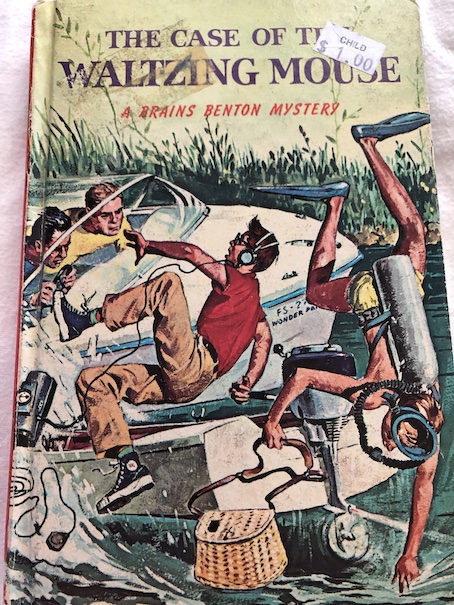
The Case of the Waltzing Mouse by by George Wyatt (Charles Spain Verral), 1961.

The Crestwood Garden Club holds an animal show to raise money for their Community Camp Fund. Brains and Jimmy enjoy seeing all of Professor Gustave’s animals, but they become concerned when a seal knocks over a creel where its fish are stored, and they see that there is a large amount of cash concealed inside. Professor Gustave says that he carries that much cash with him because he is always traveling from town to town with his animal show and can’t depend on a single bank for his money.

Brains still seems concerned about the money and the way it’s concealed, but Jimmy is hoping that Brains won’t find a mystery that will disrupt their vacation plans. Every year, they spend a few weeks at a lakeside cabin that their families rent, and all Jimmy wants to do is go swimming and fishing.

However, while Jimmy’s older sister, Ann, is driving the boys to the cabin, they come upon the professor’s trailer of animals. The animals are very upset, and the professor is nowhere to be seen. After searching the area, they find the professor, and he tells them that he was attacked by a couple of men. One of them is a guy called Blackie, who used to work for the professor, but the professor fired him because he mistreated the animals. The men were trying to take the creel with the money in it, but the professor threw it into the bushes, and they didn’t find it.

It turns out that the professor is also going to be staying at a cabin by the lake for awhile. They help him to get settled there with his animals, but Brains is still concerned that the men will be back for the professor’s money. The concern is justified because the men later attack the professor while he’s in a boat on the lake, and the creel is lost overboard. The professor is very upset, not just because the money is now at the bottom of the lake but because the money actually doesn’t belong to him. The professor says that it really belongs to someone else, although he doesn’t say who.

Brains realizes that they can get the creel back because a policeman friend of theirs is also staying at the lake and has offered to teach the boys how to skin dive. Jimmy has wanted to learn to dive and is willing to dive for the creel. Unfortunately, the situation is complicated when the men kidnap the professor for ransom, saying that they’ll let him go if the boys bring them the money.

My Reaction

There were parts of this book that I didn’t really care for. I’ve noticed that the Brains Benton books sometimes include stereotypical attitudes of boys looking down on girls or discounting their abilities. Near the beginning of the book, Jimmy’s sister Ann is trying to get the boys to hurry getting ready to go to the cabin, but Brains wants some extra time to take care of a new device that he’s just gotten. Jimmy says, “But, after all, she is a girl, and girls and women just don’t understand how it is when a fellow gets interested in something highly scientific and technical.” No, Jimmy, I don’t think that’s the issue. It’s not about not understanding how someone can find science interesting; Ann’s just in a hurry to get going. She would probably be just an impatient if you were taking extra time to pick out a different shirt or get your hair combed just right. Granted, some of Jimmy’s comments are tongue-in-cheek. When Ann later tells them to stay out of trouble because she knows that they’ve gotten into trouble with their detective business before, Jimmy mentally lists the dangerous situations they’ve been in while denying that they were really that bad. “Women! Always exaggerating!”

The mystery wasn’t too bad. We do know who the villain is from the beginning, so like the other books that I’ve read in this series, it’s more of a “howdunit” than a “whodunit.” Readers get to watch Brains and Jimmy figure out how to rescue the professor and save his money. There is one other element of the story that is more of a mystery than the professor’s kidnapping. The professor says that the money isn’t really his, and the boys see a mysterious girl talking to Blackie. Is she the one who really owns the money, and if so, what is the relationship between her and the professor?

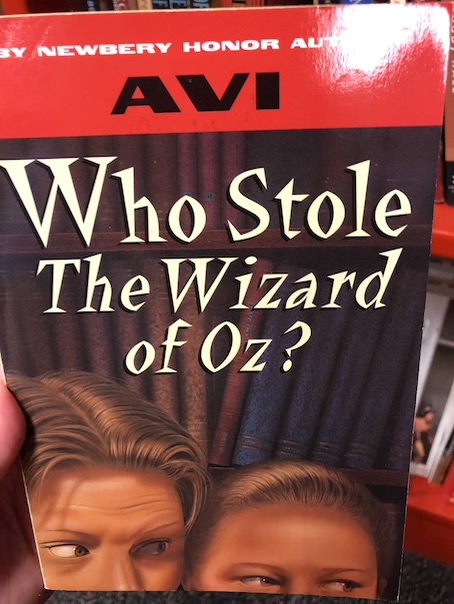
Who Stole the Wizard of Oz?

One summer, Toby and his twin sister Becky see the police go to their local library. To the children’s surprise, Mrs. Brattle, the librarian, phones their house and asks Becky to come down to the library and bring one of her parents.  The children’s parents aren’t home, so Becky and Toby go.  Mrs. Brattle doesn’t seem to want to say much over the phone, only that The Wizard of Oz was stolen, and they need to talk to Becky.

As Becky and Toby walk down to the library from their house, which isn’t far, Becky says that shortly before school let out for the summer, Becky’s teacher for sixth grade next fall handed out a summer reading assignment.  The kids have to write two book reports over the summer, and the books can’t be mysteries, fantasies, or romantic adventures.  Miss McPhearson, the sixth grade teacher, believes in only factual books.  However, Becky decided that the best thing to do was to get the book reports over as soon as possible, so she went to the library.  (Toby wasn’t involved because he has a different teacher.)  While she was there, she decided that she’d check out The Wizard of Oz for Toby, knowing that he likes fantasy books, but she was told that it was already checked out.  Mrs. Brattle told her that there would be a book sale at the library tomorrow and that she had a copy of The Wizard of Oz that Becky could buy for five cents, but since the librarian wouldn’t sell her the book that day and Becky didn’t want to make a special trip to the library the next day, she turned down the offer.

When they come to the library, the policeman accuses Becky of stealing the copy of The Wizard of Oz that the librarian showed her as well as some other children’s books.  According to the librarian, the books were actually valuable collector’s copies, worth thousands of dollars.  Becky asks the librarian why she offered to sell her one for nickel if they were so valuable and Mrs. Brattle says that it was a mistake.  The policeman says that if Becky has the books, she can return them now, and there will be no problem, but Becky is insulted and insists that she didn’t take them.  In the face of Becky’s denial, the policeman says that there isn’t much that he can do because there is only the librarian’s word that the books were valuable, and she doesn’t deny that she earlier tried to sell them for five cents each.  Missing children’s books worth less than a dollar isn’t exactly a police problem.  (I’d like to say here that I was very glad that the policeman took that attitude. I hate those children’s books where adults not only falsely accuse children of doing things that they didn’t do but also make petty incidents seem like major crimes. The policeman is correct that there is no proof that the books were as valuable as the librarian says and that this evaluation of their worth comes only after their sudden disappearance and after she was offering to sell them very cheaply.)

Even though the matter seems to be dropped for the moment, it bothers Becky that the librarian still thinks that she might have taken the books.  She suggests to Toby that they could investigate and try to find out what really happened to the books.  The first thing that they decide to do is to look for the original owner of the books.  After inspecting other children’s books at the sale and looking at the names in the front covers, they decide that Gertrude Tobias is the most likely former owner because many of the other books at the sale belonged to her.  Unfortunately, Gertrude Tobias died a few months ago.  However, it turns out that her niece is Miss McPhearson.  Becky hurriedly finishes her book reports so that she and her brother will have an excuse to visit Miss McPhearson and ask her about the books.

When they ask Miss McPhearson about her aunt, she calls her aunt a “foolish woman” who “didn’t know any better.”  However, she refuses to explain any further what she means, and the children see her crying before they leave.

When the children speak to Mrs. Chesterton, they get a very different picture of Miss McPhearson’s aunt.  When Gertrude Tobias was a young woman, she was wealthy. She could have gotten married if she wanted to, but most of the young men didn’t like women who seemed too smart, and Miss Tobias prided herself on her intelligence and cleverness.  She resented the idea that adults seemed to want women to play dumb to get a husband, so she refused to get married and spent most of her time in the company of children.  Mrs. Chesterton remembers her saying, “Children like me smart. Grown-ups want me stupid.”  She liked to read children’s books, and she often volunteered to read books to children at the library.  The children liked her and often confided in her, just like she was their aunt.  She spent a lot of her money buying children’s books for her collection.  Mrs. Chesterton says that Miss Tobias and her niece never really got along well and that Miss McPhearson used to tease her aunt about her love of children’s books.  However, Miss Tobias was rich, and Miss McPhearson didn’t have much money at all.  Miss Tobias told her that she would leave her all of her “treasure.”  When she died, it turned out that she had left her niece five children’s books – the five that are now missing.  The others were willed to the library.

At first, the picture seems like it’s becoming more clear: Miss Tobias had one last joke on her niece by giving her valuable children’s books that Miss McPhearson thought were worthless simply because they were children’s books, and the person who took them recognized what they were worth as collectors’ items.  However, the situation is actually more complicated than that.  A series of strange break-ins have been occurring around town. Nothing else has been taken, but someone is clearly searching for something.  Miss Tobias was clever, and her books have an even deeper meaning than most people have realized.  To learn Miss Tobias’ secret, Toby and Becky have to learn the secrets of the books themselves.

The book is currently available online through Internet Archive.

I really loved the puzzle in this book! There were parts that I got before the kids did and parts that they realized before I did. It isn’t a kind of puzzle that readers call fully solve before the characters in the book because it requires knowledge of their home town to get the full answer.

As an unmarried, childless adult who also enjoys children’s books, I could kind of sympathize with Miss Tobias. Children’s books, like some adults, are often very clever but go unappreciated by people who underrate them for what they appear to be. For example, Through the Looking Glass, which was one of the books featured in the story, involves a game of chess. The author, Lewis Carroll (real name Charles Dodgson), was a mathematician. His books are full of word games and logic puzzles, and the chess game described in Through the Looking Glass is an actual chess game that can be played with real pieces on a real board with a definite ending square, where Alice the pawn becomes Alice the queen (one of the clues to solving the final mystery in this book). To many adults who only know the basic story of Alice, it might just seem like a silly, nonsense children’s story, but they miss the real, clever puzzles planted in the story, just like Miss McPhearson did with her aunt’s legacy.

In the end of the story, Miss McPhearson never learns the truth about her aunt’s legacy, just as her aunt knew she would miss it. Toby and Becky come to an understanding with the real thief about Miss Tobias’ treasure that allows the library to benefit from the legacy, which is something that Miss Tobias would have appreciated. Miss McPhearson decides to give up teaching and leaves town to find another job, working with computers, a very “adult” field indeed. It’s only a pity that she wasn’t mature enough to behave nicely with her aunt and not tease her, so that her aunt would be more generous with her. People who play childish games are sometimes surprised when they meet a better game player.

Like Miss Tobias, I have little patience for people who try too hard to be “adult” or are too concerned with whether certain things are right for adults to do, especially when they show their immature sides in other ways. In the story, Miss McPhearson makes a point of being “adult” in all situations, but she wasn’t above childishly taunting an older woman about her hobbies, still expecting that woman to leave her all of her money. It reminds me of the kids I knew in elementary school who liked to act really grown up at age ten. Kids go through a phase where they start talking about doing grown-up things like having first boyfriends and girlfriends and wearing makeup and watching adult tv shows and listening to adult music, but in between doing all of that, they still act like childish brats because what they’re doing is trying on the trappings of adulthood without the real substance. Until they get some real maturity and better behavior, they’re just kids playing dress-up. Sometimes, I think that some people never quite leave that phase, which is how I view the character of Miss McPhearson.

I think of this every time I hear some adult my age or older talking about how real adults drink alcohol or real women wear high heels and lipstick. To hear them talk, there are quite a lot of rules to being grown up that very few people I know actually follow. Alcohol is expensive, plenty of people abstain for health or religious reasons, and driving drunk certainly isn’t mature behavior. High heels damage your feet the more you wear them. I’ve forgotten how much makeup I’ve thrown away because, most days, I’m just too busy to even think about putting it on, and they eventually dry out and get gross. It would be a waste of money for me to buy more, knowing I’ll never use it all. To my way of thinking, if you really are an adult and you know who and what you are, you have nothing to prove. If you aren’t mature as a person, things like high heels and lipstick aren’t going to help you, and alcohol just lowers your inhibitions and makes the immaturity more obvious. Maturity is a way of looking at things, assessing situations, and acting accordingly. It can be difficult to define, but you know it when you see someone living it, not just looking the part. Real adults don’t need to “act” like adults at all times because they aren’t “acting”; they’re just being themselves, confident that they are mature enough to handle what life throws at them along the way.
The Secrets of the Pirate Inn

The Secrets of the Pirate Inn by Wylly Folk St. John, 1968.

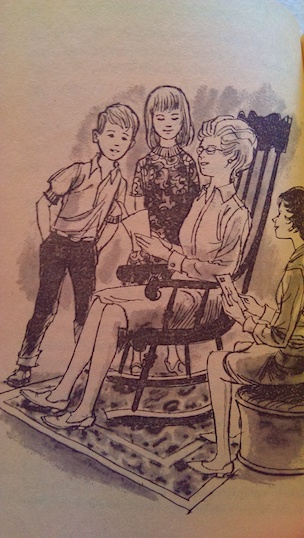
One day, Jack, Amy, and Sally’s mother receives some surprising mail for her deceased father.  The children never met their grandfather, who died before they were born, but the letters concern their grandfather’s Uncle Will.  Uncle Will is an 88-year-old man, and one of the letters is from Miss Dibble from the Welfare Department in Port Oglethorpe, Georgia, the seaside town where Uncle Will is living.  Miss Dibble is concerned that Uncle Will is no longer in his right mind and not capable of taking care of himself, and she is hoping that his family will persuade him to go live in a retirement home. 

The children’s mother says that Uncle Will was an adventurer and a wild character even in his younger years, always playing games and doing eccentric things, so the situation may not be as bad as Miss Dibble thinks it is.  The mother has never met Uncle Will, either, because her grandmother disapproved of him and discouraged him from hanging around the rest of the family years ago.  She knows that her father always thought of him as being a fun uncle and that he used to own some land in North Georgia, where he found a priceless diamond.

The second letter comes from Uncle Will himself.  It contains a strange rhyme and a letter to his deceased nephew, saying that he sold his land and that the money from that sale and his diamond will go to him upon his death.  Uncle Will says that Miss Dibble is pressuring him to turn over his money to the state and to go live in the old folks’ home.  He’s been resisting her efforts, but he admits that he has gotten absent-minded and has forgotten where he hid his money and diamond.  He knows that the rhyme he wrote down is a clue that he made to remind himself of the hiding place, but now he’s confused, and he’s hoping that his nephew can help him figure it out because it’s based on a game they used to play years ago.  Because it’s been so long since he last spoke to the family, he has no idea that his nephew has died.  Uncle Will also says that he is currently living in an old pirate’s inn near Port Oglethorpe that has its own secret passage where pirates used to shanghai sailors.

The children think that Uncle Will and his pirate’s inn sound exciting, and they’d like to go meet him.  Their mother says that she’ll have to talk to their father about it, but she thinks that it might be a good idea for them to go and check up on Uncle Will and talk to Miss Dibble.  She makes up her mind when Miss Dibble sends an urgent telegram in which she says that Uncle Will is under the delusion that someone is now hiding in his house and trying to kill him for his money. The mother and the children decide to go see Uncle Will, although the father of the family can’t go because he has a business trip.

Of course, Uncle Will isn’t delusional, and there is someone after his hidden money. The old inn where Uncle Will lives is called The Bucket of Blood. When the children and their mother arrive, Uncle Will pretends to be an old pirate parrot, calling out “Pieces of eight! Pieces of eight!” (Yes, he’s definitely an eccentric, and it’s a little more understandable why Miss Dibble thinks he might not have all of his faculties.) They introduce themselves to Uncle Will, and Uncle Will is sorry to hear that his nephew is dead, but he is pleased to meet his nephew’s daughter and her children. The children tell him that they want to help him to solve the rhyme and find his money.

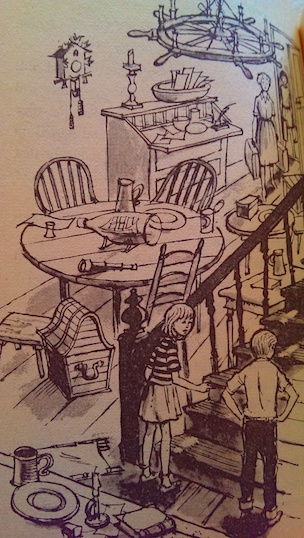
The inn is full of fascinating things, although it’s lacking in modern conveniences. The mother asks Uncle Will if they can stay there, saying that they’ve brought sleeping bags with them. Uncle Will tells them that they can use the bedrooms upstairs but warns them that he’s worried that someone might be hiding somewhere upstairs (as Miss Dibble had said earlier). Uncle Will rarely goes upstairs these days because he finds it difficult to climb up there. However, the children realize that Uncle Will is not deluded when they notice footprints in the dust on the stairs, meaning that someone has been there recently. However, the footprints seem to be only going up, not down. When the search upstairs, they don’t find anyone. Where the footprints left by a ghost? Was someone really hiding in the inn, and if so, how did they leave?

There is a live action made-for-tv Disney movie based on this book. You can see the entire movie online at Internet Archive. The movie is different from the book in a number of ways. In the movie, there are three children, but it’s two boys and a girl (a brother and sister and the brother’s friend) instead of two girls and a boy (all siblings), and none of them are related to the old Irish sea captain living in the old inn. (Note: The child characters in the movie, Scott, Tippy, and Catfish, also appeared in another made-for-tv Disney movie called The Strange Monster of Strawberry Cove, which was also based on a book for children, The Mad Scientists’ Club, but that book was written by a different author, and none of those children actually appeared in either this book or that one.) The old captain in the movie has recently inherited the inn from his brother. The location was moved to Louisiana instead of Georgia, and the treasure they’re looking for was hidden by the pirate Jean Lafitte. There are rhyming clues to the treasure’s location, but they’re not the same as the rhymes in the book. The money and the diamond are also hidden in separate locations in the book. In fact, although the bulk of the money is in one place, some of it is hidden in other places.

In the book, there are also extra characters, a man named Miles who is staying with Uncle Will while he’s working on writing a book and a young runaway nicknamed Hop who is afraid that he will be sent to another foster home like the one he ran away from if Miss Dibble catches him. At first, I suspected one of these characters of being the villain of the story, trying to steal Uncle Will’s money. However, the real villain is someone we don’t really know until the end, although he has connections to other people in the story. This is different from the movie, where the villain is a suspect we meet and see often before his guilt is established. Because of this, I think that the movie was playing more fair with the readers about the mystery.

Near the beginning of this book, the characters reference The Joyous Season by Patrick Dennis (also the author of Auntie Mame), which was published only a few years before this book was. Sally thought that the book was hilarious, but Jack thought that it was boring because the boy in the story, who was his age, “didn’t have a thing to do every day but listen to grownups talking.” I think this is meant to be a sign that the children’s parents are pretty modern and progressive, letting their children read a book about divorce and mixed-up family life in the 1960s. At one point, the mother tells Jack not to use euphemistic swear words like “Cripes!” just because characters in books to it. It gets on the mother’s nerves because she thinks that “They sound even worse than the words they’re being used to avoid.” She actually tells Jack, “When you’re old enough to swear by any words you like, I hope you’ll manage without euphemisms.” I mentioned in my page of 1960s children’s books that the 1960s were a turning point both in society and children’s literature, and this is an example of people’s changing attitudes. Sally, the oldest of the children, is allowed to wear lipstick, and Amy, who is twelve, is also allowed to wear it, although she thinks of it as being too much trouble to bother most of the time. (I can relate. I still sometimes throw out old make-up that I just plain forgot that I had because I’m too busy and preoccupied most of the time to think about it.)

The Yellow House Mystery

The Yellow House Mystery by Gertrude Chandler Warner, 1953, 1981.

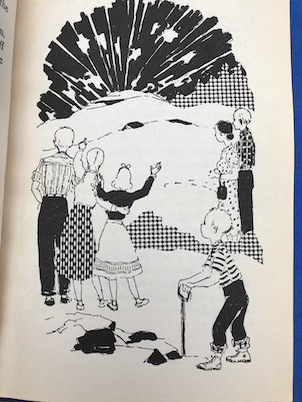
This story in the Boxcar Children series picks up the following spring after the previous book.  The children’s cousin, Joe, is arranging for the excavation of the cave where the children found their Native American artifacts.  They’ve decided to use dynamite to blast open the roof of the cave to make excavation easier (I’m not sure if this is really the best way to get at artifacts that were sheltered safely for years in their cacve and were easily being dug up by children in their current situation, but okay), and although he had told the children that they couldn’t be there for the blasting, he’s changed his mind.  He’s even going to let seven-year-old Benny be the one to push down the handle that will set off the blast.  (Because this is one of the early books in the series, the children are aging from the first book in the series – Henry is sixteen years old, Jessie is now fourteen, and Violet is twelve.)

One of the people who will be working on the excavation is Alice, an old school friend of Joe’s.  Everyone can tell that Joe is in love with her, and soon, he proposes to her.  They get married and decide to spend their honeymoon camping out in the barn on the island, just like the children did the previous summer.

However, the children have started to wonder what the story is about the old yellow house on the island.  For some reason, it makes their grandfather sad, and he doesn’t like to talk about it.  Eventually, their grandfather tells them that their housekeeper, Mrs. McGregor, used to live in that house with her husband, Bill.  Bill used to take care of Mr. Alden’s father’s race horses.  He was a nice man, but weak-willed.  His brother, Sam, and his brother’s disreputable friends were often able to persuade Bill to do things that would get him into trouble, and Bill was never able to stand up to them.  One day, he vanished mysteriously from that house, and neither his wife nor the Aldens have any idea what happened to him.  There are only two clues about the reason for Bill’s disappearance.  One is money that Bill was supposed to give to Mr. Alden’s father for the sale of two horses that he managed on his behalf.  Mr. Alden assumes that Bill’s brother did something with the money and that Bill probably left because he was afraid to face Mr. Alden without the it.  Sam died soon after Bill disappeared, so they were unable to ask him about what he knew.  The other odd thing that happened before Bill disappeared was that Mrs. McGregor heard strange sounds in the night.  When she went to investigate, her husband was apparently just reading a newspaper, and he claimed that the noise was nothing unusual.  But, what was Bill really doing?

The kids want to investigate Bill McGregor’s mysterious disappearance, and their grandfather and Joe and Alice enter the house with them to have a look for more clues.  In a hiding place behind one of the fireplace bricks, they find a letter from Sam to Bill about the money from the horse sale.  Sam promised Bill that he would be able to pay him back more than the money he owed and tells Bill to meet him at a house in Maine near Bear Trail.  The kids persuade their grandfather to let them to go Maine with Joe and Alice over the summer to try to find the house on Bear Trail so they can find out what happened to Bill.  The trip will involve camping, hiking, and canoeing, but they’re up to the challenge!

Joe is familiar with Bear Trail because he used to work as a trail guide when he was in his teens.  They are also joined by another trail guide, Mr. Hill, and have adventures that include a storm and a real bear.  However, the real answers to the mystery lie at the Old Village at the end of the trail.

The book is available to borrow and read for free online through Internet Archive. There are multiple copies of the book. In order to check out a book through Internet Archive, you need to sign up for an account. The account is free, and you read the books in your browser.

My Reaction

In a number of ways, this book is more adventure than mystery.  It doesn’t take long for the kids to realize discover Bill McGregor’s new identity.  However, what happened to the money is more of a puzzle.  Even Bill has been unable to find where his brother hid it years ago.  Benny discovers it by accident while watching a toad. 

One thing that had made me uncomfortable was how long Bill had stayed away from his wife.  When the kids confront him about his real identity, it turns out that Sam’s disreputable friends had lied to him, telling him that his wife had died shortly after he disappeared.  He is overjoyed to discover that she is still alive, and she is glad to see him when he finally returns home.

Cam Jansen and the Ghostly Mystery

Cam Jansen

CJGhostlyMystery

Cam Jansen and the Ghostly Mystery by David A. Adler, 1996.

CJGhostlyMysteryGhostCam Jansen’s Aunt Molly takes her and her friend Eric to buy tickets for a Triceratops Pops concert.  Triceratops Pops is a singing group that dresses up like dinosaurs, and many of the fans buying tickets also wear dinosaur costumes.  While they’re standing in line, someone dressed as a ghost starts sneaking up behind people and scaring them by yelling, “Boo!”  At first, it seems like a mildly annoying prank, but then one old man standing nearby seems to have a heart attack when he is startled.

The guards standing near the ticket booth rush to help the man and call for an ambulance for him.  However, while they are distracted, the person in the ghost costume robs the woman selling tickets, taking all the ticket money and her own money from her purse.

Cam is convinced that the old man who collapsed was part of the thief’s plan and that his “heart attack” was just an act to distract the guards.  She noticed that he seemed to be wearing a wig to make himself look older.  But, there are two other clues that are important: the magazines that the man dropped when he fainted, and the fact that the ghost costume was found in the ladies’ restroom.  Once again, Cam helps the police with her amazing memory!

The book is currently available online through Internet Archive.

Emil and the Detectives

Emil

Emil and the Detectives by Erich Kastner, translated by May Massee, 1929, 1930.

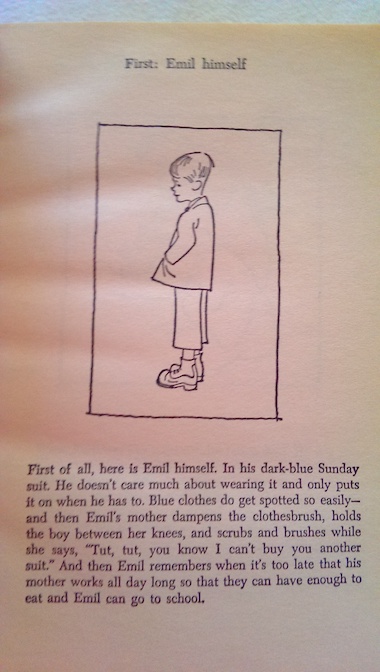
EmilHimselfThis book was originally written in German.  It was written in Germany during the period between the two World Wars.  The date of the story itself is never specified, but it may actually be earlier than when it was written, prior to World War I.  There is a sequel to the book that I haven’t read where Emil’s vacation ends early because he hears that war has broken out, an incident based on the author’s own boyhood experiences at the start of World War I.

The Emil books have an interesting history because of the time period when they were written.  This video explains how the book came to be written, the time period when it was written, and its cultural impact.  By the time the Nazis came to power, Emil and the Detectives had become popular and, as a harmless children’s book, was saved from Nazi book burnings.  The sequel story, Emil and the Three Twins, wasn’t so lucky, which is why it isn’t as well-known as the first Emil book, although it is available today.  The author, Erich Kastner, was known to be a pacifist and opposed to the Nazi government, which was why many of his works were burned during the Nazi regime and publishers were forbidden to publish new books from him.  (This video explains more about the book burnings and Kastner’s burned works.)  Although his political stance interfered with his writing, and he was questioned by the Gestapo several times, he chose to remain in Germany for the duration of the war.  Another of his children’s books, Lisa and Lottie, which was the basis for the Parent Trap movies by Disney, was written after World War II ended.

EmilTrainAt the beginning of this story, it explains that Emil Tischbein’s father died when he was very young and that his mother works hard as a hairdresser to support the two of them. When she can, she saves a little money for Emil’s grandmother as well. When the story begins, Emil is preparing for a train trip to Berlin to visit his relatives. Emil will be traveling by himself and will meet his relatives near the station when he arrives. His mother gives him some money to take to his grandmother and warns him to be careful. Emil pins the money inside his pocket for security.

On the train, Emil talks to the people who share his train compartment. One of them, who calls himself Herr Grundeis, tells him tall tales about what Berlin is like and gives him a piece of chocolate, which is apparently drugged. Emil falls asleep on the train, and when he wakes up, he realizes that he’s been robbed!

EmilGustavDetermined to get the money for his grandmother back, Emil searches for Herr Grundeis and spots him getting off the train. It’s too soon for Emil’s stop, but he follows Grundeis off the train anyway, tracking him to a café.
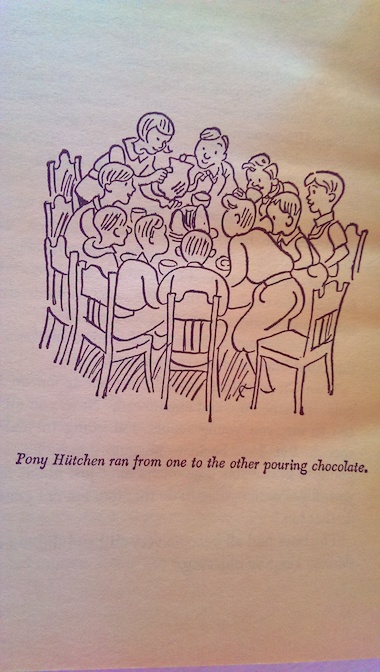
While Emil is trying to decide how to handle the situation, another boy who carries a horn that he likes to honk, Gustav, spots him watching Grundeis. Gustav asks Emil what he’s doing, and Emil explains the situation. Emil isn’t sure how to get the money back from Grundeis. At first, he’s afraid to tell the police what happened because of a prank he and some friends pulled at home. He worries that perhaps the police have found out about the prank and that they won’t take him seriously. Gustav is sympathetic to Emil and tells him that he can get together some friends to help.

EmilPonyChocolateGustav recruits a bunch of other boys from the neighborhood, and they continue tailing Grundeis through the city to his hotel. The boys call another friend at home, who keeps track of their progress and gives them reports about what others have said.  Emil gets one of the other boys to tell his relatives that he has been delayed on important business, causing his cousin, Pony Hutchen, to come and tell him that everyone is worried and that he’s going to be in big trouble with his relatives if he doesn’t show up soon.  However, they still have the problem of deciding how to confront Grundeis and get him to return the money.  In this case, the detectives don’t need to solve the mystery of who the thief is.  The real problem is how to prove it.

This book is known around the world and has been made into movies several times, including a Disney version in 1964.  The Disney version still takes place in Germany, but for some reason, Emil’s train trip is changed to a bus trip, and the criminal’s plot is much more elaborate.  It’s available on dvd, and you can see the trailer on YouTube.

The book is currently available online through Internet Archive (multiple copies).

My Reaction and Spoilers

Overall, I liked the story, although I found the book difficult to read because the wording sounded strange and awkward in many places.  I think this is probably because of the translation between German and English.  I have the feeling that the translator was trying to be too literal in the translation instead of focusing on translating for meaning and tone.  Unfortunately, I can’t read German, so I can’t say what the original version was like.

EmilReportersThere was a note in the beginning of my copy of the book that says that many of the character names in the book are actually jokes on the part of the author. It’s not as obvious in English because the forms of the names sound reasonable for German names, but anyone who knows German would spot that they aren’t real names. For example, Emil’s last name is Tischbein, which means “table-leg,” and the thief’s alias, Grundeis, means “ground-ice.”
In the end, the boys use their numbers (they have about a hundred child detective recruits by the end of the story) to corner the thief in a bank, and when they confront him in front of the bank personnel, they manage to prove that Emil is the owner of the money using the pin holes in the bills, where Emil had pinned it to his jacket.  The author of the book also appears briefly in the story as a journalist who interviews Emil and his friends for a newspaper story about how they caught the thief. (I think he’s the one standing at the back of the group of reporters in the picture because the man’s hair looks like Kastner’s, combed back.)

Like in another of Kastner’s books, Lisa and Lottie, there is the theme of a child who behaves well because of the family’s poor circumstances.  Emil, like Lottie, is being raised by a single mother who has to work hard to support the two of them. Both Emil and Lottie understand that if they behave badly and get into trouble, it would create more hardships for their mothers.  They basically live hand-to-mouth, and the children understand that their mothers cannot take time away from work to deal with their discipline problems.  Each of them has had to shoulder some of the household burdens from an early age, and it has made them more serious and also a little closer to their mothers than many of the other children from more affluent families. Aside from Emil’s prank at home (which causes him some worry), he is obedient to his mother and also very concerned about her welfare.

A Clue in Code

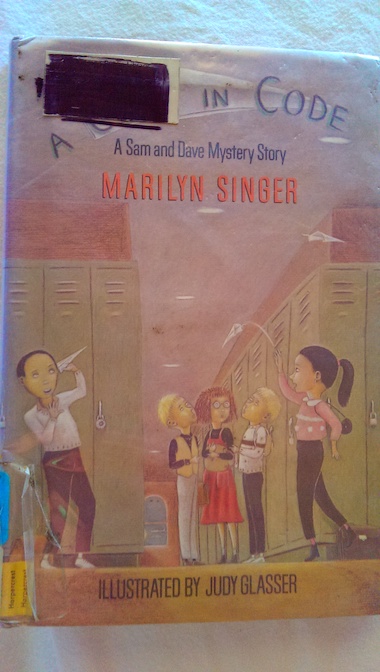
ClueInCodeA Clue in Code by Marilyn Singer, 1985.

This book is part of a series about a pair of twin boys, Sam and Dave Bean, who solve mysteries with their friends.

One day, the boys’ teacher, Ms. Corfein, has one of their classmates, Roger, collect money from the students for a class field trip.  Ms. Corfien tells Roger to put the money in her locker, but later, the money is gone.

Anyone in the class could have taken it.  When Dave went into the classroom to feed the class’s pet gerbil at lunchtime, he saw Willie, the class bully, there as well as his friend Patti, who thought that it was her turn to feed the gerbil.  Of the two, Willie seems like the best suspect for the theft because he’s been in trouble before for stealing, but perhaps there was someone else in the room before any of them arrived.

ClueInCodeSneakingSam and Dave decide to begin their investigation with Willie.  His father is the school’s custodian, and Willie has been using a copy of his father’s key to the school to sneak around after hours.  To the twins’ surprise, when they confront Willie, not only does Willie deny stealing the money, but it turns out that he’s actually been scared and upset himself.  After being caught stealing the last time, his parents have been especially strict with him, sending him to bed early, limiting his time with friends, and not allowing him to watch tv or read comic books.  In fact, his father tried to get rid of his entire collection of comic books by throwing them in the trash, but Willie rescued them and has been hiding them in the school, sneaking away to read them when he can.  However, someone has discovered them and stolen them.  Willie wants his comic books back, but he can’t report them stolen because his father thinks that they’re already gone.  Worse still, his parents will be even harder on him if he ends up taking the blame for stealing the class’s trip money.

ClueInCodeMessageIn spite of Willie’s reputation, which he deserves, Sam and Dave think that he’s telling the truth about the thefts.  Then, they happen to find a strange message that appears to be written in code after some of their classmates were throwing paper airplanes.  With the help of Rita, a friend who is very good with codes, they decode the message and uncover a valuable clue that explains why the comic books were taken and leads them to the thief’s identity.
I was pretty sure, from the very first chapter, who had stolen the money, but I wasn’t completely sure of who had taken the comic books until the end.  At first, I thought perhaps Willie’s father had found his stash and got rid of it again, but that wasn’t the case.  The thief who took the comic books was the same person who took the trip money and for the same reason.  This person’s father has been out of work, and they need the money.  It turns out that Willie has a number of comic books that are now collectors’ items, and someone is willing to pay a lot of money for them.

The Westing Game

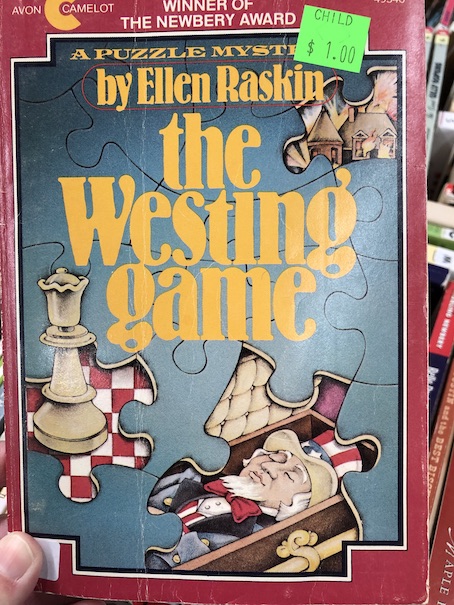
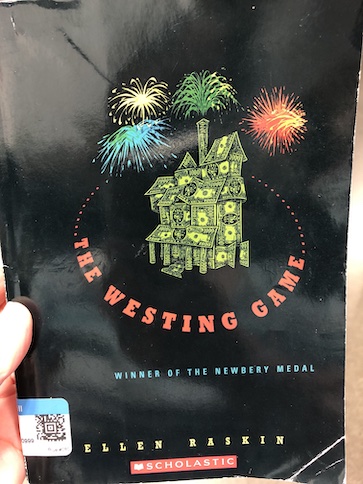
The Westing Game by Ellen Raskin, 1978.

It all starts when a mysterious person invites six sets of people to live in the new apartment building, Sunset Towers.  Sunset Towers is a luxury apartment building, but the rent for these individuals and families is surprisingly affordable.  That is because these people are special, and the owner of these apartments is preparing for a very special game.  Although there doesn’t seem to be anything to tie these people together at first, they do share a special connection that isn’t immediately obvious, a connection to the wealthy but mysterious Samuel Westing.

Among the new tenants of Sunset Towers is young Turtle Wexler.  Although she is often in the shadow of her overly-shy but pretty older sister, Angela, she has ambitions of her own in life.  While her mother dreams of making it in high society, Turtle (whose real name is also something of a mystery to the other tenants for most of the book) wants to become a successful businesswoman when she grows up, and one of the things she wants most is a subscription to the Wall Street Journal.  To raise the money she needs, Turtle accepts a bet to sneak into the supposedly empty Westing House on Halloween night, earning $2 for every minute she spends there.  There are stories that the place is haunted and that Mr. Westing’s body lies rotting on an oriental rug there, but Turtle doesn’t believe them.  As it turns out, she’s right.  Instead, she finds Mr. Westing dead in bed.

To everyone’s surprise, the tenants of Sunset Towers are all named in the will, but not in an ordinary way.  In order to determine who the final heir will be, they must all play The Westing Game.  The heirs are divided up into teams of two and given $10,000 and a set of clues.  They must use these to give an answer at the end.  But, what kind of an answer?  Mr. Westing’s will implies that he was murdered, but is that really true?  Could his murderer even be among the heirs/game players?

As the book continues, readers learn more about each of the contestants.  Each of them has their own personalities, ambitions, and problems.  For example, Angela Wexler is about to be married but seems less than enthusiastic about the wedding.  Cristos Theodorakis suffers from a strange malady that keeps him confined to a wheelchair.  Sydelle Pulaski was actually invited to join the tenants by mistake, but it might be the best mistake of her life.  Mr. Hoo is worried about his restaurant, and Madame Hoo dreams of returning to China.

The competition is fierce in the Westing Game.  Players are suspicious of other players cheating.  Things around the apartments start disappearing, and some mysterious person has even started planting explosives in unlikely places!  Whether the thefts and explosions have anything to do with the contest itself is for the reader to discover, but there is an answer to the Westing Game, and only one of the contestants will discover it.

The book is a Newbery Award winner.  There is a movie version of the book called Get a Clue! (1997), although it doesn’t follow the book completely.  There are multiple copies of the book currently available online through Internet Archive.

My Reaction

One of the great things about the Westing Game is how the seemingly mismatched pairs of contestants actually complement each other, giving people new perspectives on their lives and the answers to problems that some of them have been struggling with.   Lonely Flora Baumbach, grieving for her deceased daughter, is paired with young Turtle, who finds in her a more motherly person than her own mother, someone who values her for her intelligence and her unique skills in a way that no one else does.  Mrs. Baumbach enjoys having someone to care for again, and Turtle blossoms under her care and attention.  Mr. Hoo, meanwhile, finds some unexpected support for his business from Mrs. Wexler, who develops broader interests in life than her previous social ambitions and an unexpected flair for business and marketing.  Judge Ford, who was educated by Mr. Westing and always worried about how to repay the debt, finally finds a way to repay his kindness, a way that Mr. Westing would have approved.  Bertha Crow, an unhappy woman who turned to religion to atone for past sins, finds new happiness with someone who understands and accepts her past and is willing to help her continue her good works.  Even Angela, who seems to have everything a young girl would want (good looks and a kind fiance with a promising future in medicine), figures out what she really wants in life and finds the courage to stand up for it.