Toby Tyler

TobyTylerToby Tyler; Or, Ten Weeks with a Circus by James Otis, 1881.

Toby Tyler is an orphan who lives with a church deacon he calls “Uncle Daniel.” Uncle Daniel isn’t really his uncle, but he raised Toby after he was abandoned as a baby. Toby doesn’t know anything about his parents. Uncle Daniel is stern with him and says that Toby eats more than he earns, making it a hardship to care for him. Toby is cared for, but life with Uncle Daniel isn’t exactly happy.

Toby has a fascination for the circus, although Uncle Daniel says that the show isn’t any good, and it’s all a waste of time and money. The circus is certainly cheap, as Toby can see from the first. When he tries to buy some peanuts, he only gets six for the penny he gives, and all or most seem to be bad. The lemonade is basically water with lemon peel in it. But, to Toby’s surprise, the man who sells the snacks at the circus, Mr. Lord, offers him a job. He says that people who work for the circus get to see the show as often as they like, and he could use a boy to help him as an assistant.
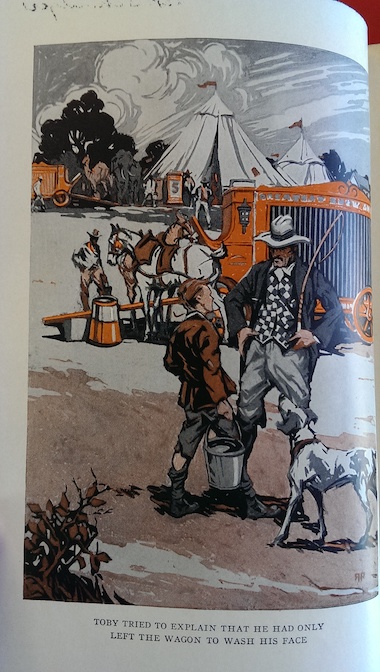
TobyTylerPicToby think that it sounds like an exciting offer, and Mr. Lord persuades Toby that the best way would be for him to sneak away at night because his Uncle Daniel might disapprove and stop him from taking the job. Not taking that as a warning, Toby agrees. Toby feels a little guilty about running away and surprisingly homesick, but he decides to stand by the agreement he made with Mr. Lord and see what possibilities life with the circus might have for him.

Life with the circus turns out to be very different from what Toby is used to and what he expects. It’s noisy and dirty, and no one seems to particularly care about Toby or his welfare. Mr. Lord also turns out to be even sterner than Uncle Daniel, not even telling Toby what he expects him to do, just expecting him to do it. Toby works hard, and Mr. Lord acknowledges that he’s better than the other boys who have helped him, but he’s still a temperamental man and hard to please. Like Uncle Daniel, he fusses about how much Toby eats. Toby also has to sell snacks inside the big top under the watchful eyes of Mr. Jacobs, who threatens him with violence if he doesn’t make sales or if people try to cheat him.

However, Toby does succeed in making a few friends in the circus. The first friend he makes is a monkey that he calls Mr. Stubbs. Mr. Treat, who plays the part of the Living Skeleton in the circus sideshow, and his wife, who is the Fat Lady, have seen Mr. Lord mistreating other boys, and they intervene to make sure that Toby is all right, giving him food when Mr. Lord doesn’t. Unlike everyone else Toby has known, Mrs. Treat lets him eat as much as he wants without worrying, saying that some people just need more food than others. Like her husband, Toby seems to have the ability to eat a lot while still being small and skinny.  Mrs. Treat herself maintains an enormous size while hardly eating anything. She says that’s just how some people are.

When Mr. Castle teaches Toby to do trick riding, his status goes up in the circus, and he is no longer under Mr. Lord’s thumb. As far as the Treats are concerned, Toby could stay with them forever. However, life in the circus isn’t what Toby had once thought it was, and Toby can’t get rid of the thought that he’s made a terrible mistake by running away from Uncle Daniel. He wants to go home and make things right with him.

In the Disney movie, Toby stays with the circus, doing well with his trick riding act and having happy adventures with his monkey friend. Unfortunately, in the book, Mr. Stubbs is accidentally shot by a hunter and dies. The book was meant to teach moral lessons about responsibility, whereas the movie was just about fun and adventure.

In the end of the movie, Toby stays with the circus even while being reunited with the people who raised him and missed him when he ran away, giving an all-around happy ending. In the book, Toby feels terrible about the death of Mr. Stubbs (although it wasn’t really his fault), and the hunter who shot him is very sorry because he hadn’t realized that he had shot someone’s pet. To make up for it, he helps Toby to get back to Uncle Daniel. At first, Toby is unsure that Uncle Daniel will want him back, but he misses his old home so much that he says he doesn’t care if Uncle Daniel whips him for running away. However, Uncle Daniel has also missed Toby since he disappeared. As stern and harsh as he could be before, Uncle Daniel genuinely cares about Toby and welcomes him back with open arms.  The ending implies that Toby’s future with Uncle Daniel will be happier than the past because they have much greater appreciation for each other now.

The book is now in the public domain and is available on Project Gutenberg.
Caps for Sale

CapsSale

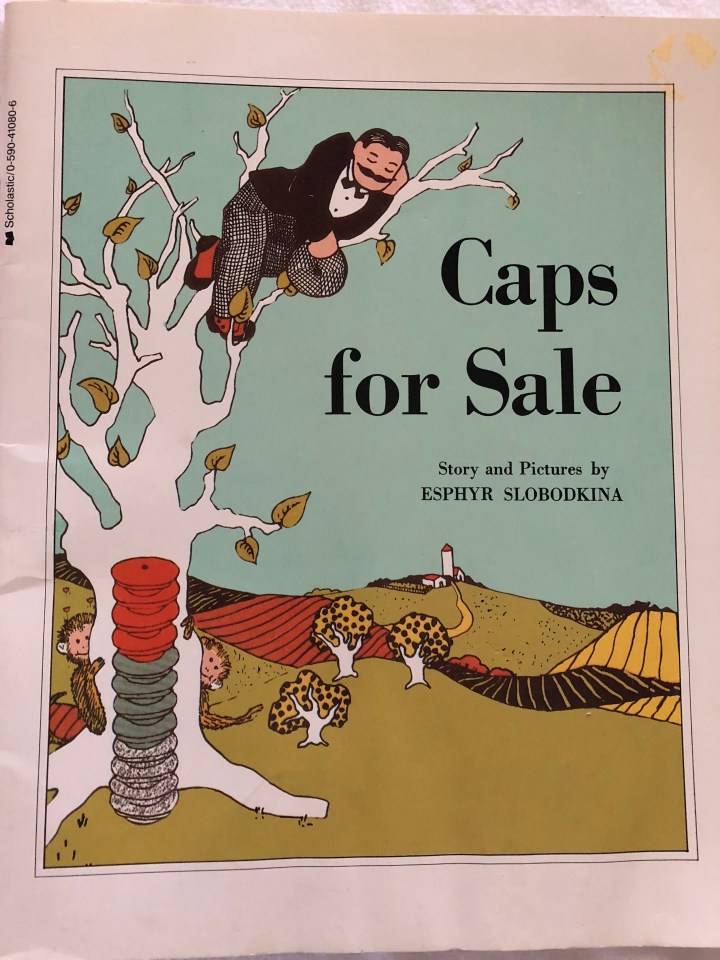
Caps for Sale written and illustrated by Esphyr Slobodkina, 1940.

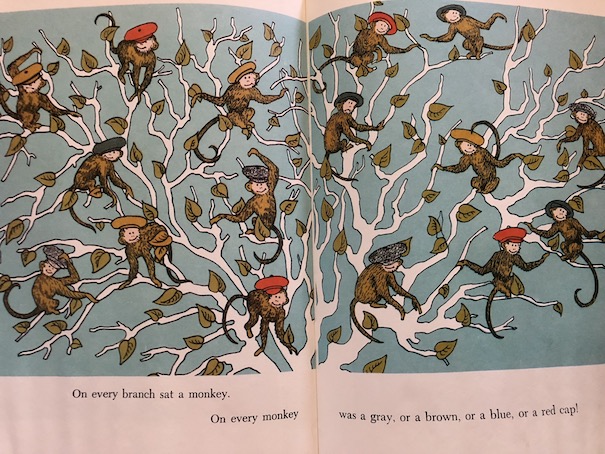
A peddler who sells caps likes to carry his wares on top of his own head, stacked in order of color.  One day, when he has trouble selling his caps, he decides to take a nap under a tree.  When he wakes up, he is astonished to see that all of his caps are gone!

He looks around frantically for his caps and realizes that the tree is full of monkeys, all wearing his caps!  At first, he doesn’t know what to do about it.  He tries shouting at the monkeys, shaking his fists, and stamping his feet, but it doesn’t help.  The monkeys just imitate everything he does.

CapsSaleMonkeys

Finally, in frustration, he throws his own cap to the ground, and the monkeys do that same thing, giving him back his caps.  The peddler is able to reclaim all of his caps, and he goes on his way.

This book is considered a children’s classic!  The story is simple, but the repetition of the peddler’s attempts to get his caps back and the “monkey see, monkey do” imitation are fun for kids.

The book is currently available online through Internet Archive.

Pippi Longstocking

PippiLongstocking

Pippi Longstocking by Astrid Lindgren, 1950.

Pippi Longstocking is an iconic figure in children’s literature, a little red-haired girl with amazing strength (she can lift a horse all by herself) and a quick wit, who can “always come out on top” in any situation and is frequently doing exciting and hilarious things without adult supervision. The books in her series were originally from Sweden, with the first one written in 1945, but I’m reading a later English translation.

In the first book, she comes to live by herself in a house, which she calls Villa Villekulla, in a small town in Sweden when her father, a ship’s captain, is washed overboard at sea.  Although others fear that he is dead, Pippi thinks it more likely that he was washed up on an island of cannibals, where he will soon be making himself their king.  (Of course, Pippi turns out to be right, but that’s getting ahead of the story.) Her mother died when she was a baby, so Pippi now lives all by herself, except for her pet monkey and horse. She pays for the things she needs with money from the suitcase of gold coins that her father left for her and spends her time doing just as she pleases.

Tommy and Annika, the children who live next door to Ville Villekulla, are perfectly ordinary, basically obedient children, who live normal lives with their parents. When Pippi moves in next door, their lives get a lot more exciting. The first time they meet her, she’s walking backward down the street. When they ask her why she’s doing that, she says that everyone walks that way in Egypt. Tommy and Annika quickly realize that she’s making that up, and Pippi admits it, but she’s such an interesting person that they accept her invitation to join her for breakfast. They’re amazed when they find out that Pippi has no parents, only a monkey and a horse living with her, and are entertained by the tall tales that she tells.

When they go back to see her the next day, Pippi tells them that she’s a “thing-finder” and invites them to come and look for things with her. Basically, Pippi is a kind of scavenger, looking for valuable things, things that might be useful, or (which is more likely) just any old random junk that she might happen across. Pippi does find some random junk, although she makes sure that Tommy and Annika find better things (probably by hiding them herself).

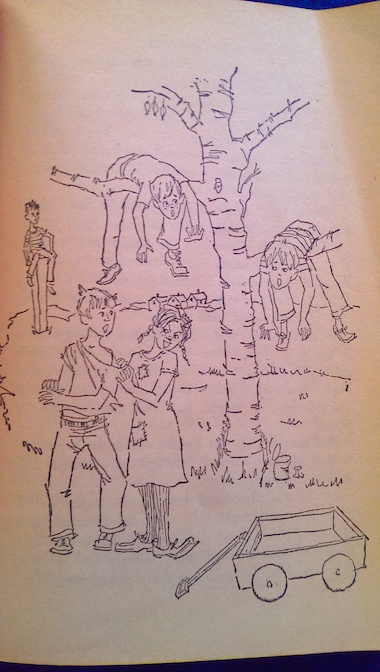
Then, the children see a group of bullies beating up another boy and decide to intervene. The meanest of the bullies, Bengt, starts picking on Pippi, but picking on a girl with super strength isn’t the wisest move. She picks him up easily and drapes him over a tree branch. Then, she takes care of his friends, too.

Word quickly spreads through town about this strange girl. Some of the adults become concerned that such a young girl seems to be living on her own. A couple of policemen come to the Ville Villekulla one day to take Pippi to a children’s home, but she saucily tells them that she already has a children’s home because she’s a child and she’s at home. Then, she tricks them into playing a bizarre game of tag that ends with them being stuck on the roof of the house. The policemen decide that perhaps Pippi can take care of herself after all and give up.

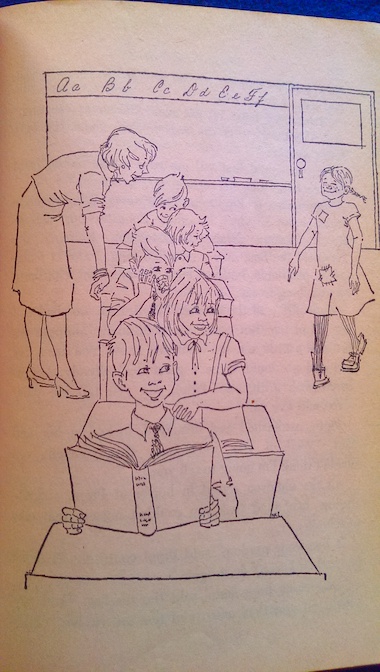
Tommy and Annika try to persuade Pippi to come to school with them, but that doesn’t work out, either. Pippi, completely unfamiliar with the routine of school, thinks that the teacher is weirdly obsessed with numbers because she keeps demanding that her students give her the answers to math problems that Pippi thinks she should be able to solve on her own. The teacher concludes that school may not be for Pippi, at least not at this point in her life.

Tommy and Annika delight in the wild things that Pippi does, like facing off with a bull while they’re on a picnic, accepting a challenge to fight a strongman at the circus, and throwing a party with a couple of burglars.  When they invite Pippi to their mother’s coffee party, and their mother’s friends begin talking about their servants and how hard it is to find good help, Pippi (having already devastated the buffet of desserts and made a mess in general) jumps in with a series of tall tales about a servant that her grandparents had, interrupting everyone else.  Tommy and Annika’s mother finally decides that she’s had enough and sends Pippi away.  Pippi does leave, but still continuing the story about the servant on the way out, yelling out the punchline from down the street.

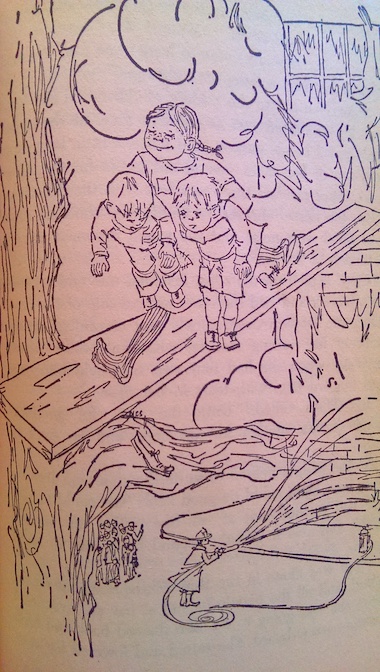
However, Pippi becomes a local hero when she saves some children from a fire after the fireman decide that they can’t reach them themselves.

The book is available to borrow and read for free online through Internet Archive.

My Reaction

I have to admit that, as a character, Pippi sometimes annoys me with her obvious lies and some of the stuff she does. She openly admits that she lies after telling some of her tall tales, but it’s the parts where she admonishes her listeners not to be so gullible that get to me. You can tell that her listeners aren’t really fooled at all; they’re just trying to be polite by not calling her a liar directly, and then she insults them for it. Maybe it’s Pippi who’s really the gullible one, thinking that she’s fooling people when she isn’t really. 

Admittedly, Pippi’s wild stories are sometimes amusing.  I liked the one where she claimed that the reason why other people don’t believe in ghosts is that all of the ghosts in the world live in her attic and play nine-pins with their heads.  When Tommy and Annika go up there to see them, there aren’t any, of course, and Pippi says that they must be away at a conference for ghosts and goblins.

I just don’t like it that Pippi seems to be deliberately trying to make people look dumb when she’s the one saying all the stupid stuff and it’s really obvious that people know it. I also don’t like the part where she makes such a mess at the coffee party because she seems to be trying to be a messy pain on purpose.  She insists that it’s just because she doesn’t know how to behave, but I get the sense that it’s just an excuse and that Pippi just likes to pretend to be more ignorant than she is, pushing limits just because she likes to and because she usually gets away with it.  I didn’t think it was very funny.  But, Tommy and Annika seem to just appreciate Pippi’s imagination, enjoying Pippi’s antics, which bring excitement and chaos to a world controlled by sensible adults, which can be boring to kids, and accepting Pippi’s stories for the tall tales they are, playing along with her.

Pippi herself is really a tall tale, with her super strength, her father the cannibal king, and her ability to turn pretty much any situation her to advantage.  Part of her ability to “come out on top” is due to her super strength and part of it is that Pippi approaches situations from the attitude that she’s already won and isn’t answerable to anyone but herself.  This approach doesn’t always work in real life (I can’t recommend trying it on any of your teachers, or worse still, your boss – not everyone is easily impressed, especially the people who pay your salary), and nobody in real life has Pippi’s super strength to back it up. The adults in the story frequently let Pippi win because they decide that fighting with her just isn’t worth it. (Admittedly, that does happen in real life, too. I’ve seen teachers and other people give in to people who are just too much of a pain to argue with because they’re too impatient or find the argument too exhausting.)  Kids delight in Pippi’s ability to get the better of the adults, who usually have all the control, and in Pippi’s freedom to do what she wants in all situations.

One thing that might surprise American children reading this story is that the children in the story drink coffee. Tommy and Annika say that they are usually only allowed to drink it at parties, although Pippi has it more often. It isn’t very common for American children to drink coffee in general because it’s usually considered more of an adult’s drink and because of concerns about the effects of too much caffeine on young children. Children in Scandinavia tend to drink coffee at a younger age than kids in the United States.

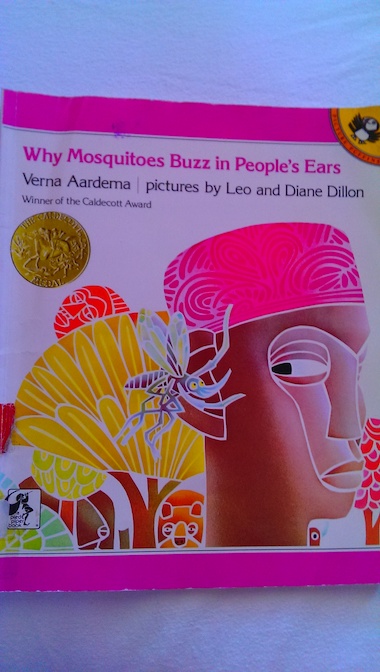
Why Mosquitoes Buzz in People’s Ears

Mosquitoes

Why Mosquitoes Buzz in People’s Ears retold by Verna Aardema, pictures by Leo and Diane Dillon, 1975.

The story comes from a West African folktale, and all the characters are animals.

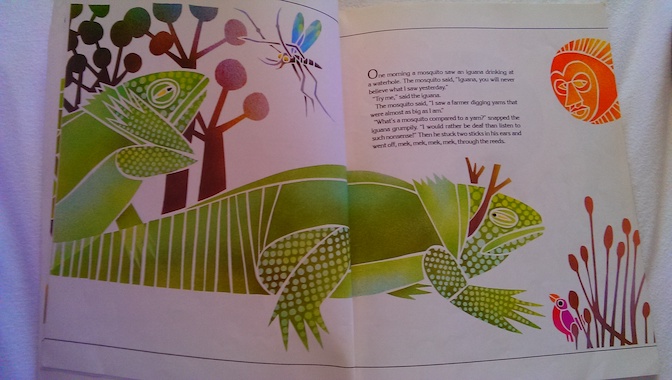
In the beginning, a grumpy iguana gets tired of hearing a mosquito telling tall tales. He sticks a couple of sticks in his ears so that he won’t have to listen anymore, and this decision leads to a series of unfortunate events that leads to the accidental death of a baby owl.

MosquitoesIguana

It starts with a snake trying to talk to the iguana, who does not hear him. The snake, thinking that perhaps the iguana is angry with him, goes to hide from him in a rabbit hole, startling the rabbit out. The chain reaction of events continues, with different animals startling each other, until a frightened monkey crashes through a tree branch, which breaks, killing the baby owl.

MosquitoesMonkeyTree

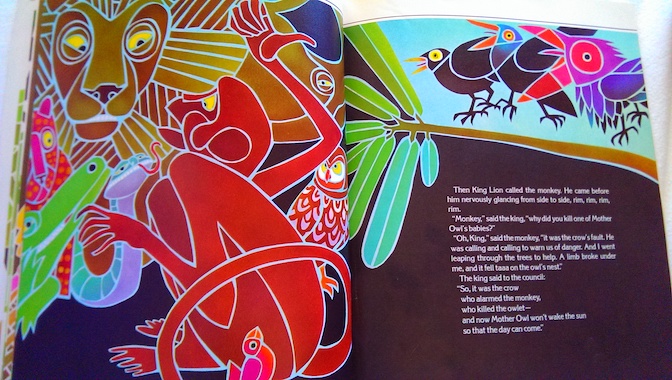
The Mother Owl is so distraught at the death of her baby that she doesn’t wake the sun so that dawn can come, as she usually does. When the other animals realize that dawn isn’t coming, King Lion calls a meeting to determine the reason why. Together, they trace the events backward to the iguana. The iguana is not at the meeting because he still has sticks in his ears and hasn’t heard a thing about it.

MosquitoesMeetingMonkey

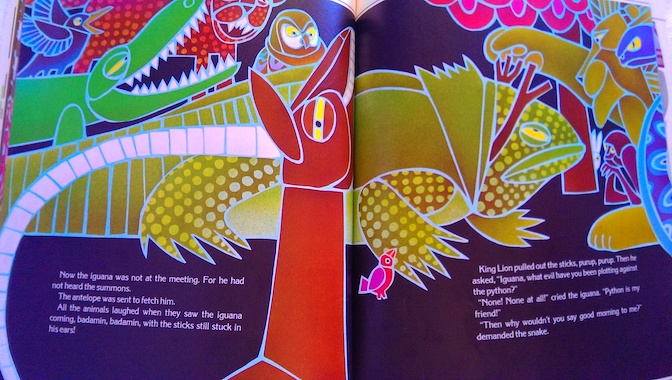
When the other animals track down the iguana and take the sticks out of his ears, they demand to know why he wouldn’t talk to the snake. When he tells them that he had sticks in his ears because he couldn’t stand listening to the mosquito’s stories anymore, the mosquito ends up taking the blame for everything. The Mother Owl is satisfied with the explanation and hoots to wake up the sun, although the mosquito escapes punishment by hiding. So, ever since, the mosquito whispers in people’s ears to find out if everyone is still angry.

MosquitoesMeetingIguana

The art style in the book is a little unusual. When I looked at the pictures the first time, I thought of them as looking stenciled. However, there is a note in the beginning of the book, near the copyright information, that says that the pictures are a combination of watercolors and india ink. The artists used an airbrush and pastels, and they created the “cut-out effect” with frisket masks and pieces cut out of vellum.

This book is a Caldecott Award winner. It is currently available online through Internet Archive.