Frankenstein Moved In on the Fourth Floor

Frankenstein Moved In on the Fourth Floor cover

Frankenstein Moved In on the Fourth Floor by Elizabeth Levy, illustrated by Mordicai Gerstein, 1979.
Frankenstein Moved In on the Fourth Floor new neighbor

Sam lives with his brother and mother on the 19th floor of a large apartment building. One day, when he and his mother are going to meet his brother at a friend’s house, they try to take the elevator down to the ground floor, but it doesn’t seem to be working. With no other choice, they take the stairs, and when they reach the fourth floor, they discover the reason why the elevator isn’t working.

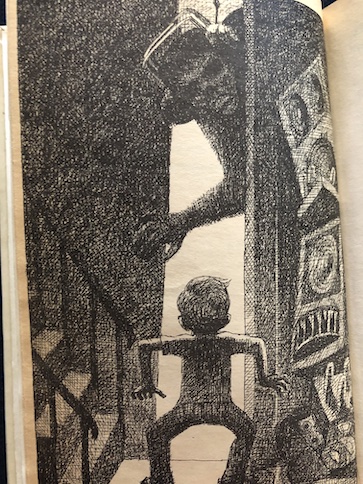
A new neighbor, Mr. Frank, is moving into the apartment building, and he’s stopped the elevator at his floor to unload all of his stuff. He has boxes and boxes of wires and other electronic components, and he gets really upset when anybody else touches them. He has refused all offers of help to unload the boxes, he’s kept the elevator tied up, and he’s been rude to his new neighbors about these things.

Frankenstein Moved In on the Fourth Floor reading book

Sam thinks that Mr. Frank is frightening. He looks weird with those strange headphones with an antenna he keeps wearing. When he and his mother go to pick up his brother, Robert, Sam tells him about Mr. Frank and his theory that Mr. Frank is actually a monster. Sam thinks that Mr. Frank looks like Frankenstein. Both of the boys are into movie monsters, but Robert thinks at first that Sam is making it up. The boys have a debate about whether Mr. Frank would actually be Frankenstein the scientist or the monster that Frankenstein created in the book and movie because, although many people call the monster Frankenstein, that was actually the name of the monster’s creator. When the boys consult an abridged version of Frankenstein, Sam becomes convinced that the book’s description of Frankenstein the scientist sounds like Mr. Frank.

Frankenstein Moved In on the Fourth Floor walking up stairs with candle

The next day, the boys go down to the apartment house’s basement, where tenants have storage rooms. Sam wants to see what Mr. Frank is storing in his storage room, but when the boys start talking about the possibility that he might keep bodies in there, they chicken out. In the meantime, Mr. Frank gets on everyone’s nerves at the apartment house. He’s always bringing in new boxes of stuff and leaving empty ones around. Neighbors hear weird noises coming from his apartment that sound like moans and groans. Mr. Frank claims that the noises are his music. Then, he overloads the electrical circuits in his apartment and causes the entire building to black out. Nobody knows what he’s doing with all that electrical equipment of his. Mr. Frank’s weird electrical experiments make Robert think maybe Sam was right about Mr. Frank being Frankenstein.

Frankenstein Moved In on the Fourth Floor discovering the Dracula doll

The boys decide that it’s important for them to take a look in Mr. Frank’s storage room, but when Robert accidentally leaves his Dracula doll behind, they realize that Mr. Frank will find out that they’ve been snooping. They may have to face the wrath of Frankenstein!

The book is available to borrow and read for free online through Internet Archive (multiple copies). There is a sequel to this book called Dracula is a Pain in the Neck.

My Reaction and Spoilers

Frankenstein Moved In on the Fourth Floor confrontation

This story is a kind of mystery story because the boys are trying to figure out if Mr. Frank is actually Frankenstein and if he’s making monsters with his electrical experiments. However, it really reminds me of the The Adventures of the Bailey School Kids, a series about kids who suspect various people in their town of being different supernatural creators. This book is older than that series, and from the way the story goes, there are more logical explanations for Mr. Frank’s behavior. However, like with The Adventures of the Bailey School Kids, the kids don’t really get firm answers at the end. It looks like Mr. Frank is probably just some weird, temperamental musician who likes to experiment with electronics, but the story leaves it open to interpretation.
Count Draculations!: Monster Riddles

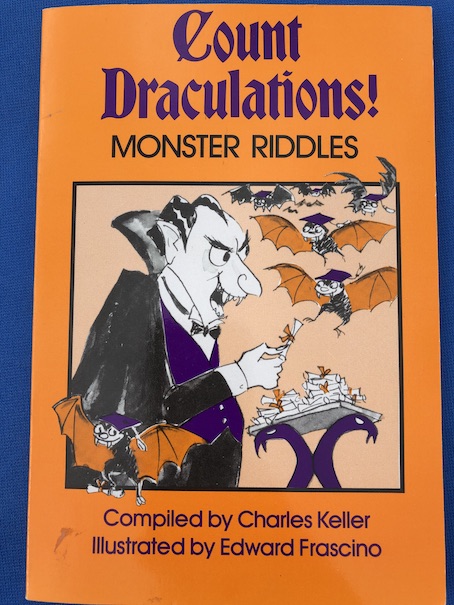
Count Draculations!: Monster Riddles compiled by Charles Keller, 1986.

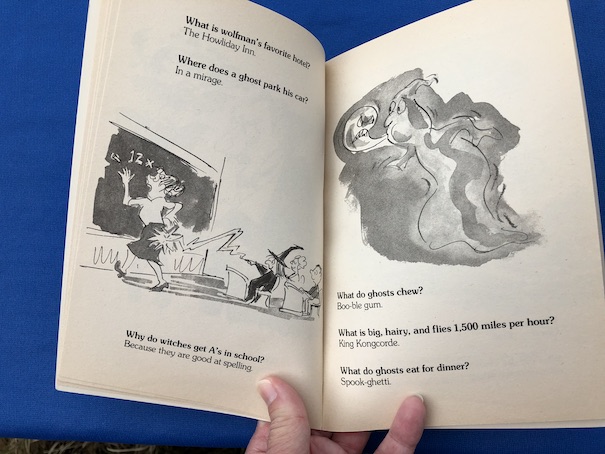
This is one of those themed joke books for kids that has monster and Halloween-themed jokes.  The jokes are the basic kid-friendly question-and-response type with lots of puns.  There are also some cute black-and-white illustrations.

Some of my favorite jokes:

Why do witches get A’s in school?

Because they are good at spelling.

How do you get into a locked cemetery?

With a skeleton key.

Why did Frankenstein’s monster go to the psychiatrist?

He thought he had a screw loose.

Why did the invisible man go crazy?

Out of sight, out of mind.

Where the Wild Things Are

Where the Wild Things Are by Maurice Sendak, 1963.

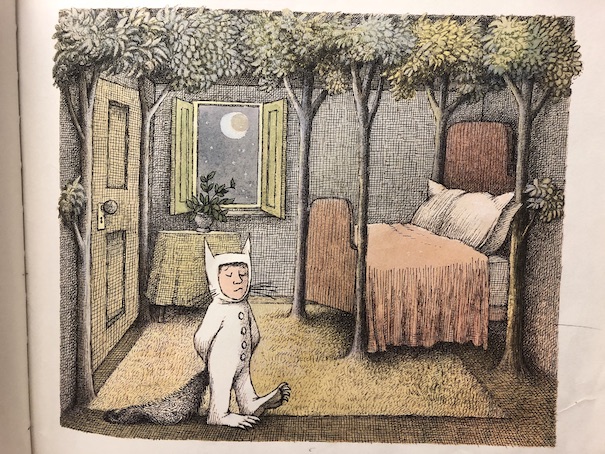
One evening, Max puts on his wolf costume and starts causing trouble all over the house. His mother calls him a “wild thing” and sends him to bed early without supper.

As Max mopes in his room, a forest grows around him, and Max climbs into a boat and sails away.

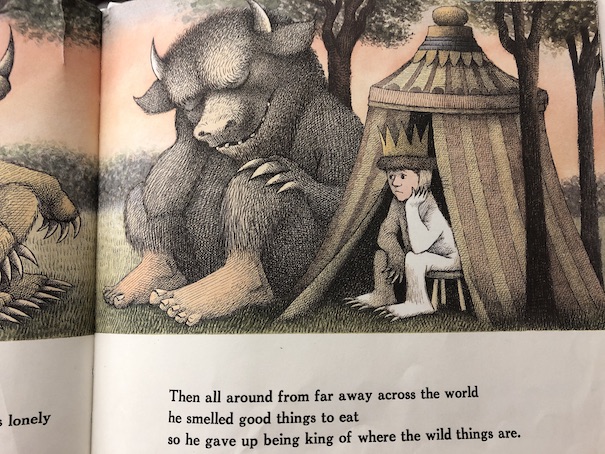
Max eventually arrives at “the place where the wild things are.” There are all kinds of wild beasts and monsters there, and they make Max their king because he’s the wildest of them all.

After they all go parading about and swinging from trees, Max sends all the wild things to bed and is lonely because he wants to be with someone who loves him.

So, Max sails home again to have his supper, which is waiting for him, still hot.

Max’s magical journey is in his own head. Angry and hurt at being told off for his behavior, he imagined himself far away from where he was being punished, in a place where he could act any way he wanted and tell other people what to do. But, that wasn’t satisfying because what he really wants is to be loved and cared for. Wild monsters don’t get the kind of nurturing that small human boys get from their mothers, so there are benefits to being a civilized human. This is a classic children’s book about the power of a child’s imagination and how love and human feeling wins out over anger.

The book is a Caldecott Medal Winner. It’s available online through Internet Archive.

Monster Slayer

MonsterSlayer

Monster Slayer retold by Vee Browne, illustrated by Baje Whitethorne, 1991.

This is a retelling of a Navajo folktale.  An Editor’s Note at the beginning of the book explains a little about the original legend.  It is actually part of a much longer story.  The book only focuses on the Walking Giant part.  The Walking Giant threatened the villages of the Anasazi.  The author and illustrator of this book are both Navajo.

Changing Woman, who created both humans and monsters, had twin sons, but they did not know who their father was until they were twelve years old, when their mother told them that their father was the Sun.

MonsterSlayerAnasaziVillage

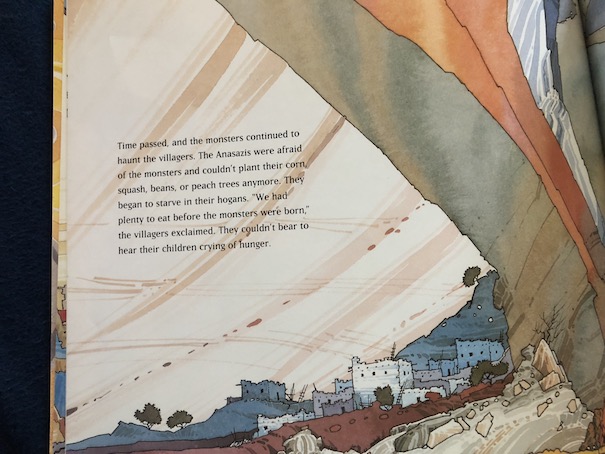
The twins went to see their father, but they were returned to Earth to help their people to fight the monsters which plagued the land.  The monsters prevented the Anasazi from planting their crops, and people were starving.  The people appealed to Changing Woman and her sons for help.  The twins’ father gave them his lightning arrows to use in the fight.

MonsterSlayerVillagers

Hearing the sound of thundering footsteps, Changing Woman told her sons that it was the sound of the Walking Giant.  The twins took their armor, sacred magic feathers, and lightning arrows and set out to find the giant.  Eventually, they found him by a lake.  The twins hid behind a rock, but the giant could smell them.

MonsterSlayerMagicFeathers

As the fight began, the twins let the giant shoot the first arrow at them because their father told them to, since Walking Giant was older that they were.  However, their magic feathers helped them to evade the giant’s boomerang.  Then, one of the twins used a lightning arrow to finish off the Walking Giant.  To commemorate their victory, Changing Woman named this twin Monster Slayer.  (The other boy was already named Child Born of Water.)

MonsterSlayerGiant

This story is interesting but felt a little disjointed to me. That may be because it is a shortened version of the legend.  I wish that the beginning note explained a little more about the context of the story.  This book won the Best Juvenile Book Western Heritage Award from the National Cowboy Hall of Fame.

The book is available to borrow and read for free online through Internet Archive.

That Terrible Halloween Night

TerribleHalloween

That Terrible Halloween Night by James Stevenson, 1980.

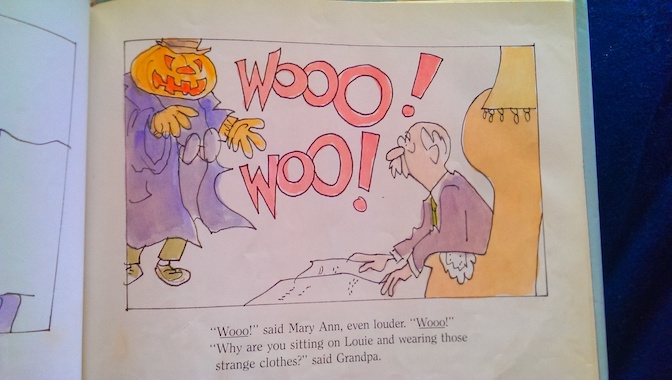
It’s Halloween, and Louie and Mary Ann think that it would be funny to play a joke on their grandfather and scare him.  First, they try putting a scary mask on their dog, Leonard, but their grandfather just pats the dog on the head.  Then, Mary Ann sits on Louie’s shoulders, and the kids put on a big, old coat and a pumpkin head.  However, their grandfather still isn’t frightened.

TerribleHalloweenCostume

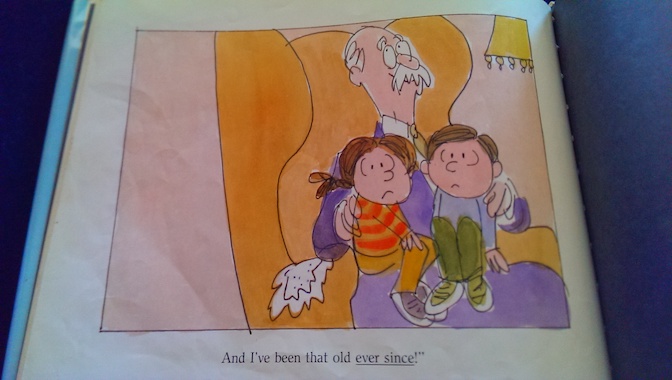
When the kids ask him why he isn’t scared, their grandfather says that he doesn’t get scared much since “that terrible Halloween night.”  When the kids ask him what he means, he starts telling them about a Halloween when he was a kid.  He was out trick-or-treating when he saw a mysterious old house and couldn’t resist taking a look inside.

TerribleHalloweenTrickOrTreat

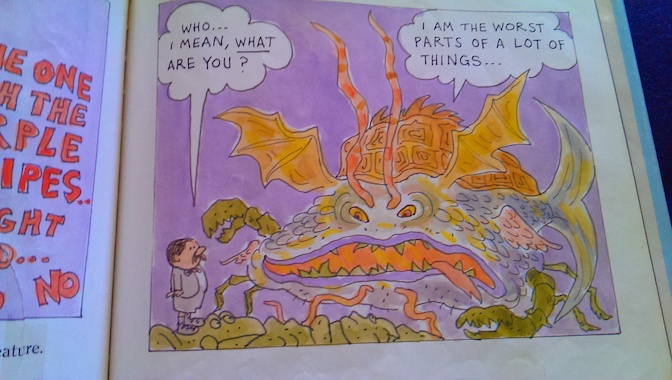
As the grandfather, as a kid, explores the house, he encounters all kinds of strange and frightening creatures.  (My favorite is the one that’s “the worst parts of a lot of things” just for the description.)

TerribleHalloweenMonster

But, nothing in the house is as scary as whatever is behind the final door in the house, the one that the monsters warn him not to go through . . .

TerribleHalloweenOldMan

You never see what’s behind the door, but the result is the punchline of the story.  Typical grandfather way to frighten the kids!

TerribleHalloweenPunchline

One of the fun things about this story is that the grandchildren aren’t just listening to the story but are shown reacting to it as the grandfather tells the story, sometimes interrupting with questions or comments.  The pictures are drawn in a comic style, and much of the dialog is contained in speech bubbles in the pictures.

The book is currently available online through Internet Archive.

Ghosts, Witches, and Things Like That

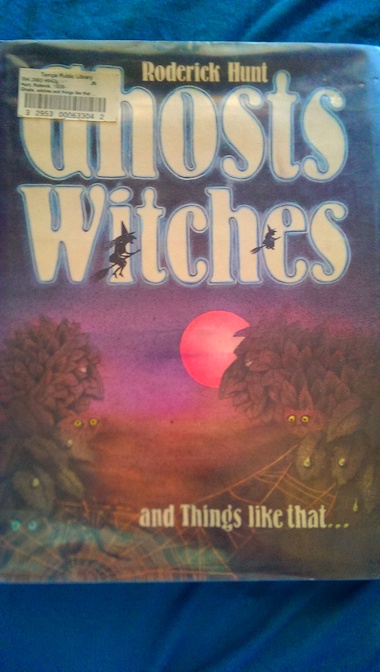
GhostsWitchesThings

Ghosts, Witches, and Things Like That by Roderick Hunt, 1984.

This is a collection of information about the history of Halloween and other things related to Halloween, like folklore, games, recipes, crafts, and poems.  There are sections about specific topics, starting with the section about Halloween itself (spelled Hallowe’en, this is a British book).  The section about Halloween talks about the origins of the holiday and has tips for holding a Halloween party, including how to make costumes and decorations, the rules for games to play (including some old traditional games), and recipes for various Halloween treats.

Other sections of the book focus on various monsters and mythical creatures associated with Halloween, such as witches, ghosts, fairies werewolves, and vampires.  There is a section of ghost stories and some fascinating historical information about spiritualists and how people have faked ghosts in the past, including the Pepper’s Ghost illusion that is still used in the haunted house in Disneyland.  The sections about witches, fairies, and monsters also include a mixture of history and folklore along with some jokes and poems about the various creatures.

GhostsWitchesHistory

This is a fun book to read around Halloween.  It’s a mixture of historical background, folklore, party-planning tips, games, and recipes.  I think that the information about traditional games is still my favorite part.

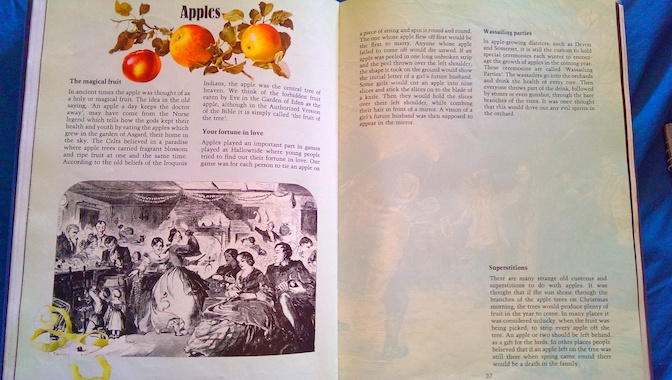
GhostsWitchesApples

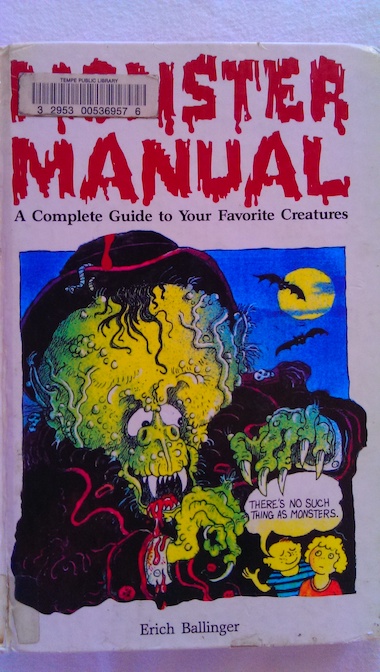
Monster Manual

MonsterManual

Monster Manual by Erich Ballinger, 1989, 1994.

This book was originally written in German and then translated into English.  It’s not a story about monsters but a kind of guide to monsters and other creatures found in fantasy, horror, and science fiction books and movies.  There are articles about different types of monsters, fictional characters, and monster-related concepts that are organized in alphabetical order, like a encyclopedia.  The creatures in the book range from traditional monsters from folktales and classic literature, like vampires, mummies, dragons, ogres, and creatures from Greek mythology, to modern ones from popular fiction, as seen on this monster family tree.

MonsterManualFamilyTree

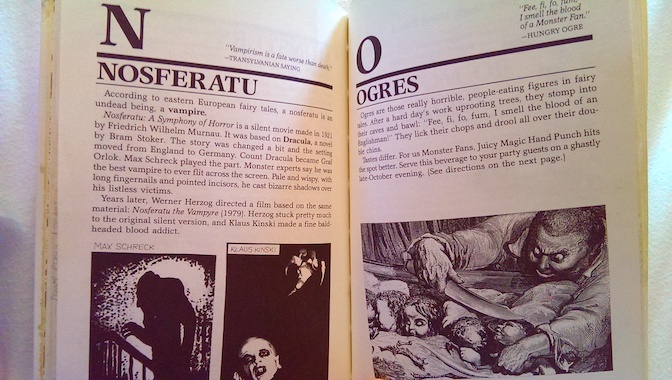
Some topics, like vampires, actually have more than one entry in the book.  There is the Vampires article, which talks about the general idea of vampires and traditional beliefs about them. Then, there are the articles about Dracula and Nosferatu, specific vampires from classic literature.  In the Nosferatu section, they tell you that the famous silent movie Nosferatu was actually based on Bram Stoker’s Dracula, just with the location and character names changed.  Unlike the suave-looking Dracula, who is not obviously a vampire at first sight, the vampire in Nosferatu was also depicted as an unearthly creature.  One thing they don’t mention is that Bram Stoker’s widow sued the studio that made Nosferatu for copyright infringement.  The studio went bankrupt, and all copies of the movie were supposed to be destroyed.  The only reason that we can see the movie now is that copies of it had already been sent overseas and preserved.  It’s now considered a classic silent film and has a cult following.

MonsterManualVampires
MonsterManualNosferatuOgres

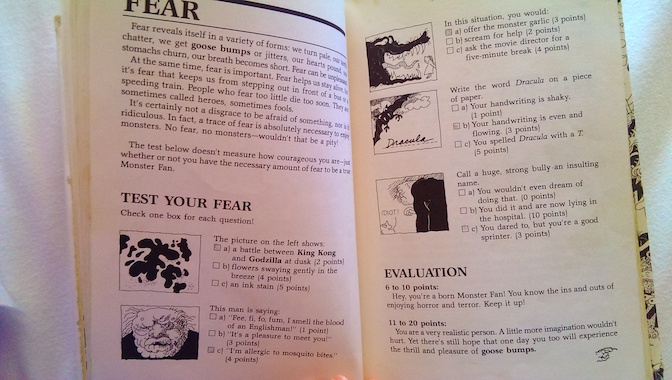
Some articles are also activities, like the one about Drawing Monsters and the quiz to see how fearful you are.

MonsterManualFearQuiz

All throughout the book, there are also segments of a comic strip at the bottoms of various pages in which a monster tries to frighten a young girl, who is unimpressed.  By the end of the comic strip, the girl and the monster become friends.

The book is available to borrow and read for free online through Internet Archive.

Encyclopedia of Legendary Creatures

LegendaryCreatures

Encyclopedia of Legendary Creatures by Tom McGowen, 1981.

This book is organized into brief encyclopedia-style entries, describing legendary creatures from around the world.  Everything is in alphabetical order, not organized by country or any other over-arching categories.

There are two things that I particularly like about this book.  One is that the mythological creatures in the book aren’t just limited to the common ones, like giants, vampires, werewolves, and unicorns (although they each have entries of their own); there are also some lesser-mentioned creatures like the Hulder Folk and the Abatwa People.  The Hulder Folk, who come from Norse folktales, look like ordinary humans, but they have tails like cows.  According to the book, they love to sing and dance, but their songs are always sad, which makes me think of country music.  They also can intermarry with humans, although their marriages are usually unhappy, which also, oddly, makes me think of country music.  The Abatwa People are part of the folklore of the Zulus in South Africa.  They are tiny people, but fierce warriors, and they get offended if people don’t treat them like they are the same size as humans.  (There are also real people in Africa called Abatwa who are pygmies.  The legendary people in this book may be connected to old legends about them, exaggerating their shorter-than-average height.)

LegendaryCreaturesNisse

The other thing that I really like about this book is the pictures.  There are many books about mythology and folklore that don’t have pictures of the creatures, and it really makes a difference being able to see what something looks like (or supposedly looks like, since these are legendary creatures) as well as read a description.

As a side note, there is an episode of the kids’ cartoon show, Arthur, where his friend, Sue Ellen, who isn’t usually frightened by scary stories, hears a strange noise that makes her think about various mythological monsters that she’s heard about in the different countries that she’s visited with her parents.  These unusual monsters, like Baba Yaga, Kappas, and Bashees, which most of her friends haven’t heard about before, do frighten her.  When I saw Kappas described in this book, it reminded me of that.

Monster Manners

MonsterManners

Monster Manners by Joanna Cole, 1985.

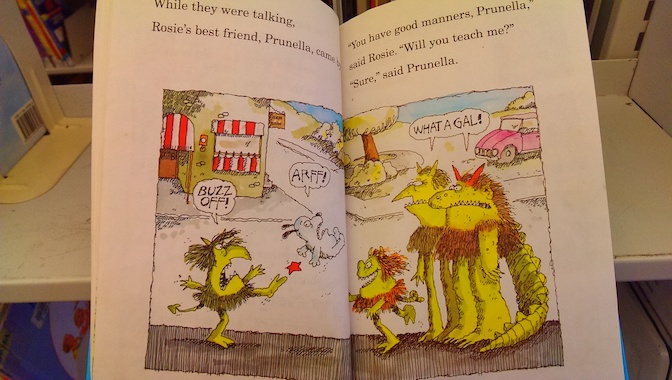
Rosie Monster’s parents worry about her because she just can’t seem to understand how monsters are supposed to behave. Monsters are supposed to be fearsome. They’re supposed to growl, fight, and break things. Rosie is just the opposite. She’s endlessly polite and sweet.

MonsterMannersRosie

Rosie’s friend Prunella tries to teach her real monster manners, but no matter what, Rosie just can’t stop being polite.

MonsterMannersPrunella

It wouldn’t be such a problem for Rosie, except that she knows that her family and friends are disappointed in her.

MonsterMannersDisappointment

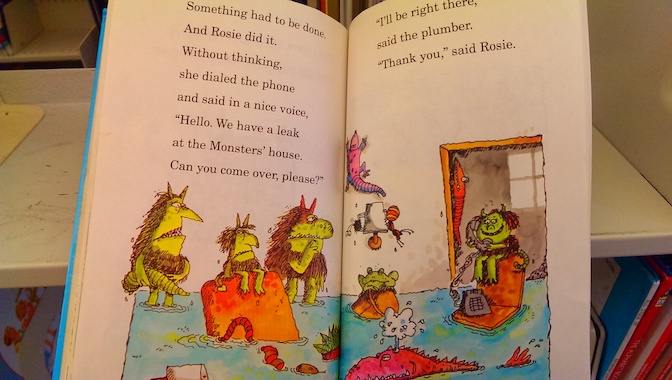
Then, a water pipe breaks at Rosie’s house. Although her parents, and even Prunella, try calling a plumber, they can’t get him to come to the house and help them no matter how loudly they growl into the phone.

MonsterMannersGrowling.jpg

It takes Rosie’s politeness to get the message across and get the help they need!

MonsterMannersPhone

A friend of mine who works in customer service wishes that more callers would be polite or, failing that, that he could just hang up like the plumber in the story.  Trying to help people who are determined to make the process of helping them harder than it has to be and who will curse and insult you for even trying is a frustrating experience.

The book is currently available online through Internet Archive.

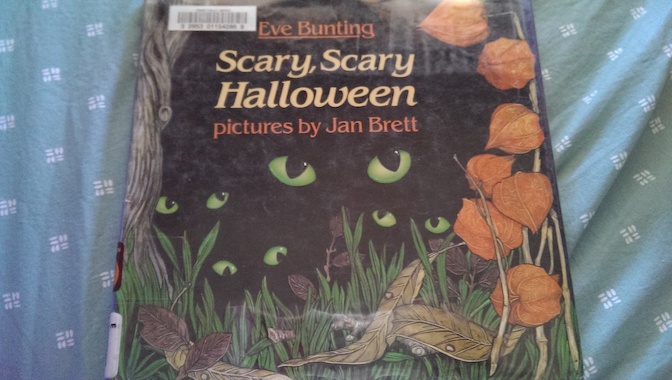
Scary, Scary Halloween

ScaryHalloween

Scary, Scary Halloween by Eve Bunting, pictures by Jan Brett, 1986.

I love the pictures in this book and enjoy the rhyming text of the story.  It’s a cute concept for Halloween, and young children will enjoy the repetition in the story.

ScaryHalloweenSkeleton

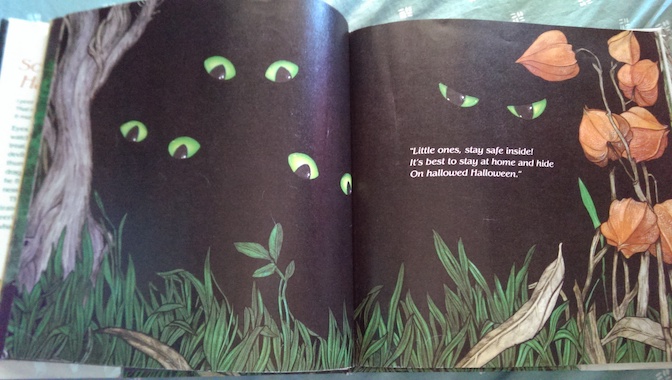
One Halloween night, unseen watchers observe children in costume trick-or-treating.  The mother cautions her children to remain hidden because of all the strange creatures that are out and about on Halloween.

ScaryHalloweenEyes

Readers will know that the monsters are simply children in costume, but the watchers do not because they are cats, which is only revealed at the end of the story.  Throughout most of the book, they only appear as green eyes as they hide under the porch of a house.
ScaryHalloweenPorch

When all the trick-or-treaters are gone, the mother cat and her kittens are free to roam the night themselves.

ScaryHalloweenCats

I thought that it was cute how the mysterious tone of the book was due to the cats’ understanding of Halloween.  At first, it may seem very mysterious to young children as well, but completely understandable as it becomes more and more obvious that all the monsters are only trick-or-treaters and the little family hiding from them are cats, who think of themselves as being pretty fierce in their own right.

The book is available to borrow and read for free online through Internet Archive.