The Case of the Wandering Werewolf

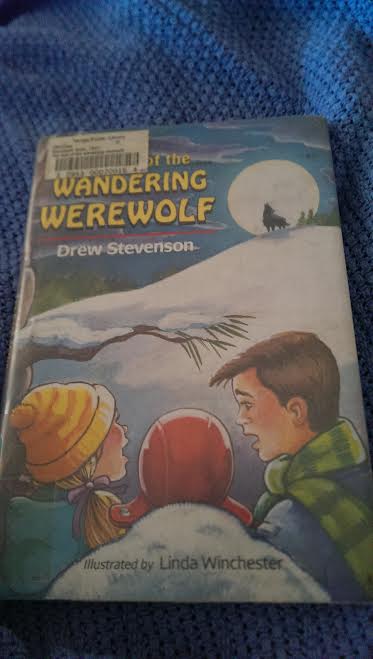
wanderingwerewolfThe Case of the Wandering Werewolf by Drew Stevenson, 1987.

A boy called Chips approaches Raymond with the story that there might be a werewolf in Lost Woods, outside of town. Chips likes animals, and he has been going into the woods to spring animal traps that someone has been leaving there. One evening, Chips thought he saw a man who seemed to turn into a wolf, and the wolf chased Chips away, only stopping when Chips crossed the creek. Chips has heard of Huntley’s monster hunting activities, and he asks Raymond to tell Huntley about the werewolf and see if he will investigate.

To Raymond’s surprise, Huntley says that he has already heard about the werewolf from another source, which he refuses to reveal.  However, he is eager to investigate, on behalf of Chips and his other mysterious source. Verna, who overhears what Chips says about the werewolf, invites herself along on the hunt.
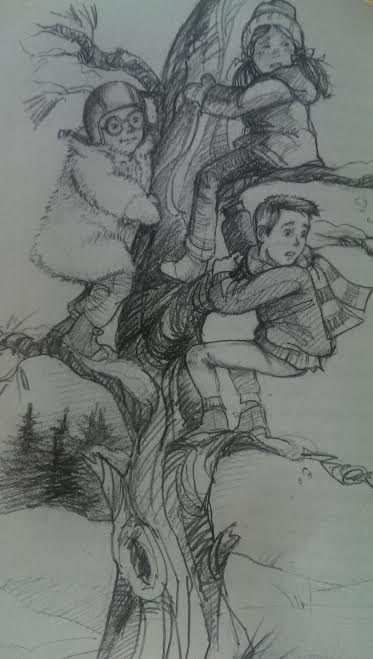
wanderingwerewolfpic1The monster hunt becomes more complicated when Bucky Bovine, a bully at their school, seems determined to stop them from going to Lost Woods to look for the monster. Does Bucky know something about the beast, or could he even be the monster himself?

As always, there are other explanations besides monsters and mysteries that require solving.  Fortunately, Huntley is an excellent detective as well as a Monster Hunter, and he puts the pieces together to explain not only the werewolf but other strange things that have been happening around town.

The book is part of the Monster Hunter series and is currently available online through Internet Archive.
The Case of the Visiting Vampire

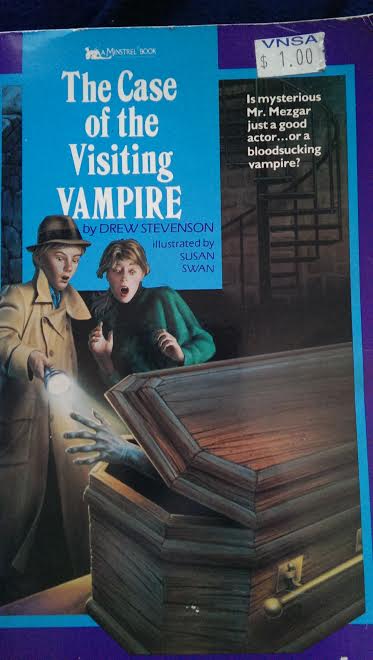
VisitingVampireThe Case of the Visiting Vampire by Drew Stevenson, 1988.

This is the second book in the series about J. Huntley English, Monster Hunter, an extremely intelligent boy who also believes in real-life monsters and is determined to become a monster hunter so that he can find some. Along with his best friend, Raymond (who narrates the books), and Verna, a bossy girl who goes to school with Raymond, he investigates possible monsters around their small Pennsylvania town. The stories are humorous mysteries, and in a kind of Scooby-Doo fashion, there are other explanations besides monsters for the mysterious things that happen.

In this story, the Big Lake Theater in Barkley, PA, is putting on a play called The Count of Castle Dracula, and a visiting actor from Romania working at a local college is playing the part of the vampire. When Verna gets a part in the play, she becomes convinced that the actor, Bela Mezgar, is a real vampire. He behaves strangely and is never seen out during the daytime. Then, Verna overhears him talking on the phone to someone about his coffin and saying that “one heart must die so the other may live.” She tells Raymond and Huntley what she heard, and the monster hunter eagerly begins his investigation. However, a mysterious stranger also seems to be showing an unusual interest in the actor.

This book was written before the end of the Cold War, when Romania was still a communist country. Although things have changed since then, I don’t think that modern kids would have too much trouble understanding the situation. It’s a fun mystery for elementary school kids.

The book is currently available online through Internet Archive.

The Case of the Horrible Swamp Monster

horribleswampmonsterThe Case of the Horrible Swamp Monster by Drew Stevenson, 1984.

This is the first book in the Monster Hunter series.

Raymond Almond knows that his class project isn’t going to go well when he finds out that bossy Verna Wilkes is in his group. Verna convinces the group that their project should be a movie because her father recently gave her a movie camera. What makes it bad is that she insists that it should be a monster movie and that Raymond should play the part of the monster.

Raymond is embarrassed about having to stumble around the spooky Lost Swamp in the ridiculous monster costume, but he puts aside his embarrassment when what looks like a real swamp monster appears in the background of the footage.  Even bossy Verna is scared at the idea of a monster living in the swamp where they were filming.

Fortunately, Raymond’s best friend is J. Huntley English, an intelligent boy and amateur cryptozoologist (or Monster Hunter, as he likes to put it). When Raymond and Verna tell Huntley what they’ve seen, he’s quick to join in the investigation, eager to discover proof of a real monster.

horribleswampmonsterpicThe course of their investigation takes a strange turn when friendly Mr. Walton, who works as a janitor at the same bank where Huntley and Verna’s mothers work, is arrested for stealing money. The kids refuse to believe that he’s guilty and soon learn that there is a connection between the thefts and the mysterious monster and possibly the strange fisherman who has also been lurking around the swamp.

The book is available online through Internet Archive.

Jumble Joan

jumblejoanJumble Joan by Rose Impey, 1989.

A boy and his friend, Mick, take his little sister upstairs to explore their grandmother’s attic one evening.  The boys are hoping to scare the girl by telling her all sorts of creepy stories about the stuff they find in the attic, but if they’re scaring anyone, it might just be themselves.

A rocking horse becomes one of the dreaded “Ten O’Clock Horses” that might drag a child off into the night if she isn’t in bed on time.  An old stuffed parrot in a cage becomes “The Deadly Vampire Bat”, waiting to suck their blood.  But, the most sinister creature of all might be “Jumble Joan”, who hides by pretending to be a pile of old clothes, ready to steal away any little girls who might want to play dress up in their grandmother’s attic!

Although the brother narrates the story, the pictures show that his little sister knows exactly what the boys are trying to do, and she does things to turn the situation around.

This is one of the books in the Creepies Series.  Kids under the age of seven might find stories in this series a little scary because they focus on how stories about monsters can build in the imagination, even if you know that you made them up yourself.  Still, all of the books have good endings, and this one is pretty funny.

This book is available to borrow and read for free online through Internet Archive.

The Flat Man

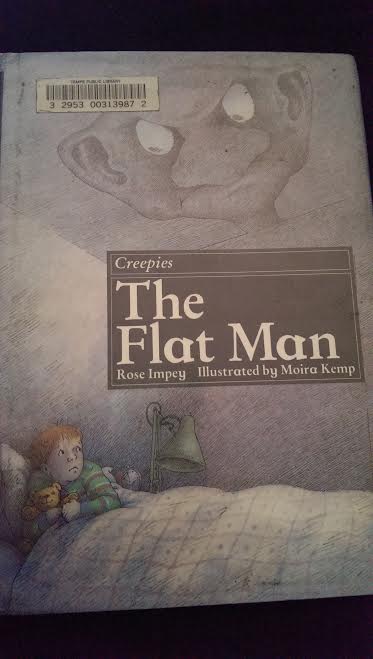
flatmanThe Flat Man by Rose Impey, 1988.

Before Slender Man, there was . . . The Flat Man!  And he wasn’t quite as scary. As far as I know, there is no connection between the two fictional characters other than a similarity in name.  Still, the Creepies Series, while picture books, should probably only be given to children no younger than seven who like scary stories.  They might provoke nightmares in very young children and sensitive children.  I liked these stories as a kid for their imagination, but individual tastes may vary.

Like all the books in the Creepies series, The Flat Man features a child who enjoys being a little scared and makes up his own imaginary monster to battle with at bedtime.  The entire time, the boy knows that the monster is imaginary and prides himself on knowing just how to deal with him.

While lying in bed one night, the boy imagines the scary creature called the Flat Man for the fun of it.  He amuses himself with imagining that every sound he hears is the Flat Man, a paper-thin creature that can sneak in anywhere, squeeze himself through any crack. But, the Flat Man has weaknesses: he’s afraid of light and open spaces. The boy acts out his duel with the imaginary Flat Man, enjoying his triumph . . . right up until his father comes in to find out what’s going on.

This book is available to borrow and read for free online through Internet Archive.

My Reaction

Even though his imaginary creature is frightening, the boy enjoys it, comes up with his own solution for defeating it, and acts out a triumphant battle with it. Those who don’t mind a bit of spookiness will appreciate the boy’s imagination and may giggle at how he gets a bit carried away with his fantasy.