Father’s Arcane Daughter

Father’s Arcane Daughter by E.L. Konigsburg, 1976.

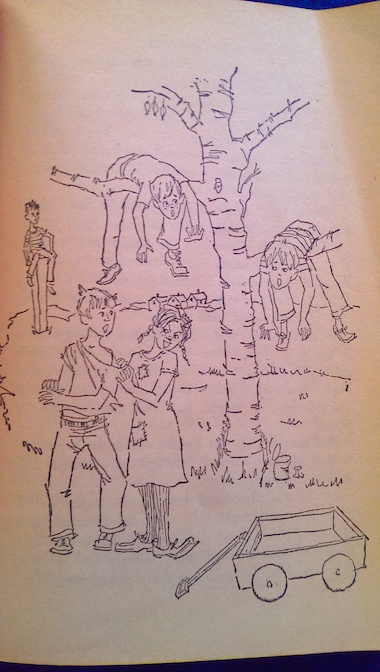
Winston Carmichael lives a very sheltered life during the 1950s. His family is wealthy. They live in Pittsburgh, and he attends a good school, but much of his free time is also taken up trying to entertain his sister, Hilary, called Heidi. He particularly has to look after Heidi every week on Thursday, while his mother leaves to get her hair done. Heidi has some developmental disabilities and is hard of hearing, so Winston’s overprotective family is especially overprotective of her. Because of that and because of her frustrations with her own limitations, Heidi is spoiled and frequently acts out when she doesn’t get her way, making her a pain for Winston to help care for. Even servants have often quit over Heidi’s behavior. However, Heidi’s disabilities are only part of the reason why the children’s parents are overprotective. The other reason is the mysterious disappearance of Caroline, Winston and Heidi’s much-older half sister, from their father’s first marriage. Winston is aware that Caroline was kidnapped years before he was born and is now presumed dead, a traumatic incident in their family. Then, one day, a woman claiming to be Caroline comes to the house to see their father.

The story is actually told in the form of flashbacks as Winston recounts it to a woman, who is at first unnamed. Winston explains how he knew about Caroline’s disappearance and how he wanted to know more about this mysterious woman claiming to be Caroline, partly in the hopes of reducing the shadow that Caroline’s disappearance has cast on all of their lives. The children’s father tells them the story of how Caroline was kidnapped 17 years earlier on her way home from the exclusive college that she was attending in Philadelphia. The kidnappers demanded a large ransom in cash, and it took longer than they thought for Mr. Carmichael to assemble that amount of cash because rich people don’t have all of their money in cash and getting large amounts of cash attracts attention from the authorities. Then, the ransom drop went badly and turned into a shootout between the police and the kidnappers at the house where the kidnappers were hiding. At some point, the house caught fire (no one is quite sure what started the fire), and everyone inside the house was killed. At the time, they assumed that Caroline was one of the people who was killed in the fire, but Mr. Carmichael was never sure because the kidnappers had said something earlier about moving Caroline. He always hoped that maybe Caroline wasn’t in the house and somehow survived, but having heard nothing from her for years, it has seemed likely that she died. After Caroline’s presumed death, her despondent mother died of alcohol-related causes. Mr. Carmichael remarried, and he and his new wife had Winston and Heidi. Still, Mr. Carmichael always hoped that maybe Caroline was alive and he would find her one day.

Caroline’s sudden reappearance, although happy for her father, is strange, and Mrs. Carmichael is suspicious that this woman’s real purpose is to claim the inheritance that Caroline was supposed to inherit from her mother’s family. The deadline for claiming the inheritance is approaching, so the woman claiming to be Caroline could be an imposter who is just after the money. Winston studies his mother’s scrapbook, containing all the known details of Caroline’s life, and he comes to understand his father and his family a little better. Caroline becomes more of a real person in his mind, not just a shadowy figure from the past, but he’s still not sure if the woman claiming to be Caroline is the real Caroline.

“Caroline’s” story is that she was rescued from her kidnapping situation by one of the kidnappers, who apparently had a change of heart, but that she had a kind of identity crisis and a sudden realization that she didn’t know who she wanted to be or what she really wanted out of life. She changed her name to Martha Sedgewick, using information given to her about a dead woman by the kidnapper who released her, and went to Ethiopia. There, she taught English for a time and then worked as a nurse. She says that she found it a very liberating experience. Winston, who feels trapped in his stifling, sheltered life understands that feeling. Caroline said that she fell in love for a time but never married the man she loved because there was a war and he died.

Caroline says that when she finally returned to the United States, she found a job as a nurse at the nursing home where her Grandmother Adkins was living. Caroline says that, at first, she wanted to see her grandmother again and get her opinion about whether or not to reveal herself to the rest of the family. However, Grandmother Adkins was senile when she finally saw her, and Caroline merely acted at her caregiver. Mrs. Carmichael thinks this is suspicious and continually quizzes “Caroline” about old acquaintances, trying to catch her slipping up and revealing herself as an imposter. Surprisingly, “Caroline” never seems to slip, and Winston finds himself becoming fond of her. Caroline has had a wide experience of life and is very well read, and she is a very interesting person to talk to. Winston blossoms intellectually under her influence.

I particularly liked the part where Winston realizes that many of his relatives have given him books to read as presents that they have never read themselves. They like to give him books that have a reputation for being “good” books, and it seems like the proper thing to do and something that will enhance their own reputations, but they never actually read the books themselves and can’t talk about them. Caroline hasn’t read all the books that have been deemed “good”, the kind that people read in order to become educated or have a reputation for being educated. However, Winston can tell by talking to Caroline that she has done a great deal of general reading just because she has a curiosity and a desire to know things. She has become a much more knowledgeable person than the people who collect all the “right” sort of books just to have them and never even open them. Many people in the Carmichael family are largely about appearance, but Caroline has substance.

However, Caroline’s presence in the house makes things uncomfortable for the family, not only because of their doubts about her true identity, but because she challenges the life the family is living and the habits they take for granted. Even though some of those habits have been making life uncomfortable for them, the changes that Caroline subtly begins to make also make them uncomfortable by bringing them out of their shells and forcing them to confront things that they have been trying not to confront. For example, Heidi is never scolded for bad habits like snatching things from others’ plates at dinner because she is young and has disabilities. Caroline doesn’t make those allowances, freely telling the family that she doesn’t like it.

Eventually, Caroline’s father is satisfied that she is his daughter and grants her the Adkins’ inheritance, although at his wife’s insistence, there is a proviso that the fortune will revert to the Carmichaels if any evidence surfaces in the future that Caroline isn’t the real Caroline. Caroline accepts those terms, but a battle of of personalities and wills still continues between her and Mrs. Carmichael over the children. Caroline insists that Winston be allowed more freedom, pointing out that Mrs. Carmichael has been using him as an unpaid babysitter while she goes to get her hair done every week. Caroline recognizes that Winston is young and needs to have some freedom and fun, and Mrs. Carmichael is pained that Caroline has caught on to the fact that her hair appointments are also a convenient excuse to get some freedom for herself.

At Christmas, Winston feels sorry for Heidi, watching other people at the family’s Christmas party, but not being able to understand what is being said around her, and knowing that she can’t understand them. On impulse, he gives her the book of poetry that he had intended to give Caroline. To his surprise, she really likes it. He knows that she can read, but he never thought of her as having the mental capacity to understand anything really complex because of her babyish behavior and fits when she doesn’t get her way on something. However, Heidi really does understand the poems and is able to read them to Caroline and tell her what they mean. At first, Winston refuses to believe it, jealous of the attention and coddling that Heidi has always received and not wanting to share Caroline and the intellectual discussions they have with Heidi.

Heidi continues to listen to their discussions and follow them as best she can. Gradually, in their company, Winston notices that her behavior begins to normalize and more of her true intelligence shows, although she reverts to her old habits around their mother. Hilary/Heidi has always been underestimated by her family because of her disabilities as well as being overprotected. Under Caroline’s influence, she learns that she is capable of more than anyone, including herself, believed possible.

Unfortunately, Mrs. Carmichael still distrusts Caroline, and in her determination to protect Heidi from her influence, will not allow her to spend time with her anymore. Caroline tells Winston that she is tired of all the Carmichaels’ pretenses, the way they try to ignore the real issues with Heidi, and she gives him an envelope, which she says will provide Winston with all the evidence he needs to decide whether she’s the real Caroline or not. Winston has to decide which is more important to him, learning whether the Caroline he knows (or thinks he does) is a pretense or accepting the realities of his family’s problems and the help Caroline can offer in learning to deal with them.

There is also a movie version of the book called Caroline? I saw the movie before I read the book, but I’ll explain the difference between the two below because it involves some spoilers.

The book is available to borrow and read for free online through Internet Archive.

Themes, Spoilers, and My Opinions

The everyone in the story, even the children, speak in a very educated and deep-thinking way, which I found interesting. At first, I thought that the children, especially Winston, should speak a little more colloquially, but then, I decided that it’s really right for him to speak in a more erudite way because of the school he attends and because much of the story emphasizes that he has been very sheltered and largely cut off from forming the sort of childhood friendships that children his age have, so he would probably use much less slang than most kids his age.

During the story, Winston is in the habit of thinking of Heidi by insulting terms, like “troglodyte”, because she is strange and awkward and her weird habits and temperamental fits cause problems for him, like preventing him from bringing friends to the house. At a couple of points, he thinks of her as a “golliwog”, which is an insulting racial term, based on a style of old dolls that look like black-faced minstrels, and later, even Heidi describes herself that way. (The term was actually coined in an old children’s book, where one of these dolls comes to life with some other toys. The doll character was actually a nice character, but since the dolls are considered ugly, its meaning has become an insult.) Winston doesn’t mean that in the racial sense here. He’s trying to convey that Heidi has an awkward, abnormal appearance.

As Winston opens up to Caroline, he finally admits to her that he knows that Heidi is “damaged”, not “special.” In other words, he understands that Heidi has disabilities and that she has been deliberately spoiled by their mother who wants to protect her from having to deal with them. Their mother herself has trouble facing the realities of Heidi’s disabilities and is actually ashamed of her daughter for not being normal, so she tries to ignore them, covering them up with cuteness, pretty dresses, presents, and indulgence. Heidi’s babyish behavior early in the story is not because her mind is infantile, but because of the coddling and overprotection she has received and poor socialization, and also because her family is afraid to face the difficulties that lie ahead for her because of her condition and underrates her capacity to do what other children can do and learn what they learn. It’s true that Heidi has some physical disabilities from birth, and she needs a hearing aid to help her hear (she reads lips up until the point that Caroline insists on her getting a hearing aid) and braces to help correct the way she walks, but her mind is excellent. Through Caroline’s attempts to help her, Heidi herself comes to realize how limited her life has been and the potential she has to expand it if she gets the help she really needs to learn how, and she eventually stands up to insist on what she wants for herself, asking her brother to kidnap her and take her to Caroline to get the help she needs and wants. Caroline acknowledges to Heidi, without being ashamed of her or trying to hide the truth, that she is not “normal” and never will be completely normal, but tells her that if she’s willing to work at it, she can realize her true potential in life, and ultimately, that’s what Heidi wants.

The movie followed the themes of the book very well, showing the effect that Caroline has on the lives of the Carmichaels, helping Hilary/Heidi to realize her true potential, helping her parents to realize what she is capable of and what she needs to make the best use of her real talents, and helping Winston to find his own sense of independence. There are some differences. In the movie, for example, Caroline wasn’t kidnapped. Supposedly, she was killed in a plane crash, although her body was never positively identified, and there was some doubt in her family about whether or not she got on the plane. In the movie, Caroline gives a similar story about feeling the need to go out and find herself, but I think she says that she became a nurse in India, not Ethiopia. (It’s been a while since I’ve seen the movie.)

One thing I am grateful for is that both the book and the movie do give a definite answer to the question of whether “Caroline” is the real Caroline or not. I’m often frustrated with movies and stories that leave loose ends like that, like Disney’s Candleshoe, where they never completely establish whether Casey/Margaret is really Margaret.

When Hilary/Heidi decides that she wants the help of Caroline and a friend of hers, who is a doctor, she asks Winston not to open the envelope. Winston keeps it sealed for years, but Hilary (who long since dropped her childhood nickname) is the women he’s talking to when he’s telling the story from his perspective, and at the end, they decide to open the envelope together and find out the truth.

Do you want to know the truth about Caroline?

The Real Spoilers

So, is Caroline actually Caroline, the same Caroline who was kidnapped and evidently killed years before? No, actually she’s not. She really is Martha Sedgewick, the identity that she supposedly took when she said that she was going off to find herself in Ethiopia. However, she is not posing as Caroline for the sake of the inheritance; she’s doing it for the sake of the family and the children. Grandmother Adkins put her up to it.

Martha really was a nurse in the nursing home where Grandmother Adkins lived before her death. She had lived in Ethiopia with her parents, who had died, and so had the man she loved, as she had said before. She had returned to the United States, alone, lonely, and depressed, before getting a job at the nursing home. Grandmother Adkins noticed her striking resemblance to Caroline, and in her confused stated of mind, sometimes thought that she was Caroline. She talked to Martha about the family all the time, which is how she knew all the right details for playing the part of Caroline. Grandmother Adkins knew that if Caroline never returned to claim her inheritance from her mother, that money would pass to Mr. Carmichael, and by extension to his new wife, whom Grandmother Adkins detested. Toward the end of her life, Grandmother Adkins urges Martha to go claim the Adkins inheritance as Caroline – revealing that, in spite of her supposed senility, she has been deliberately coaching Martha to be Caroline for that purpose. Martha decides to go through with the pretense, not because it was Grandmother Adkins’ dying wish or because she really wanted the money, but because she saw Mr. Carmichael at the funeral and was touched by how sad and lonely he looked. Martha didn’t have a family, so she decided to give Mr. Carmichael his daughter back.

In the end, she actually developed romantic feelings for Mr. Carmichael, but she could never admit to them because of their established relationship as father and daughter. Mr. Carmichael might have felt the same way, but he also couldn’t admit to those feelings without destroying the pretense that Martha was his daughter and admitting that Caroline was really dead. Martha came to love the children, and since she realized that they would never be her stepchildren, she did her best to be their big sister.

Miss Trollope, Caroline’s old headmistress, figures out the truth, and “Caroline” openly discusses the situation with her, including her desire to return to college and learn to educate children with disabilities, like Hilary. The real Caroline’s grades were never good enough to attend a university, but Miss Trollope approves of what “Caroline” wants to do and the good she is doing for the Carmichael children, so she does nothing to reveal the pretense or hinder Caroline’s education. However, Miss Trollope later admitted the truth to Hilary when she pressed her for answers.

The reason why Hilary and Winston are discussing this situation and telling the story in the book is that “Caroline” has just died. Hilary is now a business executive, and Winston is a writer. Hilary is a decisive person as well as intelligent, and she decides to put the papers proving Martha/Caroline’s true identity in her coffin, under her head, to be buried with her. Winston says that Hilary is mysterious and arcane, providing the title of the book. Caroline’s life was hidden and arcane, but Hilary’s true depths are also hidden and arcane because of the person she is.

The Secret of Terror Castle

The Three Investigators

TITerrorCastle#1 The Secret of Terror Castle by Robert Arthur, 1964, 1992.

In the first book in the series, Jupiter, Pete, and Bob form the Three Investigators, an organization dedicated to solving all kinds of mysteries.  It was particularly Jupiter’s idea. They have been friends for a long time, and they used to have a club dedicated to solving puzzles. Now, they’ve decided that they want to solve more complicated problems and mysteries. Jupiter has won the use of a Rolls Royce and chauffeur for a month by entering a contest at an auto rental agency, so he thinks that it would be a good time to get started because they will have transportation to anywhere in the city.

Jupiter also has an idea for their first case, something that will help them get publicity for their new investigative organization. There is a rumor that a director, Reginald Clarke, is looking for a genuine haunted house to be the setting of his next movie. Jupiter manages, through some clever trickery, to get an interview with Reginald Clarke and persuades him to introduce this account of their first case if he and the other investigators can find a genuine haunted house right in town. Clarke takes them up on it, not because he thinks they will succeed, but because he sees it as the only way to get Jupiter to stop doing an unflattering impersonation of him.

Jupiter, however, is confident that they will be successful because he already knows the perfect place to investigate. Terror Castle is a large mansion that was built years ago by an old actor who was in silent films. All of his movies were scary ones, and since his death under mysterious circumstances, no one has succeeded in staying in the castle very long. Strange apparitions have been seen there, and anyone who tries to spend the night there is overcome by inexplicable terror. As far as Jupiter is concerned, all they have to do is prove that the castle is really haunted, and that means that the Three Investigators must visit it themselves.

In the original books, the director that Jupiter tries to find a real haunted location for was Alfred Hitchcock.  Alfred Hitchcock introduced the early books in the series and played minor roles in some of them, and The Three Investigators capitalized on his reputation.  When the series was re-released, however, Alfred Hitchcock was replaced by a fictional director, and his role in later books was taken by a fictional mystery author named Hector Sebastian.  In the re-released version of the first book, Reginald Clarke refers the boys to Hector Sebastian at the end of the story so they can help a friend of his to find his missing parrot, which leads directly into the subject of the next book.

The haunting in this story (as with others in the series) has a reasonable explanation, not a supernatural one.  In fact, one of the things that I always found memorable about this book was the explanation of how the inexplicable feelings of terror people experienced were created using sound waves which could be felt but which were beyond the normal range of human hearing.  I’m not sure whether the book was completely correct about the science behind this technique, but I have heard about sounds being used to create odd or even harmful effects on human beings in real life.  As for the reasons behind the haunting, they concern the original owner of the castle and the life he lived.

This is one of the books in the series which was made into a movie, The Three Investigators and the Secret of Terror Castle, but the movie was very different from the original book.  In the movie, the owner of the castle was an inventor, not an actor.  Part of the plot also concerned Jupiter’s deceased parents and a mystery that they had been investigating.  Jupiter’s parents were not part of the original book at all.  A villain who appears in some of the other books in the series also makes an appearance in the movie, although he had nothing to do with this particular story in the original series.  Overall, I don’t recommend the movie for fans of the original series.  The changes don’t seem to be for the better, and I think people who remember how the original story was and liked it would be disappointed in the movie.

There are multiple copies of this book available to borrow for free online through Internet Archive, both the original version with Alfred Hitchcock and the updated one.

Pippi Longstocking

PippiLongstocking

Pippi Longstocking by Astrid Lindgren, 1950.

Pippi Longstocking is an iconic figure in children’s literature, a little red-haired girl with amazing strength (she can lift a horse all by herself) and a quick wit, who can “always come out on top” in any situation and is frequently doing exciting and hilarious things without adult supervision. The books in her series were originally from Sweden, with the first one written in 1945, but I’m reading a later English translation.

In the first book, she comes to live by herself in a house, which she calls Villa Villekulla, in a small town in Sweden when her father, a ship’s captain, is washed overboard at sea.  Although others fear that he is dead, Pippi thinks it more likely that he was washed up on an island of cannibals, where he will soon be making himself their king.  (Of course, Pippi turns out to be right, but that’s getting ahead of the story.) Her mother died when she was a baby, so Pippi now lives all by herself, except for her pet monkey and horse. She pays for the things she needs with money from the suitcase of gold coins that her father left for her and spends her time doing just as she pleases.

Tommy and Annika, the children who live next door to Ville Villekulla, are perfectly ordinary, basically obedient children, who live normal lives with their parents. When Pippi moves in next door, their lives get a lot more exciting. The first time they meet her, she’s walking backward down the street. When they ask her why she’s doing that, she says that everyone walks that way in Egypt. Tommy and Annika quickly realize that she’s making that up, and Pippi admits it, but she’s such an interesting person that they accept her invitation to join her for breakfast. They’re amazed when they find out that Pippi has no parents, only a monkey and a horse living with her, and are entertained by the tall tales that she tells.

When they go back to see her the next day, Pippi tells them that she’s a “thing-finder” and invites them to come and look for things with her. Basically, Pippi is a kind of scavenger, looking for valuable things, things that might be useful, or (which is more likely) just any old random junk that she might happen across. Pippi does find some random junk, although she makes sure that Tommy and Annika find better things (probably by hiding them herself).

Then, the children see a group of bullies beating up another boy and decide to intervene. The meanest of the bullies, Bengt, starts picking on Pippi, but picking on a girl with super strength isn’t the wisest move. She picks him up easily and drapes him over a tree branch. Then, she takes care of his friends, too.

Word quickly spreads through town about this strange girl. Some of the adults become concerned that such a young girl seems to be living on her own. A couple of policemen come to the Ville Villekulla one day to take Pippi to a children’s home, but she saucily tells them that she already has a children’s home because she’s a child and she’s at home. Then, she tricks them into playing a bizarre game of tag that ends with them being stuck on the roof of the house. The policemen decide that perhaps Pippi can take care of herself after all and give up.

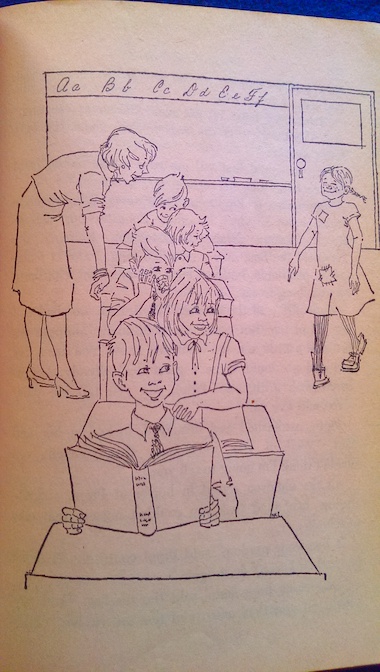
Tommy and Annika try to persuade Pippi to come to school with them, but that doesn’t work out, either. Pippi, completely unfamiliar with the routine of school, thinks that the teacher is weirdly obsessed with numbers because she keeps demanding that her students give her the answers to math problems that Pippi thinks she should be able to solve on her own. The teacher concludes that school may not be for Pippi, at least not at this point in her life.

Tommy and Annika delight in the wild things that Pippi does, like facing off with a bull while they’re on a picnic, accepting a challenge to fight a strongman at the circus, and throwing a party with a couple of burglars.  When they invite Pippi to their mother’s coffee party, and their mother’s friends begin talking about their servants and how hard it is to find good help, Pippi (having already devastated the buffet of desserts and made a mess in general) jumps in with a series of tall tales about a servant that her grandparents had, interrupting everyone else.  Tommy and Annika’s mother finally decides that she’s had enough and sends Pippi away.  Pippi does leave, but still continuing the story about the servant on the way out, yelling out the punchline from down the street.

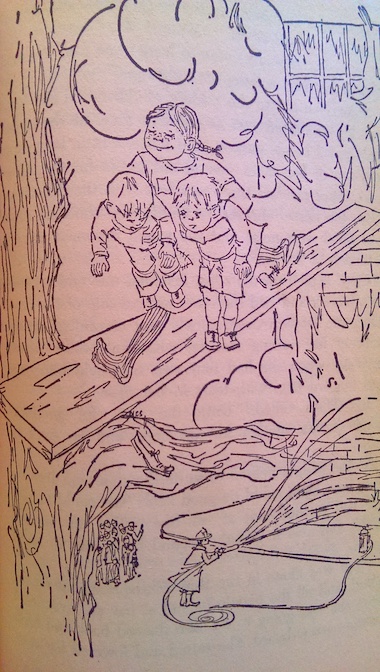
However, Pippi becomes a local hero when she saves some children from a fire after the fireman decide that they can’t reach them themselves.

The book is available to borrow and read for free online through Internet Archive.

My Reaction

I have to admit that, as a character, Pippi sometimes annoys me with her obvious lies and some of the stuff she does. She openly admits that she lies after telling some of her tall tales, but it’s the parts where she admonishes her listeners not to be so gullible that get to me. You can tell that her listeners aren’t really fooled at all; they’re just trying to be polite by not calling her a liar directly, and then she insults them for it. Maybe it’s Pippi who’s really the gullible one, thinking that she’s fooling people when she isn’t really. 

Admittedly, Pippi’s wild stories are sometimes amusing.  I liked the one where she claimed that the reason why other people don’t believe in ghosts is that all of the ghosts in the world live in her attic and play nine-pins with their heads.  When Tommy and Annika go up there to see them, there aren’t any, of course, and Pippi says that they must be away at a conference for ghosts and goblins.

I just don’t like it that Pippi seems to be deliberately trying to make people look dumb when she’s the one saying all the stupid stuff and it’s really obvious that people know it. I also don’t like the part where she makes such a mess at the coffee party because she seems to be trying to be a messy pain on purpose.  She insists that it’s just because she doesn’t know how to behave, but I get the sense that it’s just an excuse and that Pippi just likes to pretend to be more ignorant than she is, pushing limits just because she likes to and because she usually gets away with it.  I didn’t think it was very funny.  But, Tommy and Annika seem to just appreciate Pippi’s imagination, enjoying Pippi’s antics, which bring excitement and chaos to a world controlled by sensible adults, which can be boring to kids, and accepting Pippi’s stories for the tall tales they are, playing along with her.

Pippi herself is really a tall tale, with her super strength, her father the cannibal king, and her ability to turn pretty much any situation her to advantage.  Part of her ability to “come out on top” is due to her super strength and part of it is that Pippi approaches situations from the attitude that she’s already won and isn’t answerable to anyone but herself.  This approach doesn’t always work in real life (I can’t recommend trying it on any of your teachers, or worse still, your boss – not everyone is easily impressed, especially the people who pay your salary), and nobody in real life has Pippi’s super strength to back it up. The adults in the story frequently let Pippi win because they decide that fighting with her just isn’t worth it. (Admittedly, that does happen in real life, too. I’ve seen teachers and other people give in to people who are just too much of a pain to argue with because they’re too impatient or find the argument too exhausting.)  Kids delight in Pippi’s ability to get the better of the adults, who usually have all the control, and in Pippi’s freedom to do what she wants in all situations.

One thing that might surprise American children reading this story is that the children in the story drink coffee. Tommy and Annika say that they are usually only allowed to drink it at parties, although Pippi has it more often. It isn’t very common for American children to drink coffee in general because it’s usually considered more of an adult’s drink and because of concerns about the effects of too much caffeine on young children. Children in Scandinavia tend to drink coffee at a younger age than kids in the United States.

Bed-Knob and Broomstick

BedKnobBroomstickBed-Knob and Broomstick by Mary Norton, 1943, 1947.
This book is actually two books in one.  The title Bed-Knob and Broomstick is the one used for editions that include both the first book, The Magic Bed-Knob, and the sequel, Bonfires and Broomsticks.  Together, these two books were the basis for the Disney movie Bedknobs and Broomsticks, although the plot of the movie is considerably different from the two books. Because the movie is based on both of the books at once and because I read the combined edition, I’ll explain the plots of both of the books in one post.

There are two major differences between the movie and books that change many other things about the plot. The first one is that there is no mention of World War II in the books, even though the books were written during that time.  Miss Price was not studying magic to help the war effort, and the children were only in the countryside for vacation, not because they were evacuated there. Also, in the books, Emelius Jones (Emelius Brown in the movie) was a man they met when they traveled through time, not a man living in London during their own time.  He was not involved in Miss Price learning magic, although the two of them do end up together in the end.

The Magic Bed-Knob

At the beginning of the first book, the three Wilson children – Carey (who is described as being “about your age”), Charles (“a little younger”), and Paul (six years old) – are spending the summer with their Aunt Beatrice in Bedfordshire. There is never any mention of the children’s father in the books. Probably, their father is dead, although he might have left the family and went to live elsewhere or may be fighting overseas, although there is no mention of that in the book, making me think that it is probably not the case. The children apparently live with only their mother in London, and because she works, she always needs to find somewhere for them to stay during the summer, when they’re out of school. (This is a major plot point in both of the books.  In the Disney movie, the three children are orphans who have no memory of their birth parents, and their guardian was killed in a bombing shortly before they were evacuated to the countryside.  You only get their full backstory if you see the anniversary edition of the movie that includes the deleted scenes.)  While the children stay with Aunt Beatrice, they enjoy playing in the countryside, and one day, they happen to meet Miss Price, who they find with an injured ankle.

Miss Price is a respectable spinster from the village who gives piano lessons and is often seen riding around on her bicycle.  When they find her hurt, Carey says that they should get a doctor for her, but Miss Price insists that she doesn’t want one. Instead, she just asks the children to help her get home. As she starts to lean on Carey and Charles, Paul picks up a broom nearby. The older children thought it was just an old garden broom, but Paul calmly says that it belongs to Miss Price because it’s what she rides around on. The others are shocked, but Paul simply says that that he’s seen her improve in her flying, so Miss Price knows that he’s seen her riding her broom more than once. Miss Price is worried that everyone in the village will know now that she’s a witch, but Paul hadn’t even told his brother and sister what he’d seen.

The children help Miss Price get home, and they allow their aunt to think that Miss Price simply fell off of her bicycle. When the children are able to speak to Miss Price privately, they ask her directly if she’s a witch, and she admits that she’s studying to be one. She says that she’s had some talent for magic since she was young, but she never really had the time to develop it. The children are convinced that, while Miss Price might be a witch, she’s not a wicked one, and she says that’s true, that she started too late in life to be that way and that wickedness doesn’t come naturally to her. However, she’s still worried that the children might tell people about her magic.

Carey is the one who suggests that Miss Price give them a magical object as part of their pledge of secrecy (unlike in the movie, where it was Charlie’s idea), with the idea that, if they ever told anyone that she’s a witch, the magic would stop. Charles suggests that Miss Price could give them a magic ring that would summon a slave to do their bidding, but she says that she couldn’t manage that and that she has a better idea. Miss Price asks the children if they have anything on them they can twist, like a ring or a bracelet. The only thing they have is a bed-knob that Paul twisted off the end of his bed (basically, because he discovered that he could).

Miss Price says that the bed-knob will do nicely, and she casts a spell on it that will allow the children to travel to the destination of their choice when they put it back on the bed and give it a twist. If they turn it in one direction, they can travel in the present time, but turning it the other way can send them to the past. Also, because Paul was the one who had the bed-knob, he’s the only one who can make it work. Miss Price isn’t troubled by Paul’s young age because she thinks that it’s best to learn magic young, although she warns the children to be careful.

Because it’s Paul’s bed-knob, Carey and Charles give him first choice of where to go, but they think the places he wants to go sound mundane. He wants to either see a museum exhibit that the others saw without him once or to go home and see their mother in London. Carey and Charles try to persuade him to go someplace more exciting, but Paul insists that he wants to go home.

The bed whisks the children home to London, but when they get there, their mother isn’t home. Apparently, their mother has gone away for the weekend herself, and the children find themselves alone on their bed, in front of their house, on a foggy night. A policeman bumps into them, and when he demands to know who they are and where the bed came from, he doesn’t think it’s funny when they say, “Bedfordshire.” He takes them to the police station to spend the rest of the night. Fortunately, they find a way to get back to the bed and use the spell to return to their aunt’s house before they’re missed in the morning. It’s not quite the adventure that the children had been hoping for when they started out, but it’s just the beginning of their amazing summer!

However, magic turns out to be more dangerous than they thought. Their next adventure takes them to an island with cannibals (yeah, one of those scenes, sigh – I think that the island of talking animals in the movie was more fun), and they narrowly escape after Miss Price has a duel of magic with a witch doctor. Their magical adventures create problems that the children can’t explain to their aunt without giving away Miss Price’s secret. Eventually, their messes and wild stories cause their aunt to send them home to their mother. Miss Price considers that magic might cause more problems than it solves and tells the children that she’s thinking of giving it up for awhile. However, Paul keeps the bed-knob in the hopes that their adventures aren’t done yet.

BedKnobBroomstickChildren

Bonfires and Broomsticks

In Bonfires and Broomsticks, two years have passed since the children’s first adventures, and Aunt Beatrice has died. Carey and Charles, worried that Paul would talk too much about their magical adventures, tried to convince Paul that it was all just a dream, although they weren’t very successful.

Then, the children see an advertisement in the newspaper that Miss Price is offering to board a couple of schoolchildren in her house for the summer for a fee. The children’s mother works, and she always has to find somewhere for the children to spend the summer, when they’re not in school. They still have the bed-knob, so they tell their mother that they want to visit Miss Price, hoping they can have more adventures with her. At first, their mother doesn’t understand why they would want to visit Miss Price so badly, but since she seems like a nice, respectable woman and an old friend of Aunt Beatrice’s, she agrees.

Miss Price is happy to have the children stay for the summer, but they are disappointed when they learn that she was really serious about giving up magic. The children discover that Miss Price bought the old bed that they had used for their previous adventures at the estate sale after their aunt’s death. She’s been sleeping on it in her own room. They want to try the bed-knob on the bed, but Miss Price takes it from them. She tries to make their summer vacation a normal vacation with normal activities, like picnics and croquet.

But, even Miss Price can’t resist the opportunity to try the bed-knob one last time. One morning, Carey and Charles discover that Paul and Miss Price have traveled somewhere on the bed without them. When the two of them confront Paul about it, he says that they only went to a nearby town, just to see if the spell on the knob still worked. Carey and Charles understand, but Carey thinks that if they got to use the bed once more, she and Charles should have one more turn. She especially wants to try going into the past, which was something they hadn’t had a chance to try last time. Miss Price is reluctant, but finally agrees after Carey pressures her about it.

The children travel to London of 1666 (ending up there accidentally, when they were aiming for the Elizabethan era), where a man named Emelius Jones has been living as a necromancer. When he was young, he studied magic under a mentor who, as he was dying, finally told him that everything he learned was fakery. It was all an act that he used to get money from gullible people, although it paid very well. The old man leaves Emelius his business, but Emelius is always nervous, worrying both because someone might discover that it’s all a fake and because others might believe that it’s real and that he should be hung as a witch. The only reason why he stays with it is because he has no other business to follow.

The children meet Emelius after ending up lost and stopping at his house for directions. The children can see how nervous and unhappy Emelius is, and they ask him about himself, discovering that his home town is actually close to where they’re staying with Miss Price. They reveal to him that they are from the future and invite him to come home with them for a visit.

Miss Price isn’t happy to see that they’ve brought someone back from the past with them, but she ends up liking Emelius. Before sending him home, they learn that Emelius’s aunt, who lived near to where Miss Price now lives, died the same day that Emelius left London in the past, which is coincidentally shortly before the great fire that destroyed a good part of the city. They know that Emelius’s London lodgings will likely be destroyed in the fire as well, but at least he can move into the house that he will inherit from his aunt.

However, after they send him back to his own time, the children and Miss Price learn that Emelius never made it to his aunt’s house because he was executed for practicing witchcraft. Unable to leave poor Emelius to such a terrible fate, they come up with a plan to rescue him.

The combined book edition is available online through Internet Archive.

My Reaction and Spoilers

Changing Emelius’s past also changes Miss Price’s future. Neither of them has ever married, and both of them have been lonely, and they come to the conclusion that the two of them were meant to be together. In deciding that they will live their lives together on Emelius’s aunt’s farm in the past, they put an end to the magical traveling bed. Only Paul can make the magic bed-knob work, and once he sends them into the past (not going with them), they can never return. But, Carey has one final vision of the two of them, being happy together, so she knows that they will be alright.

Overall, I preferred the Disney movie to the original books.  I think the war-based plot was better than the children’s random travels to cannibal-filled islands (I never liked those tropes in children’s stories anyway) and other places.  At one point in the books, Carey did speculate about the use of magic in war, but she rejected the idea because the notion of someone with the ability to conjure a dragon that could breathe mustard gas or who could turn whole armies into mice was just too horrible.  The spell that Miss Price used against the Nazis in the movie was part of their plan to rescue Emelius in the second book, but I think the movie’s ending was much more exciting.

Escape to Witch Mountain

EscapeWitchMountain

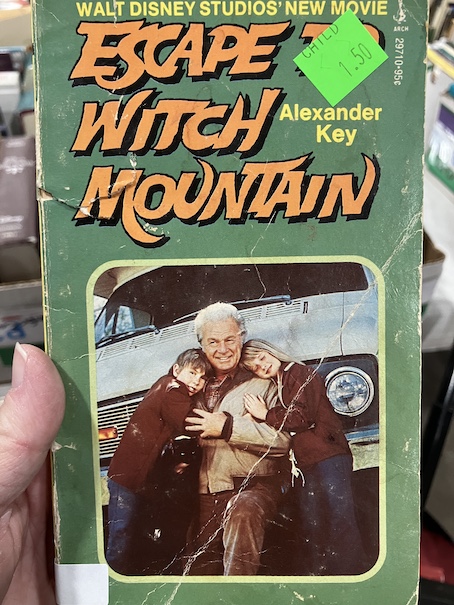
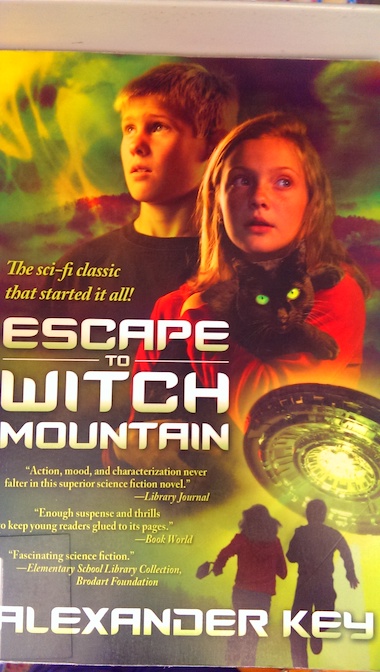
Escape to Witch Mountain by Alexander Key, 1968.

This is the book that the Disney movie of the same name was based on.  In fact, there have been three movie renditions of this book, although the 1975 Disney version is the one I know the best, and it’s the only film version to call the children by their original book names, Tia and Tony (other versions use the names Danny and Anna or Seth and Sara).  There are some major differences between the book and each of the the movies.  For one thing, most people in the book think that Tia is mute because she speaks at a frequency that ordinary humans can’t hear.  Only her brother, Tony, can hear what she’s saying.  She uses the little case with the double star emblem that she’s had ever since she can remember to carry paper and pencils so that she can write messages in order to make herself understood by other people.  In the 1975 movie, Tia can speak to Tony telepathically, but both children can speak aloud normally and be understood by everyone.

When the book begins, Tia and Tony know that they’ve always been different from other children.  They look different: they have olive skin, pale hair, and very dark blue eyes, which is a somewhat unusual combination. They can do things that others can’t: Tony can make things move with his mind, Tia can open locks without using a key or any other device, and only Tony can understand the strange way that Tia talks that others can’t even hear. They can’t remember any other home than the one they had with Granny Malone, the woman who adopted them, but now that she’s dead, they find themselves wondering who they really are and where they came from.  Tia has shadowy memories of a time before they came to Granny Malone, when they were on a boat and something bad happened to them, but she can’t quite remember what.

With no known relatives to go to, the children are taken to an orphanage, Hackett House, after Granny Malone’s death.  It’s a tough, inner-city environment, where no one has any patience with Tia and Tony’s strangeness.  However, when the children from the orphanage are sent to Heron Lake Camp in the mountains during the summer, a nun recognizes the double star symbol on Tia’s case as one that she had seen before on a letterhead, giving the children their first clue to finding their origins.

Then, a figure from one of Tia’s memories, Mr. Deranian, comes to the orphanage to claim them, saying that he’s their uncle. The children can tell that he’s no relative of theirs. They run away to see a kind priest, Father O’Day, an associate of the nun they met earlier. Father O’Day is the only one who believes the children when they talk about what they remember of their past and isn’t frightened by their strange mental powers. When the children show him a map that they found in a hidden compartment in Tia’s case, he offers to help them find the place marked on it and, hopefully, someone who knows who the children are and where they belong.

The book is currently available online through Internet Archive.  There is a sequel to this book which was also made into a movie, Return from Witch Mountain.

My Reaction and Spoilers

As the children and Father O’Day try to elude Deranian and the others who are chasing them, more of Tia’s memory returns. The children are from another planet. Years ago, their planet was destroyed when it crashed into one of their twin suns. Their people, who call themselves the Castaways, knowing that their planet would not be habitable for much longer, had already begun looking for a new home. Earth was the nearest habitable planet, so some scouts arrived early and began to create a home for them in the mountains of North America, which was the closest environment to their former home.

Unfortunately, when the rest of the children’s people came to Earth, the group that Tia and Tony were with crashed in Eastern Europe. The book was written during the Cold War, so the place where they crashed was controlled by Communists. When the Communists realized the powers these people possessed, they planned to make use of them themselves. One of Tia and Tony’s people escaped with the children and managed to get them aboard a ship heading for America. Before he died of a gunshot wound, he placed some money and a map in Tia’s case so that the children would know where to find the rest of their people. However, the children were traumatized by the experience, and Tia blocked the memory out of her mind. The ship’s captain, upon reaching the United States, gave the children to Deranian, a friend of his. Deranian, not knowing who the children were or what powers they possessed, gave them to Granny Malone to raise. Later, he found out about the children’s abilities from his contacts in Eastern Europe and tried to get the children back.

In the end, Father O’Day manages to reunite the children with the rest of their people, who take them to the community they have built on Witch Mountain, a place where locals are too superstitious to go, named for the odd things they’d seen there when the Castaways first arrived. Father O’Day plans to go there and join the community along with the children someday.

In spite of the Communists being enemies during the Cold War, Tia and Tony say that one of the reasons why their people had trouble establishing themselves in America at first was that they were unaccustomed to the idea of having to buy land to live on.  On their world, no one owned land; land was just there for people to live on and care for.  Their people’s early scouting expedition included selling pieces of their ships in order to raise enough money to buy some land in order to build their community.  Father O’Day is impressed with the Castaways’ commitment to the common good of all people and unselfish sharing.  So, although the oppressive Communist regimes of the Cold War are enemies in the book, some of the ideals of sharing and supporting the common welfare of everyone are still attractive ideals in the book.  The implication in the book is that Tia and Tony’s people are socially as well as technologically advanced and have created the best of all possible systems, a blending of ideals to create the ideal balance.

I can understand why the movies did not include Tia speaking at a frequency no one else can hear and appearing mute.  That would be difficult to show in a movie that relies on characters being able to communicate with each other, and it makes sense to replace it with an ability to communicate telepathically by choice instead.  None of the movies include the Cold War references that were present in the book, and the character of O’Day or the person who helps the children to reach Witch Mountain changes from movie to movie, but the plot of the 1975 Disney movie is still the closest to the original book.

Guns in the Heather

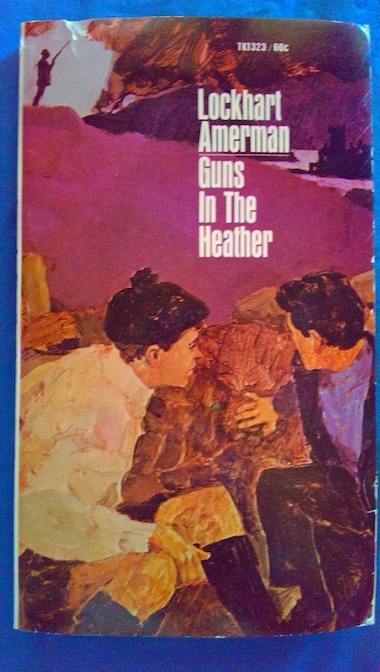
GunsHeatherGuns in the Heather by Lockhart Amerman, 1963.

This book was the basis for the Disney made-for-tv movie The Secret of Boyne Castle. However, the book and the movie are very different.  Although they have a similar premise, many details were changed in the movie version, the first of which is that the location of the story was moved from Scotland, as it was in the original book, to Ireland.

Jonathan Flower, sometimes called “Posy” by his friends, spends most of his time at various boarding schools.  His mother died when he was very young, and his father has a government job that takes him all over the world, so Jonathan has been in boarding schools in various countries, seeing his father whenever he can during school breaks.  For the most part, Jonathan doesn’t really mind it.  He and his father get along pretty well, and he knows that his father’s work is important.

Right now, he’s at a boarding school in Scotland.  He’s made a lot of friends there, spending holidays like Christmas and Easter at various friends’ homes.  He’s also developed an interest in rugby and cricket.  He anticipates that his father will meet him at the end of the school year so that they can go mountain climbing together over the summer break.  However, shortly before his father is expected to arrive, Jonathan receives a telegram from him, saying that he is to go to a certain place and meet a Mr. Finch.  Because the telegram contains certain words that this father uses when a situation is urgent, Jonathan goes to meet Mr. Finch and is kidnapped.

Mr. Finch, who also goes by the alias Dr. Fisher, holds Jonathan captive in a house, pretending that Jonathan is a patient who has volunteered for an experimental treatment.  Fortunately, Jonathan’s father, disguised as a milkman, soon rescues him.

While Jonathan’s father, who is actually a government agent, attends to some of his duties, Jonathan tries to go to the American embassy, only to be misled and almost recaptured. For a time, he is on his own, unsure of who to trust and how to reconnect with his father. When the two of them finally meet again, they both seek shelter with friends, but their enemies aren’t far behind, no matter where they go.  They end up staying with friends who own an old castle, but their enemies are planning a siege.

My Reaction

The style of the writing in this book doesn’t make for a particularly easy read.  It’s not overly difficult, but it starts off slow and is very dense, unlike many more modern books.  The scenes also change quickly throughout the book, and I had trouble keeping track of who some of the characters were.  Overall, I preferred the movie, even though it didn’t follow the book very closely.

In the Disney movie version, a strange man drives onto the grounds of an Irish boarding school, stumbles out of his car, and whispers an urgent message to a teenage American exchange student (played by a young Kurt Russell and renamed Richard Evans) that is meant for his older brother.  Then, the man dies from a bullet wound.  Another man, who is ostensibly from the American embassy in Dublin, abducts Richard after saying that he needs to go to the embassy to make a statement about the stranger’s death.  Richard is also accompanied by an Irish friend, Sean, when he is lured away from the school, and his friend helps him as they escape from the enemy spies holding them captive.  The two of them search for Richard’s older brother (who they have only just learned is a spy, whereas Jonathan was aware that his father worked for the government) to give him the dead man’s message.  In both the book and the movie, there is a final showdown with the bad guys at a castle, but in the movie, they go to the castle to retrieve a secret message that the dead man left there.  I don’t think that the movie is available on dvd, but I have seen it on YouTube and Internet Archive.

Jumanji

Jumanji

Jumanji by Chris Van Allsburg, 1981.

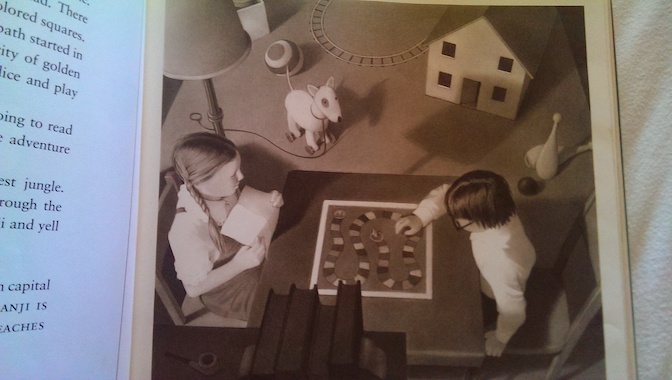
Judy and Peter, a brother and sister, are left home alone while their parents go to an opera. In spite of their parents’ warning not to make a mess because they’ll be bringing guests by later, the kids scatter all of their toys around while playing. Then, the kids go to the park to play for awhile, and they find a board game labeled Jumanji with a note that the game is free to anyone who wants to play it. Judy and Peter decide to give the game a try and take it home.

JumanjiPark

Jumanji turns out to be a kind of race game. Players are supposed to make their way down a path through a jungle, facing all kinds of dangers, until someone reaches the golden city of Jumanji. The instructions warn them that once a game has begun, it will not be over until one of the players reaches Jumanji.

JumanjiGameStart

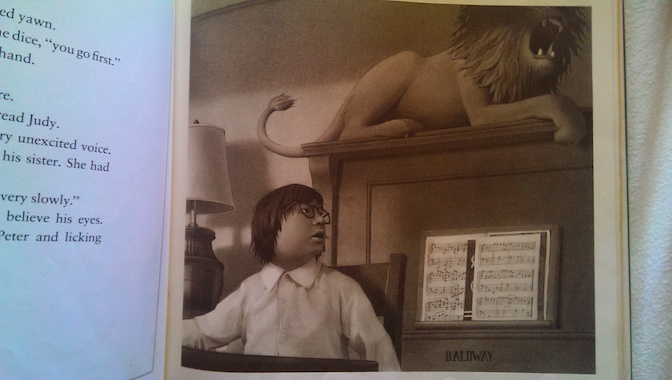
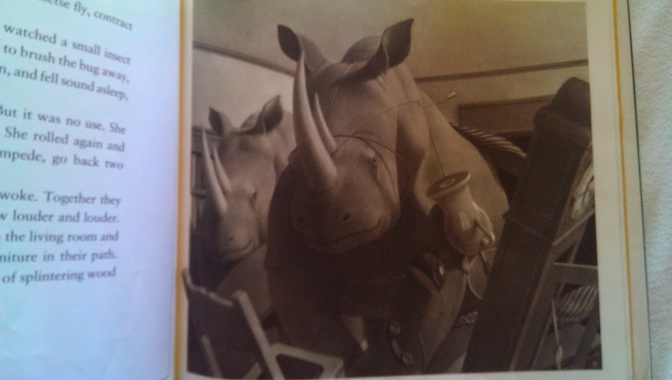
At first, Peter thinks that the game is boring and easy, but it soon becomes apparent that things that happen in the board game are starting to happen in real life when a live lion suddenly appears after an encounter with one on the game board.  Peter is scared and wants to stop playing, but Judy reminds him that they can’t stop because the game won’t end until one of them reaches the end of the path on the game board. Until the game ends, they’re stuck with the lion and anything else that happens to appear because of the game. They have no choice but to keep playing, facing each danger as wild animals rampage through their house.

JumanjiLion

Chris Van Allsburg books always have amazing illustrations, and the pictures in this book are especially good!  At the end of the book, the children see two other children find the game, which leads to the sequel, Zathura.

JumanjiRhino

There is a movie version of this book, but the movie differs greatly from the original story. In the movie, the two kids were friends, not brother and sister, and the boy ends up trapped in the game for a period of years until, finally, a new set of kids starts playing and helps the original players to finish their game.  When their game ends, the original children are returned to their own time, and no one but them knows that they were ever gone.  Things turn out better for the future children as well because the older players make things better for everyone in their own time.  There were no players stuck in the game in the original book, and everything takes place during a single day.

The book is currently available online through Internet Archive.

JumanjiParents

In the Kaiser’s Clutch

KaisersClutchIn the Kaiser’s Clutch by Kathleen Karr, 1995.
After their father’s death during World War I  (then called The Great War), the Dalton twins’ mother started supporting their family by writing.  It’s the summer of 1918, and Dorothy Dalton is now writing the scripts for a silent movie serial starring the fifteen-year-old twins, Nelly and Fitzhugh.  Times have been tough for them without their father’s support, but the serial means steady work and salaries for all three of them for the entire summer, enough to support them and buy school supplies for the fall, and maybe even enough to buy back some of the things that their mother pawned to keep their family going when they had to move out of New York to a less expensive town in New Jersey.

The movie serial, called In the Kaiser’s Clutch, is about a pair of wealthy American twins (played by Nelly and Fitz) who find themselves battling German spies.  The serial is part adventure story, part American war propaganda.  It’s also a subject that hits close to home.  The Dalton twins’ father wasn’t killed while fighting overseas.  He was in charge of the security force for the piers of Black Tom Island, just off the coast of New York, the port where most of the weaponry destined for the war in Europe was being shipped.  However, a massive explosion destroyed the port at Black Tom and killed Mr. Dalton.  Fitz wishes that he were old enough to fight directly in the war, but failing that, he wants to find the people who killed his father because he is sure that his father’s death was due to deliberate sabotage, not an accident.  However, it’s possible that the saboteur himself is looking for the Dalton family.

Strange things start to happen which the twins realize may have some bearing on their father’s death.  Someone has been spying on the family, listening by the window of their apartment.  Then, the director of their movie serial hires a new, part-time actor to play one of the villains, and this man is oddly similar to the fleeing figure of the man who was spying on them.  This new actor is German, and he seems to have some weird grudge against the twins, muttering insults in German and taking advantage of the stunts they have to perform in the movies to hurt and frighten them.  There are plenty of opportunities for the twins to get hurt on the movie set because each episode of the series has to end with a cliff-hanger scene, and there are no stunt doubles.  (Early silent movies in real life typically didn’t have stunt doubles, and the stunts were difficult and dangerous for the actors themselves.  This YouTube video explain how Buster Keaton, a famous silent film actor, performed his own stunts.)  From fist fights to car chases to quicksand to a cave-in to a giant pendulum with a mysteriously sharpened edge to sudden explosions, the Dalton twins are constantly teetering on the edge of disaster, not all of it planned by their writer mother.

Mrs. Dalton admits to the twins that, shortly before their father died, he told her that he was close to uncovering something that would be a much better story than anything she could make up.  Unfortunately, he never told her what it was.  He did tell her that he was making notes about it, but those notes were never found and may have also been destroyed in the explosion.  The only odd thing that Mrs. Dalton found after her husband’s death seemed like an ordinary shopping list: “cigars, eggs, dumplings, coal, pencils.”  However, Mrs. Dalton realized later that it has to mean something else because her husband didn’t smoke.

Could this somehow be the clue to what her husband was investigating before his death?  Are there real spies operating in the area?  Is there some other clue to their identity that they are now searching for, something that the Daltons still have in their possession?  Will the Dalton twins manage to find the spies before the spies eliminate them?  Will the family finish the serial and collect their salaries?  Find out in this exciting installment!  (There’s only one installment here because this is just a single book, not part of a series, but you get the idea.)

My Reaction

World War I books aren’t quite as common in children’s literature as World War II stories, so I found this interesting, and movie serials are also a fascinating thing of the past.  The movies that the kids are acting in are black-and-white silent films, so there are interesting discussions of the techniques they use to make things show up properly on black-and-white film (makeup, dyeing the water black for Nelly’s near-drowning scene, etc.) and conveying emotion when the actors’ voices will not actually be heard.  It’s a fun and fascinating story with spies, government agents, and the kind of movie stunts that I’m sure a lot of kids wish they could do for their summer jobs!

The Case of the Wandering Werewolf

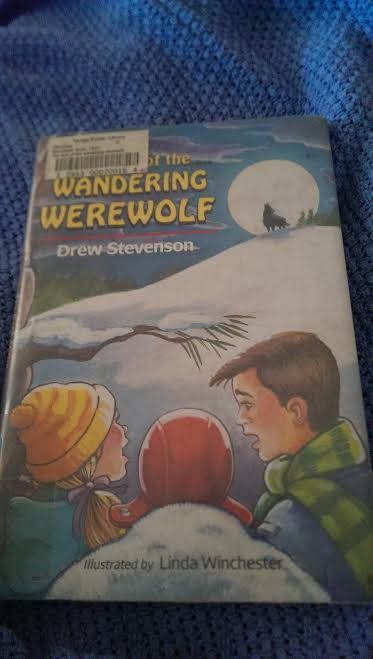
wanderingwerewolfThe Case of the Wandering Werewolf by Drew Stevenson, 1987.
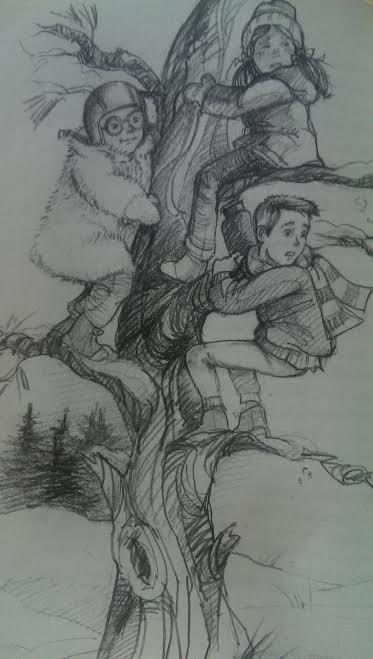
A boy called Chips approaches Raymond with the story that there might be a werewolf in Lost Woods, outside of town. Chips likes animals, and he has been going into the woods to spring animal traps that someone has been leaving there. One evening, Chips thought he saw a man who seemed to turn into a wolf, and the wolf chased Chips away, only stopping when Chips crossed the creek. Chips has heard of Huntley’s monster hunting activities, and he asks Raymond to tell Huntley about the werewolf and see if he will investigate.

To Raymond’s surprise, Huntley says that he has already heard about the werewolf from another source, which he refuses to reveal.  However, he is eager to investigate, on behalf of Chips and his other mysterious source. Verna, who overhears what Chips says about the werewolf, invites herself along on the hunt.

wanderingwerewolfpic1The monster hunt becomes more complicated when Bucky Bovine, a bully at their school, seems determined to stop them from going to Lost Woods to look for the monster. Does Bucky know something about the beast, or could he even be the monster himself?
As always, there are other explanations besides monsters and mysteries that require solving.  Fortunately, Huntley is an excellent detective as well as a Monster Hunter, and he puts the pieces together to explain not only the werewolf but other strange things that have been happening around town.

The book is part of the Monster Hunter series and is currently available online through Internet Archive.

The Case of the Horrible Swamp Monster

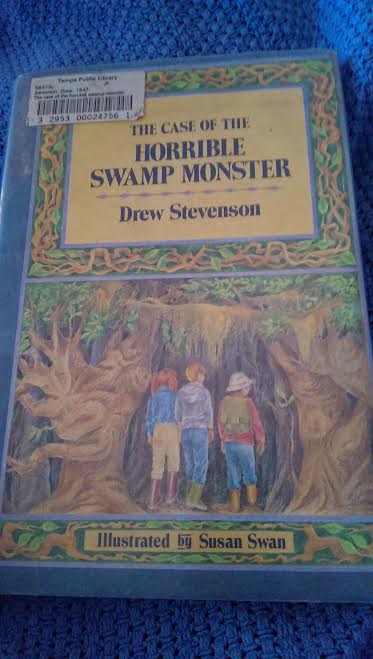
horribleswampmonsterThe Case of the Horrible Swamp Monster by Drew Stevenson, 1984.

This is the first book in the Monster Hunter series.

Raymond Almond knows that his class project isn’t going to go well when he finds out that bossy Verna Wilkes is in his group. Verna convinces the group that their project should be a movie because her father recently gave her a movie camera. What makes it bad is that she insists that it should be a monster movie and that Raymond should play the part of the monster.

Raymond is embarrassed about having to stumble around the spooky Lost Swamp in the ridiculous monster costume, but he puts aside his embarrassment when what looks like a real swamp monster appears in the background of the footage.  Even bossy Verna is scared at the idea of a monster living in the swamp where they were filming.

Fortunately, Raymond’s best friend is J. Huntley English, an intelligent boy and amateur cryptozoologist (or Monster Hunter, as he likes to put it). When Raymond and Verna tell Huntley what they’ve seen, he’s quick to join in the investigation, eager to discover proof of a real monster.

horribleswampmonsterpicThe course of their investigation takes a strange turn when friendly Mr. Walton, who works as a janitor at the same bank where Huntley and Verna’s mothers work, is arrested for stealing money. The kids refuse to believe that he’s guilty and soon learn that there is a connection between the thefts and the mysterious monster and possibly the strange fisherman who has also been lurking around the swamp.

The book is available online through Internet Archive.