The Zombie Project

Boxcar Children

The Alden children are staying in a cabin at Winding River Lodge because their grandfather is friends with Maude Hansen, who owns the lodge. They’re enjoying the fall weather in the woods, and Violet is taking pictures and videos of their trip with their new camera.

There are other people staying at the lodge, too. A newspaper reporter named Madison can’t help but stay on top of the news while she’s there. She tells everyone about a wealthy businessman, Matthew Donovan, who vanished after apparently stealing millions of dollars from his company’s investors. Surprisingly, the charity golf tournament he sponsors is still taking place in his absence. Madison also has a blog about haunted places, and she tells Maude that she’d like to include the Winding River Zombie on her blog. Maud says that the zombie is only a story that her great grandfather made up and that it doesn’t really exist. Benny asks what a zombie is, and his older siblings reluctantly tell him that it’s an undead monster from the movies that eats people. They hope that the idea of the zombie won’t give Benny nightmares.

That evening, when people are telling stories around the campfire, Maude’s teenage grandson, Jake, tells everyone the zombie story. He says that there used to be an old hermit who lived in the woods, and one day, his great grandfather found the old hermit dead. He reported the death to the local sheriff, and they tried to locate the hermit’s family, but they never found out who he really was or where he came from. With no one else to make funeral arrangements, the Hansens arranged for the old hermit to be buried in a nearby cemetery. Then, not long after, a camper had a frightening encounter with a strange man who tried to grab him and bite his arm with bloody teeth! The Hansens found out that someone had dug up the old hermit’s grave and that the body was gone. People believed that the old hermit had turned into a zombie and still lurked in the woods. Jake’s teenage friends love the zombie story, and Jake claims that he’s seen the zombie before.

When Benny thinks he sees a zombie in the woods and lights in the woods at night, the Aldens wonder if the zombie story could be true or if something else is going on. Do the Hansens fake the appearance of the story to keep the legend alive? Could Madison be faking the zombie or getting someone to play zombie so she’ll have a more exciting story for her blog? Or is there something or someone scarier lurking in the woods?

I was a little surprised at the zombie theme of the story because, although The Boxcar Children series has other spooky stories, the lumbering, cannibalistic undead seems more gruesome than this series normally gets. The unusual darkness of the subject shows in Benny’s siblings’ initial reluctance to explain to Benny what zombies are, for fear that he’ll have nightmares. However, the story doesn’t get overly scary, considering the theme. They don’t explain, for example, that zombies in movies typically want to eat human “braaaaiiiiiiinnnnns!” It’s scary enough that they might just generally want to eat people. Maude is also careful to say from the very beginning that there was never any truth to the story. It was always just something her family made up for the benefit of the tourists.

As some readers might guess, the missing businessman has something to do with the appearance of the “zombie”, but that’s not the entire explanation. There are multiple people involved in the so-called zombie sightings, which confuses the issue for the Aldens. I thought the other people involved were obvious because of some of the things the characters said, but younger readers will probably still find the story thrilling. It’s very much a Scooby-Doo style pseudo-ghost story mystery, not too gory or gruesome, but exciting for kids who like things a little spooky.

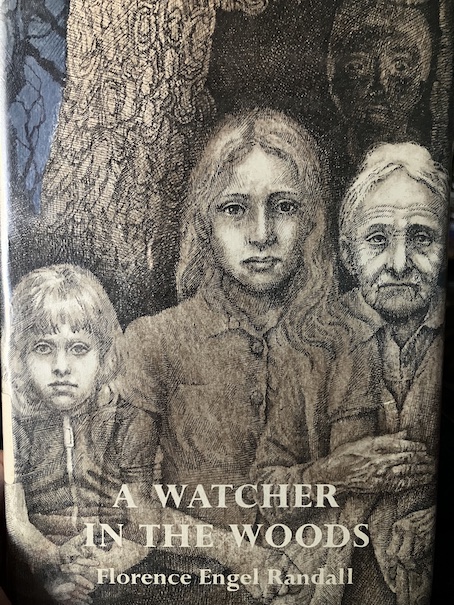
A Watcher in the Woods

The Carstairs family is moving from Ohio to a small town in Massachusetts because Professor Carstairs will be taking a new job as head of the English department at the local college. Fifteen-year-old Jan knows that she will find the move harder than her parents or her younger sister. Her father will be busy with his work, and her mother will make friends with the wives of other faculty at the college. Jan knows that her little sister, Ellie, is still very young and in elementary school, and she won’t find changing schools as difficult as she will. Jan isn’t looking forward to trying to fit in at the local high school.

The family’s first difficulty in moving is finding a house in this new town that they like. Because it’s a small town, their options are limited, and it seems like there’s something wrong with each of the houses they see. Then, their realtor suggests that they view the old Aylwood place outside of town. Living there would mean a longer distance to drive to the college and the girls’ schools, but it’s a nice, big house with some land attached to it. The land includes woods and a pond. Elderly Mrs. Aylwood can’t afford to maintain the place anymore, but she has been reluctant to sell the house. She is very attached to it and she wants to make sure that, if she sells, that she will sell it to the right kind of people, who will take care of the land and woods.

From the first time that Jan and her family visit the house, it gives Jan a strange feeling. She has the oddest feeling that someone (or something) is watching them from the woods, and it frightens her. However, when she tries to explain her uneasy feelings to her mother, her mother thinks that it’s her imagination. Jan can’t deny that the house and wood give her the feeling of a fairy tale and that Mrs. Aylwood reminds her of a fairy tale witch.

For some reason, Mrs. Aylwood becomes more welcoming to the Carstairs family after she sees Jan, and she begins asking Jan some rather odd questions about herself. Mrs. Aylwood admits that Jan reminds her of her own daughter, Karen, who she lost 50 years ago when she was only 15 years old. Jan begins to understand that Mrs. Aylwood’s attachment to the house is because it’s a link to her daughter’s memory, but she soon begins to realize that there’s more to it than that. Mrs. Aylwood asks Jan what kind of person she is and makes a cryptic comment about how Jan is a human but there are other things besides humans.

Jan’s uneasy feeling of being watched continues, and mirrors in the house are inexplicably broken in an x-shaped pattern. When she befriends a neighbor, Mark, and talks to him and his mother about the house, she learns that Karen did not die but that she disappeared 50 years ago. She apparently went out for a walk to the pond in the woods one summer morning and simply vanished with no explanation. Searches for her never lead anywhere. Most of the local people believe that Karen ran away from home, although it would have been out of character for her to do that. Jan begins to wonder if the watcher she senses in the woods could be Karen, somehow hiding out or having returned after all these years, although Mark says that doesn’t make sense. Then, remembering Mrs. Aylwood’s comment about things that aren’t human, Jan wonders if the watcher could be Karen’s ghost. What if she died all those years ago, and her spirit haunts the woods?

It seems like someone or something is communicating with Ellie. Ellie seems to hear something speaking or humming when Jan can’t. Something even suggests to Ellie that she name her new puppy Nerak, which Jan realizes is “Karen” spelled backwards. Is Karen trying to communicate with them, or is it something else?

The book is available to borrow and read for free online through Internet Archive. This book has been made into movie versions twice, but the Disney movie from 1980 is more faithful to the original story. I’ll explain why below, but it involves spoilers.

When talking about my opinion of this book, I really need to include some spoilers. This is a very unusual book because it isn’t obvious until about halfway through what kind of story it really is. From the beginning, it’s set up like a ghost story, with Karen’s mysterious disappearance, the sense of something watching the house and family from the woods, and something trying to communicate through Ellie. It’s very suspenseful and mysterious, but this is not actually a ghost story. It’s really science fiction.

Karen isn’t dead, but she has been trapped in an alternate dimension since she disappeared 50 years ago. A being from that other dimension has also been trapped in our world since then. This other being is the mysterious watcher in the woods. Jan correctly senses that this other being is also female and a child, although beings of its kind live extraordinarily long lives because time works differently in their dimension. What has been 50 years for everyone else has only seemed like a day to her. She wants to return home, but she has had to wait for conditions to be right. She also wants to help Karen, and she has been struggling to communicate with Mrs. Aylwood and Jan and her sister so she can tell them what they need to do.

In the Disney movie, there are a couple of major changes from the original book. The first is that the location is changed from the US to England, although Jan and her family are Americans. It also features a kind of initiation ritual that Jan was undergoing just as her switch with the creature from the other dimension happened, adding an element that seems supernatural, although it is still science fiction. At the very end of the Disney movie, Jan brings Karen back from the other dimension, but in the book (Spoiler!) Mrs. Aylwood goes to join Karen in the other dimension instead.

In the book, Jan’s mother worries about what life would be like for Karen if she returns, aged 50 years in what must have seemed like only a day, having lost most of her life, or what it would be like if she has not changed at all but her mother has aged 50 years, and the world has been through so many major changes since she left. It isn’t clear whether or not Karen has aged in the other dimension, but Jan’s mother’s point is that the world she came from has definitely changed. Karen can’t go back to her old life, and there is some sadness about that and about what Mrs. Aylwood has been going through since Karen disappeared. However, Mrs. Aylwood decides to join Karen in this other world, where she’s been. We don’t really know what Karen’s condition is in the other dimension because we don’t see her. She may have aged very fast there, although I think they imply that she has not aged at all because time works differently in the other dimension. Since time works differently there, it seems like they either won’t age further there or will do so much more slowly than they would on Earth.

Between the two movie versions, the Disney movie version of this book from 1980 is more faithful to the original story because it maintains the concept that this is a science fiction story and that the watcher in the woods is a being from another dimension. The movie version from 2017 turns the story into a ghost story with no science fiction elements. In the ghost story version, Karen is also still alive and hasn’t aged after being gone for many years, but the watcher in the woods is a ghost who is holding her captive. It’s a spookier version, but I think the logic of the original book, with its science fiction theme, makes more sense. 

The premise of the ghost story didn’t make as much sense to me because the ghost’s motives seem confused. First, the ghost takes Karen captive because she was staging a stunt for some friends where she appeared to be mocking the way he died. Then, he seemed to want to keep a girl for company, which is weird because it doesn’t seem like he interacts with Karen while he has her. He tries to make a bargain where he would be willing to release Karen in exchange for Ellie, but in the end, it turns out that human company isn’t really what he wants. (Spoiler!) He wants a ritual for his death that he was deprived from having when he was killed. The story just seemed to be all over the place with the ghost’s motives and desires. Is he out to punish Karen for her disrespect, lonely without human company, or just trying to get attention from the living to fulfill his final wishes? Even he doesn’t seem clear about that, which is why I prefer the sci-fi version. 

I also thought that the premise of the sci-fi story was more original, and I enjoyed the twist of a story that seems like a ghost story but really isn’t. If any sufficiently advanced technology might look like magic to someone who had never seen it before, as Arthur C. Clarke said, it makes sense that any being who was sufficiently different from the human experience might appear to be some kind of supernatural creature to human beings who didn’t know what they were perceiving.

The Disney version from 1980 actually has multiple endings because the first endings they filmed didn’t quite work and didn’t get a good reaction from audiences. If you’re curious about what the three endings are like, Jess Lambert explains them in her YouTube review of the movie.

Kiki’s Delivery Service

More Americans would probably recognize the title as the title of a Studio Ghibli animated film for children than as a book title, but the book came before the movie, and it is actually the first in a series, which continues the story about Kiki’s life and adventures, although I don’t think the later books in the series have been translated into English (at least, I haven’t found them in English). The original Japanese version of this book was written in 1985, and I read the English translation from 2003.

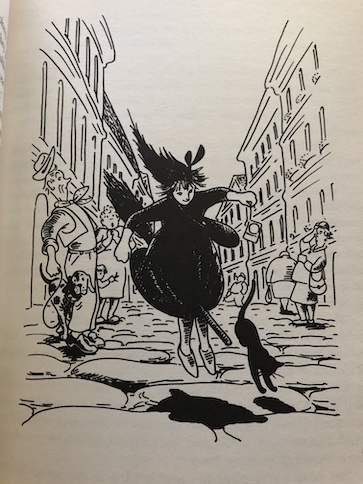
Kiki is a young witch, and in keeping with the traditions of young witches, she is expected to leave home at age 13 and live for a year in a city with no other witches.  It will be a test of her developing skills and a coming-of-age experience, helping her to recognize her talents and find her place in the world.

When Kiki sets out for her journey with her cat, Jiji, she doesn’t know exactly where she is going to go or what she will find when she gets there. Some young witches know early on what their talents are and how they plan to support themselves during their year away from home, but Kiki is less sure (like so many of us who “don’t know what we want to be when we grow up”).  The term “witch” just refers to a person’s ability to do magic.  It’s not a job title by itself, and witches are expected to develop a specialization, such as brewing potions or telling the future. Kiki’s mother has tried to teach Kiki her trade, growing herbs and making medicines from them, but Kiki hasn’t had much patience with it.  The only major ability Kiki has is flying, which is something that witches are expected to do anyway.  Still, she has an adventurous spirit and is eager to set out and see what life has to offer.

Once Kiki locates a city with no other witches, she has to find a place to stay and a job to earn money. She finds a city by the sea, which seems exciting to her.  As she explores the city, she meets Osono, a woman who owns a bakery with her husband. When she helps deliver a baby’s pacifier to a bakery customer who left it behind, flying to the customer’s house on her on her broom, Osono offers to let her stay in a small apartment attached to the bakery. Kiki feels a little overwhelmed by the big city at first, but she realizes that, in a large city like this, there are probably a lot of people who have small delivery errands that wouldn’t be covered by ordinary parcel delivery services.

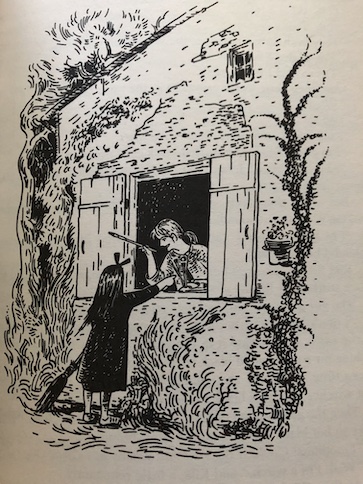
Kiki opens a delivery service, delivering small packages and running errands for people around the city.  At first, business is slow, and some people are afraid of her as a witch. During a trip to the beach, a curious boy borrows her broom and breaks it. Kiki is distressed, and the boy apologizes. The boy’s name is Tombo, and he is part of a club of other kids who are interested in flying. He has made a study of flight and had hoped to learn more about how witches fly by trying Kiki’s broom, but Kiki expains that only witches can fly with brooms and that the ability is inherited. Kiki has to make a new broom, and it takes her a while to break it in, but it actually works to her benefit. People who were initially afraid of her for being a witch become less afraid of her and more concerned about her when they see that she is just a young girl, clumsily trying to master a new broom. Kiki gets some additional support and business from people who feel moved to help a struggling young witch. Tombo also makes it up to her and becomes a friend when he helps Kiki to figure out a way to carry a difficult object on her broom.

During her very first delivery assignment, Kiki was supposed to carry a toy cat to a boy who was having a birthday, but she accidentally dropped it. When she searched for it, she met a young artist, who was enchanted by Kiki as a young witch and painted a portrait of Kiki with Jiji. When the artist asks Kiki to take the painting to the place where it will be on exhibit, Kiki isn’t sure how to carry it at first. It’s kind of a bulky object to carry on her broom. Remembering that Tombo has made a study of flying, she asks him for help. Tombo ties balloons onto the painting to make it float and tells Kiki that she can now pull the painting along on a leash, as if it were a dog. The idea works, and when people see Kiki pulling a painting of herself along through the sky with balloons tied to it, it acts as advertising, bringing her more business.

Some of Kiki’s new jobs are difficult or awkward, and some customers are more difficult to deal with than others. There are times when Kiki finds herself missing home or trying to remember how her mother did certain things, wishing that she had been better at watching and remembering what her mother did. Still, Kiki learns many new things from her experiences and acquires new skills.

Kiki’s experiences also help her to realize a few things about herself and life in general. Like other girls, Kiki worries about how boys see her. When Tombo makes a comment that he can talk to her when he can’t talk to other girls, Kiki worries that he doesn’t see her as a girl at all. A job delivering a surprise present to a boy from another girl her age helps Kiki to realize that everyone is a little shy and uncertain about romance and even people who act confident feel a little awkward about first relationships.

As her first year away from home comes to an end, Kiki wonders how much she’s really changed over the year. Although she has successfully started a new business and done well living away from her parents, she still experiences a sense of imposter syndrome, where she doesn’t quite feel like she’s really done all of the things she’s done. Her first visit home to her parents reminds her that her new town has really become her new home. She has become a part of the place, and she feels her new business and friends calling her to return.

In 2018, the author, Eiko Kadono, was awarded the Hans Christian Anderson for her contributions to children’s literature.

My Reaction

I think of this story as one of those stories that takes on more meaning the older you get.  Young adults can recognize Kiki’s struggles to make her own way in the world and establish herself in life as ones that we all go through when we start our working lives and gain our first independence.  It can be a scary, uncertain time, when we often wonder if we really know what we’re doing. (Life Spoiler: No, we don’t, but no one else completely does, either, so it’s normal and manageable. Some things just have to be lived to be really understood, and that’s kind of the point of Kiki spending a year on her own, to see something of life and how she can fit into it.) However, it’s also a time of fun and adventure as we try new things, build new confidence, make new friends, and learn new things about ourselves. Like so many of us, Kiki doesn’t always do everything right, but she learns a lot and endears herself to the people of her new town.

The Miyazaki movie captures the feel of the story well, although the plot isn’t completely the same. There are incidents and characters that are different between the book and the movie. Tombo appears in both the book and the movie, but there are other characters who appear in the book who weren’t in the movie. In the book, Kiki makes friends with a girl named Mimi, who is her age, and the two of them discuss crushes on boys and how each of them was a little envious of the other because, while each of them is struggling with their own uncertainties in life, they each thought that the other acted more confident. The movie version developed the character of the young artist more. Kiki also didn’t lose her powers during the book, although that might be a part of one of the other books in the series, since I haven’t had the chance to read the others yet.

Blackbeard’s Ghost

Blackbeard’s Ghost by Ben Stahl, 1965, 1976.

This is the novel that the live action Disney film Blackbeard’s Ghost from 1968 was based on. My copy is a later edition designed as a tie-in with the Disney movie, based on the cover, but it contains the text of the original story.

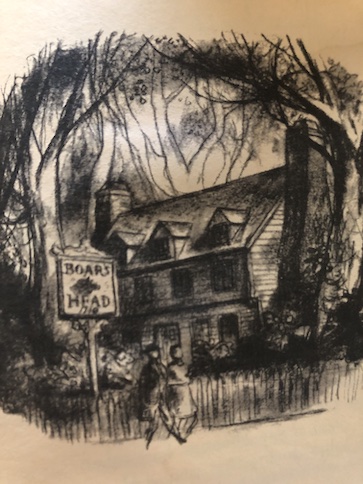
The story begins with a prologue that explains how Blackbeard the pirate evaded execution for piracy by offering to collect tolls from ships on behalf of the colonial governor, Governor Eden, in the town of Godolphin. However, instead of collecting tolls from the ships, he decided to use his position for his own benefit. Knowing that he would eventually need a source of stability on land instead of spending the rest of his life at sea, he looted wood from various ships and used it to build a tavern for himself called the Boar’s Head. He hired a woman rumored to be a witch, Aldetha, to tend the tavern for him. In the end, though, Blackbeard was killed by someone who wanted to collect the bounty on him for piracy. After his death, the poor woman who tended his tavern was burned at the stake for witchcraft.

(Note: The witch burning is historical inaccuracy because no witchcraft executions in North America involved burning, at least not in English-controlled parts of the American colonies. Accused witches in North America were typically hanged. None of this story is meant to be historically accurate, but I always feel compelled to point that out in stories that make that mistake. The town of Godolphin and the Boar’s Head Tavern are fictional. In real life, Blackbeard did receive a pardon from the real Governor Eden in Bath, North Carolina, and he was eventually killed in 1718 in a battle with Lieutenant Robert Maynard and his crew, as he did in this story. However, in the book, the tavern is now owned by a descendant of Maynard’s, and in real life, Maynard didn’t have any children.)

Most of the story takes place in the 20th century, when two 14-year-old boys, J.D. and Hank, talk about how the old Boar’s Head Tavern is about to be torn down because the former owner sold it, and there’s going to be a gas station built on the land instead. They think it’s a shame because they’ve heard ghost stories about the place and think the old tavern is fascinating. The boys go to watch the workmen tearing down the old tavern, but the workmen haven’t made any progress so far. Although they’d love to loot some of the expensive woods from the old tavern, they just can’t seem to dismantle the building. They’ve been able to dismantle some of the newer additions to the building, but somehow, they can’t seem to touch the original structure. The site has been plagued with mysterious accidents. Their equipment fails, heads fall off the ends of their hammers, and workmen keep getting injured in small accidents, not enough to seriously hurt anyone but enough to keep them away from their work for days at a time.

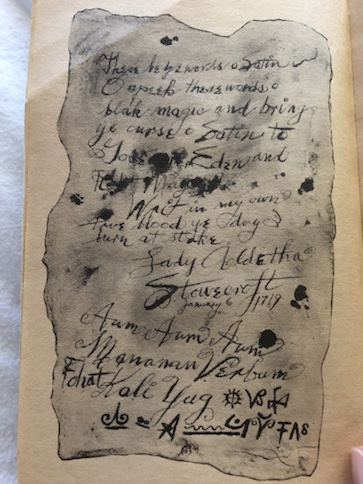
When J.D. and Hank see the workmen leaving the building in frustration soon after arriving, they decide to go inside and look around to satisfy their curiosity and see if there’s anything of value that they can salvage before the tavern is demolished. They don’t find much of value, but they do find their way into Blackbeard’s secret dungeon under the tavern. There, they find a piece of old parchment with a satanic curse written by Aldetha. (So, apparently, people were actually right about her being a witch. Plot twist!) Inspired by this creepy message from the past, the boys realize that they can make money from other kids by capitalizing on the ghost stories about the old tavern and holding seances to contact the spirits. They don’t really believe that seances are real, but they figure that, if they can get enough ghost-story fans to come to their seances, they can make a profit from this enterprise.

Of course, the boys’ seance awakens the ghost of Blackbeard. Blackbeard is invisible to everyone except for the boys, but he’s a solid ghost, who can manipulate physical objects. The boys quickly realize that Blackbeard can be a dangerous ghost, and he’s not at all happy when he finds out that a descendant of the man who killed him wants to have his tavern torn down.

The book is available to borrow and read for free online through Internet Archive. The Disney movie is available to buy or rent through YouTube or Amazon Prime. There is also a sequel to this book called The Secret of Red Skull, which involves spies and is also available online through Internet Archive.

My Reaction and Spoilers

There is some humor in this book because only the boys are able to see and hear Blackbeard, but by the end of the story, adults become aware of Blackbeard’s ghost, too. The boys’ history teacher is helpful in finding a way to appease the ghost by helping him to negotiate to buy back his tavern using his hidden treasure. When it becomes obvious both to Maynard and the company he tried to sell the tavern to that it’s haunted, they’re willing to accept pirate gold in exchange. The company also sees that it can use the building for public relations purposes by sponsoring a pirate museum in the old tavern. It’s good news for the teacher, too, because he gets to be the director of the museum. There, he can show off his collection of pirate memorabilia and indulge his love of pirate history. The tavern continues to be haunted by the ghosts of Blackbeard and his witch friend, leaving the story open for the sequel.

As expected of Disney films, the Disney movie version of the story is quite different from the book. In the movie, the person who can see the ghost is a college track coach who is staying in the old inn, which is still being operated by elderly descendants of Blackbeard’s old crew. There is a track meet in the movie that never appeared in the book, and at the end of the movie, Blackbeard disappears, having been freed from his haunting by performing a good deed.

I prefer the concept of the boys being the ones who accidentally summoned Blackbeard’s ghost, but the boys got on my nerves at first. In the early part of the book, they bickered a lot and didn’t seem to like each other enough to be best friends, although they seemed to be friendlier with each other later, when they were both trying to figure out what to do about Blackbeard. I think the teacher character was my favorite. He takes the matter of the ghost in stride, coming up with a practical solution that helps everyone.

Mary Poppins

Mary Poppins by P. L. Travers, 1934.

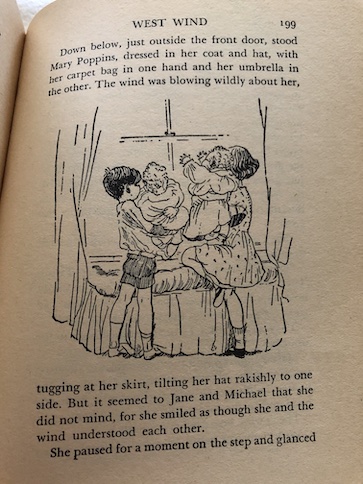
This book is a classic piece of children’s literature! This is the first book in a series of about the adventures of the Banks children with their magical nanny, Mary Poppins.

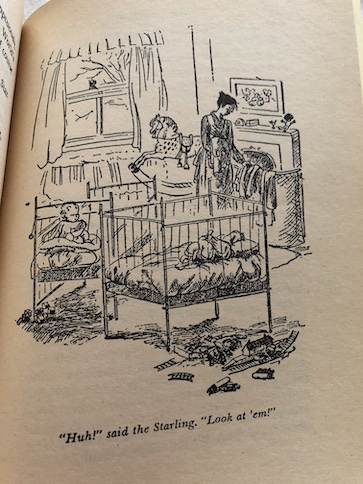
Mr. and Mrs. Banks of Cherry-Tree Lane have four children: Jane, Michael, and the infant twins, John and Barbara. When the story begins, the children’s nanny has just suddenly left her job with no real explanation. Mrs. Banks is beside herself, wondering what to do about this household upheaval, and Mr. Banks offers the practical suggestion that she should advertise for a new nanny in the newspaper. Mrs. Banks decides that’s a good idea, but a strange wind from the East brings an unexpected answer to this domestic problem.

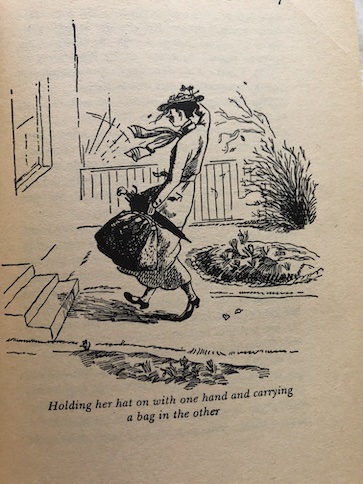
When Mary Poppins arrives at the Banks’ house to take the position of nanny, it seems like she was blown there by the wind. When the children ask her, she says that’s indeed what happened, but she offers no other explanation. Mrs. Banks discusses the position of nanny with her, but it turns out that it’s more like Mary Poppins is interviewing her and evaluating the children to see if they’ll do. Mary Poppins refuses to provide references when Mrs. Banks asks for them (I would find that worrying), saying that people don’t do that anymore because it’s too old-fashioned. Mrs. Banks actually buys that explanation and doesn’t want to seem old-fashioned, so she stops asking. Mary Poppins basically grants herself the position of nanny as if she were doing the Banks’ family a favor. Maybe she is.

Jane and Michael can tell right away that Mary Poppins is no ordinary nanny. When she begins unpacking her belongings, it seems at first that her carpet bag is empty, but she soon starts pulling many different things out of it, including some things that should be too big to be in the bag at all. Then, she gives the children some “medicine” (she doesn’t say what kind of medicine it is or what it’s supposed to do) that magically tastes like everyone’s favorite flavor.

From there, the story is episodic. Each chapter is like its own short story.

On her day off, Mary Poppins meets up with the Match Man called Bert, who also paints chalk pictures, and when he doesn’t have enough money to take her to tea, they jump into one of his chalk paintings and have a lovely tea there. The children aren’t present for that adventure, but they do go to tea at Mary’s uncle’s house.

Mary’s uncle, Mr. Wigg, is a jolly man … maybe a little too jolly. It’s his birthday, which has filled him full of high spirits, and he literally can’t keep his feet on the ground. When they arrive, he’s hovering in the air. He says that it’s because he’s filled up with Laughing Gas because he finds so many things funny. It’s happened to him before, and he can’t get down to earth again until he thinks of something very serious. The whole situation is so funny that Jane and Michael begin to laugh and find themselves floating in the air, too. Even though Mary isn’t amused and doesn’t laugh, she makes herself float in the air also and bring up the tea table so they can all have their tea in midair. The merriment only ends when Mary Poppins finally tells the children that it’s time to go home, which is very serious indeed.

Mary Poppins understands what animals are saying, helping to sort out matters for a pampered and over-protected little dog who desperately wants a friend to come live with him. Then, when the children see a cow walking down their street, Mary Poppins says that cow is a personal friend of her mother’s and is looking for a falling star. On Mary Poppins’s birthday, she and the children attend a bizarre party in the zoo where the animals are their hosts.

There is an episode in the book which has some uncomfortable racial portrayals. It takes place when Mary Poppins shows the children how a magical compass can take them to different places around the world, and they meet people who are basically caricatures of different racial groups. (This episode has resulted in the book being banned by some libraries. P. L. Travers received complaints about it in her lifetime, and she revised the scene in later printings of the book, which is why you’ll see books labeled as “Revised Edition.” I have more to say about this scene, but I’ll save it for my reaction.)

Mary Poppins and the children visit a bizarre shop where the owner’s fingers are candy and grow back after she breaks them off and gives them to the children. (That’s actually pretty freaky.) The children save the gold paper stars from the gingerbread they buy at the shop, and later, they see Mary Poppins and the shop owner and her daughters putting the stars up in the sky.

There is a story about the babies, John and Barbara, and how they understand things that the adults and older children don’t, like what animals, the wind, and sunshine are saying. They are sad to learn that they will forget these things as they grow up.

Toward the end of the book, Mary Poppins takes the children Christmas shopping, and they meet Maia, one of the Pleiades (here she is considered to be a star as well as a mythological figure, and she looks like a young, scantily-clad girl), who has come to Earth to do her Christmas shopping as well.

In the end, Mary Poppins leaves the Banks family suddenly when the wind changes directions, flying off into the sky on the wind with her umbrella. She does not say goodbye, and the children are very upset. Mrs. Banks is angry with Mary Poppins for her sudden departure on a night when she was counting on her to be there to take care of the children. The children try to defend her, though, and say that they really want her back, even though she’s often cross with them. However, she does leave behind presents for the children that hint that she may come back someday.

The book is available to borrow and read for free online through Internet Archive (multiple copies).

My Reaction

In some ways, the Mary Poppins in the original books isn’t quite as pleasant as Julie Andrews in the Disney movie version. The Mary Poppins in the book is vain and stuck up. She can be intimidating in her manner, refuses to answer questions, and even gets rude and snippy with the children. She was a little like that in the movie, but in the book, she’s even more so. After any strange or magical thing happens and the children want to talk about it, Mary Poppins gets angry at them and denies that any such thing happened at all. I found that rather annoying because it’s kind of like gaslighting, denying things happened when they really did happen. I think we’re meant to assume that’s because the adults aren’t allowed to find out that magical things have happened because they might put a stop to it or because Mary Poppins realizes that the children can only enjoy this kind of magic for a brief phase of their lives and that they’ll have to grow up in the more mundane world, just like the little twins can’t help but lose their ability to talk to animals. It’s a little sad, but I think it’s meant to provide some kind of rational explanation about how magic can exist in the world but yet go unnoticed by most people.

There is a Timeline documentary that discusses the life of P. L. Travers and how she felt about the Disney movie version of Mary Poppins. Although many people came to know and love the character through the Disney movie, and it made the books much more popular, P. L. Travers thought that the animated portions were silly and the characters weren’t represented as she wrote them.

I’d like to talk more about the racially-problematic episodes with the magic compass. A compass that can take people to different areas of the world just for asking is a good idea, but the people they meet in the places they go are all uncomfortable caricatures of different races. The one part that I’m not really sure about is how seriously these were meant. When I was trying to decide what to say about this, I considered the idea that aspects of this part of the story may have been meant as a parody of things from other children’s books and popular culture at the time. I have seen even older vintage children’s books that poke fun at concepts from earlier stories, so it occurred to me that this book might be making fun of concepts about people from around the world that young children of the time might have from things they’ve read in other books. There is a kind of humor throughout the book that involves puns and plays on certain ideas, like the way her uncle insists that he floats when he’s in a humorous mood because he’s buoyed up by “Laughing Gas”, which is not what real “Laughing Gas” is. It’s like what a child might picture as “Laughing Gas”, if they didn’t already know what that term means. It’s possible that part of this scene might be parodying other children’s fantasy books about magical travel, but it’s still very uncomfortable to read the original version of this scene, if you don’t have one of the revised editions of the book.

On the other hand, I suspect that the author isn’t really that thoughtful or self-aware by the way the adult characters speak throughout the book series. At the end of the book, when Michael is upset at Mary Poppins suddenly leaving and he throws a fit and argues with her, his mother tells him not to act like a “Red Indian.” I’m not entirely clear on what that comment was supposed to mean in that context, but Mrs. Banks uses it as if she does, so it seems that there is some implied insult there, maybe equating Michael’s behavior to being “savage” or “uncivilized” or something of that nature. Even Mary Poppins herself uses racial language throughout the series, using words like “hottentot” or “blackamoor” to criticize the children when they misbehave. It makes me think that the author was accustomed to that kind of talk herself. If Mary Poppins can get snooty as a character, I think I have the right to express my disapproval of her behavior as well.

While I like the basic character of a magical nanny who takes children on magical adventures, I don’t like either those comments or the compass scenes because the obvious caricatures are uncomfortable, and I don’t think they make good story material for children. I would recommend saving that version for adults who are interested in reading or studying nostalgic literature and use the revised versions for children, who would probably just prefer to have a story they can enjoy for fun without needing a lesson on racial attitudes of the past to understand it. If they’re curious, they can always have a look at the original later, when they’re old enough to understand it better and put it perspective. In the revised compass scenes in later books, some printings still have people but some of the offensive words removed, and in later printings, the children meet different types of animals instead of people.

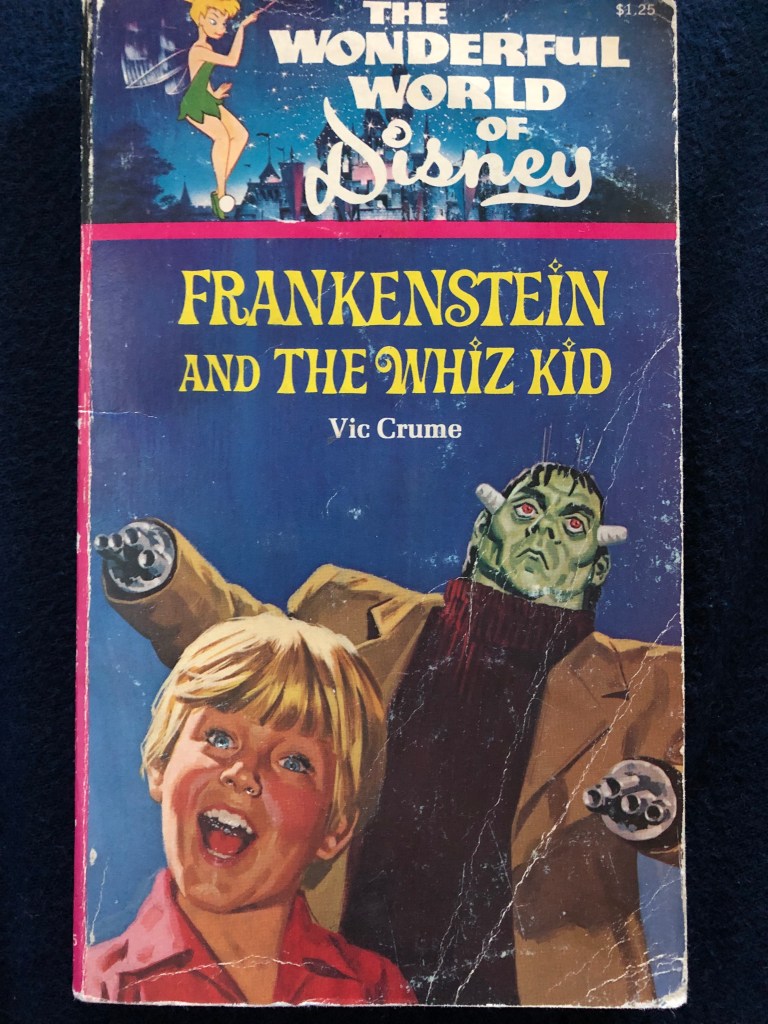
Frankenstein and the Whiz Kid

Frankenstein and the Whiz Kid by Vic Crume, 1975.

This book is a novelization of a made-for-tv Disney movie called The Whiz Kid and the Carnival Caper (some editions of this book also use that title).  There was also an earlier movie with the same characters called The Whiz Kid and the Mystery at Riverton.  I haven’t been able to find either of these movies for sale or on YouTube.  Both of the movies are based on a character created for a series of books by Clifford B. Hicks.

The “Whiz Kid” is Alvin Fernald, a boy who is always creating amazing inventions.  He has quite a reputation in his town.  Sometimes, people also call him “The Magnificent Brain.”

One day, his sister, Daphne (called “Daffy”), borrows one of Alvin’s rockets, showing a friend how they work.  However, the rocket ends up falling down a storm drain, and Daffy climbs in to retrieve it.  Alvin comes along as Daffy has trouble getting out and gives her directions to the storm drain’s opening.  Daffy follows the directions and gets out, but while she’s still walking around in the storm drain, she sees a mysterious man with a gun.  Fortunately, he doesn’t spot her, but she wonders what he was doing in the storm drain with a gun.

The place where the storm drain comes out is near a carnival that has come to town.  Alvin, Daffy, and Alvin’s friend Shoie want to go to the carnival, but they need some money.  To get some, Alvin brings out one of his earlier invention, a car-washing machine.  The others are dubious about that invention because it has caused problems before, but Alvin says that he’s fixed it.

Their first prospect for a car wash is the person who has moved into a spooky old house in their neighborhood.  It turns out to be a beautiful young woman named Cathy Martin.  Alvin is eager to impress her, but unfortunately, his invention goes haywire and ends up making a mess that the kids have to clean up (as well as making apologies to other people affected by the chaos).  However, Cathy agrees to go to the carnival with Alvin.

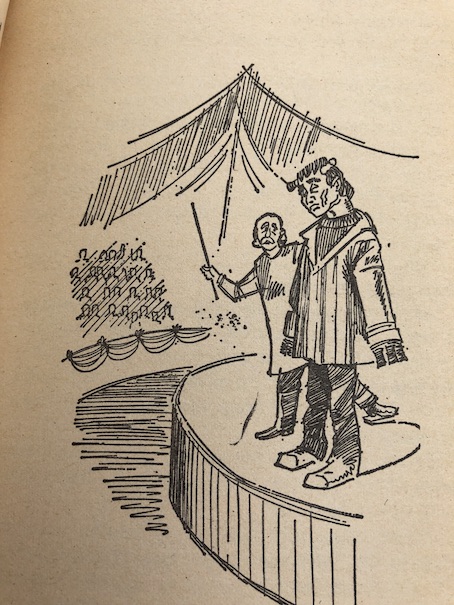
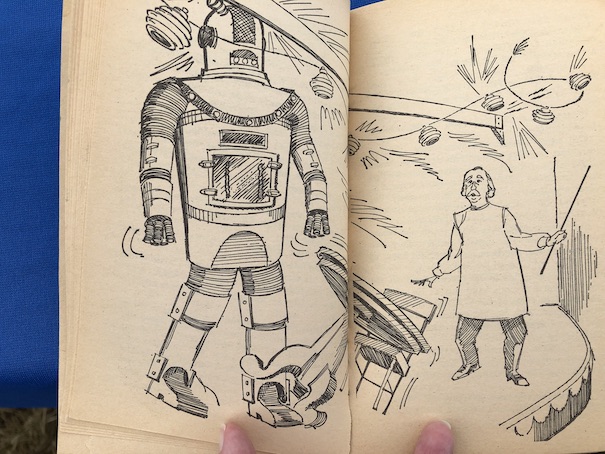
The carnival turns out to be an opportunity for another of Alvin’s inventions when the automaton that they’re using as Frankenstein’s monster in a carnival show breaks down.  Alvin also has a robot that he has built, and he offers the use of it to the man who works on the carnival’s automaton, so the show won’t have to close down.  The man accepts Alvin’s offer, and Daffy volunteers to help with the robot’s costume.

Cathy meets them at the carnival, and to Alvin’s annoyance, suggests that the four of them have fun together, instead of just her and Alvin.  The four of them do have fun, but they stumble onto something strange about Cathy.  They spot a man who Alvin and Shoie met at Cathy’s house.  Cathy said that he was her younger brother, on leave from his base, and that he had to be heading back there soon.  But, Alvin and Shoie wonder what he’s doing at the carnival if he’s supposed to be back and his base.  Then, Daffy recognizes him as the man she saw in the storm drain with a gun!  Who is he really?

The kids decide to spy on Cathy’s house, and they learn that the man, called Ernie, and the magician from the carnival, Moroni, are planning a bank robbery and that Cathy is in on their plans.  It’s a terrible disappointment to Alvin because he liked Cathy, but he thinks that they have a duty to tell Police Chief Moody about their plans.

Chief Moody is somewhat skeptical about what the kids overheard, but he and he deputy stakeout the bank.  When nothing happens, he thinks that the kids raised a false alarm, but it turns out that the robbers’ plan is more complicated than they know.

The Rescuers

The Rescuers by Margery Sharp, 1959.

This is the first book of The Rescuers Series.  Disney made a movie called The Rescuers based on this series, but the movie was very different from the book.  The movie involved a pair of mice who were members of a mouse version of the United Nations called The Rescue Aid Society who rescued a young orphan girl who was kidnapped for the purpose of recovering a treasure from a dangerous cave.  In the book, the prisoner the mice rescued was a poet who was being held captive in a castle.

The beginning of the first book of the series explains the purpose of the Prisoners’ Aid Society, an organization of mice that helps human prisoners:

“Everyone knows that the mice are the prisoners’ friends – sharing his dry bread crumbs even when they are not hungry, allowing themselves to be taught all manner of foolish tricks, such as no self-respecting mouse would otherwise contemplate, in order to cheer his lonely hours; what is less well known is how splendidly they are organized. Not a prison in any land but has its own national branch of a wonderful, world-wide system.”

However, the mice are daunted by their latest concern, a prisoner who is being held captive in the Black Castle, a Norwegian poet.  The Black Castle is a harsh prison, and because of the jailer’s cat, mice usually cannot reach the prisoners there.  However, the current chairwoman of the society believes that it may be possible to rescue one of the prisoners there.  She thinks that Miss Bianca is just the mouse for the job because she is the pet of an ambassador’s son and will soon be traveling to Norway with her owner.  The chairwoman sends Bernard, a pantry mouse, to Miss Bianca to recruit her for the mission.

Miss Bianca is frightened when Bernard explains the mission to her and faints.  However, it turns out that Miss Bianca is a poet, and so is the man who is being held prisoner.  Bernard uses her sympathy for a fellow poet and some flattery to inspire her to agree to help.

When Miss Bianca reaches Norway, she recruits some help from the mice in the cellar of the embassy.  In particular, a sailor mouse called Nils accompanies her to where the other mice from the Society are meeting.  There, Bernard joins them for the journey to the Black Castle.

When they reach the castle, Miss Bianca, Bernard, and Nils take up residence in an empty mouse hold in the head jailer’s quarters.  (There is a horrifying description of how the head jailer apparently pinned live butterflies to his walls to die. Ew!)  The jailer does have a horrible cat named Mamelouk, who is as cruel as his master.  At first, Miss Bianca isn’t afraid of the cat, having known a nice cat who didn’t eat mice when she was young.  After talking to Mamelouk and interacting with him, she comes to recognize his cruelty and real intentions toward her.  However, Mamelouk is an important source of information.  It is from Mamelouk that they learn that the jailers will be having a New Year’s Eve party soon and that many of them are likely to be lax in their duties.  This will be the best time for them to try to rescue the poet!

The mice do successfully rescue the poet, and Miss Bianca returns to her boy, who has been missing her. However, this is just the first of her adventures in this series!

Overall, I prefer the first Disney Rescuers movie to the book because the prison/castle seemed pretty dark for a children’s book, and I think the idea of rescuing a child is also more appropriate for a children’s book.

The book is currently available online through Internet Archive.

Mother Carey’s Chickens

MotherCareysChickens

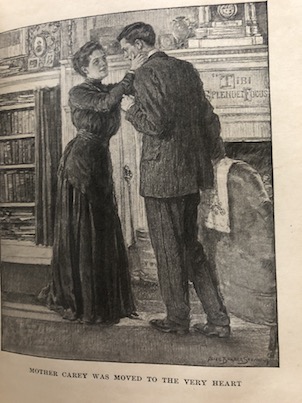
Mother Carey’s Chickens by Kate Douglas Wiggin, 1911.

The book begins with a quote from an older children’s book, Water Babies:

“By and by there came along a flock of petrels, who are Mother Carey‘s own chickens…. They flitted along like a flock of swallows, hopping and skipping from wave to wave, lifting their little feet behind them so daintily that Tom fell in love with them at once.”

This book is very different from the story in Water Babies (which is actually a very dark book for children), but the quote is foretelling some of the events of this story, and the characters refer to the story now and then throughout the book.  Mother Carey’s Chickens is the book that the Disney movie Summer Magic was based on.  The basic premise of the story is the same between the book and the movie, but there are also many differences in details.  For example, in the movie, the Carey family had only three children, and in the book there were four.  The oldest children in the family also seem older in the movie than they were in the book, and their stuck-up cousin Julia was also much younger in the book.

When the book begins, Mrs. Carey is not yet a widow, but she has received news that her husband, a Navy captain, is ill with what appears to be typhoid.  She has to go to him, leaving her four children Nancy, Gilbert, Kathleen, and Peter, at the house with their two servants.  (Kathleen was the child who did not appear in the movie.)  She gives them some instructions to call on their relatives if they need any further help and refers to them as her “chickens” in reference to the bit of seafaring folklore that the earlier quote mentioned.  They explain that this nickname for the children was based on a joke made by their father’s Admiral back when Nancy turned ten years old.

Nancy is the eldest of the Carey children (played by Hayley Mills in the movie), and from the way that the book describes her, I suspect her to be something of a Mary Sue for the author.  Nancy has a knack for making up and telling stories, and at one point, the book says, “… sometimes, of late, Mother Carey looked at her eldest chicken and wondered if after all she had hatched in her a bird of brighter plumage or rarer song than the rest, or a young eagle whose strong wings would bear her to a higher flight!”  Nancy and her younger sister, Kathleen, are both pretty, but Nancy is definitely the center of attention and a much livelier personality.  The book is complimentary to all of the children, however.  Gilbert is described as a “fiery youth” and little Peter, the youngest, as “a consummate charmer and heart-breaker.”  Although Peter is only four years old, the book says, “The usual elements that go to the making of a small boy were all there, but mixed with white magic. It is painful to think of the dozens of girl babies in long clothes who must have been feeling premonitory pangs when Peter was four, to think they couldn’t all marry him when they grew up!”  So, the Carey children are generally idealized as children, something pretty common in older children’s literature, especially in stories that are meant to teach certain lessons or morals, as this one does.

While the children wait for their mother to return home, they are on their best behavior even more than usual, with Nancy and Kathleen having the following conversation:

“It is really just as easy to do right as wrong, Kathleen,” said Nancy when the girls were going to bed one night.

“Ye-es!” assented Kathleen with some reservations in her tone, for she was more judicial and logical than her sister. “But you have to keep your mind on it so, and never relax a single bit! Then it’s lots easier for a few weeks than it is for long stretches!”

“That’s true,” agreed Nancy; “it would be hard to keep it up forever. And you have to love somebody or something like fury every minute or you can’t do it at all. How do the people manage that can’t love like that, or haven’t anybody to love?”

“I don’t know.” said Kathleen sleepily. “I’m so worn out with being good, that every night I just say my prayers and tumble into bed exhausted. Last night I fell asleep praying, I honestly did!”

“Tell that to the marines!” remarked Nancy incredulously.

So, the kids are pretty good, but perhaps not perfect. Still, Mary Sue characters usually do have a flaw that’s not really considered much of a flaw, making them more endearing.

Even if you don’t know the story from the movie, you may have guessed that when the children’s mother returns home, it is with the news that their father has died.  With the father’s death comes many changes for the Carey family, which is the point in the story where the movie begins.  Without the father’s salary, and with all four children less than fifteen years old, the family has to cut expenses, letting the servants go.
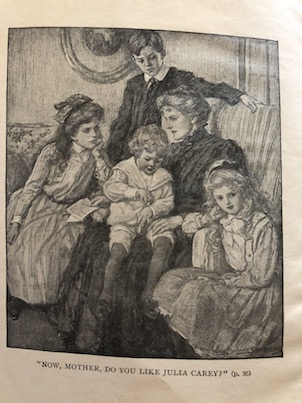
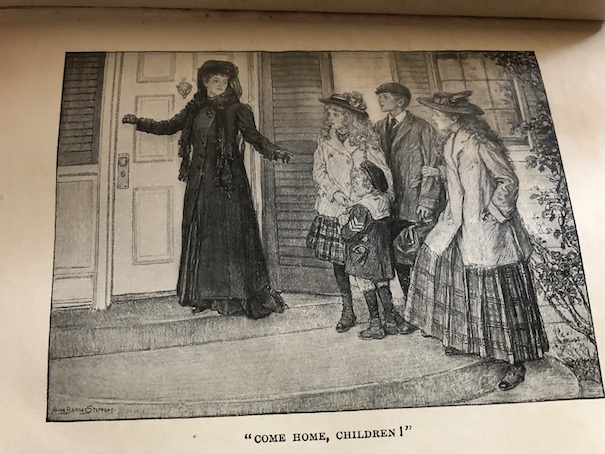
MotherCareysChickensJuliaComingThen, the family receives word that Captain Carey’s brother is in failing health and that his business partner, Mr. Manson, is seeking to place his daughter, Julia, with a relative.  Mr. Manson has already spoken to a cousin of the family about Julia, but this cousin has refused to take her.  The now-fatherless Carey family knows that taking on another relative will be an added burden on them, but Julia has no other family and nowhere else to go, so they see it as their duty to help her.  Admittedly, none of them likes Julia very much.  They remember her as a spoiled child who was always bragging about the wonderful things that her wealthier friend Gladys Ferguson had or did.  Even now, the Ferguson family has invited Julia for a visit before she goes to live with her aunt and cousins, but unfortunately, they have no intention of adopting her or even trying to care for her until her father is well themselves.  Nancy sees them as simply spoiling Julia and preparing her for a life that the Carey family can’t possibly support.

Then, Nancy has an idea that changes everything for the family.  She reminds them all of a trip that they took to Maine years ago and a beautiful old house that they saw in a small town called Beulah.  The memories of that happy time and idyllic house and small town call to them, and Nancy and her mother wonder what happened to the house.  They decide to talk to a friend of Captain Carey’s who had a small law office in the area, sending Gilbert to Beulah to find him.  In Beulah, Gilbert learns that the Yellow House (as people commonly call it, although it also has the name Garden Fore-and-Aft) belongs to the wealthy Hamilton family, who don’t live there but have used it as a kind of vacation home.  The father of the family, Lemuel Hamilton, is in diplomatic service and lives overseas.  During the last few years, the younger Hamiltons had used the house to host house parties of other young people they knew from school, but now the young people are living all over the world, and the house has been empty.  Gilbert’s father’s friend, Colonel Wheeler, and a local store owner, Bill Harmon, describe the house’s current condition to Gilbert.  Since the younger Hamiltons renovated the barn and put in a dance floor for their parties, it’s too fancy and no longer usable for its original purpose, which is why no farming families have been interested in the house themselves.  The men say that they can rent the house to the Carey family on behalf the Hamilton family (who, after all, still have to pay taxes on the property and wouldn’t mind a little extra money to cover it) for a sum much less than the rent of their current house.  The house could use a few minor repairs, and the barn is more fixed up for holding dances than keeping animals, but that’s no problem for the Carey family.  Living there would save the family a lot of money until the children are grown and able to start earning their own livings.  Even though Gilbert is only about fourteen, he is able to rent the house on his mother’s behalf.
MotherCareysChickensHome

The entire family is pleased, except for Julia, who is still a snob.  The book explains that Julia had always been a very well-behaved little girl although neglected by her somewhat flighty mother.  (The book doesn’t say exactly what happened to Julia’s mother, although she is no longer part of Julia’s life.  She may be dead, or she may have run off a long time ago.)  Because she was an only child and always seemed the “pink of perfection” (which provides the title of a song about Julia from the movie version of the book), always seeming to say and do the right thing, her father spoiled her from a young age, giving her every possible advantage he could.  When Julia first arrives at the Yellow House in Beulah to stay with her relatives, she still prattles on about her wonderful friend Gladys and all the luxuries she has.  The book says, “She seemed to have no instinct of adapting herself to the family life, standing just a little aloof and in an attitude of silent criticism.”  So, if Nancy sounded a little too wonderful in her earlier description, understand that Nancy thinks that Julia is too sickeningly perfect and smug.  Julia’s problem, as I see it, isn’t so much that she’s too perfect as she expects the rest of the world to be too perfect.  Because she is so focused on perfection, she isn’t sympathetic enough to other people or accommodating to imperfect situations.  As the book says, “She seldom did wrong, in her own opinion, because the moment she entertained an idea it at once became right, her vanity serving as a pair of blinders to keep her from seeing the truth.”  Besides being spoiled, she is very naive and rigid in her thinking.  She thinks that she knows what’s what and how things ought to be, and that’s all there is to it.

A major part of the story deals with Julia’s adjustment to family life and the realities of the family’s situation.  At first, she thinks that Mrs. Carey should save up for college for Gilbert and a proper coming-out for each of the girls in the family to give them all the advantages that life has to offer.  She’s sure that her father will get better and be able to help pay for everything when the time comes.  However, Mrs. Carey doesn’t want to wait on that hope.  She says that she’s sure that the children will be able to make something of themselves even without the advantages.  Matters come to a head with Julia when Kathleen gets tired of Julia complaining about everything and everyone and says that if her father hadn’t lost so much of her parents’ money as well as his own, the whole family would be better off.  Julia demands to know from Mrs. Carey if that is true, and Mrs. Carey says that she and her husband did invest in her father’s business, an investment which he may never pay back, due to his poor health.  She also tells Julia:

“You are not a privileged guest, you are one of the family. If you are fatherless just now, my children are fatherless forever; yet you have not made one single burden lighter by joining our forces. You have been an outsider, instead of putting yourself loyally into the breach, and working with us heart to heart. I welcomed you with open arms and you have made my life harder, much harder, than it was before your coming. To protect you I have had to discipline my own children continually, and all the time you were putting their tempers to quite unnecessary tests! I am not extenuating Kathleen, but I merely say you have no right to behave as you do. You are thirteen years old, quite old enough to make up your mind whether you wish to be loved by anybody or not; at present you are not!”

It’s an awful thing to say to a child that she isn’t loved, but it is something of a wake-up call to Julia to realize that the way that she was behaving was making herself unlovable to the people who should have been closest to her.  When she tells Mrs. Carey that Gladys loves her, Mrs. Carey says, “Then either Gladys has a remarkable gift of loving, or else you are a different Julia in her company.” Mrs. Carey tells her to consider what the Bible says about “the sin of causing your brother to offend.” It’s probably the first time that Julia was ever criticized for anything, breaking her perfect record of apparent perfection.  Julia has greatly provoked the rest of her family and realizes that she has earned whatever bad feelings they have toward her.  She has ignored their difficulties because she was too focused on what she wanted for herself and the way that she thought that life should be, not realizing how much harder she had made things for everyone.  For the first time in her life, Julia admits that she is not perfect and asks for another chance to make things right, marking a real change in her character.  Personally, though, I think that some of this drama could have been avoided if, knowing Julia and her behavior as she does, Mrs. Carey had spoken to her when she first came to live with the family, explaining the family circumstances in a straight-forward way and making it known that she expects certain standards of behavior from Julia when she’s in her house.  Making the rules and enforcing them them from the beginning may have prevented a lot of stress and saved Kathleen from exploding emotionally.
MotherCareysChickensLatinA character that appears in the movie, Ossian “Osh” Popham, is also in the book, although instead of being the store owner, he’s a local handyman who helps the family get the house in order.  His children, also characters in the movie, are in the book, too, although I didn’t like the way the book described his daughter, Lallie Joy.  It says that “she was fairly good at any kind of housework not demanding brains” and that she “was in a perpetual state of coma,” in case you didn’t understand that she’s basically stupid.  I always hate it when stories make a character intentionally stupid.  I did appreciate her explanation of her name, though: “Lallie’s out of a book named Lallie Rook, an’ I was born on the Joy steamboat line going to Boston.” I had wondered where the name came from.

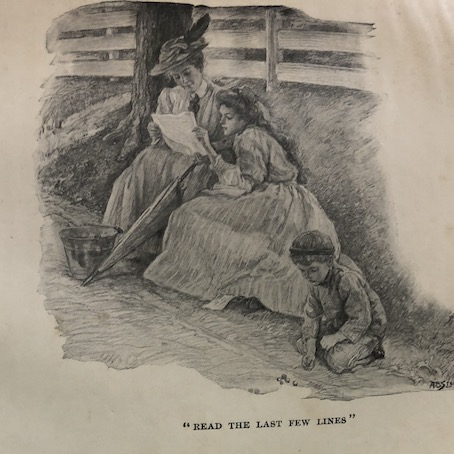
While the family continues fixing up the house to make it nicer to live in, Nancy writes a letter to the owner of the house, 50-year-old Lemuel Hamilton, who is an American consul in Germany, telling him about her family and their life at the house.  Lemuel Hamilton finds her letter charming.  Seeing the picture of her family that Nancy encloses with the letter makes Lemuel think of his own family, scattered to the four winds, the children grown or nearly grown, either away at school or starting their first business ventures in various parts of the world.  He’s lonely for the comforts of having all of his family living together and surprised at how happy this much-poorer family looks in the old house in the small town that his ambitious, social-climbing wife always thought was beneath them.  Then, it occurs to him that his sons are of an age when they’ll start thinking about marriage soon, and he wonders what wives they’ll choose and what their family lives will be like.  On an impulse, Lemuel writes to the Carey family, telling them that they can live in the house rent-free as long as they continue with the household improvements, and he also forwards Nancy’s letter to his younger son, Thomas (tying the story back to the quote at the beginning of the book), who is living in Hong Kong and who was the one who always liked the Yellow House the most.
MotherCareysChickensLetter

MotherCareysChickensTomRosesWhen Lemuel tells the Careys that they can stay in the house for as long as they like, unless his son Tom wants the house, Nancy begins thinking of Tom as a possible threat to her family’s happiness.  (She thinks of him as “The Yellow Peril” in a reference for the old xenophobic term used by people who were afraid of immigrants from Asia, since he would be coming from China, and as a pun on the Yellow House that they might be competing for. This term is also mentioned in the Disney movie.)  Of course, Tom turns out to be no threat.  Tom has been lonely pursuing his tea business in China, and Nancy’s letter and happy family life call him home to a romance that will change the lives of the Careys as well.  By the end of the book, Nancy is seventeen years old, old enough for romance and charmed by the romantic Tom.

The lessons that the story emphasizes are the importance of family relationships and togetherness over personal ambition and developing the ability to triumph over adversity instead of waiting for life advantages that may never come.  Like other books from the early 20th century, the values of hard work and cheerfulness are emphasized, and there is the implication that important people will recognize and reward these qualities when they see them.  Pretentiousness and snobbery are criticized.  A settled, happy family life is the ultimate goal.

Overall, though, I really prefer the movie to the book.  I think that cutting down some of the side plots improved the story.  Besides removing the younger daughter, Kathleen, from the story, the movie also eliminated other side characters, like Cousin Ann and the Lord siblings, Cyril and Olive, who also live in Beulah and become friends of the family.  Also, making Julia older than she was in the original book, closer to Nancy’s age than Kathleen’s, improves the sisterly relationship that the girls eventually have.

My copy of the book originally belonged to my grandmother, who was born the same year that this book was originally written.

The book is now public domain and available online through Project Gutenberg.

Molly’s Pilgrim

MollysPilgrim

Molly’s Pilgrim by Barbara Cohen, 1983.

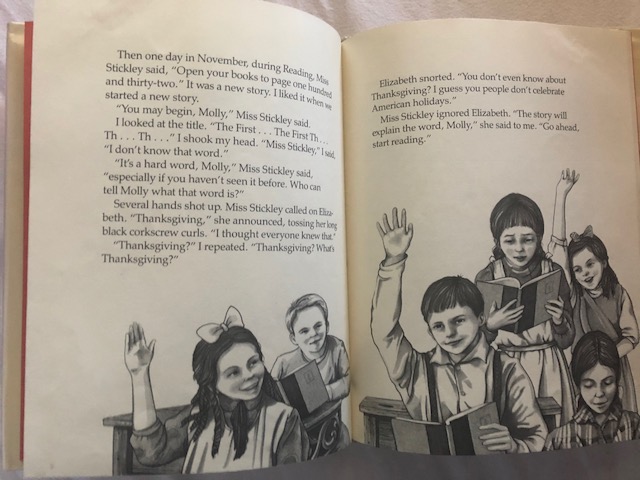
Molly has been unhappy since her family moved to the smaller town of Winter Hill, New Jersey so that her father could get a better job. In New York City, there were other Jewish girls like her, and she didn’t feel so strange and out-of-place. The Winter Hollow girls don’t understand her at all and don’t like her. Molly’s family fled Russia to escape persecution, and they’ve only been living in America for about a year.  Molly still has a Yiddish accent and doesn’t quite speak proper English yet.  Molly is constantly teased about the way she talks and her unfamiliarity with American habits.

MollysPilgrimSchool

One girl in particular, Elizabeth, makes up rhymes to make fun of Molly, even following her home from school like a creepy stalker, to continue singing them at her. The other girls follow Elizabeth’s lead because they kind of admire her and because she is always giving them candy.

MollysPilgrimBullies

Then, one day, the girls’ teacher begins teaching them about Thanksgiving. Of course, Elizabeth makes a big deal about the fact that Molly has never heard about Thanksgiving before. But, Molly finds the story about the pilgrims interesting. The teacher says that for their Thanksgiving activity, instead of making paper turkeys like they usually do, the children are going to make clothespin dolls to look like American Indians and pilgrims, so they can create a scene like the first Thanksgiving.

MollysPilgrimClass

When Molly gets home and explains the assignment to her mother, she has to tell her mother what a “pilgrim” is. She explains it by saying that they were people who came from across the ocean in search of religious freedom. Her mother understands that and offers to help Molly with the doll.

However, when Molly sees what her mother has done with the doll, she is worried. The doll is beautiful, but her mother has dressed the doll in the clothes of a Russian refugee, like Molly’s family, not in the traditional Puritan garb of the pilgrims. At first, Molly is sure that she’ll be teased more than ever at school when she shows up with a doll wearing the wrong clothes and that people will think that she’s stupid for not understanding how pilgrims dressed.

MollysPilgrimDoll

But, Molly’s mother is correct in pointing out that their family are modern pilgrims, coming to America for the same reasons that the original pilgrims did. Molly does get some teasing from Elizabeth (that’s not a surprise, since it’s Elizabeth, after all), but when the teacher asks Molly about the meaning of her doll, it leads everyone to a better understanding, both of the holiday and where Molly and her family fit in with their new country and its history.

Molly’s teacher points out that the holiday of Thanksgiving wasn’t entirely an original idea that the pilgrims invented all by themselves but that they took their inspiration from a much older Jewish tradition from the Old Testament.  Human beings do not exist in a vacuum, and we all regularly take ideas that we’re exposed to and build on them in our own lives.  Although Puritans were generally known for their belief in religious “purity” (hence, their name) and noted for their intolerance to different religions and beliefs, they also strongly believed in education, which frequently involves taking past ideas and knowledge and applying them toward new situations.  Their Thanksgiving celebration was just an example of that, an older idea that they used for their own purpose, adapted to the lives of the people who adopted the tradition.  It was their celebration, but not their sole intellectual property.

The book is currently available online through Internet Archive (multiple copies).

There is also a sequel to this book called Make a Wish, Molly, in which Molly learns about birthday parties in the United States.

My Reaction and Additional Information

The book doesn’t mention it, but the word “pilgrim” itself is also much older than the early Puritan colonists in America.  Before the development of the America colonies, it referred to any religious traveler on their way to a holy place, and many people still use it in that sense.  A person on a pilgrimage could be just about anyone from anywhere going to anywhere else as long as the journey has spiritual significance.  The Puritan colonists used that term for themselves to emphasize the reasons why they were seeking new homes in a new land.  For them, it was a kind of pilgrimage to a place where they could start again.  Molly’s family came to America in search of religious freedom, just as the Puritans did.  Their journeys weren’t quite the same, but they shared a common purpose and ended up in the same place (more or less).

By showing the links between Molly and her family and the pilgrims, Molly’s mother and her teacher help the other students to understand that Molly really does fit in, that her being there makes sense, and that she has a place in their class and in their celebration of Thanksgiving.

This story was also made into a short film. I remember seeing it in school when I was a kid in the early 1990s.  I checked on YouTube, and there are trailers posted for this film.  One thing that I hadn’t remembered from when I was a kid was that the time period of the book was earlier than the film.  In the film, the characters are shown to be contemporary with the time the film was made, but the style of dress of the girls in the book’s pictures and the things that Molly’s mother says about why the family left Russia indicate that the book probably takes place during the late 19th century or early 20th century, possibly around the same time as the events in the famous play/movie Fiddler on the Roof.

As a side note, if you’re wondering why the girl is named Molly, which doesn’t sound particularly Russian, Molly is typically a nickname for Mary and other, similar-sounding, related names.  Molly’s mother also calls her Malkeleh, which may be her original name or perhaps another variant, if her original name was Malka, as another reviewer suggests.

In spite of the warning on that last site I linked to about reading a book with your child that may be covered in class, I say to go ahead and read it anyway.  It’s hard to say what books may or may not be used in classes by individual teachers, and if your child’s teacher doesn’t happen to use this one, it’s still a good story.  Perhaps just warn your child not to say something that would spoil the ending for their classmates who haven’t read it yet.

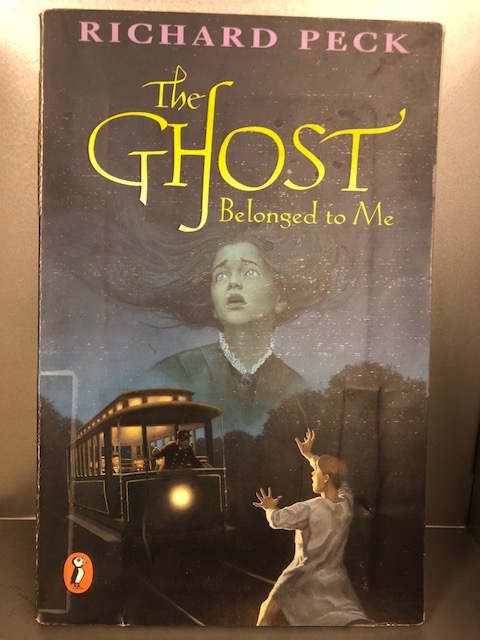
The Ghost Belonged to Me

GhostBelongedToMe

The Ghost Belonged to Me by Richard Peck, 1975.

The book takes place in the 1910s in a small town on the Mississippi River. Alexander Armsworth, a boy in his early teens, is approached by a girl from his class who tells him that the barn on his family’s property is haunted and that Alexander himself has the ability to see the “Unseen.” The girl, Blossom Culp, is a poor girl from a family of outcasts who has been known to tell tall tales, so Alexander isn’t sure he believes her at first. However, he can’t help but be curious, and when he sees a light coming from the barn at night, he decides to investigate.

Inside, he finds the ghost of a young girl who warns him of danger on the trolley tracks near his house and tells him that he must act fast to save everyone. Frightened, Alexander gets the trolley to stop and learns that by doing so, he has saved the lives of everyone on board from a disaster at the bridge further on. Naturally, everyone wants to know how Alexander knew to warn them. When Alexander explains, he is met with skepticism from his social-climbing mother and sister and unwelcome attention from news people and curiosity-seekers from town.

The ghost, who tells Alexander that her name is Inez Dumaine, is also in need of help before she can rest peacefully. Alexander will need the help of those who believe in him and the ghost to find Inez’s body and return it to her home in New Orleans.

In this first book in of the Blossom Culp series, Alexander is the main character, but the other books focus more on Blossom, who discovers that she also has the ability to see ghosts.  The book is available to borrow and read for free online through Internet Archive.

This is the movie that the Disney movie Child of Glass was based on, and the movie is available on dvd. Sometimes, you can also find it on YouTube, at least clips and reviews of it.

My Reaction

The story has sad and scary points, but those are balanced out by humorous situations. Alexander’s sister’s turmoil over the fiasco at her coming-out party is hilarious, and his mother’s change in attitude when she realizes that, instead of making them social outcasts, the ghost business actually attracts attention from one of the town’s leading citizens is a hoot. Blossom, of course, is wonderfully nosy, elbowing her way into Alexander’s life and selling tours of the haunted barn.

I was very young when I saw the Disney movie based on this book, Child of Glass (a live action movie that aired on television), and I was afraid of ghosts. However, years later, I took another look at the movie and decided to read the book that it was based on. When I did, I saw things I didn’t appreciate when I was young. The dialog and depiction of life in the early 20th century in the book are wonderful. It conjured up memories of Meet Me in St. Louis, especially the Halloween scene (which took place only about a decade earlier than this story). Unfortunately, this early 20th century setting wasn’t present in the movie version of this book because Child of Glass was placed contemporary with the time it was made, during the late 20th century.

The Disney movie was also different from the original book because it added the feature of the “child of glass” which didn’t exist in the original book. The “child of glass” was mentioned in a poem at Inez’s grave that explained how to lay her ghost to rest. At first, the Alexander and Blossom in the movie don’t know what it means, but it turns out to be Inez’s doll, which was lost when she was murdered by her wicked uncle. In the book, Inez died under different circumstances. However, the discovery of the doll in the movie uncovers the secret motive behind her murder, which is similar to the reason why Inez’s body was hidden in the book after she died in a riverboat accident.  In the book, Inez’s spirit finds rest after her body is found and taken to her family’s cemetery in New Orleans.  The Disney movie also turns this story specifically into a Halloween story, which wasn’t the case in the original book.