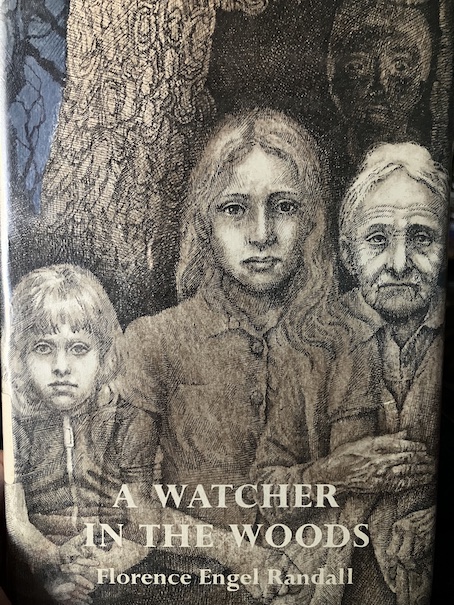
A Watcher in the Woods by Florence Engel Randall, 1976.
The Carstairs family is moving from Ohio to a small town in Massachusetts because Professor Carstairs will be taking a new job as head of the English department at the local college. Fifteen-year-old Jan knows that she will find the move harder than her parents or her younger sister. Her father will be busy with his work, and her mother will make friends with the wives of other faculty at the college. Jan knows that her little sister, Ellie, is still very young and in elementary school, and she won’t find changing schools as difficult as she will. Jan isn’t looking forward to trying to fit in at the local high school.
The family’s first difficulty in moving is finding a house in this new town that they like. Because it’s a small town, their options are limited, and it seems like there’s something wrong with each of the houses they see. Then, their realtor suggests that they view the old Aylwood place outside of town. Living there would mean a longer distance to drive to the college and the girls’ schools, but it’s a nice, big house with some land attached to it. The land includes woods and a pond. Elderly Mrs. Aylwood can’t afford to maintain the place anymore, but she has been reluctant to sell the house. She is very attached to it and she wants to make sure that, if she sells, that she will sell it to the right kind of people, who will take care of the land and woods.
From the first time that Jan and her family visit the house, it gives Jan a strange feeling. She has the oddest feeling that someone (or something) is watching them from the woods, and it frightens her. However, when she tries to explain her uneasy feelings to her mother, her mother thinks that it’s her imagination. Jan can’t deny that the house and wood give her the feeling of a fairy tale and that Mrs. Aylwood reminds her of a fairy tale witch.
For some reason, Mrs. Aylwood becomes more welcoming to the Carstairs family after she sees Jan, and she begins asking Jan some rather odd questions about herself. Mrs. Aylwood admits that Jan reminds her of her own daughter, Karen, who she lost 50 years ago when she was only 15 years old. Jan begins to understand that Mrs. Aylwood’s attachment to the house is because it’s a link to her daughter’s memory, but she soon begins to realize that there’s more to it than that. Mrs. Aylwood asks Jan what kind of person she is and makes a cryptic comment about how Jan is a human but there are other things besides humans.
Jan’s uneasy feeling of being watched continues, and mirrors in the house are inexplicably broken in an x-shaped pattern. When she befriends a neighbor, Mark, and talks to him and his mother about the house, she learns that Karen did not die but that she disappeared 50 years ago. She apparently went out for a walk to the pond in the woods one summer morning and simply vanished with no explanation. Searches for her never lead anywhere. Most of the local people believe that Karen ran away from home, although it would have been out of character for her to do that. Jan begins to wonder if the watcher she senses in the woods could be Karen, somehow hiding out or having returned after all these years, although Mark says that doesn’t make sense. Then, remembering Mrs. Aylwood’s comment about things that aren’t human, Jan wonders if the watcher could be Karen’s ghost. What if she died all those years ago, and her spirit haunts the woods?
It seems like someone or something is communicating with Ellie. Ellie seems to hear something speaking or humming when Jan can’t. Something even suggests to Ellie that she name her new puppy Nerak, which Jan realizes is “Karen” spelled backwards. Is Karen trying to communicate with them, or is it something else?
The book is available to borrow and read for free online through Internet Archive. This book has been made into movie versions twice, but the Disney movie from 1980 is more faithful to the original story. I’ll explain why below, but it involves spoilers.
My Reaction and Spoilers
When talking about my opinion of this book, I really need to include some spoilers. This is a very unusual book because it isn’t obvious until about halfway through what kind of story it really is. From the beginning, it’s set up like a ghost story, with Karen’s mysterious disappearance, the sense of something watching the house and family from the woods, and something trying to communicate through Ellie. It’s very suspenseful and mysterious, but this is not actually a ghost story. It’s really science fiction.
Karen isn’t dead, but she has been trapped in an alternate dimension since she disappeared 50 years ago. A being from that other dimension has also been trapped in our world since then. This other being is the mysterious watcher in the woods. Jan correctly senses that this other being is also female and a child, although beings of its kind live extraordinarily long lives because time works differently in their dimension. What has been 50 years for everyone else has only seemed like a day to her. She wants to return home, but she has had to wait for conditions to be right. She also wants to help Karen, and she has been struggling to communicate with Mrs. Aylwood and Jan and her sister so she can tell them what they need to do.
In the Disney movie, there are a couple of major changes from the original book. The first is that the location is changed from the US to England, although Jan and her family are Americans. It also features a kind of initiation ritual that Jan was undergoing just as her switch with the creature from the other dimension happened, adding an element that seems supernatural, although it is still science fiction. At the very end of the Disney movie, Jan brings Karen back from the other dimension, but in the book (Spoiler!) Mrs. Aylwood goes to join Karen in the other dimension instead.
In the book, Jan’s mother worries about what life would be like for Karen if she returns, aged 50 years in what must have seemed like only a day, having lost most of her life, or what it would be like if she has not changed at all but her mother has aged 50 years, and the world has been through so many major changes since she left. It isn’t clear whether or not Karen has aged in the other dimension, but Jan’s mother’s point is that the world she came from has definitely changed. Karen can’t go back to her old life, and there is some sadness about that and about what Mrs. Aylwood has been going through since Karen disappeared. However, Mrs. Aylwood decides to join Karen in this other world, where she’s been. We don’t really know what Karen’s condition is in the other dimension because we don’t see her. She may have aged very fast there, although I think they imply that she has not aged at all because time works differently in the other dimension. Since time works differently there, it seems like they either won’t age further there or will do so much more slowly than they would on Earth.
Between the two movie versions, the Disney movie version of this book from 1980 is more faithful to the original story because it maintains the concept that this is a science fiction story and that the watcher in the woods is a being from another dimension. The movie version from 2017 turns the story into a ghost story with no science fiction elements. In the ghost story version, Karen is also still alive and hasn’t aged after being gone for many years, but the watcher in the woods is a ghost who is holding her captive. It’s a spookier version, but I think the logic of the original book, with its science fiction theme, makes more sense.
The premise of the ghost story didn’t make as much sense to me because the ghost’s motives seem confused. First, the ghost takes Karen captive because she was staging a stunt for some friends where she appeared to be mocking the way he died. Then, he seemed to want to keep a girl for company, which is weird because it doesn’t seem like he interacts with Karen while he has her. He tries to make a bargain where he would be willing to release Karen in exchange for Ellie, but in the end, it turns out that human company isn’t really what he wants. (Spoiler!) He wants a ritual for his death that he was deprived from having when he was killed. The story just seemed to be all over the place with the ghost’s motives and desires. Is he out to punish Karen for her disrespect, lonely without human company, or just trying to get attention from the living to fulfill his final wishes? Even he doesn’t seem clear about that, which is why I prefer the sci-fi version.
I also thought that the premise of the sci-fi story was more original, and I enjoyed the twist of a story that seems like a ghost story but really isn’t. If any sufficiently advanced technology might look like magic to someone who had never seen it before, as Arthur C. Clarke said, it makes sense that any being who was sufficiently different from the human experience might appear to be some kind of supernatural creature to human beings who didn’t know what they were perceiving.
The Disney version from 1980 actually has multiple endings because the first endings they filmed didn’t quite work and didn’t get a good reaction from audiences. If you’re curious about what the three endings are like, Jess Lambert explains them in her YouTube review of the movie.
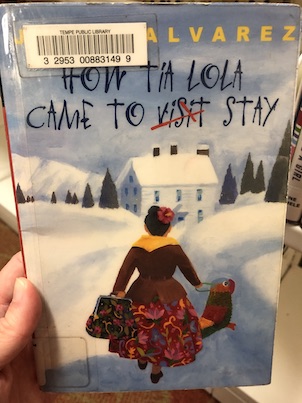
How Tia Lola Came to Visit Stay by Julia Alvarez, 2001.
After Miguel Guzman’s parents get divorced, Miguel’s mother moves from New York to a small town in Vermont with Miguel and his sister, Juanita, and invites her favorite aunt from the Dominican Republic, Tia Lola, to come stay with them and help raise the children. Miguel’s mother has gotten a job as a counselor at a small college in the area, and because of the hours she works, she asks her aunt to come and be with the kids. Miguel isn’t enthusiastic about the arrival of this aunt, who has to be called “tia”, the Spanish word for “aunt”, instead of “aunt” because she doesn’t speak English. Miguel and Juanita know some Spanish, but they’re more accustomed to English because they’ve always lived in the US.
The move from New York to Vermont isn’t easy because Miguel misses his father and New York City, and there are no other Latino families in this small town in Vermont, making Miguel feel like he doesn’t fit in. Some of the kids in Vermont don’t even know that Miguel is Latino, mistaking him for being from some other ethnic group or asking him uncomfortable questions about the way he looks and why his skin is darker than everyone else’s. He misses his old friends in New York and still doesn’t understand why his parents couldn’t just stay married instead of turning their lives upside down with this divorce.
When Tia Lola arrives, Miguel can’t think of anything else to say to her in Spanish except “Te quiero mucho” (“I love you a lot”), which is something his parents say to him. He’s a little embarrassed that he can’t think of anything else and that his sister is more bold with her Spanish, but Tia Lola appreciates the message and says that she loves both Miguel and Juanita, too. Miguel isn’t sure at first how long Tia Lola will be staying with them, but he’s astonished at the amount of luggage she’s brought. She says that she didn’t know what she would need in Vermont, so she brought a little of everything. Among her belongings are potions because Tia Lola practices santeria, particularly related to healing. Miguel’s mother explains that Tia Lola is something like a doctor, but with magic. Juanita thinks that sounds exciting, and she can’t wait to tell other kids about her magical aunt when school starts again after the winter break, but Miguel hopes nobody else finds out about Tia Lola.
Miguel thinks that people will think Tia Lola is crazy for thinking that she can do magic and for her other odd habits. The beauty mark on her face tends to change positions because she keeps forgetting where she put it last time. She refuses to even learn English, saying that Spanish is easier, and if Americans are so clever, how come they haven’t realized that? Miguel dreads what the kids at school will say about Tia Lola because they already tease him about other things. They call him “Goose man” because of his last name and quack at him. (Yes, I know geese honk and ducks quack, but the kids apparently don’t.) Miguel knows that the kids are just trying to have fun, but all the teasing makes him feel really uncomfortable, like he’s always going to be an outsider. Tia Lola is a colorful but eccentric character. A couple of boys from the Little League team at school mistake her for a ghost when they drop by the house because she’s dressed oddly and is carrying a brazier for doing one of her spells to rid the house of evil spirits. Apparently, there were already some local rumors about the house being haunted before they moved in, and Miguel lets the other boys believe that they really saw a ghost for awhile because he can’t think how to explain what Tia Lola was actually doing. At first, Miguel hopes that Tia Lola’s visit will just be temporary so no one will find out who Tia Lola really is and tease him about her. However, he gradually becomes fond of her and comes to reconsider himself whether or not Tia Lola’s “magic” really works.
As the family settles into their new home and the children get used to Tia Lola, they have to sort out some problems and learn how to live with each other. When Tia Lola realizes that Miguel seems embarrassed by her, her feelings are hurt, but Miguel finds a way to let her know that he’s glad she came. Miguel loves the stories that Tia Lola tells them about their relatives and legends of the Dominican Republic, like la ciguapa, a story that Miguel puts to his own use. (I love books with references to folklore and legends!) When she finds out that Miguel wants to try out for Little League, she makes special foods for him to help him get stronger. When Miguel turns ten years old, Tia Lola helps to throw a surprise party for Miguel with the boys from Little League. Miguel is relieved when the boys accept Tia Lola and laugh about how they thought she was a ghost.
Tia Lola sometimes gets homesick for the Dominican Republic, but she begins making friends in Vermont, starting with a local restaurant owner who joins her for Spanish lessons and dancing lessons. Tia Lola points out that people can have fun together even when they don’t speak the same language. However, the kids begin giving her English lessons, and she starts to learn some phrases. Her first attempts to speak English in public don’t go well because, while the kids taught her to speak phrases, they didn’t make the meanings of the phrases clear. Tia Lola starts saying the wrong things at the wrong time until they find a way to help her understand what she’s really saying and when to say it.
Through it all, Miguel keeps wishing that, somehow, his parents could magically get back together. In spite of Tia Lola’s “magic”, Miguel’s life and his parents’ marriage don’t return to the way they were before. Everyone’s life changes. Miguel comes to realize that there can be good changes as well as bad, and some of the changes that seemed really bad at first turn out to be better than he thought. Tia Lola is one of the greatest good surprises of them all, and Miguel finds himself hoping that, rather than just staying for a short visit, Tia Lola will stay with them forever.
This book is the first of a series of stories about Tia Lola, and it is available to borrow and read for free online through Internet Archive (multiple copies).
My Reaction and Spoilers
There is an interesting element to this story that I didn’t fully appreciate until the second time around. The first time I read this book, I read it in Spanish, the only other language I know with any fluency besides English. When you read the book in English, there are English translations for the Spanish words and phrases that the children use with their aunt. I didn’t need English translations for these phrases because they were pretty simple, but they’re useful for anyone who doesn’t know Spanish or is just a beginner. (By the way, please excuse the fact that I haven’t placed the proper accent marks in the Spanish words. I know where they’re supposed to go, like the ‘i’ in “tia”, but I’ve been having trouble typing them on this keyboard. I can fix that when I figure out what the problem is.)
Because I grew up in the Southwestern US, I took Spanish classes all through school. It’s the most popular foreign language class in Arizona schools because there are people who commonly speak it around here. It’s a very useful skill to have. My speech has always been weaker than my reading ability because of the way classes are taught, and my speech practice has been irregular. I often read children’s books in Spanish to keep my vocabulary sharp, but when I try to speak, I’m often slow. In some ways, I understand how both Miguel and Tia Lola feel, trying to communicate when you’re still learning and you have an imperfect understanding of another language. One of the things I liked about this story is that it shows how it’s okay to start with an imperfect knowledge. In my experience, if you know some of another language, the other person will try to help you and meet you halfway. Even if you don’t say everything exactly right or you’re slow and clumsy, you can still find a way to get your point across, and the more you practice, the more you improve.
Miguel and Tia Lola go through that same process, starting out with communicating imperfectly and learning to meet each other halfway, not just with language but with learning to live together as family. Miguel’s mother says, “The easiest language to learn but the hardest to speak is mutual understanding.” Tia Lola seems to have a kind of magic about her, not the fairy tale kind, but the kind that comes from having a unique way of looking at things and from understanding people. She doesn’t magically have all of the answers, she makes embarrassing mistakes sometimes, and she can’t fix Miguel’s parents’ marriage, but she makes life better for the family by being there and caring.
When Miguel’s father finds out that Tia Lola is staying with them, he likes the idea because Tia Lola will help the children improve their Spanish, something that he also wants. Miguel confides his initial worries about Tia Lola and what the other kids will say about her to his father over the phone. Miguel’s father tells him that, if he is proud of himself and proud of his family, he shouldn’t care what other people think. It’s easier said than done with the other kids at school teasing Miguel all the time. Miguel’s father says that he’ll understand evenutally and also that accepting other people for who they are helps them become the best versions of themselves they can be. Miguel thinks about what his father has told him before about the harmful effects of stereotypes because people make unfair assumptions about other and the things other people have assumed about him because of his background. One kid at school told him that he was bound to make the Little League because his family is from the Dominican Republic, like his baseball hero Sammy Sosa, and that baseball must be in his blood, but Miguel knows that’s just a stereotype. Miguel’s father tells him that his skills at baseball are his own, not due to being from the Dominican Republic, and if he makes the team, it will be because his skills are good and he worked to develop them. It makes Miguel think about some of the things he’s been assuming unfairly about Tia Lola and what she’s like, and he begins looking at her in a different way.
The book ends at Christmas, one year after Miguel’s parents separated, they moved to Vermont, and Tia Lola came to stay with them. Miguel and his mother and sister accompany Tia Lola on a visit to the Dominican Republic, where he meets his other relatives and sees what Tia Lola’s original home is like. There, he makes it clear to her that he wants her to come stay with his family in Vermont permanently, and she decides that she wants to keep living with them, too.
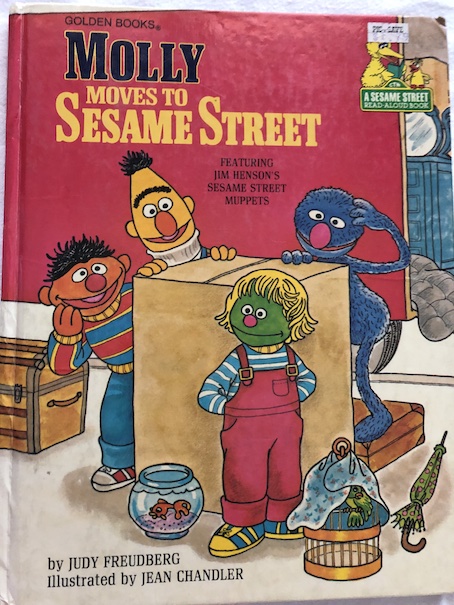
Molly Moves to Sesame Street by Judy Freudberg, illustrated by Jean Chandler, 1980.
The characters from Sesame Street greet a new neighbor who is getting used to a new home and needs some new friends.
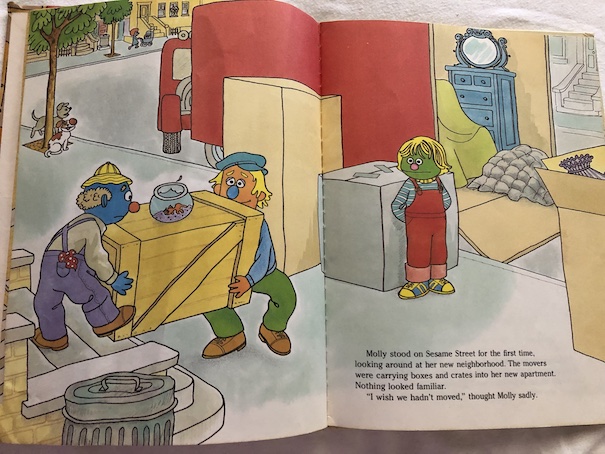
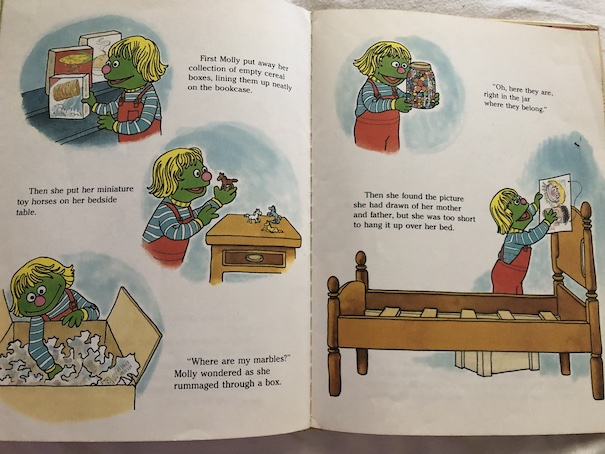
Molly and her parents are moving into a new apartment on Sesame Street, but Molly feels uncomfortable because nothing in this new neighborhood feels familiar. Her new room is still bare and doesn’t look or feel like home. Molly’s parents reassure her that it will feel more like home once all of her belongings are unpacked.
After Molly helps to unpack for awhile, her parents encourage her to go out, explore the neighborhood, and make some new friends. They say that, by the time Molly comes back, they’ll have things unpacked, and her new room will look much better.
When Molly first meets the characters from Sesame Street, they’re playing a game of hide-and-seek, but they all come out when she calls to them. They all introduce themselves to Molly and invite her to join their game.
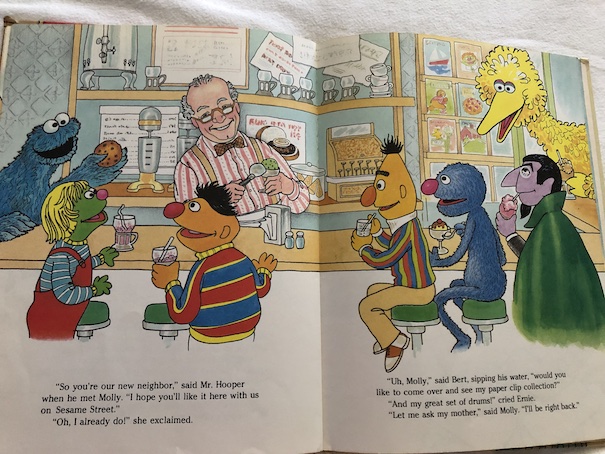
After they play, they all go to Mr. Hooper’s store for ice cream and sodas. Molly is happy that she’s having fun and starting to make friends, and she’s starting to like her new neighborhood.
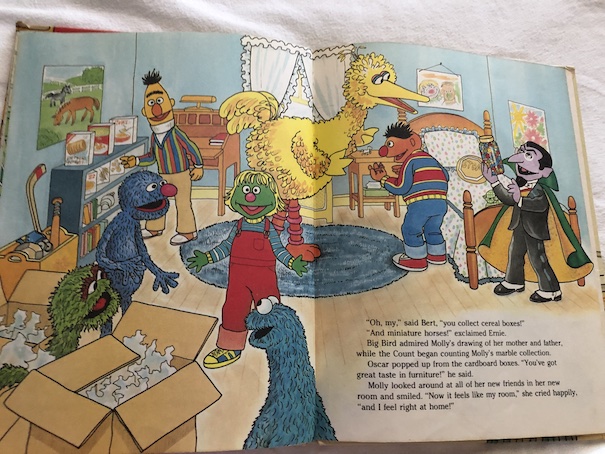
When Molly returns to the apartment, her parents have finished unpacking and arranging her new room. Molly is happy because it looks and feels more like home, and she invites her new friends to come over and see it.
This is a fun and reassuring picture book for young children that shows how making a new home look familiar and making new friends can help them to feel more at home when they move to a new place.
The book is available to borrow and read for free online through Internet Archive (multiple copies, some in different languages), but some later printings of the book have different illustrations and include Elmo, who wasn’t in the first edition of the book.
Mystery of the Pirate’s Ghost by Elizabeth Honness, 1966.
Abby
and Kit Hubbard’s mother has just received a letter telling her than her half
brother, Jonathan Pingree, has died and left her the old Pingree mansion. He has left over bequests to other family
members as well, and money to be held in trust for Abby and Kit. It’s exciting news, and the family may move
to live in the mansion they have inherited, although it partly depends on Mrs.
Hubbard’s other relatives.
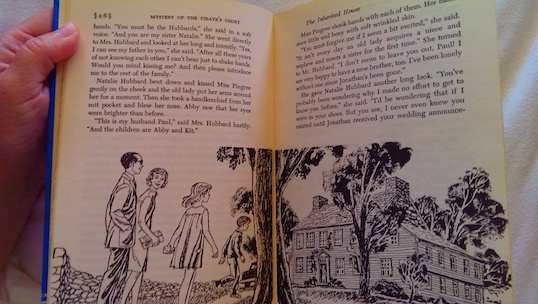
Mrs. Hubbard, who was born Natalie Pingree, has never met her half-brother or half-sister. They were her father’s children, from his first marriage. She doesn’t know much about her father’s early life because he died when she was very young, and all that she knows about him is what her mother told her. Apparently, her father’s first marriage was not a happy one. He stayed in that marriage long enough for his first two children, Jonathan and Ann, to become teenagers. Then, he made sure that his first wife and children were settled comfortably enough in the family home and left them to move to Philadelphia to start a new life by himself. Sometime later, his first wife died and he married Natalie’s mother, who was much younger. After his death, Natalie and her mother moved in with her mother’s sister, Aunt Sophie. When Natalie got married, Aunt Sophie sent a wedding invitation to Johnathan and Ann, but they never came to the wedding or made any reply. Natalie assumed that they felt uncomfortable about their father’s remarriage and didn’t want to see her, which is why she’s so surprised about Jonathan leaving the family home to her. The only reason she can think of why he would do that is that neither he nor his sister ever married or had children of their own, so there was no one else to leave the house to. Both of them were more than 30 years older than Natalie, and Ann is now an elderly woman, still living in the house. Jonathan’s will has made provision for her as well, and the Hubbards go to see her at the Pingree mansion.
Mrs. Hubbard is pleasantly surprised that Ann is actually happy to see her. Ann Pingree explains that the reason why she and Jonathan never replied to the wedding invitation was that, until that invitation arrived, neither of them had known that their father had another child, and they felt awkward about it. However, Ann has been lonely since Jonathan’s death, being the last of the Pingrees, and she is glad to have Natalie and her husband and children with her and is eager to have them move into the mansion and live there. (Ann doesn’t live in the old mansion itself, but she does live nearby.)
Aunt Ann shows the family around the old mansion and explains more about its history and the history of the Pingree family. It turns out that the house, which has existed since Colonial times, although it has been burned, remodeled, and expanded over time. The house also has a number of secrets. Apparently, there used to be a tunnel running from the basement of the house to the beach that was used to bring in smuggled goods during the Colonial Era. There is also a hidden room behind a fireplace upstairs where the children of the family could hide during Indian attacks. (It doesn’t say how often that happened.) To the family’s surprise, Ann also tells them that the mansion is supposed to be haunted. The kids think it all sounds exciting, although Ann doesn’t explain much about the ghost the first time she mentions it. (Kit uses the phrase, “Honest Injun?” when asking Aunt Ann if she really means it when she says that the house is haunted. This isn’t a term that people use anymore because it isn’t considered appropriate.)
Mr. Hubbard is able to get his job transferred to a different branch of the company he works for, so the Hubbard family decides that they will move into the Pingree mansion. The kids like living by the beach, and their parents tell them that they can use the old ballroom of the house as a kind of rec room. Soon, they meet a couple of other children who live in cottages nearby, Chuck and Patty, and make friends with them. Chuck and Patty have already heard that the Pingree house is supposed to be haunted, although they’ve never seen anything really mysterious, just a light in the house once when they thought that the house was supposed to be empty.
The next time Aunt Ann comes to visit, the four children ask her to tell them about the ghost, and she tells them the story of the first Pingree to live at Pingree Point. This ancestor, also named Jonathan Pingree, built the original house in the late 1600s. He was a shipbuilder who owned several ships of his own, and he wanted to live near the sea. Later, he also became a privateer. When the kids call Jonathan a pirate, Aunt Anne agrees and explains that, unlike a pirate, Jonathan’s position as privateer was all perfectly legal because he had a Letter of Marque. (Yes, privateers operated within the law, but yes, they were also essentially pirates who raided other ships for their goods. In other words, they did the same things, but privateers did it with permission whereas ordinary pirates didn’t get permission. Historically, some privateers continued their pirating even after permission was revoked, so as Aunt Ann says, “the line between that and piracy was finely drawn.”) His son, Robert, was sailing on one of his father’s ships when it was taken by other pirates, and Robert was forced to join their crew. The family never saw Robert again and only found out what had happened from a fellow crew member who was set adrift and managed to make it back home. What happened to Robert is a mystery. His family didn’t know if he had really taken to the life of a pirate and couldn’t return home because he couldn’t face his family, if he had been killed in some fight, if he had been hung for piracy because he had gotten caught and couldn’t prove that he was forced into it. However, members of the family claimed that Robert’s spirit did return to the house and that he knocks at doors and windows, begging to be let back into his old home. Aunt Ann says that she’s never seen the ghost herself, but old houses can make all kinds of noises on windy nights, and that’s what she thinks the “ghost” is. As Chuck and Patty leave, they say, “we hope that old ghost doesn’t show up to frighten you.” Of course, we all know that it will because otherwise this book would have a different title.
One day, Kit is bored and starts playing around in the secret room, pretending that he’s hiding from American Indians. While Kit is in the secret room, he overhears the servants, John and his wife Essie, who have worked for the family for years, talking. Essie seems very upset and wants John not to do something that might risk their home and jobs, but John says that it’s too late and that they’re already “in it” and “can’t get out.” Kit tells Abby what he heard. That night, Abby hears banging and wailing during a storm and fears that it’s the ghost. Soon, other strange things happen, like a desk that mysteriously disappears and a cupboard that also mysteriously appears in its place. The children like John, and they don’t want to think badly of him, but he’s definitely doing something suspicious. One night, the children try to spy on him, and Abby once again hears the wailing and sees a mysterious, cloaked figure in the fog. Is it the ghost?
There are some interesting facets of this story that make it a little different from other children’s books of this type. For one thing, the children confide their concerns to their parents almost immediately, and the parents immediately believe them. In so many children’s mysteries, either the children decide to investigate mysterious events on their own before telling the parents or the parents disbelieve them, forcing the children to investigate on their own. It was kind of refreshing to see the family working together on this mystery. It actually makes the story seem more realistic to me because I can’t imagine that I would have been able to keep worries about mysterious things secret from my parents as a child, and they would have noticed if I was sneaking around, trying to investigate people, anyway. Abby and Kit do something dangerous by themselves before the story is over, but they also confide what they’ve done to their parents at the first opportunity and do not take the same foolish chance again.
The truth of John’s activities comes to light fairly quickly, although it takes a little longer for the family and the authorities to decide how to handle the situation. Investigating John brings to light some of the Pingree family secrets, and Abby and Kit soon discover the fate of Robert the pirate and the truth of his ghost. I’ll spoil the story a little and tell you that the ghost that Abby sees is apparently real, but it isn’t very scary. Once they learn the truth of what happened to Robert and see that his body gets a decent burial, the ghost appears to be at peace.
One thing that bothered me was the way that the characters talk about Native Americans in the book. It’s not the talk about Native American sometimes abducting children because I know that happened. It’s more how they picture that would happen. In the scene where Kit was hiding in the secret room, Kit imagines that the Indians were attracted to the house by the smell of his mother’s cooking and that he went into hiding while his mother fed them to avoid being abducted. As part of his scenario, he imagines that his mother would have wanted to “hold her nose against the Indian smell.” What? Where did that come from? There are all kinds of tropes about Native Americans in popular culture, from the “noble savage” image to that silly “Tonto talk” that actors did in old tv westerns, but since when are they supposed to smell bad? I’ve never seen characters in cheesy westerns hold their noses before, so what’s the deal? I tried Googling it to see if there’s a trope that I missed, but I couldn’t find anything about it. I’m very disappointed in you, Elizabeth Honness.
This book is currently available online through Internet Archive.
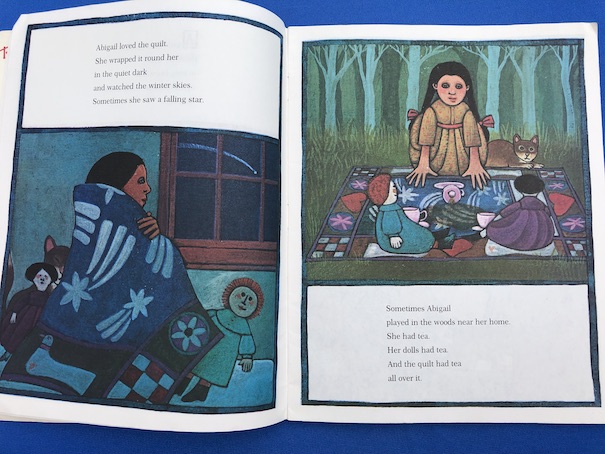
The Quilt Story by Tony Johnston and Tomie dePaola, 1985.
A woman
(at some point in the 1800s, from the pictures) makes a special quilt for her
young daughter, Abigail. It has Abigail’s
name on it and a pattern of falling stars.
Abigail loves it!
Abigail uses the quilt all the time, not just in bed. She has tea parties with her dolls on the quilt, hides under it when playing hide-and-seek, generally taking it everywhere and playing all kinds of games with it. The quilt gets worn and torn in the playing, but her mother mends it when necessary.
Eventually, Abigail and her family move to a new home, traveling in a covered wagon. Everything in their new home seems strange to Abigail, but her old quilt comforts her.
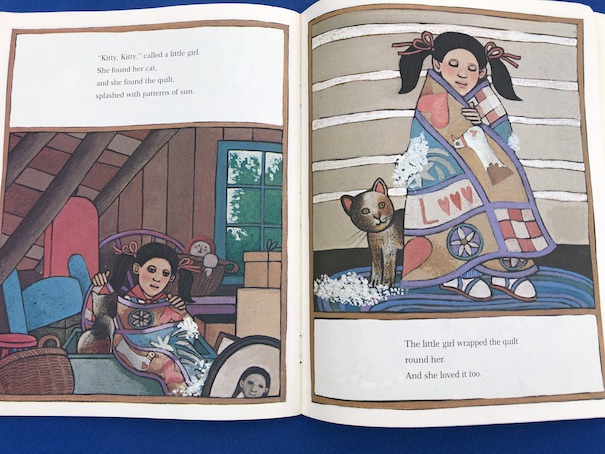
Eventually, when Abigail is older, she puts the quilt away in the attic, and people forget about it. Still, animals use the quilt. A mouse makes a nest it in. A raccoon hides food in it, and a cat naps on it. Then, one day, another girl finds the quilt in the attic. She loves it and brings it to her mother to be repaired.
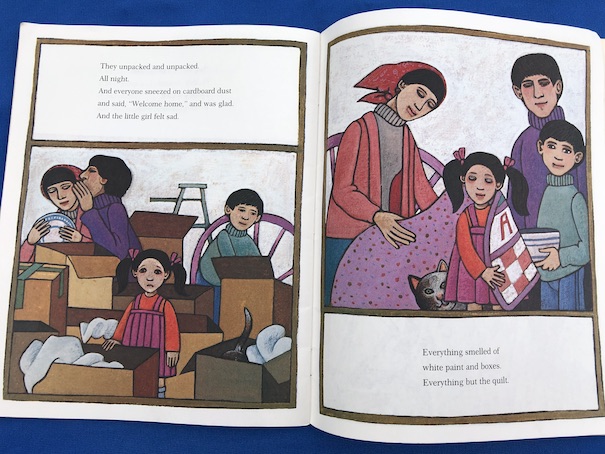
Like Abigail, though, the modern girl’s family soon moves to a new home, where everything seems new and strange. However, the old, familiar quilt comforts the girl once again.
This is a gentle, comforting story that would make nice bedtime reading or a story that could be read to a young child who is moving or has recently moved, reminding them that, even in a new place, you can bring a sense of home and the familiar with you.
The book is currently available online through Internet Archive.
The Court of the Stone Children by Eleanor Cameron, 1973.
Nina and her parents have recently moved to San Francisco from Nevada. Nina doesn’t like living in the city, but the move was necessary because her father has been ill and in need of a job. Still, Nina misses her friends, and her parents don’t understand how difficult Nina has found it to make friends in their new home.
One of the most popular girls, Marion Charles, nicknamed Marnychuck, and her friends like to tease Nina at every opportunity. Nina doesn’t think that she even wants to try to be friends with them because hanging out at Marnychuck’s house would mean always having to be on her guard about every little thing she says, knowing that they would twist every innocent comment she makes into some sort of joke so they could laugh at her. They could never be friends because there would be no way that Nina could ever open up to them about anything. (Sadly, I know the type all too well.) For example, one day, while the girls are walking home from school, they start talking about things they want to be when they grow up. Nina says that she wants to be “something in a museum,” momentarily forgetting the word “curator”, until a boy nearby helpfully supplies the word. Of course, Marnychuck and her friends ignore the helpful word and just laugh about “something in a museum” as they walk away.
However, the boy who was listening turns out to be genuinely curious about why Nina wants to work in a museum, saying that it sounds like an unusual ambition. Nina tells him that, until she had come to San Francisco, she’d never been in a big museum before, and she describes how the one in the park impressed her. She used to work in a small one in her home town. The boy understands the way she feels and shares her love of the past. He tells her about Mam’zelle Henry, a local woman who owns a private museum called the French Museum.
Nina visits the French Museum and loves the rooms with old-fashioned furniture. They give her a strange feeling of timelessness, and before she knows it, she finds herself in a room with another young girl who says, “I knew you’d come.” Nina isn’t sure who this mysterious girl is, but she asks her to come back another time.
When Nina returns to the museum the next day to return an umbrella that she borrowed from Mrs. Staynes, the registrar at the museum, she speaks to the girl again in the museum courtyard. The courtyard is full of stone statues of children, and the girl tells Nina that when she was young, she used to wish that they would come to life. The girl’s name is Dominique, although she says that people usually call her Domi. The two girls begin talking about their lives, although Domi oddly talks about her past in the present tense. Domi tells Nina about her emotionally-distant grandmother and her loving father, who was imprisoned and shot. The news of Domi’s father being shot comes as a shock to Nina. Domi tells Nina that, after her father was (“is”) imprisoned and shot, she had a dream about Nina in which her father said that Nina would help them. Domi also says that the rooms at the museum are from her home in France, which was taken apart to be “modernized”and some of the pieces were sent to the museum. Nina finds Domi’s story confusing, but Domi says that they will talk more later.
Nina meets up with the boy who introduced her to the museum, whose name is Gil, at the cottage of Auguste, who lives on the museum property. As she talks with the two of them and Mrs. Staynes, Mrs. Staynes brings up the subject of the ring that Nina saw Domi wearing and which also appears in a painting in the museum. Earlier, Mrs. Staynes had told Nina that she couldn’t possibly have seen anyone wearing that ring, and Mrs. Staynes now explains that the reason why is that she owns the ring herself. At first, Nina thinks that she must own a ring which is similar to Domi’s, since the two of them couldn’t have the same ring,but then, it turns out that the cat that Domi said was hers also belongs to Auguste.
The answer, as Nina discovers the next time she meets Dominique, is that Domi is a ghost. Mrs. Staynes does own Domi’s ring now because Domi died a long time ago. Nina faints when Domi’s hand goes right through hers. When Nina recovers, Domi is gone, and Mam’zelle Henry gives her a ride home. The two of them bond as they discuss Nina’s ambition to become a curator.
Mam’zelle lets Nina borrow a journal that she found in the garden that belonged to Odile Chrysostome in 1802. Odile was one of the names of the stone statues in the courtyard, according to Dominique, and Nina learns that the others are also named after members of the Chrysostome family. The people at the museum say that they don’t know which of the statues is supposed to have which name, but thanks to Dominique, Nina does.
Gil becomes Nina’s first friend her own age, and he’s been working on a project involving time. Someday, he wants to write a book about the concept of time. Time is important because Domi needs Nina’s help to resolve problems that occurred in the past.
Domi was young during the time of Napoleon. Her mother had died in childbirth along with Domi’s younger sibling. After her mother died, her grandmother moved into the house to oversee things and help care for Domi. However, Domi’s father had protested some of Napoleon’s policies of conquest, and it led to his downfall. One day, Domi discovered her father’s valet,Maurice, murdered in her father’s bedroom. She had thought that her father was there the night before, having returned from being away for a time, but he was nowhere to be found. A short time later, her father was charged with conspiring against Napoleon and executed. Domi knows that her father was innocent of the charges, and she suspects that Maurice was killed because he knew something important, but she needs Nina’s help to find the missing pieces. Domi knows that Mrs. Staynes is working on a book about her father’s life, and she doesn’t want the false accusations against him to be printed.
This book is available to borrow and read for free online through Internet Archive.
My Reaction and Spoilers
I thought that the book started out a little slowly. It takes quite a while before Nina discovers that the boy’s name is Gil or learns anything about him, and it’s about halfway through the book before Nina learns that Domi is a ghost, although there are hints before it. I knew that Domi was from the past, although I thought at first that she might be a time traveler of some kind. Even after Nina learns that Domi is a ghost, it takes a while before Domi tells Nina her full story and what she really needs her to do. The first part of the book dragged a little for me, and I was a little confused at first about why Odile’s diary was so important, but it turns out to contain the vital clues that Domi needs. Domi’s father was with the Chrysostome family at the time that he supposedly murdered his valet and was conspiring against Napoleon. There is a piece of physical evidence that proves it, and finding it convinces Mrs. Staynes to change her book.
One of Nina’s strengths is her power of imagination, and she helps Mrs. Staynes not only to see the truth about Domi’s father but to see him as a living, breathing person. Before, Mrs. Staynes’ book was mostly facts with little sense of the feelings of the living people behind it, but Nina’s discoveries and imagination help breathe life into the work. At the end of the book, the past remains unchanged (Domi’s life and that of her father are what they were before), but having the truth known gives Domi peace. Nina also makes peace with her new life in San Francisco, having discovered new opportunities and friends there as well as a nicer apartment for her family to live in.
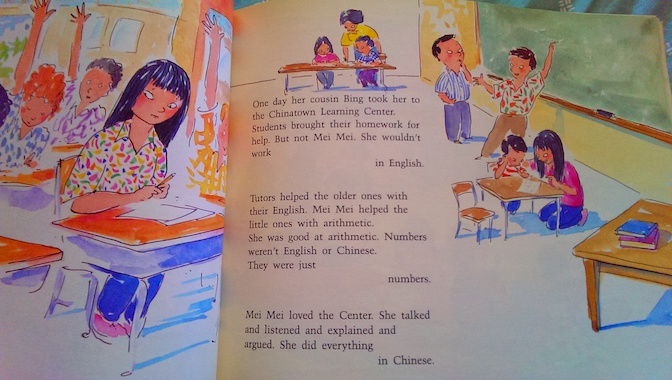
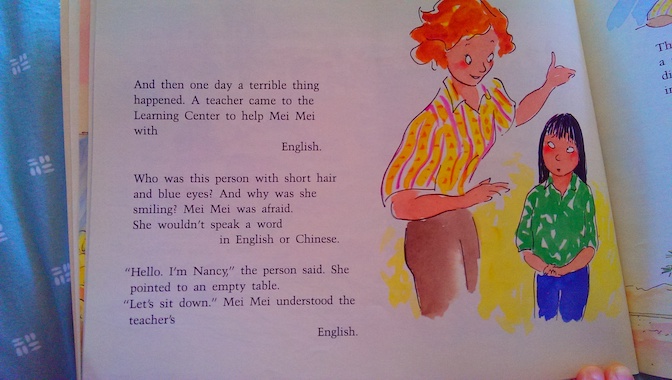
When Mei Mei’s family moves from Hong Kong to New York, she finds herself forced to go to a school where no one else speaks Chinese. She is expected to learn English and to read, write, and speak in English, and she hates it! To her, English is a very strange language, and the writing system is nothing like Chinese. For a time, Mei Mei refuses to speak in English, even when she understands what is being said around her, because she hates it so much.
The only part of New York that Mei Mei really likes is Chinatown and the Chinatown Learning Center. Mei Mei likes it because she is surrounded by people speaking Chinese. There, she can relax and be herself because people there understand her.
However, Mei Mei’s refusal to speak English isn’t helping her at school or anywhere else. It’s keeping her from speaking to anyone outside of Chinatown, and it can’t continue. When an English teacher, Nancy, comes to the Learning Center to help Mei Mei with her English, she resists learning at first. She feels like she’ll lose her Chinese and part of her identity if she uses English.
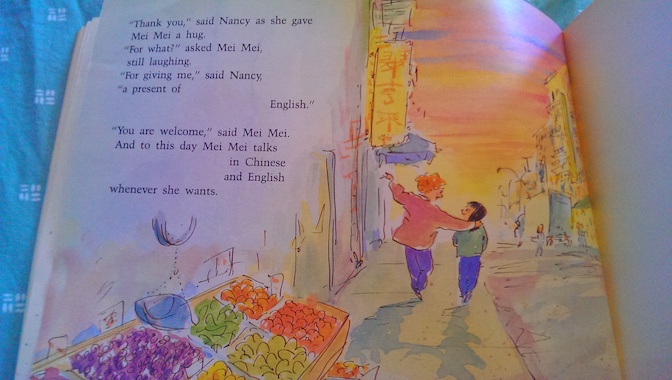
At first, Mei Mei’s worries about speaking English intensify with Nancy’s lessons. It disturbs her how English has words that would be difficult or impossible to translate into Chinese and English words seem to be coming more easily to her, even when she doesn’t really want to speak the language. Nancy explains to Mei Mei that English is necessary for her because she will need it to talk to many people in America, and there are many people who also want to talk to Mei Mei and be her friend, including Nancy. It’s only when Nancy overwhelms her by constantly talking in English and Mei Mei becomes desperate to talk about herself and be understood in English that Mei Mei realizes that speaking a new language doesn’t mean losing her identity. It’s just another way of expressing herself, and she can go back and forth between the two any time she wants.
Mei Mei’s feelings of strangeness in her new home and the difficulties of learning a new language are relatable. The hardest part of the experience for Mei Mei is feeling like she might be giving up a part of her past, her culture, and herself by switching from Chinese to English. But, refusing to speak English puts Mei Mei in the position of being someone who can only listen, never talk, limiting her ability to be understood and to make friends. In the end, she comes to realize that speaking a new language is not a matter of giving up anything, just adding to what she knows and making herself understood in a new way. It’s the beginning of expanding her horizons and building relationships with new people.
My favorite part as a kid was the part where Mei Mei and her friends went to the beach and cooked shellfish that they found. It was interesting to me because I never lived near a beach when I was young. The lifeguard at the beach tells Mei Mei and her friends that they can’t eat the shellfish, and they realize that he thinks that because he doesn’t know how to cook them. I never did either and still don’t, but I liked hearing about it.
The book is currently available online through Internet Archive.
Laura and her twin brother, James, are practical children who are fond of useful facts, but still have imaginations and appreciate fantasy stories. In this part of the Tales of Magic series, all of the previous books in the series are fictional books that the characters have read and enjoyed, and real magic may or may not exist, as the title suggests. All throughout their coming adventures, the children are never quite sure how much of what happens is magic and how much isn’t, but they’re bound for an amazing summer.
Laura and James’s family has recently bought a house in the country, and the story begins with the twins taking the train to their new town while their parents follow in the car with their luggage and their baby sister, Deborah. Laura and James haven’t seen the new house yet, but they know that it’s pretty old, and they speculate if it could be haunted or maybe even magical, like something from a fantasy story. James doesn’t think so. He thinks that magic, if it existed, is a thing of the past. Then, a strange girl on the train tells them that magic does exist. She insists that her grandmother is a witch and makes a comment about how they should “drop a wish in the wishing well, and wait and see!”
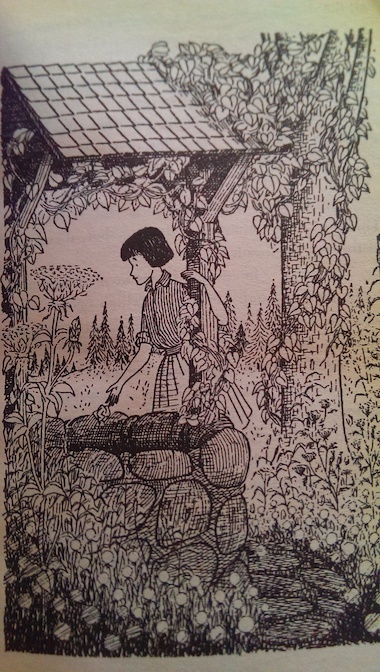
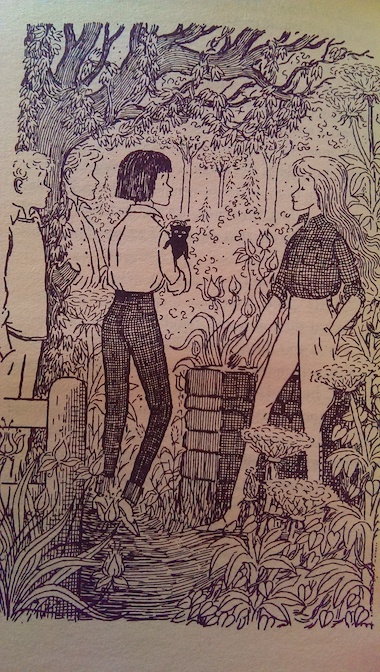
Laura and James don’t know what she means, but it turns out that there is an old well on the property of their new house. James ignores it, but Laura can’t resist giving the wishing thing a try. After struggling to come up with something appropriate to wish for, she finally writes a note that says, “I wish I had a kitten” and tosses it into the well. The next day, when they meet the boy next door, Kip (short for Christopher), they find a basket with two kittens in it sitting on the edge of the well. Kip figures that Lydia found the note that Laura wrote in the well bucket and decided to make her wish come true by leaving a couple of stray kittens for her.
It turns out that the girl from the train is Lydia Green. Kip says that she lives nearby with her grandmother. Lydia’s grandmother is an artist, and both of them are eccentrics. Lydia is kind of a wild child who likes to spend her time riding around on her black horse. She’s something of an outcast in the community, and she knows it. When the other children go to see her to ask about the kittens, Lydia seems prepared for them not to like her and for her not to like them, either. However, when she finds out that Laura’s names for the kittens were inspired by the book The Midnight Folk, she warms up to them because she also likes fantasy stories, and Laura offers to share the magic of the well with her.
James is more skeptical about Lydia and insists that she prove that there’s magic around, if her grandmother is really a witch. Lydia is reluctant at first, but then she shows the other children her grandmother’s garden. She insists that one of the plants in the messy garden (which does look like it might belong to a witch) can bring visions when it’s burned and maybe even a visitor from another world. (Sounds trippy.) The others want to see it work, so they decide to burn some. Nothing happens, and when James demands to know how long they have to wait, Lydia gives a vague answer that it might not be the right time or that maybe she just made the whole thing up. James believes the second explanation, but Laura is willing to give Lydia (and magic) more of a chance.
The two girls bond over their shared love of fantasy stories, and Laura invites Lydia to come to their house the next day. The boys admit to Laura that they kind of like Lydia, although she’d be easier to get along with if she didn’t have such a chip on her shoulder. Kip says that she’s always like that, and that’s why kids at school don’t get along with her either. Even so, Lydia is an interesting person.
When Kip gets home, he finds more of the strange plant that Lydia burned growing around his house, and his mother tells him that it’s an ordinary wildflower. Still, the next day, something happens which makes it seem like Lydia’s notion that it “makes unseen things appear and seen things disappear” has come true – the old lawnmower that came with the house is now missing, and there’s a young tree on the property that wasn’t there before. Coincidence? Maybe, but Lydia had also said that it could “transform people so they’re unrecognizable overnight”, and suddenly little Deborah has a new, weird haircut. When Deborah happily announces that she’s been transformed by magic, James realizes that it’s a trick and that Kip arranged everything. Lydia is angry that Kip was playing a joke, but he says that it isn’t really a joke, that he just wanted to keep the game going. Lydia says that it isn’t really a game to her, although she finally admits that she left the kittens.
Laura turns on the boys and says that it’s obvious that Lydia only did those things because she wanted to make friends. Lydia tries to deny it at first, but then admits that it’s true, but that she is never able to make friends and that she doesn’t know how. Laura says that she is Lydia’s friend, and the boys are, too. James agrees, saying that he just likes “to get the facts straight,” but now that the facts are known, he hopes that they can all start over again. The children each apologize to one another for the awkwardness, and Laura says that she is a little disappointed that there isn’t any real magic.
This part could be a story all by itself, but, not so fast! Just as the children are making amends with each other, a strange woman comes up to them in a horse-drawn carriage, looking like a visitor from another world in strange, old-fashioned clothing. They ask her if she came because they wished for her, and she says it’s difficult to say, but wonders why they would think so. The children say that they were playing a game and wished for a visitor from another world. The woman says that, in a way, she is from another world. She says that when she lived in this same valley, when she was young, life was very different, so it’s like she has come from the past to the present. The woman, Isabella King, lives in a house by the old silver mine. She invites the children to come and visit her sometime to have some of her silver cake and see the old mine. After she leaves, the children debate whether Isabella was brought to them by magic, but James says that it doesn’t matter because it looks like they’re going to have an adventure, magical or not.
Isabella King really does like to live in the past, maintaining her house and the old, disused silver mine that her father left her in the way that she’s sure he would want them to be maintained. However, her house and mine are threatened when the bank announces that it will foreclose on the mortgage. The children badly want to help Miss King, so they decide to go see the banker, Hiram Bundy, about it and try to persuade him to give her some leniency. Before they go to see him, Laura decides to make another wish on the wishing well because, in spite of Lydia’s earlier confession, she thinks that the well still might be magic.
Hiram Bundy agrees to talk to the children partly because he enjoys Lydia’s grandmother’s paintings, but he tells them that money isn’t the only concern about Miss King. Her family has a reputation for getting “peculiar” as they get older, and people have voiced concerns to him that Miss King is no longer capable of handling her own affairs and that she might be better off living in a nursing home. The children angrily deny that Miss King is mentally incompetent, giving him some of the cake that Miss King had baked for them as proof that she is still capable of doing things. Miss King is an excellent baker, and Mr. Bundy admits that he is impressed. Lydia also finally speaks up about the way the people in town, including Mr. Bundy himself, look at her and other people who are eccentrics. Lydia’s grandmother is allowed to be eccentric because she’s a talented artist and people make allowances for her, but those same people look at Lydia as if she’s terrible just because she likes to spend time by herself, riding her horse around. Adults in town are always saying that she’s a disgrace and that “somebody ought to do something” about her just because she doesn’t like things that other people like and wants to live her own life, doing her own thing. It’s not that there’s really anything wrong with either Lydia or Miss King so much as some of the people in town simply don’t like them and the way they do things. Because they aren’t the town’s little darlings, they are unfairly characterized as being worse than they really are and ostracized. Mr. Bundy admits the hypocrisy, which he is also guilty of, and assures her that he will take responsibility and straighten things out with Miss King.
When the children later see Mr. Bundy having cake and talking with Miss King at her house, Laura remembers that part of her wish at the well had been that Miss King would have Mr. Bundy eating out of her hand, and once again, the wish seems to have come true, literally. Although it still isn’t positive proof that Mr. Bundy’s change of heart was due to the well’s magic, the children think it might have been. They start considering that perhaps the well came through for them because they were doing a good deed, and perhaps they ought to try to do the same for others, thrilling in the apparent power they have to change people’s lives.
Testing out their theory proves difficult at first because they have trouble finding another person with a problem for them to solve. At first, the only person who seems to want their help is the woman downtown who asks them to help with setting up for a local art show to encourage amateur artists. The art show is open to anyone in town, and the kids think that maybe they should enter it, too. However, the only art supplies that they can afford are paper and crayons, and only Lydia manages to draw something that’s any good. Lydia doesn’t particularly like her drawing, saying it’s just a doodle, but Laura stops her from throwing it away. Then, the clerk at the store asks them if the small boy in the store is their little brother. It appears that the little boy is lost, so they decide that their good deed for the day will be helping him to get home.
They do find the boy’s home, and he turns out to be the child of a wealthy family who wandered off while his nurse was talking to a friend in town and ignoring him. The nurse at first blames the children for kidnapping the boy when they come to return him. The boy’s father doesn’t believe that, but he does reprimand the children for taking all day to return him because they had wanted to find his house themselves with the help of the wishing well instead of the police and allowed themselves to be sidetracked with something else they had also wanted to do. In the end, the children question how much they really helped the “lost heir”, as they think of him, because he might have been found sooner without their interference. However, one good thing does come out of their adventures: Lydia wins a prize in the art contest because Laura entered her picture on her behalf.
Lydia (as Laura had expected) is at first angry that Laura entered her in the contest without her permission, but Laura explains to her that she’s realized something about Lydia: Lydia prefers to think that no one cares about her or will ever appreciate her because she fears their rejection too much to risk trying to do anything that might earn their approval. Laura points out that their interest in her art proves that people really do appreciate her. Lydia’s grandmother even apologizes for not realizing before that Lydia has artistic talent. Lydia is amazed because she never really thought of her doodles as being anything special before. Kids at school had always made fun of her “crazy pictures,” and her teacher had always insisted that she “paint from nature” instead of drawing what she really wanted to draw.
But, the children aren’t done with the wishing well yet. Mrs. Witherspoon, the head of the local garden club and self-appointed arbiter of all that’s right and what everyone should think and do, has set herself against the new school that is planned for the area. She doesn’t like the idea of more traffic, more kids running around, and the possible risk to property values. However, many families with children live in the area, and they really want the school for their kids. Mrs. Witherspoon has set herself against them because she’s accustomed to people simply agreeing with what she wants (often just out of habit). She’s one of the big voices that enforces conformity in their town. She’s so awful that the kids consider making a voodoo doll of her, but then, it occurs to them that she might be much worse if she were actually in pain instead of just busy being one. They decide maybe she really needs people to be extra nice to her in order to make her more agreeable, but she refuses to accept any of their gestures of kindness because she thinks that they just want money from her, and she calls them juvenile delinquents. Can the power of the wishing well do anything to change her mind? Or, do they really need it?
A surprising friendship with Mrs. Witherspoon’s son, Gordy, leads the children on one last adventure that may (or may not) involve a ghost from the past and answer the question of whether or not the wishing well is really magic (unless there’s another explanation).
All through the book, there are other explanations besides magic for everything that happens. In fact, the wishing well may not do anything aside from acting as a source of inspiration for the children. Mr. Bundy might have been influenced by the children’s arguments even without the well, but the well is what influenced them to become friends with Isabella King and try to help her in the first place. Similarly, Lydia was always talented in art; it was just that no one recognized it until Laura was inspired to enter her drawing in the art show. The strangest episode takes place at the end of the book, when the children supposedly meet the ghost of the woman who may have made the well magic in the first place, but even then, the children realize that the “ghost” may have been the work of someone else, perhaps part of a conspiracy on the part of the people they’ve been helping all summer. However, it’s never established one way or the other, so it’s up to the readers’ imaginations to decide.
Much of the story is about fitting in and finding friends. In the beginning, Lydia was the main outcast in the community, but it turns out that many others, including Gordy, in spite of his mother’s social status, don’t quite fit in, either. In fact, it seems that perhaps more people in town would have liked Lydia more and encouraged her in her art if she had ever felt confident enough before to let people really get to know her. However, here I have to say that it was really the townspeople’s fault for driving her away in the first place. For a long time, Lydia had lost confidence in other people and in her ability to make friends because of the way people treated her. That was why Lydia sometimes purposely acted strange and didn’t try to get people to like her; she was already pretty firmly convinced that they didn’t and never would. It was just the message that everyone seemed to be sending her, and it kind of turned into a vicious cycle that was pushing Lydia further and further away from other people. Lydia really needed intervention from a third party to end the cycle. When Laura accepts Lydia and convinces the others to accept her as well, it opens up new sides of Lydia’s character and new possibilities for her.
The drive that some people have to assert control over others, enforce conformity within a group, and maintain an “us vs. them” mentality with non-conformists is responsible for many social problems and behavioral issues. Mrs. Witherspoon is an example of this, although it turns out that even our heroes are somewhat guilty in the way that they view Mrs. Witherspoon’s son Gordy at first.
This book taught me a new vocabulary word, purse-proud, which is used to describe Mrs. Witherspoon and her friends. Basically, it means pride in having money, especially if the person lacks other sources of pride. Mrs. Witherspoon and her friends are all wealthier members of the community, which is why they feel that they’re entitled to dictate to others what they should do and how things should be. They think that because they have more, they know best. (I’ve seen this before, but now I have a new word to describe it.) Initially, Mrs. Witherspoon is unconcerned with how local children are educated because she’s wealthy enough to send her son to private schools. Other people’s needs are of no concern and possibly a source of inconvenience for her. Gordy is the one who changes her mind when he realizes that he has a chance at making real friends with the neighborhood kids if he goes to public school, like they do, and convinces his mother that it’s what he really wants. Although his family is pretty privileged, Gordy never really made any friends at the private schools that he has attended and has actually been rather lonely. In a way, Gordy receives the final wish of the wishing well (for this book, anyway) in getting the new friends that he has needed and learning that there are other, more imaginative ways to have fun than what he’s been doing.
Gordy is a nice surprise as a character. At first, he seems to be a kind of clueless trouble-maker, but his friendship with the other kids brings out better qualities in him. Perhaps a better way to put it is that the others’ acceptance of him encourages him to show more of what he’s truly capable of. When James and Laura are introduced to Gordy, he doesn’t seem very bright, and he does things he shouldn’t, like swimming in the reservoir instead of the river and throwing rocks at windows to break them just because he can. In some ways, the other kids are right, that Gordy is thoughtless and doesn’t behave well. However, when they end up agreeing to hang out with Gordy one afternoon after failing to win over Mrs. Witherspoon with kindness, they realize that part of the reason that Gordy acts the way he does is that no one ever suggests to him that he do anything different. Gordy lacks somewhat for positive influences in his life. His mother thinks that she knows best in everything but isn’t always aware of what her son thinks and feels. Other people try to avoid talking to Gordy because they see him as an annoyance or source of trouble, so no one explains to him how his behavior is keeping him from making friends. However, Gordy does have good points. Unlike Lydia, Gordy doesn’t seem to hold any grudges in spite of experiencing similar problems with fitting in and making friends. Even when the other kids are less than enthusiastic about hanging out with him at first, he still keeps trying to be friendly and is quick to forgive their earlier coldness. Gordy knows that he really wants friends and that part of the key to getting them is to remain open to the possibility of being friends, even when those friends aren’t perfect. In the end, he is really good at showing the acceptance of others that is part of the theme of this story. Acceptance of others and willingness to be friendly improves things for everyone.
Another thing that I really liked about this book is the children’s attitudes toward people’s conventional views of art and literature. Many people are eager to tell others what art or writing should be and how it should be done. Lydia said that people had criticized her drawings before for being “crazy” or not from real life. They couldn’t see the imagination and talent that it took to make them because they weren’t what people expected. Even Lydia’s grandmother complains about always having to paint scenes with maple trees in them because that’s what grows where they live. She’d rather paint something else, but people expect maples trees, so that’s what she paints. Kip says that he kind of understands because his teachers always tell him to “write what he knows”, but really, he thinks that the things he doesn’t know well are much more interesting. They all want the freedom to explore new ideas, and that type of exploration is what makes fantasy stories so interesting. There may be magic, and maybe not, but considering the possibilities is half the fun!
The book is currently available online through Internet Archive.
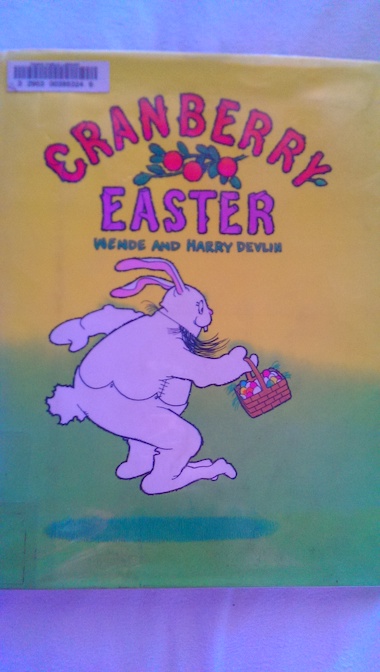
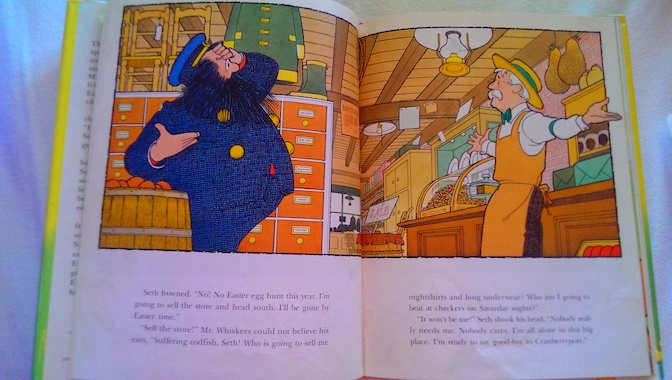
Mr. Whiskers is eager to talk to Seth, the owner of the General Store, about this year’s Easter egg hunt. Seth hosts one every year, and Mr. Whiskers is full of plans. However, Seth tells him that he’s thinking of closing the store and moving. He’s been lonely in Cranberryport since his wife died, and he’s thinking that he might want to retire and move to a warmer climate.
When Mr. Whiskers tells Maggie’s Grandmother what Seth said, she says that he’s not the only one thinking of moving. A couple of her friends say that they can’t handle living alone on their farms in the winter anymore, and because they haven’t been able to find rooms to rent in town, they are thinking of moving to a warmer climate, too.
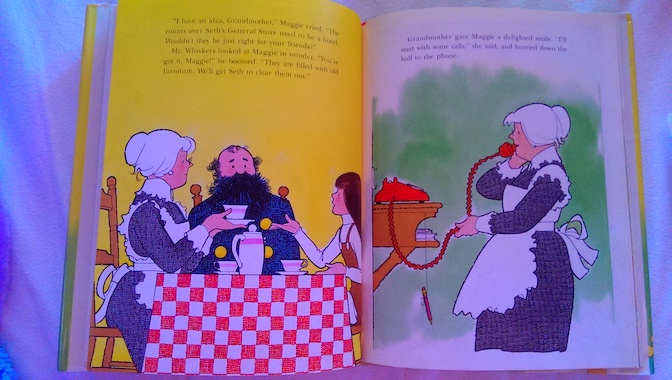
Then, Maggie comes up with a possible solution. She reminds them that the building that the General Store occupies was once a hotel. There are rooms above the store that Seth hasn’t been using. If he cleaned up those old rooms, he could rent them out to Grandmother’s friends. Seth is reluctant at first because the rooms need a lot of work to clean up, but with a little urging and help from his friends, they soon manage to turn the old hotel rooms into nice-looking apartments.
Grandmother’s friends love the apartments because, with rooms right over the store, they won’t even have to go out for groceries when the weather is bad. The arrangement works well for Seth, too. When members of the community help to clean up the old rooms, it reminds him that he has friends in town, and with some of them living right above his shop, there will be no need for him to feel lonely anymore.
Of course, when Seth decides to stay in town and hold the Easter egg hunt after all, Mr. Whiskers has to follow through on his promise to dress up as the Easter Bunny.
Like other books in the series, this book includes a recipe in the back, for Cranberry Cobbler.
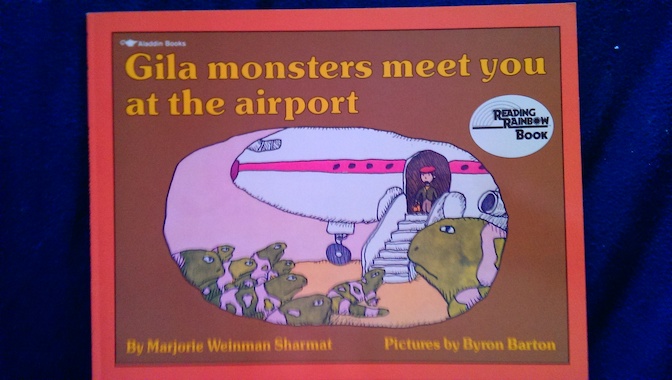
Gila Monsters Meet You at the Airport by Marjorie Weinman Sharmat, pictures by Byron Barton, 1980.
This is a humorous picture book about a boy moving from one side of the United States to the other and his misconceptions of what he’s going to find when he goes west.
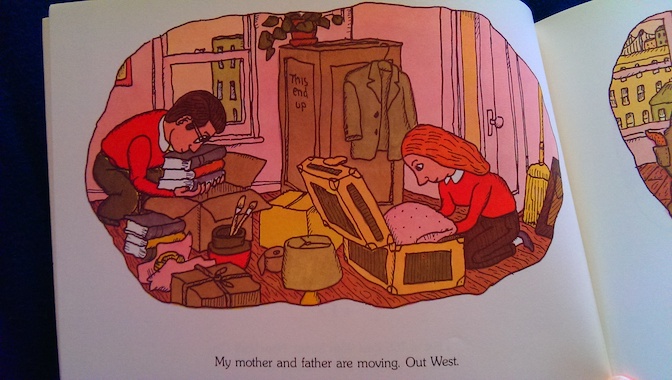
At the beginning of the story, the boy lives in an apartment in New York City. As far as he’s concerned, he could live there forever, but his parents decide that they’re going to move “Out West.” (The book never really says what state they’re moving to, but it seems to be somewhere in the Southwestern United States, like Texas, New Mexico, or Arizona.)
The boy thinks he’s going to hate his new home. He thinks of all the things that he’s heard about the West, like there’s cactus everywhere so you hardly know where to sit down, everyone dresses like a cowboy and rides horses everywhere, all he’ll ever get to eat is chili and beans, and he’s bound to die of heat exhaustion in the desert. His best friend in New York, Seymour, told him that Gila monsters would meet him at the airport.
Of course, there aren’t any Gila monsters at the airport when the boy gets there. Instead, he meets another boy whose family is moving East. The two boys talk to each other for awhile, and the Western boy starts telling him that he’s not looking forward to heading East because he’s heard that it’s always cold there, the cities are overcrowded and full of gangsters, the buildings are so tall that airplanes fly through the apartments, and there are alligators in the sewers. He expects to find alligators waiting for him at the airport.
Of course, things aren’t as bad as either boy is expecting. The boy from New York realizes that Seymour and his other friends back East don’t know much about the West, and he starts realizing that things in his new home are actually pretty good, some of them not all that different from home.

















 Jestress's Forgotten Books and Stories