The Mystery of Sara Beth

SaraBeth

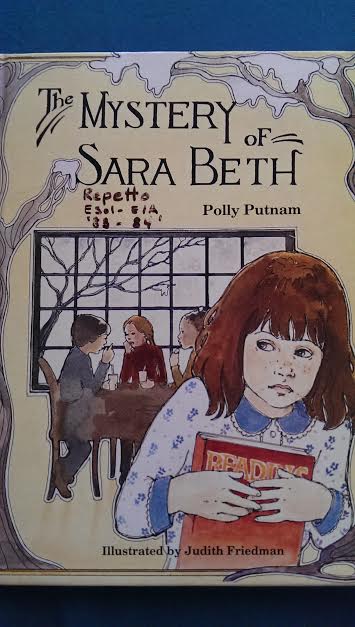
The Mystery of Sara Beth by Polly Putnam, illustrated by Judith Friedman, 1981.

This was one of my favorite books when I was young. It’s a nice mystery story for children in early elementary school.

When a new girl named Sara Beth joins their class, Becky and her friends go out of their way to make her feel welcome. However, Sara Beth barely acknowledges their attempts to make friends with her.

SaraBethPic2

Becky becomes concerned about Sara Beth and her lack of interest in making friends at school. Becky also notices some other odd things about Sara Beth’s behavior, which tends to change unexpectedly.  Sometimes, Sara Beth likes the class’s pet guinea pig, and sometimes she seems afraid of it.  One day, Becky catches Sara Beth taking a reading book home that was supposed to stay in the classroom.  Later, she sees Sara Beth hiding a cupcake from a class party to take home. Could these things help explain what Sara Beth is trying to hide?

The book is currently available online through Internet Archive.

My Reaction and Spoilers:

The solution to Sara Beth’s problem is quite simple, but it may seem bigger to younger children. The story presents a good example of the use of observation and logical thinking when approaching a problem. As Becky tries to determine why Sara Beth acts the way she does, Becky watches her closely and makes a list of her observations before coming to her final conclusion.  Becky is not only compassionate toward Sara Beth in trying to help her solve her problem and make friends at her new school, but she is also a very logical thinker.  I really enjoyed her as a character!
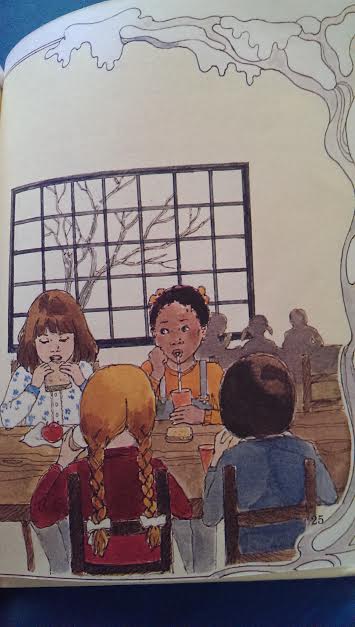
The artwork in the book is nice, and I thought it was clever how the borders of all of the images kind of give a hint to Sara Beth’s problem.  Even when the characters are indoors, the pictures are surrounded by snow-covered trees because it’s important to the story that it takes place in winter.  The snow is the root of Sara Beth’s problem.  The girls live in a cold climate and “Sara Beth” comes from a poor family.

(Spoiler: Becky correctly realizes that “Sara Beth” is actually a set of twins, Sara and Beth, which is why they behave differently each time they switch places.  Their family moved to the area from a warmer climate because the twins’ father is looking for work, but they only had enough money for one warm coat for the girls, so one of them has to stay home while the other goes to school.  They take turns going to school, and the one who goes to school brings the other one books, school assignment, and class treats so she can follow the lessons and not miss out.  When Becky confronts one of the twins, Beth, she admits that they were afraid of making friends at school because they knew that someone would find out the truth.  Becky persuades Beth to talk to their teacher, and the teacher arranges for the twins to receive an extra coat that was unclaimed from the school’s lost and found so that they can both come to school.)

In the back of the book, there’s a list of vocabulary words that appear in the story. It does not provide definitions for these words, though. I think that the most unusual words in the book were guinea pig and tetanus shot.

One more thing I thought that I would mention is that Becky, the main character, is African American. This is not mentioned at all in the text of the book and is not important to the story, but it is shown in the pictures.  I didn’t think about it much when I first read the book as a kid, but looking back on it, I found it interesting because it reminded me of the character of Adam in the Third Grade Ghosthunters series.  It fascinates me that there is something about these characters that people wouldn’t know without looking at the pictures, and I also like it that the characters themselves are not defined by race.  It’s just an interesting detail, not central to their characters.

Mystery of the Secret Message

secretmessageMystery of the Secret Message by Elizabeth Honness, 1961.

Penny lives with her aunt and uncle because her mother is dead and her father travels on business much of the time, dealing in Asian art.  Thanks to his travels, Penny and her aunt and uncle have quite a collection of Asian art themselves.  However, Penny has just been told that her father’s airplane crashed in the Pacific Ocean.  No survivors have been found, although Penny still has hope that perhaps her father survived and might yet be found.

At the same time, Penny and her aunt and uncle are moving into a house from the apartment where they used to live. Penny is happy about the move because she knows that she won’t have to worry as much about being quiet and not disturbing the neighbors, like she had to do in their apartment. This means that Penny can bring her friends over to the house to play and have parties. Also, their new house has a very special feature: its own private elevator.

Penny loves the new house and soon begins building a tree house with the help of Pete, a boy who lives nearby.  She tells Pete about her father and her hopes that he might still be alive.

However, events take a disturbing turn when Penny receives a package from Japan containing a beautiful wall scroll. The package appears to have been sent by her father, who meant it as a present for her new room in her new house. Was the package sent before his death, or did he somehow survive the crash?

There is also something odd about Penny’s new neighbors.  Penny’s new house is actually half of a duplex, and the new neighbors, the Carruthers, have also recently moved in after renting the other half. When Penny accidentally gets stuck in the elevator and hears voices coming through the wall, she starts to suspect that her neighbors might not be what they seem to be.  They show an unusual interest in her family’s collection of Asian art, asking to see pieces and borrow pieces for an exhibition that Mr. Carruthers is holding at his gallery.  One of Penny’s friends even catches Mrs. Carruthers sneaking around, looking at things uninvited.

When Penny and her friends have a sleepover on an evening when her aunt and uncle are out, someone sneaks into the house, leaving muddy footprints on the floor.  Penny isn’t sure that her aunt and uncle will believe her because they seem to like the Carruthers, so at Pete’s suggestion, she continues to spy on them, using the elevator to listen in on their conversations through the walls.

When her uncle catches her one day, using the elevator without permission (something she is not supposed to do), she finally explains her suspicions and what’s she’s heard the Carruthers say.  Together, Penny and her uncle discover a hidden secret about the wall scroll Penny recently received, which points to a number of secrets that Penny’s father kept from her and the rest of his family for years.  A stranger from the government helps Penny to fill in some of the blanks, but he has a favor to ask in return that requires Penny to take a big risk.

My Reaction and Spoilers

Although this book is much older than I am, it was a favorite of mine when I was a kid, yet another of my used book sale treasures! I actually got rid of my first copy years ago, when I was cleaning some things out, but I missed it, so I got another one. It’s actually a collector’s item these days.

I always liked the feature of the elevator in the story and how Penny uses it to find the right spot to hear what her neighbors are saying through the wall. I love intrigue, and as a kid, I liked the idea both having a house with an elevator and of overhearing clandestine conversations that reveal sinister secrets. There are points in the story where the two-faced Carruthers think that they have the upper hand, and Penny has to be careful not to let on just how much she knows.

As I explained, the neighbors are not what they seem to be, and Penny’s father was involved in things that his family knew nothing about. Since it’s not easy to get hold of this book right now, I’ll include a couple of spoilers. Penny’s father was acting as a spy for the US government, using his profession as an art dealer to travel to locations he needed to go and to smuggle information back to the US. He is apparently dead, killed in the plane crash, although there are hints that the crash wasn’t an accident, that it may have been intended to kill him. However, before his death, he managed to smuggle his last important information to Penny in the wall scroll that he sent her. When Penny manages to convince her uncle that something isn’t right about the Carruthers, he begins making inquiries and learns the truth about Penny’s father. A government agent speaks to the family and arranges a plan to fool the Carruthers into thinking that they’ve found what they were looking for, but the plan requires Penny to spend an evening in the house alone with them.

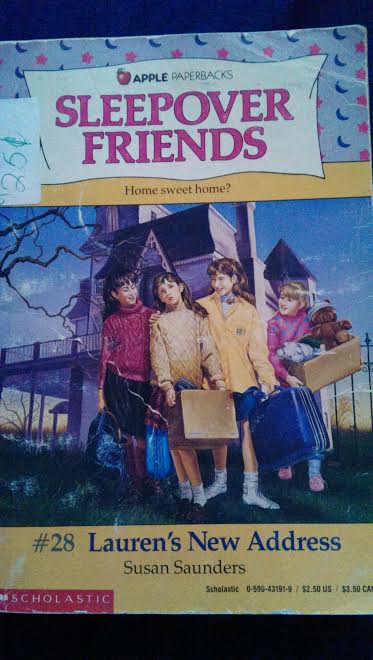
Lauren’s New Address

Sleepover Friends

SFLaurenNewAddress#28 Lauren’s New Address by Susan Saunders, 1990.

Lauren is not happy when her father announces that their family is moving to a new house a couple of miles from their old neighborhood. Her father works in real estate and wants to have his own office in their home. Their old house wasn’t big enough, so he found a new house for them.

Lauren hates the new house because it’s old and looks like a haunted house on tv. Plus, she’s afraid that she won’t see her friends as much because she’ll be living farther away from them. Her friends try to cheer her up by pointing out that she’ll have a swimming pool in her backyard and will be living down the street from one of the cutest boys in school, but nothing seems to help.

Then, Lauren learns that one of her new neighbors may be a princess from another country.  The girls hear that a young princess, Marina, from the European country of Osterburg has lost her parents in a car accident and is coming to live in their town with her American aunt and uncle. The only picture they’ve seen of the princess is blurry, but it looks a little like the young girl, Maya, living next door to Lauren in her new neighborhood. Stephanie suggests to Lauren that she try to find out more about the girl because if she is really a princess it would make a great story for their school newspaper.  At first, Lauren is doubtful, but then she overhears something that makes her think otherwise.

Things in Lauren’s neighborhood might not be quite what they seem at first, but her friends find some creative ways to help her adjust to her new house and learn ways of dealing with change, like keeping busy.  In the end, although Lauren is still getting used to her new house, she is happy because there are some good points about it, and she knows that her friends will still be there for her.

The Haunted House

hauntedhouseThe Haunted House by Peggy Parish, 1971.

The Roberts family is moving to a different house across town because they want a bigger place to live. Liza, Bill, and Jed are not very happy about moving, at least at first, because they will be farther away from their friends, especially Jimmy and Mary, who have been their best friends and next door neighbors. Liza is also worried because the house they will be living in is the old Blake house, which is rumored to be haunted. A couple of past caretakers have left because they claimed to hear ghostly noises.  The boys tease her about it, and their father insists that there is no such thing as ghosts.

The house is definitely much bigger than their old one, and there is a barn, a garden, and a large wooded area on the property. When they actually move in, the kids become fascinated with the old things in the attic, which the children are allowed to go through.  The kids also plan to start building a tree house.  The boys become excited about the house, but Liza is still nervous about the ghost stories.

Then, strange notes and coded messages appear for the children, starting with a note taped to Liza’s window in the middle of the night. Little presents are left for them in a hollow tree with promises of bigger surprises later. Who is sending these messages? Could it be the ghost?

Like other books in this series, there are coded messages and word games that the readers can solve alongside the children.  Some of them are easily recognizable, like word scrambles and Pig Latin, and others are a little harder.  The kids walk readers through their solutions, but readers can attempt the puzzles on their own first.

The book is available to borrow and read for free online through Internet Archive.

Eagle-Eye Ernie Comes to Town

eeetownEagle-Eye Ernie Comes to Town by Susan Pearson, 1990.

Ernestine Jones, better known as Ernie, is upset because her family has moved from Newport News, Virginia to White Bear Lake, Minnesota. She has no friends at school, and the other kids all think she’s strange and that she talks funny because of her southern accent.

Worse yet, someone has recently started stealing things from people’s lunches at school, and some of the kids think that Ernie might be the thief. Ernie has a knack for finding things, and her father says that she has an eagle eye. To save her reputation and any chance she might have of making friends, Ernie needs to use her eagle eye to find the thief so everyone will stop blaming her.

Ernie not only figures out who the real thief is but even helps the person find a solution to a bigger problem.

This is the first book in the Eagle-Eye Ernie series. The book is available to borrow and read for free online through Internet Archive.

My Reaction

The books are easy, beginning chapter books. The series starts with Ernie moving to her new town and making some new friends. These friends, William, Michael, and R.T. (Rachel) end up calling themselves the Martians because Michael is interested in outer space and likes calling everyone a Martian.

One of the cute parts of this book was when Ernie painted her saddle shoes to look like little bears in honor of “White Bear Lake.”  For a long time, this was the part of the story that I remembered best.