Mummies in the Morning

Magic Tree House

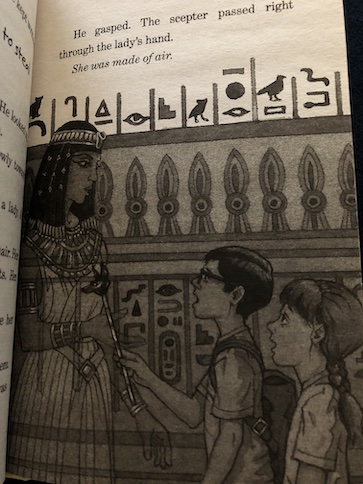
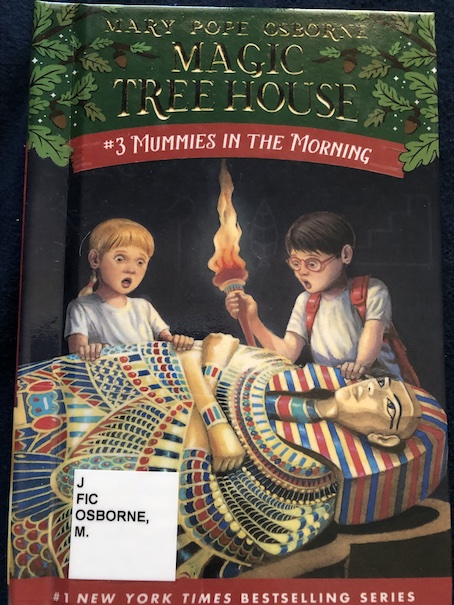
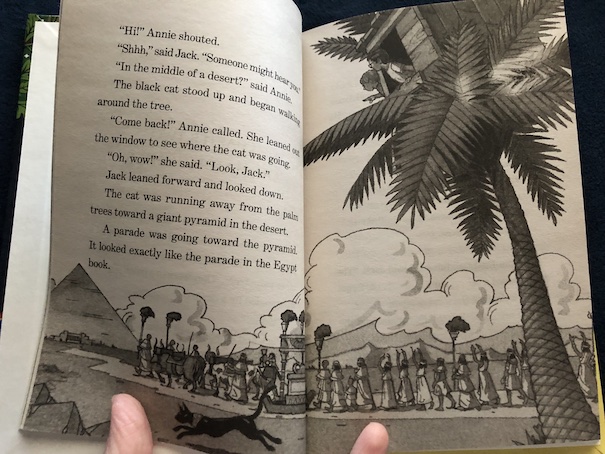
This time, Jack and Annie use a book in the magic tree house to travel back in time to Ancient Egypt. Jack has a fascination for mummies and pyramids, and Annie can’t wait to see them up close. When the children arrive, they witness what appears to be a royal funeral procession, but the people seem to vanish awfully quickly. Annie wonders if they could have been ghosts, although Jack thinks that’s nonsense. He thinks it was probably just a mirage, although he has reason to rethink that later.

The children follow a mysterious black cat into a pyramid. Annie is eager to see a mummy, but the children are startled when they see what appears to be a walking mummy that drops a scepter. Jack realizes that what they saw wasn’t a real mummy but probably a tomb robber in disguise. He reads in their book about Ancient Egypt about the problem of tomb robbers.

Then, the children encounter a real ghost! She is see-through, and objects pass through her. Fortunately, the ghost is nice instead of scary, and she explains to the children that she needs their help. She is the ghost of an Ancient Egyptian queen, and she has been unable to progress to the afterlife because she cannot find her copy of the Book of the Dead, which is supposed to guide her through the obstacles on the way to the afterlife. She knows that her brother, who designed her tomb, hid the book to protect it from tomb robbers and left clues for her in the symbols carved on the walls of her tomb. However, her brother apparently forgot that her vision was always bad, and she can’t read the symbols. (Apparently, poor vision doesn’t improve after death.) Jack would be willing to loan her his glasses, but since she’s incorporeal (not a word used in the book, but basically, she no longer has a physical presence and can’t use physical objects), the glasses wouldn’t stay on her face.

Instead, she asks the children to describe the symbols on the wall to her so she can interpret them. Together, the children and the ghost use the clues to find the scroll containing the Book of the Dead. After that, Jack and Annie have one more task: escaping the maze-like tomb!

The ghost in the story is a non-scary ghost, but there’s enough mild creepiness and mystery to satisfy kids who enjoy a little creepiness in their stories. Toward the end, they have to put the scroll in the sarcophagus with the queen’s mummy, which both grosses out and fascinates the children.

The historical information was good, although translating Egyptian hieroglyphics is much more complicated than the book indicates. In the book, the symbols are meant to literally depict specific objects, which some hieroglyphics can, but others are used to represent sounds to spell out words or names. I think the story just kept things simple for kids.

I liked the part where the kids get lost in the pyramid because pyramids were build with false hallways and dead ends to confuse tomb robbers. Everything work out fine in the end!

The Mystery of the Missing Mummy

The Bobbsey Twins

Bobbsey Twins The Mystery of the Missing Mummy cover

Before I begin, I’d like to acknowledge Sean Hagins, for supplying me with photos of this book! Usually, I take pictures of books myself, but I just couldn’t find a physical copy of this one. Sean is a big fan of the Bobbsey Twins, particularly the New Bobbsey Twins mysteries, and you can see some of his video reviews as well as videos about his photography work on his YouTube channel, SJHFoto. Thanks, Sean!

It’s only two days before Halloween, and the Bobbsey Twins are getting their costumes ready. Flossie is going to be a black cat, Bert is dressing as Frankenstein (the monster, not the scientist, for purists), and Nan is a traditional witch in a pointed hat. Only Freddie isn’t sure what he’s going to be yet. He could just put a sheet over his head and go trick-or-treating as a ghost, but that doesn’t seem exciting enough. He wants to be something really scary, but he doesn’t have much time left to decide.

The children’s mother offers Freddie some inspiration when she tells them that she will be writing a story about a new museum exhibit for the local newspaper. The new exhibit is an ancient Egyptian mummy. She asks the kids if they want to go to the museum with her to see the mummy, and they eagerly accept. Freddie thinks that a mummy would make a great costume idea, so he will be a mummy for Halloween.

The museum curator, Mr. Foxworth, gives the Bobbseys a special tour of the exhibit after hours, when there are no other visitors. The Bobbsey Twins are fascinated with the exhibit, and they talk about Egyptian hieroglyphics and the reasons why ancient Egyptians wanted their bodies preserved as mummies for the afterlife. Mr. Foxworth says that the mummy belongs to a wealthy woman named Mrs. Truesdale, who is also there to see the exhibit with her fifteen-year-old nephew, Lex.

The kids notice that Lex seems nervous, and he tells them that there’s a legend about the mummy coming to life. He even says that he’s heard strange noises coming from the mummy case. Mrs. Truesdale thinks that’s nonsense. The mummy has belonged to their family for 60 years. However, when the case is opened, Flossie is certain that she hears the mummy sigh. Then, when Freddie takes a closer look after the others leave the room, he sees the mummy breathing, and it tries to grab him!

Freddie and Flossie try to tell everyone what they saw, but everyone assumes that it was just their imagination. The kids go to the library to do some research about mummies, and they learn that Lex was telling them the truth about the legends surrounding this particular mummy. Nan doesn’t believe that the legends are real, but when the kids walk home from the library, they see the mummy walking in the park!

The kids run home and tell their parents what they saw. Their parents remind them that it’s almost Halloween, and it could have been somebody in costume, on their way home from a Halloween party. It sounds like a reasonable explanation, but the next morning, they hear a news report on the radio that someone broke into the museum and stole the mummy from the exhibit! The kids wonder if the mummy could have really come to life and broke out of the museum itself rather than being stolen.

The Bobbsey Twins decide to report their mummy sighting in the park to the police. At they police station, they see the security guard from the museum. The security guard tells them that the mummy did come to life and that it knocked him unconscious before leaving the museum, but nobody believes him because it sounds too crazy. The kids believe the security guard, but it also occurs to them that their parents might be right, that it could have been someone dressed as the mummy rather than the mummy itself. But, why would someone want to dress up like the mummy to pull a stunt like that, and if that’s what happened, where is the real mummy now?

The book is available to borrow and read for free online through Internet Archive.

I was pretty sure I knew right away who one or two of the culprits was because I figured that a theft and stunt like this would have to involve more than one person. However, I figured that there had to be another confederate involved because my favorite suspects were accounted for the first time the mummy moved. It turned out that I was way off base because there were suspects I hadn’t considered. The motive behind everything was different from the one that even the kids believed. I was pleasantly surprised by the twists in the story. There is a clue later in the book that more than one person dresses up as the mummy at different times when the kids realize that the mummy looked thin one time and fat the next time they saw him.

I liked the pieces of historical information about mummies included in the story, although the part about tanna leaves bringing mummies to life and attracting them is fictional, a concept created for a movie called The Mummy’s Hand from 1940. That’s why it’s important that one of the books Freddie finds at the library is about mummies in movies. At one point, Freddie and Flossie use what they’ve learned to build their own trap for the mummy.

I also noticed that the mummy’s legend comes with curse that rhymes when it’s translated into English, sort of like how the clues on the old Spanish map rhyme in English in The Goonies. In real life, things translated from one language to another don’t maintain their rhyme scheme. That went over my head when I was a kid, but I hadn’t studied other languages at that point, so the idea didn’t occur to me.

At one point in the story, the kids receive a message from the “mummy” that is clearly written on modern paper that someone tried to make look old, and the kids notice right away. They realize that it’s modern computer paper that someone yellowed with a candle, and they see where the holes at the sides were torn off. Modern kids might not understand what they mean about holes being torn off at the sides of the paper, but this was a familiar feature of computer paper at the time the book was written in the 1980s. Modern computer paper doesn’t have holes at the sides, but when I was a kid in the 1980s, there were perforated sections on both sides of the dot matrix printer computer paper with a series of little holes in them. The holes were where the printer would grab the paper and feed it through the machine. They later became unnecessary when printer designs changed, which is why you don’t see paper like that any more. When I was a kid, we would tear off those perforated sections with the little holes after printing. We would also have to break the individual sheets apart at perforated points because the sheets of paper were all joined together to feed continuously through the printer. That’s the type of printer paper that the kids in the story have. I don’t know if everyone did this, but I’d sometimes use those edging strips with the holes for little craft projects, or make them into little chains or bracelets.

The Mystery of the Whispering Mummy

The Three Investigators

The Mystery of the Whispering Mummy by Robert Arthur, 1965.

In the original editions of The Three Investigators, their cases were introduced by Alfred Hitchcock. Later editions of the books in the 1990s were rewritten to remove Alfred Hitchcock, but I’m using the version of this book that includes Alfred Hitchcock’s introduction for my review.

This story begins with two letters address to The Three Investigators. One of them is from an elderly woman in a wealthy area of town, who has heard about how The Three Investigators helped a friend of hers find her lost parrot in the previous book in the series. This lady would like their help to find her missing cat. Bob and Pete thinks that sounds like a simple enough case, but their other letter is from Alfred Hitchcock, so they decide to read that before committing themselves.

Alfred Hitchcock’s letter is incredible! He tells The Three Investigators about an old house that has been turned into a private museum by an archaeology professor. His museum has relics from his archaeological digs in Egypt. Recently, a mummy has arrived at his museum from a museum in Egypt. Professor Yarbrough was the one who originally discovered that particular mummy, but since it arrived at his museum, he has noticed a bizarre phenomenon. The mummy seems to whisper! Professor Yarbrough can’t figure out how the mummy can whisper, but it seems like the mummy is trying to tell him something important. Professor Yarbrough has consulted with a friend, Professor Freeman, who is a language expert, but the mummy only seems to talk when Professor Yarbrough is alone. Knowing how crazy this predicament sounds and what his other colleagues would say if he told them, Professor Yarbrough decides to tell his friend Alfred Hitchcock instead. That is why Alfred Hitchcock decides to tell The Three Investigators and see what they make of it.

Bob and Pete think that the mummy mystery sounds exciting but creepy. Since Jupiter is away on an errand, they decide that they would rather try to find the missing cat first. However, when Jupiter returns, he already knows about their prospective cases, and as predicted, he can’t wait to investigate the mummy. At first, Professor Yarbrough doesn’t have much confidence in the boys because they’re younger than he expected, but Jupiter persuades him to let them try. The professor’s butler, Wilkins, is very nervous and tells the boys that there is a curse on the mummy. Strange things are happening that make Wilkins think that the professor is in danger from the curse. The boys are there when a large statue in the professor’s museum suddenly falls over, almost striking the professor. Wilkins would rather send the mummy back to Egypt, but the professor doesn’t believe in curses. In spite of the talking mummy, the professor is sure that there must be a logical, scientific explanation for everything.

Jupiter also believes in scientific solutions, and his first theory about the whispering is that it’s being transmitted electronically, but they can’t find any electronics on or around the mummy. His next idea is to capture some of the mummy’s speech on a recording, which is successful. Professor Freeman says that the mummy seems to be speaking a form of ancient Arabic.

Then, Wilkins sees someone walking around in a jackal costume. Someone steals the mummy, and strangely, comes back a second time to steal the mummy case. Even the missing cat puts in an appearance.

Who wants the professor to think that the mummy is whispering and believe that it’s cursed? Who wants the mummy case, and why is that case even more important to the thief than the mummy itself?

The book is available to borrow and read for free online through Internet Archive (multiple copies).

My Reaction

From the beginning of the book, I had a couple of theories about who could be responsible for the mummy’s whispering and “curse”, but I was only partially correct. There are different people involved, doing different things and for different reasons. The main villain is one of the people I suspected, but I didn’t know this person’s motive until it became clear that the mummy case is what they really want. The missing cat is part of the mystery, but don’t worry, the cat is fine and being cared for!

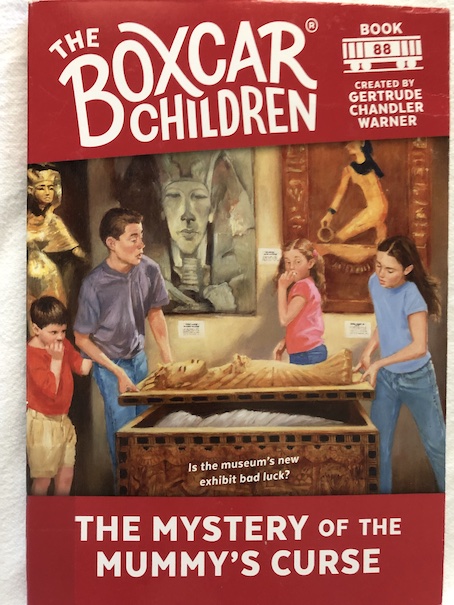
The Mystery of the Mummy’s Curse

The Boxcar Children

The Mystery of the Mummy’s Curse by Gertrude Chandler Warner, 2002.

The Alden children are at the museum to get a sneak preview of the new Egyptian exhibit because the man in charge of the exhibit is the son of one of their grandfather’s friends.  When he shows them the mummy that will be the centerpiece of the exhibit, one of his assistants accidentally falls off a stepladder and breaks her ankle.  The museum personnel joke that it’s the “mummy’s curse,” although they quickly reassure the children that they don’t believe in curses.

With the opening of the exhibit coming soon, there’s a lot of work to do, including cleaning up the exhibit hall where it will be set up.  Losing the assistant has left the museum short-handed, so the Aldens volunteer to help with the cleaning and setting up.

However, the children notice other odd things about the exhibit when they’re helping to clean up.  They hear strange noises, as if someone were creeping around the off-limits areas where the artifacts are being stored and the exhibit getting set up.  Then, some of the artifacts that they noticed when they were first introduced to the exhibit disappear.  When they check to see what else is missing, they realize that some of the artifacts they’ve seen aren’t even listed on the official roster.  Jessie tries making her own list of artifacts in the exhibit, since the master list isn’t reliable, but someone steals it.

Who is stealing from the Egyptian exhibit?

The book is available to borrow and read for free online through Internet Archive.

My Reaction

I enjoyed the mystery. I was pretty sure that I knew early on who was responsible for the thefts, but mysteries involving museums, mummies, and stolen artifacts are my cup of tea!

I did think, as I was reading this, that few museums would let random kids help set up an exhibit like this, including valuable artifacts, even if most of what they were doing is just cleaning up. In the story, the eldest of the Alden children is 14, and I’ve done enough volunteer work to know that there are age limits and training requirements for certain volunteer tasks. There are really only two reasons why kids like the Aldens would be doing this. One, the requirements of the story: having the kids help set up an exhibit of Egyptian artifacts is exciting, something that plenty of kids would find fascinating, and it allows them to be in the right place to notice the thefts. Two, Grandfather Alden is rich: if the children’s grandfather wasn’t rich and well-connected, the Aldens wouldn’t be doing most of what they do in the stories. The second reason isn’t as charming as the first, and it never occurred to me when I was younger that the Aldens are actually very privileged to be in the position to do the things they do and meet the people they meet, but they are.

I wouldn’t say that the knowledge spoils the story for me, but it did make me stop and think. Sometimes, when adults, especially older adults, look back on books like the Boxcar children series, they talk about how independent the kids in these stories are and how willing to work, but the truth is that, in most of the stories, the kids’ grandfather sets them up with the opportunities for volunteer work or independence that the children have. The kids didn’t get this volunteer position because it’s an extension of special classes any of them are taking in history or archaeology or because they’ve done lower-level volunteer work for the museum before, working their way up, or because they applied for the position. They got it because of someone their grandfather knows. The Alden children are still willing to take advantage of opportunities that come their way and work hard at them and learn whatever they can, but when you think about it, it’s not quite the same as people who have to prove themselves and their merits first just to get the opportunity to do the same thing. So, I enjoy the story for the fun and mystery, but thinking about it now, as an adult who has done volunteer work for museums as well, I’m not quite so impressed with the way other, older adults compare the characters to real kids of non-rich, non-connected parents.

There are still volunteer opportunities for youths who want to get involved in museum work, but most of them require the kids to be older teens. One of the reasons for the age requirements is that there can be liability issues if someone gets hurt on the job, but people who hire volunteers also want to know about the skills the volunteers have, what kind of training they’ve had or need, and how much they can alreay do unsupervised. Rules can vary by location and position, but in the places I’ve been, kids under 14 are usually required to be supervised by an adult, 18 or over. Often, teens who do those sorts of jobs have already proved their skills or worked their way up in some way, applying for volunteer jobs and discussing their skills, taking related classes, being part of museum programs for younger children before, and/or volunteering in tandem with a parent first. The same is true of other places where I’ve volunteered, like animal shelters. So, the kids who seem more independent are that way because the adults in their lives took them through the preparation and training first and helped them connect with people who could take them further. This is a fun mystery story, but just understand that real children often aren’t like kids in mystery adventure books because they are real people in the real world, where circumstances are different from the ones in fiction. Real life has rules and regulations, and not everybody has a rich grandfather or family friends who are willing to treat them as special exceptions to the rules. If you want to see the kids around you get involved in a cause like this and gain some skills, the best way to go about it is to get involved yourself, both with the cause and with the lives of the kids, and give them the training and knowledge they need to go further on their own. Things like this don’t just happen on their own.

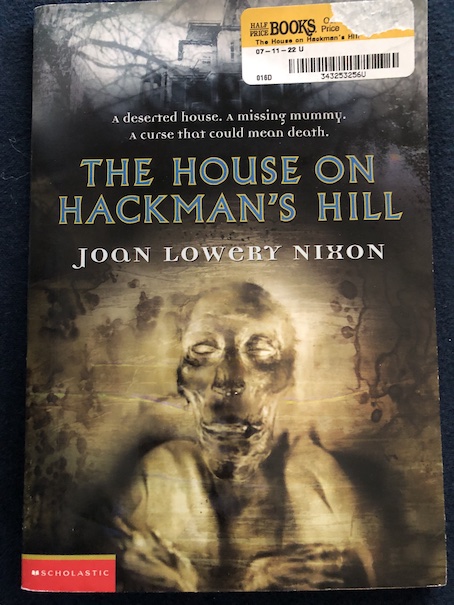
The House on Hackman’s Hill

House on Hackman's Hill cover

The House on Hackman’s Hill by Joan Lowery Nixon, 1985.

This creepy book is interesting partly because it is told in two parts. About half the story is a flashback that explains the history of the house and the mummy inside it, and the rest continues in the present day.

The very beginning of the story is in the present, starting with a pair of cousins. While they are visiting their grandparents, Jeff tells his cousin Debbie that he’s found out about an old, abandoned house nearby that supposedly contains a hidden mummy and that there’s a reward for anybody who finds it. Debbie doesn’t believe him at first, but he says that he heard all about it from their grandparents’ neighbor, Mr. Karsten. Jeff persuades Debbie to come with him to check out the old house. Debbie comes and takes pictures of it because she’s interested in entering a photo contest.

The place looks really creepy, and they have the odd feeling like somebody is watching them, even though the house is supposed to be empty. Debbie says that they should ask their grandparents what they know about the old house. At first, the grandparents don’t want to talk about it. They just say that it’s an old house and not very interesting. Debbie asks them directly about the mummy, and they say that there are a lot of rumors about the old place, but they don’t really believe them. The kids decide to talk to old Mr. Karsten again. Mr. Karsten says that he knows all about the old house on Hackman’s Hill because he lived there for awhile when he was young, back in 1911.

Paul Karsten’s Story

Paul Karsten’s mother was a secretary, and she went to work for Dr. Hackman, the former owner of the house, after the death of her husband. Dr. Hackman was a strange man with changeable moods. He was pleasant enough to Mrs. Karsten, but he hated children and didn’t really like having her son Paul in his house. Dr. Hackman was a history professor, specializing in Egyptology. He was approaching retirement, and he wanted to devote himself to his papers and his collection of Egyptian artifacts. Mrs. Karsten’s job was to help him catalog his collection, and Dr. Hackman offered such a good salary, Mrs. Karsten couldn’t refuse. The mummy was delivered the same day that Paul and his mother moved into the house.

Paul was given a room in the tower of the house, and while he thought that it had a great view at first, he got nervous when he noticed how the tower room was situated on the edge of a cliff. One of Dr. Hackman’s servants, Jules, makes a comment about how Paul should be careful because they don’t want “another accident”, refusing to say more about whatever “accident” occurred there before. Paul was uncomfortable with the house and with Dr. Hackman. He tells his mother that the house frightens him and that he wants to leave, but his mother reassures him that the place only looks strange because of the Egyptian artifacts. Paul found the artifacts he once saw at a museum exhibit frightening and he’s particularly disturbed by a statue that Dr. Hackman has of a man with an animal head, but his mother says that’s just a statue of an Egyptian god.

Paul had notice earlier that a long box had been delivered to the house, and he gives into temptation and tries to look inside. However, he is stopped by Jules. Jules and his wife Anna warn Paul that this house isn’t very good for children and that Dr. Hackman doesn’t like people nosing around or messing with any of part his collection. At dinner, Paul admits to Dr. Hackman that he tried to look in the box and apologizes for his curiosity. Dr. Hackman accepts the apology, and before Paul goes to bed that evening, Dr. Hackman shows him the mummy case that was in the box. Paul asks him if it’s real, and Dr. Hackman says it is. Paul says that he heard that it’s illegal to take real mummies out of Egypt, but Dr. Hackman says that there are ways, if you’re willing to pay for it, and he was. Dr. Hackman says that his eventual goal is to turn his house into a museum of Egyptian artifacts so that scholars will come there to study them and read his papers, and he will be famous. He also says that he knows how to protect himself from the mummy’s curse. The talk of curses scares Paul, but Dr. Hackman says that nothing has ever happened to him personally because of any tomb curses … implying that something might have happened to someone else.

When Paul tells his mother that Dr. Hackman has a real mummy, she is worried and upset. She doesn’t like the idea of people obtaining artifacts through unethical or illegal means, although she knows that the laws are poorly enforced. Mrs. Karsten doesn’t believe in superstitious curses, but soon, strange things begin to happen. While putting away his things in his room, Paul discovers a strange, triangular piece of gold metal with some kind of design on it. When he goes up to bed, he feels like someone is there in the room, although he can’t find anyone. During the night, he wakes up, sees that one of his windows is open, and feels an odd urge to walk toward it, but fortunately, his mother comes to check on him and stops him. Paul and his mother both realize that they were woken by the sound of a cry in the night. His mother supposes that it was some kind of night bird, but Paul knows that it was probably something to do with the curse.

Paul insists that Jules and Anna tell him about the accident that took place in his room. They say that they weren’t working for Dr. Hackman when it happened, but they know that the person who fell from the tower room was a guest of Dr. Hackman’s, he was from Egypt, he died when he fell, and his body was shipped back home. At first, Paul thinks that the gold piece he found probably belonged to the Egyptian guest, but that’s not quite it.

Dr. Hackman gives Paul the job of polishing some of his statues, knowing that they bother him. It amuses Dr. Hackman as a mean joke. However, Paul’s fear of them fades while working with them because he begins to appreciate their artistry. Dr. Hackman is surprised that Paul is able to see that and not just be afraid of the statues. Paul asks him about the statue of the man with the animal head, and he explains that it’s a statue of Anubis, the god of the dead, and scares Paul again by saying that Anubis is the one responsible for the curses on tombs. He says that Anubis’s head is a jackal head and that jackals hunt at night and have a bark like a cry. This confirms to Paul that the curse was responsible for the cry he and his mother heard.

Paul eventually comes to realize that the strange gold piece attracts the mummy and the mummy’s curse, which is why Dr. Hackman knows that he’s in no danger. Dr. Hackman put it in the tower room to make sure that the mummy’s wrath would only come to whoever was in that room … and that’s why he made sure that Paul was given that room, too. To protect himself and his mother, Paul knows that he has to get rid of that gold piece.

Mr. Karsten finishes his story by explaining to Jeff and Debbie where he hid the gold piece and how Dr. Hackman disappeared, apparently a victim of the curse. Nobody ever discovered what happened to Dr. Hackman, and the mummy disappeared that same night, but a museum has offered a reward for anybody who finds the mummy. Mr. Karsten says that various people have tried to stay in the house and find the mummy, but nobody has succeeded. Everyone has been frightened off after just a single night in the house.

Jeff doesn’t believe in curses, and Debbie agrees to accompany him into the old house to find the mummy and claim the reward.

Return to the Present

The rest of the story is about Jeff and Debbie’s adventures with the house on Hackman’s Hill. Jeff says that he thinks all the spooky curse stuff was just put on by Dr. Hackman, who was a mean old man having a joke by scaring a kid with all that talk of curses. Dr. Hackman was definitely a mean old man who enjoyed scaring young Paul Karsten, but questions still remain. How much of what Paul experienced was really real, and what happened to Dr. Hackman? If the curse was just something he made up, why did he scream the night he disappeared, and where did he go?

Jeff’s idea is that all the creepy stuff happened at night, so the best time to go look for the mummy would be during the day. (That’s actually pretty sensible. Why go to a supposedly haunted house during the night if you don’t have to?) The kids make a plan and put together a collection of useful supplies and food for their mummy hunt. They decide to go while their grandmother is busy watching her favorite soap opera and their grandfather is in town, arranging some sort of surprise for them.

When they enter the house, they discover that everything is still inside. All of the furniture and Egyptian artifacts are like Mr. Karsten described them. Debbie has an instant camera that with takes pictures that develop themselves. (No brand name mentioned, but basically, a Polaroid instant camera or something very similar. Those were popular when I was a kid in the 1980s and into the early 1990s, especially for families and amateur photographers. They’re not as popular now with the popularity of smart phones and digital photography, but they’re still around. Although police photographers now use digital cameras, instant cameras have been used in accident and crime scene photography because they produce quick results, the photos last for a long time, and because they develop immediately after being taken, they can’t be digitally altered. What I’m saying is that Debbie has made a good choice for recording their adventures and any evidence that they uncover, and it pays off almost immediately.) When Debbie takes a picture of the statues that Mr. Karsten told them about, she notices something frightening right away: the Anubis statue doesn’t show up in photographs.

Jeff discounts the photographic evidence because Debbie’s hand shook, and the picture is somewhat blurred. However, the kids start hearing noises in the house. Then, Debbie notices that a bad snow storm is approaching. She wants to leave the house immediately, but Jeff realizes that they can’t because they’d never make it back to their grandparents’ house by the time the storm hit. Night approaches, and the kids are about to see just how true Mr. Karsten’s story was. The kids are trapped in the house by the snow storm, but they’re not there alone.

The book is available to borrow and read for free online through Internet Archive (multiple copies).

My Reaction and Spoilers

I thought that this was a fun, creepy story. The creepiness is tempered somewhat in the first half of this story because it’s told in the form of a flashback. We know during the first part of the story that Paul survives his ordeals and lives to old age because he’s telling the story of what happened when he was young to Jeff and Debbie as an old man. When Jeff and Debbie go into the house themselves, it’s less certain what’s going to happen.

There are points in the story after Jeff and Debbie enter the house where it seems uncertain how much of what Paul Karsten experienced was supernatural and how much might have been due to the machinations of Dr. Hackman, who seems to have been a very disturbed man by himself. They soon discover that the house has secret passages that could allow Dr. Hackman to move around the house unseen and create some strange phenomena himself to scare or harm people in the house. There was a point where I thought perhaps everything would turn out to be part of some elaborate plot by Dr. Hackman or someone else, but (spoiler) there is real supernatural phenomena happening.

Before the end of the book, Jeff and Debbie discover both where the mummy is hidden and where Dr. Hackman hid the mummy’s golden eyes, which Anubis has been searching for all this time. They also learn what really happened to Dr. Hackman all those years ago. He apparently did become the victim of the curse that he had tried to evade by inflicting it on others. When the story ends, it seems that the curse is ended permanently, although Jeff and Debbie do manage to get some things out of the experience.

I liked how, even though the story does turn out to be supernatural, the author introduced the idea that it might not be because that element of uncertainty kept the suspense going for longer and introduced some interesting possibilities for readers to consider. It also made it a little more plausible that the kids would be willing to enter the house because they could believe that the house itself was harmless without Dr. Hackman there to continue his plots.
Blossom Culp and the Sleep of Death

BlossomSleepDeathBlossom Culp and the Sleep of Death by Richard Peck, 1986.
This book starts shortly after the previous book in the series ends.  After Blossom’s old history teacher was run out of town for his scandalous behavior, he was replaced by Miss Fairweather.  Miss Fairweather is a tough, no-nonsense woman who pushes her students to study hard and take history seriously.  Unexpectedly, she comes to appreciate Blossom, an outcast from a poor family, because Blossom demonstrates some knowledge of Ancient Egypt.  Little does Miss Fairweather know that Blossom’s comments in class were inspired by one of the visions that Blossom occasionally gets because of her psychic gifts.

Blossom experiences a visitation from the spirit of an Ancient Egyptian princess who says that she needs Blossom’s help.  Years ago, her mummy and some precious objects were stolen from her tomb.  The princess doesn’t seem to know exactly where her “earthly form” is now, but she’s sure that it’s somewhere nearby.  She’s very concerned because she senses that archaeologists in Egypt are digging to find her tomb and knows that when they finally reach it, they will discover that she isn’t there.  Rather than being concerned about her tomb being violated by the archaeologists, the princess senses that they are searching for her remains in order to venerate them, that if they find her mummy, they will take it to a place of great beauty where it will be treated with the utmost care and respect (a museum).  She wants that and fears that she will miss her chance at the kind of immortality that this form of glorification, care, and study will provide.  So, she asks Blossom to find her earthly remains and inform the searchers of her true whereabouts.  At first, Blossom has no idea how she can accomplish that, but the princess threatens her with a true Egyptian curse if she doesn’t try.

Then, Blossom receives a clue to the mystery in the form of a beautiful Egyptian scarab that her mother found one day while she was out scavenging.  If Blossom can find the place where her mother found the jewel, she can also find the princess’s mummy.  Fortunately, Miss Fairweather has assigned the class special projects about Ancient Egypt, and she is thrilled when Blossom says that she wants to study grave robbers.  Blossom sees this as a good way to collect some extra information about grave robbers that she can use to find the princess’s mummy as well as get a good grade in Miss Fairweather’s class.  It also proves to be an excellent way to draw Alexander Armsworth into her search for the mummy.

Alexander still denies to Blossom that he has real psychic abilities like hers, even after their previous adventures together.  He insists that it was just a phase that they were going through, one that he wants to leave behind.  He’s been busy flirting with Letty, the class snob, and he’s trying hard to get into a prestigious fraternity so that he can give Letty his fraternity pin.  Not only does Blossom think that the boys in the fraternity are a bunch of idiots who do stupid things, but the idea of Alexander giving Letty his pin as a sign of their relationship is just sickening.

Blossom is reluctant to admit her real feelings for Alexander, but the two of them are close in ways that Letty and Alexander never will be because of their shared abilities and adventures, and Blossom has a sense that their futures will be intertwined as well.  Alexander is angry that Blossom is roping her into yet another supernatural escapade, but he has to go along with her project idea because he has already gotten on Miss Fairweather’s bad side and needs to do well on the project to save his grade in class.

Along with the supernatural adventure, there is also a look into the past, the world of 1910s America as well as Ancient Egypt.  First, there are the traditions of stunts associated with Alexander’s initiation into his fraternity and the tradition of giving a girl a fraternity pin as a precursor to engagement (“engaged to be engaged”).  Then, they discover that Miss Fairweather is a suffragette, which is the reason why she left her previous teaching job.  Her feminist ideals cause problems for her in her new, small town when they become known, but with Blossom’s help, she wins over some of the influential women in town as well as a male admirer.

The book is currently available online through Internet Archive.

The Curse of the Egyptian Mummy

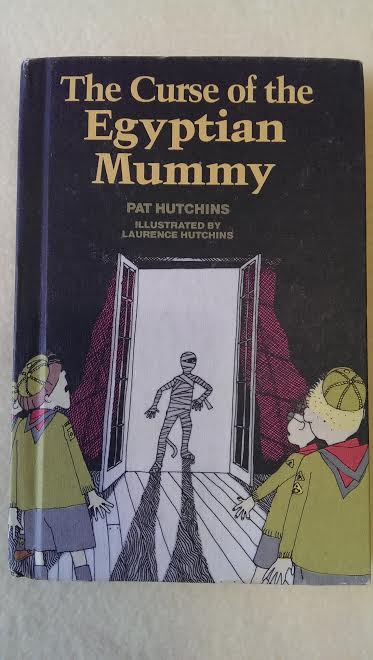
cursemummyThe Curse of the Egyptian Mummy by Pat Hutchins, 1983.

The 15th Hampstead Cub Scouts are looking forward to their camping trip. Miss. Hylyard, who runs a guesthouse for retired people, lets the scouts camp on her land and enjoys having them visit her house and entertain her guests. Mr. and Mrs. Webb are coming along to do the cooking, and their daughter, Victoria, will be there, too. She’s one of their friends from school.

Things start to get interesting pretty quickly when they hear that a man died from a poisonous snake bite not far from where they are camping. The boys are eager to show off their tracking skills by helping the police find the missing snake.  But, strangely, no one can figure out where the snake came from because none of the zoos in the area have reported one missing.  That’s only the beginning of what becomes a very strange trip for the scouts.

Sam finds a strange bird statue in a public wastebasket and decides to use it as the scouts’ new mascot. Then, someone trashes the campsite, and strange figures are seen running around the woods at night.  When Albert makes copies of the bird statue to earn his art badge, the first one is broken, and the second is stolen after some adult shoves Albert into the river near the camp.  Some of the guests at Miss Hylyard’s look suspicious, and when Victoria unexpectedly stumbles into an evening’s entertainment there still wrapped in bandages from the scouts’ first aid practice, a guest who was supposedly unable to speak suddenly blurts out, “The Curse of the Mummy’s Tomb!” in Arabic (which Miss Hylyard knows from her travels with her father).

Who are these mysterious people?  What is the importance of the statue?  And, is there really a curse?

The book is currently available online through Internet Archive.