The Scandalous Sisterhood of Prickwillow Place

The story is set in England in 1890. There are seven girls at the proper Victorian boarding school known as Saint Ethelreda’s School for Young Ladies on Prickwillow Road in Ely. As the beginning sections of the book explain when they introduce the girls and members of their families and acquaintances, they were all sent to Saint Ethelreda’s because their families want them to become proper Victorian young ladies, ready to make suitable and socially-acceptably marriages. Some of the girls have defects in their characters or personal interests that are considered entirely unsuitable, and their families are hoping that the school’s discipline and propriety will cure them.
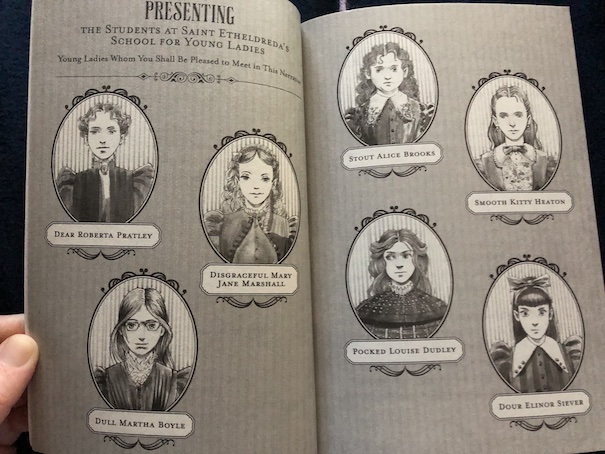
“Dear” Roberta Pratley – Her mother died while she was still young, and her father remarried. It was her stepmother’s idea to send her to boarding school, thinking her too soft, clumsy, awkward, and overindulged by her late mother. Her stepmother hopes that boarding school will strengthen her and turn her into a more graceful young lady. Roberta is known for being gentle and kind. She’s good at sewing.

“Disgraceful” Mary Jane Marshall – She was sent to boarding school by her mother, who has noticed that Mary Jane, while still rather young, is very pretty and precociously flirtatious, with a tendency to attract disreputable and penniless young men. Worse still, Mary Jane enjoys the company of these disreputable young men and regularly slips away from her mother to see them on the sly. Fearful that Mary Jane’s recklessness with young men will lead her into a disastrous marriage too early in life, her mother enrolled her in an all-female boarding school to keep her away from boys and, hopefully, give her a chance to mature and improve herself. So far, it’s not working. The only non-disreputable young man who interests her is the young local police constable.

“Dull” Martha Boyle – Martha has four brothers at home who make her life miserable with their pranks and teasing. Boarding school gives her an escape from them. She isn’t considered very bright, but she has a talent for music. She has a crush on a nearby farmer’s son.

“Stout” Alice Brooks – Poor Alice has a tendency to put on weight and is often compared unfavorably to her cousin Isabelle, who seems to be able to eat anything she wants without putting on an ounce. Alice doesn’t really hate Isabelle for this, but she’s tired of her grandmother’s criticism over it. She has a crush on a young law clerk.

“Smooth” Kitty Heaton – Kitty’s mother died when she was only four years old, and Kitty has no other siblings, which is a disappointment to her father, who hoped for a son to take over his business enterprises one day. Kitty’s father largely ignores her, and he has not yet noticed that Kitty is developing some shrewd business skills herself.

“Pocked” Louise Dudley – Louise’s face is scarred because she contracted smallpox at a young age. She survived this potentially-deadly illness because her devoted uncle, a talented doctor, nursed her through it. Ever since, she has revered her uncle and looks up to him as a mentor. Her uncle enjoys sharing his scientific and medical knowledge with her, he encourages her studies, and he thinks that she has the potential to a be doctor herself. Unfortunately, Louise’s parents don’t think that this is a proper profession for a young lady, so they sent her to boarding school to learn the kind of skills young ladies need to know to be wives and mothers. However, Louise has not given up her scientific interests.

“Dour” Elinor Siever – Elinor has a macabre side to her personality. Actually, her macabre side is most of her personality. When she was younger, she started sneaking out at night to explore, and she watched with fascination as the old grave digger in her town exhumed bodies to rob them or sell them for medical experiments. When the old grave digger spotted her watching him, she gave him a fright, and when her parents found out what she’d been doing, they packed her off to boarding school to put an end to this morbid interest and encourage her to be a sweeter, more cheerful, and more normal girl. None of that is working, but her morbid interests are about to come in handy when death comes to the little school.

One evening, while the headmistress of the girls’ school is dining with her visiting brother, both the headmistress and her brother are poisoned. The girls are saved because they were not eating the same food. Realizing that the headmistress and her brother are dead and quickly concluding that they were murdered, the girls debate about what to do. They consider calling a doctor, but it’s obviously too late for that. They could get the police, but before they do, the girls stop to consider what this will mean for themselves.

They have no idea who poisoned the headmistress and her brother. The girls prepared the food they were eating, so the poisoner could have even been one of them, or at least, they could be potential suspects. At the very least, the death of the headmistress means the end of the school, and the girls will all be sent home to their families. The truth is that the girls don’t want to go home. Each of them has some sort of tension at home or a reason why they were sent away, and they’ve all become like sisters to each other. More than anything, they want to be able to stay together and have some freedom from their tensions at home.

With their headmistress gone and no adults around to tell them what to do, what not to do, or how to be, the girls realize that they have unprecedented freedom to do as they like and be themselves, but that’s not going to last if they’re suspected of murder. Kitty is the first to suggest that they not tell anyone that the headmistress and her brother are dead, but she’s also the first to realize that, if they don’t find out who killed them, there will be a scandal, and each of the girls will be under suspicion for the rest of their lives. While Kitty relishes the idea of taking charge of the other girls and having them organize their own lessons and self-study from now on, according to the subjects that interest each of them the most, they also need to investigate and solve the murders. There is little hope for any of their future prospects if they have to go through life as murder suspects.

Their first problem arises when some friends of the headmistress and her brother show up unexpectedly as part of a surprise party for the brother’s birthday. Acting quickly, the girls hide the bodies and convince the guests that the brother has gone to India suddenly to tend to a sick relative and their headmistress has gone to bed because she was feeling unwell. However, one of the girls accidentally injures the ankle of the choir teacher, who has to spend the night at the school, causing them further complications. Desperately, the girls try to cover up the fact that their headmistress is dead and buy themselves time to investigate.

Although none of the girls is what their families consider a proper Victorian young lady, they each have skills that are useful to their deception and investigation. Kitty is good at organizing and managing people, and Mary Jane knows how to charm them. Elinor isn’t afraid of handling the dead, and Louise has scientific knowledge. Alice is the right size to pose for their headmistress in her clothes, and she has some acting ability.

Can the girls find the real murderer before someone figures out that two murders have taken place and blame the girls for them? What will the girls do if it turns out that the murderer is one of them? And, if it’s not one of them, what’s to stop the murderer from trying to kill again if he believes the girls’ ruse that their headmistress is still alive?

The book is available to borrow and read for free online through Internet Archive (multiple copies).

This is a humorous mystery with delightful characters! Although none of the girls is quite what their families or society wishes they were, readers will see that some of their supposed defects are actually strengths and skills. The humor in the story is dark, and the girls are unsentimental about the deaths of their annoying headmistress and her odious brother. They explain the reasons for their lack of sentimentality through their explanations of the victims’ characters. Neither of them was ever very nice to the girls, and they both had dark sides to their personalities.

Because some of the girls have morbid tendencies or possibly scandalous sides to their personalities that they need to cover up, it is plausible from the beginning that one of them could have had a reason to kill the headmistress, leaving readers more in suspense about the identity of the murderer. Although the girls love each other like sisters, there are moments when even they question whether they can really trust each other. However, the introduction of the headmistress’s friends and associates add other possible suspects to consider.

The first half of the book is largely about the girls getting themselves organized and covering up the deaths of the headmistress and her brother. They get more into solving the murders about halfway through the book, although they begin developing suspicions before that. I was pretty sure from the beginning that none of the girls did it, although the book does a good job of making it plausible that they could have. However, the girls soon learn that there were sides to their headmistress and her brother that they didn’t know about.

Early on, I had a theory that there could be more than one murderer involved. The headmistress and her brother didn’t seem to have exactly the same symptoms when they died, so I thought that it was possible that they were poisoned by different people coincidentally at the same meal. That’s not quite the right answer, although the parts of the story that made me think so are actual clues to what really happened. There are multiple villains in the story, some working together and some not. Some of what I suspected turned out to be true, but not all of it, and I didn’t figure out the whole situation before the characters explained it.

During the course of their adventures, the girls remain friends, and they also come to realize some things about themselves. Some of the girls develop budding romantic interests. Whether or not those fully develop, we don’t know, but it appears that there’s someone out there for everyone. Even Elinor finds someone to bond with over her morbid fascination for death. Some of the girls also come to realize talents they didn’t fully consider before and begin developing ambitions for their future. Kitty comes to reckon with her father’s lack of interest and emotional connection with her, and she also comes to realize that she shares some traits with him, even some of the less desirable ones. She realizes that she doesn’t want to be like her father, cold and commanding. While she felt little for her old headmistress, she was primarily motivated by her warm feelings for her best friends and fellow students, whom she regards as sisters. Because of her father’s detachment, she desperately guards the only warm connections she has in her life. Fortunately, the book has a happy ending. Circumstances allow the girls to continue with their education together in a way that supports all of their interests and under the guidance of someone who truly cares for them and understands them.
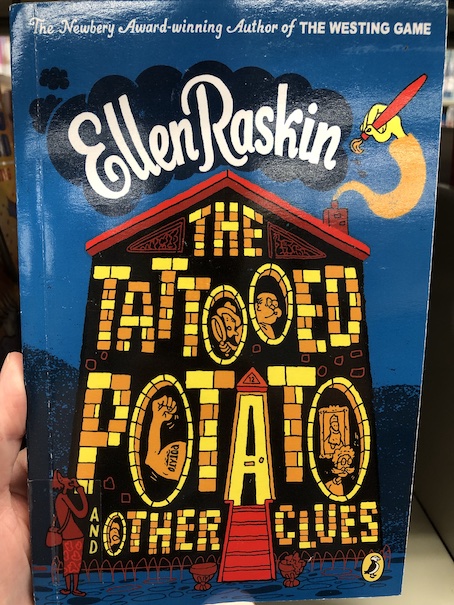
The Tattooed Potato and Other Clues

The Tattooed Potato and Other Clues by Ellen Raskin, 1975.

Dickory Dock (yes, that’s her name) is a 17-year-old art student in New York. She takes a part time job as an assistant to a mysterious artist who only calls himself Garson. She really needs the job because she’s very poor and often only has markers to use in making drawings for her art classes. She lives with her brother and his wife because their parents are dead, but her brother and his wife struggle financially and sometimes can’t even pay their bills. However, Garson is a strange person who seems determined to keep the details of his past secret.

Garson requires Dickory to be quiet, well-organized, and observant as his assistant, and she tries her best to be these things. He periodically tests her powers of observation and perception, pointing out that these are valuable skills for artists to have to see beyond the outward appearances of things and into their very essence. Garson lives in a house with a deaf-mute man called Isaac. Isaac frightens Dickory at first because he is a large man who appears scarred and is brain-damaged. Garson says this is just his outward appearance and tells her that Isaac is a gentle soul. On the other hand, Manny Mallomar, the fat, greasy man who rents the lower apartment in the house, is rough and rude. Because he dresses all in white, Dickory describes him as looking “like the ghost of a greasy hamburger.” Manny Mallowmar’s associate, Shrimps Marinara comes to visit him, and Garson praises Dickory for guessing his name because he’s a shrimpy little man. (This pair sounds like the criminals in The Maltese Falcon.) Garson stresses the importance of seeing behind the outward appearance of people and objects to their inner natures, what they hide behind the disguises they wear. Garson himself, however, remains a mystery, purposely covering himself up with bland manners.

Garson is good at reading people, and he accurately realizes that Dickory is a haunted person. Dickory admits that the reason why she lives with her brother is that their parents were murdered. Their parents ran a pawn shop, and they were killed in a robbery. Dickory’s brother (his name is Donald Dock, and he’ll hit anybody who makes quacking sounds at him) is terrible at managing money, which is why they can’t always pay their bills, and they no longer own their parents’ pawn shop as a source of income because he lost it to a bookie.

Strangely, Dickory realizes that, even though Garson is perceptive to people’s hidden deaths, this isn’t always reflected in his work, which does focus on showing people the way they want to be seen, not how they actually are. It’s just the sort of thing Garson tells her not to do, so why does he do it himself?

Then, the Chief of Detectives Quinn comes to see Garson. Garson was talking about the need to see behind people’s disguises with an artist’s eye at a party, and Quinn has come to take him up on the offer. Quinn has been struggling with a case of fraud where widows have been duped out of their savings by a mysterious hair dresser who got them to invest in a new kind of hair treatment. At first, the hair treatment made them look really good … and then, their hair fell out, and the hair dresser was gone with their money. Garson interviews the three fraud victims, and they all describe the hair dresser, who called himself Francis, slightly differently, although there are certain details of their accounts which are the same. In the end, Garson’s conclusion is that “Francis” is actually a woman named Frances, and that she probably had the extremely short hair they described because she was the first victim of her own hair tonic that doesn’t work, and her own hair has only just started to grow back. Garson tells Quinn that she has probably used these ladies’ money to set herself up with her own hair salon.

Garson’s theory of the case turns out to be accurate, so Quinn asks his opinion on another case. This next case involves a counterfeiter whose bills are almost perfect, except he puts his own self-portrait on them where the presidents’ picture is supposed to be. Garson seems to like playing detective in these cases, but Dickory realizes that he is still a mystery himself. He seems to love using disguises, and he tries to trick Dickory with them. Dickory can tell that these disguises aren’t just tests of her observation skills but also seem to be ways for Garson to try out different disguises for his own sake. She also begins to realize that Manny Mallomar isn’t just a disagreeable character but actually a criminal. He’s blackmailing the people who come to visit him, and also Garson, which is the reason why he’s allowed to live in Garson’s house. What is there in Garson’s past that Manny knows and Garson doesn’t want to reveal?

The book is available to borrow and read for free online through Internet Archive (multiple copies).

My Reaction

Ellen Raskin is also the author of The Westing Game. The Westing Game is better-known than this book, and I read The Westing Game first as a kid, which is what led me to this one when I was in middle school. It’s interesting to note that The Tattooed Potato and Other Clues was actually written and published a few years before The Westing Game, and it has some similar themes in the story. Both books involve people with mysterious, hidden pasts, and they delve into the psychology of a cast of characters whose pasts are linked, even though the characters themselves don’t know all the connections between them initially.

Dickory knows from the beginning that Garson is being secretive about his past, but everyone involved in the situation has secrets. Manny Mallowmar and Shrimps are blackmailers, but they also have guilty secrets from their other crimes. Quinn is also not just consulting Garson for help on cases but using those cases as excuses to investigate Garson and the other people in his house. Quinn is aware of Mallowmar’s shady history, and he thinks that he knows what Garson’s guilty secret is. Dickory inadvertently learns the truth behind the murder of her own parents, and she becomes the only person to figure out the full story behind Garson’s past crime.

Garson teaches Dickory how to see behind people’s facades, which is how she is able to learn his true identity and the secrets of his past. Garson didn’t intentionally do anything evil, but he recognizes that, while he is considered a gifted artist for being able to see the truth about people, he has caused great harm to someone he really cared about by revealing painful truths in a heartless way. Garson harbors guilt for the harm he has caused, and in a way, he actually seems to fear his gift for the harm it can do. However, not every kind of truth is hurtful. Dickory shows Garson that some truths can heal, and that he can expose the good and lovable sides of people as well as their dark sides.

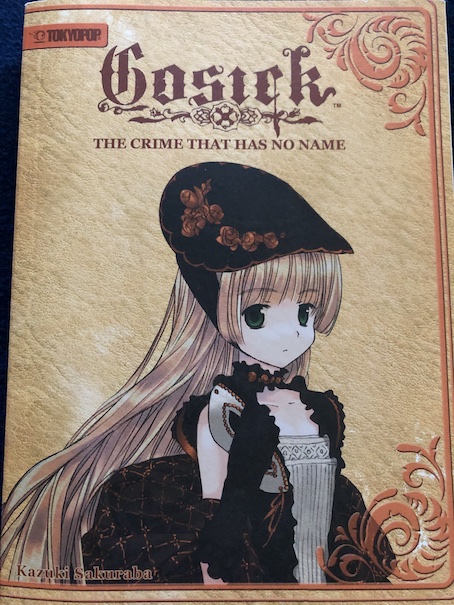
The Crime That Has No Name

This is the second book in the Gosick series. Only two of these Japanese light novels were printed in English, but there is also an anime based on the series that has been dubbed in English.

It’s 1924, and mysterious things happen around the fictional European country of Sauville. The students at the elite boarding school called St. Marguerite Academy are obsessed with ghost stories and spooky legends, as are many of the people of Sauville. Kazuya Kujou, a Japanese student attending the school, is among the few who doesn’t enjoy these stories, but he can’t help but become involved. One of his closest friends is the mysterious and enigmatic Victorique, who is the subject of some spooky legends herself. Victorique is both a student and prisoner at the school. She is a child genius, and rather than attend classes with the other students, she prefers to spend all of her time reading and studying by herself in the conservatory at the top of the library. Kazuya is one of the few people who ever sees or speaks to Victorique because he brings her assignments from class.

The reasons why Victorique is allowed to skip class, have special library privileges, and housing away from the other students but is still a prisoner, forbidden to leave the school, are partially, but not completely, explained in this book. Victorique is not a normal girl or a normal student, and there are some dark secrets in her past that even she doesn’t fully understand.

When the story begins, Kazuya has just received his allowance from home, and another friend at school, Avril, convinces him to come shopping with her. Avril is one of the students who really loves ghost stories, and she insists on telling them to Kazuya, even though he doesn’t want to hear them. Avril knows about Victorique, and she tells Kazuya that the rumor is that Victorique isn’t really a human but a legendary creature call a “gray wolf.” Kazuya doesn’t think Victorique is anything other than an extremely smart but also extremely temperamental girl.

While they are shopping, Avril is a little offended that Kazuya has her help pick out a present for Victorique. Kazuya wants to give Victorique something because she’s normally not allowed to leave the school. Avril and Kazuya study some items being offered for sale by a nun, and Avril suggests that Kazuya give Victorique a fancy turban. As they look over the other items, a music box that is apparently some kind of magic trick bursts open and releases a pigeon. Then, the nun cries out that the most expensive item for sale, a fancy plate with historical value, has been stolen! Kazuya thinks that Victorique will enjoy hearing about the theft even more that getting a present.

When Kazuya tells Victorique about the theft, she says that it’s not that interesting because it’s a very simple matter. Before she can explain why it’s simple, her half-brother, Inspector Grevil de Blois, comes to the library to once again indirectly consult with his sister about the case. When he walks in and sees Victorique sitting there, wearing the fancy turban that Kazuya bought for her, he panicks, mistaking her for someone called Cordelia Gallo. Kazuya has no idea who he’s talking about, but neither of them seems to want to explain. Once Grevil realizes that he was mistaken, he pretends like nothing happened and starts talking about the case. Victorique simply explains that the thief was the nun, and that she was the one who set up the distraction with the music box and the pigeon.

The next day, Kazuya looks at the newspaper, and he sees that Grevil was unable to catch the nun before she got away. Then, something else in the newspaper catches his attention, a notice that says, “Descendants of the Gray Wolves. Midsummer Feast is near. We welcome you all with open arms.” The people of Sauville, and the school in particular, are obsessed with legends and ghost stories. The story of the Gray Wolves is a popular legend about a mythical race of people who are smarter than normal humans. The basis of the legend is that people who were unnaturally smart were said to be human-wolf hybrids. Kazuya remembers that people at the school call Victorique a “reincarnation of a Gray Wolf”, like they’ve been calling him “the Reaper” based on their stories and legends. He decides to show the notice to Victorique.

When Kazuya shows the notice to Victorique, she is shocked. After she accidentally trips and falls and throws a childish fit about it, she shows Kazuya a centuries-old account of a village of gray wolves who spoke human language. Kazuya doesn’t know what to think about the stories. To be honest, he’s never been very interested in the legends and ghost stories of Sauville, even though everyone else is obsessed with them. Instead, he finds himself wondering if Victorique is unnaturally sensitive to pain because it seemed like she really overreacted from her trip and fall. As an experiment, he gives her forehead a slight flick. When he does that, Victorique reacts as if he had just slapped her and tells him that she’ll never speak to him again. He tries to apologize, but Victorique ignores him, so Kazuya just storms out of the library.

Later that night, while Kazuya is studying, he looks up and sees what looks like a large suitcase moving on its own outside the window. It turns out to be Victorique, trying to sneak out of the school with way too much luggage. She’s still not speaking to Kazuya, but Kazuya is concerned about her because even normal students aren’t allowed to leave the school grounds after hours, and Victorique isn’t supposed to leave the school at all. Kazuya doesn’t know exactly why Victorique is sneaking out of the school, but he knows that, while she is extremely intelligent, she has very little knowledge of or experience with the outside world. He worries that she won’t be able to cope on her own. Even though Victorique still isn’t speaking to him, he leaves the school with her and finds out that she’s taking a train to the village that is hosting the Midsummer Feast and inviting the descendants of the Gray Wolves.

Victorique and Kazuya find themselves on a train with the thieving nun from before. She’s heading to the same town they are because she says that she grew up there. She introduces herself as Mildred Arbogast. When they get to town, the innkeeper says that they had better get inside because there’s a storm coming and the Gray Wolves come out on nights like that. He says that the Gray Wolves live in a village in the mountains and that they’re werewolves. They look like normal humans, but they hunt people when they come out. When the innkeeper describes them as being short with golden hair, it suddenly occurs to him that Victorique looks just like them.

In spite of Victorique looking like a Gray Wolf, the innkeeper allows them to rent rooms for the night. He lets Kazuya know that, since that notice appeared in the newspaper, other people who have been curious about the Gray Wolves have been showing up, but he thinks that they’re asking for trouble because the Gray Wolves won’t tolerate anyone looking into their affairs. When Kazuya says that the nun is from this town, the innkeeper says that isn’t true. It’s a small town, so everyone knows everyone else, and the nun is a total stranger.

When Victorique finally starts talking to Kazuya again, she says that the reason why she wanted to come to this place was to clear her mother’s name. Her mother is Cordelia Gallo, which is why Grevil mistook her for Cordelia. Victorique shows Kazuya a pendant she has made from a gold coin. On the other side of the pendant is a picture of Cordelia Gallo, and she really does look like Victorique. For the first time, Victorique talks to Kazuya about her mother. Cordelia was a dancer, but at some point, she became involved with Victorique’s father, the Marquis de Blois. After she gave birth to Victorique, she mysteriously disappeared, and Victorique was raised in isolation in her father’s mansion. (This is why Victorique is so naive about the outside world and awkward and temperamental around other people. She’s extremely learned in terms of book knowledge but low on experience with the outside world and other people.) Victorique only remembers seeing her mother once, when she sneaked up to her window one night and gave her the pendant, but she knows that her mother still watches over her. Victorique also knows that her mother was originally from the village of the Gray Wolves. Apparently, Cordelia was once a maid there, but she was banished from the village for committing a terrible crime. Her father became involved with Cordelia because he wanted a child with the blood of the Gray Wolves, although he has always been a little afraid of Victorique, which is why he keeps her at a distance, either held prisoner in his mansion or at the school for her entire life. (The Marquis de Blois is a nefarious character with grandiose schemes of power, which are addressed further in other stories in the series and in the anime based on them, and he wanted a child like Victorique as part of those schemes.) Now that an invitation has been extended to the descendants of the Gray Wolves, Victorique is determined to see the village where her mother came from and, if possible, clear her name of the crime she supposedly committed.

The next day, Victorique and Kazuya travel to the village of the Gray Wolves along with the nun and three young men, who say that they’re college students. The village has a Medieval look to it, and the people there wear old-fashioned clothes. People there recognize Victorique as Cordelia’s daughter immediately. It makes them uneasy, but they say that they do not hold her responsible for what Cordelia did and say that she is welcome to stay for the Midsummer Festival, even though her mother is a murderer.

The leader of the Gray Wolves, Sergius, explains that the Gray Wolves aren’t really werewolves. They’re normal people, but they prefer to live in isolation from the outside world. People just assume things about the Gray Wolves because they have odd, old-fashioned lifestyles, don’t mix with other people much, and inhabit a village in a mountainside surrounded by real wolves. The Midsummer Festival is one of the few times that they allow other people in from the outside. The purpose of the festival is to welcome home the spirits of their ancestors and pray for a good harvest.

Sergius invites Victorique and Kazuya to stay with him for the festival. In his manor, a maid called Harminia says that Cordelia murdered the previous village chief, leaving gold coins scattered around his body. Cordelia was an orphan who worked as a maid for the village chief at the manor. She was blamed for the chief’s death because she was the only other person who had access to his study, where he was murdered. Victorique says that they only have until the end of the festival to investigate the murder her mother was accused of committing because the village won’t let them stay any longer. However, there are more crimes afoot in the village, and the original murderer is still there after all these years.

There is an English translation available to read for free online at Internet Archive.

This is not a series for young kids. It’s more for teens and young adults because parts get truly violent and disturbing. I find the series interesting for its references to other detective series, ghost stories, and legends, but I have to admit that the plots of the stories get a little over-the-top. As the series goes on, the stories get weirder.

This particular story fills it parts of Victorique’s back story, which even she doesn’t fully understand at first. As I said, the Marquis de Blois is a nefarious character with an over-the-top, long-term plan to seize power in Sauville, using his young daughter’s mysterious heritage and Sauville’s obsession with legends and stories. His plot is revealed later, but this book focuses on Victorique’s mother backstory. Years ago, Cordelia was framed for a murder she didn’t commit. If she hadn’t been, she would never have left the village, and Victorique wouldn’t have been born. Victorique eventually discovers who committed the original crime and clears her mother’s name, but nobody from the outside will be able to return to the village for a long time because the drawbridge to the village gets destroyed. At the end of the book, Victorique still doesn’t know where her mother currently is, but she learns a few things about her life.

The motive for the original murder concerns prophecies and fortune-telling, like the first story in this series, although in a different way. The Gray Wolves believe in prophecies, just like the rest of Sauville believes in legends. In a similar way, there is at least some truth to these prophecies just like there is always at least some basis for Sauville’s legends. The previous chief of the village was murdered because he gave his murderer a prophecy at a past Midsummer Festival that person couldn’t bear to hear. As Victorique explains it, “It’s just fortune-telling. You didn’t have to take it seriously. But you had strong faith in the laws of the village and the words of the village chief. You could not doubt the divination.” Because this person didn’t doubt what the village chief said, they believed that the only way to change their fate was to kill the person who made the prophecy. Ironically, it is that crime that makes the prophecy come true.

The story raises the questions of whether fate is unavoidable and whether prophecies are self-fulfilling. If the murderer had asked the previous chief a different question at the festival or just refused to believe what he said, would things have turned out differently for everyone? There’s no real answer to that, but the murderer’s belief that the prophecy had power is what set everything in motion. Victorique and Kazuya also receive prophecies about their futures that cause them some worry. Because I know how the rest of the series goes, I know that there is some truth in the prophecies for them, that they will be caught up in events larger than themselves that will separate them, but that’s not the entire story for them. There is a separation coming for them in this series, but it’s only a temporary one. As strange as this series is, it actually does have a happy ending for our heroes. Whether the two of them might be separated again once WWII starts is a matter of speculation because the series doesn’t extend that far. It’s possible, but they will have plenty of time together first, and as Victorique points out, you don’t really have to believe fortune-tellers.

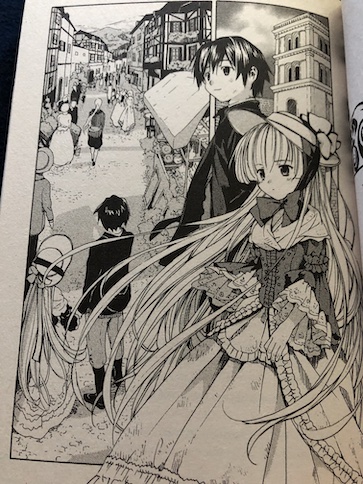
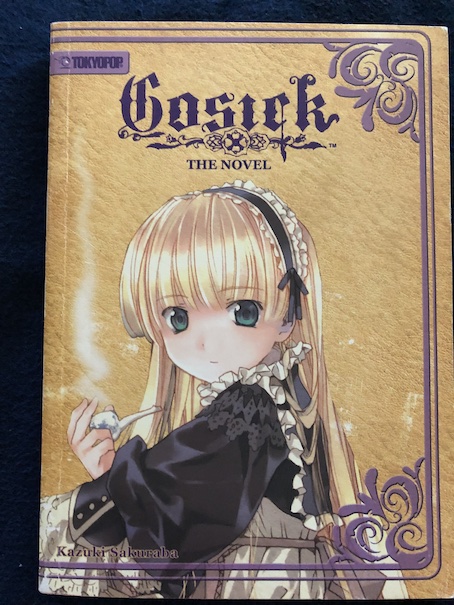
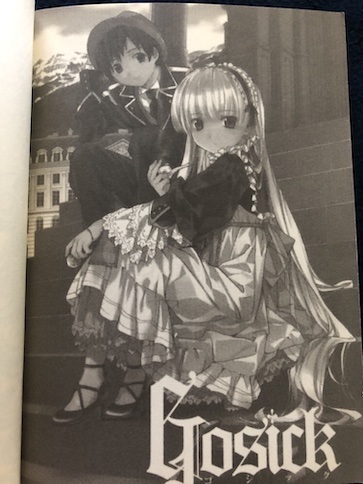
Gosick: the Novel

The year is 1924, and a boy from Japan named Kazuya Kujo is attending a prestigious boarding school called Saint Marguerite Academy, in the small European country of Sauville (fictional). The students at this school have an obsession with ghost stories. Kazuya is a very serious boy, and he doesn’t see the appeal of all of these gruesome stories, although his friend, Avril Bradley (an international student from Great Britain) loves them and insists on sharing scary stories with him. Part of the reason why Kazuya doesn’t like all the scary stories is that other students insist on calling him “the Reaper” based on a character from one of the more popular ghost stories. However, he’s not the only student at school who stands out, and some of the school’s ghost stories have more truth behind them than Kazuya would have dreamed.

There is one seat in Kazuya’s class which is always empty. That seat belongs to Victorique, and Kazuya is one of the few people at the school who has ever seen her. Victorique never comes to class, preferring to spend her time reading and studying by herself in the conservatory at the top of the library. One day, when their teacher gives Kazuya some papers to take to Victorique, Avril tries to ask Kazuya what Victorique is like. Kazuya doesn’t want to explain much about Victorique, just saying that she can be blunt and kind of mean, which is true. Victorique is brilliant, a child genius, and she looks like a little china doll, but she’s not easy to get along with. She’s temperamental and not used to dealing with other people in general. She smokes a pipe, like Sherlock Holmes, and makes deductions using her “fountain of knowledge”, even about places she hasn’t been and things she hasn’t witnessed, like Nero Wolfe.

Victorique is not allowed to leave the school grounds (for reasons which are explained as the series continues), and aside from Kazuya, there’s only one other person who visits her: her older half-brother, a local police detective. He never admits that he gets help from Victorique on his cases, and he typically prefers to act like he’s talking to Kazuya rather than speak to Victorique directly. Victorique, who is often bored, enjoys solving puzzles and mysteries, so she does give her brother help, although there is little affection between them.

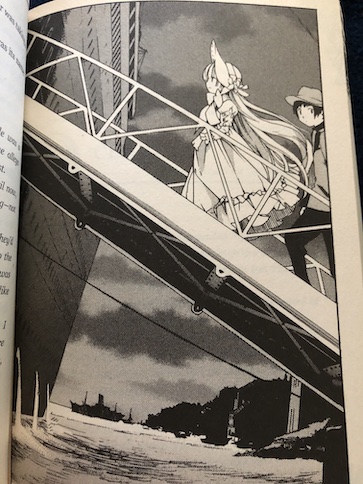
One day, Victorique’s brother, Grevil de Blois, comes to consult with her, through Kazuya, about the murder of an elderly fortune teller. After hearing a description of the murder, Victorique correctly realizes that the fortune teller was killed by her maid. However, that isn’t the end of it. Kazuya thinks that it’s unfair that de Blois always takes the credit for Victorique’s solutions to mysteries. This time, when he finds out that the grateful family of the fortune teller has given de Blois a yacht as a present and that he’s planning to spend the weekend on it, Kazuya decides that he’s going to make de Blois share this present with Victorique. Victorique is normally forbidden to leave the school grounds, but with Kazuya threatening to reveal the true secret of his success, de Blois agrees to take Kazuya and Victorique with him on the weekend yachting trip. Neither of the two kids really likes de Blois, and the thought of spending an entire weekend with him, even aboard a luxury yacht isn’t great, but it is one of the rare opportunities Victorique has to leave the school.

Victorique has rarely been anywhere other than the mansion where she was born and the school, so everything is new and fascinating to her as they take a train to the seaside to meet de Blois at the yacht. When they get there, de Blois informs them that they’ve been having trouble understanding the maid who murdered the fortune teller because she only speaks Arabic, but apparently her motive was revenge for something she calls “the box.” Then, de Blois suddenly gets word that the maid has escaped. He has to leave the kids aboard the yacht, but he tells them to just stay there and wait for him.

Victorique realizes that the yacht once belonged to the fortune teller and that some of her belongings are still on it. Among them, they find a strange invitation to a dinner party called “Evening at the Bottom of the Box” on a luxury cruise ship anchored nearby. The invitation also mentions that the main dish will be rabbit. This is chilling because it is known that the fortune teller kept rabbits and periodically allowed her dog to hunt them. It was part of her fortune telling – she would predict things based on which rabbits survived the hunt and which did not. (There is a graphic description of this at the beginning of the book that I hated. Although I found the overall mystery intriguing, there are some very gross and violent things in it.) Since they are bored and want to learn what the mystery is about, Victorique and Kazuya decide to use the invitation and attend the dinner in the fortune teller’s place.

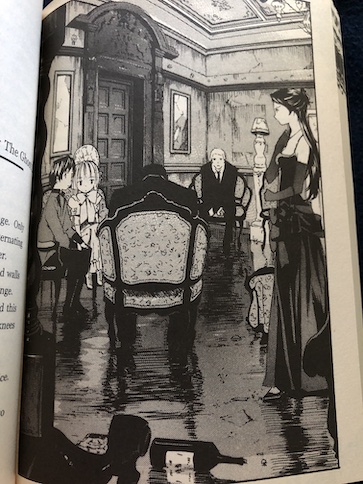
When Victorique and Kazuya join this mysterious dinner party on the luxury ship, Kazuya suddenly recognizes that the name the of ship is the same as the one of a ghost ship in one of the scary stories that Avril told him at school! The ghost stories that have been going around the school have more truth to them than Kazuya or even the students who are obsessed with them have guessed. Some dark things have happened in the history of Sauville which have become part of its local legends. Events that resemble the ones that happened years before and are described in the ghost story are starting to repeat themselves. There is at least one murderer among the dinner party guests, and someone is playing a deadly game. Now, Victorique and Kazuya will have to play along to find the answers and save their own lives!

This is the first book in the Gosick series of Japanese light novels and one of only two that were published in English. There is a full set in Japanese, of course, and I think the German language translation is also a complete set. There is an English translation of this first book available to read for free online at Internet Archive. Because not many copies were published in English, English copies are collectors’ items and can be expensive. As of this writing (September 2023), the cheapest copies on eBay are about $30, and they can go for much higher on Amazon. All of the stories in the series have been made into an anime, and that is available in the US on Amazon Prime. Because of the violence in the story, I would recommend this book and the anime for teens or young adults. It’s not for young kids!

This was the first book in this series that I read, one of only two published in English. The first time I read it, I was surprised at how many tropes of old ghost stories and detective stories that the series references. Victorique uses a pipe, which is an obvious reference to Sherlock Holmes and his famous pipe, but Victorique is also frequently a Nero Wolfe type of detective, relying on an assistant to go places that she can’t go and give her information. She spends most of her time amassing knowledge through reading, and she is able to use that knowledge to make order out of the “chaos” of a mystery.

The basis of this mystery is in fortune telling, and at the beginning of the story, Victorique is reading a book about fortune telling. She explains to Kazuya Kujo how fortune telling actually works. Basically, it’s all about psychology. People think that fortune telling works because they believe it will work, and they make things happen to cause the predicted future to happen. It’s like all prophecies are self-fulfilling prophecies – they may or may not have happened except that people believed that they would, so they made sure they did. People remember and record accurate predictions because those are the most exciting and amazing, and they forget all the inaccurate ones. Fortune tellers are also good at reading people and telling people what they want to hear, which is what they already think will happen or what they’re hoping and working to make happen.

Fortune telling is at the heart of the mystery. Mysteries in this series tend to have over-the-top plots, and this one is no exception. The grudge against the fortune teller and the other guests invited to the dinner goes back to when the fortune teller staged a very large experiment in fate at the request of some very wealthy and influential clients. This past fortune telling experiment was along the lines of the ones that she did with rabbits, only it was with human children. As I said, there are violent and gruesome aspects of this story, and in this case, they were playing with human lives.

As with other books and stories in this series, the ghost stories that the kids pass around at school turn out to have at least some basis in fact. Sauville (remember, it’s a fictional country) and some of its leading citizens have violent histories. There is a long history of conspiracies, power struggles, and general skullduggery in this place. Because of the citizens’ long obsession with stories and legends, much of what has happened there has become legendary, and important people have used the citizens’ superstitions and stories to obscure the truth. Solving the crime means exposing what really happened and the truth behind the legends.

What I found most interesting about this story was its references to some classic characters in detective fiction and ghost stories, and I appreciated Victorique’s thoughts on the nature of fortune telling and human expectations. In the end, it may be more important what people believe and work to make true than what was actually predicted. However, I have to admit that the over-the-top plots of these mysteries are probably a large part of why this series wasn’t printed beyond the second book in the United States. In the beginning of the book, there is also a reference to Kazuya being suspected of a crime. This incident was in the Gosick manga, not the light novels. It is shown in the anime, but I don’t think the manga was printed in English.

The Shimmering Ghost of Riversend

Kathy Wicklow is going to visit her Aunt Sharon at their old family home over the summer. The old family home, Wicklow Manor, is in Riversend, California, which is in an area where gold was found years ago. Kathy isn’t happy about the trip. She has to leave her dog behind because her aunt owns a cat. She doesn’t even really know her aunt very well. Aunt Sharon is her father’s sister, and her mother has said that she’s weird (which was not a good thing for her to say, both because it’s insulting and because that’s not something to make her daughter glad about spending time with her). Kathy blames her mother for going back to work. Because her mother is working and won’t be home with her, Kathy has to leave her home, her friends, and her dog for a month!

Although Kathy loves to draw, she doesn’t think that she’ll want to do that in a place she is sure she’s going to hate. She also thinks maybe her parents don’t trust her at home because of the weird dreams she’s been having. Kathy has dreams about things that later happen, although she doesn’t know why.

Her father has nostalgic memories of the old family home where he and Sharon grew up. Sharon has only recently returned there after living on the East Coast. Kathy’s father says that Sharon is looking forward to seeing Kathy again and getting to know her because she hasn’t seen Kathy since she was a baby.

Right from the first, Wicklow Manor gives Kathy the creeps. There’s even a small graveyard nearby where Kathy’s father says their ancestors are buried because people used to be buried close to their homes. When she can actually see the house, Kathy is also shocked to realize that she has drawn that house before! She thought that she had invented the house she drew from her imagination, but somehow, she had a vision of the real house. Her father thinks that she must have seen a picture of it somewhere or maybe was inspired by his descriptions of the place. However, Kathy has also done a drawing of Aunt Sharon’s pet cat, without knowing what it looked like before. When they meet Aunt Sharon, she mentions that she’s glad Kathy is there because the house has been lonely, especially at night. Kathy’s dad starts to ask her if something is still happening, but Aunt Sharon quickly denies it before he can finish the thought. Kathy can tell there’s some kind of secret between them.

Aunt Sharon has turned the family’s manor into an inn, and she’s expecting guests soon. It also turns out that part of the reason why Kathy’s mother says that Sharon is weird is that she’s into health food, and Sharon is aware that Kathy’s mother thinks that she’s a weird health nut. Kathy’s father volunteers her to help in the kitchen, although Kathy is a little worried that she won’t like the health food, although the lemonade that she makes with maple syrup instead of sugar is pretty good.

Still, Aunt Sharon gives Kathy a beautiful room with a balcony. Kathy also meets a boy named Todd who lives nearby with his great-grandfather, who is called Upstream Mike. Todd and his great-grandfather pan for gold in the nearby river, and Mike also takes his burro called Nugget into town so tourists can pay for rides on him and pictures with him. Todd is just a little older than Kathy, and he tells Kathy that he likes to write down stories that his grandfather tells him, especially scary stories about the old Wicklow Manor. Kathy asks if there are ghosts there, and Todd tells her to ask his great-grandfather about it. Kathy asks her aunt about ghosts, and Aunt Sharon tells her that Mike has told scary stories about the place for years that were apparently passed down in his family. Mike’s family lived in the area when the first Wicklows arrived.

Aunt Sharon shows Kathy some of the things in the house that belonged to their ancestors, including a portrait of a pretty young woman, who Aunt Sharon says was Jenny Wicklow, who died young by drowning in the river and was buried in the old family graveyard. One of their ancestors, James Wicklow, made his fortune as a banker during the Gold Rush days, and Jenny was his daughter. There is one room in the house where Kathy isn’t allowed to go, which is the old room in the tower. Aunt Sharon says that the staircase is broken, and she can’t have it fixed yet.

On her first night at the manor, Kathy sees a woman in a cloak with a lantern. When she asks Mike about it, he says that it’s a ghost or spirit of some kind that usually appears to young ladies at the manor, possibly a banshee or similar spirit that is a harbinger of death. Kathy worries about that, and Mike tells her the story about Jenny Wicklow. Jenny was one of three children of James Wicklow. She also had a sister named Lora and a brother named Daniel, and Kathy is a descendant of Daniel. After their parents died, Daniel went to work in the city and left the running of the manor and family farm to his sisters. The two young women hired a handsome young drifter to help them, but he started flirting with both of the sisters. The sisters seemed to develop a rivalry for him and argued with each other about it. Rumor had it that Lora was the one who pushed Jenny into the river so she could have not only her own inheritance but her sister’s as well and get the man they both wanted. After Jenny was dead, it seemed like all of their gold disappeared, and so did Lora. People assumed that Lora ran off with her lover and took the money. Mike thinks that the ghost is dangerous, and that Sharon is the one who’s in danger!

Kathy soon begins to learn that Mike is both right and wrong about the ghost. The ghost is Lora, but she’s not trying to hurt Sharon or anyone else. Something tragic happened at Wicklow Manor years ago, and Lora is trying to tell someone about it, if she can find anyone brave enough to listen … and to discovered what actually happened to Lora herself.

The book is available to borrow and read for free online through Internet Archive.

For a good part of the story, I wasn’t sure exactly what Lora’s ghost was attempting to accomplish, keeping me in suspense. I did have the sense that Lora wasn’t the one who had murdered Jenny and that she had probably been murdered herself, which was why nobody saw her after Jenny’s body was found.

Mike is correct that Lora is the ghost, but she was not Jenny’s murderer. Like Kathy, Lora was psychic. She has been trying to communicate with different girls in the family over the years to clear her name, but the other girls have all been frightened of her. Sharon claims not to believe Kathy at first about how Lora is trying to communicate with her, but she later admits that it was because she was frightened. She also saw Lora when she was young, and that’s part of the reason why she was afraid to return to the old family home for so long. She was afraid to admit that the house was really haunted and that she was afraid of the ghost. It was a long time before she could even tell her own mother and brother about seeing Lora because she was afraid of being different from everyone else in the family. Sharon is also psychic, and like Kathy was initially, she was afraid of her gift.

Kathy and Todd use the messages that Lora communicates through Kathy’s drawings and Lora’s old diary to learn the truth. Jenny was murdered by the man she loved. Lora didn’t actually love him at all. She saw that he was a violent person and tried to warn Jenny about him, but Jenny wouldn’t listen because she thought Lora wanted him for herself. Lora saw the murder that was going to happen in a dream, and she wanted to stop it by using her own inheritance to pay the man to leave her sister alone. However, Lora was unable to save her sister. After he killed Jenny, the man came after Lora and murdered her, too. Then, he stole both of their inheritances. He hid Lora’s body, which was why everyone thought she must have run away with him.

After Lora’s ghost leads Kathy to where her body is buried in the cellar and she is given a proper burial in the family graveyard, the haunting ends. However, Kathy learns to appreciate her psychic gift because of this experience. She finds it reassuring that she shares her abilities with other people in her family. When she reads in Lora’s diary that Lora thought of her own psychic abilities as a gift, Kathy also comes to think of being psychic as a gift rather than a weird defect or something to fear.

The mystery in the story was good, and I also liked the information about panning for gold that Mike gives to Kathy when he gives her a gold panning lesson. There is also a tie-in with real children’s literature because Kathy mentions that she is reading Down a Dark Hall by Lois Duncan. I’ve reviewed Down a Dark Hall on my site, and it is about girls with psychic abilities at a haunted boarding school who channel the spirits of famous people to complete their unfinished works. The channeling and spiritual possession in that book are dangerous and harmful to the girls doing it, but in this book, Kathy becomes reconciled to her psychic abilities and Lora’s gentle spirit, who needs her help.

Something Upstairs

Something Upstairs cover

Something Upstairs by Avi, 1988.

This story begins with a famous quote:

Those who cannot remember the past are condemned to relive it.

Santayana

It’s an appropriate quote for the story, which is about memory and a repeated wrong that has led to a seemingly endless cycle of violence. The story is framed as having been told to the author by the boy who actually had this frightening adventure.

Kenny Huldorf is unhappy when his parents decide to move the family from California to Rhode Island. Kenny was happy in California, the weather was much better there, and the streets and buildings in Rhode Island all seem small and old. The house they move into is called the Daniel Stillwell House, and it was built in 1789. Right from the beginning, the house gives Kenny a strange feeling, like there’s something or someone there when there shouldn’t be anyone or anything.

Kenny starts to feel better when his parents give him the big, renovated room with the private bathroom in the attic of the house. He likes that room, but there are two smaller rooms off the attic that haven’t been renovated, and they give Kenny a strange feeling. His parents think they were probably old servants’ quarters. One of them has a stain on the floor that makes Kenny think of death, and even more frightening, Kenny gets an odd sense that, somehow, it’s a death he may be responsible for. For a time, Kenny tries to tell himself that it’s nothing but an old stain and occupies himself with unpacking and getting settled. Since school hasn’t started yet, Kenny gets bored and does some exploring of the area. He starts wondering about the history of the town and the house.

Then, one night, Kenny hears a strange sound from the room with the stain. When he goes to investigate, he sees a pair of ghostly, glowing hands reaching up out of the stain on the floor. The hands pull the rest of the ghostly person out of the floor, and Kenny can see that it’s the figure of a boy. When the boy tries to reach out to him, Kenny reacts defensively, and the ghost boy seems frightened and vanishes. The next day, Kenny asks his parents if they believe in ghosts. His father says he doesn’t but that Providence is a very old town and a lot of things have happened there over the years. His mother later says that she doesn’t really believe in ghosts either, but she believes that places have memories. Kenny’s parents conclusions seem to be that Kenny is sensing the general history of the town, but Kenny feels that it’s something more specific than that, that the ghost he saw is a specific person from a specific incident in the history of the house.

The family was given a scrapbook with a list of former owners of their historic home, so Kenny decides to do some research about the past owners and see if he can learn more about where the ghost came from and who it is. When he arrives at the local Historical Library, Kenny is surprised to find out that someone there is expecting him. He is directed to the office of an historian named Pardon Willinghast. Willinghast tells Kenny that he keeps track of the owners of historic homes, which is how he and others at the library recognized his last name, and he expected that someone from the Huldorf family might come to ask about the house. Kenny gives him the list of past owners and asks what Willinghast can tell him about them. Willinghast looks at the list of names and says that there probably won’t be much about them in the library but that he’ll do some research and see what he can find. Kenny also gets the idea to have the local pharmacy test a sample of wood from the stained floor to find out what the stain is.

The next time Kenny sees the ghost, he tries to talk to the ghost boy and ask him who he is. The ghost has trouble talking but manages to communicate one word: “slave.” The pharmacy tells Kenny that the stain on the wood is human blood. They can tell that the stain is more than 100 years old, which is why they haven’t reported it to the police, like they’d have to with a recent blood stain. When Kenny talks to Willinghast again, he wants to know about people who lived in his house over 100 years ago who might have owned slaves, which limits the scope of his investigation to the first three families who owned the house. Willinghast is oddly vague in his reply, and when the subject of abolitionists comes up, he makes vague references to “agitators” and people who want to “rush history.” When Kenny tries to ask him about a murder that may have occurred in the house, Willinghast becomes agitated himself and tries to discourage Kenny from inquiring further. He says that if a slave was murdered, it probably wouldn’t even have been reported in a newspaper because it wouldn’t have been considered important.

However, now that Kenny understands that a young slave was murdered in his house and is still haunting it, he can’t leave the situation alone. He continues trying to communicate with the ghost boy, and the ghost gradually finds it easier to talk to him. He says that his name is Caleb and indicates that he is tied to the stain on the floor. He can’t seem to move very far from it. He says that he’s a memory of what happened there. He is aware that he was murdered, but he doesn’t know who did it because he was killed in his sleep. He senses that he was killed by someone who wanted to keep him a slave because he and other black people were trying to free themselves from slavery. Kenny asks Caleb if there’s anything he can do to help him, and Caleb asks him to find his murderer. Kenny asks how he can do that when the murder happened so long ago.

Then, the attic changes, and Kenny finds himself back in the past, in Caleb’s time. Kenny looks out the window and sees a strange man in a black cape watching the house. As he explores the town, he witnesses a public argument about slavery and someone asks him to deliver a note. The next morning, Kenny is back in his own bed, in his own time. When Kenny talks to the ghost again, he describes what he saw in the past, and Caleb recognizes these events and people as being part of the circumstances that led to his death. He has trouble believing that Kenny really cares about what happened to him so long ago. He says that white people have broken their promises to him before, but Kenny insists that he does care and that he wants to not only solve his murder but prevent it so Caleb can finally be free from haunting that room.

However, that’s going to be even more difficult than Kenny thinks. On his next trip into the past, he discovers who their true enemy is: Pardon Willinghast. Willinghast isn’t just an historian. Almost like Caleb, Willinghast is memory, a piece of the past that keeps coming back to haunt the people who live in Caleb’s old house and who have tried to help Caleb before. Willinghast has figured out that if someone from the future comes to the past and they lose something they’ve carried with them or if they get hurt or change themselves in some way, they can get stuck in the past, seeming like ghosts to the people there. (Or, so he says.) He has used this knowledge before against other people who have tried to help Caleb, blackmailing them into helping him instead. Now, he has the lucky key chain that Kenny always carries with him. Until Kenny gets this key chain back, he’s stuck in the past, and Willinghast won’t return it until Kenny does what he wants. In fact, he implies that Kenny is already doing what he wants, leaving Kenny to wonder if he’s accidentally leading Caleb into a trap while trying to help him escape from one.

Kenny set out to help Caleb, but he’s in danger of becoming a part of the same cycle of murder that has been repeated over and over for almost 200 years. As Kenny tries to help Caleb, he knows he’s being manipulated by Willinghast into playing a role in a very old story, but since he doesn’t have a copy of the script, he struggles to figure out what has to change to break the cycle. Can he find a way to break cycle and escape without either himself or Caleb losing their lives?

Th book is available to borrow and read for free online through Internet Archive (multiple copies).

My Reaction and Spoilers

This is a book that I remembered from when I was a kid, but strangely, I’m sure that I never heard the end of it back then. I’m having trouble remembering exactly why I never heard the end. I think it might have been one that a teacher was reading aloud, and maybe I was absent the day she finished it. Either that, or I started reading it myself and chickened out before the end because I was spooked.

This book poses a kind of “gun-to-your-head” type of decision, forcing both Kenny and the readers to consider what they would do if they were forced to make a choice between two horrible options. In this case, Kenny is put into the position of being pressured into committing a murder or being trapped forever in the past. Willinghast committed the original murder, and he tells Kenny that the only way he’ll return his keychain to him and let him go home is if he shoots Caleb himself this time. Willinghast is confident that he can force Kenny to do what he wants because he’s done the same to others before him. Other past owners of the house have tried to help Caleb before, but Willinghast has manipulated each of them into betraying Caleb and shooting him instead. These are the betrayals that Caleb referred to earlier. Willinghast claims that each of these people has lost their memory of what they’ve done when they return to their own time, so Kenny won’t have to worry about feeling guilty about killing Caleb. But, if Kenny gives in, he knows that Caleb will remain a ghost, and someday, someone else will also be in Kenny’s position, another pawn in Willinghast’s sick game of endlessly repeated murder. As long as Willinghast gets his way, not only is Caleb going to be his perpetual murder victim, but every person who tries to help will continue to be victimized and forced to participate in his bloody crime.

There is also a deeper theme to this story. Violence begets violence, and hate begins hate. Murder, revenge, hatred, and yes, also slavery and racism, are part of violent cycles that draw other people into them long after the original deed was done. People are haunted by the past in many ways … especially those who feel like they’ve got something to prove about it. It’s a theme that’s been very much on people’s minds in the early 21st century, and there are many, like Kenny, who are unwilling to be pulled into going along with violence, murder, racism, and everything that goes with it just to save some past people’s public images or some modern people’s egos.

Willinghast has correctly realized that the reason why he’s able to come back is because he’s a part of Caleb’s memory as his original murderer. Every time Caleb’s ghost tries to solve his murder and change the past, Willinghast gets reawakened to interfere. In his role posing as the historian, he rewrites the accounts of Caleb’s death in the archives to trick the people trying to help him. He’s not about truth but manipulation, much like the pseudo-historians who resurface to tell “their truth” when certain controversial topics come up. He has a vested interest in lying to cover up his own shameful deed and to force others into helping him get things his way. Willinghast does not care either about accurate history or about the welfare of future generations; he only uses them to cover up his own misdeeds. He’s used other people to repeat his dirty work before, and he’ll do it again, blaming Caleb each time for bringing it on himself by trying to survive instead of just accepting his own murder and staying dead … unless things are different this time around. The violence ends when someone finally says no and refuses to play along. So, what Kenny is really looking for, in this situation where he seems to be given a choice between two horrible options, is a third option that allows both him and Caleb to escape.

Because the story is framed as one being told by Kenny to the author later, readers know from the beginning that Kenny finds another solution to the problem that doesn’t include murdering Caleb or being trapped in the past as a ghost. The suspense comes from the readers wondering how he’s going to do that. Kenny’s solution isn’t entirely peaceful (spoiler) because he ends up shooting Willinghast, but that could be seen as an act of self-defense, not only saving himself but also Caleb and all of Willinghast’s future victims. It seems like eliminating Willinghast was the only way to end the cycle of murder because it wasn’t really Caleb’s attempts to save himself or bring his murderer to justice but Willinghast’s attempts to cover up his crime that kept the cycle going. Willinghast blames Caleb for trying to avoid being murdered, but the truth is that it’s his original act of murder that created this situation from the beginning and his continual cover-up and recruitment of unwilling abettors that has kept the cycle going. Readers can debate whether there was another way to solve the problem, but once Willinghast is gone, the cycle is broken.

Some might also point out that the reason why Willinghast targeted Caleb in the first place was that Caleb shot one of Willinghast’s associates first, but the reason why Caleb did that was that Willinghast’s associates were violently targeting a black neighborhood, and Caleb was trying to hold them off. Once again, violence begets violence until someone decides not to participate. In the end, Kenny commits a violent act, but the cycle ends because he gets the one person who was at the center of all of the other violence from the beginning. Kenny also remembers everything that happened when he returns to his own time, which brings up a point that I’ve already mentioned but I’d like to explain in more detail: Willinghast is a liar.

The only reason why Kenny knows, or thinks he knows, that Willinghast has power over him and can prevent him from returning to his own time as long as he holds one of his belongings is because Willinghast says so. Nobody else in the story says that, and frankly, Willinghast is a known liar. He was never a real historian. He’s only another ghost from the past masquerading as one to trick people into doing his bidding. He fakes historical records to manipulate people. He is an admitted murderer. He said that Kenny wouldn’t remember what happened in the past when he returns to his own time, so he wouldn’t have to feel guilty about shooting someone, but Kenny remembers everything. This didn’t occur to me when I first encountered this story as a kid, but looking at it now, I can’t help but think, why the heck should Kenny believe anything that Willinghast says about how the time travel works?

At the point in the story where Willinghast tells Kenny that he’s trapped in the past as long as he has his key chain, Kenny already been to the past once and returned from it without either Willinghast’s help or interference. Kenny did not get to the past by Willinghast’s power, but through Caleb’s memories. Willinghast was counting on Kenny to be frightened and confused so that he would rely on his word for what’s going to happen to him in the past and feel like he had something real to lose for not going along with his plans, but even as I read the story, I doubted him. I think what he said about Kenny needing his key chain to return home might have just been another of Willinghast’s lies. I don’t recall seeing anything in the story that proved that Willinghast was right, and it seems that none of his other victim/accomplices put his lies to the test to find out. There is no one else trapped in the past as a ghost because we never see any such people in the story. So, if that hasn’t actually happened to anyone before, how would Willinghast or anyone else know that such a thing was even a possibility?

The fact that Kenny remembers shooting Willinghast also suggests that everything Willinghast said may have been a lie. He claimed that none of the other time travelers retained their memories, so Kenny wouldn’t remember if he shot Caleb. If Kenny wouldn’t remember shooting Caleb, how would he be able to remember shooting Willinghast? Unless Willinghast needs to be alive after Caleb’s death to rewrite people’s memories, it sounds like the idea that Kenny wouldn’t remember what happened in the past was a lie. We never see or hear from the other people Willinghast manipulated, so we don’t know for sure that they had no memories or guilt over what happened. That could be another subject for debate among readers, but from what I saw in the story, I’m thinking that Willinghast should be considered a liar on everything he said. I think the real trap wasn’t that Willinghast was holding Kenny in the past so much as Willinghast was making Kenny believe that he was. Although he tried to make Kenny believe that he only had two choices, Kenny himself found a third one. Perhaps there were other possible choices, but we know that there was at least one more option than Willinghast led Kenny to believe he had.

Because there are violent themes in this story, it isn’t for very young kids, but it does combine some historical details with excitement for kids who enjoy scary stories. There is also some use of the n-word on the part of the villains in the story, so be warned. The story is thought-provoking on the subjects of history and personal choices.

In the end, after Kenny has finished telling his story to the author, he says that he knows that Caleb survived the room where he was murdered before and no longer haunts it. Caleb ran away after Willinghast was dead, but Kenny doesn’t know where he went after that or what happened to him. He finds himself worrying that the violence caught up with him again somewhere else and that maybe he’s just haunting a different house now because the memory of all that was done to him will never end. This is the final question the story leaves readers. Is that how it really is? Is there an end to the wrong, or are Caleb and others like him still ghosts who haunt us all?

This story reminds me somewhat of a YouTube video made by Kaz Rowe in 2022 about the history of ghost hunting. While talking about the history of belief in ghosts and our society’s fascination with ghosts and ghost stories, Kaz Rowe points out that many of our historical American ghost stories focus on moments when our society failed and innocent or vulnerable people suffered. The ghosts that haunt our society often represent unresolved situations – unpunished crimes, unacknowledged injustices, perpetuated wrongs, and tragedies that can’t be undone. There is a feeling that there was more that our society could have done and should have done to prevent needless death and suffering, and that’s probably true. Perhaps some of these problems were the result of people who thought (or convinced others) that they only had one option or just one choice between two bad options – black-and-white thinking, if you will – so they made terrible choices, never considering or choosing to acknowledge that there might be other ways. One of the difficult parts of studying history is considering the choices not made and the things people of the past left undone. It does create an unsettling a sense of the unresolved, that the past is still with us and haunting us today. What Kaz Rowe was talking about is that part of the interest in communicating with ghosts is that sense of the unresolved. There were people in the past who needed help and didn’t get it, people whose voices weren’t heard when they needed someone to listen, and people who suffered when no one seemed to care. When people reach out to ghosts, they seem to be saying that, even if no one heard them or cared about them in their time, someone does care now and wants to hear what they have to say. We don’t have the ability to go back and change the past, like the character in the story, but there may be the hope that caring and listening can, in some way, offer peace to the ghosts of the past because someone finally understands what they went through and how they felt.

Do I think Caleb and others are still haunting us? Yes, after a fashion, I think so. There is the haunting feeling of a past that can’t be changed or entirely made right. Caleb isn’t haunting Kenny’s house anymore, but he is haunting Kenny’s mind because of the shared trauma of what they went through and Kenny’s lingering fears about Caleb’s life after the events.

In that sense, I would say that maybe the ghost hunters have it right. Maybe the best thing to do with the ghosts of the past is not to be afraid of them but to pay attention to them and see them and their situations for exactly what they were. The haunting in the back of our minds comes from our inability or unwillingness to see what we can sense is there and is begging to be seen. That feeling comes from the human impulse to investigate and understand. It’s the unknowables and uncertainties in life that are the most frightening. When you know, even when you know the worst, you stop worrying so much about it. There are no more unanswered questions and things that just don’t add up, the questioning little voices in your head fall quiet, and the ghosts have nothing more to say because they’ve been heard and seen.

Mystery Madness

Mystery Madness by Otto Coontz, 1982.

While Murray’s parents are on vacation, his older sister, Blanche, is in charge of the house. One day, he calls Blanche to get a ride home from the dentist and hears what he thinks is Blanche shooting their housekeeper.

Earlier that morning, he had heard Blanche talking on the phone to someone about a gun. Then, when he calls home, a friend of Blanche’s, Harold, answers, and Murray hears a gun going off in the background and Blanche apologizing to the housekeeper and talking about blood on the carpet. When Murray gets home, his mother’s Persian rug is missing and sees what appears to be a head in a bucket under the sink in the kitchen, further proof that the housekeeper is dead and that her blood stained the carpet.

Murray doesn’t know what to do because he is sure that his sister would never shoot anyone on purpose, and he doesn’t want to see her go to jail. He consults a private detective, Mat Cloak, who he met in a doughnut shop, for help.

The detective agrees to look into the case, and along the way, he realizes that it has connections to a case that he is already investigating. What really happened to the housekeeper? Is Blanche really guilty of murder? Moreover, who is the strange man who is following Murray around?

It’s a very funny story with some twists that readers won’t be able to guess right away. Part of the mystery is pretty obvious because Blanche is a theater student, but the real mystery is one that Murray isn’t even trying to solve and the real villain is someone who Murray thinks is a victim.

The book is available to borrow and read for free online through Internet Archive.

Disappearing Acts

Herculeah Jones

Disappearing Acts by Betsy Byars, 1998.

Herculeah’s friend, Meat, decides to take a comedy class at a local comedy club called Funny Bonz.  While he’s at the club for his class, he finds a dead body in the men’s restroom.  He quickly runs to get help, but when the club’s owner (who is also the teacher of the class), Mike Howard, goes to check, the body is gone.  It happens to be April 1st, so everyone assumes that it was just an April Fool’s Day prank.  However, Meat is sure that what he saw was a real dead body.

He tells Herculeah what happened, and he also remembers that he has proof of what he saw: a blue wallet that he picked from the floor near the body.  The ID in the wallet says is for a woman named Marcie Mullet.  Meat never got a clear look at the identity of the body because it was lying face down, but he remembers that it had a ponytail, so they assume that it was Marcie.  Marcie was supposed to be a student in the class, too, but she never showed up.  Meat and Herculeah assume that the body must have been Marcie.

However, Herculeah is somewhat preoccupied by something else.  She’s been getting strange vibes from a camera that she bought at a secondhand shop.  The camera was cheap, only a dollar, and there’s still a partially-exposed roll of film inside.  The camera was a great deal, but Herculeah’s hair is frizzling, and she senses danger approaching.

When she develops the film left in the camera, she realizes that the camera had once belonged to Meat’s mother, and the pictures show Meat’s father.  Meat has very little memory of his father because his parents separated when he was very young, and his mother has refused to talk about him for years.  Herculeah knows that Meat badly wants more information about his father, but she hesitates to show him the pictures because she doesn’t think that he’ll like what he sees.  He’s imagined that his father could have all kinds of cool professions, and she doesn’t know how he’ll react to his real one.

Self-perception is also very important to the solution to the murder.  Meat is the first to learn the killer’s true identity and is able to get the killer to confess and confide in him.  The killer was tired of the victim’s mean-spirited jokes, all of which were about the killer, who is fat.  The murder was unintended; the person just snapped when the victim gloated about using the mean-spirited comedy routine to become famous.  Meat understands how the killer feels because he hasn’t had a very good perception of himself and knows what it’s like to be fat.  There is a series of fat jokes in this part of the book, the meanest of which (the killer quoting the victim) are about a fat woman’s bra size.

When his father’s true identity is revealed, Meat is actually glad, which surprises Herculeah.  Meat’s father is very different from what he had imagined, but oddly, finding out that his father is a professional wrestler gives Meat something new to aim for.  Meat is sometimes self-conscious of his large size, but seeing his father makes him realize that he can change his fat to muscle and be really impressive.  The two of them meet, and Meat’s father apologizes for leaving so suddenly when Meat was young.  He explains that, much like his own father, he has trouble living anywhere for very long.  His own father had similarly abandoned his family when he was young.  Both of them just reached a point when they had an irresistible urge to pick up and move on.  However, Meat’s father makes it clear that he really does love him and is proud of him and says that he will continue to see him.  It’s a strange explanation, but Meat accepts it and forgives his father.

This book is available to borrow for free online through Internet Archive.

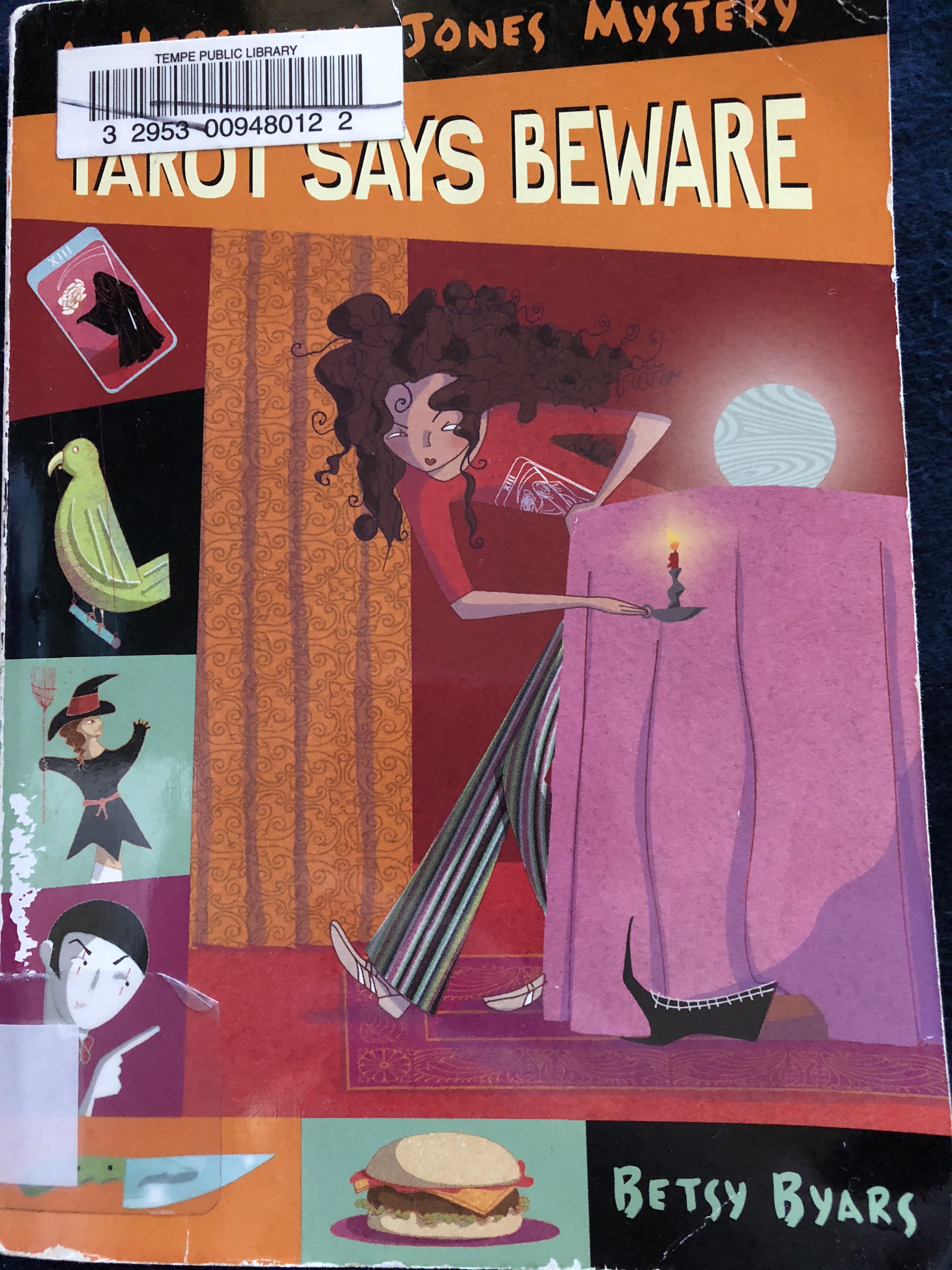
Tarot Says Beware

Herculeah Jones Mysteries

HJTarotBeware

Tarot Says Beware by Betsy Byars, 1995.

Madame Rosa is a fortune teller and one of Herculeah’s neighbors.  Herculeah has been taking care of Madame Rosa’s pet parrot, Tarot, when she goes out of town.  One day, Herculeah notices that Tarot has gotten loose and is sitting on the porch, so she goes to retrieve him.  When she takes the parrot back into the house, she doesn’t see Madame Rosa.  After investigating further, she finds Madame Rosa dead and calls her father, a police officer.

Herculeah is very upset about Madame Rosa’s death.  She had considered her a friend.  Even Meat said that he once consulted her for information about his father.  She told Meat that his father danced, and Meat’s mother was very angry when she found out because she never wanted Meat to know anything about her ex-husband.  She even said that she “could kill that woman.”  But, who would really want Madame Rosa dead, badly enough to murder her?  Was there someone else who didn’t like their fortune?  Did Madame Rosa know something that someone was afraid that she would tell?

It turns out that Herculeah’s mother holds an important clue.  Madame Rosa came to see her about a troubling client.  A woman visited Madame Rosa to ask if her son could kill someone.  The woman’s son had threatened her, and she wanted to know if he was capable of acting on his threats.  Madame Rosa had asked her to bring something that belonged to her son, and the woman brought her the knife that the son had used to threaten her.  That was when Madame Rosa had a vision of her own death.  It frightened her so much that she fainted, and when she woke up, the woman was gone.  Herculeah’s mother asked Madame Rosa what she’d like her to do, and Madame Rosa told her that she didn’t think anything could be done.  Later, Madame Rosa was murdered with a knife.

So, now Herculeah suspects that the woman’s son came and murdered Madame Rosa, but she has no idea who the woman or the son are.  Then, when Herculeah and Meat go to snoop around Madame Rosa’s house, Herculeah thinks that she sees Madame Rosa.  Is she a ghost, or could Madame Rosa really be alive?

The title of the book comes from the fact that Tarot the parrot always says “Beware” to strangers, but not to Madame Rosa herself.

The book is available to borrow for free online through Internet Archive (multiple copies).

Once Upon a Dark November

Once Upon a Dark November by Carol Beach York, 1989.

Katie Allen likes her part-time job helping Mrs. Herron with her housework. One of the best parts of the job is that she gets to see Mr. Herron, her English teacher, at home. Katie has a crush on Mr. Herron, although no one but her best friend knows it.

One day, while she’s at the Herrons’ house, Mrs. Herron tells her that her cousin Martin is coming for a visit. She says that Martin hasn’t been in Granville in years, although he used to live with their aunt when he was young. Their aunt is Miss Gorley, the creepy lady who lives across the street from Katie’s house. When Martin arrives, he turns out to be pretty creepy himself. He never says very much to anyone and spends a lot of his time just staring out the window. Mrs. Herron is not happy to have him there and wishes that he would leave.

One day, Martin disappears, and the next day, Miss Gorley is found murdered in her house. Did Martin return to Granville just to murder his aunt? Where is he now, and who is that mysterious person who tried to attack Katie at her house, dressed in a Frankenstein costume? Did Katie see something that she wasn’t meant to see?  Katie doesn’t remember seeing anything important, but now she has to figure out what it was before it’s too late!

This book is not for young children.  It would be best for kids in middle school (about 12 and up).  There is murder and attempted murder, including the attempted murder of Katie, who is a child, because the murderer of Miss Gorley thinks that she knows too much.  There is also some discussion of child abuse, which was part of the motive behind Miss Gorley’s murder.  Katie did see some things that are important to the case, but their full importance doesn’t occur to her until the attempt on her own life.  People are not quite who they seem to be, and some of Katie’s initial impressions were closer to the truth than someone wants her to know.

The book is currently available to borrow for free online through Internet Archive.