Mystery Up the Winding Stair

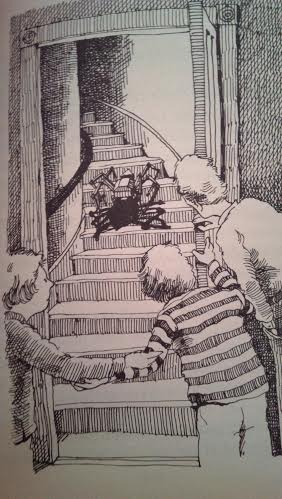
Harry Hunter and his mother have been living with his grandfather in his big mansion while his father is in Japan doing work for the government. His family has owned the mansion for a long time, and it has a small museum in it containing Native American artifacts and things relating to pioneer life, including a small log cabin built in a large room up a winding staircase.

When Harry’s mother goes on a trip to see his father, Harry and his grandfather invite Harry’s cousins to visit them: Ned and his sister Lou, and Carol, whose family has only recently moved to the area.  When the children try to decide what they would like to do together, Carol suggests a treasure hunt.  Their grandfather sends them on a treasure hunt to find something that he hid himself a long time ago: a set of silver spoons made by Paul Revere and a diamond. The explanation is that the grandfather is rather absent-minded and has forgotten where he hid the treasure, although he knows that it’s somewhere in the house.

A storm leaves them all snowbound in the mansion, but they are not alone. There are mysterious footsteps, someone using a secret staircase to the attic, and signs that the bed in the cabin has been slept in. The children begin to realize that someone else is in the house with them, and this person wants the treasure for himself!

This book is out of print, but you can borrow and read it online for free through Internet Archive.  Internet Archive requires you to sign up for an account to borrow books, but the account is free, and you read the books directly in your browser.  There are no overdue fees because the books simply disappear from your virtual loan list when your time is up.  You are allowed to re-borrow books as long as copies are available (not being “borrowed” by other people).

The house the mansion in the book was based on was the old summer home of Governor Washington Hunt, located in Lockport, New York. (I learned about the house from an article about the story behind the book and an event related to the book that was held at the library in Lockport, but the site that had the article doesn’t have it up anymore. I think I saved a copy somewhere, but I’m having trouble finding it right now.)  It was called Wyndham Lawn and later became a children’s home. It’s now a private school called the Henrietta G. Lewis Campus School.  When the author, Helen Fuller Orton, was young, some of her relatives rented Wyndham Lawn from its owner, and she lived with them for a time.  In the article, the author noted that the house had been changed somewhat since the time when she lived there in the 1880s in order to accommodate the needs of the children’s home.

When I first read this book, I thought that the part about the grandfather simply forgetting where he hid an important treasure was a little cheesy, but the treasure hunt in a mansion with its own museum is fun. It’s a little spooky when the kids realize that there’s an intruder in the house with them while they’re snowbound, although it’s pretty obvious to readers of the story who the intruder was. The house really makes the story because it is a fantastic setting! It’s a very cozy mystery for winter.

I enjoyed the story and learning about the history of the real house. I also considered what Harry’s father is doing in Japan because this book was published just after WWII. I don’t think they ever explain why Harry’s father is in Japan on government work, but I’m sure he’s involved with the occupation and reconstruction of Japan after the war. It’s a subtle reference to current events at the time this story was written that’s not part of the main story but is used as part of the reason why the main story is happening.

Sarah Morton’s Day

sarahmortonSarah Morton’s Day: A Day in the Life of a Pilgrim Girl by Kate Waters, 1989.
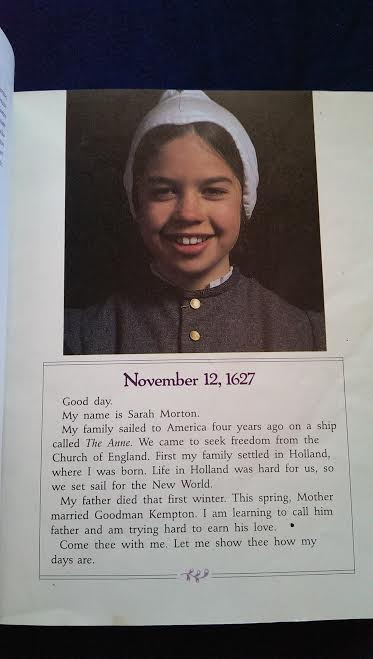
This book is part of a series of historical picture books. It features a young girl who was an historical interpreter at Plimoth Plantation, a living history museum, playing the part of a real pilgrim girl who lived in 17th century Plymouth.  The pilgrim girl’s name was Sarah Morton, and she was nine years old in 1627, the year that Plimoth Plantation reenacts.

As Sarah Morton, the girl takes readers through a typical day in her life.  She demonstrates the chores that a pilgrim girl would have to perform.  She explains the clothes that a pilgrim girl would wear and what people ate.  There is a recipe for 17th Century Indian Corn Bread, a simple recipe that readers can make at home, but it warns that modern people wouldn’t think that it tastes very good.  It’s basically just water and cornmeal grits.

sarahmortonpic1Although much of Sarah Morton’s day is taken up with chores, she also discusses her relationship with her mother and her new stepfather.  The death of a parent was something that pilgrim children often experienced.  After her father’s death, Sarah’s mother remarried, and Sarah is concerned about whether her new father likes her.

However, her stepfather is a good man who cares about her.  He gives her lessons in reading and writing, something that not every pilgrim girl would have.  He also gives her a special toy: a knicker box, which is a wooden box with arches for rolling marbles through as a game.  She gets to play with her friend, Elizabeth.

The two girls are also excited about a ship that has been sighted out at sea.  Soon, new people will be coming to their colony, and they wonder if the ship is also carrying letters from England or special goods that they would like, like a new bolt of cloth.

In the back of the book, there are sections explaining a little about the Plimoth Plantation living history museum, the real Sarah Morton, and the girl portraying Sarah Morton, Amelia Poole. The Plimoth Plantation site has more information about the real Sarah’s Morton’s life, including what happened to her when she grew up.  If you’re curious about what Amelia Poole is doing today, she is a fiber artist and lives in Maine.

The book is available to borrow and read for free online through Internet Archive.

sarahmortonpic2

Never Hit a Ghost with a Baseball Bat

GhostBaseballBatNever Hit a Ghost with a Baseball Bat by Eth Clifford, 1993.

Mary Rose and Jo-Beth are visiting another museum with their father, but they’re not happy about it.  Mary Rose is annoyed because there’s a boy she likes, and no matter what she does, he just won’t pay attention to her.  Jo-Beth is annoyed because she just turned eight years old, and well, . . . she just turned eight.  Nothing special happened on her birthday.  She doesn’t look different, she doesn’t feel different, and she just had to go to school like normal.  Their father, Harry, hopes that a visit to a strange museum dedicated to antique trolleys will help snap them out of their funks, although neither girl thinks so at first.

But, it seems like the trolley museum might be inhabited by a ghost.  The owner, Sam Thorne, doesn’t think so, but his assistant, Hoot Turner, can’t think of any other explanation.  Strange things are happening.  Food and other objects disappear.  Things are moved around.  Areas are . . . unexpectedly tidy?  What gives?  If it’s a ghost, it’s apparently a ghost that believes in cleanliness and doesn’t mind doing the dishes.  But, if the ghost is so friendly and useful, why do mysterious voices call out to them to beware?

GhostBaseballBatPicThe girls explore the trolleys parked in the museum and admire the manikins dressed in old-fashioned clothing that are part of the displays in each trolley car, but more strange things happen.  A teddy bear seems to speak to them, even though it isn’t the kind with a string and a talk-box.  The manikins start to seem creepier.  Mary-Rose and Jo-Beth are only armed with a baseball bat from one of the displays and the old teddy bear (which terrifies Jo-Beth).  But, Mary Rose is determined to find the ghost, even if it’s the last thing she does!

Telling you about one of the themes of this story would spoil the ending, but both the girls come to realize that there are people in the world with much more serious problems than the ones that they were worried about at the beginning of the story.  There is a happy ending for everyone as Mary Rose turns her mind to something more interesting than a boy who takes no notice of her and Jo-Beth appreciates her birthday more by throwing a special party for someone else.

This is part of the Mary Rose and Jo-Beth Mysteries series. It is available to borrow and read for free online through Internet Archive.

Scared Silly

ScaredSillyScared Silly by Eth Clifford, 1988.

Grandma Post has decided that Mary Rose and Jo-Beth Onetree are finally old enough and responsible enough to have an antique doll house that has been in their family for years. But Jo-Beth is irritated because her family thinks of Mary Rose as the responsible one, and Mary Rose doesn’t take her seriously. Jo-Beth is the dramatic one, a day dreamer.

Although Jo-Beth is determined to prove that she can be as practical and sensible as her older sister, neither she nor her father can resist a look at the Walk-Your-Way-Around-the-World Museum when they spot the sign for it on the way to their grandmother’s house to pick up the dollhouse.  Practical Mary Rose thinks they should just continue with their journey and not get distracted, especially because the weather has turned stormy. Then, the bridge they had to cross over collapses behind them, washed away by rising river waters, so they have no choice but to keep heading toward the museum and call for help.

The Walk-Your-Way-Around-the-World Museum is a museum dedicated to shoes from different periods of history and different parts of the world. It’s owned by the eccentric Harper family, who also owns the strange house nearby called Harper’s Abode. Gus Harper made his fortune in shoes, and he’s the one who came up who built the museum. He’s also an inventor who creates magic tricks for stage magicians, and he decorated Harper’s Abode with them, almost like a funhouse. His brother, Razendale Harper, lives there, too. Razendale was an actor, and he now teaches drama and entertains children at the local hospital while wearing giant rabbit costume. Their nephew, Erik, lives with them, and Daisy Dorcet manages the family’s affairs.

ScaredSillyPicWhile the Onetree family is visiting the museum, a pair of shoes that once belonged to a Chinese emperor disappears. Like the two Onetree sisters, Gus considers himself the sensible brother and doesn’t take Razendale, the dreamier sibling, very seriously. He thinks Razendale ran off with the shoes as a prank. But, Erik, who seems more sensible than either of his uncles, says that they can’t just accuse him without proof. Gus provides them with an invention that could settle the whole matter, but that depends on whether or not they can trust Gus.
This book is a little different from the others in the series in that there isn’t just one issue that the girls consider along with the mystery. Jo-Beth considers whether or not she’s going to remain a dreamer or try to be more sensible (at least, part of the time, like maybe once or twice a week). Mary Rose is surprised that Jo-Beth can come up with some sensible solutions when she puts her mind to it. Then, there’s the shoe thief, whose motives are more altruistic than anyone suspects and who raises the question of where certain museum artifacts actually belong.

This is part of the Mary Rose and Jo-Beth Mysteries series.  It is available to borrow and read for free online through Internet Archive.

Help! I’m a Prisoner in the Library!

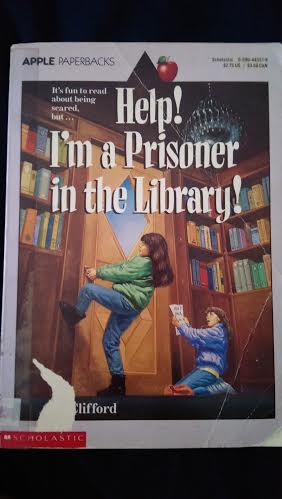
Help! I’m a Prisoner in the Library! by Eth Clifford, 1979.

Harry Onetree is taking his two daughters, Mary Rose and Jo-Beth, to stay with their aunt on a snowy evening because their mother is about to have a baby and will soon be in the hospital. But, Harry has a habit of being careless and doing things at the last minute. In spite of practical Mary Rose’s warning that they’re running low on gas, Harry doesn’t stop to get any until they finally run out, and he has to hike through the snow back to the last gas station they passed.

Before their father gets back, Jo-Beth, the younger sister, declares that she has to go to the bathroom. Long-suffering Mary Rose finds one for her in a nearby library just before closing time. But, it’s not an ordinary library. It’s actually an old mansion which has been converted into a branch library for children. It has some fantastic displays, including an old wooden wagon called a “kid hack” which was once used to carry children to school, like a school bus. Unfortunately, the girls get distracted by this strange library.  The girls forget about the library closing, and the librarian, not knowing that they’re there, locks them in for the night.

Meanwhile, the blizzard outside is getting worse, and their father has returned to the car and realized that they’re missing. The girls try to call the police, but they refuse to listen, thinking it’s a prank. Melodramatic Jo-Beth thinks that they’re doomed to starve to death in the library, trapped by the blizzard. Then, the girls hear a mysterious “thump” from upstairs. It turns out that they’re not alone in the library . . .

This is the first book in the Mary Rose and Jo-Beth Mysteries.  It is available to borrow and read for free online through Internet Archive.

My Reaction

The Mary Rose and Jo-Beth books are fun with the way Jo-Beth delights in imagining doom and gloom while Mary Rose tries to work out a practical solution to their problems. The books in this series are also frequently about something other than the immediate mystery that the girls face. In this case, the girls learn about the history of the old house, how it became a branch library, and how old buildings, even though they are beautiful and have a history to them, may face destruction if people don’t care enough about them or find a way to put them to some useful purpose.