Meg Mackintosh and The Stage Fright Secret

Meg Mackintosh Mysteries

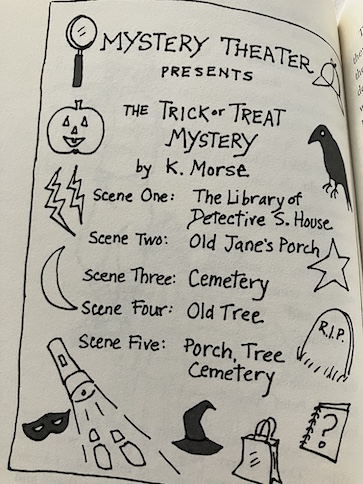
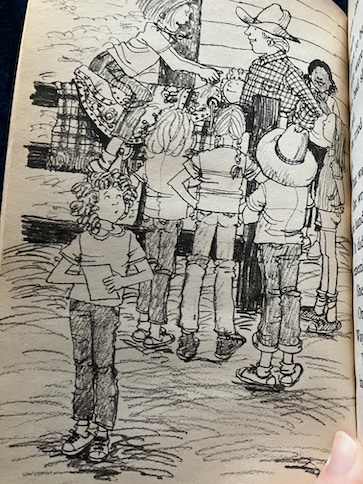
The mystery club at Meg’s school is putting on a play, and Meg’s friend, Liddy, says that they should try out for parts. The play is a Halloween mystery called The Trick or Treat Mystery with a detective called Sureluck House. Meg is nervous during the try-outs and rushes through her lines, so she doesn’t get the part of the detective. However, the club’s advisor, Ms. Morse, gives her the role of announcer. The announcer is like a narrator, introducing scenes of the play. Meg still wishes that she had a regular part in the play, but being the announcer gives her a chance to be involved.

The kids begin assembling costumes and props. Meg creates signs for each scene, including signs to invite the audience to figure out clues during the performance. Once the play gets started, the story takes the form of the play itself. All of the dialogue is presented as part of the play and other information as stage directions, and Meg’s signs invite readers to figure out clues to the mystery.

In the play, Sureluck House gets a letter from Old Jane, a woman who lives in a spooky cottage near a cemetery, asking him to find who stole her stuffed raven. The raven has glowing red eyes, and Old Jane likes to put him on her porch on Halloween to scare away trick-or-treaters.

Sureluck and his friend Witson visit Old Jane, who tells them that three trick-or-treaters have visited her: a witch, a mummy, and a pirate. Then, Old Jane got distracted, chasing one of her kittens, and when she returned to her porch, the raven was gone. She thinks one of the trick-or-treaters stole it. Sureluck and Witson interview the three trick-or-treaters and point out evidence that each of them left at the scene, but they all deny taking the raven.

Then, there is a spooky part of the play where the actors are scared by lightning and thunder, and the lights go out. Readers and the audience can tell that the actors are also confused at this part of the play, and the Ms. Morse sticks her head out from behind the curtain to say that they’re experiencing technical difficulties.

When the lights come back on and the curtain opens again, Sureluck is lying on the ground, having apparently fainted from fright, and only Witson and Old Jane are on the scene. Witson says he thinks he can solve the mystery and invites the audience to guess which suspect stole the raven and where it is. When the audience says where they think the raven is. They guess the correct suspect, but the raven isn’t where it’s supposed to be. Also, Meg has suddenly disappeared, leaving her sign behind. Now, everybody, audience, actors, and Ms. Morse seem really confused.

Has an actual raven theft occurred in the middle of the play? Is Meg the culprit? Where is she?

The book is available to borrow and read for free online through Internet Archive.

I liked the unusual format to this book, having most of the mystery be in the form of a play within the story. Like other books in this series, readers are given the opportunity to spot the clues and solve the puzzle along with Meg. Because of the play format, we are also like part of the audience, watching the play and trying to figure out where the mystery in the play leaves off and where the mystery that Meg needs to solve begins. The ending is a little unusual because Meg seems to disappear briefly. I didn’t think it was too hard to figure out where Meg went, but I still enjoyed the story, and I though a spooky mystery play was a nice idea for a Halloween story!

The Vampire Mystery

The Boxcar Children

The Alden children are introduced to a local author by their grandfather. Charles Hudson lives in an old house that his family has owned for years, next to a graveyard. He is known for writing a book about a vampire, and he explains to the Aldens that he was inspired to write the story because there are local stories about a vampire in that graveyard. He grew up hearing those stories, and he used to scare his brother with them when they were kids.

Mr. Hudson is now trying to sell the house. He doesn’t really want to, but he’s getting older, and the house is really too big for him to easily maintain it by himself. However, strange things have started happening since he decided to sell. His For Sale signs have been stolen and vandalized, people have been hearing strange sounds coming from the cemetery, and one of his neighbors, Mrs. Fairfax, found what looks like blood on her porch. His nervous realtor, Josh, seems to think that the vampire stories are real and that the vampire is trying to stop anyone new from moving into the house. He got that idea from the author’s book, where the sale of a house near a cemetery awakened the vampire’s wrath. Of course, Mr. Hudson and Mr. Alden say that’s just a story, but it’s still spooky to the Alden children. When they went outside to explore the cemetery, they also saw a mysterious figure lurking around. Mr. Hudson worries that the stories about the vampire will make it hard for him to sell his house.

The author says that he needs to out of town to meet with a movie producer about making a movie based on his book, and he’s a little worried about not having anyone to look after the house while he’s away. The Alden children offer to look after his house while he’s away, watering the plants and keeping things tidy for potential buyers. Mr. Hudson gratefully accepts their offer of help.

However, the next time the children go to the house to check on it, they find that the police are already there because someone vandalized the house during the night. The vandal ripped out some flowers in the garden and left a threatening message painted in red on the porch: “Leave me to rest in peace or you will be sorry.” The neighbor, Mrs. Fairfax accuses the children of doing the vandalism because she doesn’t like kids. Fortunately, Josh the realtor is there and vouches that the children are friends of Mr. Hudson and are just helping him with some things while he’s away.

At a local bake sale, the children have an odd experience when Benny bumps into a man who looks a lot like Mr. Hudson. In fact, he thought for a moment it was Mr. Hudson. The man left quickly, and he dropped a vial of something red, which the kids think looks a lot like blood!

Who could be behind the vandalism at Mr. Hudson’s house? Is Mrs. Fairfax so worried that a family with children will move in that she would fake the return of the legendary vampire to prevent anyone from buying Mr. Hudson’s house? Is Josh really as scared of the vampire as he pretends, or does he have his own reasons for wanting to sabotage the sale of Mr. Hudson’s house? What about the mysterious man who looks a lot like Mr. Hudson? Was that really blood in that vial, and could he actually be … the vampire?

The book is available to borrow and read for free online through Internet Archive (multiple copies).

I enjoyed this mystery! It’s mildly spooky, but not too scary. The children and the adults around them, for the most part, are pretty sure that whoever is doing these things isn’t a real vampire. They’re just not sure who’s pretending to be a vampire. There are some spooky moments, where someone is lurking around the cemetery, and later, someone enters Mr. Hudson’s house during the night, and the kids almost catch that person there. The person does some things to scare and distract them, but nobody gets hurt.

I had a couple of theories about who was doing what, and in a way, they both turned out to be right! It’s a bit of a spoiler, but there are two people who are doing secretive things in the story, and they’re not working with each other. They have separate motives for what they’re doing. Their separate plots just kind of build on each other’s, further building up the legend of the vampire.

It’s a fun, mildly spooky mystery that would be fun to read about Halloween, although it’s not specifically a Halloween story.

The Mystery of the Laughing Shadow

The Three Investigators

The mystery begins when Bob and Pete are bicycling by the old Sandow estate and they hear a call for help. Although it’s dark they can’t see who yelled for help, they can tell that the person threw something small that lands near them. They pick it up and discover that it is a small gold amulet. Then, Bob and Pete have to hide when a dark, shadowy figure comes looking for the amulet. The figure appears humpbacked and has a weird laugh that Bob and Pete have trouble describing.

They tell Jupiter what happened, and he joins them in searching for the person who called for help and figuring out the significance of the amulet. Someone steals the amulet from Jupiter, although Jupiter manages to save a message that was hidden inside the amulet. Then, they consult an expert in Native American languages and antiquities and learn that the amulet may be part of the Chumash treasure hoard, a treasure stolen from the Spanish settlers of the area many years ago by Chumash Indians (Native Americans) who once lived in the area. People have searched for the treasure for many years, but no one has found it. However, the message that was hidden inside the amulet is written in a language that belongs to the Yaquali Indians of Mexico (this is a fictional group, not the Yaqui), a remote tribe mostly living in isolation but known for their climbing skills. The expert is puzzled because he can’t figure out what the connection can be between the Chumash and the Yaqualis. The two group don’t live in the same area, their languages aren’t related, and the Yaqualis had nothing to do with the lost Chumash treasure hoard.

Jupiter says that their next move should be to investigate the Sandow estate. At first, they plan to make an excuse that they’re researching the Sandow estate for a school project, but to their surprise, Ted Sandow, grandnephew of Sarah Sandow, who owns the Sandow estate, shows up at Jupiter’s uncle salvage yard. Ted is just a few years older than the Three Investigators, and he explains that he came from England to visit his Great-Aunt Sarah after his father died. He says that his aunt wants to clean out a bunch of old things that have been in storage on the estate and that someone recommended the salvage yard to him. He invites the boys to the estate so he can show them some antiques that Jupiter’s uncle might want to buy. It seems like quite a coincidence that Ted Sandow would just come looking for them and give them an invitation to the Sandow estate just when they were planning to investigate the place, but the boys can’t pass up the invitation.

At the Sandow estate, the boys are amazed at the antiques that Sarah Sandow is offering to sell, and they’re sure that Jupiter’s uncle will be interested. They spend some time chatting with Ted, Great-Aunt Sarah, and Mr. Harris, a friend of the Sandows who has started a Vegetarian League with the help of Sarah Sandow. Sarah tells the boys that the reason she wants to clean out some of the clutter around the estate is that they recently had a burglary. They all explain to the boys that a small gold statue (the amulet) was stolen from the estate by an unknown boy. It was one of a pair that used to belong to Sarah’s brother, who was Ted’s grandfather. The boys explain that they are investigators and that they would be happy to help them recover the little statue, without telling them that they had it in their possession at one point or about the message they found with it. The Sandows hire boys to find it, promising them a reward if they’re successful, but some things about their offer don’t ring true.

For one thing, Ted Sandow asks the boys about the meaning of the question marks on their business card before he even looks at the card, indicating that he already knew about their investigation business and that he sought them out for that purpose rather than just to sell things to the salvage yard. It’s also strange that he stresses that they will reward the boys for the return of the amulet with “no questions asked” about how they found it. What are the Sandows hiding, and what is the meaning of the message that was with the amulet? Do they know the location of the Chumash hoard, or do they have it themselves? Who was the mysterious shadow with the weird laugh? Lives may hang in the balance as the boys struggle to learn the identity of the laughing shadow.

The book is available to borrow and read for free online through Internet Archive.

I like books that reference history, but this book bothers me a little because of the introduction of the Yaquali. The Chumash are real, but the Yaquali are a fictional group, and it just feels strange to have the book start with a real group of Native Americans and then incorporate a fictional group. It also makes the story feel a little contrived that the villain needs the Yaquali for their excellent climbing skills to reach the treasure when it doesn’t seem like the Yaquali had anything to do with placing the treasure where it’s hidden.

The explanation behind the laughing shadow also feels a little contrived. There’s a logical explanation but at the same time, it depends on the villain having a pet that makes a sound that sounds like a laugh, and this pet’s origins point to the villain’s origins.

The part of the story that I thought was most interesting was that, while the Three Investigators are suspicious of the Sandows, it’s implied that the suspicious is mutual. The Sandows offer the Three Investigators the job of finding the amulet with “no questions asked” about how they found it, and there is an implication that they suspect that the boys stole it. The implication that the “no questions asked” is actually an invitation to the boys to return what they took with a promised reward and no repercussions. However, at the same time as the boys accept the job from the Sandows, they have their own suspicions about what the Sandows are doing and what the meaning of the message in the amulet is. They see the investigation job as a way to learn more about what’s going on. The interesting part is that, while each of them has some reason to suspect each other, the real culprit in this situation isn’t either of them.

Although the boys suspect Ted at first, the real villain is Harris.  Years ago, Sarah Sandow’s brother, Ted’s grandfather, learned that the Chumash hoard was located on their property, but for reasons that no one seems to know, he killed the only person who could tell him where it was and had to leave the country.  Ted was born in England, and he has been visiting his Great-Aunt Sarah.  He met Mr. Harris on the way here, and Harris introduced himself to Sarah on the pretext of getting a donation to help set up a society for vegetarians in the area.  He had already figured out where the hoard was located on her property, and he had convinced some young Yaqualis from Mexico to come to the United States to help him get it. 

The treasure is hidden in a cave which can only be reached by experienced climbers, and the Yaqualis are known for their climbing skills.  One of the Yaqualis realized that what Harris wanted them to do was illegal and that he was planning to do away with them when it was all over.  He managed to get word to his family, and he put the message in the amulet in the hopes that someone would find it later and help him and the others. 

Jupiter figures out that Harris is the villain when he realizes that the mysterious laugh isn’t human; it was caused by a kookaburra, a pet of Harris’s from Australia.  His shadow only looked humpbacked because the bird was sitting on him at the time.  Jupiter gets the police to check with the Australian authorities, and they learn about Harris’s criminal past.  By then Harris has taken Bob and Pete hostage, and they must stage a daring rescue to save them.  For a while, Bob and the young Yaqualis are trapped in the cave with the treasure, but a couple of other Yaqualis who have been searching for them help to rescue them.  At the end of the book, the ownership of the treasure still has to be determined, but many museums are hoping to acquire pieces for their collections.

The Mystery of the Talking Skull

The Three Investigators

Jupiter reads in the newspaper about a public auction of luggage abandoned at hotels. He is curious about the auction and persuades Bob and Pete to come with him. On a whim, Jupiter bids on an old trunk at the auction and gets it for a dollar. Even the auctioneers don’t know what’s in the trunk because it’s locked. However, shortly after Jupiter buys the trunk, others show up offering to buy it from him.

It turns out that the trunk used to belong to a magician called the Great Gulliver, who disappeared about a year earlier. His signature trick was a talking skull called Socrates, which is still inside the trunk. The Three Investigators study the skull because Jupiter is curious to see how the trick works, but he can’t find anything about the skull that would explain how the trick was done. However, when the skull begins to speak to the boys, it suggests an even more puzzling mystery.

In the middle of the night, the skull tells Jupiter to go to a certain address and use the skull’s name, Socrates, as the password. When Jupiter goes there, he meets a gypsy fortune teller called Zelda, who tells him that Gulliver isn’t dead but he’s no longer among the living. She also tells him that there are people who want money, but the money they want is hidden. Zelda says that maybe Jupiter can help, and she tells him to protect the trunk and listen to anything else the skull might say.

When the Three Investigators look through the trunk again, they find a letter hidden inside, under the lining. The letter is from a man Gulliver once knew in prison, Spike Neely. The man was dying, and he wanted to tell Gulliver where he hid some money he stole years before. Because he knew the authorities would read any letter he sent, he could only hint at the location. The letter was short, and it doesn’t seem to say much, but The Three Investigators are sure that there’s a clue to where Spike hid the money somewhere in the letter.

However, The Three Investigators find themselves questioning how much they want to investigate this particular mystery. Jupiter was followed by a strange car on the way home from Zelda’s, probably the men Zelda spoke of who are looking for the money. Then, Jupiter’s Aunt Mathilda gets spooked by the skull when it says “boo” to her, and she tells Jupiter to get rid of it. The boys decide to sell the trunk to Maximilian, a magician who was interested in buying it for the sake of the talking skull and other tricks inside. When Maximilian takes the trunk, they think that’s going to be the end of the matter for them, but the next day, Police Chief Reynolds comes to see them because Maximilian was in a car accident. He says that another car forced him off the road and a couple of men stole the trunk!

Chief Reynolds tries to see Zelda, since she seemed to know something about the hidden money, but when he goes to the address where Jupiter met her, Zelda and the other gypsies are gone. Then, somebody mails the trunk back to Jupiter! When the boys open the trunk again, Socrates the skull says, “Hurry! Find–the clue.” It looks like they’re on a hunt for stolen money whether they like it or not!

The book is available to borrow and read for free online through Internet Archive (multiple copies).

The idea of a mysterious talking skull that used to belong to a vanished magician is exciting by itself, and I remember liking this story the first time I read it. As an adult, the parts about the gypsies seem a little cringey, the stereotypical stuff of vintage children’s books. A mysterious fortune teller is compelling and reminds me of similar type characters that appeared in the original Scooby-Doo cartoons, but The Three Investigators aren’t really big on accuracy when it comes to cultural representations. That sort of thing never occurred to me as a kid. All I cared about was an interesting story, and this book does have that. It’s just that, when you’re an adult and you know more about the world, you can tell when a character or culture is really just a cardboard cutout with no depth to it, more of a stock element pulled out of an old bag of tricks, and it hits you differently.

The talking skull element was cool, and I loved the idea of buying a mystery trunk cheaply and finding an amazing mystery in side. It’s the sort of thing I would have loved to do or envision doing as a kid, although in real life, the contents of the trunk would probably have turned out to be far less exciting, like a bunch of rusty hardware or somebody’s collection of water-damaged magazines. It’s that sense that, when you open it, there could be anything inside that’s compelling, and the best books have that sense of anticipation, too.

The solution to this mystery involves the Three Investigators examining the letter to figure out where Spike hid the clue to finding his loot. There is one part of his letter that seems to hint at something personal, a person who doesn’t really seem to exist, but that’s only half of the clue. The other part lies in the stamps he used and also in Spike’s distinctive trait of having trouble pronouncing words with the letter ‘L’ in them. It’s the sort of multi-layered clue that might appear in a Sherlock Holmes story. From there, the Three Investigators have to track down the house that Spike’s sister owned, where he was apprehended after the robbery, which proves more difficult than they anticipated because all of the houses from that neighborhood have been moved to a new location and were given new numbers. There were parts of the treasure hunt that were exciting and others that seemed to drag a little, but there are definitely some violent characters looking for the money, too.

Someone is obviously using the Three Investigators to try to find the money on their behalf, urging them on by using the talking skull, and that adds layers to the mystery. Who is trying to use them to solve the mystery, or is it more than one person or group of people? When people approach them with information or ask for their help, who can they trust? By the end of the story, we do learn where Gulliver is (if you haven’t guess it already) and the full story behind Spike hiding the money and what led to Gulliver’s disappearance.

Meg Mackintosh and The Mystery in the Locked Library

Meg Mackintosh Mysteries

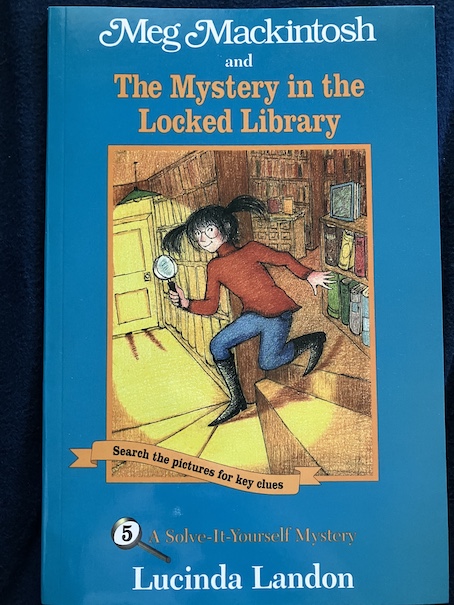
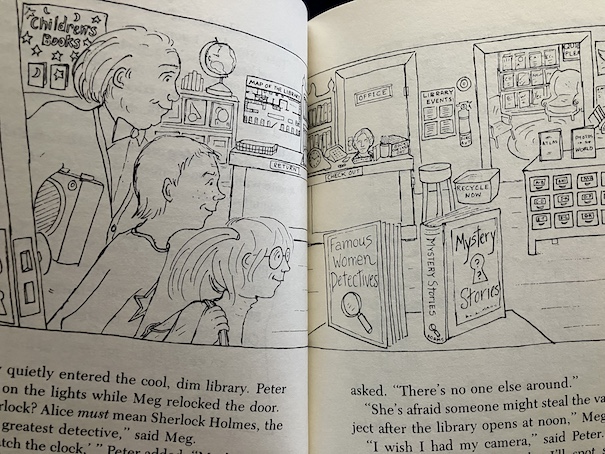
Meg, her brother Peter, and their grandfather are visiting their grandfather’s cousin, Alice, who was introduced in the first book of the series as the one who created the treasure hunt to find his missing Babe Ruth baseball when they were young. Grown up Alice is now a librarian, and she has created another treasure hunt for them.

One morning, she leaves them a note saying that she has a dentist appointment, but she wants them to go to the library and find something valuable that she’s hidden there before the library opens at noon. Readers follow along with the clues that Alice has left for them to solve and the pictures in the book, seeing if they can solve each part of the mystery along with Meg. In keeping with the library and book theme of the story, the clues are based around books, particularly Sherlock Holmes books.

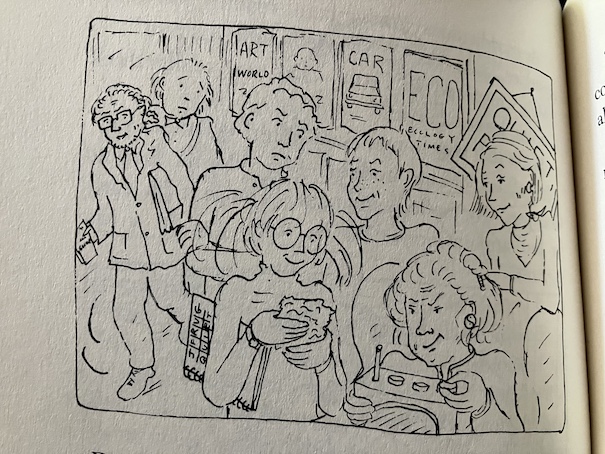
When Meg and her family arrive at the library and begin following the clues, they discover that there are other people in the library, even though the library isn’t officially open yet. Caroline is the assistant librarian, and Gerry also works there. Then, a man named Horace Plotnik shows up, saying that he’s an antiques expert and that Alice asked him to come to appraise something.

They discover that Alice didn’t make it to her dentist appointment because someone locked her in the library’s book repair room. It turns out that the valuable item that Alice hid was a first edition of The Adventures of Sherlock Holmes by Sir Arthur Conan Doyle that recently came to the library in a donation of books, but when Meg and Peter finish the treasure hunt and go to the place where Alice did the book, it’s gone! Was it stolen by the person who locked Alice in the book repair room, and if so, who was it?

The Book is available to borrow and read for free online through Internet Archive (multiple copies).

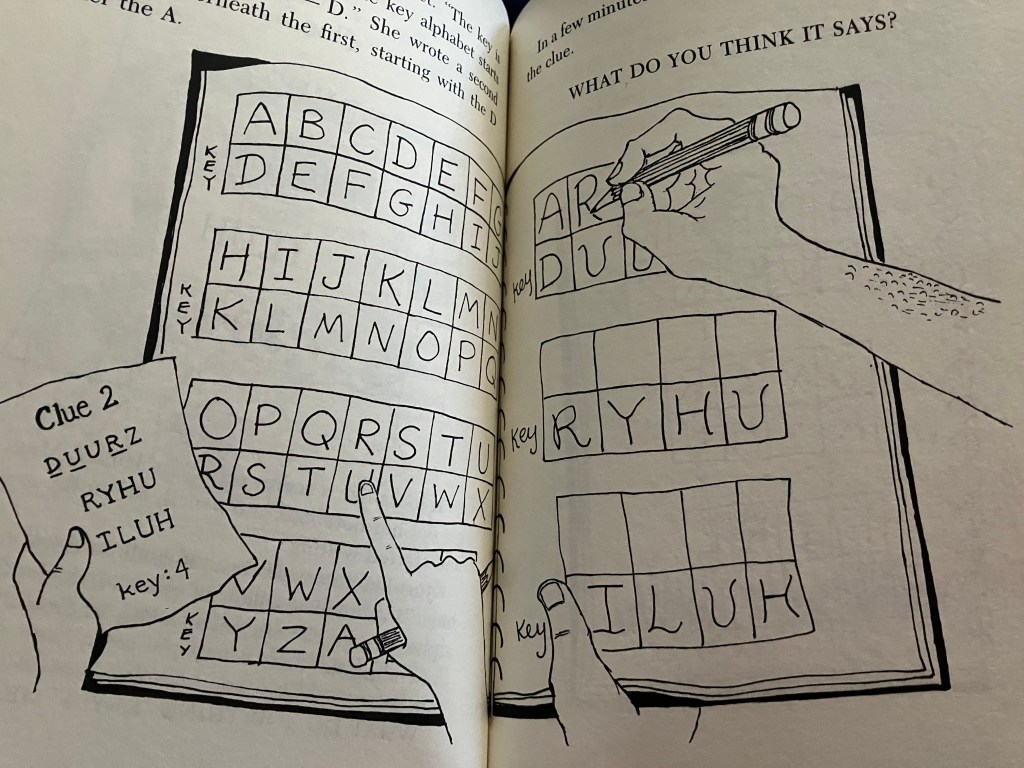
I always enjoy treasure hunt stories, and like other Meg Mackintosh mysteries, this story gives readers the opportunity to figure out the clues and puzzles along with Meg. The information readers need is in the pictures of the story. When I was a kid, I particularly liked puzzles based around solving a secret code, and there is a secret code puzzle in this book that readers can solve themselves.

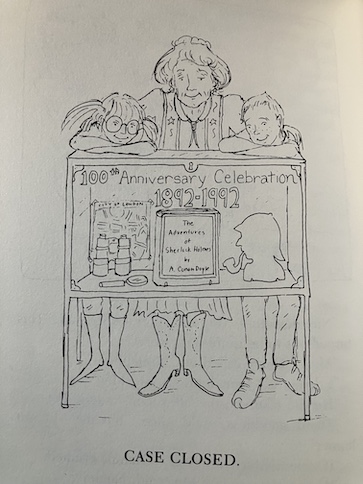
This treasure hunt is fun because it’s based around library and book themes, particularly focusing on Sherlock Holmes. The idea of hunting for a lost copy of a first edition Sherlock Holmes book was timely for when the book was originally written because, as the story indicates at the end, the book was written around the 100th anniversary of the character of Sherlock Holmes!

Mystery of the Strange Traveler

This book was originally published under the title The Island of Dark Woods.

Laurie Kane and her older sister, Celia, are traveling by train without their parents to visit their Aunt Serena in New York. Aunt Serena has invited the girls to come stay with her while their parents are traveling in Asia for one of their father’s newspaper assignments. In her letter to the family, Aunt Serena hints at exciting things that are happening. She used to be a schoolteacher, but she says that she’s starting a new business, and the girls can help her with it, although she won’t say what it is until they arrive. Also, Aunt Serena has recently moved to a new house. When their father sees where she’s living now, he’s intrigued because it’s the location of their “ancestral mystery.” He would tell the girls the story himself, but Aunt Serena says in her letter that she would like to be the one to tell them about it. There father says that Aunt Serena loves being tantalizing and mysterious. Laurie, who loves mystery stories, wonders about it all the way to New York.

Aunt Serena lives in a wooded area on Staten Island, near Clove Lakes Park. She has a small red brick house with another outbuilding on her property that she says used to be an old cobbler’s shop. Her new business idea is to turn it into a small bookshop. Laurie loves it immediately because she loves books. She wants to be an author herself, and Aunt Serena says that she might even get a chance to meet her favorite author, Katherine Parsons, because she lives in the area. Celia is the practical one, and she asks Aunt Serena all the practical questions about how she plans to get people to come to her little shop when there are no other stores around them to draw customers in. Aunt Serena says that she’s not expecting her shop to turn into a big business. It’s more of a small hobby business to bring in a little extra money and also be a fun activity.

Laurie and Celia begin unpacking some of the books that Aunt Serena will sell in her small shop, and Laurie is pleased to see a collection of books by Katherine Parsons. On the back of one of the books, there’s a picture of the author and a short biography. Laurie is pleased to note that Katherine Parsons is left-handed, like herself. There are times when Laurie has difficult with things because she’s left-handed, and she feels a kinship toward the author because she shares that trait.

Meanwhile, Celia has noticed that there is a boy next door, moving the lawn. Laurie is more interested in books than boys, so she doesn’t find this exciting news. Celia tries to get the boy’s attention, but he seems to be ignoring her. When he does seem to notice the girls, he turns away quickly, like he wants to avoid them. Celia points out to Laurie how the house where the boy is looks very different from the rest of the houses around it – big, old-fashioned, dark, and creepy. Laurie comments that it looks haunted, and their Aunt Serena surprises them by saying it is.

The boy, Norman, lives with his grandfather, Mr. Bennett, in the old house. Mr. Bennett is a difficult man, and Aunt Serena admits that she got on his bad side when she first moved to the area by asking him if she could buy his house. Aunt Serena admits that she didn’t actually want to buy Mr. Bennett’s house; she was only using her inquiry as an excuse to talk to him and maybe get a look inside the house. However, Mr. Bennett took offense at the inquiry.

There is another boy in the neighborhood called Russ Sperry, and he’s friendlier. His mother sends him to bring a cake to Aunt Serena, and Aunt Serena says that she hopes he will be friends with the girls and show them around. Russ stays awhile to have some cake and chat, and he mentions that Norman Bennett’s father is in South America because he has a job there, which is why he’s staying with his grandfather. Aunt Serena says that Norman’s mother is dead and that his father rarely comes home. She doesn’t approve of the lonely way Norman’s grandfather seems to be raising him because it seems like Norman doesn’t have any friends. Laurie thinks that Norman’s loneliness is at least partly his own fault because he seems to avoid contact with people when she and Celia try to approach him. Celia decides that Russ is cute, but Laurie finds herself intrigued by Norman, not because she wants to flirt with him but because there’s an element of mystery about him.

The girls try to ask Aunt Serena more about what she means when she says that the Bennett house is haunted, but she says that she would rather talk about that later. She gets the girls busy unpacking their belongings, arranging things in her shop, and talking to Russ about the area. Russ helps to explain the geography of Staten Island, and Aunt Serena tells the girls more about the history of the area. Aunt Serena mentions that there are dances in the park on Wednesday nights, which sounds exciting to Celia. When Laurie spots Norman passing by, wearing riding clothes, Russ explains that there are a couple of stables in the area, where people can rent horses. There are plenty of things for the girls to do in the area, and Aunt Serena begins planning an opening party for her bookshop, with Katherine Parsons there as a special guest to sign her books.

Laurie is excited about the party and the opportunity to meet Katherine Parsons, but she continues to think about the mystery of why Norman seems so unfriendly. Soon, other strange things start happening. One night, she sees a light in Aunt Serena’s bookshop, as if someone were sneaking around in there. However, when Laurie goes to wake Aunt Serena to show her, the light is gone, and the next day, there aren’t any obvious signs that anything in the shop was disturbed.

When Laurie has a chance encounter with Mr. Bennett, where she asks him if he’s ever seen the ghost that haunts his house, he says, no he hasn’t seen it. The ghost is supposedly a phantom stagecoach, but Mr. Bennett doesn’t believe it exists. Once Laurie knows that there’s supposed to be a phantom stagecoach, she tries to press Aunt Serena for more details, but Aunt Serena refuses to tell them the rest of the story until she can tell them on a gray, stormy day, when the atmosphere is right.

When a stormy day comes and Aunt Serena agrees to tell the story, she allows Celia and Laurie to invite Russ and Norman over to hear it, too. Norman comes to hear the story without his grandfather’s permission because he’s always known there was some story about the house, but his grandfather hasn’t wanted to talk to him about it. When Aunt Serena tells the ghost story, the connections between the Kane family and the Bennett family become clear.

About 100 years before, there was a stagecoach route that ran through this area. One stormy day, a stagecoach was passing through the area, and one of the passengers, a woman with an infant daughter, was seriously ill and had become delirious. The stagecoach driver sought help at the Bennett house. The Bennetts brought the sick woman inside the house, along with the infant daughter. The stagecoach driver sent a doctor to tend to the woman, but she died in the Bennett house. They had no idea who the woman was and were unable to trace her origins or family. If the woman had a husband or the infant girl had a living father, the man never showed up to inquire after his wife or to claim the baby. All the Bennetts had do go on were the meager possessions the woman was carrying with her, and the little girl herself, whose last name was unknown but the mother had called “Serena.”

At this point, Serena explains that this Serena was the ancestor of the Kane family, the great-grandmother of Celia and Laurie. Since nobody was able to discover where she and her mother came from or locate any relative, the Bennetts adopted the first Serena and raised her until she grew up, got married, and moved away from the island. However, local people still tell stories about the terrible day when the first Serena and her ill mother were brought to the area, claiming to have seen a ghostly stagecoach pull up to the Bennett house and a ghostly woman get out.

Laurie is intrigued by the mystery surrounding her family’s origins. Aunt Serena shows them some of the belongings that the first Serena’s mother had when she died, which have been passed down as heirlooms. There was a doll with doll clothes, a woman’s dress with bonnet and gloves, a sewing kit, a fan, an old novel the woman must have been reading at the time, and a purse containing a very old coin. The old coin is another oddity about this strange situation because it dates from before the Revolutionary War and would have been long obsolete by the time the woman died during the 19th century. Is it still possible to solve a mystery that’s about 100 years old? Will Laurie and her family ever learn who their ancestors really were? Why does Mr. Bennett not want them to visit his house or talk about the old mystery or the ghost story? Does he know more about them than he wants to admit?

The book is available to borrow and read for free online through Internet Archive.

The mystery in the story unfolds slowly, which might make people who are used to faster-paced modern stories a little impatient. Aunt Serena takes quite a while from the time when she first mentions that the house next door is haunted until she actually explains what the ghost is supposed to be and what the mystery surrounding their family is. However, Aunt Serena values atmosphere, so the story could appeal to people who don’t mind a slower-paced mystery as long as it has a good atmosphere.

When the mystery does begin, some parts are resolved quickly and others are more of a puzzle. The idea of an orphan with an unknown identity and a hidden past is always intriguing. The light in the bookshop at night, on the other hand, turns out to be less of a mystery, and Mr. Bennett’s reluctance to discuss the ghost story and the old mystery turns out to be nothing sinister. Mr. Bennett doesn’t really have any hidden knowledge about the orphaned child or her dead mother. It’s just that he’s a very reclusive person who craves peace and quiet so he can work on his private projects. He also has some resentment toward the Kane family because, while they used to be very close, Laurie’s grandfather was the one who inspired Mr. Bennett’s son to take a job in another country, which is why Mr. Bennett and Norman rarely see him. By the end of the story, though, things get patched up between them.

Every time the matter of the mysterious orphan and the question of whether or not the house is haunted by her mother is raised, Mr. Bennett has had to deal with a bunch of people and reporters stopping by his house, harassing him with questions and asking for tours of the place, and he’s sick of it. He doesn’t want Aunt Serena or the kids raising the issue again because he doesn’t want to deal with everybody’s questions anymore, and he has no more information to give anyone. As far as he’s concerned, the mystery is unsolvable because he thinks whatever trail there might have been has long since grown cold, and if it were ever possible to learn the dead woman’s identity or the real origins of the child, someone else would have figured it out a long time ago. However, Laurie tells Mr. Bennett that she thinks that there’s still a chance to figure it out, and that plays into one of the major themes of the story.

The atmosphere of the story is pleasant, with Aunt Serena’s cheery little house decorated with bowls of wildflowers and her little bookshop. Aunt Serena greatly believes in establishing atmosphere, creating scene, and setting a mood. On the stormy day when Aunt Serena finally tells the girls the local ghost story, she makes it a point to set the atmosphere for the story by making popcorn and lighting candles.

Like other books by Phyllis Whitney, this story is set in a real location and uses some of the history of that location. The original title of this book came from the original Native American name for Staten Island, Monocknong, which the fictional author in the story, Katherine Parsons says means “The Island of Dark Woods.” Mr. Bennett disagrees, though, saying that it actually might mean, “The Place of the Bad Woods,” and they debate about different possible translations and meanings of the phrase. The history of the Staten Island plays directly into the story because it turns out that Laurie’s ancestors were involved with the historical events of the area, particularly Santa Ana’s stay on Staten Island after the Battle of the Alamo in Texas that was part of the Texas Revolution against Mexico.

A couple of other points I’d like to make regarding history are about race in the story. Toward the end of the book, Mr. Bennett hires “a young colored woman” as a housekeeper. “Colored” is a dated term in the 21st century, but this book was written in the 1950s, when that was considered one of the more polite ways to refer to black people. The popular terms we use now (“black” as the informal generic term and “African American” as the formal term specific to black people of African descent who live in the United States) came into use after the Civil Rights Movement as people tried to distance themselves from older terms as a way to shed the emotional baggage associated with them. The housekeeper, Anna, becomes friendly with Laurie, and she offers her a new perspective and some helpful advice about a different approach to tracing her family’s roots. Anna enters the story late, so she doesn’t appear much, but she is helpful, and I didn’t notice anything particularly stereotypical about her, although I suppose the idea of a black person in domestic service might be kind of cliche.

The other thing I wanted to mention is that American Indians are referred to multiple times in the story when the characters discuss the island’s history. The characters always refer to them as just “Indians” instead of “American Indians” or “Native Americans”, which is typical of the 1950s. At one point, Celia and Laurie are discussing their role in the island’s history. Celia talks about how she was glad that she wasn’t around then because there were massacres and “the Dutch kept buying the island from the Indians and the Indians kept taking it back.” However, Laurie says that was “because the white men cheated them.” I appreciated that Laurie acknowledged that, and I think that this exchange not only highlights some of the stereotypical views people had in the 1950s about Native Americans and history, but also differences between the ways Celia and Laurie look at other people. I have more to say about that below, but Celia tends to cling toward accepted views and the general social rules of society while Laurie has a talent for empathy and looking at situations from another person’s perspective. I’ve noticed that the author, Phyllis Whitney, has used this technique in other books of hers to subtly challenge stereotypes, pointing out that different groups of people have their own perspective and their own side of the story.

This book is fun for book lovers. Laurie’s favorite author, Katherine Parsons, is fictional, but the story captures the spirit of book lovers. It turns out that Norman is a book lover, too, and Laurie is able to draw him out and bond with him over their shared love of books. Aunt Serena also praises Laurie for her ability feel empathy for other people, a quality that she believes comes partly from Laurie being a book lover. After all, readers are accustomed to the idea of seeing circumstances through the eyes of someone else and experiencing their thought processes when they read a story. Aunt Serena believes that one of the benefits of reading it that it helps to cultivate a person’s skills in using empathy to understand other people and that readers carry that technique over into the real world.

I will say, though, that Laurie’s story took an unexpected turn. Laurie is a book lover, but through her association with Katherine Parsons, she unexpectedly realizes that, while she’s always dreamed of writing stories and being published, she doesn’t actually like the writing process. She enjoys the stories other people have written, and she has a knack for understanding characters, whether real or on the page, but she’s surprised to realize that the routine of writing doesn’t appeal to her. She feels a little sad at the realization because it means giving up an old dream but also a little relief because her life is now open to more possibilities that she might like better.

I also enjoyed the relationship between the two sisters in the story. They get on each other’s nerves and fight with each other sometimes, but they also care about each other and make up with each other after fighting. Celia, as the older sister, is more interested in boys than Laurie is, and she has all kinds of social rules about how to talk to boys and how to get their attention. Laurie knows that Celia and her friends talk about these things a lot, but Laurie doesn’t really understand all of their little rules and thinks a lot of them sound silly, like the idea that girls can’t invite boys to things but have to wait for the boys to ask them or that they should pretend like they’re not too interested in a boy so the boy will approach them first. This book was written in the 1950s, so a lot of Celia’s social expectations about how girls and boys should act around each other sound dated, but I enjoyed Laurie questioning Celia’s rules.

Laurie thinks it more important to know about what specific people like and how to appeal to them as individuals than to adhere to more general social rules. This is especially apparent when the girls try to get Mr. Bennett to let them in his house and talk to him. When the sisters compete to ingratiate themselves to Mr. Bennett so they can get access to the house and talk to him about the mystery, their different approaches play on their concepts of social rules and human empathy. Celia tries a very conventional approach, trying to appeal to Mr. Bennett in a general way, but Laurie decides that “Mr. Bennett was too much of an individual to be governed by rules that worked for most people” and tailors her approach to him as an eccentric individual.

Celia’s idea is to make some homemade cupcakes and take them to Mr. Bennett as a gift because she believes in the old axiom that the way to a man’s heart is through his stomach. As Laurie suspects, though, this approach falls flat because Mr. Bennett isn’t interested in baked goods. Laurie has a better idea of what Mr. Bennett really likes because she has talked to Norman about him, and she decides that the way to get his attention is to demonstrate a shared interest in something he likes. Knowing that he likes nature more than anything else, she starts putting together a collection of interesting leaves and asks Mr. Bennett if he can help identify them. Mr. Bennett isn’t really impressed by her collection because she didn’t mount the collection properly, most of her collection is very common leaves that he thinks she should be able to identify if she knew anything about trees, and she also included a sample of poison ivy, which she should have known better than to touch. However, he is sufficiently amused by her efforts and her mistake to talk to her for a few minutes.

One of the major themes of the story is that “No man is an island”, meaning that people do need other people. Aunt Serena is concerned that Mr. Bennett’s obsession with solitude is hurting his grandson because he’s making it difficult for Norman to make friends. Mr. Bennett has forbidden Norman to bring any other kids to the house because he doesn’t want to deal with the noise and disturbance. Because she’s been a teacher, Aunt Serena knows that Norman needs more opportunities to socialize with his peers. Mr. Bennett doesn’t even seem to pay much attention to Norman himself because he’s too absorbed in his own work.

What Laurie points out to Mr. Bennett when Mr. Bennett tries to tell the kids that the old mystery is unsolvable is that a group of people working together can accomplish more than any one person, working alone. They don’t have many clues to the past, but just because they don’t all make sense to any one of them doesn’t mean that parts of them wouldn’t make sense to different people. By pooling their knowledge and consulting other people, they could still put together the pieces of the past.

Along the way, Laurie also makes Mr. Bennett realize that there are many things he doesn’t know about Norman. Even though he and Norman have been living alone together for a long time, Mr. Bennett hasn’t paid much attention to Norman or things Norman has been doing. Norman has felt lonely and neglected, although he hasn’t wanted to admit how much. When Mr. Bennett realizes that Norman is an artist and has been developing his skills to an impressive degree without him even seeing any of Norman’s projects, he realizes that he has been too absorbed in his own concerns and starts to make an effort to learn more about what’s happening in the lives of the people around him. This is a similar situation to a grandmother in another of the author’s books, Mystery of the Angry Idol.

Meg Mackintosh and The Case of the Curious Whale Watch

Meg Mackintosh Mysteries

Meg and her brother, Peter, are going on a whale watch trip with their grandfather. As they board the boat, their grandfather tells them that the captain is well-known as a treasure hunter, looking for pirate treasure.

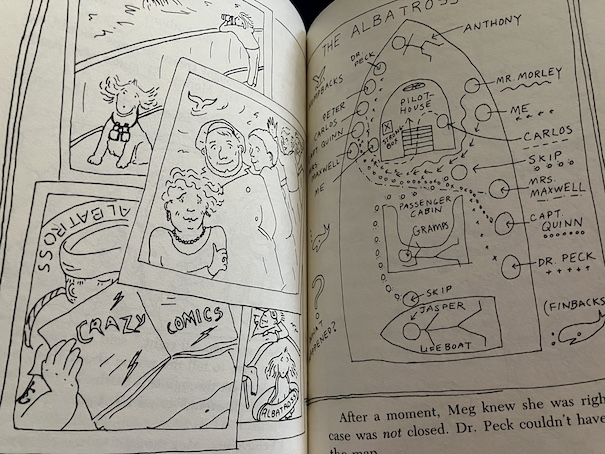
On board the Albatross, they are greeted by Captain Caleb and meet his mate Jasper, and the other whale watch guests. The guests are Mrs. Clarissa Maxwell and her nephew Anthony, who seems to like gambling; a man named Oliver Morley, who likes stamps; a college student called Carlos de Christopher; and a marine biologist, Dr. Susan Peck.

Meg asks Captain Caleb about his treasure hunting, and he shows everyone an old map that’s been in his family for many years. The sailor who gave it to them also gave them a whale’s tooth with a scrimshaw carving of a whale on it. It’s supposed to help explain where the treasure is hidden. Some of the members of the expedition debate about how much money the treasure of the map would be worth, but Dr. Peck is completely opposed to treasure hunting because it’s disruptive to the environment.

The group enjoys watching the whales, although Meg’s grandfather has to go lie down for a while because he’s seasick, and lazy Jasper spends his time reading comic books in the lifeboat. When they encounter a storm, and everyone goes into the cabin to get out of the rain, they discover that the map is missing!

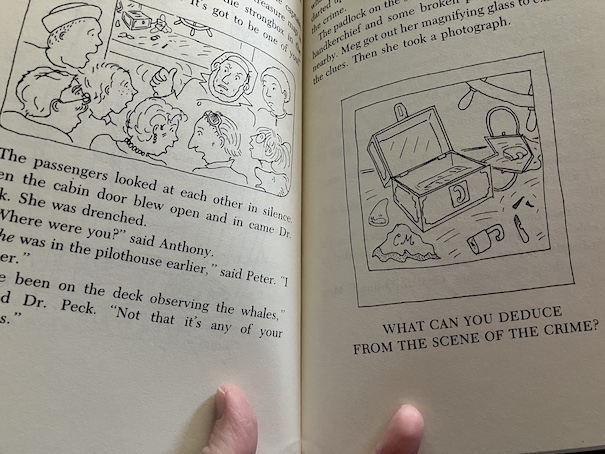
Who could have taken it? Various members of the whale watch have talked about their need for money, and Dr. Peck said that she thought the map should be destroyed to prevent damage to the environment. Meg goes over the pictures she’s take to find the thief!

The book is available to borrow and read for free online through Internet Archive (multiple copies).

I like the Meg Mackintosh books because it’s fun to solve the mystery along with the heroine. Like other books in the series, readers are supposed to use the story and the clues in the pictures to solve the mystery. At various points in the story, the story pauses for readers to figure out something about what’s happening, and these are good points for readers to check that they’re on track and to review the information they know so far. The story isn’t very long, but there are multiple points for readers to figure out something about what’s going on.

I did figure out the answer to this one very quickly. It’s partly because I’m an adult and this is aimed at children, but more importantly, I’ve seen the movie Charade with Audrey Hepburn, which used a similar plot device. The story did a good job of making all the suspects look like they had a motive, but when you figure out what the thief’s real goal was, there’s only one person who qualifies. Kids in early elementary school would probably find the mystery more challenging.

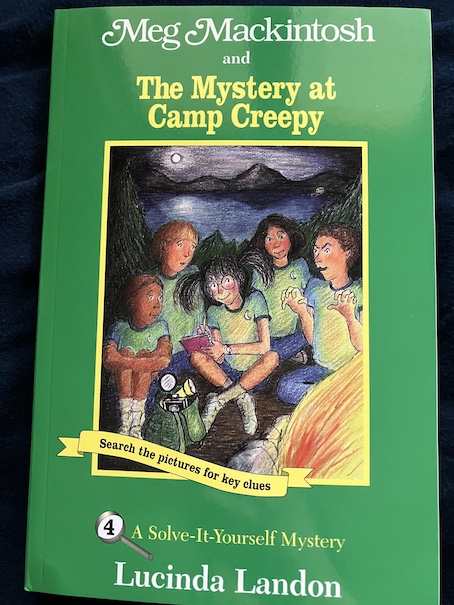
Meg Mackintosh and The Mystery at Camp Creepy

Meg Mackintosh Mysteries

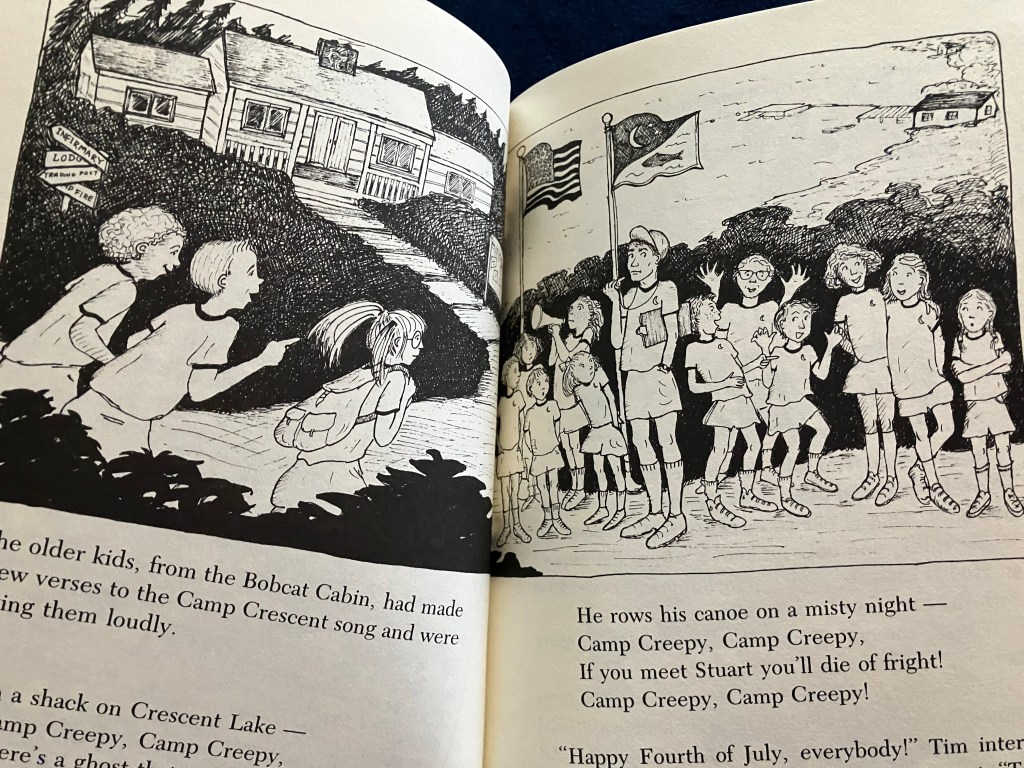
Meg Mackintosh is at a summer camp in Maine! The camp is called Camp Crescent, but it soon gets the name Camp Creepy because there’s a ghost story about the camp. The story says that an old man named Stuart once lived in the building that the camp uses for a boathouse and that he still haunts the camp. When people start hearing strange noises at night, the campers start thinking maybe the ghost story is true.

To celebrate the Fourth of July, the camp decides to hold a treasure hunt with puzzles for the campers to solve. Everyone is excited about the treasure hunt, but Meg is especially excited because she’s solved treasure hunts before. However, in her excitement to start the treasure hunt, she accidentally drops the first clue on the camp fire, and much of it burns.

Everyone is angry with Meg for messing up the treasure hunt because they’re supposed to solve it before nightfall to enjoy the prize. Although they don’t know what the prize is supposed to be, they’re told that it won’t be any good if they find it too late. While the others go on a hike, Meg fakes a stomach ache because she just can’t face the other campers again.

At the camp’s infirmary, Meg meets two other campers who are staying behind. Russell has a bad case of poison ivy, and Tina has been dealing with homesickness. They ask to see what’s left of the first clue, and Meg shows them. Something in the clue reminds Meg of something she saw at camp earlier, and the three of them begin thinking that they might be able to solve the after all. If they can just get past that first burned clue, they can continue the treasure hunt like normal.
Can the three of them manage to solve the treasure hunt and save the prize for all the other campers? Will they meet Stuart’s ghost along the way?

The Book is available to borrow and read for free online through Internet Archive (multiple copies).

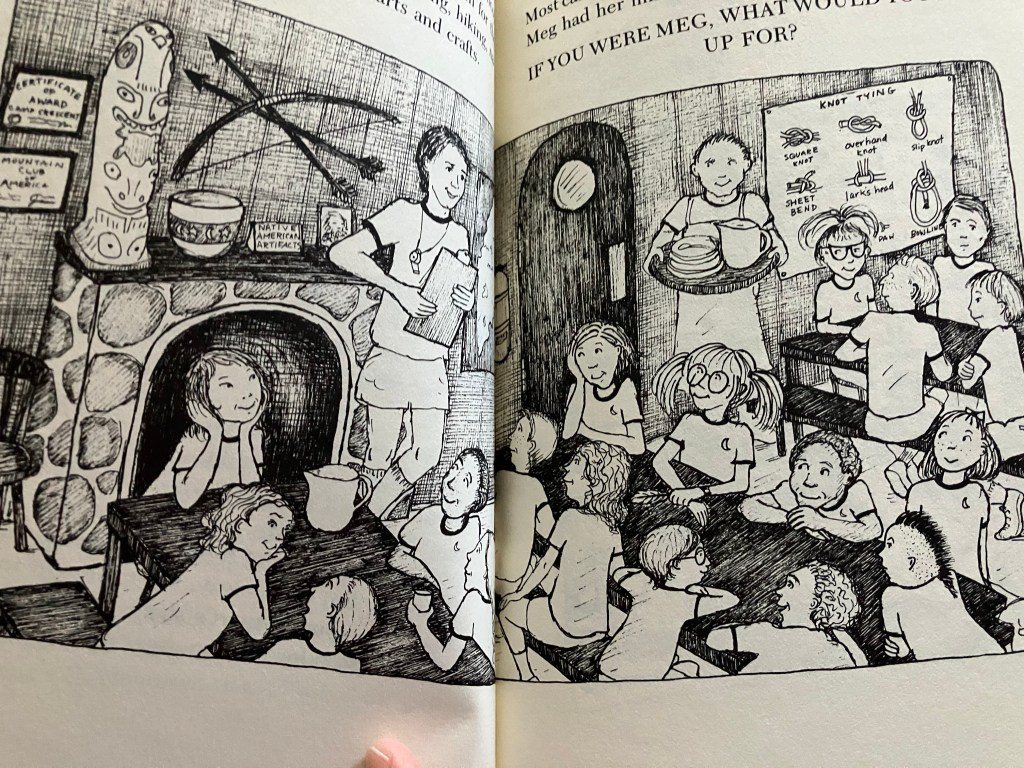
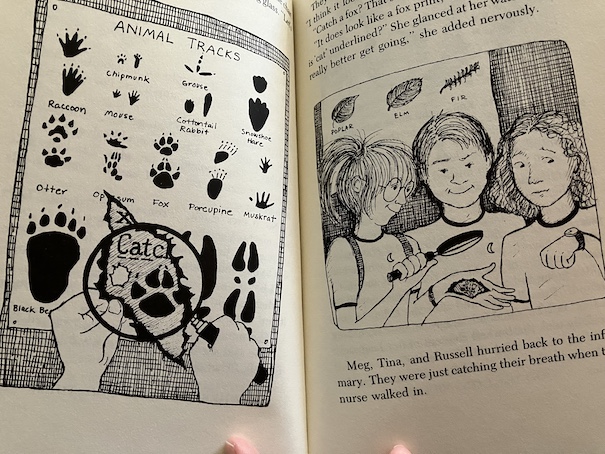
I always enjoy treasure hunt stories, and like other Meg Mackintosh mysteries, this story gives readers the opportunity to figure out the clues and puzzles along with Meg. The information readers need is in the pictures of the story.

Most of the focus of the story is on the treasure hunt, and the ghost is kind of a side plot. Maybe the ghost would seem a little spookier to young readers, but I have to admit that I found it difficult to think of anybody named Stuart as sounding very sinister. The legend of Stuart doesn’t even seem to carry any consequences for people who see him other than it just being spooky, so I didn’t think the story was that creepy.

Garbage Juice for Breakfast

Polka Dot Private Eye

This book follows an earlier book in the series, The Case of the Cool-Itch Kid, while Dawn is staying at her summer camp, Camp Wild-In-The-Woods. Her friend from school, Jill Simon, is at camp with her, and they’ve made friends with another character from the earlier book, Lizzie Lee, who started out as a rival/antagonist for Dawn. Both Dawn and Lizzie like mysteries and being private detectives, and they’ve bonded over that. There is still an element of rivalry between them, but it’s a friendlier rivalry than when they first met each other.

When their camp counselor announces that she has set up a treasure hunt for the campers to solve, Dawn is excited. As the Polka Dot Private Eye, she’s sure that she’ll be the first to solve the mystery! However, Lizzie is the Cool Cat Detective. (Each of them take their names from the detective kits that each of them own.) Dawn knows that Lizzie will be tough competition.

Because the kids in their cabin are from different schools and some were friends with each other before they came to camp, the campers in the cabin have favorites between the two girl detectives. Jill thinks that Dawn is the best detective and will solve the treasure hunt before Lizzie will, while Lizzie’s friends think that she’s going to be the one to solve the mystery. They decide to turn the treasure hunt into a contest to show which of the girls is the best detective.

The first clue is in the form of a rhyme. It seems to have something to do with horses, and the girls are starting to learn horseback riding. There is also a hint about taking a particular trail. It’s tough for both Dawn and Lizzie to investigate the same mystery without getting in each other’s way, following one another or being suspicious that they’re following each other, or accidentally giving each other hints. Is the competition between them really a good idea, or is teamwork what they really need?

The book is available to borrow and read for free online through Internet Archive (multiple copies).

I remember reading this book when I was a kid, and I loved it because I always loved treasure hunt books! There are parts of the treasure hunt that readers can solve along with the characters in the story, although it’s not one of those stories that pauses to ask readers if they’ve solved parts before the characters have. It’s just that the information necessary to solve each part of the treasure hunt is given in the story and shown in the pictures, so readers have the opportunity to think what the next step should be along with the characters or before the characters announce what they’ve figured out. Some of the clues point to features of the camp itself, like the names of the trails around the camp, but the story does provide that information to the readers, so there’s nothing that the characters know that the readers don’t. Other clues use pop culture references, like Donald Duck, because their camp counselor is a Disney fan and has items with Disney characters on them.

Dawn and Lizzie do compete with each other to solve the treasure hunt, until they solve the final clue. All through the book, Dawn struggles with the horse lessons because she’s actually afraid of horses. When reaching the prize means going through an area with a lot bugs, Dawn suddenly feels sorry for Lizzie, who is following her but struggling because she’s afraid of bugs. Understanding what it’s like to struggle with something that scares her, she feels some empathy for Lizzie and realizes that she can’t use Lizzie’s fear to get ahead of her and reach the treasure first. She tells Lizzie that they can go together to reach the treasure, so they are able to share the glory. The experience helps the girls a little with their respective fears, and they share the final prize.

The name of this book comes from a kind of mixed fruit juice that the camp serves in the dining hall. None of the campers know exactly what’s in it, nobody really likes it, and the camp rumor is that it’s just strained out of the garbage. It doesn’t really have anything to do with the mystery in the story, but it’s there for background color, the kind of stories that kids tell about food at camps and schools that they don’t like.

Aside from the mystery, the story has some fun camp atmosphere for beginning chapter book readers: horses and barns, the camp dining hall, a picnic with books, and a cozy, rainy night in their cabin with cookies.

Megan’s Island

School will be out soon, and eleven-year-old Megan and her best friend, Annie, are making plans for the summer. Megan’s family doesn’t have much money because her father died when she and her brother, Sandy, were very young, and her mother struggles to find a job that will pay enough to support the three of them. They’ve moved around multiple times in the last several years while her mother looks for better work, and they get by with some help from Megan’s grandfather. This summer, Megan’s family is planning to visit her grandfather at his cottage by the lake. Her grandfather is already staying there, recovering from an injured foot, and Megan’s mother agreed that Annie can come with them on the trip.

However, before school lets out for the summer, something happens that suddenly changes their plans. One evening, while their mother is in the kitchen, clearing up from dinner, she suddenly drops her favorite salad bowl, cutting herself on the glass. Megan and Sandy help her clean up the mess and bandage her cut, but they can tell that it wasn’t just clumsiness that made their mother drop the bowl. She really seems to be upset and even afraid of something. Since they didn’t have any phone calls or mail that could have given her upsetting news, they can only think that it must have been something she heard on the tv news. Their mother had been listening to the news on the small tv in the kitchen before she dropped the bowl, and she quickly turned it off when the children came to see what was wrong.

Their mother refuses to explain what upset her, and she tries to pretend that nothing is wrong, but she quickly tells the children to pack their things because she’s taking them to their grandfather at the lake early. Megan protests that school isn’t out yet, but their mother says that they’ve already finished their tests, so they won’t be missing anything important. Megan also worries that they’re leaving without Annie or even telling Annie that they’re going early, but their mother says it can’t be helped. Then, Sandy overhears their mother asking a friend of hers on the phone, asking her to put their things in storage for her while they’re gone, making the kids worry that they’re leaving for good and not just for vacation. Refusing to answer any more questions from the children, their mother hurries them through their packing and out of the house that very night. She drives them all through the night to get to the lake.

When they get to their grandfather’s cottage at the lake, he is surprised to see them, showing that their early arrival wasn’t something he had arranged with their mother. Later, Megan overhears them talking. Her grandfather urges their mother to tell them the truth about what’s happening because kids are more resilient than they seem, and whatever they’re imagining might be worse than the truth. However, their mother says that the truth really is upsetting, and while she knows that she has always insisted that her children tell the truth, telling them the truth now would mean admitting that she has already lied to them.

Megan is shaken by what she hears. What has their mother lied to them about? Is it something to do with her father? Megan barely remembers him, and their mother gets upset when she asks questions about him. Her mother seems to be hoping that this whole matter will just blow over, but her grandfather comments about how what happened eight years ago didn’t just blow over. He implies that whatever secret their mother is hiding is the real reason why the family has moved around so much, that it wasn’t just because she needed to find new jobs. Megan worries about what her mother could be hiding and what terrible thing could have happened eight years ago that would affect her family today. Then, Megan remembers that eight years ago is about when her father died.

Megan tells Sandy what she overheard and that their mother is hiding a secret, something that might have to do with their father’s death. Before either of the children can talk to their mother and ask her what’s going on, she tells them that she’s leaving them with their grandfather at the lake for a few days because there’s something she has to do. She won’t say where she’s going or what she needs to do, but she says that they’ll be safe there with their grandfather. Megan finds it disturbing that her mother made it a point to say that they’ll be safe because it implies that the reason why they left home so suddenly was that, for some reason, they weren’t safe at home. Megan also begins to wonder whether whatever danger there was at home might find them at the lake.

Sandy seems to find it easier than Megan to put aside whatever worries and secrets are following the family and just enjoy being at the lake, going fishing with their grandfather and exploring the area with Megan, although he later admits that he tried to ask their grandfather some questions while they were fishing that he refused to answer. Megan can’t stop wondering and worrying, though. She and Sandy agree that coming to the lake wasn’t just a vacation. Their mother brought them there to hide from something … or someone.

Megan remembers that, every time they’ve moved before, their mother refused to let them even write letters to friends they were leaving behind. Sandy says that she didn’t tell them not to write any letters this time, and with no phone at the cottage, there’s no other way for Megan to tell Annie what happened and to apologize for their ruined summer plans. Megan decides to go ahead and write to Annie. That letter to Annie changes everything for Megan and her brother.

Megan and Sandy go rowing out on the lake and find an island with a beautiful hiding place beneath an overhanging rock that’s almost like a cave. It becomes a special place for Megan, and she goes there to think. Then, one day, they meet a boy named Ben who’s also staying at the lake for the summer with his divorced father and has been exploring the island that Megan has started to think of as hers. Megan doesn’t like Ben at first because he’s bossy, but he proves to be someone she and Sandy can confide in when the adults won’t give them answers, and he become a useful ally in their troubles.

Ben tells the Megan and Sandy that his father said that someone in the nearby town is looking for a couple of kids with red hair, matching Megan and Sandy’s description. This man claims to be their uncle, but Megan and Sandy don’t have an uncle. Then, Megan spots a strange man prowling around the outside of their grandfather’s cottage. A letter that Megan receives from Annie says that people have been asking about them since they left town, and Ben correctly realizes that someone has traced them through Megan’s letter to Annie. Whatever trouble their mother has been hiding them from has found them. With their mother still away and their grandfather having gone to town for some x-rays on his injured foot, Megan and Sandy hide out with Ben in a tree house they’ve built on the island. The island seems to be their last safe place to hide while they wait for their mother and grandfather to return. But, when they do, will they finally get the answers they need? What terrible secret has their mother been hiding from them all these years?

The book is a winner of the Edgar Allan Poe Award.

I didn’t read this book when I was a kid, but I did read others by the same author, The View From the Cherry Tree and Baby-Sitting is a Dangerous Job. I really liked this book. I think one of the author’s strengths is her ability to create suspense. This story is very compelling. Right from the beginning, readers as well as Megan know that her mother is behaving oddly and that what she is doing has sinister or troubling implications. There isn’t a wholesome or happy reason why anybody decides to skip town suddenly in the middle of the night. I could hardly put the book down, wanting to get into the details of the situation. It was hard for me not to skip to the end to see what happened and what it was all about, but I made myself slow down a little to appreciate the journey.

I guessed, at the beginning, that this was going to turn out to be a case of a non-custodial parent kidnapping their own children after a messy divorce. We are told that Megan’s father died when she was very little and that she barely remembers him, and then, we are told that the family moves frequently because the mother has trouble getting work as a single parent. That, by itself, isn’t necessarily sinister, but after we see the mother rush her children away in the middle of the night and we learn that she has never allowed them to keep in touch with old friends after any of their other moves, it starts to look like a suspicious pattern. I had guessed that what upset her mother while she was watching the news was that there was an announcement about the father looking for his missing children. My other thought was that maybe they were in the Witness Protection Program, possibly because their father was murdered and the mother needed protection from the people who killed him, and that what alarmed the mother on the news was that his killer was being released from prison. That second theory of mine was way off. The first one was closer, but that’s still not quite the situation, although elements of that are close to what happens in the story.

Because the suspense in this was so good, I don’t want to spoil the ending entirely. The custody of the children is the reason for the mother’s panic, but there’s a twist on it that I wasn’t quite expecting, and as the story goes on, it becomes apparent that there are two sets of people hunting for the children instead of one. One set of searchers is who the mother was expecting, but the other set is someone else who has different motives and is an even bigger threat.

I thought it was interesting that the story brought up the question of a person’s right to disappear and whether that disappearance can sometimes be justified. The fact is that it’s not a crime if an adult decides to go voluntarily missing. It’s only a crime if the adult has committed a crime prior to disappearing or in the process of their disappearance or if the person is missing because they’re the victim of a crime. Otherwise, any adult has the right to walk away from their old life, cut off old relationships, change their name, and reestablish their identity somewhere else. People can do this for a variety of reasons, but it usually has something to do with overwhelming problems in the person’s life, mental health issues, and/or abusive relationships. It occurred to me that the mother in the story might be afraid of her ex-husband because he was abusive, and she was afraid of what he might do to the kids if she had to either give him custody of them or share custody with them. Again, that’s not quite the case here, although I was thinking about it through a good part of the story because it would explain the mother’s behavior.

If the mother was a non-custodial parent or had violated custody arrangements with the children’s father, then she would have committed a crime by taking the children. However, that doesn’t turn out to be the case here. The mother hasn’t committed any crime, but the fact that she has the children with her is the reason why someone is looking for them. Missing children is a matter of legal concern and can be a matter of humanitarian concern, although even then, the issue can be complicated. Not all runaway children are “saved” by being found or returned to legal guardians, and some of them have had very good reasons for leaving toxic or abusive home environments. The sad fact of real life is that, sometimes, the people who are searching for missing children can be the very threats those children are escaping. People who disappear have reasons for doing so, but giving them the type of help they need means discovering what those reasons are.

To be honest, I’m not completely sure of the legality of the person looking for the particular children in the story or publicizing their search for them, but it is telling that this individual is using a private investigator to look for them, not the official police. The official police are not looking for the family because the mother hasn’t committed a crime. She is their real mother and has legal custody of the children. The person who is searching for the children does not. When their mother reveals the truth to the children, Megan is forced to consider that a person might have good reasons or at least a compelling motive for wanting to get away from their past and not be found by people who are looking for them.

Part of the issue related to that is that Megan and her brother Sandy were never consulted about whether or not they wanted to separate from their old life or to live the kind of lifestyle they’ve been living. Up to this point, they’ve taken for granted that they’ve had to move and lose contact with friends repeatedly because their mom needed to look for work and had trouble finding jobs as a single parent. When they realize that what’s been happening to their family isn’t normal, that their lives have been disrupted, and that their mother has lied to them about important pieces of their past and even their own identities, the children are understandably shocked and upset. Megan is angry with her mother for the position she’s put them in, and she is right that she needs answers.

Fortunately, things do work out for the best for the kids and their mother in the end. It is a relief that the mother has not actually committed a crime because of what she’s doing. She apologizes to the kids for not explaining things to them sooner, but she explains that, when the whole thing started, they were only little toddlers and couldn’t understand the seriousness of what was happening or what was at stake for them. When Megan learns the full truth, she does come to understand her mother’s motives, and she realizes that it has also changed the way she’s always felt about her father, whose life and death turn out to be very different from what she’s always assumed. Perhaps, if she had found out the truth earlier, when she was much younger, it would have been harder for her to take. Now that she and her brother are old enough to speak up for themselves and the situation they were running from has changed somewhat, things are likely to be much better for them. We’re not entirely sure at the end how things will be for their family or where they will be living, but it seems like their days of hiding and running are over.

The addition of Ben as a character not only gives Megan and Sandy an ally during their worries and evading the people searching for them, but he also provides a different perspective on their situation, in more ways than one. While Megan struggles to come to terms with her family’s secrets and the idea that both she and her family are not quite what she’s always believed they are, she also considers how her situation compares to Ben’s situation with his family.

Ben isn’t a happy kid. He’s been in trouble at different schools and behaves badly because he’s deeply troubled about his parents’ divorce and his mother’s remarriage to a man who isn’t thrilled to be his stepfather. Part of Ben’s troubles with his parents and stepfather are because he’s been acting out, and they don’t know how to deal with him, but deep down, he feels like his parents don’t love him. In fact, he admits that he’s been getting into trouble at school on purpose to get his parents’ attention. He had hoped that things would be better while he was staying with his father over the summer, but his father is a writer and absorbed in his work. He doesn’t seem to care much about what Ben does as long as he doesn’t disturb him while he’s writing. Ben feels like neither of his parents really loves him or wants him.

One thing that Megan has always been sure of is that her mother loves her, and even though her mother hasn’t told her the truth about everything before, Megan can tell that she still cares about her, takes time for her, and does things to ensure her safety. Megan’s family has their problems, but they are still a family. Even though Ben still has two parents and a stepfather, he doesn’t feel like he’s part of a family or that he can really rely on his parents. Megan’s realization that she feels very differently about her mother is part of what convinces her to listen to her mother and understand her side of the story.

Things start working out for Ben by the end of the story, too. He admits that he knows the way his dad acts is because he’s also upset about the divorce. He hadn’t really wanted to divorce his wife, but Ben’s mother wanted to marry someone else. He also hasn’t meant to neglect Ben. He’s just been preoccupied. Before the end of the story, he finishes the book he’s been working on and apologizes to Ben about being so busy. He’s not a bad father, and he and Ben usually get along better with each other. Now that he’s finished with his project and has more time to concentrate on Ben, Ben will get more attention. Ben also reassures Megan and Sandy, who are worried about how other people will look at them when the truth about their family’s past gets out, that he doesn’t see them any differently because of what he knows and that real friends will know and like them for who they are, not judge them for what their family members did.