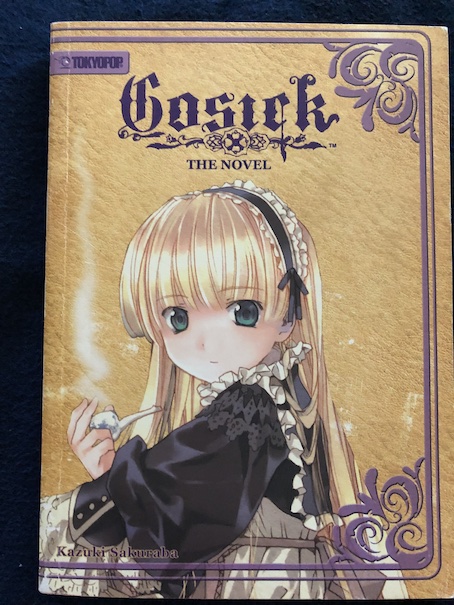
Gosick: the Novel by Kazuki Sakuraba, illustrated by Hinata Takeda, 2003.
The year is 1924, and a boy from Japan named Kazuya Kujo is attending a prestigious boarding school called Saint Marguerite Academy, in the small European country of Sauville (fictional). The students at this school have an obsession with ghost stories. Kazuya is a very serious boy, and he doesn’t see the appeal of all of these gruesome stories, although his friend, Avril Bradley (an international student from Great Britain) loves them and insists on sharing scary stories with him. Part of the reason why Kazuya doesn’t like all the scary stories is that other students insist on calling him “the Reaper” based on a character from one of the more popular ghost stories. However, he’s not the only student at school who stands out, and some of the school’s ghost stories have more truth behind them than Kazuya would have dreamed.
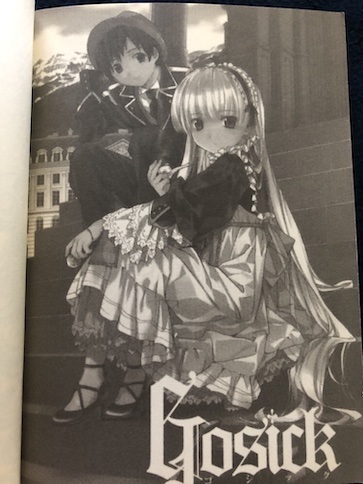
There is one seat in Kazuya’s class which is always empty. That seat belongs to Victorique, and Kazuya is one of the few people at the school who has ever seen her. Victorique never comes to class, preferring to spend her time reading and studying by herself in the conservatory at the top of the library. One day, when their teacher gives Kazuya some papers to take to Victorique, Avril tries to ask Kazuya what Victorique is like. Kazuya doesn’t want to explain much about Victorique, just saying that she can be blunt and kind of mean, which is true. Victorique is brilliant, a child genius, and she looks like a little china doll, but she’s not easy to get along with. She’s temperamental and not used to dealing with other people in general. She smokes a pipe, like Sherlock Holmes, and makes deductions using her “fountain of knowledge”, even about places she hasn’t been and things she hasn’t witnessed, like Nero Wolfe.
Victorique is not allowed to leave the school grounds (for reasons which are explained as the series continues), and aside from Kazuya, there’s only one other person who visits her: her older half-brother, a local police detective. He never admits that he gets help from Victorique on his cases, and he typically prefers to act like he’s talking to Kazuya rather than speak to Victorique directly. Victorique, who is often bored, enjoys solving puzzles and mysteries, so she does give her brother help, although there is little affection between them.
One day, Victorique’s brother, Grevil de Blois, comes to consult with her, through Kazuya, about the murder of an elderly fortune teller. After hearing a description of the murder, Victorique correctly realizes that the fortune teller was killed by her maid. However, that isn’t the end of it. Kazuya thinks that it’s unfair that de Blois always takes the credit for Victorique’s solutions to mysteries. This time, when he finds out that the grateful family of the fortune teller has given de Blois a yacht as a present and that he’s planning to spend the weekend on it, Kazuya decides that he’s going to make de Blois share this present with Victorique. Victorique is normally forbidden to leave the school grounds, but with Kazuya threatening to reveal the true secret of his success, de Blois agrees to take Kazuya and Victorique with him on the weekend yachting trip. Neither of the two kids really likes de Blois, and the thought of spending an entire weekend with him, even aboard a luxury yacht isn’t great, but it is one of the rare opportunities Victorique has to leave the school.
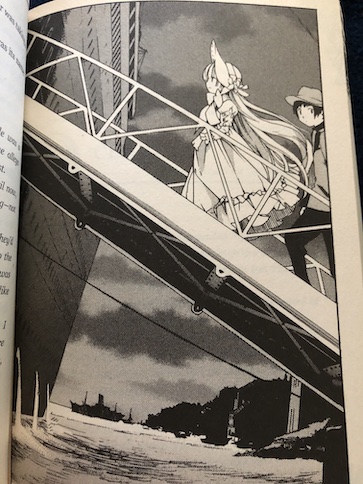
Victorique has rarely been anywhere other than the mansion where she was born and the school, so everything is new and fascinating to her as they take a train to the seaside to meet de Blois at the yacht. When they get there, de Blois informs them that they’ve been having trouble understanding the maid who murdered the fortune teller because she only speaks Arabic, but apparently her motive was revenge for something she calls “the box.” Then, de Blois suddenly gets word that the maid has escaped. He has to leave the kids aboard the yacht, but he tells them to just stay there and wait for him.
Victorique realizes that the yacht once belonged to the fortune teller and that some of her belongings are still on it. Among them, they find a strange invitation to a dinner party called “Evening at the Bottom of the Box” on a luxury cruise ship anchored nearby. The invitation also mentions that the main dish will be rabbit. This is chilling because it is known that the fortune teller kept rabbits and periodically allowed her dog to hunt them. It was part of her fortune telling – she would predict things based on which rabbits survived the hunt and which did not. (There is a graphic description of this at the beginning of the book that I hated. Although I found the overall mystery intriguing, there are some very gross and violent things in it.) Since they are bored and want to learn what the mystery is about, Victorique and Kazuya decide to use the invitation and attend the dinner in the fortune teller’s place.
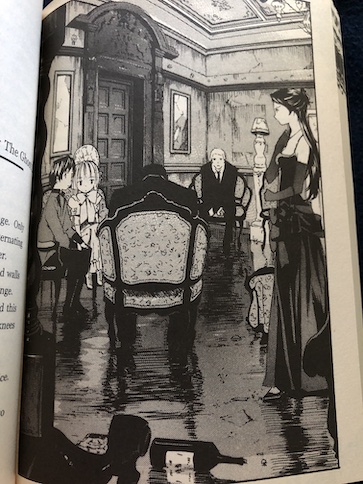
When Victorique and Kazuya join this mysterious dinner party on the luxury ship, Kazuya suddenly recognizes that the name the of ship is the same as the one of a ghost ship in one of the scary stories that Avril told him at school! The ghost stories that have been going around the school have more truth to them than Kazuya or even the students who are obsessed with them have guessed. Some dark things have happened in the history of Sauville which have become part of its local legends. Events that resemble the ones that happened years before and are described in the ghost story are starting to repeat themselves. There is at least one murderer among the dinner party guests, and someone is playing a deadly game. Now, Victorique and Kazuya will have to play along to find the answers and save their own lives!
This is the first book in the Gosick series of Japanese light novels and one of only two that were published in English. There is a full set in Japanese, of course, and I think the German language translation is also a complete set. There is an English translation of this first book available to read for free online at Internet Archive. Because not many copies were published in English, English copies are collectors’ items and can be expensive. As of this writing (September 2023), the cheapest copies on eBay are about $30, and they can go for much higher on Amazon. All of the stories in the series have been made into an anime, and that is available in the US on Amazon Prime. Because of the violence in the story, I would recommend this book and the anime for teens or young adults. It’s not for young kids!
My Reaction
This was the first book in this series that I read, one of only two published in English. The first time I read it, I was surprised at how many tropes of old ghost stories and detective stories that the series references. Victorique uses a pipe, which is an obvious reference to Sherlock Holmes and his famous pipe, but Victorique is also frequently a Nero Wolfe type of detective, relying on an assistant to go places that she can’t go and give her information. She spends most of her time amassing knowledge through reading, and she is able to use that knowledge to make order out of the “chaos” of a mystery.
The basis of this mystery is in fortune telling, and at the beginning of the story, Victorique is reading a book about fortune telling. She explains to Kazuya Kujo how fortune telling actually works. Basically, it’s all about psychology. People think that fortune telling works because they believe it will work, and they make things happen to cause the predicted future to happen. It’s like all prophecies are self-fulfilling prophecies – they may or may not have happened except that people believed that they would, so they made sure they did. People remember and record accurate predictions because those are the most exciting and amazing, and they forget all the inaccurate ones. Fortune tellers are also good at reading people and telling people what they want to hear, which is what they already think will happen or what they’re hoping and working to make happen.
Fortune telling is at the heart of the mystery. Mysteries in this series tend to have over-the-top plots, and this one is no exception. The grudge against the fortune teller and the other guests invited to the dinner goes back to when the fortune teller staged a very large experiment in fate at the request of some very wealthy and influential clients. This past fortune telling experiment was along the lines of the ones that she did with rabbits, only it was with human children. As I said, there are violent and gruesome aspects of this story, and in this case, they were playing with human lives.
As with other books and stories in this series, the ghost stories that the kids pass around at school turn out to have at least some basis in fact. Sauville (remember, it’s a fictional country) and some of its leading citizens have violent histories. There is a long history of conspiracies, power struggles, and general skullduggery in this place. Because of the citizens’ long obsession with stories and legends, much of what has happened there has become legendary, and important people have used the citizens’ superstitions and stories to obscure the truth. Solving the crime means exposing what really happened and the truth behind the legends.
What I found most interesting about this story was its references to some classic characters in detective fiction and ghost stories, and I appreciated Victorique’s thoughts on the nature of fortune telling and human expectations. In the end, it may be more important what people believe and work to make true than what was actually predicted. However, I have to admit that the over-the-top plots of these mysteries are probably a large part of why this series wasn’t printed beyond the second book in the United States. In the beginning of the book, there is also a reference to Kazuya being suspected of a crime. This incident was in the Gosick manga, not the light novels. It is shown in the anime, but I don’t think the manga was printed in English.
The Secret of Skeleton Island by Robert Arthur, 1966.
In the original editions of The Three Investigators, their cases were introduced by Alfred Hitchcock. Later editions of the books were rewritten to remove Alfred Hitchcock, but I’m using the version of this book that includes Alfred Hitchcock for my review.
At the beginning of the story, Alfred Hitchcock himself brings the boys a new mystery and an acting job. Of the three boys, only Jupiter has done any acting before. However, Alfred Hitchcock knows that Pete’s father is a movie technician and that he’s working on a new suspense film. When Hitchcock speaks to the boys, Pete’s father is helping to restore an old amusement park on an island off the southeast coast of the United States that will be used in the movie. The name of the island is Skeleton Island because it’s shaped like a skull, and other formations around it look like part of a skeleton. It was once a place where pirates hid out. Sometimes, people still find buried bones there, and the island is supposedly haunted. The problem is that someone has been stealing equipment from the movie company and sabotaging their boats. Hitchcock wants the boys to discover who is behind the theft and sabotage. As their cover for the investigation, the boys can take part in a short film being shot at the same location, about a group of boys searching for pirate treasure.
When the boys arrive at Skeleton Island, they hear about the Phantom of the Merry-Go-Round. Supposedly, years before, there was a girl who was riding the merry-go-round at the amusement park when there was a terrible storm. The girl, Sally, refused to get off the merry-go-round with everyone else, and she was killed when the merry-go-round was struck by lightning. Since then, the merry-go-round supposedly runs by itself, and Sally’s ghost rides it. The amusement park has been abandoned for years, but people still report seeing Sally’s ghost and the running merry-go-round.
The man who was supposed to bring the boys to the island, Sam, maroons them in the wrong place at night during a storm. They are rescued by Chris, a young diver who originally came from Greece, who was hoping to get work in the movie industry and is currently looking for treasure because he needs money to help his father. He says that he has sailed the area many times in his boat, and he tells the boys the legend of the pirate who was executed there, Captain One Ear. Nobody was able to find his treasure, and he went to his execution saying that Davy Jones had it. People have believed that the treasure is lost at sea, dumped overboard by Captain One Ear, and occasionally, a gold doubloon washes up on shore on the island, which seems to indicate that’s what happened. (ch 3)
As the boys approach the island with Chris, they see what looks like the lights of the merry-go-round with a pale figure among the horses. It looks like a girl in a white dress, and they hear the music of the merry-go-round. The Three Investigators want to go see the ghost and investigate, but Chris refuses. Instead, he takes the boys to the boarding house in town.
When the boys tell Pete’s father and the other movie people about their night’s adventures, they learn that Sam is known as a local prankster and troublemaker, and he’s been in trouble with the law before. Could he be behind the thefts, sabotage, and apparent hauntings? Some people suspect Chris because he’s a foreigner, local people don’t trust outsiders, and everyone knows that Chris needs money for his father, who has health problems. Maybe he could be stealing from the movie company to get money. On the other hand, the movie people are suspicious of some of the local fishermen. Some of the local people suspect that the movie people are secretly looking for pirate treasure instead of making a movie. Then, the boys learn about a robbery that took place in the area years before and are told that the robbers have recently been released from prison. It seems like there’s no end of suspicious people!
The Three Investigators think that the culprit behind everything is someone who was to drive away the movie company and keep people off the island. Who could that be, and what is there on the island that someone wants to protect?
The book is available to borrow and read for free online through Internet Archive (multiple copies).
My Reaction
I enjoyed this book because of its abundance of suspects! I kept changing my mind about what was really happening and who was behind it. Because there were several mysterious things happening at once – lost pirate treasure, ghost at a haunted amusement park, sabotage of the movie crew, old robbery with the money never found and the robbers recently released from prison, and suspicious locals suffering from a failing local economy – it occurred to me that there might even be multiple plots being staged by multiple people. There is one main scheme, and it is the one that I thought would be most likely, but there’s plenty of adventure and plot twists along the way. In the end, things are wrapped up neatly without any hanging plot threads.
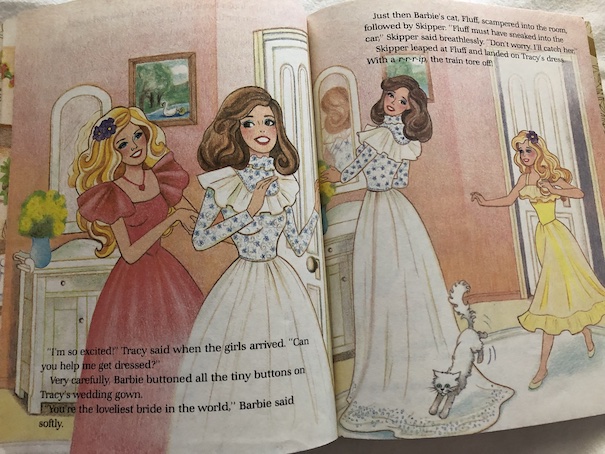
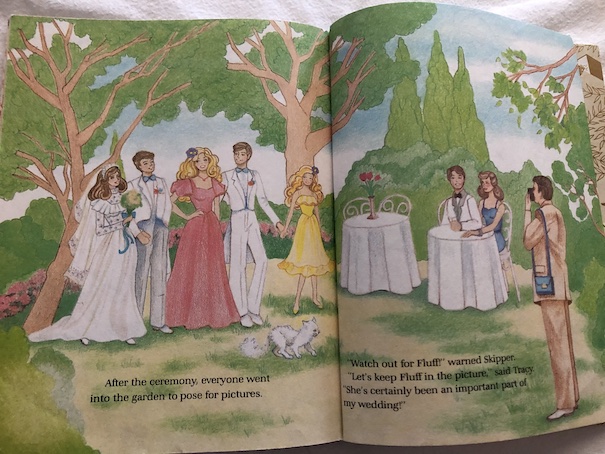
Barbie’s friends, Tracy and Todd, are getting married, and Barbie and Skipper are helping Tracy to get ready. Barbie is going to be Tracy’s maid of honor, and Skipper will be the flower girl for the wedding.
However, when they’re helping Tracy to get dressed for the wedding, Barbie’s cat gets loose and Skipper accidentally tears Tracy’s dress trying to catch the cat. The three of them take the dress to the dressmaker to be fixed.
After the dress is repaired, they stop at the shoe store to pick up Barbie’s shoes. However, when they leave the store, they suddenly realize that they no longer have the box with the dress in it. Instead, they have a box that contains several pairs of jogging shoes! Somehow, the boxes were switched, but how are they going to find the person with the right box?
Barbie, Skipper, and Tracy track the person with the dress across town, using the clues that the jogging shoes belonged to a woman in a floppy straw hat with a red van that says “Flo” on it.
The book is available to borrow and read for free online through Internet Archive.
My Reaction
I read this book when I was a kid and I liked to play with Barbies, and I thought that having them solve a kind of mystery was fun, although it’s a very simple sort of mystery, chasing down a lost object. I liked this book a lot when I was little.
Barbie fans might notice that Skipper doesn’t have her 2000s look, basically looking like a smaller version of Barbie herself, which was how she looked in the 1980s and 1990s, when I got my Barbie dolls. Since then, Mattel has changed Skipper’s hair. However, people who are younger than I am might not be aware that Tracy was also a doll from the 1980s, a friend of Barbie who came in a wedding dress. This 1982 commercial on YouTube shows bride doll Tracy with her groom, Todd. The Tracy and Todd dolls existed before this book was written, so the book was written to give the dolls a story, and the dolls weren’t created based on the book.
The Mysterious Christmas Shell by Eleanor Cameron, 1961.
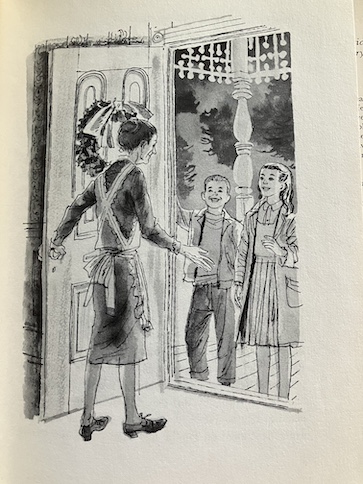
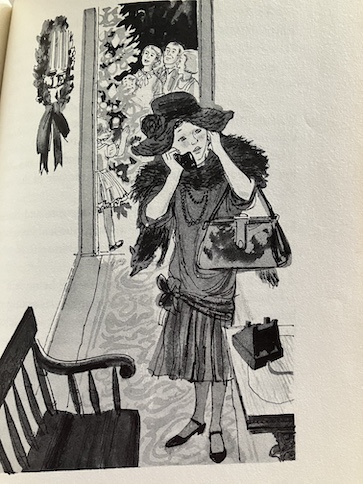
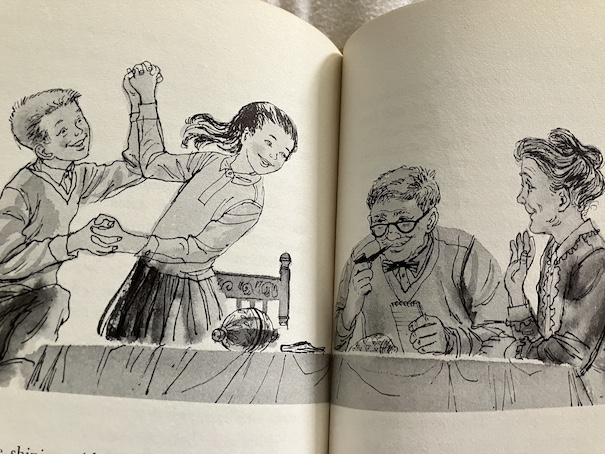
Tom and Jennifer are visiting their grandmother and their Aunt Vicky and Aunt Melissa Vining in Monterey for Christmas while their parents are in New York, taking care of Aunt Winny, who is sick. However, the children can tell that something is wrong as soon as they arrive because Mrs. Nipper, their aunts’ housekeeper, seems upset, and the house isn’t decorated for Christmas like it usually is. They have a Christmas tree, but there are no ornaments on it yet, and the Christmas greenery hasn’t been laid out.
The children hear their aunts talking about a letter that their father (the children’s grandfather) had written before he died. They know that he wrote the letter, but they’re upset because they can’t find it. The aunts explain to the children that they had to sell Sea Meadows, the wooded lands that they own, to a man called Theodore Bidwell. It’s a deep disappointment because Sea Meadows is full of ancient sequoias, and the children always liked to go camping and exploring there. Originally, Mr. Bidwell told them that we was only planning to put a few houses on that land that wouldn’t require removing many of the old trees, but now, they’ve learned that he’s actually planning on creating a large summer resort town. The aunts are upset that Mr. Bidwell lied to them to get them to sell the property, but there wasn’t much they could do anyway because they badly needed money to settle debts they had after their father died. The saddest part is that the family business has improved since they made the sale, and the aunts could now afford to buy back the property, but Mr. Bidwell refuses to sell it back to them.
There is one thing that might change the situation. Before the aunts’ father died, he discussed changing his will. He decided that, rather than leave that land to them as he originally planned, he wanted to leave it to the state of California to be turned into a state park. He thought it was the best way of ensuring that the natural beauty of the land would be preserved, and his daughters approved. The aunts already had the family business, and they didn’t need the land for their own sake. However, for some reason, his lawyer never got the letter their father said he was going send about the change in his will. The aunts are sure that he actually wrote the letter, but they think it got lost or mislaid instead of being mailed. If the aunts can find the letter that their father wrote, it would prove that the land actually belongs to the state of California and that it was never really theirs to sell. They’d have to refund Mr. Bidwell’s money, but they’re prepared to do that. It’s more important to them that the land would be preserved from development. Even local people have been angry with the family for selling the land to Mr. Bidwell because they don’t want the development, either.
When Tom and Jennifer begin helping with the Christmas decorations, and they start reminiscing about the Christmas before, the last Christmas when their grandfather was alive and he wrote his letter about the land, they remember that their cousin Elsa was also visiting. Elsa is about Jennifer’s age, and she and her parents are living in France now, so she doesn’t come to visit very often. The mention of Elsa makes the aunts remember that there was something that their father wanted to tell them about Elsa. He mentioned a funny thing she did, but then, they were interrupted, and he didn’t finish telling them what it was before he died. Everyone starts to wonder if Elsa may have done something with the important letter, but they can’t ask her because they know that she and her parents are visiting friends somewhere in France for Christmas, and they don’t know where or how to get in touch with them. (This is the 1960s, pre-Internet and pre-cell phones, so there are no methods of communication they can use that are independent of also knowing their physical location. They have to either know the address or phone number of where they are staying, and they don’t.)
The children’s grandmother recalls that Elsa was still with them even after Tom and Jennifer left with their parents, and they talked about Sea Meadows and showed her the deed to the land. Elsa had been helping to put away Christmas decorations at the time, and while the adults were talking, she suddenly started to cry. She had cut her finger on something, but they were never sure how she did that because none of the decorations were broken. Elsa was also upset because she had done two things earlier in the day that had caused trouble: she’d broken a little figurine and she’d forgotten to tell her grandfather about a phone call from a friend. She seemed worried that she had done yet another thing wrong, but her grandfather told her not to worry because troubles come in threes, and if the cut finger is her third trouble, she has nothing more to worry about. However, their grandmother recalls that Elsa didn’t seem reassured by that. Rather than being the third trouble of last Christmas, Elsa’s cut finger is a clue to a bigger problem that Elsa was afraid to admit, and that’s the clue they need to solve the problems of this Christmas.
The book is available to borrow and read for free online through Internet Archive. There is an earlier book with the same characters, a mystery about a sea monster in the same area of California, called The Terrible Churnadryne, but I haven’t read it and haven’t been able to find a copy.
My Reaction and Spoilers
I read this book years ago, and I remember liking it, but for a long time, I couldn’t remember the details of the story. I only remembered bits and pieces. I didn’t remember that it was a Christmas story, which would have helped. I remembered that a girl did something with an important paper, but until I reread the book, I couldn’t remember why the paper was important. What stayed with me the longest was the solution to the missing letter and the cut on Elsa’s finger. But, because I forgot that this was a Christmas story, I misremembered exactly what Elsa put the letter in.
I also remembered that one of the aunts had a secret hiding place in a cave when she was young, and when they revisit the cave, they find cave drawings done by Native Americans. I also remembered that the cave is dangerous at certain times because the tide comes in. Years ago, Aunt Melissa was almost trapped there because she stayed too long and was caught by the tide. When her father found out, he refused to allow her to go there alone again. Since her mother and sister didn’t like going to the cave at all and she and her sister soon went away to boarding school, she gave up going there entirely for a long time. She was always sad about the loss of her secret hiding place. However, when she returns there as an adult, it contains part of the secret to unraveling what happened to her father’s letter last Christmas.
At one point in the story, Jennifer finds a very distinctive seashell with red and green colors. Everyone is amazed because it’s a court cone, not a shell normally found on the shores of California, and it also doesn’t normally appear in those colors. This is the shell that Jennifer calls the Christmas Shell. This shell doesn’t directly contain the solution to the mystery, but its shape and something Jennifer does with the shell awaken some of Aunt Melissa’s memories. I also remembered that Jennifer was the one who figured out what Elsa did after watching her brother fiddling around with a napkin in a napkin ring.
While I was rereading this book, I was happy to see all the bits and pieces of my memories of this book fall into place alongside the clues to the mystery. Stories with secret hiding places are always fun, and this one has two – Aunt Melissa’s old secret hiding place in the cave and the place where the missing letter is hidden.
There is also a reference in this story to the Elsie Dinsmore books, a children’s series from the late 1800s and early 1900s.
Since the characters’ adventures in the previous book, Minabell Mouse has come to live with her Aunt Pitty Pat in their ancestral home, Mousehaven Manor. Just as Aunt Pitty Pat and Minabell have finished their spring cleaning, Minabell’s cousin Violet Mae arrives for a visit … apparently a long one, based on the amount of luggage that she brought with her.
Also, the prairie hawk who brought Violet Mae to Mousehaven Manor brings a package for Minabell, although there’s nothing to say who the package is from. Minabell finds the package disturbing and is afraid to open it. Instead, she stashes it in the music room. Still, the package leaves her feeling weak and unwell, as if it were somehow cursed.
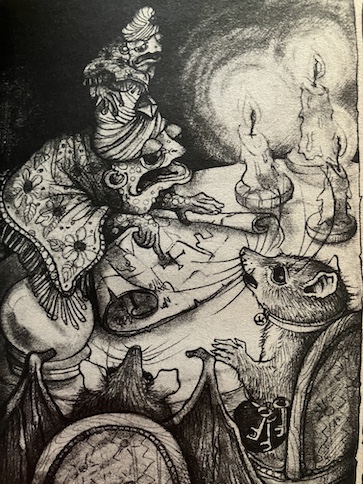
That evening, their friend Percy the bat comes to dinner, and they are also joined by a mysterious stranger bat who calls himself Count Von Flittermouse. Count Von Flittermouse is a traveler, but he has no luggage except for a large box, which he declines to bring inside. They invite him to join them for dinner, but he says he’s already eaten, so he will just join them in conversation. Aunt Pitty Pat asks the Count if he’d like to spend the night at Mousehaven Manor, but the Count says that he’s a nocturnal creature, so he’s active at night. He asks for directions to Springfield because he says he wants to camp in the Oak Ridge Cemetery and visit Lincoln’s tomb. After dinner, the Count leaves, and they see he’s carrying a long box on his back. He’d mentioned that he brought his bed with him, so they figure that’s what it is. Percy seems a little uneasy about the Count, and Minabell notices that the Count left some odd kind of dust on the chair where he was sitting.
Minabell is in charge of security at Mousehaven Manor, but that evening, she accidentally leaves the music room window open. At night, Minabell hears someone moving around the manor, but she never sees the mysterious intruder, and in the morning, nothing is missing, so her aunt thinks it might have been her imagination.
Meanwhile, a country singer mouse called the Rhinestone Rodent arrives in town. (A joke on the Rhinestone Cowboy song.) Minabell is shopping when she stops to watch the singer perform. Then, an alarm goes up among the mice in town because Mousehaven Manor is on fire! Minabell rushes home, and Percy rings the bell at Mousehaven Manor to summon help. Others come to form a bucket brigade, and they successfully put the fire out. Aunt Pitty Pat is fine, but it takes them awhile to find Violet Mae. Violet Mae casually strolls downstairs and tells them that she was upstairs, having a nap and missing the whole thing.
Part of the mansion is damaged from the fire, and they have to clean everything up. Violet Mae meets the Rhinestone Rodent and develops a crush on him. While Violet Mae and Aunt Pitty Pat go to see the Rhinestone Rodent perform, Minabell and Percy inspect the site of the fire. They determine that the fire was set deliberately, but it was never intended to burn down the whole mansion. It seems like whoever set the fire was using it to cause a distraction while they did something else, but they’re not sure what.
The mysterious package that Minabell hid in the music room is still there, and Minabell finally opens it in front of Percy. It turns out that it’s from Wendell Weasel, a member of the local law enforcement agency, the Illinois State Ski Patrol. The mysterious package contains an equally mysterious ancient box, and Wendell’s letter explains that this box has been passed down in the Mouse family for generations, always held by the head of the family. Until recently, it was in the possession of Colonel Mouse, who was Violet Mae’s guardian but has recently passed away (something that Violet Mae has completely failed to mention to anyone, which is weird). Wendell says that Violet Mae doesn’t know anything about the box, but Colonel Mouse wanted Minabell to look after both the box and Violet Mae. Wendell says that there is a document in the box itself that will explain the purpose of the box, but each caretaker of the box is bound to use its contents to help others and not just for personal gain. Also, there are evil people who may try to steal the box, so Minabell is going to have to be careful.
In the mysterious antique box, Minabell finds a pile of sand surrounding a bottle holding something intensely cold and an old map written in Spanish. It seems like this is what their mysterious intruder was looking for, but what does it mean, and who wants it?
The book is available to borrow and read for free online through Internet Archive (multiple copies).
My Reaction and Spoilers
This story is more supernatural than the previous book in the series, which was an adventure story. I thought that the villain in the story was pretty obvious, although I did have a couple other suspects in mind for a more devious twist. It turned out to be the obvious choice, though.
Count von Flittermouse is not what he seems, in more ways than once. Percy figures out pretty quickly that the Count is a vampire bat, but what that seems to mean in this version of the animal world is not only different from what vampire bats actually are, but it’s also kind of confusing. I expected that he’d turn out to be like a human vampire, only with a bat as his main form – drinking blood, being immortal, etc. But, that’s not it. Count von Flittermouse is a shapeshifter. He can change into different scary animals, like wolf and spider. That’s his main super power. So, he’s not exactly what I think of as a “vampire”, he’s more like a werewolf, or werebat, or werewolf bat or something. We never see him drink blood or try to drink blood, although there are some bones in his lair that suggest that he might eat other animals. They don’t really go deep into the lore of it or outline the rules for vampire bats in their version of Illinois. You just have to take their word for it that vampire bats are shapeshifters, and that’s it. That’s their thing. Also, their vampire bats aren’t immortal vampires. That’s really the problem that Count von Flittermouse has. He’s actually a very old vampire bat and not likely to live much longer unless he can get his little winged paws on the package that Minabell received.
The bottle in the mysterious package turns out to contain water from the Fountain of Youth. Generations back, one of Minabell’s ancestors accompanied Spanish conquistadors on their search for the Fountain of Youth, and they not only found it but saved some water from it. Count von Flittermouse wants it to restore his youth and make him immortal. It wouldn’t be so bad if he wasn’t also evil and a werewolf bat.
Of course, our heroes are victorious. They find a way to use the special water so that it benefits everyone, except for the evil bat, and everything ends happily. I actually think that this book might make a fun Disney cartoon, something like a more supernatural version of The Great Mouse Detective. Even though I thought that the book’s version of what a vampire bat is and what it does is a little confusing, a movie version could clarify some of the rules regarding what vampire bats are supposed to be and what they do. The lore about human vampires varies depending on the source, although they usually do have the ability to shapeshift into bats, an ability which is kind of pointless if the vampire happens to already be a bat. It’s understandable that the story has to tweak the traditional vampire lore to fit into this animal society. I kind of picture that the vampire bat would only be able to change into things whose blood it sucked earlier, but that’s just my theory; the book doesn’t clarify that point. Still, it’s a fun story, and I think a movie version would also be fun.
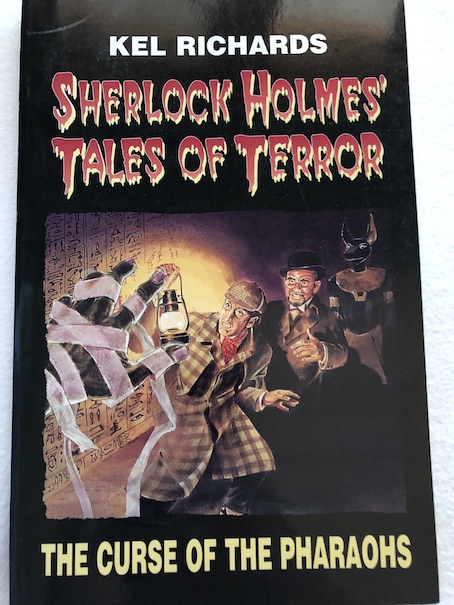
This is the first book in a short series of spooky mysteries for children featuring Sherlock Holmes.
One foggy night, a woman named Laura Coffin comes to Baker Street to see Sherlock Holmes, and his friend, Dr. Watson. She’s very worried about her uncle, Professor Sloane Coffin, who is an Egyptologist, living in Scotland. He’s been very ill and is likely to die, but Laura is increasingly alarmed by his mental state. Her uncle has come to believe in the Ancient Egyptian religion and believes that, when he dies, he will return from the dead. He thinks this power to return from the dead and live forever will come from a diamond he found in a tomb in Egypt called the Eye of Osiris. Laura and her uncle’s doctor, Dr. Cabot, have also come to suspect that her uncle’s medical state may be due to poison, although they’re not sure who could be poisoning him. Laura has come to Sherlock Holmes because the local authorities don’t believe her.
The most likely suspects for poisoning the professor would be his lawyer, Mr. Grizzard, who has been staying in his house and seems to have a sinister and unhealthy influence over the professor; the professor’s manservant, who Laura suspects of plotting to steal her uncle’s diamond when he dies; and a mysterious Egyptian man who has been staying nearby and seems to be lurking around the professor’s property for unknown reasons. Sherlock Holmes promises Laura that he and Dr. Watson will come to Scotland and investigate her uncle’s condition. Privately, he tells Dr. Watson that he thinks that there is something else that’s bothering Laura, something that she’s not telling them.
When they arrive in Scotland, Laura is glad to see them, although Mr. Grizzard isn’t. Laura introduces them to Dr. Cabot and her uncle. Dr. Watson doesn’t recognize the disease that the professor is suffering from, and Dr. Cabot says that he can’t figure out why the professor is so sick. Based on the tests he’s done, the professor really shouldn’t be this bad, but he does look like he’s dying. The professor accuses his niece and everyone else of only being concerned about his diamond. The professor confirms that he believes everything that his niece said earlier. He says that he believes in Ancient Egyptian gods (he calls them “gods of darkness”, which doesn’t seem scholarly), and he believes that, through his diamond, they will bring him back to life, and he will live forever.
Soon after Holmes and Watson meet the professor, he suddenly dies. Mr. Grizzard explains the professor’s will and final wishes. Laura is the professor’s primary heir, but she cannot take possession of the estate until she is 21 years old, so Mr. Grizzard will be in charge of the estate as executor until then. The professor had an Egyptian-style tomb built in his backyard, and his wish was to be buried there, along with his diamond. Mr. Grizzard makes certain that the professor’s requests are carried out, including the requirement that the tomb must be able to unlock from the inside.
Holmes spots a man spying on the funeral. He and Watson take turns watching this man as he seems to be observing the tomb and waiting for something. As Watson watches this man during a storm, he sees the door of the tomb open and the professor come out! Unfortunately, Watson is knocked unconscious by a falling tree branch. When he wakes up, there is no sign of the professor, and the man who was spying on the tomb has been murdered!
Did Watson really see what he thought he saw? Did the professor really rise from his tomb and kill the man watching him? Why was this man watching the tomb in the first place? What will the professor do now, and what does he want?
My Reaction
When I first got this book, I wasn’t quite sure what to expect. Pastiches can take familiar characters in some unusual directions, and I had read a review criticizing this series for adding supernatural elements and Christian themes that weren’t found in the original Sherlock Holmes stories. I thought that the story would probably be a pseudo-ghost story, somewhat like Scooby-Doo mysteries, where it seems like something supernatural is happening, but there’s actually a rational, more physical explanation. However, I wasn’t completely sure for most of the book whether that would be the case or not. There’s room left for readers to wonder whether Professor Coffin has really risen from the dead or not.
For those who prefer the ghosts to have logical explanations … you won’t be disappointed. There is a rational explanation for everything that happens in the story, and there are multiple people who could be good candidates for the villain behind everything that happens. Some of my suspicions turned out to be correct, but there are actually multiple villains involved, which complicates the situation and offers surprises for readers.
The other reviewer was right that there are Christian themes in the story. The Christian themes don’t really come into the story until the end, when Holmes and Watson are discussing the case with Laura Coffin. Laura asks why God allows people to behave wickedly. Holmes and Watson say that it’s not so much a matter of God allowing it as people choosing to commit evil deeds, and reassuring her that, sooner or later, everyone faces the judgement of God. Laura feels disillusioned about some of the people she trusted, but they also reassure her that, as a wealthy young heiress, she has her life still ahead of her to enjoy, and she will find better people. The religious talk and the quote from the Bible do seem a little out of character because I can’t recall the characters focusing on religious morals in the original stories so much as the deductive process, but I didn’t think it was bad. It was just a brief conversation, not overdone. If the characters had talked that way all the way through the book, it might have been a bit much, but it seemed plausible enough for a brief conversation on the subject.
The themes of the story reminded me of the Sherlock Holmes computer game The Mystery of the Mummy, but the story in that computer game isn’t the same one in this book.
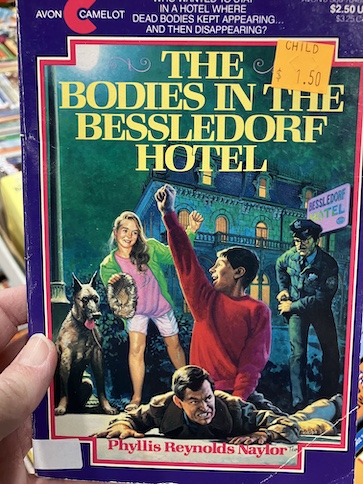
The Bodies in the Bessledorf Hotel by Phyllis Reynolds Naylor, 1986.
Officer Feeney is the first person who suggests that, someday, there might be a dead body at the Bessledorf Hotel. The hotel is coincidentally located next to the local funeral parlor, which is why the subject of dead bodies comes up, and Officer Feeney has a way of suggesting frightening things that scare Bernie Magruder, son of the hotel’s manager. Officer Feeney’s reasoning is that most people die in bed, so it only makes sense that some of them would be hotel beds. The hotel has 30 rooms, and with people coming and going, it’s surely just a matter of time before a guest dies there. It’s a morbid thought, although Bernie reasons that Officer Feeney is overestimating the number of people who pass through the hotel because it isn’t always full and some of the guests are long-term residents.
Still, Bernie gets a shock after he returns to the hotel, and the cleaning lady, Hildegarde bursts in on him and his parents, hysterical about finding a body in a bathtub of Room 107 with all his clothes on. Bernie’s father tells his wife to call Officer Feeney to write a report of the death and considers whether they can remove the body secretly, perhaps in a laundry cart, to avoid bad publicity for the hotel. Unfortunately, some of their guests already heard Hildegarde screaming about a dead body, so word is out. They want to know if it’s a case of murder or suicide and how it’s being investigated, and one of the long-term guests, who is a poet, has already written a short poem for the occasion.
However, by the time they all get to the room where Hildegarde saw the body, it’s gone. There is nothing in the bathtub, not even water. Officer Feeney shows up and demands to know what’s going on, and Hildegarde insists that she really saw something. The Magruders believe her, but they have no explanation for where the body could have gone. The guests speculate about body-snatchers and ghosts.
All they know about the man who occupied that room is that he gave his name as Phillip A. Gusset, he checked in the evening before, and he said that he would be leaving the next morning. Officer Feeney asks them if there was anything odd about him, like if he seemed nervous or unwell. Nobody remembers anything like that. They remember that he had a mustache and a hat with a red feather and just a single bag with him. He did kind of make Bernie’s parents uneasy, and he seemed to have a strange scent about him, although they find it difficult to describe what it actually smelled like. Officer Feeney says that, without a body or any evidence that something has happened, there doesn’t seem like anything to investigate. Bernie’s father is relieved that there won’t be any report of a murder or death occurring at the hotel because, otherwise, the owner might fire him. Bernie remembers that the man’s slippers were still in the room and goes to get them in case they’re evidence. When he gets there, he discovers that the slippers have mysteriously disappeared.
Bernie’s friends, Weasel and Georgene, think that people will probably never want to rent that hotel room ever again, and Bernie’s father renumbers the rooms so there will be no Room 107. Weasel convinces Bernie and Georgene to help him search the area for the body, thinking that whoever took it would most likely want to dispose of it quickly. They search down by the river, but they only find a bag of garbage that Bernie’s younger brother, Lester, left there to trick them.
Even though there’s no evidence that anything happened and the police aren’t investigating the situation, the incident of the disappearing guest appears in a newspaper in Indianapolis, where the hotel owner, Mr. Fairchild, lives. Mr. Fairchild calls the hotel to demand to know what’s going on. Mr. Fairchild says that he want the hotel to put on live entertainment in the evening on weekends to draw attention away from the incident and bring people in. However, he expects Bernie’s father to hire the entertainment out of his own money since Mr. Fairchild thinks this situation is his fault, and most entertainment is out of the Magruders’ price range. Fortunately, Bernie’s father has joined a barbershop quartet, so his group can do their singing at the hotel.
The singing goes well, but a strange woman with orange hair checks into the hotel and keeps making comments about dead bodies there. Then, one of the waiters finds this woman dead in her room, Room 321. Just like the first body, this body also vanishes. By this time, Bernie’s father suspects that the woman faked her “death” just to scare the waiter and ran away as soon as he was gone. As Bernie’s parents investigate the room, they notice an odd smell that reminds them of the first guest who disappeared. The smell really unnerves his father, but strangely, not his mother. It’s a faint smell that’s difficult to identify, but it conjures different images for both of them. Bernie’s father says it reminds him of sweaty clothes, cigars, and pastrami, while his mother says it makes her think of flowers and a porch swing in the evening.
The Magruders aren’t sure why someone wants to fake deaths at the hotel, but this latest faker didn’t pay for either her room or dinner, and somehow, the newspaper has heard about it and reported it again. Mr. Fairchild is angry, and Bernie knows that they need to figure out who the prankster is before they do it again!
The book is part of the Bessledorf mystery series, also known as the Bernie Magruder series. It is available to borrow and read for free online through Internet Archive (multiple copies).
My Reaction
Attempts to investigate the mystery alternate with the Magruders’ attempts at cheap hotel entertainment. The barbershop quartet works until one of the members gets laryngitis. Some of the guests start a food fight when the entertainment is bad. Then, Joseph gets some of his friends from the veterinary college who play instruments to come. Personally, I like the part where Lester suggests that they hold a haunted house at the hotel and take people on tours of the rooms where “dead” bodies have been found. They reject that idea, but there are hotels and bed-and-breakfasts that give haunted tours, and people come to investigate ghosts. That actually can be a successful gimmick. I once intentionally stayed in a supposedly haunted hospital that had been turned into a hotel in an old western mining town. A possible murder once occurred there, but I enjoyed the visit.
When a new guest shows up at the hotel with that same, strange scent, Bernie knows that it’s their culprit, back again in another disguise. Now that he knows who to watch, he starts planning how they’re going to trap the person.
I had a couple of ideas in beginning about who was doing all of this and why, but there are some surprising twists in the story. Bernie’s first attempt to catch the villain is weirdly thwarted by the discovery of a dead body that is actually a real, dead person. It’s not a guest; it’s a body stolen from the funeral parlor next door. The bad guy decided to change his tactics.
One of the clues to the person’s identity is that mysterious smell and the way it has an opposite effect on Bernie’s parents. It irritates Bernie’s father but makes his mother feel strangely nostalgic. The truth is that they’re both remembering the same thing or the same person, but although they can’t remember right away exactly what they’re remembering, they have very different feelings about it.
Surprisingly, although Mr. Fairchild threatens to replace Mr. Magruder with another manager, he actually shows up at the hotel himself and discovers that he likes playing detective and figuring out what’s going on. He’s also impressed with the way Mr. Magruder stayed to finish managing things even after he told him that he was planning to hire someone to replace him, and that secures the family’s position.
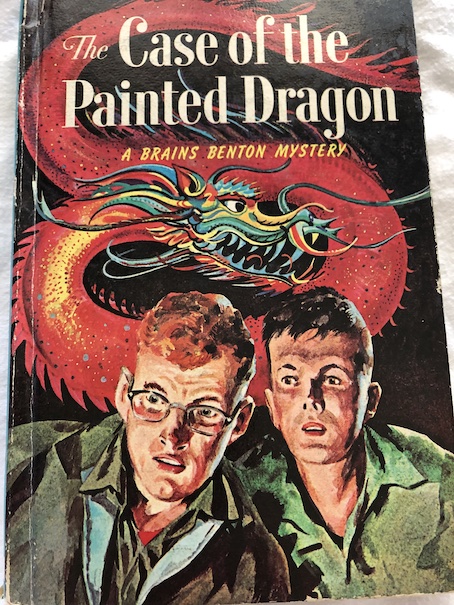
The Case of the Painted Dragon by by George Wyatt (Charles Spain Verral), 1961.
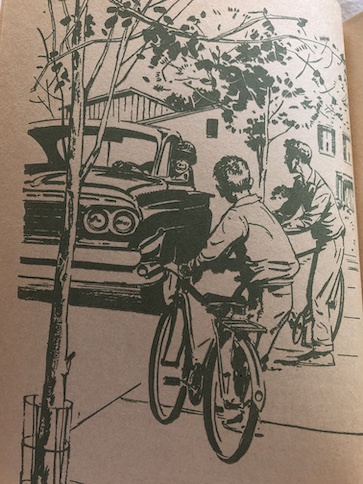
Jimmy and Brains are on their way to school when a strange man in a car stops and asks them if they know where he can find a Japanese kid. (He uses the derogatory terms “Jap” and “Nip”, and Brains disapproves. Also, the man is very unspecific about which kid he’s looking for. He offers no names, just that he’s looking for a Japanese boy about their age The town where the boys live is a fairly small college town, so I guess it’s supposed to be reasonable that there would only be one boy matching that description. I grew up in a larger university town, so the idea of there being only one person who could match any description and just expecting random people to know who it is seems really odd to me.) Brains just says that they don’t know anybody with Japanese ancestry, and the man drives away.
After the man leaves, the boy talk about how suspicious he was. They really don’t know who he could be looking for. The last Japanese family to live in their town was the Yamadas, but Mrs. and Mrs. Yamada were killed in a car accident the year before. (It was a point in the book’s favor that Brains doesn’t like derogatory racial terms, but the point is lost quickly when Jimmy is describing Mr. Yamada, who taught art at the boys’ school, and he says that Mr. Yamada “wasn’t one of those ‘inscrutable orientals’ you’re always reading about.” He says that Mr. Yamada was friendly and also coached the school’s swimming team. It’s nice that Jimmy liked Mr. Yamada, but the way he says it sounds a little back-handed. I suppose it’s a sign of the times when this book was written that the author thought it was reasonable for people, even kids, to “always” be reading about “inscrutable orientals”, but on the other hand, I’ve read other books from this time period and earlier that weren’t like that, so I’m inclined to think that it’s not really “always” and everyone.) However, the boys don’t remember the Yamadas having a son their age, so they doubt there’s a connection. They’re concerned because they think that the suspicious stranger might have bad intentions toward the kid he’s looking for.
After the boys get to school, Jimmy sees that stranger driving by the school, and he gets worried. Either the stranger is still looking for the Japanese boy, or he’s looking for Brains and Jimmy. Brains thinks that the best thing to do is try to find the Japanese boy before the man does. However, Brains doesn’t want to tell their principal or teacher about the stranger or the boy. Jimmy worries that maybe the stranger made up the Japanese boy as an excuse to get to him and Brain, and he decides to tell the principal about the stranger in the car, and the principal goes outside and demands that the stranger tell him who he is and what he’s doing, hanging around the school and scaring the students. Unfortunately, he confronts the wrong person in the wrong car, which is an embarrassing situation. (He did the right thing even if he confronted the wrong person. I give him credit for that, but they need to have a reason why the school authorities don’t do anything about the weirdo scouting the students.)
In the boys’ next class, they meet a new student, Mikko, who may be the Japanese boy that the stranger was looking for. The boys make friends with Mikko, inviting him to come to baseball practice with them. They want to warn him about the stranger, but before they talk to him about thr man who seems to be looking for him, they spot the car following them again. Mikko spots the car, too, and the boys ask him if he knows the driver. Mikko says, no, the man is a stranger. Aside from the people at school, the only people Mikko knows in town are Mr. and Mrs. Bevans, the people he’s staying with. Brains makes up a story about why the man might be following them because he doesn’t want to alarm Mikko too much and also because he doesn’t want anybody calling the police until he and Jimmy have had a chance to investigate the situation themselves. (This is a selfish move – Brains just wants a case to investigate, and he doesn’t want to share the case with the proper authorities. But, again, the story needs to provide a reason for Brains and Jimmy to handle the investigation without adult help.)
Jimmy’s mother knows about Mikko’s background and tells him about it when he gets home. It turns out that Mikko is the Yamadas’ son, but until recently, he had been living with relatives in Japan. Mr. Yamada was born in the US, but he worked in Army Intelligence during WWII, which is when he went to Japan and met his wife. Mikko had been born in Japan and was going to school there, but the Yamadas planned to move to the US permanently. Mr. and Mrs. Yamada had come first to get established, but they died in the car accident before they could bring Mikko to join them in the US. However, Mr. Yamada had wanted his son to become an American citizen, like him, and get an American education. The Yamadas had boarded with Mr. and Mrs. Bevans and became friends with them. The Bevanses’ have no children of their own, and they are considering adopting Mikko and giving him the American life that his father wanted him to have.
There is one adult who knows about the mysterious car following Mikko: Yama, an old family servant who accompanied Mikko from Japan to the US to make sure that he gets settled in his new home. Yama is a former sumo wrestler and a formidable man, and when Mikko tells him about the mysterious stranger in the black car, Yama says that he will protect him. However, when the Bevanses’ house is ransacked while the boys are playing baseball and they return and find Yama looking around Mikko’s room, they boys start to suspect that Yama may be involved with the mysterious stranger in some way. At least, he seems to know more than he wants to say about the situation because he refuses to call the police to report the ransacking.
After some further research, Brains and Jimmy learn that the Yamadas’ car accident might not have entirely been an accident, and Brains suspects that everything that has happened may relate somehow to Mr. Yamada’s former work in Army Intelligence.
My Reaction
This is the last book in the Brain Benton series, but it’s also more of a mystery than the previous books. In most of the books, it doesn’t take the boys long to realize who the villains are, and the mystery is more about how they’re going to prove it and stop the bad guys. However, in this book, Brains and Jimmy really do start off completely in the dark. First, they have to learn who the Japanese boy is that the strange man is looking for, and then, they have to learn the history of Mikko and his family. Brains and Jimmy do genuine investigative work, starting with old newspaper stories about the accident that killed Mikko’s parents. Little by little, they begin to reconstruct the past and learn why someone is looking for Mikko and what Mikko has that they want. Even when the boys know who the bad guys are and what they’re after, there is still the puzzle of where Mikko’s father hid it before he died.
I enjoyed the mystery in the book, but I didn’t like some of the ways Jimmy talked about Japanese people. I think it was good that he noted that derogatory terms are inappropriate, and I appreciated that he liked Mikko pretty quickly and pointed out good things about him. Those are good points. It’s just that, sometimes, even when Jimmy speaks favorable about some of the Japanese people in the story, it comes off sounding a little back-handed, like when he says that Mr. Yamada was actually a really nice and friendly guy and not “inscrutable” like characters Jimmy has heard about. I can see that it’s a positive point that someone who has been given a negative impression about certain types of people can consciously notice that the reality is both different and better than what he’s heard before. I think Jimmy is moving in a good direction in his attitudes. It’s just that compliments sound flat when they’re accompanied by a negative or implied negative. It’s like the difference between saying “He’s a really nice guy” vs. “He’s a really nice guy for being the kind of person I’ve always heard was really sinister.” It just adds an uncomfortable twist on the sentiment. I know that the reason Jimmy talks like this is because this book was written during the 1960s, when racial attitudes were changing, and the author probably felt like it was necessary to acknowledge old stereotypes, but I still don’t like it.
#13 The Mystery of the Gingerbread House by Elspeth Campbell Murphy, 1997.
Sarah-Jane lives near a couple whose names are Jack and Jill. They live in an old Victorian gingerbread style house. They have been fixing up the old house, and Sarah-Jane has been acting as a messenger, carrying samples of wallpaper to them from her mother, who is a decorator.
Sarah-Jane brings her cousins to see the house, and Jill shows them an old photograph that she and her husband found of the children who used to live in the house a hundred years ago and a friend of theirs. When the kids first arrived at the house, they startled someone who was working in the parlor. However, Jack and Jill insist that it was not either of them. They look in the parlor and are surprised to see that someone has continued the work they were doing, removing some of the old wallpaper that needs to be replaced. Why would someone sneak into the house to continue their work?
Someone has learned an important secret about the house and something hidden inside, and they are trying to find it before Jack and Jill stumble across it in their renovation work.
The theme of this story is Proverbs 25:13, “A trustworthy messenger refreshes those who send him. He is like the coolness of snow in the summertime.”
The Silver Spoon Mystery by Dorothy Sterling, 1958.
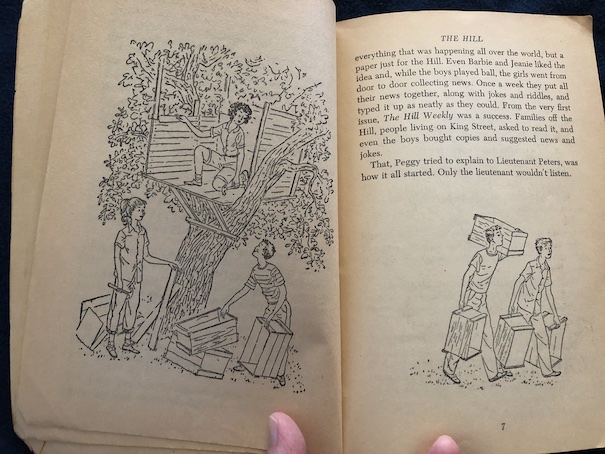
A group of families move into the new suburb built on The Hill overlooking the town of Dwighton. The kids in the new neighborhood become close friends, visiting each other’s houses, playing games, and running around town together. It’s idyllic, but then the boys in the group start playing baseball together, and they begin excluding the girls from the group, even though they’ve all played baseball together before and the girls are good at it. The boys also stop working on the tree house that the kids were all making together, taking some of the tools and materials and building themselves a clubhouse near the baseball field with a sign that says, “NO GIRLS ALLOWED.”
The girls are offended at suddenly being shunned by the boys, so they decide that they need to have some special project, something that will show the boys that girls are just as good as they are and that the girls don’t have to rely on the boys to have some fun. They decide to start a neighborhood newspaper, writing about local events and having fun stuff, like jokes. The newspaper is a success, and adult neighbors buy copies. Then, the boys decide to start a competing newspaper themselves. One of the girls, Peggy, is upset because she’s sure that the boys’ newspaper will be more successful. Some of the boys are older than the girls so they might write better, there are more boys than girls in the group so they have more people to gather news and sell papers, Davey is better at drawing cartoons than the girls are, and worst of all, the boys splurged to buy a hectograph, which uses a gelatin substance for making copies of writing and drawings (as in this video) and will allow the boys to print papers by the hundred (“hecto” means one hundred, and that’s how many copies a hectograph makes at a time). (This is before home computers, so the characters have to rely on manual printing methods. People used hectographs to make copies before modern copy machines, but modern hectographs still exist, and some people use them for artwork or tattoo stencils.)
Peggy’s afraid that the girls won’t be able to compete with the boys’ advantages and thinks that the boys are mean for trying to steal their business. Peggy’s mother tells her that she shouldn’t worry about being better than the boys but focus on being different. She says that the girls should make sure that their paper has different content from the boys’ paper so people will still have a reason to buy theirs even if they’ve already bought the boys’ paper. If the boys’ paper has cartoons, the girls’ paper should have things the boys wouldn’t think to include, like recipes, poems, and fictional stories that could be written and submitted by local people.
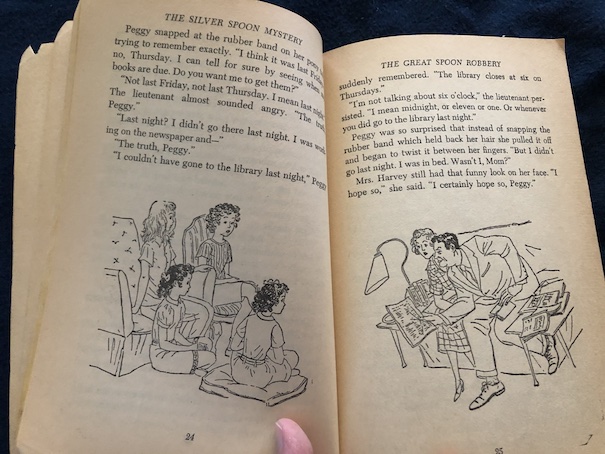
Peggy gets an idea from what her mother says, but it’s not a good one. Peggy still wants to show up the boys, and she thinks that the best way to do it is to get a “scoop”, meaning printing an exiting news story that the boys won’t have in their paper. The problem is that the girls don’t know where they’re going to get an exciting news story that the boys don’t know anything about. Nothing that exciting is happening in their town anyway. There haven’t been any shocking events, no murders, no robberies. Peggy tells the other girls that means that they have write about something that hasn’t happened yet. Peggy poses the idea of writing about someone stealing the silver on display at the local library that was made by the silversmith who was the founder of their town. Of course, the problem with that is that the silver hasn’t actually been stolen. One of the girls, Ellen, objects to writing a story about something that hasn’t happened because that’s not actually “news.” However, Peggy talks the other girls into it by saying that they would be writing about it as fiction because people write fictional books all the time, and that’s allowed. Ellen still isn’t convinced, but Peggy goes ahead and writes the story anyway. (Basically, she’s turning the girls’ newspaper into a tabloid, although the kids don’t seem to quite get the difference, even though Ellen can tell that this isn’t right for a newspaper.) The girls all discuss how they would go about stealing the silver spoons from the library, if they were going to do it, and Peggy writes the story from their speculations.
You just know that there’s going to be trouble with Peggy trying to sell a story that everyone knows didn’t happen, but what actually happens is even stranger. After the girls sell their paper with the spoon theft story, Peggy gets home to find a policeman, Lieutenant Peters, waiting for her with her mother. Lieutenant Peters wants to talk to Peggy about the robbery at the library because it turns out that the very night when Peggy was writing her big fictional scoop about silver spoons being stolen from the library, someone was in fact stealing silver spoons from the library, and this thief apparently did it the way Peggy described in her story. Lieutenant Peters wants to know everything that Peggy knows about the theft, and he won’t believe that Peggy wasn’t there to witness it because her description of what happened is so accurate. She even has a description of the thief in her story. Since the theft happened in the middle of the night, Peggy points out that she was asleep in bed, but even Peggy’s mother isn’t sure that Peggy didn’t sneak out. When Peggy’s friends show up at her house, Lieutenant Peters questions them too and comes to the conclusion that Peggy and maybe also her friends stole the spoons themselves to make their story true. Lieutenant Peters says that they’ll be forgiven if they give the spoons back, but the girls can’t do that because they don’t have them.
As Lieutenant Peters and Peggy’s mother continue to question the girls about their story, the girls admit that they made up the whole thing as a fictional story just to attract attention to their paper. Lieutenant Peters catches the boys listening in on their conversation and questions them about what they know about the situation. The boys don’t really know anything about the theft, either, but they were pretty sure that Peggy made up the story she wrote, and they’re fascinated that she might be about to be arrested and taken to “children’s jail.” Peggy’s mother believes her that she just made up the story and it’s all a coincidence that someone happened to steal the silver spoons from the library around the same time, but Lieutenant Peters isn’t convinced.
Word of the spoon theft spreads across town quickly, partly because of Peggy’s story in the neighborhood newspaper and partly because of the story in the regular news. People call Peggy’s house to ask for details, and kids at school look at Peggy and her friends suspiciously, wondering how much they had to do with the theft. Peggy is especially offended when Davey says that his father thinks that it’s an unlikely coincidence that Peggy would write a story about the theft and then the theft would just happen. Before the boys started their “no girls allowed” stuff, Peggy and Davey used to be close friends. However, Davey assures her that he doesn’t think that she’s responsible for the theft. He also tells her that he and the other boys are sorry about pushing the girls by trying to compete with their paper, and they’ve decided to give up theirs and let the girls use the hectograph. The kids discuss trying to investigate the crime themselves because, until the real thief is found, people are going to keep looking at the girls suspiciously.
Most of the neighborhood kids, both boys and girls, join the investigation as the “Hill Detective Club”, except for one of the older girls who is studying for exams and Davey’s older brother, Allen, the only boy who’s mad at the other boys because they don’t want to play baseball now. (Allen is apparently the one who started all the “no girls allowed” stuff because he didn’t make the high school baseball team and he’s been ultra-serious about practicing during the neighborhood games. He’s trying to organize a game between the boys in the neighborhood and their fathers. The book doesn’t explicitly say so, but there might also be an element of embarrassment for him that some of the girls play better than he does. Peggy is described as being the fastest runner in the neighborhood, and Ellen is a good batter.) As they begin their investigation, the kids visit the scene of the crime and study the ways the thief could have gotten into the library, starting to separate the made-up details from Peggy’s fictional story from the real facts and circumstances of the case. Peggy admits that her mind is biased because she still thinks of her story as the way things happened and her fictional suspect as the type of thief they’re looking for, but the truth is that they don’t know for sure how the crime actually happened or what type of person they’re looking for.
When the kids talk to one of the librarians, Miss Bancroft, they learn that the police did find a few sets of fingerprints on the case that held the silver spoons: Miss Lowell, the head librarian; Mrs. Simpson, a descendant of the town’s founding father and part of the local antiquarian society; and Mr. Weatherspoon, who owns a local antique store. Could one of these people be the thief?
The book is available to borrow and read for free online through Internet Archive.
My Reaction
To begin with, this book seems like it’s meant for fairly young elementary students. It tries to teach readers the meaning of some of the words in the story because some of the characters don’t know the meanings of various words the other characters use or words that they encounter in various places, like “descendant” or “optometrist.” The kids in the story are a variety of ages even though they all play together in the neighborhood, and I could understand why some of the younger kids would struggle with bigger words, but there were times when I thought that they were carrying it a little far. Peggy is twelve years old, so it seems like she should have been old enough to know what an optometrist is. Has she never had her eyes checked before? Actually, maybe she never has. If her vision is good or seems good, maybe her family just doesn’t bother. I guess it’s educational for young readers just branching out into chapter books.
I like books that bring up interesting historical topics. The parts about older printing/copying techniques and Mrs. Simpson’s old electric car with the steering stick instead of a steering wheel (possibly a Baker Electric, like the one Jay Leno owns, or something very similar – this video explains the history of the Baker Electric and shows what it’s like to drive it) were interesting, and one of the characters in the story explains more about the history of the town’s famous silver spoons to the kids. Although the town, its founder, and the spoons are all fiction, spoons of this sort did exist in real life. The silver spoons are specifically christening spoons. It used to be traditional to give presents made of silver to new babies and their parents for the child’s christening. One of the most popular presents of this type was small silver baby spoons, especially with special designs or engravings to remember the child’s birth. The character explains why this particular set of spoons is so distinctive, talking about their unique design, how antique dealers would be able to look them up in a reference book and learn their history, and how each of the of the spoons is marked with the maker’s hallmark, the special symbol that the maker would use to identify himself.
Part of the mystery hinges on the coincidence of the theft occurring just when Peggy decides to write a sensational story about an imaginary theft to get attention for her neighborhood newspaper. For readers, the question is whether the timing of the actual theft is really just coincidental or if there’s a direct connection between the story of the theft and the theft itself. I would have been very disappointed in the book if it was just a coincidence, so I immediately approached the story with the idea that the timing of the theft was a clue. I enjoyed considering different possibilities. My first thought, when the theft happened mysteriously immediately after Peggy and her friends invented their theft story, was that someone overheard the girls talking about how they would commit a theft like that and decided to use their imaginary scheme as their own. However, the conversation between Peggy and her friends took place in Peggy’s room, which was pretty private. For someone to overhear them, it would have to be someone in Peggy’s own house, possibly family or a neighborhood friend, or someone listening in from outside, probably one of the neighborhood kids. Those possibilities didn’t seem likely. Then, I remembered the Nero Wolfe murder mystery story Not Quite Dead Enough. What if the theft didn’t occur when the police thought it did (mostly because they believed Peggy’s original story) but actually at the point where the theft was supposedly discovered? The person who claimed to discover the theft was one of the people with the strongest motives to commit it, and this person could have done it after reading the fake news story, seeing an opportunity to make it true and cast suspicion on Peggy’s fictional suspect. The mystery is simple enough to figure out for an adult who likes mystery stories, but probably much more mysterious for kids. Once the kids realize who has the spoons, there is also the additional challenge of proving it and getting the spoons back without getting everyone in trouble.
I thought it was interesting that the story shows some of the problems with sensationalist or tabloid style “news” stories, or “yellow journalism“, as it used to be called. It’s the sort of “news” that relies on flashy and misleading headlines, buzzwords and catch phrases that appeal to its fans and rile them up emotionally, hyperbole and emotionally-charged language, conspiracy theories, pseudoscience, and poorly-qualified or debunked “experts”, to draw readership and advertising money. Basically, they aren’t really “news.” They don’t try to describe things as they actually happened for informative purposes. These are “news” stories that are less about fact than about entertaining their audience or shocking people and stirring up strong emotions to grab people’s attention. That’s basically what Peggy was trying to do with her fake news story, even if she wasn’t quite thinking about it in those terms. Just like tabloid or sensationalist news, Peggy’s story was almost a kind of fan fiction based on the real world. That is, she took real things and situations that she knew existed (the silver display at the library) and wrote an exciting conspiracy story around them that didn’t actually happen (the made-up theft) as a shocking, attention-getting entertainment piece to encourage people to buy the paper she and the other girls were selling. She thought what she was doing was like harmless entertainment, but it wasn’t because it was based on something real, and her made-up story had real consequences. Not only is there a direct connection between the fake story and the real theft, but Peggy’s fake story confuses people, including the local police and insurance investigator, because they have trouble telling how much of Peggy’s story is false, and it biases their minds and the direction of their investigations. Even Peggy herself sometimes gets confused during the investigation, mixing up details from her made-up story with real events. Even though she wrote the fictional story herself, knowing it was fictional, she gets hung up on the way she imagined things would happen when she invented the story and needs to be occasionally reminded to look at the situation as it actually exists, not as she imagined it would be. If the author of the fictional news story can’t even keep her own fiction and the real facts straight in her mind at first, how can the police or anyone else?
Sensationalist journalism can and has led to real problems in real life, setting up dangerous situations by stirring up the emotions of people who may already be unbalanced and suggesting unrealistic events or courses of action that interfere with people’s sense of reality and ability to make informed, reasoned decisions (something else that ties in with the story). In a famous real life case from the early 1900s, the famous newspaper publisher William Randolph Hearst had his own reputation seriously damaged when he published articles written by two of his columnists smearing President McKinley’s reputation and seemingly recommending his assassination. (“If bad institutions and bad men can be got rid of only by killing, then the killing must be done.”) These articles were published only months before President McKinley was actually assassinated. Hearst had used yellow journalism in his papers for years to manipulate public opinion to further his political causes and gain readership. (“War makes for great circulation,” Hearst said after successfully urging public opinion in favor of the Spanish-American War.) After the assassination of the president, people made a connection between the assassination the articles in Hearst’s papers seemed to be advocating (although they called it a “mental exercise” and a joke) and the assassination that actually happened. Whether Hearst actually wanted McKinley to be killed by someone or whether the man who assassinated McKinley was directly inspired by those sensationalist articles is questionable, but the suspicion that was what happened, in a sort of “Will no one rid me of this turbulent priest?” kind of moment, did seriously damage Hearst’s own political ambitions. Hearst did intentionally want to smear McKinley’s reputation, but his lack of consideration for the possible results of his stories, which seemed to be advocating an actual murder that did occur soon after, caused the public to turn against Hearst himself.
We frequently caution people to be careful of what they read because you can’t trust everything, which is sensible advice, but I’d go a little further and say, be careful of why you choose to read what you’re reading and why believe what you read. Was it because the information was presented logically and authoritatively, or is it because you decided ahead of time what you were going to read because of something you already believed or something you already knew you really wanted to do? Picking the right information source is good, but it may be even better to ask yourself what you, as an individual, plan to actually do because of the news sources you’re following. Is it a good thing to do that’s going to help someone or something that’s going to hurt people? Take a look in the mirror once in a while and question your motives as one of your own primary sources of information. You are the one who chooses what news sources you consume. You are the one who decides what you believe because you always have the choice to accept or reject anything you hear from someone else. You are the one who decides what your standards are and where your limits are set. You are the one person who knows exactly what you’re willing to do to accomplish your goals. You are the one who moves your body to the locations you decide to go and makes your mouth say the things it says and your body do the things it does. You are the one who has ability to say “yes” or “no”, not only to other people but yourself when necessary. Anything you may decide to do involves not just a single choice but multiple choices along the way that can only be made by you, so you’re going to have to be your own fact checker at every step, not just about what other people are telling you but what you’re telling yourself and why.
Sensationalist news stories are intentionally emotionally manipulative in order to get people hooked on reading that source, but you’re the only one who gets to decide if you’re hooked and what you’re going to do about it. The next time you read something that makes you really mad at somebody, before you do whatever you’re considering doing about it, pause a moment to ask, not just whether the source you just read might be wrong, but “What if I’m wrong? What if I’m wrong about this situation, and I’m about to do the wrong thing? Am I prepared to face the consequences for my actions if this turns out to be serious?” The reason for asking these questions is, if the consequences of what you’re planning to do are serious, there will be a point where people won’t want to hear about what you believed or thought you believed or what someone else told you earlier. If you’re the one who did the thing, you’re the one who’s going to be facing the consequences for that thing. There’s a point where everyone has to accept the consequences for themselves all by themselves. (To put a finer point on it, riot and people will riot with you, but you’ll be tried as an adult alone.)



















 Jestress's Forgotten Books and Stories