The Snowy Day Mystery

Cam Jansen

CJSnowyDayMystery

The Snowy Day Mystery by David A. Adler, 2004.

One snowy day, Cam Jansen and her friends are on the school bus outside of their school.  Because of the snow, a lot of parents have decided to drive their kids to school, and with all the extra cars, it’s difficult for the bus driver to pull up and let the kids out.  Cam and her friend, Eric, pass the time while they’re waiting with a memory game.

Their game proves useful later, when one of their teachers discovers that someone has stolen three computers from one of the classrooms.  There are footprints in the snow outside the classroom window, but the window was locked from the inside after the theft.  Whoever took the computers must have actually entered the school and passed them to someone outside.  But, computers are big and heavy.  How did they get them away without anyone seeing them?

Cam and Eric begin to investigate, and Danny, a classmate with a habit of telling really bad jokes, tags along.  Part of the solution to the mystery has to do with all of the extra cars in front of the school that morning.  The thieves’ car would have blended in with all of the others, except that they were doing something that none of the other cars were doing, something that Cam realizes that no car would have had a reason to do.  Cam saw the thieves leave herself and is later able to describe the car to the police, but the unusual thing about it doesn’t occur to her until she thinks about where the thieves parked their car.

The book is currently available online through Internet Archive.

Eat Your Poison, Dear

EatYourPoisonDear

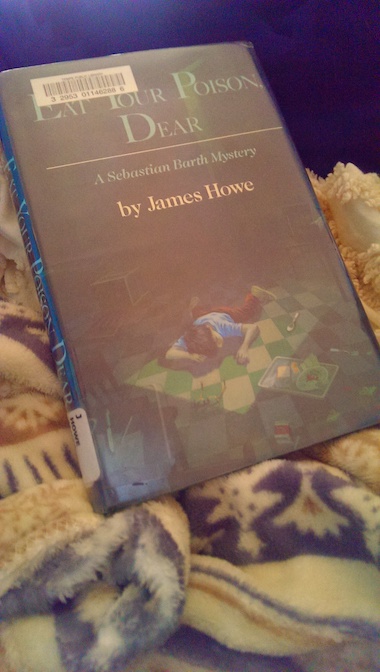
Eat Your Poison, Dear by James Howe, 1986.

Milo Groot is the editor of the school paper at Sebastian Barth’s school. Milo is something of a social outcast at school, but after he gets extremely ill eating in the school cafeteria, Sebastian and his friend David begin to wonder if there’s been some foul play. Although everyone thinks it’s just a bad case of the flu at first, it’s strange how Milo’s symptoms only come up after eating lunch at school.

Milo recently wrote an editorial for the school paper, criticizing a group of boys at school who have adopted kind of a “greaser” look, wearing leather jackets, smoking cigarettes, wearing temporary tattoos (so badass), and calling each other by biker-style nicknames. The biker boys, who like to call themselves the Devil Riders (they don’t actually have motorcycles, but they like to stand around and look at pictures of them a lot), have been kind of mean to other kids, even former friends, but the school’s principal says that there’s no school rule against simply wearing leather jackets, so there’s nothing he can do about their biker persona. Milo starts up a petition against them, though, trying to get the principal to crack down on their little group. Could one of them be behind Milo’s poisoning?

Then, suddenly, two more kids at school get sick in the same way. The school cafeteria has always gotten good health ratings, leading Sebastian to think that whatever is harming people at school must be deliberate. Soon, whatever is harming the students affects a large part of the student body, with seventy-seven students all getting sick on the same day. But, still, who is doing it and what is their motive?

The book is currently available online through Internet Archive.

My Reaction and Spoilers

The story gets somewhat philosophical about the nature of hurt and why people hurt each other. Sebastian asks his friend Corrie’s father, Reverend Wingate, for his opinion about why people hurt others. Sebastian’s grandmother thinks that people hurt others because of some hurt that they have themselves. This is part of the reason why the Devil Riders act the way they do. It is revealed that the leader of the little gang, Harley (not his real name, that’s his “biker” nickname) has a very unhappy home life that he often lies about to others. Acting tough with his friends and pushing other people around is his way of dealing with it. One thing that Reverend Wingate notes is that “There is no way for people to stop hurting one another except to stop.” He relates it to the arms race of the Cold War (contemporary with when the story was written), saying:

“If we justify building up our own arsenals because they have more weapons, then we only heap one folly on top of another. There comes a time when we must say, ‘Enough! I don’t have to have more toys than you. I don’t need the last word. I will turn the other cheek.’”

In other words, some battles aren’t worth fighting because the cost is too high, higher than the gains of victory, and in those cases, it’s better just to move on. In a way, both Sebastian’s grandmother and Reverend Wingate are correct; the villain that they’re looking for is someone who’s been harboring hurt for a long time and hasn’t yet realized the cost of getting revenge.

I found it interesting when Harley (who is not the villain, even though he is the primary suspect for a time) tells Sebastian that a person who is less popular than others is at a disadvantage when they do something wrong. Harley says that his social worker tells him, “. . . everybody makes mistakes. She says, you make a mistake on the blackboard, what do you do? You erase it and try again. I say to her, sometimes somebody writes on the blackboard with a magic marker, just to be mean, and everybody sees it and nobody can erase it away. It’s always there, and always will be the rest of your life.”

Popularity can make other people more willing to forgive a wider range of behavior, however I think that the situation that Harley describes is less a matter of popularity and more of method and intent. When someone does something “just to be mean,” it’s always going to leave a mark, at least emotionally, and “magic marker” isn’t meant to be erased, so it’s a bad choice for someone airing only temporary feelings.  If he had chosen chalk, then yeah, whatever mean or rude thing he wrote would have been erased and forgotten, but Harley didn’t do that, and that’s his own fault. If his aim was to hurt people, he can’t legitimately complain that people got hurt because all that happened was that he succeeded in what he deliberately set out to do. He also can’t legitimately complain about lasting consequences when he deliberately chose a lasting form of inflicting that hurt.  Some people just have poor priorities and bad strategy, and that’s what gets them into trouble.  Harley is still blaming other people for his own bad choices, and he’s going to continue having problems until he realizes that he, and he alone, is the one responsible for the thing he does and only he can change what he decides to do.

That being said, some things that are apparently permanent aren’t really, if you know how to clean up after yourself and have the will to do it.  You can even get permanent marker off of a chalkboard, if you have some rubbing alcohol.  People have figured out how to do that because there are times when they’ve had the need to do it, and they tried ways to fix the situation until they found what worked.  Life is like that.  You can gripe about things being wrong and unfixable, or you can try ways of fixing things before you decide that they’re impossible to fix.  People also appreciate people who make an effort.  Harley needs to learn both how to behave himself in the first place and how to clean up after himself in the second.  He could use a practical adult who understands how to fix things, and he needs to develop the mindfulness to keep himself from creating more problems to solve.

Before the story is over, Sebastian himself makes a big mistake, accusing the wrong person because he made a false confession. However, Sebastian is willing to face up to the apologies that he will owe others after he learns the truth, realizing that a false accusation was part of what the real villain was hoping for. Anger is also a kind of poison. Truth can hurt at first, but unlike poison, it can make things better.

Nate the Great and the Halloween Hunt

NateHalloweenHunt

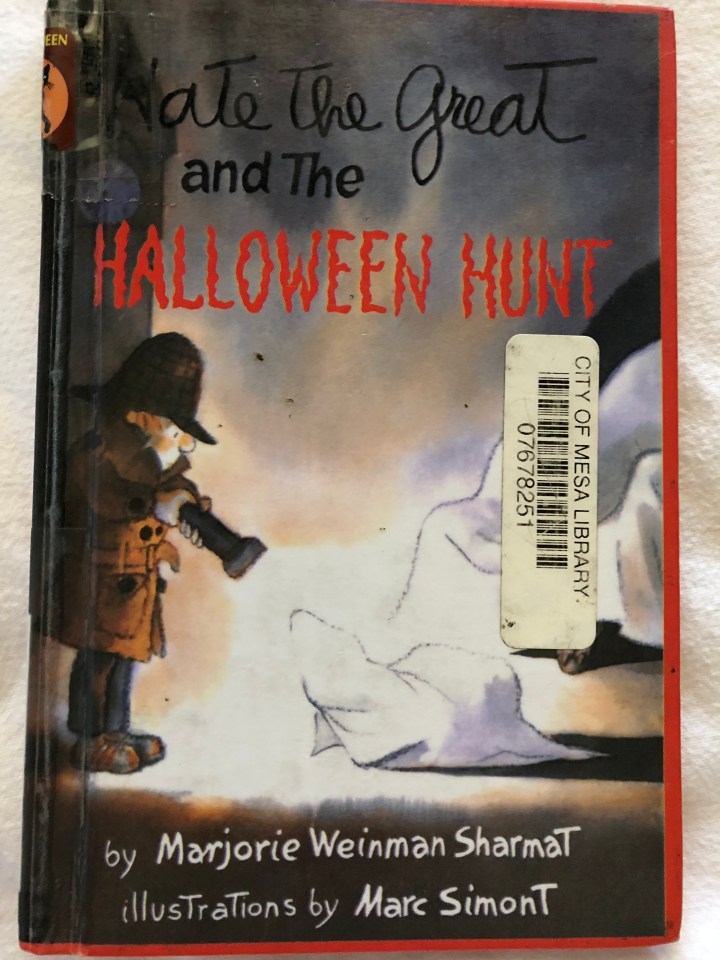
Nate the Great and the Halloween Hunt by Marjorie Weinman Sharmat, 1989.

Nate the Great gets a Halloween case when Rosamond asks him to help her find one of her cats.  Rosamond and Annie show up at Nate’s house, trick-or-treating.  They’re both dressed as Little Red Riding Hood, and Annie’s dog, Fang, is the wolf/grandmother.

Rosamond has several cats, all named “Hex”: Big Hex, Plain Hex, Super Hex, etc.  But, she’s worried because she can’t find Little Hex.  Every Halloween, her other cats like to go to an old house in the neighborhood that is supposedly haunted in order to help haunt it, but Little Hex is afraid on Halloween and apparently hid somewhere.  Nate thinks that Little Hex will probably come out as soon as Halloween is over, but Rosamond is so worried that he agrees to look for Little Hex anyway.

NateHalloweenHuntTrickOrTreat

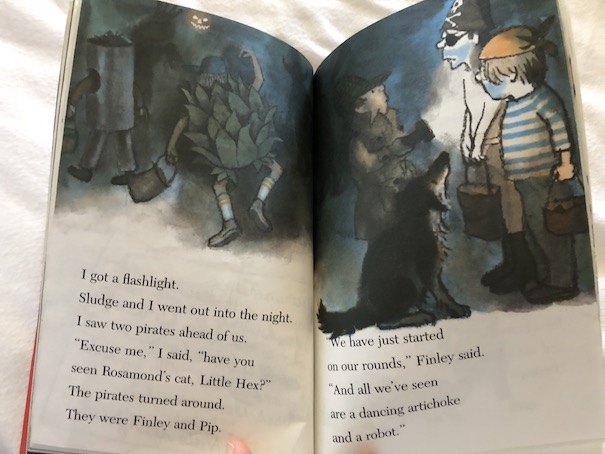
Nate interviews kids in the neighborhood to see if they’ve seen Little Hex, but they haven’t.  Then, he and his dog, Sludge, go to the haunted house to look around.  He sees Rosamond’s other cats, but not Little Hex.  There’s a scary moment when he realizes that he’s locked in the house, but Sludge helps him to escape.

Little Hex isn’t as far away or lost as Rosamond thinks, and Nate realizes that both Sludge and Rosamond herself have given him the clues he needs to solve the mystery.  Sludge demonstrates what an animal might do when it’s frightened, and Nate suddenly realizes why Rosamund’s treat basket was so much heavier than Annie’s even though they had been to the same houses.

The book is available to borrow and read for free online through Internet Archive.

Aunt Eater’s Mystery Halloween

AuntEatersHalloween

Aunt Eater’s Mystery Halloween by Doug Cushman, 1998.

This is a cute Halloween book for kids.  There are actually four short mystery stories in the book as Aunt Eater, dressed as Sherlock Holmes, goes to a Halloween party and encounters various spooky happenings.

Aunt Eater Sees a Monster

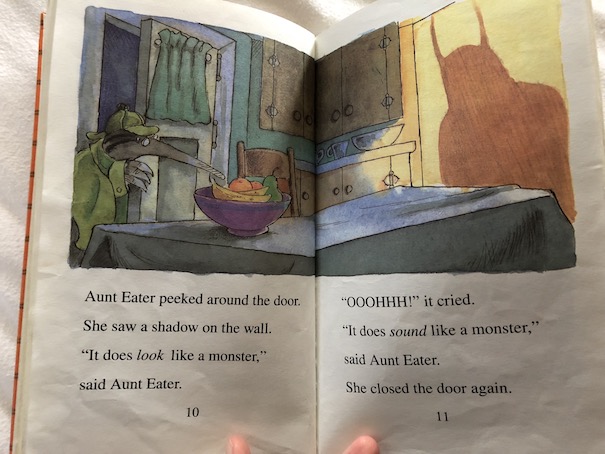
While she’s on her way to the Halloween party, Wally stops Aunt Eater and says that there’s a monster in his kitchen and that it ate his father.  When Aunt Eater takes a look, she sees a scary shadow in the kitchen and hears a terrible groan.  Is it really a monster?

AuntEatersHalloweenKitchenMonster

Aunt Eater Sees a Ghost

Aunt Eater continues walking to the party with Mr. Chumly, who is dressed as a turnip.  Mr. Chumly points out a hollow tree that they pass and tells her that it’s supposed to be haunted by a headless ghost.  Aunt Eater doesn’t believe in ghost, but then a scary jack o’lantern appears, moving by itself, and it’s followed by a ghost with no head!  Fortunately, there is a logical explanation.

AuntEatersHalloweenHeadlessGhost.JPG

Aunt Eater Hears Some Music

Aunt Eater is glad to see all of her friends at the party.  Miss Underbelly has brought her pet snake with her.  Later, the piano suddenly starts playing strange music without anyone sitting at it, and the snake has disappeared!  What do you suppose is happening?

AuntEatersHalloweenPiano

Aunt Eater Dances a Jig

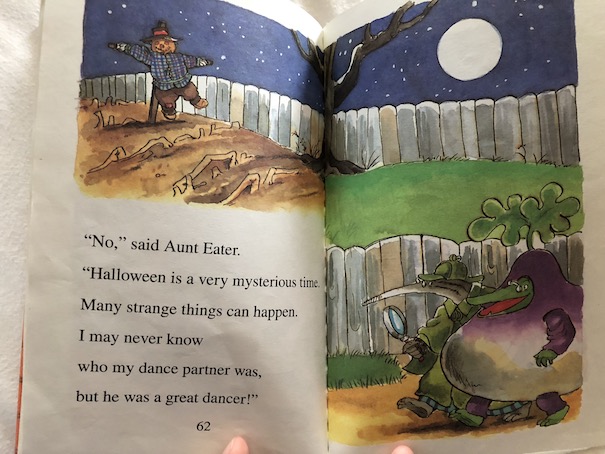
Mr. Fragg, a friend of Aunt Eater’s, is wearing a scarecrow costume, and he tells Aunt Eater that he’d like to dance with her later in the evening.  She does dance with a scarecrow, but then learns that it wasn’t Mr. Fragg because Mr. Fragg hurt his foot.  Who was that mysterious scarecrow?  Aunt Eater never figures it out, but readers do.

AuntEatersHalloweenScarecrow

The book is currently available online through Internet Archive.

The Traitor’s Gate

TraitorsGate

The Traitor’s Gate by Avi, 2007.

The story is set in London, in 1849. Fourteen-year-old John Huffam lives with his parents and sister and their servant, Brigit and attends a school taught by a former military man who acts like he is still in the army and teaches them little beyond discipline and what army life would be like.

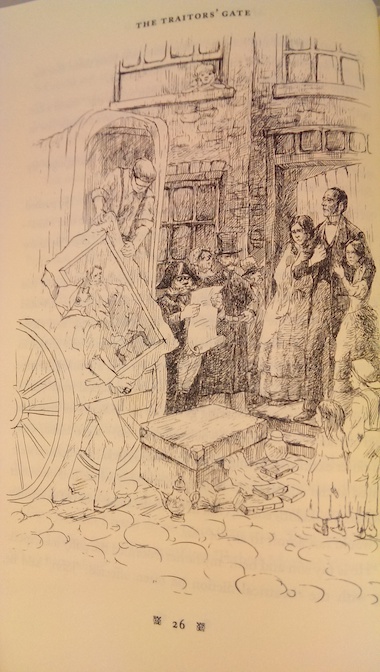
Then, one day, John is called home suddenly because of a family emergency. His family has fallen on hard times, and his father is in debt, so the family’s belongings are being confiscated. His father is summoned to appear in court, and if he cannot find the money to pay his debt, he will have to go to debtors’ prison. John’s father is shocked because he doesn’t actually owe any money to the man who is trying to call in the debt, Finnegan O’Doul.

TraitorsGateConfiscation

In spite of this, John and the rest of the Huffam family must spend the night in the bailiff’s sponging house, the Halfmoon Inn. There, John’s father again promises John that there is no debt between himself and Mr. O’Doul. He even says that he doesn’t really know O’Doul, although John doubts him. It seems like his father has had dealings of some kind with the man that he wants to keep secret.

John’s father, Wesley Huffam, was originally from a fairly well-off family, but all the family’s money ended up going to a great-aunt instead of to him (possibly because it became obvious to his relatives that he had little skill at handling money in the first place). John’s father is resentful toward the great-aunt, Euphemia Huffam, for inheriting when he thinks that, as a man, he should have been first in line for the family’s money. However, with this enormous (although possibly false) debt hanging over his head, he may be forced to appeal to Great-Aunt Euphemia for help. He persuades John to go and visit Great-Aunt Euphemia on his behalf, since he is not allowed to leave the sponging house for now and the past quarrels between him and his aunt would make it unlikely that his aunt would want to see him. John is beginning to realize that there are pieces of his father’s life and their family’s past that have been kept from him, and he doesn’t like the idea that his father has been deceiving him, but with their family in such a desperate situation, he agrees to visit Great-Aunt Euphemia.

TraitorsGateSary

The bailiff, John’s mother, and Brigid all agree that John is going to have to be instrumental in solving their family’s problems. Of all the people in his family, he is the most practical, in spite of his young age. His father is an impractical man, stuck in a vision of his family’s former glory (and his aunt’s current money, which he does not share in) that doesn’t fit their current circumstances. John’s mother thinks that her husband’s job as a clerk for the Naval Ordinance Office doesn’t provide enough money for the family to live on, even though he earns more than twice what typical London tradesmen of the time do. The real problem is that the family doesn’t live within its means (it is eventually revealed that Wesley Huffam has been withholding money from his family that he uses for gambling), and John’s father’s snobbish attitude because he thinks of his family as being more grand than the commoners around them alienates people who might otherwise be friends and help them. John knows that he’s young, and he’s not completely sure what he can do to help his family, but he knows that there is no other option but to try. In the process, he learns quite a lot about life, himself, the people in his family, and the wider issues in the world around him, including some political intrigue that hits uncomfortably close to home.

Great-Aunt Euphemia agrees to see John when he comes to her house, but their first meeting doesn’t go very well. Great-Aunt Euphemia is ill (or says she is), and she bluntly tells John that his father was always bad with money. She is not at all surprised that he is in debt and needs her help. John gets upset at the bad things that Euphemia tells him about his father, and she gets angry when John tells her the amount of the debt. At first, John is sure that she will refuse to help them completely, but Euphemia tells him not to assume anything but that he should come back the next day.  Her eventual contribution to helping John’s family in their troubles comes in the form of a job for John.

TraitorsGateRookery

As John moves around the city, he gets the feeling that he is being followed, and he is. One of the people following him turns out to be Inspector Copperfield (or so he calls himself) from Scotland Yard. When John confronts him, the inspector seems to have a pretty good idea of the difficulty that his family is in and what John himself has been doing. John asks him why he cares, and the inspector says that John’s father is suspected of a crime and that John had better learn more about what his father has been doing and share that information with him. John doesn’t believe that his father could be a criminal, but the accusation is worrying because he knows that his father is hiding something (his gambling addiction isn’t the only secret he has).

The other person following John is a young girl in ragged clothes. The girl, who calls herself Sary the Sneak, approaches John herself, freely admitting that she’s been following him. In spite of her young age, Sarah (or Sary, as she is frequently called) lives on her own and must support herself because her mother is dead and her father was transported to Australia. People don’t often notice a young girl on the street, so sometimes people will pay her to follow someone and provide information about them. The reason why she tells John about it is because she isn’t above playing both sides of the street; sometimes, she gets the people she’s been following to pay her to provide them with information about the people who hired her to spy on them. She considers it even-handed. However, John has no money to pay her for information and finds her spying distasteful, so he doesn’t want to take her up on the offer at first.

However, John does a little spying of his own when his father sneaks away from the Halfmoon Inn, which he is not supposed to do. He follows his father to a pub called the Red Lion, where he witnesses his father gambling with money that he had claimed not to have. More than that, he sees his father arguing with a man who turns out to be O’Doul, another gambler. To John’s surprise, his teacher also shows up and seems to know O’Doul. When John later confronts his father with what he saw at the Red Lion, all his father will say is that he is carrying a fortune around in his head. Later, John overhears the bailiff speaking with someone else, an Inspector Ratchet from Scotland, saying that it appears that Wesley Huffam may be a traitor involved with spies and that the Inspector Copperfield who spoke to John earlier was an imposter, probably also a spy.

Could it be true? Is John’s father really a traitor, selling naval secrets from his job? If so, who can John trust?  Conspirators seem to be around every corner, and John has the feeling that the people who are closest to him may be the biggest threats.

The book is currently available online through Internet Archive.

A Samurai Never Fears Death

SamuraiNeverFearsDeath

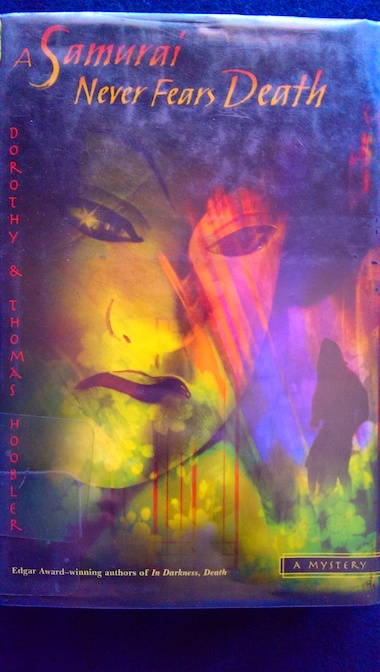
A Samurai Never Fears Death by Dorothy and Thomas Hoobler, 2007.

This book is part of the The Samurai Detective Series.

Sixteen-year-old Seikei returns home to visit his birth family in Osaka while Judge Ooka investigates reports of smugglers in the city.  Seikei is a little nervous about seeing his birth family because he hasn’t gone to see them since he was adopted by Judge Ooka about two years before.  All he knows is that his younger brother, Denzaburo, is helping his father to run the family’s tea business, which is probably a relief to Seikei’s father because Denzaburo was always more interested in the business than Seikei was.

However, things have changed in Seikei’s family since he left Osaka, and his homecoming isn’t quite what he imagined it would be.  Seikei had expected that his older sister, Asako, might be married by now, but she says that Denzaburo is keeping her from her dowry because he needs her to help run the family business.  Although Denzaburo enjoys business and the life of a merchant, it turns out that Asako has a better mind for it than he has.  The two of them have been running the family’s tea shop by themselves because their father is ill.  Also, although the family no longer lives above their shop, having bought a new house for themselves, Denzaburo says that he sometimes stays at the shop overnight to receive deliveries of goods.  Seikei knows that can’t be true because no one ever delivers goods at night in Osaka.  Denzaburo brushes off Seikei’s questions by suggesting that the three of them visit the puppet theater together to celebrate Seikei’s visit.

At the puppet theater, Seikei learns that Asako is in love with a young man who is an apprentice there, Ojoji.  Because Ojoji is only an apprentice, the two of them cannot afford to get married, something that Denzaburo laughs about.  However, before Seikei can give the matter more thought, they discover that one of the narrators of the plays has been murdered, strangled.

They summon an official from Osaka to investigate the scene, Judge Izumo, but Seikei isn’t satisfied with his investigation because it seems like Judge Izumo is quick to jump to conclusions.  Then, suspicion falls on Ojoji.  Asako doesn’t believe that the man she loves could commit murder and wants Seikei to ask Judge Ooka to intercede on Ojoji’s behalf, so Seikei begins to search for evidence that will help to prove Ojoji’s innocence.

The mysterious happenings and murders (there is another death before the book is over) at the puppet theater are connected to the smuggling case that Judge Ooka is investigating, and for Seikei, part of the solution hits uncomfortably close to home.  However, I’d like to assure readers that Asako and her beloved get a happy ending.

During part of the story, Seikei struggles to understand how the villains, a group of bandits, seem to get so much support and admiration from other people in the community, including his brother.  It is Asako who explains it to him.  It’s partly about profit because the outlaws’ activities benefit others monetarily, but that’s only part of it.  In Japan’s society, birth typically determines people’s roles in life, and each role in society comes with its own expectations about behavior, as Seikei himself well knows.  Seikei is fortunate that circumstances allowed him to choose a different path when he didn’t feel comfortable in the role that his birth seemed to choose for him; he never really wanted to be a merchant in spite of being born into a merchant family.  Others similarly do not feel completely comfortable with the standards that society has set for them, and their fascination with the outlaws is that the outlaws do not seem to care what society or anyone else thinks of them.  The outlaws do exactly what they want, when they want to do it, dressing any way they please, acting any way they please, and taking anything they want to use for their own profit.  Denzaburo, who was always willing to cut corners when it profited him, sees nothing wrong with this, and he envies the outlaws for taking this idea to greater lengths that he would ever dare to do himself.

The idea of throwing off all rules and living in complete freedom without having to consider anyone else, their ideas, their wants, their needs, can be appealing.  Asako understands because, although she is better at business than either of her younger brothers, she cannot inherit the family’s tea business because she is a girl.  She thinks that, because the system of society doesn’t look out for her interests, she has to look out for herself, and what does no harm and makes people happy (in the sense of giving them lots of money) shouldn’t be illegal.  At first, Asako sees their activities as victimless crimes. Although she doesn’t use that term to describe it, it seems to be her attitude.  However, do victimless crimes really exist?  Seikei has a problem with this attitude because what the outlaws are doing has already caused harm in form of two deaths and the risk to Ojoji, who may take the blame for the deaths even though he is innocent.  Asako might not care very much about the others at the puppet theater, but she does care about Ojoji.

It’s true that Seikei has defied the usual rules of society by becoming something other than what he was intended to be, and for a time, he struggles with the idea, comparing himself to the outlaws, who were also unhappy with their roles and wanted something different.  However, the means that Seikei used to get what he wanted in life are different from the means that the outlaws use, and Seikei also realizes that his aspirations are very different from theirs.  While Seikei had always admired the samurai for their ideals and sense of honor and order, the outlaws throw off the ideals of their society in the name of doing whatever they want.  Although the outlaws do benefit some of the poorer members of society, paying money for goods that the makers might otherwise have to give to the upper classes as taxes and tribute and trying to stand up for abused children when they can because their leader was also abused as a child, their main focus is still on themselves and what they and their well-paying friends want.  Seikei is concerned with justice and truth, which are among his highest ideals.  Even though he learns early on that, as a samurai, he could claim responsibility for the deaths at the theater himself because, in their society, a samurai would have the legal authority to kill someone for an insult.  Claiming responsibility for the killings would allow Ojoji to go free, and it would be one way to solve the problem quickly and make Asako happy, but Seikei cares too much about finding the truth behind the murders and bringing the real murderer to justice to take the easy way out.  It is this difference in ideals and priorities between Seikei and others around him which set them on different paths in life.

One thought that seemed particularly poignant to me in the story is when Seikei reflects that we don’t always understand the importance of the choices we make in life at the time when we have to make them because we don’t fully understand all the ways in which a single choice can affect our lives.  He thinks this when the leader of the outlaws offers to let a boy who was abused come with them and join their group after they intervene in a beating that the boy’s father was giving him.  They tell him that joining their group would mean that he could do whatever he wants from now on.  The boy, not being sure who they are or what joining their group would really mean for him, chooses to stay with his father.  Seikei wonders then whether the boy will later regret his decision or not.  His father obviously doesn’t treat him well and may not truly appreciate his show of loyalty by remaining, although joining the outlaws comes with its own risks.  It’s difficult to say exactly which two fates the boy was really choosing between in the long run and which would be likely to give him a longer, happier life, which is probably why the boy chose to stick with what he already knew.

There is quite a lot in this story that can cause debates about the nature of law and order, society’s expectations, and the effects of crime on society and innocent bystanders.  I also found Seikei’s thoughts about what makes different people choose different paths in life fascinating.  I’ve often thought that what choices a person makes in life  are determined about half and half between a person’s basic nature and the circumstances in which people find themselves, but how much you think that or whether you give more weight to a person’s character vs. a person’s circumstances may also make a difference.

The story also explains what fugu is, and there is kind of a side plot in which Judge Ooka wants to try some.  A lot of the characters think that the risk involved in eating the stuff isn’t worth it, but well, a samurai never fears death, right?

There is a section in the back with historical information, explaining more about 18th century Japan and the style of puppet theaters called ningyo joruri, where unlike with marionettes or hand puppets, the puppeteers are on stage with the puppets themselves, wearing black garments with hoods so that the audience will disregard their presence (except for very well-known puppeteers, who might reveal their faces).  For another book that also involves this style of puppetry, see The Master Puppeteer.

In Darkness, Death

InDarknessDeath

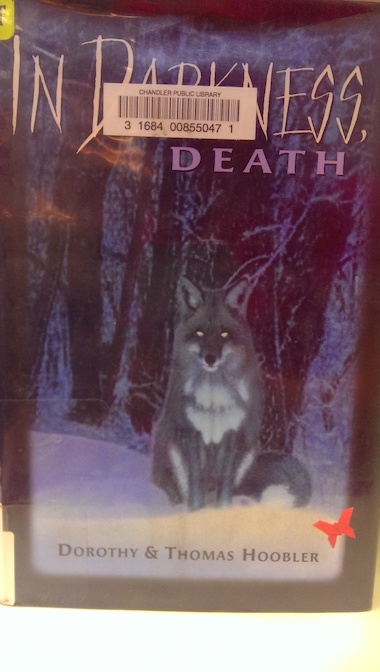
In Darkness, Death by Dorothy and Thomas Hoobler, 2004.

This book is part of The Samurai Detective Series.

One night, after a party, Lord Inaba is killed in his room by a mysterious intruder. The only clue to the intruder’s identity is a red origami butterfly left at the scene. Lord Inaba’s death is an embarrassment to the shogun because Lord Inaba was in Edo under his protection.

It doesn’t take Judge Ooka long to decide that the murderer was a ninja. Ninjas are hired assassins known for their stealth and great skill with weapons. The butterfly left at the scene was to purify the spirit of the dead man and keep it from coming after his killer.

However, Judge Ooka says that it is not enough to know that that the murderer was a ninja; what they have to find out is who hired the ninja. He assigns Seikei the task of finding the source of the butterfly and learning who Lord Inaba’s enemies were. Judge Ooka finds a ninja he knows, Tatsuno, and convinces him to accompany Seikei on a journey through Lord Inaba’s territory and to teach him what ninjas are like. Although Seikei is not sure that he trusts Tatsuno, he learns to be grateful to him for his help and for saving him from the real danger, which comes from a surprising source.

While many children’s movies glorify the ninja, in real life, they were mercenaries, assassins for hire.  They used clever tricks in order to gain access to their victims and to get away without being caught, which ended up giving rise to a number of legends about them, attributing an almost supernatural quality to their skills.  While searching for the assassin and the person who hired him, Seikei learns a number of the tricks that ninjas used and the security measures that people would take to try to guard against them, such as nightingale floors (here is a video of a nightingale floor in a Japanese castle and another where you can hear the floor even better).

The book is currently available online through Internet Archive.

The Haunting of Cabin 13

Cabin13The Haunting of Cabin 13 by Kristi D. Holl, 1987.
Thirteen-year-old Laurie is looking forward to her family’s vacation. They’ve rented a cabin for a week, Cabin 13, by the lake at Backbone State Park (It’s a real state park in Iowa. Link repaired 10-19-22.), and her friend Jenny is staying there with them. Laurie’s mother isn’t looking forward to the trip. She hates dirt and bugs and doesn’t like the cabin when they arrive. As everyone starts unpacking, Laurie looks around the cabin and finds a note that warns them to leave because the cabin is haunted. Supposedly, it was written by the ghost herself. The note is signed “Eleanor.” Laurie’s mother thinks that they should leave right away, but Laurie and the rest of the family persuade her that it’s just a joke. At first, Laurie’s sure that’s all it is.

Then, the park ranger tells the family that the other families who have tried to stay in that cabin this summer also found similar notes. It might be just a prank, but it might not. He also tells them that a girl named Eleanor, the same age as Laurie and Jenny, drowned there the summer before, and strange things have been seen there since, like lights around the lake. Laurie’s brother, Ricky, thinks it sounds cool that they’re staying in a haunted cabin by a haunted lake. Like others, Laurie thinks that the notes are the product of a prankster, but what would be the point behind it?

The girls meet a pair of brothers who are staying nearby, Kevin and Matt. When they tell them about the note, Matt is eager to investigate. Jenny enjoys flirting with boys, and she’s mostly interested in flirting with good-looking, athletic Kevin. Matt is in a wheelchair, so Jenny doesn’t pay much attention to him. She just makes an awkward comment about cripples being able to contribute to society that makes everyone feel uncomfortable. Although Laurie knows that Jenny’s comment was inappropriately personal and callous, Laurie also underrates Matt’s ability to help with their note mystery at first, and she’s shy about talking to him because she’s often shy around boys. However, needing someone to confide her thoughts in when Jenny isn’t interested, Laurie talks to Matt about her theories about the mysterious notes. Matt turns out to be easy to talk to, helping Laurie get over her nervousness about talking to boys.

At first, Laurie tells Matt that she thinks that the prankster is trying to drive people away from Cabin 13 because something important is hidden there. However, as she starts asking questions about Eleanor, she learns that the notes haven’t just been directed at Cabin 13. Staff at the park have also received notes from “Eleanor.” Laurie also sees a figure in black sneaking around the park, who she is sure is not a ghost.

It isn’t long before Laurie receives more notes from “Eleanor,” hinting that she might be in danger, and she and Jenny see the mysterious lights that people have been talking about. Then, when the children are out in a canoe together, it develops a leak and sinks. Matt panics because his legs are paralyzed, and he can’t swim, but Laurie saves him with the help of some people in another boat.

Was that accident just an accident, or could it have something to do with Eleanor’s “accident” last year? There are plenty of suspects who might have reasons for playing ghost and stirring up trouble at the lake. Matt’s father blames the park ranger for the accident that paralyzed Matt. At a previous visit to the lake, Matt was crossing a road with his father and brother and was struck by a speeding car. Matt father says it wouldn’t have happened if the roads had been policed properly. Laurie realizes that he might have a motive for revenge. Then again, some people have been coming to the lake, drawn by the ghost stories and hoping to see the mysterious lights. Could the ghost be a publicity stunt to drum up business?

The book is available to borrow and read for free online through Internet Archive.

My Reaction and Spoilers

When Laurie discovers that Eleanor’s half sister has come to the lake to investigate Eleanor’s death herself, she thinks that she has the mystery solved, but she’s only half right. It’s true that Eleanor’s sister has been responsible for some of the things happening at the lake, but not all of them.  She explains to the kids that Eleanor loved mystery stories and was always playing detective games, but she thinks that perhaps the game got too real for Eleanor the summer that she died.  There is something sinister going on at the lake, something that Eleanor also realized before her death, and there is more to Eleanor’s death than most people know.

At the end of the book, Matt gets a chance to be a hero and stop the bad guy from escaping, using his wheelchair to his advantage because a person on wheels can sometimes move faster than a person on foot.  Even before that, Laurie had gained an appreciation for Matt and his sensible thinking, realizing that a person who is impaired in one way can still have great abilities in other areas of life.  She also comes to think of Matt as being brave for coming back to the site of the accident that made him a paraplegic.  Matt says that he had to come in order to prove to himself that there was nothing inherently bad about the  place and to stop the nightmares he was having about his accident.  Matt and Eleanor’s sister both make Laurie realize that everyone has something difficult or frightening that they have to deal with in their lives; it’s just that some people’s problems are more obvious than others.  Everyone can see what Matt’s dealing with at first glance because he’s in a wheelchair, but no one knew about the pain and fear that Eleanor’s sister was carrying around with her until she admitted it.

I consider this story a pseudo-ghost story because the obvious parts of the haunting were caused by living people, for reasons of their own.  However, Laurie seems to feel that Eleanor’s spirit was there with them, waiting to see the mystery of her death solved.  It’s left open to interpretation, but if Eleanor was there, it was only seen in the odd feelings that Laurie had from time to time, not in any more obvious or physical way.

Something that confused me a little in the book is that, at one point, Jenny tells someone that Laurie already has a reputation for being an amateur detective, having discovered that Jenny herself had been kidnapped when the authorities thought that she had run away from home. Jenny gives full details of the time when she was kidnapped, including who kidnapped her and why and how Laurie figured out where she was. When I read that section of the story, I thought at first that the author was talking about a previous book that she had written with these two characters, but I had trouble figuring out which it was, if any.

Interesting fact: some of the children in the story are named after the author’s own children.

Ginnie and the Mystery Doll

GinnieMysteryDoll

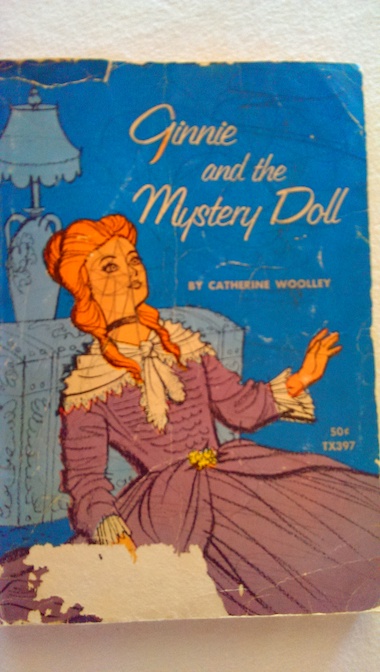
Ginnie and the Mystery Doll by Catherine Woolley, 1960.

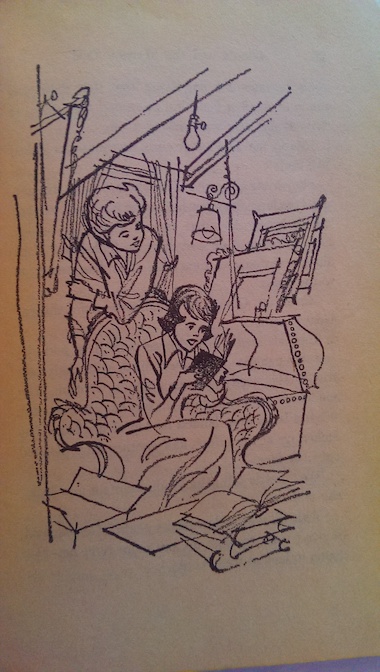
Ginnie and Geneva’s families have rented a house on Cape Cod for the summer, so they’ll be sharing their vacation at the beach. Their next door neighbor at Cape Cod is Miss Wade, a nice older lady. Miss Wade’s house is very old-fashioned, and when the girls make friends with her, she shows it to them, allowing them to see some of the neat old things in her attic on a rainy day. The girls have fun trying on the old clothes in the attic, and then they find an old diary belonging to Miss Wade’s mother when she was a girl. In the diary, the girl talks about the special doll that her uncle gave her, which has a “precious jewel.”

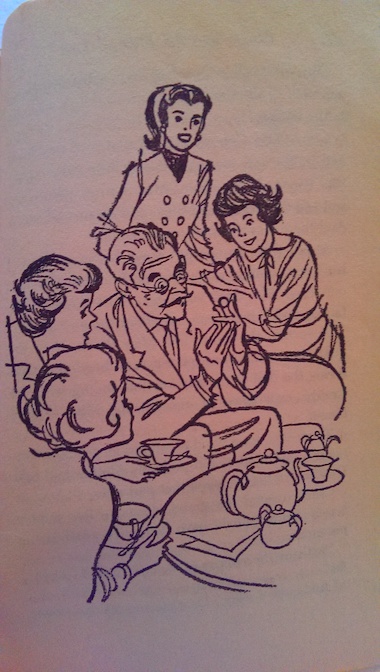
GinnieMysteryDollDiaryAtticThe girls ask Miss Wade about the doll, and she says that she knows the one they mean, but she no longer has it. Her mother’s uncle was the captain of a ship and used to bring her presents from around the world. The doll, called Lady Vanderbilt, was very fancy, and Miss Wade describers her costume to the girls. However, she says that the doll disappeared after she rented her house out to a family one summer while she was traveling. She never found out what happened to the doll, but she assumed that the children of the family probably found her and either took her or broke her. Miss Wade said that she didn’t think that the doll was worth making a fuss about, so she never asked the family about it. The girls note that Miss Wade doesn’t seem to know anything about a precious jewel in the doll, but they decide not to say anything about it since Miss Wade doesn’t have the doll anymore.
The girls decide to concentrate on enjoying their summer vacation, picking beach plums and digging clams with Miss Wade on the beach. Then, when they go to see a local auction, they spot a doll that looks exactly like the Lady Vanderbilt that Miss Wade described! The girls try to bid on the doll at the auction, but someone else buys her instead, and that lady leaves the auction before the girls can talk to her.

GinnieMysteryDollJewelThe girls tell Miss Wade and their mothers about the doll, but when they try to ask the people in charge of the auction where the doll came from and who bought her, they learn that the woman who was in charge of organizing the toys has already left on vacation. The only clue that the girls have is that the woman who bought the doll left the auction in a red Jaguar.
The girls make it their mission to track down the doll and its buyer, asking questions all over town about who might own a red Jaguar. Then, at an art exhibit at the Historical Society, they make a surprising discovery: a painting of the very doll that they’re looking for!

But, just when they figure out who has the doll and where she is, she disappears again when the red Jaguar is stolen with Lady Vanderbilt inside! Was it just an accident that the doll was stolen along with the car, or does someone else know that Lady Vanderbilt might be hiding a valuable secret?

The book is currently available online through Internet Archive.

Coffin on a Case

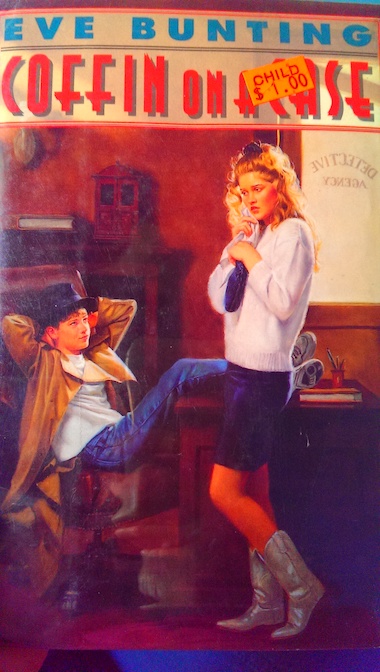
CoffinCaseCoffin on a Case by Eve Bunting, 1992.

Twelve-year-old Henry Coffin’s father is a private investigator, and Henry hopes to be one himself someday.  He’s learned a lot by watching his father in action.  One day, a sixteen-year-old girl, Lily, comes to the office and asks for help in finding her missing mother.  Lily found her mother’s car in their driveway with groceries still in it, and her mother is nowhere to be found.  She doesn’t want to go to the police because she once called the police about her mother being missing only to discover that there was a mix-up and that her mother had tried to leave her a note that she hadn’t seen.  Lily has double-checked this time to make sure that there was definitely no note from her mother and none of her mother’s friends have heard from her, but she worries that the police would think that she’s being paranoid, so she decided to consult a private investigator instead.

Henry’s father is concerned about the disappearance of Lily’s mother, but he’s unable to take the case because he has to go out of town.  He tries to refer Lily to another investigator or a friend of his who is with the police, but Lily just storms out of the office.  Henry wishes that he could take the case for his father.  His own mother abandoned him and his father when Henry was just a baby, so disappearing mothers are of great concern to him.  Later, when Lily gets in touch with him, Henry agrees to help her without telling either his father or Mrs. Sypes, the housekeeper who has looked after him since his mother left.

At first, there doesn’t seem to be much to go on.  Lily’s mother makes wooden storks that she sells as lawn decorations to people who have recently had a baby.  She was going to sell a couple before going to pick up the groceries, but Lily says that there is an extra one missing.  Somewhere between the grocery store and home, Lily’s mother made an unexpected stop . . . and there are signs that someone other than Lily’s mother drove the car to Lily’s house.  But, who was it, and what happened to Lily’s mother?

The answers to these puzzles put Henry on the trail of some dangerous thieves who would do just about anything to cover up their crime.

The book is available to borrow and read for free online through Internet Archive (multiple copies).

My Reaction

Henry shows excellent deductive reasoning as he analyzes the clues and reconstructs Lily’s mother’s trail to learn what happened to her. Both Henry and his father are inspired by the fictional character, Sam Spade, and Henry makes frequent references to him in the story, thinking what Sam Spade would say or do in certain situations.

Throughout the book, Henry also considers his own mother’s disappearance years ago.  Her abandonment of her family was her own choice, not an abduction, which makes her situation different from what happened to Lily’s mother.  Henry has no real memory of his mother, which pains him somewhat.  He sometimes dreams that she’ll return home one day for a happy ending, like in the movies, but he also realizes that’s really just a daydream.  When Lily’s mother is finally rescued, Henry and Lily continue being friends, and Henry also considers whether a relationship would be possible between his father and Lily’s mother.  It’s a nice idea, but Henry also thinks that isn’t likely, and he’s okay with that.