The Mysteries of Harris Burdick

HarrisBurdick

The Mysteries of Harris Burdick by Chris Van Allsburg, 1984.

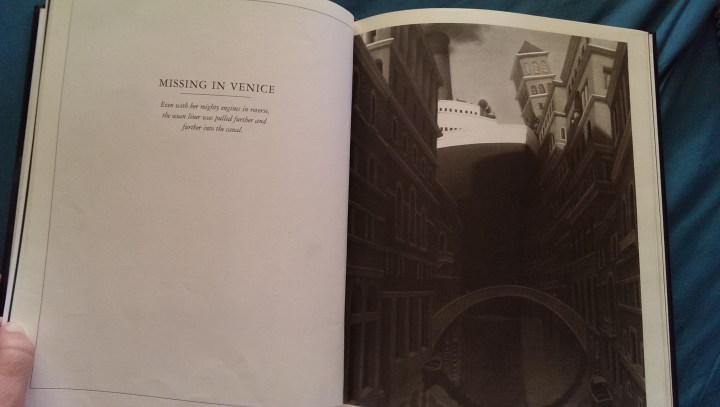
Harris Burdick isn’t exactly a mystery story, not even really a story exactly, but it is mysterious.  Most of the book is pictures, and that’s kind of the point.  The premise of the book is that a mysterious stranger known only as Harris Burdick approached a publisher about some stories that he had written and illustrated.  As examples of his work, he gave the publisher a collection of illustrations he had done for each of his stories with accompanying captions.  The publisher loved the illustrations, but Harris Burdick didn’t keep his appointment to bring in the complete stories the next day.  When the publisher tried to contact him about the stories, he was never able to find Harris Burdick and never heard from him again.  However, the publisher continued to be intrigued by the pictures and wondered what the stories were like, so his children and their friends wrote their own stories about them.  The pictures are therefore presented as a collection, and readers are invited to imagine the stories that they are part of.

HarrisBurdickAnotherPlace

I remember one of my teachers using this book as part of a writing exercise, having us each choose a picture and write the accompanying story as we imagined it.  Over the years, I’ve changed my mind about which picture is my favorite.

HarrisBurdickLibrary

I thought for awhile that “The House on Maple Street” could have inspired the author himself in writing Zathura, the sequel to his other book, Jumanji, although there is apparently no direct link between the two.

HarrisBurdickHouse

The book is currently available online through Internet Archive.  There is also a collection of stories called The Chronicles of Harris Burdick in which well-known authors present their own versions of each of the stories.

HarrisBurdickVenice

The Happy Valley Mystery

Trixie Belden

TBHappyValley

#9 The Happy Valley Mystery by Kathryn Kenny, 1962.

Trixie’s uncle, Andrew Belden, after hearing about the mysteries that the kids have solved, invites them all to spend a week on his sheep farm in Iowa. He won’t be there because he has to take a trip to Scotland, but the Gormans, who are taking care of the sheep, could use their help. Someone has been stealing sheep from the farm, and no one seems able to figure out who it is or how the sheep keep disappearing.

Although Andrew Belden mainly wants the kids to relax, have fun, and learn a little about taking care of sheep, Trixie just can’t resist the challenge to save her uncle’s sheep.  In this book, Trixie is teased a lot for her detective ambitions, and she embarrasses herself a couple of times by suspecting the wrong people. Part of the trouble comes from the fact that she doesn’t know the people in the area and who can legally be the area of her uncle’s farm.

There is a harrowing scene where Trixie and her friends are caught in a flood.  This book also develops the relationship between Jim and Trixie more.  For awhile, each of them is jealous because they think that the other likes someone else.  At the end, Jim gives Trixie a bracelet with his name on it as a sign that they are now boyfriend and girlfriend.

The book is currently available online through Internet Archive.

The Black Jacket Mystery

Trixie Belden

TBBlackJacket

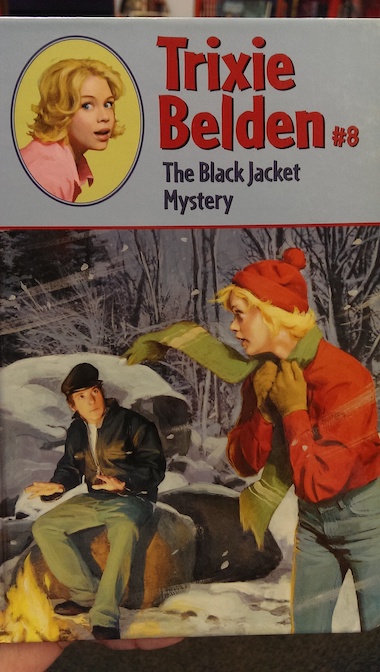
#8 The Black Jacket Mystery by Kathryn Kenny, 1961.

Trixie and the other Bob-Whites are concerned about their pen pals in Mexico because an earthquake has damaged their town. To help them rebuild their school library, the Bob-Whites decide to hold a benefit carnival to collect books.

While they are planning the carnival, Trixie becomes worried about Regan, who is in charge of Mr. Wheeler’s stable. She overhears him speaking to her mother about a problem, asking her advice, but saying that he doesn’t want the kids to know. Although Trixie doesn’t want to pry to into Regan’s business, she can’t help but worry about him and wonder what he doesn’t want them to know.

Then, a boy called Dan Mangan comes to live with Mr. Maypenny. Dan wears a black jacket and looks like a member of some kind of street gang. At school, he brags about brushes with the law. The Bob-Whites try to be friendly with him, but something about Dan gets on Trixie’s nerves.

When someone sells Honey’s missing watch at Mr. Lytell’s store, people begin to suspect that Dan may be a thief. But, soon, Trixie and the others start to suspect that someone else may be hiding out in the woods.

The book is currently available online through Internet Archive.

The One Hundredth Thing About Caroline

The One Hundredth Thing About Caroline

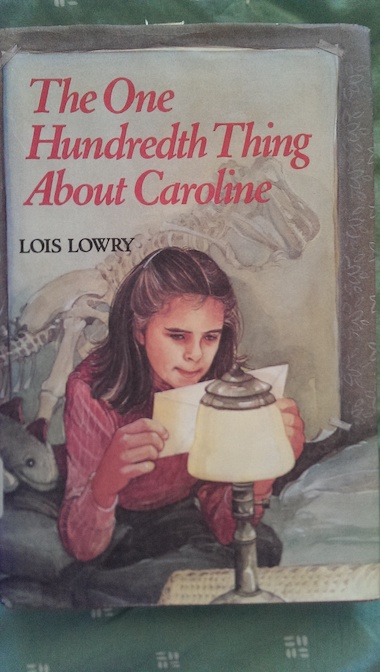
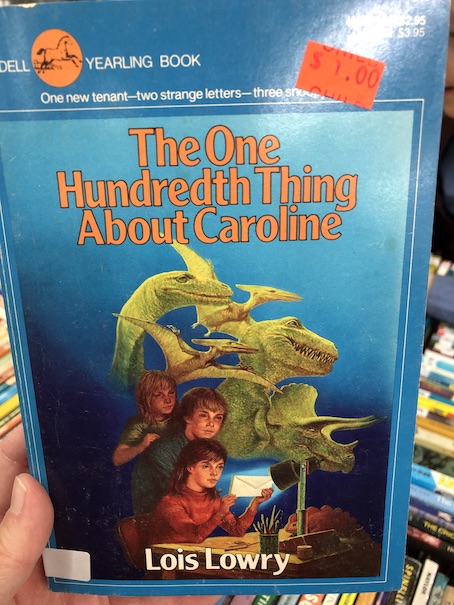
The One Hundredth Thing About Caroline by Lois Lowry, 1983.

Eleven-year-old Caroline Tate knows that she wants to be a paleontologist when she grows up, but she is also fascinated with her friend Stacy’s dream of becoming a great investigative reporter. For fun, the two girls begin investigating the people who live in their respective apartment buildings.

Caroline’s investigation focuses on the mysterious Frederick Fiske, who lives on the fifth floor of her building. In a wastebasket, she finds a letter written to him by a man she’s never heard of telling him to “eliminate the kids.” Also in the wastebasket, there is an overdue notice for Fiske from the library, and the book is about poisons. From this evidence, Caroline comes to believe that the strange Mr. Fiske is planning to murder some children.

The situation becomes worse when Mr. Fiske begins dating her divorced mother, and Caroline fears that the children Mr. Fiske is planning to murder are her and her brother, J.P.. Can Caroline, J.P., and Stacy prove that Mr. Fiske is a cold-blooded murderer before his relationship with the Caroline’s mother can go any further and before he succeeds in poisoning them?

The book is available to borrow and read for free online through Internet Archive.

My Reaction and Spoilers:

It’s a bit of a spoiler, but this is one of those stories where the mystery is largely based on a series of misunderstandings. The book is a comedy mystery.  Mr. Fiske isn’t really a murderer, although he has done some things which make the children suspicious.  It’s a humorous story, and the kids’ antics as they try to further their investigation and collect “evidence” against Mr. Fiske are hilarious.  Along the way, the kids end up helping Mr. Fiske with a problem he’s been having, and the kids realize that they’ve made a mistake about him and his intentions.  Whether Mr. Fiske learns of their suspicions about him or not is left to the imagination, although something at the very end of the story may bring everything out into the open.

The title of the book comes from a joke between Caroline and her mother.  Caroline’s mother is always talking about the things she loves about Caroline, giving them different numbers.

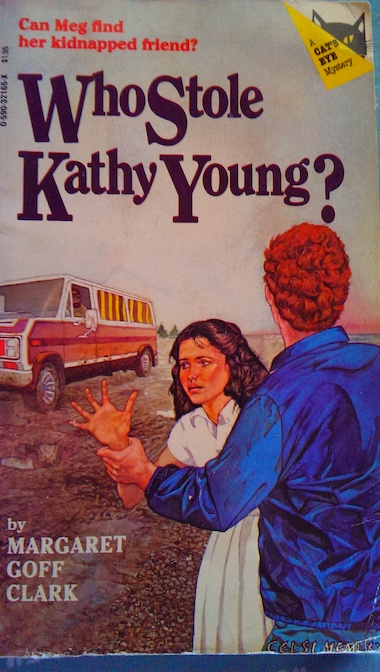
Who Stole Kathy Young?

KathyYoungWho Stole Kathy Young? by Margaret Goff Clark, 1980.

Kathy Young has had her share of problems.  Her mother died a year and a half ago, and now, her father has a housekeeper with a sour personality.  A couple of months after her mother’s death, Kathy was seriously ill, and her illness caused her to lose most of her hearing.  She now depends on a hearing aid and her improving lip-reading and sign language abilities.

This summer, Kathy’s best friend, Meg, is staying with her while her parents are on a trip to Switzerland.  Meg was of great help to Kathy when she was trying to adjust to her hearing loss, practicing sign language with her during her special lessons.  Kathy’s dream is to become an artist, but Meg now wants to be a teacher for the deaf, like the teacher who taught Kathy.  Kathy is still very unsure of her abilities to cope with her deafness.  She had the opportunity to attend a special art workshop over the summer but passed it up because she was worried about whether she would be able to communicate with and understand her teacher and the other students, and she knew Meg couldn’t attend to help her.

Kathy has been enjoying Meg’s summer visit, but the girls have noticed something odd.  It seems like a couple of strangers, a man and a woman, have been hanging around everywhere they go.  Meg is worried about it, but Kathy doesn’t want to worry her father.  She thinks that they’re probably tourists, like the housekeeper said.  They nickname the strangers Heron and Toad because of their appearances.

One day, Kathy is kidnapped!  Some men in a van stop to ask her directions and when she tries to explain where they have to go, they pull her inside and drug her!  Meg witnesses the kidnapping, but is standing too far away to help Kathy.

When Kathy wakes up from being drugged, she finds herself on a boat.  Her abductors have cut her hair and changed her shirt to disguise her from anyone who might spot her.  They’ve also taken her hearing aid, hoping to render her helpless and keep her from finding out their plans because she can’t hear them.  However, Kathy isn’t as helpless as they think.  She can still read lips, and she can still think.

Kathy learns to rely on herself and her own wits as she tries to gather as much information as she can about her kidnappers and to figure out how she can save herself.  Through this experience, she develops more self-confidence, realizing that she can do more and handle more than she had thought was possible.

While Kathy is struggling in captivity and her father is dealing with the police and the ransom demand, her friend Meg is trying desperately to find her.  The story alternates viewpoints between the two girls as Meg aids the investigation into Kathy’s disappearance and puts together clues that Kathy leaves for her as her abductors move her from place to place.  The mastermind behind the kidnapping plot is closer to home than they think.

The book is available to borrow and read for free online through Internet Archive.

Magic Elizabeth

MagicElizabeth

Magic Elizabeth by Norma Kassirer, 1966.

Young Sally’s parents are away on a business trip, so she’s been staying with Mrs. Chipley, but now Mrs. Chipley has a family emergency to tend to. Mrs. Chipley’s daughter is ill, and Mrs. Chipley needs to go and help her with her children. While Mrs. Chipley is gone, there is only one other person for Sally to stay with: her Aunt Sarah, an elderly woman who Sally doesn’t really know. Aunt Sarah moved to California when Sally was just a baby, and the only reason why she has returned is that she has decided to sell her old house.

MagicElizabethArrival

Sally is a rather shy girl. She’s uneasy around Aunt Sarah, who is obviously unaccustomed to spending time with children, and Aunt Sarah’s creepy cat, Shadow. The house is old, chilly, and filled with strange things. However, Sally is enchanted with the bedroom that Aunt Sarah gives her and the portrait of a girl and her doll that hangs on the wall. The girl looks very much like Sally herself, and Aunt Sarah tells her that the girl was also called Sally and lived in that bedroom as a child, many years ago.

MagicElizabethKitchen

Fascinated by this earlier Sally and her beautiful doll, modern Sally decides to try to find the doll. Although her aunt tells her that she shouldn’t go poking around in the attic, Sally can’t help herself. She finds a trunk with Sally’s name on it full of girls’ clothes, just the right size for modern Sally to wear. There is a doll in the trunk also, but it’s not the same doll as the one in the portrait. When Sally reads the diary in the old trunk she learns the reason why. The doll in the picture, Elizabeth, was lost many years ago, when the earlier Sally was still young. As modern Sally plays dress up with the earlier Sally’s old clothes and studies herself in the mirror, she finds herself taken back in time, seeing the house through earlier Sally’s eyes. In the past, it was a busy and happy household with parents, an elderly aunt, earlier Sally, Sally’s little brother, and Sally’s pet cats.

A short time later, Aunt Sarah wakes modern Sally on the floor of the attic, and they assume that it was all a dream, but this look into the past changes Sally’s feelings about the house and her aunt’s cat, who suddenly seems friendlier and reminds her of the mother cat she saw in the past. Aunt Sarah also seems a little less stern as they discuss earlier Sally and her lost doll. Aunt Sarah says that no one ever saw the doll again after it disappeared on Christmas Eve all those years ago.  Earlier Sally had put the doll on top of the Christmas tree, like an angel, and after the family finished singing Christmas carols, the doll was gone.  They could never figure out what happened to her.  Modern Sally thinks that sounds very sad and wants to investigate the mystery of the missing doll, although Aunt Sarah isn’t very enthusiastic. She says that if the doll could be found, it would have been found long ago, and the earlier Sally has long since grown up and no longer needs it. Although, oddly, Aunt Sarah remarks that the earlier Sally had always thought that Elizabeth was “a little bit magic.”

Modern Sally continues to look for the doll anyway and also continues having moments when she sees the past as the earlier Sally did many years ago, especially when she looks into the mirror in the attic. One day, she invites a neighbor girl named Emily over, and while the two of them are looking around the attic, Emily finds Elizabeth’s old doll bonnet. The girls are excited because they now know for certain that Elizabeth is still in the house, waiting to be found. The girls are running out of time to find her. If Aunt Sarah agrees to sell the house, it will be torn down to build apartments. But, Sally falls ill with the flu, and it isn’t until Shadow gives her an important clue that Sally realizes where Elizabeth must be.

This book is currently out of print, but it’s one that I’d dearly love to see in print once more!  It is available to borrow and read for free online through Internet Archive.

My Reaction and Spoilers

Adults reading this story will probably realize before the children do (spoiler) that Aunt Sarah herself was the earlier Sally, the one who lost her favorite doll many years ago. “Sally” is a nickname for Sarah, like “Molly” can be for Mary and “Peggy” can be for Margaret, although any of those names can also be used by itself.  (In the Middle Ages, it was common for popular names to get different variations of nicknames by changing one sound in the original name and then changing one more sound in the first nickname to get another one, and sometimes even moving on to change one more sound to get yet another nickname that was very changed from the first. Those nicknames that look significantly different from their original names are a holdover from that practice, having lasted even into modern times.  John/Jack works on the same principle.  Fun fact!)  When Aunt Sarah grew up, she stopped using her childhood nickname, but the name was passed on to modern Sally.

At first, modern Sally sees her stern aunt as being witch-like, all dressed in black and fussy, but gradually, the memories of the past, her new relationship with young Sally, and the finding of her slightly-magical doll soften her. There are hints of Aunt Sarah’s youth in the attic, although Sally at first dismisses thoughts that some of the lovely things there could have belonged to her cranky old aunt because she has trouble thinking of her aunt as once having been young, pretty, and sweet. However, part of the theme of the story is that everyone was young once. Aunt Sarah is is bent and achy from arthritis, giving her the witch-like appearance and making her short-tempered at times. She also hasn’t been around children much for years, and part of her fussiness comes from forgetting what it was like to be young herself. Modern Sally, with her resemblance to her elderly aunt, and Elizabeth the doll both work their magic on her, reminding her what it was like to be a young girl and helping to revive a more youthful spirit in her.

I was happy that (further spoiler) Aunt Sarah decides not to sell the house after all, not just because she and Sally will get to spend more time together, but because old houses like that are rare these days. I like the idea that the old family heirlooms in the house will now be preserved, like the sleigh out in the old barn and the melodeon, a type of small organ.  I liked the way the book described the melodeon making musical sounds as people walk past it because of the way the floor boards move.  I also loved the description of the gas plant that Sally sees in earlier Sally’s memories.  If you’d like to see what a gas plant looks like when it’s lit, have a look at this video on YouTube.MagicElizabethMelodeon

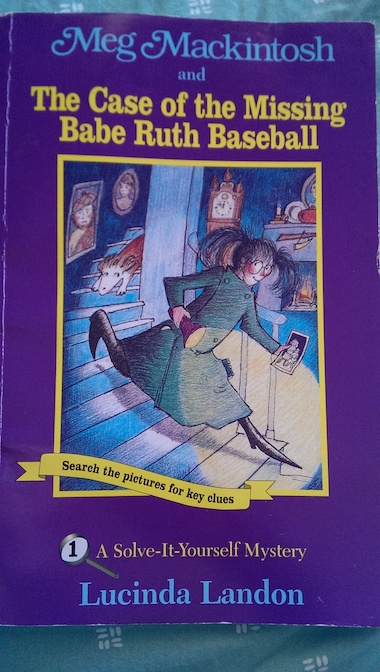
Meg Mackintosh and The Case of the Missing Babe Ruth Baseball

Meg Mackintosh Mysteries

MMBaseball

Meg Mackintosh and The Case of the Missing Babe Ruth Baseball by Lucinda Landon, 1986.

MMBaseballAlbumThis is the first book in the Meg Mackintosh series, and it was the first mystery story that I ever read, when I was about seven years old.  It started a life-long love of mysteries!

Meg’s grandfather shows Meg and her friend Liddy some old family photographs and tells them about the time when his cousin Alice took his prize possession: a baseball autographed by Babe Ruth.  Alice was a bossy girl who always liked to tease him, and so she created a kind of treasure hunt, challenging him to solve it in order to get the baseball back.  Unfortunately, he could never figure out the clues and still doesn’t know what happened to the baseball.

Meg’s brother, Peter, has a Detective Club, but he refuses to allow Meg to join, saying that she needs to prove that she can solve a mystery.  Seeing this as her chance, Meg decides that she’s going to solve this old puzzle and find the Babe Ruth baseball!  However, she also has competition from Peter, who thinks that he’s the better detective and tries to send Meg off in the wrong direction.

The book is currently available online through Internet Archive.

My Reaction

All of the books in the Meg Mackintosh series allow readers to try to solve the mysteries along with Meg, stopping periodically to ask them if they’ve noticed a clue that Meg has noticed or if they know what the significance of a clue is.  There are pictures to help, and readers are invited to stop and study the details before moving on. I think this is a good way to introduce children to puzzle-solving and help them develop critical thinking skills and an ability to notice details. I would recommend adults reading these books, or at least the first one or two along with children, so they can discuss the stories and clues with them, helping them spot clues as they begin to get used to the format of the books.

This is an excellent series for introducing children to the mystery genre for the first time! When I was young and just learning what mysteries were, I was fascinated to discover that I already had all of the knowledge I needed to solve this mystery along with Meg because all of the clues to Alice’s treasure hunt had to do with nursery rhymes. If you can recognize the rhymes in the book, you’re well on your way to solving the mystery!

The Headless Cupid

HeadlessCupidThe Headless Cupid by Zilpha Keatley Snyder, 1971.

This is the first book in the Stanley Family Mysteries series.  Some people might be put off by the occult themes in this book, but this is a mystery story, and all is not what it seems.  Read to the end or skip to the spoilers section to find out.

Eleven-year-old David Stanley has had to help take care of his younger siblings since his mother’s death.  In some ways, he feels like his mother knew that she was dying before anyone else did, preparing David to help his father by taking care of his younger sister Janie and the young twins, Esther and Blair.  David thinks that his mother might have been psychic because she tended to believe in some odd things and often knew things before other people did.

Now David’s father, a college professor, has remarried, to a divorced woman with a daughter of her own, Amanda, who is twelve years old.  David likes his new stepmother, Molly, who is an artist, and he appreciates having someone else to help take care of the other kids.  Amanda is a different story.  She was an only child before her mother’s remarriage, and she’s not happy to suddenly have step-siblings, some of whom are rather young.  Amanda has been unhappy in general since her parents’ divorce, and she wishes that she could go to live with her father full time. Her father says that he can’t take care of her because he has to work so much, but he spoils her whenever they spend time together.  David has doubts about the things Amanda says about her father, but he and the others try to make her welcome in their new home.

HeadlessCupidNewsWith their family suddenly much larger, David’s father bought a new house for them to live in.  Actually, it’s a very old house just outside of a small town.  People call it the Westerly house after the former owners.  Not long after the family moves in, they find out that people used to say that the Westerly house was haunted.  Mr. and Mrs. Westerly used to travel around the world with their two daughters because Mr. Westerly worked for the government, but after they settled down to a quieter life in this small town in the late 1800s, strange things started happening in their house.  Rocks would fly around the house, seemingly thrown by invisible hands, and someone (or something) cut the head off the carved cupid on the fancy staircase banister.  The head was never found.  These incidents were reported in the local paper, and people believed that the Westerly family was haunted by a poltergeist.  These hauntings seemed to center around the two Westerly girls, particularly the older one, Harriette, which made some people think that the girls were faking the poltergeist.  However, they were never able to catch either of the girls doing anything.  The strange activities finally ended when the girls were sent away to boarding school, but now that the Stanleys have moved into the house, strange things are starting to happen again.
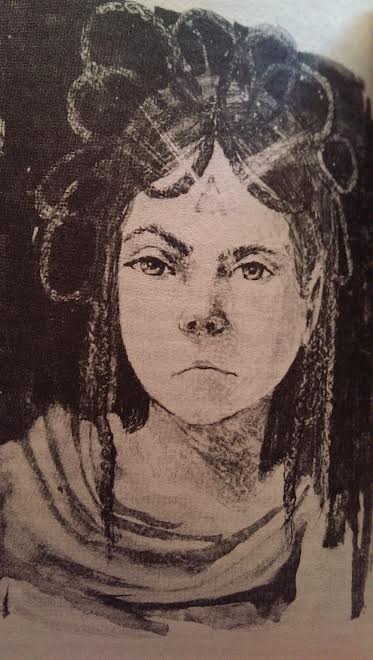
HeadlessCupidAmandaAmanda is fascinated by stories of the poltergeist.  A friend of hers where she used to live (one her mother didn’t approve of) was teaching her about the occult and how to do magic spells.  When David tells Amanda that he thought that his mother was psychic, Amanda is surprised, and she offers to teach David and the other kids about magic over the summer.  David eagerly accepts the offer because he finds the subject fascinating and because it’s the only thing that Amanda really seems interested in.  The other kids are also fascinated at the idea, even the littlest ones, which takes Amanda by surprise.  She had expected them to be scared.

Still, Amanda begins leading the kids through a series of rituals that will supposedly initiate them into the occult world, all of which have to be done in secrecy, without the parents’ knowledge.  They have to do some bizarre things like spend an entire day not talking (they have to take turns so the adults won’t notice, and it’s harder for some kids than others), spend a day where they can’t touch anything metal (mealtimes are awkward), offer “sacrifices” to the spirits (basically giving Amanda things she likes), and find animals to be their “familiars.”  As some of these rituals and the kids’ strange, secretive behavior cause problems, particularly for David’s stepmother, David begins to suspect that Amanda’s “rituals” have an ulterior motive that has nothing to do with magic at all.  Then, the poltergeist activity begins.
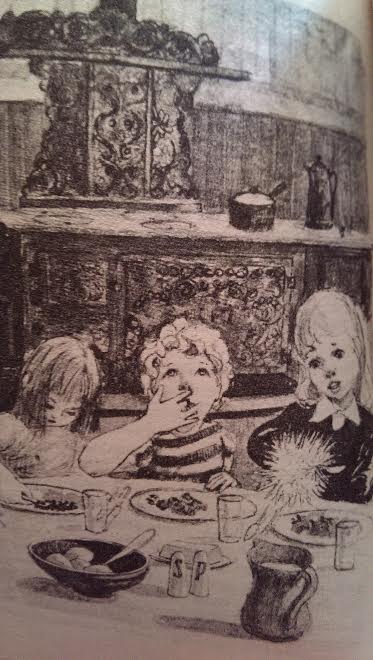
HeadlessCupidKidsJust as with the Westerly family years ago, rocks are thrown around the house or found just laying around.  Things are broken in the middle of the night.  Have Amanda’s rituals somehow awoken the poltergeist once more?  David has his doubts, suspecting that it’s part of Amanda’s playacting, but she is accounted for when some of these strange things happen.  The younger kids are still more fascinated than frightened by these strange happenings, but their stepmother finds them particularly unnerving.

Then, just when David thinks that he understands the situation and Amanda seems to be calming down her occult talk and behaving more normally, something happens which is really inexplicable: the missing head of the cupid suddenly reappears.

This is a Newbery Honor Book.  It is available to borrow and read for free online through Internet Archive.

My Reaction, Themes, and Spoilers

The reason why I want to explain some of this is because I think this book has received some unfair criticism because of the “occult” themes in the book, and I want to clarify the situation for the benefit of parents and teachers who have not yet read the book and may be concerned.  I’m putting “occult” in quotes because, as I said before, that’s not really what’s going on.  The book is a mystery story, and the “supernatural” stuff is largely window dressing for the real themes of the story, which have to do with unresolved feelings and revenge.  The story even contains a kind of warning about getting involved with the occult, which is another reason why I think the criticism of this book is unfair.

That Amanda is faking at least part of the haunting is pretty obvious even early on, so I don’t think it’s much of a spoiler to say that.  Amanda is an unhappy girl whose life abruptly changed with her mother’s remarriage, and her occult talk and fake witchcraft are part of her way of dealing with her feelings.  She admits to David at the end of the story that she was purposely trying to frighten her mother, trying to “get even” with her for turning her life upside down, first by divorcing her father and then by getting married again, forcing Amanda to move to a strange town where she has no friends and live with a bunch of kids she hardly knows.  Getting to know her new siblings better and sharing adventures with them helps, but it takes the frightening moment when the cupid’s head suddenly reappears to get Amanda to admit that real occult stuff scares her, too, and to confess the truth of what she did and her real feelings to her mother.

HeadlessCupidDavidAmandaThere are some elements of the happenings, particularly the reappearance of the cupid’s head, that are never fully explained, although David ends up knowing more than Amanda by the end.  Some aspects of the situation are hinted at.  There may be a real supernatural event at the end of the story.  Blair appears to have inherited psychic abilities from his mother, and there is a distinct possibility that the Westerly sisters who once lived in the house were just as unhappy with their parents for the changes in their lives as Amanda was with her mother.  Although the “poltergeist” as it first appears doesn’t exist, it may be that the “poltergeist” of the past remembers what it was like to be young and unhappy and that she wanted to make amends for past wrongs and to help another troubled young girl to make peace with her life and family.  But, if you don’t like that explanation, there is a more conventional, non-supernatural explanation that David considers, which equally possible.  Personally, I think it’s a combination of the two, but it’s not completely clear.  I think the author left it open-ended like that to make readers wonder and to preserve the air of mystery after the other mysteries have been cleared up.

As a kid, I enjoyed the creepy aspects of the story and the sense of wonder the kids experience as they go through their “rituals,” trying to bring some magic to their regular lives, wondering if things like ghosts and magic can really exist.  Now, I more appreciate how Amanda researched tricks used by fake psychics and mediums and used them creatively to her advantage.  When I was a kid, I liked magic tricks, and psychics and mediums make use of those types of stage illusions and psychological tricks in their acts.  I still have some books on the subject myself.  I also like the way David sensed the truth behind Amanda and the strange happenings even though he didn’t really understand how or why it was done at first.  David has some genuine curiosity about magic, but even after he realized that Amanda was faking things and was disappointed by it, he didn’t immediately tell the others.  He could have unmasked her as a fraud, but he knew that would only earn her resentment.  He wanted to understand her motives and help her feel better, giving her the chance to make peace with her mother herself and become part of their family.

This book has been frequently challenged because of the children’s inquiries into the occult, but I would like to point out that their “occult” experiments were all fake, pretty obviously so, and it is acknowledged that Amanda’s interest in the occult was fueled by her emotional distress (part of her urge to “get even” with her mother by causing problems).  By the end of the story, Amanda and her mother have an honest talk with each other about everything.  Amanda admitts her true feelings and makes peace with her mother, and she also says that her mother explained some things that Amanda didn’t know before.  The book doesn’t say exactly what Amanda’s mother told her, but from the context, it’s probably something about the circumstances behind her parents’ divorce, something that they might not have wanted to explain to her earlier.  I have a theory about it, although there’s nothing explicit that I could point to to prove it.  I suspect that Amanda’s father had an affair and that the affair is continuing, which I think is the real reason why he doesn’t want Amanda to live with him full time.  If Amanda were to live at his house, she would be sure to find out the truth.  Maybe his girlfriend is even the housekeeper Amanda referred to, the one who doesn’t help take care of children because she’s “not that kind of housekeeper.”  That possibility didn’t occur to me when I was a kid, but it seems kind of odd for a single man, living without children or other people in his house or other household staff to manage and who spends a large amount of time working away from home, to even have a housekeeper instead of simply hiring a maid or cleaning service to come in from time to time.  Households with fewer people require less maintenance.  There is less laundry to do, and single people who work tend to eat out or order in pretty often or make very simple meals, so I doubt he even needs much help with cooking.  But, that’s just my theory.  No one ever says why Amanda’s parents divorced in the story.  The reasons are less important to the story than Amanda’s feelings concerning the divorce.  Some of Amanda’s earlier resentment toward her mother was fueled by things that her father told her, making it seem like her mother was the one who caused the divorce.  After talking with her mother, Amanda seems to realize that some of the nasty things that her father said about her mother may not have been true and that her resentment toward her mother for causing the divorce was needless.  Much of the story involves unresolved feelings and the need to communicate them honestly.

The difference between reality and perceptions is also important to the story.  Although Amanda at first tries to convince the other kids that she is an expert on all things magic, David soon realizes that she’s not: she acts like ordinary, easily-identifiable wild flowers are rare herbs, she can’t control her “familiar” because she has no idea how to handle animals, and when things happen that Amanda can’t explain, she’s the first to be terrified.  In the end, Amanda gives up on the idea of the occult completely, realizing that the things she did were wrong and that she had gotten involved in something that she really didn’t want to be involved in.  Many kids wonder about the supernatural when they’re young, and I don’t think it’s bad to point out to them that they if they experiment with such things, they may be getting involved in something they could regret and that they should consider their motives for wanting to do so.  Playacting when you know it’s pretend is one thing, but not knowing if the scary stuff is real is another.

For further discussion of the dynamics of the blended family in this story, I recommend the SSR Podcast about this book.  The podcast also points out that there is an incident in this story which might be racially problematic.

Anti-Plagiarism Check

I’ve been thinking about how my reviews could be used for plagiarism ever since I caught a couple of those essay-writing companies trying to follow my blog.  It’s difficult for me to review certain books without giving spoilers, but I’d like to point out that none of my reviews explain everything there is to know about the stories.  That would be completely impossible without reprinting the entire text of the book, which plagiarists are too lazy to read anyway.  There are certain plot points which only a person who has actually read the book would understand and be able to explain.  Teachers who suspect that a student has plagiarized a book review or only pretended to read the book should ask them to verbally explain the points that I have not covered in my review, giving them no chance to try to look up the answers elsewhere or try to find them by quickly skimming the book.  I’m not going to print suggestions for questions to ask here because I don’t want to give the plagiarists a hint, and I doubt that teachers who have read the book recently themselves would really need a hint, but any teacher who contacts me via their official school e-mail address can discuss it with me.  I know these stories well because I’ve loved them for years, and I’ve started a file with suggested plot points to discuss.  I will not send this information to anyone who does not contact me from an official school e-mail address.  Keep in mind that I can easily look up the name of the person who contacts me to determine whether I’ve been contacted by a teacher or a student.

It’s one thing for a student to want to discuss the book with someone to clarify confusing plot points, but it’s another to ask someone to do their homework for them.  I know the difference, and I know homework when I see it.  Let me explain something.  All WordPress blogs have built-in analytics, and I’ve been studying SEO, so I pay attention to who has been visiting my site and how they get there.  I know whether you came here by using a search engine or whether you were referred by another site, and I can also see search terms that you used.  I added this note to this review specifically because I noticed that someone has been trying to Google what are plainly homework questions, and I just got a site referral from an online plagiarism checker.  Yeah, I see what you did there.  This is the Information Age, and when you go looking for information, sometimes, there’s someone else looking back at you, even if you can’t see them.  Not everyone with a blog pays that kind of attention to their traffic, but some of us do, and while some may not say anything about it, some of us are also a little more vocal.  I saw what you did, and I didn’t like it.  I don’t know you, but I know you’re a fool, and your teacher has just discovered it, too.  Now, we’re all aware.  It’s your own fault, and it’s too late to whine about it now.  I do sometimes help people who ask for it.  You should have asked for help when you needed it instead of cheating and stealing my words.  Maybe next time you’ll ask for what you need instead of just taking what you want.

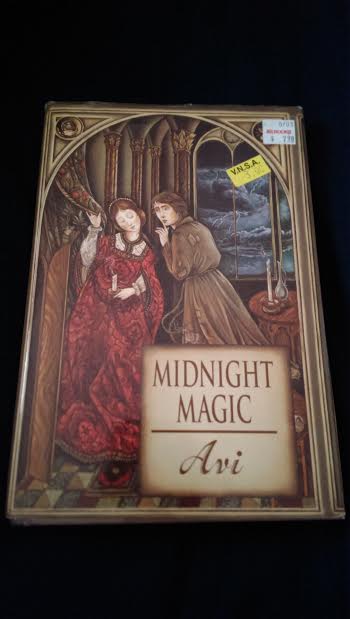
Midnight Magic

midnightmagicMidnight Magic by Avi, 1999.

The story takes place in Italy, toward the end of the Middle Ages.  Mangus, a formerly wealthy scholar and philosopher, is living under house arrest because the king believes that he has practiced black magic. Mangus was merely performing magic tricks to earn extra money, and in fact, does not believe in real magic.  However, the king is very superstitious and easily influenced by his scheming advisor, Count Scarazoni, who needed a scapegoat to distract everyone from his schemes.  Unfortunately, many people in the kingdom of Pergamontio believe that Mangus is a real magician with frightful powers.  Even Fabrizio, an orphan who is Mangus’s only remaining servant, believes that magic really exists.

When a messenger arrives, summoning Mangus to the castle to see the king, they are afraid that the king has reconsidered his decision to spare Mangus’s life. However, it turns out that the king is in need of Mangus’s help. He believes that his young daughter, Princess Teresina, is being tormented by a ghost, and he wants Mangus to use his magic to get rid of it.

Mangus again protests that he does not do real magic, but both the king and Count Scarazoni promise dire consequences if he fails to help them deal with the problem.  Mangus isn’t sure why Count Scarazoni has asked for his help because he knows that the count doesn’t really believe in magic, except perhaps as a way of appeasing the king.  The king promises that if Mangus can free the princess from the influence of the ghost, he will not only end Mangus’s house arrest but reward him with a generous pension.  Mangus has little choice but to agree to do his best, and the promise of the pension for his master convinces Fabrizio to do everything he can to make sure that Mangus succeeds, not only to save his master’s life but to restore his family’s fortunes.

But, what is the secret of the ghost?  Fabrizio believes in ghosts, even though Mangus doesn’t.  Princess Teresina insists that the ghost is real, appealing directly to Fabrizio to convince Mangus that it is. Adding to the mystery is the disappearance of the princess’s brother, Prince Lorenzo, and the murder of the princess’s tutor. Danger lurks in the castle, and conspiracies are around every corner. Could the troubled spirit really belong to the murdered prince?

The book is available to borrow and read for free online through Internet Archive.

My Reaction

I love historical books and spooky mysteries, and this is both! The Italian kingdom where the story takes place is fictional, but it takes its inspiration from real kingdoms of the later Middle Ages and early Renaissance, with Machiavellian intrigue, power struggles, and arranged marriages, even for children, that could influence the balance of power and successions. (There is talk of a potential arranged marriage in the story, but no child marriages actually take place.  If a child is old enough for ghost stories and murder mysteries and isn’t too frightened by them, there is really nothing more concerning than that to prevent them from reading this book.)

Princess Teresina is one of the most intriguing characters in the book.  Although young, she isn’t a shrinking violet or anyone’s fool, and she’s definitely not a tea party and ball gown kind of princess.  Like real life Medieval princesses, she is the product of a family who came to power by the sword and maintains it by the iron fist in the velvet glove and some clever political maneuvering, although some members of the family are more clever about it than others.  Princess Teresina well knows the family she was born into and what’s expected of her as royalty, and she knows to be careful about who she trusts and what the consequences of trusting the wrong people can be.  Although apparently terrified by the ghost, the princess has a kind of toughness and shrewd determination to do what she thinks is necessary.  She seems to be smarter and knows more than most people give her credit, and Fabrizio often wonders just how much she really knows.

One of the best things about the story is that, as soon as you think you know what’s going on, you learn that there is more to the story. There are conspiracies within conspiracies!

Hint: If you like pseudo-ghost stories, spooky stories of the Scooby-Doo variety, where there are logical explanations for the supernatural phenomena … you won’t be disappointed.

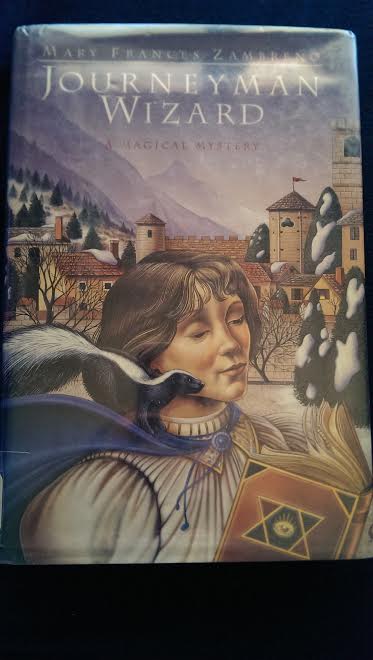
Journeyman Wizard

JourneymanWizardJourneyman Wizard by Mary Frances Zambreno, 1994.

This book is the sequel to A Plague of Sorcerers.

Jermyn Graves has finished his apprenticeship and is ready to move onto his Journeyman studies.  As a Spellmaker, an especially rare type of wizard, he really needs to study with a Master Spellmaker, and for years, there has only been one in the Wizard’s Guild: Lady Jean Allons.  Jermyn’s current teacher, Theoretician William Eschar, once studied under her himself.

Mistress Allons is a formidable old woman, and Jermyn is nervous about going to live with her and completing the next part of his training. Master Eschar says that she is strict but an excellent teacher, and he has fond memories of her from his own youth.  However, much has changed for Mistress Allons since those days.

Mistress Allons lives in her manor house in the small town of Land’s End with her widower son-in-law, Duncan, and her granddaughter, Brianne, who is only a little younger than Jermyn himself. Since the death of her only daughter, Annalise, in a mysterious accident during a magical experiment, Mistress Allons has not really practiced magic and no longer even keeps a familiar.  As Jermyn soon learns, everyone in Land’s End is still haunted by Annalise’s death.

Although Brianne has magical talent, both her father and grandmother refuse to let her study magic.  In defiance and because her talent will not allow her to leave magic alone, Brianne has taken to studying magic with a local Hedgewitch, Maudie.  Hedgewitches, or Wise Women as they call themselves, practice a very natural form of magic, but it can also be very dangerous because of its raw, undisciplined nature.  Although magical accidents are usually rare, that type of magic is more prone to them than the more formal kind that Jermyn is studying.  Jermyn tries to convince Brianne of the danger, but Brianne sees it as her only hope for learning anything, in view of her father and grandmother’s opposition.

Jermyn is not there for very long before Mistress Allons herself dies, the victim of another strange magical accident. Was it really just a terrible accident, or was it actually murder?  Jermyn struggles to find the answers while some people believe that he may have been responsible for Mistress Allons’s death himself.

I enjoyed the fascinating combination of mystery and fantasy in this short series.  While Jermyn’s magical studies are fictional, the book has some interesting insights into cross-disciplinary studies as Jermyn comes to understand something that Mistress Allons was trying to explain to him about using lessons from art and science to solve magical problems because different fields of knowledge are connected and the principles of one discipline have some bearing on the other.

There is also something interesting that Jermyn says to the evil wizard who is responsible for everything about how he can’t really do all the things that he thinks he can do (specifically flying) because the kind of drugs that evil wizards use to boost their powers also cause hallucinations.  When I was in college, I did a report about witchcraft trials, and some of the plants used by supposed “witches” in their potions also had hallucinogenic properties, which is probably the origin of the belief in flying witches.  Just an interesting little cross-over from real history.