The Curse of the Egyptian Mummy

cursemummyThe Curse of the Egyptian Mummy by Pat Hutchins, 1983.

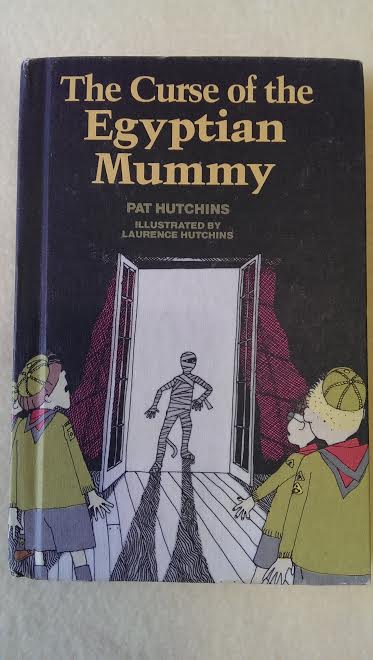
The 15th Hampstead Cub Scouts are looking forward to their camping trip. Miss. Hylyard, who runs a guesthouse for retired people, lets the scouts camp on her land and enjoys having them visit her house and entertain her guests. Mr. and Mrs. Webb are coming along to do the cooking, and their daughter, Victoria, will be there, too. She’s one of their friends from school.

Things start to get interesting pretty quickly when they hear that a man died from a poisonous snake bite not far from where they are camping. The boys are eager to show off their tracking skills by helping the police find the missing snake.  But, strangely, no one can figure out where the snake came from because none of the zoos in the area have reported one missing.  That’s only the beginning of what becomes a very strange trip for the scouts.

Sam finds a strange bird statue in a public wastebasket and decides to use it as the scouts’ new mascot. Then, someone trashes the campsite, and strange figures are seen running around the woods at night.  When Albert makes copies of the bird statue to earn his art badge, the first one is broken, and the second is stolen after some adult shoves Albert into the river near the camp.  Some of the guests at Miss Hylyard’s look suspicious, and when Victoria unexpectedly stumbles into an evening’s entertainment there still wrapped in bandages from the scouts’ first aid practice, a guest who was supposedly unable to speak suddenly blurts out, “The Curse of the Mummy’s Tomb!” in Arabic (which Miss Hylyard knows from her travels with her father).

Who are these mysterious people?  What is the importance of the statue?  And, is there really a curse?

The book is currently available online through Internet Archive.

Mystery at Camp Triumph

camptriumphMystery at Camp Triumph by Mary Blount Christian, 1986.

A year ago, sixteen-year-old Angie was blinded in a car accident.  It was shocking and devastating for her, especially since she was planning to become an artist.  She loved painting, and she feels like all of her dreams have died since she became blind.  Many of her friends no longer speak to her (partly because she has become angry and bitter and they don’t know how to cope with it), and she refuses to return to her old school, partly because of her fears of not being able to cope and largely because she doesn’t want to be the subject of ridicule or pity because of her new disability.  Her mother has been tutoring her at home, and her parents argue frequently about what’s best for her.

On the advice of a psychologist who has been trying to help Angie during her difficult adjustment, Angie’s parents have decided to send her to a special camp for children with disabilities called Camp Triumph.  Angie makes it plain that doesn’t want to go.  She feels that going to the camp with other disabled kids will just a painful reminder that she’s no longer “normal”, and she can’t imagine that there will be anything fun that she can do at a camp now that she can no longer see.  She knows that she’ll never be able to paint again, so she thinks arts and crafts are out, and how can she possibly ride a horse or go on nature walks?  However, her parents are firm with her, telling her that this is for the best.  There are things Angie needs to learn that they can teach her at camp.

Angie’s first days at the camp are miserable.  The other campers try to make friends with her, although she tries their patience with her bitterness and complaining that she doesn’t want to be there.  Then, someone messes with the guide ropes put up to help the blind children find their way around, sending a frightened Angie plunging into the river on her way back to her cabin.  Although she isn’t hurt, she becomes convinced that the camp is dangerous.  Everyone else thinks it was just a mean-spirited prank by one of the other campers.

Then, while visiting the doctor in town, Angie overhears a conversation between people she whose voices she doesn’t recognize, learning that what happened to her wasn’t just a prank.  Someone is deliberately committing acts of vandalism and sabotage at the camp, trying to get it shut down.  But why?   Angie flees the scene when she realizes that the people who were talking have heard her.  Unfortunately, she drops her cane as she flees.  Her cane has her name and address on it, and Angie later finds it lying on her bed in her cabin at camp.  Whoever these mysterious people are, they know who she is and can find her at any time.  Can Angie convince the other campers of what she heard and find the culprits before something worse happens?

Angie is terrified as she tries to solve the mystery, feeling helpless against her unknown enemies, who can see her while she can’t see them.  But, with the help of her new friends at camp, she comes to realize that she isn’t as helpless as she thinks she is.  Her experiences give her a new perspective on her life.  It’s true that things will never go back to being as they were.  Her life won’t be an easy one, and there are certain things that she can no longer do.  But, she comes to realize that there are still many things she can do, and there are other types of art that are still open to her.  In the end, Angie has friends she can count on, a life that’s worth living, and a better future ahead of her than she thinks.

Along with the story, the book describes some of the techniques that Angie has to learn to cope with her blindness: picturing a “clock” to remember the positions of objects around her (ex. “Your suitcase is at two o’clock.”), following the guide ropes with notches in them to know which path she’s on, listening for clues about her surroundings (she and other blind people recognize the sound of clinking from the flagpole at the center of camp and use that to orient themselves when things get confusing), putting notches in the tags of her clothes so that she knows which pieces of clothing match, using her sense of touch to make clay sculptures, etc.

Besides addressing Angie’s feelings and how she copes with them, the story also touches on how disabilities affect the people who are close to the disabled person.  At first, Angie’s parents don’t know how to help her, struggling themselves with coming to terms with what’s happened.  Her mother feels guilty because she was driving the car when they had their accident, and she wasn’t as badly hurt.  Her guilt leads her to baby Angie more than is good for her.  Angie’s father is a stern businessman with high ambitions, failing at first to understand and accept Angie’s feelings and the way her life has changed, reacting with impatience while Angie struggles.  Angie’s parents also had marital problems before the accident, which only added to the tension between them.  In the end, coming to terms with what has happened to Angie not only helps Angie to improve but helps her parents to improve their relationship with each other.

The book is currently available online through Internet Archive.
Something Fishy at MacDonald Hall

somethingfishySomething Fishy at MacDonald Hall by Gordon Korman, 1995.
Time moves on, and Boots’s little brother, Edward, is just starting school at MacDonald Hall. He’s made it clear that he thinks his older brother and his friends are “over the hill” and uncool.  Mr. Sturgeon is also feeling “over the hill” and thinking about retiring.  Being the headmaster just doesn’t seem that exciting to him anymore.

But, MacDonald Hall just wouldn’t be MacDonald Hall without strange things happening, and some mysterious person has been playing a series of bizarre pranks that rival anything Bruno and Boots have ever done.

Naturally, Mr. Sturgeon suspects them of being the pranksters, but for once, Bruno and Boots aren’t guilty.  On the one hand, they’re a little envious of the prankster’s ingenuity, but on the other, they don’t want to take the rap for something they haven’t done.

Who could the mysterious prankster be?  It is Edward, trying to prove that he’s more clever than Bruno and Boots?  Could it be Cathy and Diane, the girls at Miss Scrimmage’s Finishing School for Young Ladies?  They’ve been somewhat distant this year, for some reason.  Maybe it was Mark, who runs the MacDonald Hall school newspaper, drumming up interest in the paper by creating the phantom joker so he can write stories about it.  Elmer Drimsdale, the school genius, has been acting pretty odd since he developed a crush on a girl at the summer science fair, a girl who also happens to attend Miss Scrimmage’s.

There are plenty of suspects to choose from, and time is running out.  Bruno and Boots may be facing expulsion if they can’t figure out who is behind all the pranks!

This book is part of the MacDonald Hall Series (or Bruno and Boots series).

The Eleventh Hour

The Eleventh Hour by Graeme Base, 1989.

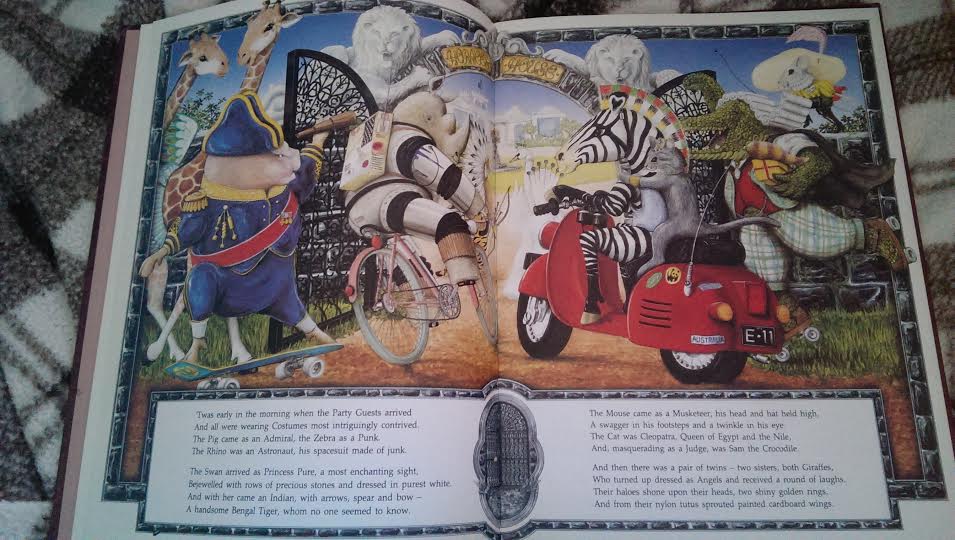
Horace the elephant is turning eleven years old, so he’s invited all of his animal friends to his house for a costume party.  The best part will be the extraordinary feast that Horace has created himself with all kinds of cakes and pastries and other desserts.

eleventhhourguests2

But, Horace refuses to let his friends eat any of the goodies until after they’ve played the party games. The guests have a lot of fun, but through all the games, they’re still thinking about that glorious feast. Only, when they finally go to eat, the food is all gone! Who could have taken it?

The book is available to borrow and read for free online through Internet Archive.

My Reaction

This picture book is actually a puzzle book, with puzzles difficult enough to even challenge adults.  Hidden within each of the large pictures taking up the entire page of each page in the book, are secret messages that hint at the identity of the thief, who is one of the party guests.  Some of the messages are in code.  Although a young child might enjoy the pictures in the book and the rhymes of the story, it would take someone older to be able to solve the puzzles.

There is a way to find the thief without finding the hidden messages or solving any codes, but it still requires attention to detail. There is a section in the back of the book that explains everything, pointing out all the secrets that you can find in the pictures, including the names of one of the giraffes and the swan, whose names are not given in the story itself.

But, don’t skip straight to the answers.  As Base himself says at the beginning to the section of answers, “the getting of wisdom is no match for the thrill of the chase, and those who choose the longer road shall reap their reward!”

The Master Puppeteer

masterpuppeteerThe Master Puppeteer by Katherine Paterson, 1975.
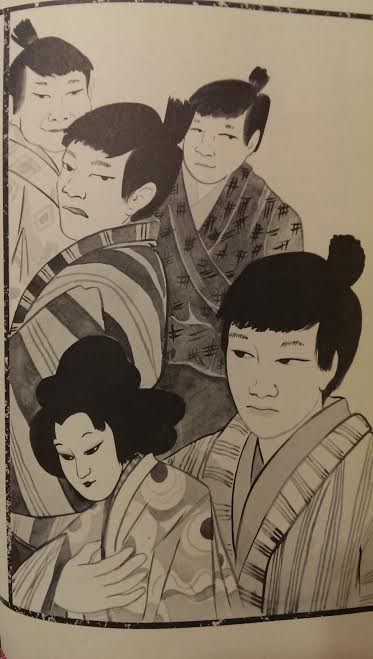
Jiro was born during a terrible time in the history of Osaka, Japan, during the 18th century. Around the time he was born, a plague swept the city, killing his other siblings, making Jiro the only child of Isako and Hanji, the puppet maker. His mother resents him for surviving when her other children didn’t and criticizes him for being clumsy when he tries to help his father make puppets. Now there is famine in Osaka, and Jiro’s family is on the verge of starvation. The only way they can support themselves is by making puppets for Yoshida’s puppet theater, the Hanaza.

The Hanaza has been doing well in spite of everything because the rice merchants are still wealthy enough that they can afford to spend money attending the theater. One day, when Jiro goes with his father to bring a puppet to Yoshida, Yoshida comments that the boy has spirit and offers to take him on as an apprentice at the theater. Hanji does not take the offer seriously, but Jiro does. He knows that he will not be able to help his parents by making puppets, and the people at the theater earn money and have plenty to eat. He joins the theater without telling his parents, introducing himself to the old, blind Okada, who chants the words of the plays.

masterpuppeteerpic1Okada was once Yoshida’s teacher, and he accepts Jiro into the theater. Jiro is fascinated with the world of the theater, studying alongside Yoshida’s son, Kinshi, who becomes his closest friend. However, he must first graduate from apprentice to puppeteer before he can begin earning enough money to support his family, and the news from outside the theater is grim. Word has reached him that his father is ill and his mother is starving. The poor people of Osaka, starving and oppressed by the wealthy merchants and tax collectors, begin rioting.

Saburo, the leader of a gang of bandits, has become a hero to the people, taking food and money from rich people in clever and daring raids and using it to feed some of those who are starving. Kinshi in particular admires Saburo and sets off on his own mission to save the poor people of Osaka. Jiro fears for Kinshi’s safety but does not know who to turn to for help until he finds evidence that seems to point to the true identity of Saburo.

One of the fascinating things about this story is the way the puppets are operated.  Unlike either hand puppets or marionettes, where the operators are never seen, the operators of puppets in Japanese theater are on stage with them.  However, the operators are dressed completely in black with hoods, so the audience will disregard their presence.  Because of the violent episodes in this story, I would recommend it for middle school level.

The Mystery in Old Quebec

mysteryoldquebecThe Mystery in Old Quebec by Mary C. Jane, 1955.
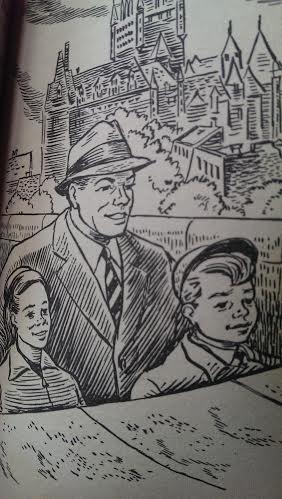
Mark and Kerry, a brother and sister, are visiting Quebec with their father, who is on a business trip. Their father allows them to explore the city on their own during the day while he works (something that would be unlikely to happen in modern times). The kids enjoy sight-seeing and learning French words and phrases.  They even make a new friend in the city, but they are troubled by events at the quaint little inn where they are staying.

On their first day there, Kerry’s coat mysteriously disappears and reappears with some strange messages in the pocket.  A boy wants them to take a message to someone in the city.  At night, Kerry hears someone crying in the next room. Is the boy being held prisoner at the inn? If so, why? Kerry and Mark are determined to help in any way they can, but time is running out.

The book is currently available online through Internet Archive.

My Reaction and Spoilers

mysteryoldquebecpicThe solution to the mystery involves family quarrels, custody issues, and racial tensions. In spite of that, this is actually a very gentle story.  In the end, the kids are dependent on the people the mysterious message was intended for to help a troubled, lonely child.  It turns out that the boy is an orphan, and some of his relatives are white, and some are First Nations (Native American). There is a fight for the boy’s custody, but the boy knows where he really wants to be.
The author describes the atmosphere of Quebec in some detail. The famous landmarks probably haven’t changed much, although I don’t know if all the descriptions are accurate anymore. I also thought it was interesting how the author includes some French phrases and their pronunciations and translations as the kids learn to communicate with French-speaking people in the city.

Terror on Cemetery Hill

cemeteryhillTerror on Cemetery Hill by Drew Stevenson, 1996.
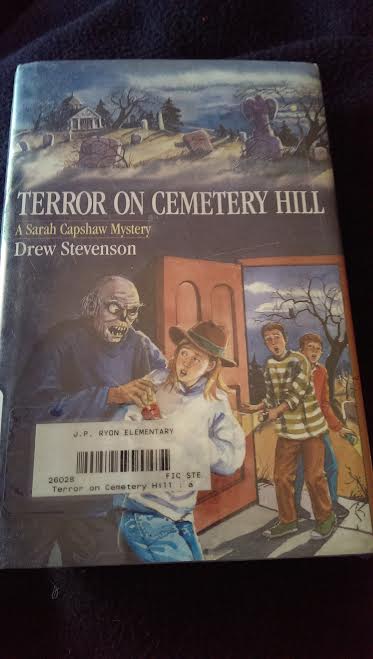
Halloween is coming, and spooky things are happening around Wilsonburg. Randall Davis, a new boy in town, comes to the diner looking for Sarah because he’s heard that she likes to investigate mysteries. Randall’s mother has recently become the caretaker of the cemetery, and Randall enjoys astronomy, so he decided one night to take his telescope up on top of Cemetery Hill. While he was there, he saw what looked like a hideous monster. Randall asks Sarah to have a look around the cemetery and help him figure out what he saw.

After some persuading, Sarah convinces Clark and Frog to come with her. Not only do they see the creature in the cemetery, but they find Mrs. Biddle, head of the town’s group of psychic investigators, unconscious in the Wilson family mausoleum. The Wilsons are the family that the town was named after. Mrs. Biddle and her group have been told before not to hold any ceremonies or investigations in the cemetery because they disturb people.  She insists that she was investigating the creature in the cemetery and that it pushed her and knocked her out. Something strange is going on in the cemetery, but is it a creature come back from the dead, or maybe something to do with the recent bank robbery in town?

Everyone believes that the bank robbery was just one in a series of robberies staged across the country by a robber known as the Village Bandit because he tends to rob banks in small towns.  However, Sarah has a different theory.

This is part of the Sarah Capshaw Mysteries series.  It is currently available online through Internet Archive.

Toying With Danger

toyingwithdangerToying With Danger by Drew Stevenson, 1993.
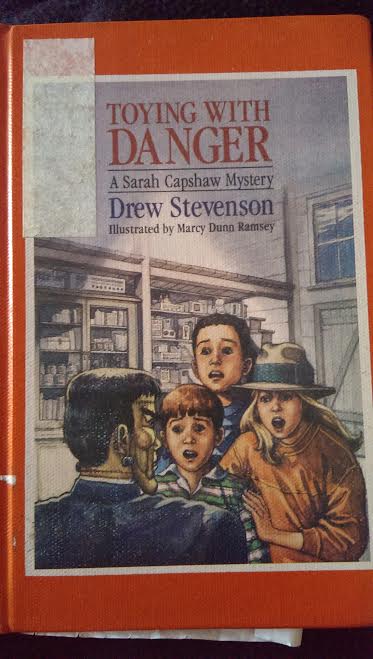
Sarah Capshaw is lamenting to her friend Clark that she hasn’t had an interesting case to solve since she and her parents moved to Wilsonburg when their friend Frog tells them that the local bully saw a monster at the old Harley farm outside of town.  Rumor has it that a mad scientist bought the place.  Naturally, Sarah wants to investigate.

It turns out that the “mad scientist,” Dr. Becker, is actually an eccentric toy inventor.  The “monster” is an electronic Frankenstein monster.  Dr. Becker is actually pretty nice and is even interested in seeing the detective board game that Frog is trying to invent.

Even though the monster wasn’t a real monster, there are still strange things happening in the woods surrounding the old farm where Dr. Becker’s workshop is.  The local bully is hanging around in the woods and trying to scare everyone away.  The kids also see a mysterious man hanging around, and Sarah wonders if he could be spying on Dr. Becker in order to steal his designs.

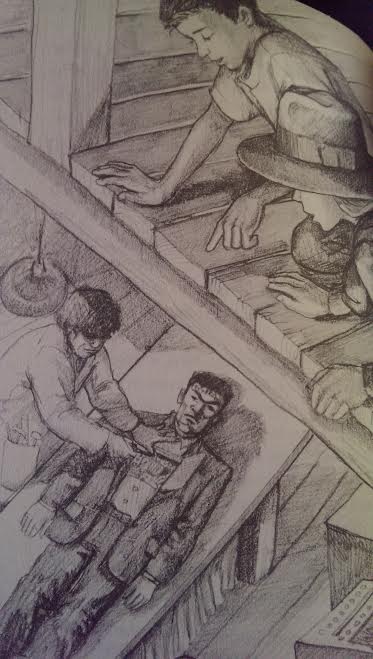
toyingwithdangerpic2It seems that Sarah is right that someone is trying to spy on Dr. Becker.  The kids learn more about the money involved in buying and selling toy designs when they visit the Too Wonderful toy company for a tour with Sarah’s grandfather.  Making toys is serious business, and companies guard their designs very carefully.  The Too Wonderful toy company wants to purchase some of Dr. Becker’s designs, but one of the members of the company says some strange things about Dr. Becker.  Can the kids trust him?  Can they trust the strange Dr. Becker?  Can Sarah catch the spy before it’s too late?
This is part of the Sarah Capshaw Mysteries series.

One Ghost Too Many

oneghostOne Ghost Too Many by Drew Stevenson, 1991.
Clark Lannigan meets Sarah Capshaw by accident when she comes to spend the summer with her grandparents in Wilsonburg. Sarah’s grandfather, Conrad Capshaw, is a lawyer, and he is handling the estate of Rodney Maplewood. Rodney Maplewood used to be a museum curator and had an impressive collection of antiques which he kept in his large house, Maplewood Manor.

Maplewood Manor is the oldest and the spookiest house in town. It was once owned by the eccentric Antonia Whitemarsh, who was a spiritualist and believed that her father’s spirit still inhabited the house. Now, people in town think that Rodney Maplewood’s ghost is also haunting the house because lights have been seen in the house at night. Conrad Chapshaw also says that, although nothing is missing, some objects in the house have been moved around.

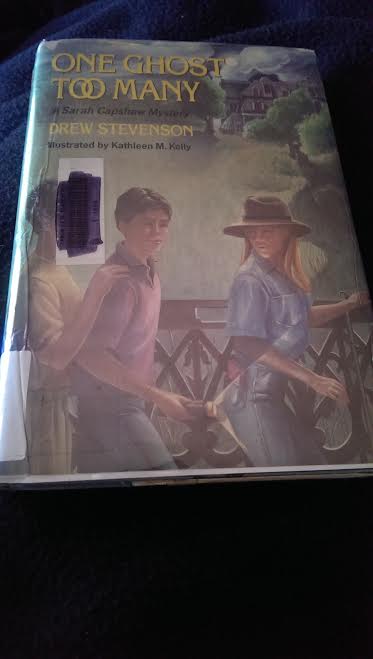
oneghostpic1Sarah persuades Clark and his friend “Frog” Fenniman to join her investigation of the house, but besides the resident ghost, they will also have to deal with a local group interested in psychic phenomena and a mysterious stranger who is paying the local bully to spy on the house.

This is the first book in the Sarah Capshaw Mysteries series.  Sarah and her parents move to Wilsonburg, and she has other adventures with Clark and Frog, all narrated by Clark.

The book is currently available online through Internet Archive.

The Mystery on October Road

OctoberRoadThe Mystery on October Road by Alison Cragin Herzig and Jane Lawrence Mali, 1991.

A strange man has moved next door to Casey.  He always wears a bandana tied across the lower part of his face, like a bandit.  His pets are the strangest dogs Casey has ever seen, huge Irish Wolfhounds.  He’s started fixing up his new house, but for some reason, he only likes to work at night.

One day Casey and her friend Cats (really, they’re both named Catherine, but they each have nicknames) go to take the man some bread that Casey’s mother baked, and they’re frightened away by one of the dogs.  Casey goes back to get the bread they left behind, and the man tells her to go away and leave him alone.

Casey and her friends (Cats and Benny, a boy Cats likes) are curious about this strange man.  They even wonder if he could be some kind of gangster, hiding out.  At her friends’ urging, they sneak into his house one day to look around.  When the man comes back unexpectedly, her friends get away in time, but Casey falls and hurts her ankle.  The man finds her in his house, and she learns the truth about him.

The man isn’t a bad guy, and Casey even becomes a friend for him.  The story ends on Halloween, when the man creates a special Halloween display for Casey of beautifully carved pumpkins.  The part that always fascinated me was the way he carved them, by peeling the skin off the pumpkin and only leaving it in places where he wanted dark lines.

Part of the story is about how appearances can be deceptive.  The stranger is actually a good person, but he is physically disfigured, which is why he doesn’t like people to see him.  For part of the story, Cats isn’t really a very good friend for Casey, neglecting her feelings and the feelings of the mysterious stranger in order to impress Benny.  But later, when she realizes that Casey was right about the stranger and that she was really hurt in their little escapade, she shows that she can be a better friend, too.

The book is currently available online through Internet Archive.