
The First Book of Tales of Ancient Egypt by Charles Mozley, 1960.
The book begins with a section “About this book” that introduces the stories, but I felt like it could have said a little more. The introductory section points out how amazing it is that these folktales and myths from Ancient Egypt have survived thousands of years to reach us, but there’s a bit more to the story than that. For a long time, people were unable to read texts written in Ancient Egypt because knowledge of ancient writing was lost when Egyptian culture changed and developed new writing systems. Modern people eventually regained the lost knowledge of Ancient Egyptian writing when the Rosetta Stone was discovered because the Rosetta Stone contains the same message written in three different systems of writing – Ancient Greek, Ancient Egyptian hieroglyphics, and Ancient Egyptian demotic script. Because European scholars knew Ancient Greek at the time the Rosetta Stone was discovered, they were able to use the Ancient Greek portion of the stone to learn how to read the rest of it. It took years of study for them to fully understand not only the message on the stone in all three writing systems but to learn to apply the rules of Ancient Egyptian writing to other messages and carvings and decipher what each of them meant. Even in modern times, scholars are still working on translations of Ancient Egyptian writing and publishing new books of Ancient Egyptian stories that modern people have not read in English. It’s not just that these stories have survived for thousands of years to reach us; it’s also that people worked very hard to learn exactly what did survive for those thousands of years and make it possible for ordinary people to understand it. This book for children would not have been possible without many years of scholarly research.
The pictures in the book are sometimes monochromatic in different colors and sometimes full color.
The book is available to borrow and read for free online through Internet Archive.
The stories in the book are:
The Magic Crocodile – When King Khu-fu is bored and nothing seems to please him, his sons tell him stories to amuse him.
In his first son’s story, in the distant past, during King Nebka’s reign, magic was commonplace, and King Nebka had a young magician named Uba-na-ner at his court. At first, the magician was very happy, but then, the woman he was going to marry ran off with another man. Angry, the young magician made a magical crocodile out of wax and sent it to attack his former fiance’s new husband. After the crocodile killed the new husband, the magician’s former fiance went to the kind and accused the magician of murder. Faced with the king’s questions, the magician confessed what he had done. The magician expressed remorse and turned over the box where he kept the wax crocodile. The king pardoned him because of his remorse but hid the box with the wax crocodile so it couldn’t be used again. That seems to be letting a magical murderer off lightly, and King Khu-fu doesn’t find the story very interesting.
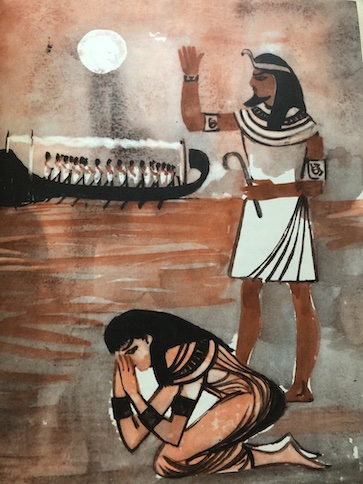
In the second son’s story, there is a powerful wizard named Zaza-man-khu in the reign of King Sene-fe-ru. When Sene-fe-ru is feeling down, he asks Zaza-man-khu for something to cheer him up. Zaza-man-khu suggests a boating trip on the palace lake, rowed by singing maidens. At first, the trip is pleasant, but then, something happens that upsets all of the maidens, and they stop singing and start crying. Soon, everyone is crying so hard that it’s difficult for the king or his wizard to find out what’s wrong. It turns out that one of the maidens lost a precious jewel in the water, and it was some kind of lucky amulet. Now, she’s worried that something bad will happen to her, and all of the other girls are crying in sympathy with her. The king promises that he will give the maiden plenty new jewels if she stops crying, but she says that she needs that particular amulet, and none of the other maidens will start rowing the boat again until they figure out what to do. The king’s wizard is able to retrieve the lost jewel by parting the waters in the lake so he can walk out across the bottom of the lake and find it. King Khu-fu finds the story mildly interesting and says that it would be impressive if there was such a wizard in their time.
King Khu-fu’s eldest son says that he knows of such a wizard, a man named Didi, who is supposed to be 110 years old. Interested at last, King Khu-fu says that he wants to meet Didi. According to stories about Didi, he can restore life to a person or animal after it’s been beheaded, but how far will they make him go to prove it?

Isis and the Secret Name of Ra – This story explains the origins of the goddess Isis. In the beginning, Isis is not a goddess but a clever young woman. Although she is clever and has extensive magical knowledge, it isn’t enough for her. She wants to learn the secret name of the sun god Ra (Ra isn’t the secret name itself) to gain power over the whole world. People call Ra by many different names, but Isis is aware that he has one secret name that no one knows and from which he derives his power. Isis creates a magical snake that bites Ra, and Ra experiences pain for the first time. Isis offers to help heal him from the bite (that she caused), but she says that she needs to know Ra’s secret name. Ra says that if she knows the name, she will also become immortal, and Isis says that she’ll try to bear it (wink, wink). So, Isis becomes immortal and heals Ra from the poisonous snake wound.
After she becomes a goddess, Isis continues living as a mortal woman for awhile, but then she marries King Osiris. Osiris is a great king who teaches his people how to farm, and Isis teaches them healing arts. Their kingdom is great and peaceful, and Osiris and Isis have a son they name Horus. For a long time, no one, not even Osiris, knows that Isis is actually an immortal goddess. However, Isis’s powers allow her to sense evil and deception from Osiris’s jealous brother, Set. Osiris can’t believe that his brother is evil. Then, Set tricks Osiris into getting into a chest and throws him into the river and drowns him.
When Isis realizes what has happened, she realizes that she has the power to restore Osiris to life. At first, Isis is unsuccessful in her attempt to bring Osiris back to life because too much time has gone by since his death, but Thoth, the god of wisdom, has pity on her and Osiris and raises Osiris to serve as king of deserving spirits among the dead.
King Setnau and the Assyrians – King Setnau is a gentle and peaceful king, so even though Egypt has enemies, he does not try to improve Egypt’s army. Although most citizens love King Setnau, his generals don’t. When the King of Assyria decides to invade, seeing Egypt as easy prey, the angry Egyptian army refuses to obey the king and fight for Egypt. In despair, King Setnau prays at the temple and then tells his people about the army’s refusal to obey him. The ordinary citizens decide that they will be the king’s new army themselves. They are untrained and have mostly improvised weapons, and Egypt’s official army doesn’t take them seriously. However, King Setnau is appreciative of their loyalty and prays the he will be a suitable leader to them so they can save their kingdom. In the end, they are successful with a little help from the gods and a swarm of field mice.

The Wonder Child – King Usi-ma-res has a son who is a wise sage, Sat-ni. However, Sat-ni is unhappy because he and his wife have been unable to have a child, and they want one more than anything. Sat-ni’s wife prays for a child, and finally, she gives birth to a son, Se-Osiris. Se-Osiris turns out to be remarkably intelligent and learns very quickly. As he progresses in his studies, he begins learning magic, and by the age of twelve, he is already a master magician.
One day, a man from Ethiopia comes to the pharaoh’s court with a challenge: he has a sealed book and he wants to see Egyptian wizards attempt to read the book without breaking the seal. The pharaoh consults with all of his wizards and magicians about the book challenge, and Sat-ni says that he suspects that the book and its contents are protected by some kind of spell that will prevent the Egyptian wizards from reading it. However, Se-Osiris insists that he can read the book. To demonstrate, he proves to his father that he can read any book from his father’s library even though he has never seen it before while his father holds it sealed in another room. Pleased and amazed with his son’s skill, Sat-ni brings Se-Osiris to court to answer the challenge.
At first, the Ethiopian man sneers at the young boy who claims that he can answer his magical challenge, but the pharaoh says that it’s a sign of how great Egyptian magic is that even a twelve-year-old Egyptian can answer any challenge that Ethiopia could set. In front of everyone, Se-Osiris reads the book without even touching it, telling an ancient story about three Nubian magicians and their boasting of the ways that they would punish the King of Egypt for the amusement of their king and how the King of Egypt gets revenge.
However, the story doesn’t end there. The mysterious Ethiopian turns out to be the spirit of one of the magicians from the story in the book, who was disgraced through the magic of the Egyptian magicians and who has come back to settle the score. Se-Osiris must now face him in a magical duel.
The Thief and the King’s Treasure – King Rhamp-si-ni-tes loves gold and treasure more than anything. He loves it so much, he allows criminals and corrupt official to buy their way out of trouble. The king compromises law and justice in the land, thinking only of getting more gold and jewels. He neglects the state of his kingdom and even his own daughter. Soon, the king also becomes paranoid, constantly afraid that someone might take some of his beautiful treasures. Finally, the king hires an architect to design a safe place to keep his treasure, a vault no thief could enter.
However, the king is a terrible ruler and also a dishonest man. He pays the architect only a fraction of the money he promised him, so the architect clever engineers a secret entrance to the treasure vault so he and his sons can enter any time they want and help themselves to the money that the king owes them and all of his other subjects.
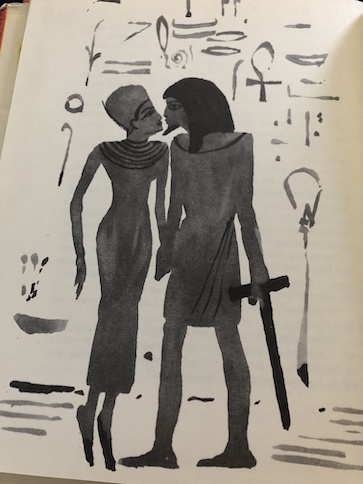
For awhile, it works, but then, the king notices that someone has been taking some of his treasures. He has some metal workers build a terrible mantrap that traps one of the architects sons. When it becomes clear that he is hopelessly trapped and their whole family may suffer the king’s wrath once he realizes who has been stealing from him and how it was done, the trapped son tells his brother there is only one, terrible solution – his brother must cut off his head. The trapped brother will die anyway because the king will have him killed, but if his brother removes his head, no one will be able to identify him, and the rest of their family will be safe. Reluctantly, his brother does as he asks.
However, the fact that the head was removed from the body tells the king that the dead thief must have had a confederate. He has his guards display the body of the thief publicly on a hill and watch for anyone who shows grief at seeing it. The dead man’s mother quietly grieves at the loss of her son, and when she says that she wants to see her son properly buried, his brother figures out a clever way to retrieve the body.
The king is enraged, but his neglected daughter decides that she also wants to find the thief, seeing it as her chance to secure her future in spite of her father’s neglect. She promises her father that she can find the thief but only if he promises her that she can have whatever she wants afterward. The king promises, not realizing that the one thing that the princess wants is to marry the thief.







 Jestress's Forgotten Books and Stories