The Legend of the Bluebonnet

LegendBluebonnet

The Legend of the Bluebonnet by Tomie dePaola, 1983.

This is a story about the Comanche People in what is now Texas, based on an old folktale.

There has been a severe drought and famine in the land for a long time, and many people have died.  The survivors pray to the spirits for help in ending the drought, and they receive a sign that it will not end until someone among the Comanches makes a sacrifice of the thing that is most dear to them.

LegendBluebonnetShaman

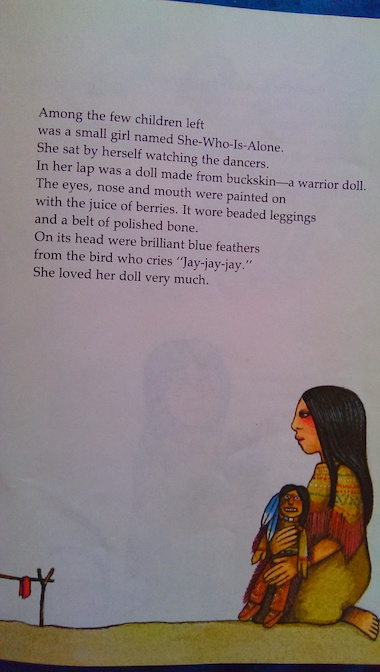
The people debate about who is supposed to make the sacrifice and what object the spirits could want, but one young girl thinks that the spirits are talking about her and her doll.  The girl is called She-Who-Is-Alone because she is the last of her family.  Her parents and grandparents are dead, victims of the famine.  The only thing she has left to remind her of them is her doll, a warrior with blue feathers in its hair, that her parents made for her before they died.

Desperate to end the drought and famine and to save her people, the girl makes the difficult decision to sacrifice her doll by burning it.  Her sacrifice is rewarded not only by the end of the drought but by the sudden appearance of a field of flowers as blue as the feathers in her doll’s hair.  The girl receives a new name from her people, acknowledging her sacrifice on their behalf.

LegendBluebonnetFlowers

A section in the back of the book explains a little about the Bluebonnet flower, which is the state flower of Texas, and the origins of the story in the book, which is based on a folktale.  This is also a little information about the Comanche People.

The book is currently available online through Internet Archive (multiple copies).

Giving Thanks

GivingThanks

Giving Thanks by Kate Waters, 2001.

This book describes the feast of 1621 that we think of as “the first Thanksgiving” from the point of view of two boys: Resolved White (a six-year-old English colonist) and Dancing Moccasins (a fourteen-year-old Wampanoag).  The book explains that the reality of this feast is somewhat different from the way many people think of it.  For one thing, the exact date is unknown, and it wasn’t really a single meal but a kind of harvest celebration that took place over several days.  The events of that celebration were re-created using reenactors from the Plimoth Plantation living history museum.

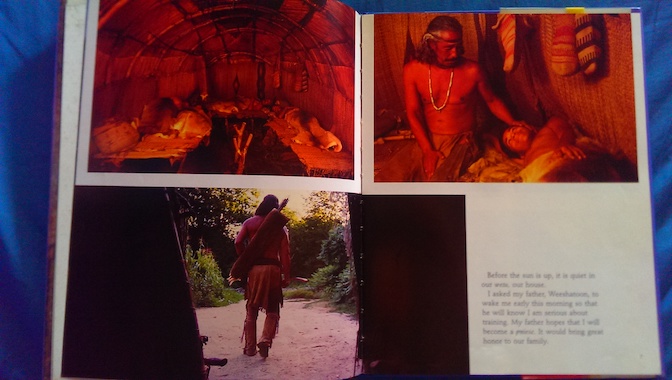
In the beginning of the book, Dancing Moccasins explains that his family has been harvesting their crops and preparing to move to the place where they live in the winter. Wampanoag lived in different places depending on the time of year, moving between them when the seasons changed.  At their winter home, they would continue hunting and fishing, returning to the place where they planted their crops at the end of winter.

GivingThanksBeginning

Similarly, Resolved’s family has finished harvesting their crops and have stored up food for the winter.  Now that most of the hard work is over, they have time to relax and celebrate.  The community is planning a feast.  Resolved and his friend, Bartle, follow some of the men, who are going out hunting and target-shooting.

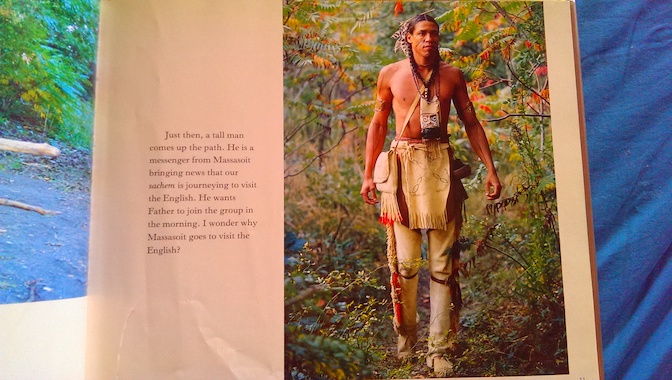
The colonists meet up with some of the Wampanoag, which is how Dancing Moccasins and Resolved first see each other.  Dancing Moccasins returns home and tells his father what he has seen.  Then, a messenger arrives from their chief, Massasoit, saying that he will be visiting the colonists soon, and Dancing Moccasins’s father is invited to come.

GivingThanksMessenger

Just as Dancing Moccasins is wondering about the purpose of this visit, Resolved is wondering the same thing because word has reached the colonists that they will soon be visited by the chief and representatives of the tribe.  (The book explains in the back that the exact reasons for the Wampanoag visit to the colonists are unknown today, only that it happened at the same time that the colonists were planning their harvest feast.) The two boys meet again when Dancing Moccasins accompanies his father on the visit to the colonists’ village.

GivingThanksGovernorDinner

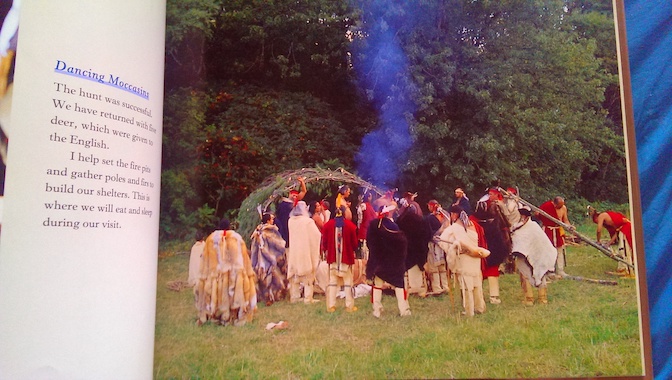
When the Wampanoag arrive at the village, they are treated as honored guests, and some of the Wampanoag go deer-hunting to provide a present for their hosts.  The chief dines with the governor of the colonists.  The Wampanoag build shelters for themselves, where they will stay during their visit.

GivingThanksShelters

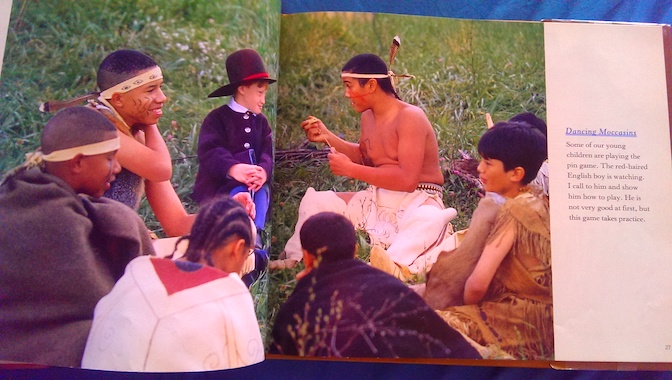
Eventually, Dancing Moccassins invites Resolved to play a game with him and some other Wampanoag boys when he sees him watching them.  Some of the Wampanoag men also join in the games that the English men play, like competing to see who can throw a log the farthest.

GivingThanksGames

At the end of the day, Dancing Moccassins and Resolved each eat with their own families, but there is plenty for everyone.

There is a section in the back with historical information about the harvest feast, traditions about giving thanks among both the colonists and the Wampanoag, and how Thanksgiving eventually became a national holiday in the United States.  There is also information about food and clothing in the time of the story and a recipe for samp (a kind of corn pottage eaten by the Wampanoag and later adopted by the English colonists).  The book also has some information about the Plimoth Plantation living history museum and the reeanctors.  It is part of a series of books by the same author about the lives of children in Colonial America.

The book is available to borrow and read for free online through Internet Archive.

Tapenum’s Day

Tapenum's Day

Tapenum’s Day by Kate Waters, 1996.

This is about a day in the life of a Wampanoag boy living in the area around Plymouth, Massachusetts during the 1620s.  His life is reenacted by Issac Hendricks, who was a participant in the Wampanoag Indian Program at the Plimoth Plantation living history museum.

In the beginning, Tapenum introduces himself, explaining a little about his people and the strangers who have only recently come to their land, the English colonists, whom the Wampanoag call wautaconuoag (meaning “coat-men”).  Tapenum has just learned that he was not among those young men chosen to train as pniesog, a special kind of warrior among the Wampanoag who also possessed spiritual powers and acted as advisors and diplomats for their chief.  It has come as a great disappointment to him that he was not chosen for training.  To improve his chances of being chosen later, Tapenum has decided to train himself to improve his strength and hunting abilities.

Tapenum's Day Begins

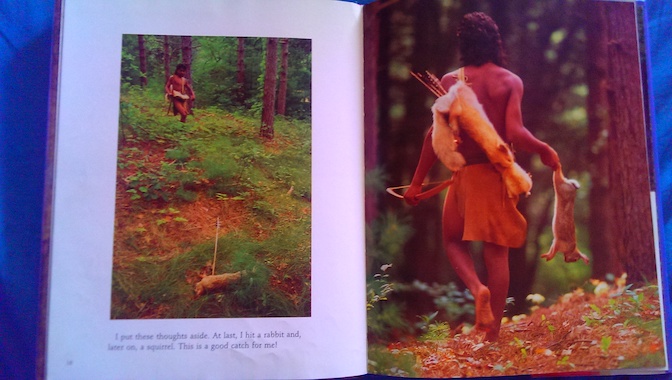
Tapenum goes out hunting early in the morning, while his mother and sister are still asleep.  He starts before eating anything because he says that being hungry “makes the hunter more serious.”  Eventually, he catches a rabbit and a squirrel.  His mother is pleased with his catch, although his father has done even better by bringing home a wild turkey, which is even more difficult.

Tapenum's Day Hunting Trip

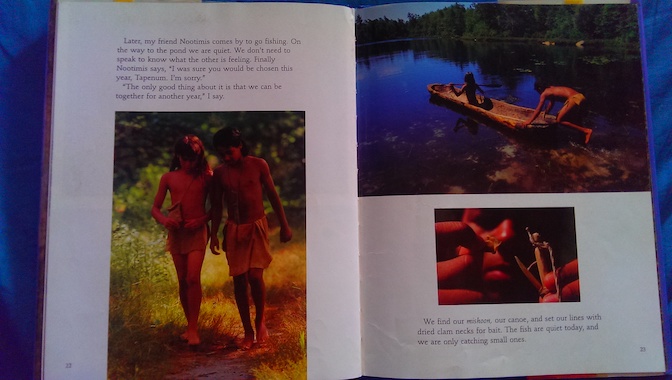
Later, Tapenum meets up with a friend, Nootimis.  The two of them go fishing in a canoe.  Nootimis knows that Tapenum is disappointed about not being chosen, but Tapenum says that at least he can still spend time with him before (hopefully) going away for training next year.

Tapenum's Friend

After fishing, Tapenum goes for a run as part of his training, and he sees smoke.  When he investigates, he finds an old wise man named Waban making a canoe.  Waban was a pniese himself when he was younger, and Tapenum offers him the fish he caught, hoping that Waban can tell him some things that will help him to be chosen for training.

Tapenum meets Waban

Tapenum ends up spending the rest of the day with the older man, learning and perfecting his skill at fletching arrows.  Waban also explains to him the importance of patience.  Tapenum is in too much of a hurry to grow up and begin serious training, but growing up takes time and so does developing the kind of strength and wisdom that he will need as warrior.

Tapenum learns some lessons

There is a section in the back of the book that explains more about the Wampanoag people, the the Wampanoag Indian Program, the Plimoth Plantation living history museum (now called Plimoth Patuxet), and the boy reenacting Tapenum’s life.

This is part of a series of books focusing on the lives of children in Colonial American history.  It is available to borrow and read for free online through Internet Archive.

Mandie and the Ghost Bandits

MandieGhostBandits#3 Mandie and the Ghost Bandits by Lois Gladys Leppard, 1984.

Mandie and her family are going to proceed with the plan to create a hospital for the Cherokees with the gold that they found in the cave. To do that, they need to take the gold to a bank in Asheville.  They decide to take the gold secretly on a train. Uncle Ned stays in the baggage car to watch the gold as they set out on their journey.

When the kids decide to leave their car to go visit him, strange things begin to happen. They see riders dressed as ghosts out the window. Then, the car with Uncle Ned and the gold inside is disconnected from the rest of the train, crashing into a ravine. The train comes to a stop, and the kids jump off to see if they can help Uncle Ned.

Before they can find him, the train starts up again, leaving them behind, and they are taken prisoner by the mysterious ghost bandits. They are after the gold in the baggage car, but how did they know it was there when Mandie’s family tried so hard to keep it a secret? Mandie and her friends must escape and find the others before it is too late!

In some respects, I would call this more of an adventure story than a mystery, although there is still the question of how the bandits knew where the gold was in order to steal it.

The book is currently available online through Internet Archive.

Mandie and the Cherokee Legend

MandieCherokeeLegend#2 Mandie and the Cherokee Legend by Lois Gladys Leppard, 1983.

Mandie is going to visit her Cherokee relatives with her mother and Uncle John. Mandie is eager to meet her relatives, and she hopes that they all like her. The Cherokees all knew her father well, and most of them are eager to meet her. All except for her cousin, Tsa’ni, that is.

Tsa’ni knows the stories of how white men have oppressed the Cherokees and forced them to move off of their land years ago, and he resents all white people because of it. The others tell him that he is wrong to hate all white people because of what some of them did in the past and that Mandie and her Uncle John are good people. However, Tsa’ni doesn’t listen to them, and he plays a mean trick on Mandie, Joe, and Uncle Ned’s granddaughter, Sallie. He offers to show them a cave, but then he abandons them inside.

The three kids have to find their own way out, but they discover a fortune in gold nuggets in the process. First, the children have to make it back to Uncle Ned’s house after a frightening night in the woods. Mandie, Joe, and Sallie accidentally stumble onto a still (machinery for making alcohol) that belongs to a white couple while they are wandering around in the woods after leaving the cave. The couple are worried that they will tell people about their illegal still, so they hold the kids prisoner.

Although the kids manage to escape, they must return to the cave to find the treasure again (while dodging Tsa’ni’s tricks to foil their efforts) and keep it safe (from the still operators and anyone else who might want to steal it) until they can decide what to do with it. As far as Uncle Ned and the other Cherokees are concerned, gold is bad luck because it was the discovery of gold which forced the Cherokees out of their old homeland. However, the origin of this gold may help to change their minds.

This book is one of the Mandie Books.  It is currently available online through Internet Archive.

Mandie and the Secret Tunnel

MandieSecretTunnelMandie and the Secret Tunnel by Lois Gladys Leppard, 1983.

Young Amanda Shaw is almost twelve when her father dies, leaving her with a bully of a sister and a mother who doesn’t really love her. Her only friends are Joe, who is the son of the local doctor, and Uncle Ned, a Cherokee Indian. Amanda and her father are part Cherokee, and Uncle Ned helps to look after her now that her father is gone. Then, Amanda’s mother remarries and sends her to live with another family who want someone to help them look after their young son. However, the family is rather mean to Mandie, exploiting her for cheap labor, and Uncle Ned offers to take Mandie to live with her uncle in the town of Franklin.

Mandie never knew that her father had a brother (Uncle Ned is Mandie’s “uncle” by affection, not blood), but she readily agrees to go to him. Uncle Ned and some other Cherokees help Mandie to sneak away in the middle of the night and make the journey to Franklin. When she arrives at her uncle’s house, she is taken in by the servants, but she is told that her uncle is away in Europe.  Mandie’s uncle turns out to be rich, and Mandie is very happy in his house. She gets new dresses for the first time in her life and makes friends with Polly, the girl next door.

Then, word comes that her uncle has died in Europe. Her uncle’s will is missing, and no one knows exactly what will happen to her uncle’s property or to Mandie until it is found. Strangers come to the house, saying that they are also relatives of Mandie’s uncle, but Mandie wonders if they really are who they claim to be. With the help of Polly and Joe, who comes to visit her, Mandie searches for her uncle’s missing will and accidentally finds a secret tunnel leading out of her uncle’s house.

As Mandie and her friends investigate this mysterious situation, where things and people aren’t what they claim to be, Mandie learns that her own past isn’t what she believed it was.  Her family has kept many secrets from her, and learning these secrets leads her to a better future than she’d ever imagined.

This book is one of the Mandie Books.  It is currently available online through Internet Archive.
Key to the Treasure

keytreasureKey to the Treasure by Peggy Parish, 1966.

When twins Liza and Bill and their older brother Jed visit their grandparents for the summer, their grandfather tells them the story of a treasure hidden somewhere on their farm. Over a hundred years ago, their great-great-grandfather was friends with an Indian (Native American) woman. When she died, she left her belongings to him, including a feathered bonnet, a leather shield, a mask, and a doll.

When he grew up, he went away to fight in the Civil War. Before he left, he hid three of the items (the shield, the mask, and the doll) and made up a series of clues to help his children find them.  Unfortunately, the first clue was lost, and he never returned to tell his children where he hid the treasure. The only clue that was left was a picture of the feathered bonnet, a little pot, and a strange-looking key.  From then on, each generation in their family has tried to solve the puzzle. Since so many generations of their family have failed to find the treasure, Liza, Bill, and Jed don’t have much hope for success until they accidentally stumble on something that gives them their first clue.

keytreasurepic1Together, the three children quietly work on the clues, following each to the next.  They hope to surprise their grandfather with the solution to this old family mystery.  But, can they?

The clues to the treasure take the form of word games and codes (the first is a simple substitution code, and the other two are word games). Young readers will find it challenging to solve the codes along with the children in the book (Liza, Bill, and Jed walk readers through their solutions as they work on the puzzle, even showing how they correct for mistakes along the way), although older readers may find them rather easy.  It’s a good book for introducing children to codes and word games if they haven’t really encountered them before.  For the challenge of it, you can stop reading at each new puzzle and attempt to solve it before the kids do!

This is the first book in the Liza, Bill, and Jed Mysteries series.  It is currently available online through Internet Archive.

The Mystery in Old Quebec

mysteryoldquebecThe Mystery in Old Quebec by Mary C. Jane, 1955.

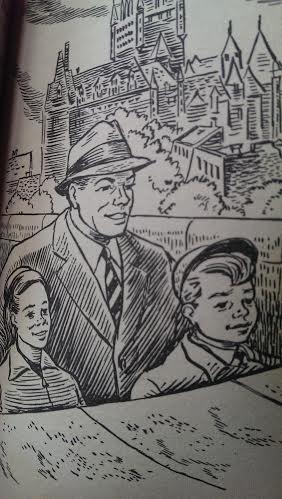
Mark and Kerry, a brother and sister, are visiting Quebec with their father, who is on a business trip. Their father allows them to explore the city on their own during the day while he works (something that would be unlikely to happen in modern times). The kids enjoy sight-seeing and learning French words and phrases.  They even make a new friend in the city, but they are troubled by events at the quaint little inn where they are staying.

On their first day there, Kerry’s coat mysteriously disappears and reappears with some strange messages in the pocket.  A boy wants them to take a message to someone in the city.  At night, Kerry hears someone crying in the next room. Is the boy being held prisoner at the inn? If so, why? Kerry and Mark are determined to help in any way they can, but time is running out.

The book is currently available online through Internet Archive.
My Reaction and Spoilers

mysteryoldquebecpicThe solution to the mystery involves family quarrels, custody issues, and racial tensions. In spite of that, this is actually a very gentle story.  In the end, the kids are dependent on the people the mysterious message was intended for to help a troubled, lonely child.  It turns out that the boy is an orphan, and some of his relatives are white, and some are First Nations (Native American). There is a fight for the boy’s custody, but the boy knows where he really wants to be.

The author describes the atmosphere of Quebec in some detail. The famous landmarks probably haven’t changed much, although I don’t know if all the descriptions are accurate anymore. I also thought it was interesting how the author includes some French phrases and their pronunciations and translations as the kids learn to communicate with French-speaking people in the city.

The Ghost on the Hill

ghosthillThe Ghost on the Hill by Grace Maccarone, 1990.
This is the last book in the Third Grade Ghosthunters series.

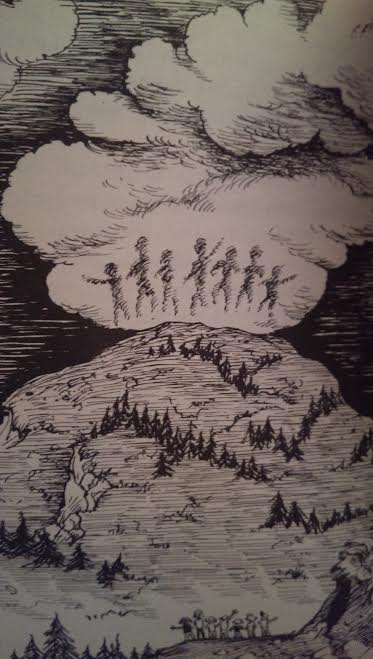
The kids take another field trip, this time to a state park. Native Americans used to live on that land, but most of the tribe died from disease many years ago. There are stories about spirits that live in the hills and the forest. Young boys from the tribe used to perform a ritual where they would dance with the Great Spirit in order to become men.

The third graders have been studying Native American history and customs to prepare for the field trip.  Norma wrote a report about Native American names, which tended to describe some significant characteristic of the person.  Their teacher tells the students that they should think of names for themselves which describe something significant about themselves.  Most of the kids think it sounds like a fun idea, but Joey doesn’t.  He’s just one kid in a family with a dozen other kids, and he’s never felt like there was anything particularly special about him.  That’s why he makes up tall tales about himself that all the other kids find weird and annoying.

ghosthillpicWhen they reach the state park, Dennis Ten Foot Bridge, who is the last of his tribe, tells the students about his tribe, teaches them wilderness skills, and leads them in group activities.  One evening, Joey goes out to practice some rowing on the lake by himself, and he sees what looks like a large ghost at the top of a hill  However, everyone knows that Joey lies about a lot of things, so at first, no one believes him.  At least, no one except Adam.

Adam agrees to help Joey investigate the mysterious spirit. Eventually, all of the members of the ghosthunting group decide to go up on the hill together to see the ghost for themselves.  There, Joey finds the courage to face the spirit directly, and everyone sees the truth. Together, Joey and his friends end up repeating the ancient coming-of-age ritual that the tribe that used to live there would perform.

The solution to the mystery is a little strange, but the book is great for the characters alone. This final book in the Third Grade Ghosthunters series is a coming-of-age story. The other books in the series addressed personal issues and personality quirks in the characters as side-plots, such worrying about not being as smart others, worries about making and keeping friends, and the trouble with teasing. This one focuses on Joey and his sense of identity. He’s always felt that there is nothing special about him compared to his brothers and sisters. In this story, he develops his own character more and gains new confidence. In the process, he ends up becoming more comfortable with his role as a kid in a family with many children as well as appreciating his own uniqueness.  He also finds a name for himself that expresses his new sense of identity.