Bird Wise by Pamela M. Hickman, illustrations by Judie Shore, 1988.
This is a beginning guide to birds and bird watching for kids. I thought that the guide was very helpful with nice, detailed illustrations. The book explains the appearance, biology, and lives of birds and offers activities to help readers understand and interact with birds.
The first section in the book is about the appearance and body parts of birds. It explains how different birds have differently-shaped beaks and feet and different types of feathers and how the differences help each type of bird eat the foods they like and live in the places where they live. One of the activities for this section is about how to start a feather collection. The book also explains that different birds have different styles of flying.
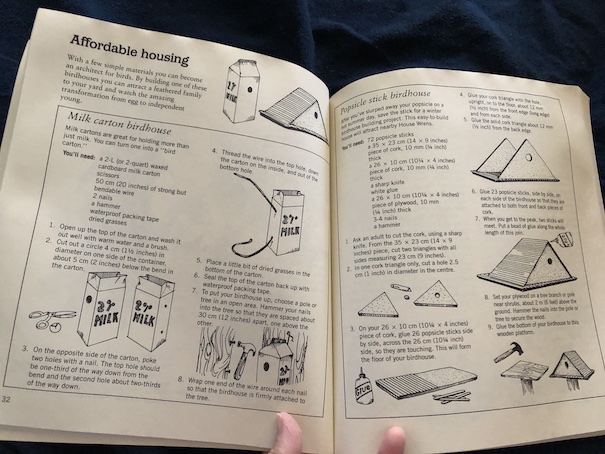
The section about how birds live explain about different types of bird nests and how they migrate and raise their young. The book explains different methods for making bird feeders and bird houses.
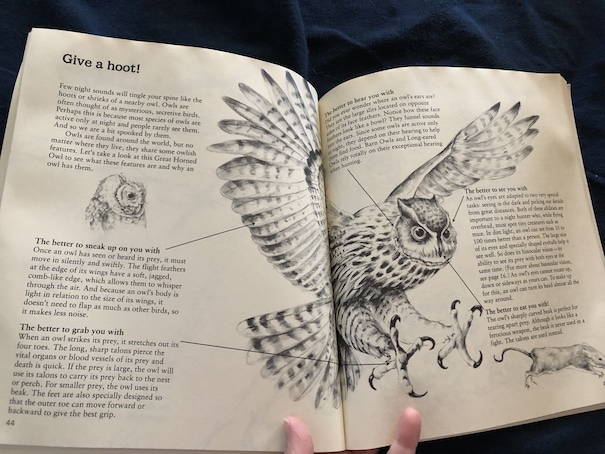
The book profiles certain specific types of birds, including owls (there is an activity about dissecting owl pellets, which I had to do when I was in elementary school), gulls, hummingbirds, and woodpeckers.
In the section about bird watching, the book offers tips for what to look for to identify a bird’s type. It also explains how to make bird blinds to avoid being seen and how to recognize types of bird songs.
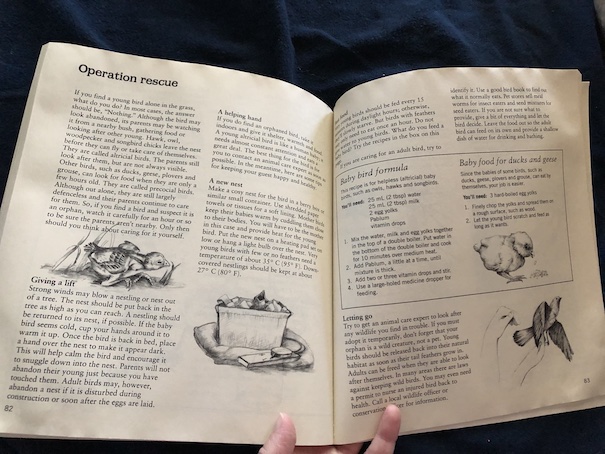
The book also contains other helpful information, like how to care for injured birds and how to plant a garden that will attract birds. It also includes a board game that emphasizes some of the lessons about birds in the book.
Overall, I was pleased with the range of information in the book. It was interesting and well-presented.
The book is available to borrow and read for free online through Internet Archive.
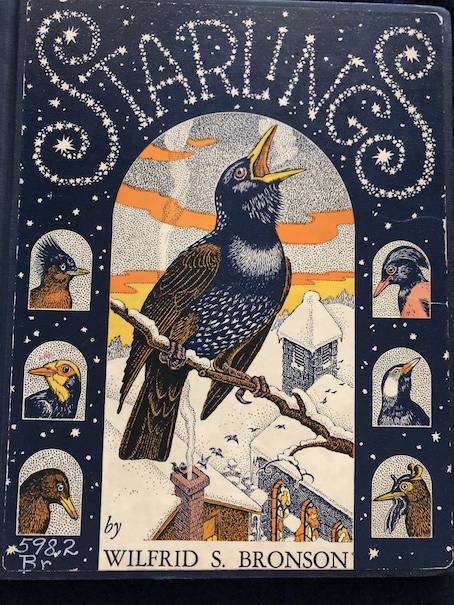
The title of the book tells you what it’s about; this is a children’s picture book about starlings. That sounds pretty straight-forward and even a little dull, but there is more to learn about starlings than I imagined, and the author of this book has an imaginative way of explaining information. I love books that cover odd topics in detail, and I enjoyed the whimsical quality of this book. The pictures are detailed black-and-white drawings, some with captions like comics. Most of them explain the anatomy of the birds or their habits, but they have some unique ways of expressing educational information.
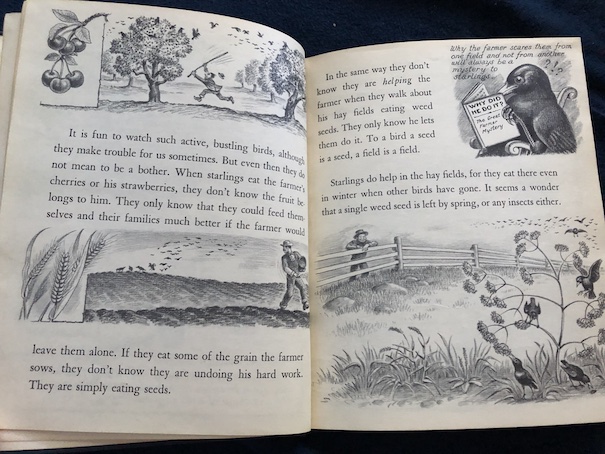
The book begins by describing the singing of starlings and then explains how farmers view starlings. Starlings can be a pest to farmers when they eat their fruit or the seeds the farmers are trying to plant, but they can also be helpful when they eat weed seeds and prevent weeds from coming up in the farmers’ fields. Of course, the birds don’t know when they’re helping or hindering because, as far as they’re concerned, they’re just there to eat any food that happens to be available at the moment. I like the little picture of the bird reading a mystery book, trying to figure out why farmers don’t mind when they eat some seeds and try to scare them away from others. That’s an example of the whimsy I was talking about.
The book continues describing what starlings eat and places where they like to roost, and it explains how they affect people living in cities (mainly, messing up their cars). There were times when people in cities considered them such a nuisance that they would shoot them, and some poor people hunted them for food. Actually, the entire reason why we have starlings in the US is that people over-hunted other types of birds (there is a disturbing picture of hunters with piles of dead birds at one point in the book), and birds are an important part of the ecosystem. Even though they can annoy farmers when they eat seeds and fruit, they also eat bugs that are pests to crops.
I was really struck by the passage that explained how starlings were first brought to the United States and why they were brought here:
“Some people think that starlings have no right to food or nesting-places because they are not ‘American birds.’ Yet all the starlings you see were born in America. So were their parents and grandparents and great-great-grandparents and all their relatives clear back to 1890. In that year their ancestors were caught in Europe and brought in cages to America. So many American birds had been killed at that time by our own ancestors that our crops were growing wormier and wormier each year, while insect pests grew worse and worse. So starlings were imported to help us fight the insects. They were freed in Central Park in New York City and left to look out for themselves.”
This explanation uses simplified language for children, and it also oddly evokes imagery of human beings. We don’t normally refer to animals as “foreigners” because animals don’t speak different human languages or have allegiances to foreign governments like people from other countries do. When we talk about new species that have been introduced to an environment where they did not originally belong and quickly spread out and multiple, we usually call them “invasive species.” In that case, the ecological concern is that the new invasive species will disrupt the balance of the natural environment and crowd out native species, but the author is trying to point out that the situation with the starlings was different. The starlings were introduced to the environment in the US on purpose, not by accident, and it was done specifically because they were meant to a solution to a problem. The environment had already been disrupted by humans who had moved into areas where they had not lived previously and where they killed too many of the native species themselves without regard to what that would do to the natural environment and their own farming. The introduction of the starlings was meant to restore a balance that had been lost. However, the people who had originally caused the problem didn’t see it that way, seeing the starlings as pests because they were “foreign.” While birds in general may occasionally be a nuisance because they don’t understand human priorities, they still perform useful functions for human beings as they go about their lives, just being the birds they are – eating annoying weed seeds and bugs and scavenging food from what humans throw out.
“People who think that starlings should be starvelings because they are ‘foreigners’ should remember that these American-born birds save much of what they themselves throw away and are still helping us to fight insects as they did in 1890.”
I understand what the author is trying to explain about balance in the ecological system, but I was struck by the human imagery that the passage evokes: “Foreigners” who came to New York City, not unlike immigrants fresh off the boat from Ellis Island during the 19th century, set free to make their way in a strange environment among people who often regarded them as worthless pests, disliking them while still using the useful services they provided. The comparison still fascinates me. At first, I wasn’t sure that the author meant to make that broader comparison here. I thought he probably used that language just to simply the ecological concepts for children’s understanding, but the author does make another comparison a little further on:
“So let’s be fair. If American-born starlings are foreigners, then so are all people in America except the Indians (Native Americans). So are many kinds of birds, animals, and plants. Our ancestors brought them here from other countries. But if all these creatures, and ourselves, are American now, then so are the starlings. Yes indeed!”
So get off your high horse, starling-haters.
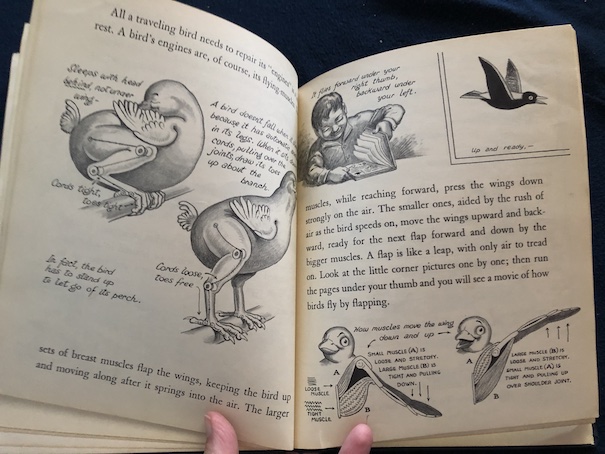
At several points in the book, the author compares birds to airplanes, explaining their muscles and flying mechanisms like machinery. I liked the page where the author compares different planes and helicopters to types of birds (cruisers being like gliding eagles and albatrosses, fast-turning speed planes like starlings and swallows, and hovering helicopters like humming birds). The parts that describe how birds cling to branches as they sleep and how their wings move look accurate and helpful. The part about how a bird creates eggs is hilarious. The text about the formation of the egg inside the bird isn’t bad. It completely skips over the subject of the fertilization of eggs (understandably), and the picture show the bird as a kind of egg-making factory with little men assembling the parts of the egg in stages instead of showing a bird’s reproductive anatomy.
In the upper right corners of this section of the book, there are little squares with a flying bird because part of the book is meant to be uses as a flip book to see a bird flying. The page shown above with the boy flipping through the book shows how to use the flip book portion.
There is a section of the book that explains how baby birds develop in the egg and eventually hatch.
There is also a section in the book that shows how adult starlings will prepare a nest for their eggs and how they raise their babies.
As I was reading the book, I wondered who the author, Wilfred S. Bronson, was. Bronson was an artist specializing in natural history, and he wrote and illustrated other books for children about animals and natural history. In the years before he wrote this particular book, he served in the US Army during World War I and painted murals for the Works Progress Administration (WPA) during the Great Depression. He also participated in expeditions to gather specimens and create illustrations of wildlife for botanical gardens and museums.
I haven’t found a copy of this particular book to read online, but it was republished in 2008 and is still available from Amazon.
This is a reprint of an earlier book, and it’s interesting because this was part of an educational science series. The author was from the University of Chicago, and the accuracy was verified by Walter H. Chute, the Director of the John G. Shedd Aquarium at the time.
As a child, I was never particularly interested in fish. My mother had a fish tank with pet fish, but I lived pretty far from large bodies of water and never went fishing. For years, this book, probably purchased at one of the many used book sales my family attended over the years, went unread. However, as an adult, I like reading children’s books about very specific topics because they often include some fun and usual facts.
The book begins by explaining to child readers how goldfish are similar to and different from human beings. It seems pretty straight forward, but they point out some thoughtful similarities and differences. Both fish and humans need to breathe, but they do it in different ways, which is why humans drown in water and fish effectively drown in air. The book also points out that goldfish cannot move their heads independently of their bodies in the way that humans do.
In the section called “The Story of the Goldfish”, the book explains how wild goldfish were first kept as pets in China and Japan. Wild goldfish actually have a variety of colors, but hundreds of years ago in China, people liked the yellow or gold ones best as pets, and they began deliberately breeding fish with these colors, which is how they came to be known as “goldfish.”
The book defines “fish” as creatures with gills, fins, and backbones but no arms or legs. It uses this definition to separate fish from other aquatic creatures like whales (no gills, actually a mammal with lungs), jellyfish (no fins, gills, or backbone), crabs (gills but no fins, arms and an exoskeleton instead of a backbone), and starfish. It also explains the difference between fish that live in salt water vs. fish that live in fresh water.
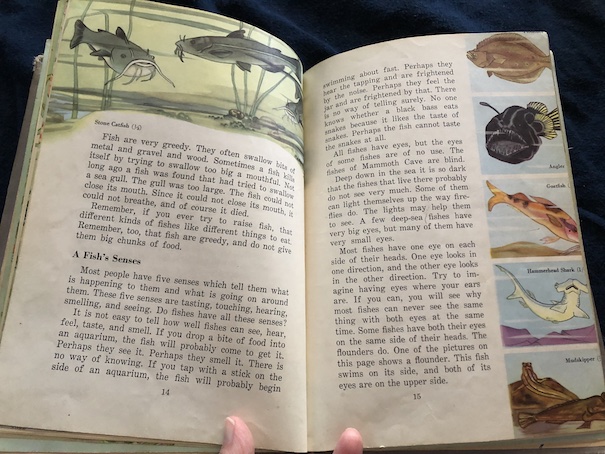
The book explains what different types of fishes eat, how they’re born (most hatch from eggs), how they defend themselves, and how they migrate. In one section, the book explains how fish have some or all of the five senses that humans have (sight, hearing, smelling, taste, and touch), but they have them to different degrees and use them in different ways.
The book presents information about some specific types of fish, and it even mentions that some types of fish are endangered species. I usually associate environmental messages with the late 20th century, but this book discussed the over-fishing of sturgeon and the ecological dangers of erosion caused by deforestation on river banks and factory waste dumped in water in the mid-20th century.
The book ends with a list of tips for observing fish.
The book presents a pretty comprehensive beginner’s guide to fish in general, and I really appreciated the mentions of environmental issues. My one criticism is that the book could use more pictures and especially bigger pictures. All of the pictures are in full color, but most of them are rather small, just in the corners or edges of the pages, which are mostly full of text. I just think that larger pictures would be more appealing and more child-friendly. There are even places where the edges of the pictures and their captions are cut off by the edges of the book (as shown in two of the pictures of pages above), which looks clumsy and annoying. The book seems pretty authoritative, but I think it could have been presented better. I’m not sure how people who originally read this book looked at it, but I didn’t like the size and positioning of the illustrations.
I couldn’t find an online edition of this vintage nonfiction children’s book, but I did find online editions of other nonfiction books for children by the same author through Internet Archive.







 Jestress's Forgotten Books and Stories