Magdalena

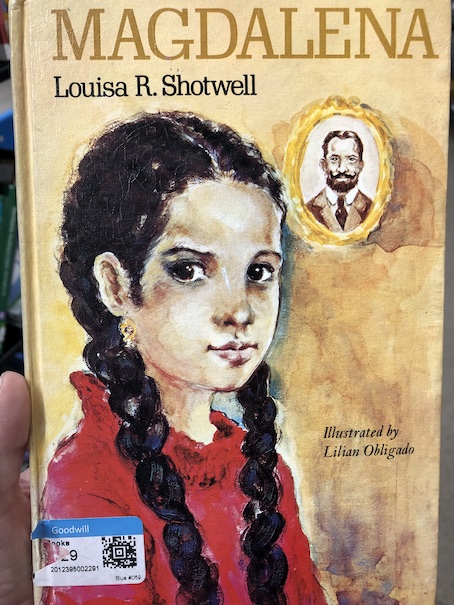
Magdalena is switching classes at school. She’s happy about it because she found her old class too chaotic. She thinks she will be happier in her new class. Her friend in her current class at school, a boy named Saul, tells her that she must be an IGC, an Intellectually Gifted Child, in order to get transferred to that class because that class only takes gifted children. However, she is told that she will also have to wait a little for them to give her a desk in the room. When months go by without her being told that there is a spot ready for her and she can make the switch, Saul thinks that they were probably lying to her about her being able to switch classes.

Finally, in January, she is able to switch to the new class, but right away, she runs into trouble with the class bullies. A boy named Andy and his friend start calling her “Miss Two-Ropes” because of her long braids, and the name sticks. Magdalena wishes that she didn’t have to wear her hair in braids, but her grandmother, Nani, insists on it. She loves Nani, who is from Puerto Rico and has looked after her for last two years, ever since her mother died when she was nine years old, but Nani has some old-fashioned ideas about how girls ought to be raised.
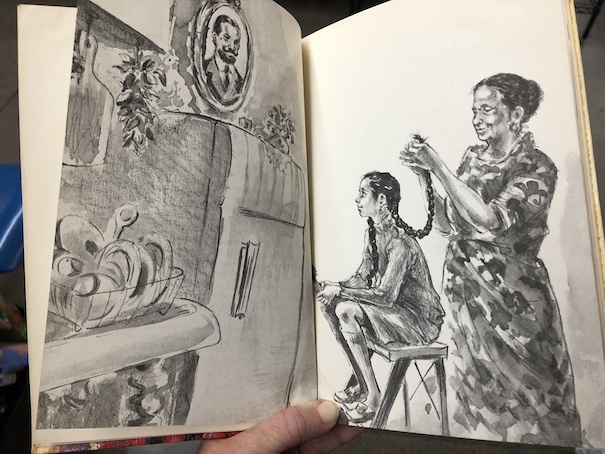
Magdalena’s father is a sailor, and he spends much of his time away at sea, so Magdalena and her grandmother are alone most of the time. Nani speaks Spanish to Magdalena at home because she thinks that’s proper for a Puerto Rican family like theirs, although Magdalena speaks English at school. She thinks that her grandmother probably knows more English than she pretends. Nani also keeps a portrait of Great-Grandfather Mendez, which she brought from Puerto Rico. Although he has been dead for years, the portrait always feels like a living person to Magdalena.

After some further teasing from the boys in her class, Magdalena decides to tell her grandmother that she doesn’t like her braids. Nani says that not unusual, that many children don’t like their braids, but they get over it. Magdalena doesn’t think she’s going to just get over it. Like a lot of kids, she would rather just look like everyone else so she won’t get teased, but Nani doesn’t approve of the short hairstyles that are popular among American girls at Magdalena’s school. She says that Magdalena’s braids are a mark of pride and a caring grandmother who brushes and braids her hair. She thinks the American girls wear their hair short because their mothers can’t be bothered to spend time on caring for long hair, and they don’t have grandmothers to nurture them. When Magdalena tells her that the boys at school are calling her names because of her braids, her grandmother decides that she should talk to the teacher about it. Magdalena thinks that having her grandmother talk to the teacher might be more embarrassing than having the boys call her names, so she persuades her grandmother to forget about it for now and let her handle it.

Then, Magdalena is called to the principal’s office at school. At first, Magdalena is upset because it sounds like she’s in trouble, and she can’t understand what she could have done to cause that. She is calmed a little when a black boy in the office, who is also waiting to talk to the principal, is nice to her. It turns out that Magdalena isn’t really in trouble. Instead, the principal wants to talk to her about one of her classmates, a girl named Daisy Gonzales, who is also transferring into her new class.

Madgalena is surprised because Daisy hasn’t struck her as a gifted child. Most of the other students call her “Spook” because she tends to lurk around the school and suddenly jump out at people to scare them, and she is known to frequently skip classes. The principal says that Daisy might be gifted, but it’s difficult to tell. The teachers think that she’s at least bright, but she’s an “under-achiever.” The principal explains that means that Daisy could do better at school than she does, but for some reason, she doesn’t seem motivated to do better. That’s why they’ve decided to transfer her to the class with the gifted students. They think that she isn’t being challenged enough in the class where she is. The teachers are also concerned that Daisy has no friends at school. They’ve noticed that the other girls at school seem to be afraid of Daisy, although they don’t seem to understand about Daisy’s “Spook” act. They do know that Daisy has behavioral problems and an unhappy home life. The reason why the principal is telling Magdalena about this is that she wants Magdalena to try to be Daisy’s friend when she transfers into her new class. The reason why she selected Magdalena to be Daisy’s new friend is because Daisy’s family is also Puerto Rican, like Magdalena’s family, so she thinks that the girls might understand each other better than their other classmates. The principal thinks that Daisy might settle down at school if she had a friend to help her feel more comfortable there. Magdalena isn’t comfortable with the idea of trying to be Spook’s friend because she also finds Daisy spooky, but the principal persuades her to try but not to let on that the principal asked her to do this.

Magdalena has no idea how to approach Daisy/Spook to be friends, since she’s not the easiest person to approach about anything. Then, Sue Ellen, the most popular girl in class tells Magdalena that she wants to be friends with her. She says that she’s been feeling empathy for her since the first day that she came to class and the boys started teasing her, and she felt it again when she got called to see the principal. She asks her what the principal wanted, and Magdalena explains that she asked her to do something, but it’s something really hard, and she isn’t supposed to talk about it. Sue Ellen offers to help her with whatever the principal’s task is. Magdalena thinks maybe making friends with Spook won’t be so bad if Sue Ellen helps, so she takes Sue Ellen into her confidence. Sue Ellen agrees with Magdalena that making friends with Spook would be hard because she’s so weird and spooky. Both girls admit that they’re a little afraid of her, but Sue Ellen agrees to try to be basically nice to Spook along with Magdalena and see what happens. Sue Ellen says that the principal ought to have more empathy for the students and see just how hard it would be to get along with someone like Spook.

Their first attempts at making friends with Spook are clumsy. Sue Ellen tries offering her advice, pointing out that she wore the wrong thing to the school assembly, but criticism and advice aren’t the best ice-breakers. Then, to Magdalena’s surprise, Spook approaches her in the school library, when she is trying to find a specific book for her grandmother. The school library doesn’t have the book she wants, but Spook says that she knows where to find it. However, she will only help Magdalena if she plays hooky and goes with her right now. Magdalena hesitates because she doesn’t really want to skip class and get in trouble, but Spook says that Magdalena will have to come with her because she’s “emotionally disturbed” and might do crazy things if she doesn’t get her way. Magdalena points out that school will end in only 20 minutes, and she asks Spook to wait for her. Spook makes her promise that she won’t change her mind and let her down in that time.
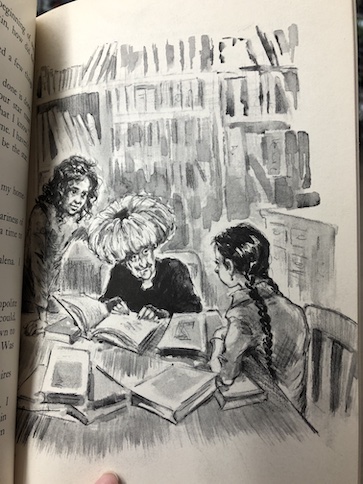
When Magdalena waits for Spook, she doesn’t show up at first, but Spook jumps out at her just when she’s giving up waiting. Spook says that she just wanted to see if Magdalena was serious about wanting to come with her. The place where Spook knows they can find the book turns out to be the Brooklyn Public Library. Along the way, Magdalena begins to learn more about Spook. The reason why she wasn’t dressed right this morning was that the sweater she was wearing was the only thing she had to wear that was clean. She skipped out during the school assembly to go home and see if her mother was back from the laundromat so she could put on something else. Also, Spook isn’t completely friendless. She is friends with a strange woman named Miss Lilley, who wears an unusual, large hat. When Daisy tells Miss Lilley that she got put into the class at school with the smart kids, Miss Lilley congratulates her and tells her that she knew she was smart. Daisy admits that she’s been trying not to let her teachers know that she’s smart because she knows that they will expect more of her and insist that she do all her homework. People don’t expect so much of kids who aren’t bright. There is method to Daisy’s madness. All of her weird and spooky acts are tools that she uses to get her, get out of things that she doesn’t want to do, cover up for problems that she has, and keep people she doesn’t like or doesn’t think would understand her at a distance.

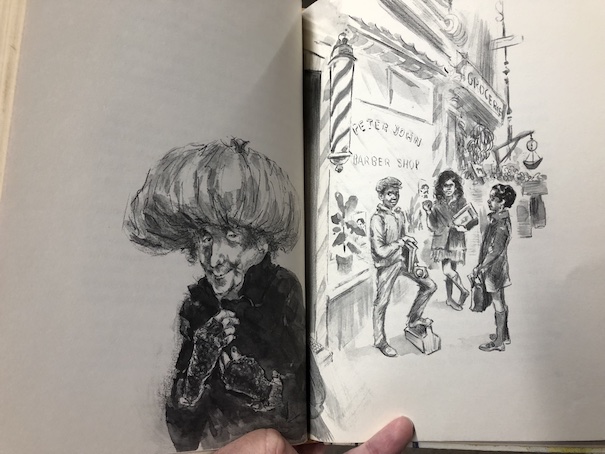
Daisy introduces Magdalena as one of the smart kids from her class, but Miss Lilley thinks that Magdalena’s manners aren’t very polite because she keeps staring. Magdalena has trouble getting over the large hat, which looks like a large pumpkin. Miss Lilley begins evaluating Magdalena’s appearance, and Magdalena comments about how she hates her braids, but her grandmother makes her wear them. Miss Lilley says that she understands that her grandmother likes the quaintness of the braids, but she knows how to deal with that. She also knows where to find a good barber. The black boy who was nice to Magdalena earlier, Samson Shivers, makes money after school by shining shoes outside the library, and when Miss Lilley asks him if he would be willing to lend them money for the haircut, he joins the others at the barber shop. Miss Lilley takes the kids to the barber shop, and Magdalena gets a haircut. Magdalena feels wonderfully free after he haircut, although she saves the braids as a souvenir and worries about what her grandmother will say when she gets home.
Nani is very upset when she sees Magdalena’s short hair and worries that Magdalena is rejecting her care for her and her Puerto Rican heritage. Magdalena says that’s not the case and explains about going to the library and meeting Miss Lilley. Magdalena’s grandmother thinks that she’s bewitched and says that she knows how to deal with that. She uses herbs on Magdalena to break the bewitchment.

Getting the haircut changes things for Magdalena. The boys stop teasing her, which is a relief. However, Sue Ellen is annoyed that Magdalena didn’t tell her that she was going to get her hair cut. Magdalena explains that it was a sudden decision and a possible bewitchment by Miss Lilley. Sue Ellen thinks that Spook is probably the one who bewitched Magdalena because she’s so spooky and that maybe Magdalena would rather be best friends with her. Magdalena says that’s not the case and that she doesn’t see why she can’t be friends with both girls. Sue Ellen still expects that Spook is going to do something to ruin the class, but Magdalena notices that Spook is becoming less spooky in their class. She stops skipping classes, does more of her homework, and cuts out some of her previous spooky behavior.

Samson, often called Sam, is a practical boy, and when Magdalena tells him how her grandmother thinks Miss Lilley is a witch and bewitched her, he says that she can’t be a witch. Sam sees her often because he shines shoes by the library, and he realizes that Miss Lilley is actually just a poor, old woman. She goes to the library all the time because she can’t afford proper heating for her apartment. She often has little to eat, and she partly survives off of candy that he gives her. Like Spook, she seems spooky because she looks odd and behaves oddly, but there are explanations for what she does that show that she’s actually unfortunate.

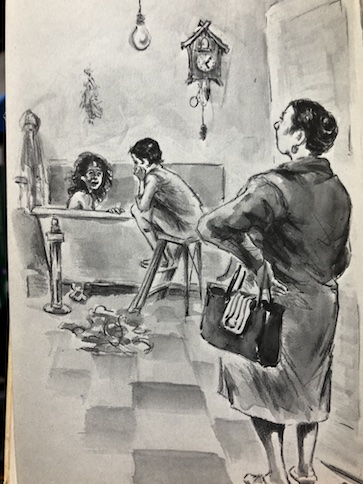
Magdalena’s grandmother meets Spook for the first time when Spook hangs out with Magdalena at her apartment after school. Nani isn’t home at the time, but the girls talk to each other about their lives and families. Magdalena gets to know more about Spook, and Spook admires the place where Magdalena lives. Spook’s family lives in a much poorer apartment, and it’s crowded with Spook’s younger siblings. Spook admires the nice bathtub that Magdalena and her grandmother have and says that she wishes they had one at her apartment. Part of the reason why she looks so strange is that she doesn’t get the opportunity to take baths often. Magdalena tells her that if she wants a bath, she can go ahead and take one. Nani arrives home before Spook is finished with her bath, but Nani stops her when she tries to get out and get her clothes. Nani can see how badly Spook needs some care, so she insists that she finish the bath, clean the tub, and let her shampoo her hair. When she’s done, Nani has Magdalena loan her some clean clothes, and the girls are amazed at the transformation.
After the bath incident, Spook avoids Magdalena for a while, and she can’t understand why, but it’s about Spook realizing what’s been lacking in her life and envying what Magdalena has: someone who really cares for her. She was so emotional when she looked at herself in the mirror that she spit at the image and then was embarrassed that she had done that. Nani surprisingly understands Spook’s behavior. She can see that Spook lacks impulse control and the ability to understand and manage her feelings. Nani comments that she’s angry with Spook’s mother because she can tell that the girl has been badly neglected. Having been a mother and grandmother herself, she knows exactly how to deal with this.
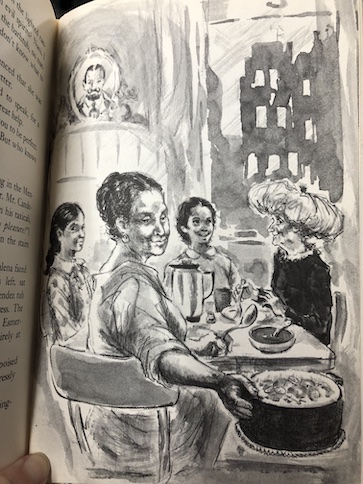
Meanwhile, Sam is correct about Miss Lilley. Miss Lilley is poor and not in very good health, but she also knows what Magdalena and Spook/Daisy need. She is eager to help the girls, but she also needs some help and attention herself. When Miss Lilley decides that it’s time to have a word with Nani about the needs of modern girls and her fears about her granddaughter becoming too American, a number of things get better.

The book is available to borrow and read for free online through Internet Archive.

The heart of this story is understanding and empathy. By the time it’s over, many of the characters come to a better understanding of each other and maybe themselves. Although Spook’s transformation is the most dramatic, the other characters are also changed after their experiences in the story.

Magdalena’s changes come with her admission to her grandmother that she really doesn’t like her braids and then with her decision to have her hair cut against her grandmothers wishes. She knew that her grandmother wouldn’t like it when she said that she didn’t want braids because her grandmother is a traditionalist, and she knew that Nani wouldn’t react well to the haircut. At first, it was easier for Magdalena to buy into the idea that Miss Lilley was a witch who bewitched her into doing it, but that’s not really the truth. It wasn’t even that Magdalena was getting her hair cut just because of the teasing. When Magdalena and Spook are talking about whether or not they truly understand the reasons why they do things, Magdalena acknowledges that she has reasons for the things she does, and the truth is that she got the haircut because she herself really hated wearing braids. If she had really loved her braids, she could have kept them in spite of the teasing, and she could have turned down the offer of a haircut, but she really wanted to change her hairstyle, and she just took advantage of the opportunity to do it.

Nani understands from the first time she meets Spook that she has not had nearly the level of care and attention that she has needed in life. Spook doesn’t even really understand all of the motivations she has for the things she does. Her behavior is odd partly because she acts on impulse, not fully thinking about the consequences or the affect her behavior has on others. She initially doesn’t have much self-awareness because she has not had caring adults in her life to teach her how to behave, how to understand her feelings, and how to control herself. Because she hasn’t really had any friends before, she hasn’t really had anyone to talk to about these things and help give her some perspective. When Spook and Magdalena talk about why she spit on the mirror, Spook says at first that she isn’t sure why she did it. As they continue to talk about reasons for doing things, though, Spook admits that she did it because, while she was stunned at how nice she looked, she quickly became upset because she didn’t think that nice look could last.

Nani is the nurturing type of person, and she quickly sees that Spook is in dire need of some nurturing and guidance. She also recognizes that Spook doesn’t have much confidence in herself. She is bright, but she has grown used to hiding it. She also thinks, because she doesn’t really understand her feelings or behavior, that is can never really control herself. She thinks that she will always be a “stinker” who does things that she shouldn’t and acts weird. Nani has a frank talk with her and tells her that she can be herself without being a “stinker”, and the first step is believing that she can. Even if she’s not in the habit of understanding and controlling herself, she can learn. People have different sides to their personalities and different ways of expressing themselves, and Spook can learn how to show the best sides of herself in the best possible ways.

Magdalena appreciates that Nani is understanding and helping Spook, but she also has a frank talk with her grandmother about why she doesn’t understand her own granddaughter as well. When Magdalena tries to tell her what she wants or doesn’t want, Nani contradicts her or ignores her feelings. Nani is understanding with Spook because she can tell that Spook is a disadvantaged child, but she doesn’t see her granddaughter the same way, so she doesn’t try to understand why Magdalena sometimes does things she doesn’t like. Nani admits that she wanted her granddaughter to be “perfect”, but maybe she doesn’t really know what “perfect” actually is. She wants the traditional ways for her granddaughter because she really thinks that’s what’s best, but even grandmother doesn’t always know what’s best.

Miss Lilley is concerned about the girls and offers them attention and support. When she goes to see Nani and open her eyes to her grandmother’s needs and the ways of modern girls, she collapses because of her bad health. Fortunately, Nani is a nurturing person, and she nurtures Miss Lilley, making sure that she gets the treatment she needs and even looking after her when she gets out of the hospital. Miss Lilley’s health improves, and the two of them become friends. Although they are both older ladies, they each admit that they have things to learn in their lives, and they can learn from each other. Nani helps her to make changes to her living arrangements so she will be healthier and more comfortable, and Miss Lilley helps her understand what modern American life has to offer for girls like Magdalena.

Samson is always a very understanding character because he is genuinely interested in people, and he meets many different types of people through his shoe-shining business. Although Sue Ellen is the first person who brings up the topic of empathy, she is really the one who understands it the least. I think her relatively narrow view of empathy is because of her relatively narrow life experiences. She feels some empathy for Magdalena because she sees Magdalena experiencing something she understands, but she doesn’t seem to know what to do when she encounters something she doesn’t understand. Admittedly, Spook’s spooky act is off-putting, partly by design and partly because Spook has issues she herself doesn’t know how to handle. However, because Sue Ellen only wants to stick to the familiar and understandable, she doesn’t notice when Spook begins to change and doesn’t see how some support from her could influence her for the better. Sue Ellen’s attempts at friendliness and helpfulness often involve offering some kind of criticism, like pointing out that Spook isn’t dressed right. Magdalena can tell that Sue Ellen is trying to be helpful, but she’s also kind of snippy and smug in the way she does it, and that gets on Magdalena’s nerves, too. Sue Ellen kind of fades out of the story toward the end, so we don’t know if she continues being friendly with Magdalena or not or if she ever recognizes Spook’s transformation.

There is also a subplot that I haven’t mentioned about the literary magazine that the girls’ class starts. Their teacher has some thought-provoking descriptions about what good writing is and does, and the girls’ choices of what to write about are based on their experiences and the changes in their lives.

The book doesn’t shy away from the harsh realities of life. Magdalena’s mother is dead, and her father is away most of the time, so she is being raised by her grandmother. Her father never even makes an appearance in the story. Miss Lilley is a poor and lonely old woman who needs help and friends. It is acknowledged that Spook is a neglected child, and she even tells Magdalena that her favorite brother died at age three because he was asthmatic, and they were living in bad conditions. We don’t know exactly how her family came to be living in such bad conditions, but Spook says that, if she wrote a story about her family, the teacher would think she had a filthy mind.

Since the story is about understanding other people, one could consider whether we might view Spook’s neglectful mother more sympathetically if we knew her past and what led her to the situation they’re now in, but we do not see Spook’s mother at any point in the story. I think it’s also important to note that understanding does not equal approval. You can know a person’s history and reasons for doing things and still not agree with them. Maybe Spook’s mother is another unfortunate soul who needs some help, but if she is, she doesn’t seem to be looking for that help. Her vulnerable children are suffering for it, and one has died. Empathy doesn’t mean saying that things are okay when they really aren’t, and this mother’s neglect of her children is not okay.
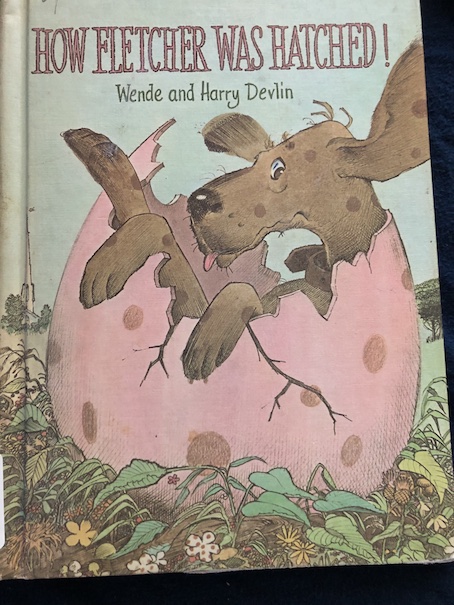
How Fletcher Was Hatched

How Fletcher Was Hatched! by Wende and Harry Devlin, 1969.

Fletcher the dog is sad and upset because it seems like his owner, Alexandra, is forgetting about him. She’s been playing with the new baby chicks, which she thinks are cute, and she’s been forgetting to pet her dog or even fill his water bowl!

Distressed, Fletcher goes to see his friends, Beaver and Otter, at the pond. Beaver and Otter don’t have human owners, so they don’t understand Fletcher’s feelings about Alexandra, but they try to think of ways to get her attention. They think it would help if Fletcher could make himself more like the chicks Alexandra has been obsessed with. Aince he can’t make himself small and yellow, they decide that he should hatch out of an egg, like the chicks do. Fletcher is skeptical about this plan, but Beaver and Otter think that hatching out of an egg will be like having a new beginning in his relationship with Alexandra.

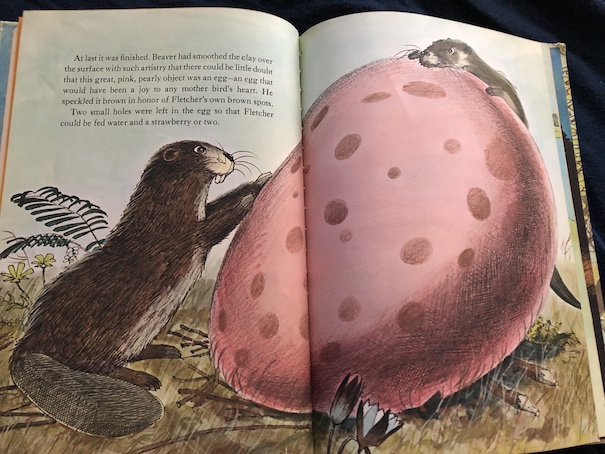
Beaver and Otter build an egg around Fletcher with reeds, grass, and clay from the river, leaving a little hole so they can give Fletcher water and food. When they’re done, it’s a very convincing but giant egg.

By the time they’re finished, it’s night. Fletcher is uncomfortable sleeping in the egg and wonders what Alexandra is doing. Meanwhile, Alexandra is having trouble sleeping because she’s worried about her lost dog.

In the morning, Beaver and Otto roll the egg over to Alexandra’s school to make sure that she sees it. The first person who sees the egg, though, is the school’s custodian. He’s shocked at the sight of such a giant egg and starts yelling for the science teacher to come look at it.

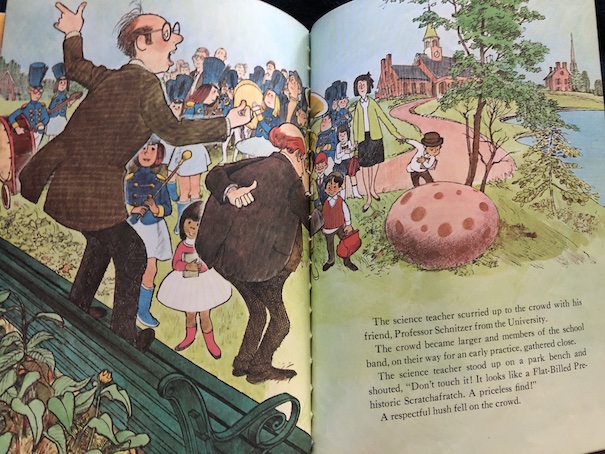
Soon, the egg is surrounded by children and adults, marveling over what kind of it could be and where it came from. The science teacher brings a friend who is a university professor, and the two of them are convinced that the egg must belong to a rare creature, although they disagree about the type of creature it is.

Fletcher waits to hatch until he hears Alexandra. Alexandra’s friends are excited about the egg, but she’s just upset and only wants to go looking for her lost dog.

Fletcher decides it’s time to hatch, and he busts his way out of the egg. Alexandra is happy to see him, even though Fletcher’s attempt at peeping is a little weak. Everyone is confused, but Alexandra is just relieved that she has her dog back. Fletcher feels better, realizing that he is important to Alexandra, and she really cares about him, even though he’s not yellow and doesn’t peep.

The book is available to borrow and read for free online through Internet Archive.

My Reaction

I read this book as a kid, but I had forgotten much of the story. I remembered that Fletcher hatched out of an artificial egg and that he did it to get his owner’s attention, but I couldn’t remember why he needed attention. I can understand Alexandra being temporarily distracted by the little chicks on the farm, but forgetting to give her dog water is really bad for a pet owner. I felt like her parents should have noticed and said something. But, mostly, the situation is just set up for the purposes of this humorous hatching of a dog from a giant egg. Because the egg was created by animals, the humans in the story never find out how or why Fletcher got in the egg, which is actually the funniest part for me as an adult.

A Spell is Cast

A Spell is Cast by Eleanor Cameron, 1974.

This story is fascinating and magical, partly because of other the stories that it reminds me of and partly because, at various points in the story, I was pretty sure that I knew what kind of book it was going to be, but I was never more than partly correct.

When young Cory Winterslow arrives at the airport in California, she expects to be met by her Uncle Dirk. Uncle Dirk has sent her letters before and a picture of himself, but they’ve never actually met in person. Cory is supposed to be spending Easter vacation with her relatives, the Van Heusens, a wealthy family living on an estate called Tarnhelm. Her mother, Stephanie, sent a telegram to the Van Heusens to tell them when Cory would arrive on the plane from New York, where they’ve been living, but no one shows up to meet Cory at the airport. This seems almost like the beginning of a gothic novel, with a young heroine on her way to meet people she’s never met who turn out to not really be expecting her and aren’t what they appear to be, but that’s not really the case here.

Fortunately, a sympathetic older woman who was also on the plane, Mrs. Smallwood, talks to Cory, who explains the situation. Mrs. Smallwood knows the Van Heusens, and she calls both the house at Tarnhelm and Uncle Dirk’s office. Apparently, Uncle Dirk never mentioned to his secretary that he needed to meet anyone that day, and he’s away on business until late. Nobody is home at Tarnhelm, but Mrs. Smallwood is optimistic that it’s all just an oversight. She says that she’ll give Cory a ride to the house. Cory is hesitant to accept a ride from a stranger because she and Mrs. Smallwood have only just met, but it’s raining and she doesn’t know what else to do, so she goes with her. This part seems a bit worrying, but you don’t have to worry because it’s not a kidnapping story.

On the way to Tarnhelm, Mrs. Smallwood points out local sights, and Cory asks her a bit about her relatives. Cory’s mother has always been reluctant to talk about her relatives in California. Mrs. Smallwood describes Uncle Dirk as a young man who never smiles. She says that his mother, Cory’s grandmother, as a high society woman who sometimes acknowledges acquaintances in public and sometimes doesn’t, depending on her mood, something that often offends Mrs. Smallwood, as one of those acquaintances. They also pick up a boy called Peter Hawthorne, who was out walking in the rain and needed a ride. He introduces himself to Cory as the president of the Explorers Club. His description of Cory’s Uncle Dirk doesn’t sound very favorable, either. However, he mentions that the sign for the mansion at Tarnhelm has a unicorn on it, just like the unicorn on the pendant that Cory wears, which she thinks of as her “amulet”, and Cory takes that as a hopeful sign.

Unfortunately, the Smallwoods’ car runs out of gas. Since it’s not raining anymore, Peter offers to walk Cory the rest of the way to Tarnhelm. Then, it starts to rain again, so they take shelter in a cave that Peter knows. While they wait out the storm, Peter asks Cory more about herself. Cory explains that she usually refers to her mother as “Stephanie” because she’s actually adopted. She later reveals that she doesn’t know anything about her birth parents because Stephanie doesn’t like to talk about them, saying that it makes her sad. Stephanie is an actress, and they’ve had to move around sometimes. Because she’s had to switch schools several times, Cory hasn’t made many friends her own age. Cory doesn’t always go with Stephanie when she travels for work, often staying at home with housekeepers (which she calls “lady-helps”) so she can continue going to school. Stephanie isn’t married, so Cory doesn’t have a father to take care of her. The reason why she has come to stay with her relatives during this school break is that Stephanie needs to travel again for her work and couldn’t manage to find new help to stay with Cory. This is the first mention that Cory’s “mother” isn’t really her mother and these relatives that she’s going to visit aren’t blood relatives. This is central to the plot of the book, but there’s a twist coming, and it’s not the twist that I expected. I had theories about the identities of Cory’s biological parents at this point that turned out to be completely wrong.

When the rain lets up a bit, Peter takes Cory the rest of the way to the house, although they leave her luggage in the cave because it’s too hard to carry it over the muddy ground. When they arrive at the house, the housekeeper, Fergie, welcomes Cory. She says that everyone has been in a tizzy about her because Stephanie actually sent multiple telegrams with different sets of instructions for picking up Cory, so nobody knew when she was really arriving. (This is the first indication that Stephanie is unreliable.) Fergie and her husband, Andrew Ferguson, both work for the Van Heusens, and they make Cory feel welcome at Tarnhelm, fussing over her and giving her and Peter a hot dinner. However, they tell Cory not to mention the cave to her grandmother because she wouldn’t understand, and she might be unhappy about Cory showing up at the house wet and muddy. Peter promises to bring Cory’s luggage up to the house later. If this were a gothic novel style of story, the servants would be strict, unhappy, uncaring, or putting on a facade of caring while being just plain sinister, but the Fergusons are exactly as caring and friendly as they seem to be. This isn’t that kind of book.

The Fergusons are Scottish and a bit superstitious. At dinner, they notice that Cory is left-handed, “cawry-fisted”, as they call it. Peter is intrigued that “cawry” sounds like “Cory”, and the Fergusons say that there’s a superstition that left-handed people are enchanted or bewitched. However, the Fergusons don’t think it’s a bad thing that Cory is left-handed and possibly bewitched; it’s just more of an interesting idea to them. This story isn’t as supernatural as I originally expected.

The Fergusons tell Cory that her grandmother and uncle are good, kind people, but they aren’t used to children and are fussy about some things. Uncle Dirk is known to be moody, and Cory’s grandmother likes things quiet and orderly. Cory starts to think that she might be happier with just the Fergusons, although she is still curious about her relatives. She hopes that they will like her, and maybe if they like her enough, they’ll let her stay longer so she can go to Peter’s school and join his Explorers Club because she badly wants friends. Issues about how to make friends add an element of teen drama to the story, but there’s more going on here than that.

The house is beautiful and charming, and Fergie gives Cory Stephanie’s old room, which Cory loves. It has beautiful, old-fashioned furniture and its own fireplace! She also shows Cory a collection of carved wooden masks hanging on the walls of the hallways that her Uncle Dirk made. Uncle Dirk is an architect, but he’s also been a wood carver. In Stephanie’s room, there is even a mask of Stephanie’s face, which Cory recognizes. During the night, she half wakes up and is aware of her grandmother and Uncle Dirk in her room, whispering about her, saying that she looks rather plain and something about somebody “getting used to” something. They don’t deny this conversion later when Cory asks them about it, and there is less sinister significance to it than it seems at first.

The next morning, Cory meets her grandmother and Uncle Dirk at breakfast. They greet her politely, but her grandmother says that she wants to have a word with Peter about how he should have taken her to his house until the rain stopped, not made her walk through the mud to Tarnhelm, ruining her shoes. Cory asks her not to say anything to Peter because she really wants to join the Explorers, and they wouldn’t let her in if they thought that she was afraid of a little mud. However, her grandmother reminds her that she’s only there for a short visit, and she doesn’t want her getting hurt or doing anything dangerous. Uncle Dirk is more sympathetic and offers to teach her to swim.

Mrs. Van Heusen brings up the subject of Stephanie, and during the conversion, she lets slip that Stephanie has never legally adopted Cory. Now, we’re getting to a major plot point of the story! Stephanie is consumed by her acting work and not good with paperwork, and Mrs. Van Heusen thinks it’s about time that she took care of the issue of Cory’s legal adoption. The news comes as a shock to Cory, who thinks that, not being legally adopted, she doesn’t really belong to the family at Tarnhelm. Both her grandmother and Uncle Dirk hurriedly reassure her that she is family to them and belongs at Tarnhelm and that the official paperwork doesn’t really make a difference to them. There is no danger in the story of Cory being rejected by this family, and they don’t have any objection to her visit or Stephanie’s guardianship of her. However, this is another of the early indications that Stephanie is not as attentive as she should be as Cory’s guardian and that there are aspects of Cory’s life and well-being that are being neglected. Cory is starting to develop a new awareness of these issues.

Cory asks her grandmother and Uncle Dirk about her birth parents because Stephanie has never explained who they were or what happened to them. Her grandmother says that it’s only right that she knows and that Stephanie really should have told her before. Uncle Dirk explains to Cory that her parents’ names were Lawrence and Coralie Winterslow and that they were friends of Stephanie’s when they were young, before they were even married. They all liked to go skiing together. Cory’s parents lived in England for awhile after they were married, and Cory was actually born in London. Then, her parents were killed in a skiing accident in Switzerland. Stephanie had been with them on that skiing trip, and before Cory’s mother died from her injuries, she asked Stephanie to take three-year-old Cory because she had no living relatives on her father’s side and she didn’t want to leave her child with her own relatives, for some reason. Cory is glad to know the story of her parents but sad at the same time and worried about not being legally adopted. Fergie suggests to her that she write to Stephanie about it and see what she says. (At first, I was expecting that there would be more intrigue about Cory’s parents’ deaths, but there’s nothing suspicious about their cause of death. The story that Uncle Dirk tells Cory is exactly what happened. The Winterslows were also definitely Cory’s biological parents. I thought that there might be some intrigue about that, but her birth parents were who Uncle Dirk says they were.)

Later, Cory also asks Uncle Dirk about the unicorn on the sign at Tarnhelm and about her own silver unicorn pendant. Uncle Dirk tells her that he has a fascination for British history and heraldry, which is why he carved the unicorn as the symbol of Tarnhelm. He also says that the pendant used to belong to Cory’s mother and that her father had a matching unicorn tie pin, although he doesn’t know what happened to it after his death. Cory wishes that she’d thought to ask Stephanie about it in her letter.

All of this explanation about Cory’s parents’ history sounds pretty straight-forward, although sad. However, the story doesn’t end there. Everyone has a history, and there are things about her Uncle Dirk that Cory doesn’t know yet as well as the reasons why Stephanie has never completed Cory’s adoption papers.

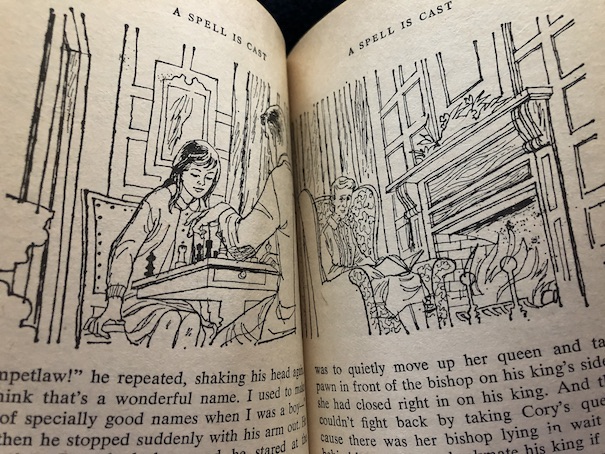
Cory becomes sick and feverish, spending a few days in bed. During this time, she has strange dreams, but not all of them are actually dreams. She remembers dreaming about a room with a chess set that has carved unicorns instead of horses as the knight pieces. Later, when Uncle Dirk plays chess with her, with a normal chess set, she mentions this dream, and both Uncle Dirk and her grandmother act strangely about it. Eventually, Cory comes to realize that her “dream” wasn’t just a dream, that she actually did get out of bed and wander around while she was feverish, but it takes some time before the full meaning of the chess set becomes clear to her.

Various people comment to Cory about Uncle Dirk’s moods and personality, hinting at past problems he’s had. Cory’s grandmother makes a comment to Cory about Uncle Dirk harming himself more than anyone else, except perhaps for one person, hinting at relationship troubles in Uncle Dirk’s past that contribute to his dark moods. Nosy Mrs. Smallwood also refers to the strange behavior of the Van Heusen family, often rude and unfriendly. While Mrs. Smallwood is a busy-body with issues of her own, she is correct in noticing the casual harm that various members of the Van Heusen family have done to people around them. It’s never intentional and they rarely notice the consequences of what they do, but that’s part of the problem. The Van Heusens are often selfish, thoughtless, and out-of-touch with other people’s feelings and the effects of their actions on others. Even Uncle Dirk acknowledges that members of the family are often hard on each other even when they care about one another.

However, the Van Heusens aren’t all bad, and some of them have changed somewhat over time. Mr. Smallwood, who is a more optimistic and level-headed person than his wife, tells Cory that his wife likes to live in the past, and while Uncle Dirk was a rather thoughtless young man who wouldn’t have made a good husband, he’s grown up since then. He says that Uncle Dirk has become friendlier and more thoughtful toward others, in spite of his occasional dark moods. But, since Uncle Dirk has never been married, what did Mr. Smallwood mean about him not making a good husband?

On the grounds of the Van Heusens’ estate, Cory spots what looks like the foundations of a house that was started to be built but never completed. Peter says that he and the other Explorers sometimes play around these foundations. Cory wonders who was planning to build a house there and why they never finished it. Uncle Dirk gets angry when he catches Cory and Peter snooping around the tower at Tarnhelm, where he keeps some of his old wood-carving things and where Peter finds some mysterious poetry.

Peter later takes Cory to visit Laurel Woodford, a young woman Cory met on the beach earlier, who helped Cory find her necklace when she lost it. Laurel is a weaver. Laurel lives by herself, but she says that she isn’t lonely because she has plenty of things to do that keep her busy. However, there is a kind of sadness about Laurel, and she has secrets of her own. She knows the Van Heusen family herself, and it wasn’t a happy experience for her.

Slowly, without Cory really doing any intentional investigating, the pieces of the past start coming together – Uncle Dirk, a marriage that didn’t take place, a house that wasn’t completed … and two identical unicorn pendants.

The story is haunting and magical, but not because of an real spells or magic. The only ghosts are the ghosts of the past. The book reminds me of a couple of other books that I’ve read, but explaining which ones involves some spoilers. I don’t mind giving spoilers for this story because I haven’t found a copy of this book that’s available to read online, and it’s something of a collector’s item now, with copies typically costing at least $20 and frequently more, although it’s sometimes possible to find one for less.

My Thoughts and A Few Spoilers

One of the interesting things about this book is that it reminds me of other books that I’ve read and liked. Some children’s books are mentioned in the course of the story because Cory likes to read, like The Five Little Peppers and How They Grew and The Story of the Amulet, but these aren’t the books that the story reminds me of.

Throughout the book, the Fergusons use various Scottish words and phrases, sometimes singing old songs or quoting from poems. Mrs. Van Heusen says that she particularly likes the Fergusons because her family was also from Scotland, and they remind her of her youth, which is a comfort to her. The Scottish element and the young orphan learning to make friends and become close to a new family remind me of Mystery on the Isle of Skye, although that book was actually set in Scotland. The books also have a similar feel in the way they approach the element of mystery in the story and the element of “magic” and “spells” that aren’t really magic spells. Both books have an enchanting quality to them, but it’s because of the atmosphere of the stories, not because there’s any actual magic.

During the course of the story, Cory learns more about what it takes to make friends. Peter realizes that Cory isn’t particularly good at making friends and confronts her about the reasons why. It’s partly because Cory has had to change school multiple times, but Peter has also noticed that Cory always waits for other people to approach her with offers of friendship and invitations to join in. If they don’t, she just feels hurt and left out instead of voicing her desire to join in. Even when she gets an invitation, her impulse is to reject it if she thinks it was only offered out of pity. Peter finds it annoying that Cory seems to need people to practically beg her to be their friend and join in activities. It reminds Cory of advice that Stephanie has tried to offer her before that she should just join in and not worry or assume that people don’t want her around. Even Fergie told her that if she wants to make friends, she’ll have to drop her pride, meaning that she’ll have to learn to make the first move and approach other people instead of waiting for them to come to her. This criticism is partly true, but Cory’s experience of life is that many of the things she wants also depend on the decisions of other people, and Peter comes to rethink some of what he said when some of his friends are less than accepting of Cory. It isn’t nice to be invited into a place where you aren’t really made to feel welcome and accepted. This is also a fitting description of Cory’s life with Stephanie, being largely raised by her hired help.

When Cory finally receives Stephanie’s reply to her letter, Stephanie’s selfishness and detachment from Cory’s life become increasingly apparent. Cory shares the letter with her grandmother and Fergie and outright asks her grandmother if she can stay in California. Her grandmother asks her if she won’t miss Stephanie because Stephanie is the only mother she’s known since she was little, but Cory says she won’t because Stephanie is gone so much and busy with her acting, leaving her with hired help. Fergie, while being hired help herself, is more maternal and says that situation is unacceptable, but Cory’s grandmother says that she’s not sure that she’s up to raising another child, that she’s old and wants her peace and quiet now. Even while Cory’s grandmother knows that her daughter is self-centered, she has a kind of self-centeredness of her own. When her grandmother gets dramatic about the worry Cory puts her through when she’s running around the caves with her friends, Cory realizes that Stephanie has been imitating her during her dramatic acts.

Cory begins to get the answers about her past and Uncle Dirk’s when Peter shares some treasure with her that he and other members of the Explorers have found and are hiding in a cave on the Van Heusens’ property. This treasure is part of the reason why some of the other Explorers have been less than welcoming to Cory, not wanting to share it and their secret hiding place with her. They’re worried that she’ll give their secrets away to the Van Heusens, and then, they’ll lose their treasure and their secret hiding place. However, among their treasures is a carved wooden box that Peter found, and it looks like Uncle Dirk’s carving work. Cory points out that the carved wooden box probably belongs to Uncle Dirk, and since it was on the Van Heusen land, he probably hid it in the cave himself. Peter, as the finder of the box, lets Cory have it to return to Uncle Dirk.

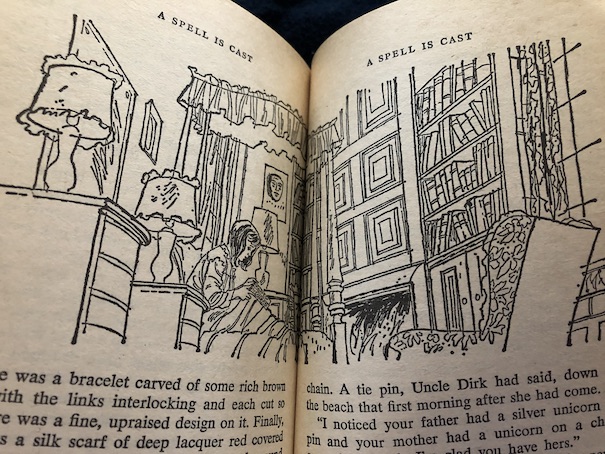
In the box, Cory finds four colorful feathers, four pretty seashells, a poem about an angry quarrel signed with the initials “L.W.”, a carved wooden bracelet, a woman’s scarf, and a small silver pendant that is identical to the one that Cory wears. However, the back of this particular unicorn has a rough spot where it used to be mounted on something else, and Cory realizes that this is the one from the tie pin that Uncle Dirk told her about, turned into a necklace. From these pieces, Cory begins to realize that the contents of the box are Laurel’s – her initials on the poem and a necklace made for her that Cory thinks must have come from her father. If that’s true, Cory thinks Laurel must be some kind of relation to her.

Cory also explores the room off the tower in Tarnhelm that contains the amazing chess set with the unicorn knights, and now that she’s no longer sick, she sees that the room also holds other furniture that Uncle Dirk made. Uncle Dirk was the person who started to have the house built, and he was making furniture to go in the house, but for some reason, he stopped and stored the furniture away because there was no new house to put it in. There are also carved masks of Laurel in the room.

Early in the morning, Cory decides to go see Laurel about what she’s found, knowing that if she waits, she’ll miss her because she’s about to leave on a trip. When Cory shows her the box that she’s found and asks her about the unicorn pendant and whether or not they’re related, Laurel tells her that they’re not related but that the unicorn did come from her father’s tie pin. Like my earlier theories, Cory’s theories about Laurel are partly right and partly wrong. After Cory’s parents died, Stephanie sorted through their belongings. She gave the little unicorn necklace to Cory, and she gave Cory’s father’s tie pin to her brother, Dirk. After Dirk got the unicorn tie pin, he had it made into a necklace for Laurel.

Laurel explains that, about seven years earlier, she and Dirk got engaged while they were still in college. However, Dirk was very spoiled by his mother after his sister left home and went to New York to do her acting. He was a very talented wood-carver and looked at himself as an artist who would never have to earn a living because his mother was very wealthy, and she encouraged him in his art. Dirk wanted to drop out of college and just spend his time doing wood carving, without caring much whether he ever made any money at it. Laurel argued with him about it because she didn’t like the idea of living on Mrs. Van Heusen’s money, and she broke off the engagement. Looking back on it, Laurel regrets doing that. She finished college and could have worked to support herself and Dirk independently, just as she’s been supporting herself these last several years, ironically with an art of her own, and with Dirk’s talent at carving, he might have ended up making money at his art anyway, doing something he really loved to do.

It was all about pride. Laurel was too proud to rely on Mrs. Van Heusen, who was happy to support her son’s art, and Dirk was both proud and spoiled and wanted everything his own way on his say-so without working things out with Laurel. Dirk was being a little selfish, but Laurel comes to realize that she was a bit selfish too because she refused to acknowledge how important Dirk’s art was to him and wanted him to be something else. At one point, Laurel wanted to make up with Dirk and talk things out, but he ignored her and refused to talk to her. She got so mad that she left the box of treasures in the cave where she and Dirk used to play as children and threw the engagement ring in the ocean. Since that time, she and Dirk haven’t been able to talk to each other, even though they both wanted to. Dirk gave up the woodcarving that he loved because it was a painful reminder of the reason why he and Laurel broke up. Instead, he went back to college and became an architect so he would have a profession of his own. However, he is given to dark moods because he misses both Laurel and his woodcarving and doesn’t know what to do about it.

The situation gets straightened out when Dirk, realizing that Cory is missing from the house and that fog is coming in, goes to Laurel’s house to make sure that Cory is safe with her. The three of them talk things over, and Dirk asks Cory to give him some time to talk to Laurel alone. Dirk and Laurel make up, and Laurel agrees to marry Dirk as they planned, on the condition that they both adopt Cory because she’s come to love Cory as a niece. Cory is overjoyed to hear the news, and Dirk plans to begin construction on the house that they’d started years before.

The story of the lovers parted by a prideful quarrel and the unicorns that bind them together reminded me of The Little White Horse by Elizabeth Goudge.

There is a scene when Stephanie shows up to claim Cory and take her back to New York, but the family talk it out with her. Stephanie admits that she took Cory partly because that was her promise to her old friend and partly out of guilt because the skiing trip where Cory’s parents were killed had been her idea. Mrs. Van Heusen tells her not to blame herself because she couldn’t have known what was going to happen and Cory’s parents chose to come on the trip with her. Stephanie further admits that she didn’t legally adopt Cory because she was aware that her lifestyle wasn’t particularly suited to bringing up a child, although she’s done her best, and because she knew that Cory did have other relatives. She doesn’t quite admit that she was hoping that one of these other relatives might take her someday, but she gives that impression. Cory’s relatives on her mother’s side haven’t tried to claim her because her grandmother on that side of the family was too old to look after her, and her aunt already had a large family and not much money. Stephanie loves Cory, even though she doesn’t really know how to raise a child and has found it difficult to care for her, and she feels betrayed at first when Cory says that she’d rather stay with Dirk and Laurel. However, Stephanie later apologizes to Cory for making a scene about it because it really would be better for everyone if Cory stayed in California, where she would have a stable life and Stephanie wouldn’t have to worry about her. Stephanie returns to New York on her own, and Cory tells Peter that she’s going to stay in California. Peter and the other Explorers welcome her into their club. Now that Cory knows that she’s going to be staying, everyone feels more like she truly belongs.

The Best School Year Ever

BestSchoolYearThe Best School Year Every by Barbara Robinson, 1994.

This year at school, Beth’s teacher has assigned everyone a year-long project to think about good points about their classmates, but it’s difficult when one of your classmates is Imogene Herdman.  The Herdmans are generally awful.  They lie, steal, set things on fire, bully other kids, and have been kicked out of almost every building in town for one reason or another.

Mr. Herdman deserted the family years ago, and Mrs. Herdman works long hours at the shoe factory, so the six awful Herman kids are left to do pretty much anything they want most of the time, even if what they want to do is to walk off with Louella’s baby brother Howard and draw pictures on his bald little head and charge other kids a quarter to see the amazing “tattooed baby” like some kind of sideshow freak.  It’s difficult for the adults in town to tell them off because they never listen or punish them because no punishment ever seems to stick.  Mostly, when the Herdmans are around, the adults seem to focus on damage control.

So, Beth struggles to find anything good to say about awful Imogene, the oldest girl in an awful family, but throughout the school year, Beth does begin to notice that Imogene does have other sides to her personality.  The book is more of a collection of short stories about the Herdmans’ various antics and escapades and Imogene’s role in them than one single story as Beth thinks about the things Imogene does.  Imogene can’t really be called “nice,” and she definitely causes her share of chaos, but she does have occasional moments when she’s helpful or does something in the name of justice, like giving her old blanket to Louella’s little brother to replace the one he lost so he wouldn’t be sad.

Some of Beth’s compliments to Imogene at the end are somewhat generic because Beth struggles to get around some of Imogene’s genuinely awful behavior, but when she considers what Imogene’s best trait is, she finds something that really captures Imogene’s spirit, a quality that Imogene genuinely admires and may lead her on to better things in her life.

This is the second book in The Herdmans Series.  The books are funny because of the chaos that the Herdmans cause wherever they go, although you can’t help but feel a little sorry for them at times, too.  It’s part of that awful dilemma when you think that someone deserves a good spanking for what they’ve done but, at the same time, you see that it wasn’t entirely their fault.  While the Herdmans are responsible for the things they do, they’re also victims of neglect.  Their parents aren’t really raising them, and the other adults have mostly given up on them.  They do what they do because they can and because no one is there to make sure that they’re doing the right thing.  No one even really expects them to do the right thing, so if they do something right, it’s completely up to them.

Beth’s observations about Imogene show that there is hope for her.  Imogene has some good traits as well as bad ones, and occasionally, she does do good deeds as well as bad.  Beth realizes that Imogene could do some great things in her life because of her resourcefulness (a quality that Imogene likes when Beth points out that she has it), but she realizes that what Imogene eventually turns out to be is still in her hands, whether she uses her abilities to rob banks or run for President.  Adults will know that Imogene’s reality is likely to be something in the middle, but the point is that Imogene has more good points than it appears at first and more possibilities in her life than just being a trouble-making Herdman.

As in the first book in the series, there is also something of a contrast between Imogene and Beth’s friend Alice.  Alice is the perfect child (at least in her mother’s eyes, and her mother lets everyone know it), but she is also often shallow, bragging up her looks, talents, and perfect behavior to get attention and feel important (which is what Beth thinks is really the best compliment to give Alice because it’s the one she would most value).  When Alice is nice, it’s not so much because she is a nice person as she likes the praise she gets for doing it.  Really, neither Alice nor Imogene are especially nice; they’re just not nice in different ways and for different reasons (although both have good points, too, which is the point of the story).  When Alice gets a compliment, she sees it as merely her due for her perfection, but for Imogene, compliments come as a surprise because she doesn’t hear them much and she knows that she is far from perfect.

The book is currently available online through Internet Archive (multiple copies, actually).