The Magician’s Nephew

The Chronicles of Narnia

The Magician’s Nephew by C. S. Lewis, 1955.

Although this is not the first book in The Chronicles of Narnia, it takes place earlier in time than the other books and explains much of what happens in the later books. It starts in London in the late 1800s. No exact date is given, but the story says that it’s when Sherlock Holmes was still living in Baker Street and the Bastable Children were hunting for treasure (a reference to a Victorian children’s book by E. Nesbit). In fact, the characters make many other references to popular literature of the period throughout the story.

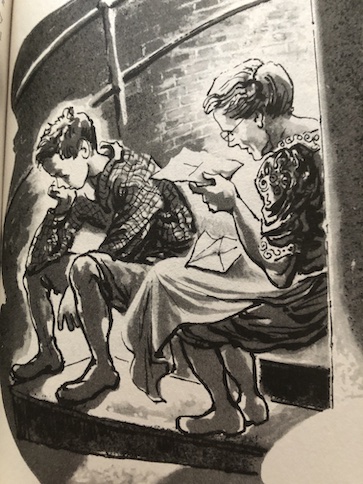
A girl named Polly Plummer is living in London when a boy called Digory Kirke comes to live with his aunt and uncle in the house next door. Digory is very unhappy because he used to live in the countryside and have his own pony, and he doesn’t like the city. The reason why he has to live with his aunt and uncle is that his father needs to go to India, and his mother is very ill and may die, something that has Digory very worried. He also tells Polly that his aunt and uncle are very strange, and it makes him nervous. His uncle spends most of his time in his study at the top of the house, a room where Digory is forbidden to go, and Digory thinks that there might be some terrible secret there. He once heard what sounded like a scream from that room. There are times when his uncle starts to talk about something while they’re eating together, but Digory’s aunt (his uncle’s sister, not his wife) keeps interrupting him and stopping the conversation before it even starts. The children speculate that Digory’s uncle’s secret might be that he’s keeping a mad wife in the attic (like in Jane Eyre) or maybe he’s involved with pirates, like in Treasure Island. Polly thinks all this secrecy and mysteriousness sounds exciting, but Diory says she might not think so if she had to live in a house like that. His uncle is a sinister person, and Digory thinks he might be mad. After a fashion, Digory is correct.

Digory and Polly become friends and play together over the summer. The weather is frequently rainy, so they spend most of their time inside, exploring their own houses. Their houses are part of a row of adjoined houses, and Polly discovers an attic crawl space that links all of the houses together. The children realize that they can use this crawl space to access other houses in the block. They don’t want to trespass into an occupied house, but there’s an empty house beyond the one where Digory’s aunt and uncle live that’s been empty for years. The children are curious about that house and think maybe it’s haunted, so they decide to use the crawl space to access the empty house. Unfortunately, the children accidentally come out of the crawl space in Digory’s uncle’s secret study.

When Digory’s Uncle Andrew catches the children in his study, he locks them in, saying that children are exactly what he needs for his experiment, and this time, his sister can’t interfere. The children are frightened and ask to leave, but Uncle Andrew offers Polly one of the yellow rings he has on a table. Polly can’t resist touching one of the yellow rings, and she suddenly vanishes from the room. Digory angrily demands to know where Polly went, and Uncle Andrew explains that this is his experiment.

Uncle Andrew calls himself a scholar, but he’s also a magician, and he’s been experimenting with dangerous magic. When he was young, he had a godmother named Mrs. Le Fay. Mrs. Le Fay was a somewhat disreputable person who had been to prison (for things that Uncle Andrew doesn’t want to explain), but she was always nice to Andrew because they shared common interests. Their interests were magic and esoteric knowledge. Mrs. Le Fay was one of the few living humans who had some fairy blood in her, so she was Andrew’s “fairy godmother.” Before she died, she gave Andrew a strange box and told him to destroy it using a magical ritual after her death. Of course, Andrew broke his promise and kept the box to study it. Uncle Andrew thinks of himself as a great scholar and researcher, and things like promises and ethics and even the welfare of other human beings are not going to stand in the way of his pursuit of arcane knowledge.

After spending considerable time studying the box, he realizes that it was made in the ancient land of Atlantis, but more than that, the contents, a set of yellow and green rings, came from another dimension, another world in another universe. Uncle Andrew realized that the rings would allow a person to access that other dimension. The yellow rings would send people to the other dimension, and the green ones (he’s pretty sure) allow them to return from that dimension. Naturally, he thought of himself as too important to risk in the experiment, so he needed to send someone else instead. He tried it at first with guinea pigs, but he couldn’t tell the guinea pigs what to do to come back, so he realized that he needed to send humans. Now that he has tricked Polly into going, he says that the only way Polly can come back is if Digory goes, too, and brings her one of the green rings that she can use to return. Digory is angry at his uncle for trapping them in this way, but since he knows his uncle won’t rescue Polly, he agrees to go find her.

After using one of the yellow rings himself, Digory finds himself coming out of a pool in a strange forest. Polly is there, but something about this forest muddles their minds so they have trouble remembering who they are, where they’re from, and what they’re supposed to do. After talking to each other awhile, they remember. They’re about to return to their own world by putting on their green rings and stepping into the pool they both came from when Digory realizes that there are other pools around them that could lead them to other worlds. Digory is excited and wants to explore these other worlds, but Polly sensibility insists that they carefully mark the pool that will take them home and test it to make sure that it will allow them to return before they try going to a different world. They change rings before they are fully in their own world again, so they won’t immediately return to Uncle Andrew before they’ve fully understood what these other places are and what they’re about.

When the children try entering a different world, they find the ruins of an ancient palace and city. There is no one around, and it looks like it’s been dead or abandoned for ages. Exploring the palace, they find a collection of statues in royal clothes and crowns. Some of the statues seem to have kind and wise faces, while others are cruel and distressed. Then, the children see a little bell and a hammer with a warning on the bell in a strange language that the children are somehow able to understand. Polly thinks that they should leave the bell alone, but Digory feels a strong urge to strike the bell and see what happens. Digory grabs Polly’s arm to stop her from leaving this ruined world and strikes the bell. Almost immediately, the children realize that this was a terrible choice.

The bell wakes one of the statues, a tall and beautiful but cruel woman who says that she is Jadis, the last queen of this world. Digory finds her impressive at first, but that feeling turns to horror as she tells them her story. Jadis says that she and her sister were fighting for the throne, and her sister’s forces were winning. As she stood on the brink of defeat, Jadis used a terrible spell that immediately killed everyone in their world except herself, including her sister, her forces, and all of the citizens. Jadis says that the citizens served no other purpose than to serve her anyway, since she is rightful queen, and she blames her sister for not simply giving her the crown when she demanded it. After everyone was dead in her world, Jadis put herself into a magical sleep until someone came to wake her up. When she has finished telling the story, Jadis commands the children to take her to their world so she can rule them instead.

Polly and Digory try to use their magic rings to escape from this terrible queen, but Jadis grabs hold of them and is brought to Earth anyway. Although Jadis’s magical powers don’t seem to work on Earth as they did in her world, she is still unnaturally strong and formidable. She is as cruel, selfish, and vain as Uncle Andrew, but she could easily wipe the floor with him, if she wanted to. Uncle Andrew’s initial joy at his experiment being an unqualified success that actually bought someone from another world into his world turns to panic when he realizes that Jadis is more than he can control and regards him as no more important than one of his guinea pigs was to him. Digory apologizes to Polly for ignoring her warnings and waking Jadis, and the children try to figure out how they can get rid of her before she can take over their world.

My Reaction and Spoilers

I didn’t read this book when I was a kid, but I’m glad I did as an adult because I enjoyed it, and I appreciated the explanations behind some of the things that happen or exist in the other stories. Digory Kirke is actually the old professor the Pevensie children go to stay with in the country when they are evacuated from London during WWII in the first book in the series, The Lion, the Witch, and the Wardrobe. We also learn that he and Polly actually witness the creation of Narnia when they try to get Jadis back to her own, crumbling world. Jadis was inadvertently responsible for the lamppost that the Pevensie children find in the woods when they first visit Narnia. Jadis also becomes the White Witch who tries to make herself Queen of Narnia. At the end of the book, we also learn the origins of the magic wardrobe and what makes it so special.

There are Biblical themes throughout the story, but especially around the creation of Narnia and the mission that Aslan gives Digory to make up for accidentally bringing Jadis to Narnia. Narnia’s creation isn’t quite like the Biblical creation story. In this book, Aslan the Lion sings Narnia into existence. However, there is a pairing up of animals that almost mimics the pairs of animals being chosen for the Ark in the Noah story.

After Digory admits that he is the one who brought Jadis to this new world, Aslan sends him to fetch an apple from a distant garden, from which Aslan says he will plant a tree that will protect Narnia for years. The apple and the garden mimic the story of the Garden of Eden. The garden has a fence around it with a warning about trespassing and stealing fruit for selfish purposes. Digory retrieves the apple that Aslan asks for, and he is tempted to take one himself, but before he can go much further with that thought, he catches Jadis in the garden, stealing an apple for herself. When Jadis eats the apple, it turns her into the pale witch she becomes. Jadis says that she will now live forever and never age. She tries to convince Digory to eat the apple he has picked or give it to his ill mother, but Digory successfully resists the temptation. Aslan tells Digory that it is good that he resisted the temptation because, while the fruit would grant eternal life to whoever eats it, it comes with a heavy price if the fruit is obtained through dishonest means. Jadis/the White Witch is granted unnaturally long life, but she is never the same again. Aslan does give Digory the means to heal his mother before he returns home.

I really liked the children’s hideout in the crawl space that spans the houses. They use the crawl space and its relationship to the houses to explain how there can be parallel worlds that can be connected, but I like the setting so much that I would have liked to see a children’s mystery or adventure story in a similar setting. I found myself wondering what would have happened if the children had managed to reach the empty house they wanted to enter and explore. They never did because they got into Uncle Andrew’s study by mistake, but I think it’s fun to imagine what they would have done if they had. Maybe they would have turned it into a secret hideout, or maybe they would have encountered criminals who had already turned it into their hideout. Maybe someone would eventually buy the house and move in. The whole setup offers possibilities.
The Light at Tern Rock

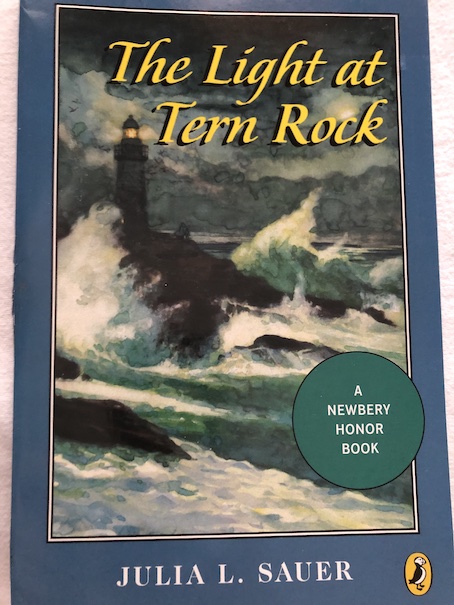
The Light at Tern Rock by Julia L. Sauer, 1951.

Not long before Christmas, the lighthouse keeper at Tern Rock, Byron Flagg, approaches Martha Morse, asking her if she would be willing to temporarily take the job of tending the lighthouse while he takes a vacation. The lighthouse can never be untended because ships rely on that light, and it can be difficult for Mr. Flagg to find someone to take over his duties for an extended period of time, especially so close to Christmas. Mr. Flagg wants to hire a substitute with experience tending the lighthouse. Mrs. Morse lived there for 14 years while her late husband was the lighthouse keeper. Although many people would be daunted by the isolation of the lighthouse, Mrs. Morse actually loved it because she enjoyed the beauty of the sea and nature. She knows that she would enjoy staying there again. However, she hesitates to take the job of temporarily tending the light because she is caring for her young nephew, 11-year-old Ronnie. Ronnie might enjoy the adventure of staying in a lighthouse, but he would have to miss some school.

Mr. Flagg appeals to Mrs. Morse’s sense of nostalgia about the lighthouse and points out that Ronnie could bring along some of his schoolwork to study during their stay. Mr. Flagg says that their stay will only be for two weeks, and that he’ll return and relieve them on December 15th. Mrs. Morse points out that the weather around Tern Rock can be unpredictable and that he might not be able to return when he says he will, but Mr. Flagg says he is confident that he can. They talk to Ronnie about it, and Ronnie says that he would like to see the lighthouse, but he wants to be home for Christmas. Mr. Flagg assures them that won’t be a problem and that they will enjoy their stay at the lighthouse, so they agree to go.

When they arrive at the lighthouse, Ronnie is awed by rugged environment of Tern Rock and daunted by the isolation of the lighthouse. His Aunt Martha says that she understands how he feels, that he wonders if they’re up to the task, but she assures them that they are. The job they will do is a necessary one because, without the light, the rocks in this area are a danger to ships.

As they settle in, Ronnie becomes fascinated with the lighthouse. The interior is comfortable and designed to be compact, almost like the interior of a ship. His Aunt Martha establishes their schedule, teaching Ronnie what they need to do. She turns off the light at sunrise and lets it cool down while they have breakfast. Then, they clean the lamp, polish its lens, and do other chores to keep the light in working order. Ronnie does his schoolwork in the afternoon, and they turn on the light when the sun goes down. They spend their evenings doing quiet activities, like reading and playing games. Although Aunt Martha wasn’t sure that the quietness and monotony would appeal to an active boy like Ronnie, Ronnie finds the newness of the environment and the change in his usual routine fascinating.

Ronnie’s feelings change when December 15th arrives, and Mr. Flagg doesn’t. The weather is good, so there’s no reason why a boat shouldn’t approach Tern Rock, but Aunt Martha says that there may have been some other problem that delayed him. She doesn’t think an extra day or two at the lighthouse will hurt them, but the days go by, and still, Mr. Flagg doesn’t come. They are still comfortable in the lighthouse and there haven’t been any problems with the light, but Ronnie is angry because he realizes that Mr. Flagg lied to them. Christmas is approaching, and it becomes clear that Mr. Flagg never had any intention of being back at the lighthouse in time for Christmas.

Ronnie has trouble understanding and excepting Mr. Flagg’s lies and broken promises. Ronnie and Aunt Martha discuss the importance of honesty and the meaning of broken promises. Ronnie thinks that Mr. Flagg has been wicked. He has certainly been unfair, but Aunt Martha says that there are worse kinds of wickedness, and before they jump to conclusions about what has happened, they need to know the reasons for it.

Aunt Martha says that the Christ Child visits every home on Christmas, and no place is too distant for Him to reach, so they should make the lighthouse ready and prepare for Christmas. Ronnie doesn’t see how they can because they didn’t bring any decorations or anything for Christmas. Ronnie considers firing the cannon that would signal an emergency to bring someone out to the lighthouse, but Aunt Martha firmly tells him no. The cannon is only for serious emergencies, when there are lives in danger, not for mere disappointment and self-pity. However, Mr. Flagg has left some special surprises for them.

It is true that he intentionally deceived them about being back in time for Christmas. When Ronnie finds a sea chest with a Christmas message, he knows for certain that Mr. Flagg was lying to them the entire time, which makes him angrier. However, a letter that Mr. Flagg left explains his reasons, which earns their sympathy. To soften the blow of his deception, he has also left them some special presents and treats gathered from exotic places. This still isn’t the Christmas that Ronnie and Aunt Martha had originally planned, and being lied to doesn’t feel good. Still, in the end, this Christmas is pretty special and memorable, and they both realize that they are exactly where they need to be.

The book is a Newbery Honor book. It is recommended for ages 8 to 12 years old. It is available to borrow and read for free online through Internet Archive. The author, Julia L. Sauer, also wrote Fog Magic.

My Reaction

I wasn’t familiar with this story when the Coronavirus Pandemic started, which is a pity because this would have been a great book for the type of Christmas we had in 2020. Still, this is a lovely Christmas story, and the pandemic isn’t quite over yet. Things have improved considerably since 2020 because people have been vaccinated, but for those who still need to be cautious and are disappointed that things aren’t completely back to normal or anyone who has hard feelings toward someone or is having a rough Christmas for any other reason, this story is a useful reminder that disappointments are still temporary, and sometimes, the place where you find yourself is exactly where you need to be. Also, disappointments and inconveniences can come with compensations, if you’re open to experiencing them.

Mr. Flagg shouldn’t have lied to Mrs. Morse and Ronnie. He acknowledges in his letter that this was a hurtful thing to do, and he explains his reasons. Basically, he was lonely and desperate. As a lighthouse keeper, he is what we might call an “essential worker”, someone who can’t easily take time off from his work because he does a necessary job that can only be done in a particular place. People’s lives depend on the light from the lighthouse, so Mr. Flagg can’t leave his job for any length of time unless he finds someone qualified who is willing to take his place. This story is set during a time before lighthouses became automated, so there must be a human in this role.

Mr. Flagg is in his 60s, and he explains in his letter that he has spent most of his Christmases either alone or with other adults because of his life as a sailor and lighthouse keeper. He has a niece who has several children and who would be happy to have him for Christmas, but he has never managed to find anyone who was willing to relieve him from his duties during Christmas before. He was desperate to spend at least one Christmas with his family, so he resorted this deception out of desperation, but he left all the presents and special treats for Aunt Martha and Ronnie because he didn’t want them to be miserable.

Aunt Martha is getting older herself, and she understands how Mr. Flagg feels, having lived a similar sort of life. When she lived at the lighthouse, she and her husband were together, but Mr. Flagg has never married, and he was desperately lonely. Ronnie has more trouble understanding the feeling because he is younger and hasn’t experienced this type of loneliness before. Aunt Martha points out that Ronnie will have many more Christmases before him, more than either she or Mr. Flagg have left. One disappointing or just bizarre Christmas won’t mean that much to him in the long term. With maybe 50 or more future Christmases to come as well as the ones he’s already experienced, this strange Christmas in the lighthouse is just one more memory or story to tell other people in Christmases to come.

Part of this story is about forgiveness, but they don’t use that word at all in the story. People have different views about what forgiveness entails, but I think it’s important that Aunt Martha and Ronnie don’t excuse Mr. Flagg’s actions. They come to understand his motives, and they feel pity or sympathy for him for the kind of rough and lonely life he’s lived, but that doesn’t make lies to them good or right. He did something hurtful by betraying their trust, and there will probably be some kind of reckoning between them when Mr. Flagg eventually shows up. Mr. Flagg acknowledges that in his letter, that the knowledge that he betrayed their trust will keep him from fully enjoying Christmas with his family, even when he’s finally getting the kind of Christmas he has wanted, and he can’t blame them for whatever they’re feeling as they read his letter. So, the story never says that what Mr. Flagg did was okay or that it didn’t hurt that he lied to the people who were helping him. Lying was wrong, and it was hurtful, and the characters are honest about that. They don’t try to pretend that they’re not hurt, which I think would have made their feelings worse in the long run. Instead, it’s about looking past that hurt to something better and finding things to be happy about even in a situation where they didn’t want to be.

Aunt Martha sees that what’s really preventing Ronnie from enjoying Christmas as they happen to have it is his anger, disappointment, and bitter feelings and the way he broods about them. Brooding about the angry things he wants to say to Mr. Flagg when he sees him isn’t making his Christmas any better. Aunt Martha compares cleaning out negative emotions to cleaning house before the holiday. You have to clear out all the dust and negativity to let in something better. They will eventually see Mr. Flagg, and there will probably be words between them, but those words can wait while they enjoy themselves as best they can for this Christmas. By then, each of them will probably have a better sense of just how they really feel about the situation and what they want to say about it anyway.

Once Ronnie works through his feelings and is able to put aside his anger, he realizes that this Christmas is something special. He does miss the class Christmas party the rest of his school is having, but in return for that sacrifice, he is experiencing something truly unique that his school friends will probably never experience. He doesn’t fully consider how unique this experience actually is at first, but he senses that there is a unique feel to Christmas in the lighthouse, with its giant light. Ronnie considers the tradition of putting candles in windows at Christmas, to guide the Christ Child or other travelers. (They emphasize candles as welcoming the Christ Child in the story, but when I first heard of the tradition, it was to welcome travelers or absent family members.) He realizes that, by tending the lighthouse, he and his aunt are doing the same thing, but they’ve got the biggest candle of anyone!

Whatever your Christmas happens to be this year, wherever you’re spending it, and whoever you’re spending it with (even if it’s just yourself), don’t forget to do the little things to make it special and enjoy it for whatever it is! Merry Christmas!

The Lost City of Faar

Pendragon

The Lost City of Faar by D.J. MacHale, 2003.

Press and Bobby have followed Saint Dane to the territory of Cloral, a world completely covered by water and occupied by peaceful people who live in floating cities.  Of course, with Saint Dane on the loose, things aren’t going to stay peaceful for long.  An entire city of people are killed when they eat poisoned food, and it looks like Cloral’s entire food supply may be in danger. 

Saint Dane is commanding a group of pirates raiding cities for their food supplies.  Among the dead is Cloral’s last Traveler, and his successor is his son, Spader, who has no idea what the Travelers are or what kind of dangerous mission awaits him.  Spader takes his father’s dead very hard and vows revenge upon Saint Dane.  As Bobby, Press, and Loor, who Bobby introduces to Spader in order to help explain who Travelers are, acquaint Spader with his new duties as the Traveler of Cloral, they try to convince him that preserving the peace of Cloral is more important than seeking revenge.  Spader is hot tempered, and they try to teach him to use peaceful means to combat Saint Dane, who has superior strength, anyway. 

Before he died, Spader’s father left behind one clue to the solution of their problems: a reference to the lost city of Faar, apparently the last city on dry land on Cloral. According to legend, it sank many years ago, but its advanced civilization may not have been completely destroyed. Centuries ago, the water level of Cloral rose, and the people of Faar realized that their city would soon be underwater.  They built a dome to protect their city, and they have been secretly helping the people in the floating cities by tending to their underwater farms and sharing technology with them.  However, they have been afraid to openly reveal themselves to the rest of Cloral because they were worried about their culture becoming contaminated. 

When Press, Bobby, and Spader tell them that Saint Dane knows where they are and is on his way to destroy them, most of the people flee the city.  The dome is broken, and it looks as though they will be unable to retrieve the equipment that the people of Faar were going to give them to save Cloral’s food supply.  However, the one person who remained in Faar and was killed was talking about making Faar “transpire.” Bobby, wanting to fulfill the dead man’s mission, activates the machinery to make it happen.  It turns out that the people of Faar have made it possible for their city to detach from the ground and float to the surface, like the other cities of Cloral.  Faar and its people have now rejoined the rest of Cloral, and they are able to retrieve the machinery they need.  Sadly, Spader tries to chase down Saint Dane as he escapes through the flume, and Press is killed saving him.  Spader volunteers to accompany Bobby on his mission to stop Saint Dane.

Throughout the books, Bobby, like Spader, has to come to terms with the fact that his life and his entire identity are not what he has always thought they were. Other Travelers also go through the same process as they learn about what it means to be a Traveler and to accept the mission of the Travelers. All through the series, there are other revelations about the nature of the Travelers themselves and how they came to be.

The book is available to borrow for free online through Internet Archive.

The Merchant of Death

Pendragon

The Merchant of Death by D.J. MacHale, 2002.

Bobby Pendragon is a normal fourteen-year-old boy, or at least he thought he was.  One day, his mysterious Uncle Press shows up at his house right before he’s supposed to leave for an important basketball game at school and tells him that he needs his help and that Bobby must come with him right away. 

Although Bobby doesn’t know what is going on, he goes with his uncle and begins a terrifying journey to another world.  His uncle reveals to him that they are both Travelers, members of a select group of people who can use gateways called flumes to travel across time and space to other worlds.  Worlds everywhere are in chaos, and an evil Traveler called Saint Dane is manipulating events to cause more chaos and destruction.  On the world of Denduron, the decadent Bedoowan society is oppressing the Milago miners, and thanks to Saint Dane, their world is about to erupt in warfare unless Bobby and his uncle can stop it.

Bobby and his uncle are separated for a while when some Bedoowans capture Uncle Press, and Bobby meets up with fellow travelers Osa, Loor, and Alder.  Osa, the most experienced Traveler, is killed trying to protect Bobby, and Bobby makes some mistakes that make the situation worse, including having his friends back home send him some items that are advanced technology to the people of Denduron. 

The Milago have discovered an explosive mineral called Tak, and they are using it to build a super weapon to wipe out the Bedoowan.  Saint Dane is trying to increase tensions between the two groups of people so that they will use this weapon, which will lead to the destruction of their world … unless Bobby and his friends can stop it.

This series reminds me a little of old movie serials, like Flash Gordon, where the good guys must defeat an evil overlord, free people from oppression, and bring peace to warring groups.  However, like with Flash Gordon’s evil nemesis, Ming the Merciless, Saint Dane has a way of escaping even when our heroes have put a stop to his plans. By the time matters are straightened out with the Bedoowans and the Milago, Saint Dane has escaped to another world, and Bobby and his companions must find him and stop him from causing further destruction.

The book is available to borrow for free online through Internet Archive.

The Mystery of the Backdoor Bundle

Three Cousins Detective Club

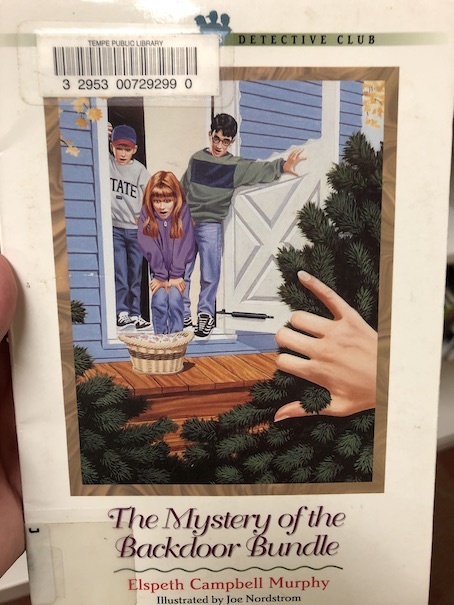
#28 The Mystery of the Backdoor Bundle by Elspeth Campbell Murphy, 2000.

Sarah-Jane’s mother owns a decorating business, but recently she and her business partner have started repairing dolls because he has discovered that he has a talent for it. One day, while the Sarah-Jane and her cousins, Timothy and Titus, are sitting in the kitchen, someone knocks on the door and leaves a basket with a doll inside it. There is a note with the doll that says, “Please help me!”

When the kids show it to Sarah-Jane’s mother and her business partner, the partner says that the doll is an antique. The question is why anyone would simply abandon the doll with a note asking for help. The only clues they have are some footprints, a button, and a scrap of paper outside with logo of a blue kangaroo.

The doll is hiding a secret, and it’s up to the cousins to learn what it is and to help someone who cannot ask for help directly. This person has done something that they can’t admit to doing, but they’re trying to do the right thing and need some help to make it right.

The theme of the story is Psalm 147:3, “[The Lord] heals the brokenhearted and binds up their wounds.”

Mystery Behind Dark Windows

MysteryDarkWindowsMystery Behind Dark Windows by Mary C. Jane, 1962.
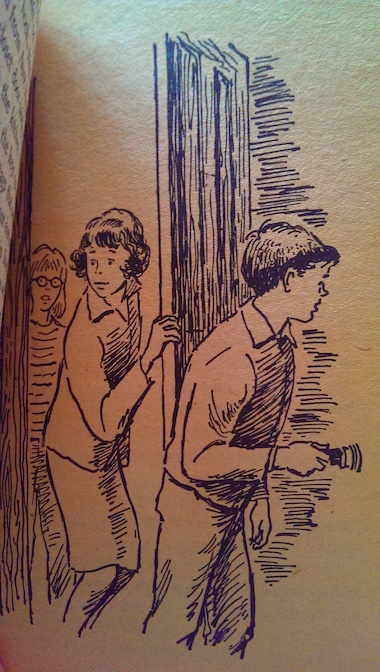
Recent years have brought misfortune to the formerly wealthy Pride family.  First, Tony and Ellie’s father was killed while on a business trip on behalf of the family’s mill.  Then, the workers in the mill went on strike, and the children’s grandfather died.  Their Aunt Rachel blames the strikers for putting stress on her father while he was still grieving for his son, thereby causing his death.  Because of that and because she doesn’t believe that she can handle the running of the mill herself, she has closed down the mill, putting all of the workers out of a job.

The townspeople of Darkwater Falls struggle to get by without the mill and are angry with the remaining members of the Pride family for the lay-offs, but Aunt Rachel thinks that their suffering is earned and so does nothing to help.  If Aunt Rachel would be willing to sell the mill to someone who would put it back into good use and employ people, the community’s problems would be solved, but Aunt Rachel can’t bring herself to do that, in spite of the offers she’s received and the urging of the family lawyer, Mr. Ralph Joslin.  She has high hopes that Tony might revive the mill one day when he’s grown up, and in the meantime, she wants to punish the strikers with unemployment and underemployment.  However, Aunt Rachel, absorbed in her personal pride and bad feelings, is ignoring some serious issues.  The taxes on the disused mill are costing the family dearly, the equipment is rusting, and Tony isn’t even sure that he wants to go into the family business.  Tony and Ellie are unhappy with their family’s situation, their aunt’s bitterness, and the way many of the townspeople now look at them, but they’re not sure what to do about it.

MysteryDarkWindowsMillSearchThen, one night, Ellie goes out to look for her aunt’s missing cat and hears someone in the old, supposedly empty mill.  When she tries to tell Tony, he doesn’t take her seriously, but Ellie knows what she heard.  Ellie later goes back to the mill to take another look at the place, and she sees Jeff, a boy from Tony’s high school, hanging around.  Later, she confides what she’s heard and seen in Hank, an old friend who lives on the other side of the river, and Violet, another girl from her class whose family has suffered since the closure of the mill.  The two of them start helping Ellie to investigate.

Some people in town have become concerned about children in the area getting into trouble, and they think that maybe some of the local youths have formed a gang.  Ellie worries about Tony, who has started sneaking out of the house at night to hang out with friends.  Is he now part of a gang?  Are he and his friends the ones who were sneaking around the old mill? Or could it be some of the disgruntled townsfolk, bitter about the mill remaining empty and not providing much-needed jobs?

While the kids have a look inside the mill, they discover that someone has been using the place as a hideout.  A fire at the mill reveals a number of secrets and sheds light on a town and a family caught in a cycle of bitter feelings and revenge.  Aunt Rachel is stunned when some of the townspeople accuse her of setting the fire herself in order to get insurance money for the mill.  The fire was clearly arson, and since Aunt Rachel has gone out of her way to make life difficult for people in town, many of them would be ready to believe just about anything of her.  It’s up to the young people to put the pieces together and reveal the true arsonist before the mill, the town, and the Pride family are completely destroyed.

Many of Aunt Rachel’s decisions are guided by a mixture of grief and anger, but she is also stubborn and prideful.  The Pride family was aptly named.  Although they have suffered misfortune, their privileged position as the (former) main employer of the community has given Aunt Rachel the sense that she and others in her family could do no wrong.  Aunt Rachel is absorbed in herself, her own feelings (which she places above others), and the past to the point where she feels justified in deliberately causing harm to her community and the people in it, failing to see the consequences of her actions, even the effects that her attitude has on the orphaned young niece and nephew in her charge.  Ellie feels like they don’t have a real family because her aunt’s bitter feelings prevent her and her brother from getting close to their aunt.  Her aunt’s actions have also made it difficult for her and Tony to get along well with other members of the community, further isolating them from comfort in their own grief.

In a way, the fire brings Aunt Rachel back to reality, forcing her to see the consequences of her actions (and inaction).  It comes as something of a shock to her that, while she felt fully justified in her bad feelings for the town, they are also fully justified in feeling badly about her.  Somehow, it never occurred to her how someone, doing the things she’s been doing and saying the things she’s been saying, would look to the people she deliberately set out to hurt.  For most of the story, the only feelings that were real to Aunt Rachel were her own.  Even when she thought about how people hated her, she didn’t think that what they thought would matter until she began to see how it was affecting Ellie and Tony as well as the other children in town.  Ellie can see that many things would have been resolved sooner if both her aunt and her brother could open up and discuss things honestly, both within the family and with other people.  Although neither of them set the fire, their secretiveness and self-absorption at first create the impression that they did.  Ellie’s eventual outburst at her aunt and the real guilty person force both of them to acknowledge the reality of their actions and motives.

I was somewhat fascinated by the motives of the arsonist, who understands the effects that Aunt Rachel’s bitterness and revenge have been having on the young people in town, even her own nephew, better than she does.  This person was wrong in the path he tried to take to fix the situation, but he does correctly see that unemployed men not only lack the money they need to properly take care of their families but may also set a bad example for boys and young men, either through the habits and attitudes that they let themselves fall into or by becoming too absorbed in their difficulties to see what’s happening to their own children.  I also agree with his assertion that those responsible for putting people out of their jobs bear some responsibility for the results of their actions, something which resonates in today’s economy, where many people are still unemployed or underemployed.  The Pride family’s previous high standing in the community was directly because of their ability to employ people and improve the lives of others.  When they began making life hard for others and refused to use their ability to help people, they lost that standing.  Aunt Rachel was just the last to realize it, which was part of the reason why she was surprised to discover just how badly the town thought of her.  She didn’t have a good reputation because she had done nothing to earn one, no matter what her family used to do.  She was no longer using their powers for good, so she turned herself into a villain.  However, it’s important to point out that the arsonist isn’t really in the right himself because, as Ellie points out, the spirit behind his actions isn’t much different from her aunt’s.

Ellie is correct in pointing out that both her aunt and the arsonist were wrong, not just because of what they did, but because of the feelings and motives behind it.  In their own way, each of them set out to deliberately hurt others because they had each been hurt.  Which of them was hurt first or hurt worse ultimately doesn’t matter.  Their mutual desire for vengeance against each other not only hurt the people around them but kept each of them from doing what they needed to do in order to heal their own wounds.  That is also a message that resonates today, in these times of political division, with two large parts of society trying to one-up each other and even actively harm one another, largely because they can’t stand the idea of someone wanting something or believing something that they don’t.  Whatever the circumstances, when people focus on winning on their own terms, no matter what the cost, everyone loses in the end.

Toward the end of the story, as Aunt Rachel and the arsonist begin making grudging apologies to one another and reluctant steps to fix things, Ellie decides that grudging and reluctant aren’t good enough and finally gets up the nerve to tell them what she really thinks, what they most need to hear:

“Just selling the mill won’t make things better . . . It’s the way [they] feel about it that’s wrong. That’s what made them act the way they did in the first place. They just wanted to get even with people, and hurt people, because they’d been hurt themselves. And they feel the same way still. You can see they do.”

How much can people help what they feel? It partly depends on what people choose to do about their feelings.  Actions guide feelings, and feelings guide actions.  Aunt Rachel and the arsonist indulged their bad feelings, nursing them, amplifying them, and making them their first priorities, the guiding force of their actions.  As long as they keep doing that, Ellie knows that the problems aren’t really over, and everyone will remain trapped in this bad cycle.  Ellie’s honest outburst finally breaks through to both of them, showing them what they really look like to others and making them reconsider their feelings and priorities.

One of my favorite characters in this story was Mr. Joslin, the lawyer.  Although he looks a little suspicious himself for a time, he is actually a good man, who looks after the family’s interests and genuinely cares about them as well as about the town.  He is the one who convinces Tony to be honest with his aunt about the friends he hangs out with and helps persuade Aunt Rachel to see things from others’ point of view.  He loves Aunt Rachel, in spite of her faults, and is honest with her about those faults, telling her what she needs to hear.  Of all the characters, with the exception of Ellie, he seems to have the most insight into other people’s feelings and situations.  He supports what Ellie says, quoting Lord Bacon, “A man who studieth revenge keeps his own wounds green, which otherwise would heal and do well.”