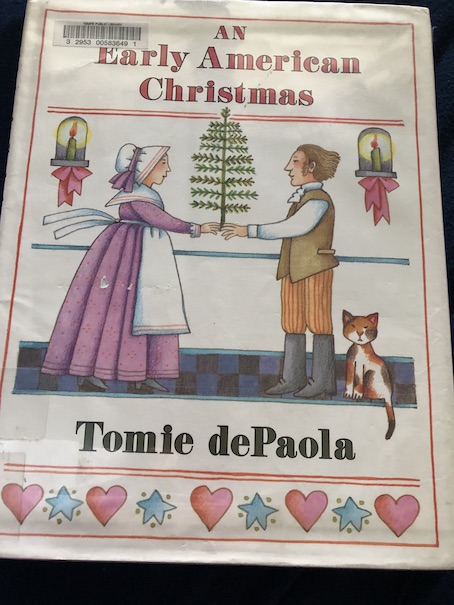
An Early American Christmas by Tomie dePaola, 1987.
A note at the beginning of the book explains the story behind the book, which is based on the history of early Colonial America. Although Christmas is now a popular American holiday with lavish celebrations, many early colonial groups didn’t celebrate Christmas much at all. Even among Christian groups, Christmas was not regarded as a major holiday. In particular, groups like the Puritans, Presbyterians, Quakers, and Baptists tended to avoid celebrating Christmas, seeing it as a frivolous sort of celebration. However, there were other groups, like Catholics, Lutherans, and Episcopalians, who did celebrate the holiday in a festive fashion. The author of this book imagines what it would have been like for a family that celebrates Christmas if they moved to a New England community that didn’t during the early 1800s. In particular, he used New Hampshire as his inspiration.
The beginning of the story describes a New England town that doesn’t celebrate Christmas with decorations or songs. Then, a new family comes to the village. They were originally from Germany, and they had lived in Pennsylvania before coming to the village. (This would make them Pennsylvania Dutch.) They are usual because of their festive Christmas celebrations.
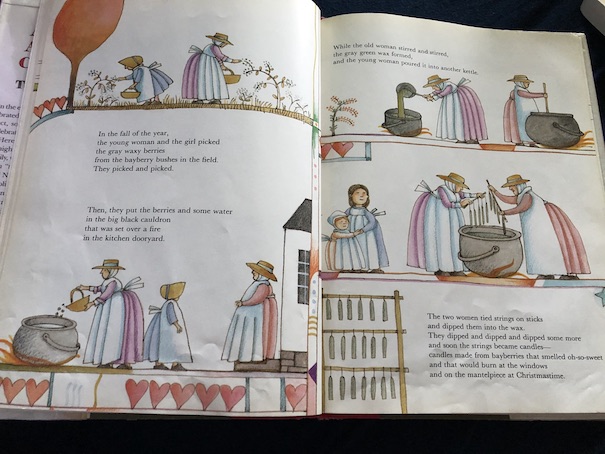
They begin planning for their Christmas celebration in the fall. The women and girls pick bayberries and use them to make candles. They say that bayberry candles bring good luck when they’re burned on Christmas.
The men and boys gather the crops that they will need for their feast. The grandfather of the family carves figures for their manger scene.
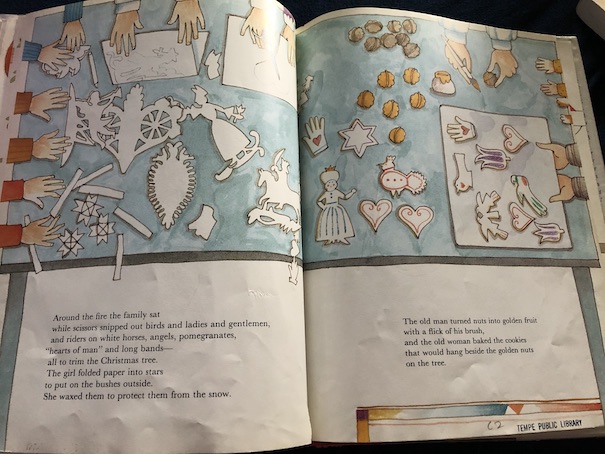
In December, the whole family makes paper decorations and specially-shaped cookies. I liked the variety of baked goods that they show in the pictures. They pick out a tree and make strings of popcorn and dried apples.
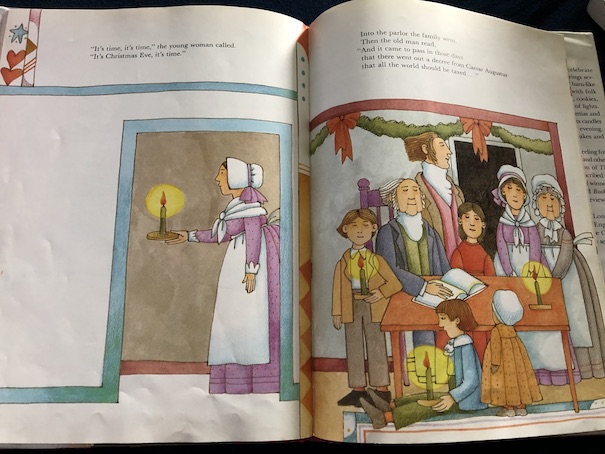
On Christmas Eve, they read the story of Jesus’s birth and decorate their home with all of the decorations they have prepared.
As the years go by and other people in town see what the Christmas Family is doing, they begin to celebrate Christmas, too.
The book is available to borrow and read for free online through Internet Archive.
The kids are studying the history of their New England town in school. McGurk studies witchcraft trials, and he is outraged at how innocent people could be charged with witchcraft on little evidence and sentenced to death. When their teacher tells them that she has learned that a young girl was once put on trial for witchcraft in their town 300 years ago, McGurk convinces the others to try to use their “little black boxes” from the previous book in the series to go back in time and try to save the girl.
The girl, Hester Bidgood, is thirteen years old and turns out to be the goddaughter of Gwyneth, one of their friends from their last fantasy adventure. Gwyneth is now very old, but she remembers them and welcomes them into her home. A man in their community, Jacob Peabody, is trying to pressure Gwyneth into selling him her property. He is the one who brings charges of witchcraft against Hester. Hester calls herself an “investigatrix,” meaning that she is a detective, like the kids in the McGurk organization. She knows some disreputable things that Peabody has done, and Peabody wants to keep her quiet as well as force Gwyneth to give up her property. The McGurk organization is determined to save Hester, but they must be careful not to make anyone think that they might also be witches.
Of course, that turns out to be difficult because all of the modern-day members of the McGurk Organization have magical black boxes.
The book is currently available online through Internet Archive.
Spoiler:
Hester has a friend called Rob McGregor who was captured and raised by Indians when he was young. Although he now lives with his grandparents, he still has habits and skills that he learned from the Indians, and Hester likes to call him by his Indian name, Blazing Scalp (because of his red hair). I expected that Rob would turn out to be some ancestor of McGurk’s, just like the last book had a definite McGurk ancestor, because he has that distinctive red hair, but if there’s a connection, it isn’t definite.
Rob knows that Hester has learned that Peabody earned his fortune by cheating at cards and that he is hiding a mysterious guest in his house. Rob saves Hester when the people in the town try to conduct the water trial, seeing whether she will float or sink in water to determine whether or not she is a witch. Then, Rob and Hester hide in Rob’s secret lodge in the swamp while the McGurk organization tricks the man hiding in Peabody’s house into revealing himself.
The man, who has been going by the name Mica Holroyd, is really Matthew Hopkins, a former witch hunter who has been charged with witchcraft himself and is now a fugitive from the law. Once everyone in town realizes that Peabody is dishonest and harboring a fugitive, they know that the charges against Hester were false. Peabody and Hopkins are both sent back to England, never to return. When the McGurk organization returns to its own time, they learn that Rob and Hester eventually married and that the town gave Hester property that used to belong to Peabody as compensation for accusing her of witchcraft. Hester started a home for orphans and elderly people, which is now a retirement community in the kids’ town.
There is another book in the series which focuses on Rob and Hester alone, without the members of the McGurk Organization.
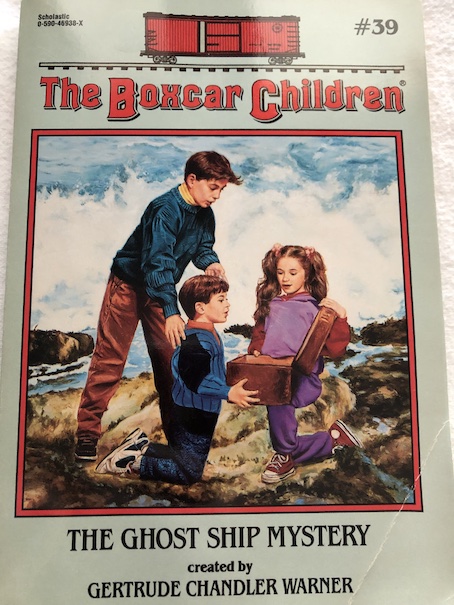
#39 The Ghost Ship Mystery by Gertrude Chandler Warner, 1994.
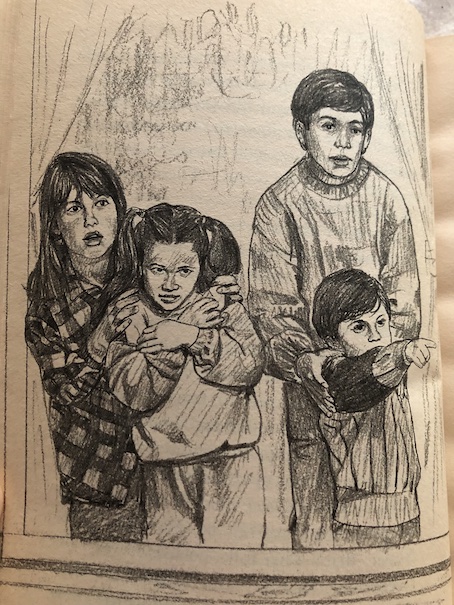
The Alden children are visiting the New England seaside town of Ragged Cove while traveling with their grandfather on a business trip. They enjoy visiting the sea, but on a stormy night at the inn where they are staying, they learn that the town has its own ghost story about a ship called the Flying Cloud that sank off the coast years ago. When storms are coming, people see strange lights that some people think might be the spirits of the people on the Flying Cloud.
As the Aldens soon learn, the events of the Flying Cloud are still affecting people who live in the town. When the ship was wrecked, the only member of the crew who made it to shore was a cabin boy, who died shortly afterward, mumbling about how one of the crew members had taken command of the ship away from the captain in an apparent mutiny. The descendant of the ship’s captain, a woman who manages the small local museum, is bitter toward the descendant of the man who apparently led the mutiny, who now gives whale watch tours.
The Aldens find it strange how events of the distant past can still mean so much to people who are still living, but they find themselves caught up in learning the real secrets of the Flying Cloud when they go on a whale watch tour and their guide, Captain Bob, also takes them scavenging for wreckage after the storm. They make an amazing discovery of a sailors’ post box, a metal box where sailors used to leave messages for each other or objects that they wanted to have delivered home before they would arrive themselves. This particular box has been untouched in a niche in a rock for years, and it has information about the Flying Cloud. At first, Captain Bob is reluctant to part with it, but the Aldens persuade him that it should go to the museum. Captain Bob says that they should take it there on his behalf because the woman who runs the museum won’t want to see him.
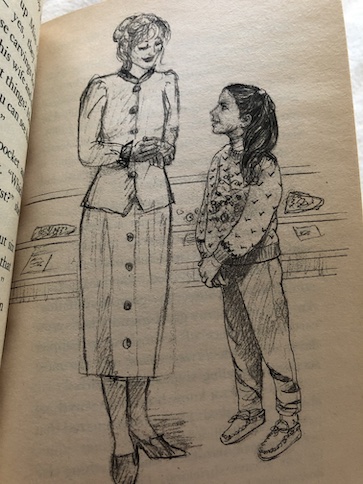
The woman who runs the museum is amazed at the find and is eager to explore the contents of the box. However, when the Aldens leave her alone with it for a short time, they notice that a leather book that was in the box suddenly disappears. The woman denies that it was ever there, making the Aldens suspicious. Then, they later hear that someone broke into the museum and stole the entire contents of the box. Who is really responsible for the break-in, and what really happened on the Flying Cloud all those years ago?
Part of the mystery concerns how people deal with history, especially history that concerns them in a very personal way, when new information is uncovered that changes the story. That the woman who runs the museum is responsible for the book that disappears is obvious because she denies its existence when the Aldens know that they left it with her. The book turns out to be the log book of the Flying Cloud with its final entry, left behind in the post box when the crew began to doubt if they’d make it safely home. The story about the woman’s ancestor, the brave captain who was apparently the victim of a mutiny, isn’t quite what she had always believed, what her family told her, and what she herself had reported in a book that she wrote about the incident. It was partly true, but the final log entry contains new information that puts the whole situation into a different light. The woman struggles not only with the changing story but how that story affected her own behavior, and she worries that what she wrote in her book was a lie. A friend of hers comforts her by saying that it wasn’t a lie, it was the truth as they all understood it for years, just not the complete story, as it turns out. Benny’s proposal that the woman write a new book with the new information makes her feel better.
(Spoiler: It’s not really a mutiny if the captain is incapacitated, and the captain had already died of a severe illness by the time that the ship was wrecked. The person who was blamed for the mutiny wasn’t really at fault.)
The story also explains a little about scrimshaw for an educational element. They describe various objects that sailors could make from scrimshaw. When I first heard of it, it was described as being decorative, but the book talks about useful things, like sewing needles and pie crimpers, that were made with scrimshaw.






 Jestress's Forgotten Books and Stories