Grover Goes to School

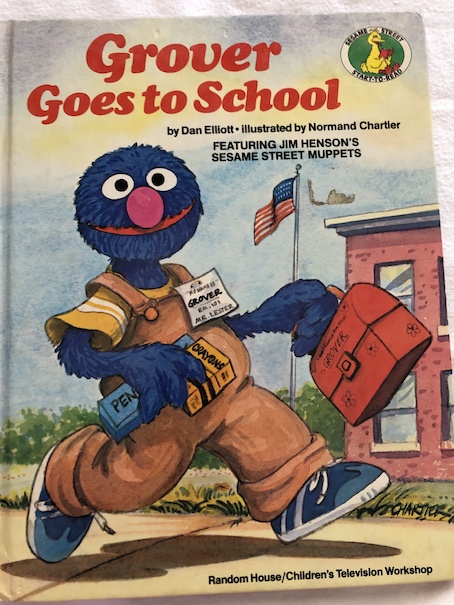
Grover Goes to School by Dan Elliott, illustrated by Normand Chartier, 1982.

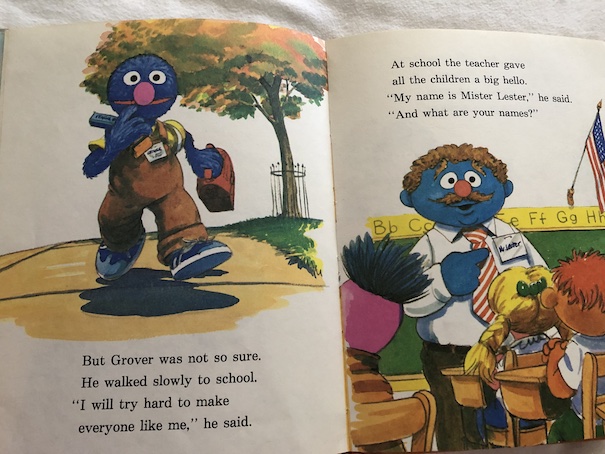
This nostalgic picture book about a child’s first day of school features Grover, one of the characters from the Sesame Street tv show.

Grover is very exited about his first day at school. He’s ready and has everything he needs, but then, he starts to worry about whether the other kids at school will like him or not. His mother tells him that all he needs to do is be himself, but Grover decides he’s going to try hard to get everyone to like him.

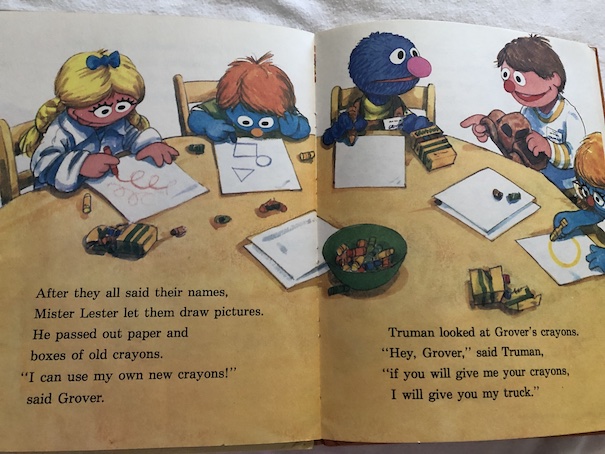
Grover’s attempts to get the other kids to like him cause him to agree to do things that he doesn’t really want to do. When a boy named Truman likes Grover’s nice, new crayons and offers to trade him his old toy truck for the crayons, Grover doesn’t really want to make the trade, but he agrees because he wants Truman to like him.

Then, Grover offers to clean up while the other kids have snack time. Grover does a good job cleaning, but the others forget to save a cookie for him.

The day gets worse with Grover helping the others play jump rope when he doesn’t want to and feeling obligated to trade his lunch for food that he doesn’t want. Finally, Grover bursts into tears

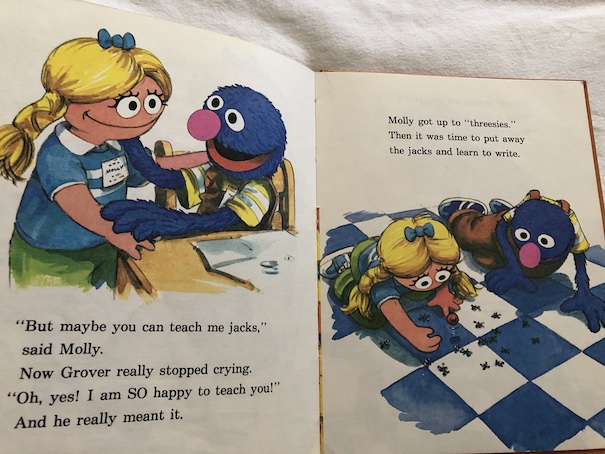
Seeing Grover sad and upset, a girl named Molly asks him what’s wrong. Grover explains everything that’s been happening to her, and she says that she’ll play with him and cheer him up. Molly doesn’t know how to play jacks, which is Grover’s favorite game, but she says that she’d like to learn, and Grover enjoys teaching her.

When a boy named Bill offers to trade his old pencil box for Grover’s nice, new one, Grover decides to say no and keep the pencil box he loves. Grover worries that Bill might be mad at him, but he’s not. Instead, it turns out that Bill also likes jacks.

Making friends with Molly and Bill turns Grover’s day around, and by the time he comes home, he’s feeling much better about school.

The book is available to borrow and read for free online through Internet Archive.

My Reaction

I loved this picture book when I was a kid! I used to watch Sesame Street as a young child, and I liked Grover, who is a shy monster kid who just wants to be friends with other people. In this book, he not only shows little kids how to get used to school on their first day but also teaches a lesson about trying too hard to get people to like you and what it means to be a real friend with someone. Grover realizes that he doesn’t have to do things he doesn’t want to do or give people things to buy their friendship. People still like him even if he sometimes tells them “no.” Like his mother says, he just needs to be himself, and he learns to make friends in ways that are comfortable to him, finding kids who genuinely care about others’ feelings and share common interests.

Molly Moves to Sesame Street

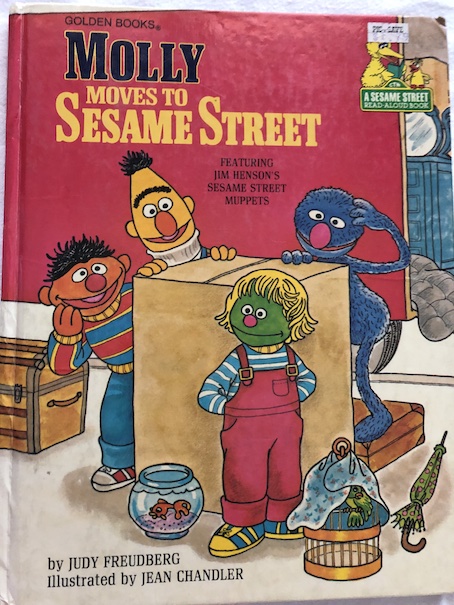
Molly Moves to Sesame Street by Judy Freudberg, illustrated by Jean Chandler, 1980.

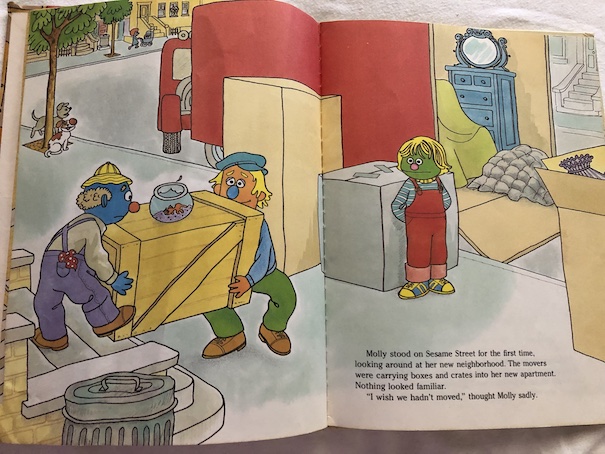
The characters from Sesame Street greet a new neighbor who is getting used to a new home and needs some new friends.

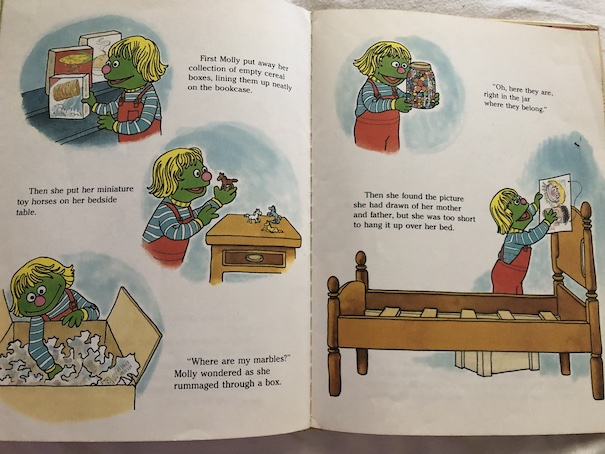
Molly and her parents are moving into a new apartment on Sesame Street, but Molly feels uncomfortable because nothing in this new neighborhood feels familiar. Her new room is still bare and doesn’t look or feel like home. Molly’s parents reassure her that it will feel more like home once all of her belongings are unpacked.

After Molly helps to unpack for awhile, her parents encourage her to go out, explore the neighborhood, and make some new friends. They say that, by the time Molly comes back, they’ll have things unpacked, and her new room will look much better.

When Molly first meets the characters from Sesame Street, they’re playing a game of hide-and-seek, but they all come out when she calls to them. They all introduce themselves to Molly and invite her to join their game.

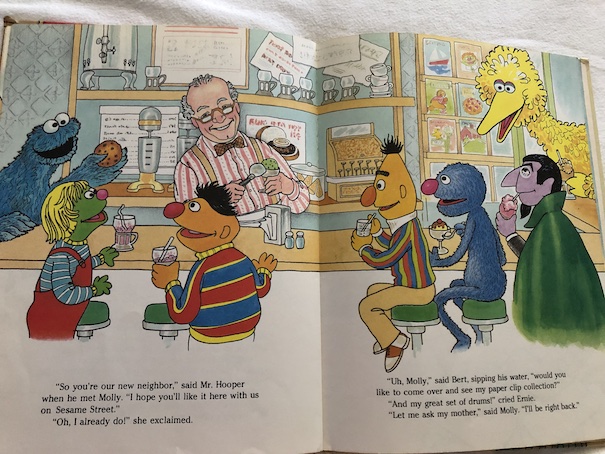
After they play, they all go to Mr. Hooper’s store for ice cream and sodas. Molly is happy that she’s having fun and starting to make friends, and she’s starting to like her new neighborhood.

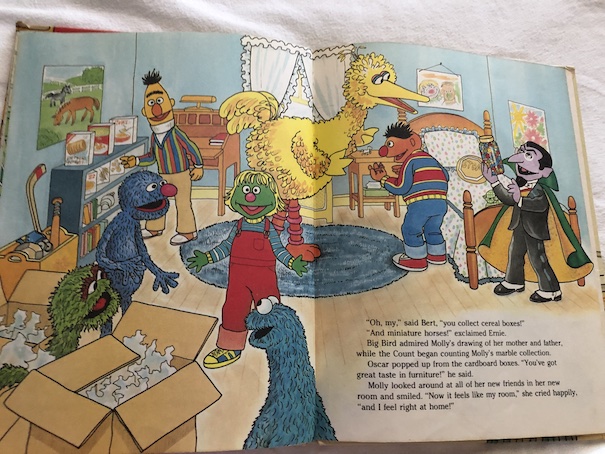
When Molly returns to the apartment, her parents have finished unpacking and arranging her new room. Molly is happy because it looks and feels more like home, and she invites her new friends to come over and see it.

This is a fun and reassuring picture book for young children that shows how making a new home look familiar and making new friends can help them to feel more at home when they move to a new place.

The book is available to borrow and read for free online through Internet Archive (multiple copies, some in different languages), but some later printings of the book have different illustrations and include Elmo, who wasn’t in the first edition of the book.

Mystery in the Apple Orchard

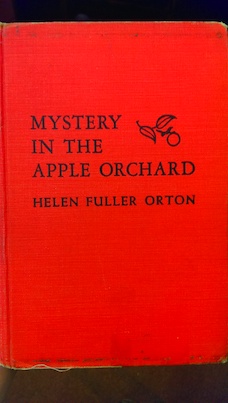
Mystery in the Apple Orchard cover

Mystery in the Apple Orchard by Helen Fuller Orton, 1954.

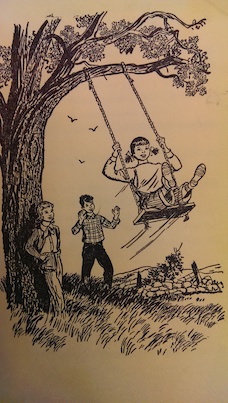
Mystery in the Apple Orchard swing

Dee Waters (age nine), her brother Ronnie (age eleven), and the other neighborhood children enjoy playing in the nearby apple orchard. The orchard was planted by Dee and Ronnie’s grandfather, and the trees are all different types of apple. Sometimes, the children take a lunch with them and spend hours climbing trees and playing. They like to watch the animals there, like the squirrels and crows, running around and hiding things in the trees. There is also a swing hung in one of the trees.

The Waters’ housekeeper, Mrs. Brown, lives in the city and commutes to her job in the country. She also has a son, Timmy, and she’s been concerned about him. Timmy is recovering from a broken leg. The bullies in his neighborhood dared him to climb a tall pole, and he fell. Although Timmy’s been out of the hospital, he hasn’t been getting enough fresh air and time outdoors in the city because they don’t live near a park. Dee and Ronnie don’t know Timmy, but hearing that he’s been unwell, they suggest that Mrs. Brown bring him along the next time she comes so that they can show Timmy the apple orchard. The children’s mother thinks that’s a good idea and also urges Mrs. Brown to bring Timmy for a visit.

Timmy is a little younger than Dee and Ronnie, and he can’t play many games with the children yet because he still walks with a crutch and can’t run. Still, he is fascinated by the animals in the orchard and enjoys watching them. He doesn’t see many wild animals in the city.

Most of the other children in the area are nice to Timmy, but Gloria is a little bit of a snob. Ronnie finds Gloria annoying because she is so prissy and extra careful about her clothes, and on Timmy’s first day in the orchard, Gloria shows up with a ring that she says has a real diamond and a family. The other children don’t believe her at first because it would be silly to wear an old, valuable ring to an apple orchard, especially when it looks so loose on her finger. Ronnie warns her that it could get lost, but Gloria tells him to mind his own business. She also tries to cheat when they play hide-and-seek, asking Timmy to tell her where everyone is because he can’t play the game anyway. Timmy refuses to help her cheat, and Gloria leaves in a huff. Because this is a mystery story, you can see where this is probably leading.

Mystery in the Apple Orchard play ticket desk

When Timmy comes the next time, the children decide to pretend that they’re going on trips by airplanes, with the trees in the orchard representing the planes. Timmy is sad that he can’t climb with the others, so they make him the ticket agent in the airport. Gloria shows up again, still with her diamond ring, and the other children again warn her that she could lose it in the orchard. Gloria says that’s impossible because she tied it to her finger, and she shows the the string. (What was it they said about the Titanic being unsinkable?)

Naturally, the ring gets in the way while Gloria is playing with the others, catching on a twig in a tree. They have to untie the string to get her loose. The other children tell Gloria to put the ring somewhere safe while she plays, suggesting that Timmy the ticket agent could watch it. However, Gloria decides to put the ring on a stone near the old well that has been filled in. (Considering that there are small animals in the orchard that happen to like shiny things, this was not the best decision.)

Mystery in the Apple Orchard digging

Sure enough, by the time Gloria comes down from her tree and her imaginary flight to Paris, her ring is gone. Naturally, Gloria is upset and admits that she was wearing the ring without her mother’s permission. (Gloria likes to show off.) She accuses one of the other children of taking the ring. Timmy seems like the most logical suspect, since he was on the ground while the others were in the trees, but he denies it, saying that he closed his eyes so he could imagine a flight, like the others were doing. Dee suggests that an animal could have taken the ring. Earlier, a chipmunk carried off the piece of string. On the other hand, crows also like shiny things. Could the crow have swooped down and carried it away?

Gloria still insists that Timmy took the ring, and she threatens to tell her mother that he stole it. Can the others find the ring before Timmy is labeled as a thief?

It take awhile for the other children to find Gloria’s ring, and because they failed to find it with the animals right away, some readers might wonder whether a human was responsible for taking. However, the mystery itself is very simple and wouldn’t really surprise anyone but young children. In the end, though, the important point is that Timmy is so motivated to find the ring and clear his name that he finds the courage to climb a tree again. He has healed from his broken leg more than even he thought he had. Before coming to the country, the doctor had told him that he could stop using his crutch, but he hesitated to do that because he was so afraid of re-injuring himself. Once he gets the courage to try not using his crutch, he discovers that he can also do many other things, although he does freeze up when trying to come back down the tree and needs the help of a couple of telephone linesmen to get back down. The linesmen tell him that it’s okay and that God has smiled on him for helping him to improve and do what he needed to do. Timmy is reassured by the discovery that he can do more than he thought he could, and his mother and Mrs. Waters decide that the Browns should move to the country permanently so that Mrs. Brown won’t have to commute to work and Timmy can have more fresh air, playing with the other children in the apple orchard.

This book is available to borrow for free online through Internet Archive.

Annie’s Promise

AnniesPromise

Annie’s Promise by Sonia Levitin, 1993.

This is the final book in the Journey to America Saga.  Annie, the youngest of the Platt girls, is more of a tomboy than her older sisters.  Her father thinks that she’s been growing up too wild in America, running around and climbing like a boy.  This summer, in 1945, while her best friend goes to visit their family’s farm in Wisconsin, Annie’s father wants her to stay home and help him with sewing for his coat business, and Annie’s mother has a list of chores for her to do.  It all sounds so boring and dreary.  Twelve-year-old Annie longs for excitement, but because of her recent appendix operation and her migraine headaches, her parents worry about her health.

Then, Annie gets the opportunity to attend summer camp.  She wants to go and do all the fun summer camp activities that other girls do, but her parents worry at first.  They worry about Annie’s health, and they don’t know who is running the camp or what they do there.  Annie’s older sisters, Ruth and Lisa, tell their parents that it’s normal for girls in America to go to summer camp and that the experience might do Annie some good.  When the family doctor says that Annie is healthy enough to go, her parents finally agree.

At first, camp is hard.  Annie faints soon after her arrival, and she worries that maybe her parents were right about her being delicate.  However, one of the counselors tells her that these things happen and that she was probably just overtired, overheated, and still suffering from the rough bus ride to the camp and that she will be fine after she rests.  Annie is physically fine, although one of the other campers, Nancy Rae, makes a big deal about the incident, calling Annie a “sickie” and other names.  Nancy Rae is a terrible bully, and Annie nearly drowns in the lake after accepting a dare from Nancy Rae to swim across it, in spite of not being a good swimmer.  Annie overhears the counselors saying that Nancy Rae should probably be sent home for goading Annie into a dangerous stunt, but they know that Nancy Rae comes from a bad home and that her father abuses her.  For her own sake, they decide to give her another chance.

However, even knowing Nancy Rae’s troubled history doesn’t help Annie when Nancy Rae keeps picking on her and a black girl named Tallahassee (Tally, for short).  Nancy Rae calls Tally and her younger brother (who is also at the camp) “nigger” and says that Annie is a “nigger-lover” when she tries to protect the younger brother from one of Nancy Rae’s tricks that could have really hurt him.  (Note: I’m not using the n-word here because I like it. I’m just quoting because I want you to see exactly how bad this gets.  Nancy Rae uses this word multiple times, and so do others when quoting her. This book is not for young children.  Readers should be old enough to understand this word and beyond the “monkey see, monkey do” kind of imitation some kids do when they learn about bad words.  The management assumes no responsibility if they aren’t.)  Nancy Rae is a thrill-seeker, who frequently does wild stunts to get attention and tries to make other girls hate Annie as much as she does.  At one point, she snoops through Annie’s things and tries to take her diary.  Eventually, she figures out that Annie is Jewish and makes fun of her for that, painfully reminding Annie of what it was like living in Nazi Germany and of her relatives, who died in the concentration camps.

Finally, Annie reaches the breaking point with Nancy Rae.  At a camp talent show, she arranges with other kids to dump horse manure on Nancy Rae’s head after she finishes singing a song.  Nancy Rae is so humiliated by the experience that she ends up leaving camp.  Annie is relieved that she is gone, but one of the camp counselors, Mary, makes her feel guilty about her revenge because she sees Annie as being stronger and more talented than Nancy Rae and wishes that she could have made Nancy Rae her friend instead, giving the bully a chance to improve herself.  (I disagree with what the counselor says, but I’ll explain more later why.)  Annie feels badly about how things turned out, but the incident blows over, and the rest of camp is a great adventure for her.

At camp, Annie mixes with different kinds of children from the ones she usually sees in her neighborhood and at school, and everything is a learning experience.  She becomes friends with Tally and gets a crush on a boy named John.  There is an ugly incident in which an assistant in the camp kitchen tries to molest Annie when he finds her alone (this really isn’t a book for kids), but the camp counselors dismiss him for what he did.  Annie and Tally talk about many things together, and Tally is very understanding.  The incidents with Nancy Rae and the kitchen assistant bring up the subjects of people who try to victimize others and how to deal with them.  Annie resents that people like that force others to be on their guard, limiting them in ways that they can behave in order to avoid being victimized, but Tally says that there’s no help for that.  As long as people like that exist, she says, protecting yourself is a necessity.  They also compare the way Annie feels when John gives her a little kiss to the repulsed and frightened way that she felt when the kitchen assistant tried to force himself on her.  Both incidents involved a kiss, but the way it was delivered and the person delivering it made each experience feel very different.  In the end, Annie’s crush on John turns into friendship rather than love as she realizes that the kiss was just a friendly gesture.  It is a little disappointing to her at first, but it is still a learning experience for her.

Annie learns that everyone at this camp has been through something bad in their lives.  Annie’s family are war refugees, but Tally’s father has been married three times, and she’s often the one to take care of the house and her younger brother, while her current stepmother cleans other people’s houses for money.  Other kids are poor or orphans or have fathers in jail.  The camp gives them a chance to get away from their problems for awhile, to make new friends, and to develop talents that they can be proud of.  Annie really blossoms at camp, learning to ride horses and work on the camp newspaper.  As Annie’s session at camp comes to an end, Mary offers Annie a position as a junior counselor for the final session of camp, helping the young children.  Annie is enthusiastic about the prospect, but family dramas at home threaten to derail her plans.  Ruth’s fiancé is shell-shocked from the war and has broken off their engagement.  Lisa is tired of arguing with their parents about every small piece of independence in her own life and has decided to move to a place of her own.  With all of this going on, and their parents upset about everything, what chance is there that they will sign the permission slip that Annie needs to become a junior counselor?

This book shows how much the lives of the girls in the Platt family have changed since they first left Germany for America.  It’s partly because they are living in a different country, partly because times and habits are changing everywhere, and partly because all of the girls are growing up and making decisions about what they really want to do with their lives.  The older girls in the family, Ruth and Lisa, are women now and thinking about careers and marriage.  As the girls suffer disappointments and changes of heart, their parents suffer along with them, and Annie realizes that she has to make up her own mind about what she really wants.  As Annie tries to decide what she really does want, her parents struggle to cope with all of the changes in their daughters’ lives and in the changing world around them.  They fight against it in a number of ways, and when things go wrong, whether it’s Annie’s illnesses or the older girls’ romantic problems, they tend to get angry or panic.  As the book goes on, it becomes more clear that what the parents really feel is helplessness.  More than anything, they’ve wanted life to be better for their daughters in their new country, and it upsets them when things don’t work out.  They want to help guide their daughters and make their futures work out for the best, but in the process, they often come across as too controlling or making the wrong decisions because they don’t fully understand the girls’ feelings or situations.

Ruth and Lisa each suffer romantic disappointment before they settle down.  Ruth had a fiancé, Peter, who went away to fight in World War II, but having seen the prisoners in the concentration camps, he has returned disillusioned and dispirited.  He was Jewish, but now comes to associate his religion and heritage with pain and suffering and wants to give it up, breaking off his engagement to Ruth in the process.  At first, Ruth is angry with him, saving that it’s like he wants to give up on his whole life, on the whole world.  The girls’ father says that he wants to kill Peter for leading his daughter on, but part of his feelings turn out to be his own feelings for somehow failing his daughter, that he is somehow to blame for allowing this disappointment.  When Lisa is upset because the young man that she’s been seeing says that he doesn’t want to get married, she argues with her parents about the course of her life and leaves home to live on her own.  Her parents see that as turning her back on their love and protection, but Lisa says that she just wants the independence that other girls have.  Even Annie feels abandoned by Lisa because Lisa was always there to comfort her as a sister and help her persuade their parents to listen to her, but Lisa says that she has to deal with problems on her own and that Annie will understand someday, when she’s in the same position.  Annie realizes that, in a way, she already is in the same position.

The one time that Tally comes to visit Annie at her house and the girls go to the beach together, Annie’s parents make a scene when she gets home because she’s left sewing all over the house and eaten more food than she should have.  Tally was going to apply for a sewing job with Annie’s father, which would have helped both of them, but Annie’s parents send her away, thinking that she’s a bad influence who encouraged Annie to goof off.  Then, Annie hears her own parents use the n-word.  It’s the final straw for Annie, and she runs away to camp.

The people at camp are glad to have her because they need her help, but being there, helping them, and thinking about her own life and future help Annie to realize what’s really important to her.  She’s been feeling bad about the hate she got from Nancy Rae and the hate that she felt from her parents with their insults to her friend.  However, her parents don’t really hate her, and in spite of what they’ve done, she doesn’t really hate them.  She realizes that, before she does anything more with the camp, she needs to go back and see them.

Annie rethinks what Nancy Rae was really about, how she was filled with hate for everyone, dealing out hatred because of all that she’d received from everyone else.  The counselors realized that she needed love more than anything, but Nancy Rae’s own hateful behavior pushed away the people who would have given her more positive attention and Annie’s revenge (although provoked) ended her camp experience.  Annie realizes that she doesn’t want to go down the same path and that she must mend her relationship with her family.

I said before that I disagreed with the counselor’s approach to the problem of Nancy Rae and what she said to Annie about her revenge.  I see what they were trying to do with giving Nancy Rae another chance, but what bothers me about it is that they act like Annie was in a much less vulnerable position to Nancy Rae and that she should have been strong enough to take what Nancy Rae dished out without hitting back, and I don’t think that’s true.  All of the kids at the camp were there because they had something troubling in their lives, some vulnerability, including Annie.  To say that Annie was more fortunate and more talented and that it should have been enough was to discount the harm that Nancy Rae was doing.  I know that the counselors were trying to make the camp experience positive for Nancy Rae, but she was making the camp experience more negative for everyone else around her and needed to be stopped.  Everyone suffers from something in life (as this book also demonstrates), but not everyone chooses to become a bully because of it.  Nancy Rae made that decision herself, within herself, and for herself alone.

Part of the problem, I think, was that there were no obvious consequences for Nancy Rae’s bad behavior, and therefore, she had no reason to stop doing what she was doing.  The lack of punishment and the inequity of the situation was what finally sent Annie over the edge with her.  Since the counselors didn’t make it obvious that Nancy Rae was in the wrong, Annie felt that she had to, and that says to me that there was a lack of responsibility and accountability.  I think that life is a balance and that both positive reinforcement (giving rewards to people who do good) and negative reinforcement (punishment for bad behavior) are necessary.  I believe in plain speaking, and if I were in the counselors’ position, I would make it plainly and specifically clear that no campers were to use the n-word, to mess with others’ belongings, or to do the other things that Nancy Rae was doing and that there would be consequences for doing so, telling them exactly what those consequences were so that no one could say that they were surprised.  I would also make it clear to Nancy Rae that I knew exactly what she was doing and why she was doing it and that it was unacceptable.  When we choose what we do and say in life, we all consider (or should consider) what we want to happen in life, and I would put it plainly to Nancy Rae how she really expects others to react to her and how their reactions would change if she did things differently.  Clearly, no one has ever told her that in her life before, and it was about time that she heard it from someone.  I suppose we could guess that the counselors may have said something of the sort to her out of hearing of the others, but I would also say the same thing to Nancy Rae’s victims.  Letting them know that I’d dealt with her adequately might head off their attempts to deal with her themselves and talking about what our behavior might lead others to do might also discourage revenge.

Also, the counselors were counting too much on the idea of friendship with Annie to get Nancy Rae to stop treating her badly, but that’s not at all the way that bullies work.  One of the primary reasons why people bully is that they know that there are a lot of people who like mean humor, and they use their bullying to bond with those people, not their victims.  Their friendships are formed on mutual contempt for the victim and the fun of humiliating that person.  They’re getting everything they want through their bullying, so there’s no reason for them to stop until someone else gives them consequences and puts an end to their bully support network.  I think that the counselors should have also talked to the people Nancy Rae was trying to bond with, explaining that they know what Nancy Rae is attempting to do and telling them that they would also be punished if they tried to help her, further cutting off one of Nancy Rae’s incentives to keep doing what she’s doing.

I’m not saying that it’s a perfect solution or that it would be guaranteed to work, just that I believe in being direct rather than letting things slide and just hoping that people will someday see the light.  Sometimes, people just need to have things spelled out for them in no uncertain terms.  If they chose to ignore what you say, then it’s on their own head, and they can’t say otherwise because you were clear and backed up your words exactly how you said you would.  I do think that the counselors were right that, in the long term, revenge never turns out well.  It often turns into a vicious cycle, as Annie later considers.  However, in this case, some proper handling in the first place, with consequences as well as words, might have headed off the situation before it got that far.

We don’t know what eventually happened to Nancy Rae by the end of the story, but I’m not sure that Annie is right to think that she wronged her.  In fact, she might have actually done her some good.  Sometimes, seeing others react badly to bad treatment can make a difference to someone’s future.  In my experience, people sometimes don’t realize that they’ve pushed another person too far until that other person finally reacts and says or does something.  Realizing that they’ve pushed someone too far can give them a reason to change because they realize that people won’t put up with their behavior forever.  Part of me thinks that maybe, at some point in the future, Nancy Rae might look back on this experience and quietly admit to herself that she had provoked it, being more careful the next time not to pick fights because she can be humiliated or excluded when people get fed up.  It might even help Nancy Rae to realize that she doesn’t have to put up with her father’s ill treatment forever because she also has the right to lose patience with bad treatment, too.  At least, I hope that this was a learning experience for her.

Annie realizes that both her parents and Nancy Rae are angry and hateful because of what they’ve suffered in their lives, but the problem is that both of them are taking it out on the wrong people.  Annie’s parents, at least, seem to realize that what they did was going too far and taking out their feelings on someone who didn’t deserve it.  By the time that Annie arrives home, they are also ready to make their peace with her and even support her return to the camp as a junior counselor, if that’s what she really wants to do.

The final days of World War II frame this story, beginning with the reports of Hitler’s death in the late spring of 1945 and ending with the bombings of Hiroshima and Nagasaki and the Japanese surrender in August.  With the end of the war comes a new chapter in the lives of the Platt family.  They’ve been through a lot together, but in spite of the girls growing up, moving out, and arguing with their parents, they still are a family.  There are no more books in the series, but Annie explains that Lisa gives up the dream she once had of being a dancer because she doesn’t think that she’s star material and because she decides that what she really wants is to get married and have children of her own.  In the end, she and her boyfriend get married, and she is happy with her life.  Similarly, Ruth, who is now a nurse, meets a new love when she visits Annie at camp and later marries him.  Annie realizes that she has found what she loves most in teaching young children, taking care of animals, and writing, and these things will form the basis of what she does with her future life.
Who’s Afraid of Haggerty House?

HaggertyHouse

Who’s Afraid of Haggerty House? By Linda Gondosch, 1987.

Kelly McCoy is eager to begin selling greeting cards for the Bismarck Greeting Card company because she wants to earn extra money for Christmas shopping.  Her best friends, Jennifer and Adelaide are selling cards, too, and Kelly is looking forward to teaming up with them.  However, she soon finds out that Jennifer and Adelaide have already finished their selling.  While Kelly was visiting her grandparents for a couple of days, the other girls hurried right out and started selling their cards.  They were worried about other kids beating them to the neighborhood houses.  By the time Kelly is ready to begin, the others are done and tired of going door-to-door, and many of the houses in the area have already bought all the Christmas cards they want.

Angry and hurt, Kelly has a fight with the other girls, and they mention that one house they didn’t visit was Haggerty House, which is supposed to be haunted.  Although the house spooks Kelly, she decides to go there and try to sell her cards.  When her brother, Ben, followers her and hits her with snowballs, further angering her, she dares him to come to Haggerty House, too.  Ben might be annoying company, but he’s still company.

Usually, the only time that kids in the neighborhood go to Haggerty House is on Halloween, and old Mr. and Mrs. Haggerty give good treats for the kids who are daring enough to visit, usually candied apples and nickels.  When Kelly and Ben approach the house to sell Christmas cards, Mrs. Haggerty invites them in for hot chocolate.  Mrs. Haggerty buys one of Kelly’s cards, and Kelly and Ben learn that Mrs. Haggerty is very lonely.  Her husband is ill and in the hospital.  She invites the garbage men in for hot chocolate, too, but is disappointed that they can’t stay very long because they have to finish their rounds.

Kelly and Ben can’t stay very long, either, much to Mrs. Haggerty’s disappointment.  However, Kelly later accepts an invitation from Mrs. Haggerty to visit again.  Mrs. Haggerty shows her some Christmas cards that people have given her previous years and tells her about her son, Tyler, who is a filmmaker in Los Angeles.  Tyler doesn’t visit very often because his work keeps him busy.  Mrs. Haggerty plays the piano, and she’s writing a song for Tyler for Christmas.  Mrs. Haggerty enjoys Kelly’s visit and wishes she could stay even longer.

Mrs. Haggerty becomes closer to Kelly’s family.  Ben helps Kelly to take Mrs. Haggerty’s picture and record the song she’s writing for Tyler so she can send it to him for Christmas.  Mrs. Haggerty also comes with the McCoys when they go shopping for a Christmas tree, and she comes to see Kelly as the Ghost of Christmas Past in her school’s A Christmas Carol play.

Then, while the kids are helping Mrs. Haggerty decorate at her house, an eccentric woman from the neighborhood, Malvina Krebs, comes to the house to ask if Mrs. Haggerty would like to participate in one of the seances that she holds regularly with friends.  Actually, they are hoping that she will let them hold a séance at her house because her house has such wonderful atmosphere and “vibrations.”  Mrs. Haggerty agrees because she’s never seen a séance before, and the séance group will be additional company.  Kelly asks if she could come because she’s curious to see what a séance looks like as well, and the ladies agree.

The séance is a very strange experience, although Kelly later discovers that some of what happened was a prank by her brother and his friend.  It occurs to Kelly that what she likes about visiting Mrs. Haggerty is that, unlike her friends right now, Mrs. Haggerty is always glad to see her and the interesting things that they do take her mind off of her fight with her friends.  However, she has come to miss talking to people who really understand her.  She can imagine what Jennifer would say about the séance and how she would find it interesting and how she would understand how Kelly felt about it.  Kelly’s earlier anger at her friends wasn’t really about how they made money with their cards and left no customers for her so much as they were having a good time without her and how they no longer seem interested in spending time with her.  She confides a little in Mrs. Haggerty how she feels about her friends, and she says that friends don’t always act like friends should.  Mrs. Haggerty herself doesn’t have as many friends as she used to because many of them have passed away.

Kelly does make up with Jennifer and Adelaide, inviting them to a Christmas party at Mrs. Haggerty’s.  There, she learns that some of their stand-offishness and secretiveness was because they’ve been planning a special Christmas present for Kelly.  The Christmas party is fun with a lot of old-fashioned games, but the best part is when Tyler finally comes home for Christmas!

The book is available to borrow and read for free online through Internet Archive.

My Reaction

Friendship is a large part of the theme of this story.  Kelly comes to understand Mrs. Haggerty’s loneliness partly through her quarrels with her friends.  At this point in their lives, each of them needs the other because they don’t really have anyone else.  Kelly’s time with Mrs. Haggerty gives her a new perspective on her relationship with her friends, and she also comes to understand some of the difficulties that Mrs. Haggerty faces because she is elderly.  Mrs. Haggerty’s song for her son is what makes him realize that he needs to spend more time with his aging parents, and Kelly and her friends decide that they will continue to visit with Mrs. Haggerty regularly.

Under Copp’s Hill

UnderCoppsHill

Under Copp’s Hill by Katherine Ayres, 2000.

This book is part of the American Girl History Mysteries series.

The year is 1908, and eleven-year-old Innocenza Moretti lives with her relatives in Boston.  They are immigrants from Italy.  Innie, as her family calls her, is an orphan.  According to the story that her grandmother told her, she was the only one of her parents’ children to survive infancy, her siblings being born prematurely and dying shortly after birth.  Innie’s mother was so grateful that Innie survived that she promised her to the Holy Mother at her baptism.  Then, Innie’s parents died in a fire in their tenement building when she was about two years old.  Innie and her grandmother, Nonna, survived the fire only because little Innie had started crying in the night, and she took her outside to walk her around so that she wouldn’t wake her parents.  Because of that experience, Nonna is deathly afraid of fire and also has become convinced that the Holy Mother must have spared Innie (as well as herself).  She thinks that Innie is destined to become a nun and has continued to promise her to the Holy Mother in prayer, repeating the promise regularly.  Although Nonna thinks that the miracles surrounding Innie’s life are signs of a future life in the Church for Innie, her grandmother’s promises in prayer terrify Innie.

Innie feels trapped by her grandmother’s expectations for her, expectations that the rest of her family don’t even know about.  She doesn’t want to be a nun, but her grandmother is sure that she will be.  Because of her fears that her grandmother may force her to become a nun when she grows up, Innie is never on her best behavior.  She thinks that if she gets a reputation as a trouble-maker, the Church will decide that she is unsuited for a religious life.  Unfortunately, Innie’s long-practiced habit of ignoring rules and her problem child reputation lead her to be suspected of something worse than just minor misbehaving.

Innie’s family owns a boardinghouse where they provide food and lodging for young immigrant men.  Innie and Nonna live on the ground floor, and Innie’s aunt, uncle, and cousins live above them.  Innie spends a lot of time with her cousins, especially Teresa, who is about her age.  Her older cousin, Carmela, persuades both Teresa and Innie to join a library club at a new settlement house with her.  The settlement house helps girls and young women from immigrant families by teaching them work skills and aspects of American culture that they can use as they become American citizens in exchange for some of the work that the girls do on behalf of the settlement house.  Carmela has taken a new job as a pottery painter there and tells her parents that it will be good for Teresa and Innie to go there as well because they will receive help with their schoolwork and they will also have classes to teach them skills like sewing, knitting, and pottery, that they can use to make money later.  However, the real attraction of the club for the girls is that they get to listen to music, have dancing lessons, read books, and socialize with other girls about their age.  The prospect of sewing classes isn’t appealing for Innie, but she loves books and looks forward to borrowing some from the settlement house library.

At the settlement house, Innie meets a variety of girls from other immigrant families, not just Italian ones.  In particular, Innie makes friends with a girl named Matela, who is a Jewish girl from Russia.  As the girls talk about a recent, large fire in town, Matela talks about the czar’s soldiers burning things back in Russia and how she misses her grandfather, who is still there.  Innie understands Matela’s feelings because she knows what it’s like to miss someone.  She doesn’t really remember her parents, but she feels the lack of them in her life.  Teresa also becomes friends with Matela, but the three girls agree to keep their friendship secret because each of their families prefers them to associate with girls from backgrounds similar to their own.  Innie’s uncle wants the girls to spend time with other Italians, and Matela admits that her father prefers her to spend time with other Jewish girls.  The adults don’t really understand the cultural mix at the settlement house.

However, from the very first day that the girls begin going to events at the house, strange things start happening.  Things disappear or are oddly moved about.  Food disappears.  A silver teapot belonging to the ladies who run the settlement house is stolen.  Then, someone steals some pottery and a shawl.

To Innie’s horror, she ends up becoming the prime suspect for the thefts because she was caught snooping in an area of the house where she didn’t belong and because she accidentally broke one of the pieces of pottery that the others girls made and tried to sweep it up without telling anyone.  When she and her friends snoop around and try to find the missing objects, Innie discovers one of the missing pottery pieces.  However, instead of being happy for the clue, the ladies who run the house just think that Innie must have broken more of the pottery and tried to cover it up, like she did before, by hiding the rest of the set.  After all, if she was doing some things she shouldn’t have been doing, it’s plausible that she could be a thief, too.

If Innie is going to remain a member of the library club (and continue to have access to books that she can read), she’s going to have to prove her innocence.  In fact, proving her innocence may also be important for Carmela, who is supposed to have a citizenship hearing soon.  If Innie’s bad reputation causes problems for her at work, she may lose her job and be denied American citizenship!

Matela thinks that the thief could be a ghost from the nearby Copp’s Hill graveyard, but Innie is sure that it must be a human being.  There are secrets at the settlement house that even the ladies who run it are unaware of and someone who desperately needs help and can’t ask for it.

Teresa and Matela continue to help Innie, and in the process, Innie confesses to Matela her fears about becoming a nun.  It is Matela who helps Innie to find the solution to her problem, urging her to step outside of the small community of Italian immigrants that her family clings to and to seek advice from a priest in the Irish area of the city.  As a priest, he has the knowledge that Innie needs to understand her faith, and because he doesn’t know Innie’s family personally, he has the objectivity to help Innie to see her grandmother’s promise in a new light and to understand that her future destiny is still in her own hands.  No one can speak for another person or make important promises on their behalf.  A religious vocation is a serious decision that only a mature adult can make for herself, or not make, as the case may be.  The priest tells her that, as young as she is, Innie should focus on learning to be a good person, and then she will see what direction life leads her.  With that knowledge, of course, Innie realizes that she will have to put more effort into behaving herself, but it’s a relief to her to realize that she doesn’t need to purposely misbehave in order to control her life.

Eventually, Innie’s aunt also learns about the grandmother’s promise and Innie’s worries and reassures her that, although her grandmother can be an intimidating woman with what she wants, Innie’s family loves her and that she shouldn’t be afraid to come to them with her questions and concerns. Innie has thought of herself as parentless, at the mercy of her grandmother’s wishes and expectations, but her aunt says that she loves Innie like she does her own daughters and that Innie is as much a part of their family as they are.  If Innie has problems, her aunt will be there for her, helping her find whatever answers she needs.

There is also a subplot about how girls in immigrant families (at least, in ones like Innie’s family) aren’t as highly-regarded as boys.  When the family is discussing important matters, Innie often tries to comment on what she thinks, but her grandmother keeps telling her to be quiet because it isn’t a girl’s place to comment on business that men should handle and her male cousins sneer at her because they don’t think she knows anything.  However, when Innie’s uncle is worried about the legal papers he has to sign in order to open his new grocery business because his English still isn’t good enough to understand them, Innie points out that Carmela’s English is the best of the family because of all the books she had to read and the paperwork she had to complete when she was applying for citizenship and that she would be the best person to study the paperwork.  At first, her grandmother makes her try to be quiet and her male cousins laugh, but Carmela speaks up and says that she can help her father, if he wants her to, and her father agrees, on the condition that she act as translator and adviser and let him make the final decisions about the business.  Carmela is happy because the arrangement allows her to use her skills without taking her away from the pottery painting that she loves.  The point of this part of the story is about acknowledging the talents that people possess and not disregarding them because they are outside of the usual roles and expectations.  It fits in with the subplot about the grandmother’s expectations for Innie’s future, which are not really in keeping with either her talents or character.  The young people in the story are growing up under different circumstances than their parents, and they will have to learn to find their own way in life, using the abilities they have and the education they can find.

In the back of the book, there is a section with historical information about Boston in 1908.  The fire that happens around the time that the story takes place was a real event.  The settlement house with its library club was also real, and the ladies who run the settlement house, Miss Brown and Miss Guerrier, were also real people.  The book explains more about what life was like for immigrant families like Innie’s and about what the future held for girls like her.  Many of the girls who attended the library clubs later became librarians and teachers themselves, which may be Innie’s eventual destiny when she grows up.  The book also mentions that the area of Boston where Innie’s family lived still has many Italian restaurants and groceries that were started by immigrant families like Innie’s, so we can imagine that the grocery store that Innie’s uncle wants to open will be successful.

The book is currently available online through Internet Archive.

A Hug for a New Friend

HGHugFriend

A Hug for a New Friend by Janet Anderson, illustrated by Ron C. Lipking, 1985.

Sarah is worried because her usual babysitter, Kim, is sick, and her mother says that she will have to have a new one until Kim is better.  Her temporary new babysitter is named Laura, and Sarah will meet her the next morning. Sarah really likes Kim, and she worries that her new babysitter will be mean or not like her.

When Sarah wakes up the next morning, before she goes to meet Laura, she sees an odd little person in her bedroom mirror. This odd little person is Tickles, one of the Hugga Bunch. She says that she likes making new friends, but Sarah isn’t sure that she feels the same way.

HugFriendMirror

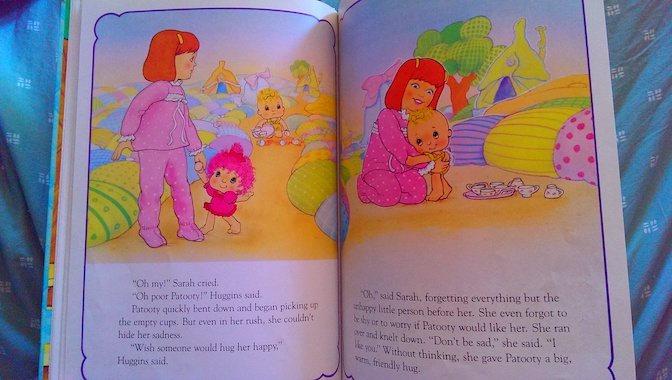
Tickles says that she came to see Sarah because she saw her looking sad and invites her to come to Huggaland with her to meet the other Hugga Bunch. Sarah worries at first about what the other Hugga Bunch will be like and whether they’ll like her, but she is amazed at what she sees. Huggaland is soft and colorful, and everyone is very friendly.

HugFriendHuggaland

She asks Tickles how they can all like her when they don’t know her, and they explain that being friendly to other people encourages them to be friendly in return. That’s really how friends are made. When Sarah comforts one of the Hugga Bunch after she drops a tray of lemonade, she sees what they mean. Her kind gesture has earned her a new friend.

HugFriendSpill

When Sarah returns home and goes to meet her new babysitter, she discovers that Laura is actually rather sweet and shy, not mean, as Sarah feared. Sarah greets Laura with a friendly hug, and the two of them become friends.

HugFriendLaura

The Hugga Bunch’s advice to immediately start a new friendship with a hug may be somewhat awkward in real life, but the idea that kindness and friendly gestures inspire others to respond with kindness and friendship is a good one.