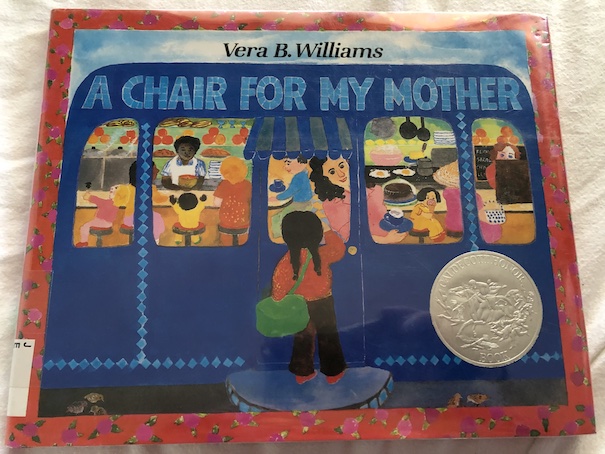
A Chair for My Mother

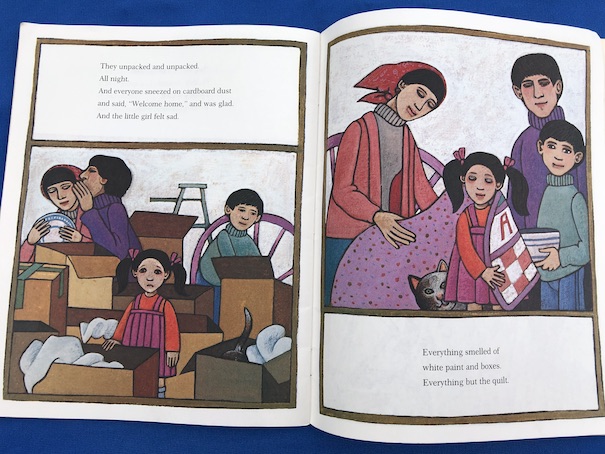
A girl explains how her family is saving up for a new chair after a fire destroyed all the furniture in their old home. The fire happened before the story really begins, but the girl explains how she and her mother returned from a shopping trip and discovered that their home was on fire.

The girl’s grandmother and the family cat escaped from the fire, but everything they had in the house burned.

The girl, her mother, and her grandmother all moved in with the girl’s aunt and uncle until they could move into a new apartment. However, they didn’t have any furniture in the apartment. Their relatives, friends, and neighbors all helped them by giving them food and pieces of furniture they didn’t need anymore.

It was a big help, however, a year later, they still don’t have a sofa or comfortable armchairs. The girl’s mother works in a restaurant, and when she comes home, she’s very tired from being on her feet all day. She wishes that they had a comfortable armchair where she could rest after work.

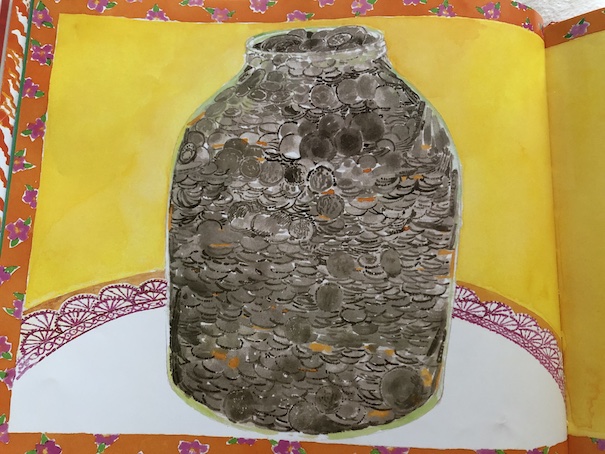
The mother starts saving part of her tips from the restaurant in a coin jar to save up for a new chair. Sometimes, the restaurant owner even pays the girl to do little chores, and she saves part of her money for the chair. Whenever the girl’s grandmother saves money on food she buys, she also puts the savings into the jar. They say that when the jar is full of coins, they will buy the new chair they want.

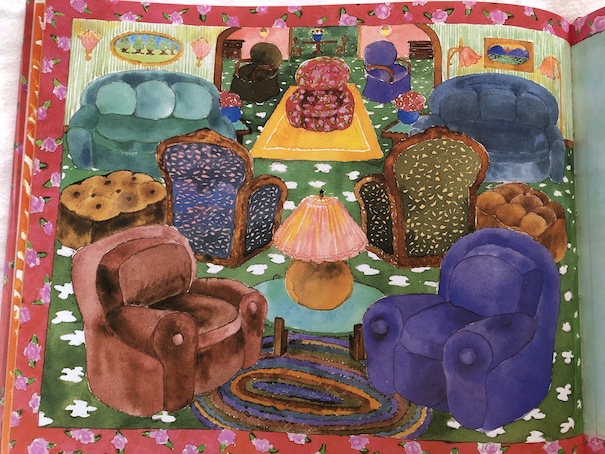
Eventually, the jar is completely full. They count the coins, roll them in coin wrappers, and take them to the bank to change them for ten-dollar bills. Then, they go shopping for a new chair! There are many chairs to choose from, but they know exactly what kind of chair they want.

The book is a Caldecott Honor Book. It’s available to borrow and read for free online through Internet Archive (multiple copies, including one in Spanish).

I remember this book from Reading Rainbow when I was a kid! The pictures are bright and colorful, and the story offers comfort and hope.

The people in the story have been through a tragedy where they lost almost everything they had, but the book shows how they recover. Although the fire was sad, the story starts after the fire happened, and the girl talks about the help they’ve received and what they’re doing to make their new home more comfortable. They’re over the initial shock of the fire and concentrating on improving their situation from there. This book felt both comforting and very real. I liked how it showed the family recovering from their ordeal through a combination of help from relatives and friends and their own efforts. Other people help them with some basic household items as they move into a new apartment, and they also save up their money for the chair they want to make their new place feel more like home.

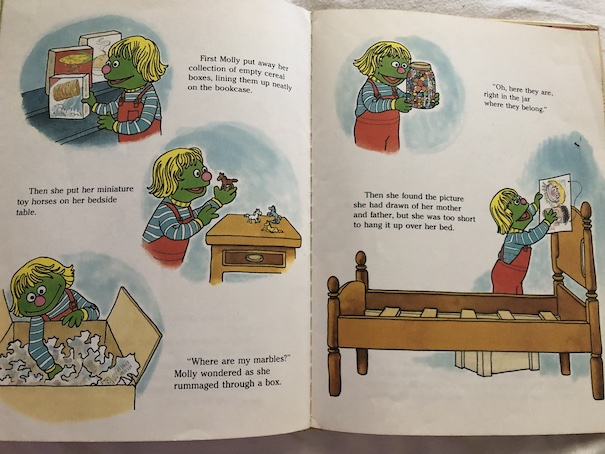
Molly Moves to Sesame Street

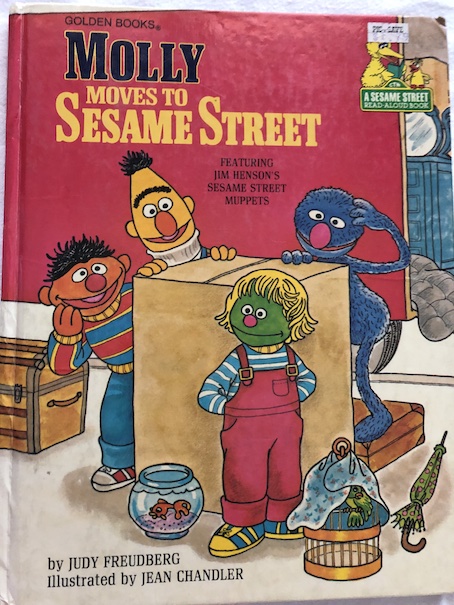
Molly Moves to Sesame Street by Judy Freudberg, illustrated by Jean Chandler, 1980.

The characters from Sesame Street greet a new neighbor who is getting used to a new home and needs some new friends.

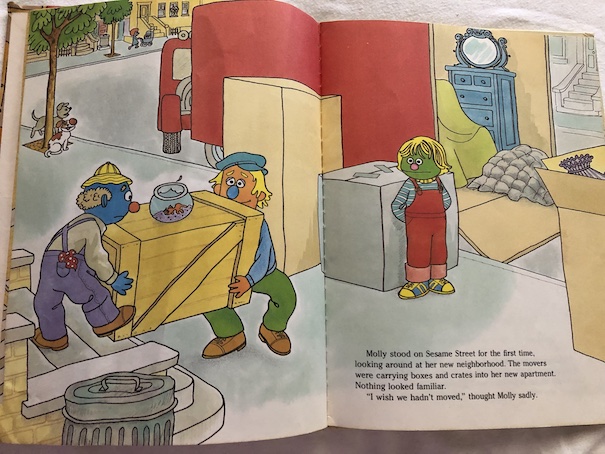
Molly and her parents are moving into a new apartment on Sesame Street, but Molly feels uncomfortable because nothing in this new neighborhood feels familiar. Her new room is still bare and doesn’t look or feel like home. Molly’s parents reassure her that it will feel more like home once all of her belongings are unpacked.

After Molly helps to unpack for awhile, her parents encourage her to go out, explore the neighborhood, and make some new friends. They say that, by the time Molly comes back, they’ll have things unpacked, and her new room will look much better.

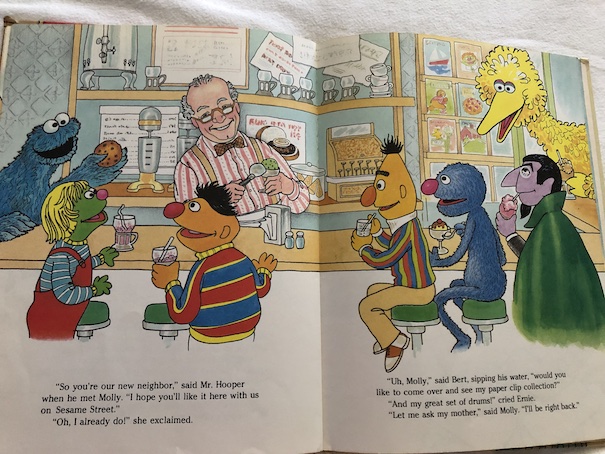
When Molly first meets the characters from Sesame Street, they’re playing a game of hide-and-seek, but they all come out when she calls to them. They all introduce themselves to Molly and invite her to join their game.

After they play, they all go to Mr. Hooper’s store for ice cream and sodas. Molly is happy that she’s having fun and starting to make friends, and she’s starting to like her new neighborhood.

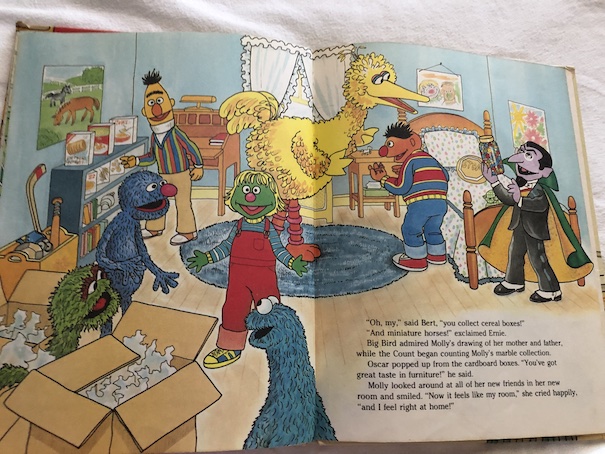
When Molly returns to the apartment, her parents have finished unpacking and arranging her new room. Molly is happy because it looks and feels more like home, and she invites her new friends to come over and see it.

This is a fun and reassuring picture book for young children that shows how making a new home look familiar and making new friends can help them to feel more at home when they move to a new place.

The book is available to borrow and read for free online through Internet Archive (multiple copies, some in different languages), but some later printings of the book have different illustrations and include Elmo, who wasn’t in the first edition of the book.

Sarah, Plain and Tall

Sarah, Plain and Tall by Patricia MacLachlan, 1985.

This is a popular book to read in schools in the United States, the first in a series.  It’s a Newbery Award winner, and it shows aspects of farm life during the early 20th century and the concept of mail-order brides, a practice from American frontier days where men living in the West or Midwest, where there were not many available women in the population, would write to agencies or advertise for a bride from the East.  The process for arranging these marriages could vary, but it typically started with written correspondence before the man and woman would meet in person.  In this book, the man looking for a bride, Jacob Witting, is a widower with two children who has a farm on the Great Plains.  The story is narrated by his older child, Anna. The book isn’t very long, and it’s a pretty quick read, but it’s filled with colorful imagery and emotion.

Anna has had to help take care of her little brother, Caleb, since he was born.  Their mother died shortly after giving birth to him, and Caleb frequently asks Anna questions about what their mother was like.  Anna’s memories of their mother are fading because she was still very young when she died, but she really misses her.

Then, Jacob tells the children that he has advertised for a bride from the East, the way a neighbor of theirs did.  The children like their neighbor’s new wife and wouldn’t mind having a mother like her.  The father has received a reply to his advertisement from a woman in Maine, Sarah Wheaton.  Sarah has never been married, and now that her brother is getting married, she feels the need for a change in her life.  She loves living by the sea in Maine, but she is willing to move to start a new life.  She says that she would like to know more about Jacob and his children.

Jacob and the children write letters to Sarah, getting to know her better.  They come to like each other, but the children worry about whether Sarah will change her mind about coming to see them or whether she’ll like them or their farm when or if she comes.  When Sarah tells them that she’s coming during the spring, she says that they will know her because she will be wearing a yellow bonnet and describes herself as being plain and tall (the title of the book).

Sarah will stay with the family for a time while they decide if they can be a family together and if she will marry Jacob that summer.  There are adjustments that they will all have to make.  Life on the prairie is very different from what Sarah is used to, and the children still worry that she won’t want to stay.  Sarah brings seashells from Maine to show them, and they teach her about the local wildflowers.  One of my favorite scenes was where Sarah cuts Caleb’s hair, and they put the hair clippings out for birds to use in their nests.  Caleb was particularly concerned about whether Sarah would sing like their mother used to, and Sarah does. 

Through it all, the children can tell that Sarah really misses the sea.  Sarah does say that the land around the farm kind of rolls, a little like the sea, and they play in a haystack, like it was a dune by the sea.  When they visit their neighbors, Sarah talks with Maggie, the mail-order bride who came from Tennessee.  Maggie understands Sarah feels, missing her home in Maine, and it upsets Anna to hear them talk about missing their old homes.  However, Sarah says that things were changing at home, and Maggie comments that, “There are always things to miss, no matter where you are.”  What the women realize is that, although they miss their old homes, they have grown to love the new people in their lives and would miss them if they tried to go back to where they came from.

At one point, Sarah goes to town alone, and the children worry that she won’t come back, but she does.  She just went to town to buy colored pencils in her favorite sea colors.  Sarah does stay and marry Jacob, setting up the rest of the series.

The book is available to borrow and read for free on Internet Archive (multiple copies).

My Reaction

There is a movie version of this book, which follows the story pretty well. The book wasn’t specific about the time period, although it seems to take place during the early 1900s. The movie and its sequels are set during the 1910s, which makes sense for the rest of the series. The book also didn’t say exactly where the farm was, but the movie clarifies that it’s in Kansas. The movie also emphasizes how much the whole family, particularly Jacob and Anna, misses the mother who died.  In the movie, Jacob forbids the children to use any of his dead wife’s things and doesn’t want to talk about her.  However, when Sarah realizes that trying to avoid his wife’s memory is hurting Anna, she brings out some of the dead wife’s belongs to use, helping the family to make peace with the past and prepare for the future. 

In the movie, Jacob’s pain over his wife’s death is partly about guilt as well as grief. The book doesn’t really talk about why Anna’s mother died after childbirth, but in the movie, Jacob has a painful discussion with Sarah about how he blames himself for his wife’s death because the doctor had warned them that they shouldn’t have any more children after Anna.  Apparently, Anna’s birth had been difficult and caused complications because his wife was so young, and the doctor had said that having another child would be dangerous.  However, after a few years went by, they decided to try for a son to help run the farm, thinking that enough time had gone by for it to be safe.  When his wife died giving birth to Caleb, Jacob felt terrible, thinking that he should have taken the doctor’s warning more seriously and not tried to have another child.  Confessing all of this to Sarah helps Jacob to make his own peace with what happened.  However, none of this discussion appears in the book.

In both the book and the movie, Jacob also has to adjust to Sarah’s different personality.  Sarah is more stubborn and independent than his first wife, with her own way of doing things.  Living with her is different from living the mother of his children.  However, Jacob comes to love Sarah for the person that she is.

The Quilt Story

The Quilt Story by Tony Johnston and Tomie dePaola, 1985.

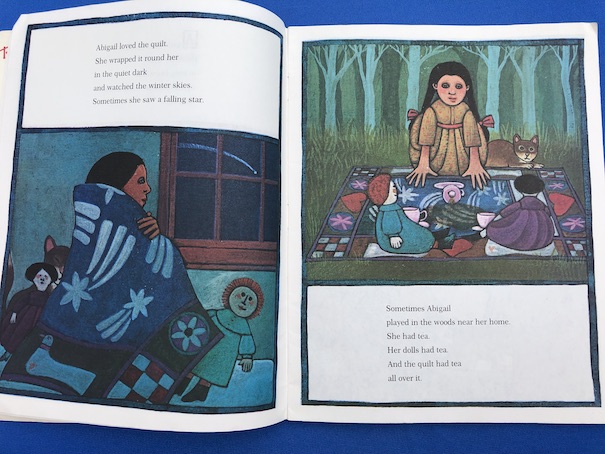
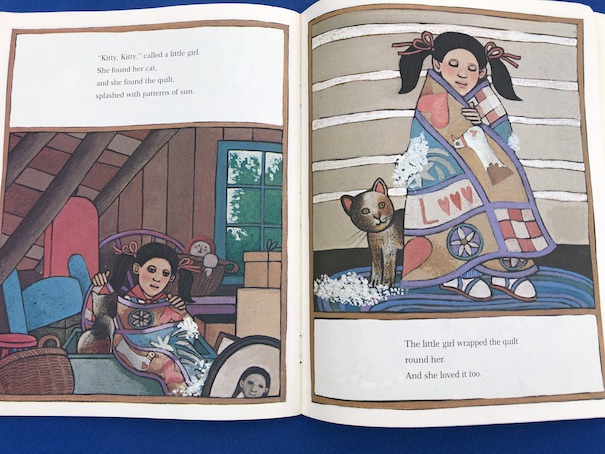
A woman (at some point in the 1800s, from the pictures) makes a special quilt for her young daughter, Abigail.  It has Abigail’s name on it and a pattern of falling stars.  Abigail loves it!

Abigail uses the quilt all the time, not just in bed.  She has tea parties with her dolls on the quilt, hides under it when playing hide-and-seek, generally taking it everywhere and playing all kinds of games with it.  The quilt gets worn and torn in the playing, but her mother mends it when necessary.

Eventually, Abigail and her family move to a new home, traveling in a covered wagon.  Everything in their new home seems strange to Abigail, but her old quilt comforts her.

Eventually, when Abigail is older, she puts the quilt away in the attic, and people forget about it.  Still, animals use the quilt.  A mouse makes a nest it in.  A raccoon hides food in it, and a cat naps on it. Then, one day, another girl finds the quilt in the attic.  She loves it and brings it to her mother to be repaired. 

Like Abigail, though, the modern girl’s family soon moves to a new home, where everything seems new and strange.  However, the old, familiar quilt comforts the girl once again.

This is a gentle, comforting story that would make nice bedtime reading or a story that could be read to a young child who is moving or has recently moved, reminding them that, even in a new place, you can bring a sense of home and the familiar with you.

The book is currently available online through Internet Archive.

The Lottery Rose

LotteryRoseThe Lottery Rose by Irene Hunt, 1976.

Young Georgie Burgess has been abused his entire life by his mother, Rennie, and her boyfriend, Steve (who is not Georgie’s father, whose identity is unknown, Rennie says that she is a widow).  Rennie is an alcoholic, and she and Steve (who is the source of most of the violence in Georgie’s life) once deliberately burned the side of Georgie’s face when he was a baby because he wouldn’t stop crying and they were angry that they had run out of whisky.  Sometimes, they tie him up in a closet for days at a time with no food.  Other times, they beat him, even leaving scars.  When Rennie is confronted by the school nurse about Georgie’s injuries, she claims that Georgie is a problem child who gets into fights.  Georgie’s teacher believes that because Georgie is always acting up and doesn’t appear to learn anything, although he is actually smarter than he pretends to be.  Because the other adults in Georgie’s life either do not see his condition for what it is or do not want to acknowledge the truth of it, it is a long time before he gets the help he really needs.

Georgie’s early life is bleak, and at first, his future seems equally bleak.  The only people who seem to care about him at all are the school librarian and Mrs. Sims, who works at the grocery store.  Georgie’s real love in life is flowers.   He likes to borrow a book from the school library about flowers, and one day, he enters a drawing at the store and wins a rose bush of his very own!

It’s the best thing that ever happened to Georgie, but shortly afterward, Steve beats him so badly that the police are finally called.  Georgie is taken away from his mother, and for the first time, his life becomes different.  Georgie insists on bringing his precious rose bush with him when the police take him away, and it becomes instrumental in helping him reshape his life.

For a time, Georgie has to stay in the hospital to recover from his injuries, and then he stays with Mrs. Sims.  Unfortunately, as much as Mrs. Sims and her husband care for Georgie, they can’t afford to take care of him.  Instead, Georgie is sent to a Catholic boarding school with his new teacher and guardian, Sister Mary Angela.  Sister Mary Angela assures Georgie that he will be taken care of at the school and so will his rose bush.

Georgie thinks the school is ugly, but there is a beautiful house nearby with a beautiful garden.  It belongs to Mrs. Harper, who lost her husband and one of her sons in a tragic car accident.  Although Georgie isn’t supposed to go there, he can’t help himself.  It seems like the the perfect place for his rose bush . . . and maybe even for himself.

The tragedies and descriptions of child abuse in this story make it inappropriate for young children.  This would be a good book for kids at the middle school level, probably age twelve and up.

Georgie, who has never really known kindness in his life, blossoms like a rose at the school, making new friends for the first time and coming to terms with his past.  At the same time, Mrs. Harper, who is still suffering from the loss of her husband and son and also loses her other son (a child with developmental disabilities) during the course of the book, finds her heart warmed by Georgie.  Georgie has desperately needed a mother who acts like a real mother and really loves him, and Mrs. Harper comes to realize that she also needs a boy like Georgie to love.  While he is not a replacement for the sons she has lost, he does help to fill an empty place in her life, and the two of them become the family that each of them needs.

The book is currently available online through Internet Archive.

The Court of the Stone Children

The Court of the Stone Children by Eleanor Cameron, 1973.

Nina and her parents have recently moved to San Francisco from Nevada.  Nina doesn’t like living in the city, but the move was necessary because her father has been ill and in need of a job.  Still, Nina misses her friends, and her parents don’t understand how difficult Nina has found it to make friends in their new home.

One of the most popular girls, Marion Charles, nicknamed Marnychuck, and her friends like to tease Nina at every opportunity. Nina doesn’t think that she even wants to try to be friends with them because hanging out at Marnychuck’s house would mean always having to be on her guard about every little thing she says, knowing that they would twist every innocent comment she makes into some sort of joke so they could laugh at her.  They could never be friends because there would be no way that Nina could ever open up to them about anything.  (Sadly, I know the type all too well.)  For example, one day, while the girls are walking home from school, they start talking about things they want to be when they grow up.  Nina says that she wants to be “something in a museum,” momentarily forgetting the word “curator”, until a boy nearby helpfully supplies the word. Of course, Marnychuck and her friends ignore the helpful word and just laugh about “something in a museum” as they walk away.

However, the boy who was listening turns out to be genuinely curious about why Nina wants to work in a museum, saying that it sounds like an unusual ambition.  Nina tells him that, until she had come to San Francisco, she’d never been in a big museum before, and she describes how the one in the park impressed her.  She used to work in a small one in her home town. The boy understands the way she feels and shares her love of the past.  He tells her about Mam’zelle Henry, a local woman who owns a private museum called the French Museum.

Nina visits the French Museum and loves the rooms with old-fashioned furniture.  They give her a strange feeling of timelessness, and before she knows it, she finds herself in a room with another young girl who says, “I knew you’d come.”  Nina isn’t sure who this mysterious girl is, but she asks her to come back another time.

When Nina returns to the museum the next day to return an umbrella that she borrowed from Mrs. Staynes, the registrar at the museum, she speaks to the girl again in the museum courtyard.  The courtyard is full of stone statues of children, and the girl tells Nina that when she was young, she used to wish that they would come to life.  The girl’s name is Dominique, although she says that people usually call her Domi. The two girls begin talking about their lives, although Domi oddly talks about her past in the present tense. Domi tells Nina about her emotionally-distant grandmother and her loving father, who was imprisoned and shot.  The news of Domi’s father being shot comes as a shock to Nina.  Domi tells Nina that, after her father was (“is”) imprisoned and shot, she had a dream about Nina in which her father said that Nina would help them.  Domi also says that the rooms at the museum are from her home in France, which was taken apart to be “modernized”and some of the pieces were sent to the museum. Nina finds Domi’s story confusing, but Domi says that they will talk more later.

Nina meets up with the boy who introduced her to the museum, whose name is Gil, at the cottage of Auguste, who lives on the museum property.  As she talks with the two of them and Mrs. Staynes, Mrs. Staynes brings up the subject of the ring that Nina saw Domi wearing and which also appears in a painting in the museum.  Earlier, Mrs. Staynes had told Nina that she couldn’t possibly have seen anyone wearing that ring, and Mrs. Staynes now explains that the reason why is that she owns the ring herself.  At first, Nina thinks that she must own a ring which is similar to Domi’s, since the two of them couldn’t have the same ring,but then, it turns out that the cat that Domi said was hers also belongs to Auguste.

The answer, as Nina discovers the next time she meets Dominique, is that Domi is a ghost.  Mrs. Staynes does own Domi’s ring now because Domi died a long time ago. Nina faints when Domi’s hand goes right through hers.  When Nina recovers, Domi is gone, and Mam’zelle Henry gives her a ride home.  The two of them bond as they discuss Nina’s ambition to become a curator.

Mam’zelle lets Nina borrow a journal that she found in the garden that belonged to Odile Chrysostome in 1802.  Odile was one of the names of the stone statues in the courtyard, according to Dominique, and Nina learns that the others are also named after members of the Chrysostome family.  The people at the museum say that they don’t know which of the statues is supposed to have which name, but thanks to Dominique, Nina does.

Gil becomes Nina’s first friend her own age, and he’s been working on a project involving time.  Someday, he wants to write a book about the concept of time. Time is important because Domi needs Nina’s help to resolve problems that occurred in the past.

Domi was young during the time of Napoleon.  Her mother had died in childbirth along with Domi’s younger sibling.  After her mother died, her grandmother moved into the house to oversee things and help care for Domi.  However, Domi’s father had protested some of Napoleon’s policies of conquest, and it led to his downfall.  One day, Domi discovered her father’s valet,Maurice, murdered in her father’s bedroom. She had thought that her father was there the night before, having returned from being away for a time, but he was nowhere to be found.  A short time later, her father was charged with conspiring against Napoleon and executed. Domi knows that her father was innocent of the charges, and she suspects that Maurice was killed because he knew something important, but she needs Nina’s help to find the missing pieces.  Domi knows that Mrs. Staynes is working on a book about her father’s life, and she doesn’t want the false accusations against him to be printed.

This book is available to borrow and read for free online through Internet Archive.

My Reaction and Spoilers

I thought that the book started out a little slowly.  It takes quite a while before Nina discovers that the boy’s name is Gil or learns anything about him, and it’s about halfway through the book before Nina learns that Domi is a ghost, although there are hints before it.  I knew that Domi was from the past, although I thought at first that she might be a time traveler of some kind.  Even after Nina learns that Domi is a ghost, it takes a while before Domi tells Nina her full story and what she really needs her to do.  The first part of the book dragged a little for me, and I was a little confused at first about why Odile’s diary was so important, but it turns out to contain the vital clues that Domi needs.  Domi’s father was with the Chrysostome family at the time that he supposedly murdered his valet and was conspiring against Napoleon. There is a piece of physical evidence that proves it, and finding it convinces Mrs. Staynes to change her book. 

One of Nina’s strengths is her power of imagination, and she helps Mrs. Staynes not only to see the truth about Domi’s father but to see him as a living, breathing person.  Before, Mrs. Staynes’ book was mostly facts with little sense of the feelings of the living people behind it, but Nina’s discoveries and imagination help breathe life into the work.  At the end of the book, the past remains unchanged (Domi’s life and that of her father are what they were before), but having the truth known gives Domi peace. Nina also makes peace with her new life in San Francisco, having discovered new opportunities and friends there as well as a nicer apartment for her family to live in.

The Courage of Sarah Noble

SarahNoble

The Courage of Sarah Noble by Alice Dalgliesh, 1954.

SarahNobleCookingIn 1707, a man living in Massachusetts named John Noble bought some land in Connecticut which had recently been purchased from a tribe of Indians (Native Americans) living nearby.  He planned to move his family there and start a new homestead, but with his children so young and the baby somewhat sickly, it was decided that he would travel to the new land ahead of his family and start building a new house there.  The only family member to accompany him was his eight-year-old daughter, Sarah, who came along to cook for him.  Before they leave home, Sarah’s mother tells her to “Keep up your courage,” something which Sarah repeats to herself from time to time.

SarahNobleFamilyOn the way to their new property, Sarah and her father have to camp out in the wilderness, although they do manage to stay one night with a family called Robinson.  The Robinson boys tease Sarah, saying that where she’s going, the Indians will probably chop off her head and eat her or do other horrible things.  Their sister tells Sarah not to worry because her brothers just like to tease.  Sarah’s father and Mistress Robinson also reassure her that the Indians in the area are friendly and that they sold their land knowing that new people would come there.

The Robinsons make Sarah uncomfortable.  Sarah later says to her father that there doesn’t seem to be love in the Robinson house. Her father agrees with the observation and says that the Robinsons should learn to watch their words and teach their children to do the same, adding “there are people in this world who do not help others along the way, Sarah, while there are those who do. In our home all will be treated with kindness-always, Sarah. The Indians, too, and they will not harm us.”  Although the Robinsons allowed the Nobles to stay the night in their house, they didn’t exactly make them feel welcome, and both of them realize that the things the boys were saying and their rough manner were clues to the Robinsons’ real attitudes and the kinds of things the parents talk about when no one else is around.

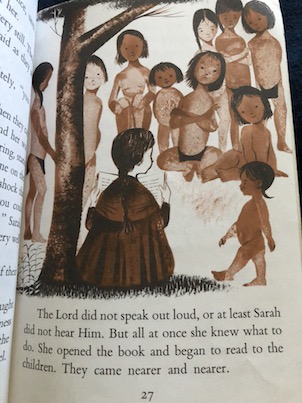
SarahNobleReadingWhen Sarah and her father reach the land that is to be their new home, they take refuge in a hollow place in a hillside, and John begins building their new house.  However, Sarah is still very nervous and lonely.  Then, while Sarah sits, reading the Bible, some curious Indian children from the nearby tribe come to see her.  She reads a Bible story aloud to them, and they listen, but she when she finishes the story, she can tell that they didn’t understand what she was saying.  Sarah can’t understand them, either, when they try to talk to her.  She gets impatient and snaps at them for not knowing English, and they run away from her.  Sarah is sorry about that because she realizes that she shouldn’t have been so irritable, and even if they couldn’t talk to each other, it was still nice to have people around.

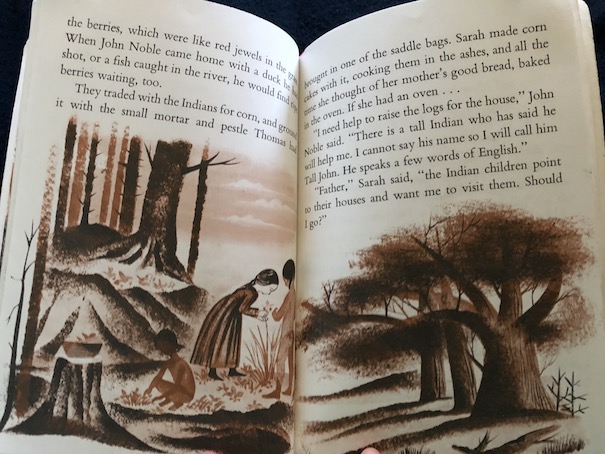
Fortunately, the Indian children come back to see her again, and they become friends.  She tries to teach them English, but they don’t make much progress at first.  Even without being able to talk to each other, though, they can still do things like picking berries together.

SarahNobleNativeAmericanChildren

Sarah’s father also becomes friends with an Indian he nicknames “Tall John” because he can’t figure out how to pronounce his real name.  John and Tall John trade with each other, and John allows Sarah to visit Tall John’s home to play with his children.

When John finishes building the house and it is time for him to go and fetch the rest of their family, he decides that it would be better for Sarah not to make the long journey again, so he leaves her in the care of Tall John and his family.

SarahNobleStaysBehind

At first, Sarah is a little worried about living with the Indians.  Being friends and visiting during the day is one thing, but what would it be like to actually live with them?  Although Sarah likes her Indian friends, it’s obvious that the stories that she’s heard all her life about “savage” Indians bother her, and she still has some prejudices and misconceptions to overcome.  There are also the worries that often accompany children who are staying with someone other than their parents: what if something bad happens, her father never comes back, and she never sees her family again?  Sarah worries that, even though the tribe that lives nearby is nice, there are other Indians who aren’t, and some of them might attack while her father is away.

Fortunately, things go well during Sarah’s time with the Indians.  She finds some of their habits strange, and she notices that Tall John’s children (nicknamed “Small John” and “Mary”) find some of her habits strange, like the clothes she wears and the way she prays at night.  Tall John’s family gives Sarah some deerskin clothing, like they wear, and some moccasins, which she finds surprisingly comfortable.  There is a scare about a possible attack, but that passes without incident, and Sarah ends up enjoying her time with her Indian friends, playing games and participating in chores with them.  Tall John and his wife treat Sarah like one of their own children.

When it’s time for her to rejoin her family, Sarah changes back to her old clothes, but they no longer seem as comfortable to her, and she decides to keep wearing the moccasins.  A little of her Indian friends has rubbed off on her, and she is a different person because of her experiences.  Sarah’s mother expresses some concern about her daughter having lived with “savages” (her word), but Sarah is quick to defend them, saying that they aren’t savages and that they’re friends.  Her father agrees that Tall John and his family are good people who took good care of Sarah.

This book is a Newbery Honor Book.  It is currently available online through Internet Archive (multiple copies).

My Reaction

Throughout the story, various characters have obvious prejudices about American Indians, and the language used isn’t what we would use today (ex. “Indians” instead of “Native Americans” and nobody says “squaw” anymore (or shouldn’t – white people used to think it simply meant “woman” but it has other connotations as well, better to just say “woman” when that’s what you mean)), but these are fitting with the time period when the story takes place.  The overall attitude of the story, especially Sarah’s evolving attitudes toward her new Native American friends, is good.  Sarah begins by being frightened because of all of the scary things people have told her about Indians, but once she begins spending time with them and living among them, she sees that the things she heard before weren’t true, and she values their friendship.  The parts where characters behave in prejudiced or condescending ways are uncomfortable, but you can’t have a story about improvement without someone behaving or thinking wrongly in the first place.  At least, that was my interpretation.  I understand that there are others who are more concerned.  At the end of the story, Sarah’s mother doesn’t seem convinced about the Indians, but I like to think that experience may change her as it did Sarah.  I think Sarah’s mother represents where Sarah came from but not where she ends up.  I think it’s important to explain to children the historical context of the story and put the emphasis on Sarah’s changing opinions.  Sarah’s experiences help her to see the truth about her new neighbors.

The author’s note in the beginning of the book explains that the story of Sarah Noble is based on the life of the real Sarah Noble, who did accompany her father to the family’s new homestead when the community of New Milford was forming in order to cook for him while he built the family’s new house.  The real Sarah did live with the nearby tribe of Native Americans for a time, although the author of the story had to invent some of the details of her stay.  It also says that the real Sarah maintained a friendship with the Indian the book refers to as “Tall John.”  The real Sarah become a school teacher as an adult, as the Sarah in the story said that she wanted.  She also married and had children.

Are You There, God? It’s Me, Margaret

MeMargaretAre You There, God?  It’s Me, Margaret by Judy Blume, 1970.

This is one of the more controversial children’s books because parents raised concerns about the discussions of religion and puberty which are central to the story, and it has been banned or challenged in some libraries.  (Read to the end and see the spoilers before you decide if you agree with that.)

I wouldn’t recommend this book for young children because they wouldn’t understand the issues the story discusses, but it does speak to the concerns that pre-teen girls typically have about growing up, finding their place in the wider world, and fitting in with their friends as well as that haunting fear kids often have that they aren’t normal, compared to everyone else.  This isn’t a spoiler for the story (although there are plenty of those later on because I can’t really describe my thoughts about this book without them), but I just have to say that, in my experience, by the time people are done with college, maybe even by the time they’re done with high school, most of them come to realize that nobody out there is completely “normal.”  Some are just better at giving that impression.  Everyone out there has their quirks or issues, so if you think you’re a little odd in one way or another, or if you think your family is a little weird, you’re in pretty decent company.  Generally, it’s best not to worry too much about it and just get on with life.  In a way, I think that does fit in with the ending of the book.  But, I’ll talk a little more about my personal opinions about the controversial parts later.

When Margaret Simon is eleven years old, her parents decide to move from New York City to a suburb in New Jersey.  Margaret is accustomed to living in an apartment in a big city, and her new town and house seem a little odd to her.  She isn’t sure that she’s going to like her new home, and she knows that part of the reason why her mother wanted them to move was that she was worried that Margaret was becoming too close to her grandmother in New York and too easily influenced by her.

Margaret’s family is a little unusual in that her mother is Christian but her father is Jewish. (This is a little more unusual for when the book was first written than now because marriages of mixed religions are more common now than they were before, although they can still be complicated.)  The religious differences between her parents caused conflicts in their family even before Margaret was born.  Neither side of the family really approved of the match, so Margaret’s parents had to elope to get married.  Margaret’s mother’s parents disowned their daughter because of her marriage and haven’t seen or spoken to the couple in years or met their granddaughter.  However, Margaret’s father’s mother (his father is deceased) continues to spend time with the family, although she admits that it’s mostly for Margaret’s sake.  Margaret’s only close grandparent likes to spoil her and pays for her education at a private Jewish school, which is why her mother has become concerned that Margaret is influenced by her too much.  Margaret’s mother wants some separation so that she and Margaret can become closer as mother and daughter. The move and Margaret’s new friendships in New Jersey raise a number of troubling questions for Margaret about growing up, both physically and spiritually.

Because of the family religious conflicts, Margaret’s parents purposely raised her without a religion, telling her that she could choose for herself when she was old enough.  Until now, Margaret was not terribly concerned about it, but the move, the new friends she makes in New Jersey, and her increasing awareness of how religious differences have influenced her relationships with her family and other people cause her to question the choices she must make and what she really believes.  Throughout the book, she prays frequently in a casual, conversational fashion, telling God about the things that are happening in her life, the questions and problems she has, and what she really wants most.  Sometimes, she gets angry with God or disappointed when things don’t work out well, but the story makes it clear that her relationship with God is evolving, just as Margaret herself is changing as she grows up.  At one point, Margaret worries that, at age twelve, she is too old already to choose a religion and wishes that her parents had just given her one when she was little so she wouldn’t have this uncertainty.  However, growing up is a long process that Margaret is only beginning to appreciate.

The first new friend Margaret makes is a girl her age who lives next door, Nancy.  Nancy is eager to grow up and not at all shy about talking about things like boys, periods, bras, kissing, and even sex.  Sometimes, Nancy talks like she knows a lot about such things, although more mature people (and, eventually, Margaret) would realize that she doesn’t.  She introduces Margaret to two other girls, Gretchen and Janie, and the four of them form a kind of club that they call the Pre-Teen Sensations (PTS for short).  They give themselves secret names and hold meetings, talking about boys, people they know at school, and concerns that they have in their lives, especially related to growing up, periods, and sex (no one has any in the story, but the girls are fascinated by the idea).  One of the requirements of this club is that each of the girls has to wear a bra, and they feel each other’s backs at the beginning of each meeting to make sure.  Up until then, Margaret didn’t have a bra, so she has to buy her first one.  The girls worry about their breast size (none of them has much yet), and they try exercises to see if they can improve it (which is ridiculous, but it is the kind of thing that some pre-teen girls believe).  At the beginning, none of the girls has had their first period yet, and they’re looking forward to it with nervousness and anticipation, wondering what it’s going to be like.  They agree that whoever gets their period first has to tell the others about what it’s like.  Margaret nervously worries that she’ll be the last one to get hers or that she’ll turn out to be “weird” and never have one for some reason, although her mother assures her that it’s not likely and that it’s really just a matter of time.

Meanwhile, Margaret has some awkwardness at her new school, getting to know new people, sometimes making mistakes in the ways she relates to others, and figuring out which boys she likes the best. (She doesn’t get a boyfriend, just crushes.)  Her new teacher is also a little awkward because he’s young and this is his first teaching assignment, and he seems self-conscious that male teachers aren’t as common as female teachers.  Even adults can worry about being accepted by others.  He seems to be a good teacher, however, and he asks the students questions about themselves in an effort to get to know them better.  He learns early on that Margaret doesn’t have a religion and that it bothers her.  When he tells the students to choose a topic for a year-long research project into something that they care about, he allows Margaret to choose the topic of religion.

Margaret decides that her project for the year will be to learn about different religions and to finally choose one for herself.  Her focus is mainly on trying to decide between Judaism and Christianity because that’s what the two sides of her families are, that’s what most of the people her community are, and she says at one point that she doesn’t know anyone who is Muslim or Buddhist, so she can’t talk to them about their religions.   People in this community tend to belong either to the local YMCA or the Jewish community center, and Margaret thinks that if she figures out if she should be Christian or Jewish, she’ll be able to join one of those herself and fit in better.  Her friends help her in her project, some of them letting her come to church with them.  Each of the PTS girls is a different religion.  Janie is Jewish, and Nancy and Gretchen each attend a different Christian church.

Margaret’s friends aren’t particularly concerned about which choice Margaret will eventually make.  They find the story of her parents’ elopement romantic and are sympathetic to Margaret’s feelings.  However, Margaret notices that other people react differently to her project.  It seems like some of them view the idea of winning her to their side as some kind of personal victory for them, which hurts because she realizes that this is how her grandparents view her, even her beloved grandmother.  When her mother’s parents decide to visit them for the first time, there is an ugly scene where the family conflicts over religion come to a head, and Margaret feels so overwhelmed that she wants to give up on God and religion completely.  However, Margaret’s story isn’t over yet.  She’s really just started growing up, and whether she believes it or not at first, God hasn’t given up on her.  Getting what she wants most is really just a matter of time and patience.  Everyone grows up eventually.

So, what’s my overall opinion?  Generally favorable.  I read this book when I was about Margaret’s age and had the same concerns she did (or very similar, no two people are alike) and my friends and I were talking about the same kinds of things she and her friends were.  I think the key to this book is age-appropriateness.  Like I said, girls younger than about ten or eleven years old probably would not understand Margaret and her concerns because they just don’t share them.  It’s like Margaret and her friends themselves: they talk about the concerns that they all share, growing up and their new interests in boys and the idea of first periods.  If the reader isn’t a girl at that phase of her life, she just wouldn’t understand and connect with the story, and a few years later, those girls would likely move beyond all of that and on to other concerns (like whether or not they should go to college, what their major or career should be, etc. – life is full of things to figure out).  The things that seem so new and mysterious at age eleven, like real signs of growing up, later won’t matter so much because they’ve already lived it and found out that it’s not such a big deal.  Girls eager to get their first period or start shaving their legs at age twelve because they want to feel grown-up often start thinking of these things as hassles when they’re older and it’s all just become part of the routine of life.  They groan when a period starts on the day they want to go swimming or wear long pants on days when they’re too busy or just don’t want to bother shaving.  The novelty wears off, and you never look at it the same way again.  When older girls and women enjoy this book, it’s mainly as nostalgia for when they were Margaret’s age and still figuring things out.

The reason why this controversial story still remains popular even decades after its original publication is because it pretty accurately captures the thoughts and feelings of that pre-teen phase of life, when girls are just starting to grasp the complexities of life and the changes that lie ahead, alternately worrying about them and eager to get on with it and grow up.  It speaks to girls who are currently in that phase.  Reading it again as an adult, it reminds me of a time when I was in a similar place in life, although part of me now wishes that I could take young Margaret aside and tell her a few things that she eventually will come to realize:

  • That her friends are still finding their own way in life, just like she is, and even the ones who act like they know a whole lot really don’t (especially Nancy).
  • That growing up doesn’t end when you get your first period or even when you hit 18 or 21 because change is a life-long process and people mature at different rates, mentally as well as physically.
  • That many of the questions she’s struggling with are ones that everyone wonders about.  Some of them, like the religious issues and her own identity, are life-long struggles, even for people raised in more religiously-conventional households.  What human being can say that they thoroughly understand God and the mysterious ways in which He works?  It’s a worthwhile struggle, but not one that people resolve with complete certainty, certainly not by age twelve (Margaret’s age at the end of the book).  Margaret is far from being too old to consider these issues.  Philosophers and theologians have spent entire lifetimes on that subject.

But, even if I could say some of those things to young Margaret, they probably wouldn’t help completely because some things just have to be lived to be understood, which is the main reason why I would say banning the book is a mistake.  The issues Margaret deals with in the book are just common issues that come up in daily living, and the questions she asks about what she believes and what’s ahead for her are things that girls think about anyway and talk about with their friends, whether they read about them or not.  There’s no point in trying to get kids to stop thinking about these things because, at some point, they just have to because it’s a part of life, growing up, and the world around them.   Until they do consider some of these issues, it is difficult to move on to other, even more complex aspects of life, so I think it’s better to face them directly when the subjects come up instead of trying to dodge the subjects or put off thinking about them.

I think that Margaret’s elders were somewhat unhelpful in their approaches to Margaret’s religious life.  Her maternal grandparents are clearly selfish in their motives, caring only about winning the argument for their side, not really taking any interest in getting to know Margaret personally or caring about her feelings.  In fact, they only decide that they want to meet Margaret when they realize that she will be their only grandchild by blood, and even then, they make it clear that they expect the relationship to be on their terms alone.  Margaret’s paternal grandmother is better in her approach, nurturing Margaret from an early age in the hopes that she will grow up in the way she thinks best, but she endangers her relationship with her granddaughter when it seems like her previous nurturing and attention had the same selfish motive, wanting to win the argument in the same way that her other grandparents did.  Margaret wants them to like her for the person she is, not for what she might become or the ego boost they might get from her agreeing with their point of view.  Margaret’s parents are more interested in allowing her to develop her religious side on her own terms, loving her no matter what she chooses. However, Margaret might be correct in that they should have started discussing the issue honestly with her earlier in life, being a little too hands-off in order to avoid trying to win the argument or influence her too much one way or the other.

Even if the adults in Margaret’s life aren’t always the most helpful, children also learn the things that they don’t want to do from their elders.  Margaret at age twelve thinks that she’d like to raise any children she might have with a religion early in life so they won’t have to deal with the uncertainty and conflicts that she has, but she still has a lot of growing up to do, so anything can happen in her future.  Margaret’s future children (if any) will depend in equal measure on who Margaret’s eventual husband turns out to be and what he believes.  Life is a long journey, but Margaret seems headed for good things.

Many of Margaret’s growing-up issues will, like her first period, resolve themselves in time, and when she’s more experienced, part of her will look back and wonder why it all seemed so big and serious back then.  But, that’s just the phase of life she has to live through first.  Her religious issues will probably take a lot longer than physically growing up, but I think it’s important for readers to remember (as well as Margaret herself or anyone in a similar position) that Margaret is still young.  At the end of the story, Margaret still doesn’t know what religion she will choose (if any), but she’s still growing and changing, her life is changing, she’s becoming more aware of the larger world, and her mind may change many times with maturity and experience (like how many of us change majors about two or three times in college and then eventually end up in a completely different career).  Anything could happen in her life, and the range of possibilities in her life are part of the real magic of being young.  Because Margaret is a thoughtful person who seriously wants to understand the bigger issues in life, I think that she will probably be okay in the long run and that her personal relationship with God will continue to develop even if she finds it difficult to connect to an established religion.  That might not seem ideal to many people, but Margaret does the best she can with what she has in life, her circumstances and her understanding, and I think that’s a good sign.

Later editions of this book were revised to reflect new details of modern life, including how women and girls handle periods.  I’ve never actually seen the old belt-style of period pads that Margaret describes in the original version of the book, and later versions of the book describe the ones that are common today.  There is a movie version planned.
Immigrant Kids

ImmigrantKids

Immigrant Kids by Russell Freedman, 1980.

ImmigrantKidsEllisIsland

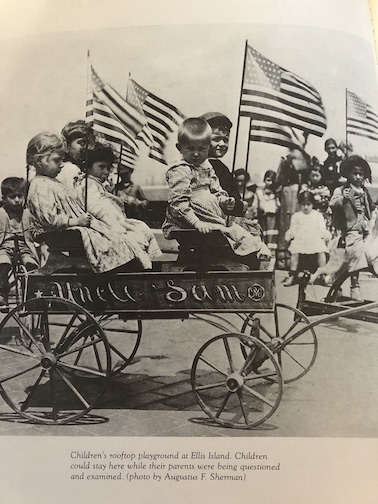
One of the best parts about this book is the pictures.  The preface of the book specifically talks about photography at the turn of the 20th century, how cameras were still fairly new technology but growing in popularity.  Cameras that were small enough to be held in a person’s hands were an 1880s innovation, and the book mentions that small cameras like that were known as “detective cameras” because they were small enough that they could be used to take pictures without the subjects noticing.  Over time, it became easier for amateurs to learn to use cameras, and it became more common for people to take pictures of their ordinary, everyday lives.  Pictures like these open up a window on the past.  The pictures in this book are of children whose families had only recently arrived in America from countries around the world.  The photographer for many of these pictures was Jacob A. Riis, a journalist in New York City who wanted to document the living conditions of poor immigrants.  He published a book called How the Other Half Lives in 1890, in which you can see more of his work.  Other pictures in this book are by Lewis Hine, who is known for his photographs of child laborers.  They are not the only photographers whose work appears in this book, but they are the most famous.

The book is divided into sections, covering different aspects of the lives of immigrant children.  In the chapter called Coming Over, the author describes what the journey to America was like.  One of the primary motivations for people to come to America around the turn of the century was money and employment opportunities.  If a family had little money and little or no chance of getting better jobs in their home country, they would decide to try their luck somewhere else.  Because most of the immigrant families were poor, it was common for families to immigrate gradually.  Often, the father of the family would come first, find a job, start establishing a life and home for his family, and eventually send for his wife and children when he’d saved enough money.  The actual journey was by ship, often in “steerage,” the cheapest form of passage available, in cramped rooms in the ship’s hold.

ImmigrantKidsFamilyQuestions

Although the journey could be harrowing, one of the most nerve-wracking parts was the immigrant processing that took place at immigrant ports like Ellis Island.  There were routine questions that immigrants were expected to answer and exams for them to take, and if the questioners weren’t satisfied, the immigrants could be sent back to the country they came from.  Doctors would examine the immigrants to evaluate their health and look for signs of possible mental defects.  They were particularly concerned about signs of infectious diseases.  Sometimes, it was difficult for immigrants to answer all the questions because of language barriers and the immigrants’ own nerves at being interrogated.  If an immigrant seemed too agitated, the examiners would typically let them rest for a while before trying again.

ImmigrantKidsTenement

The other chapters in the book are At Home, At School, At Work, and At Play, which give more details about the lives of immigrant children as their families settled in America.  They often settled in large cities because those were where the most employment opportunities were to be found.  Because they didn’t speak much English and needed help learning how things worked in America, such as how to find jobs and places to live and how laws worked, they tended to settle in neighborhoods with others from similar backgrounds who could help them.  That is why, even to this day, there are certain areas of large cities, such as New York, Boston, or Chicago, which are known for people of a particular nationality (like the Irish neighborhood, the Jewish neighborhood, Chinatowns, etc.).  New arrivals often joined friends or relatives who had already been living in the US for a while, seeking help in getting themselves established.  These ethnic neighborhoods were located in poor parts of town because the people there didn’t have much money.  People lived in small, crowded apartments called tenements, sharing water and toilet facilities with other families because the apartments were not provided with individual facilities.  However, once these groups of immigrant families became established, they remained established for a long time, and they gave these neighborhoods their own distinctive style.

ImmigrantKidsSchool

School was often difficult for new arrivals because the children had to learn English before they could study other subjects.  There were some special English language learning classes for them at larger schools with enough demand for them.  At smaller schools which didn’t have these classes, they often had help from other children who had arrived in America earlier and could act as translators.  They were also frequently put into classes for children who were younger than they were, studying easy subjects, until they had learned enough English to move up to classes with children their own age.

Typically, immigrant children aimed to stay in school until they were fourteen years old because that was the age when they could officially get full-time work.  However, because their families were poor, the children might have to leave school early to find jobs and help their families make ends meet.  The book describes how rules were frequently bent or broken because the laws were not well-enforced, and children often worked at younger ages, even under harsh conditions.  For immigrant children, the most important education was that which taught practical, vocational skills that would help them find jobs quickly.  Some agencies, like the Children’s Aid Society (known for the Orphan Trains), would help them with vocational training.

ImmigrantKidsBaseball

However, immigrant children still like to play.  Boys and girls usually played separately.  Boys frequently played games like baseball in the street, or stickball, which was a variant that could be played in smaller spaces.  In stickball, the “bat” was a stick or the handle of an old broom, and the ball was rubber and allowed to bounce before it was hit.  Girls would play other games, like “potsy,” which was a version of hopscotch.

Because of the lessons they were taught in schools and because the immigrant children mixed with children outside of their immigrant groups in school, the children absorbed the local culture and became Americanized faster than their parents.  Many of them experienced the feelings of being torn between their parents’ traditions and wanting to fit in with society around them.

In each of the chapters in the book, there are anecdotes from people who had arrived in the US as children around the turn of the century, telling stories about different aspects of their lives.

The book is currently available online through Internet Archive.

Gila Monsters Meet You at the Airport

GilaMonsters

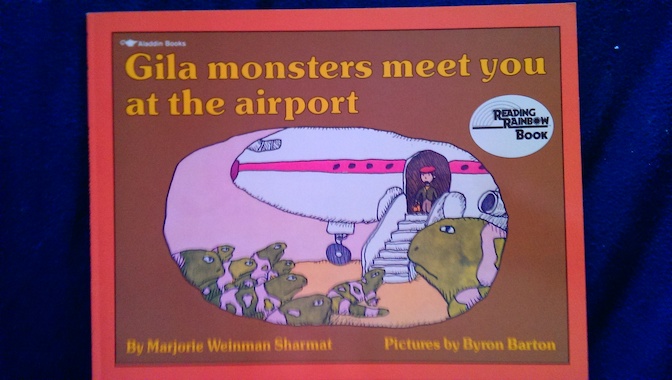
Gila Monsters Meet You at the Airport by Marjorie Weinman Sharmat, pictures by Byron Barton, 1980.

This is a humorous picture book about a boy moving from one side of the United States to the other and his misconceptions of what he’s going to find when he goes west.

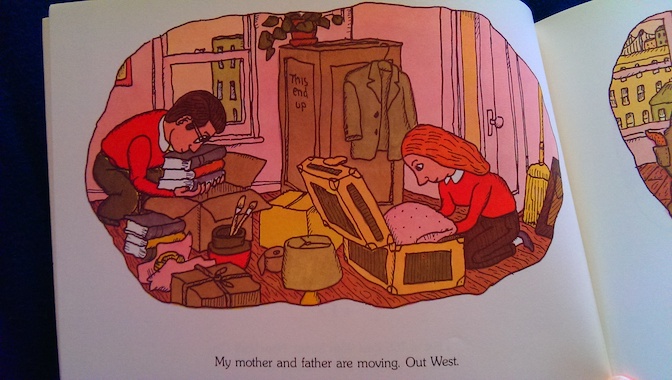
At the beginning of the story, the boy lives in an apartment in  New York City.  As far as he’s concerned, he could live there forever, but his parents decide that they’re going to move “Out West.” (The book never really says what state they’re moving to, but it seems to be somewhere in the Southwestern United States, like Texas, New Mexico, or Arizona.)

GilaMonstersMoving

The boy thinks he’s going to hate his new home.  He thinks of all the things that he’s heard about the West, like there’s cactus everywhere so you hardly know where to sit down, everyone dresses like a cowboy and rides horses everywhere, all he’ll ever get to eat is chili and beans, and he’s bound to die of heat exhaustion in the desert.  His best friend in New York, Seymour, told him that Gila monsters would meet him at the airport.

GilaMonstersCactus

Of course, there aren’t any Gila monsters at the airport when the boy gets there.  Instead, he meets another boy whose family is moving East.  The two boys talk to each other for awhile, and the Western boy starts telling him that he’s not looking forward to heading East because he’s heard that it’s always cold there, the cities are overcrowded and full of gangsters, the buildings are so tall that airplanes fly through the apartments, and there are alligators in the sewers.  He expects to find alligators waiting for him at the airport.

GilaMonstersAirportBoy

Of course, things aren’t as bad as either boy is expecting.  The boy from New York realizes that Seymour and his other friends back East don’t know much about the West, and he starts realizing that things in his new home are actually pretty good, some of them not all that different from home.

GilaMonstersArrival

This book was featured on Reading Rainbow.