American Girls
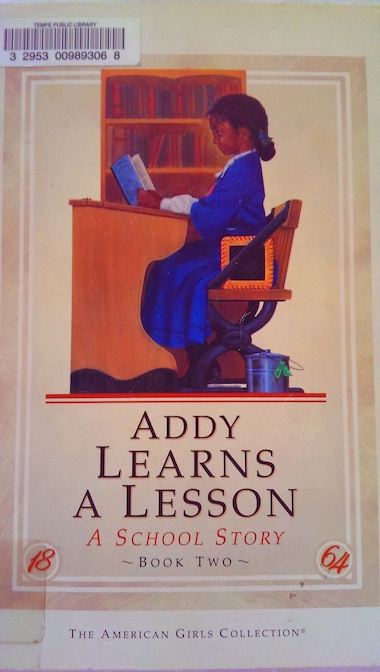
Addy Learns a Lesson by Connie Porter, 1993.
 After escaping from slavery, Addy and her mother finally arrive in Philadelphia, Pennsylvania, where they will start a new life. Philadelphia is a big city, and at first, Addy feels lost, not knowing where to go and what to do. They have no family or friends to turn to, and neither she or her mother can even read the street signs, never having been taught to read. They are dependent on help from other free black people, former slaves who have already established themselves in the community.
The first people they meet in Philadelphia are Mrs. Moore and her daughter, Sarah. They are part of the Freedom Society of Trinity A.M.E. Church, which helps new arrivals escaping from slavery, like Addy and her mother. The Moores take them to the church, where they attend a church supper, along with some other new arrivals. Mrs. Moore asks Addy’s mother what work skills she has, and when she says that she can sew, Mrs. Moore says that she might be able to get a job in a dress shop. Mrs. Ford, the white woman who owns the shop, is strict and fussy, but she hires Addy’s mother and gives them a room to live in.
Life in freedom isn’t as glamorous as Addy thought it would be at first. Her mother works hard for little pay, and the attic room where they live is small and uncomfortable. She misses the rest of their family and still doesn’t know where her father and brother are. There are also things that black people in Philadelphia can’t do, even though they aren’t slaves, like riding on the streetcar.
However, there is one thing that Addy is looking forward to: going to school for the first time. Sarah Moore is Addy’s age, and she tells Addy about her family escaped from slavery in Virginia. Like Addy, she couldn’t read when she first arrived, but now, Sarah attends school. Addy is excited about attending the same school as Sarah and happy that she has made a new friend. Addy’s new teacher, Miss Dunn, was also a former slave from North Carolina, and she reassures Addy that, although she hasn’t been to school before or learned to read yet, it won’t be long before she learns.


All of the other children at school are black, many of them former slaves. However, Addy can’t help but notice that some of their families are more prosperous than others. In particular, a girl named Harriet wears beautiful dresses, the kind that Addy has dreamed of having herself. Sarah and Harriet don’t get along because Harriet is snobbish, but Addy is fascinated by her, wishing that she could have things like Harriet has. Harriet says that her family were never slaves, and as bossy as Harriet is, Addy can’t help but admire her. Harriet is nice to Addy at first, bragging about how smart she is and how much she can help Addy, but she isn’t as patient or as helpful to Addy as Sarah is.
When there is a spelling match at school, Addy accepts Harriet’s invitation to go to her house to study. Harriet always seems to do well in class, and Addy is curious to see what her house is like. However, Harriet and her friends force Addy to be their “flunky,” carrying all of their books, and they say insulting things about Sarah. Then, Harriet retracts the invitation to study.
As Addy sees the way Harriet takes advantage of her, she comes to realize some important things about the way people act and about herself and the type of friends she really wants in her new life. Unlike Harriet, Sarah is Addy’s real friend. Addy realizes that she doesn’t need to admire people like Harriet because she is smart and works hard and can do just fine without Harriet’s false friendship.


In the back of the book, there is a section of historical information about education during the American Civil War, especially for black children. It was actually against the law to teach slaves to read during Addy’s time, although some were able to learn in secret. Even for free blacks in the North, there were few educational opportunities. Black children couldn’t go to school with white children, and the schools for black children were poor, unable to afford many supplies. Over time, more and more black people were able to get an education, in spite of the difficulties involved, and education helped to improve their lives. However, segregated schools remained the norm until the 20th century.
I liked the way they showed the medal that Addy wins in the spelling bee. Students who particularly excelled at a subject in class were sometimes given a small medal on a pin to wear as a badge of honor, something that people don’t do in modern times.
 The Root Cellar by Janet Lunn, 1981.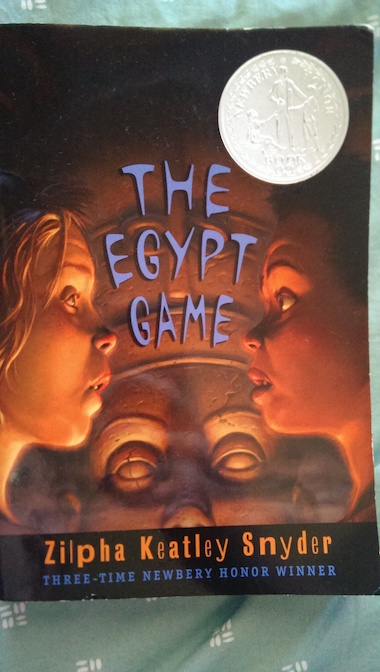
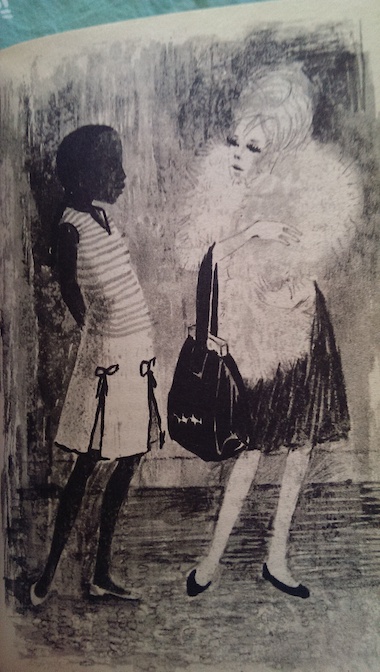 April Hall has come to live with her grandmother (the mother of her deceased father) because her actress mother is touring with a band as a singer. April’s mother isn’t a big star, although April likes to brag about her and their Hollywood life. Really, her mother is mostly a vocalist who occasionally gets parts as an extra, hoping for that big break. April is sure that when her mother gets back from her tour, she will send for her, and they will live together in Hollywood again. Although, from the way her grandmother behaves, it seems as though April may have to prepare herself for living with her for the long term. April resents her grandmother’s apparent belief that her mother has dumped her because she is unwilling or unable to take care of her.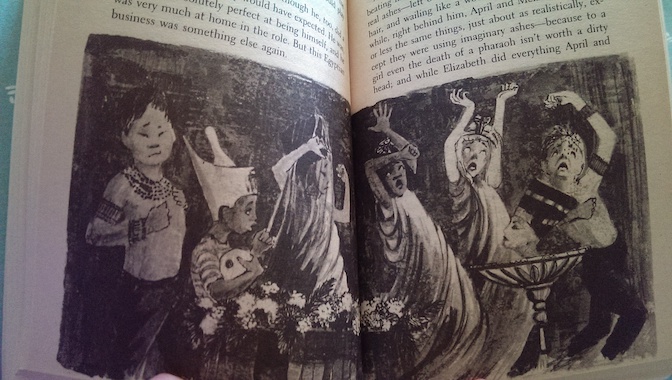
 The children are uneasy about this unexpected game player because frightening things are happening in their neighborhood. The kids wonder if the mysterious messages could be from the crazed killer who murdered the young girl. People have been looking suspiciously at the loner who owns the antique store, an older man who everyone calls the Professor. However, the kids have become too enmeshed in the Egypt game to give it up in spite of their fears.

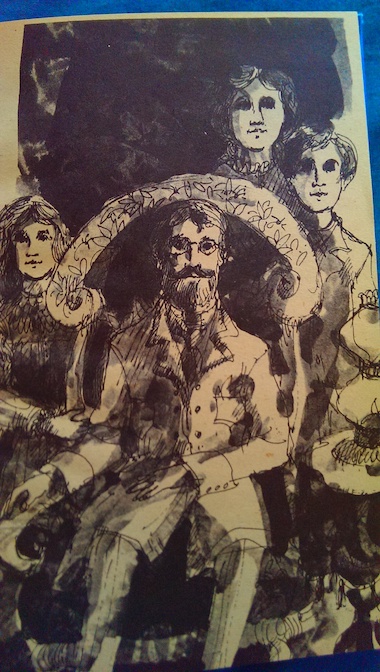 It’s 1851, and Professor Carver of Boston is living in an apartment above a candle shop with his wife and two children, his son Jamie and daughter Lorna. One day, a man named Mr. Giddings comes to see Professor Carver to request his help. For years, he has wanted to buy a particular farm with a beautiful house called Windy Hill. However, when he finally succeeded in buying the house and he and his wife went to live there, his wife became very upset. She said that she felt strange in the house and that she had seen a ghost. Now, she is too upset to return to Windy Hill. Mr. Giddings has heard that Professor Carver once helped a friend get rid of a ghost haunting his house, and he asks the professor if he would be willing to do the same for him.
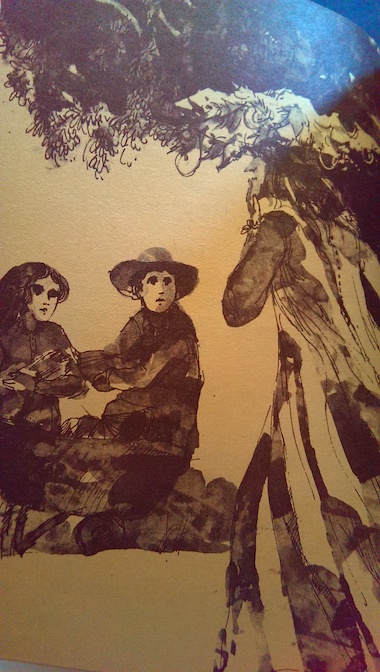 Jamie and Lorna are thrilled by the house, which is much bigger than their apartment in town. They can each have their own room, and there is an old tower in the house that was built by a former owner, who was always paranoid about Indian (Native American) attacks (something which had never actually happened). However, their new neighbors are kind of strange. Stover, the handyman, warns them that the house is haunted and also tells them about another neighbor, Miss Miggie. Miss Miggie is an old woman who wanders around, all dressed in white, and likes to spy on people. There is also a boy named Bruno, who apparently can’t walk and often begs at the side of the road with his pet goat, and his father, Tench, who is often drunk and doesn’t want people to make friends with Bruno.
 Then, strange things do start happening in the house. The quilt that Lorna has been making disappears and reappears in another room in the middle of the night. At first, the family thinks maybe she was walking in her sleep because she had done it before, when she was younger. However, there is someone who has been entering the house without the Carvers’ knowledge, and Jamie and Lorna set a trap that catches the mysterious “ghost.”
 #28 Lauren’s New Address by Susan Saunders, 1990.
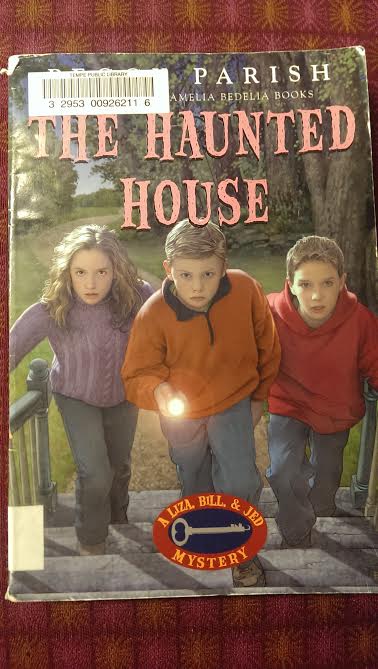 The Haunted House by Peggy Parish, 1971.

 Jestress's Forgotten Books and Stories