The Saturdays

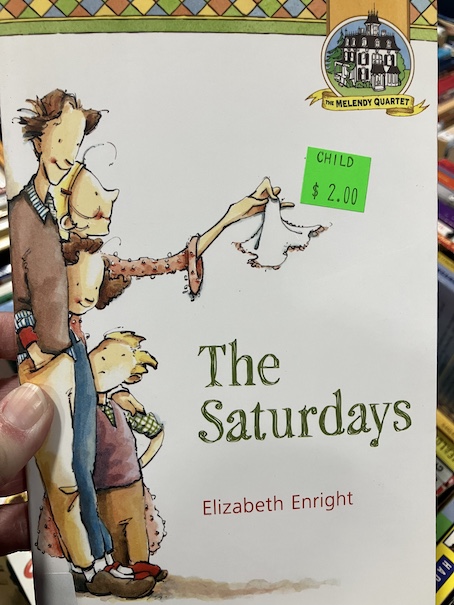
The four Melendy children live in a brownstone townhouse in New York City during the early 1940s. Their mother is dead, but they get along well with their father, and their housekeeper, Cuffy, is a motherly woman and helps look after the children. Each of the children has their own responsibilities in the house and distinctive talents and ambitions in life. Mona is the eldest at age 13, and she wants to be an actress. Rush, age 12, wants to be a mechanical engineer and a pianist. Miranda, who is 10 years old and usually goes by the nickname “Randy”, loves dancing and painting. Oliver, the youngest at 6 years old, wants to be a train engineer.

The children have a room at the top of the house which is a sort of playroom, although they call it the “office.” It has the children’s toys and books and plenty of things that they’ve gathered for their various hobbies, activities, and experiments. However, one rainy Saturday, the kids are bored. It isn’t that they don’t have anything to do. It’s more that the day is so wet and miserable that they have trouble getting interested in anything. While they debate different things they could do or wish they could do and complain about the weather and the size of their allowance, Randy comes up with an interesting idea.

Each of the four children has something that they wish they could do, but they’ve never been able to afford to do it because it costs more than the allowance they receive. Randy suggests that they form a kind of Saturday club. Every week, they will pool their allowances, and one of them will use the collected money to do something they’ve always wanted to do. To make it worth the investment from the others, they all have to agree that they won’t just blow the money on something they could do any time, like buy a bunch of candy. Each child’s special Saturday should be something really exciting and worthwhile. All of the kids are interested and have ideas about what they could do if they had a lump sum equal to four allowances and one free Saturday to do whatever they want by themselves.

When they explain the plan to their father and Cuffy, they agree that the children can do what they like with their allowance money, including taking turns pooling it and sharing it with each other. They also agree that the children can go off by themselves for their adventures as long as they agree to some basic safety rules. Over the next several Saturdays, the children take turns having their own special days with their pooled allowance money.

Randy is the first one to have her turn. As an art lover, she goes to an art gallery. To her surprise, Randy also sees an elderly woman she knows, Mrs. Oliphant, who is an old friend of the Melendy family. Mrs. Oliphant is a kind woman, but the Melendy children never thought of her as much fun. Randy loves the art and the ways the paintings make her feel, almost as though she could step into them and experience what the people in the paintings are experiencing. There is one particular picture that interests her, a picture of a girl who looks like she’s the same age as Randy is now. Randy finds herself wishing that she could meet the girl in the painting, like the girl might be someone she could have been friends with.

Then, Mrs. Oliphant approaches Randy and asks her about whether or not she likes the painting. Randy is surprised when Mrs. Oliphant tells her that it was painted 60 years ago and that she was the girl in the picture. Randy’s artistic afternoon takes an unexpected turn when Mrs. Oliphant invites Randy to have a snack with her, and she tells Randy about her youth in Paris, when she was a lonely only child being raised by a strict father, elderly aunts, and a governess. The artist who painted her was a friend of her father’s, who thought that she looked like a little princess. It was at the inspiration of the artist that young Mrs. Oliphant snuck out of her house to visit her first carnival when her overprotective family wouldn’t let her go, and she was kidnapped for ransom by a gypsy fortune teller. Fortunately, she was found again by the artist at another carnival where the fortune teller was performing. The artist persuaded her father to let him paint her after the rescue. Randy loves that exciting story and is surprised at how romantic and fascinating Mrs. Oliphant really is. Mrs. Oliphant invites her to visit her sometime and see some of the fascinating things that she’s collected over the years, and she buys a little box of petite fours (fancy little cakes that the children have never had before) for Randy to take home to her siblings.

When it’s Rush’s turn for a special Saturday, he decides that he wants to go see an opera because he loves music. He goes to see Wagner’s opera Siegfried (part of a series of operas based on the Nibelungenlied epic poem that helped inspire Tolkien‘s The Lord of the Rings), about a hero and a magic ring made by dwarves and a fearsome dragon. On the way home, Rush rescue’s a stray dog and brings him home. He tries to clean up the dog before showing him to his father and Cuffy, but the dog gets loose before he’s done washing him. Fortunately, the dog manages to charm the rest of the family, so the family gains a pet.

Mona’s turn is next. She really hates her long braids, so she decides to use her Saturday for her first trip to a beauty parlor and asks for a hair cut. She isn’t really sure that her father or Cuffy would approve of it, but nobody has told her not to (because she didn’t ask). At the beauty parlor, they ask her if she’s really sure that she wants a hair cut because her braids are almost down to her waist, but she insists. While she works on Mona’s hair, the stylist tells her a story about how she and her brother ran away to New York as children and how she got into the beauty business.

When she’s finished, Mona is impressed with how beautiful she looks, and she even lets the stylist paint her nails. However, the reception she gets at home is about as bad as Mona might have expected. Her father and Cuffy are pretty conservative on the subject of girls’ hair and makeup. They disapprove of her trying to be too grown up and not consulting them about her hair, and they want to get the nail polish off her fingers as soon as possible. Even her siblings think that she’s been too daring with her appearance.

When Cuffy sees how upset Mona is about their criticism and disapproval, she comforts her, and she admits that the hair cut is actually practical because it will be easier to wash and brush shorter hair than long hair. Mona’s father admits that he might also get used to the hairstyle and come to like it. He further admits that it can be hard for parents sometimes, when they see signs that their children are growing up. Randy also says that Mona really does look like a movie star.

The children continue taking turns with their special Saturdays. Oliver, being only 6 years old, can’t go out into the city alone, like the others can, so the others spend their Saturdays at home with him whenever it’s his turn. Then, on one of Oliver’s Saturdays, he disappears. Sneaking out of the house by himself, he takes the money that he’s saved and asks a policeman the way to the circus, which is at Madison Square Garden.

While his siblings panic when they realize that Oliver is missing, Oliver has a great time at the circus, watching all the animals perform and buying cotton candy and other treats. However, when it’s time to leave, Oliver gets lost on his way home, and he starts feeling sick from everything he’s eaten. He gets a ride home from a friendly policeman on a horse, and looking back on it, Oliver decides that was the best part of his day. He decides that maybe, instead of being a train engineer, he’ll become a policeman on a horse when he grows up.

After Oliver’s circus adventure, the siblings decide that they want to do a shared adventure, so they go on a picnic. Their new dog, Isaac, later saves them from a disaster caused by a careless mistake that could have killed them all at home. The children’s father decides on some home repairs, and the children realize that they won’t be able to go away for their usual summer trip and that they’ll have to economize on their Saturday adventures. Fortunately, Mrs. Oliphant has an idea for a summer adventure for the family. She owns a lighthouse, and she invites the Melendy family for a summer visit!

This is the first book in The Melendy Family series. The book is available to borrow and read for free online through Internet Archive, as part of a collection.

I like this series because it’s set contemporary to the time when it was written, in the early 1940s. This first book sets the time period with a comment about a mark on the floor left by one of the children trying out roller skates on Christmas 1939 and one of the children commenting that a stain on the wall looks a lot like Hitler because it looks like a man’s face with a mustache. (One of the other children comments that he’s going to turn the stain into a bearded man, like George Bernard Shaw, because he doesn’t want to see Hitler.) Toward the end of the book, the children talk about the war a little with Cuffy. The war has definitely been going on because they mention bombs and blackouts in London, and Randy asks Cuffy what it was like when the world was peaceful. Cuffy says that it seemed lovely, at least on the surface, but the peace didn’t last. There was another bad war before this one, and a peaceful time in between the two wars when people could travel freely. When Mona was a baby, their parents took a trip through Europe, and Cuffy was there to look after Mona. Because the children live in New York, they never see the war directly, but they’re aware that it’s happening, and they have feelings about it.

Apart from the historical war references, this book is just generally fun to read. It’s fun to see what each of the children does when they have a little money and the freedom to go where they want and do what they want in the city. The kids have minimal adult supervision on their adventures, and it’s the sort of thing that kids today might dream about doing. In general, kids love stories about other kids with the freedom to do what they want to do, although because this family likes the arts and culture, many of their chosen activities, like going to an art gallery or an opera, are things that many other children might not think to do. I was thinking that, probably, one adventure that many kids in my area could do or might do unsupervised might be to get their hair cut and/or nails done in some fancy way, like Mona did.

I was a little surprised that the father of the family reacted as strongly as he did to Mona having shorter hair because shorter hair for women and girls had become more acceptable by the 1940s. I think that regarding short hair as scandalous was more common when the style was new in the late 1910s and the 1920s (see the story Bernice Bobs Her Hair by F. Scott Fitzgerald from 1920). On the other hand, the real issue here seems to be that the father and Cuffy think that Mona is trying to act too old for her age (which is a way of saying too attractive or too sexy for a girl who is still too young to date). The father somewhat admits that it can be a shock to a parent to see how much his daughter is growing up. In that case, it’s not so much about short hair in general but now grown-up and attractive Mona looks in a more adult hairstyle.

Something else I’ve noticed about books in this series is that they frequently contain mini-stories told by other characters to the Melendy children. In this book, we get the story told by the hairdresser about how she and her brother ran away to the city when they were young and the story of Mrs. Oliphant’s adventures when she was kidnapped by a gypsy as a child. Children kidnapped by gypsies is a theme in vintage children’s books, although this is considered a stereotypical depiction in the 21st century. The stereotype of the child-stealing gypsy was probably based in prejudice, the use of community outsiders as scapegoats, and erroneous conclusions drawn from observing family members who do not physically resemble each other. (For example, I remember being told as a child that two blue-eyed parents would not produce a brown-eyed child because blues eyes are a recessive gene, yet it actually does happen, although it’s relatively rare. It’s just that human genetics are complex and produce more variations or throw-backs to earlier generations than some people might expect.) The main character in another book by a different author, The Girl in the Window, challenges the prejudices of adults in her community when they start to blame the disappearance of a local girl on a gypsy.
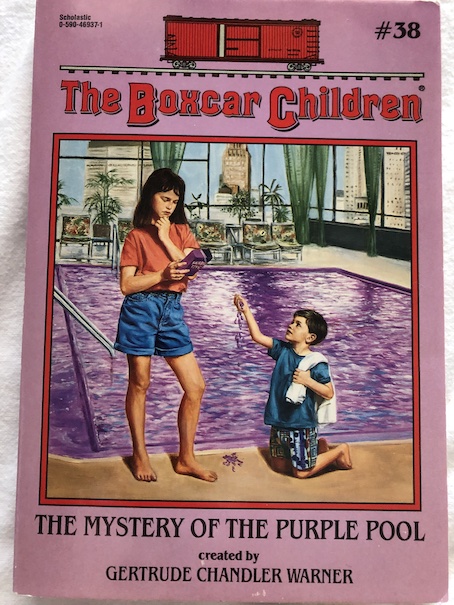
The Mystery of the Purple Pool

The Boxcar Children

The Boxcar Children are all bored, especially Benny. Grandfather Alden tells them that he has to go to New York City on business, and the children can come with him and see the city. That sounds like just the kind of excitement the kids need! Their grandfather calls the hotel where he’ll be staying and reserves a suite of room for all of them. Then, he tells the children to look through some guidebooks for the city and decide what they want to see there. He says that, during the time when he’ll be working, the two oldest children, Henry and Jessie, will be in charge. The children start looking through the guidebooks and talking about things they want to see in New York.
When they arrive at the Plymouth Hotel in New York, the children’s grandfather notices right away that the service isn’t how it usually is at this hotel. For some reason, their reservation was canceled, although they are still able to get rooms. Then, there are no bellhops to be found to carry their bags, and even the hotel management doesn’t know where they are. As they go to their room, they hear another guest complaining that his room wasn’t cleaned, even though the maid said that she’d cleaned it.

All of these things could be mistakes or signs of bad hotel management, but it soon becomes apparent that someone is deliberately trying to sabotage the hotel. When the children try to swim in the hotel pool, they find out that someone dyed the pool purple! Then, someone switches the sugar and salt in the hotel restaurant, ruining everyone’s breakfast. When the kids come back from sight-seeing, they see a crowd of people in the lobby, all complaining about various things missing from their rooms, like pillows and shower curtains. Then, the children get stuck in the hotel elevator when someone turns it off and have to call for help.

The Alden children have another mystery on their hands! Who could be the mysterious saboteur, and what would they want to harm the hotel? There’s a mysterious man who seems to be lurking around when bad things happen. There’s also a maid who is angry about her brother being fired from the hotel. The hotel manager isn’t always on hand to deal with things when they go wrong. There’s also an unfriendly woman who doesn’t like kids (named Karen before that name started to be used as a slang word for a disagreeable, complaining woman) and is always scribbling in her notebook, never letting anybody see what she’s writing. Any of them could be the culprit, or it could be someone they haven’t even thought to suspect.

The book is available to borrow and read for free online through Internet Archive (multiple copies).

I remember reading this book and liking it when I was a kid. One of the hallmarks of The Boxcar Children series is that the children are always allowed their independence in their adventures. Their grandfather lets them explore the city completely on their own, even though the oldest child in the family is only 14 years old. Few people would let their children roam around New York City completely on their own these days, and they didn’t when I was a kid in the 1990s, either. Another guest at the hotel even lets his young son go sight-seeing with the Alden children when they haven’t known each other very long.

The kids have fun exploring the amenities at the hotel, too. The book draws attention to various aspects of staying at hotel, like suites with kitchenettes, hotel restaurants, pools and exercise rooms, and the snacks and toiletries you might find in your hotel room. I thought it was interesting how the book explains how you can call for help in an elevator if it gets stuck. Its a useful thing for kids to know.

One thing that occurred to me when I revisited this story was that it doesn’t mention the World Trade Center. They characters could have visited the original World Trade Center in the story because the book was published 7 years before it was destroyed in the September 11, 2001 terrorist attack, but the World Trade Center was not one of the sights that the children went to see. If it had been, it would have dated the story, but I can’t think of anything the children saw or did in the book that really dates it. The things they mention still exist in New York, and this story could still be set in the early 21st century.

From the Mixed-Up Files of Mrs. Basil E. Frankweiler

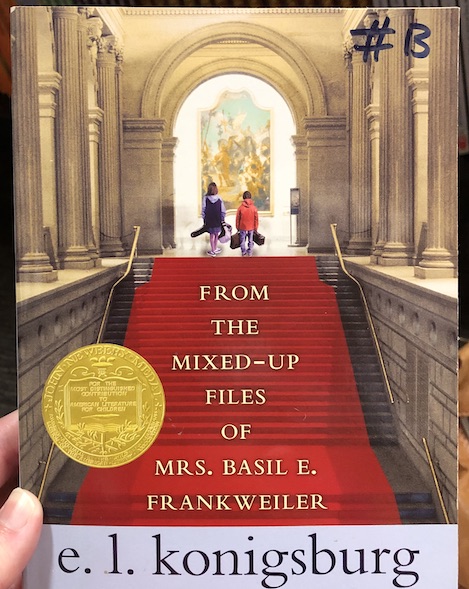
From the Mixed-Up Files of Mrs. Basil E. Frankweiler by E.L. Konigsburg, 1967.

Twelve-year-old Claudia Kincaid is bored with her dull suburban life in Connecticut with her parents and her brothers. Her life also often seems unfair, like she has more responsibilities than her brothers do and she has more chores than her others friends. Basically, Claudia is bored and feeling unsatisfied with her life. She wants to get away from it all and have a little adventure … although not too much adventure because Claudia isn’t the overly-adventurous type.

Claudia is cautious and methodical. When she plans to run away from home, she carefully plans every step and invites her more adventurous nine-year-old brother Jamie to go with her, both for the companionship and because he is a tightwad and has the cash necessary to fund their adventure. Although Claudia and Jamie bicker as siblings, they’re closer to each other than to either of their other brothers. Jamie eagerly accepts Claudia’s proposition to run away, although at first, he’s a little disappointed when he finds out where they’re going.

Claudia plans for them to run away to New York City because, as she puts it, it’s “a good place to get lost.” The city is so big, Claudia is sure that two runaway children will be easily overlooked. She’s also found a great place for them to stay during their adventure: the Metropolitan Museum of Art. Claudia loves comfort, convenience, and beauty, and the museum can offer all of that without the fees of staying in a hotel. There are exhibits of furniture, which provide them with a bed to sleep in, and interesting exhibits to keep them entertained and educated, and all they have to do is evade the security guards. At first, Jamie thinks that sounds a little too tame, but their adventure soon proves to be exciting and challenging, with enough mystery to satisfy both of them.

Claudia and Jamie develop routines for sneaking around the museum, evading the guards, hiding the backpacks and instrument cases that hold their clothes, and raiding the coins in the fountain for extra money. One day, while they’re hiding in the restrooms and waiting for the museum staff to leave, the staff set up a new exhibit for an angel sculpture sold to the museum by the wealthy and mysterious widow Mrs. Basil E. Frankweiler, who is actually the person narrating Claudia and Jamie’s story in a letter to her lawyer.

Claudia develops a fascination for the angel and a desire to learn the truth about the theory that the statue was made by Michelangelo. Between the two children, Claudia is the more imaginative and romantic, but Jamie’s logical mind and zest for adventure serve them well as they delve deeper into the mystery. They do learn something important at the museum, but to get the full truth, they have to leave their planned hiding place in the museum and go see Mrs. Basil E. Frankweiler herself.

Mrs. Frankweiler is a delightfully eccentric student of human nature, who is fascinated by the young runaways who come to her for answers to a mystery hundreds of years old. In exchange for the details of their exploits, Mrs. Frankweiler gives the children a chance to locate the answers they’re seeking in her strange, mixed-up files. In the process, the children learn a secret that gives both of them the sense of being part of something secret and exciting and much bigger than their ordinary, hum-drum lives, which is what they were originally looking for when they ran away from home.

The book is a Newbery Award winner, and it is available to borrow for free online through Internet Archive (many copies).

My Reaction

During the course of the adventure, Claudia and Jamie become closer to each other than they were before they ran away from home. They learn a little more about each other and themselves, and neither of them is quite the same as they were before they started, which is at the heart of Claudia’s reasons for wanting to run away from home in the first place. The language and descriptions in the book are colorful, which is part of the reason why this book is popular to read in schools.

There were two movies made of this story. One is a made-for-tv movie version from 1995, although it changed some of the details from the original story. In the 1995 movie, there is a scene with Jamie getting sick and Claudia worrying about him and taking care of him that never happened in the original book. Also, in the movie, Claudia stops Jamie from taking the coins from the fountain when they had no qualms about raiding the fountain for money in the book. At the end of the book, the children don’t tell their parents where they were hiding when they return home, but in the movie, the parents do find out. There is also an older movie from 1973 which is sometimes called The Hideaways.

Nellie’s Promise

American Girls

Nellie’s Promise by Valerie Tripp, 2004.

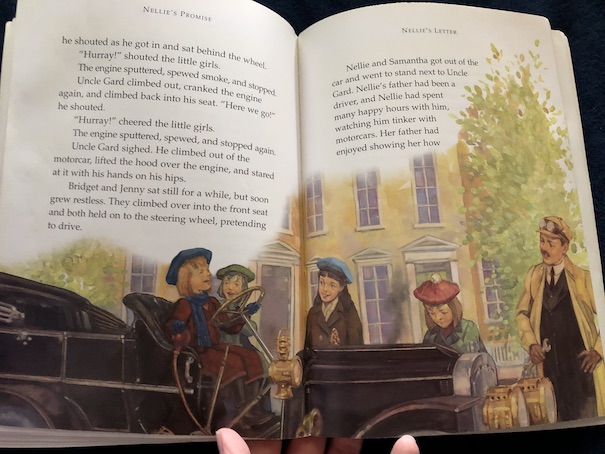
This book is a companion book to the Samantha, An American Girl series, focusing on Samantha’s best friend, Nellie. Personally, I don’t like the companion books to the main American Girls books as well as the original books, but this book does follow up on the events to the main series. At the end of Samantha’s series, Samantha’s aunt and uncle took in Nellie and her sisters, Bridget and Jenny, after their parents died. Nellie and her sisters were from a poor family and had to start working from a young age before their parents died. After their parents died, their disreputable uncle abandoned them, and they were sent to an orphanage before Samantha discovered where they were. Samantha’s aunt and uncle are wealthy, and the girls’ lives have improved considerably.

Nellie’s happiness is threatened by the sudden reappearance of her Uncle Mike. Uncle Mike sees Nellie walking down the street in her nice new clothes and wants to know what rich family the girls are living with. Nellie runs away from him, but he threatens to find out where she’s living and to take her and her sisters back, saying that it’s his right as her uncle. He says that he means to put the girls to work earning money for him. Nellie is afraid that he might be able to reclaim them from Uncle Gard and Aunt Cornelia because he is a blood relative.

At first, Nellie is afraid to tell anyone that she’s seen her uncle and that he threatened to take her and her sisters back. Before her parents died, her mother made her promise to look after her younger sisters, so Nellie makes up her mind that’s what she’s going to do.

Nellie worries about the future for her and her sisters. She feels like she doesn’t fit in with the wealthy girls at Samantha’s school, who have had very different lives from hers, and the lessons they learn are the type of lessons for fine young ladies who will marry rich men and spend most of their time raising families, overseeing a house with servants, and entertaining friends and their husbands’ business associates, not preparing for practical professions outside the home. Nellie thinks that it’s important that she have some kind of job skills because the future can be very uncertain, and she wants to know that she can provide for her sisters, no matter what happens.

Samantha senses that Nellie is unhappy, and she asks her if she likes living with Uncle Gard and Aunt Cornelia. Nellie tells her that she does, but she hesitates to explain what’s really worrying her. Instead, she lets Samantha think that she just wants to feel like she’s doing something useful for the family. Before her parents died, Nellie used to get sewing lessons at a settlement house (a place where immigrant families could go to learn English, new job skills, and other skills they would need in their new lives in the United States) run by Miss Brennan. Aunt Cornelia is involved with many good causes, and she wants to visit a settlement house and get an introduction to Miss Brennan. Because Nellie knows Miss Brennan, she can help arrange that. It’s in a rough part of town, but Nellie is more accustomed to navigating rough neighborhoods than Samantha or her aunt. It also occurs to Nellie that she could ask Miss Brennan what to do about Uncle Mike.

Miss Brennan is glad to see Nellie, and she lets her show Aunt Cornelia and Samantha around the settlement house. They have many different types of classes for children as well as adults. Nellie says that she likes the practical classes that she used to have there, and even the types of dances that they do seem more practical than the more purely artistic ones that they do at the school she now attends with Samantha. Aunt Cornelia is pleased with the classes that they offer for women, and because she is interested in women’s education, decides that she wants to help out at the settlement house. However, the visit to the settlement house leaves Samantha irritated for reasons that Nellie doesn’t fully understand.

As Nellie begins spending more time with Aunt Cornelia at the settlement house, Samantha begins spending more time with Bridget and Jenny, and Nellie becomes jealous of how Samantha seems more like their older sister than she is. However, the others still don’t know about Uncle Mike’s reappearance, and Nellie is still fearful of what he might do and what will happen to her and her sisters if Uncle Mike tries to take them away. She feels like her only option is to try to prepare herself for a better job than that of factory worker.

When Nellie finally gets the courage to tell Miss Brennan about her worries, Miss Brennan tells her that she needs to discuss the situation with Uncle Gard. Uncle Gard is a good man, but he’s also a lawyer, and he will know how to legally stop Uncle Mike from trying to take custody of the girls. However, Miss Brennan adds that, whatever else happens, Nellie will still need to make some decisions about her future and what she wants to do with her life and education. The more Nellie thinks about it, the more certain she is about what she wants to do. She wants to become a teacher, like Miss Brennan.

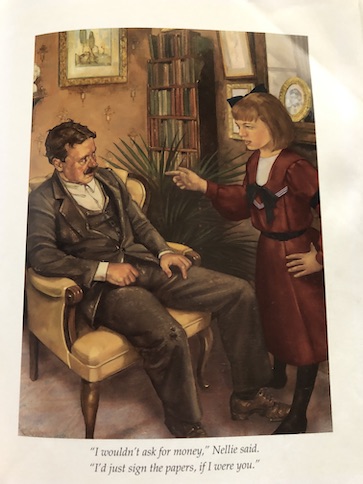
Nellie provokes more drama by applying to the boarding school in Boston where Miss Brennan said that she trained to be a teacher without talking to Aunt Cornelia, Uncle Gard, or Samantha about her decision or about her uncle. However, when the truth comes out about Uncle Mike, everyone understands that she was trying to hide and protect her sisters from him. It turns out that Uncle Gard has actually been looking for Uncle Mike because he already has the documents that he needs to legally adopt Nellie, Bridget, and Jenny, and he just needs Uncle Mike to legally release them into his custody. At first, Uncle Mike tries to extort money from Uncle Gard for the girls, but Nellie gets up the courage to tell him off, promising that if he doesn’t sign the papers and leave, she’ll tell everyone about how he stole all of their money and abandoned them to freeze the last time they were in his custody. The book ends happily, with Aunt Cornelia and Uncle Gard adopting the girls and understanding Nellie’s ambition to be a teacher. They enroll Nellie in a school in New York that teaches the skills she really wants so that she can continue living with them and not go to Boston. It also turns out that Samantha was mostly uncomfortable at the settlement house because she felt so sorry for the young children there and that spending time taking care of Bridget and Jenny was part of her way of trying to help Nellie by leaving her more free to do some of the things that she felt like she had to do. With everything out in the open, Nellie and her sisters are able to more fully become part of the family.

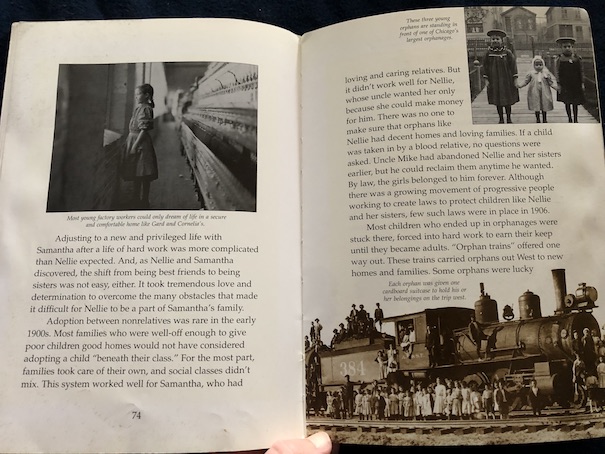
In the back of the book, there is a section with historical information about orphans and adoption in the early 1900s. There were not many laws and regulations governing care of orphans. Usually, orphans would be taken in by relatives, like Samantha was when her parents died. If a child didn’t have any relatives who were willing and able to take them, the child might be sent to an orphanage and possibly sent west on an orphan train as Nellie almost was at the end of the Samantha series. Families didn’t usually adopt children from different levels of society.

Settlement houses were important resources for poor immigrant families, and the education they received allowed immigrants to enter higher professions than servant or factory worker, which had been the primary source of income for many of them. It was common for settlement houses to help train young women to become teachers. There are still similar institutions and organizations in operation in 21st century America.

The book is available to borrow for free online through Internet Archive.

My Reaction and Further Historical Information

Part of the reason why I don’t like the companion books as much as the original American Girls series is that they tend to get more dramatic than the original books, and sometimes, I feel like the attitudes of the characters are less realistic for their time periods than they were in the original books. I think what made the original books more realistic was the restraint of the stories – they had their share of excitement and sometimes drama, but they never went overboard. The return of Nellie’s disreputable uncle struck me as both unlikely and unnecessary to Nellie’s and Samantha’s larger stories.

The historical details in this book are good. What they say about orphans of the time is basically true, although they note in the historical information section in the back of the book that Nellie’s experience of being adopted by a wealthier family was not typical of the time, and I think that’s part of what bothers me. Adoptions in general during the early 1900s were less formal than they are in modern times, and the idea of Uncle Gard hiring a private detective to find Uncle Mike and get him to sign legal documents doesn’t seem entirely realistic. I think it would have been more realistic to me the way that the last Samantha book ended, with Uncle Mike leaving and the assumption that none of the characters would see him again.

The reason why Nellie and her sisters were sent to the orphanage and why the orphanage was considering sending Nellie west on the orphan train was that no one expected that Uncle Mike would ever want to see the girls again. He’d already taken everything he could from them and left with them with no concern for what would happen to them. In the time that has passed since then, I would have expected that Uncle Mike would already have gotten into trouble that would keep him busy and out of their lives, maybe ended up in prison for being drunk and disorderly or hopping from job to job or begging for money as their little money ran out. Even if Uncle Mike had some thought of finding the girls, I don’t think it’s likely that he would have succeeded or even gotten close on his own because he is not that bright and he is not the kind of person who makes friends in places where he’s been before. I doubt that his former neighbor who took his nieces to the orphanage would have told him much if he had shown up again, looking for them. She knew that he was a drunk who abandoned the girls, and she made it clear that she didn’t like him. The people at the orphanage would have probably sent him away with no information because they would probably view the situation as closed since the girls are already placed out and Mike may not even have any proof of his identity and relationship to the girls. There is no such thing as a driver’s license during this period and many people did not even have birth certificates, so it’s possible that the people at the orphanage could simply choose to disbelieve this disreputable character and send him away. When I was watching a documentary about the orphan trains, former orphan train riders said that the orphanages that sent them west deliberately took notes from them that had their living parents’ addresses and otherwise cut off contact with living parents because they wanted the children to sever their ties to their difficult pasts and devote their attention to their new families, not maintain contact with the parents who were unable to care for them financially, so I wouldn’t expect that anyone at the orphanage in these books would go out of their way to reunite the orphaned girls with a rather shady uncle when they knew that the girls were already placed with a wealthy family and no longer their responsibility. Without help, which would be unlikely to be forthcoming, it doesn’t seem likely that Uncle Mike would be able to stumble on the girls by accident. As mentioned in Changes for Samantha, New York is a big city, people can be difficult to find if you don’t have a hint of where to look, and the wealthier part of the city where Nellie and her sisters live now is not a part of town where a guy like Uncle Mike would be likely to hang out. They could all easily live in New York City for years without meeting each other.

I feel like the situations in the story were a little contrived. By now, I would have thought that Nellie would know that Uncle Gard is a lawyer and would be the best person to ask about the laws. I don’t recall the earlier books saying what Uncle Gard did for a living, but Nellie lives with him now, and I would think that someone would have mentioned Uncle Gard’s profession by now. In the book, it oddly seems like as much of a surprise to Nellie as it is to the readers. I could believe that Nellie would go to the settlement house and do volunteer work there with Aunt Cornelia because it was already established in the previous books that Aunt Cornelia supports good causes, and although women of her level of society didn’t usually work for living, supporting good causes and charitable works would have been acceptable. Nellie’s level of knowledge seems a little odd, considering that she needed extra tutoring in basic subjects, like reading, in Samantha Learns a Lesson. In that book, Nellie never mentioned settlement house lessons, which she would have done if it hadn’t been a sudden decision to insert that this in book. Here, Nellie talks about classes that she had at the settlement house, where I would have expected to have more lessons to improve her reading, and it seems like she learned more there than she seemed to know before, even knowing a few words of foreign languages. In Samantha Learns a Lesson, one of Nellie’s skills was her ability to do math quickly handle money because she used to do the shopping for her mother, and in this book, she mentions that she helped to teach immigrants about American money, which she never mentioned before. These things are necessarily contradictory, but it all just seems a little off because they don’t quite fit into Nellie’s established character and history, and it implies that Nellie has had more education and training than she seemed to have before. It’s not necessarily impossible for a girl of Nellie’s time to know some of these things, but it’s the departure from what was already established about Nellie and her situation in life than kind of grates on me.

I think it could be reasonable for Nellie to develop the ambition to be a teacher. Even Samantha has previously some interest in that direction, having helped to tutor Nellie before. Not all women of this time went on to higher education, but those who did might attend a normal school, which is basically a college that focuses on training teachers. By contrast, the daughters of wealthy, high society families would be more likely attend a finishing school that emphasized social skills and entertaining more than academics. Both Samantha and Nellie are about twelve years old during this story and would be a little young for either of these options, but Samantha’s school seems to be more inclined toward preparing the girls for a finishing school. Given Aunt Cornelia’s interest in education and social causes and Uncle Gard’s support of it, I would expect that Samantha would be more likely to attend a women’s liberal arts college when she gets older, preparing her to marry a well-educated and culturally aware man as well as a wealthy one and probably engage in some form of social work and/or the arts in her spare time, but that’s just a guess. (I discussed some of this already in my review of Happy Birthday, Samantha. See also the book Daddy-Long-Legs for a description of what that might have been like for a girl of Samantha’s and Nellie’s time. The book was written a little later in than the time period of this book, but it’s set at about the right time for Samantha and Nellie to be old enough for college and includes characters of approximately their social backgrounds.) This book doesn’t really go into the subject, but if that’s the case, Samantha’s future might not be as different from Nellie’s as it first seems, and there might be a kind of middle path that both of them could choose. The Finch College in Manhattan, which was a fairly new preparatory school in Samantha’s and Nellie’s time, seems like it would have been a good option for both Samantha and Nellie, catering to upper-class girls while focusing on a more practical liberal arts education than the less academic finishing schools. Its founder, Jessica Finch, was a women’s rights activist and may have moved in similar circles to Aunt Cornelia. Her attempts to balance theoretical and practical knowledge sound like they would have appealed to the characters in the story. I’m not an expert on the Finch College, only having heard a little about it, but I think a school like that would present an intriguing possibility for the girls’ futures.

Voices After Midnight

Voices After Midnight by Richard Peck, 1989.

Three children, Heidi, Chad, and Luke, are traveling from their home in California to spend a couple of weeks in New York during the summer because their father has to do some work for his advertising firm there.  Heidi, the oldest child, didn’t want to go on the trip.  She would rather have stayed at home with her best friend, but her parents insisted that she go because she borrowed her mother’s car without permission and took it out driving without an adult in the car even though she only had a learner’s permit, not a real driver’s license, and barely even knew where the car’s controls were (she took her younger brothers along just so they could tell her about the controls, which shows her level of driving skill).  The resulting accident she had took out a flower bed.  Although her parents didn’t find out about the accident, she decided that perhaps it would be a good idea to get out of town for awhile while the whole incident blows over.

Chad is the narrator of the story, and he explains that his father’s company has rented a house for them to live in while they’re in New York, or rather, part of an old house.  It’s a very old house, and it’s five stories tall.  There is an old cage elevator that has been repurposed as a telephone nook.  It’s a nice place, but there’s something strange about it.  Even before they arrive in New York, both Chad and Luke begin dreaming about snow.  Then, on their first night in the house in New York, Chad hears voices in the house after midnight.  It sounds like a man and a woman.  They are trapped somewhere, and they are cold.  Even the family’s dog, Victoria Alexandrina (Al for short) is frightened in the house.

Luke loves old houses and places with history, and he seems to have an odd ability to sense the past, even being able to describe what places looked like in the past without doing any research to find out.  Luke tries to tell Chad that he has the same ability to get in touch with the past, but Chad doesn’t believe it at first.  Luke thinks that they have a special mission in New York, to resolve some kind of unfinished business, although he’s not sure what. 

Then, Luke admits to Chad that he’s been hearing the voices in the house, too.  The two of them sneak up to the upper floors of the house, the part that they haven’t rented, and they see that the rooms are all empty and in bad repair.  When they look out of the windows, they see the landscape as it was years ago, with buildings being constructed that are already old in modern times.  Heidi finds them up there and becomes fascinated by a dress that they find in an old trunk.

The boys’ abilities to see the past keep getting stronger, and more strange things happen in the house.  A bouquet of flowers suddenly appears in Heidi’s room with a message from a mysterious admirer, and then almost as suddenly, the flowers wilt and the card with the message fades, as if they had aged suddenly.  The boys keep seeing people and things from the past all over town as they explore New York City.

At night, Chad and Luke find themselves going back in time in the house’s history.  Chad is frightened, but Luke knows that they’re looking for an event in the house’s history, something that must be changed.

Back in the late 1800s, the Dunlap family lived in the house, with two teenage children, Emily and her older brother, Tyler.  Their family is fairly well-off, but not as wealthy as the family of the girl Tyler has a crush on.  One night, Chad and Luke witness a conversation between Emily and her mother about Tyler’s marriage prospects.  Emily thinks that Tyler is making the wrong choice, pursuing the wrong girl in his romantic life.  It doesn’t seem like an earth-shattering tragedy, but events are moving closer to an even greater tragedy.  It is Emily and Tyler’s voices that the boys have been hearing after midnight in the house.

Chad finds their trips into the past unnerving and he fears that he and Luke might accidentally become stuck in the past.  He wants to stop, but Luke insists that they keep going.  The situation becomes more urgent because Heidi has also found her way into the past and is falling in love with Tyler!  When Chad and Luke go into the past, they are invisible to the people there, but Tyler not only sees Heidi but dances with her at a New Year’s ball.  From then on, Heidi is also involved in the adventure.  Like Luke, she has a sense that there is something that they need to do in that house, in the past.

Something bad is going to happen to Emily and Tyler.  Somehow, they are going to die.  Cold.  Trapped.  During the Great Blizzard of 1888.  The kids are not sure quite what exactly is going to happen until almost the end, but they can feel it coming.  It has already happened in the distant past, but they need to find the right moment in time to stop it from happening again!

All three of the children, Chad, Heidi, and Luke, have psychic abilities and are able to see and travel through time, although Chad and Heidi have mostly worked to ignore it in their lives, trying to just be normal kids.  When they succeed in saving Tyler and Emily Dunlap, they not only change the past but the present, eventually meeting some of Tyler’s descendants (who he marries is a bit of a surprise, although it’s not either of the girls that Emily had expected it to be).  There is a kind of odd time loop, though.  At the end of the story, they learn about their own, special, previously unknown connection to the Dunlap family and the possible reason why they are gifted with their time-traveling abilities.  In saving Tyler and Emily, they are also saving themselves, which oddly, begs the question of how real they were before . . . but, maybe they were always fated to succeed.  In the end, the house in New York is still “haunted”, but the final joke (unknown to the current owners) is that Heidi becomes the beautiful but mysterious “ghost” who appeared at the right time and then suddenly disappeared and whose story has been passed down through the generations.

The book is available to borrow for free online through Internet Archive.

Anna, Grandpa, and the Big Storm

Anna, Grandpa, and the Big Storm by Carla Stevens, 1982.

The story takes place during the Great Blizzard of 1888. Anna’s Grandpa is visiting her family in New York City, but he thinks the city is boring. He says that there isn’t much there for him to do. One day, Anna is worried about getting to school because it is starting to snow heavily. Anna’s mother says that she can stay home, but Anna is supposed to be in a spelling bee, and she doesn’t want to miss out. Grandpa volunteers to take Anna to school on the elevated train.

As the two set out, Anna begins to get scared because the storm is getting worse. Grandpa urges her on, and the two make it onto the train. Before they can go very far, the tracks freeze over, and the train gets stuck. Anna and her Grandpa are trapped in the train with a bunch of strangers, waiting for rescue.

Anna and Grandpa make friends with the other people on the train, finding ways to keep themselves moving and warm while they wait for help to arrive, like playing “Simon Says.”  Even though Anna doesn’t make it to school for the spelling bee, their adventures turn out to be good for the people they are able to help and the new friends they make.  Grandpa sees a different side of life in the city and decides to stay for awhile longer so he can spend time with some new friends.

The story is based upon actual accounts of the famous blizzard when many other people were trapped on the elevated trains around the city. The book is available to borrow and read for free online through Internet Archive.

Changes for Samantha

American Girls

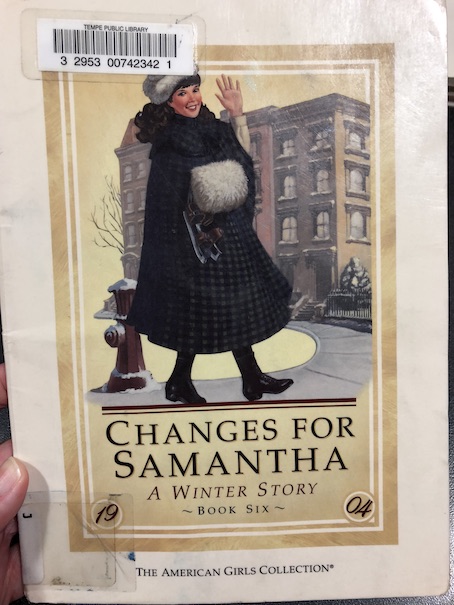
Changes for Samantha by Valerie Tripp, 1988.

This book is part of the Samantha, An American Girl series. This is the last book in the original series of Samantha’s stories and explains the changes in the lives of Samantha and her friends, especially Nellie. When Samantha met Nellie in the first book in the series, Nellie was a poor girl working as a servant girl in a neighboring house. Later, Nellie and her family moved to Samantha’s town, Mount Bedford, and Nellie and her sisters were able to attend school for the first time.

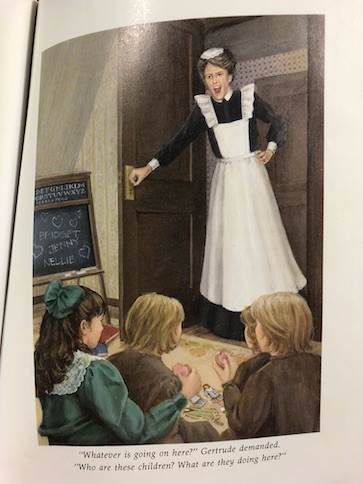
Now, Samantha has moved to New York City to live with her Uncle Gard and his new wife, Aunt Cornelia. Samantha likes living with them, although their housekeeper, Gertrude, is strict and often makes her feel like she’s doing things wrong. Samantha’s grandmother, a widow, has remarried to her long-time friend, the Admiral. Samantha’s life has changed considerably since the first book. Since her move to New York City, Samantha hasn’t seen Nellie or her sisters, but their lives have also changed, and not for the better.

When the book begins, Samantha and Aunt Cornelia are making Valentines to give to friends and family. Samantha receives a letter from Nellie that says that her parents have died of the flu and their employer, Mrs. Van Sicklen, is sending her and her sisters to New York City to live with her Uncle Mike. Nellie says that she’ll try to visit Samantha in New York City soon. Samantha is upset to hear that Nellie’s parents are dead, but Uncle Gard and Aunt Cornelia reassure her that Nellie’s uncle will take care of her and that she’ll soon be living much closer to Samantha.

After some time goes by and Samantha doesn’t hear any more from Nellie, she begins to worry about her. Uncle Gard decides to call Mrs. Van Sicklen and find out Nellie’s new address, but she doesn’t know where Nellie’s uncle, Mike O’Malley, lives. All Mrs. Van Sicklen knows is that he lives on 17th or 18th Street, but New York City is so big, that doesn’t help much. Uncle Gard and Aunt Cornelia say that maybe Nellie has had to get a job or look after her sisters and that she’s just been too busy to visit, but Samantha is still worried that something is very wrong.

Samantha decides to start asking around 17th and 18th Streets to see if she can locate Mike O’Malley, and she finds a chestnut seller who knows Mike O’Malley. However, he warns Samatha not to get involved with him because Mike O’Malley is a “hooligan.” Samantha worries about that, but it’s just another reason for her to want to check on Nellie. When she reaches the apartment where Mike O’Malley last lived, he isn’t there anymore. His neighbor explains that Mike O’Malley was a drunk who simply abandoned his nieces in his old apartment. The neighbor took the girls in for a while, but she is a poor woman with children of her own to raise, so she had to turn Nellie and her sisters over to an orphanage, the Coldrock House for Homeless Girls.

Samantha tells her aunt and uncle what she’s learned, and they’re upset that she went to such a dangerous part of the city alone. However, Aunt Cornelia agrees to take Samantha to the orphanage to see Nellie. The directoress, Miss Frouchy, is a stern and sneaky woman, but she agrees to let Samantha see Nellie, even though it isn’t a visitors’ day. It is difficult for the girls to speak candidly with Miss Frouchy watching them and monitoring everything that Nellie says. When Aunt Cornelia asks if Nellie and her sisters need anything, Miss Frouchy interrupts and says that they don’t. However, Samantha notes how thin Nellie looks and suspects that there is more going on than Nellie is being allowed to say, and Miss Frouchy even confiscates the cookies meant for Nellie and her sisters right in front of Aunt Cornelia and Samantha.

Aunt Cornelia asks Miss Frouchy for a tour of the orphanage so that Nellie and Samantha can be alone, and so the girls are able to speak openly. Nellie confirms that things are hard at the orphanage and her sister, Bridget, isn’t strong. Miss Frouchy thinks that Bridget is lazy and doesn’t want to work, so Nellie tries to cover Bridget’s chores as best she can. Samantha says that Nellie could come and stay with her and her aunt and uncle, but Nellie says that they probably don’t need any more maids. Samantha offers to hide Nellie and her sisters, but Nellie thinks that plan is too risky. More than anything, Nellie wants to keep her sisters together. She says with a little more training, she could find a job as a maid and support them.

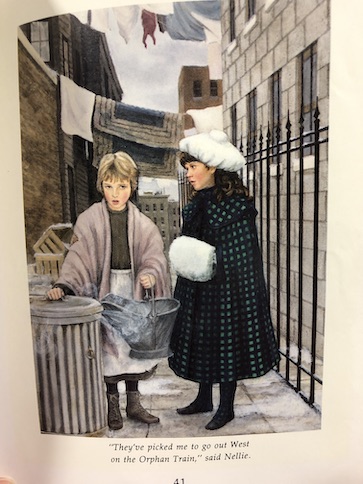
Samantha returns to the orphanage again with her aunt and uncle to visit all three girls, and she and Nellie arrange to meet secretly at the time when Nellie is supposed to take the fireplace ashes out to the alley for disposal. At their next meeting, Samantha finds out that Miss Frouchy took the gloves that they had given Nellie and even punished her for having them because she said that she must have stolen the gloves. However, there is worse to come. Soon, Nellie tells Samantha that she has been chosen to be sent out west on the Orphan Train, but because her sisters are too young to go, they’ll be left in New York alone. With the sisters about to be split up, Samantha’s plan to help the girls run away and hide is looking better.

Together, Nellie and Samantha help to sneak the younger girls out of the orphanage, and Samantha hides the three of them in an upstairs room in the aunt and uncle’s house that isn’t being used. She sneaks food and toys upstairs to them, and Nellie sneaks out during the day to go looking for work. However, Gertrude soon gets suspicious about how much food Samantha seems to be eating and how she seems to be sneaking around with it. When the girls are finally caught, Samantha owes her aunt and uncle some explanations, but admitting the truth of what has happened changes things for the better for all of the girls.

In the movie version of the Samantha series, which combined all the stories from the Samantha books into one, the story ends at Christmas, but in the book, it’s Valentine’s Day. The Christmas ending is nice, but Valentine’s Day does make for a nice difference, and love is appropriate to the theme of the story. Uncle Gard and Aunt Cornelia end up adopting Nellie and her sisters, so they officially become part of Samantha’s family. Unlike other characters in the story, who see the orphans as either an inconvenience or a source of cheap labor, Uncle Gard and Aunt Cornelia genuinely love them and want to raise them.

Something that struck me about the book was that both Nellie and Samantha are orphans, but their lives were very different at the beginning of the story because Samantha is from a wealthy family with an uncle who loves her and Nellie is a poor girl with an irresponsible uncle. If Samantha had been poor, she might have been destined for an orphanage or the orphan train herself. Because she wasn’t and because her family looks after children well and is willing to share what they have with others, Samantha has a secure future, and Nellie and her sisters become part of their family.

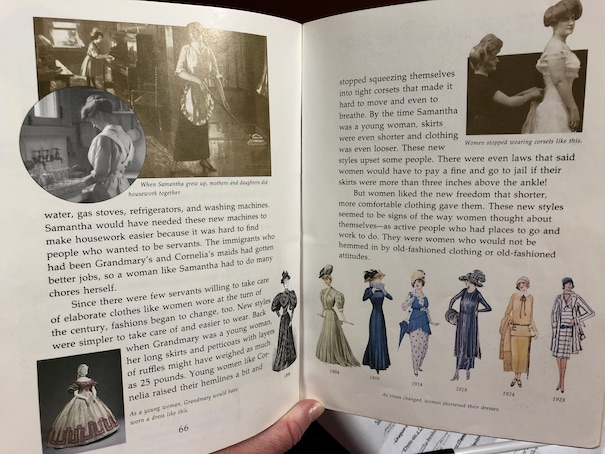
The book ends with a section of historical information about all the changes taking place in Samantha’s time, from technological changes, such as the first airplanes and new cars, to the increasing sizes of cities and new immigrants arriving in the United States.

As girls like Samantha grew up, society continued to change. In earlier books, Samantha’s grandmother talked about how young ladies aren’t supposed to work but learn how to be ladies and take care of a household. By the time Samantha was an adult, in the 1910s and 1920s, it was becoming more common for women to hold others jobs, although they would often stop working when they got married so they could focus on raising their children. The profession of social work evolved to help care for children like Nellie and her sisters. Some social workers also helped immigrants to learn English and train for new jobs when the came to the United States. The book specifically mentions Jane Addams, who founded the settlement house, Hull House.

Change is a major theme of all of the American Girl books, and a girl like Samantha would have seen some drastic changes in the ways that people lived as she got older. Over time, fewer immigrants looked for jobs as domestic servants, and newer forms of household technology, like washing machines, made it easier for housewives to do more of their domestic chores themselves. The section of historical information ends with examples of the changes in styles of women’s clothing through the 1920s, explaining how the changes in clothing styles were part of the changes in the types of lives the women wearing them were leading.

Although the book doesn’t go into these details, I would just like to point out how old Samantha would have been at various points in the 20th century. She was born in 1894, and ten years old in 1904, so that means that she would have been:

  • 23 years old when the US entered World War I in 1917
  • 26 years old when the 19th Amendment granted women’s suffrage in the United States in 1920
  • 30 years old in 1924 (Jazz age and Prohibition)
  • 35 years old when the stock market crashed in 1929, the beginning of the Great Depression
  • 47 years old in 1941, when the attack on Pearl Harbor occurred, and the US entered World War II, and 50 years old in 1944, when the Molly, An American Girl series takes place.
  • In her 50s during the early days of the Cold War. She would have to live to be 95 to see the end of it.
  • In her 60s through her early 70s during the Civil Rights Movement.

I like to think about these things because it puts history in perspective, and it gives us some sense of what Samantha’s future life might have been like. When she was a young woman, she may have joined the women’s suffrage movement with her Aunt Cornelia. She probably knew young men her age who went to fight in World War I. (Eddie, the annoying boy who lived next door to Samantha’s grandmother, would have been old enough to fight and may have been a WWI soldier himself.) Perhaps, Samantha’s future husband was a soldier. When she was older, Samantha could have either joined the temperance movement behind Prohibition or visited a speakeasy or at least knew people who did. It’s difficult to say what happened to Samantha’s family during the Great Depression. Depending on their professions and what they may have invested their money in, they may have lost their fortunes in the stock market crash, or they may have ridden out the whole thing in relative comfort. By World War II, Samantha may have had a son who was old enough to fight. One of the things I find interesting about historical novels with children is imagining what their future lives may have been like, and Samantha was born at a time when she would have witnessed many major events throughout her future life. The book shows how women’s fashions changed as Samantha grew up, but I’m fascinated by the events in Samantha’s life that I know must be coming, just because of when she was born. By the end of her life, the world would be a very different place from what she knew when she was young.

The book is available to borrow for free online through Internet Archive.

Happy Birthday, Samantha

American Girls

Happy Birthday, Samantha by Valerie Tripp, 1987.

This is part of the Samantha, An American Girl series.

Samantha is turning ten years old! She is having a birthday party with some other girls, and Aunt Cornelia’s younger sisters, the twins Agnes and Agatha, are coming to visit. Samantha’s grandmother is very strict, with very precise ideas about the way that things should be done. The twins are accustomed to being raised more permissively. When Samantha complains that her grandmother makes her wear long underwear for most of the year, even when it’s really too hot to wear it. Her grandmother thinks that it will help ward off illness. The twins encourage Samantha to think for herself. Few people wear long underwear anymore or believe that they will get sick by not wearing it, the twins say, and if Samantha doesn’t want to wear it, she should be allowed to make up her own mind about it. Samantha agrees that ten years old should be old enough to decide about simple things, like what kind of underwear to wear.

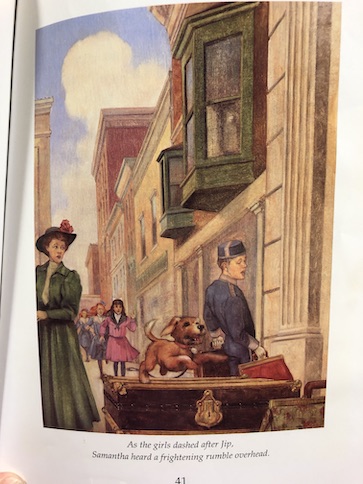
The twins have a lot of interesting ideas about how to do things differently, and they encourage Samantha to be a little more daring and try new things. When the cook talks about Samantha’s birthday cake and how it will have ten candles on it, the twins suggest that she could make ten smaller cakes, called petite fours, and put one candle on each of them. Samantha thinks that sounds so elegant that she wants to try it, although the cook thinks that it sounds a little strange for birthday cakes. They’re also going to have ice cream at the party, homemade. Samantha and the twins help to make it, although they are annoyed by Eddie, the nosy and bossy boy from next door, who shows up and tries to tell them what to do, hoping for a taste of ice cream himself.

At first, girls the party act a bit self-conscious, trying to be polite and grown-up in their party clothes. After Samantha opens her presents, her Uncle Gard and Aunt Cornelia show up with a special surprise: a puppy named Jip. Jip is a little wild and doesn’t know how to obey commands. He runs off with Samantha’s new teddy bear (a recent invention in Samantha’s time), and the girls have to chase him and get him to drop the toy. Samantha distracts the dog by offering him her shoe, and Eddie, who was watching, picks up the bear. At first, he says that he’ll give it back if they give him some ice cream and let him play with the dog, but Samantha refuses because he was not invited to the party, and she doesn’t like him nosing in. Agatha wrestles the teddy bear away from Eddie before Samantha’s grandmother arrives and tells them that young ladies shouldn’t fight or make spectacles of themselves. Most of the rest of the party is elegant, and the girls are a little more relaxed, now that they look a little less elegant from chasing the dog. However, Eddie gets revenge on the girls by adding salt to the ice cream they made. Even though everything else is fine, including the petite fours, Samantha is still angry at Eddie for ruining the ice cream.

Since Samantha didn’t get to eat the ice cream at her birthday party, the twins and Aunt Cornelia suggest that Samantha return to New York City with them for a visit, and they can all go to a fancy ice cream parlor there. Grandmary agrees and says that she would like to go to New York City herself. On the way to Uncle Gard and Aunt Cornelia’s new house, Grandmary says to Samantha that she hopes that she thinks that the twins get too carried away with some of their ideas. She thinks that they’re too impulsive and don’t think before they act, and while they’ve been raised to be very modern children, she still thinks that some of the old ways are best.

When Grandmary and Samantha see a protest held by women’s suffragists, Grandmary is annoyed at the women, making public spectacles of themselves and inconveniencing passing traffic. She thinks that it’s just another “newfangled notion” that’s a lot of fuss and bother over nothing. She’s never had to vote in her entire life, and she doesn’t see why any other woman would need to. Samantha can tell that this opinion bothers Aunt Cornelia and the twins when Grandmary says it in front of them, but they don’t seem to want to discuss it further.

The twins and Samantha ask to take Jip to the park, and Aunt Cornelia says that’s fine. She has a meeting to attend, but she wants them back home in time to go to the ice cream parlor after her meeting. However, Jip gets away from the girls when they try to put him in Samantha’s doll carriage, and they chase him to the place where the suffragists are meeting. Although Samantha knows that her grandmother doesn’t approve of the suffragists, they have to go after the dog. There, the twins tell Samantha that Cornelia is also a suffragist, and she is speaking at the meeting.

Jip charges right up to the stage where Cornelia is giving her speech, and Cornelia lectures the girls about not thinking about the consequences of their actions and not following her instructions for taking proper care of Jip. Sometimes, they are too impulsive and don’t think ahead. Cornelia explains to the girls about the need to follow agreed-upon rules for safety and how that is different from the changes that her group is advocating. While Grandmary has been saying that the suffragists are also too radical and impulsive and making a fuss about nothing, Cornelia says that much thought, planning, and hard work has gone into their movement to ensure that the changes they’re advocating will be for the better. Grandmary doesn’t appreciate how much thought and preparation the group has done and how long it has taken them to get this far because she hasn’t really thought about the issues at all herself and she has not been to any of previous meetings, where the planning has taken place.

Note: The women’s suffrage movement was already decades old by 1904, when this story takes place, so it’s not really as “newfangled” as Grandmary describes it. It had been building for a long time. However, Grandmary may not have been aware of that because she never needed to be aware. Consider what her life has been like. Remember that Grandmary is a wealthy lady and that marriage and social connections have been the basis of her life. Her husband was wealthy, and she was likely born into a wealthy family. Her life has always been comfortable without her needing to have a job or vote or do anything other than be a wife and mother. Growing up, becoming a well-behaved young lady, and getting married set her for life, and up to this point, she hasn’t had any major problems with money or her lifestyle and hasn’t really needed to think much further than that. She’s used to letting the men in her life handle business and politics and provide her with money, and she now lives on the money that her husband left to her, which is more than ample. Mostly, what Grandmary has needed to manage in her life are the social graces necessary for entertaining her husband’s business associates and their wives and for helping to facilitate her children’s marriages and careers. Grandmary’s daughter was also married to a well-off man before their early deaths. Her son is also a wealthy man, who can provide for his wife, and Cornelia is also from a wealthy family in New York City, a natural extension of their social circle. Grandmary assumes that Samantha, raised in this wealthy social atmosphere, will also naturally meet and marry a wealthy man through the connections of her friends and family, one who will support her and their children in a comfortable fashion. She thinks that, besides caring for her future children, Samantha will likely occupy her time with good works for the less fortunate and that she will give elegant parties for the fashionably-dressed ladies of their social level to solidify their social connections. The elegant affair that her tenth birthday was supposed to be was also practice for her future, as Grandmary envisions it. Grandmary thinks that life will continue to follow this same general course in their family and that there will never be a need for anything different because her own life has been fairly smooth, comfortable, and predictable, largely unshaken, even by the deaths of her husband and Samantha’s parents. But, she’s about to change her mind.

The girls are a little disheveled when they go to meet Grandmary at the ice cream parlor because there is no time to go home and change. As they explain to Grandmary about why the girls look a little disheveled, she tells them that she already knows because she was there, watching the speech. When she saw that Cornelia was the one speaking, she decided to stop and listen, and she was impressed by what she heard. She liked the part where Cornelia talked about the importance of standing up for what is right, and that’s something that Grandmary believes in, too. She is now more open to the suffrage movement than she was before.

The story is partly about growing up and how Samantha realizes that she needs to learn to make her own decisions. She can’t always go by what her grandmother tells her, and sometimes, listening to the twins isn’t always the wisest choice, either. Samantha also begins to see that she has choices to make about the kind of young lady that she will grow up to be. She can be the elegant lady at the party or the public crusader for the causes she believes in or maybe something that combines aspects of both. In the end, Grandmary also begins to see the possibilities of change.

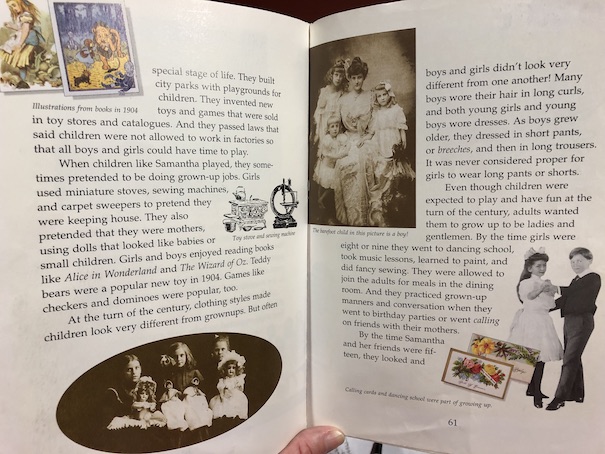
In the back of the book, there is a section about babies and children during the early 1900s. It discusses what children liked to do for fun and how adults would begin training children to be young adults early in life, emphasizing social skills, like dancing, how to behave at the dinner table, and how to engage in polite adult conversation. A girl from a wealthy family, like Samantha, might go to a finishing school instead of college after completing her basic education. At finishing school, she would learn how to manage a household, including how to manage servants (how to hire them, how to tell if they were doing a good job, etc.) and how to throw elegant dinner parties. She might have a coming out or debutante party to introduce her to society as an adult, which meant that she would be ready for introductions and dates with young gentlemen and would probably soon be considering marriage. (This is likely the path that Samantha’s grandmother took in life and the one that she is considering for Samantha.) However, some young ladies did go to college, had careers, or become suffragists, and some did some combination of the above. Samantha’s life is full of possibilities, and her future hasn’t been decided yet. Because Samantha was ten years old in 1904, she would have been eighteen in 1912. For an example of what college life would have been like for an eighteen-year-old girl at a college in the eastern United States in 1912, see the novel Daddy-Long-Legs.

The book is currently available to borrow for free online through Internet Archive.

If Your Name Was Changed at Ellis Island

NameChangedEllisIsland

If Your Name Was Changed at Ellis Island by Ellen Levine, 1993.

Like other books in this series, this book explains about a part of American history using a series of questions and answers.  Each section of the book starts with a different question about what it was like to come to America as an immigrant in the past and what happened when they reached Ellis Island, one of the main ports of entry into the United States around the turn of the 20th century, just off the coast of New York City, such as, “Would everyone in your family come together?”, “What did people bring with them?”, and “What did the legal inspectors do?”  Then, the book answers each of the questions.

The questions and answers start by describing what the journey to America was like from the late 1800s through the early 1900s.  Typically, families would come to the United States in stages: the father of a family (or perhaps one of the older children) would make the trip first, find a job in the United States and start saving money to prepare for rest of the family to come.  Depending on the family’s individual circumstances, it might be years before all the members completed the immigration process and reunited in America.

People traveled by ship in those days, and an often-forgotten part of their journey was even reaching the port the ship to America would be leaving from.  Depending on the starting point of the journey and the travel arrangements each family was able to make, getting to the port might involve crossing borders between other countries, adding another layer of legal difficulties to the journey.

There was also the knowledge that they might be turned away once they arrived at Ellis Island.  One of the chief concerns at the time was illness.  The inspectors at Ellis Island checked immigrants for signs of infectious diseases, and the ship companies knew that if their passengers were turned away because of the fear of disease, they would be required to pay for the return voyage themselves.  To help ensure that their passengers would not arrive with a disease, they would conduct their own health checks before the ship ever left port, looking for signs of illness, giving the passengers vaccines, and disinfecting things.  They were particularly afraid of passengers with lice because lice can spread typhus, which is deadly.  They would often cut the passengers’ hair or comb it very carefully.

The treatment passengers on ships received depended largely on their class of passage.  First and second-class passengers received the best rooms and the best food, and when they arrived in New York (assuming that was their destination), they didn’t even have to go to Ellis Island at all; the immigration inspectors would inspect first and second-class passengers on board the ship.  Only steerage passengers (“third class”, the cheapest possible method of travel, used by the poorest people, the largest group) would have to get off the ship for processing at Ellis Island.

EllisIslandComplex

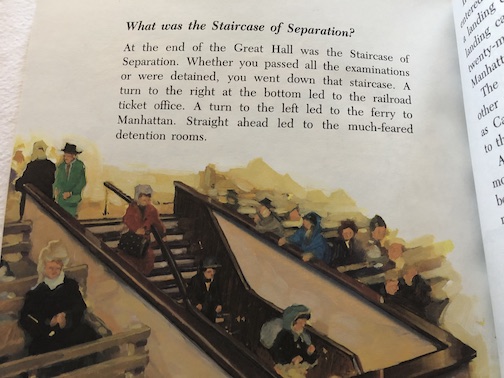
The processing center at Ellis Island wasn’t just a building; it was an entire complex.  The Great Hall alone was large enough to contain hundreds of people at a time, and when it was full of immigrants there were so many languages being spoken at once (sometimes as many as 30 different languages) that some people described it as sounding like the Tower of Babel.  There were also dormitories that could house more than a thousand people, a hospital for the sick, a post office, banks where people could change their cash for American money, a restaurant to feed everyone (with two kitchens, one kosher and one regular), a railroad ticket office where immigrants who would be moving on from New York could make their travel arrangements, and much more.  Some people called Ellis Island the “Island of Tears” because the arrival there after a long journey was an emotional experience and many immigrants were worried that they might be sent back if they couldn’t answer the inspectors’ questions to their satisfaction.  At the end of the Great Hall, there was a large staircase that came to be known as the Staircase of Separation.  Everyone had to go down this staircase after their examination by the inspectors.  At the bottom, they would go their separate ways, depending on their travel plans or whether they had passed inspection.  People who turned to the right were heading to the railroad ticket office.  People turning to the left were heading to the Manhattan ferry.  People who went straight were heading to the detention rooms because they hadn’t passed the inspection.

EllisIslandStaircase

As I mentioned before, the inspectors were very concerned about people who showed signs of serious diseases.  One of the first things that would happen during inspection was a brief examination by the Ellis Island doctors.  Because of the massive amount of people who had to be processed, this examination lasted only a few minutes, during which the doctor would quickly check for very specific symptoms and signs of possible illness.  If they didn’t see anything obviously wrong, such as red eyes (possible sign of eye infection, although for some, it was just because they’d been crying), difficulty in breathing, or lice, they would let the people pass.  If the doctors thought that they saw something that might be sign of illness, they would write a letter in chalk on the person’s clothes and send them on to be examined more thoroughly by another doctor.  Getting one of these letters didn’t always mean rejection.  If the other doctor decided that the first doctor was mistaken or that the person’s symptoms weren’t serious, they would still be allowed into the country.  Sometimes, if a person was ill but had a curable disease, they would be kept in the hospital on Ellis Island until they were better.  If the doctors weren’t quite sure if a person was ill or not, they might keep the person in the dormitories for a few days and then check them again after they had a chance to rest.  The people who were sent back on the ship were ones who had diseases that were incurable or seriously contagious.  (It sounds heartless, but they were trying to head off deadly epidemics.  During the 1800s, large cities like New York sometimes suffered serious epidemics of deadly diseases because of the sudden influx of new people who were living in overly-crowded conditions with relatively poor sanitation.  By preventing people with signs of serious diseases from joining the rest of the population, they were hoping to head off new epidemics and save lives.)

One of the more controversial parts of the examination was when they tested people for possible mental problems.  They wanted to make sure that they were mentally fit enough to find work, but the problem was that the tests designed by people who didn’t take cultural differences into account when they designed them.  The parts where they asked people to do simple arithmetic problems or to demonstrate that they could read, count backwards, or match up sets of similar drawings were pretty straight-forward.  However, sometimes they were shown a picture and asked to describe what was happening in the picture, and the immigrants gave the inspectors some surprising interpretations because it turns out that some experiences aren’t quite as universal as some people think.  For example, one picture was of some children digging a hole with a dead rabbit lying nearby.  It was supposed to depict children burying a dead pet.  But, some people view rabbits more as food than pets, and some immigrants said that the children were doing their chores because why shouldn’t the children work in the garden (the digging) after hunting a rabbit for dinner?  Fiorello La Guardia, himself from an immigrant family, an interpreter on Ellis Island and later, mayor of New York, particularly despised tests like these because the people who designed them and administered them were trying to test the minds of others without any real idea about what their lives had been like or how their minds actually worked.

EllisIslandGreatHall

The inspectors’ examinations in general weren’t always reliable because they were often hurried (dealing with so many people in a limited amount of time) and because the interpreters weren’t always accurate, which brings us to the question of why people’s names were sometimes changed at Ellis Island.  Sometimes, it was intentional.  Some immigrants thought that they would be more likely to be accepted by the inspectors if they had short, easy-to-pronounce names, so they would purposely give them shorter versions of their names.  There was some basis for this belief because, if an inspector didn’t understand a long, unfamiliar name, they wouldn’t have much time to figure it out and so would either take their best guess at the what the name should be, shorten it when they wrote it down, or give up altogether and write a much shorter name instead.  For example, when they processed Jewish people from Russia, the inspectors often ran into difficulties in understanding their last names and would sometimes just write down “Cohen” or “Levine”, no matter what the original name really was.  Sometimes, name changes were just an honest mistake because the inspector didn’t know how a name was really spelled (I can speak from personal experience because my family’s last name wasn’t always spelled like it is now, and when they found out that it had been changed, it was just too much trouble to fix it) or because they had misinterpreted something that the immigrant said.  One of my favorite examples of this was a young man who tried to explain to the inspector that he was an orphan (“yosem” in Yiddish). The inspector dutifully wrote his last name as Josem.

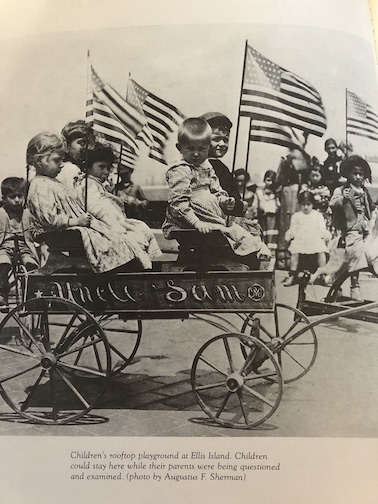
EllisIslandPlayground

The pictures in the book are paintings based on original photographs of immigrants and Ellis Island.  (See Immigrant Kids to compare some of the pictures.)

The book also contains some further information about the lives of immigrants once they arrived in America (Immigrant Kids goes into a lot more detail), the attitudes of Americans toward immigrants at the time (varied but with strong strains of anti-Catholic, anti-Irish, and general anti-immigrant attitudes during the 1800s), and the contributions of immigrants to American society.  I actually bought this book as a souvenir on a visit to Ellis Island years ago.

The book is currently available online through Internet Archive.

Immigrant Kids

ImmigrantKids

Immigrant Kids by Russell Freedman, 1980.

ImmigrantKidsEllisIsland

One of the best parts about this book is the pictures.  The preface of the book specifically talks about photography at the turn of the 20th century, how cameras were still fairly new technology but growing in popularity.  Cameras that were small enough to be held in a person’s hands were an 1880s innovation, and the book mentions that small cameras like that were known as “detective cameras” because they were small enough that they could be used to take pictures without the subjects noticing.  Over time, it became easier for amateurs to learn to use cameras, and it became more common for people to take pictures of their ordinary, everyday lives.  Pictures like these open up a window on the past.  The pictures in this book are of children whose families had only recently arrived in America from countries around the world.  The photographer for many of these pictures was Jacob A. Riis, a journalist in New York City who wanted to document the living conditions of poor immigrants.  He published a book called How the Other Half Lives in 1890, in which you can see more of his work.  Other pictures in this book are by Lewis Hine, who is known for his photographs of child laborers.  They are not the only photographers whose work appears in this book, but they are the most famous.

The book is divided into sections, covering different aspects of the lives of immigrant children.  In the chapter called Coming Over, the author describes what the journey to America was like.  One of the primary motivations for people to come to America around the turn of the century was money and employment opportunities.  If a family had little money and little or no chance of getting better jobs in their home country, they would decide to try their luck somewhere else.  Because most of the immigrant families were poor, it was common for families to immigrate gradually.  Often, the father of the family would come first, find a job, start establishing a life and home for his family, and eventually send for his wife and children when he’d saved enough money.  The actual journey was by ship, often in “steerage,” the cheapest form of passage available, in cramped rooms in the ship’s hold.

ImmigrantKidsFamilyQuestions

Although the journey could be harrowing, one of the most nerve-wracking parts was the immigrant processing that took place at immigrant ports like Ellis Island.  There were routine questions that immigrants were expected to answer and exams for them to take, and if the questioners weren’t satisfied, the immigrants could be sent back to the country they came from.  Doctors would examine the immigrants to evaluate their health and look for signs of possible mental defects.  They were particularly concerned about signs of infectious diseases.  Sometimes, it was difficult for immigrants to answer all the questions because of language barriers and the immigrants’ own nerves at being interrogated.  If an immigrant seemed too agitated, the examiners would typically let them rest for a while before trying again.

ImmigrantKidsTenement

The other chapters in the book are At Home, At School, At Work, and At Play, which give more details about the lives of immigrant children as their families settled in America.  They often settled in large cities because those were where the most employment opportunities were to be found.  Because they didn’t speak much English and needed help learning how things worked in America, such as how to find jobs and places to live and how laws worked, they tended to settle in neighborhoods with others from similar backgrounds who could help them.  That is why, even to this day, there are certain areas of large cities, such as New York, Boston, or Chicago, which are known for people of a particular nationality (like the Irish neighborhood, the Jewish neighborhood, Chinatowns, etc.).  New arrivals often joined friends or relatives who had already been living in the US for a while, seeking help in getting themselves established.  These ethnic neighborhoods were located in poor parts of town because the people there didn’t have much money.  People lived in small, crowded apartments called tenements, sharing water and toilet facilities with other families because the apartments were not provided with individual facilities.  However, once these groups of immigrant families became established, they remained established for a long time, and they gave these neighborhoods their own distinctive style.

ImmigrantKidsSchool

School was often difficult for new arrivals because the children had to learn English before they could study other subjects.  There were some special English language learning classes for them at larger schools with enough demand for them.  At smaller schools which didn’t have these classes, they often had help from other children who had arrived in America earlier and could act as translators.  They were also frequently put into classes for children who were younger than they were, studying easy subjects, until they had learned enough English to move up to classes with children their own age.

Typically, immigrant children aimed to stay in school until they were fourteen years old because that was the age when they could officially get full-time work.  However, because their families were poor, the children might have to leave school early to find jobs and help their families make ends meet.  The book describes how rules were frequently bent or broken because the laws were not well-enforced, and children often worked at younger ages, even under harsh conditions.  For immigrant children, the most important education was that which taught practical, vocational skills that would help them find jobs quickly.  Some agencies, like the Children’s Aid Society (known for the Orphan Trains), would help them with vocational training.

ImmigrantKidsBaseball

However, immigrant children still like to play.  Boys and girls usually played separately.  Boys frequently played games like baseball in the street, or stickball, which was a variant that could be played in smaller spaces.  In stickball, the “bat” was a stick or the handle of an old broom, and the ball was rubber and allowed to bounce before it was hit.  Girls would play other games, like “potsy,” which was a version of hopscotch.

Because of the lessons they were taught in schools and because the immigrant children mixed with children outside of their immigrant groups in school, the children absorbed the local culture and became Americanized faster than their parents.  Many of them experienced the feelings of being torn between their parents’ traditions and wanting to fit in with society around them.

In each of the chapters in the book, there are anecdotes from people who had arrived in the US as children around the turn of the century, telling stories about different aspects of their lives.

The book is currently available online through Internet Archive.