Anna, Grandpa, and the Big Storm by Carla Stevens, 1982.
The story takes place during the Great Blizzard of 1888. Anna’s Grandpa is visiting her family in New York City, but he thinks the city is boring. He says that there isn’t much there for him to do. One day, Anna is worried about getting to school because it is starting to snow heavily. Anna’s mother says that she can stay home, but Anna is supposed to be in a spelling bee, and she doesn’t want to miss out. Grandpa volunteers to take Anna to school on the elevated train.
As the two set out, Anna begins to get scared because the storm is getting worse. Grandpa urges her on, and the two make it onto the train. Before they can go very far, the tracks freeze over, and the train gets stuck. Anna and her Grandpa are trapped in the train with a bunch of strangers, waiting for rescue.
Anna and Grandpa make friends with the other people on the train, finding ways to keep themselves moving and warm while they wait for help to arrive, like playing “Simon Says.” Even though Anna doesn’t make it to school for the spelling bee, their adventures turn out to be good for the people they are able to help and the new friends they make. Grandpa sees a different side of life in the city and decides to stay for awhile longer so he can spend time with some new friends.
The story is based upon actual accounts of the famous blizzard when many other people were trapped on the elevated trains around the city. The book is available to borrow and read for free online through Internet Archive.
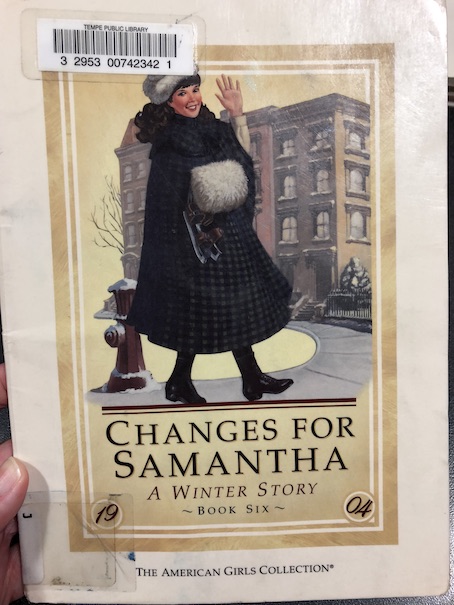
This book is part of the Samantha, An American Girl series. This is the last book in the original series of Samantha’s stories and explains the changes in the lives of Samantha and her friends, especially Nellie. When Samantha met Nellie in the first book in the series, Nellie was a poor girl working as a servant girl in a neighboring house. Later, Nellie and her family moved to Samantha’s town, Mount Bedford, and Nellie and her sisters were able to attend school for the first time.
Now, Samantha has moved to New York City to live with her Uncle Gard and his new wife, Aunt Cornelia. Samantha likes living with them, although their housekeeper, Gertrude, is strict and often makes her feel like she’s doing things wrong. Samantha’s grandmother, a widow, has remarried to her long-time friend, the Admiral. Samantha’s life has changed considerably since the first book. Since her move to New York City, Samantha hasn’t seen Nellie or her sisters, but their lives have also changed, and not for the better.
When the book begins, Samantha and Aunt Cornelia are making Valentines to give to friends and family. Samantha receives a letter from Nellie that says that her parents have died of the flu and their employer, Mrs. Van Sicklen, is sending her and her sisters to New York City to live with her Uncle Mike. Nellie says that she’ll try to visit Samantha in New York City soon. Samantha is upset to hear that Nellie’s parents are dead, but Uncle Gard and Aunt Cornelia reassure her that Nellie’s uncle will take care of her and that she’ll soon be living much closer to Samantha.
After some time goes by and Samantha doesn’t hear any more from Nellie, she begins to worry about her. Uncle Gard decides to call Mrs. Van Sicklen and find out Nellie’s new address, but she doesn’t know where Nellie’s uncle, Mike O’Malley, lives. All Mrs. Van Sicklen knows is that he lives on 17th or 18th Street, but New York City is so big, that doesn’t help much. Uncle Gard and Aunt Cornelia say that maybe Nellie has had to get a job or look after her sisters and that she’s just been too busy to visit, but Samantha is still worried that something is very wrong.
Samantha decides to start asking around 17th and 18th Streets to see if she can locate Mike O’Malley, and she finds a chestnut seller who knows Mike O’Malley. However, he warns Samatha not to get involved with him because Mike O’Malley is a “hooligan.” Samantha worries about that, but it’s just another reason for her to want to check on Nellie. When she reaches the apartment where Mike O’Malley last lived, he isn’t there anymore. His neighbor explains that Mike O’Malley was a drunk who simply abandoned his nieces in his old apartment. The neighbor took the girls in for a while, but she is a poor woman with children of her own to raise, so she had to turn Nellie and her sisters over to an orphanage, the Coldrock House for Homeless Girls.
Samantha tells her aunt and uncle what she’s learned, and they’re upset that she went to such a dangerous part of the city alone. However, Aunt Cornelia agrees to take Samantha to the orphanage to see Nellie. The directoress, Miss Frouchy, is a stern and sneaky woman, but she agrees to let Samantha see Nellie, even though it isn’t a visitors’ day. It is difficult for the girls to speak candidly with Miss Frouchy watching them and monitoring everything that Nellie says. When Aunt Cornelia asks if Nellie and her sisters need anything, Miss Frouchy interrupts and says that they don’t. However, Samantha notes how thin Nellie looks and suspects that there is more going on than Nellie is being allowed to say, and Miss Frouchy even confiscates the cookies meant for Nellie and her sisters right in front of Aunt Cornelia and Samantha.
Aunt Cornelia asks Miss Frouchy for a tour of the orphanage so that Nellie and Samantha can be alone, and so the girls are able to speak openly. Nellie confirms that things are hard at the orphanage and her sister, Bridget, isn’t strong. Miss Frouchy thinks that Bridget is lazy and doesn’t want to work, so Nellie tries to cover Bridget’s chores as best she can. Samantha says that Nellie could come and stay with her and her aunt and uncle, but Nellie says that they probably don’t need any more maids. Samantha offers to hide Nellie and her sisters, but Nellie thinks that plan is too risky. More than anything, Nellie wants to keep her sisters together. She says with a little more training, she could find a job as a maid and support them.
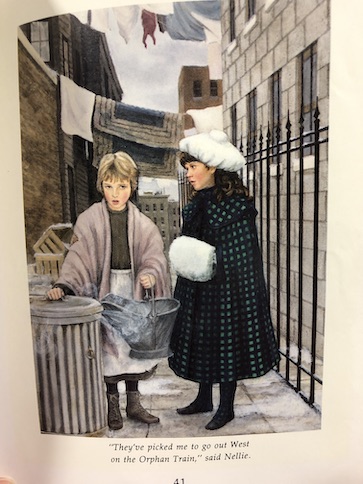
Samantha returns to the orphanage again with her aunt and uncle to visit all three girls, and she and Nellie arrange to meet secretly at the time when Nellie is supposed to take the fireplace ashes out to the alley for disposal. At their next meeting, Samantha finds out that Miss Frouchy took the gloves that they had given Nellie and even punished her for having them because she said that she must have stolen the gloves. However, there is worse to come. Soon, Nellie tells Samantha that she has been chosen to be sent out west on the Orphan Train, but because her sisters are too young to go, they’ll be left in New York alone. With the sisters about to be split up, Samantha’s plan to help the girls run away and hide is looking better.
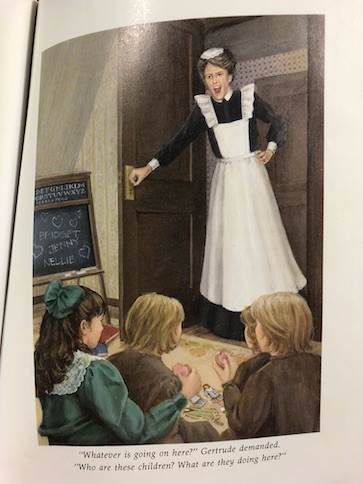
Together, Nellie and Samantha help to sneak the younger girls out of the orphanage, and Samantha hides the three of them in an upstairs room in the aunt and uncle’s house that isn’t being used. She sneaks food and toys upstairs to them, and Nellie sneaks out during the day to go looking for work. However, Gertrude soon gets suspicious about how much food Samantha seems to be eating and how she seems to be sneaking around with it. When the girls are finally caught, Samantha owes her aunt and uncle some explanations, but admitting the truth of what has happened changes things for the better for all of the girls.
In the movie version of the Samantha series, which combined all the stories from the Samantha books into one, the story ends at Christmas, but in the book, it’s Valentine’s Day. The Christmas ending is nice, but Valentine’s Day does make for a nice difference, and love is appropriate to the theme of the story. Uncle Gard and Aunt Cornelia end up adopting Nellie and her sisters, so they officially become part of Samantha’s family. Unlike other characters in the story, who see the orphans as either an inconvenience or a source of cheap labor, Uncle Gard and Aunt Cornelia genuinely love them and want to raise them.
Something that struck me about the book was that both Nellie and Samantha are orphans, but their lives were very different at the beginning of the story because Samantha is from a wealthy family with an uncle who loves her and Nellie is a poor girl with an irresponsible uncle. If Samantha had been poor, she might have been destined for an orphanage or the orphan train herself. Because she wasn’t and because her family looks after children well and is willing to share what they have with others, Samantha has a secure future, and Nellie and her sisters become part of their family.
The book ends with a section of historical information about all the changes taking place in Samantha’s time, from technological changes, such as the first airplanes and new cars, to the increasing sizes of cities and new immigrants arriving in the United States.
As girls like Samantha grew up, society continued to change. In earlier books, Samantha’s grandmother talked about how young ladies aren’t supposed to work but learn how to be ladies and take care of a household. By the time Samantha was an adult, in the 1910s and 1920s, it was becoming more common for women to hold others jobs, although they would often stop working when they got married so they could focus on raising their children. The profession of social work evolved to help care for children like Nellie and her sisters. Some social workers also helped immigrants to learn English and train for new jobs when the came to the United States. The book specifically mentions Jane Addams, who founded the settlement house, Hull House.
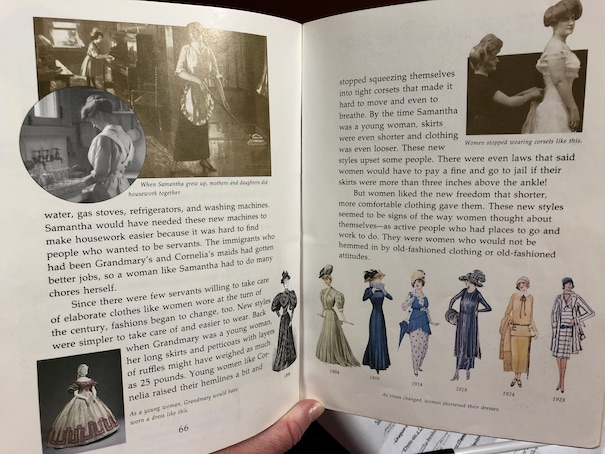
Change is a major theme of all of the American Girl books, and a girl like Samantha would have seen some drastic changes in the ways that people lived as she got older. Over time, fewer immigrants looked for jobs as domestic servants, and newer forms of household technology, like washing machines, made it easier for housewives to do more of their domestic chores themselves. The section of historical information ends with examples of the changes in styles of women’s clothing through the 1920s, explaining how the changes in clothing styles were part of the changes in the types of lives the women wearing them were leading.
Although the book doesn’t go into these details, I would just like to point out how old Samantha would have been at various points in the 20th century. She was born in 1894, and ten years old in 1904, so that means that she would have been:
23 years old when the US entered World War I in 1917
26 years old when the 19th Amendment granted women’s suffrage in the United States in 1920
30 years old in 1924 (Jazz age and Prohibition)
35 years old when the stock market crashed in 1929, the beginning of the Great Depression
47 years old in 1941, when the attack on Pearl Harbor occurred, and the US entered World War II, and 50 years old in 1944, when the Molly, An American Girl series takes place.
In her 50s during the early days of the Cold War. She would have to live to be 95 to see the end of it.
In her 60s through her early 70s during the Civil Rights Movement.
I like to think about these things because it puts history in perspective, and it gives us some sense of what Samantha’s future life might have been like. When she was a young woman, she may have joined the women’s suffrage movement with her Aunt Cornelia. She probably knew young men her age who went to fight in World War I. (Eddie, the annoying boy who lived next door to Samantha’s grandmother, would have been old enough to fight and may have been a WWI soldier himself.) Perhaps, Samantha’s future husband was a soldier. When she was older, Samantha could have either joined the temperance movement behind Prohibition or visited a speakeasy or at least knew people who did. It’s difficult to say what happened to Samantha’s family during the Great Depression. Depending on their professions and what they may have invested their money in, they may have lost their fortunes in the stock market crash, or they may have ridden out the whole thing in relative comfort. By World War II, Samantha may have had a son who was old enough to fight. One of the things I find interesting about historical novels with children is imagining what their future lives may have been like, and Samantha was born at a time when she would have witnessed many major events throughout her future life. The book shows how women’s fashions changed as Samantha grew up, but I’m fascinated by the events in Samantha’s life that I know must be coming, just because of when she was born. By the end of her life, the world would be a very different place from what she knew when she was young.
The book is available to borrow for free online through Internet Archive.
Samantha is turning ten years old! She is having a birthday party with some other girls, and Aunt Cornelia’s younger sisters, the twins Agnes and Agatha, are coming to visit. Samantha’s grandmother is very strict, with very precise ideas about the way that things should be done. The twins are accustomed to being raised more permissively. When Samantha complains that her grandmother makes her wear long underwear for most of the year, even when it’s really too hot to wear it. Her grandmother thinks that it will help ward off illness. The twins encourage Samantha to think for herself. Few people wear long underwear anymore or believe that they will get sick by not wearing it, the twins say, and if Samantha doesn’t want to wear it, she should be allowed to make up her own mind about it. Samantha agrees that ten years old should be old enough to decide about simple things, like what kind of underwear to wear.
The twins have a lot of interesting ideas about how to do things differently, and they encourage Samantha to be a little more daring and try new things. When the cook talks about Samantha’s birthday cake and how it will have ten candles on it, the twins suggest that she could make ten smaller cakes, called petite fours, and put one candle on each of them. Samantha thinks that sounds so elegant that she wants to try it, although the cook thinks that it sounds a little strange for birthday cakes. They’re also going to have ice cream at the party, homemade. Samantha and the twins help to make it, although they are annoyed by Eddie, the nosy and bossy boy from next door, who shows up and tries to tell them what to do, hoping for a taste of ice cream himself.
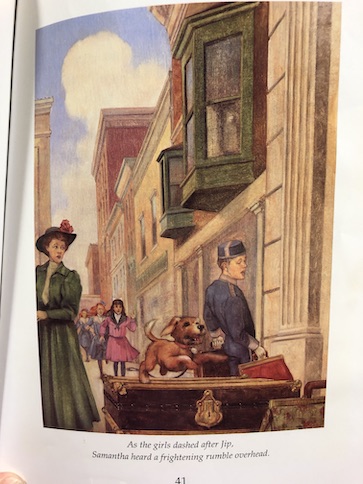
At first, girls the party act a bit self-conscious, trying to be polite and grown-up in their party clothes. After Samantha opens her presents, her Uncle Gard and Aunt Cornelia show up with a special surprise: a puppy named Jip. Jip is a little wild and doesn’t know how to obey commands. He runs off with Samantha’s new teddy bear (a recent invention in Samantha’s time), and the girls have to chase him and get him to drop the toy. Samantha distracts the dog by offering him her shoe, and Eddie, who was watching, picks up the bear. At first, he says that he’ll give it back if they give him some ice cream and let him play with the dog, but Samantha refuses because he was not invited to the party, and she doesn’t like him nosing in. Agatha wrestles the teddy bear away from Eddie before Samantha’s grandmother arrives and tells them that young ladies shouldn’t fight or make spectacles of themselves. Most of the rest of the party is elegant, and the girls are a little more relaxed, now that they look a little less elegant from chasing the dog. However, Eddie gets revenge on the girls by adding salt to the ice cream they made. Even though everything else is fine, including the petite fours, Samantha is still angry at Eddie for ruining the ice cream.
Since Samantha didn’t get to eat the ice cream at her birthday party, the twins and Aunt Cornelia suggest that Samantha return to New York City with them for a visit, and they can all go to a fancy ice cream parlor there. Grandmary agrees and says that she would like to go to New York City herself. On the way to Uncle Gard and Aunt Cornelia’s new house, Grandmary says to Samantha that she hopes that she thinks that the twins get too carried away with some of their ideas. She thinks that they’re too impulsive and don’t think before they act, and while they’ve been raised to be very modern children, she still thinks that some of the old ways are best.
When Grandmary and Samantha see a protest held by women’s suffragists, Grandmary is annoyed at the women, making public spectacles of themselves and inconveniencing passing traffic. She thinks that it’s just another “newfangled notion” that’s a lot of fuss and bother over nothing. She’s never had to vote in her entire life, and she doesn’t see why any other woman would need to. Samantha can tell that this opinion bothers Aunt Cornelia and the twins when Grandmary says it in front of them, but they don’t seem to want to discuss it further.
The twins and Samantha ask to take Jip to the park, and Aunt Cornelia says that’s fine. She has a meeting to attend, but she wants them back home in time to go to the ice cream parlor after her meeting. However, Jip gets away from the girls when they try to put him in Samantha’s doll carriage, and they chase him to the place where the suffragists are meeting. Although Samantha knows that her grandmother doesn’t approve of the suffragists, they have to go after the dog. There, the twins tell Samantha that Cornelia is also a suffragist, and she is speaking at the meeting.
Jip charges right up to the stage where Cornelia is giving her speech, and Cornelia lectures the girls about not thinking about the consequences of their actions and not following her instructions for taking proper care of Jip. Sometimes, they are too impulsive and don’t think ahead. Cornelia explains to the girls about the need to follow agreed-upon rules for safety and how that is different from the changes that her group is advocating. While Grandmary has been saying that the suffragists are also too radical and impulsive and making a fuss about nothing, Cornelia says that much thought, planning, and hard work has gone into their movement to ensure that the changes they’re advocating will be for the better. Grandmary doesn’t appreciate how much thought and preparation the group has done and how long it has taken them to get this far because she hasn’t really thought about the issues at all herself and she has not been to any of previous meetings, where the planning has taken place.
Note:The women’s suffrage movement was already decades old by 1904, when this story takes place, so it’s not really as “newfangled” as Grandmary describes it. It had been building for a long time. However, Grandmary may not have been aware of that because she never needed to be aware. Consider what her life has been like. Remember that Grandmary is a wealthy lady and that marriage and social connections have been the basis of her life. Her husband was wealthy, and she was likely born into a wealthy family. Her life has always been comfortable without her needing to have a job or vote or do anything other than be a wife and mother. Growing up, becoming a well-behaved young lady, and getting married set her for life, and up to this point, she hasn’t had any major problems with money or her lifestyle and hasn’t really needed to think much further than that. She’s used to letting the men in her life handle business and politics and provide her with money, and she now lives on the money that her husband left to her, which is more than ample. Mostly, what Grandmary has needed to manage in her life are the social graces necessary for entertaining her husband’s business associates and their wives and for helping to facilitate her children’s marriages and careers. Grandmary’s daughter was also married to a well-off man before their early deaths. Her son is also a wealthy man, who can provide for his wife, and Cornelia is also from a wealthy family in New York City, a natural extension of their social circle. Grandmary assumes that Samantha, raised in this wealthy social atmosphere, will also naturally meet and marry a wealthy man through the connections of her friends and family, one who will support her and their children in a comfortable fashion. She thinks that, besides caring for her future children, Samantha will likely occupy her time with good works for the less fortunate and that she will give elegant parties for the fashionably-dressed ladies of their social level to solidify their social connections. The elegant affair that her tenth birthday was supposed to be was also practice for her future, as Grandmary envisions it. Grandmary thinks that life will continue to follow this same general course in their family and that there will never be a need for anything different because her own life has been fairly smooth, comfortable, and predictable, largely unshaken, even by the deaths of her husband and Samantha’s parents. But, she’s about to change her mind.
The girls are a little disheveled when they go to meet Grandmary at the ice cream parlor because there is no time to go home and change. As they explain to Grandmary about why the girls look a little disheveled, she tells them that she already knows because she was there, watching the speech. When she saw that Cornelia was the one speaking, she decided to stop and listen, and she was impressed by what she heard. She liked the part where Cornelia talked about the importance of standing up for what is right, and that’s something that Grandmary believes in, too. She is now more open to the suffrage movement than she was before.
The story is partly about growing up and how Samantha realizes that she needs to learn to make her own decisions. She can’t always go by what her grandmother tells her, and sometimes, listening to the twins isn’t always the wisest choice, either. Samantha also begins to see that she has choices to make about the kind of young lady that she will grow up to be. She can be the elegant lady at the party or the public crusader for the causes she believes in or maybe something that combines aspects of both. In the end, Grandmary also begins to see the possibilities of change.
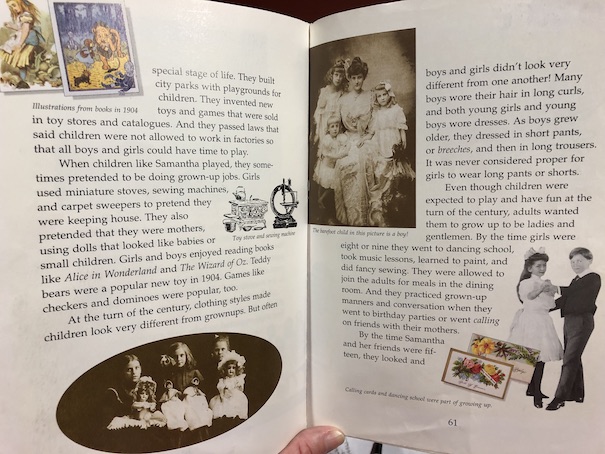
In the back of the book, there is a section about babies and children during the early 1900s. It discusses what children liked to do for fun and how adults would begin training children to be young adults early in life, emphasizing social skills, like dancing, how to behave at the dinner table, and how to engage in polite adult conversation. A girl from a wealthy family, like Samantha, might go to a finishing school instead of college after completing her basic education. At finishing school, she would learn how to manage a household, including how to manage servants (how to hire them, how to tell if they were doing a good job, etc.) and how to throw elegant dinner parties. She might have a coming out or debutante party to introduce her to society as an adult, which meant that she would be ready for introductions and dates with young gentlemen and would probably soon be considering marriage. (This is likely the path that Samantha’s grandmother took in life and the one that she is considering for Samantha.) However, some young ladies did go to college, had careers, or become suffragists, and some did some combination of the above. Samantha’s life is full of possibilities, and her future hasn’t been decided yet. Because Samantha was ten years old in 1904, she would have been eighteen in 1912. For an example of what college life would have been like for an eighteen-year-old girl at a college in the eastern United States in 1912, see the novel Daddy-Long-Legs.
The book is currently available to borrow for free online through Internet Archive.
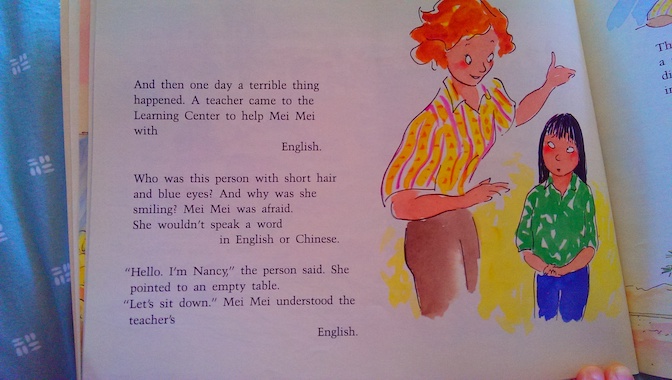
When Mei Mei’s family moves from Hong Kong to New York, she finds herself forced to go to a school where no one else speaks Chinese. She is expected to learn English and to read, write, and speak in English, and she hates it! To her, English is a very strange language, and the writing system is nothing like Chinese. For a time, Mei Mei refuses to speak in English, even when she understands what is being said around her, because she hates it so much.
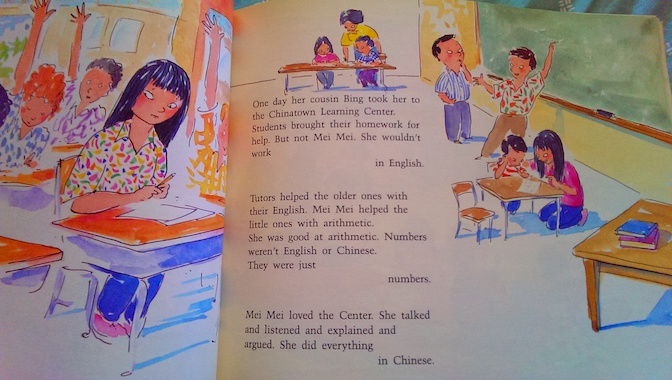
The only part of New York that Mei Mei really likes is Chinatown and the Chinatown Learning Center. Mei Mei likes it because she is surrounded by people speaking Chinese. There, she can relax and be herself because people there understand her.
However, Mei Mei’s refusal to speak English isn’t helping her at school or anywhere else. It’s keeping her from speaking to anyone outside of Chinatown, and it can’t continue. When an English teacher, Nancy, comes to the Learning Center to help Mei Mei with her English, she resists learning at first. She feels like she’ll lose her Chinese and part of her identity if she uses English.
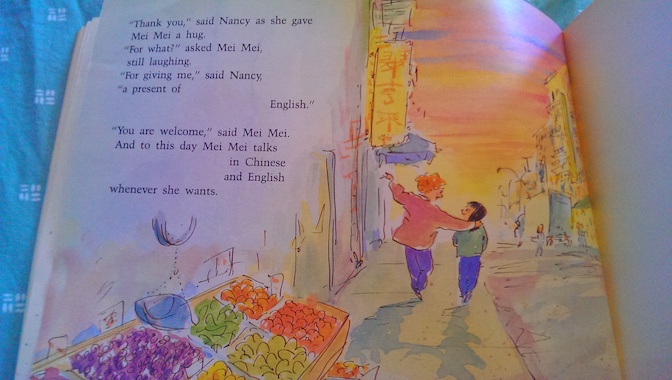
At first, Mei Mei’s worries about speaking English intensify with Nancy’s lessons. It disturbs her how English has words that would be difficult or impossible to translate into Chinese and English words seem to be coming more easily to her, even when she doesn’t really want to speak the language. Nancy explains to Mei Mei that English is necessary for her because she will need it to talk to many people in America, and there are many people who also want to talk to Mei Mei and be her friend, including Nancy. It’s only when Nancy overwhelms her by constantly talking in English and Mei Mei becomes desperate to talk about herself and be understood in English that Mei Mei realizes that speaking a new language doesn’t mean losing her identity. It’s just another way of expressing herself, and she can go back and forth between the two any time she wants.
Mei Mei’s feelings of strangeness in her new home and the difficulties of learning a new language are relatable. The hardest part of the experience for Mei Mei is feeling like she might be giving up a part of her past, her culture, and herself by switching from Chinese to English. But, refusing to speak English puts Mei Mei in the position of being someone who can only listen, never talk, limiting her ability to be understood and to make friends. In the end, she comes to realize that speaking a new language is not a matter of giving up anything, just adding to what she knows and making herself understood in a new way. It’s the beginning of expanding her horizons and building relationships with new people.
My favorite part as a kid was the part where Mei Mei and her friends went to the beach and cooked shellfish that they found. It was interesting to me because I never lived near a beach when I was young. The lifeguard at the beach tells Mei Mei and her friends that they can’t eat the shellfish, and they realize that he thinks that because he doesn’t know how to cook them. I never did either and still don’t, but I liked hearing about it.
The book is currently available online through Internet Archive.
If Your Name Was Changed at Ellis Island by Ellen Levine, 1993.
Like other books in this series, this book explains about a part of American history using a series of questions and answers. Each section of the book starts with a different question about what it was like to come to America as an immigrant in the past and what happened when they reached Ellis Island, one of the main ports of entry into the United States around the turn of the 20th century, just off the coast of New York City, such as, “Would everyone in your family come together?”, “What did people bring with them?”, and “What did the legal inspectors do?” Then, the book answers each of the questions.
The questions and answers start by describing what the journey to America was like from the late 1800s through the early 1900s. Typically, families would come to the United States in stages: the father of a family (or perhaps one of the older children) would make the trip first, find a job in the United States and start saving money to prepare for rest of the family to come. Depending on the family’s individual circumstances, it might be years before all the members completed the immigration process and reunited in America.
People traveled by ship in those days, and an often-forgotten part of their journey was even reaching the port the ship to America would be leaving from. Depending on the starting point of the journey and the travel arrangements each family was able to make, getting to the port might involve crossing borders between other countries, adding another layer of legal difficulties to the journey.
There was also the knowledge that they might be turned away once they arrived at Ellis Island. One of the chief concerns at the time was illness. The inspectors at Ellis Island checked immigrants for signs of infectious diseases, and the ship companies knew that if their passengers were turned away because of the fear of disease, they would be required to pay for the return voyage themselves. To help ensure that their passengers would not arrive with a disease, they would conduct their own health checks before the ship ever left port, looking for signs of illness, giving the passengers vaccines, and disinfecting things. They were particularly afraid of passengers with lice because lice can spread typhus, which is deadly. They would often cut the passengers’ hair or comb it very carefully.
The treatment passengers on ships received depended largely on their class of passage. First and second-class passengers received the best rooms and the best food, and when they arrived in New York (assuming that was their destination), they didn’t even have to go to Ellis Island at all; the immigration inspectors would inspect first and second-class passengers on board the ship. Only steerage passengers (“third class”, the cheapest possible method of travel, used by the poorest people, the largest group) would have to get off the ship for processing at Ellis Island.
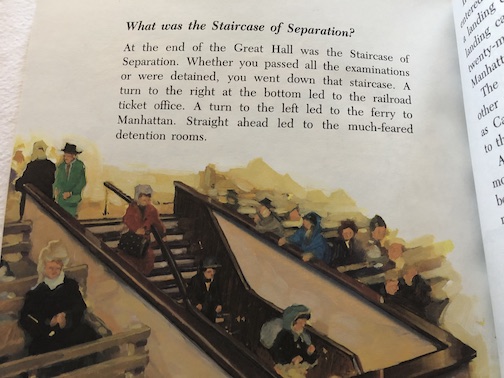
The processing center at Ellis Island wasn’t just a building; it was an entire complex. The Great Hall alone was large enough to contain hundreds of people at a time, and when it was full of immigrants there were so many languages being spoken at once (sometimes as many as 30 different languages) that some people described it as sounding like the Tower of Babel. There were also dormitories that could house more than a thousand people, a hospital for the sick, a post office, banks where people could change their cash for American money, a restaurant to feed everyone (with two kitchens, one kosher and one regular), a railroad ticket office where immigrants who would be moving on from New York could make their travel arrangements, and much more. Some people called Ellis Island the “Island of Tears” because the arrival there after a long journey was an emotional experience and many immigrants were worried that they might be sent back if they couldn’t answer the inspectors’ questions to their satisfaction. At the end of the Great Hall, there was a large staircase that came to be known as the Staircase of Separation. Everyone had to go down this staircase after their examination by the inspectors. At the bottom, they would go their separate ways, depending on their travel plans or whether they had passed inspection. People who turned to the right were heading to the railroad ticket office. People turning to the left were heading to the Manhattan ferry. People who went straight were heading to the detention rooms because they hadn’t passed the inspection.
As I mentioned before, the inspectors were very concerned about people who showed signs of serious diseases. One of the first things that would happen during inspection was a brief examination by the Ellis Island doctors. Because of the massive amount of people who had to be processed, this examination lasted only a few minutes, during which the doctor would quickly check for very specific symptoms and signs of possible illness. If they didn’t see anything obviously wrong, such as red eyes (possible sign of eye infection, although for some, it was just because they’d been crying), difficulty in breathing, or lice, they would let the people pass. If the doctors thought that they saw something that might be sign of illness, they would write a letter in chalk on the person’s clothes and send them on to be examined more thoroughly by another doctor. Getting one of these letters didn’t always mean rejection. If the other doctor decided that the first doctor was mistaken or that the person’s symptoms weren’t serious, they would still be allowed into the country. Sometimes, if a person was ill but had a curable disease, they would be kept in the hospital on Ellis Island until they were better. If the doctors weren’t quite sure if a person was ill or not, they might keep the person in the dormitories for a few days and then check them again after they had a chance to rest. The people who were sent back on the ship were ones who had diseases that were incurable or seriously contagious. (It sounds heartless, but they were trying to head off deadly epidemics. During the 1800s, large cities like New York sometimes suffered serious epidemics of deadly diseases because of the sudden influx of new people who were living in overly-crowded conditions with relatively poor sanitation. By preventing people with signs of serious diseases from joining the rest of the population, they were hoping to head off new epidemics and save lives.)
One of the more controversial parts of the examination was when they tested people for possible mental problems. They wanted to make sure that they were mentally fit enough to find work, but the problem was that the tests designed by people who didn’t take cultural differences into account when they designed them. The parts where they asked people to do simple arithmetic problems or to demonstrate that they could read, count backwards, or match up sets of similar drawings were pretty straight-forward. However, sometimes they were shown a picture and asked to describe what was happening in the picture, and the immigrants gave the inspectors some surprising interpretations because it turns out that some experiences aren’t quite as universal as some people think. For example, one picture was of some children digging a hole with a dead rabbit lying nearby. It was supposed to depict children burying a dead pet. But, some people view rabbits more as food than pets, and some immigrants said that the children were doing their chores because why shouldn’t the children work in the garden (the digging) after hunting a rabbit for dinner? Fiorello La Guardia, himself from an immigrant family, an interpreter on Ellis Island and later, mayor of New York, particularly despised tests like these because the people who designed them and administered them were trying to test the minds of others without any real idea about what their lives had been like or how their minds actually worked.
The inspectors’ examinations in general weren’t always reliable because they were often hurried (dealing with so many people in a limited amount of time) and because the interpreters weren’t always accurate, which brings us to the question of why people’s names were sometimes changed at Ellis Island. Sometimes, it was intentional. Some immigrants thought that they would be more likely to be accepted by the inspectors if they had short, easy-to-pronounce names, so they would purposely give them shorter versions of their names. There was some basis for this belief because, if an inspector didn’t understand a long, unfamiliar name, they wouldn’t have much time to figure it out and so would either take their best guess at the what the name should be, shorten it when they wrote it down, or give up altogether and write a much shorter name instead. For example, when they processed Jewish people from Russia, the inspectors often ran into difficulties in understanding their last names and would sometimes just write down “Cohen” or “Levine”, no matter what the original name really was. Sometimes, name changes were just an honest mistake because the inspector didn’t know how a name was really spelled (I can speak from personal experience because my family’s last name wasn’t always spelled like it is now, and when they found out that it had been changed, it was just too much trouble to fix it) or because they had misinterpreted something that the immigrant said. One of my favorite examples of this was a young man who tried to explain to the inspector that he was an orphan (“yosem” in Yiddish). The inspector dutifully wrote his last name as Josem.
The pictures in the book are paintings based on original photographs of immigrants and Ellis Island. (See Immigrant Kids to compare some of the pictures.)
The book also contains some further information about the lives of immigrants once they arrived in America (Immigrant Kids goes into a lot more detail), the attitudes of Americans toward immigrants at the time (varied but with strong strains of anti-Catholic, anti-Irish, and general anti-immigrant attitudes during the 1800s), and the contributions of immigrants to American society. I actually bought this book as a souvenir on a visit to Ellis Island years ago.
The book is currently available online through Internet Archive.
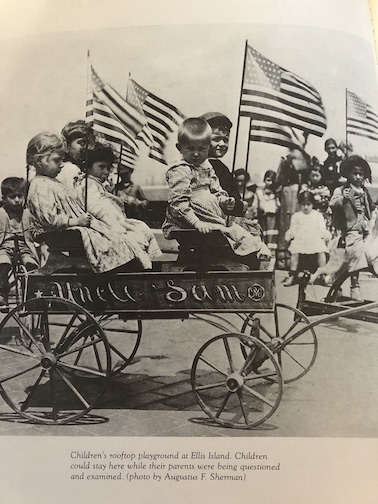
One of the best parts about this book is the pictures. The preface of the book specifically talks about photography at the turn of the 20th century, how cameras were still fairly new technology but growing in popularity. Cameras that were small enough to be held in a person’s hands were an 1880s innovation, and the book mentions that small cameras like that were known as “detective cameras” because they were small enough that they could be used to take pictures without the subjects noticing. Over time, it became easier for amateurs to learn to use cameras, and it became more common for people to take pictures of their ordinary, everyday lives. Pictures like these open up a window on the past. The pictures in this book are of children whose families had only recently arrived in America from countries around the world. The photographer for many of these pictures was Jacob A. Riis, a journalist in New York City who wanted to document the living conditions of poor immigrants. He published a book called How the Other Half Lives in 1890, in which you can see more of his work. Other pictures in this book are by Lewis Hine, who is known for his photographs of child laborers. They are not the only photographers whose work appears in this book, but they are the most famous.
The book is divided into sections, covering different aspects of the lives of immigrant children. In the chapter called Coming Over, the author describes what the journey to America was like. One of the primary motivations for people to come to America around the turn of the century was money and employment opportunities. If a family had little money and little or no chance of getting better jobs in their home country, they would decide to try their luck somewhere else. Because most of the immigrant families were poor, it was common for families to immigrate gradually. Often, the father of the family would come first, find a job, start establishing a life and home for his family, and eventually send for his wife and children when he’d saved enough money. The actual journey was by ship, often in “steerage,” the cheapest form of passage available, in cramped rooms in the ship’s hold.
Although the journey could be harrowing, one of the most nerve-wracking parts was the immigrant processing that took place at immigrant ports like Ellis Island. There were routine questions that immigrants were expected to answer and exams for them to take, and if the questioners weren’t satisfied, the immigrants could be sent back to the country they came from. Doctors would examine the immigrants to evaluate their health and look for signs of possible mental defects. They were particularly concerned about signs of infectious diseases. Sometimes, it was difficult for immigrants to answer all the questions because of language barriers and the immigrants’ own nerves at being interrogated. If an immigrant seemed too agitated, the examiners would typically let them rest for a while before trying again.
The other chapters in the book are At Home, At School, At Work, and At Play, which give more details about the lives of immigrant children as their families settled in America. They often settled in large cities because those were where the most employment opportunities were to be found. Because they didn’t speak much English and needed help learning how things worked in America, such as how to find jobs and places to live and how laws worked, they tended to settle in neighborhoods with others from similar backgrounds who could help them. That is why, even to this day, there are certain areas of large cities, such as New York, Boston, or Chicago, which are known for people of a particular nationality (like the Irish neighborhood, the Jewish neighborhood, Chinatowns, etc.). New arrivals often joined friends or relatives who had already been living in the US for a while, seeking help in getting themselves established. These ethnic neighborhoods were located in poor parts of town because the people there didn’t have much money. People lived in small, crowded apartments called tenements, sharing water and toilet facilities with other families because the apartments were not provided with individual facilities. However, once these groups of immigrant families became established, they remained established for a long time, and they gave these neighborhoods their own distinctive style.
School was often difficult for new arrivals because the children had to learn English before they could study other subjects. There were some special English language learning classes for them at larger schools with enough demand for them. At smaller schools which didn’t have these classes, they often had help from other children who had arrived in America earlier and could act as translators. They were also frequently put into classes for children who were younger than they were, studying easy subjects, until they had learned enough English to move up to classes with children their own age.
Typically, immigrant children aimed to stay in school until they were fourteen years old because that was the age when they could officially get full-time work. However, because their families were poor, the children might have to leave school early to find jobs and help their families make ends meet. The book describes how rules were frequently bent or broken because the laws were not well-enforced, and children often worked at younger ages, even under harsh conditions. For immigrant children, the most important education was that which taught practical, vocational skills that would help them find jobs quickly. Some agencies, like the Children’s Aid Society (known for the Orphan Trains), would help them with vocational training.
However, immigrant children still like to play. Boys and girls usually played separately. Boys frequently played games like baseball in the street, or stickball, which was a variant that could be played in smaller spaces. In stickball, the “bat” was a stick or the handle of an old broom, and the ball was rubber and allowed to bounce before it was hit. Girls would play other games, like “potsy,” which was a version of hopscotch.
Because of the lessons they were taught in schools and because the immigrant children mixed with children outside of their immigrant groups in school, the children absorbed the local culture and became Americanized faster than their parents. Many of them experienced the feelings of being torn between their parents’ traditions and wanting to fit in with society around them.
In each of the chapters in the book, there are anecdotes from people who had arrived in the US as children around the turn of the century, telling stories about different aspects of their lives.
The book is currently available online through Internet Archive.
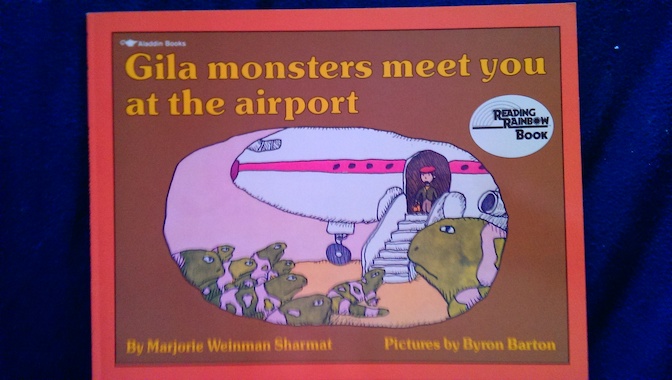
Gila Monsters Meet You at the Airport by Marjorie Weinman Sharmat, pictures by Byron Barton, 1980.
This is a humorous picture book about a boy moving from one side of the United States to the other and his misconceptions of what he’s going to find when he goes west.
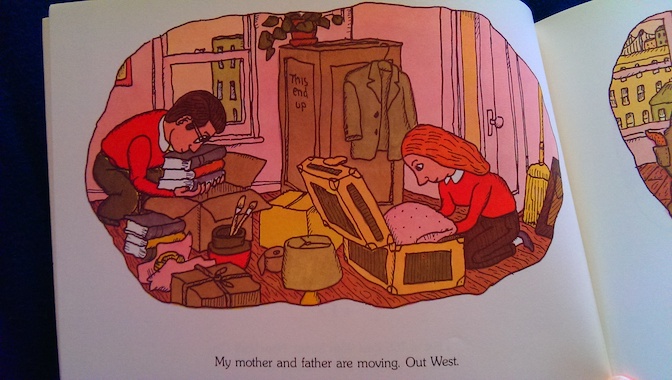
At the beginning of the story, the boy lives in an apartment in New York City. As far as he’s concerned, he could live there forever, but his parents decide that they’re going to move “Out West.” (The book never really says what state they’re moving to, but it seems to be somewhere in the Southwestern United States, like Texas, New Mexico, or Arizona.)
The boy thinks he’s going to hate his new home. He thinks of all the things that he’s heard about the West, like there’s cactus everywhere so you hardly know where to sit down, everyone dresses like a cowboy and rides horses everywhere, all he’ll ever get to eat is chili and beans, and he’s bound to die of heat exhaustion in the desert. His best friend in New York, Seymour, told him that Gila monsters would meet him at the airport.
Of course, there aren’t any Gila monsters at the airport when the boy gets there. Instead, he meets another boy whose family is moving East. The two boys talk to each other for awhile, and the Western boy starts telling him that he’s not looking forward to heading East because he’s heard that it’s always cold there, the cities are overcrowded and full of gangsters, the buildings are so tall that airplanes fly through the apartments, and there are alligators in the sewers. He expects to find alligators waiting for him at the airport.
Of course, things aren’t as bad as either boy is expecting. The boy from New York realizes that Seymour and his other friends back East don’t know much about the West, and he starts realizing that things in his new home are actually pretty good, some of them not all that different from home.
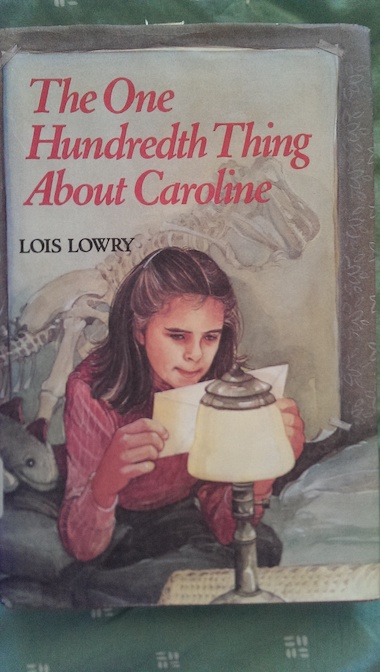
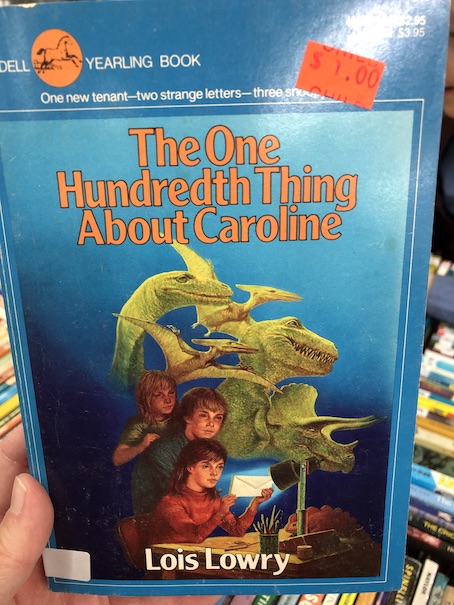
The One Hundredth Thing About Caroline by Lois Lowry, 1983.
Eleven-year-old Caroline Tate knows that she wants to be a paleontologist when she grows up, but she is also fascinated with her friend Stacy’s dream of becoming a great investigative reporter. For fun, the two girls begin investigating the people who live in their respective apartment buildings.
Caroline’s investigation focuses on the mysterious Frederick Fiske, who lives on the fifth floor of her building. In a wastebasket, she finds a letter written to him by a man she’s never heard of telling him to “eliminate the kids.” Also in the wastebasket, there is an overdue notice for Fiske from the library, and the book is about poisons. From this evidence, Caroline comes to believe that the strange Mr. Fiske is planning to murder some children.
The situation becomes worse when Mr. Fiske begins dating her divorced mother, and Caroline fears that the children Mr. Fiske is planning to murder are her and her brother, J.P.. Can Caroline, J.P., and Stacy prove that Mr. Fiske is a cold-blooded murderer before his relationship with the Caroline’s mother can go any further and before he succeeds in poisoning them?
The book is available to borrow and read for free online through Internet Archive.
My Reaction and Spoilers:
It’s a bit of a spoiler, but this is one of those stories where the mystery is largely based on a series of misunderstandings. The book is a comedy mystery. Mr. Fiske isn’t really a murderer, although he has done some things which make the children suspicious. It’s a humorous story, and the kids’ antics as they try to further their investigation and collect “evidence” against Mr. Fiske are hilarious. Along the way, the kids end up helping Mr. Fiske with a problem he’s been having, and the kids realize that they’ve made a mistake about him and his intentions. Whether Mr. Fiske learns of their suspicions about him or not is left to the imagination, although something at the very end of the story may bring everything out into the open.
The title of the book comes from a joke between Caroline and her mother. Caroline’s mother is always talking about the things she loves about Caroline, giving them different numbers.
Audrey (called Andy) and her younger brother Nathan are having a picnic in Prospect Park in Brooklyn, New York, when Nathan falls and knocks over an old tree stump. They spot something shiny in the deep hole under the old stump, and Nathan climbs down to get it. It turns out to be an old pocket watch, the kind that needs to be wound with a key. Nathan has a small key in his pocket, made for a toy, and decides to try it on the watch. He manages to wind it, but suddenly, the hands of the watch move backwards, the children feel strange, and everything around them seems different. Although it takes the children a little while to realize it, they’ve traveled back in time about 200 years, back to the Revolutionary War.
They meet a boy named Franz and become friends with him. Franz is a drummer boy for the Hessian soldiers, Germans hired by the British to help them fight against the rebelling colonists. Franz’s superior orders his men to commandeer food and supplies from the people living in the area. Franz is supposed to take a family’s cow, but the family desperately beg him not to because they have nothing left and will need the cow to support themselves. Andy persuades Franz to leave the family and their cow alone. However, disobeying the order means that Franz will be in trouble with his superior. He decides that the only thing to do is to desert the army.
Franz had only joined the army in the first place because his parents were dead, and he didn’t know what else to do. Now, he has to find a new place to live, somewhere where there won’t be other Hessians who would recognize him as a deserter. Andy and Nathan also have problems because they’ve now realized what time they’re in, and they don’t know how to get home. The watch no longer seems to work.
The children travel together, meeting others who help them and seeing the effects that all of the armies, British, Hessian, and American, have on the ordinary people as the war continues around them.
When they finally find a place where Franz can stay safely and someone he can call family, who can also use Franz’s help, Andy and Nathan realize who the watch really belongs to and how they can return to their own time.
The watch’s real owner is the person I thought it would be, and it took the kids unexpectedly long to realize it. There is a hint of what happened to Franz when the kids finally return to their own time, but I kind of wished that they learned more about what Franz’s life turned out to be like. From what the kids see, it seems that things went well for Franz and that he continued living in the house where they left him.
The book is currently available online through Internet Archive.






















 Trapped in Time by Ruth Chew, 1986.
 Franz had only joined the army in the first place because his parents were dead, and he didn’t know what else to do. Now, he has to find a new place to live, somewhere where there won’t be other Hessians who would recognize him as a deserter. Andy and Nathan also have problems because they’ve now realized what time they’re in, and they don’t know how to get home. The watch no longer seems to work.
 Jestress's Forgotten Books and Stories