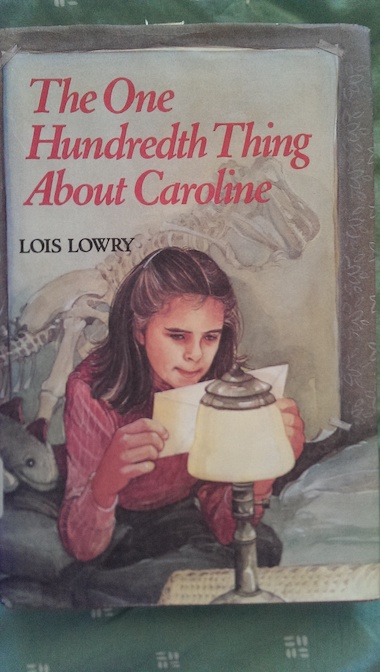
The One Hundredth Thing About Caroline by Lois Lowry, 1983.
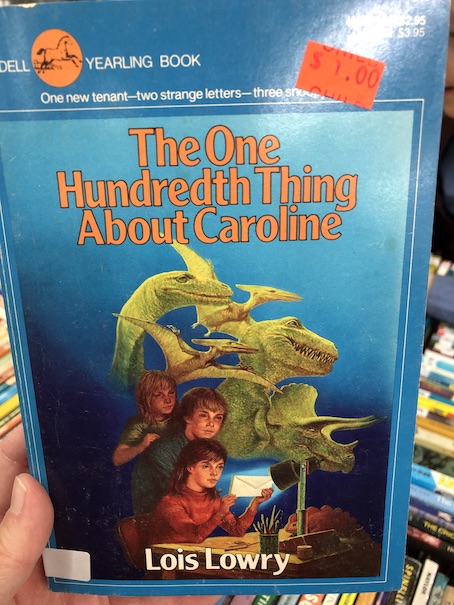
Eleven-year-old Caroline Tate knows that she wants to be a paleontologist when she grows up, but she is also fascinated with her friend Stacy’s dream of becoming a great investigative reporter. For fun, the two girls begin investigating the people who live in their respective apartment buildings.
Caroline’s investigation focuses on the mysterious Frederick Fiske, who lives on the fifth floor of her building. In a wastebasket, she finds a letter written to him by a man she’s never heard of telling him to “eliminate the kids.” Also in the wastebasket, there is an overdue notice for Fiske from the library, and the book is about poisons. From this evidence, Caroline comes to believe that the strange Mr. Fiske is planning to murder some children.
The situation becomes worse when Mr. Fiske begins dating her divorced mother, and Caroline fears that the children Mr. Fiske is planning to murder are her and her brother, J.P.. Can Caroline, J.P., and Stacy prove that Mr. Fiske is a cold-blooded murderer before his relationship with the Caroline’s mother can go any further and before he succeeds in poisoning them?
The book is available to borrow and read for free online through Internet Archive.
My Reaction and Spoilers:
It’s a bit of a spoiler, but this is one of those stories where the mystery is largely based on a series of misunderstandings. The book is a comedy mystery. Mr. Fiske isn’t really a murderer, although he has done some things which make the children suspicious. It’s a humorous story, and the kids’ antics as they try to further their investigation and collect “evidence” against Mr. Fiske are hilarious. Along the way, the kids end up helping Mr. Fiske with a problem he’s been having, and the kids realize that they’ve made a mistake about him and his intentions. Whether Mr. Fiske learns of their suspicions about him or not is left to the imagination, although something at the very end of the story may bring everything out into the open.
The title of the book comes from a joke between Caroline and her mother. Caroline’s mother is always talking about the things she loves about Caroline, giving them different numbers.
 Trapped in Time by Ruth Chew, 1986.
 Franz had only joined the army in the first place because his parents were dead, and he didn’t know what else to do. Now, he has to find a new place to live, somewhere where there won’t be other Hessians who would recognize him as a deserter. Andy and Nathan also have problems because they’ve now realized what time they’re in, and they don’t know how to get home. The watch no longer seems to work.
