Last Stop on Market Street

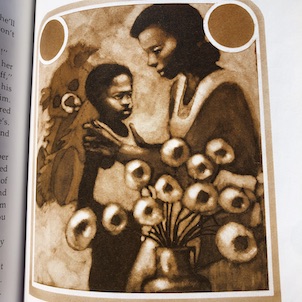
After church, CJ and his grandmother have to wait for the bus while other people just get in their cars and leave. CJ is annoyed because it’s raining. He asks his Nana why they have to wait in the rain and why they don’t have a car. His Nana says that they don’t need a car because they have the bus.

The bus is interesting because many interesting people take the bus. The bus driver does little tricks, like pulling a coin from behind CJ’s ear, and there are interesting passengers, like the lady with a jar of butterflies and a man with a guitar.

While CJ’s friends, whose families have cars, go straight home after church, CJ and his Nana have somewhere else to go. CJ wishes that he could just go home, too, but Nana points out that the boys who just go straight home miss meeting so many interesting people. CJ does enjoy listening to the man with the guitar playing music on the bus.

CJ and his grandmother get off at the last stop on Market Street, which is in a bad neighborhood. CJ comments about how dirty it is, but his grandmother points out that people who surrounded by dirt know how to see what’s beautiful.

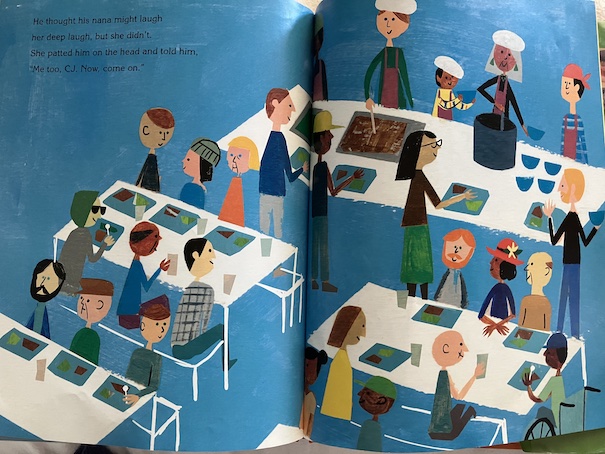
The reason why CJ and his grandmother are here is that they help out at a soup kitchen. CJ recognizes the faces of people he’s seen there before, and he realizes that he’s glad that he came.

This book is the winner of multiple awards. It’s a Newbery Medal winner, a Caldecott Honor book, and a Coretta Scott King Award honor book for its messages about appreciating and helping other people in a diverse community.

This is one of those picture books that I think can speak to adults as well as kids, maybe even more so because adults might understand some of the broader context of the story. CJ and his grandmother probably don’t have as much money as some of CJ’s friends and their families, which is why they don’t have a car. When CJ comments about why do they have to wait for the bus in the rain, his grandmother could have given him a straightforward answer about how they can’t afford a car, but that would have been depressing. Instead, she points out the positives of the bus and the people they meet. All through the book, she points out the positives about situations that both CJ and the readers can see are not entirely positive. It’s noticing these positives that help make the situation better.

CJ and his grandmother don’t have much money themselves, but Nana is teaching CJ how to help other people and build relationships with them. The people they meet are often poor people or people who are unfortunate in some way, but they still enjoy meeting these interesting people with colorful lives. There are times when CJ wishes that he could be somewhere else or doing something else, but yet, he also enjoys parts of where he is and realizes that what he’s doing is better than other things he could be doing. CJ and his grandmother experience the enrichment of life experiences and relationships with other people.

Thimble Summer

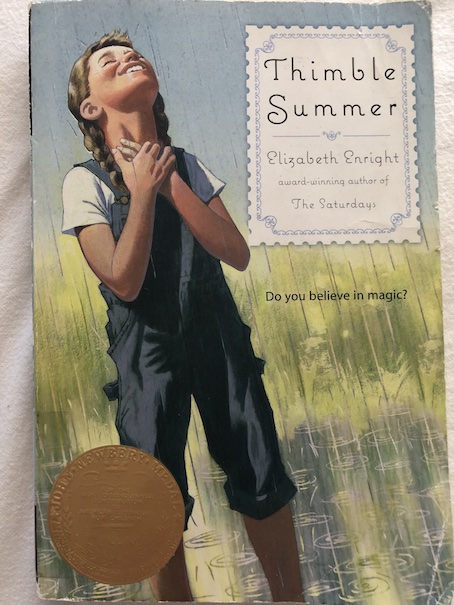
Thimble Summer by Elizabeth Enright, 1938, 1966.

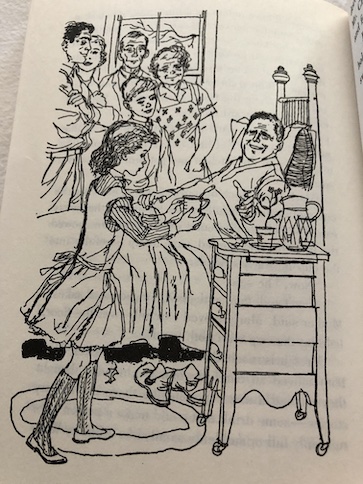
It’s summer, and Garnet is a 9-year-old girl living on a farm with her parents and brothers in a rural community in Wisconsin. The story is episodic, with each chapter describing things that happen to Garnet over the course of one magical summer when she found a silver thimble down by the river. Garnet thinks that the thimble itself is magic, but maybe the magic is just in the happy summer adventures that follow.

The book is a Newbery Medal winner. It’s available to borrow and read for free online through Internet Archive (multiple copies, including one in Chinese).

The chapters in the book are:

The Silver Thimble

It’s been hot and rainless, and the crops are in danger of being ruined if they don’t get some rain soon. It’s a real worry because, if the crops are bad, Garnet’s family won’t be able to pay their bills. When Garnet and her brother Jay go swimming in the nearby river, Garnet finds a silver thimble. It’s a lucky find, and Garnet becomes convinced that the thimble is magic and that something wonderful is about to happen. Jay thinks that’s silly, but that night, the rain they’ve so badly needed comes! Garnet and Jay are so overjoyed with the rain that they go out running in the rain in the middle of the night, until they are frightened by lightning striking something, and their mother calls them back.

The Coral Bracelet

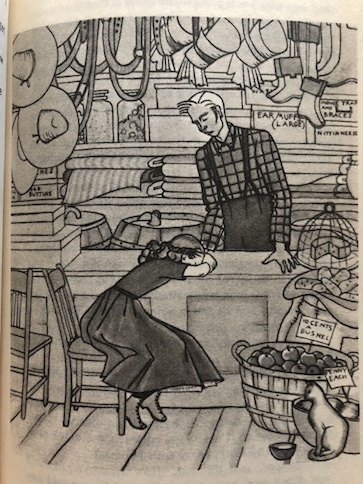
Garnet’s best friend is a girl name Citronella, who lives nearby. Citronella’s great-grandmother lives with her, and she tells the girls stories about what it was like when she was young. She tells them about Indians (Native Americans) who would sneak into her family’s house in bad weather to get warm and leave them presents as thanks. (I don’t know if any Native Americans ever did this in real life, but she says it like it really happened.) Then, she tells the girls about a special coral bracelet that she wanted at the general store when she was young and some foolish risks she took to get it.

The lucky thing that happens in this chapter is that Garnet’s father gets a government loan to build a new barn.

The Lime Kiln

The family needs to make lime for building their new barn. The kiln needs to burn for three days straight, and they all need to take turns tending it, day and night. Jay and Garnet are allowed to stay up all night there with their father. Friends help them, and neighbors come to visit and talk with them. Garnet brings along a picnic with sandwiches and apple pie that they eat at midnight.

The Stranger

While they’re tending the kiln, a strange boy comes along and asks them for food. His name is Eric, and he’s a parentless boy who travels around and makes his living from odd jobs. He tells them about his life and travels, and Garnet’s father hires him to help the family build the new barn.

Locked In

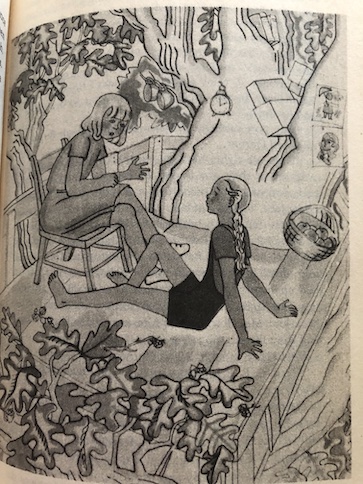
Garnet likes having Eric at the farm, but she’s also a little jealous that Jay wants to spend more time with Eric now than with her. Garnet starts spending even more time with Citronella, and the two girls build a tree house together. The girls tell stories in their tree house, and because it’s going to rain again, Garnet suggests that they go to the library in town. They get so engrossed in their books that they lose track of time and get locked in the library. Garnet thinks this is a fabulous adventure until Citronella points out that it’s Saturday, and the library is closed on Sunday. If they can’t find a way out, they could be there for the rest of the weekend!

Journey

It’s harvest time, and everyone is occupied in picking crops and canning foods. Garnet helps, and she is temporarily put in charge of the threshing machine. Unfortunately, she falls asleep and lets the straw stack pile up until it falls over and makes a mess. Eric tells her not to worry about it, but Jay yells at her and tells her that she had no business helping out as a girl and that she should be at the house with the women. Garnet is so upset at the way Jay has been critical of her lately that she decides to run away and hitchhike around, like Eric used to do.

“As a Ragpicker’s Pocket”

Garnet is still running away, and she takes a bus to the next town. By the time she has explored the town and looked at all the store windows, she isn’t so upset and can see the funny side of what happened with the thresher, and she’s about ready to go home. She buys a few things for her family at the dime store and a hot dog to eat. Then, she has a horrible realization: she’s out of money. How is she going to get back home?

Fair Day

Garnet goes to the fair with her family and neighbors, and she enters her pig, Timmy, in a contest. Timmy was the runt of his litter, but Garnet has taken special care of him, and she thinks that he has a good chance of winning a prize.

Ice-Cream Cones and Blue Ribbons

Garnet and Citronella enjoy the wonders of the fair while Garnet is waiting for the pig contest. They spot the lady sword-swallower darning her socks, they ride the rides, and they have snacks. The girls get stuck on the Ferris wheel when it stops working, and Garnet worries about getting down in time for the judging of the pig contest.

The Silver Thimble

The silver thimble hasn’t been mentioned since the first chapter, but when Garnet looks back on all the good things that have happened this summer, she’s still sure that it’s magic. All the good things that have happened started right after she found it. She shows the thimble to Eric, and the kids talk about what they want to do with their futures.

My Reaction

This story is more like a collection of stories, some of which continue each other. The book is somewhat episodic, leading up to the fair at the end of the summer. The stories are pretty gentle, slice-of-life adventures. Eric has had a hard life, but he doesn’t want to dwell on it too much, and things improve for him when he decides to stay with Garnet’s family. There are hints that Eric might marry Garnet someday, and the two of them might stay on the family’s farm. Eric has had enough of traveling in his young life, and he wants to be a farmer and thinks that he would like to save up money and buy land near the family’s farm. Jay wants to be a sailor or something else that will let him travel and see the world, although he thinks that he might want to come back to the farm when he’s done traveling and farm it with his father and Eric.

The book fits with the Cottagecore genre, and it would make good bedtime reading. Foodies will enjoy the mentions of old-fashioned treats, like apple pie, griddle cakes, and vinegar candy. Garnet also imagines that each of the kitchen things have their own personalities.

I liked Garnet’s name, which is very unusual in the early 21st century. Citronella is an even more unusual name, but I prefer Garnet. I think it’s charming, and it’s one of the less-common gem names used for girls. In the story, Garnet mentions that the librarian frequently gets her name wrong because gemstone names are popular in her time and area. There are other girls in town named Ruby, Pearl, Opal, and Beryl, and the library usually calls her Ruby, the most popular of the gemstone names.

There are some stereotypical mentions of Native Americans in the story. They’re not derogatory, and they’re minor parts, but there were a couple of things that struck me as being a little stereotypical, like the kids saying that they’re Comanche Indians doing a rain dance when they’re running around in the rain. I also didn’t care for the way the characters kept pointing out which people were “fat” or “fleshy.” They’re not really shaming these characters, just sort of remarking, but I just felt like it was rude and unnecessary. You see this sometimes in older children’s books. Fortunately, none of the fat characters are considered bad characters in this story, as they sometimes are in other books. There aren’t really any bad characters in the story in general. Jay is annoying at times and says things that put down his sister and girls in general in a bratty, macho kind of way, but nobody in the story is a villain.

One Morning in Maine

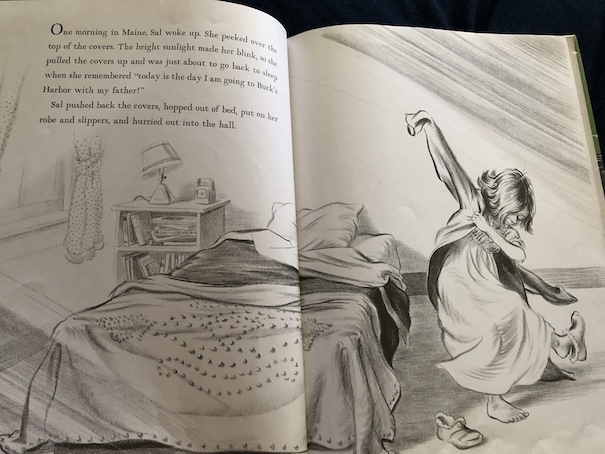
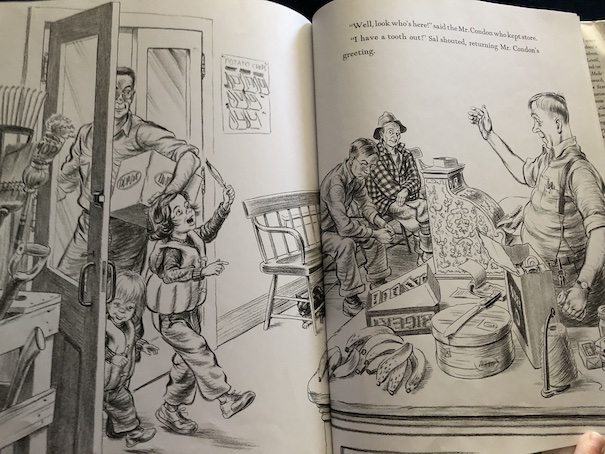
This cute picture book features Sal, a little girl who also appeared in Blueberries for Sal. She and her family live or are staying on an island off the coast of Maine. One morning, Sal wakes up and is excited because she remembers that she and her father will be going to Buck’s Harbor (a real place).

She helps her little sister, Jane, to get ready, and while they’re brushing their teeth, she feels that one of her teeth is loose. She’s never had a loose tooth before, and she runs to tell her mother. Her mother tells her not to worry about it because everyone loses their baby teeth when they’re growing up. She say that a new, bigger tooth will grow in when the old tooth falls out. Her mother says that if she puts her baby tooth under her pillow, she will get a wish, but she shouldn’t tell anyone what the wish is.

On her way to the beach, where her father is digging clams, Sal proudly tells all the animals she sees about her loose tooth. When she reaches her father, she tells him about the tooth, too. Then, she joins him in digging for clams.

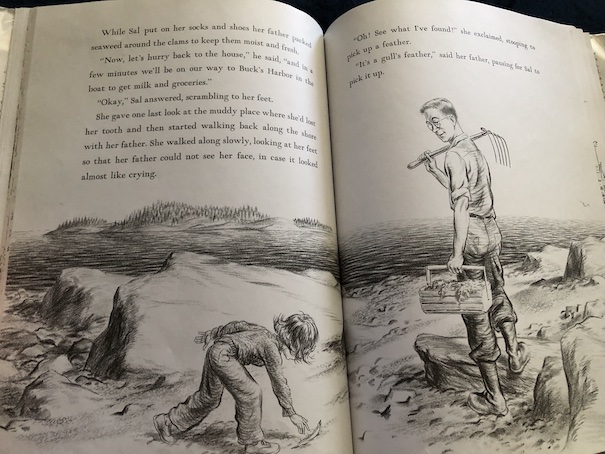
Then, Sal realizes that she’s already lost the tooth somewhere. She’s really disappointed because she wanted to make a wish. As she and her father walk back to the house, Sal sees a feather that a gull lost. Since the feather is kind of like a tooth because a new feather grows in when one falls out, she decides that she can make her wish on that.

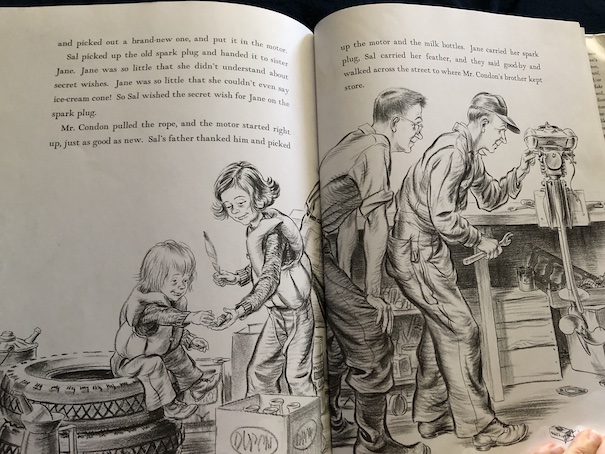
When it’s time to go to Buck’s Harbor, the motor on the boat won’t run, so the girls’ father has to row the boat. When they go to get the motor fixed, Sal tells the mechanic about her tooth. When the spark plug in the motor is replaced, Sal compares the old plug to her lost tooth and gives the old plug to Jane so she can have something to wish on, too.

She also tells the men at the grocery store about her tooth, and she ends up getting an ice cream cone, exactly what she wished for! The book ends with Sal, her father, and her little sister all going home for clam chowder for lunch.

The book is available to borrow and read for free online through Internet Archive (multiple copies). It’s a Newbery Honor Book!

This is just a cute little story about a little girl who is proud of losing her first loose tooth. It’s a sort of rite of passage that all small children go through. Her parents don’t tell her about the tooth fairy or promise her money for her tooth, but she does get a wish. Because her wish is a simple one, it’s easily fulfilled.

The different animals that can be found on the coast of Maine would also be interesting to child readers. Sal and her father also talk about which of the animals have teeth and which don’t. The birds and the clams don’t have teeth, but seals do. Sal keeps making comparisons between her tooth and other things that have to be replaced eventually, like the bird’s feather and the old spark plug, finding a kind of magic in things that are discarded and replaced with something new.

Sal and Jane are based on the author’s real life daughters, and their family did live in Maine. The setting of the book is the family’s summer home.

Invincible Louisa

Invincible Louisa by Cornelia Meigs, 1933.

This is the story of Louisa May Alcott, the famous 19th century author who wrote Little Women and other books for children.

The book begins with Louisa May Alcott’s birth on November 29, 1832 in Pennsylvania and explains about her parents’ backgrounds. When Louisa’s mother, Abba (short for Abigail), had first become engaged to her father, Amos Bronson Alcott, people advised her not to go through with the marriage because Bronson didn’t seem like a very practical man and nobody really expected that he would amount to much. However, Abba genuinely loved him and understood him. They shared similar ideals, including Abolitionism and the practice of service and charity to others, although they didn’t agree about everything. Bronson was a scholarly man who worked as a teacher, although he struggled to get an education himself when he was young because he was born to a family of poor farmers. As a young man, he had worked as a traveling salesman and had seen much of life across the country. He was good at talking to people and was very good at speaking to children, which led him to eventually settle down to teaching.

The Alcott family was happy where Bronson Alcott was teaching in Germantown, but the death of his school’s patron was a heavy blow. Without his patron’s backing, the school didn’t last, so the Alcott family left Germantown and moved to Boston. Little Louisa enjoyed the busy city of Boston, but the book also describes a harrowing situation in which she almost drowned after falling into Frog Pond. This incident was a traumatic memory for Louisa, but it wasn’t just the trauma that left a mark on her. The person who rescued her from drowning was a black boy. (The book uses the word “Negro.”) Louisa never knew the boy’s name, but her gratitude toward her rescuer influenced her feelings toward black people for the better at a time when the country was heading toward Civil War over the issue of slavery.

The Alcott family had ties to some important people. Her father was friends with Ralph Waldo Emerson and Elizabeth Peabody, who was instrumental in the development of kindergarten education in the United States, worked at his school in Boston. Her mother’s elderly aunt, known as the formidable Aunt Hancock, had been the wife of the famous John Hancock. However, in spite of connections, Bronson met with opposition to his teaching when parents of the students learned that he was an Abolitionist. A friend of his, William Lloyd Garrison, was almost lynched by an angry mob for airing his views about ending slavery. When Bronson admitted a black boy as a student to his school, it was the last straw, and many parents withdrew their children. Louisa later remembered discovering that her parents helped to hide runaway slaves when she was young, but it isn’t clear at which of their homes they were doing this.

After his school in Boston closed, he moved the family to Concord. He didn’t have the heart to open another school, so he supported this family through farming. They were poor and lived very simply, but they enjoyed living in the countryside. However, her father did maintain some scholarly contacts and was involved with the Transcendentalist movement. In 1843, the family moved yet again to join a community of Transcendentalists, experimenting with a more isolated lifestyle. (A footnote in the book, added decades after the original writing, compares it to the communes of the 1960s and 1970s.) However, the community was not a success. When one of the leaders of the community suggested that Bronson give up his wife and daughters to live in the style of Shakers, Bronson discussed the situation with his family, and they all came to the conclusion that this community was asking too much. Giving up on his experimental lifestyle was difficult for Bronson, but Abba’s brother understood the situation and helped the family move to a new home. Eventually, the family resettled in Concord.

Compared to her sisters, Louisa was a boisterous and temperamental child. She loved running wild in the countryside, and her curiosity and impulsiveness sometimes got her into scrapes. She wasn’t as good at housework as her older sister, Anna. However, she was always imaginative. When the family returned to Concord, Louisa was able to have a room to herself for the first time, and she used her new privacy for writing stories. She created plays for her and her sisters to perform.

As she grew up, Louisa became increasingly aware of her family’s poverty and her father’s lack of understanding for the ways of the world. Her mother was frequently worn out from trying to make do and take care of the four girls in the family. She began making plans early that she would find a way to provide for her parents and her sisters when she got older.

At Concord, her family continued their friendships with Thoreau and Emerson, and Ralph Waldo Emerson allowed Louisa to read books from his library, She developed a kind of hero-worship of him as a teenager. The Alcott girls also attended a regular school for the first time. Louisa often felt awkward because she was taller than the other girls at school, but she was also very athletic. She frequently wished that she had been born a boy instead of a girl.

At age 16, Louisa began her professional life, giving lessons to Emerson’s children. She was a good teacher, although as an active person, she found quiet study and teaching for extended periods difficult. Her mind often wandered to ideas for romantic stories, and she wrote a collection of little stories for Ellen Emerson. However, the family was badly in need of money, and they had to leave Concord and return to Boston, where they would live with her mother’s brother.

In Boston, Louisa continued teaching and found work as a governess. She also picked up other odd jobs to help support her family. One of them, a job as a live-in companion for an invalid, turned out especially badly because the job had been misrepresented and turned out to be hard labor. She was paid very little for it, too. It was during this time that her father discovered the little stories that Louisa had written for Ellen Emerson. He took one of them to a publisher he knew, and the story was published. Encouraged, Louisa and her father had the rest of the stories published in a collection called Flower Fables, Louisa’s very first book.

This did not bring her instant success as a writer, though. The family’s lives were filled with ups and downs, and they moved house multiple times. Louisa left her family to pursue an independent living for a time, although she made very little money, taking teaching jobs, sewing, and anything she could find. It was during this time that Louisa’s two younger sisters became ill with scarlet fever while the family was engaging in their usual charity work. Elizabeth had it particularly badly, and her health was never good after that. Louisa rejoined the family when they once again returned to Concord, where Elizabeth passed away. Elizabeth’s death was reflected in Louisa’s semi-autobiographical Little Women with the death of Jo’s sister Beth.

The Alcotts had been such a tight-knit family that separations of the sisters were bitterly painful, but every family experiences change over time. After Elizabeth’s death, Anna became engaged to marry John Pratt. It upset Louisa because it felt like she was losing another sister. Louisa once again set out to try to make her own living, but for a long time, it seemed like nothing would go right for her. It was difficult for her to find work, and opportunities seemed to disappear when she was about to take them. At one point, she was in such despair that she even considered suicide. Fortunately, after hearing an uplifting sermon about girls who were in her position, she renewed her determination to succeed, and she received a job offer from someone she had worked for before. Meanwhile, her father was finally starting to have some success with his educational lectures, and he even became superintendent of schools in Concord.

During all of these trials and tribulations for Louisa and the Alcott family, the country was headed toward Civil War. The Alcotts were still Abolitionists, and Louisa’s father had even been involved in a riot in Boston where a mob of citizens had tried to rescue a runaway slave who was about to be returned to the slave owner. After the war started, Louisa felt the urge to do something to help the side of the Union, so she volunteered as a nurse. Conditions were rough at the hospital where she worked, and she was put to work immediately with no training. She had some talent for nursing and a good bedside manner, having nursed Elizabeth through her final illness, but nothing could have prepared her for dealing with the war wounded. It was difficult and often heart-wrenching work, and it took a toll on her own health. After only about a month of working there, she caught typhoid, and her father was summoned to come and take her home.

Louisa eventually recovered from her illness. She felt like a failure for not being able to complete the full term she had originally promised to the hospital, but her nursing experiences helped further her writing career. The letters that she had written to her family about the people she met and her experiences at the hospital were so interesting that they had them published as “Hospital Sketches”, and they were extremely popular. So many people had friends or family who had gone away to war that they were anxious to know as much as they could about what was happening to them and others like them. The success of the “Hospital Sketches” led publishers to ask Louisa for further writings.

When Louisa recovered further, she felt restless, so she accepted a position as a nurse/companion to a friend’s daughter, who was unwell but wanted to go on a trip to Europe. Traveling as a nurse/companion didn’t give Louisa all of the freedom she would have liked to see and do everything she wanted, but she did get to see many things in Europe. She was able to visit the home of the German philosopher Goethe, and she attended a public reading by Charles Dickens. During their travels, she also met the young man who would be the inspiration for Laurie in Little Women.

She started writing Little Women after she returned home from Europe, at the suggestion of her publisher, who thought that she should write books for girls. When her publisher read it, he wasn’t sure that it would be successful at first because its tone was different from the popular children’s books for girls at the time. He tested it out by giving copies to his niece and some other girls who were about the same age, and they all loved it, so he went ahead and published it. It was so successful that it provided Louisa and her parents with financial stability for the first time, and readers wanted more! Much of the story was based on Louisa’s own life with her sisters and on people they knew, but she changed some parts for the sake of the story. Since the real Louisa never married, she made up a fictional husband for her story counterpart, Jo. In the story, Jo marries a German professor, and in the sequel, she and her husband start a school for boys based on Louisa’s father’s theories about the ideal school. Many of her father’s theories about education were very progressive for the time, and since he never got the chance to try all of them, Jo and her husband did in the story.

Even though she never fully recovered her health after having typhoid, she continued to write books for children, and she visited schools to speak to children. The book explains how these other books were also inspired by aspects of Louisa’s life. She and her youngest sister, May, took another trip to Europe together. May always had a talent for art, and Louisa funded her further travels and studies in Europe. May eventually married, but sadly, she died not long after the birth of her only child, a daughter named after Louisa. In accordance with her wishes, May’s infant daughter was brought to Louisa to raise, and Louisa treated her like her own daughter, calling her Lulu as a nickname. The book ends with Louisa’s death, mentioning that she made one of Anna’s sons her heir to perpetuate her copyrights. In the back of the book, there is a chronology of events from Louisa May Alcott’s life.

The book is a Newbery Medal winner. It is available to borrow and read for free online through Internet Archive (multiple copies).

My Reaction

I bought my copy of this book at a Scholastic Book Fair back in the 1990s, but I didn’t notice until I was an adult that the book was originally published in the early 1930s. I think part of the reason why the author was interested in doing a biography of Louisa May Alcott at that particular time was that it was around the 100th anniversary of her birth. I appreciated how later reprintings of this book also tried to keep it up-to-date and relevant for modern readers, including the addition of the footnote in the book about communes of the 1960s and 1970s.

Something that shows how 19th century society was different from modern society is the qualifications required for certain types of jobs. In the past, there were relatively few professional and educations qualifications required for teachers and nurses. In the 21st century, both teachers and nurses are required to have college degrees and relevant certifications to apply for their jobs. Nobody in the 21st century gets those jobs without having the requisite professional credentials (with the exception of homeschooling families, where the teachers are the parents). It would be useless to apply for such careers without having all of the education and certification required. In the 19th century, it was sometimes more important to just find someone willing to do the job, whether they had any particular qualifications to do it or not. Where the need was sufficiently great, like in the hospitals tending to the war wounded, they would take almost anyone who showed up and was willing to take the job with the hardships and blood involved. (There is one episode where Louisa witnesses an applicant being turned down because, while this person wanted to help the war effort, they didn’t have the stomach or stamina for the demands of the job. Next to that, medical knowledge was less important.) I explained dame schools when I reviewed Going to School in 1776, and the concept still applied in the mid-19th century. Dame schools were informal schools set up by people, often women, who were simply willing to take on the job of teaching local children. They got the jobs chiefly because they were the people who were willing to do them in the area. The quality of education these informal teachers could provide varied drastically, depending on the individual teacher. Some of them were actually well-read individuals with a gift for teaching (this is what Louisa and her father were like, in spite of their relative lack of formal education), while others provided little more than day care while the children’s parents worked. In the section of this book that explains Bronson Alcott’s history, there is some discussion of how education levels and quality varied across the country in the mid-1800s.

Parts of this book and the lives of the Alcott family also offer a different perspective on what it means to be successful in life. Through most of their lives, the family has little money, and Louisa and her father often struggle to find jobs and get recognition for their work. Louisa May Alcott is famous now, but early in her life, she felt like a failure. She struggled to find and keep jobs and had health problems that interfered with her ability to find and keep work. In the end, it wasn’t having money that made her famous but her talent and perseverance. There were times when she wanted to give up, and she even felt suicidal at one point, but she kept going in spite of everything. Even her father eventually managed to carve out a career for himself that suited his real talents. Their early problems didn’t mean that they were worthless or incapable. Their talents were just unusual, and they needed time to find their proper niche in life, the right circumstances to demonstrate what they could do, and the right people to recognize and appreciate their abilities.

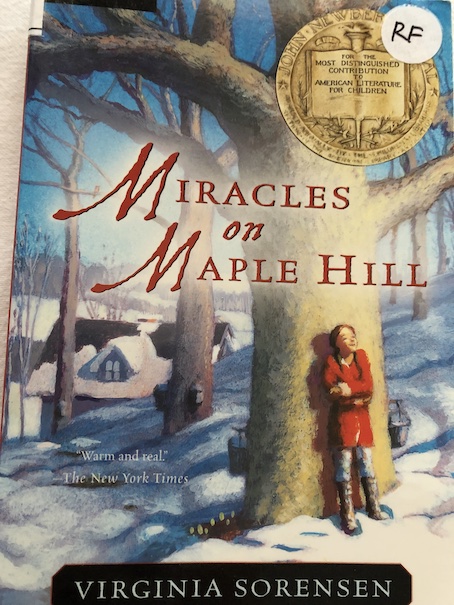
Miracles On Maple Hill

Miracles On Maple Hill by Virginia Sorensen, 1956.

Ten-year-old Marly and her family are moving from Pittsburgh to the countryside, to Marly’s mother’s grandmother’s old house on Maple Hill. They’re making the move for Marly’s father’s sake. Marly’s father was a soldier and prisoner of war, and everyone says he was lucky to return home from the war. (The book doesn’t specify which war, and no date is given for the story, but the book was written during the 1950s. If it was set slightly earlier than the time of writing, it could be WWII, and if it’s in the 1950s, it would be the Korean War. Not giving the story a date gives it a timeless feel.) Since then, he has suffered from the stress of his experiences. He is frequently tired and irritable. He is easily startled by loud noises, even a door slamming, and he finds arguments between Marly and her older brother Joe too much to handle. On Christmas, he can’t even bring himself to get out of bed to celebrate with his family. (He is suffering from shell shock or PTSD, although the characters in the book don’t use those terms. Mostly, they just describe the symptoms they see in him without giving it a name. Much of our modern understanding of what PTSD is and how to treat it came out of the World Wars and following conflicts, like the Korean War and the Vietnam War. During the 1950s, they had a general sense of what it was, and they called it different names, like “battle fatigue” or “combat stress reaction” or “gross stress reaction,” but not everyone fully understood it or how to treat it. They didn’t have as many resources for dealing with it, so this family is trying to find their own solution by giving the father a quiet place to rest and process his feelings.) Marly’s mother thinks that the peace of the countryside will do him good.

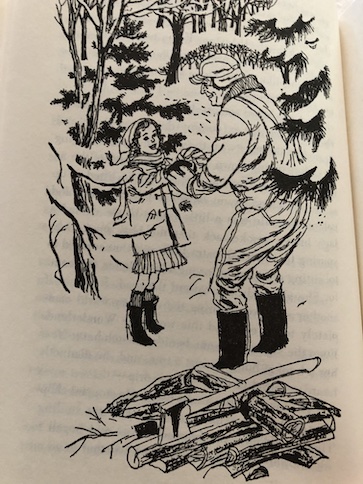
It’s March when the family makes their first trip to Maple Hill, and there is still snow on the ground. Their car gets stuck in the snow before they reach the house. Joe and Marly both get out of the car to find help. Twelve-year-old Joe initially didn’t want Marly to come with him because he’s in a phase where he likes to show off and make a big deal about how much better he is at doing things than his younger sister, but Marly sets off by herself and meets their friendly neighbor, Mr. Chris. Joe is a little offended that Marly saved the day instead of him, but Mr. Chris and his wife are very friendly and helpful. They remember the children’s mother from when she used to visit her grandmother as a child, and they welcome the family like they’re relatives themselves. Marly likes Mr. and Mrs. Chris, but her father finds their friendliness a little overwhelming. He feels like what he really needs is time alone, and he doesn’t feel much like chatting with people.

The old house at Maple Hill is a little run down because no one has lived there for years. The family has a lot of fixing-up to do, but Marly’s mother thinks that the work will be good for the children’s father. Marly and Joe aren’t used to living in the countryside, and they find some parts of it fascinating. They use a pump for water for the first time and take baths in an old tub. The house contains a Franklin stove (and Marly references the story Ben and Me by Robert Lawson).

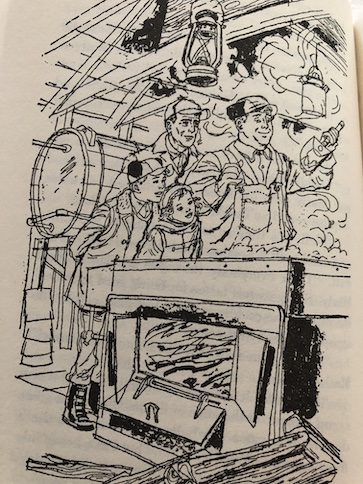
Marly is upset when her family kills a nest of baby mice, although they tell her that mice are pests, and they have to get rid of them or be overrun by them. Marly loves animals, and she would have loved to keep the cute little mice as pets. Marly talks about her feelings with Mr. Chris when he shows them how he processes maple syrup. Mr. Chris says that he understands how Marly feels. He also has a soft spot for small animals. Although he doesn’t tell his wife about it, he has a little mouse friend who visits him every day. Marly’s family is there for the conversation, and they say that Marly makes too big a deal out of getting rid of pests, but Mr. Chris says that there’s nothing wrong with Marly for caring and gives her an extra taste of the maple sap. To Marly’s surprise, her father takes her on his lap and says that the only thing wrong with Marly caring too much is that she’ll have to spent her life crying more than she would otherwise have to. Feeling an emotional attachment to people or animals can mean having your feelings hurt when you lose them, and what Marly’s father has been through is about the most extreme version of having hurt feelings that human beings experience.

Marly’s father stays at Maple Hill alone for a couple of months while his wife and children return to the city so the children can finish the school year. In spite of her father’s reluctance to be around people, he does become friends with Mr. and Mrs. Chris in their absence. He sometimes calls his family from the phone at their house. Mr. and Mrs. Chris help him adjust to living in the countryside. He discovers how much life in the countryside is influence by changes in the weather, much more so than life in the city, where people spend more of their time indoors, and Mr. Chris gives him an almanac to use. Mr. Chris tells Marly that, when she and her brother return to the countryside in the summer, he’ll take her around and show her everything, and he’ll show her all the “miracles” at Maple Hill, meaning the wonders of the natural world.

However, even people in the peaceful countryside have their troubles. Marly overhears her mother talking to Mrs. Chris, and Mrs. Chris says that she’s worried about Mr. Chris’s health. Jolly Mr. Chris has suffered a heart attack before, and he hasn’t been taking it easy. He’s always been a hard worker, and Mrs. Chris worries that he pushes himself too hard.

Over the summer, when Marly and her brother and mother return to Maple Hill, Marly has to get used to life in the countryside, as her father has. One morning, when she tries to make pancakes for her family by herself, she accidentally fills the kitchen with smoke because she doesn’t really know how to use the old-fashioned stove. Her father comes in and helps her, and at first, Marly is worried that he’s going to get really angry, the way he often has when things go wrong because of his stress from the war. However, this time, he reacts much more calmly because he knows how to handle the situation, and he admits that he did the same thing himself when he first used that stove. It’s one of the first signs that Marly’s father has been improving in the peaceful countryside.

As Mr. Chris promised, he shows Marly the wonders of the countryside and introduces her to different types of plants and animals. Joe likes to show off what he knows about plants and animals and their scientific names from his books, but Marly enjoys learning the colloquial names for plants from Mr. Chris and observing them directly. However, she realizes that she and her brother Joe have to be careful not to overtax Mr. Chris. When Mr. Chris gets really enthusiastic about something, he pushes himself harder than he should.

As the summer comes to an end, Marly’s parents discuss whether the mother should return to the city with the children for school or if they should stay at Maple Hill year-round now. Marly’s father loves life in the country. He has been growing crops on the farm, and he feels better in the peaceful countryside. He wants to stay there for at least for one year before trying city life again. Marly is eager to stay, although Joe is reluctant because he really likes his old school and the museums and theaters of the city. However, even Joe finds some parts of country life fun and fulfilling, so he is persuaded to give it a try. It helps that boys Joe’s age take the bus to the bigger school in the next town, and that school has a marching band, because Joe had wanted to join the band at his old school.

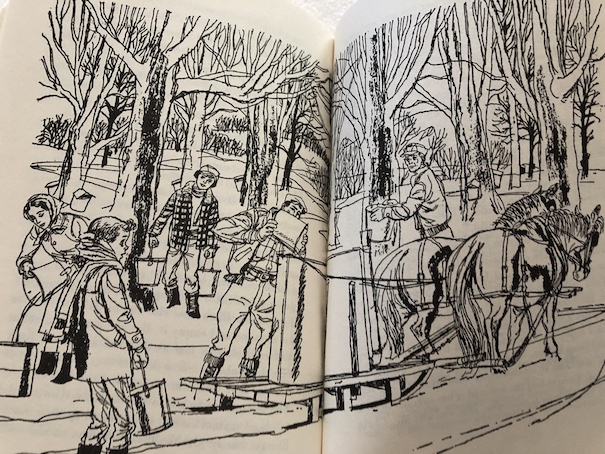
Staying in the country year-round gives the children the opportunity to experience the changes in nature and farm life through the seasons. However, as it reaches a year since they first came to Maple Hill, Mr. Chris suffers another heart attack. While he is in the hospital, Marly’s family steps in to help harvest and process the maple sap crop, turning it into maple syrup. It’s hard work because the family also has their own crop to tend to, but helping Mr. Chris helps Marly’s family as well. Through hard work for the sake of helping someone else and the relationships they build with their new community, Marly’s father’s old tiredness and harshness turns to gentleness, further healing his spirit.

The book is a Newbery Medal winner. It’s available to borrow and read for free online through Internet Archive (multiple copies, including one translated into Chinese).

My Reaction

Cottagecore Style

This book is a gentle story that would appeal to people who enjoy Cottagecore Style Books. It’s full of the wonders of nature and life in the countryside, and the family’s little farmhouse is cozy and charmingly old-fashioned. The “miracles” in the book refer to changes in the natural world that take place over time and with the changing of the seasons. Even Marly’s father’s recovery is natural and gradually takes place over time during the course of the story.

The book doesn’t go into detail about what Marly’s father experienced as a soldier, but it does a good job of showing how the war has affected him. He is tense, nervous, and angry because of his experiences, but not in a way that would be too frightening for children. Getting away from the chaos of the city and working outside in nature does help him. The physical activity of working outdoors gives him an outlet for his stress, and the slower pace of life and limited number of people he sees in the country give the chance he needs to rest.

Cottagecore as a genre and aesthetic became very popular during the Coronavirus Pandemic of the early 2020s. I explained when I wrote my list of books that fit the genre how the pandemic forced many people to change the way they were living. During the height of the pandemic, when there were lockdowns and quarantines, people didn’t get out as much. Many people worked from home, if they could, and limited the number of people they would see. This caused some people to feel stressed and cooped up, but one of the ways they were able to alleviate that feeling was to spend time outside, whether it was in their own gardens or in public parks or in the open countryside. When people were outside, there was less risk of contagion because they either wouldn’t encounter other people or could encounter them from a safe distance. Being out in nature, as much as they could manage, helped people feel a little more free. It gave them a welcome break from being inside their own homes all the time, and seeing beauty in the natural world can be soothing for all kinds of stress.

I mention this because that’s similar to the way Marly’s father and the rest of their family felt when they decided to go to the country. Marly’s father’s condition was hard on his family as well as himself because they were worried about him and because he would become moody and irritable at small things they would do which ordinarily wouldn’t have bothered him much. For a long time since he came back from the war, everyone had to be extremely careful about what they did around him because they didn’t want to upset him. In the countryside, without other distractions and causes of stress, everyone in the family was able to relax more. That’s why books of this kind became so popular during the pandemic; people saw in them feelings that they were experiencing themselves because of the stressful situation everyone was going through. I noticed that the people who handled the social distancing of the pandemic the best were the ones who used it as an opportunity to enjoy a slower pace of life and simple pleasures and to strengthen their connections with a small number of important people, like the people in this story do. Of course, individual circumstances varied, and some people had a greater ability to do this than others, but I think it’s interesting and helpful to note these common ways that people have of dealing with trauma and stress, even when the trauma and stress come from different sources.

Life and Death of Animals and War

There is a subplot that continues all the way through the book about how Marly feels about animals and how her feelings clash with both the way her family feels and the realities of life in the country. She gets very upset when her family destroys the nest with baby mice, and she bonds with Mr. Chris about their caring for small animals. However, Mr. Chris shocks her when he talks about hunting a family of foxes. Marly cares about the foxes because they have five babies, and she can’t imagine how a caring man like Mr. Chris would hunt baby animals. What is the difference between cute little baby mice and baby foxes? Mr. Chris explains that the foxes have been hunting his chickens, and they also eat mice. By eliminating the foxes, he can save the lives of other animals. The area has too many foxes already, and there is a bounty on their pelts. What Mr. Chris and the rest of Marly’s family understand, and which Marly struggles to come to terms with, is that sometimes animals pose a risk to other animals and even to humans. The mice would carry disease if they were allowed to live in the house with humans, and the foxes are killing the chickens. In a perfect world, everything would be able to live peacefully side-by-side without hurting each other, but the world isn’t perfect, and circumstances mean that something that poses a risk to something else sometimes has to be killed. It’s a good metaphor for war.

Marly’s father didn’t go to war because he wanted to. He was sent to war because the government decided it was necessary to prevent something even worse from happening. People don’t normally want to hurt and kill each other, but when faced with someone who poses a real threat, they will. Part of the reason why Marly’s father has suffered is that he had to endure things that went against his natural instincts. Ordinarily, he wouldn’t want to hurt or kill other people, but he had to as a soldier, and he had to survive other people’s attempts to hurt or kill him. To survive those circumstances, he had to change his way of thinking, and now that it’s over, he’s struggling to get back into the mindset of peace, where not every loud sound is a threat, conflicts are minor, and it’s okay to care about people and be sentimental about things. During their time at Maple Hill, the family also meets a hermit who came to the countryside while he was recovering from shell shock from a previous war. The book doesn’t say what war that was, but he’s been in the area for years. If Marly’s father was in either WWII or the Korean War, this man could have been a soldier during WWI, given the time period. The hermit’s experiences show the family and readers that the trauma of war affects people in similar ways across generations and between conflicts, and that what Marly’s father experienced is an inherently human reaction. It also points to the similar ways people have of responding to that type of trauma. Both Marly’s father and the hermit found solace in nature and the peaceful countryside.

Fortunately, Marly and her brother figure out a way to save the foxes from being hunted by scaring them away from their den. If you can get past the early point in the book where they destroy the nest of mice, no further animals were harmed during the course of the story. There is a point where Marly gets some chickens of her own to care for, and I was worried that the foxes would come and eat them, to prove her family’s point that some animals have to be hunted, but I was glad that didn’t happen. Marly does reflect more on how animals eat each other later in the book without needing to have anything else killed. She thinks about how she and her brother saw small animal bones and fur around the foxes’ den and how her own family eats meat and eggs. Mr. Chris says that everything needs to eat something to survive, and that helps Marly to understand the cycles of life and death in the animal kingdom and in farming. The lessons in the book are pretty gentle even though they touch on serious topics.

Boys vs Girls

One of the criticisms that I’ve sometimes seen about this book is the stereotypical gender roles in the story, but I think that’s a little unfair because Marly in particular questions the ways boys act and how other people view boys and girls. It starts very early in the story when the family’s car gets stuck and Joe doesn’t want Marly to go with him to get help. When Marly goes on her own and finds help first because she’s put a little more thought into where to go for help, Joe feels a little bad that his younger sister did better than he did. There’s a kind of competition between them that mostly seems to come from Joe, and Marly gets a little offended sometimes when he tries to leave her out of things so he can be first to do something.

I thought that it was perceptive of her to realize that boys try to prove that they’re better at things than girls because they “seemed afraid they’d stop being boys altogether if they couldn’t be first at everything.” Marly knows that boys aren’t treated the same as girls, and I think her comment comes pretty close to the reason why. The boys have a stronger idea of what they’re supposed to be, relative to girls, and in a way, they’re more threatened when either they’re not as good at something as a girl is or a girl does something that they think is supposed to be a boys’ activity. I’ve noticed men and boys with this sort of attitude even in the 21st century, and it’s ironic that they don’t seem to realize that very attitude puts them at a disadvantage by making their sense of self more fragile and dependent on someone else’s relative skills and interests.

Marly realizes this sense of fragility later in the story when she thinks about how she really likes being a girl better than she would like being a boy. Although some people might tell girls that they can’t do certain things or think of girls as being silly compared to boys, Marly realizes that there is a greater amount of freedom for girls in her time and society to simply be human beings than the boys experience. In some ways, the boys of her time seem like they’re being raised to be like little soldiers, possibly to prepare them for the day when they might be drafted, like their fathers. Boys are urged to be tough, competitive, and unsentimental. Marly knows that her brother cries sometimes, but he doesn’t want to be seen crying. Joe is not expected to care about animals or feel anything about killing them. By contrast, Marly can feel emotions and show them freely about anything she wants because she’s a girl. She realizes that people sometimes laugh when a girl does something silly or makes a mistake or asks what seems like a dumb question or is overly emotional about something, but girls are still allowed to do these things without people thinking much of it. They can do all of these things without anyone questioning their identities as girls or human beings in general. Really, everyone does these things once in a while, but Marly realizes that a boy doing one of these very human things is likely to get more criticism and might even be called “girly.” People of this time would question a boy’s identity as a boy in ways that they wouldn’t question a girl’s identity as a girl, and that’s why Joe acts the way he does sometimes, like he has something to prove to everybody. Boys of her time may have more opportunities in some ways, but in some ways, girls are more free to simply be human. Joe acts like he’s competing with his sister sometimes and trying to show her up, but in reality, he’s competing with society’s expectations for him and his own expectations for himself because of what he’s been told that boys are or have to be.

Toward the end of the story, Marly and Joe are so busy trying to help their family and the Chrises with their maple syrup processing that they miss some time in school. The local truant officer comes to check up on them and find out if they’ve been ill, and she is fascinated when she finds out that they’ve been helping to make maple syrup. She admits that, even though she’s lived in the area her whole life, she’s never actually helped to make maple syrup herself or eve watched it being done. She spends some time with the family, watching them work and asking them questions about the process. Based on what she’s seen, she decides that the children are engaging in a practical and educational experience because they are learning something that is culturally and historically relevant to the area that is not taught in classrooms. In fact, she thinks that this is such a great educational opportunity that she not only makes sure that the children are excused from classes until the work is done but also arranges for field trips of other children from the area to come to the farms and help, giving the two families the extra help they really need and the children’s classmates a unique experience. I thought that was a great example of how a disruption to the usual routine can be an exciting and valuable learning experience, something that I think is also relevant to the changes people had to make to their routines and education during the pandemic, but it also brings up the topic of boys’ work vs girls’ work again.

Throughout the book, there are certain types of work that are considered for men or women, and Marly is happy when her mother counts her among the “women” doing work in the kitchen because it makes her feel grown-up. However, there are times when she boldly speaks up about how girls should be allowed to do other things that boys also do. The truant officer is a woman, but when she arranges the field trips of students visiting the farm to help out, she specifically invites only boys at first. Marly asks her why she didn’t invite the girls because she’d like some other girls on the farm. The truant officer admits that she didn’t think of it as something the girls would want to do, but finding the process interesting herself, she decides that she’ll ask the girls to see if they’re interested. Joe dismisses the idea that girls would help out with the maple syrup because farm work is men’s work. Marly points out that she’s been doing this work the entire time herself, and Joe says that she’s different because she’s kind of a “tomboy” (meaning a girl with boyish qualities or who enjoys activities that boys typically enjoy). Marly insists that she’s not a tomboy because she’s very comfortable with her identity as a girl, and she just thinks that other people are wrong about the range of things that girls can do or be expected to enjoy. It turns out that she’s right that other girls are interested in the farm work and making maple syrup and do want to come on the field trips. They just didn’t before because nobody asked them.

I haven’t actually heard anybody say the word “tomboy” in a long time. When I was a kid in the 1980s and 1990s, it referred to a girl who acted like a boy and liked things boys liked, and it was a term far older than my childhood. In the 21st century, I more often hear about girls who are described, or more often, describe themselves as being “not like other girls.” There is still a concept that “typical” boys and “typical” girls like or do certain kinds of things and that people who don’t like or do the typical things are different somehow, although I think that concept isn’t as strict as it once was. I think that 21st century society has a more expansive notion of the types of things people of different genders like and do and a greater recognition of the varying interests people can have. Some people still leap to the conclusion that, just because someone doesn’t do or like what’s “typical”, they might be homosexual or trans (which I think might be part of that fear that Marly described about boys worrying that they’d “stop being boys altogether” if they couldn’t be first and best at everything compared to girls), but that’s not always the case. Humans come in many variations, and in the grand scheme of life, figuring out what’s “typical” for boys or girls doesn’t really tell you much about any particular individual person’s interests or feelings. (If you’ve ever tried to buy Christmas or birthday presents for a kid based on general recommendations for boys or girls their age and guessed wrong for that person, you know what I’m talking about.) There are some things that can really only be decided on an individual level. Marly is not a “tomboy.” She knows who and what she is, and she’s a girl who also likes to do outdoor activities and farm work. That’s really all there is to it, and there are more girls like her who find that appealing, when people bother to ask them how they feel.

History and Language

There aren’t many issues with language in the story, but there is one incident that I thought I would mention. There are a couple of points in the story where the characters discuss the history of making maple syrup. Mr. Chris says that one of his ancestors learned how to do it from some “Indians” in the area, meaning Native Americans, and his family has continued using the same process ever since. The truant officer is intrigued when Marly’s family tells her that, and she wonders how the Native Americans first realized that they could process tree sap into a food product. She does a little research and later tells the family a story about how a Native American woman used tree sap in making a kind of mush for her husband, and he liked the flavor, so they continued cooking with it.

Using the term “Indians” instead of “Native Americans” is very common in older children’s books, especially those from the 1950s or 1960s and earlier. This book isn’t unusual for doing that because it was written in the 1950s, although “Native American” is the preferred term of the late 20th and early 21st centuries when referring to “American Indians.” I think it’s generally better to use the most specific term possible in descriptors because it’s both more accurate and less confusing, and most people find it more polite and respectful. When I was a kid, I remember finding the term “Indian” a little confusing sometimes because I was aware that “Indians” are also people from India, although I could usually tell by context which kind of “Indians” authors meant.

(By the way, if anybody out there know which kind of “Indian” is meant when someone is sitting “Indian style”, meaning cross-legged or what some teachers now call “criss-cross applesauce”, do let me know. I asked one of my teachers when they first taught us to do it when I was a little kid, and I never got an answer. She rudely ignored the question, probably because she didn’t know the answer, either. I thought at the time it was probably based on Native Americans because of where we were living, but I was curious which tribe it was. The more I thought about it, I also realized that I couldn’t rule out India as the source because people sit crossed-legged for yoga, and yoga comes from India. Personally, I prefer to just call that kind of sitting as “sitting cross-legged” because that describes exactly what you’re supposed to do, and both of those other terms require more explanation of what they mean than I think should be necessary for just telling someone how to sit.)

The use of “Indian” instead of “Native American” sounds outdated and can be a little irritating to some people, but there is one instance where the truant officer uses the word “squaw” to refer to the Native American woman who discovered how to cook with sap from the maple tree. “Squaw” is a controversial word because, apparently, it can mean “woman” in a generic sense in some Native American languages, but in other Native American languages, it can mean something more vulgar and offensive. The word is only used briefly in that one part of the story and not in any insulting manner, but if you’re going to read this to children or have them read this story, I think it’s important for them to understand that this is not a word they should use themselves in conversation. If they want to refer to a Native American woman, they should just call her a woman and not use an ambiguous term that may seem insulting to some people. If they can understand that, sometimes, a word can mean different things to different people and that it’s important to consider your audience’s feelings when choosing what to say and how to describe other people, I don’t think this will be a serious issue with this story.

One final note that I thought of adding is about Marly’s name. Nobody in the story ever calls her anything but “Marly”, but I think that’s a nickname. In the early 21st century, there’s been a trend of giving children, especially girls, surnames as first names as a form of “gender neutral” name, but that wasn’t common back in the 1950s, and the surname of “Marley” is usually spelled with an ‘e’, unlike Marly’s name. Marly’s name could just be “Marly” as a variant of “Marley”, but I suspect, although I can’t prove it, that “Marly” is a nickname for Marlene or a similar name. I think her name is probably Marlene because there was a famous actress during the 1930s named Marlene Dietrich, and there was a spike in popularity for the name Marlene during the mid-20th century, probably because of her. Marlene Dietrich was known for defying traditional gender roles, both in her acting career and in her private life. Although she was considered a fashion icon in her time, when she described her sense of fashion in 1960, she said, “I dress for the image. Not for myself, not for the public, not for fashion, not for men. If I dressed for myself I wouldn’t bother at all. Clothes bore me. I’d wear jeans. I adore jeans. I get them in a public store—men’s, of course; I can’t wear women’s trousers. But I dress for the profession.” That sounds like the kind of girl Marly is. She knows that she’s a girl, but she’s her own kind of girl, who knows what she likes and doesn’t like.

Johnny Tremain

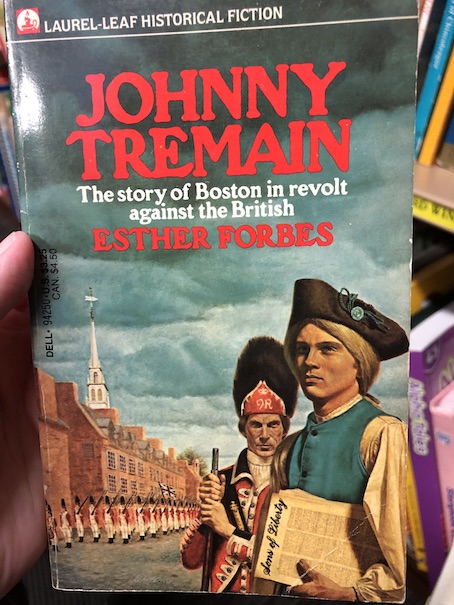
Johnny Tremain by Esther Forbes, 1943, 1971.

The story takes place in Boston around the time of the American Revolutionary War, and famous historical figures appear in the story.

Fourteen-year-old Johnny Tremain is a young apprentice to a silversmith. Even though he is one of the younger apprentices, he has talent and is favored by the silversmith. His favored position allows him to boss the other apprentices, and the silversmith is even considering having him marry one of his granddaughters when he has completed his apprenticeship so he can inherit the business. Johnny doesn’t mind the idea of marrying one of the granddaughters, although he is in the habit of teasing them, and inheriting the business would give him a steady future, although the business isn’t particular lucrative. Most people basically like Johnny, although one of the older apprentices, a boy called Dove, resents him.

Johnny has one particular flaw, and that is that he is arrogant and prideful. While he is talented, he gets overconfident and too full of himself because of his talent. The silversmith even warns him and lectures him about it, telling Johnny not to lord it over the other apprentices that they are not as gifted as he is.

However, Johnny doesn’t listen to him, and he soon pays the price for it. The reason why the silversmith’s shop hasn’t been very lucrative is because the silversmith is getting old, and he can’t work as hard as he used to. That’s one of the reasons why Johnny feels like he has to push the pace in the shop and keep the other apprentices in line. When the silversmith is late making a particular order, Johnny takes it on himself to complete the work on a Sunday, which is forbidden by the laws of Boston at that time and would have been forbidden by the pious silversmith, too, if he knew what Johnny was doing. While Johnny is working, Dove hands him a crucible with a crack it in, thinking to embarrass Johnny by ensuring that the work will go wrong. Unfortunately, it turns out to be worse than that. Johnny’s hand is badly burned by molten silver.

With a crippled and useless hand, Johnny doesn’t see how he can continue his apprenticeship and become a silversmith. For the first time in prideful Johnny’s life, he is an object of pity, and he seems to have no future ahead of him. There aren’t many kinds of work a person in his time can do with only one usable hand. The silversmith’s youngest granddaughter has always been sickly, and people think that she isn’t likely to live to adulthood. Even the girl’s own mother says that it hardly seems worth the effort of raising her when she isn’t likely to survive, and privately, Johnny has also agreed. Now that Johnny is disabled, seemingly useless, and without a future, is he also hardly worth anyone’s help?

The silversmith’s daughter-in-law, Mrs. Lapham, seems to think he isn’t worth anything. In spite of her being the one who originally insisted that he do the task on Sunday that crippled him, she begins giving him repeated and casual insults like “lazy good-for-nothing” and “worthless limb of Satan.” Her previous praise and encouragement for Johnny and wish for Johnny to marry one of her daughters hadn’t been based on any liking for Johnny but only based on what she thought Johnny could do for her and her daughters in the future. Now that he can’t take over the business, Mrs. Lapham is ready to kick him to the curb. Mrs. Lapham discourages Johnny from eating much food, tells him that she’ll be needing the place where he sleeps soon for someone else to help her father-in-law with his shop, and tells the silversmith that he should get rid of Johnny. The silversmith refuses to kick the boy out onto the street with nothing and no prospects, especially since Johnny has been doing small chores for the family to earn his keep. The silversmith tells Johnny that he cannot continuing learning the silversmithing trade, so he’s going to have to find a new one. He encourages Johnny to explore the city and watch different people at their trades until he can find one that he thinks he can do, and then, he will give the contract for Johnny’s apprenticeship to his new master.

However, Johnny is still prideful and can’t see himself doing any of the unskilled trades that might take him, and he only half-heartedly tries to find a new position. He still sees himself as a craftsman, and that’s all he really wants to be. He still feels like other jobs are beneath him. One day, he goes inside the printing shop for the Boston Observer, which the silversmith disapproved of for trying to stir up dissent and resentment against the English king among the colonists, and immediately is fascinated at the way the boy working in the shop interviews a woman about an advertisement for her lost pig. Johnny feels an odd friendly feeling toward the boy, who is a good and patient listener. When the woman leaves, Johnny finds himself pouring out his own story to the boy, whose name is Rab, without his usual arrogance. Rab understands Johnny’s feelings and agrees that most of the jobs that would be open to him now are the unskilled jobs he doesn’t want to do. He says that the Observer could hire him, but it would be a position as a delivery boy and messenger, but that doesn’t sound like the kind of work Johnny really wants. Still, Rab tells him that if he can’t find anything else, he could come back and take the messenger job. Johnny hopes that he can come back and tell him that he’s found a much better job.

However, Johnny still can’t find someone to take him. When he tries to get a job from John Hancock, whose project was the one that ruined Johnny’s hand, John Hancock is repulsed at the sight of Johnny’s hand and won’t even take him as a cabin boy for one of his ships. Johnny is angry and despairing when John Hancock sends him away, but John Hancock sends a slave after him with a whole back of silver, apparently out of guilt. Hungry because he’s had so little to eat lately, he goes to a tavern and orders a great deal of food. He is disappointed to see how much of his money he wasted and realizes that he has been a fool for ordering too much all at once. He spends the rest of his money buying presents for the silversmith’s daughters and new shoes for himself. When Johnny comes home in his new shoes, Mrs. Lapham accuses him of stealing them from someone because she can’t imagine that he could earn enough money to buy them. The girls are happy with the presents until the youngest one suddenly gets upset at Johnny touching her with his bad hand because it looks weird and she’s afraid of it, ruining the moment.

There is one last thing Johnny has that might help him. He has had a silver cup his entire life with his full name on it: Jonathan Lyte Tremain. The cup also bears the family crest of the Lyte family, a wealthy merchant family in Boston. Johnny’s mother never introduced Johnny to her relatives before she died, although she said that she was from a genteel and educated background and their own names, Jonathan and Lavinia, were family names. Johnny knows that the head of the wealthy Lyte family is also named Jonathan Lyte, so he thinks that he could be a relative. For some reason, his mother didn’t want him to show the cup to anyone, although she told him to keep it in case he ever needed it. She said to only show it others if he was in dire trouble and it seemed like even God Himself had forsaken him, and his current situation certainly qualifies.

When Johnny goes to see Mr. Lyte, Mr. Lyte doesn’t believe that he’s really a relative. He thinks that it’s just a story to get some of the Lyte family’s money, and he’s heard stories like this before. Johnny argues unpleasantly with Mr. Lyte before telling him that he has a silver cup that will prove the relationship. Mr. Lyte seems interested in the cup and tells Johnny to bring it to him that night. Before returning to Mr. Lyte with the cup, Johnny goes to Rab and tells him what he’s about to do. Rab gives him some food and a change of clothes before he goes but warns him that Mr. Lyte has been deceptive and unethical in his business dealings.

Rab’s warning is prophetic. When Johnny produces the silver cup, Mr. Lyte agrees that it is part of a set that the family has, but he says that the cup was stolen from his house only two months before. He accuses Johnny of being the thief and has him arrested. Rab finds out about it and asks Johnny if he showed the cup to anyone else before the date when it was supposedly stolen. With his mother dead, the only other person who could vouch that Johnny had the cup before is Priscilla, the Lapham daughter that Johnny was originally supposed to marry before the accident that ruined his hand. Priscilla, called Cilla for short, is willing to testify in court that Johnny showed her the cup before, but Mr. Lyte begins exerting his influence on the Laphams. He places a large order for silver and pays in advance as a kind of bribe, and Mrs. Lapham, who has already decided that Johnny is no good, declares that she will keep Cilla locked up on the day of the trial so she can’t speak on his behalf, even though she knows young Johnny will be executed without her testimony.

Rab correctly realizes that some of the attitudes of people against Johnny are because Johnny is an arrogant hothead who has made enemies because of the sharp and snooty remarks he’s made to them and about them in the past. He points out that these people, who have felt oppressed by Johnny are now taking their opportunity to get even with him and get rid of him, just like the rival apprentice whose dangerous trick ruined Johnny’s hand. If Johnny is going to get out of this mess and change his life, he’s going to have to change his own attitude and behavior and learn to make friends, develop some humility, and show gratitude for the help that he receives.

Fortunately, Rab knows a lawyer who is willing to take Johnny’s case without pay, Josiah Quincy (historical figure – Johnny notices that he has a dangerous-sounding cough, like the kind his mother had before she died, and the real-life Josiah Quincy did die of tuberculosis), because Mr. Lyte is a Tory who has crossed the Colonial Patriots who call themselves the Sons of Liberty with his crooked business dealings. Johnny’s trial becomes the latest skirmish between the two sides of the Revolution that is building. For the first time in his life, Johnny does have cause to be truly grateful to others. Unfortunately, he has also made one more enemy. Mr. Lyte is publicly embarrassed at having been shown to bring a false charge against an unfortunate boy in court, and if anyone is even more proud and arrogant than Johnny has been, it’s Mr. Lyte.

Johnny takes the job of delivery boy for Rab’s newspaper and becomes more involved in the politics of the Colonies and the growing Revolution. He learns how to ride a horse for the first time, even learning to manage a previously abused and skittish horse. Johnny becomes known as a good messenger and finds other side jobs. He develops his use of his uninjured left hand and even increases his use of his damaged right hand. He becomes better read and educated as he builds his messenger career. However, Johnny is also drawn into the growing conflict and learning the truth about his relationship with Mr. Lyte.

The book is a Newbery Medal Winner and available to borrow and read for free online through Internet Archive (multiple copies). It was made into a movie by Disney in 1957.

My Reaction

The Background of the Book

Because this book is an award-winner and has patriotic themes, it is a popular book for children to read and study in American schools. I didn’t actually read the book when I was in elementary school, probably because it contains works like “slut”, but I remember our teacher showing us the Disney live-action movie version from 1957. I still sometimes think of the Liberty Tree and the Sons of Liberty song from that movie. If you read the comments below the YouTube clip of that song, some people were commenting about seeing this movie when they were in 5th grade at school, and that’s about when I saw it, too, back in the 1990s. I found the song stirring then, although it looks a little corny to me now. For patriotic musicals, I prefer 1776, which I saw in high school and which is also corny but brings up some interesting historical topics. 1776 was based on a Broadway play written as the US approached its Bicentennial. If you look at my page of books from the 1970s, you’ll see that people were writing books for children focusing on the American Revolution, Colonial America, and other patriotic themes because the Bicentennial was on people’s minds at the time. The 200-year anniversary of the country was something people wanted to celebrate, and they used it as an opportunity to educate children about the history and lore of the country. Part of what makes Johnny Tremain interesting is that the original book was written in the middle of WWII, which was more of a worrying time rather than a celebration. The Disney move was made after the war, when people were in a celebratory and triumphant mood about how well the country was doing, and it ends on a triumphant note, but the original book was much darker.

During WWII, children’s authors had a choice about whether or not to mention the war in the books they were writing. If you look at my page of books written during the 1940s, you’ll see that some children’s authors addressed the war directly and even worked it into the plots of their books while it was still happening. I’ve marked which ones did that on the 1940s page. However, for those who didn’t want to write contemporary stories mentioning WWII, there were other options. Some authors wrote just-for-fun stories that had nothing to do with the war at all, which were good for helping children relax and take a break from the harsh realities going on around them, and some wrote books with historical themes.

The books with historical themes, like Johnny Tremain, often had a patriotic focus, putting the current war into perspective by reminding children that the country had been through struggles and dark times before, and reinforcing the patriotic ideals that made the struggle worth it. You can see these themes in both American and British books written around the same time, trying to help children understand that concepts of the war, what people were fighting to protect, and why the sacrifices and deprivations of the war were necessary.

There is a scene in Johnny Tremain where James Otis tries to make sure that the Sons of Liberty who are ready to fight the British understand what they’re really fighting for, the larger implications for the rest of the world, and the sacrifices they might make, including their lives. Some of his speech seems a little anachronistic with its mention of rights for everyone, regardless of race, because slavery is practiced during this era. I suppose it’s not impossible that Otis said something like that at some point, but racial equality would not have been high among the priorities of these people in real life. It felt like it was meant more for modern, 20th century audiences. He also makes a reference to rich people in France running down poor children in their carriages, which sounds like a reference to a scene in Charles Dickens’s A Tale of Two Cities, from 1859. My impression is that Otis’s speech in the book is meant more for the book’s original audience of children during WWII than for the original Sons of Liberty. Dr. Warren later makes comments about young men who give up their lives so that others can stand up like men and how a hundred or two hundred years later, men will be doing the same thing. I think those comments are also meant to help 1940s children understand why the men of their time, possibly their own fathers and brothers, might be willing to sacrifice themselves as soldiers.

Johnny Tremain is really a rather dark story in places, which is probably why my teachers showed us the Disney movie rather than having us read the book. They did have us read plenty of other dark stories when I was in school, even ones much darker that this one, although most didn’t have the kind of objectionable language this book does.

Story Themes

Although this is an historical novel, the main focus of the story is the transformation in young Johnny’s life and character as he suffers from misfortune, redeems himself, and plays a part in larger events and history. At the beginning of the story, even though Johnny is an orphan, he seems to have his future made at a young age. He has a particular talent for working with silver, and he’s in an apprenticeship and poised to take over the master’s business someday. However, like many classic heroes, he has the fatal flaw of hubris – he’s too proud of himself. It makes him arrogant and overconfident. His arrogance makes enemies of his fellow apprentices, and in one moment when he pushes his luck, his chief rival does something that seriously harms Johnny and apparently ruins his future. Johnny, who has never had any real patience or sympathy for other people who are less gifted or fortunate than himself finds himself in the position of needing patience and sympathy from others. His master sees the difficulty Johnny is in and tries to help him learn the lessons of humility that he needs to cope with the situation, but for someone as proud as Johnny has been, it’s not easy to cope with his humbled position. It’s a serious struggle for Johnny to find a new place in the world and a new path for his future. There are people who openly despise him for his weakened condition, which is unfair, and initially, he passes up some opportunities for improvement because he considers the jobs beneath him.

Johnny life changes when he finds himself in a situation so hopeless that he is really dependent on the help of other people. Some of those other people help Johnny in the court trial, not just out of a desire to help Johnny but also to embarrass Mr. Lyte by publicly exposing him for bringing a false charge. Still, they save Johnny’s life, and Johnny gains a new life by working for Rab’s family as a delivery boy and following Rab’s example in behavior. Rab is calmer and more thoughtful than Johnny, and he encourages Johnny to learn to be more thoughtful and to think before he speaks and acts. As Johnny does so, he notices that people begin treating him better because he begins giving the chance to do so instead of thoughtlessly offending them or picking fights. With Johnny’s change of attitude and behavior, he is able to forge new relationships, and new opportunities open up for him. While Johnny’s hand getting damaged seemed to be the end of everything to him and the delivery job at first seemed to be beneath him, these changes in his life actually lead to personal growth for him.

Through his work for the newspaper and the Sons of Liberty, Johnny becomes part of the American Revolution. It brings him into contact with many notable Revoluntionary war figures, including John Hancock, Josiah Quincy, Paul Revere, Samuel Adams, John Adams, and Dr. Joseph Warren. Not all of these figures are pleasant figures in the story. John Hancock, in particular, doesn’t treat Johnny well when he’s at the lowest point of his life. Dr. Warren is kind and attempts to help Johnny with his hand when they first meet, but at first, Johnny doesn’t want him to even look at it because he’s still ashamed of it and how it was damaged. Johnny later regrets that, and explains the details of his injury to him. The book ends with Dr. Warren performing a procedure to remove the scar tissue that has kept Johnny’s hand deformed. Without it, his hand will move more freely, and he will be able to fire a gun in the coming war and do other things he thought he would never be able to do again. It is uncertain whether or not he will ever regain enough dexterity to be able to return to being a silversmith, but his eyes have been opened to many other possibilities in life, and he has a cause to fight for first.

During the course of the book, Johnny also takes part in the Boston Tea Party and Paul Revere’s famous ride. His role as one of the participants in larger events is partly to teach and reinforce history lessons and patriotic feelings for the young readers of this book but also to show that even a flawed and somewhat disabled person like Johnny is worth something, has a future, and can participate in larger events and make their mark on the world. The more Johnny does participate in larger events and make connections with other people, the more his life also changes for the better and the more opportunities open up for him.

Life is Full of Mixed Feelings

I also noticed that there are many cases where people have mixed feelings about each other. As I said before, although Johnny becomes allied with the Sons of Liberty and believes in their cause, not all of them really treat him well, at least at first. Johnny also realizes that he doesn’t agree with all of their personal attitudes. At one point, he realizes that Sam Adams wouldn’t approve of the quality of mercy toward his enemies, but Johnny actually does. Although Johnny doesn’t like the British soldiers, there are moments when some of them do something kind or honorable. He doesn’t like them as a group, but he privately acknowledges that he can like certain ones as individuals in certain circumstances. Johnny comes to see the British soldiers as human beings who can be likeable, and as he sees that the situation around them is going to lead to war, he realizes that having to fight and maybe even kill some of these people would be painful. Although he still believes in his cause and is willing to fight for it, the seriousness and pain of war becomes clear to him.

Johnny’s ability to see multiple sides to people’s personalities and the capacity he has to show mercy even toward people he doesn’t like or who have actively tried to harm him are important developments of his character. Mrs. Lapham, Dove, and Mr. Lyte were all pretty bad to Johnny, in different ways. As the story progresses and Johnny’s condition in life improves and he has some separation and independence from both of them, he feels less resentful toward them both and even begins to see them in a better light. Personally, I don’t think that erases the unlikable and even dangerous sides of these characters. Mrs. Lapham would have happily watched Johnny be hung for a crime he never committed and was perfectly willing to take a bribe to lock up her own daughter, knowing that she was an important witness who could save him. That side of her personality is a definite side of her personality, and that is something that she definitely and knowingly did. However, Johnny later has a feeling of nostalgia when he remembers that Mrs. Lapham did have a hard life in some ways and yet was a hard worker, who always tried to look after her household, even when it was difficult, so she isn’t wholly evil. In some ways, her evil side and opportunism is a reflection of the hard life she’s lived and what she thinks she has to do to get ahead in the world and provide security for her fatherless daughters. Again, I don’t see her as being a really good person as a person because of what she does, what she thinks is acceptable to do, and how she treats other people, and I don’t believe that much of that was as necessary or excusable as she seemed to think it was. However, with some time and separation, Johnny starts to remember that she did have some relatively good sides.

I do note that, while it’s good that Johnny sees people for what they are, even acknowledging that unlikable people have their good sides, this does not mean that it would be good or healthy for Johnny to allow himself to be at the mercy or under the control of these people eve again. No matter how hard a worker Mrs. Lapham is, I can’t help but notice she is fundamentally untrustworthy. Knowingly helping to frame a helpless boy for a crime with a death penalty is pretty close to deliberate murder, and that’s about as bad as a person can get. The argument could be made that Mrs. Lapham didn’t know that Johnny didn’t steal the silver cup, but I don’t think that’s true. I’m sure that she was fully aware that he didn’t because of her declaration that she would lock up Cilla on the day of the trial, which indicates that Cilla told her what she knew and that the cup was honestly Johnny’s from the beginning, and she was determined to prevent Cilla from telling the truth in court, making sure that Johnny would die so she and her family could profit from Mr. Lyte’s bribe. No, from what I’ve seen of Mrs. Lapham, merely being a “hard worker”, while a good trait by itself, isn’t enough to redeem her as a character or make her trustworthy because she definitely doesn’t have that hard-working trait in isolation from her willingness to throw people under the proverbial bus and even try to get them killed for the sake of money.

Although Dove is never as sorry for the accident that hurt Johnny’s hand as he told their master he was. Behind the master’s back, he is gleefully cruel to Johnny when he has the opportunity. Admittedly, what Rab says about that being Dove’s form of retaliation for Johnny’s own arrogant meanness toward him is true, but it is equally true that Dove’s own behavior never improves even when Johnny’s does. Initially, Johnny swears revenge against Dove, but when he sees that his life isn’t really ruined by him and Dove gets some comeuppance in other ways, Johnny begins to feel a little more kindly toward him and no longer feels the need for revenge. (Although, he does get Rab to help him toss Dove into the harbor during the Boston Tea Party because Dove was trying to steal some of the tea for himself, in spite of the participants agreeing not to do that ahead of time, and attempting to lie about it. It’s not the grand revenge that Johnny initially envisioned, but it is a brief moment of comeuppance.) Johnny even treats Dove nicely after he goes to work as a stable hand for the British troops. Dove is loyal to the British, but the British are not nice to him in return, largely because Dove isn’t particularly competent at what he does and because he is obviously self-interested. Johnny realizes that he is lonely and could use friends, but even when Dove admits that Johnny and Rab treat him better than anyone else does (largely so they can pump him for information about the British troop movements), Dove still repeatedly tries to tell the British that Johnny is a spy for the Sons of Liberty and openly admits it to Johnny. Dove feels like it’s his duty as a loyal Tory to turn Johnny in, not showing loyalty to the people who have shown him the most kindness. Johnny understands all of that. While Johnny’s behavior has changed and improved, and because of that, Johnny is more respected by the even the British than Dove is. In the end, Dove is his own worst enemy, and his own behavior is the reason why more people don’t like him.

Mr. Lyte deliberately tried to have Johnny executed for a crime he didn’t commit. That was pretty horrible, and Mr. Lyte also steals the silver cup from Johnny when he attempts to sell it to him. It’s all the more horrible when Johnny is a young relative of his. However, there is something of an explanation behind it. Mr. Lyte didn’t recognize Johnny as a relative because he knew Johnny’s father under another name and had believed that Johnny’s mother, who was his niece, had died childless. Mr. Lyte is still an unethical man, both in his personal and business dealings, but although he was wrong about Johnny not being related to him, the one thing he was honest about was saying that was what he believed. His beliefs were wrong and the actions that were based on those beliefs were also wrong, but he wasn’t actually lying about those particular beliefs, even though he has lied about other things. Later, when Johnny’s life changes, he no longer cares about having the silver cup or any relation to the Lytes.

On the other hand, there are also some characters who seem likeable initially but who prove to have dark sides. The most notable character of this type is Lavinia Lyte, the daughter of the wealthy merchant, Mr. Lyte. At first, Johnny has a crush on her because she is pretty, although he knows that they are probably related in some way. However, he eventually discovers that Lavinia Lyte is silly, shallow, spoiled, snobbish, and uncaring. She takes Cilla and her little sister Isannah into her household as servants and companions when their family doesn’t have much money. It does help Cilla and Isannah monetarily, but Johnny notices that Lavinia treats them very differently. She initially only wanted Isannah because Isannah is a pretty and adorable little girl. Lavinia is supposedly mentoring Isannah as a protege and raising her to enter high society, but really, she treats her like a pet lap dog or a living doll she can dress up and play with. Isannah is young and impressionable and has never been much of an independent thinker, often imitating other people throughout the story. Under Lavinia’s influence, Johnny sees that Isannah is becoming spoiled and badly behaved, just like Lavinia, and is not developing properly, either intellectually, morally, or emotionally. Meanwhile, Lavinia treats Cilla like an ungrateful servant, calling her “stupid” when she doesn’t do things right, even when she is merely doing precisely what Lavinia told her to do in the first place. Johnny gets fed up with this situation and tells Lavinia off for it. In return, she snobbishly tells him that he’s just a ragamuffin boy. Although Johnny still feels some attraction for Lavinia because of her looks, he learns what her personal character is really like and what being around her really involves. This remaining attraction he feels for her dies when he understands their real family relationship.

Rab is generally a good character and a positive influence on Johnny, but even he has his faults. People in his family don’t communicate their feelings as much as they should, and Johnny becomes jealous and angry with Rab when he discovers that he’s been courting Cilla behind his back and not talking to him about it. Rab’s desire for a gun so he can fight in their cause also gets him into trouble a couple of times. Even as one of the nicest characters in the book, Rab isn’t perfect, either.

The characters in the story feel very real because they do have multiple sides to their personalities and often cause mixed emotions. Johnny also comes to realize that feelings about people and relationships can change over time. Some relationships develop for the best and others for the worse. It is a sign of Johnny’s growth as a character that he can see and acknowledge the complexity of the characters of other people and his own feelings regarding them. His ability to understand and manage his feelings grows throughout the story.

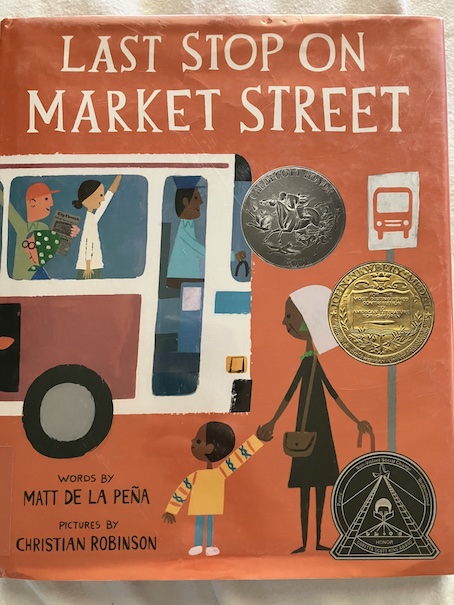
The Grey King

The Dark is Rising Sequence

The Grey King by Susan Cooper, 1975.

This is the fourth book in The Dark is Rising Sequence, and it picks up not long after the previous book ends.

Will Stanton has been very ill with hepatitis, and the doctor ask advised his parents to send him somewhere to rest for a while and recover his strength. In the previous book, his sister Mary had gone to stay with relatives in Wales after she had the mumps, so his parents agree to send him there. Even after he recovers, Will has a nagging feeling that he’s forgotten something very important. What he’s forgotten are the clues that he and his friends discovered at the end of the previous book, but little by little, they come back to him.

Will calls his relatives Aunt Gem and Uncle David, but really, they’re distant cousins. On his way to stay with them on their farm, Will sees a mountain that locals call “the Grey King”, which begins bringing back Will’s memory of the clues to the next item of power that he and his friends are supposed to find. An encounter with a strange dog with silvery eyes brings back the rest of Will’s memory, reminding him that he is the youngest of the Old Ones and it is his mission to find a magical harp in Wales.

The owner of the dog is an albino boy named Bran, who surprisingly knows the clues that Will had been struggling to remember. Bran reveals that Merriman visited him before Will arrived, told him to keep an eye out for Will and help him, and taught him the first part of the clue rhyme as a show that he can be trusted. The boys talk about what the clues in the rhyme mean. Will is supposed to find the harp on “the Day of the Dead”, which Will thinks means Halloween and which is coming soon, but he’s confused because the rhyme also refers to the end of the year. Bran says that Halloween might have once been regarded as the time of the New Year (which is true, and I discussed it in the History section of my Halloween Ideas site), and the two of them discuss some old traditions and superstitions about Halloween.

On Halloween, Bran and Will go into the mountains, and Will’s knowledge and abilities are tested before they are given the harp. Yet, Will is not the one to play it because he doesn’t know how. Bran is the harper. He also seems to have a strange connection to one of the lords who guarded the harp in the mountains. On the way down, the boys have a frightening encounter with a fox who has been killing sheep in the area, but weirdly, nobody else else can see the fox but the boys. A disagreeable farmer shoots poor Bran’s brave dog because he thinks that the dog is the one killing the sheep, and Bran is inconsolable. (I hate books where the dog dies.)

However, their work is not yet done. Will has to use what he’s learned from Bran about playing the harp to wake the Sleepers, who will aid the Light in the upcoming battle against the Dark. Bran also comes to learn his true identity and that of his mother. Although he is not one of the Old Ones, Bran is special and will play a pivotal role in the battle between Light and Dark.

The book is a Newbery Medal winner. It is available to borrow and read for free online through Internet Archive (multiple copies).

My Reaction and Spoilers

Even though this book is the Newbery Medal winner in the series, I didn’t like it as well as the earlier books. It’s partly because the dog Cafall dies, and I always hate books where the dog dies. I love dogs, and also, I realize that it’s often a cheap way to give readers and emotional wrench, to kill off a beloved animal. Also, I missed the familiar characters from the earlier books. The Drew children are not in this story, and even Merriman doesn’t play much of a role. For most of the story, Will is alone, although he does make an important friend in Bran, whose past is more mysterious than most people know.

Although, Cafall also represents one of the innocent sacrifices in the name of the battle between good and evil. Bran is angry at Cafall’s death and says that neither he nor his dog were part of Will’s battle or quest, and it wasn’t fair for them to be dragged into it or for Cafall to be killed. He’s partly right, although he is actually much closer to the center of this battle than he knows. Another character in the book talks to Will about the apparent callousness of the Light for those who end up being sacrificed in the struggle. Will’s answer is that some things cannot be helped. They might want to protect everyone and make things work out well for everyone, but circumstances don’t always make it possible, and there are times when trying to save someone or make someone happy could cause something else to happen that would be worse for everyone. I’m not completely satisfied with that explanation because, in this particular instance, I don’t see why this sacrifice was necessary and I feel like it could have been avoided, like I felt that another tragedy in The Dark is Rising could have been avoided. I suppose the principle that avoiding one sort of bad thing could lead to something worse could be true, but I just don’t feel it in these stories.

I was more convinced and intrigued by the concept of people who aid the dark without knowing that they’re doing it. In the previous book in the series, the author addressed the idea of neutral parties in the struggle between good and evil, but this book introduces the idea of ignorant or deluded people who do bad things without realizing. In the story, they aren’t regarded as true agents of the Dark because they haven’t consciously joined the Dark side and don’t even know that there’s any Light/Dark struggle happening around them, but they are doing what the Dark wants them to do and hurting people and the cause of the Light either because they are being tricked and manipulated into doing it or because they have some other motive that allows them to do bad things because they don’t care as much about the concept of good and evil as much as accomplishing their own goal.

In this case, the unwitting helper of the dark is the farmer who shot Bran’s dog. He genuinely did think that the dog was killing his sheep, so he thought that he was just protecting his property by killing the dog. That could be seen as a good motive gone astray, but when Bran’s real history is revealed, it is also revealed that the farmer also has darker motives for his bad behavior that he has been trying to keep hidden. It’s not just about protecting his sheep but also his resentment against Bran and Bran’s father, so he enjoyed hurting them by killing their dog. The farmer’s resentment goes back to when Bran’s mother, Guinevere, brought him out of the past to be raised by his adoptive father in the 20th century. Bran’s real father is King Arthur, but by the time Bran was born, Guinevere had already betrayed Arthur and feared that he would reject his son because of what she did. She wanted Bran to grow up in a safe place, away from his parents’ struggles. At her request, Merlin (which is Merriman Lyon’s real identity), brought her forward in time to the 20th century to find a new home for Bran. Bran’s adoptive father is a good man, and Guinevere knew that her son would be safe with him. He loved her in return and wanted her to stay and marry him, but Guinevere knew she couldn’t stay, so she left secretly, leaving Bran behind. Her departure might have been hastened because the farmer was jealous of Bran’s adoptive father for having Guinevere. Although he didn’t know Guinevere’s true identity, she was a beautiful woman, and the farmer wanted her for himself. He apparently tried to attack her or maybe even force himself on her, and he was fought off by Bran’s adoptive father and a friend of his. Although the farmer is a married man, he still harbors possessive feelings about Bran’s absent mother and resentment toward the men who stopped him from taking her. By extension, he also resents Bran. In the end, he is driven mad by his obsessions and his manipulation by the forces of the Dark.

From the Mixed-Up Files of Mrs. Basil E. Frankweiler

From the Mixed-Up Files of Mrs. Basil E. Frankweiler by E.L. Konigsburg, 1967.

Twelve-year-old Claudia Kincaid is bored with her dull suburban life in Connecticut with her parents and her brothers. Her life also often seems unfair, like she has more responsibilities than her brothers do and she has more chores than her others friends. Basically, Claudia is bored and feeling unsatisfied with her life. She wants to get away from it all and have a little adventure … although not too much adventure because Claudia isn’t the overly-adventurous type.

Claudia is cautious and methodical. When she plans to run away from home, she carefully plans every step and invites her more adventurous nine-year-old brother Jamie to go with her, both for the companionship and because he is a tightwad and has the cash necessary to fund their adventure. Although Claudia and Jamie bicker as siblings, they’re closer to each other than to either of their other brothers. Jamie eagerly accepts Claudia’s proposition to run away, although at first, he’s a little disappointed when he finds out where they’re going.

Claudia plans for them to run away to New York City because, as she puts it, it’s “a good place to get lost.” The city is so big, Claudia is sure that two runaway children will be easily overlooked. She’s also found a great place for them to stay during their adventure: the Metropolitan Museum of Art. Claudia loves comfort, convenience, and beauty, and the museum can offer all of that without the fees of staying in a hotel. There are exhibits of furniture, which provide them with a bed to sleep in, and interesting exhibits to keep them entertained and educated, and all they have to do is evade the security guards. At first, Jamie thinks that sounds a little too tame, but their adventure soon proves to be exciting and challenging, with enough mystery to satisfy both of them.

Claudia and Jamie develop routines for sneaking around the museum, evading the guards, hiding the backpacks and instrument cases that hold their clothes, and raiding the coins in the fountain for extra money. One day, while they’re hiding in the restrooms and waiting for the museum staff to leave, the staff set up a new exhibit for an angel sculpture sold to the museum by the wealthy and mysterious widow Mrs. Basil E. Frankweiler, who is actually the person narrating Claudia and Jamie’s story in a letter to her lawyer.

Claudia develops a fascination for the angel and a desire to learn the truth about the theory that the statue was made by Michelangelo. Between the two children, Claudia is the more imaginative and romantic, but Jamie’s logical mind and zest for adventure serve them well as they delve deeper into the mystery. They do learn something important at the museum, but to get the full truth, they have to leave their planned hiding place in the museum and go see Mrs. Basil E. Frankweiler herself.

Mrs. Frankweiler is a delightfully eccentric student of human nature, who is fascinated by the young runaways who come to her for answers to a mystery hundreds of years old. In exchange for the details of their exploits, Mrs. Frankweiler gives the children a chance to locate the answers they’re seeking in her strange, mixed-up files. In the process, the children learn a secret that gives both of them the sense of being part of something secret and exciting and much bigger than their ordinary, hum-drum lives, which is what they were originally looking for when they ran away from home.

The book is a Newbery Award winner, and it is available to borrow for free online through Internet Archive (many copies).

My Reaction

During the course of the adventure, Claudia and Jamie become closer to each other than they were before they ran away from home. They learn a little more about each other and themselves, and neither of them is quite the same as they were before they started, which is at the heart of Claudia’s reasons for wanting to run away from home in the first place. The language and descriptions in the book are colorful, which is part of the reason why this book is popular to read in schools.

There were two movies made of this story. One is a made-for-tv movie version from 1995, although it changed some of the details from the original story. In the 1995 movie, there is a scene with Jamie getting sick and Claudia worrying about him and taking care of him that never happened in the original book. Also, in the movie, Claudia stops Jamie from taking the coins from the fountain when they had no qualms about raiding the fountain for money in the book. At the end of the book, the children don’t tell their parents where they were hiding when they return home, but in the movie, the parents do find out. There is also an older movie from 1973 which is sometimes called The Hideaways.

The Door in the Wall

The Door in the Wall by Marguerite de Angeli, 1949.

The story takes place in Medieval England. Robin is the son of a noble family. All his life, there has been the expectation that Robin would learn to be a knight, like his father. Soon after Robin turns ten years old, Robin’s father goes away to fight in Scotland, and Robin’s mother arranges for him to be sent away to begin his training as a knight while she takes a position as lady-in-waiting to the queen. However, soon after his parents’ departure, Robin becomes terribly ill and loses the use of his legs.

Now, Robin is miserable and wishing that his mother was still with him to help him get over his illness. Instead, he is looked after by servants. Then, after Robin throws a fit and refuses to eat, his servants disappear. The next person Robin sees is Brother Luke, a friar from St. Mark’s monastery. The friar tells him that his servants were ill and have fled from the plague, but one of them sent him to care for Robin. He feeds Robin and tells him that he will take him to St. Mark’s and continue to care for him there. Robin tells Brother Luke about how he was supposed to be taken away for training but that he was unable to go because he was ill, and he asks how they will get to St. Mark’s because he cannot walk. Brother Luke says that the man who was supposed to escort him to the castle where he would live and be trained as a knight may be unable to get back into London because travel is restricted due to the plague, so Robin’s training will have to wait. As for how they will travel, Brother Luke has a horse that they can ride.

Before they leave, Brother Luke asks Robin to remember the wall around his father’s garden and the wall around the Tower. He points out that all walls have a door in them somewhere and that if you follow a wall long enough, you will eventually find the door. At first, Robin doesn’t understand what Brother Luke is trying to tell him, but the metaphor is the theme of the book and it becomes clear through the adventures that follow. The wall stands for adversity, and the door stands for solutions to problems, other paths to take, and ways to move forward in life. What Brother Luke is trying to say is that there are many types of problems in life (the walls), but that problems have solutions (doors). There are ways around obstacles, and if you persevere, you will find them. He reminds Robin of this throughout the story.
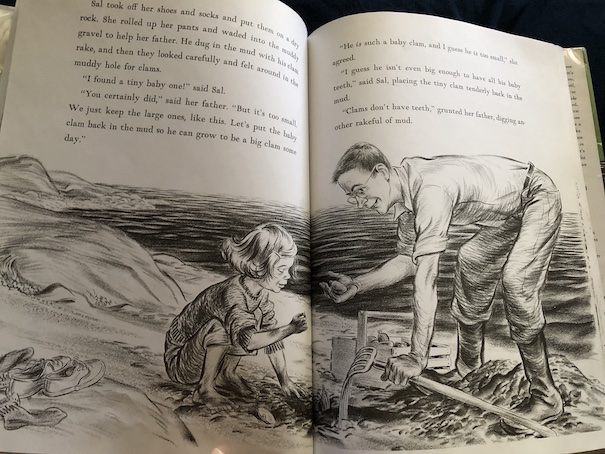
At St. Mark’s, Robin stays in Brother Luke’s quarters, and Brother Luke takes care of him. When Robin is a little stronger, Brother Luke gives him wood to whittle. When he grows stronger yet, Brother Luke gives him writing lessons. As the plague begins to pass and there are fewer patients to tend to, Brother Luke begins to carry Robin around or push him in a cart, taking him to visit other parts of of the monastery.

Since Robin still cannot walk, Brother Luke thinks it’s important to keep his mind and hands busy, one of the first “doors” that he finds for Robin around his current limitations. Brother Matthew oversees Robin as he learns and practices carving wood, teaching him patience when he has a temper tantrum on ruining one of his first projects. Brother Luke helps Robin to write a letter to his father, in which Robin explains his current situation, and a traveling minstrel, John-go-in-the-Wynd, will carry it to Scotland when he goes there with some soldiers. Later, Brother Luke even takes Robin to go fishing and begins teaching him to swim. In spite of these improvements, Robin still worries about his inability to walk and how it will affect his future and his father’s hopes for him to be a knight.

When John-go-in-the-Wynd returns with a reply from Robin’s father, Robin’s father says that he is distressed to hear that Robin has been ill, although he thankful that Robin did not get the plague and die with so many others. Robin’s illness was severe, but he is already showing signs of recovering. His father has made arrangements for him to travel to the castle of Sir Peter in Shropshire, who is Robin’s godfather and where he was meant to go for his training, accompanied by Brother Luke and John-go-in-the-Wynd, as soon as he is well enough to travel. Since Robin has already become well enough to make himself a pair a crutches with his new woodworking skills and has begun to use them, they decide to proceed with the journey.

On the journey to Sir Peter’s castle, they have adventures, narrowly escaping from thieves and visiting a fair in Oxford. Robin encounters Welsh speakers for the first time. Although Robin is worried about what Sir Peter will think of him when he sees his condition, Sir Peter welcomes the travelers gladly. He has recently been injured in battle and still recovering himself. Robin says that he doesn’t think that he will make a very good page because of his difficulties in walking but that he can read, write, and sing to provide entertainment. Sir Peter says that there are many ways to serve others and that people must do what they can.

Brother Luke and John-go-in-the-Wynd stay at the castle to help Robin settle in, and Sir Peter gives Robin duties that he can perform. Robin asks Brother Luke if he thinks that he will ever be able to walk normally again, and Brother Luke admits that he doesn’t know but that he is sure that Robin will have a fine life ahead of him. People are not perfect, but everyone has to do the best they can with what they have. Robin soon learns to get around well enough to navigate the castle easily and play with the other boys, but he is still bent and unable to walk without crutches. Robin’s disability and the craftsman skills he learned from the monks have taught him patience and that he feels better after accomplishing difficult tasks.

Then, one foggy day, the Welsh surround and attack Sir Peter’s castle. The defenders hold out in the keep, but they begin to run low on food, and strangely, the well seems to be running dry. As they run low on water, hope seems to be lost. They begin to devise a plan for someone to slip out and go for help. Robin volunteers to go. He knows where John-go-in-the-Wynd is staying with his mother nearby, and he can tell him about the situation in the castle and where to go for help. Robin knows that if anyone catches sight of him, he will look like a poor, lame, shepherd boy, and no one will suspect him of coming from the castle.

Robin has felt badly about his new disability, but his youth and disability are actually what allow him to pass unchallenged through the enemy lines. Suddenly, his disability actually becomes an advantage, allowing him to do what others cannot. Robin’s future may not be the one that he first expected, but he has found ways to move forward in his life and ends up a hero!

The book is a Newbery Award Winner. It is available to borrow and read for free online through Internet Archive (multiple copies).

The Hundred Penny Box

The Hundred Penny Box by Sharon Bell Mathis, 1975.

Michael’s great-great-aunt, Aunt Dew (short for Dewbet), has moved in with him and his parents because she is one hundred years old and no longer able to live on her own.  It has been a big adjustment for the entire family, but even though Michael has had to give up space in his room for her, he is glad that she has come to live with them because the old woman fascinates him.  She is (apparently) extremely absent-minded, often calling Michael by his father’s name, John, although some of that seems to be deliberate because she wishes that Michael’s parents had named him after his father.  Other times, she seems to forget that she’s no longer living in her old house or just starts singing an old spiritual song, forgetting what she was talking about before.

John is extremely fond of his elderly aunt because she raised him after his parents died in a boating accident, and she loves him like a son.  Aunt Dew’s own sons are long grown and gone.  However, Michael’s mother, Ruth, finds Aunt Dew’s presence in the house difficult.  Ruth thinks that Aunt Dew doesn’t appreciate some of the nice things that she does for her, and she thinks that Aunt Dew doesn’t like her.  It’s not completely true, but Aunt Dew does seem more comfortable around Michael after spending many years of her life raising boys, and Aunt Dew admits to Michael that she finds it difficult to talk to Ruth because they don’t know each other like she and John do. Aunt Dew and Ruth also have a conflict over some of Aunt Dew’s old possessions.

Aunt Dew is upset that Ruth got rid of some of her old things after she moved in with them.  Michael thought it was a mean thing to do, and Aunt Dew misses these objects.  When Michael argues with his mother about these objects, Ruth explains to him that she’s not trying to be mean.  Ruth compares Aunt Dew to a child, like Michael, saying that she “Thinks she needs a whole lot of stuff she really doesn’t.”  Ruth sees it as just clearing out things that are old and worn out and no good in order to make room for newer, nicer things, comparing it to when Michael got old enough to realize that he didn’t need his old teddy bear that was falling apart and was willing to get rid of it along with some other things in order to make room for Aunt Dew to move in.  Ruth sees clearing out old things as a way to move forward in life and thinks that it’s important to help Aunt Dew adjust to her new life with the family.  However, a lot of Aunt Dew’s long life and past are tied in with some of these objects, and as a one-hundred-year-old woman, Aunt Dew has more past behind her than future life to make room for.  Michael helps her to hide some of them in her closet to keep them from being thrown out, but he’s particularly concerned about her hundred penny box.

When Aunt Dew’s husband was alive, he started a penny collection for her with one penny to represent every year that Aunt Dew has been alive.  After his death, Aunt Dew continued to collect pennies, putting another penny into the box every year to represent her age.  Michael loves the pennies in the box because, when he counts them with Aunt Dew, she will stop him at certain years and tell him stories about things that happened during those years, telling him a lot of family stories.  Michael’s mother isn’t interested in taking the pennies, but she thinks that the old box they’re in is too worn out and should be replaced with something else.  However, Aunt Dew sees that box as being like herself: old and worn and holding all of the years of her life.  To throw it out would be almost like throwing out Aunt Dew herself.  Michael’s mother doesn’t see it that way, but Michael sees the connection.  To try to save the box, Michael hides it from his mother.

The conflict about Aunt Dew’s things isn’t really resolved by the end of the story because Michael’s mother still doesn’t understand how Aunt Dew feels, and we don’t know if she will come to understand or if the box will remain hidden or not.  I found parts of the story frustrating because Ruth doesn’t seem to want to listen to either Aunt Dew or Michael, discounting them as the kid and the old lady.  Even though Ruth is frustrated with Aunt Dew, I think that part of it is her fault for not really listening or trying to understand how she feels. This may be part of the reason why Aunt Dew feels like she can’t really talk to Ruth. To be fair, Ruth doesn’t mean to be mean, but at the same time, she kind of is because she’s too stuck on what she thinks is best and that idea that she knows better than a young boy and an old woman to consider that her ideas might not be what’s best for her family and family relationships and that she needs to give a little. My guess is that she’ll understand how Aunt Dew feels when she’s also an old woman, with more past than future ahead, but with a little imagination and empathy, I think she could see that decades sooner.  I remember reading this book when I was a kid and liking it for the concept of the hundred penny box and the old woman’s stories, but I find the lack of resolution a little frustrating now.  It’s one of those books that makes me want to sit the characters down and explain a few things to them, but I can’t.

Besides the concept of the penny box, I’m also fascinated by the name Dewbet, which I’ve never heard anywhere else besides this story.  The pictures in the book are also unusual, and there’s a note in the back of the book that explains a little about the art style.  The pictures, which are in sepia tones, are painted with water colors, and the light areas were made with water and bleach.

This is a Newbery Honor Book, and it is currently available online through Internet Archive.

There is also a short film version that is available to buy or rent from Vimeo. Teachers Pay Teachers has lesson plans for this book. If you would like to see a reading and discussion with the author of the book, there is a copy on YouTube.