Sarah, Plain and Tall

Sarah, Plain and Tall by Patricia MacLachlan, 1985.

This is a popular book to read in schools in the United States, the first in a series.  It’s a Newbery Award winner, and it shows aspects of farm life during the early 20th century and the concept of mail-order brides, a practice from American frontier days where men living in the West or Midwest, where there were not many available women in the population, would write to agencies or advertise for a bride from the East.  The process for arranging these marriages could vary, but it typically started with written correspondence before the man and woman would meet in person.  In this book, the man looking for a bride, Jacob Witting, is a widower with two children who has a farm on the Great Plains.  The story is narrated by his older child, Anna. The book isn’t very long, and it’s a pretty quick read, but it’s filled with colorful imagery and emotion.

Anna has had to help take care of her little brother, Caleb, since he was born.  Their mother died shortly after giving birth to him, and Caleb frequently asks Anna questions about what their mother was like.  Anna’s memories of their mother are fading because she was still very young when she died, but she really misses her.

Then, Jacob tells the children that he has advertised for a bride from the East, the way a neighbor of theirs did.  The children like their neighbor’s new wife and wouldn’t mind having a mother like her.  The father has received a reply to his advertisement from a woman in Maine, Sarah Wheaton.  Sarah has never been married, and now that her brother is getting married, she feels the need for a change in her life.  She loves living by the sea in Maine, but she is willing to move to start a new life.  She says that she would like to know more about Jacob and his children.

Jacob and the children write letters to Sarah, getting to know her better.  They come to like each other, but the children worry about whether Sarah will change her mind about coming to see them or whether she’ll like them or their farm when or if she comes.  When Sarah tells them that she’s coming during the spring, she says that they will know her because she will be wearing a yellow bonnet and describes herself as being plain and tall (the title of the book).

Sarah will stay with the family for a time while they decide if they can be a family together and if she will marry Jacob that summer.  There are adjustments that they will all have to make.  Life on the prairie is very different from what Sarah is used to, and the children still worry that she won’t want to stay.  Sarah brings seashells from Maine to show them, and they teach her about the local wildflowers.  One of my favorite scenes was where Sarah cuts Caleb’s hair, and they put the hair clippings out for birds to use in their nests.  Caleb was particularly concerned about whether Sarah would sing like their mother used to, and Sarah does. 

Through it all, the children can tell that Sarah really misses the sea.  Sarah does say that the land around the farm kind of rolls, a little like the sea, and they play in a haystack, like it was a dune by the sea.  When they visit their neighbors, Sarah talks with Maggie, the mail-order bride who came from Tennessee.  Maggie understands Sarah feels, missing her home in Maine, and it upsets Anna to hear them talk about missing their old homes.  However, Sarah says that things were changing at home, and Maggie comments that, “There are always things to miss, no matter where you are.”  What the women realize is that, although they miss their old homes, they have grown to love the new people in their lives and would miss them if they tried to go back to where they came from.

At one point, Sarah goes to town alone, and the children worry that she won’t come back, but she does.  She just went to town to buy colored pencils in her favorite sea colors.  Sarah does stay and marry Jacob, setting up the rest of the series.

The book is available to borrow and read for free on Internet Archive (multiple copies).

My Reaction

There is a movie version of this book, which follows the story pretty well. The book wasn’t specific about the time period, although it seems to take place during the early 1900s. The movie and its sequels are set during the 1910s, which makes sense for the rest of the series. The book also didn’t say exactly where the farm was, but the movie clarifies that it’s in Kansas. The movie also emphasizes how much the whole family, particularly Jacob and Anna, misses the mother who died.  In the movie, Jacob forbids the children to use any of his dead wife’s things and doesn’t want to talk about her.  However, when Sarah realizes that trying to avoid his wife’s memory is hurting Anna, she brings out some of the dead wife’s belongs to use, helping the family to make peace with the past and prepare for the future. 

In the movie, Jacob’s pain over his wife’s death is partly about guilt as well as grief. The book doesn’t really talk about why Anna’s mother died after childbirth, but in the movie, Jacob has a painful discussion with Sarah about how he blames himself for his wife’s death because the doctor had warned them that they shouldn’t have any more children after Anna.  Apparently, Anna’s birth had been difficult and caused complications because his wife was so young, and the doctor had said that having another child would be dangerous.  However, after a few years went by, they decided to try for a son to help run the farm, thinking that enough time had gone by for it to be safe.  When his wife died giving birth to Caleb, Jacob felt terrible, thinking that he should have taken the doctor’s warning more seriously and not tried to have another child.  Confessing all of this to Sarah helps Jacob to make his own peace with what happened.  However, none of this discussion appears in the book.

In both the book and the movie, Jacob also has to adjust to Sarah’s different personality.  Sarah is more stubborn and independent than his first wife, with her own way of doing things.  Living with her is different from living the mother of his children.  However, Jacob comes to love Sarah for the person that she is.

Fog Magic

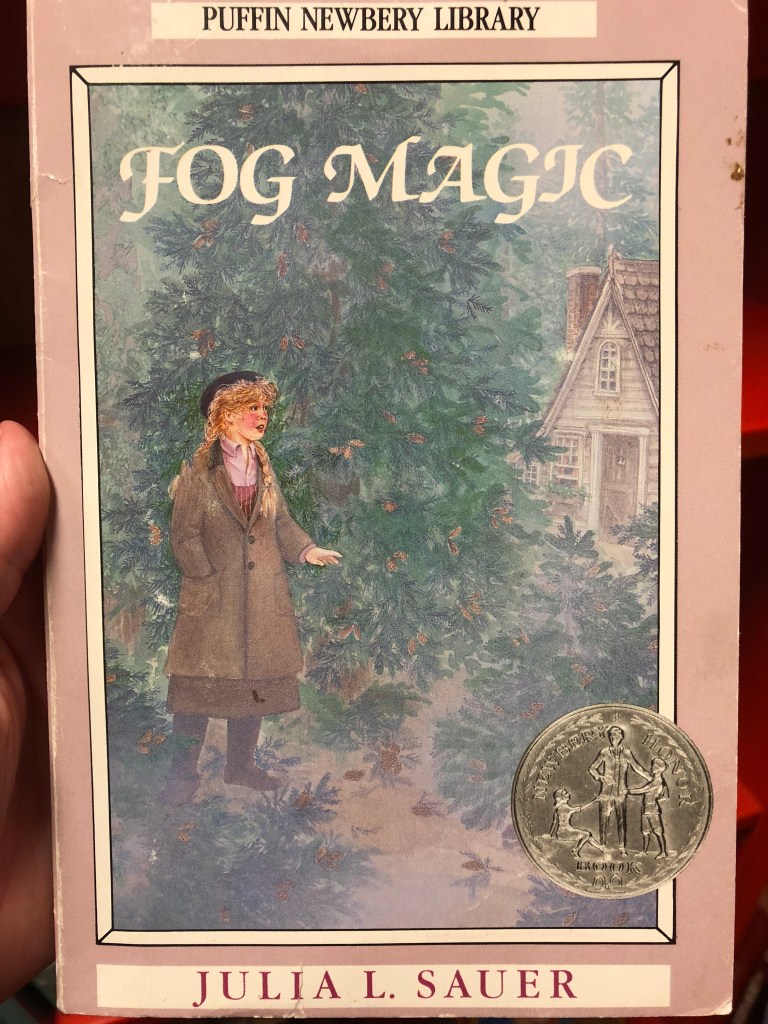
Fog Magic by Julia L. Sauer, 1943.

Greta loves fog and always has, although other people can’t understand it.  When she is ten years old, she begins to get the sense that there is something in the fog that she should find.  One day, when she goes looking for a lost cow from her family’s farm, she sees a house in the fog that isn’t there when the fog is gone.  Apparently, there used to be a house on that site, but it’s gone now.  Except when there’s fog.

From then on, Greta loves to walk in the fog.  When she does, she meets people from the past.  One day, she meets a woman named Laura Morrill, who recognizes her as being from the Addington family and says that her name must be Greta.  According to Laura, there’s always a Greta in every generation of Addingtons and that there’s always a child in every generation who has a great love of fog.  Greta’s ability to use the fog to travel back in time and see her town as it once was is apparently inherited.

Greta makes friends with Retha Morill, Laura’s daughter.  However, when Mrs. Morrill gives her a piece of pie to take home, it disappears, making Greta realize that she can’t bring things from the past to the present.  Retha’s parents seem to realize it, too.  When Retha offers her a little silver egg cup to take home, Mrs. Morrill suggests that perhaps it would be better for Greta to leave it at their house and use it when she comes.  Greta also has the feeling that, when the fog starts to lift, she needs to go home, and Mrs. Morrill agrees.

On another day, Greta and Retha spot an older girl in the woods.  Retha seems to know who she is and calls out to her, but she runs from them.  They try to catch up to her, but she gets away, and Retha is upset.  It turns out that the girl is named Ann, and she was falsely accused of theft.  When it was discovered that she hadn’t stolen anything, the townspeople had tried to find her, but she’s been hiding from them ever since, too afraid to come back.  At first, people had thought that maybe she had gone to another town to find work, but now that they know that she’s been living alone in the woods, they’re worried about her.  The story also upsets Greta because she has heard a local ghost story about a girl who haunts the woods after being falsely accused, and Greta takes that to mean that Ann will die.  The Morrills assure her that they will look out for Ann.

Greta is tempted to talk to Retha about her mysterious time traveling in the fog, but Retha stops her from talking about it.  Retha says that even her mother doesn’t want to talk about where Greta goes while she’s not with them, only saying that both men who go to sea and the women who wait for them on shore “have to learn to be content and at peace shut in by their horizon.”  To Greta, that means that she should be content with wherever she is while she’s there and with the fog that allows her to see her friends in the past.

The more Greta visits the Morrills, the more she gets caught up in the lives and troubles of the people living in the past.  At one point, Greta and Retha talk about some of the sad things that have happened to people the Morrills know, and Retha asks Greta if there is sorrow where she lives.  Greta has to admit that there is.  People generally do have their troubles, no matter when they live.  Retha says that her mother says that living and dying are both natural things, so there is no use being sad about them, except when the death is an unnatural one, like in a war.  There is no war going on in Retha’s time, but Greta lives during the time this book was written, in the middle of World War II.  Greta is aware of the war and says that sometimes people have to fight whether they want to or not, but Retha doesn’t think so.  Greta realizes that she can’t make Retha understand the circumstances of the world in the future.

However, as Greta’s twelfth birthday approaches, she has the feeling that things are changing.  Her birthday will be the last time that she can visit her fog friends, but they give her a special present to remember them by.  Greta’s father seems to know what Greta has been doing in the fog, and he reveals to her, without actually saying it, that he once did the same thing himself.  He says that when people grow up, they leave the things of childhood behind, but each of them is able to keep a special birthday gift from the past as a reminder that some things do last.

The ending of the story implies that, although Greta’s adventures in the fog were real, not purely imaginary, she has to give them up to make room for the new things that will enter her life as she grows up.  Her life lies in her present and future, so she can’t keep going back to the past.  However, her experiences with her friends in the past are part of what has made her more mature, and they will stay with her forever.

The book is a Newbery Honor Book. It is available to borrow and read for free online through Internet Archive.

My Reaction

The idea of magic and magical adventures ending at a certain age, as the person begins to grow up, is a classic idea in children’s literature. Sometimes, in other books, it’s implied that the reason this happens is because the “magic” was all imaginary, and the child in the story grew out of that particular kind of imagining, but that isn’t the case in this story. The explanation in this book for why the magic has to end is simple but makes sense. The characters don’t really analyze the issue too deeply, simply taking it in stride. We never find out why this particular family seems to have this tradition of going back in time in the fog as children, and the characters seem to decide that there is no reason to find out why.

Unlike in some modern books, there doesn’t seem to be any particular mission for Greta (or her father or any other generations before her) to fulfill in her time traveling. Greta is mostly an observer of the events in the past, not really participating in them directly or changing them in any way. She doesn’t even seem to influence the thoughts or attitudes of people in the past much. When she talks about the concept of war with Retha, she doesn’t try to change Retha’s mind about it or tell her about World War II and other future events because she realizes that each of them really belongs to two different times and sets of circumstances, and each of them needs to live in their own time, dealing with their own situations. It is their differing situations which give them their attitudes. The Morrills seem to be aware that Greta comes from the future, but they treat the subject carefully, never directly stating where she is from, just hinting at it. From they way they act, it seems as though they’ve met other members of Greta’s family before, but again, the ties between their two families (if any) are never explained, and none of them seems to want to delve too deeply into the matter. For the most part, they just seem to take the whole situation as being a natural part of life in their families and in the area where they live, something just to be enjoyed and not questioned. In fact, some of their attitudes seem to imply that they fear questioning too deeply, as if that in itself might end the magic too soon.

Although the story leaves the reasons behind the time traveling very open and unresolved (probably, other children in Greta’s family will be doing this in the future, also not really knowing why), it is really a very calm story. Not having a special mission to complete in the past leaves Greta free to simply enjoy the company of the people in the past, observing their lives without the stress of needing to solve their problems for them, and readers can similarly enjoy the ride without worrying that anything really bad will happen. You do end up being interested in what happens to some of the characters, like the woman who is in danger of losing her family’s home, but events unfold in the way Greta knows they will. She’s sad when she knows that certain people are going to die (not the woman whose home was in danger, that works out well) and there is nothing she can do about it, but it all seems to be part of the natural circle of life, something that matures Greta when she realizes it.

One of the fun things that I liked about the book were some of the unusual first names of the characters, like Retha, Eldred (Retha’s father), and Ardis (Mrs. Stanton).

The Courage of Sarah Noble

SarahNoble

The Courage of Sarah Noble by Alice Dalgliesh, 1954.

SarahNobleCookingIn 1707, a man living in Massachusetts named John Noble bought some land in Connecticut which had recently been purchased from a tribe of Indians (Native Americans) living nearby.  He planned to move his family there and start a new homestead, but with his children so young and the baby somewhat sickly, it was decided that he would travel to the new land ahead of his family and start building a new house there.  The only family member to accompany him was his eight-year-old daughter, Sarah, who came along to cook for him.  Before they leave home, Sarah’s mother tells her to “Keep up your courage,” something which Sarah repeats to herself from time to time.

SarahNobleFamilyOn the way to their new property, Sarah and her father have to camp out in the wilderness, although they do manage to stay one night with a family called Robinson.  The Robinson boys tease Sarah, saying that where she’s going, the Indians will probably chop off her head and eat her or do other horrible things.  Their sister tells Sarah not to worry because her brothers just like to tease.  Sarah’s father and Mistress Robinson also reassure her that the Indians in the area are friendly and that they sold their land knowing that new people would come there.

The Robinsons make Sarah uncomfortable.  Sarah later says to her father that there doesn’t seem to be love in the Robinson house. Her father agrees with the observation and says that the Robinsons should learn to watch their words and teach their children to do the same, adding “there are people in this world who do not help others along the way, Sarah, while there are those who do. In our home all will be treated with kindness-always, Sarah. The Indians, too, and they will not harm us.”  Although the Robinsons allowed the Nobles to stay the night in their house, they didn’t exactly make them feel welcome, and both of them realize that the things the boys were saying and their rough manner were clues to the Robinsons’ real attitudes and the kinds of things the parents talk about when no one else is around.

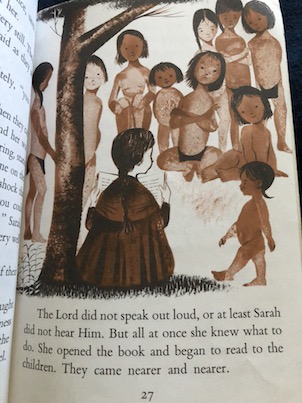
SarahNobleReadingWhen Sarah and her father reach the land that is to be their new home, they take refuge in a hollow place in a hillside, and John begins building their new house.  However, Sarah is still very nervous and lonely.  Then, while Sarah sits, reading the Bible, some curious Indian children from the nearby tribe come to see her.  She reads a Bible story aloud to them, and they listen, but she when she finishes the story, she can tell that they didn’t understand what she was saying.  Sarah can’t understand them, either, when they try to talk to her.  She gets impatient and snaps at them for not knowing English, and they run away from her.  Sarah is sorry about that because she realizes that she shouldn’t have been so irritable, and even if they couldn’t talk to each other, it was still nice to have people around.

Fortunately, the Indian children come back to see her again, and they become friends.  She tries to teach them English, but they don’t make much progress at first.  Even without being able to talk to each other, though, they can still do things like picking berries together.

SarahNobleNativeAmericanChildren

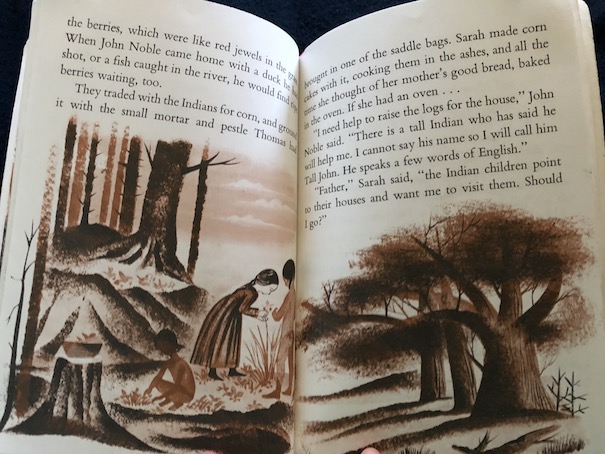
Sarah’s father also becomes friends with an Indian he nicknames “Tall John” because he can’t figure out how to pronounce his real name.  John and Tall John trade with each other, and John allows Sarah to visit Tall John’s home to play with his children.

When John finishes building the house and it is time for him to go and fetch the rest of their family, he decides that it would be better for Sarah not to make the long journey again, so he leaves her in the care of Tall John and his family.

SarahNobleStaysBehind

At first, Sarah is a little worried about living with the Indians.  Being friends and visiting during the day is one thing, but what would it be like to actually live with them?  Although Sarah likes her Indian friends, it’s obvious that the stories that she’s heard all her life about “savage” Indians bother her, and she still has some prejudices and misconceptions to overcome.  There are also the worries that often accompany children who are staying with someone other than their parents: what if something bad happens, her father never comes back, and she never sees her family again?  Sarah worries that, even though the tribe that lives nearby is nice, there are other Indians who aren’t, and some of them might attack while her father is away.

Fortunately, things go well during Sarah’s time with the Indians.  She finds some of their habits strange, and she notices that Tall John’s children (nicknamed “Small John” and “Mary”) find some of her habits strange, like the clothes she wears and the way she prays at night.  Tall John’s family gives Sarah some deerskin clothing, like they wear, and some moccasins, which she finds surprisingly comfortable.  There is a scare about a possible attack, but that passes without incident, and Sarah ends up enjoying her time with her Indian friends, playing games and participating in chores with them.  Tall John and his wife treat Sarah like one of their own children.

When it’s time for her to rejoin her family, Sarah changes back to her old clothes, but they no longer seem as comfortable to her, and she decides to keep wearing the moccasins.  A little of her Indian friends has rubbed off on her, and she is a different person because of her experiences.  Sarah’s mother expresses some concern about her daughter having lived with “savages” (her word), but Sarah is quick to defend them, saying that they aren’t savages and that they’re friends.  Her father agrees that Tall John and his family are good people who took good care of Sarah.

This book is a Newbery Honor Book.  It is currently available online through Internet Archive (multiple copies).

My Reaction

Throughout the story, various characters have obvious prejudices about American Indians, and the language used isn’t what we would use today (ex. “Indians” instead of “Native Americans” and nobody says “squaw” anymore (or shouldn’t – white people used to think it simply meant “woman” but it has other connotations as well, better to just say “woman” when that’s what you mean)), but these are fitting with the time period when the story takes place.  The overall attitude of the story, especially Sarah’s evolving attitudes toward her new Native American friends, is good.  Sarah begins by being frightened because of all of the scary things people have told her about Indians, but once she begins spending time with them and living among them, she sees that the things she heard before weren’t true, and she values their friendship.  The parts where characters behave in prejudiced or condescending ways are uncomfortable, but you can’t have a story about improvement without someone behaving or thinking wrongly in the first place.  At least, that was my interpretation.  I understand that there are others who are more concerned.  At the end of the story, Sarah’s mother doesn’t seem convinced about the Indians, but I like to think that experience may change her as it did Sarah.  I think Sarah’s mother represents where Sarah came from but not where she ends up.  I think it’s important to explain to children the historical context of the story and put the emphasis on Sarah’s changing opinions.  Sarah’s experiences help her to see the truth about her new neighbors.

The author’s note in the beginning of the book explains that the story of Sarah Noble is based on the life of the real Sarah Noble, who did accompany her father to the family’s new homestead when the community of New Milford was forming in order to cook for him while he built the family’s new house.  The real Sarah did live with the nearby tribe of Native Americans for a time, although the author of the story had to invent some of the details of her stay.  It also says that the real Sarah maintained a friendship with the Indian the book refers to as “Tall John.”  The real Sarah become a school teacher as an adult, as the Sarah in the story said that she wanted.  She also married and had children.

Hitty, Her First Hundred Years

Hitty

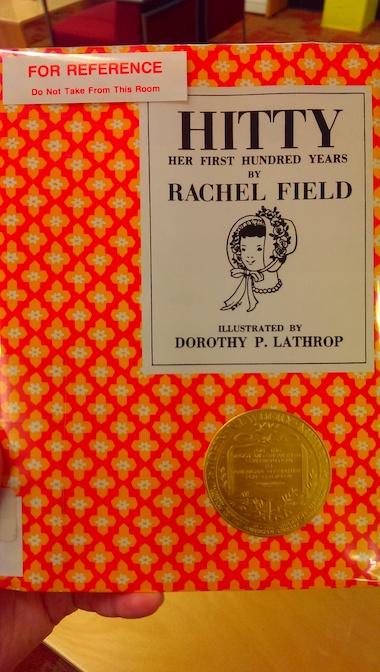
Hitty, Her First Hundred Years by Rachel Field, 1929.

Sometimes, I debate about how much detail I should use when describing the plots of books, but since this is such an old book and a more recently released version has altered the events in Hitty’s life significantly, I’ve decided to cover it in detail.  I do not have the updated version and haven’t read it, so what I describe below is the older version.  The book is episodic in nature, following the life and travels of a small doll named Hitty.  This book is a Newbery Award winner and is currently available online through Internet Archive (multiple copies).

These are the memoirs and adventures of a hundred-year-old wooden doll, which she writes as she lives in antique shop. She doesn’t recall exactly when she was made, but she knows that it was about a century earlier and that she was carved by a peddler in Maine for a little girl named Phoebe Preble.

HittyMemoirsThe peddler did some odd jobs for the Preble family on their farm that winter, while the weather was too bad for him to travel. They named the doll Mehitabel (a Biblical name from the Old Testament), and Phoebe nicknamed her Hitty. At her mother’s insistence, Phoebe made clothes for Hitty and embroidered Hitty’s name on the doll’s petticoat. Phoebe’s mother says that as long as she has her name on her clothes, she’ll always know what it is, whatever happens to her. Phoebe doesn’t see what could happen to Hitty because she wants to keep her forever, but Hitty is destined to live an adventurous life.

Phoebe misplaces Hitty more than once during their time together. The first time, she accidentally leaves her at church (when she wasn’t even supposed to bring her there in the first place). Then, Phoebe takes Hitty out to play one day, but she and her brother are frightened when they see some American Indians. (Phoebe lives in the early 1800s.) When they run away from the Indians, Phoebe accidentally leaves Hitty behind. Then, Hitty is picked up by a curious crow and carried to the tree next to the Preble house. She hangs from a tree branch for awhile before they realize that she is there and rescue her.

HittyShipwreckedThen, Phoebe’s father, who is the captain of a whaling ship, convinces his family to join him on a voyage. Life aboard ship turns out to be both exciting and perilous. One day, the ship catches fire, and the Preble family and all the crew abandon it. Hitty, once again, is unfortunately left behind. Although Hitty sees Phoebe gesture back at the ship and knows that Phoebe wants to return for her, it is too late for that.

However, luck is with Hitty, and instead of being burned, she is washed overboard as the ship goes down. Miraculously, she is washed ashore and found once again by the Preble family, who are now castaways on an island. They hope for rescue but fear the “natives” on the island. (Yep. “Savages”, “natives”, etc. These are sadly a common feature in vintage children’s literature. See Edward Eager’s Magic by the Lake for a funnier spoof version. The scene in this book is the sort of generic “savage natives” or “native savages” scenes he was making fun of, except that nobody tries any silly ooga-booga talk to communicate with them, and they don’t turn out to be cannibals. But, it does occur to me that if this book had been written in modern times, people would have insisted that the author give the proper name for the civilization on this island instead of just calling them “natives” and thoroughly research their actual habits and customs and present them in an informative, realistic way for the education of children reading this book, while writers and parents during this period didn’t seem to care about any of that.  Keep this in mind the next time someone tells you that younger generations are lazier and not as well-educated.)

One day, the natives come to have a look at the castaways, and their leader catches sight of Hitty and demands (through gestures) that she be handed over to him. Phoebe doesn’t want to give up her doll, but her father tells her that she has to. It turns out that the natives think that Hitty might be an idol that gives the castaways power, which is why they want it for themselves. Hitty is taken back to the natives’ village, and they use her as an idol themselves, making a little shrine to house her.

Hitty probably would have remained there if she had not been stolen from the temple by some curious monkeys and once again found by members of the Prebles’ party, who return the doll to Phoebe. Fortunately, the family sees a passing ship and manages to get rescued before the natives can come after Hitty again.

However, Hitty’s adventures are still not over. The ship that rescues them is going to India, and unfortunately, this is where Hitty and Phoebe are permanently separated when Phoebe loses her in a bazaar. Instead of being found by Phoebe or her family again, Hitty is found by a snake charmer, who uses her in his act, positioned near the snake. Even though Hitty is made of wood and not vulnerable to snake bites, she still finds the experience frightening.

From this point on (we’re about halfway through the story), Hitty changes hands repeatedly, gaining and losing owners every few years or so. Most of her new owners give Hitty a change of clothes, but they always keep her petticoat with her name still embroidered on it so, as Mrs. Preble once said, Hitty and her new owners always know her name.

An American missionary couple spot Hitty with the snake charmer and realize that her design looks like dolls in America. They have no idea how she got to India, but they buy her from the snake charmer and give her to their daughter, Thankful. Hitty lives with Thankful for a couple of years, and she enjoys her time with her, even though she really misses Phoebe.
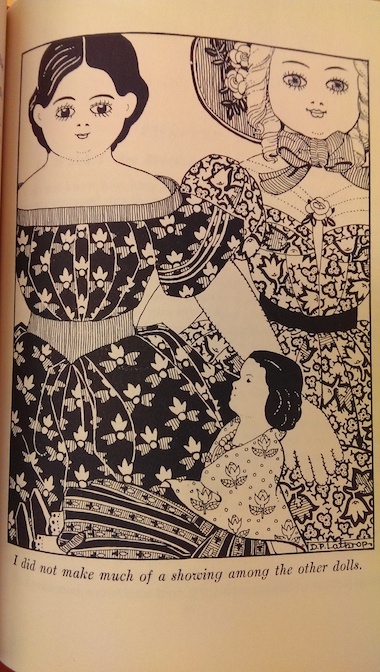
HittyOtherDollsThen, Thankful gets sick, and her parents decide that it might be time to send her home to the United States to stay with her grandparents. Thankful takes Hitty with her when she goes home to Philadelphia. Because Thankful’s early life was spent entirely in India, she has been unaccustomed to spending time with American girls her age, and she doesn’t know how to behave around the American children she meets when she first arrives in Philadelphia.  When the some of these (still 19th century) American girls first meet Thankful and Hitty, they think that Thankful is strange and make fun of her for her unusual habits and the way she dresses, telling her that her doll is ugly, too. Hitty has to admit that she isn’t as fancy as the other girls’ dolls. Thankful is so embarrassed by what the other girls say that she decides to hide Hitty in a sofa. After that, the sofa is taken up to an attic for storage, so Hitty remains hidden for a number of years.

HittyQuakerDuring her time in the attic, Hitty resents Thankful for abandoning her, in spite of all the charitable talk of her missionary parents. However, when Thankful is grown, Hitty is finally found by one of Thankful’s younger cousins, Clarissa Pryce, who really appreciates her. She doesn’t know how Hitty came to be in the attic, but thanks to the name still embroidered on Hitty’s petticoat, knows what to call her. Clarissa is a quiet, conscientious girl in a family of Quakers. She dresses Hitty as a Quaker girl, and Hitty lives with her for many happy years, learning to write as Clarissa goes through her schooling.

By now, the time of the Civil War is approaching, and Clarissa’s family are abolitionists. Hitty doesn’t really understand what the war was about, but she remembers being with Clarissa and watching soldiers march off to war. (This is where the updated version of the book differs greatly.  In the older version, Hitty doesn’t witness the war directly, but in the newer one, she does when she is sent to Charleston.)

Eventually, Clarissa gets older and is sent away to boarding school. Hitty is put into storage for awhile and then sent to the Pryces’ relatives in New York, along with some other things. However, Hitty’s package is misdirected and ends up being delivered to the wealthy Van Rensselaer family by accident. There, she is found by Milly Pinch, a seamstress doing some sewing for the Van Rensselaer family. Miss Pinch makes some stylish new clothes for Hitty, although she still lets her keep the petticoat with her name on it.

The Van Rensselaers’ young daughter, Isabella, sneaks into Miss Pinch’s room one day and finds Hitty, and a debate ensues about who really owns her. Mr. Van Rensselaer, on hearing where Miss Pinch found Hitty, says that rightfully, Hitty belongs to their family but that the clothes she is wearing are obviously Miss Pinch’s because she made them. Miss Pinch is gratified that he is being fair about it, but because Isabella really wants both the doll and clothes together, the family purchases them from Miss Pinch and gives her an excellent employment recommendation for her sewing.

Isabella is rather spoiled and has several dolls already, but she genuinely likes Hitty and takes care of her. Unlike Thankful, she even speaks up for Hitty when others say disparaging things about her plainness. While living with Isabella, Hitty even gets the chance to meet Charles Dickens. However, Hitty is stolen from Isabella by a gang of mean boys.

One of the boys in the youth gang takes the doll home with him and gives her to his younger cousin, Katie. The family is poor, but Katie loves her and gives her plenty of attention. When Katie gets sick and goes to live in the country for awhile, Hitty is accidentally lost in some hay and spends a long time in the barn, living with the mice.

When she is finally found, a pair of traveling artists are staying at the farm, and one of them keeps her to use as an artist’s model. He uses her to amuse children when he paints their portraits and even adds her into still life paintings. Hitty worries about how her painted features have faded, but the artist thinks that she’s much easier to paint than newer china dolls because the light doesn’t glare off of her. She stays with him for many years while he travels around the country, but he eventually leaves her with a pair of spinster ladies, Miss Hortense and Miss Annette, in New Orleans when he rents a room from them.

HittyBrideWhile living with these ladies, Hitty learns that Miss Annette’s fiancé died young, fighting for the Confederacy in the Civil War, and she still feels bitterly toward the North because of it. From her time with Clarissa, Hitty knows that many people in the North could say the same about the South, but of course, she can’t actually say so out loud. The ladies make new clothes for Hitty, dressing her as a bride, with her clothes made from an heirloom handkerchief, and put her on display at the Cotton Exposition (aka the 1884 World’s Fair). From there, Hitty is stolen by a little girl named Sally, whose father is the captain of a riverboat that carries cotton up and down the Mississippi River.

Hitty learns that Sally is a lonely child who travels with her father frequently because her mother is an invalid and cannot always take care of her. Sally knows that it was wrong for her to steal Hitty, but she so badly needs a companion that she is even willing to risk jail if it means that she can keep Hitty. However, after attending a revival meeting where there are warnings against the evils of theft and getting caught in a sudden thunderstorm, Sally panics, thinking that God may be about to strike her down for her sins, and throws Hitty into the river. (I found this scene a little disturbing because, when Sally fears that God will smite her with lightning for stealing, she not only makes a desperate apology but asks if anyone has to be struck, couldn’t it be one of the newly-baptized kids, who are sinless and would know that they were going to heaven? The fearful apology is understandable, but it’s a little disturbing to hear this little girl try to throw someone else under the bus like that.)

From the river, Hitty is rescued by a couple of black boys (the book says “Negro” because it was written in the 1920s) who are fishing. One of them gives Hitty to his sister, “Car’line.” (Her name is probably really Caroline, but Hitty just says the name as she hears it, and the boys have a Southern accent. This is one of those books where they try to give the impression of accents with odd spellings like, “How you come by dat doll?” It’s not the worst example I’ve seen of this, but I have to admit that I’ve never really liked the use of odd spellings like that.) Car’line’s family is the poorest one that Hitty has ever lived with, with a fairly sizable family living in a small cabin. However, Hitty likes the way Car’line treats her and how close her family is, and she loves the music that they sometimes play and the old spirituals that they sing.

At Christmas, Car’line’s family goes to a big party at a house that was apparently once an old plantation. The wealthier owners of the house give presents to the poor children of the area, like Car’line. While they are at the party, one of the women at the house, Miss Hope, recognizes Hitty from a newspaper report that a doll in heirloom clothing had disappeared from the Exposition in New Orleans. Car’line is upset when Miss Hope tells her that the doll really belongs to someone else and should be returned, but Miss Hope understands Car’line’s feelings toward Hitty and soothes her by giving her the doll she had played with as a child, a fancy French doll named Mignonette, as a replacement for Hitty.

As the end of the book draws closer, Hitty changes hands more often than before, and she doesn’t describe her time with new owners in as much detail, partly because her new owners tend to be adults and mostly display her, not play with her. Miss Hope attempts to return Hitty to the ladies in New Orleans, but since the heirloom handkerchief clothes are ruined, they decide that she should really be returned to the artist who had her before. When they try to mail Hitty to his address in New York, it turns out that he has moved without leaving an accurate forwarding address. Hitty spends some time as a package in the postal service, ending up in the dead letter office, where she is sold off, along with other undeliverable packages, to people who are willing to take a chance that there might be something interesting or valuable in them. She doesn’t spend much time with the man who bought her because her package is accidentally left behind at a tobacconist’s shop, where she is accidentally delivered to a house with an order of pipes. The lady of the house has been wanting to try a craft project for turning a doll into a pincushion, so she adds padding to Hitty and puts some pins in her (terrifying but not actually painful for Hitty). From there, Hitty is sold at a craft sale, where she is bought as a present for someone’s great aunt. The great aunt doesn’t think much of the pincushion, but her friend collects dolls and recognizes that Hitty is a collectable. For awhile, Hitty lives happily with the friend as part of her collection, until she is lost out of a car on her very first automobile ride. Then, she lays alone in the countryside, fearful that this is going to be the end for her, until she is found and rescued by some picnickers.
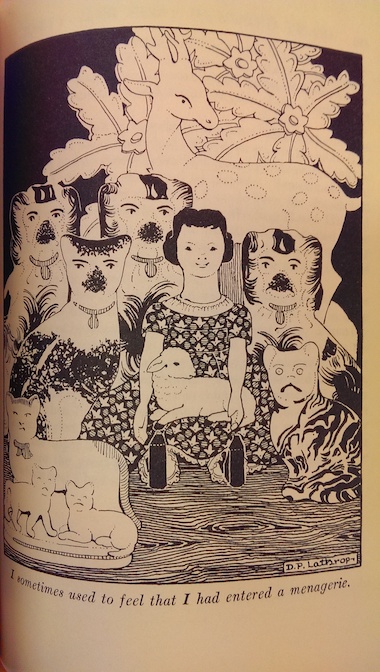
HittyCollectableIt is at this point that Hitty learns something astonishing: not only is she now about a hundred years old, but she has actually managed to make it back to her home state of Maine. To her further astonishment, she even returns to the Preble house where she originally lived, which is now the summer home of an elderly woman. Hitty knows that it’s far too late for her to have any hope of seeing Phoebe Preble again, and she never learns what exactly happened to Phoebe in her later life (which I thought was kind of a shame, bu it fits with the story of a doll, drifting from one owner to the next, unable to control her destiny or ask any questions of the people around her). The elderly lady collects antiques, and Hitty becomes a part of her collection, although the lady has no idea that this is Hitty’s original home.

Eventually, the elderly lady dies (it’s implied, but not stated – one summer, she simply never comes back), and her collection is auctioned off. Hitty is again surprised when she discovers that people view her as a valuable antique now. An Old Gentleman buys her at the auction, and when he takes her with him to New York, he comments that he supposes that it’s probably the first time she’s been outside of Maine and that her travels are about to begin. Hitty is amused.

At the end of the story, it is revealed that the Old Gentleman has purchased her for Miss Hunter’s antique shop, which is where she is now writing her memoirs. Miss Hunter and the Old Gentleman are delighted by Hitty and consider her a “museum piece.” Even though they could sell her, they don’t seem anxious to do so. She has become their shop’s mascot, and many people who visit the shop like to say hello to Hitty. Still, Hitty knows from her experiences that change is a part of life, and she is looking forward to seeing more changes in the world around her and the new adventures she may have with future owners!

My Reaction

In some ways, I was surprised by how much I enjoyed this story.  The length may seem a little daunting at first (262 pages about the adventures of a doll!), but the reading time is faster than you think, partly because of the episodic nature of Hitty’s life.  Books that are episodic can sometimes be a drag because, no sooner are the characters out of one situation, they plunge straight into another.  If it isn’t done right, it can leave the reader feeling like it’s all getting tiresome and repetitive and wondering where it’s all heading.  It’s a little different with Hitty, partly because the writing quality is good and partly because her owners and their lives are so varied.  I didn’t think much of the whole “natives” episode (because I never like “savage native” scenes in anything), but her other owners are a eclectic range of people, young and old, who have different interests and uses for Hitty.  Hitty ends up in some worrying situations, but you can feel reassured that she is going to be all right in the end because you know from the beginning that these are her memoirs that she is writing during the course of the story.

Hitty is unable to move around much on her own, which is part of the reason why she moves from place to place because of accidents or intentionally being carried or shipped by people.  However, she does seem to have the ability to move by herself in some small ways, such as writing her memoirs and when she tries to imitate Isabella’s dancing lessons, only to discover that she can’t quite do it because a doll’s legs aren’t jointed in the same way that human ones are.

Apart from the “savage native” scene, I don’t think the book was too bad, racially speaking.  I can’t recall any really objectionable terms being used.  Black people, when they appear, are called either “black” or “Negro”, and nothing insulting is said about them.  They are not treated cruelly in the course of the story.  Hitty enjoys her time as Car’line’s doll and doesn’t think badly of her or hold her in lesser esteem than other owners because she was poor.  The people in India aren’t described too badly, either, although Hitty thinks that the snake charmer was weird, and she seems to think well of the Indian nurse who took care of Thankful.  Thankful’s parents never discover that the Indian nurse gave her additional herbal remedies when she was ill, but Hitty appreciates the nurse’s devotion to the girl, doing everything she could to help her.  Hitty even says that she doesn’t know which medicines helped Thankful the most or if it was really the combination of all of them that saved her from her illness.

Some of Hitty’s owners are obviously nicer than others, with Thankful being arguably among the worst of them.  Even though Thankful’s upbringing is very religious, she and her new American friends are apparently rather shallow and thoughtless.  Even though her new “friends” in Philadelphia aren’t even nice to her, Thankful still worries about how she looks to them and is ready to chuck her beloved doll to please them.  Even spoiled little Isabella takes better care of Hitty and is more loyal to her, standing up to mean people as best she can instead of trying to appease them.

Mostly, Hitty prefers to be owned by young girls because she likes it when they play with her and carry her around, but she does enjoy being with adults who pay attention to her and treat her as a personality instead of as a mere object.  I was glad that none of the children Hitty lives with dies young, which could have been a risk in real life but would have been tragic.  Even with the elderly owner who presumably died, which was probably why her collection was being auctioned, Hitty never sees her die and doesn’t explicitly know that she is dead.  Whether Hitty will ever be owned as a child again now that she is considered an antique is unknown, but the author leaves the end of the story open, so just about anything could happen in Hitty’s future.

In a way, though, Hitty’s fate is already known.  Great Cranberry Island is the part of Maine where Hitty is supposed to have come from, and the Preble house is based on a real house. The story was based on a real doll that the author found in an antique store.  This doll is now at the Stockbridge Library Museum in Stockbridge, Massachusetts. There is also a cafe that is named after Hitty. There are fan sites dedicated to Hitty, some of which have tips for creating a doll very much like her.

The Headless Cupid

HeadlessCupidThe Headless Cupid by Zilpha Keatley Snyder, 1971.

This is the first book in the Stanley Family Mysteries series.  Some people might be put off by the occult themes in this book, but this is a mystery story, and all is not what it seems.  Read to the end or skip to the spoilers section to find out.

Eleven-year-old David Stanley has had to help take care of his younger siblings since his mother’s death.  In some ways, he feels like his mother knew that she was dying before anyone else did, preparing David to help his father by taking care of his younger sister Janie and the young twins, Esther and Blair.  David thinks that his mother might have been psychic because she tended to believe in some odd things and often knew things before other people did.

Now David’s father, a college professor, has remarried, to a divorced woman with a daughter of her own, Amanda, who is twelve years old.  David likes his new stepmother, Molly, who is an artist, and he appreciates having someone else to help take care of the other kids.  Amanda is a different story.  She was an only child before her mother’s remarriage, and she’s not happy to suddenly have step-siblings, some of whom are rather young.  Amanda has been unhappy in general since her parents’ divorce, and she wishes that she could go to live with her father full time. Her father says that he can’t take care of her because he has to work so much, but he spoils her whenever they spend time together.  David has doubts about the things Amanda says about her father, but he and the others try to make her welcome in their new home.

HeadlessCupidNewsWith their family suddenly much larger, David’s father bought a new house for them to live in.  Actually, it’s a very old house just outside of a small town.  People call it the Westerly house after the former owners.  Not long after the family moves in, they find out that people used to say that the Westerly house was haunted.  Mr. and Mrs. Westerly used to travel around the world with their two daughters because Mr. Westerly worked for the government, but after they settled down to a quieter life in this small town in the late 1800s, strange things started happening in their house.  Rocks would fly around the house, seemingly thrown by invisible hands, and someone (or something) cut the head off the carved cupid on the fancy staircase banister.  The head was never found.  These incidents were reported in the local paper, and people believed that the Westerly family was haunted by a poltergeist.  These hauntings seemed to center around the two Westerly girls, particularly the older one, Harriette, which made some people think that the girls were faking the poltergeist.  However, they were never able to catch either of the girls doing anything.  The strange activities finally ended when the girls were sent away to boarding school, but now that the Stanleys have moved into the house, strange things are starting to happen again.
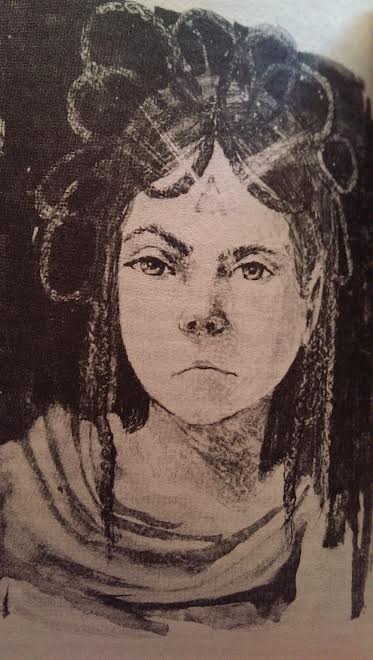
HeadlessCupidAmandaAmanda is fascinated by stories of the poltergeist.  A friend of hers where she used to live (one her mother didn’t approve of) was teaching her about the occult and how to do magic spells.  When David tells Amanda that he thought that his mother was psychic, Amanda is surprised, and she offers to teach David and the other kids about magic over the summer.  David eagerly accepts the offer because he finds the subject fascinating and because it’s the only thing that Amanda really seems interested in.  The other kids are also fascinated at the idea, even the littlest ones, which takes Amanda by surprise.  She had expected them to be scared.
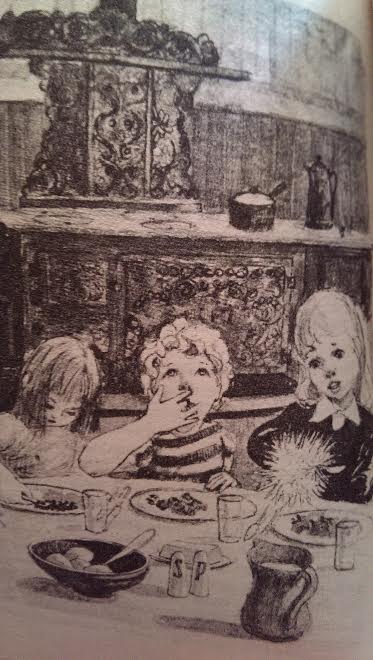
Still, Amanda begins leading the kids through a series of rituals that will supposedly initiate them into the occult world, all of which have to be done in secrecy, without the parents’ knowledge.  They have to do some bizarre things like spend an entire day not talking (they have to take turns so the adults won’t notice, and it’s harder for some kids than others), spend a day where they can’t touch anything metal (mealtimes are awkward), offer “sacrifices” to the spirits (basically giving Amanda things she likes), and find animals to be their “familiars.”  As some of these rituals and the kids’ strange, secretive behavior cause problems, particularly for David’s stepmother, David begins to suspect that Amanda’s “rituals” have an ulterior motive that has nothing to do with magic at all.  Then, the poltergeist activity begins.

HeadlessCupidKidsJust as with the Westerly family years ago, rocks are thrown around the house or found just laying around.  Things are broken in the middle of the night.  Have Amanda’s rituals somehow awoken the poltergeist once more?  David has his doubts, suspecting that it’s part of Amanda’s playacting, but she is accounted for when some of these strange things happen.  The younger kids are still more fascinated than frightened by these strange happenings, but their stepmother finds them particularly unnerving.

Then, just when David thinks that he understands the situation and Amanda seems to be calming down her occult talk and behaving more normally, something happens which is really inexplicable: the missing head of the cupid suddenly reappears.

This is a Newbery Honor Book.  It is available to borrow and read for free online through Internet Archive.

My Reaction, Themes, and Spoilers

The reason why I want to explain some of this is because I think this book has received some unfair criticism because of the “occult” themes in the book, and I want to clarify the situation for the benefit of parents and teachers who have not yet read the book and may be concerned.  I’m putting “occult” in quotes because, as I said before, that’s not really what’s going on.  The book is a mystery story, and the “supernatural” stuff is largely window dressing for the real themes of the story, which have to do with unresolved feelings and revenge.  The story even contains a kind of warning about getting involved with the occult, which is another reason why I think the criticism of this book is unfair.

That Amanda is faking at least part of the haunting is pretty obvious even early on, so I don’t think it’s much of a spoiler to say that.  Amanda is an unhappy girl whose life abruptly changed with her mother’s remarriage, and her occult talk and fake witchcraft are part of her way of dealing with her feelings.  She admits to David at the end of the story that she was purposely trying to frighten her mother, trying to “get even” with her for turning her life upside down, first by divorcing her father and then by getting married again, forcing Amanda to move to a strange town where she has no friends and live with a bunch of kids she hardly knows.  Getting to know her new siblings better and sharing adventures with them helps, but it takes the frightening moment when the cupid’s head suddenly reappears to get Amanda to admit that real occult stuff scares her, too, and to confess the truth of what she did and her real feelings to her mother.

HeadlessCupidDavidAmandaThere are some elements of the happenings, particularly the reappearance of the cupid’s head, that are never fully explained, although David ends up knowing more than Amanda by the end.  Some aspects of the situation are hinted at.  There may be a real supernatural event at the end of the story.  Blair appears to have inherited psychic abilities from his mother, and there is a distinct possibility that the Westerly sisters who once lived in the house were just as unhappy with their parents for the changes in their lives as Amanda was with her mother.  Although the “poltergeist” as it first appears doesn’t exist, it may be that the “poltergeist” of the past remembers what it was like to be young and unhappy and that she wanted to make amends for past wrongs and to help another troubled young girl to make peace with her life and family.  But, if you don’t like that explanation, there is a more conventional, non-supernatural explanation that David considers, which equally possible.  Personally, I think it’s a combination of the two, but it’s not completely clear.  I think the author left it open-ended like that to make readers wonder and to preserve the air of mystery after the other mysteries have been cleared up.
As a kid, I enjoyed the creepy aspects of the story and the sense of wonder the kids experience as they go through their “rituals,” trying to bring some magic to their regular lives, wondering if things like ghosts and magic can really exist.  Now, I more appreciate how Amanda researched tricks used by fake psychics and mediums and used them creatively to her advantage.  When I was a kid, I liked magic tricks, and psychics and mediums make use of those types of stage illusions and psychological tricks in their acts.  I still have some books on the subject myself.  I also like the way David sensed the truth behind Amanda and the strange happenings even though he didn’t really understand how or why it was done at first.  David has some genuine curiosity about magic, but even after he realized that Amanda was faking things and was disappointed by it, he didn’t immediately tell the others.  He could have unmasked her as a fraud, but he knew that would only earn her resentment.  He wanted to understand her motives and help her feel better, giving her the chance to make peace with her mother herself and become part of their family.

This book has been frequently challenged because of the children’s inquiries into the occult, but I would like to point out that their “occult” experiments were all fake, pretty obviously so, and it is acknowledged that Amanda’s interest in the occult was fueled by her emotional distress (part of her urge to “get even” with her mother by causing problems).  By the end of the story, Amanda and her mother have an honest talk with each other about everything.  Amanda admitts her true feelings and makes peace with her mother, and she also says that her mother explained some things that Amanda didn’t know before.  The book doesn’t say exactly what Amanda’s mother told her, but from the context, it’s probably something about the circumstances behind her parents’ divorce, something that they might not have wanted to explain to her earlier.  I have a theory about it, although there’s nothing explicit that I could point to to prove it.  I suspect that Amanda’s father had an affair and that the affair is continuing, which I think is the real reason why he doesn’t want Amanda to live with him full time.  If Amanda were to live at his house, she would be sure to find out the truth.  Maybe his girlfriend is even the housekeeper Amanda referred to, the one who doesn’t help take care of children because she’s “not that kind of housekeeper.”  That possibility didn’t occur to me when I was a kid, but it seems kind of odd for a single man, living without children or other people in his house or other household staff to manage and who spends a large amount of time working away from home, to even have a housekeeper instead of simply hiring a maid or cleaning service to come in from time to time.  Households with fewer people require less maintenance.  There is less laundry to do, and single people who work tend to eat out or order in pretty often or make very simple meals, so I doubt he even needs much help with cooking.  But, that’s just my theory.  No one ever says why Amanda’s parents divorced in the story.  The reasons are less important to the story than Amanda’s feelings concerning the divorce.  Some of Amanda’s earlier resentment toward her mother was fueled by things that her father told her, making it seem like her mother was the one who caused the divorce.  After talking with her mother, Amanda seems to realize that some of the nasty things that her father said about her mother may not have been true and that her resentment toward her mother for causing the divorce was needless.  Much of the story involves unresolved feelings and the need to communicate them honestly.

The difference between reality and perceptions is also important to the story.  Although Amanda at first tries to convince the other kids that she is an expert on all things magic, David soon realizes that she’s not: she acts like ordinary, easily-identifiable wild flowers are rare herbs, she can’t control her “familiar” because she has no idea how to handle animals, and when things happen that Amanda can’t explain, she’s the first to be terrified.  In the end, Amanda gives up on the idea of the occult completely, realizing that the things she did were wrong and that she had gotten involved in something that she really didn’t want to be involved in.  Many kids wonder about the supernatural when they’re young, and I don’t think it’s bad to point out to them that they if they experiment with such things, they may be getting involved in something they could regret and that they should consider their motives for wanting to do so.  Playacting when you know it’s pretend is one thing, but not knowing if the scary stuff is real is another.

For further discussion of the dynamics of the blended family in this story, I recommend the SSR Podcast about this book.  The podcast also points out that there is an incident in this story which might be racially problematic.

Anti-Plagiarism Check

I’ve been thinking about how my reviews could be used for plagiarism ever since I caught a couple of those essay-writing companies trying to follow my blog.  It’s difficult for me to review certain books without giving spoilers, but I’d like to point out that none of my reviews explain everything there is to know about the stories.  That would be completely impossible without reprinting the entire text of the book, which plagiarists are too lazy to read anyway.  There are certain plot points which only a person who has actually read the book would understand and be able to explain.  Teachers who suspect that a student has plagiarized a book review or only pretended to read the book should ask them to verbally explain the points that I have not covered in my review, giving them no chance to try to look up the answers elsewhere or try to find them by quickly skimming the book.  I’m not going to print suggestions for questions to ask here because I don’t want to give the plagiarists a hint, and I doubt that teachers who have read the book recently themselves would really need a hint, but any teacher who contacts me via their official school e-mail address can discuss it with me.  I know these stories well because I’ve loved them for years, and I’ve started a file with suggested plot points to discuss.  I will not send this information to anyone who does not contact me from an official school e-mail address.  Keep in mind that I can easily look up the name of the person who contacts me to determine whether I’ve been contacted by a teacher or a student.

It’s one thing for a student to want to discuss the book with someone to clarify confusing plot points, but it’s another to ask someone to do their homework for them.  I know the difference, and I know homework when I see it.  Let me explain something.  All WordPress blogs have built-in analytics, and I’ve been studying SEO, so I pay attention to who has been visiting my site and how they get there.  I know whether you came here by using a search engine or whether you were referred by another site, and I can also see search terms that you used.  I added this note to this review specifically because I noticed that someone has been trying to Google what are plainly homework questions, and I just got a site referral from an online plagiarism checker.  Yeah, I see what you did there.  This is the Information Age, and when you go looking for information, sometimes, there’s someone else looking back at you, even if you can’t see them.  Not everyone with a blog pays that kind of attention to their traffic, but some of us do, and while some may not say anything about it, some of us are also a little more vocal.  I saw what you did, and I didn’t like it.  I don’t know you, but I know you’re a fool, and your teacher has just discovered it, too.  Now, we’re all aware.  It’s your own fault, and it’s too late to whine about it now.  I do sometimes help people who ask for it.  You should have asked for help when you needed it instead of cheating and stealing my words.  Maybe next time you’ll ask for what you need instead of just taking what you want.

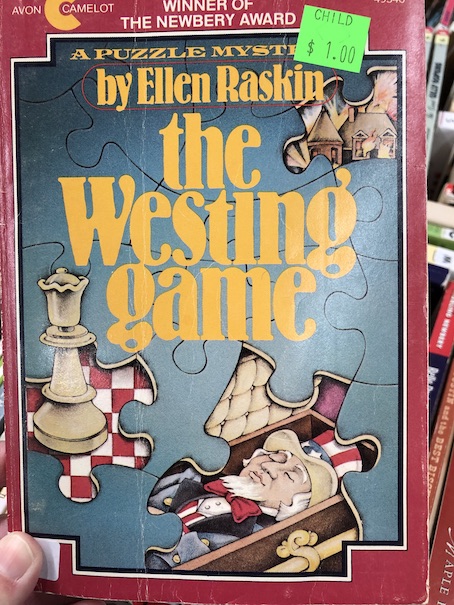
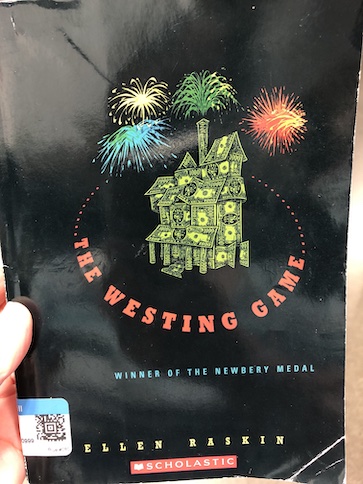
The Westing Game

The Westing Game by Ellen Raskin, 1978.

It all starts when a mysterious person invites six sets of people to live in the new apartment building, Sunset Towers.  Sunset Towers is a luxury apartment building, but the rent for these individuals and families is surprisingly affordable.  That is because these people are special, and the owner of these apartments is preparing for a very special game.  Although there doesn’t seem to be anything to tie these people together at first, they do share a special connection that isn’t immediately obvious, a connection to the wealthy but mysterious Samuel Westing.

Among the new tenants of Sunset Towers is young Turtle Wexler.  Although she is often in the shadow of her overly-shy but pretty older sister, Angela, she has ambitions of her own in life.  While her mother dreams of making it in high society, Turtle (whose real name is also something of a mystery to the other tenants for most of the book) wants to become a successful businesswoman when she grows up, and one of the things she wants most is a subscription to the Wall Street Journal.  To raise the money she needs, Turtle accepts a bet to sneak into the supposedly empty Westing House on Halloween night, earning $2 for every minute she spends there.  There are stories that the place is haunted and that Mr. Westing’s body lies rotting on an oriental rug there, but Turtle doesn’t believe them.  As it turns out, she’s right.  Instead, she finds Mr. Westing dead in bed.

To everyone’s surprise, the tenants of Sunset Towers are all named in the will, but not in an ordinary way.  In order to determine who the final heir will be, they must all play The Westing Game.  The heirs are divided up into teams of two and given $10,000 and a set of clues.  They must use these to give an answer at the end.  But, what kind of an answer?  Mr. Westing’s will implies that he was murdered, but is that really true?  Could his murderer even be among the heirs/game players?

As the book continues, readers learn more about each of the contestants.  Each of them has their own personalities, ambitions, and problems.  For example, Angela Wexler is about to be married but seems less than enthusiastic about the wedding.  Cristos Theodorakis suffers from a strange malady that keeps him confined to a wheelchair.  Sydelle Pulaski was actually invited to join the tenants by mistake, but it might be the best mistake of her life.  Mr. Hoo is worried about his restaurant, and Madame Hoo dreams of returning to China.

The competition is fierce in the Westing Game.  Players are suspicious of other players cheating.  Things around the apartments start disappearing, and some mysterious person has even started planting explosives in unlikely places!  Whether the thefts and explosions have anything to do with the contest itself is for the reader to discover, but there is an answer to the Westing Game, and only one of the contestants will discover it.

The book is a Newbery Award winner.  There is a movie version of the book called Get a Clue! (1997), although it doesn’t follow the book completely.  There are multiple copies of the book currently available online through Internet Archive.

My Reaction

One of the great things about the Westing Game is how the seemingly mismatched pairs of contestants actually complement each other, giving people new perspectives on their lives and the answers to problems that some of them have been struggling with.   Lonely Flora Baumbach, grieving for her deceased daughter, is paired with young Turtle, who finds in her a more motherly person than her own mother, someone who values her for her intelligence and her unique skills in a way that no one else does.  Mrs. Baumbach enjoys having someone to care for again, and Turtle blossoms under her care and attention.  Mr. Hoo, meanwhile, finds some unexpected support for his business from Mrs. Wexler, who develops broader interests in life than her previous social ambitions and an unexpected flair for business and marketing.  Judge Ford, who was educated by Mr. Westing and always worried about how to repay the debt, finally finds a way to repay his kindness, a way that Mr. Westing would have approved.  Bertha Crow, an unhappy woman who turned to religion to atone for past sins, finds new happiness with someone who understands and accepts her past and is willing to help her continue her good works.  Even Angela, who seems to have everything a young girl would want (good looks and a kind fiance with a promising future in medicine), figures out what she really wants in life and finds the courage to stand up for it.

A Year Down Yonder

YearDownYonderA Year Down Yonder by Richard Peck, 2000.

This is the sequel to A Long Way from Chicago. The story takes place shortly after the Great Depression, in 1937.

Times are still hard, and a recession has left a lot of people out of work again. Mary Alice’s father is out of work, and her brother Joey is out west working for the Civilian Conservation Corps. Because her family has to move to a smaller apartment, fifteen-year-old Mary Alice leaves Chicago to stay with her Grandma in the country for the year. Times are hard in Grandma’s small town as well, but Mary Alice’s Grandma is as wily and eccentric as ever.

Like the first book, this book is really a series of short stories about Mary Alice’s adventures with her Grandma during their year together. The stories generally have a hilarious turn as Grandma gets the better of everyone, often in the name justice or a good cause.  (Although, Grandma’s sense of justice is debatable since it involves “borrowing” pumpkins from the neighbors in the dead of night and other questionable activities.)

These stories present a detailed picture of rural life during the 1930s, from pranks played on Halloween to how Armistice Day was celebrated in the years following World War I, when people were still alive who had strong memories of that war. The stories also capture some of the personalities and politics of life in a small town, from a disreputable family of outcasts to the local elite, who have more money than the others and brag about having ancestors who fought in the Revolutionary War (which may or may not be so).

Rich Chicago Girl: Mary Alice arrives in Grandma’s small town and is enrolled in the local school.  She meets the class bully, and Grandma helps her to deal with her.

Vittles and Vengeance: At Halloween, Grandma gets revenge against a group of pranksters and raids her neighbors for ingredients to make the school Halloween party better.

A Minute in the Morning: Armistice Day, November 11, has more meaning for people who have actual memories of The Great War (World War I).  Grandma makes sure that those who can afford it pay what they owe to the veterans of that war and shows Mary Alice the price that some soldiers paid for supporting their country.

Away in a Manger: Mary Alice is picked to play Mary in the school’s Christmas Nativity play.  The baby Jesus turns out to be a surprise for the whole town, and Grandma arranges a special surprise for Mary Alice.

Hearts and Flour: The head of the local branch of the DAR pushes Grandma to make cherry tarts for their annual tea in honor of George Washington’s birthday.  Since she will neither allow Grandma to join the DAR (because Grandma doesn’t have the proper lineage) nor pay Grandma for her work (she thinks Grandma should ‘volunteer’ her services as part of her patriotic duty), Grandma insists that if she bakes, she must host the tea as well . . . with a couple of special surprise guests.  Meanwhile, a handsome new boy named Royce joins Mary Alice’s class at school.

A Dangerous Man: An artist working for the WPA rents a room from Grandma, treating Mary Alice and Royce to a scandalous but hilarious sight when his subject matter gets out of hand.

Gone with the Wind: A tornado sweeps through the town, and Grandma and Mary Alice go to check on residents who live alone.  Mary Alice also prepares to return home to her parents in Chicago.

Ever After: The final story in the book is about Mary Alice’s wedding, years later, toward the end of World War II.

This book is a Newbery Award winner.  There are multiple copies currently available online through Internet Archive.

Number the Stars

numberstarsNumber the Stars by Lois Lowry, 1989.

Annemarie Johansen is ten years old and living in Copenhagen in 1943.  Denmark is now occupied by the Nazis, and she and her little sister Kirsti have become accustomed to the sight of German soldiers in the streets and the food rationing and curfews that have come with the war.  But, there are still worse changes to come in their lives. Jewish people like Annemarie’s best friend, Ellen Rosen, are in danger.  The Germans have been closing businesses owned by Jews, and worse still, some Jewish families simply . . . disappear.

Annemarie comes to understand the disturbing truth behind many of the things that have been happening around her, including the sudden death of her older, grown-up sister, Lise.  Although she had earlier been told that Lise had been killed in an accident, what happened to Lise was no accident.  Lise and her fiance, Peter, were both part of an underground Resistance movement, working against the Nazis.  Peter is still part of the Resistance, and he calls upon Annemarie’s family to help him save not only Ellen’s life but the lives of other Jews who are in danger.

When the Johansens learn that the Nazis are looking for Jews from the register at the Rosens’ synagogue, Annemarie’s family takes in Ellen and pretends that she is their third daughter, Lise, while Peter helps to hide her parents make preparations to get them out of the country.  They journey to the seaside, where Annemarie’s Uncle Henrik prepares to help take the Rosens and others to safety on his fishing boat.  At first, Annemarie is angry that the adults are telling her things that she knows aren’t true and keeping secrets from her about their plans, but they tell her that it is for her own good not to know too much because they don’t want her to be too frightened with the details.  She soon comes to see their point because, as they set their plan into motion, Annemarie must perform an act of bravery for it to be successful.

Besides being an historical novel, this is partly a coming-of-age story as Annemarie goes from being an innocent young girl to being more fully aware of the problems and dangers surrounding her, her family, and her friends.  The title of the book comes from a Biblical quotation about how God “numbers the stars” and Annemarie’s thoughts as she considers her situation and the danger everyone is in.  Ellen’s mother said that she doesn’t like the sea because it is too big and too cold, and on a starry night in the middle of their peril, it strikes Annemarie that night sky and the whole world is like that, too: too big and too cold.  Annemarie thinks that sky is full of more stars than anyone can count, and the world situation and its complexities seem too great for Annemarie to fully grasp.  The immensity and  dangerous nature of it all frighten her.

Annemarie’s older sister, the grown-up child in their family, understood the complexities and dangers of the world and risked her life to fight for their country’s freedom, ultimately losing her life in the process.  Annemarie’s younger sister is still largely unaware of the risks her family is taking to save their friends, still thinking in her innocence that the explosions from the destruction of the Danish naval fleet when the Nazis invaded were “fireworks” for her birthday.  At the beginning of the story, Annemarie is between her two sisters: more aware of what is going on than Kirsti is but not aware of what her older sister did or knew.  By the end of the story, Annemarie has moved to a more grown-up understanding but uses her innocent, little-girl appearance to fool the Nazis into thinking that she is just an ignorant child so they will be less suspicious of her.

Although this story is fiction, similar incidents happened in real life when people took great risks to help Jewish people escape from the Nazis. In the back of the book, there is an Afterword that explains more about the historical events behind the story.

This book was a 1990 Newbery Award winner.  It is currently available online through Internet Archive.