Tools of Native Americans

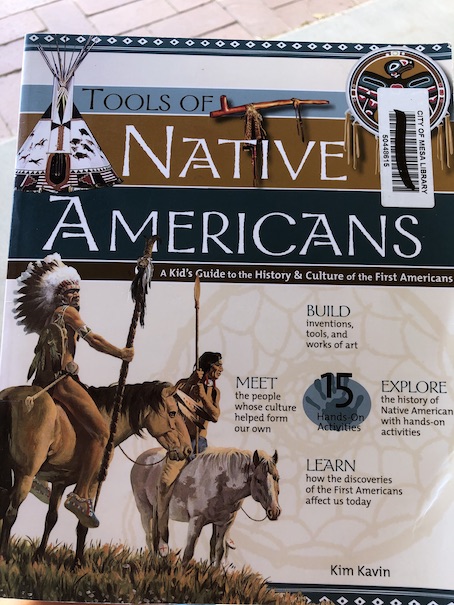
Tools of Native Americans by Kim Kavin, 2006.

This nonfiction book is part of a series recommended for kids ages 9 to 12. It provides insights into the daily lives of Native Americans of the past by explaining their tools and inventions. I was intrigued by the idea immediately because I love books that give insights into history through the lives of ordinary people.

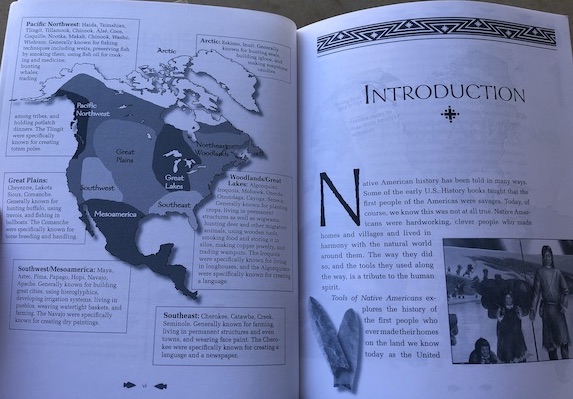
The book is divided into time periods and geographic areas of North America. At the beginning of the book, there is a timeline of important events in the history of North America and Native American culture, beginning c. 20,000 to 8000 BCE, when the ancestors of Native Americans are believed to have migrated to the continent and ending in 2006, the year the book was published. There is also a map showing major geographic regions of North America and the Native American tribes that live there. The chapters of the book are mostly grouped by region, except for the first two, which are about the First Americans and Archaic and Formative Periods.

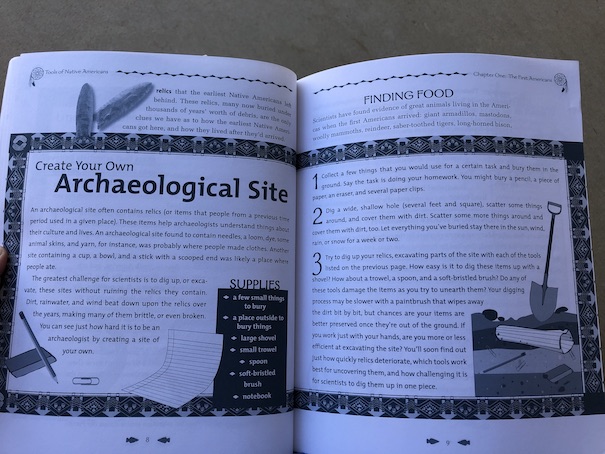
The first chapter, called The First Americans, discusses theories about how the ancestors of Native Americans first arrived on the continent from Asia. The exact circumstances of their arrival are unknown, but there are some possible migration paths that they could have taken. The chapter discusses the Ice Age that existed when this migration took place, how people found food, and Clovis culture, one of the earliest known civilizations in the Americas. One of the activities from this section is about archaeology, which is what we use to learn more about ancient civilizations that did not leave written records, and how to create an archaeological site of your own.

The next chapter is about the Archaic and Formative Periods, which were characterized by climate change as the Ice Age came to an end and many plants and animals that had thrived in the colder climate died off. The changes in the environment cause Native American groups to make changes in their own lifestyles. Rather than relying on herds of large animals for food, they began cultivating crops. They made pottery and developed new cooking techniques. They still hunted, using a device called an atlatl to throw their spears further and with more power. Civilizations like the Maya flourished.

After the second chapter, the other chapters discuss tribes by region:

The Northeast Woodland and Great Lakes Tribes – The Algonquian and Iroquois

This chapter discusses Native American tribes from the East Coast to the Midwest, around the Great Lakes, who primarily lived in woodland areas. The Iroquois and the Algonquian were both collections confederated tribes. There is information about the Algonquian language, which contributed some words to English, including moccasin, succotash, hominy, hickory, and moose. There is also an activity about creating Algonquian style pictographs and petroglyphs.

The Southeast Tribes – The Cherokee, Catawba, Creeks, and Seminoles

The tribes in this chapter lived in and around the Appalachian Mountains. It explains about Sequoyah, who developed a system of writing for the Cherokee language.

The Great Plains Tribes – The Cheyenne, Lakota Sioux, and Comanche

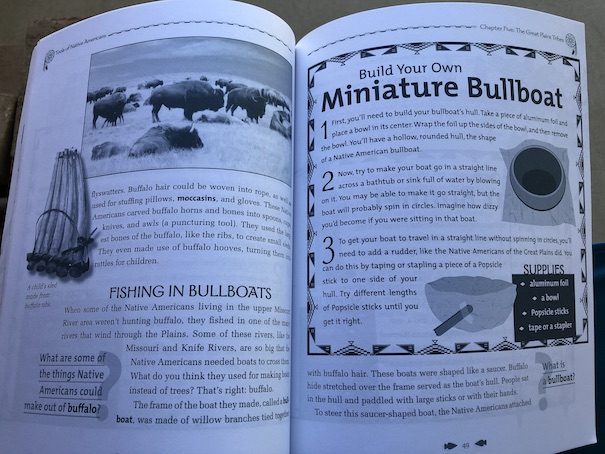
The tribes of the Great Plains were migratory, following herds of buffalo, which were a primary source of food. Because they moved often, everything they owned, from the tepees where they lived to the tools and other objects they used, had to be easily portable. The Comanche were particularly known for being expert horsemen. This chapter also discusses the Lewis and Clark Expedition and Sacagawea, who was part of the Shoshone tribe from the Rocky Mountains. She had been abducted when she was young, and when she joined the Expedition, she was able to guide Lewis and Clark and their men back to the territory she had known when she was a child and to the Pacific Ocean. Activities for this chapter include making a rattle of the kind children used as toys, making a miniature bullboat, and making a war bonnet (using pieces of poster board instead of feathers).

The Southwest and Mesoamerican Tribes – The Hohokam, Mogollon, Anasazi, Maya, Aztec, Hopi, Apache, and Navajo

I know this area because this is where I grew up. Much of it is desert, and the book is correct that there can be sharp differences in temperature between day and night. In modern Southwestern cities, buildings and pavement can hold in heat even at night, but there isn’t much to hold in heat in the open countryside, not even much humidity in the air to hold heat once the sun goes down. There is an abundance of clay in the soil in this region which local tribes used to make pottery and adobe homes.

Among the civilizations discussed in this section are the Hohokam, whose name means “Vanished Ones” (I’ve seen different versions of the translation of that name, but they’re all words to that effect – that they are gone, vanished, disappeared, etc.) because, for unknown reasons, they seem to have suddenly abandoned the area where they had previously lived and farmed for generations. They don’t seem to have died off, at least not all of them. It’s believed that they were the ancestors of the Pima and Tohono O’odham tribes, and the book discusses that a little further on in the chapter. There is a Pima story about a fierce rainstorm and a massive flood that killed many people, but The Hohokam were the ones who built the original irrigation canals for watering their crops. Later, when settlers came from the Eastern United States, they found these abandoned canals, dug them out, and started using them again. The canals are still in use today, and one of the activities in this chapter of the book is about irrigation.

This section of the book also covers the Maya and the Aztecs, who lived in what is now Mexico and Guatemala. There is an activity about creating hieroglyphs, like the kind that the Maya once used.

In the part that describes the Navajo, there are activities for sand painting and Navajo-style jewelry.

The Pacific Northwest Tribes – The Nootkas, Makahs, and Tlingits

Much of this chapter discusses hunting and fishing and the preservation of food. Because food-related work mostly took place during a single season due to the severity of the winters, there were periods of time when the members of the Pacific Northwest Tribes had time for social and artistic pursuits. The book explains the meaning of totem poles, and there is an activity for readers to create their own.

The Arctic Tribes – The Inuit

The lives of the Inuit were shaped by learning to live in a very cold environment. The book explains how they built igloos out of packed snow and ice, but really, igloos were temporary shelters. The houses they lived in long term where made of sod and were partially built underground for insulation. There are activities for building a snow cave called a quinzy (this requires that you live in a place with snow) and for playing a game called Nugluktaq.

The last chapter in the book is called New Immigrants, Manifest Destiny, and the Trail of Tears. It’s about how European settlers arrived in the Americas, the westward expansion of the United States, and the confinement of Native American tribes to reservations.

The book ends with an Appendix with further information about Native American Sites and Museums State by State. There is also a glossary, index, and bibliography.

How Did They Live? Greece

How Did They Live? Greece edited by Raymond Fawcett, 1951, 1953.

This is a non-fiction book, part of a series about life in the past, but it’s told in the form of a story where the readers are visiting a man living in ancient Athens named Simonides. The story is told from the point of view of “we” as “we” visit Simonides, and he shows us around Athens.

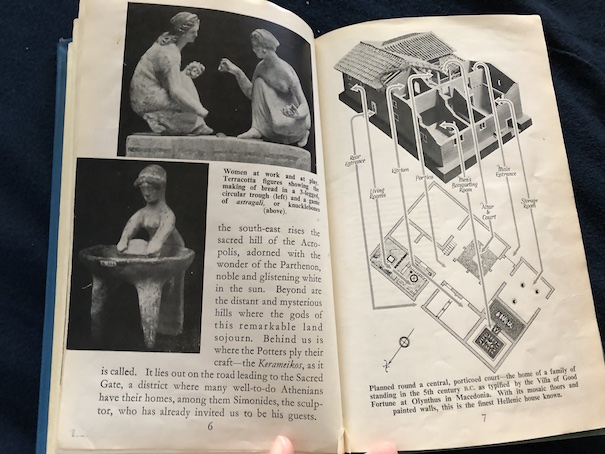
At the beginning of the story, Simonides meets us at the Temple of Hephaestus. The book provides a map and a description of the city so we know our way around. Simonides is a sculptor, and he lives in a nice house in an area of the city with well-to-do people. The book provides a map of the interior of Simonides’s home. His house is bigger and nicer than those of poorer people, and he also owns slaves. (The women playing a game on this page are playing Knucklebones, a precursor to modern Jacks but played with animal bones.)

Athens, like other cities in Greece at this time, is actually a city-state, an independent state with its own government, separate from other Greek city-states. Simonides explains that he served in Athens’s army when he was younger. Now, as a sculptor, he works with an artist producing public art in Athens. During a war with Sparta, many homes and buildings were badly damaged, so they’ve been rebuilding what was ruined and creating new public monuments.

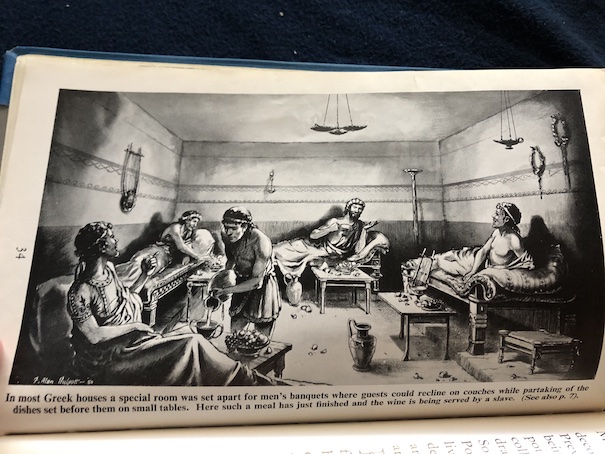
Simonides takes his guests into a special dining room, where we can relax. Guests are only allowed into areas of the men’s quarters of the house. The women’s quarters are strictly private, and we are told that the women in Athens spend most of their time at home, tending to household tasks. Usually, they only go out for special occasions, like festivals or plays. The Athenian women do not have the rights to property and having a say in public life that the men do. However, women from wealthy families lead comfortable lives and authority with in their houses. The book puts it, “Besides running the household she has her little vanities and the universal feminine interest in dress and adornment to help her and, in spite of her seclusion, she contrives to keep herself pretty well informed about what is going on in the city.” The part about the “little vanities” seemed a little insulting to me because I personally don’t like vain and shallow women who can’t think outside of the clothes closet, and I know plenty of women who aren’t in clothes and fashion. It seems like one of those cases where interest in these things might not really be “universal” but it’s something that women do because there just isn’t that much else for them to do. If they had more options of other activities, some of them might have found other things to do. The book goes on to describe various styles of women’s dress, hair, and makeup.

As the guests, we are invited to spend the night at Simonides’s house, and the next day, slaves bring us water to wash in and a breakfast of pieces of bread in wine. Then, we visit the agora (marketplace) with Simonides. There are people hanging around, socializing with friends, and the book describes the tunics and mantles they wear. After Simonides makes his purchases, he has his slaves carry them home. As we wander through the public meeting places, Simonides explains about the local philosophical groups that meet there, like the Stoics. We even meet Socrates as a young man.

After the shopping and visiting the public meeting places, we return to Simonides’s house for the midday meal of fish, vegetables, fruit, and bread. After the meal, Simonides’s wife, Hestia, explains more about the lives of women and children in Athens. As explained before, women have fewer rights than men, and female children do not receive as much education and training as boys do. Children younger than seven are all raised in the women’s quarters of the house. They play with toys like rattles, dolls, balls, spinning tops. Girls like to play on swings and see-saws and learn to dance, while boys play with kites, hoops, and hobby-horses. They all listen to stories like Aesop’s Fables to learn moral lessons. At the age of eight, boys begin to go to school, and at the age of eighteen, they join the army. Meanwhile, girls are taught to handle domestic tasks.

After that, we make a visit to the Acropolis to see the Parthenon, which is the Temple of Athena. The carved figures in the pediments of the building tell stories from the life of Athena. That evening, Simonides invites some friends to the house for a dinner party in his banquet room, where people eat while reclining on couches.

The next day, we learn about pottery and how it is made. The book describes the types of pictures and designs painted on pottery and says that the style with red figures painted on a black background is a newer style. Before, black figures were painted on a red background.

Toward the end of the book, we attend the Panathenaic Festival, which is meant to honor Athena. The festival includes athletic competitions and music and literature contests. There is a procession of important public officials and animals to be sacrificed to Athena. We (the guests) ask Simonides to explain more about the religion and gods of Ancient Greece, and he does. Religion is an important part of public life in Athens, but the book includes a suggestion that Simonides might not actually believe in the gods and goddesses of Ancient Greece: “We do not ask Simonides if he himself believes in these gods. But we have an idea that, like many other Grees, he may not do so, for he suggests that a knowledge of the gods has been handed down from the poets of old and the sculptors have clothed the ancient myths in beautiful forms.” That’s not much of an explanation, although I suppose it’s reasonable that people would believe in the religion of Ancient Greece to varying degrees, and there would have been at least some disbelievers. That’s found in pretty much every religion. There are also people around the world in modern times who engage in religious traditions less out of personal belief than out of civic or cultural participation (like this description of Shinto in modern Japan), which is the implication about the people in this story.

The book ends with a visit to Olympia to see the ancient Olympic Games.

My Reaction

I love books that explain daily life in different time periods, and I thought this one was pretty well done. It covers a few days in the life of Ancient Athens and also does a good job of explaining the wider society of Athens. Most of the perspective is on a fairly wealthy family and their slaves. I found parts about the descriptions of the lives of women and slaves distasteful, but the descriptions and attitudes of the people seem pretty accurate for the time and place. My feelings were more about not liking the lifestyle and circumstances than about disagreeing with the author. There are more details about the raising and schooling of children and about food and clothing than I’ve included in this description.

I particularly liked the maps of the city and the interior of the house. I also liked the way they included Greek words and explained their meanings, like kerameikos (pottery, note the resemblance to the word “ceramics“). Even though I took a philosophy class in college and learned about the Stoics, I didn’t remember the professor explaining that the origin of the word “Stoics” was the stoa, the public gathering place like a covered porch where they would meet.

I was confused for a moment when the book explained that Simonides doesn’t bow when he meets people “as we would do.” As an American, I wondered, “Who’s ‘we’?” Americans aren’t in the habit of bowing to random people we meet on the street, either. I checked, and the book was printed in England. British spellings in the book (“honour” vs. “honor”) also confirm that this is a British book. I didn’t think that people in England in the 1950s bowed to people either, except maybe during important events with royalty and nobility. The most I would ordinarily expect would be a nod or bow of the head to acknowledge other people, and people in the US do that, too.

For Those Thinking of Notre Dame …

Sometimes, current events remind me of the events of children’s books. I debated about bringing this one up because I haven’t gotten hold of this particular book recently (partly because I’m probably not the only person who’s thinking about it right now), and I don’t have a proper post prepared for it, but years ago, a teacher introduced my class to Cathedral by David Macaulay. David Macaulay wrote a series of children’s books, explaining the architecture of historical buildings, including one about the construction of Gothic cathedrals, like Notre Dame in Paris.

The pictures in these books are fascinating, which is why I’m sorry that I don’t have a proper post prepared with example pictures. (I’ll probably do one later, when I can get hold of the book again) The book is available in multiple copies through Internet Archive, although there is a waiting list to get it right now.

However, the book was also made into a documentary film. Part of the story-line involves a fictional Medieval town replacing their cathedral after their first cathedral was destroyed by fire. (In the book, the cathedral was damaged by lightning, not destroyed by fire. The two stories aren’t the same.) This fictional cathedral serves as an example of the process of constructing a Medieval cathedral and the difficulties and dangers it might involve. The story of the town alternates with explanations about the history and architecture of cathedrals. This short clip explains the basic architecture of a Gothic cathedral, using Notre Dame as an example toward the end.

One of the aspects of the story that I find most inspiring is the dedication that the people who funded and built the cathedral showed. The construction of a cathedral in the Middle Ages could take a lifetime or even longer, and not everyone who began the task would live to see its completion. Their motivation was not mere personal gain but a glorious accomplishment that would both honor their beliefs and last far beyond them.

I’m not sure how long it will take to complete the renovations after the fire that damaged Notre Dame, but whatever it takes, I’m sure it will be worth it.

Cheaper By the Dozen

CheaperDozen

Cheaper By the Dozen by Frank B. Gilbreth, Jr. and Ernestine Gilbreth Carey, 1948.

These are the real reminiscences of children from the Gilbreth family about their unusual childhoods during the 1910s and 1920s.  There are a couple of movies based on this book, including the 2003 movie that features the dad who is a football coach, but that story is fictional and bears almost no resemblance to the actual lives of the real Gilbreth family.  The older 1950 movie with Myrna Loy as the mother is closer.  The only parts that they have in common are that there were a dozen children in the family, and they had some unusual systems for handling their chaotic household.

The father of the Gilbreth family, Frank Gilbreth, Sr., was a motion study and efficiency expert.  He was one of the early pioneers in the field, studying the ways that people do things, whether it was routine household chores or making things in factories and trying to find ways to help them perform their tasks more efficiently.  Saving time was a passion for him, and he often used his own children and household as guinea pigs for his projects.  His wife, Lillian Gilbreth, was also a psychologist and engineer and was his partner in his work, continuing it after his death.

Part of the reason Frank Gilbreth was so interested in efficiency was that, in his early life, he worked with his hands and built a reputation as an efficient worker.  Later, he also learned that he had a heart condition that might cause him to lead a shorter life.  He had wanted a large family, and he and his wife had agreed that they wanted an even dozen of children, six boys and six girls.  He got his wish, but he was concerned about helping his children to make it as far as they could through school and giving his large household a structure that would last even after he died.

The stories in this book are mostly funny stories as his children fondly remember the things their father taught them and the usual systems in their house that were designed to keep a dozen children in order.  The stories jump around a bit in time, and it isn’t always clear exactly which children were alive at certain points in the stories.  Whenever Jane, the youngest, is mentioned, the stories take place between 1922 and 1924, and there should be eleven living children in the family at most.  Although the Gilbreths did have a total of twelve children, as they had hoped, they were all single births (no twins or other multiples), spaced out over 17 years.  Also, although this book does not mention it (the sequel, Belles on Their Toes contains a brief footnote), one of the older girls in the family (Mary) died very young of diphtheria, before her youngest sister was born, so there was no point at which all twelve children were together.  Even so, the Gilbreths always referred to their children as their “dozen,” and the stories make it sound like all twelve were together.  (This article explains a little more about Mary’s death and its effect on her family and the reasons why the books explain little about it.)

The children’s birth order isn’t specified in the stories, but for reference, these are their birth and death dates (courtesy of Wikipedia):

Anne Moller Gilbreth Barney (1905-1987)

Mary Elizabeth Gilbreth (1906–1912)

Ernestine Moller Gilbreth Carey (1908-2006)

Martha Bunker Gilbreth Tallman (1909-1968)

Frank Bunker Gilbreth Jr. (1911-2001)

William Moller Gilbreth (1912-1990)

Lillian Gilbreth Johnson (1914-2001)

Frederick Moller Gilbreth (1916-2015)

Daniel Bunker Gilbreth (1917-2006)

John Moller Gilbreth (1919-2002)

Robert Moller Gilbreth (1920-2007)

Jane Moller Gilbreth Heppes (1922-2006)

Wikipedia also claims that there was a thirteenth baby, an unnamed stillborn daughter, but this child isn’t mentioned in the books, and I don’t know for sure if that’s true.  Most of the children lived to adulthood, married, and had children of their own.

Racial Language Warning: I usually make notes about racial language in the books I review.  There are a couple of things I’d like to point out, although I also have to point out that, since this book is non-fiction, the people writing it were quoting people from memory.  Just be prepared for a few things that people said back in the 1910s/1920s that wouldn’t be acceptable in modern speech.  They aren’t central factors in the stories, but they are there.  For example, one of the children’s grandmothers used to get dramatic when threatening the children with punishment and say that she would “scalp them like Red Indians.” (I’m not completely sure if she meant that the Indians would get scalped like that or do scalping like that, but I’m guessing that she probably wasn’t being particular.)  The mother of the family also frequently used the word “Eskimo” to describe bad language or “anything that was off-color, revolting, or evil-minded.”  Most of the time in the book, she says it kind of like the way some people say, “Pardon my French” when using bad language, and her definition of bad language was pretty mild.  I’ve never heard the word “Eskimo” used in that sense anywhere else, and it makes me cringe here.  There is some pay-off to the word when a couple of pet canaries whose full names the mother had declared were “Eskimo” escaped during a boat ride, and one of the kids tries to explain to the boat captain that he’s upset about “Peter” and “Maggie” being lost but he can’t say their last names because they’re “Eskimo,” making the captain think that a couple of Alaskan natives have mysteriously disappeared over the side of his boat.  It reminded me of something similar in Fudge-A-Mania, where Fudge accidentally made people think that his lost pet bird was his crazy uncle.  When sharing this book with children, like other older books, it might be a good idea to make it clear that they shouldn’t try to imitate some of the expressions the book uses because it might cause problems and misunderstandings.  There is also a Chinese cook in one chapter who speaks a kind of pidgin English that no one should imitate, either.

Overall, these are calm, funny stories about a somewhat eccentric family that can make nice bedtime reading.  The book is currently available online through Internet Archive.

Chapters

Each of the chapters in this book talks about a different topic or period in the family’s life:

CheaperDozenShavingWhistles and Shaving Bristles

Introduces the father of the family and his experiments in motion study.  Frank Gilbreth was highly self-confident and frequently took at least some of his children (and sometimes the whole family) with him on visits to factories where he was helping to increase their efficiency.  He gave the children notebooks and pencils and had them take notes about what they saw.

To keep the household orderly and make sure that each child got ready for school on time and did their chores and homework, the parents instituted a chart that each child had to initial after completing certain routine tasks such as brushing teeth or making beds, and there was a special whistle that their father would give to get all of the children to come quickly for a meeting.  The father would sometimes take moving pictures of the children doing chores, like washing dishes, so that he could study their motions and determine if there were wasted motions that could be eliminated so that the task could be completed more efficiently.  He also used himself as a guinea pig, always trying to do daily tasks, like buttoning his coat or shaving, more quickly and efficiently.

Pierce Arrow

The family moves from their home in Providence, Rhode Island, to Montclair, New Jersey.  This chapter explains the move and also the father’s love of practical jokes.  Before taking the family to their real new house, he takes them to one that’s really old and run-down so that the new one will look that much better when they get there.  When they get their large Pierce Arrow car, big enough to carry the whole family, the father tricks each of the kids into looking for the “birdie” in the engine and then honks the horn to scare them.  He thinks it’s funny until one of the kids does the same thing to him.

CheaperDozenCarOrphans in Uniform

This chapter explains that the mother of the family was a psychologist.  While the father instituted systems and dealt out discipline, the mother was often the one who made the systems work, resolving conflicts among the children and making sure that everyone was doing what they needed to do and that they had everything they needed.  Older children also helped by looking after a designated younger sibling.

Much of the chapter explains how things often happened on family outings.  They always took roll call because there were a couple of incidents when children had been left behind by accident on earlier trips.  As a large family, they also attracted a lot of attention.  Sometimes, their father would try to get discounts on things like ticket prices and toll booths by pretending that his children were the nationality of whoever seemed to be in charge, and he was pretty good at guessing that correctly.  All of the Gilbreths were either blonde or red-haired, so Mr. Gilbreth was known to gleefully pretend that they were Irish, when in fact, their heritage was Scottish.  He always thought jokes like that were funny, but finally his wife and children put a stop to his playacting the day that the family was mistaken for an orphanage on an outing.

Visiting Mrs. Murphy

The family enjoyed going on picnics together.  While they were eating, the father would often try to squeeze in an educational lesson, pointing out things like the way ants work together, how a nearby bridge would have been constructed, or what was going on at a nearby factory.  The children learned a lot from him, especially how to notice details in the world around them, but they noted that it was their mother who often put the lessons in perspective for them by pointing out the human side of each of these things, such as describing the fat queen ant in a colony with all of her slaves (their word, I’ve usually heard them referred to as “workers”, but you get the idea) waiting on her or the workmen on a construction project in their jeans, stopping for lunch.  Their father was also pleased by the mother’s descriptions, which complemented his lessons so well.  These stories help explain how the parents worked well together as a team.

The “visiting Mrs. Murphy” was a euphemism for going to the bathroom in the woods because the family didn’t really trust public restrooms.

Mister Chairman

This chapter explains a little about Frank Gilbreth’s youth and how he got his start.  His father died when he was young, and his mother encouraged her children to get the best education they could.  However, Frank Gilbreth decided to get a job instead of going to the Massachusetts Institute of Technology like his mother planned because he was concerned about the family finances and his sisters’ education.  He became a bricklayer and drove his supervisor crazy because he always had tips for working faster and more efficiently.  Eventually, the supervisor adopted some of his suggestions, and Frank discovered his passion for motion study.  He worked his way up in construction until he became a contractor, and he was also hired to study working methods in the factories he built.  He became a wealthy man and met his wife as she passed through Boston on her way to a trip in Europe.  Lillian was from a wealthy family in California, and she had a college degree in psychology.  Although many people didn’t take female scholars seriously in those days, Frank did, and the two of them became a team, both personally and professionally.  They were both interested in the psychology of management, and they applied many of the principles from the professional world to their household and vice versa.

To help organize household tasks and make family decisions, Frank created a Family Council with himself as the Chairman and his wife as the Assistant Chairman that was similar to an employer-employee board.  For the most part, it did help to keep order in the family, but once in a while, the Chairman was overruled, including the time when the children ended up persuading their parents that they should get a family dog.

Touch System

This chapter goes into more detail about how responsibilities and chores were assigned in the family.  It also describes how the father arranged to make best use of “unavoidable delay” in the bathroom by putting Victrolas with language lessons in the children’s bathrooms, so they could learn while bathing or brushing their teeth.  He also taught them how to take baths efficiently, so that they could be in and out of the bathroom as quickly as possible.  Mr. Gilbreth took every opportunity and free moment to improve his children’s minds, including teaching them ways to perform complex math problems at the dinner table.

While working as a consultant for the Remington typewriter company, Mr. Gilbreth developed a system for teaching touch typing, and he taught it to his children.
CheaperDozenSchoolSkipping Through School

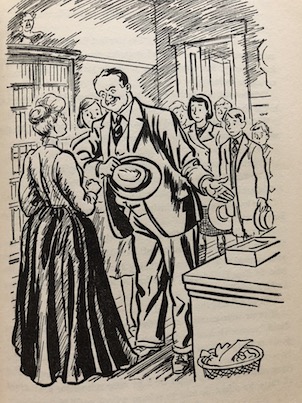
Not knowing how long he was going to live, Mr. Gilbreth was anxious to see as many of his children get through school as he could, and he had great confidence in their abilities, so he often pushed his children to skip grades in school, using persuasion and his bombastic personality to get their schools to agree.  The children’s mother, however, saw her children more as individuals who needed time to grow up emotionally and socially as well as intellectually and tempered her husband’s enthusiasm for skipping grades.

The parents also had their children attend church and Sunday School, although the father wasn’t very interested in organized religion.  Lillian volunteered for a number of church projects and committees.  Once, as a joke, a friend of hers who had eight children of her own, referred her to a birth control advocate who was looking for someone local to volunteer to promote the movement.  The friend thought that it was a great joke, and the family saw the humor and made the most of it when the advocate showed up at their house.

Kissing Kin

When the United States joined World War I, Mr. Gilbreth offered his services to the U.S. Army.  While he was working at Fort Sill, Mrs. Gilbreth took their children (they had seven at the time) to visit her relatives in California.  The Mollers were a wealthy family, and the children enjoyed being spoiled by their grandparents and their aunts and uncles after the arduous train journey there.

Chinese Cooking

At first, the children felt like they should be on their best behavior when visiting their grandparents and aunts and uncles.  However, the adults were a little worried about how subdued the children were, and constantly being on their best behavior grew more difficult for the children.  One day, when the adults made the children wear new outfits that they hated for a special party, the children finally rebelled and got them all wet by playing in the garden sprinklers.  From then on, everyone was much more relaxed and informal.

The grandparents had servants, and Billy became rather attached to their Chinese cook, Chew Wong (I’m not completely sure if “Chew” was his real name or a nickname), who was known for being somewhat temperamental.  The cook enjoyed Billy’s company also, although when Billy got troublesome, he sometimes picked him up, held him in front of the oven, and threatened to cook him.  It was an empty threat, but one day, Billy (five years old at the time) pushed the cook when he was standing in front of the oven, also joking that he was going to cook him, and the cook apparently got his hands burned.  (This incident alarmed me a bit.  It seems that the cook wasn’t badly hurt, but still, that’s the kind of problem that horseplay like that can cause, and it could have been really serious.  The cook is described as speaking a kind of heavily-accented pidgin English.)

On the way home, all of the children came down with whooping cough.  When they picked up Mr. Gilbreth, Mrs. Gilbreth told him that next time, he could take the kids to California, and she would go to war instead.

Motion Study Tonsils

The family didn’t get sick very often (and tried hard to ignore it when they did), but this chapter describes what happened when the children all came down with measles and when several of them needed to have their tonsils taken out at the same time.  Their father decided to turn the tonsil operations into a motion study experiment.

Nantucket

The family had a vacation home in Nantucket, Massachusetts that they called “The Shoe” (after the nursery rhyme about the old woman who lived in a shoe and had so many children that she didn’t know what to do).  Although the father promised the kids that there would be no lessons and studying over the summer, he still found ways to teach them things by turning the lessons into games, like when he painted Morse code messages all over The Shoe and offered prizes to the children who could solve them.

This chapter also explains about the Gilbreths’ concept of “therbligs.”  The word comes from “Gilbreth” spelled backward, and it refers to a single unit of thought or motion.  Every task a person does is composed of a certain number of therbligs.  Reducing the amount of time needed for each therblig makes a task more efficient.  They taught this concept to their children as well, putting symbols representing the different possible therbligs on the walls of The Shoe as well.

For a while, The Shoe became a point of interest on local tours.

The Rena

The Rena was a catboat that the family owned.  Their father liked to run it like he was a real ship’s captain.

CheaperDozenBabyBathHave You Seen the Latest Model?

The births of new children were a regular experience in the Gilbreth family through much of the children’s early lives.  This chapter explains how the parents approached the births.  They decided very early in their marriage that they wanted a large family, choosing the number twelve as their target on the day they were married.

Mr. Gilbreth had a lot of theories about babies which he started testing on their first child, Anne.  He refused to allow people to speak baby talk around the babies (although he caved in and did it sometimes himself) so they would learn to speak properly.  He hired a nurse who spoke German in the hopes that the baby would start learning a second language immediately, and the nurse’s horror, he once tried to see if babies have an innate ability to swim by trying Anne in the bathtub. (No, they don’t, and he was careful not to let Anne almost drown.)

Mrs. Gilbreth had her first seven children at home, finding the hospital too dull because they wouldn’t let her work on anything while she was there.  As time went on, the children in the family began to wonder more about where the babies came from, although they knew that it involved their mother spending the day in bed, the doctor coming, and sometimes hearing their mother yell (she was embarrassed that they’d noticed).  Their mother tried to explain babies to them in terms of bees and flowers, but she was too shy to give them any real, direct information about it, and their father didn’t want to discuss the subject with them at all.  This chapter also mentions that part of the family tradition was that the mother would read the book The Five Little Peppers to her children while she was recovering from a birth.  (I also reviewed this book.)

Flash Powder and Funerals

Mr. Gilbreth loved taking pictures of his children (using a frightening amount of flash powder whenever he was in charge of it) and also frequently used pictures and movies of his children as part of his projects or as promotional images.  One of the most bizarre promotions they did was when Mr. Gilbreth was hired by a company that made automatic pencils.  They took pictures and movies of the Gilbreth children burying a coffin full of regular old wooden pencils.  The kids had to bury the coffin and dig it up again multiple times while they took all the pictures and movies they wanted.  Then, when the filming was over, Mr. Gilbreth made them dig up the coffin again and use all the wooden pencils in it so that none of them would go to waste.

Sometimes, these pictures and promotions were embarrassing to the children when they were made public and classmates and teachers talked about them at school.  Some of the reporters who interviewed the family for human interest pieces made up bits of dialogue to make their stories more interesting and embarrassed the family.  (Ex. “I am far more proud of my dozen husky, red-blooded American children than I am of my two dozen honorary degrees …”)

Gilbreth and Company

This chapter explains what it was like for special visitors to come to the Gilbreth house.  Most people found it pretty strange, with so many young children and the strict household rules which the children would also try to enforce on visitors.  The chapter mentions that Mrs. Gilbreth never liked using physical punishments on the children, but Mr. Gilbreth used them regularly.  Mrs. Gilbreth kept trying to tell him that he shouldn’t spank the children on various body parts because of the harm it could do.  At one point, Mr. Gilbreth asks her, irritably, “Where did your father spank you?  Across the soles of the by jingoed feet like the heathen Chinese?”  (It was a thing, but not exclusively Chinese.)

In particular, this part of the book describes two special visitors to the Gilbreth house: the father’s older sister, the children’s Aunt Anne, who came to look after the children while the parents were out of town, and a female psychologist who was trying to analyze the children for a paper she was writing.  The children generally liked Aunt Anne, who also gave them music lessons, even though none of them had any talent for music.  However, they started playing pranks on her when she started getting too militant with them, replacing the routines that their father gave them with ones of her own.

The children were more offended by the visiting psychologist, who asked them deeply embarrassing questions (ex. “Does it hurt when your father spanks you?”) and who seemed to have an agenda to prove that, while the Gilbreth children were smart, they were socially or behaviorally abnormal for living in such a large family under unusual systems.  The children also played pranks on her, getting hold of the answers to the intelligence test that she was giving them so they could give her either abnormally correct answers or psychologically abnormal answers and purposely behaving abnormally in her presence, intentionally twitching and scratching themselves.  Eventually, the psychologist caught on to what they were doing and left in a huff.

Over the Hill

This chapter is about family entertainment.  The Gilbreths liked to go to the movies about once a week, often staying to see films twice.  (Films were silent at this point.)  The father loved the movies as much as the kids, if not more so.  The children also sometimes put on little shows or skits for their parents.  In particular, they liked to do imitations of their parents, many of which involved either taking the children places or being asked questions about what it was like to have so many children.  Mr. Gilbreth also liked to do a “Messrs. Jones and Bones” cross-talk routine like the ones from minstrel shows, where a pair of actors perform pun-based jokes, except that he would play both parts himself, putting on accents like the black-face minstrels.  (Ex. “And does you know Isabelle?” “Isabelle?” “Yeah, Isabelle necessary on a bicycle.”)  The jokes are corny puns, but it’s a little uncomfortable now that I’m old enough to know the origin of this act.  It went over my head as a kid.
CheaperDozenUnderwearFour Wheels, No Brakes

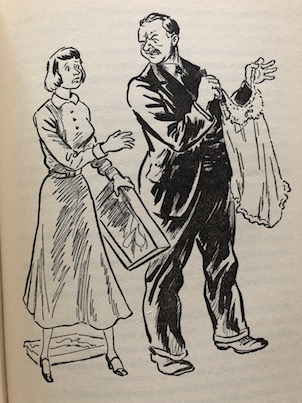
The oldest girls in the family were getting old enough to start dating in the early 1920s, around the time that flapper culture was beginning.  Their parents were fairly conservative in their habits, and the girls argued with them about being allowed to bob their hair and wear the latest fashions, like short dresses.  The parents finally broke down and allowed the girls to have their hair professionally bobbed after Anne gave herself a dreadful bob.  The father drew the line on make-up, however.

Motorcycle Mac

During the early 1920s, girls often referred to their boyfriends as “sheiks” in reference to the popular silent movie The Sheik.  The father of the family often chaperoned his daughters on dates or had one of their brothers do it, although he eased off after getting to know some of the young men better.  The younger siblings enjoyed teasing the older ones about their dates.  My favorite episode when I first read this as a kid was the time when one of Ernestine’s boyfriends climbed a tree outside of her window to spy on her, hoping to see her getting undressed, and the other siblings decided to teach him a lesson by pretending that they were going to set the tree on fire and roast him alive.  (They didn’t do it, they just threatened to.  It’s a dangerous prank, but effective.)

The Party Who Called You…

Mr. Gilbreth knew that he had a bad heart condition even before his last two children were born, and he made preparations that would help his wife to run the household efficiently after his death.  He died in his 50s while he was on his way to a series of conferences in Europe.  He had called his wife from the train station and was on the phone with her when he had his fatal heart attack.

The book ends with describing what his wife and children did after his death.  One of the things that I found most touching was the way that the children described the changes in their mother after her husband died.  They said that in their mother’s youth, she had been accustomed to other people making decisions for her, first her parents, then her husband, who guided their work and who had the idea of the large family in the first place.  In some ways, their mother had been a very nervous, anxious person, afraid of things like going out alone at night, lightning storms, and making speeches (although she did them anyway).  After her husband died, Lillian’s fears seemed to drop away because the thing that she had always feared the most, losing her husband, had happened, and she discovered that she and the children could still manage.  When Lillin’s mother suggested that she move the family out to California to be close to their relatives there, Lillian held a Family Council with the children to decide what they were going to do.  Lillian said that she planned to continue their father’s work, even going to Europe in her husband’s place to present his papers, and that would mean that the children would have to take on greater responsibilities in running the house and caring for the younger children.  The children agreed, and although money was tighter than it was before, they were able to carry on.
Chimney Sweeps

ChimneySweeps

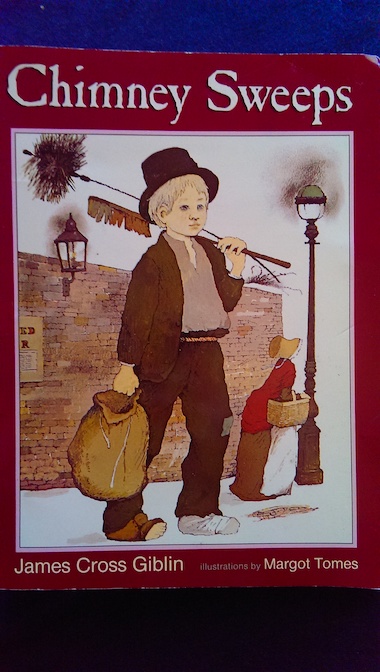
Chimney Sweeps by James Cross Giblin, 1982.

This book explains about the history and traditions of chimney sweeps. I love books that cover odd topics from history like this!

It starts by explaining the origins of chimneys in the Middle Ages. Before they were invented, people would have to have simple holes in the roofs of their houses to let out smoke from heating and cooking fires, or they would have had to rely on windows or doors to perform the function of venting smoke. Chimneys vent smoke more efficiently, but the more they are used, the more soot collects inside them, and they need to be cleaned out from time to time. If they aren’t cleaned, the build-up inside could either block air from getting to the fire in the fireplace, causing the fire to go out sooner, or it could pose a fire risk because the build-up inside the chimney is still flammable. Sometimes, home owners could clean their own chimneys, if they weren’t very tall, but the taller the chimney is, the more professionals are needed to clean it.

ChimneySweepsAdult

Modern chimney cleaners have vacuums that they can use to clean soot out of a chimney, but originally, people were basically relying on brushes. The book explains the evolution of the profession and variations in the profession between England, Germany, and the United States. Germany is significant to the profession because it was one of the first places where chimney sweep became a recognized profession and there were laws even in the 1400s that all chimneys had to be cleaned twice year. (Remember that chimneys that haven’t been cleaned can be a real fire risk, posing a danger not only to you but your neighbors, especially during a time when most buildings are made of wood and other highly flammable materials.) When chimney sweep became a recognized profession during the Middle Ages, members of the profession formed a guild (as was traditional for different professions in general during the Middle Ages) and established rules and standards for the profession. One of the responsibilities of a guild was to decide on the training and qualifications that the profession requires, and in the case of chimney sweeps, the only way to learn was by serving an apprenticeship. The apprentice would live with a master sweep for three years, learning the trade, and at the end of his training, he would have to prove that he could clean a difficult chimney all by himself with thoroughness and reasonable speed.

There are many traditions and superstitions that came to surround the profession of chimney sweep. One of them that you can still sometimes see even in modern times is the image of the chimney sweep in a top hat. The exact reasons for adopting a top hat and tailcoat as part of their uniform are uncertain, but it began back in the 1500s in Europe. The sweeps often got their top hats and tailcoats as secondhand clothing from undertakers (yes, really). Part of the reason for wearing them might have been as an effort to look professional, but the color black was also suitable for a person who was going to end up covered in soot. According to superstition, the top hat would help to protect the chimney sweep from falling when he was on the roof of a house. Chimney sweeps were often thought to be lucky because their jobs were dangerous, yet they survived.

ChimneySweepsChild

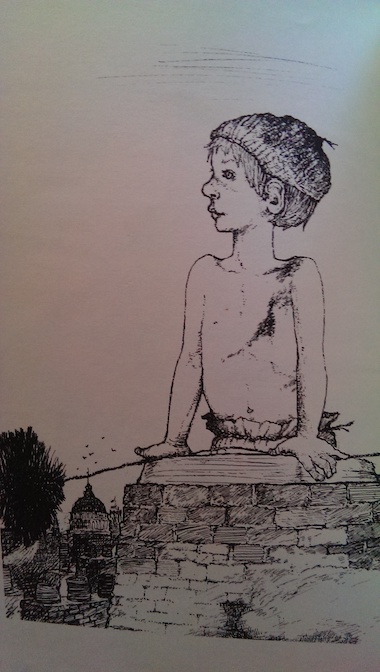
However, chimney sweeps’ lives and work were often hard. In 18th century England, their jobs became more difficult because chimneys were purposely being built in narrow, crooked zigzags. The idea behind the crooked chimneys was that they would keep more heat in, but that made them much harder to clean. Because brushes couldn’t make it around the bends of these chimneys and adults couldn’t get into the narrow flues, sweeps became reliant on young boys to climb up into them and clean them by hand. Although the law required boy apprentices to be no younger than eight years old, many sweeps used boys as young as four or five. Sometimes these boys were official apprentices with the permission of their parents (typically from poor families with many children) or even the sweep’s own children (sometimes, they used their daughters because girls were often smaller than boys). If they couldn’t get children any other way, sometimes sweeps would get children from orphanages or might even resort to kidnapping.  The author of this book includes a short story about what a day in the life of a child chimney sweep was like.

The plight of child chimney sweeps came to light during the early 19th century, when people were starting to become concerned about child labor of all kinds. At first, there was strong opposition to banning child chimney sweeps and using new cleaning devices because the adult chimney sweeps saw it as a threat to their livelihoods and home owners were worried that new methods would be more expensive for them (of the two, I think I’m more offended at the home owners’ attitudes because of the implication that they were more upset about a possible slight increase in expense than the risk to the lives of the children they knowingly endangered).  Many of the child chimney sweeps suffered severe and permanent health problems because they were forced to do this kind of work at an early age, while they were still growing, and because they inhaled and were covered with soot for such long periods.

In the back of the book, there is a poem by William Blake called “The Chimney Sweeper,” which was published in Songs of Innocence in 1789. Knowing the risks to young children, like the little boys in the poem, makes the poem seem pretty disturbing, which may actually be the author’s intention.  Eventually, after long years of struggles in which children were still exploited in chimney sweeping spite of regulations against it, in 1875, Parliament tightened regulations against child labor even further, forcing chimney sweeps to apply for licenses in order to practice their trade, listing each of their apprentices and their ages.

Chimney sweeping in American history was a little different from the way things were done in Europe. The American colonists sometimes tried some strange tactics for cleaning their chimneys. One of the oddest methods was to tie a rope to a goose’s feet and lower it down the chimney. The goose would become frightened and flap its wings, thus knocking the soot loose. When the job was done, the home owner would pull the goose out of the chimney and wash it off. Another tactic was to actually burn the excess soot out of the chimney, although there was a risk of simply setting the house on fire. Later, American cities had official chimney sweeps who were licensed and regulated. On Southern plantations, slaves were used as chimney sweeps, and some of them continued to work as chimney sweeps after they gained their freedom.

Later, when homes began to be heated by other sources than fireplaces, chimney sweeps were in less demand, although there was increased demand in the 1970s, during the energy crisis, because people started using their fireplaces more instead of relying on other heating methods that involved scarce or expensive fuel. Chimney sweeps can also perform other duties beyond simply cleaning chimneys, depending on where they live. For example, in Germany, sweeps perform inspections of factories and homes to make sure that they are using fuels efficiently, looking for sources of needless pollution, which can lead to fines for the owners of the buildings if the problems are not corrected. Some people might also become chimney sweeps as a seasonal part-time job, while they also have another career.

The book is available to borrow and read for free online through Internet Archive.

Games From Long Ago

Historic Communities

GamesLongAgo

Games From Long Ago by Bobbie Kalman, 1995.

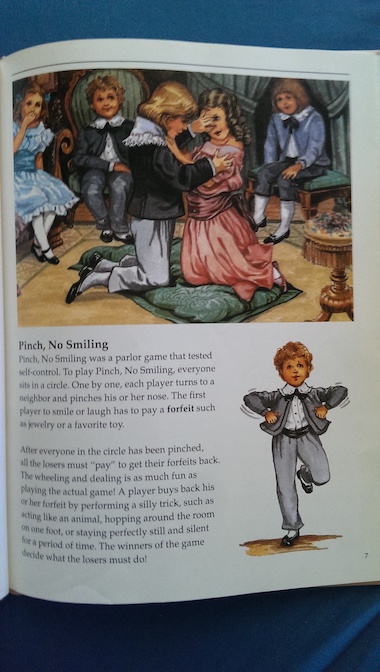
GamesLongAgoForfeitsThis book is about games people would play in 19th century America.  There is a variety of different types of games, although the main focus is on parlor games.  Many of them have been passed on for generations by word of mouth and are still played today, such  as Charades and Blind Man’s Buff, although the book discusses games that are no longer common.
One important concept in 19th century games was the “forfeit”, where losing players would have to perform a kind of silly stunt. The other players might hold onto an object belonging to the losing player, holding it as hostage until they performed the stunt.  Forfeits were a common part of parlor games.

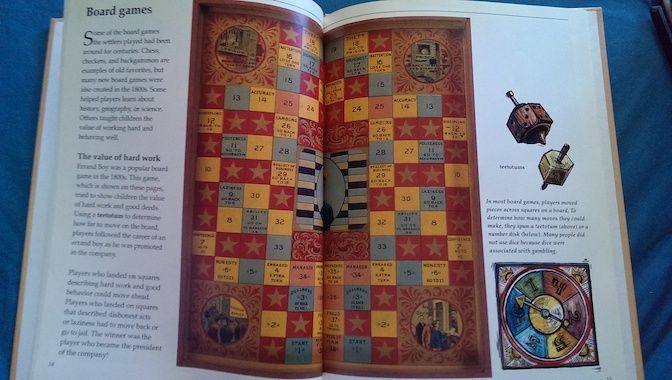
The book also talks about popular tabletop games such as dominoes, cards, tiddlywinks, and pick-up sticks.  Because dice were often associated with gambling, movements in board games were often determined by spinners or special numbered spinning tops called “teetotums,” which look something like dreidels but with more sides.  Board games for children were often educational, teaching them about subjects like history or geography or moral lessons, rewarding “good” decisions and penalizing “bad” ones (although, since movements in these games were determined by spinners, the players were at the mercy of the random chance as to which of these choices their playing pieces landed on, not making actual good and bad decisions by themselves).

GamesLongAgoTeetotum

There are also examples of games played at work parties, parties or “bees” organized around farm tasks such as barn-building or harvests.  These parties might include a hay maze (like a corn maze, but with hay sheaves), a game of Gossip (an early version of Telephone, played exactly the same way), or Bobbing for Apples.

GamesLongAgoHoliday

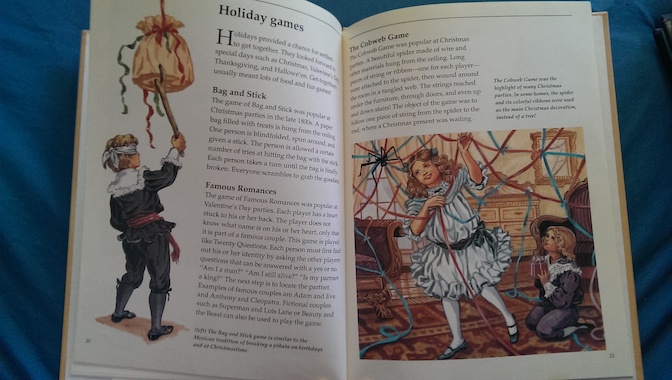
There is a short section about games for specific holidays, although there are only three given.  Two of them are for Christmas (one of those is a basic version of Pinata called Bag and Stick), and one for Valentine’s Day.  There are also sections about outdoor games and sports.

The book is currently available online through Internet Archive.

GamesLongAgoOutdoor

Christmas Around the World

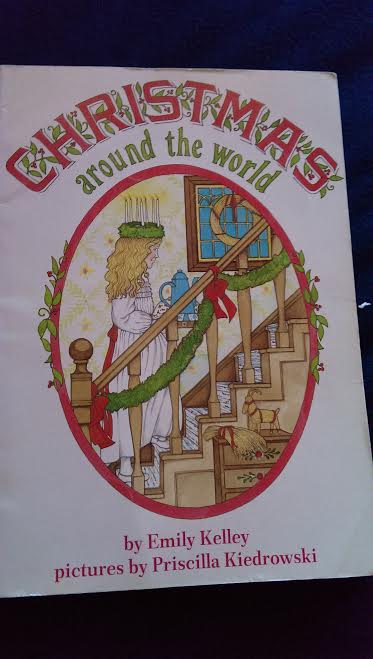
christmasworldChristmas Around the World by Emily Kelley, 1986.
This is a non-fiction book that describes Christmas customs from various countries around the world.  There is some history and folklore associated with different Christmas traditions in every country.  The main countries described are Mexico, Iran, China, Sweden, Iraq, Spain, and Norway, although there is a section in the back that briefly mentions a few other countries.

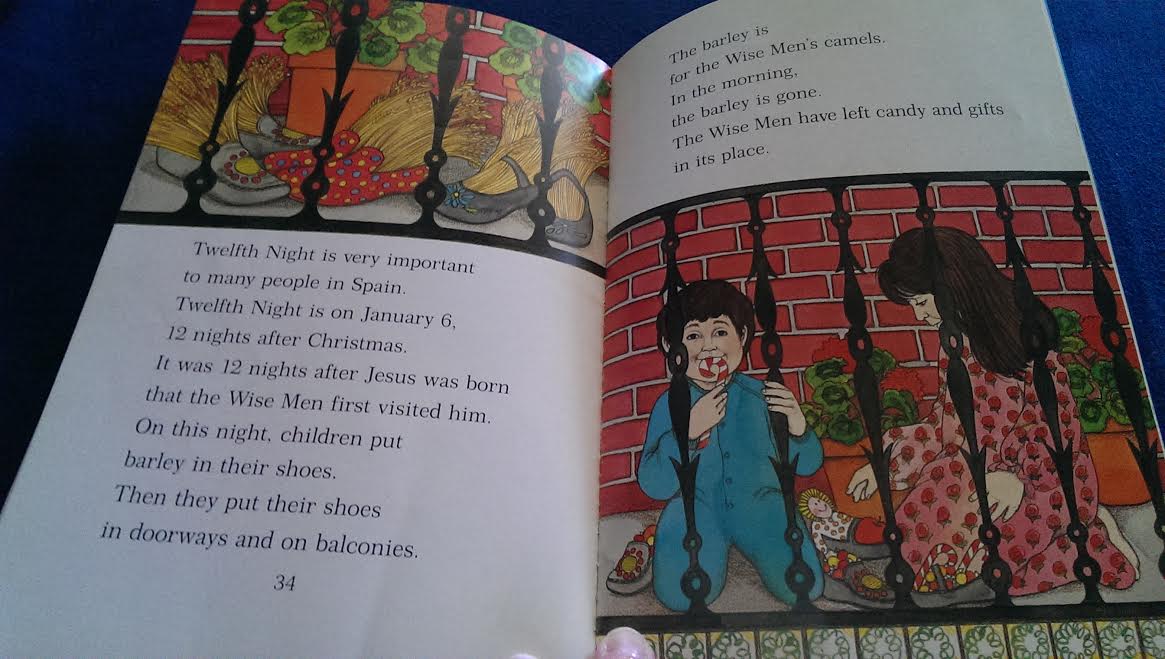
In some countries, children leave out their shoes instead of their stockings in the hopes of receiving small presents in them.  Sometimes, the gifts are from Santa, and sometimes, they’re from someone else, like the Wise Men.  In other countries, people do not give gifts on Christmas, except maybe new clothes for the children.

Some of the traditions described are older ones, based on folklore, like the one about hiding brooms and tools from witches and bad spirits in Norway.  In countries in the Southern Hemisphere, Christmas is associated with summer instead of winter, changing the way people celebrate the holiday.  Each country has their own special foods associated with the holiday, too.

christmasnorway

The book also describes traditions that are associated with other special days related to Christmas, such as St. Lucia Day in Sweden (December 13) and Twelfth Night, when the Wise Men came to visit Jesus (January 6).  These special days are kind of an extension of the Christmas season in different countries.

christmasspain

christmasspain2

The pictures in the book are beautiful.  Some of them are in color and some are in black and white.

christmasmexico

In the back of the book, there are jokes, a craft project, and a recipe for Christmas cookies.

The book is available to borrow and read for free online through Internet Archive.